Queensgate – solutions for space
John Clarke Applications Engineer Queengate.
Alison Raby Business Manager Queensgate
Company Profile
•Spin-off of the Imperial College of London
•Delivering Nanopositioning Systems since 1978
•Close relationships with Educational Institutions and National Labs
•Manufactured in United Kingdom
•Part of Elektron Technology (EKT, London Stock Exchange)
- 10 brands
- 1,200 people globally
- Distribution network in 125 countries
- Developer & manufacturer of technologies within the Fast Moving
Engineered Products (FMEP) sector
- Global manufacturing and sales. Products used in all 7 continents
and in space
- Cambridge UK based R&D and HQ
- Growing through international expansion and new product
development
Working with Queensgate
Proven engagement model for advanced and custom requirements
• Rapid opportunity analysis qualification
• 1-2 day intensive feasibility studies - focus on full system requirements
• Accelerated design and prototyping using state of art modelling and
FEA optimisation
• Innovative automated test and characterisation
• Scalable OEM manufacture and support
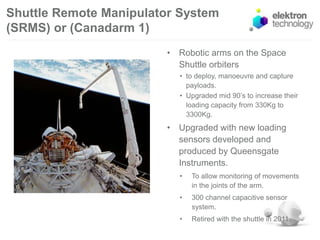
Shuttle Remote Manipulator System
(SRMS) or (Canadarm 1)
• Robotic arms on the Space
Shuttle orbiters
• to deploy, manoeuvre and capture
payloads.
• Upgraded mid 90’s to increase their
loading capacity from 330Kg to
3300Kg.
• Upgraded with new loading
sensors developed and
produced by Queensgate
Instruments.
• To allow monitoring of movements
in the joints of the arm.
• 300 channel capacitive sensor
system.
• Retired with the shuttle in 2011.
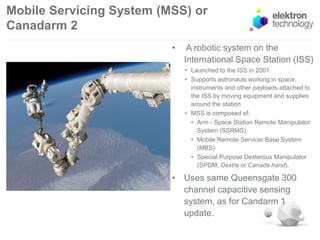
Mobile Servicing System (MSS) or
Canadarm 2
• A robotic system on the
International Space Station (ISS)
• Launched to the ISS in 2001
• Supports astronauts working in space,
instruments and other payloads attached to
the ISS by moving equipment and supplies
around the station
• MSS is composed of:
• Arm - Space Station Remote Manipulator
System (SSRMS)
• Mobile Remote Servicer Base System
(MBS)
• Special Purpose Dexterous Manipulator
(SPDM, Dextre or Canada hand).
• Uses same Queensgate 300
channel capacitive sensing
system, as for Candarm 1
update.
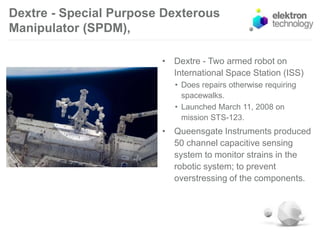
Dextre - Special Purpose Dexterous
Manipulator (SPDM),
• Dextre - Two armed robot on
International Space Station (ISS)
• Does repairs otherwise requiring
spacewalks.
• Launched March 11, 2008 on
mission STS-123.
• Queensgate Instruments produced
50 channel capacitive sensing
system to monitor strains in the
robotic system; to prevent
overstressing of the components.
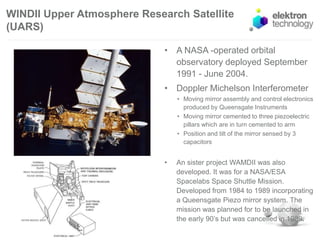
WINDII Upper Atmosphere Research Satellite
(UARS)
• A NASA -operated orbital
observatory deployed September
1991 - June 2004.
• Doppler Michelson Interferometer
• Moving mirror assembly and control electronics
produced by Queensgate Instruments
• Moving mirror cemented to three piezoelectric
pillars which are in turn cemented to arm
• Position and tilt of the mirror sensed by 3
capacitors
• An sister project WAMDII was also
developed. It was for a NASA/ESA
Spacelabs Space Shuttle Mission.
Developed from 1984 to 1989 incorporating
a Queensgate Piezo mirror system. The
mission was planned for to be launched in
the early 90’s but was cancelled in 1989.
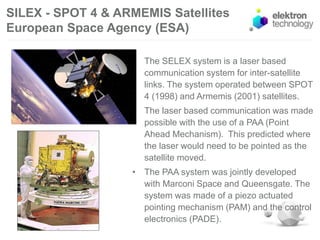
SILEX - SPOT 4 & ARMEMIS Satellites
European Space Agency (ESA)
• The SELEX system is a laser based
communication system for inter-satellite
links. The system operated between SPOT
4 (1998) and Armemis (2001) satellites.
• The laser based communication was made
possible with the use of a PAA (Point
Ahead Mechanism). This predicted where
the laser would need to be pointed as the
satellite moved.
• The PAA system was jointly developed
with Marconi Space and Queensgate. The
system was made of a piezo actuated
pointing mechanism (PAM) and the control
electronics (PADE).
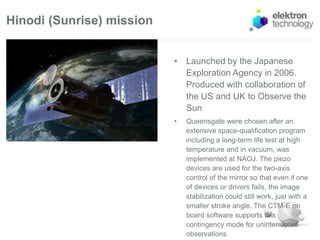
Hinodi (Sunrise) mission
• Launched by the Japanese
Exploration Agency in 2006.
Produced with collaboration of
the US and UK to Observe the
Sun
• Queensgate were chosen after an
extensive space-qualification program
including a long-term life test at high
temperature and in vacuum, was
implemented at NAOJ. The piezo
devices are used for the two-axis
control of the mirror so that even if one
of devices or drivers fails, the image
stabilization could still work, just with a
smaller stroke angle. The CTM-E on
board software supports this
contingency mode for uninterrupted
observations.
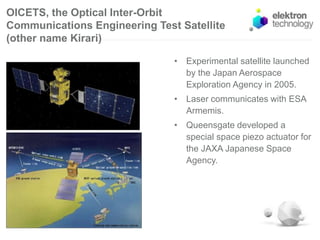
OICETS, the Optical Inter-Orbit
Communications Engineering Test Satellite
(other name Kirari)
• Experimental satellite launched
by the Japan Aerospace
Exploration Agency in 2005.
• Laser communicates with ESA
Armemis.
• Queensgate developed a
special space piezo actuator for
the JAXA Japanese Space
Agency.
Technologies
Beam Steering Mechanism:
• Tip mechanisms – A single axis of
rotation with highest operational
bandwidth and nanoradian levels
of resolution.
• Tip Tilt Mechanisms – Two axis of
rotation with nanoradian levels of
resolution.
• Rotation – Single axis system - the
axis of ratio is perpendicular to the
stage platform. For rotation prisms
or side mounted mirrors where the
axis of rotation can be aligned to
pass through the reflective face.
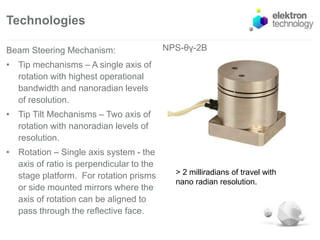
NPS-θγ-2B
> 2 milliradians of travel with
nano radian resolution.
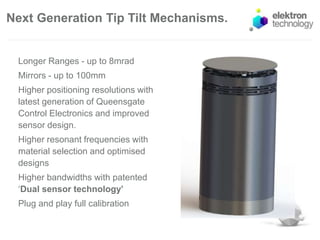
Next Generation Tip Tilt Mechanisms.
Longer Ranges - up to 8mrad
Mirrors - up to 100mm
Higher positioning resolutions with
latest generation of Queensgate
Control Electronics and improved
sensor design.
Higher resonant frequencies with
material selection and optimised
designs
Higher bandwidths with patented
‘Dual sensor technology’
Plug and play full calibration
Enabling Technology
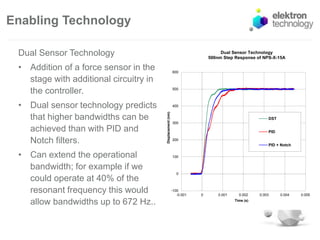
Dual Sensor Technology
• Addition of a force sensor in the
stage with additional circuitry in
the controller.
• Dual sensor technology predicts
that higher bandwidths can be
achieved than with PID and
Notch filters.
• Can extend the operational
bandwidth; for example if we
could operate at 40% of the
resonant frequency this would
allow bandwidths up to 672 Hz..
-100
0
100
200
300
400
500
600
-0.001 0 0.001 0.002 0.003 0.004 0.005
Displacement(nm)
Time (s)
Dual Sensor Technology
500nm Step Response of NPS-X-15A
DST
PID
PID + Notch
Technologies - Sensors
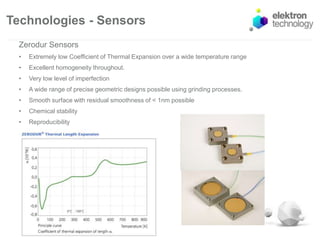
Zerodur Sensors
• Extremely low Coefficient of Thermal Expansion over a wide temperature range
• Excellent homogeneity throughout.
• Very low level of imperfection
• A wide range of precise geometric designs possible using grinding processes.
• Smooth surface with residual smoothness of < 1nm possible
• Chemical stability
• Reproducibility
Technologies - Sensors
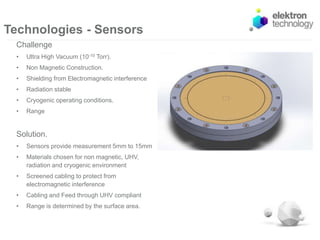
Challenge
• Ultra High Vacuum (10-10 Torr).
• Non Magnetic Construction.
• Shielding from Electromagnetic interference
• Radiation stable
• Cryogenic operating conditions.
• Range
Solution.
• Sensors provide measurement 5mm to 15mm
• Materials chosen for non magnetic, UHV,
radiation and cryogenic environment
• Screened cabling to protect from
electromagnetic interference
• Cabling and Feed through UHV compliant
• Range is determined by the surface area.
Technologies - Actuators
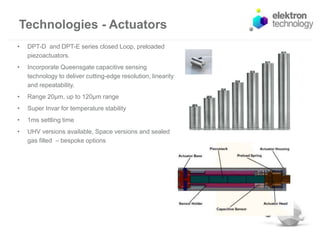
• DPT-D and DPT-E series closed Loop, preloaded
piezoactuators.
• Incorporate Queensgate capacitive sensing
technology to deliver cutting-edge resolution, linearity
and repeatability.
• Range 20µm, up to 120µm range
• Super Invar for temperature stability
• 1ms settling time
• UHV versions available, Space versions and sealed
gas filled – bespoke options
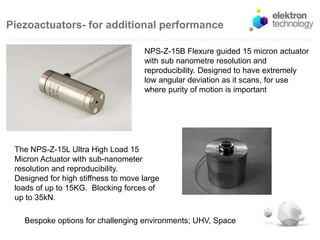
NPS-Z-15B Flexure guided 15 micron actuator
with sub nanometre resolution and
reproducibility. Designed to have extremely
low angular deviation as it scans, for use
where purity of motion is important
The NPS-Z-15L Ultra High Load 15
Micron Actuator with sub-nanometer
resolution and reproducibility.
Designed for high stiffness to move large
loads of up to 15KG. Blocking forces of
up to 35kN.
Piezoactuators- for additional performance
Bespoke options for challenging environments; UHV, Space
Custom Solutions
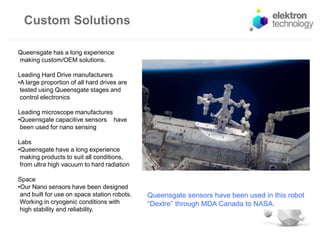
Queensgate sensors have been used in this robot
“Dextre” through MDA Canada to NASA.
Queensgate has a long experience
making custom/OEM solutions.
Leading Hard Drive manufacturers
•A large proportion of all hard drives are
tested using Queensgate stages and
control electronics
Leading microscope manufactures
•Queensgate capacitive sensors have
been used for nano sensing
Labs
•Queensgate have a long experience
making products to suit all conditions,
from ultra high vacuum to hard radiation
Space
•Our Nano sensors have been designed
and built for use on space station robots.
Working in cryogenic conditions with
high stability and reliability.

Space Solutions

  • 1.
    Queensgate – solutionsfor space John Clarke Applications Engineer Queengate. Alison Raby Business Manager Queensgate
  • 2.
    Company Profile •Spin-off ofthe Imperial College of London •Delivering Nanopositioning Systems since 1978 •Close relationships with Educational Institutions and National Labs •Manufactured in United Kingdom •Part of Elektron Technology (EKT, London Stock Exchange) - 10 brands - 1,200 people globally - Distribution network in 125 countries - Developer & manufacturer of technologies within the Fast Moving Engineered Products (FMEP) sector - Global manufacturing and sales. Products used in all 7 continents and in space - Cambridge UK based R&D and HQ - Growing through international expansion and new product development
  • 3.
    Working with Queensgate Provenengagement model for advanced and custom requirements • Rapid opportunity analysis qualification • 1-2 day intensive feasibility studies - focus on full system requirements • Accelerated design and prototyping using state of art modelling and FEA optimisation • Innovative automated test and characterisation • Scalable OEM manufacture and support
  • 4.
    Shuttle Remote ManipulatorSystem (SRMS) or (Canadarm 1) • Robotic arms on the Space Shuttle orbiters • to deploy, manoeuvre and capture payloads. • Upgraded mid 90’s to increase their loading capacity from 330Kg to 3300Kg. • Upgraded with new loading sensors developed and produced by Queensgate Instruments. • To allow monitoring of movements in the joints of the arm. • 300 channel capacitive sensor system. • Retired with the shuttle in 2011.
  • 5.
    Mobile Servicing System(MSS) or Canadarm 2 • A robotic system on the International Space Station (ISS) • Launched to the ISS in 2001 • Supports astronauts working in space, instruments and other payloads attached to the ISS by moving equipment and supplies around the station • MSS is composed of: • Arm - Space Station Remote Manipulator System (SSRMS) • Mobile Remote Servicer Base System (MBS) • Special Purpose Dexterous Manipulator (SPDM, Dextre or Canada hand). • Uses same Queensgate 300 channel capacitive sensing system, as for Candarm 1 update.
  • 6.
    Dextre - SpecialPurpose Dexterous Manipulator (SPDM), • Dextre - Two armed robot on International Space Station (ISS) • Does repairs otherwise requiring spacewalks. • Launched March 11, 2008 on mission STS-123. • Queensgate Instruments produced 50 channel capacitive sensing system to monitor strains in the robotic system; to prevent overstressing of the components.
  • 7.
    WINDII Upper AtmosphereResearch Satellite (UARS) • A NASA -operated orbital observatory deployed September 1991 - June 2004. • Doppler Michelson Interferometer • Moving mirror assembly and control electronics produced by Queensgate Instruments • Moving mirror cemented to three piezoelectric pillars which are in turn cemented to arm • Position and tilt of the mirror sensed by 3 capacitors • An sister project WAMDII was also developed. It was for a NASA/ESA Spacelabs Space Shuttle Mission. Developed from 1984 to 1989 incorporating a Queensgate Piezo mirror system. The mission was planned for to be launched in the early 90’s but was cancelled in 1989.
  • 8.
    SILEX - SPOT4 & ARMEMIS Satellites European Space Agency (ESA) • The SELEX system is a laser based communication system for inter-satellite links. The system operated between SPOT 4 (1998) and Armemis (2001) satellites. • The laser based communication was made possible with the use of a PAA (Point Ahead Mechanism). This predicted where the laser would need to be pointed as the satellite moved. • The PAA system was jointly developed with Marconi Space and Queensgate. The system was made of a piezo actuated pointing mechanism (PAM) and the control electronics (PADE).
  • 9.
    Hinodi (Sunrise) mission •Launched by the Japanese Exploration Agency in 2006. Produced with collaboration of the US and UK to Observe the Sun • Queensgate were chosen after an extensive space-qualification program including a long-term life test at high temperature and in vacuum, was implemented at NAOJ. The piezo devices are used for the two-axis control of the mirror so that even if one of devices or drivers fails, the image stabilization could still work, just with a smaller stroke angle. The CTM-E on board software supports this contingency mode for uninterrupted observations.
  • 10.
    OICETS, the OpticalInter-Orbit Communications Engineering Test Satellite (other name Kirari) • Experimental satellite launched by the Japan Aerospace Exploration Agency in 2005. • Laser communicates with ESA Armemis. • Queensgate developed a special space piezo actuator for the JAXA Japanese Space Agency.
  • 11.
    Technologies Beam Steering Mechanism: •Tip mechanisms – A single axis of rotation with highest operational bandwidth and nanoradian levels of resolution. • Tip Tilt Mechanisms – Two axis of rotation with nanoradian levels of resolution. • Rotation – Single axis system - the axis of ratio is perpendicular to the stage platform. For rotation prisms or side mounted mirrors where the axis of rotation can be aligned to pass through the reflective face. NPS-θγ-2B > 2 milliradians of travel with nano radian resolution.
  • 12.
    Next Generation TipTilt Mechanisms. Longer Ranges - up to 8mrad Mirrors - up to 100mm Higher positioning resolutions with latest generation of Queensgate Control Electronics and improved sensor design. Higher resonant frequencies with material selection and optimised designs Higher bandwidths with patented ‘Dual sensor technology’ Plug and play full calibration
  • 13.
    Enabling Technology Dual SensorTechnology • Addition of a force sensor in the stage with additional circuitry in the controller. • Dual sensor technology predicts that higher bandwidths can be achieved than with PID and Notch filters. • Can extend the operational bandwidth; for example if we could operate at 40% of the resonant frequency this would allow bandwidths up to 672 Hz.. -100 0 100 200 300 400 500 600 -0.001 0 0.001 0.002 0.003 0.004 0.005 Displacement(nm) Time (s) Dual Sensor Technology 500nm Step Response of NPS-X-15A DST PID PID + Notch
  • 14.
    Technologies - Sensors ZerodurSensors • Extremely low Coefficient of Thermal Expansion over a wide temperature range • Excellent homogeneity throughout. • Very low level of imperfection • A wide range of precise geometric designs possible using grinding processes. • Smooth surface with residual smoothness of < 1nm possible • Chemical stability • Reproducibility
  • 15.
    Technologies - Sensors Challenge •Ultra High Vacuum (10-10 Torr). • Non Magnetic Construction. • Shielding from Electromagnetic interference • Radiation stable • Cryogenic operating conditions. • Range Solution. • Sensors provide measurement 5mm to 15mm • Materials chosen for non magnetic, UHV, radiation and cryogenic environment • Screened cabling to protect from electromagnetic interference • Cabling and Feed through UHV compliant • Range is determined by the surface area.
  • 16.
    Technologies - Actuators •DPT-D and DPT-E series closed Loop, preloaded piezoactuators. • Incorporate Queensgate capacitive sensing technology to deliver cutting-edge resolution, linearity and repeatability. • Range 20µm, up to 120µm range • Super Invar for temperature stability • 1ms settling time • UHV versions available, Space versions and sealed gas filled – bespoke options
  • 17.
    NPS-Z-15B Flexure guided15 micron actuator with sub nanometre resolution and reproducibility. Designed to have extremely low angular deviation as it scans, for use where purity of motion is important The NPS-Z-15L Ultra High Load 15 Micron Actuator with sub-nanometer resolution and reproducibility. Designed for high stiffness to move large loads of up to 15KG. Blocking forces of up to 35kN. Piezoactuators- for additional performance Bespoke options for challenging environments; UHV, Space
  • 18.
    Custom Solutions Queensgate sensorshave been used in this robot “Dextre” through MDA Canada to NASA. Queensgate has a long experience making custom/OEM solutions. Leading Hard Drive manufacturers •A large proportion of all hard drives are tested using Queensgate stages and control electronics Leading microscope manufactures •Queensgate capacitive sensors have been used for nano sensing Labs •Queensgate have a long experience making products to suit all conditions, from ultra high vacuum to hard radiation Space •Our Nano sensors have been designed and built for use on space station robots. Working in cryogenic conditions with high stability and reliability.