SPACEMAP in BDD
Organizing a motivational environment
About me
• Fin Kingma
• Agile Tester / Scrum Master
• Testing not just products  People
• Fascinated by: What drives us
Tuesday, January 16, 2018 SPACEMAP 2
Content
• Let’s play a game!
• Understanding our motivation with the SPACEMAP (w.
exercises)
• The theory behind motivation
• The SPACEMAP
• Motivation in BDD
• How to leverage motivation in BDD
• Brainstorming how to improve your own environment
Tuesday, January 16, 2018 SPACEMAP 3
Let’s play a game
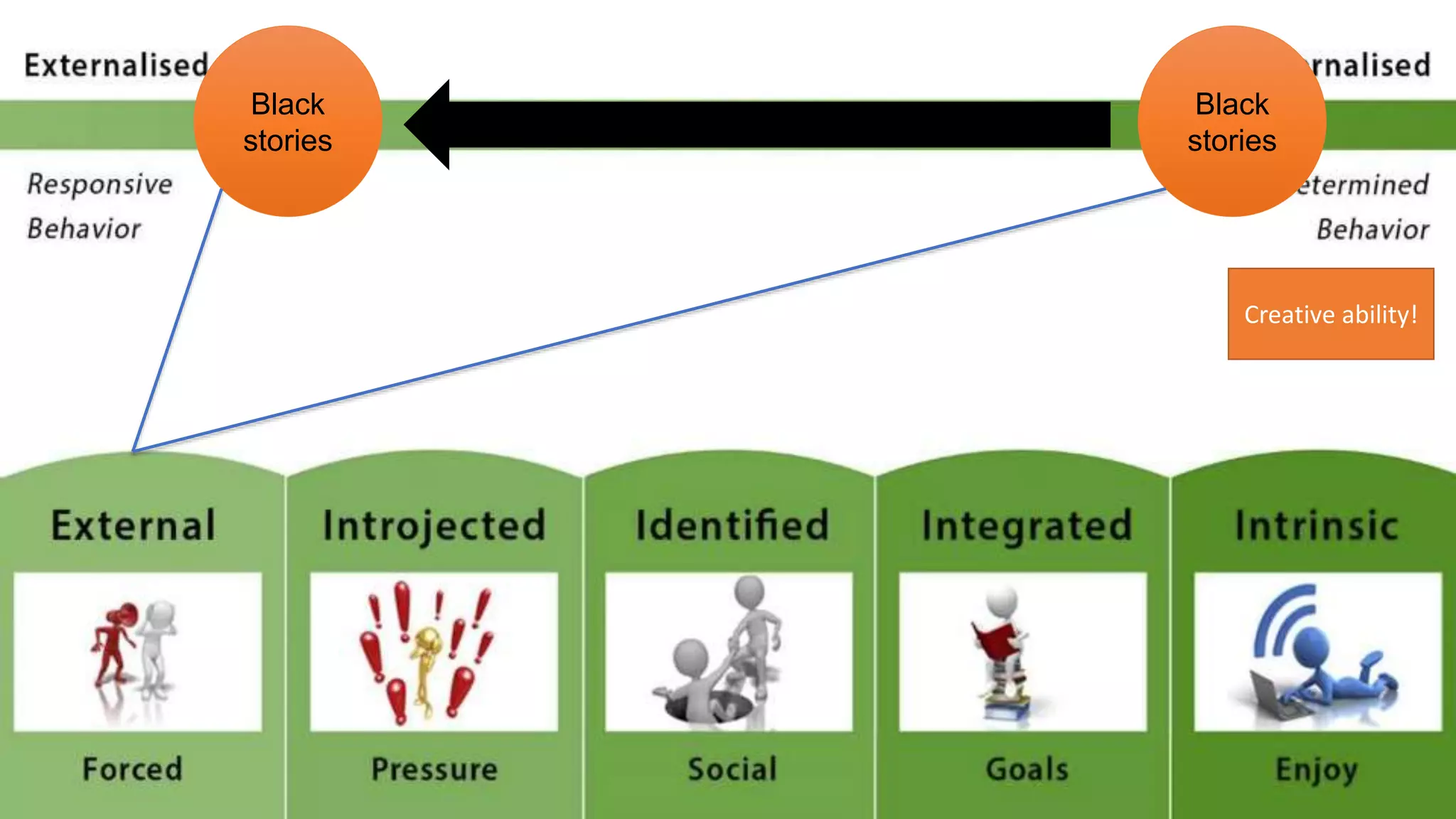
Called blackstories
New rules
• Game master decides if questions are relevant or not
• Gain 1 point for each relevant question
• Lose 1 point for each non-relevant question
• You’re out when reaching 0 points
Tuesday, January 16, 2018 SPACEMAP 5
Observations
• What did you notice?
Tuesday, January 16, 2018 SPACEMAP 6
The theory behind it
How does it work?
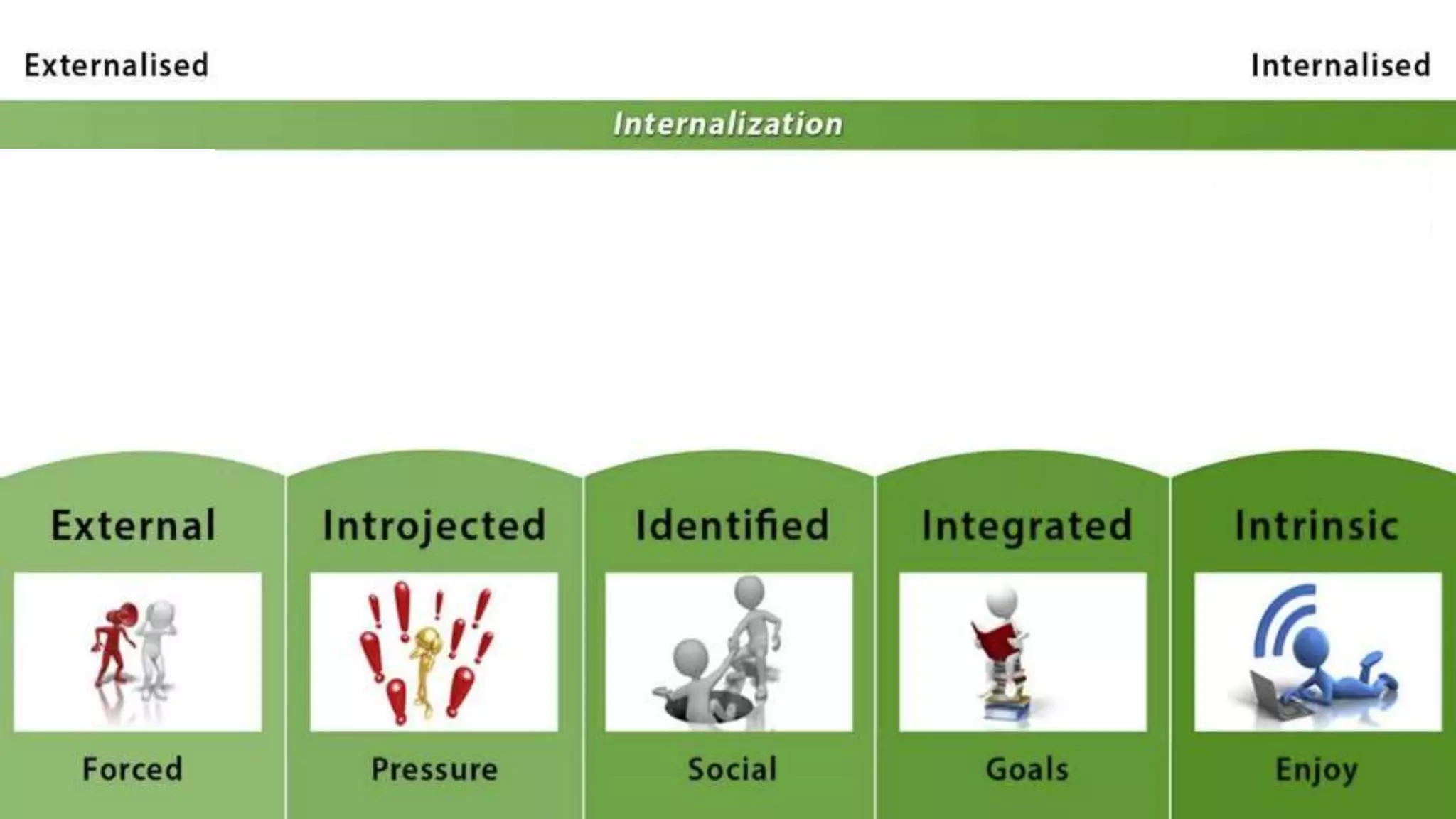
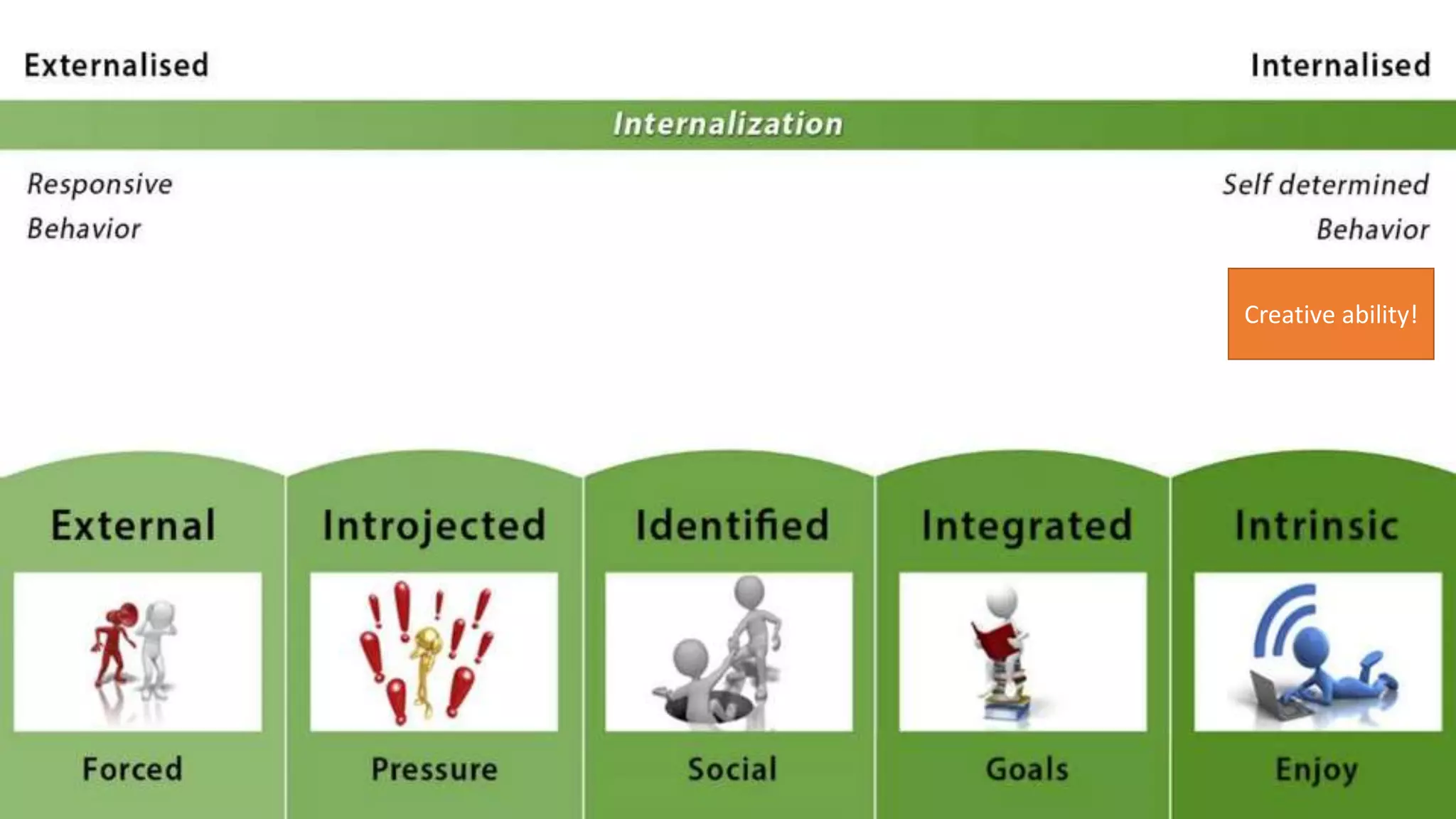
Internalisation of Motivation
Exercise: Which level of motivation is
this?
Tuesday, January 16, 2018 SPACEMAP 9
Tuesday, January 16, 2018SPACEMAP 10
Running
Tuesday, January 16, 2018SPACEMAP 11
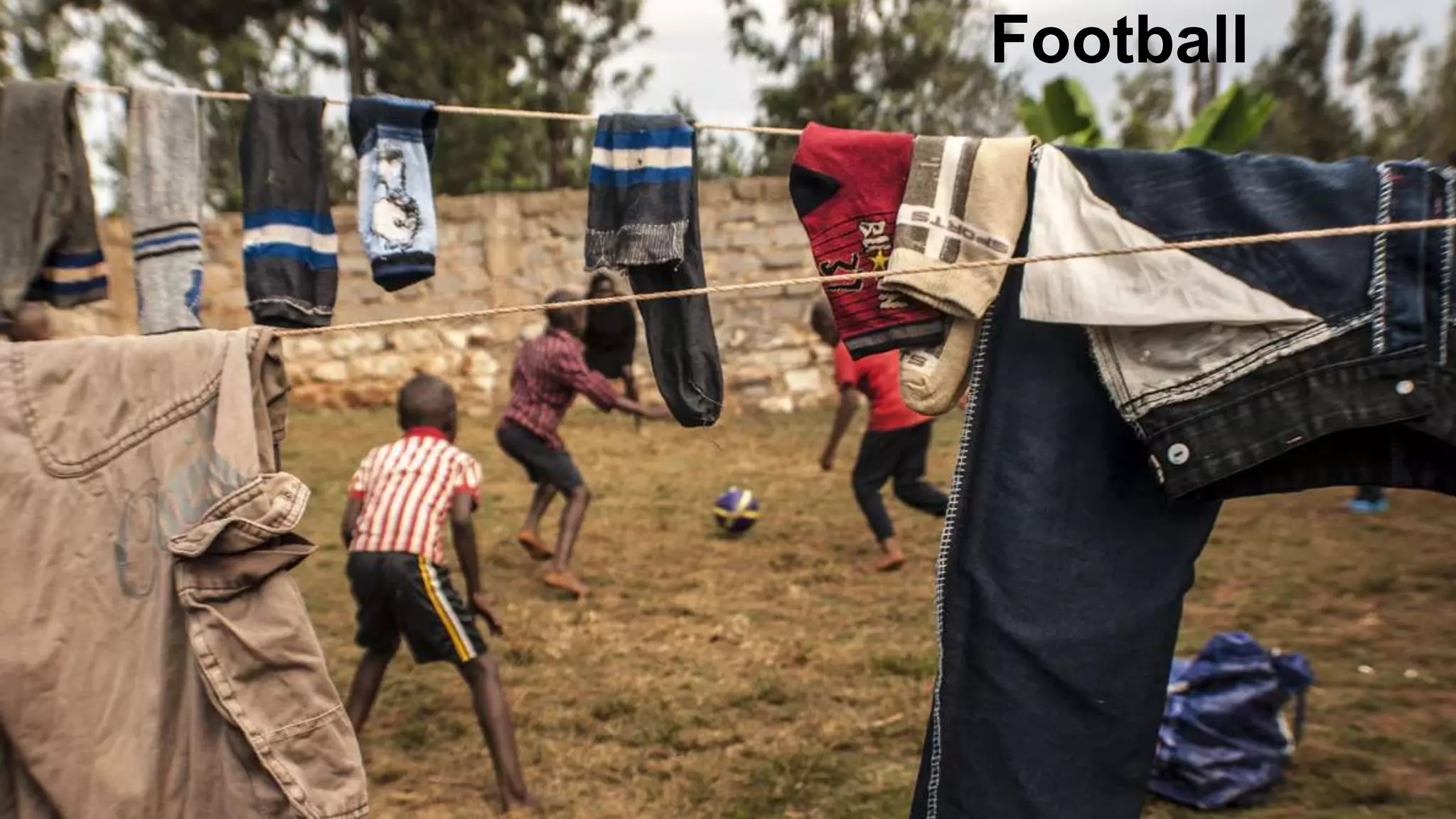
Football
Cleaning
Work
Exercise: Which level of motivation is
this?
• We can never know for sure, it’s always personal
• Best way is to ask
Tuesday, January 16, 2018 SPACEMAP 14
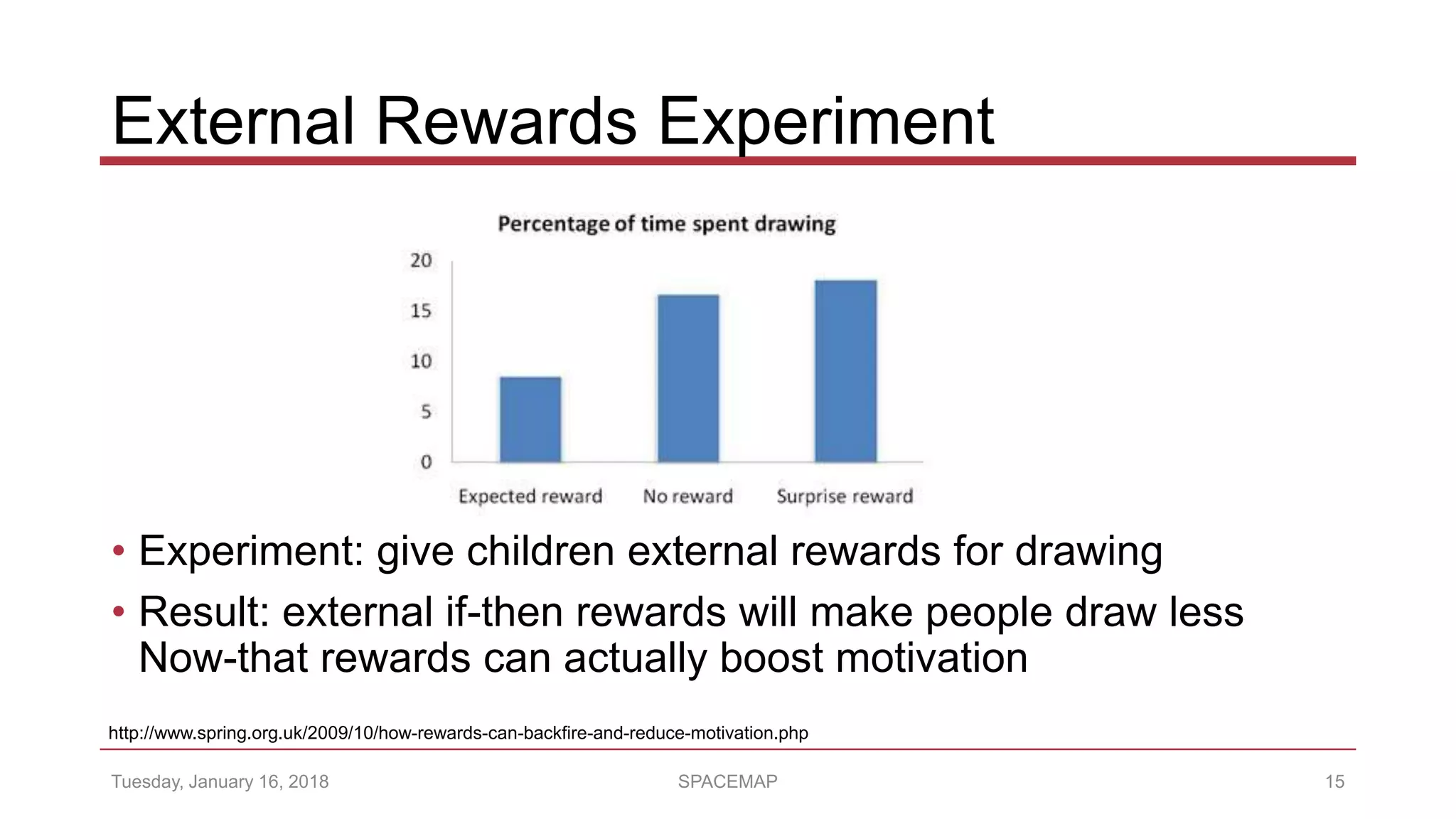
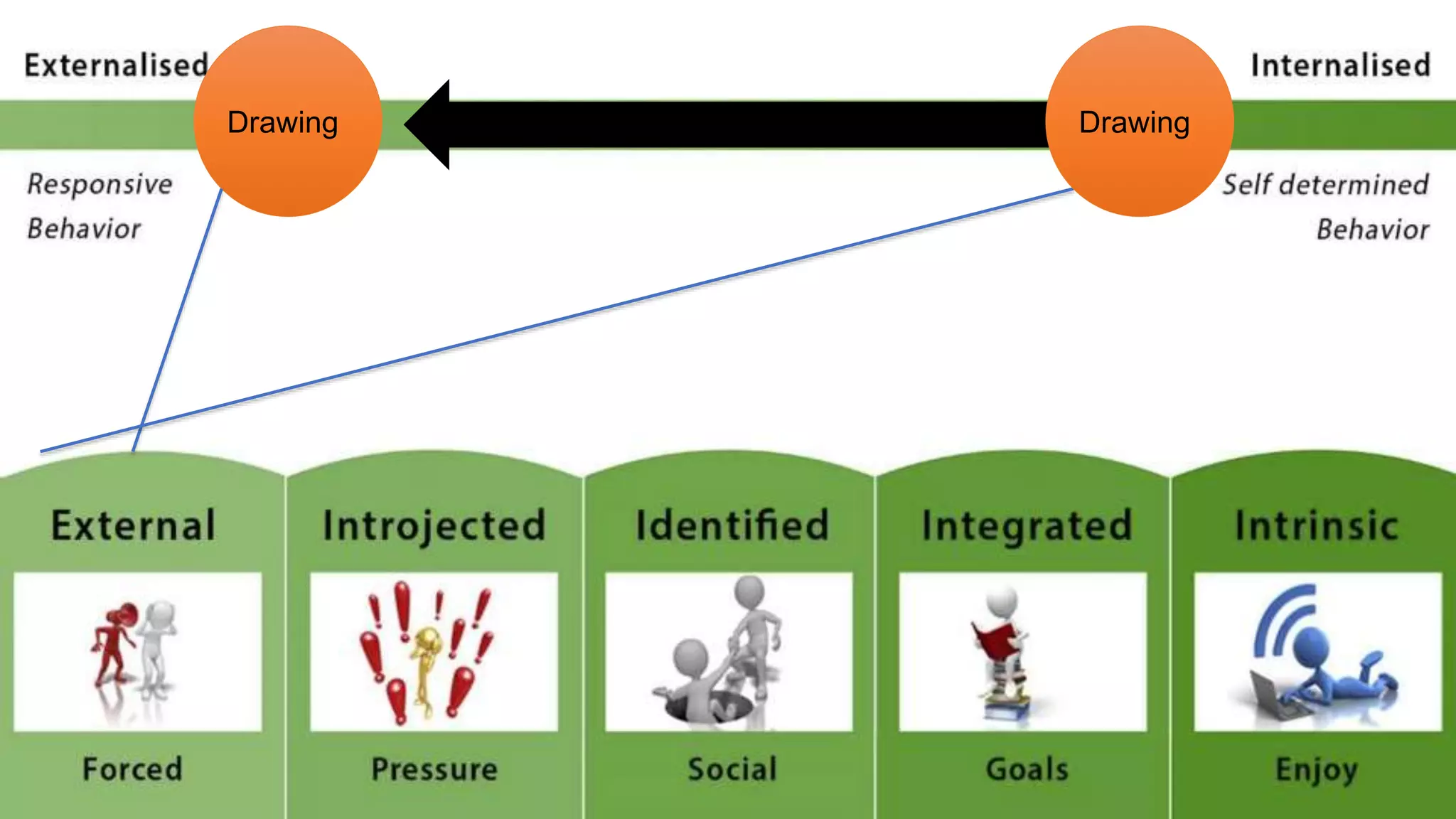
External Rewards Experiment
• Experiment: give children external rewards for drawing
• Result: external if-then rewards will make people draw less
Now-that rewards can actually boost motivation
http://www.spring.org.uk/2009/10/how-rewards-can-backfire-and-reduce-motivation.php
Tuesday, January 16, 2018 SPACEMAP 15
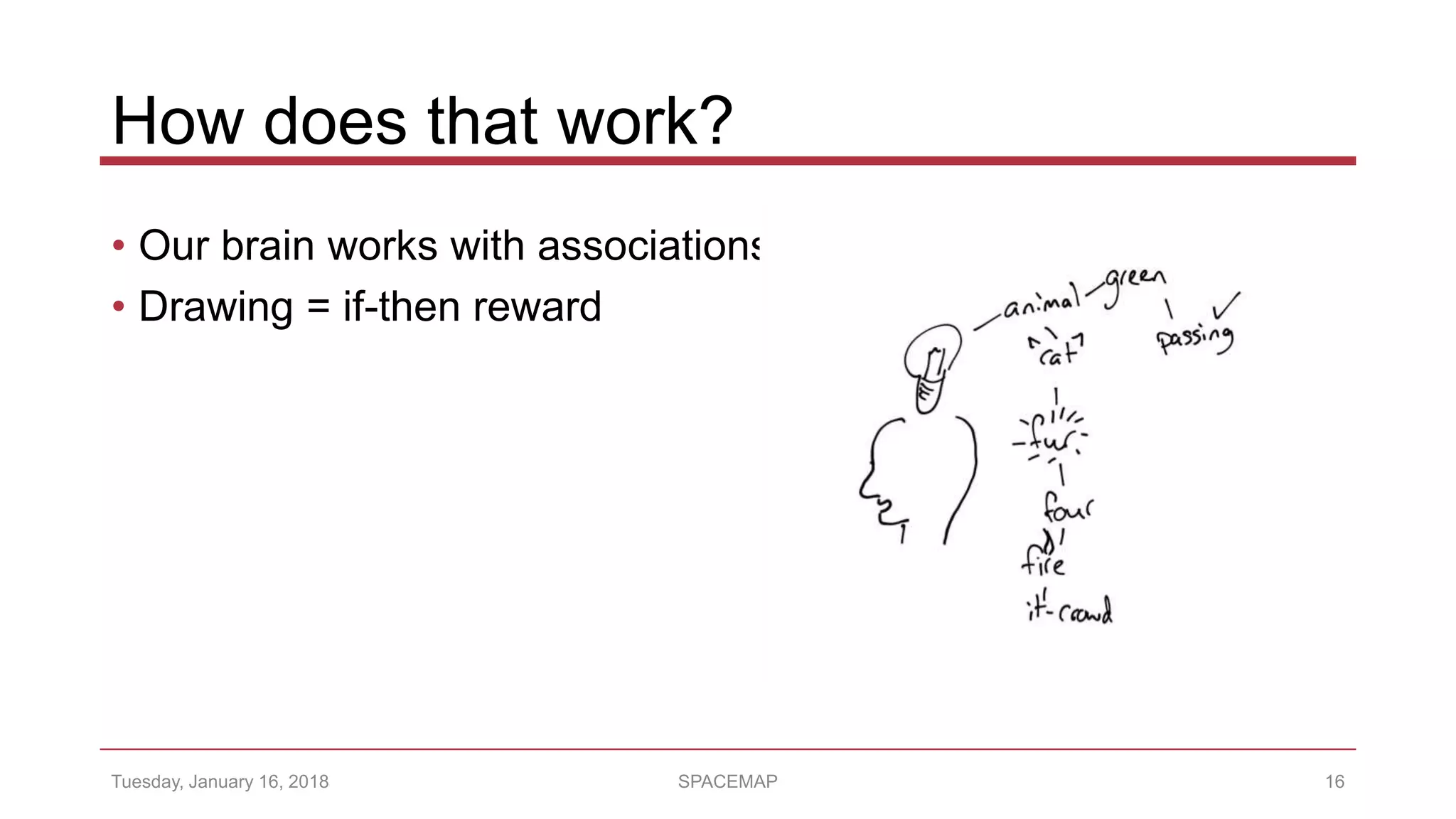
How does that work?
• Our brain works with associations
• Drawing = if-then reward
Tuesday, January 16, 2018 SPACEMAP 16
Drawing Drawing
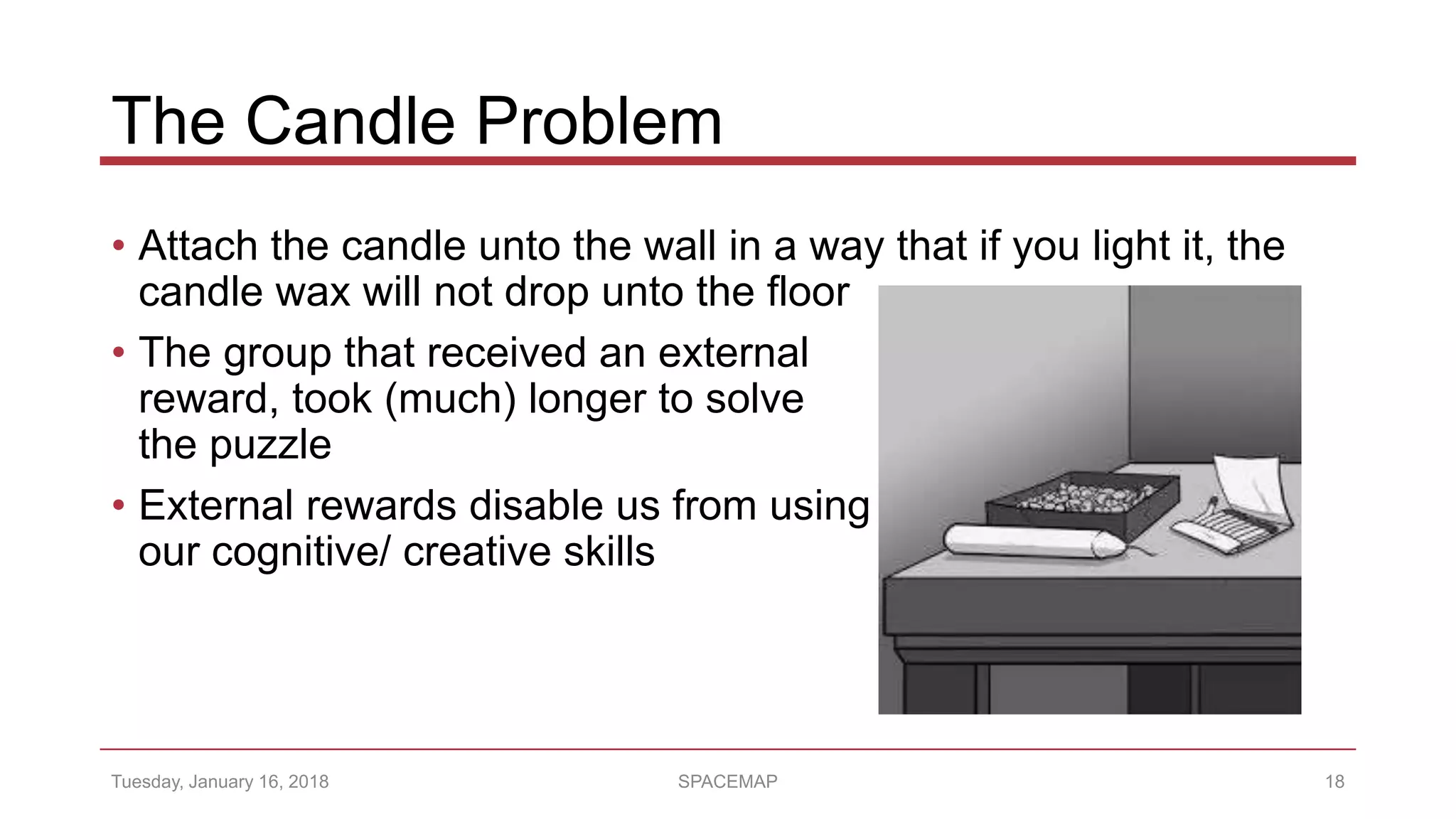
The Candle Problem
• Attach the candle unto the wall in a way that if you light it, the
candle wax will not drop unto the floor
• The group that received an external
reward, took (much) longer to solve
the puzzle
• External rewards disable us from using
our cognitive/ creative skills
Tuesday, January 16, 2018 SPACEMAP 18
Internalisation of Motivation
Creative ability!
Black
stories
Black
stories
Creative ability!
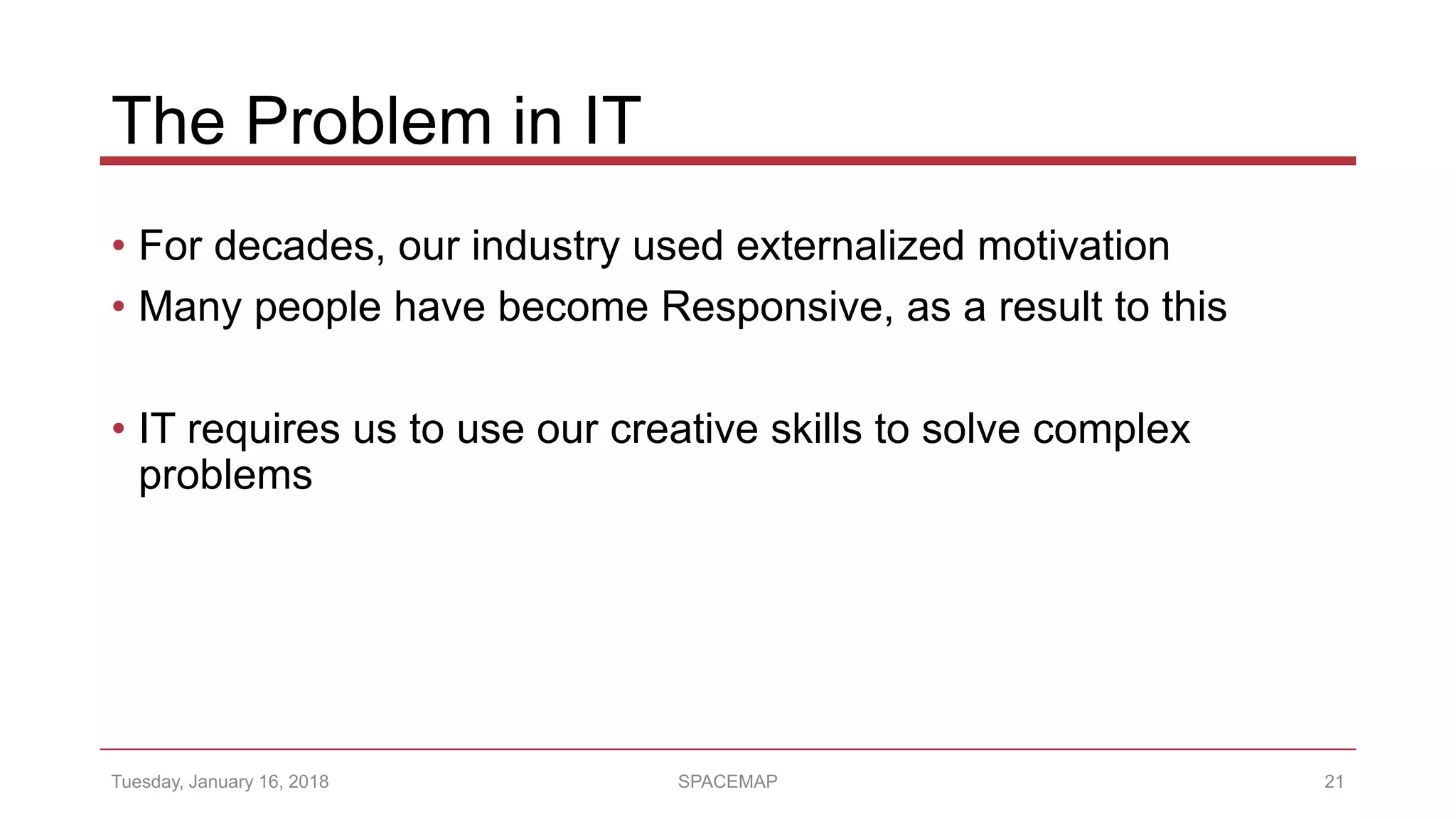
The Problem in IT
• For decades, our industry used externalized motivation
• Many people have become Responsive, as a result to this
• IT requires us to use our creative skills to solve complex
problems
Tuesday, January 16, 2018 SPACEMAP 21
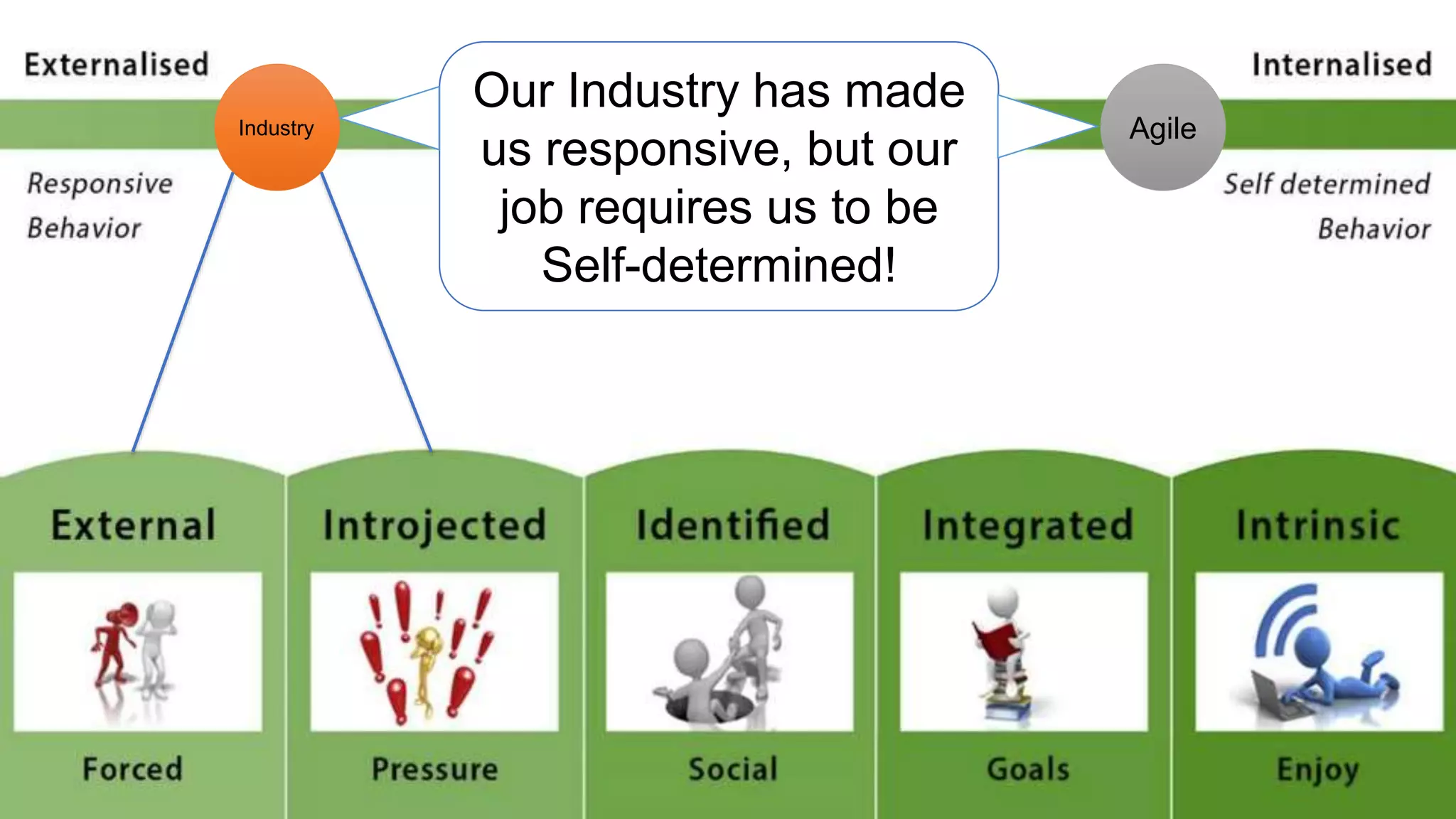
Industry
Our Industry has made
us responsive, but our
job requires us to be
Self-determined!
Agile
How to solve this?
• Effective Agile techniques (like Scrum) already have a lot of
motivation built-in
• But what has to be built in?
Tuesday, January 16, 2018 SPACEMAP 23
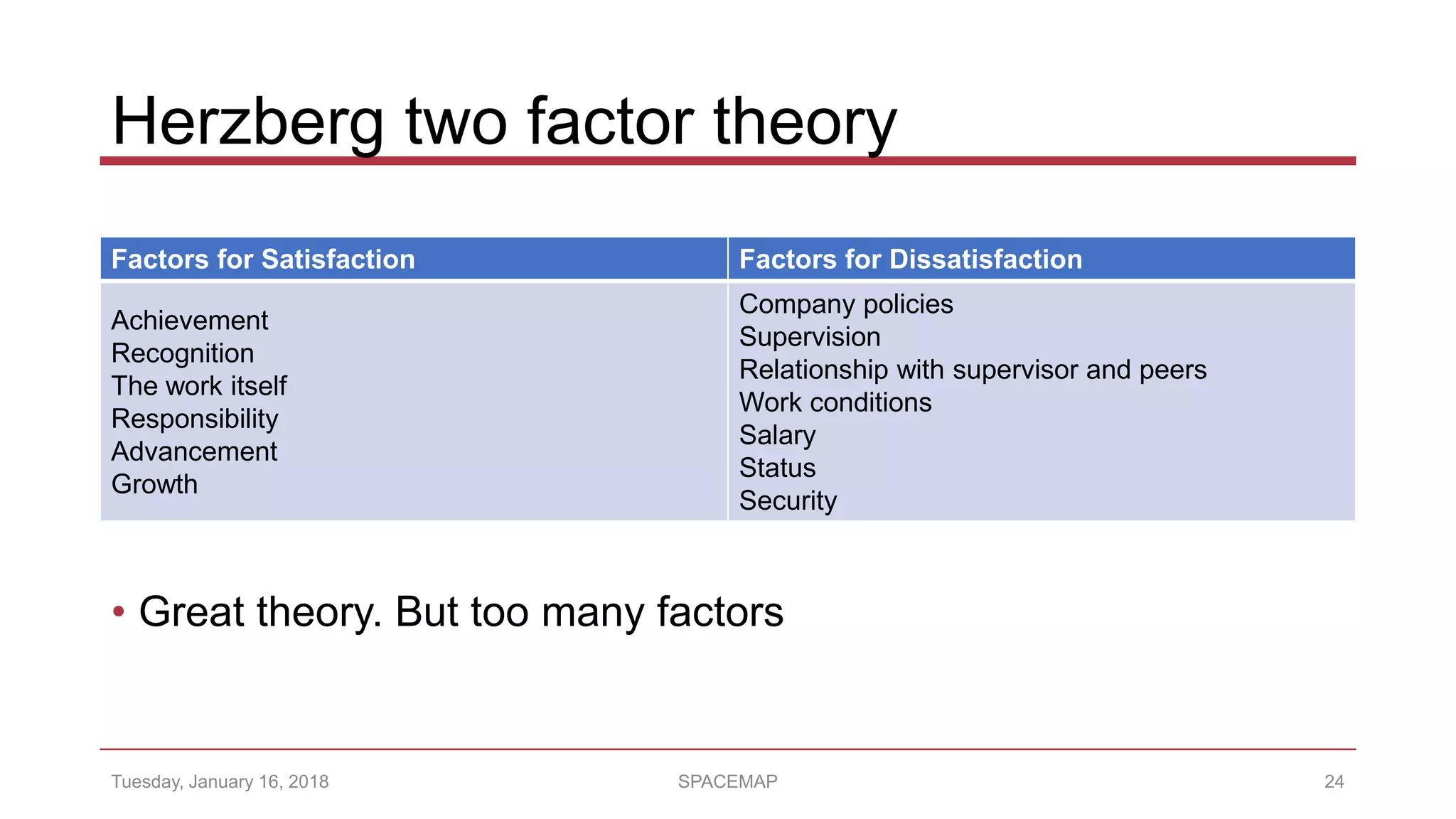
Herzberg two factor theory
Factors for Satisfaction Factors for Dissatisfaction
Achievement
Recognition
The work itself
Responsibility
Advancement
Growth
Company policies
Supervision
Relationship with supervisor and peers
Work conditions
Salary
Status
Security
Tuesday, January 16, 2018 SPACEMAP 24
• Great theory. But too many factors
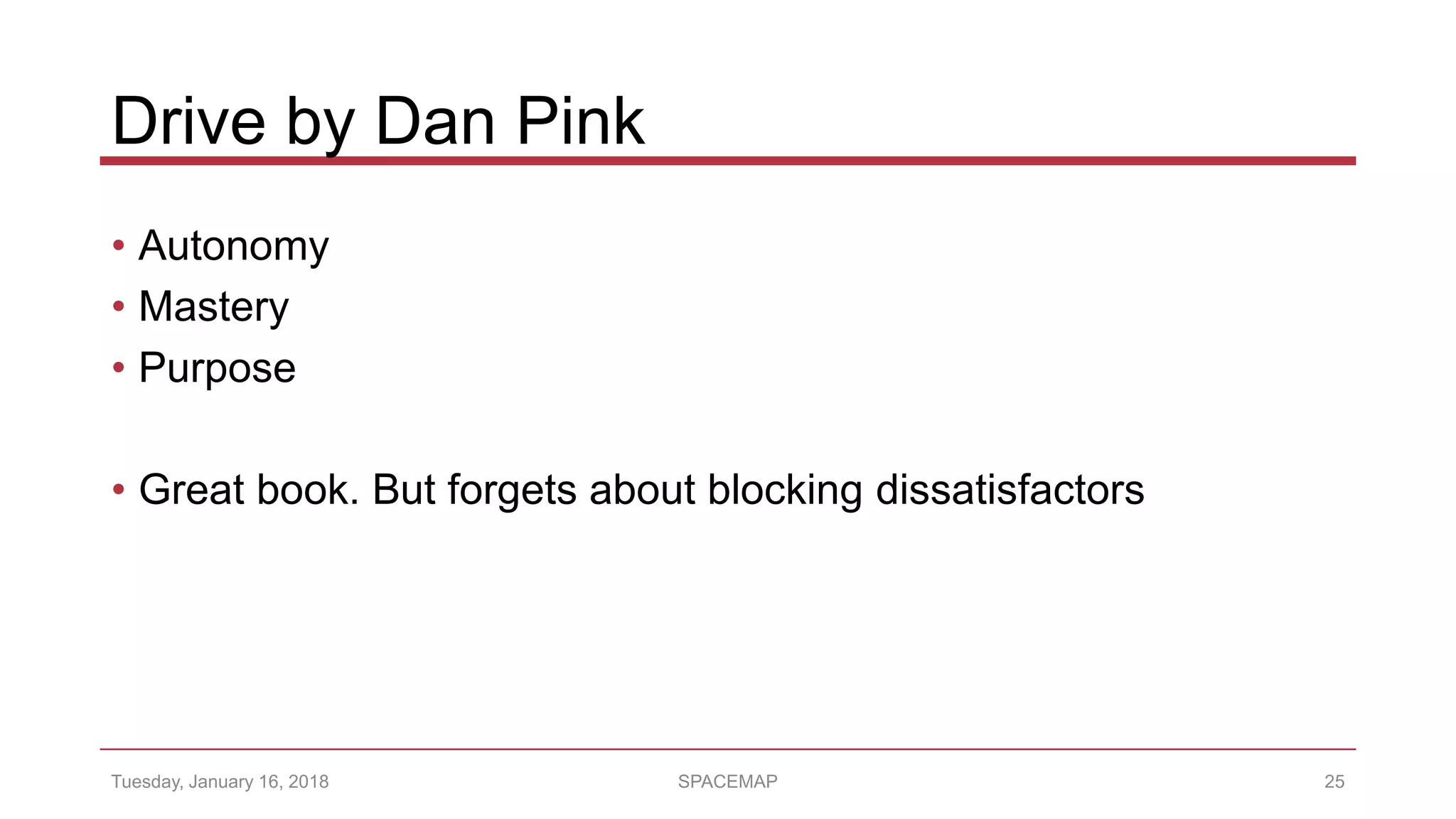
Drive by Dan Pink
Tuesday, January 16, 2018 SPACEMAP 25
• Autonomy
• Mastery
• Purpose
• Great book. But forgets about blocking dissatisfactors
The SPACEMAP
To solve the responsiveness problem
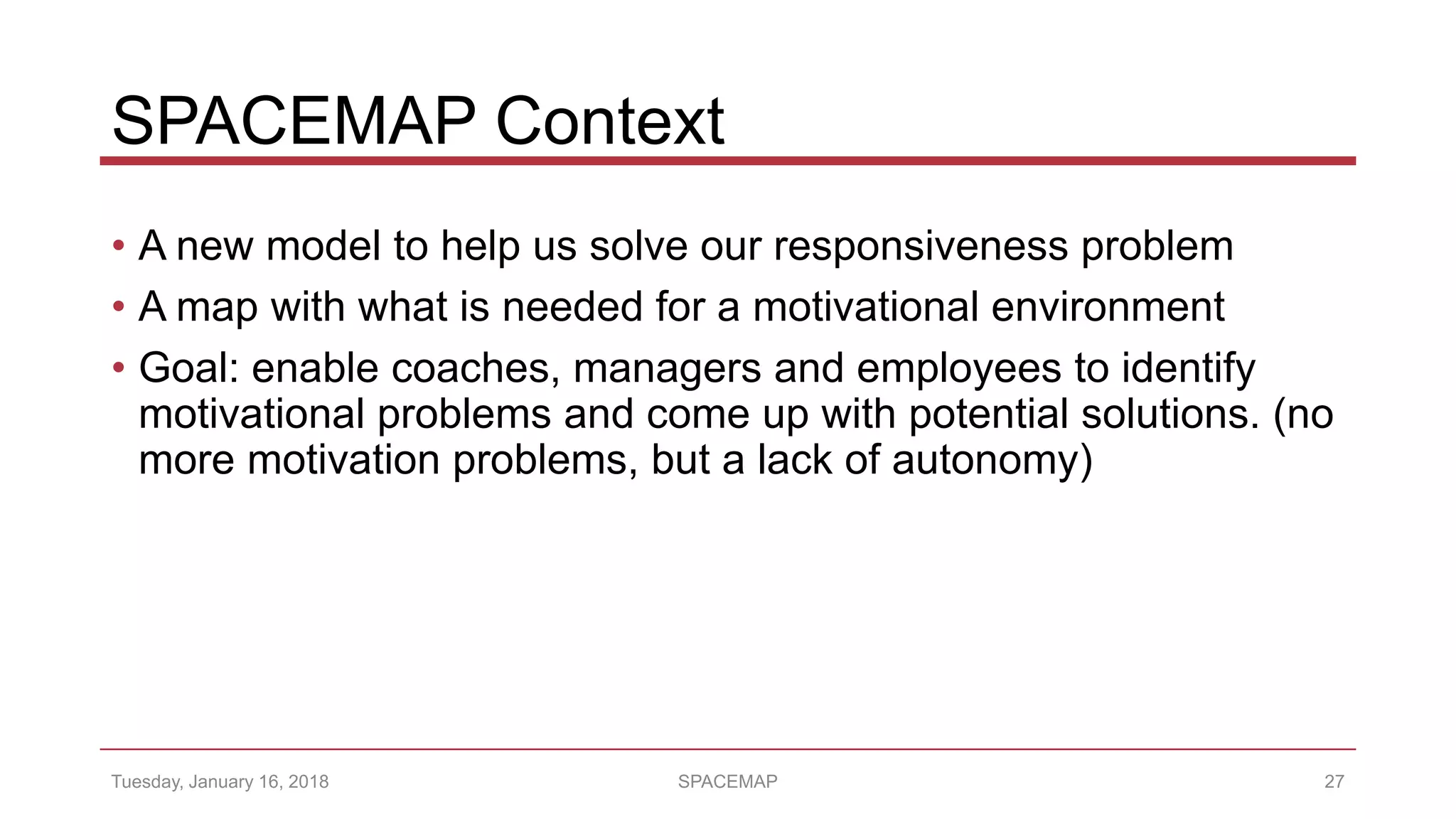
SPACEMAP Context
• A new model to help us solve our responsiveness problem
• A map with what is needed for a motivational environment
• Goal: enable coaches, managers and employees to identify
motivational problems and come up with potential solutions. (no
more motivation problems, but a lack of autonomy)
Tuesday, January 16, 2018 SPACEMAP 27
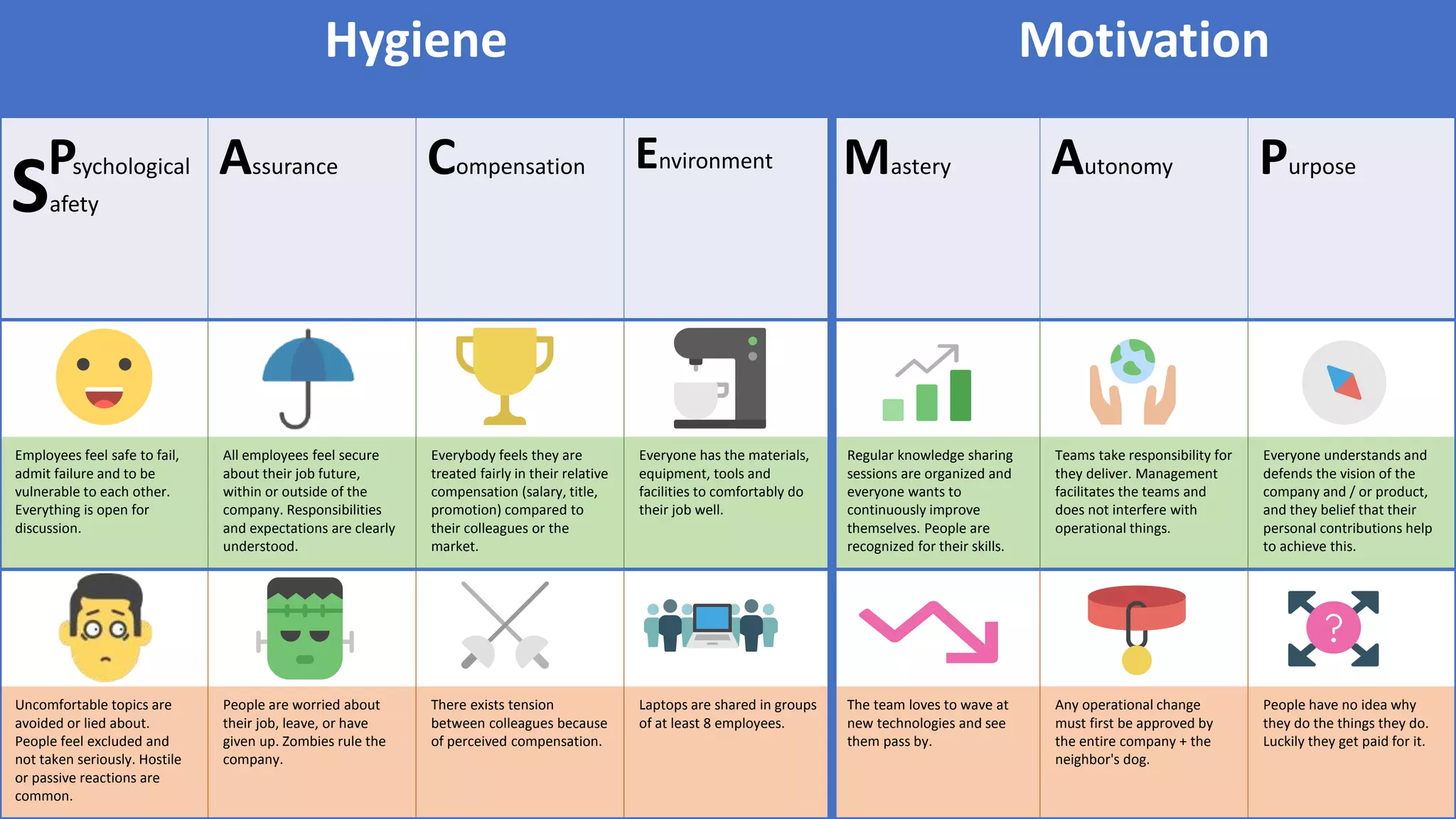
Hygiene Motivation
Psychological Assurance Compensation Environment Mastery Autonomy Purpose
Employees feel safe to fail,
admit failure and to be
vulnerable to each other.
Everything is open for
discussion.
All employees feel secure
about their job future,
within or outside of the
company. Responsibilities
and expectations are clearly
understood.
Everybody feels they are
treated fairly in their relative
compensation (salary, title,
promotion) compared to
their colleagues or the
market.
Everyone has the materials,
equipment, tools and
facilities to comfortably do
their job well.
Regular knowledge sharing
sessions are organized and
everyone wants to
continuously improve
themselves. People are
recognized for their skills.
Teams take responsibility for
they deliver. Management
facilitates the teams and
does not interfere with
operational things.
Everyone understands and
defends the vision of the
company and / or product,
and they belief that their
personal contributions help
to achieve this.
Uncomfortable topics are
avoided or lied about.
People feel excluded and
not taken seriously. Hostile
or passive reactions are
common.
People are worried about
their job, leave, or have
given up. Zombies rule the
company.
There exists tension
between colleagues because
of perceived compensation.
Laptops are shared in groups
of at least 8 employees.
The team loves to wave at
new technologies and see
them pass by.
Any operational change
must first be approved by
the entire company + the
neighbor's dog.
People have no idea why
they do the things they do.
Luckily they get paid for it.
Safety
SPACEMAP excludes
• Personal factors, only focuses on generic work factors
• Unbalanced teams
• Lack of specialist knowledge
Tuesday, January 16, 2018 SPACEMAP 29
In-depth Work Factors
Not all of them though, just the ones that require more explanation
Psychological Safety
• Creating a positive work environment
• Safe-to-fail environment
• Trust & Respect
Tuesday, January 16, 2018 SPACEMAP 31
Mastery
• Mastery or Competence
• “People are active, development-oriented organisms who
behave to encounter challenges, to toy with danger, to
experience more facets of their being, including, at times, pain
and displeasure“
Tuesday, January 16, 2018 SPACEMAP 32
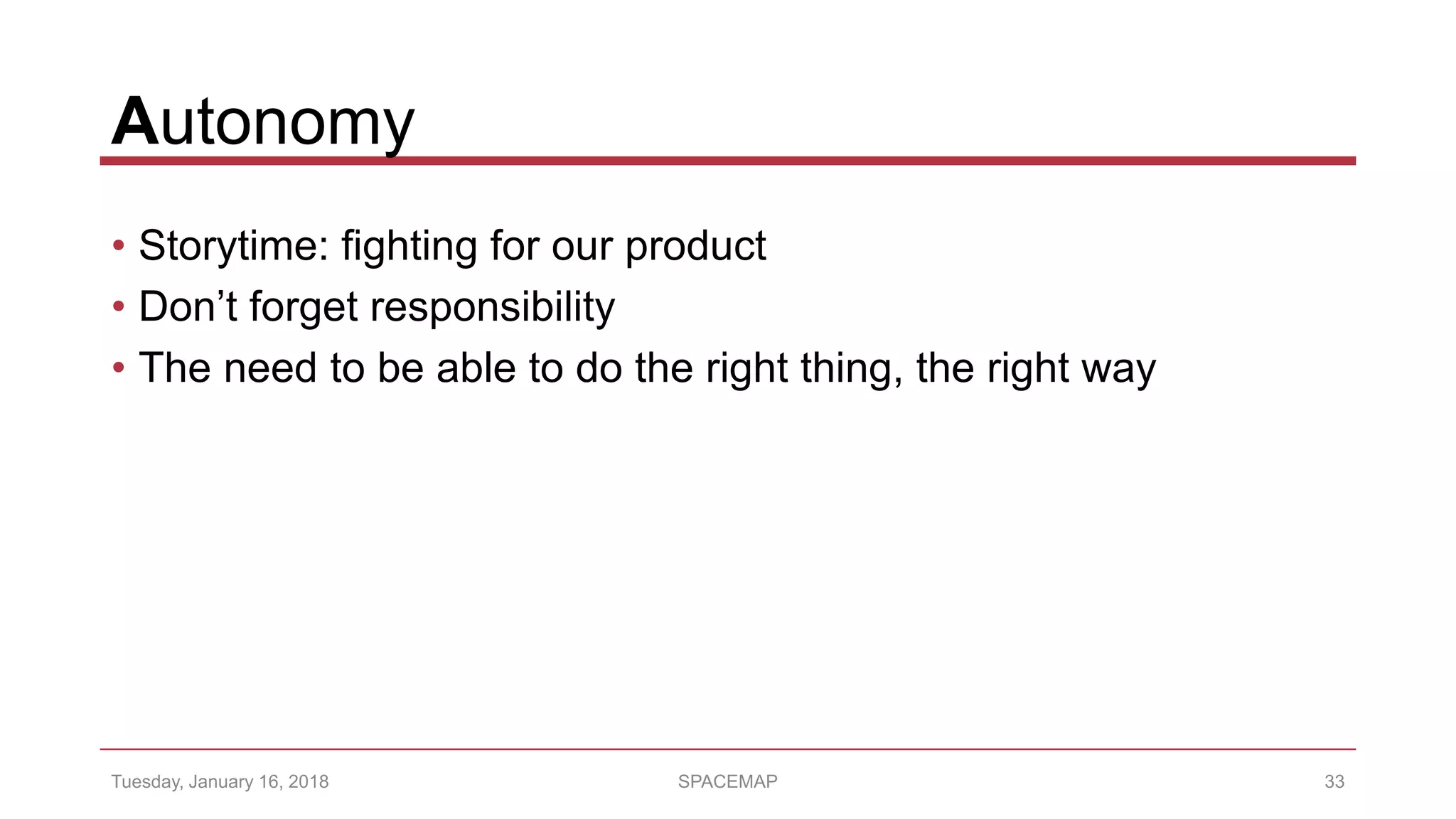
Autonomy
• Storytime: fighting for our product
• Don’t forget responsibility
• The need to be able to do the right thing, the right way
Tuesday, January 16, 2018 SPACEMAP 33
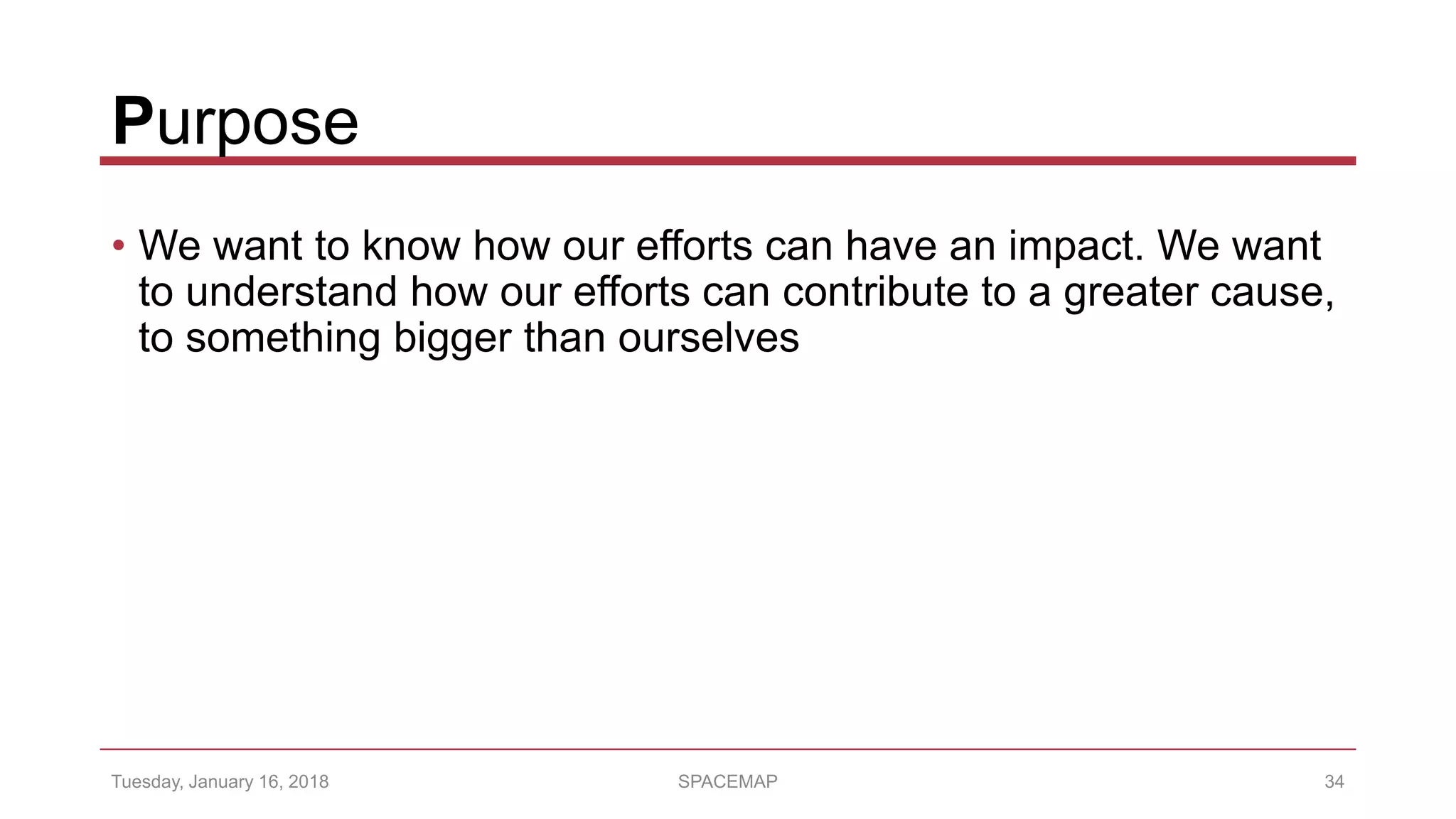
Purpose
• We want to know how our efforts can have an impact. We want
to understand how our efforts can contribute to a greater cause,
to something bigger than ourselves
Tuesday, January 16, 2018 SPACEMAP 34
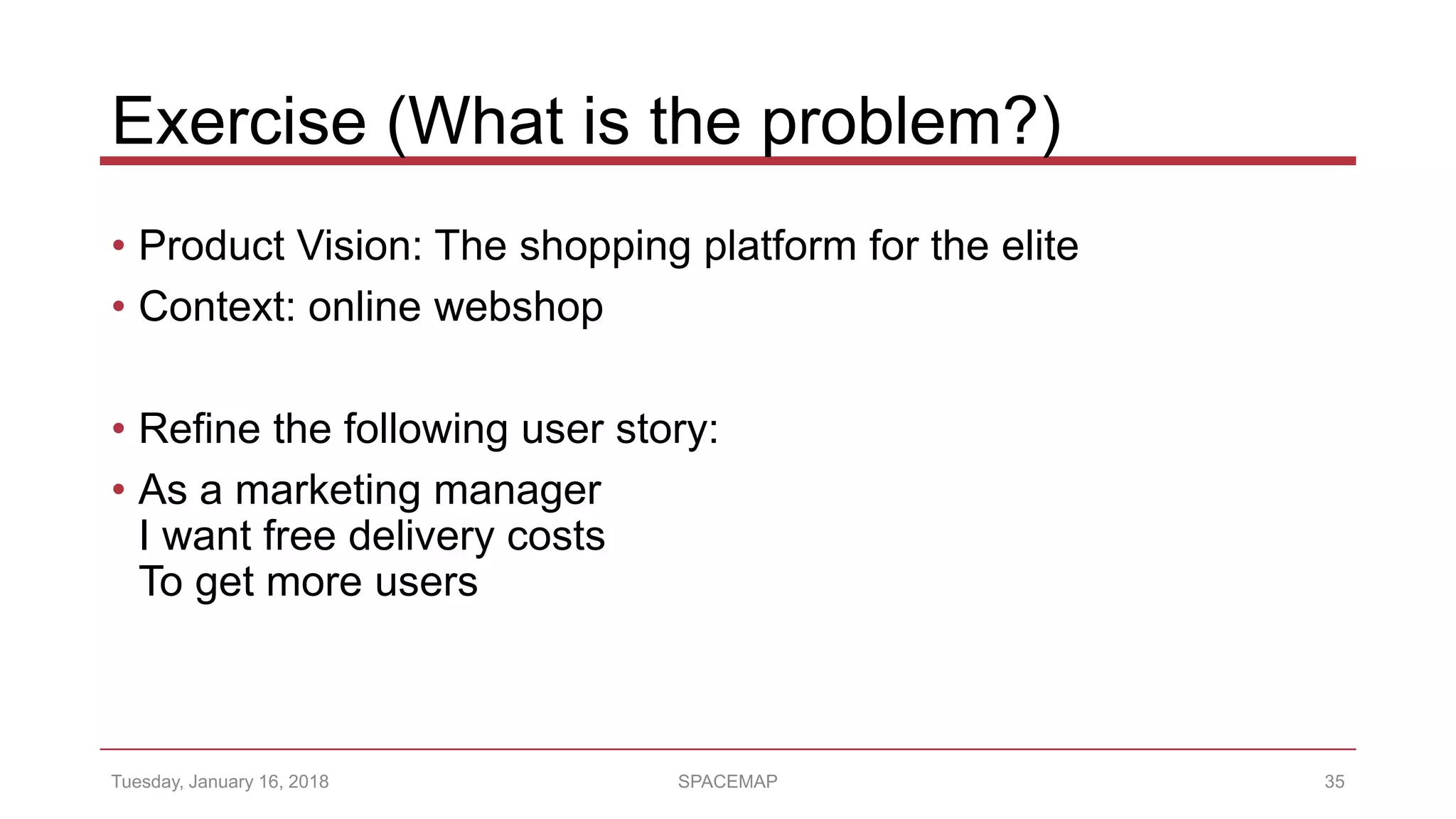
Exercise (What is the problem?)
• Product Vision: The shopping platform for the elite
• Context: online webshop
• Refine the following user story:
• As a marketing manager
I want free delivery costs
To get more users
Tuesday, January 16, 2018 SPACEMAP 35
Motivation in BDD
How the two are related
BDD is about:
• Collaborate effectively to write the code that has the most
business value
Motivation is about
• We want to give meaning to our life.
• We gain meaning through others (helping others, be recognized
by others, etc)
Both have the same goal
• Our meaning in IT is focused on creating value for our
customers (by solving their problems)
• Both BDD and our motivation strife to create value for your
customers
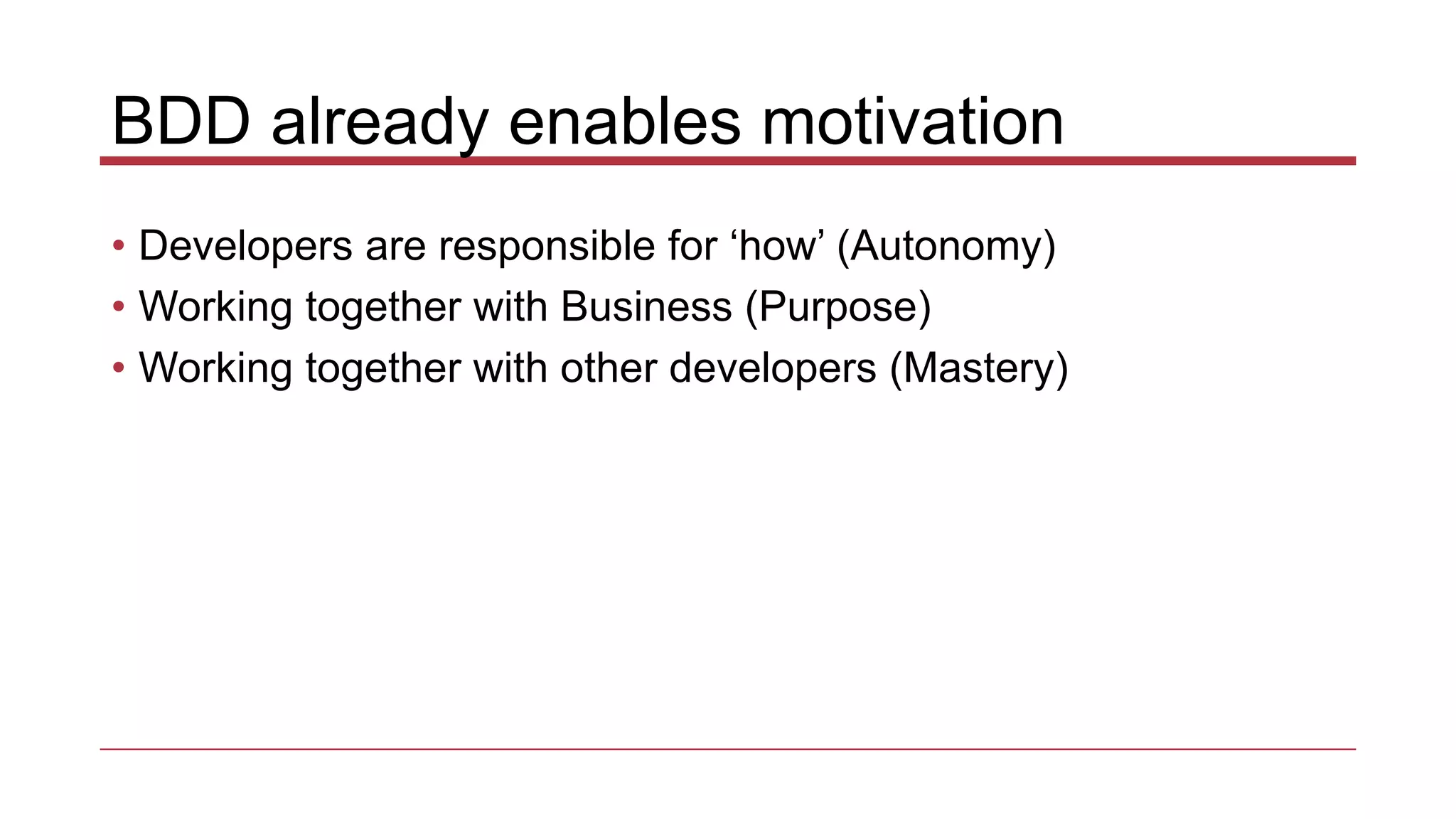
BDD already enables motivation
• Developers are responsible for ‘how’ (Autonomy)
• Working together with Business (Purpose)
• Working together with other developers (Mastery)
Why is this so interesting?
• BDD focuses on the techniques to add value to our customers
• The SPACEMAP is the underlying model that explains which 7
work factors need to be addressed to make people self
determined and add the most value to our customers
• We can use the SPACEMAP to change / improve the way we
do BDD
How to leverage motivation in
BDD
Applying motivational work factors in BDD
Examples (which you might do already)
• Psychological Safety: Try and fail (and learn) a lot
• Psychological Safety: Dare to be vulnerable to each other (“I’m sorry,
I don’t know that”)
• Autonomy: Only work on user stories with a clear
problem/opportunity, and dare to think out of the box to come up with
the best possible solution
• Mastery: Regularly revise written code. Your codebase should be
used to learn from
• Purpose: Make sure a Product Vision exists. Every developer should
understand how their code can help their customers.
• Purpose: Visualize the important production metrics.
Brainstorming how to improve
your own environment
Let’s apply this knowledge to our own environment
How’s your SPACEMAP?
• Which motivational problems at your client can you map to the
SPACEMAP?
Tuesday, January 16, 2018 SPACEMAP 45
Let’s get cracking
• Form groups of 5-6
• Come up with a motivational problem that one of you is facing
currently
• Identify where in the SPACEMAP (which pillars) this problem
occurs
• Brainstorm for solutions
• Don’t forget to ask questions!
• Debriefing after 25 min (or whenever the group is done)
Thank you, questions?
Or interesting observations?

Space map-in-bdd

  • 1.
    SPACEMAP in BDD Organizinga motivational environment
  • 2.
    About me • FinKingma • Agile Tester / Scrum Master • Testing not just products  People • Fascinated by: What drives us Tuesday, January 16, 2018 SPACEMAP 2
  • 3.
    Content • Let’s playa game! • Understanding our motivation with the SPACEMAP (w. exercises) • The theory behind motivation • The SPACEMAP • Motivation in BDD • How to leverage motivation in BDD • Brainstorming how to improve your own environment Tuesday, January 16, 2018 SPACEMAP 3
  • 4.
    Let’s play agame Called blackstories
  • 5.
    New rules • Gamemaster decides if questions are relevant or not • Gain 1 point for each relevant question • Lose 1 point for each non-relevant question • You’re out when reaching 0 points Tuesday, January 16, 2018 SPACEMAP 5
  • 6.
    Observations • What didyou notice? Tuesday, January 16, 2018 SPACEMAP 6
  • 7.
    The theory behindit How does it work?
  • 8.
  • 9.
    Exercise: Which levelof motivation is this? Tuesday, January 16, 2018 SPACEMAP 9
  • 10.
    Tuesday, January 16,2018SPACEMAP 10 Running
  • 11.
    Tuesday, January 16,2018SPACEMAP 11 Football
  • 12.
  • 13.
  • 14.
    Exercise: Which levelof motivation is this? • We can never know for sure, it’s always personal • Best way is to ask Tuesday, January 16, 2018 SPACEMAP 14
  • 15.
    External Rewards Experiment •Experiment: give children external rewards for drawing • Result: external if-then rewards will make people draw less Now-that rewards can actually boost motivation http://www.spring.org.uk/2009/10/how-rewards-can-backfire-and-reduce-motivation.php Tuesday, January 16, 2018 SPACEMAP 15
  • 16.
    How does thatwork? • Our brain works with associations • Drawing = if-then reward Tuesday, January 16, 2018 SPACEMAP 16
  • 17.
  • 18.
    The Candle Problem •Attach the candle unto the wall in a way that if you light it, the candle wax will not drop unto the floor • The group that received an external reward, took (much) longer to solve the puzzle • External rewards disable us from using our cognitive/ creative skills Tuesday, January 16, 2018 SPACEMAP 18
  • 19.
  • 20.
  • 21.
    The Problem inIT • For decades, our industry used externalized motivation • Many people have become Responsive, as a result to this • IT requires us to use our creative skills to solve complex problems Tuesday, January 16, 2018 SPACEMAP 21
  • 22.
    Industry Our Industry hasmade us responsive, but our job requires us to be Self-determined! Agile
  • 23.
    How to solvethis? • Effective Agile techniques (like Scrum) already have a lot of motivation built-in • But what has to be built in? Tuesday, January 16, 2018 SPACEMAP 23
  • 24.
    Herzberg two factortheory Factors for Satisfaction Factors for Dissatisfaction Achievement Recognition The work itself Responsibility Advancement Growth Company policies Supervision Relationship with supervisor and peers Work conditions Salary Status Security Tuesday, January 16, 2018 SPACEMAP 24 • Great theory. But too many factors
  • 25.
    Drive by DanPink Tuesday, January 16, 2018 SPACEMAP 25 • Autonomy • Mastery • Purpose • Great book. But forgets about blocking dissatisfactors
  • 26.
    The SPACEMAP To solvethe responsiveness problem
  • 27.
    SPACEMAP Context • Anew model to help us solve our responsiveness problem • A map with what is needed for a motivational environment • Goal: enable coaches, managers and employees to identify motivational problems and come up with potential solutions. (no more motivation problems, but a lack of autonomy) Tuesday, January 16, 2018 SPACEMAP 27
  • 28.
    Hygiene Motivation Psychological AssuranceCompensation Environment Mastery Autonomy Purpose Employees feel safe to fail, admit failure and to be vulnerable to each other. Everything is open for discussion. All employees feel secure about their job future, within or outside of the company. Responsibilities and expectations are clearly understood. Everybody feels they are treated fairly in their relative compensation (salary, title, promotion) compared to their colleagues or the market. Everyone has the materials, equipment, tools and facilities to comfortably do their job well. Regular knowledge sharing sessions are organized and everyone wants to continuously improve themselves. People are recognized for their skills. Teams take responsibility for they deliver. Management facilitates the teams and does not interfere with operational things. Everyone understands and defends the vision of the company and / or product, and they belief that their personal contributions help to achieve this. Uncomfortable topics are avoided or lied about. People feel excluded and not taken seriously. Hostile or passive reactions are common. People are worried about their job, leave, or have given up. Zombies rule the company. There exists tension between colleagues because of perceived compensation. Laptops are shared in groups of at least 8 employees. The team loves to wave at new technologies and see them pass by. Any operational change must first be approved by the entire company + the neighbor's dog. People have no idea why they do the things they do. Luckily they get paid for it. Safety
  • 29.
    SPACEMAP excludes • Personalfactors, only focuses on generic work factors • Unbalanced teams • Lack of specialist knowledge Tuesday, January 16, 2018 SPACEMAP 29
  • 30.
    In-depth Work Factors Notall of them though, just the ones that require more explanation
  • 31.
    Psychological Safety • Creatinga positive work environment • Safe-to-fail environment • Trust & Respect Tuesday, January 16, 2018 SPACEMAP 31
  • 32.
    Mastery • Mastery orCompetence • “People are active, development-oriented organisms who behave to encounter challenges, to toy with danger, to experience more facets of their being, including, at times, pain and displeasure“ Tuesday, January 16, 2018 SPACEMAP 32
  • 33.
    Autonomy • Storytime: fightingfor our product • Don’t forget responsibility • The need to be able to do the right thing, the right way Tuesday, January 16, 2018 SPACEMAP 33
  • 34.
    Purpose • We wantto know how our efforts can have an impact. We want to understand how our efforts can contribute to a greater cause, to something bigger than ourselves Tuesday, January 16, 2018 SPACEMAP 34
  • 35.
    Exercise (What isthe problem?) • Product Vision: The shopping platform for the elite • Context: online webshop • Refine the following user story: • As a marketing manager I want free delivery costs To get more users Tuesday, January 16, 2018 SPACEMAP 35
  • 36.
    Motivation in BDD Howthe two are related
  • 37.
    BDD is about: •Collaborate effectively to write the code that has the most business value
  • 38.
    Motivation is about •We want to give meaning to our life. • We gain meaning through others (helping others, be recognized by others, etc)
  • 39.
    Both have thesame goal • Our meaning in IT is focused on creating value for our customers (by solving their problems) • Both BDD and our motivation strife to create value for your customers
  • 40.
    BDD already enablesmotivation • Developers are responsible for ‘how’ (Autonomy) • Working together with Business (Purpose) • Working together with other developers (Mastery)
  • 41.
    Why is thisso interesting? • BDD focuses on the techniques to add value to our customers • The SPACEMAP is the underlying model that explains which 7 work factors need to be addressed to make people self determined and add the most value to our customers • We can use the SPACEMAP to change / improve the way we do BDD
  • 42.
    How to leveragemotivation in BDD Applying motivational work factors in BDD
  • 43.
    Examples (which youmight do already) • Psychological Safety: Try and fail (and learn) a lot • Psychological Safety: Dare to be vulnerable to each other (“I’m sorry, I don’t know that”) • Autonomy: Only work on user stories with a clear problem/opportunity, and dare to think out of the box to come up with the best possible solution • Mastery: Regularly revise written code. Your codebase should be used to learn from • Purpose: Make sure a Product Vision exists. Every developer should understand how their code can help their customers. • Purpose: Visualize the important production metrics.
  • 44.
    Brainstorming how toimprove your own environment Let’s apply this knowledge to our own environment
  • 45.
    How’s your SPACEMAP? •Which motivational problems at your client can you map to the SPACEMAP? Tuesday, January 16, 2018 SPACEMAP 45
  • 46.
    Let’s get cracking •Form groups of 5-6 • Come up with a motivational problem that one of you is facing currently • Identify where in the SPACEMAP (which pillars) this problem occurs • Brainstorm for solutions • Don’t forget to ask questions! • Debriefing after 25 min (or whenever the group is done)
  • 47.
    Thank you, questions? Orinteresting observations?

Editor's Notes

  • #9 Designed the Internalization Model several years ago. Helps understand the problem Does not help to change things
  • #28 hier nog lijstje met factoren over two factor theory
  • #29 Motivation vs Hygiene Metaphor car (motivation is engine, hygiene is wheels): Improving the engine is useless with square wheels.
  • #36 Purpose exercise This user story is totally not in line with our Product Vision. Actual problem: the elite do not use our shopping platform.
  • #46 Purpose exercise This user story is totally not in line with our Product Vision. Actual problem: the elite do not use our shopping platform.