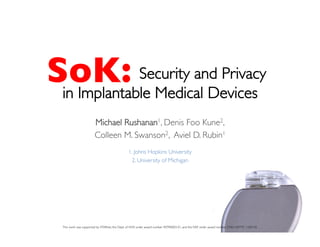
SoK:	

Security and Privacy 
in Implantable Medical Devices 
	

Michael Rushanan1, Denis Foo Kune2, 	

Colleen M. Swanson2, Aviel D. Rubin1	


1. Johns Hopkins University	

2. University of Michigan	

0	
  
This work was supported by STARnet, the Dept. of HHS under award number 90TR0003-01, and the NSF under award number CNS1329737, 1330142.
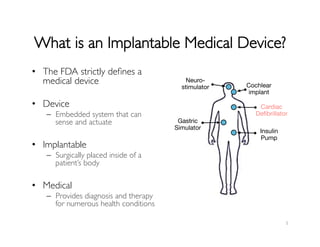
What is an Implantable Medical Device?	

•  The FDA strictly defines a
medical device	


•  Device 	

–  Embedded system that can
sense and actuate	

•  Implantable 	

–  Surgically placed inside of a
patient’s body	


•  Medical 	

–  Provides diagnosis and therapy
for numerous health conditions	

1	
  
Neuro-
stimulator Cochlear
implant
Cardiac
Insulin
Pump
Gastric
Simulator
Various IMDs Trigger M
Se
S
2	
  
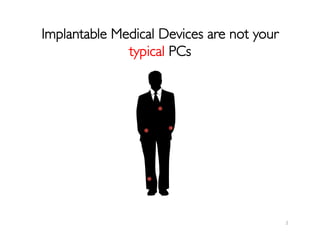
Implantable Medical Devices are not your
typical PCs
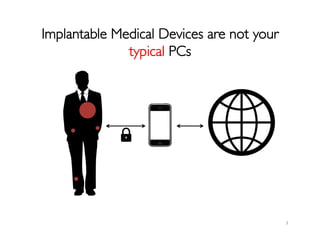
Implantable Medical Devices are not your
typical PCs	

3	
  
Implantable Medical Devices are not your
typical PCs	

4	
  
•  There exists resource limitations	

–  The battery limits computation and is not
rechargeable	


•  There are safety and utility concerns	

–  The IMD must be beneficial to the patient and elevate
patient safety above all else	

–  Security and privacy mechanisms must not adversely
affect the patient or therapy	

•  Lack of security mechanisms may have severe
consequences	


•  IMD’s provide safety-critical operation	

–  Must fail-open in the context of an emergency
Research Questions	

•  How do we provide security and privacy mechanisms that
adequately consider safety and utility?	

•  When do we use traditional security and privacy
mechanisms or invent new protocols?	

•  How do we formally evaluate security and privacy
mechanisms?	

•  Novel attack surfaces	

5	
  
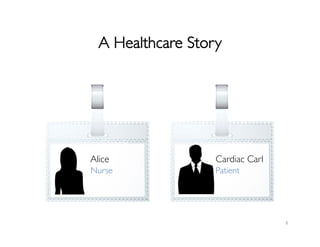
A Healthcare Story	

6	
  
Alice	

 Cardiac Carl	

Nurse	

 Patient
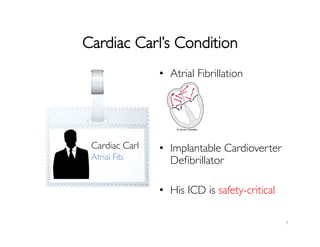
Cardiac Carl’s Condition	

7	
  
•  Atrial Fibrillation	


•  Implantable Cardioverter
Defibrillator	

•  His ICD is safety-critical	

Cardiac Carl	

Atrial Fib.
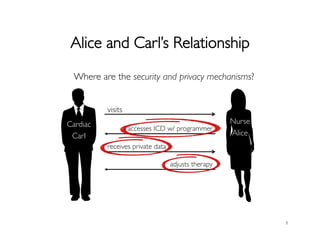
Alice and Carl’s Relationship	

8	
  
visits	

accesses ICD w/ programmer	

receives private data	

adjusts therapy	

Where are the security and privacy mechanisms?	

Cardiac	

Carl	

Nurse	

Alice
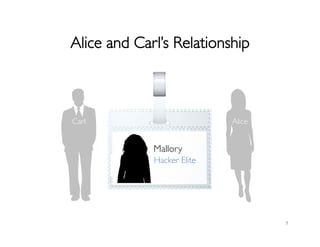
Alice and Carl’s Relationship	

9	
  
visits!
accesses ICD!
send private data!
adjust therapy!
Carl! Alice!
Mallory	

Hacker Elite
Alice Mallory and Carl’s Relationship	

10	
  
Cardiac	

Carl	

Nurse	

Alice	

Mallory	

wireless communication	

[Halperin, SP, 08], [Li, HealthCom, 11] 	

eavesdrop	

forge	

modify	

jam
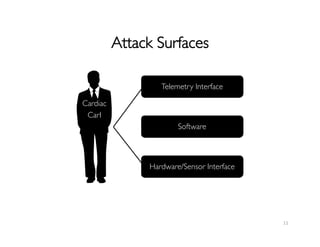
Attack Surfaces	

11	
  
Cardiac	

Carl	

Telemetry Interface
Software
Hardware/Sensor Interface
Security and Privacy Mechanisms	

12	
  
•  Security and Privacy mechanisms exist in standards	

–  Medical Implant Communication Services	

–  Wireless MedicalTelemetry Service	

•  These mechanisms are optional	

•  Interoperability might take priority of security	

[Foo Kune, MedCOMM, 12]
H2H:
authentication
using IPI
Rostami et al. [45],
CCS ’13
Attacks on
OPFKA and
IMDGuard
Rostami et al. [19],
DAC ’13
Using bowel
sounds for audit
Henry et al. [46],
HealthTech ’13
OPFKA: key
agreement
based on
overlapping
PVs
Hu et al. [47],
INFOCOM ’13
Namaste:
proximity-
based attack
against ECG
Bagade et al. [23],
BSN ’13
ASK-BAN: key
gen and auth
using wireless
channel chars
Shi et al. [48],
WiSec ’13
FDA MAUDE
and Recall
database
analysis
Alemzadeh et al.
[49], SP ’13
Attacks on
friendly
jamming
techniques
Tippenhauer et al.
[50], SP ’13
MedMon:
physical layer
anomaly
detection
Zhang et al. [51],
T-BCAS ’13
Ghost Talk:
EMI signal
injection
on ICDs
Foo Kune et al. [22]
SP ’13
Key sharing via
human body
transmission
Chang et al. [52],
HealthSec ’12
Security and
privacy analysis
of MAUDE
Database
Kramer et al. [53],
PLoS ONE ’12
BANA:
authentication
using received
signal strength
variation
Shi et al. [54],
WiSec ’12
Side-channel
attacks on BCI
Martinovic et al.
[55], USENIX ’12
PSKA: PPG
and ECG-based
key agreement
Venkatasubramanian
et al. [56], T-
ITB ’10
Wristband
and password
tattoos
Denning et al. [39],
CHI ’10
ECG used
to determine
proximity
Jurik et al. [57],
ICCCN ’11
ICD validation
and verification
Jiang et al. [58],
ECRTS ’10
Shield: external
proxy and
jamming device
Gollakota et al. [59]
SIGCOMM ’11
BioSec
extension
for BANs
(journal version)
Venkatasubramanian
et al. [60],
TOSN ’10
Eavesdropping
on acoustic
authentication
Halevi et al. [61],
CCS ’10
Wireless
attacks against
insulin pumps
Li et al. [18],
HealthCom ’11
Authentication
using body
coupled
communication
Li et al. [18],
HealthCom ’11
Software
security
analysis of
external
defibrillator
Hanna et al. [1],
HealthSec ’10
IMDGuard:
ECG-based key
management
Xu et al. [62],
INFOCOM ’11
Defending
against
resource
depletion
Hei et al. [63],
GLOBECOM ’10
PPG-based
key agreement
Venkatasubramanian
et al. [64],
MILCOM ’08
Audible, tactile,
and zero power
key exchange
Halperin et al. [12],
SP ’08
Wireless
attacks
against ICDs
Halperin et al. [12],
SP ’08
Proximity-
based access
control using
ultrasonic
frequency
Rasmussen et al.
[65], CCS ’09
Security and
privacy of
neural devices
Denning et al. [66],
Neurosurg
Focus ’09
Biometric
requirements
for key
generation
Ballard et al. [67],
USENIX ’08
ECG-based
key agreement
Venkatasubramanian
et al. [68],
INFOCOM ’08
Cloaker:
external
proxy device
Denning et al. [69],
HotSec ’08
BioSec
extension
for BANs
Venkatasubramanian
and Gupta. [70],
ICISIP ’06
BioSec:
extracting
keys from PVs
Cherukuri
et al. [71]
ICPPW ’03
Authentication
and secure
key exchange
using IPI
Poon et al. [72],
Commun. Mag ’06
Biometric and Physiological Values Distance BoundingWireless Attacks Software/Malware Anomaly DetectionOut-of-Band External Devices Emerging Threats
Food-grade meat phantom used Defense contribution Dependency RelationshipAttack contribution
13	
  
Biometrics and PhysiologicalValues	

Out-of-Band	

Distance Bounding	

Software/Malware	

External Devices	

Anomaly Detection	

Future Work	

Telemetry Interface	

2013
2003
Research Challenges	

•  Access to Implantable Medical Devices	

–  Is much harder then getting other components	

•  Reproducibility	

–  Limited analysis of attacks and defenses	

–  Do not use meat-based human tissue simulators	

–  Do use a calibrated saline solution at 1.8 g/L at 21 ◦C 	

•  The complete design is described in the ANSI/AAMI
PC69:2007 standard [92,Annex G]	


14	
  
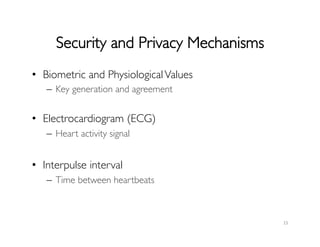
Security and Privacy Mechanisms	

•  Biometric and PhysiologicalValues	

–  Key generation and agreement	

•  Electrocardiogram (ECG)	

–  Heart activity signal	

•  Interpulse interval	

–  Time between heartbeats	

15	
  
H2H Authentication Protocol	

16	
  
[Rostami, CCS, 13]	

Cardiac	

Carl	

Nurse	

Alice	

measure ECG α	

measure ECG β	

send ECG measurement β 	

send ECG measurement α	

TLS without certs
H2H Authentication Protocol	

17	
  
[Rostami, CCS, 13]	

•  Adversarial Assumptions	

–  Active attacker with full network control	

–  The attacker cannot:	

•  Compromise the programmer	

•  Engage in a denial-of-service	

•  Remotely measure ECG to weaken authentication
PhysiologicalValues as an Entropy Source	

•  How do ECG-based protocols work in practice?	

–  Age, Exertion, Noise	

•  ECG-based protocols rely on an analysis of ideal data in an
unrealistic setting	

–  Data sample is close to their ideal distribution	

–  Very accurate estimate of distribution characteristics	

–  Extract randomness using the estimate on the same data sample	


•  Observability	

–  Using video processing techniques to extract ECG-signals	

18	
  
[Rostami, SP, 2013] [Chang, HealthTech, 2012] 	

[Poh, Biomedical Engineering, 11]
19	
  
H2H:
authentication
using IPI
Rostami et al. [45],
CCS ’13
Attacks on
OPFKA and
IMDGuard
Rostami et al. [19],
DAC ’13
Using bowel
sounds for audit
Henry et al. [46],
HealthTech ’13
OPFKA: key
agreement
based on
overlapping
PVs
Hu et al. [47],
INFOCOM ’13
Namaste:
proximity-
based attack
against ECG
Bagade et al. [23],
BSN ’13
ASK-BAN: key
gen and auth
using wireless
channel chars
Shi et al. [48],
WiSec ’13
FDA MAUDE
and Recall
database
analysis
Alemzadeh et al.
[49], SP ’13
Attacks on
friendly
jamming
techniques
Tippenhauer et al.
[50], SP ’13
MedMon:
physical layer
anomaly
detection
Zhang et al. [51],
T-BCAS ’13
Ghost Talk:
EMI signal
injection
on ICDs
Foo Kune et al. [22]
SP ’13
Key sharing via
human body
transmission
Chang et al. [52],
HealthSec ’12
Security and
privacy analysis
of MAUDE
Database
Kramer et al. [53],
PLoS ONE ’12
BANA:
authentication
using received
signal strength
variation
Shi et al. [54],
WiSec ’12
Side-channel
attacks on BCI
Martinovic et al.
[55], USENIX ’12
PSKA: PPG
and ECG-based
key agreement
Venkatasubramanian
et al. [56], T-
ITB ’10
Wristband
and password
tattoos
Denning et al. [39],
CHI ’10
ECG used
to determine
proximity
Jurik et al. [57],
ICCCN ’11
ICD validation
and verification
Jiang et al. [58],
ECRTS ’10
Shield: external
proxy and
jamming device
Gollakota et al. [59]
SIGCOMM ’11
BioSec
extension
for BANs
(journal version)
Venkatasubramanian
et al. [60],
TOSN ’10
Eavesdropping
on acoustic
authentication
Halevi et al. [61],
CCS ’10
Wireless
attacks against
insulin pumps
Li et al. [18],
HealthCom ’11
Authentication
using body
coupled
communication
Li et al. [18],
HealthCom ’11
Software
security
analysis of
external
defibrillator
Hanna et al. [1],
HealthSec ’10
IMDGuard:
ECG-based key
management
Xu et al. [62],
INFOCOM ’11
Defending
against
resource
depletion
Hei et al. [63],
GLOBECOM ’10
PPG-based
key agreement
Venkatasubramanian
et al. [64],
MILCOM ’08
Audible, tactile,
and zero power
key exchange
Halperin et al. [12],
SP ’08
Wireless
attacks
against ICDs
Halperin et al. [12],
SP ’08
Proximity-
based access
control using
ultrasonic
frequency
Rasmussen et al.
[65], CCS ’09
Security and
privacy of
neural devices
Denning et al. [66],
Neurosurg
Focus ’09
Biometric
requirements
for key
generation
Ballard et al. [67],
USENIX ’08
ECG-based
key agreement
Venkatasubramanian
et al. [68],
INFOCOM ’08
Cloaker:
external
proxy device
Denning et al. [69],
HotSec ’08
BioSec
extension
for BANs
Venkatasubramanian
and Gupta. [70],
ICISIP ’06
BioSec:
extracting
keys from PVs
Cherukuri
et al. [71]
ICPPW ’03
Authentication
and secure
key exchange
using IPI
Poon et al. [72],
Commun. Mag ’06
Biometric and Physiological Values Distance BoundingWireless Attacks Software/Malware Anomaly DetectionOut-of-Band External Devices Emerging Threats
Food-grade meat phantom used Defense contribution Dependency RelationshipAttack contribution
Future Work
Trusted Sensor Interface	

•  Current systems trust their analog sensor inputs	

•  This assumption may not always hold	

•  Forging signals using electromagnetic interference	

–  Inject cardiac waveform	


20	
  
[Foo Kune, SP, 2013]
Neurosecurity	

21	
  
•  Neurostimulators	

–  What are the new attack surfaces	

–  What are the implications of recording and transmitting
brainwaves	

•  Brain computer interfaces	

•  Cognitive recognition could leak:	

–  Passwords, personal information	

[Martinovic, USENIX, 2012], [Denning, Neurosurg Focus, 09]
Questions?	

•  IMDs are becoming more common	

–  Improving patient outcome	


•  Research gaps exists	

–  Software	

–  Sensor Interface	

•  Areas for future work include	

–  Physiological values as an Entropy Source	

–  Trusted Sensor Interface	

–  Neurosecurity	

•  See our paper for more details!	

22	
  

Security and Privacy in Implantable Medical Devices

  • 1.
    SoK: Security and Privacy in Implantable Medical Devices Michael Rushanan1, Denis Foo Kune2, Colleen M. Swanson2, Aviel D. Rubin1 1. Johns Hopkins University 2. University of Michigan 0   This work was supported by STARnet, the Dept. of HHS under award number 90TR0003-01, and the NSF under award number CNS1329737, 1330142.
  • 2.
    What is anImplantable Medical Device? •  The FDA strictly defines a medical device •  Device –  Embedded system that can sense and actuate •  Implantable –  Surgically placed inside of a patient’s body •  Medical –  Provides diagnosis and therapy for numerous health conditions 1   Neuro- stimulator Cochlear implant Cardiac Insulin Pump Gastric Simulator Various IMDs Trigger M Se S
  • 3.
    2   Implantable MedicalDevices are not your typical PCs
  • 4.
    Implantable Medical Devicesare not your typical PCs 3  
  • 5.
    Implantable Medical Devicesare not your typical PCs 4   •  There exists resource limitations –  The battery limits computation and is not rechargeable •  There are safety and utility concerns –  The IMD must be beneficial to the patient and elevate patient safety above all else –  Security and privacy mechanisms must not adversely affect the patient or therapy •  Lack of security mechanisms may have severe consequences •  IMD’s provide safety-critical operation –  Must fail-open in the context of an emergency
  • 6.
    Research Questions •  Howdo we provide security and privacy mechanisms that adequately consider safety and utility? •  When do we use traditional security and privacy mechanisms or invent new protocols? •  How do we formally evaluate security and privacy mechanisms? •  Novel attack surfaces 5  
  • 7.
    A Healthcare Story 6   Alice Cardiac Carl Nurse Patient
  • 8.
    Cardiac Carl’s Condition 7   •  Atrial Fibrillation •  Implantable Cardioverter Defibrillator •  His ICD is safety-critical Cardiac Carl Atrial Fib.
  • 9.
    Alice and Carl’sRelationship 8   visits accesses ICD w/ programmer receives private data adjusts therapy Where are the security and privacy mechanisms? Cardiac Carl Nurse Alice
  • 10.
    Alice and Carl’sRelationship 9   visits! accesses ICD! send private data! adjust therapy! Carl! Alice! Mallory Hacker Elite
  • 11.
    Alice Mallory andCarl’s Relationship 10   Cardiac Carl Nurse Alice Mallory wireless communication [Halperin, SP, 08], [Li, HealthCom, 11] eavesdrop forge modify jam
  • 12.
    Attack Surfaces 11   Cardiac Carl TelemetryInterface Software Hardware/Sensor Interface
  • 13.
    Security and PrivacyMechanisms 12   •  Security and Privacy mechanisms exist in standards –  Medical Implant Communication Services –  Wireless MedicalTelemetry Service •  These mechanisms are optional •  Interoperability might take priority of security [Foo Kune, MedCOMM, 12]
  • 14.
    H2H: authentication using IPI Rostami etal. [45], CCS ’13 Attacks on OPFKA and IMDGuard Rostami et al. [19], DAC ’13 Using bowel sounds for audit Henry et al. [46], HealthTech ’13 OPFKA: key agreement based on overlapping PVs Hu et al. [47], INFOCOM ’13 Namaste: proximity- based attack against ECG Bagade et al. [23], BSN ’13 ASK-BAN: key gen and auth using wireless channel chars Shi et al. [48], WiSec ’13 FDA MAUDE and Recall database analysis Alemzadeh et al. [49], SP ’13 Attacks on friendly jamming techniques Tippenhauer et al. [50], SP ’13 MedMon: physical layer anomaly detection Zhang et al. [51], T-BCAS ’13 Ghost Talk: EMI signal injection on ICDs Foo Kune et al. [22] SP ’13 Key sharing via human body transmission Chang et al. [52], HealthSec ’12 Security and privacy analysis of MAUDE Database Kramer et al. [53], PLoS ONE ’12 BANA: authentication using received signal strength variation Shi et al. [54], WiSec ’12 Side-channel attacks on BCI Martinovic et al. [55], USENIX ’12 PSKA: PPG and ECG-based key agreement Venkatasubramanian et al. [56], T- ITB ’10 Wristband and password tattoos Denning et al. [39], CHI ’10 ECG used to determine proximity Jurik et al. [57], ICCCN ’11 ICD validation and verification Jiang et al. [58], ECRTS ’10 Shield: external proxy and jamming device Gollakota et al. [59] SIGCOMM ’11 BioSec extension for BANs (journal version) Venkatasubramanian et al. [60], TOSN ’10 Eavesdropping on acoustic authentication Halevi et al. [61], CCS ’10 Wireless attacks against insulin pumps Li et al. [18], HealthCom ’11 Authentication using body coupled communication Li et al. [18], HealthCom ’11 Software security analysis of external defibrillator Hanna et al. [1], HealthSec ’10 IMDGuard: ECG-based key management Xu et al. [62], INFOCOM ’11 Defending against resource depletion Hei et al. [63], GLOBECOM ’10 PPG-based key agreement Venkatasubramanian et al. [64], MILCOM ’08 Audible, tactile, and zero power key exchange Halperin et al. [12], SP ’08 Wireless attacks against ICDs Halperin et al. [12], SP ’08 Proximity- based access control using ultrasonic frequency Rasmussen et al. [65], CCS ’09 Security and privacy of neural devices Denning et al. [66], Neurosurg Focus ’09 Biometric requirements for key generation Ballard et al. [67], USENIX ’08 ECG-based key agreement Venkatasubramanian et al. [68], INFOCOM ’08 Cloaker: external proxy device Denning et al. [69], HotSec ’08 BioSec extension for BANs Venkatasubramanian and Gupta. [70], ICISIP ’06 BioSec: extracting keys from PVs Cherukuri et al. [71] ICPPW ’03 Authentication and secure key exchange using IPI Poon et al. [72], Commun. Mag ’06 Biometric and Physiological Values Distance BoundingWireless Attacks Software/Malware Anomaly DetectionOut-of-Band External Devices Emerging Threats Food-grade meat phantom used Defense contribution Dependency RelationshipAttack contribution 13   Biometrics and PhysiologicalValues Out-of-Band Distance Bounding Software/Malware External Devices Anomaly Detection Future Work Telemetry Interface 2013 2003
  • 15.
    Research Challenges •  Accessto Implantable Medical Devices –  Is much harder then getting other components •  Reproducibility –  Limited analysis of attacks and defenses –  Do not use meat-based human tissue simulators –  Do use a calibrated saline solution at 1.8 g/L at 21 ◦C •  The complete design is described in the ANSI/AAMI PC69:2007 standard [92,Annex G] 14  
  • 16.
    Security and PrivacyMechanisms •  Biometric and PhysiologicalValues –  Key generation and agreement •  Electrocardiogram (ECG) –  Heart activity signal •  Interpulse interval –  Time between heartbeats 15  
  • 17.
    H2H Authentication Protocol 16   [Rostami, CCS, 13] Cardiac Carl Nurse Alice measure ECG α measure ECG β send ECG measurement β send ECG measurement α TLS without certs
  • 18.
    H2H Authentication Protocol 17   [Rostami, CCS, 13] •  Adversarial Assumptions –  Active attacker with full network control –  The attacker cannot: •  Compromise the programmer •  Engage in a denial-of-service •  Remotely measure ECG to weaken authentication
  • 19.
    PhysiologicalValues as anEntropy Source •  How do ECG-based protocols work in practice? –  Age, Exertion, Noise •  ECG-based protocols rely on an analysis of ideal data in an unrealistic setting –  Data sample is close to their ideal distribution –  Very accurate estimate of distribution characteristics –  Extract randomness using the estimate on the same data sample •  Observability –  Using video processing techniques to extract ECG-signals 18   [Rostami, SP, 2013] [Chang, HealthTech, 2012] [Poh, Biomedical Engineering, 11]
  • 20.
    19   H2H: authentication using IPI Rostamiet al. [45], CCS ’13 Attacks on OPFKA and IMDGuard Rostami et al. [19], DAC ’13 Using bowel sounds for audit Henry et al. [46], HealthTech ’13 OPFKA: key agreement based on overlapping PVs Hu et al. [47], INFOCOM ’13 Namaste: proximity- based attack against ECG Bagade et al. [23], BSN ’13 ASK-BAN: key gen and auth using wireless channel chars Shi et al. [48], WiSec ’13 FDA MAUDE and Recall database analysis Alemzadeh et al. [49], SP ’13 Attacks on friendly jamming techniques Tippenhauer et al. [50], SP ’13 MedMon: physical layer anomaly detection Zhang et al. [51], T-BCAS ’13 Ghost Talk: EMI signal injection on ICDs Foo Kune et al. [22] SP ’13 Key sharing via human body transmission Chang et al. [52], HealthSec ’12 Security and privacy analysis of MAUDE Database Kramer et al. [53], PLoS ONE ’12 BANA: authentication using received signal strength variation Shi et al. [54], WiSec ’12 Side-channel attacks on BCI Martinovic et al. [55], USENIX ’12 PSKA: PPG and ECG-based key agreement Venkatasubramanian et al. [56], T- ITB ’10 Wristband and password tattoos Denning et al. [39], CHI ’10 ECG used to determine proximity Jurik et al. [57], ICCCN ’11 ICD validation and verification Jiang et al. [58], ECRTS ’10 Shield: external proxy and jamming device Gollakota et al. [59] SIGCOMM ’11 BioSec extension for BANs (journal version) Venkatasubramanian et al. [60], TOSN ’10 Eavesdropping on acoustic authentication Halevi et al. [61], CCS ’10 Wireless attacks against insulin pumps Li et al. [18], HealthCom ’11 Authentication using body coupled communication Li et al. [18], HealthCom ’11 Software security analysis of external defibrillator Hanna et al. [1], HealthSec ’10 IMDGuard: ECG-based key management Xu et al. [62], INFOCOM ’11 Defending against resource depletion Hei et al. [63], GLOBECOM ’10 PPG-based key agreement Venkatasubramanian et al. [64], MILCOM ’08 Audible, tactile, and zero power key exchange Halperin et al. [12], SP ’08 Wireless attacks against ICDs Halperin et al. [12], SP ’08 Proximity- based access control using ultrasonic frequency Rasmussen et al. [65], CCS ’09 Security and privacy of neural devices Denning et al. [66], Neurosurg Focus ’09 Biometric requirements for key generation Ballard et al. [67], USENIX ’08 ECG-based key agreement Venkatasubramanian et al. [68], INFOCOM ’08 Cloaker: external proxy device Denning et al. [69], HotSec ’08 BioSec extension for BANs Venkatasubramanian and Gupta. [70], ICISIP ’06 BioSec: extracting keys from PVs Cherukuri et al. [71] ICPPW ’03 Authentication and secure key exchange using IPI Poon et al. [72], Commun. Mag ’06 Biometric and Physiological Values Distance BoundingWireless Attacks Software/Malware Anomaly DetectionOut-of-Band External Devices Emerging Threats Food-grade meat phantom used Defense contribution Dependency RelationshipAttack contribution Future Work
  • 21.
    Trusted Sensor Interface • Current systems trust their analog sensor inputs •  This assumption may not always hold •  Forging signals using electromagnetic interference –  Inject cardiac waveform 20   [Foo Kune, SP, 2013]
  • 22.
    Neurosecurity 21   •  Neurostimulators – What are the new attack surfaces –  What are the implications of recording and transmitting brainwaves •  Brain computer interfaces •  Cognitive recognition could leak: –  Passwords, personal information [Martinovic, USENIX, 2012], [Denning, Neurosurg Focus, 09]
  • 23.
    Questions? •  IMDs arebecoming more common –  Improving patient outcome •  Research gaps exists –  Software –  Sensor Interface •  Areas for future work include –  Physiological values as an Entropy Source –  Trusted Sensor Interface –  Neurosecurity •  See our paper for more details! 22