Securing the Healthcare 
Industry: IMD 
Tandhy Simanjuntak 
Seminar on Practical Security 
08/18/2014
Implantable Medical Devices 
Device inserted into human body for medical purposes
2011 Most implanted medical devices in America[17] 
39% 
8% 11% 
8% 
6% 
6% 
7% 
6% 
4% 
3% 2% 
Artificial Eye Lenses 
Ear Tubes 
Coronary Stents 
Artificial Knees 
Traumatic Fracture Repair 
IUDs 
Spinal Fusion Hardware 
Breast Implants 
Heart Pacemakers 
Artificial Hips 
Implantable Cardioverter Defibrillators
Implantable Medical Devices 
Device inserted into human body for medical purposes 
Small size 
Tiny computing platform with firmware[28] 
Programmable[28] 
Limited Resources[28] 
Limited Power[28] 
Network-connected
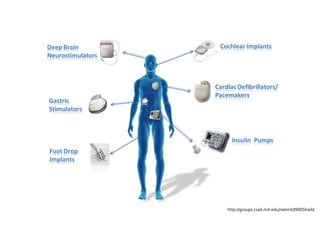
Deep Brain 
Neurostimulator[1] 
Deep brain neurostimulator. http://www.synaptix.be 
Use for treatment of movement and affective disorders[6] 
• Parkinson’s disease 
• Essential tremor 
• Dystonia 
• Chronic Pain 
• Major depression 
• OCD
Cochlear Implant[3] 
Cochlear implant. www.medel.com. 
May helps patients with deaf to enable sufficient 
hearing for better understanding of speech[7]
Gastric Stimulator[2] 
• Attached to the surface of the stomach[7] 
• Aimed at obesity management[7] 
Implant Cardiac Defibrillator[4] 
• Implanted in the upper left chest and the lead in the right ventricle of the heart[9] 
• Detect Cardiac Arrhythmia and correct it with brief electrical impulse[9] 
Insulin Pumps[5] 
• Implanted under the skin[10] 
• Administer the insulin for the treatment of diabetes mellitus patient[10]
ACNR. Foot drop. http://www.acnr.co.uk 
Foot Drop Implant 
• Implanted on peroneal nerve, proximal to the knee[11] 
• Gait abnormality, which dropping the forefoot[12]
http://groups.csail.mit.edu/netmit/IMDShield
IMD Data[28] Static Data 
• Device make and model number 
Semi-static Data 
• Physician & Health Center ID 
• Patient Name and DOB 
• Medical Condition 
• Therapy configuration 
Dynamic Data 
• Patient health status history 
• Therapy and dosage history 
• Audit logs
Threats[28] 
Patient data extraction 
Patient data tampering 
Device re-programming 
Repeated access attempts
Threats[28] 
Device shut-off 
Therapy update 
Malicious inputs 
Data flooding
Attacks Pacemakers & ICDs : software radio attacks 
and Zero-Power defenses[26] 
Resource depletion attacks[27] 
pacemaker or ICDs 
Insulin pumps
Attacks Pacemakers & ICDs : software radio attacks and 
Zero-Power defenses[26] 
Pacemakers & ICDs : 
software radio attacks 
and Zero-Power 
defenses[26] 
Resource depletion 
attacks[27] 
pacemaker or ICD 
insulin pumps 
 Non-encrypted sensitive information 
 Reprogramming attack 
 Communicate with unauthenticated device DoS 
 3 adversaries: 
 Adversary with commercial ICD programmer 
 Passive adversary : eavesdrops communication 
 Active adversary : generate arbitrary RF
Attacks 
Resource depletion attacks[27] 
bladeRF. www.nuand.com 
Pacemakers & ICDs : 
software radio attacks 
and Zero-Power 
defenses[26] 
Resource depletion 
attacks[27] 
pacemaker or ICD 
insulin pumps 
Forced authentication attack: 
 software defined radio (bladeRF[29]/hackRF[30]) 
 Communications and computations 
 Security logs
Attacks 
Pacemakers & ICDs : 
software radio attacks 
and Zero-Power 
defenses[26] 
Resource depletion 
attacks[27] 
pacemaker or ICD 
insulin pumps 
Pacemaker or ICD[32] 
• Device shut-off 
• Read and write 
• Deliver electric shock up to 830 Volts 
Insulin Pumps 
• Supply more insulin[33] 
• Hacking Medical Devices for Fun and Insulin: Brea-king 
the Human SCADA System[34] Blackhat 2013
Challenges[28] 
Resource limitations 
Cryptography : ECC[14][15] 
Audit mechanisms
Criteria for 
IMDs[22] Safety and Utility Goals 
Security and Privacy Goals
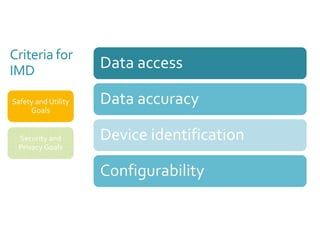
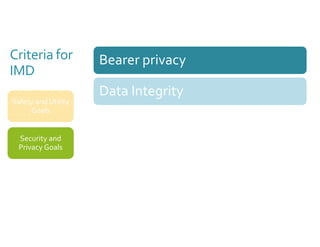
Criteria for 
IMD 
Safety and Utility 
Goals 
Security and 
Privacy Goals 
Data access 
Data accuracy 
Device identification 
Configurability
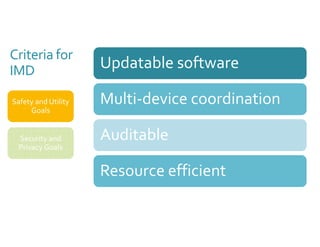
Criteria for 
IMD 
Safety and Utility 
Goals 
Security and 
Privacy Goals 
Updatable software 
Multi-device coordination 
Auditable 
Resource efficient
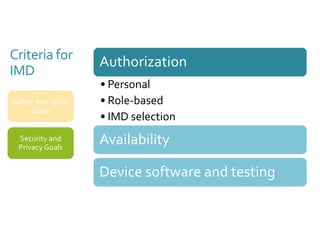
Criteria for 
IMD 
Safety and Utility 
Goals 
Security and 
Privacy Goals 
Authorization 
• Personal 
• Role-based 
• IMD selection 
Availability 
Device software and testing
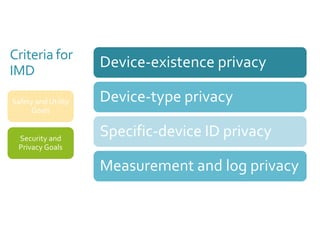
Criteria for 
IMD 
Safety and Utility 
Goals 
Security and 
Privacy Goals 
Device-existence privacy 
Device-type privacy 
Specific-device ID privacy 
Measurement and log privacy
Criteria for 
IMD 
Safety and Utility 
Goals 
Security and 
Privacy Goals 
Bearer privacy 
Data Integrity
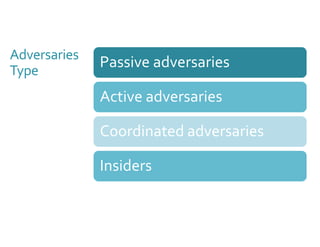
Adversaries 
Type Passive adversaries 
Active adversaries 
Coordinated adversaries 
Insiders
Adversaries 
Equipment Standard equipment 
Custom equipment
Others work MedMon: with wireless monitoring and anomaly 
detection[18] 
• Snoops radio-frequency wireless 
• Multi-layer anomaly detection 
• Identify malicious transactions 
• Response: passive (notify user) or active (jamming 
packets) 
IMDShield[16] 
• Jam IMD’s messages and unauthorized commands
“At this time we believe that the risk is low and the 
benefits of the therapy to people with diabetes outweigh the 
Risk of an individual criminal attack” 
Amanda McNulty Sheldon 
Director of Public Relations for Medtronic Diabetes 
http://www.bloomberg.com/video/87427352-mcafee-s-barnaby-on-medical-device-hacking.html
References 
1. Deep brain neurosimulator. www.virtualworldlets.net. Web. 7 Aug 2014. 
2. Gastric Stimulator. www.medicalexpo.com. Web. 7 Aug 2014. 
3. Cochlear Implant. http://professionals.cochlearamericas.com. Web. 7 Aug 2014. 
4. Implant Cardiac Defribillator. drivetheweb.com. Web. 7 Aug 2014. 
5. Insulin pumps. www.medgadget.com. Web. 7 Aug 2014. 
6. Wikipedia. http://en.wikipedia.org/wiki/Deep_brain_stimulation. Web. 8 Aug 2014. 
7. Wikipedia. http://en.wikipedia.org/wiki/Cochlear_implant. Web. 8 Aug 2014. 
8. Wikipedia. http://en.wikipedia.org/wiki/Implantable_gastric_stimulation. Web. 8 Aug 2014. 
9. Wikipedia. http://en.wikipedia.org/wiki/Implantable_cardioverter-defibrillator. Web. 8 Aug 2014. 
10. Wikipedia. http://en.wikipedia.org/wiki/Insulin_pump. Web. 8 Aug 2014. 
11. Haugland, M., Childs, C., Ladouceur, M., Haase*, J., Sinkjær, T. (2000). An Implantable Foot Drop Stimulator. Proceedings of the 5th Annual IFESS 
Conference, pp. 59-62. 2000. 
12. Wikipedia. http://en.wikipedia.org/wiki/Foot_drop. Web. 8 Aug 214. 
13. T. Buchegger, G. Obberger, A. Reisenzahn, E. Hochmair, A. Stelzer, and A. Springer, ‘‘Ultrawideband transceivers for cochlear implants,EURASIP J. 
Appl. Signal. Process., vol. 2005, no. 18, pp. 3069–3075, 2005. 
14. Fan, J., Reparaz, O., Rozic, V., Verbauwhede, I. (2013). Low-Energy Encryption for Medical Devices: Security Adds an Extra Design Dimension. Design 
Automation Conference (DAC), 2013 50th ACM / EDAC / IEEE. May 29 2013-June 7 2013. 
15. Malasri, K., Wang, L. (2008) Design and Implementation of a Secure Wireless Mote-Based Medical Sensor Network. UbiComp 2008, Sept 21-24, 2008, 
Seoul, Korea. 
16. IMDShield. http://groups.csail.mit.edu/netmit/IMDShield/. Web. 7 Aug 2014.
References 
17. The eleven most implanted medical devices in America. http://247wallst.com/healthcare-economy/2011/07/18/the-eleven-most-implanted-medical-devices-in-america/ 
3/. Web. 12 Aug 2014. 
18. Zhang, M., Raghunathan, A., Jha, N.K. (2013). MedMon : Securing Medical Devices Through Wireless Monitoring and Anomaly Detection. IEEE TRANSACTIONS 
ON BIOMEDICAL CIRCUITS AND SYSTEMS, VOL. 7, NO. 6, DECEMBER 2013 
19. Gollakota, S., Hassanieh, H., Ransford, B., Katabi, D., Fu, K (2011). They Can Hear Your Heartbeats: Non-Invasive Security for Implantable Medical Devices. 
SIGCOMM 2011, Aug 15-19, 2011, Toronto, ON, Canada. 
20. C. Zhan, W. B. Baine, A. Sedrakyan, and S. Claudia. Cardiac device implantation in the US from 1997 through 2004: A population-based analysis. Journal of 
General Internal Medicine, 2007. 
21. Fu, K. (2009) Inside risks: Reducing risks of implantable medical devices. Communications of the ACM - One Laptop Per Child: Vision vs. Reality CACM Homepage 
archive, Volume 52 Issue 6, June 2009 Pages 25-27, ACM New York, NY, USA. 
22. Halperin, D. ; Kohno, T. ; Heydt-Benjamin, T.S. ; Fu, K. ; Maisel, W.H. (2008). Security and Privacy for Implantable Medical Devices. Pervasive Computing, IEEE 
(Volume:7 , Issue: 1 ). Date of Publication: Jan.-March 2008. IEEE 
23. W. H. Maisel. Safety issues involving medical devices: Implications of recent implantable cardioverter-defibrillator malfunctions. Journal of the American Medical 
Association, 2005. 
24. ETSI EN 301 839-1 V 1.3.1 (2009-10). Electromagnetic compatibility and Radio spectrum Matters (ERM); Short Range Devices (SRD); Ultra Low Power Active 
Medical Implants (ULP-AMI) and Peripherals (ULP-AMI-P) operating in the frequency range 402 MHz to 405 MHz; Part 1: Technical characteristics and test 
methods 
25. Medical Implant Communication Service. http://en.wikipedia.org/wiki/Medical_Implant_Communication_Service. Web. 13 Aug 2014. 
26. Halperin, D. ; Heydt-Benjamin, T.S. ; Ransford, B. ; Clark, S.S. ; Defend, B. ; Morgan, W. ; Fu, K. ; Kohno, T. ; Maisel, W.H. (2008) Pacemakers and Implantable 
Cardiac Defibrillators: Software Radio Attacks and Zero-Power Defenses. Security and Privacy, 2008. SP 2008. IEEE Symposium. Publication Year: 2008 , Page(s): 
129 – 142.
References 
27. Hei, X., Du, X., Wu, J., Hu, F. (2010). Defending Resource Depletion Attacks on Implantable Medical Devices. Global Telecommunications Conference 
(GLOBECOM 2010),IEEE. 
28. Gupta, S.(2012). Implantable Medical Devices-Cyber Risks and Mitigation Approaches. Presentation. NIST Cyber Physical Systems Workshop. April 23- 
24, 2012. 
29. BladeRF, Software defined Radio. www.nuand.com. Web. 17 Aug 2014. 
30. hackRF, open source software defined radio. http://greatscottgadgets.com/hackrf/. Web. 17 Aug 2014. 
31. bladeRF. https://www.kickstarter.com/projects/1085541682/bladerf-usb-30-software-defined-radio. Web. 17 Aug 2014 
32. Hacking implantable medical devices. http://resources.infosecinstitute.com/hcking-implantable-medical-devices/. Web. 17 Aug 2014. 
33. McAfee’s Barnaby on Medical Device Hacking. http://www.bloomberg.com/video/87427352-mcafee-s-barnaby-on-medical-device-hacking.html. 
Video. 17 Aug 2014. 
34. Radcliffe, J. (2011). Hacking Medical Devices for Fun and Insulin: Breaking the Human SCADA System.

Securing the Healthcare Industry : Implantable Medical Devices

  • 1.
    Securing the Healthcare Industry: IMD Tandhy Simanjuntak Seminar on Practical Security 08/18/2014
  • 2.
    Implantable Medical Devices Device inserted into human body for medical purposes
  • 3.
    2011 Most implantedmedical devices in America[17] 39% 8% 11% 8% 6% 6% 7% 6% 4% 3% 2% Artificial Eye Lenses Ear Tubes Coronary Stents Artificial Knees Traumatic Fracture Repair IUDs Spinal Fusion Hardware Breast Implants Heart Pacemakers Artificial Hips Implantable Cardioverter Defibrillators
  • 4.
    Implantable Medical Devices Device inserted into human body for medical purposes Small size Tiny computing platform with firmware[28] Programmable[28] Limited Resources[28] Limited Power[28] Network-connected
  • 5.
    Deep Brain Neurostimulator[1] Deep brain neurostimulator. http://www.synaptix.be Use for treatment of movement and affective disorders[6] • Parkinson’s disease • Essential tremor • Dystonia • Chronic Pain • Major depression • OCD
  • 6.
    Cochlear Implant[3] Cochlearimplant. www.medel.com. May helps patients with deaf to enable sufficient hearing for better understanding of speech[7]
  • 7.
    Gastric Stimulator[2] •Attached to the surface of the stomach[7] • Aimed at obesity management[7] Implant Cardiac Defibrillator[4] • Implanted in the upper left chest and the lead in the right ventricle of the heart[9] • Detect Cardiac Arrhythmia and correct it with brief electrical impulse[9] Insulin Pumps[5] • Implanted under the skin[10] • Administer the insulin for the treatment of diabetes mellitus patient[10]
  • 8.
    ACNR. Foot drop.http://www.acnr.co.uk Foot Drop Implant • Implanted on peroneal nerve, proximal to the knee[11] • Gait abnormality, which dropping the forefoot[12]
  • 9.
  • 10.
    IMD Data[28] StaticData • Device make and model number Semi-static Data • Physician & Health Center ID • Patient Name and DOB • Medical Condition • Therapy configuration Dynamic Data • Patient health status history • Therapy and dosage history • Audit logs
  • 11.
    Threats[28] Patient dataextraction Patient data tampering Device re-programming Repeated access attempts
  • 12.
    Threats[28] Device shut-off Therapy update Malicious inputs Data flooding
  • 13.
    Attacks Pacemakers &ICDs : software radio attacks and Zero-Power defenses[26] Resource depletion attacks[27] pacemaker or ICDs Insulin pumps
  • 14.
    Attacks Pacemakers &ICDs : software radio attacks and Zero-Power defenses[26] Pacemakers & ICDs : software radio attacks and Zero-Power defenses[26] Resource depletion attacks[27] pacemaker or ICD insulin pumps  Non-encrypted sensitive information  Reprogramming attack  Communicate with unauthenticated device DoS  3 adversaries:  Adversary with commercial ICD programmer  Passive adversary : eavesdrops communication  Active adversary : generate arbitrary RF
  • 15.
    Attacks Resource depletionattacks[27] bladeRF. www.nuand.com Pacemakers & ICDs : software radio attacks and Zero-Power defenses[26] Resource depletion attacks[27] pacemaker or ICD insulin pumps Forced authentication attack:  software defined radio (bladeRF[29]/hackRF[30])  Communications and computations  Security logs
  • 16.
    Attacks Pacemakers &ICDs : software radio attacks and Zero-Power defenses[26] Resource depletion attacks[27] pacemaker or ICD insulin pumps Pacemaker or ICD[32] • Device shut-off • Read and write • Deliver electric shock up to 830 Volts Insulin Pumps • Supply more insulin[33] • Hacking Medical Devices for Fun and Insulin: Brea-king the Human SCADA System[34] Blackhat 2013
  • 17.
    Challenges[28] Resource limitations Cryptography : ECC[14][15] Audit mechanisms
  • 18.
    Criteria for IMDs[22]Safety and Utility Goals Security and Privacy Goals
  • 19.
    Criteria for IMD Safety and Utility Goals Security and Privacy Goals Data access Data accuracy Device identification Configurability
  • 20.
    Criteria for IMD Safety and Utility Goals Security and Privacy Goals Updatable software Multi-device coordination Auditable Resource efficient
  • 21.
    Criteria for IMD Safety and Utility Goals Security and Privacy Goals Authorization • Personal • Role-based • IMD selection Availability Device software and testing
  • 22.
    Criteria for IMD Safety and Utility Goals Security and Privacy Goals Device-existence privacy Device-type privacy Specific-device ID privacy Measurement and log privacy
  • 23.
    Criteria for IMD Safety and Utility Goals Security and Privacy Goals Bearer privacy Data Integrity
  • 24.
    Adversaries Type Passiveadversaries Active adversaries Coordinated adversaries Insiders
  • 25.
    Adversaries Equipment Standardequipment Custom equipment
  • 26.
    Others work MedMon:with wireless monitoring and anomaly detection[18] • Snoops radio-frequency wireless • Multi-layer anomaly detection • Identify malicious transactions • Response: passive (notify user) or active (jamming packets) IMDShield[16] • Jam IMD’s messages and unauthorized commands
  • 27.
    “At this timewe believe that the risk is low and the benefits of the therapy to people with diabetes outweigh the Risk of an individual criminal attack” Amanda McNulty Sheldon Director of Public Relations for Medtronic Diabetes http://www.bloomberg.com/video/87427352-mcafee-s-barnaby-on-medical-device-hacking.html
  • 28.
    References 1. Deepbrain neurosimulator. www.virtualworldlets.net. Web. 7 Aug 2014. 2. Gastric Stimulator. www.medicalexpo.com. Web. 7 Aug 2014. 3. Cochlear Implant. http://professionals.cochlearamericas.com. Web. 7 Aug 2014. 4. Implant Cardiac Defribillator. drivetheweb.com. Web. 7 Aug 2014. 5. Insulin pumps. www.medgadget.com. Web. 7 Aug 2014. 6. Wikipedia. http://en.wikipedia.org/wiki/Deep_brain_stimulation. Web. 8 Aug 2014. 7. Wikipedia. http://en.wikipedia.org/wiki/Cochlear_implant. Web. 8 Aug 2014. 8. Wikipedia. http://en.wikipedia.org/wiki/Implantable_gastric_stimulation. Web. 8 Aug 2014. 9. Wikipedia. http://en.wikipedia.org/wiki/Implantable_cardioverter-defibrillator. Web. 8 Aug 2014. 10. Wikipedia. http://en.wikipedia.org/wiki/Insulin_pump. Web. 8 Aug 2014. 11. Haugland, M., Childs, C., Ladouceur, M., Haase*, J., Sinkjær, T. (2000). An Implantable Foot Drop Stimulator. Proceedings of the 5th Annual IFESS Conference, pp. 59-62. 2000. 12. Wikipedia. http://en.wikipedia.org/wiki/Foot_drop. Web. 8 Aug 214. 13. T. Buchegger, G. Obberger, A. Reisenzahn, E. Hochmair, A. Stelzer, and A. Springer, ‘‘Ultrawideband transceivers for cochlear implants,EURASIP J. Appl. Signal. Process., vol. 2005, no. 18, pp. 3069–3075, 2005. 14. Fan, J., Reparaz, O., Rozic, V., Verbauwhede, I. (2013). Low-Energy Encryption for Medical Devices: Security Adds an Extra Design Dimension. Design Automation Conference (DAC), 2013 50th ACM / EDAC / IEEE. May 29 2013-June 7 2013. 15. Malasri, K., Wang, L. (2008) Design and Implementation of a Secure Wireless Mote-Based Medical Sensor Network. UbiComp 2008, Sept 21-24, 2008, Seoul, Korea. 16. IMDShield. http://groups.csail.mit.edu/netmit/IMDShield/. Web. 7 Aug 2014.
  • 29.
    References 17. Theeleven most implanted medical devices in America. http://247wallst.com/healthcare-economy/2011/07/18/the-eleven-most-implanted-medical-devices-in-america/ 3/. Web. 12 Aug 2014. 18. Zhang, M., Raghunathan, A., Jha, N.K. (2013). MedMon : Securing Medical Devices Through Wireless Monitoring and Anomaly Detection. IEEE TRANSACTIONS ON BIOMEDICAL CIRCUITS AND SYSTEMS, VOL. 7, NO. 6, DECEMBER 2013 19. Gollakota, S., Hassanieh, H., Ransford, B., Katabi, D., Fu, K (2011). They Can Hear Your Heartbeats: Non-Invasive Security for Implantable Medical Devices. SIGCOMM 2011, Aug 15-19, 2011, Toronto, ON, Canada. 20. C. Zhan, W. B. Baine, A. Sedrakyan, and S. Claudia. Cardiac device implantation in the US from 1997 through 2004: A population-based analysis. Journal of General Internal Medicine, 2007. 21. Fu, K. (2009) Inside risks: Reducing risks of implantable medical devices. Communications of the ACM - One Laptop Per Child: Vision vs. Reality CACM Homepage archive, Volume 52 Issue 6, June 2009 Pages 25-27, ACM New York, NY, USA. 22. Halperin, D. ; Kohno, T. ; Heydt-Benjamin, T.S. ; Fu, K. ; Maisel, W.H. (2008). Security and Privacy for Implantable Medical Devices. Pervasive Computing, IEEE (Volume:7 , Issue: 1 ). Date of Publication: Jan.-March 2008. IEEE 23. W. H. Maisel. Safety issues involving medical devices: Implications of recent implantable cardioverter-defibrillator malfunctions. Journal of the American Medical Association, 2005. 24. ETSI EN 301 839-1 V 1.3.1 (2009-10). Electromagnetic compatibility and Radio spectrum Matters (ERM); Short Range Devices (SRD); Ultra Low Power Active Medical Implants (ULP-AMI) and Peripherals (ULP-AMI-P) operating in the frequency range 402 MHz to 405 MHz; Part 1: Technical characteristics and test methods 25. Medical Implant Communication Service. http://en.wikipedia.org/wiki/Medical_Implant_Communication_Service. Web. 13 Aug 2014. 26. Halperin, D. ; Heydt-Benjamin, T.S. ; Ransford, B. ; Clark, S.S. ; Defend, B. ; Morgan, W. ; Fu, K. ; Kohno, T. ; Maisel, W.H. (2008) Pacemakers and Implantable Cardiac Defibrillators: Software Radio Attacks and Zero-Power Defenses. Security and Privacy, 2008. SP 2008. IEEE Symposium. Publication Year: 2008 , Page(s): 129 – 142.
  • 30.
    References 27. Hei,X., Du, X., Wu, J., Hu, F. (2010). Defending Resource Depletion Attacks on Implantable Medical Devices. Global Telecommunications Conference (GLOBECOM 2010),IEEE. 28. Gupta, S.(2012). Implantable Medical Devices-Cyber Risks and Mitigation Approaches. Presentation. NIST Cyber Physical Systems Workshop. April 23- 24, 2012. 29. BladeRF, Software defined Radio. www.nuand.com. Web. 17 Aug 2014. 30. hackRF, open source software defined radio. http://greatscottgadgets.com/hackrf/. Web. 17 Aug 2014. 31. bladeRF. https://www.kickstarter.com/projects/1085541682/bladerf-usb-30-software-defined-radio. Web. 17 Aug 2014 32. Hacking implantable medical devices. http://resources.infosecinstitute.com/hcking-implantable-medical-devices/. Web. 17 Aug 2014. 33. McAfee’s Barnaby on Medical Device Hacking. http://www.bloomberg.com/video/87427352-mcafee-s-barnaby-on-medical-device-hacking.html. Video. 17 Aug 2014. 34. Radcliffe, J. (2011). Hacking Medical Devices for Fun and Insulin: Breaking the Human SCADA System.