CTEK SUMMIT
2020
CTEK SUMMIT
2020
2
Medical Device Security
Services Overview
CTEK SUMMIT
2020
3
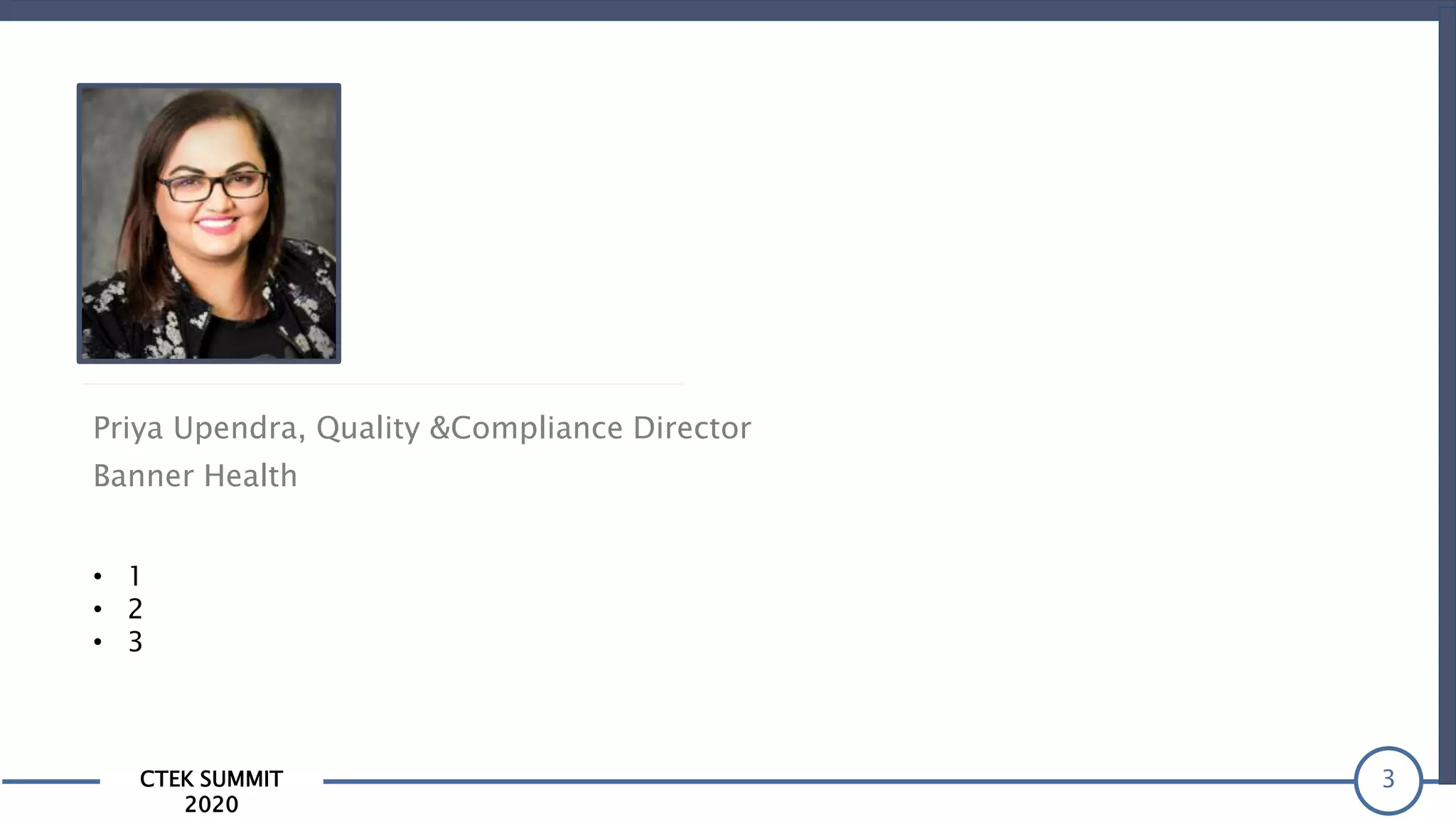
Priya Upendra, Quality &Compliance Director
Banner Health
• 1
• 2
• 3
CTEK SUMMIT
2020
4
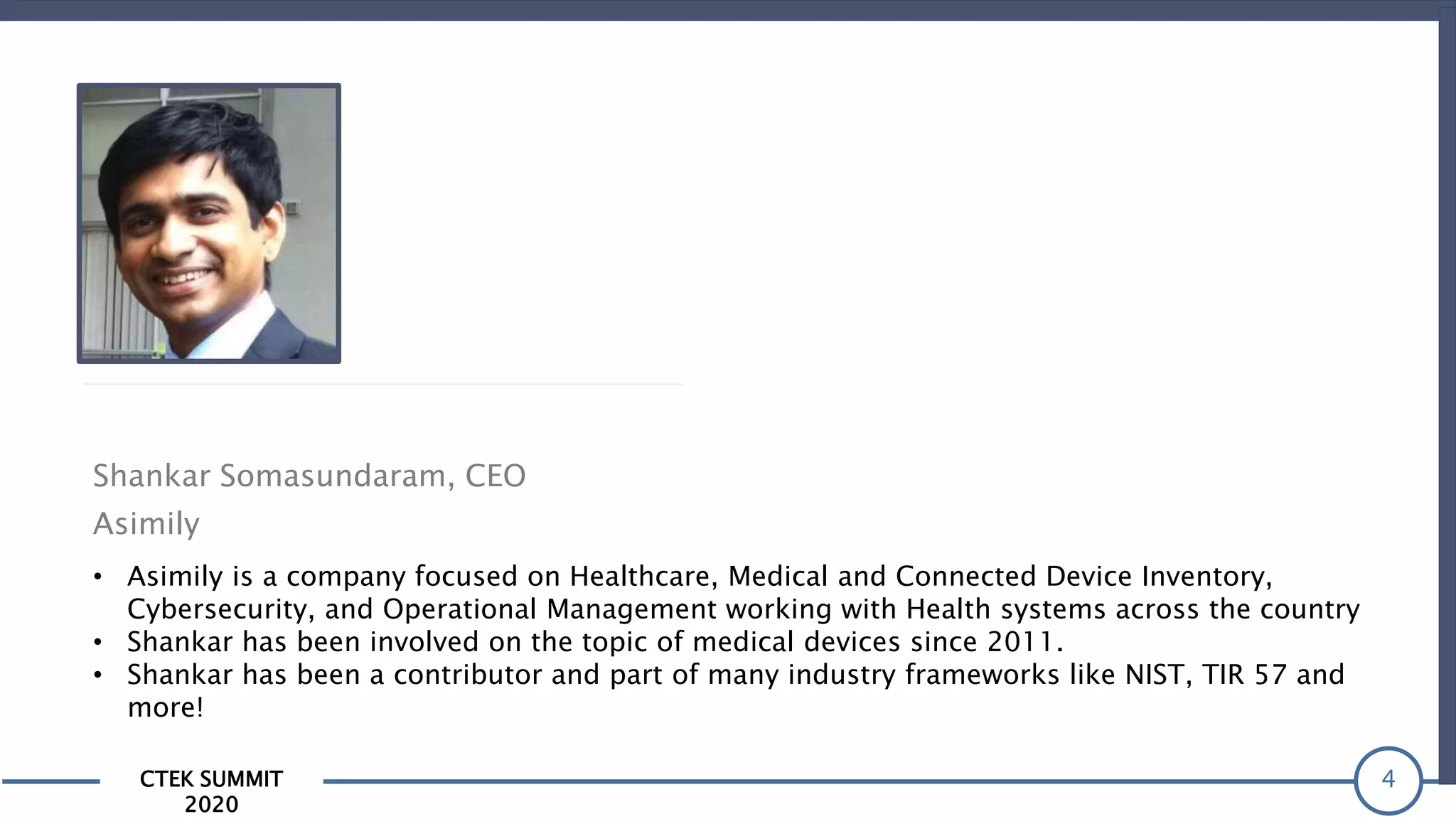
Shankar Somasundaram, CEO
Asimily
• Asimily is a company focused on Healthcare, Medical and Connected Device Inventory,
Cybersecurity, and Operational Management working with Health systems across the country
• Shankar has been involved on the topic of medical devices since 2011.
• Shankar has been a contributor and part of many industry frameworks like NIST, TIR 57 and
more!
CTEK SUMMIT
2020
5
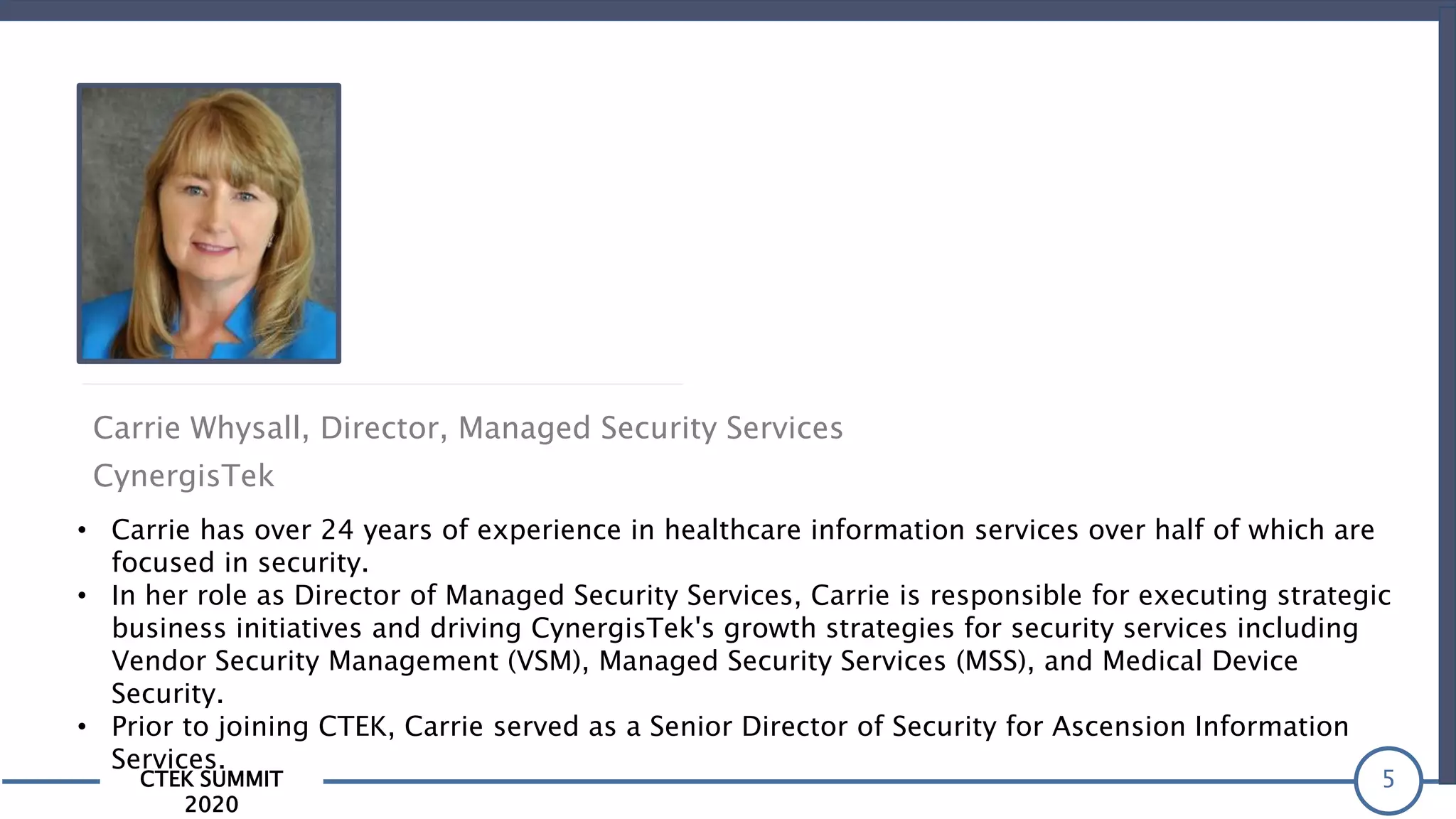
Carrie Whysall, Director, Managed Security Services
CynergisTek
• Carrie has over 24 years of experience in healthcare information services over half of which are
focused in security.
• In her role as Director of Managed Security Services, Carrie is responsible for executing strategic
business initiatives and driving CynergisTek's growth strategies for security services including
Vendor Security Management (VSM), Managed Security Services (MSS), and Medical Device
Security.
• Prior to joining CTEK, Carrie served as a Senior Director of Security for Ascension Information
Services.
CTEK SUMMIT
2020
Agenda
6
• Effective Risk Management Solutions
• Medical Device Security Services & Challenges
• Vulnerability Management
• Taking Steps to Apply Concepts
• Wrap-Up/Q&A
CTEK SUMMIT
2020
Medical Device Security
Services and Challenges
7
CTEK SUMMIT
2020
8
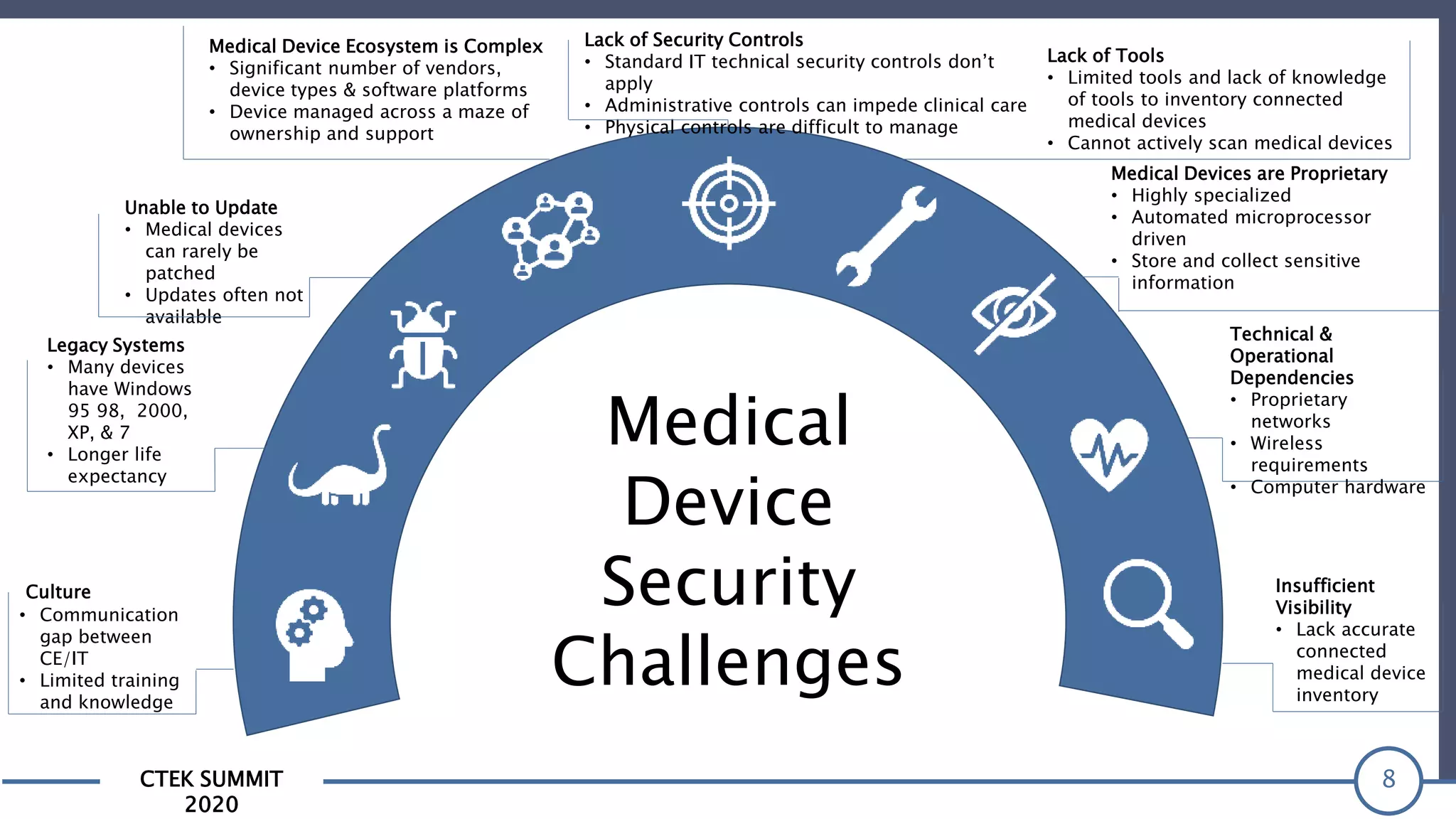
Insufficient
Visibility
• Lack accurate
connected
medical device
inventory
Medical Device Ecosystem is Complex
• Significant number of vendors,
device types & software platforms
• Device managed across a maze of
ownership and support
Unable to Update
• Medical devices
can rarely be
patched
• Updates often not
available
Legacy Systems
• Many devices
have Windows
95 98, 2000,
XP, & 7
• Longer life
expectancy
Culture
• Communication
gap between
CE/IT
• Limited training
and knowledge
Technical &
Operational
Dependencies
• Proprietary
networks
• Wireless
requirements
• Computer hardware
Medical Devices are Proprietary
• Highly specialized
• Automated microprocessor
driven
• Store and collect sensitive
information
Lack of Tools
• Limited tools and lack of knowledge
of tools to inventory connected
medical devices
• Cannot actively scan medical devices
Lack of Security Controls
• Standard IT technical security controls don’t
apply
• Administrative controls can impede clinical care
• Physical controls are difficult to manage
Medical
Device
Security
Challenges
CTEK SUMMIT
2020
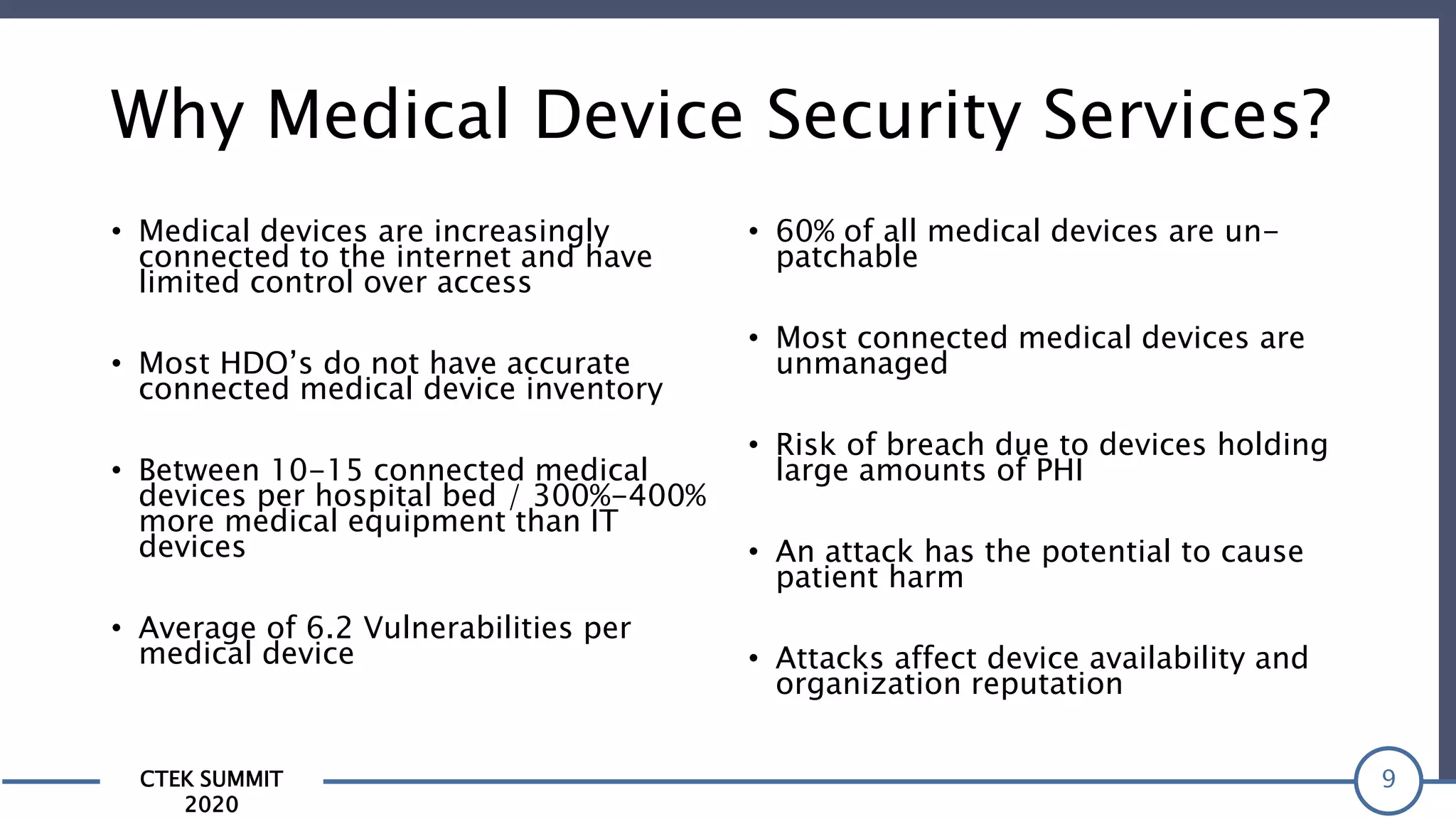
Why Medical Device Security Services?
• Medical devices are increasingly
connected to the internet and have
limited control over access
• Most HDO’s do not have accurate
connected medical device inventory
• Between 10-15 connected medical
devices per hospital bed / 300%-400%
more medical equipment than IT
devices
• Average of 6.2 Vulnerabilities per
medical device
• 60% of all medical devices are un-
patchable
• Most connected medical devices are
unmanaged
• Risk of breach due to devices holding
large amounts of PHI
• An attack has the potential to cause
patient harm
• Attacks affect device availability and
organization reputation
9
CTEK SUMMIT
2020
10
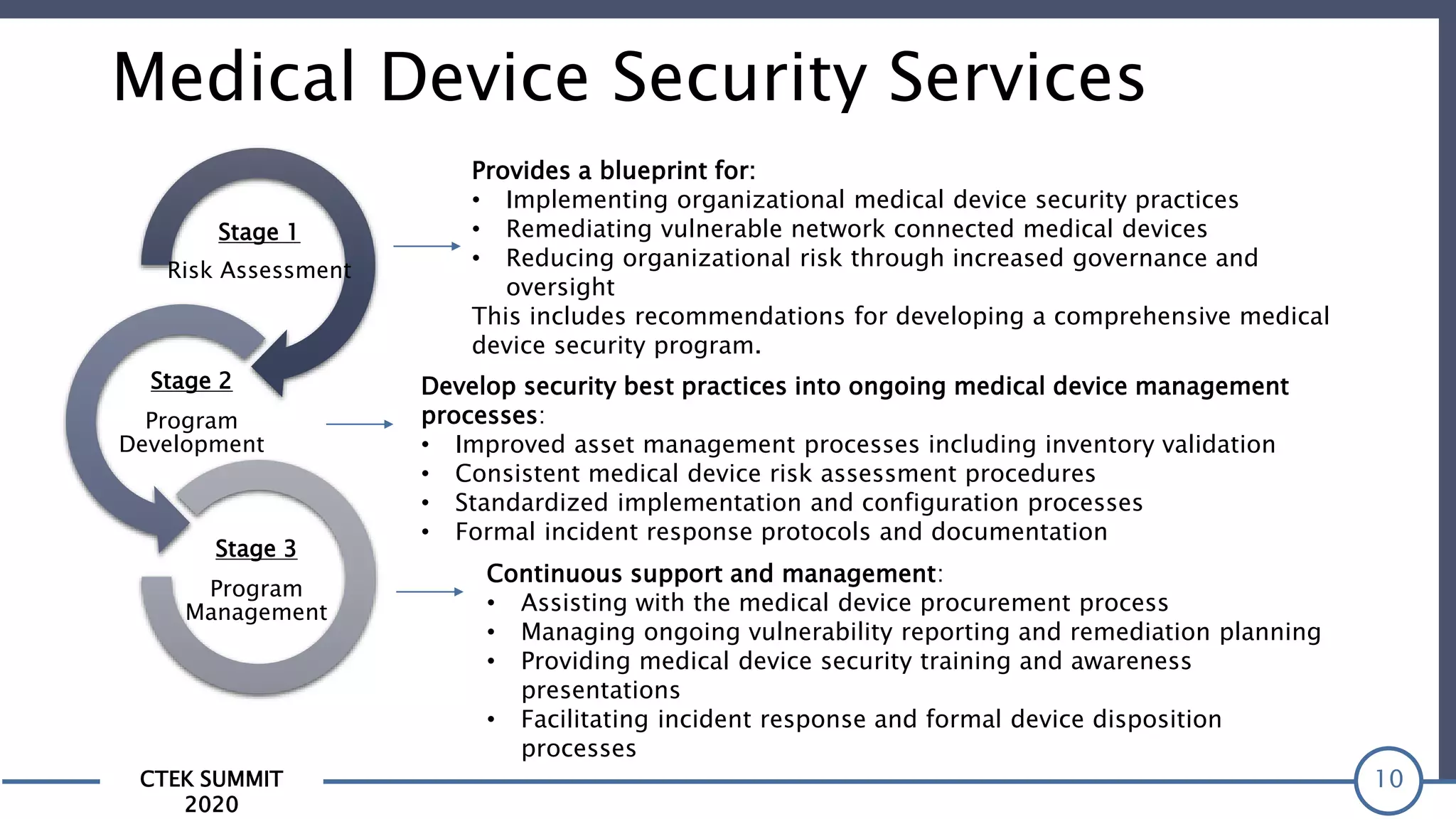
Stage 1
Risk Assessment
Stage 2
Program
Development
Stage 3
Program
Management
Provides a blueprint for:
• Implementing organizational medical device security practices
• Remediating vulnerable network connected medical devices
• Reducing organizational risk through increased governance and
oversight
This includes recommendations for developing a comprehensive medical
device security program.
Develop security best practices into ongoing medical device management
processes:
• Improved asset management processes including inventory validation
• Consistent medical device risk assessment procedures
• Standardized implementation and configuration processes
• Formal incident response protocols and documentation
Continuous support and management:
• Assisting with the medical device procurement process
• Managing ongoing vulnerability reporting and remediation planning
• Providing medical device security training and awareness
presentations
• Facilitating incident response and formal device disposition
processes
Medical Device Security Services
CTEK SUMMIT
2020
11
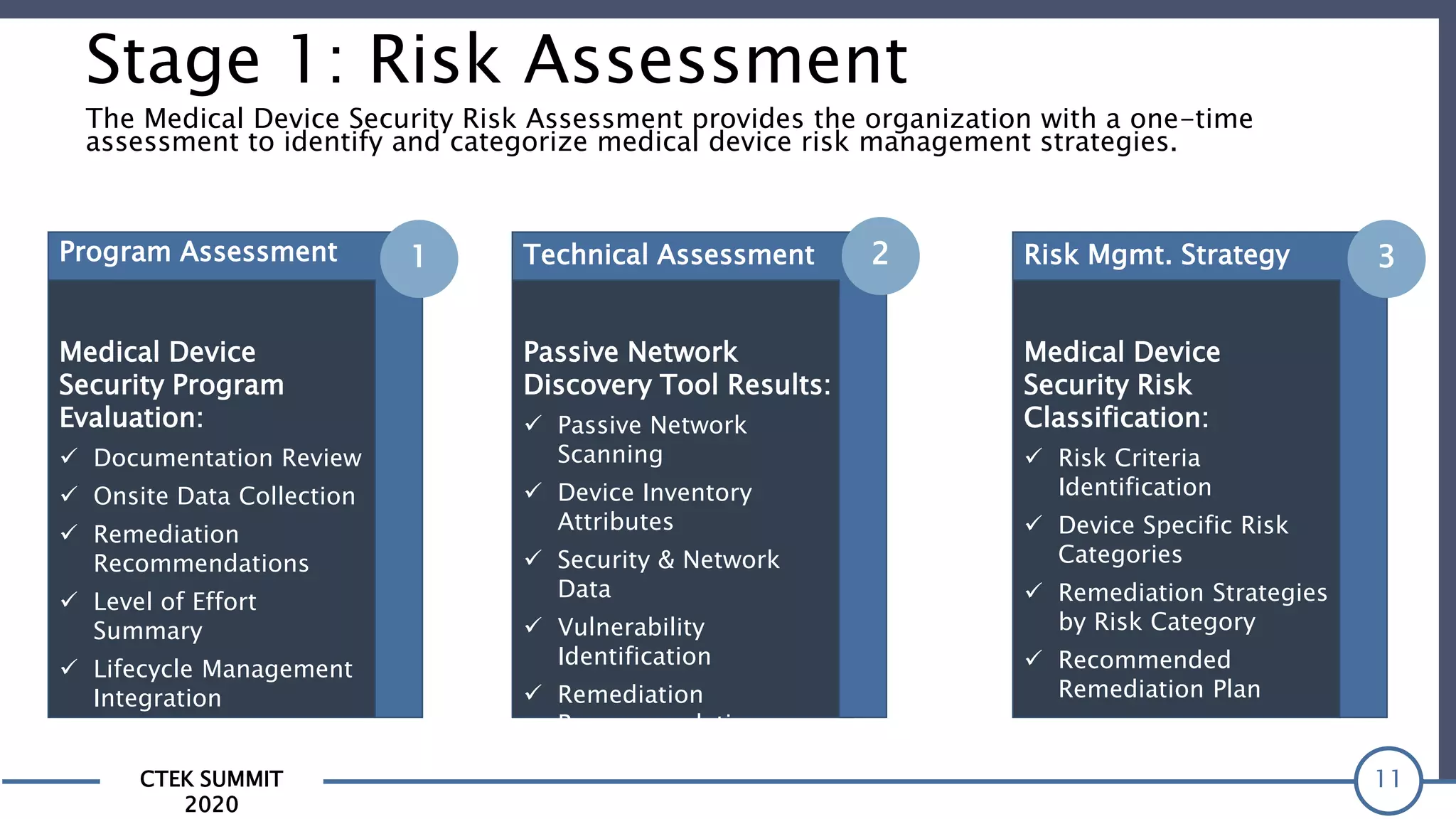
Stage 1: Risk Assessment
The Medical Device Security Risk Assessment provides the organization with a one-time
assessment to identify and categorize medical device risk management strategies.
Medical Device
Security Program
Evaluation:
 Documentation Review
 Onsite Data Collection
 Remediation
Recommendations
 Level of Effort
Summary
 Lifecycle Management
Integration
Passive Network
Discovery Tool Results:
 Passive Network
Scanning
 Device Inventory
Attributes
 Security & Network
Data
 Vulnerability
Identification
 Remediation
Recommendations
Medical Device
Security Risk
Classification:
 Risk Criteria
Identification
 Device Specific Risk
Categories
 Remediation Strategies
by Risk Category
 Recommended
Remediation Plan
1Program Assessment Technical Assessment Risk Mgmt. Strategy2 3
CTEK SUMMIT
2020
12
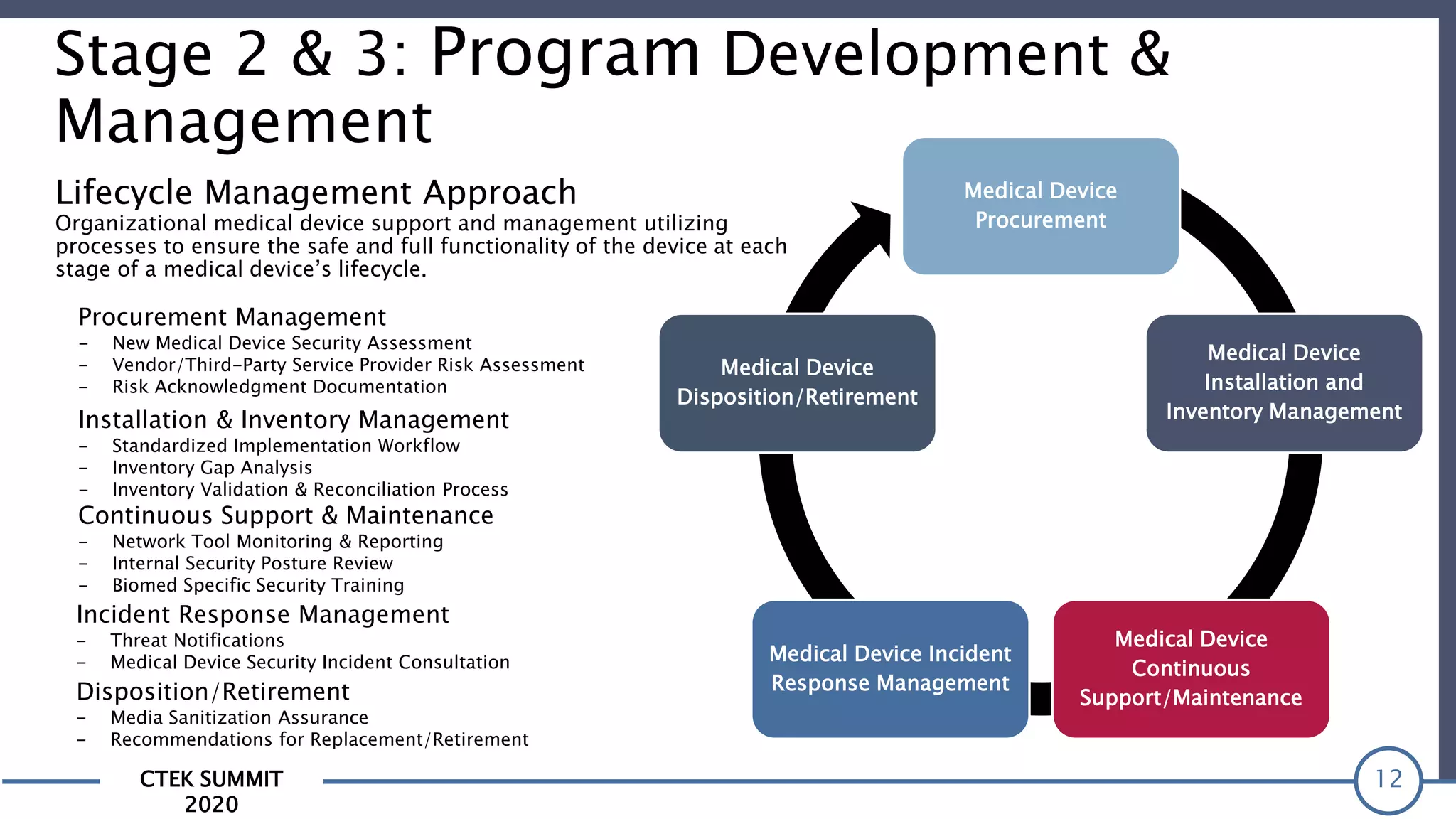
Stage 2 & 3: Program Development &
Management
Medical Device
Procurement
Medical Device
Installation and
Inventory Management
Medical Device
Continuous
Support/Maintenance
Medical Device Incident
Response Management
Medical Device
Disposition/Retirement
Procurement Management
- New Medical Device Security Assessment
- Vendor/Third-Party Service Provider Risk Assessment
- Risk Acknowledgment Documentation
Installation & Inventory Management
- Standardized Implementation Workflow
- Inventory Gap Analysis
- Inventory Validation & Reconciliation Process
Continuous Support & Maintenance
- Network Tool Monitoring & Reporting
- Internal Security Posture Review
- Biomed Specific Security Training
Incident Response Management
- Threat Notifications
- Medical Device Security Incident Consultation
Disposition/Retirement
- Media Sanitization Assurance
- Recommendations for Replacement/Retirement
Lifecycle Management Approach
Organizational medical device support and management utilizing
processes to ensure the safe and full functionality of the device at each
stage of a medical device’s lifecycle.
CTEK SUMMIT
2020
Effective Risk Management
Solutions
13
CTEK SUMMIT
2020
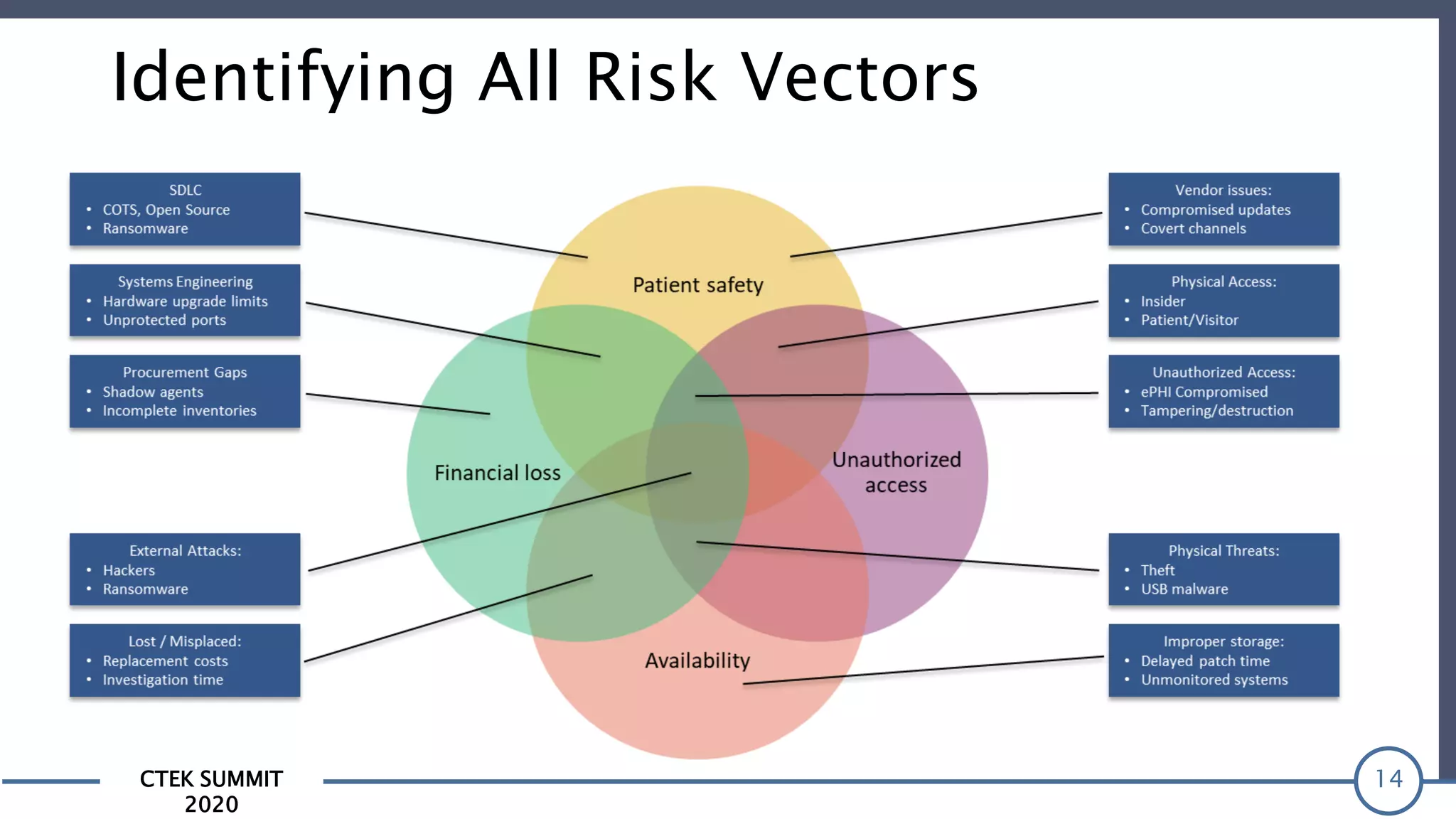
14
Identifying All Risk Vectors
CTEK SUMMIT
2020
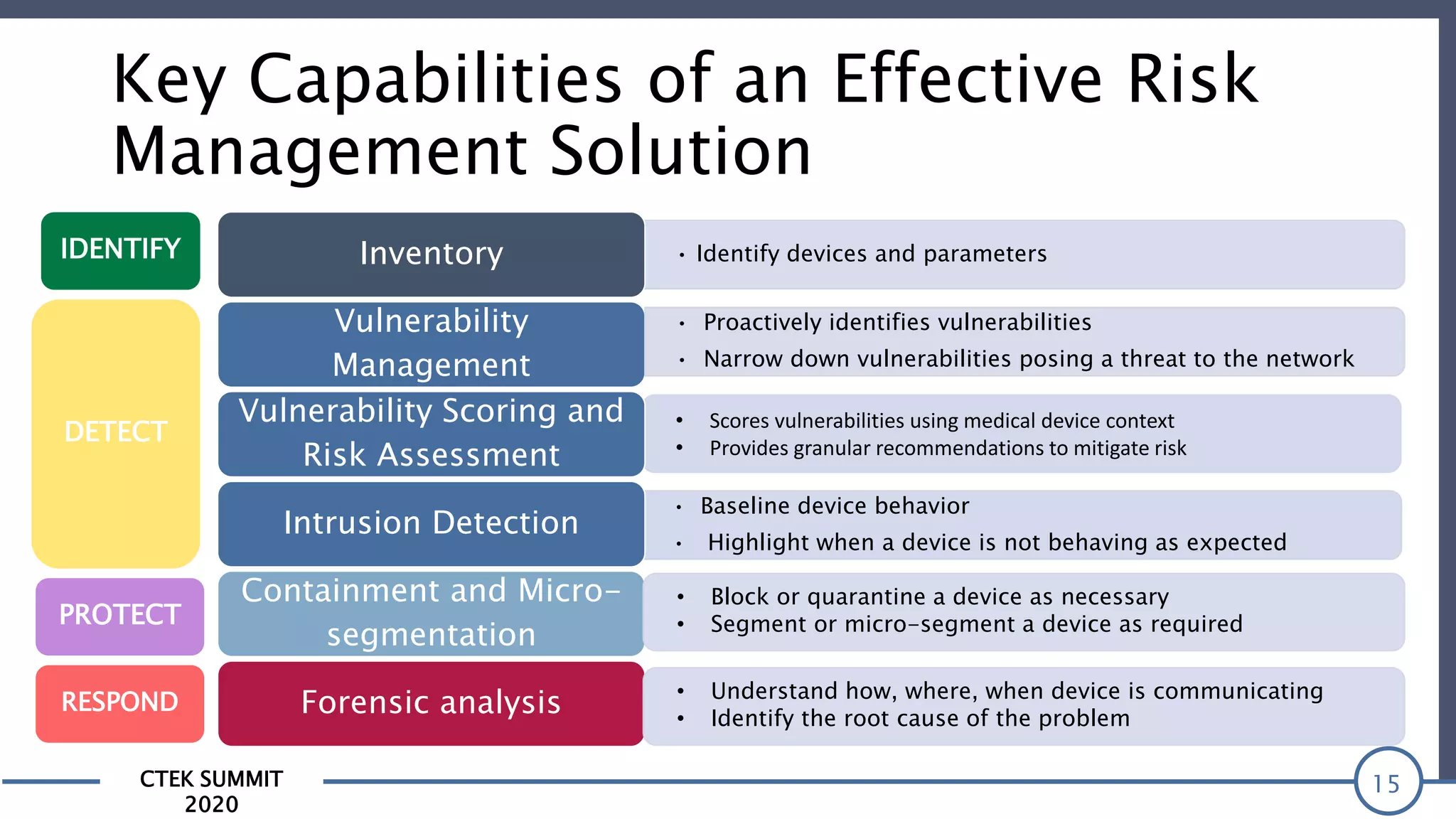
• Scores vulnerabilities using medical device context
• Provides granular recommendations to mitigate risk
Key Capabilities of an Effective Risk
Management Solution
15
• Identify devices and parametersInventory
• Baseline device behavior
• Highlight when a device is not behaving as expected
Vulnerability
Management
• Proactively identifies vulnerabilities
• Narrow down vulnerabilities posing a threat to the network
Vulnerability Scoring and
Risk Assessment
Intrusion Detection
Containment and Micro-
segmentation
Forensic analysis
• Block or quarantine a device as necessary
• Segment or micro-segment a device as required
• Understand how, where, when device is communicating
• Identify the root cause of the problem
IDENTIFY
DETECT
PROTECT
RESPOND
CTEK SUMMIT
2020
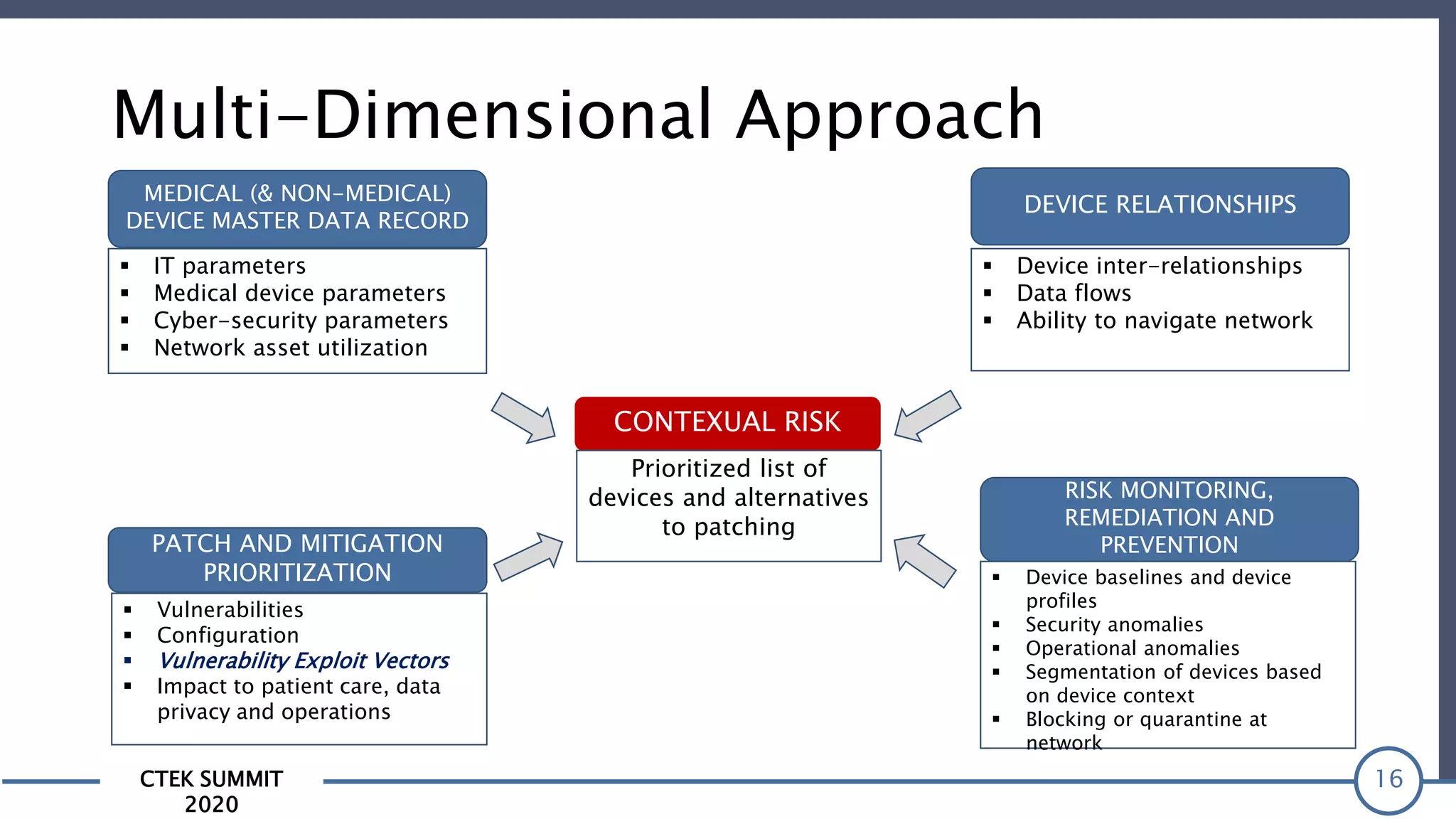
Multi-Dimensional Approach
16
MEDICAL (& NON-MEDICAL)
DEVICE MASTER DATA RECORD
 IT parameters
 Medical device parameters
 Cyber-security parameters
 Network asset utilization
DEVICE RELATIONSHIPS
 Device inter-relationships
 Data flows
 Ability to navigate network
CONTEXUAL RISK
Prioritized list of
devices and alternatives
to patching
PATCH AND MITIGATION
PRIORITIZATION
 Vulnerabilities
 Configuration
 Vulnerability Exploit Vectors
 Impact to patient care, data
privacy and operations
RISK MONITORING,
REMEDIATION AND
PREVENTION
 Device baselines and device
profiles
 Security anomalies
 Operational anomalies
 Segmentation of devices based
on device context
 Blocking or quarantine at
network
CTEK SUMMIT
2020
Medical Device
Vulnerability Management
17
CTEK SUMMIT
2020
Vulnerability Management
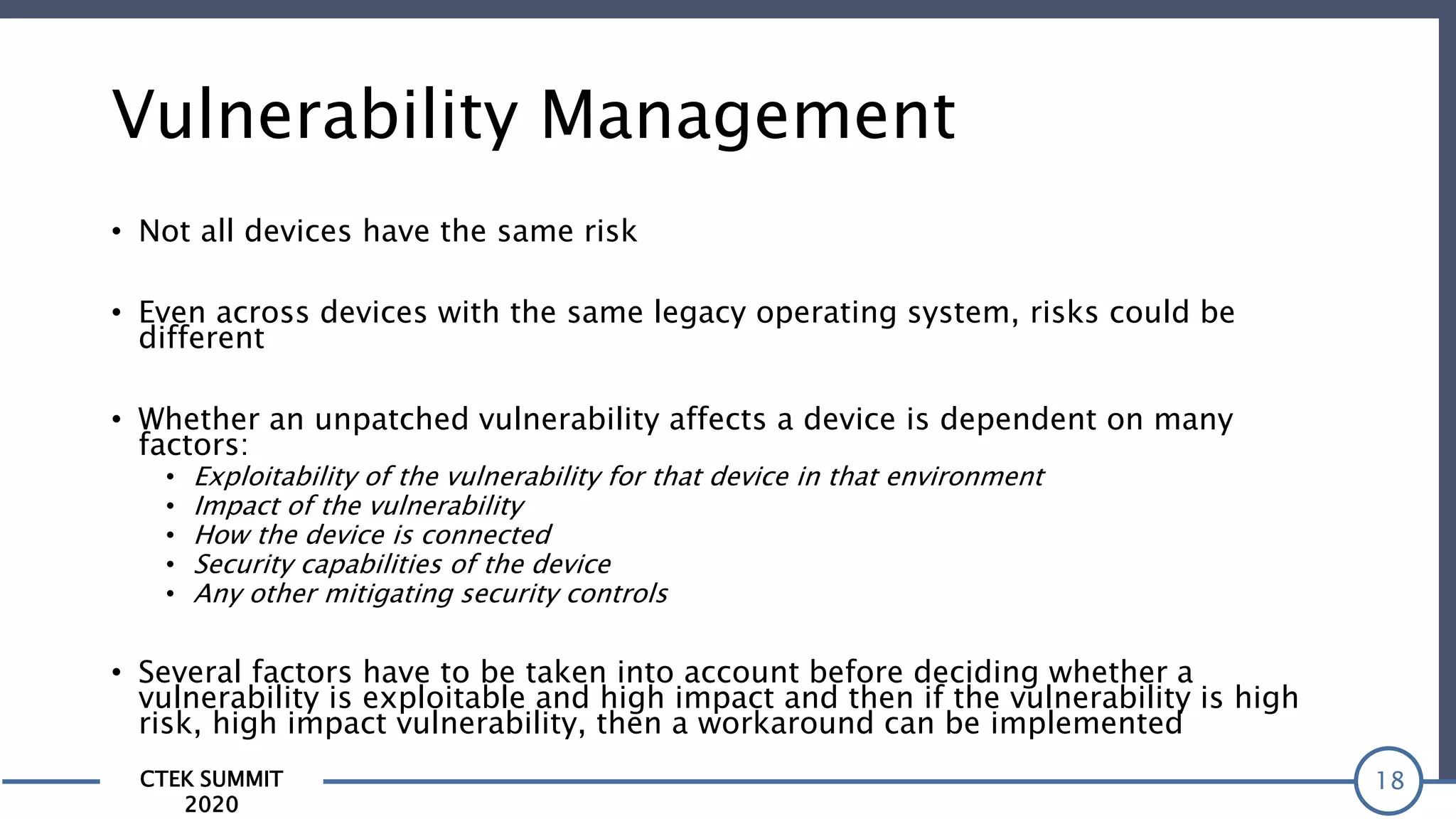
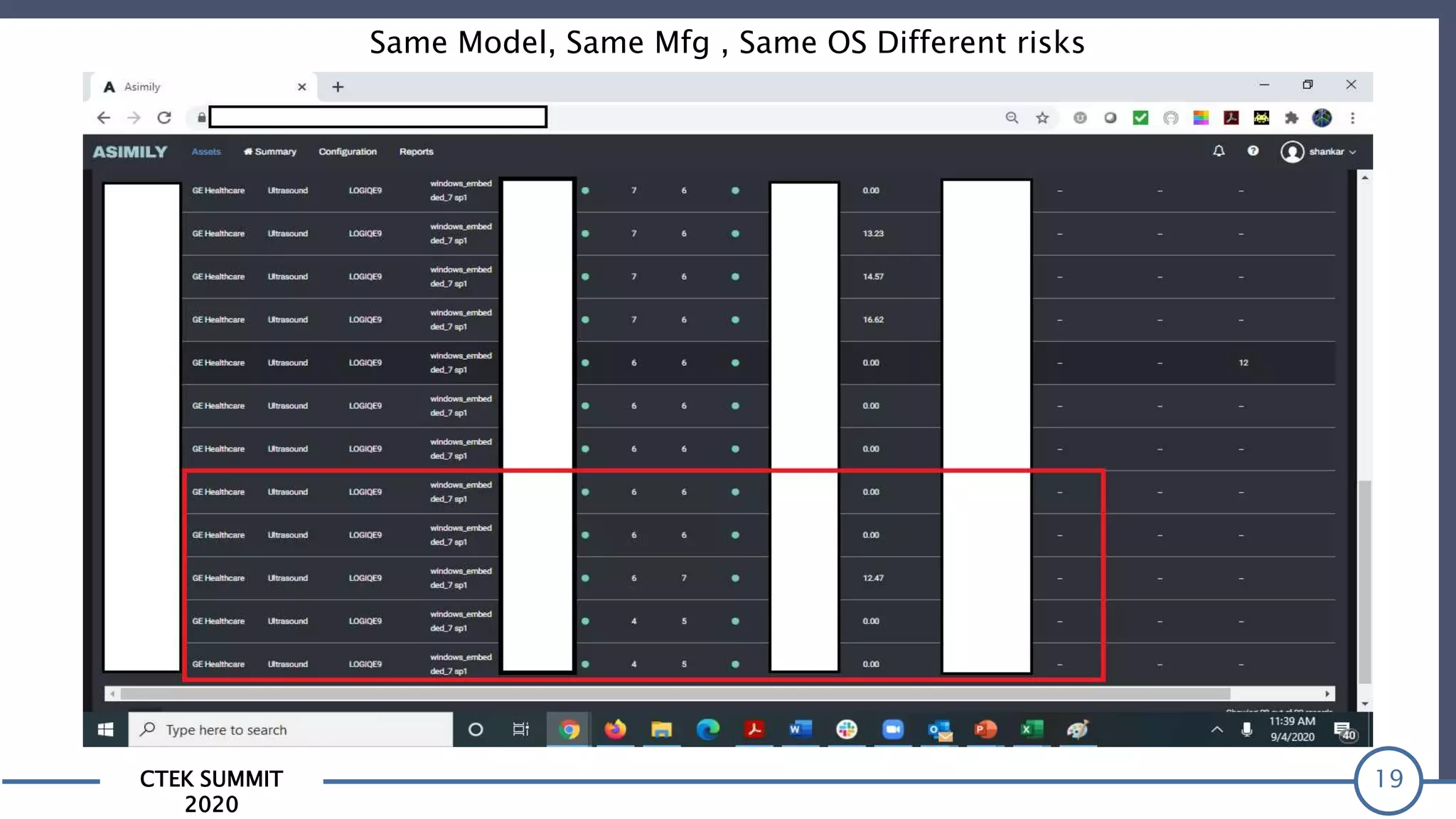
• Not all devices have the same risk
• Even across devices with the same legacy operating system, risks could be
different
• Whether an unpatched vulnerability affects a device is dependent on many
factors:
• Exploitability of the vulnerability for that device in that environment
• Impact of the vulnerability
• How the device is connected
• Security capabilities of the device
• Any other mitigating security controls
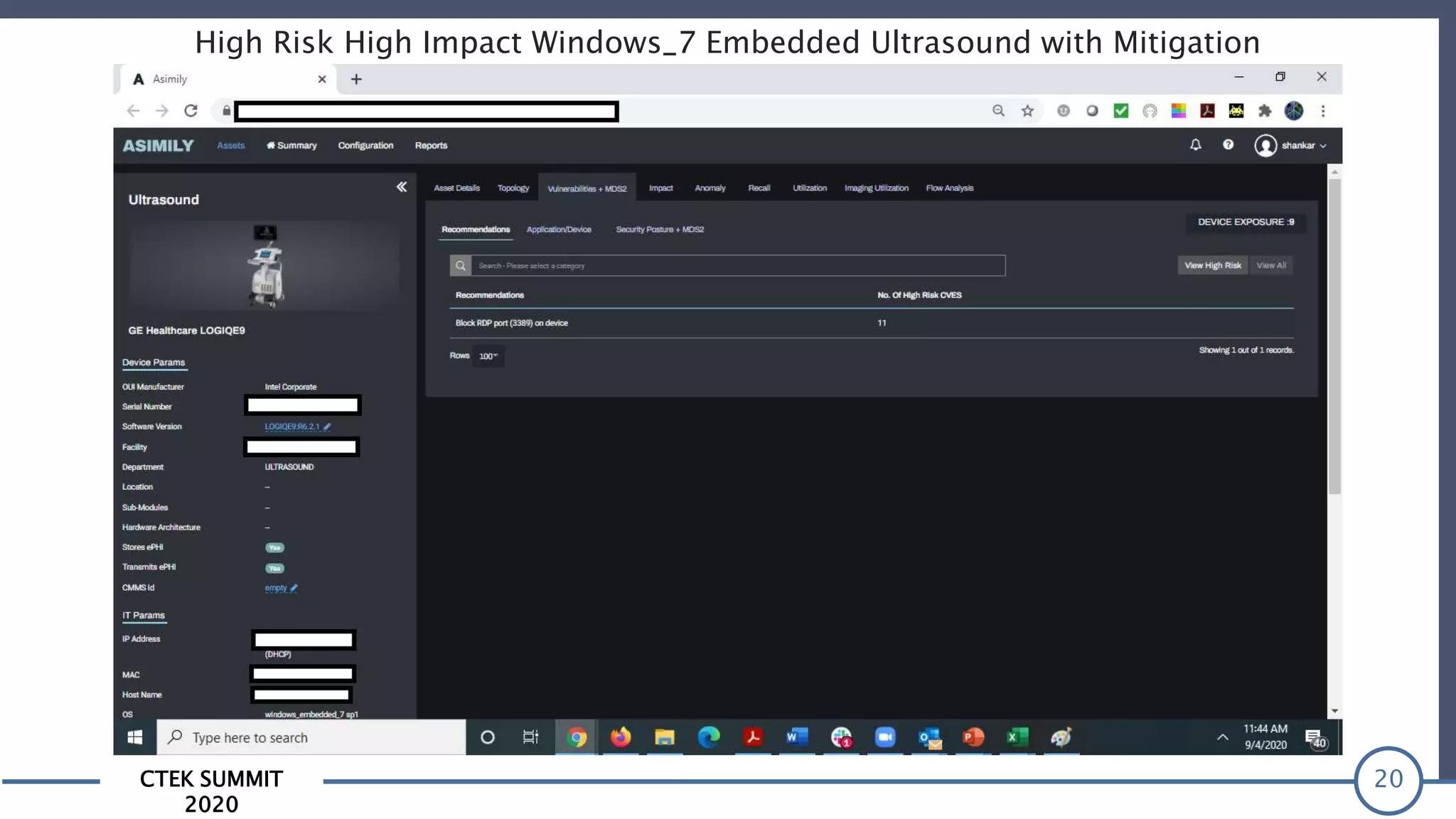
• Several factors have to be taken into account before deciding whether a
vulnerability is exploitable and high impact and then if the vulnerability is high
risk, high impact vulnerability, then a workaround can be implemented
18
CTEK SUMMIT
2020
Same Model, Same Mfg , Same OS Different risks
19
CTEK SUMMIT
2020
High Risk High Impact Windows_7 Embedded Ultrasound with Mitigation
20
CTEK SUMMIT
2020
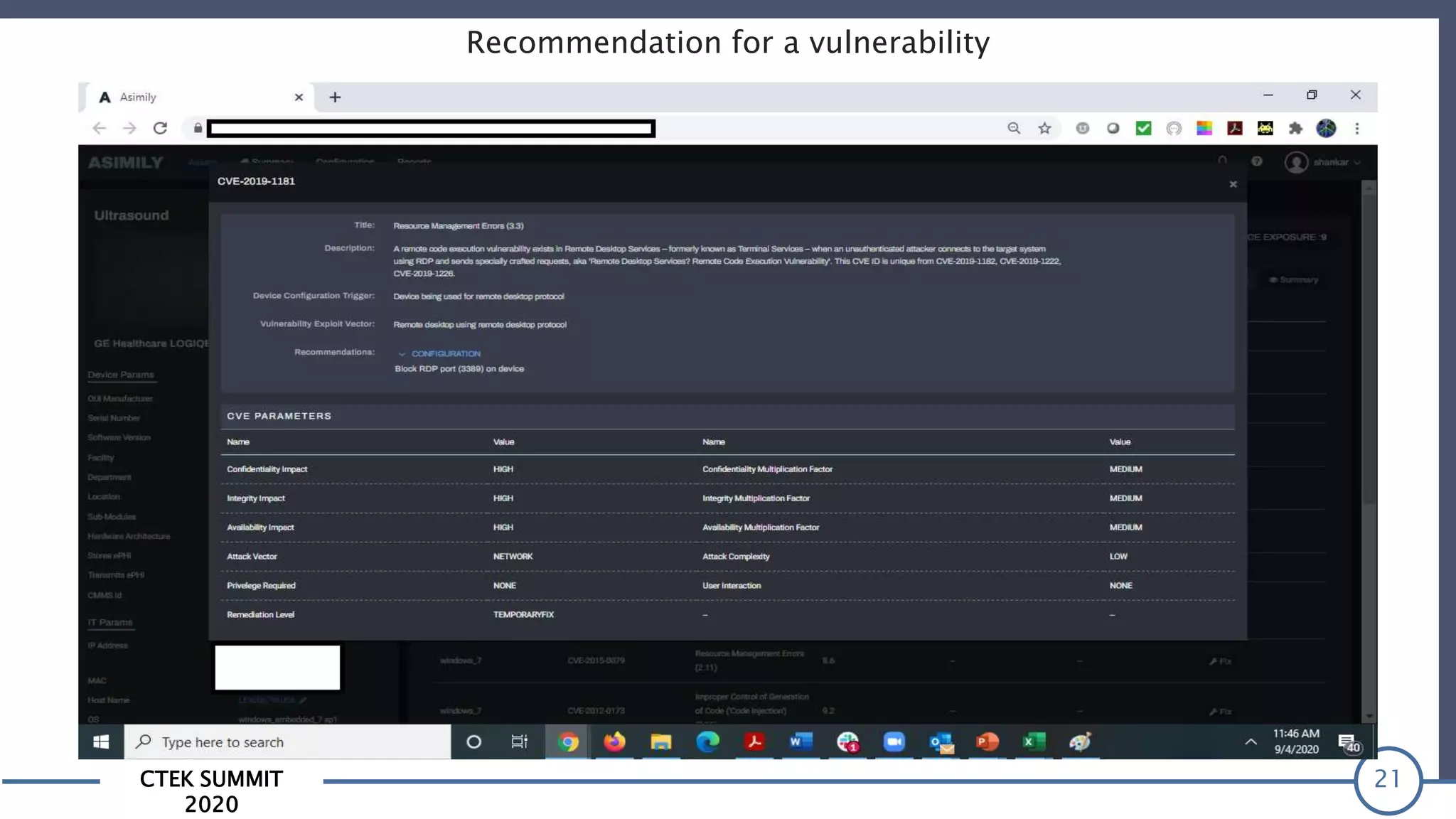
Recommendation for a vulnerability
21
CTEK SUMMIT
2020
Medical Device Security -
Taking Steps to Apply
These Concepts
22
CTEK SUMMIT
2020
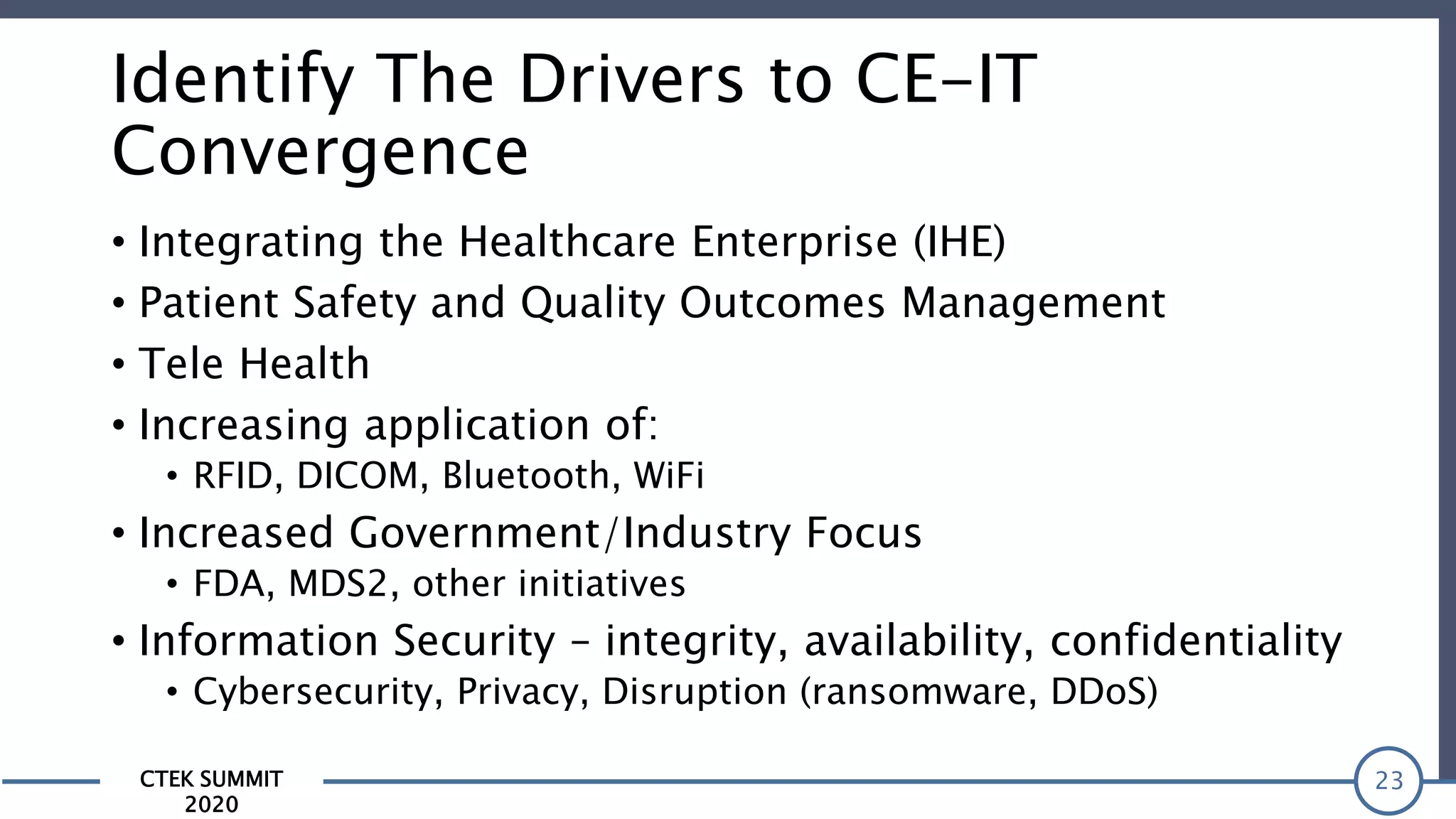
Identify The Drivers to CE-IT
Convergence
• Integrating the Healthcare Enterprise (IHE)
• Patient Safety and Quality Outcomes Management
• Tele Health
• Increasing application of:
• RFID, DICOM, Bluetooth, WiFi
• Increased Government/Industry Focus
• FDA, MDS2, other initiatives
• Information Security – integrity, availability, confidentiality
• Cybersecurity, Privacy, Disruption (ransomware, DDoS)
23
CTEK SUMMIT
2020
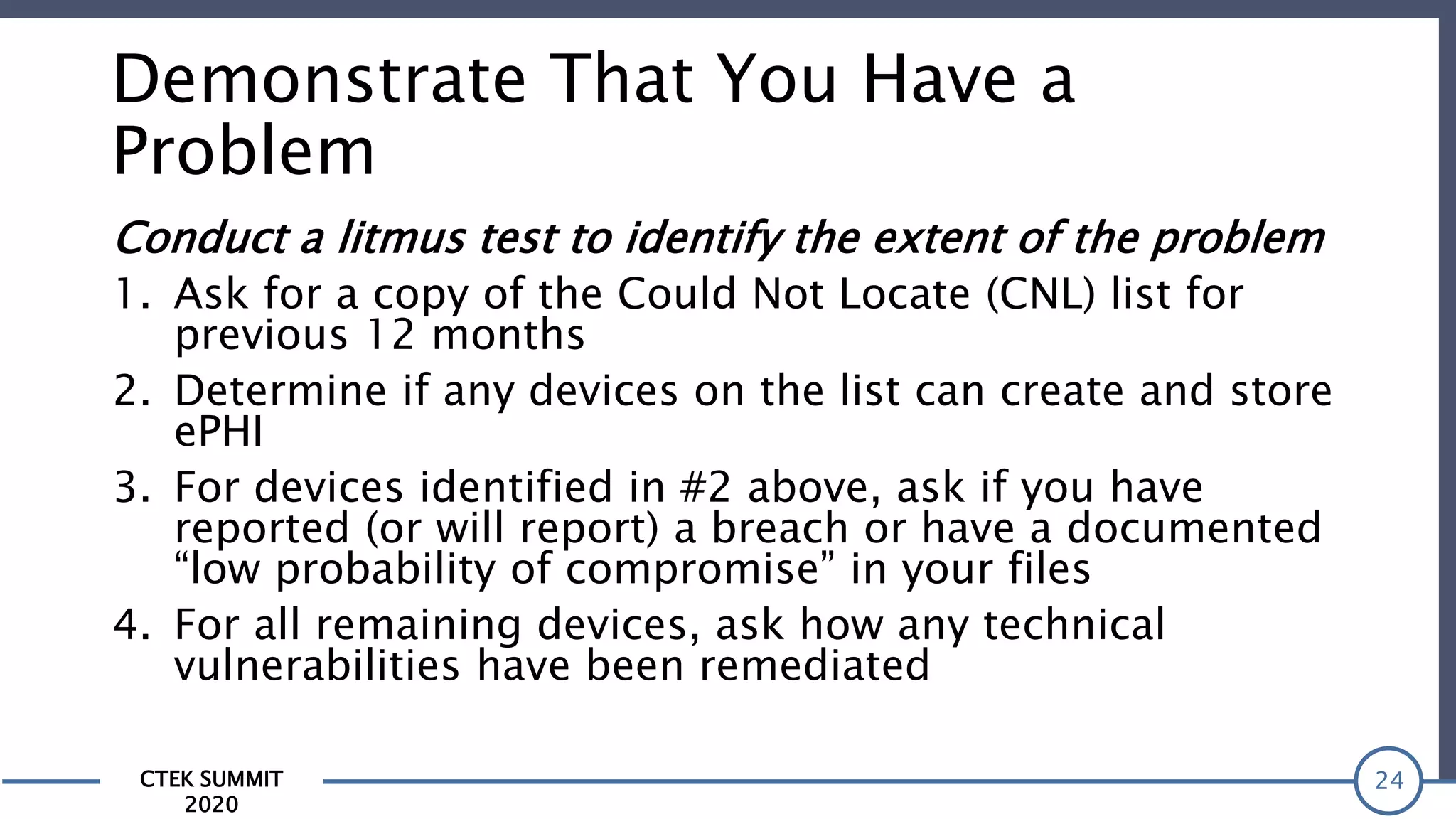
Demonstrate That You Have a
Problem
Conduct a litmus test to identify the extent of the problem
1. Ask for a copy of the Could Not Locate (CNL) list for
previous 12 months
2. Determine if any devices on the list can create and store
ePHI
3. For devices identified in #2 above, ask if you have
reported (or will report) a breach or have a documented
“low probability of compromise” in your files
4. For all remaining devices, ask how any technical
vulnerabilities have been remediated
24
CTEK SUMMIT
2020
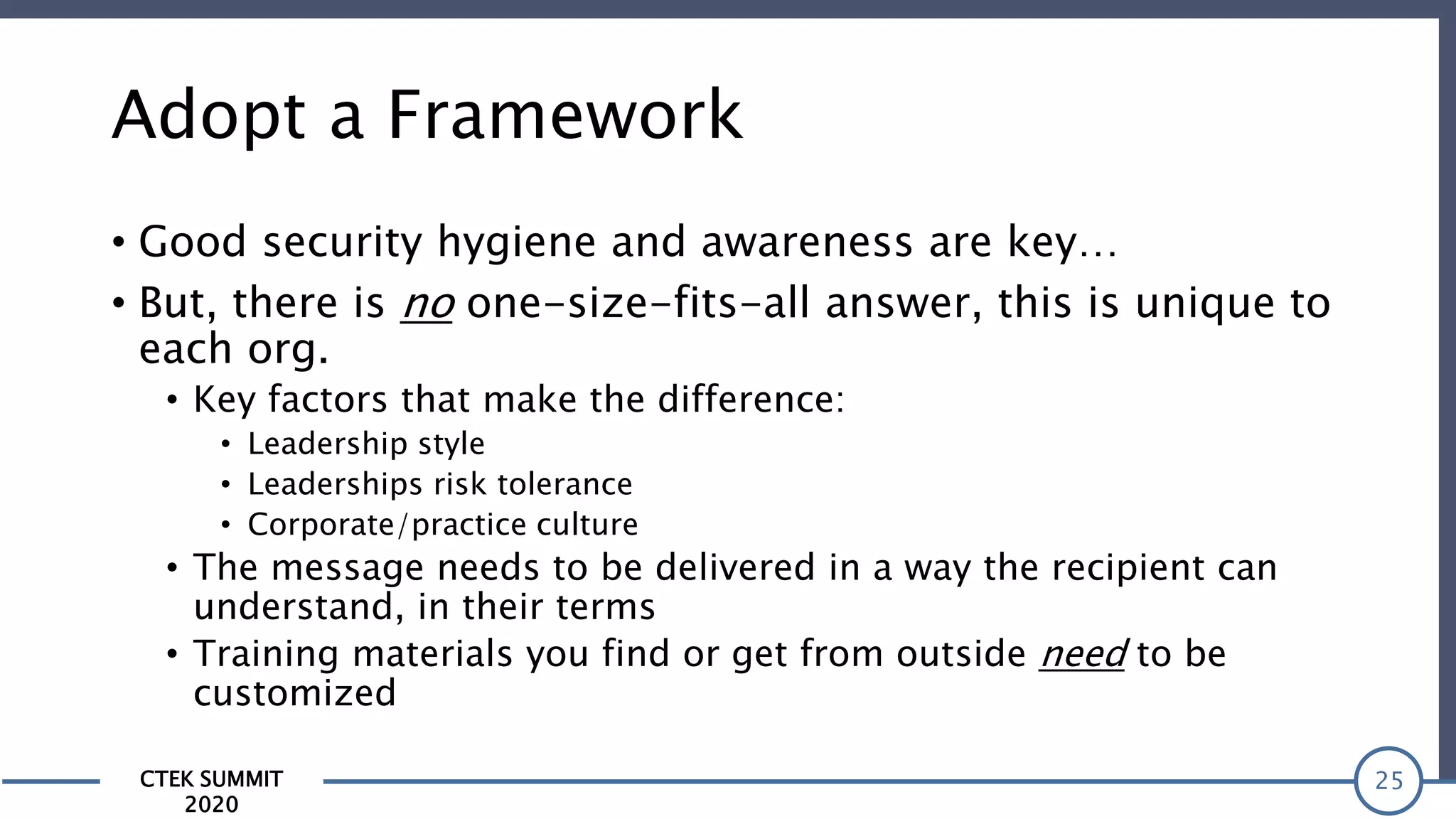
Adopt a Framework
• Good security hygiene and awareness are key…
• But, there is no one-size-fits-all answer, this is unique to
each org.
• Key factors that make the difference:
• Leadership style
• Leaderships risk tolerance
• Corporate/practice culture
• The message needs to be delivered in a way the recipient can
understand, in their terms
• Training materials you find or get from outside need to be
customized
25
CTEK SUMMIT
2020
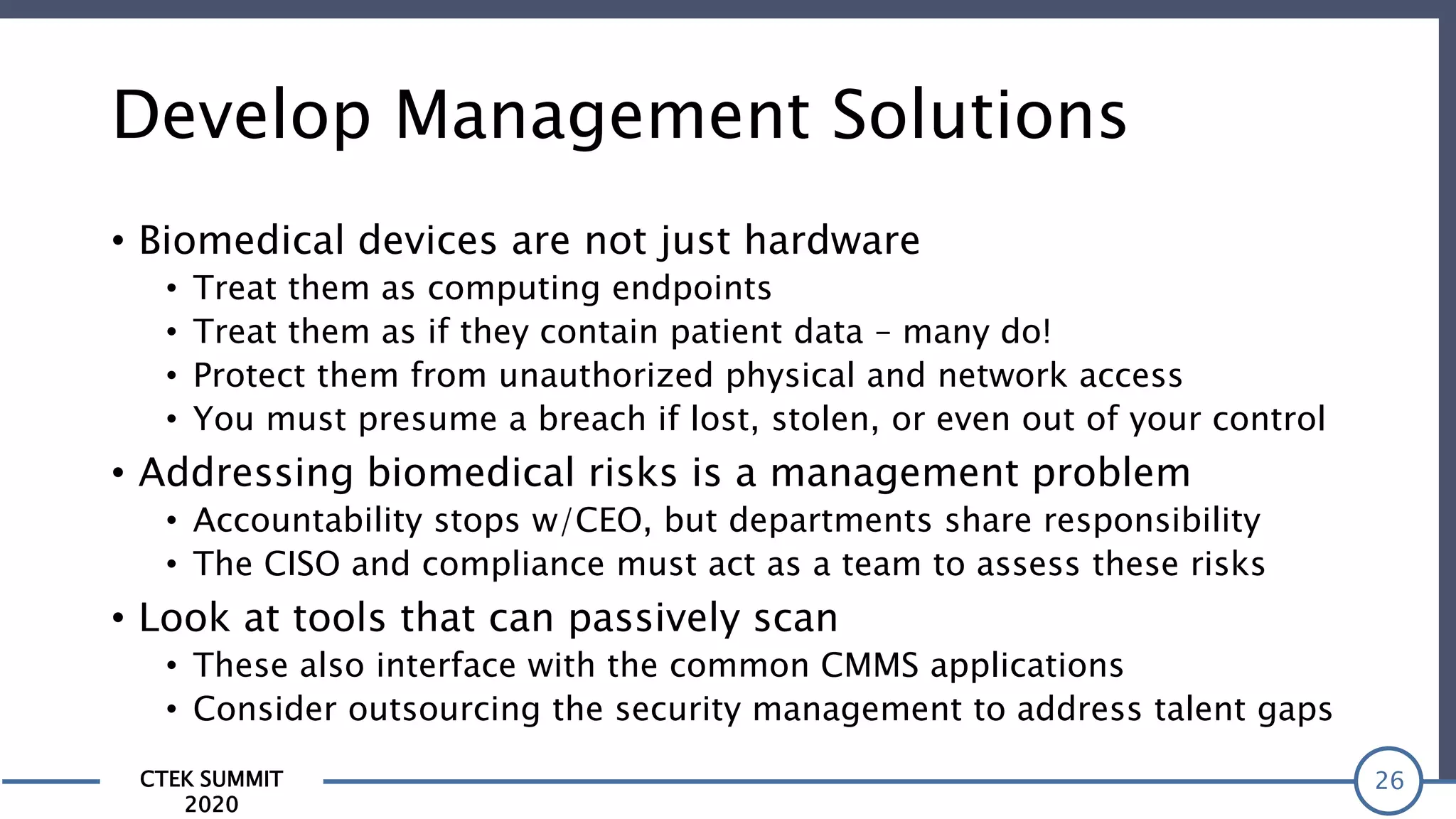
Develop Management Solutions
• Biomedical devices are not just hardware
• Treat them as computing endpoints
• Treat them as if they contain patient data – many do!
• Protect them from unauthorized physical and network access
• You must presume a breach if lost, stolen, or even out of your control
• Addressing biomedical risks is a management problem
• Accountability stops w/CEO, but departments share responsibility
• The CISO and compliance must act as a team to assess these risks
• Look at tools that can passively scan
• These also interface with the common CMMS applications
• Consider outsourcing the security management to address talent gaps
26
CTEK SUMMIT
2020
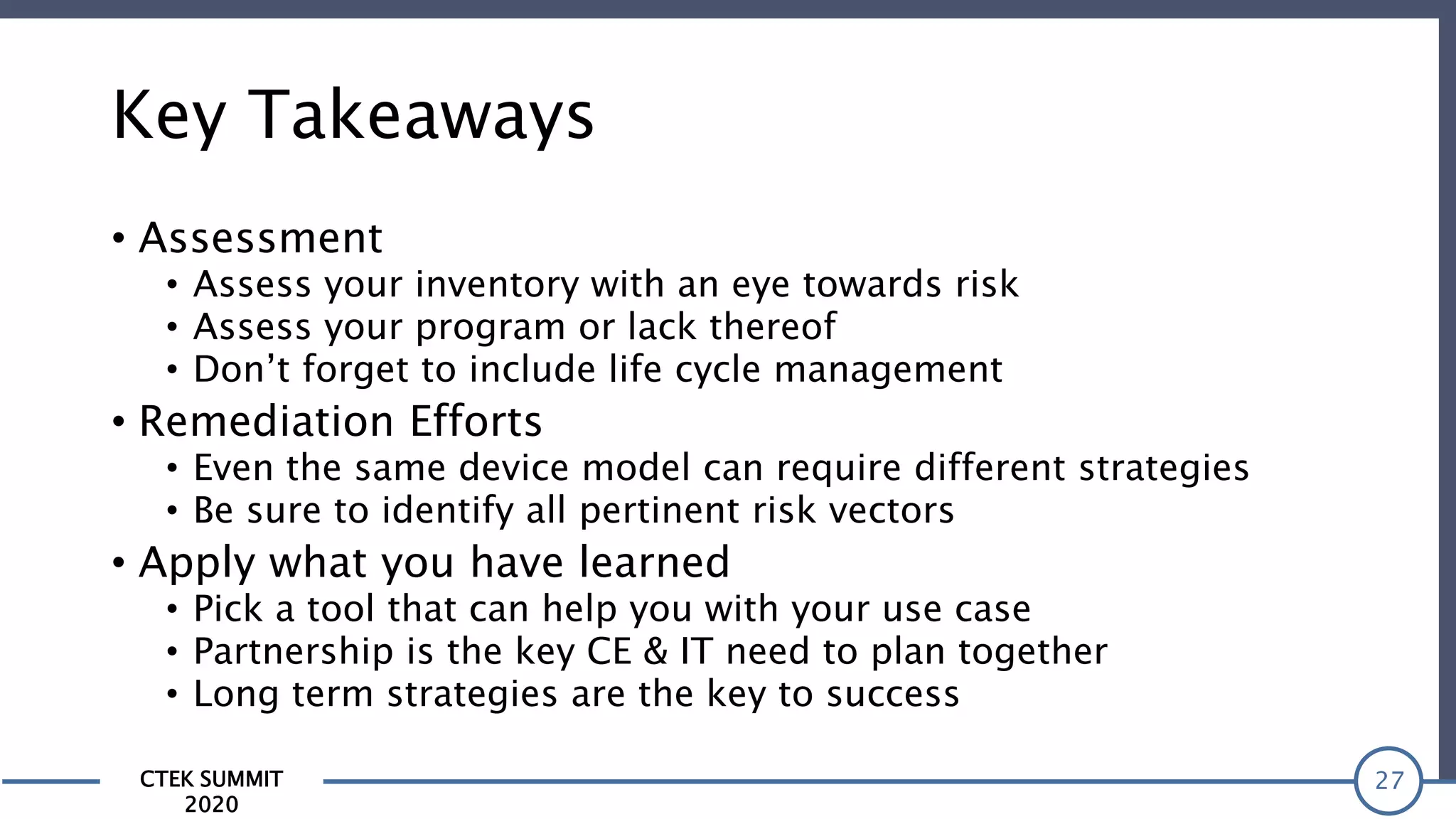
Key Takeaways
• Assessment
• Assess your inventory with an eye towards risk
• Assess your program or lack thereof
• Don’t forget to include life cycle management
• Remediation Efforts
• Even the same device model can require different strategies
• Be sure to identify all pertinent risk vectors
• Apply what you have learned
• Pick a tool that can help you with your use case
• Partnership is the key CE & IT need to plan together
• Long term strategies are the key to success
27
CTEK SUMMIT
2020
THANK YOU
• priyanka.upendra@bannerhealth.com
• shankar@asimily.com
• carrie.whysall@cynergistek.com
28

Network Connected Medical Devices - A Case Study

  • 1.
  • 2.
    CTEK SUMMIT 2020 2 Medical DeviceSecurity Services Overview
  • 3.
    CTEK SUMMIT 2020 3 Priya Upendra,Quality &Compliance Director Banner Health • 1 • 2 • 3
  • 4.
    CTEK SUMMIT 2020 4 Shankar Somasundaram,CEO Asimily • Asimily is a company focused on Healthcare, Medical and Connected Device Inventory, Cybersecurity, and Operational Management working with Health systems across the country • Shankar has been involved on the topic of medical devices since 2011. • Shankar has been a contributor and part of many industry frameworks like NIST, TIR 57 and more!
  • 5.
    CTEK SUMMIT 2020 5 Carrie Whysall,Director, Managed Security Services CynergisTek • Carrie has over 24 years of experience in healthcare information services over half of which are focused in security. • In her role as Director of Managed Security Services, Carrie is responsible for executing strategic business initiatives and driving CynergisTek's growth strategies for security services including Vendor Security Management (VSM), Managed Security Services (MSS), and Medical Device Security. • Prior to joining CTEK, Carrie served as a Senior Director of Security for Ascension Information Services.
  • 6.
    CTEK SUMMIT 2020 Agenda 6 • EffectiveRisk Management Solutions • Medical Device Security Services & Challenges • Vulnerability Management • Taking Steps to Apply Concepts • Wrap-Up/Q&A
  • 7.
    CTEK SUMMIT 2020 Medical DeviceSecurity Services and Challenges 7
  • 8.
    CTEK SUMMIT 2020 8 Insufficient Visibility • Lackaccurate connected medical device inventory Medical Device Ecosystem is Complex • Significant number of vendors, device types & software platforms • Device managed across a maze of ownership and support Unable to Update • Medical devices can rarely be patched • Updates often not available Legacy Systems • Many devices have Windows 95 98, 2000, XP, & 7 • Longer life expectancy Culture • Communication gap between CE/IT • Limited training and knowledge Technical & Operational Dependencies • Proprietary networks • Wireless requirements • Computer hardware Medical Devices are Proprietary • Highly specialized • Automated microprocessor driven • Store and collect sensitive information Lack of Tools • Limited tools and lack of knowledge of tools to inventory connected medical devices • Cannot actively scan medical devices Lack of Security Controls • Standard IT technical security controls don’t apply • Administrative controls can impede clinical care • Physical controls are difficult to manage Medical Device Security Challenges
  • 9.
    CTEK SUMMIT 2020 Why MedicalDevice Security Services? • Medical devices are increasingly connected to the internet and have limited control over access • Most HDO’s do not have accurate connected medical device inventory • Between 10-15 connected medical devices per hospital bed / 300%-400% more medical equipment than IT devices • Average of 6.2 Vulnerabilities per medical device • 60% of all medical devices are un- patchable • Most connected medical devices are unmanaged • Risk of breach due to devices holding large amounts of PHI • An attack has the potential to cause patient harm • Attacks affect device availability and organization reputation 9
  • 10.
    CTEK SUMMIT 2020 10 Stage 1 RiskAssessment Stage 2 Program Development Stage 3 Program Management Provides a blueprint for: • Implementing organizational medical device security practices • Remediating vulnerable network connected medical devices • Reducing organizational risk through increased governance and oversight This includes recommendations for developing a comprehensive medical device security program. Develop security best practices into ongoing medical device management processes: • Improved asset management processes including inventory validation • Consistent medical device risk assessment procedures • Standardized implementation and configuration processes • Formal incident response protocols and documentation Continuous support and management: • Assisting with the medical device procurement process • Managing ongoing vulnerability reporting and remediation planning • Providing medical device security training and awareness presentations • Facilitating incident response and formal device disposition processes Medical Device Security Services
  • 11.
    CTEK SUMMIT 2020 11 Stage 1:Risk Assessment The Medical Device Security Risk Assessment provides the organization with a one-time assessment to identify and categorize medical device risk management strategies. Medical Device Security Program Evaluation:  Documentation Review  Onsite Data Collection  Remediation Recommendations  Level of Effort Summary  Lifecycle Management Integration Passive Network Discovery Tool Results:  Passive Network Scanning  Device Inventory Attributes  Security & Network Data  Vulnerability Identification  Remediation Recommendations Medical Device Security Risk Classification:  Risk Criteria Identification  Device Specific Risk Categories  Remediation Strategies by Risk Category  Recommended Remediation Plan 1Program Assessment Technical Assessment Risk Mgmt. Strategy2 3
  • 12.
    CTEK SUMMIT 2020 12 Stage 2& 3: Program Development & Management Medical Device Procurement Medical Device Installation and Inventory Management Medical Device Continuous Support/Maintenance Medical Device Incident Response Management Medical Device Disposition/Retirement Procurement Management - New Medical Device Security Assessment - Vendor/Third-Party Service Provider Risk Assessment - Risk Acknowledgment Documentation Installation & Inventory Management - Standardized Implementation Workflow - Inventory Gap Analysis - Inventory Validation & Reconciliation Process Continuous Support & Maintenance - Network Tool Monitoring & Reporting - Internal Security Posture Review - Biomed Specific Security Training Incident Response Management - Threat Notifications - Medical Device Security Incident Consultation Disposition/Retirement - Media Sanitization Assurance - Recommendations for Replacement/Retirement Lifecycle Management Approach Organizational medical device support and management utilizing processes to ensure the safe and full functionality of the device at each stage of a medical device’s lifecycle.
  • 13.
    CTEK SUMMIT 2020 Effective RiskManagement Solutions 13
  • 14.
  • 15.
    CTEK SUMMIT 2020 • Scoresvulnerabilities using medical device context • Provides granular recommendations to mitigate risk Key Capabilities of an Effective Risk Management Solution 15 • Identify devices and parametersInventory • Baseline device behavior • Highlight when a device is not behaving as expected Vulnerability Management • Proactively identifies vulnerabilities • Narrow down vulnerabilities posing a threat to the network Vulnerability Scoring and Risk Assessment Intrusion Detection Containment and Micro- segmentation Forensic analysis • Block or quarantine a device as necessary • Segment or micro-segment a device as required • Understand how, where, when device is communicating • Identify the root cause of the problem IDENTIFY DETECT PROTECT RESPOND
  • 16.
    CTEK SUMMIT 2020 Multi-Dimensional Approach 16 MEDICAL(& NON-MEDICAL) DEVICE MASTER DATA RECORD  IT parameters  Medical device parameters  Cyber-security parameters  Network asset utilization DEVICE RELATIONSHIPS  Device inter-relationships  Data flows  Ability to navigate network CONTEXUAL RISK Prioritized list of devices and alternatives to patching PATCH AND MITIGATION PRIORITIZATION  Vulnerabilities  Configuration  Vulnerability Exploit Vectors  Impact to patient care, data privacy and operations RISK MONITORING, REMEDIATION AND PREVENTION  Device baselines and device profiles  Security anomalies  Operational anomalies  Segmentation of devices based on device context  Blocking or quarantine at network
  • 17.
  • 18.
    CTEK SUMMIT 2020 Vulnerability Management •Not all devices have the same risk • Even across devices with the same legacy operating system, risks could be different • Whether an unpatched vulnerability affects a device is dependent on many factors: • Exploitability of the vulnerability for that device in that environment • Impact of the vulnerability • How the device is connected • Security capabilities of the device • Any other mitigating security controls • Several factors have to be taken into account before deciding whether a vulnerability is exploitable and high impact and then if the vulnerability is high risk, high impact vulnerability, then a workaround can be implemented 18
  • 19.
    CTEK SUMMIT 2020 Same Model,Same Mfg , Same OS Different risks 19
  • 20.
    CTEK SUMMIT 2020 High RiskHigh Impact Windows_7 Embedded Ultrasound with Mitigation 20
  • 21.
  • 22.
    CTEK SUMMIT 2020 Medical DeviceSecurity - Taking Steps to Apply These Concepts 22
  • 23.
    CTEK SUMMIT 2020 Identify TheDrivers to CE-IT Convergence • Integrating the Healthcare Enterprise (IHE) • Patient Safety and Quality Outcomes Management • Tele Health • Increasing application of: • RFID, DICOM, Bluetooth, WiFi • Increased Government/Industry Focus • FDA, MDS2, other initiatives • Information Security – integrity, availability, confidentiality • Cybersecurity, Privacy, Disruption (ransomware, DDoS) 23
  • 24.
    CTEK SUMMIT 2020 Demonstrate ThatYou Have a Problem Conduct a litmus test to identify the extent of the problem 1. Ask for a copy of the Could Not Locate (CNL) list for previous 12 months 2. Determine if any devices on the list can create and store ePHI 3. For devices identified in #2 above, ask if you have reported (or will report) a breach or have a documented “low probability of compromise” in your files 4. For all remaining devices, ask how any technical vulnerabilities have been remediated 24
  • 25.
    CTEK SUMMIT 2020 Adopt aFramework • Good security hygiene and awareness are key… • But, there is no one-size-fits-all answer, this is unique to each org. • Key factors that make the difference: • Leadership style • Leaderships risk tolerance • Corporate/practice culture • The message needs to be delivered in a way the recipient can understand, in their terms • Training materials you find or get from outside need to be customized 25
  • 26.
    CTEK SUMMIT 2020 Develop ManagementSolutions • Biomedical devices are not just hardware • Treat them as computing endpoints • Treat them as if they contain patient data – many do! • Protect them from unauthorized physical and network access • You must presume a breach if lost, stolen, or even out of your control • Addressing biomedical risks is a management problem • Accountability stops w/CEO, but departments share responsibility • The CISO and compliance must act as a team to assess these risks • Look at tools that can passively scan • These also interface with the common CMMS applications • Consider outsourcing the security management to address talent gaps 26
  • 27.
    CTEK SUMMIT 2020 Key Takeaways •Assessment • Assess your inventory with an eye towards risk • Assess your program or lack thereof • Don’t forget to include life cycle management • Remediation Efforts • Even the same device model can require different strategies • Be sure to identify all pertinent risk vectors • Apply what you have learned • Pick a tool that can help you with your use case • Partnership is the key CE & IT need to plan together • Long term strategies are the key to success 27
  • 28.
    CTEK SUMMIT 2020 THANK YOU •priyanka.upendra@bannerhealth.com • shankar@asimily.com • carrie.whysall@cynergistek.com 28

Editor's Notes

  • #16 Shankar to discuss how Asimily features align with what’s needed to meet NIST CSF requirements and HIPAA regs