Basic Organic Soil Management:
Caring for the Soil as a Living System
Southern Sustainable Agriculture Working
Group Annual Conference
Mobile, AL – January 18, 2014
“Feed the soil, and the soil will feed the crop”

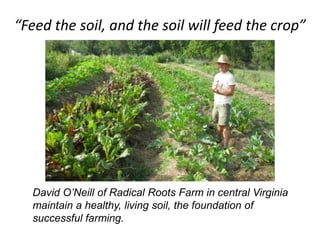
David O’Neill of Radical Roots Farm in central Virginia
maintain a healthy, living soil, the foundation of
successful farming.
Part One

Feeding and Protecting the Soil
• Conservation – prevent erosion losses
• Soil life – the “livestock” on every farm
• Habitat – organic matter and tilth
First, keep the soil on the farm!

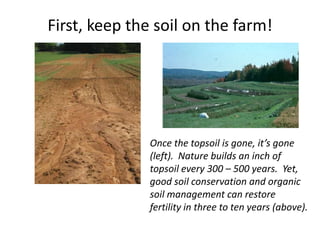
Once the topsoil is gone, it’s gone
(left). Nature builds an inch of
topsoil every 300 – 500 years. Yet,
good soil conservation and organic
soil management can restore
fertility in three to ten years (above).
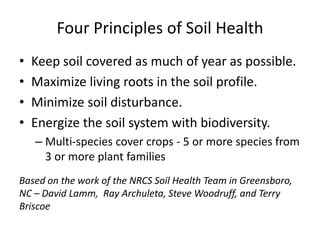
Four Principles of Soil Health
•
•
•
•

Keep soil covered as much of year as possible.
Maximize living roots in the soil profile.
Minimize soil disturbance.
Energize the soil system with biodiversity.
– Multi-species cover crops - 5 or more species from
3 or more plant families

Based on the work of the NRCS Soil Health Team in Greensboro,
NC – David Lamm, Ray Archuleta, Steve Woodruff, and Terry
Briscoe
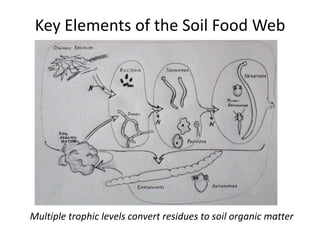
Key Elements of the Soil Food Web

Multiple trophic levels convert residues to soil organic matter
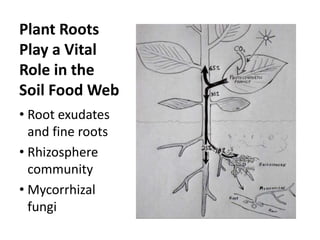
Plant Roots
Play a Vital
Role in the
Soil Food Web
• Root exudates
and fine roots
• Rhizosphere
community
• Mycorrhizal
fungi
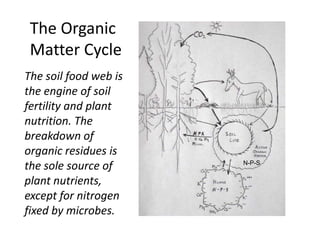
The Organic
Matter Cycle
The soil food web is
the engine of soil
fertility and plant
nutrition. The
breakdown of
organic residues is
the sole source of
plant nutrients,
except for nitrogen
fixed by microbes.

N-P-S
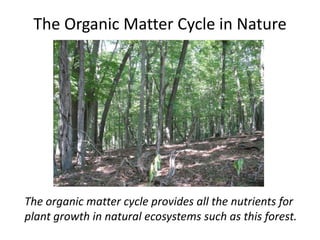
The Organic Matter Cycle in Nature

The organic matter cycle provides all the nutrients for
plant growth in natural ecosystems such as this forest.
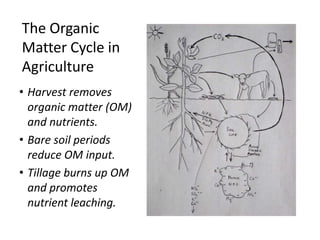
The Organic
Matter Cycle in
Agriculture
• Harvest removes
organic matter (OM)
and nutrients.
• Bare soil periods
reduce OM input.
• Tillage burns up OM
and promotes
nutrient leaching.
Replenishing the Organic Matter Cycle
To make up for these losses and maintain soil
health, feed the soil life a “balanced diet” of:
•
•
•
•
•
•

Cover crops and green manures
Compost
Organic mulches
Crop residues
Manure
Organic fertilizers and amendments
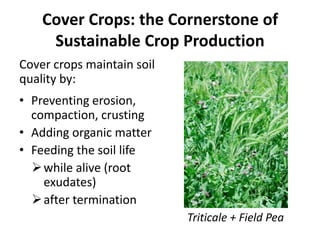
Cover Crops: the Cornerstone of
Sustainable Crop Production
Cover crops maintain soil
quality by:
• Preventing erosion,
compaction, crusting
• Adding organic matter
• Feeding the soil life
 while alive (root
exudates)
 after termination
Triticale + Field Pea
Cover Crops: the Cornerstone of
Sustainable Organic Crop Production
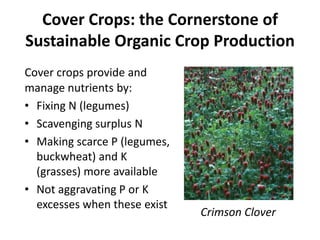
Cover crops provide and
manage nutrients by:
• Fixing N (legumes)
• Scavenging surplus N
• Making scarce P (legumes,
buckwheat) and K
(grasses) more available
• Not aggravating P or K
excesses when these exist

Crimson Clover
Cover Crops: the Cornerstone of
Sustainable Organic Crop Production
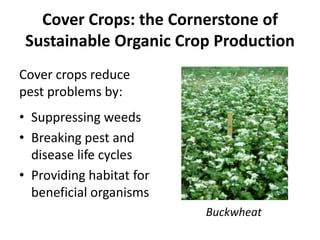
Cover crops reduce
pest problems by:
• Suppressing weeds
• Breaking pest and
disease life cycles
• Providing habitat for
beneficial organisms
Buckwheat
Living Plant Cover is Vital
to Soil Health
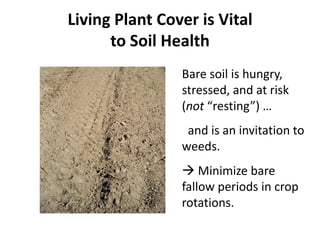
Bare soil is hungry,
stressed, and at risk
(not “resting”) …
and is an invitation to
weeds.
 Minimize bare
fallow periods in crop
rotations.
Living Plant Cover is Vital
to Soil Health
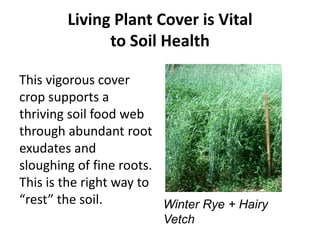
This vigorous cover
crop supports a
thriving soil food web
through abundant root
exudates and
sloughing of fine roots.
This is the right way to
“rest” the soil.
Winter Rye + Hairy
Vetch
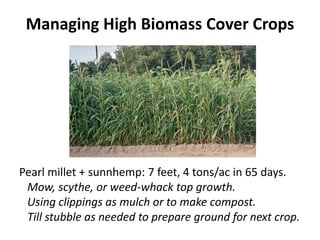
Managing High Biomass Cover Crops

Pearl millet + sunnhemp: 7 feet, 4 tons/ac in 65 days.
Mow, scythe, or weed-whack top growth.
Using clippings as mulch or to make compost.
Till stubble as needed to prepare ground for next crop.
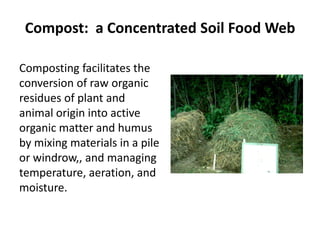
Compost: a Concentrated Soil Food Web
Composting facilitates the
conversion of raw organic
residues of plant and
animal origin into active
organic matter and humus
by mixing materials in a pile
or windrow,, and managing
temperature, aeration, and
moisture.
Composting Tips
• Start with diverse mix of organic materials.
• Balance carbon & nitrogen – C:N ratio 25-35:1
Use 2 – 3 parts plant matter and 1 part manure.
• Maintain optimum moisture – 50 – 60%.
• Turn windrow to aerate and compost all parts.
• Heating to 135 – 150°F for 15 days kills pests,
pathogens, weed seeds. Avoid temps > 150°F
• Cool curing period (2-6 months) builds beneficial
microbiota.
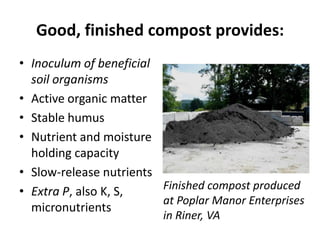
Good, finished compost provides:
• Inoculum of beneficial
soil organisms
• Active organic matter
• Stable humus
• Nutrient and moisture
holding capacity
• Slow-release nutrients
Finished compost produced
• Extra P, also K, S,
at Poplar Manor Enterprises
micronutrients
in Riner, VA
Manure: the Original Organic Fertilizer
Manure benefits:

Manure cautions:

• Provides N, P, K, and
micronutrients.
• Supports beneficial
soil life.
• Promotes heating and
provides nutrients in
compost pile (20-30%
of total mix).

• Unstable N
• Pathogens
• Antibiotic and
herbicide residues
• Weed seeds
• Salts
• Unbalanced N:P ratio
• Cu and Zn buildup
(poultry litter)
Manure Management
• Know the source, avoid chemical residues.
• Compost or age with carbon (e.g. bedding) to
stabilize nutrients and reduce pathogens.
• Compost at ≥131°F for 15 days, or apply at least 120
days before harvest to protect food safety.
• Spread on heavy feeding cover crop.
• Adjust rates to optimize soil P and other nutrients.
• Avoid nutrient runoff – do not spread on bare or
frozen soil on sloping fields near streams or ponds.
Organic Mulch: Simulating Nature’s
Way of Feeding the Soil
Organic mulches:
• Protect the soil surface.
• Conserve soil moisture.
• Suppress annual weeds.
• Feed the soil life.
• Provide slow-release
nutrients.
• Provide habitat for
spiders and other
generalist pest predators.

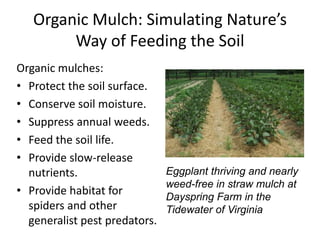
Eggplant thriving and nearly
weed-free in straw mulch at
Dayspring Farm in the
Tidewater of Virginia
Mulching cautions:
• Weed seeds
• Herbicide residues in hay (especially
picloram, clopyralid, aminopyralid,
aminocyclopyrachlor)
• Cooler soil
• Potential pest habitat (slugs, squash bugs)
• Excess K with heavy use (esp. grass hay)
• Costs of purchase, hauling, and spreading
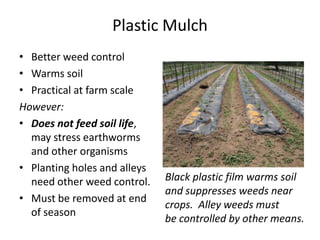
Plastic Mulch
• Better weed control
• Warms soil
• Practical at farm scale
However:
• Does not feed soil life,
may stress earthworms
and other organisms
• Planting holes and alleys
need other weed control.
• Must be removed at end
of season

Black plastic film warms soil
and suppresses weeds near
crops. Alley weeds must
be controlled by other means.
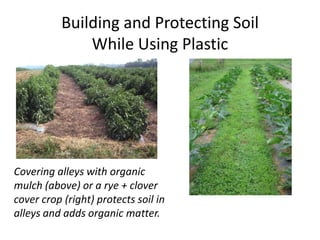
Building and Protecting Soil
While Using Plastic

Covering alleys with organic
mulch (above) or a rye + clover
cover crop (right) protects soil in
alleys and adds organic matter.
Soil Health Challenges for Vegetable
Production in the South
• Many vegetable crops return little residue to
feed the soil life.
• Farmers working small acreages must crop
intensively to make a living, have less
flexibility to include soil building cover crops.
• Warm, rainy climates accelerate organic
matter oxidation in Southern region soils,
especially in tilled annual cropping systems.
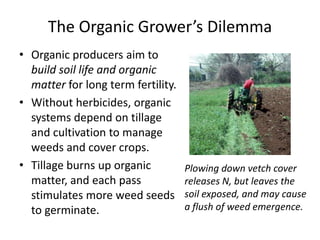
The Organic Grower’s Dilemma
• Organic producers aim to
build soil life and organic
matter for long term fertility.
• Without herbicides, organic
systems depend on tillage
and cultivation to manage
weeds and cover crops.
• Tillage burns up organic
matter, and each pass
stimulates more weed seeds
to germinate.

Plowing down vetch cover
releases N, but leaves the
soil exposed, and may cause
a flush of weed emergence.
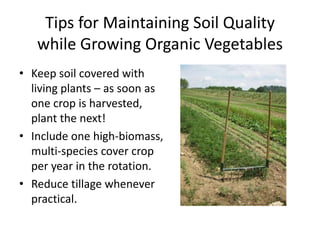
Tips for Maintaining Soil Quality
while Growing Organic Vegetables
• Keep soil covered with
living plants – as soon as
one crop is harvested,
plant the next!
• Include one high-biomass,
multi-species cover crop
per year in the rotation.
• Reduce tillage whenever
practical.
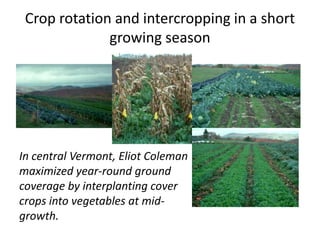
Crop rotation and intercropping in a short
growing season

In central Vermont, Eliot Coleman
maximized year-round ground
coverage by interplanting cover
crops into vegetables at midgrowth.
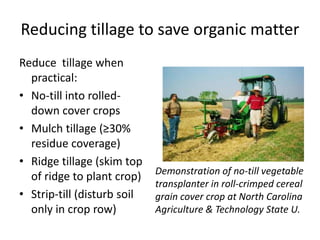
Reducing tillage to save organic matter
Reduce tillage when
practical:
• No-till into rolleddown cover crops
• Mulch tillage (≥30%
residue coverage)
• Ridge tillage (skim top
of ridge to plant crop)
• Strip-till (disturb soil
only in crop row)

Demonstration of no-till vegetable
transplanter in roll-crimped cereal
grain cover crop at North Carolina
Agriculture & Technology State U.
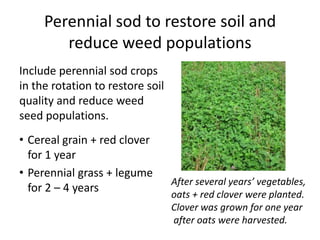
Perennial sod to restore soil and
reduce weed populations
Include perennial sod crops
in the rotation to restore soil
quality and reduce weed
seed populations.

• Cereal grain + red clover
for 1 year
• Perennial grass + legume
for 2 – 4 years

After several years’ vegetables,
oats + red clover were planted.
Clover was grown for one year
after oats were harvested.
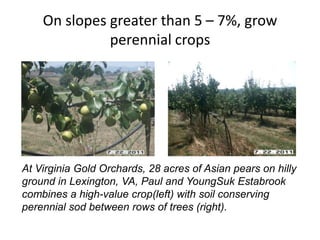
On slopes greater than 5 – 7%, grow
perennial crops

At Virginia Gold Orchards, 28 acres of Asian pears on hilly
ground in Lexington, VA, Paul and YoungSuk Estabrook
combines a high-value crop(left) with soil conserving
perennial sod between rows of trees (right).
Part Two

Feeding the Crop
•
•
•
•

Meeting crop nutritional needs
Optimizing efficiency, avoiding pollution
Understanding soil tests
Developing organic recommendations
Can “Feed the Soil”
adequately feed the crop?
• Healthy, well-fed soil food web can meet most
of the crop’s nutrient needs.
• Usually need some nutrient inputs.
• NPK input needs are often less than
conventional recommendations.
• Replenish organic matter to maintain soil life.
How the Soil Life Modulates Crop Nutrition

Nitrogen is initially tied up as microbes digest fresh residues, then
gradually released as higher trophic levels consume microbes.
Organic Nutrient Management
Use organic and natural mineral amendments to:
• Restore depleted soils
• Remedy nutrient deficiencies & imbalances

• Adjust soil pH
• Meet nutrient demand of heavy feeders

• Replenish nutrients removed in harvest
Determining Fertilizer Needs: Soil Test
A soil test is a “snapshot” of the chemical
condition of the soil, including:
• pH (acidity)
• Plant-available P, K, Ca, Mg, micronutrients
• Organic matter content
• Cation exchange capacity (CEC)
• Recommendations for lime, nitrogen (N),
phosphate (P2O5), potash (K2O)
Interpreting the Soil Test
• VL = very low

critically deficient

• L = low

likely yield limiting

• M = medium

possibly yield limiting

• H = high

optimum for most crops

• VH = very high

possibly excessive
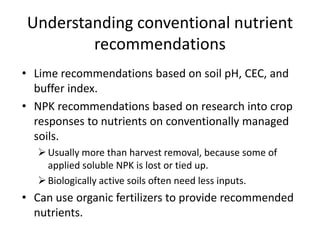
Understanding conventional nutrient
recommendations
• Lime recommendations based on soil pH, CEC, and
buffer index.
• NPK recommendations based on research into crop
responses to nutrients on conventionally managed
soils.
 Usually more than harvest removal, because some of
applied soluble NPK is lost or tied up.
 Biologically active soils often need less inputs.

• Can use organic fertilizers to provide recommended
nutrients.
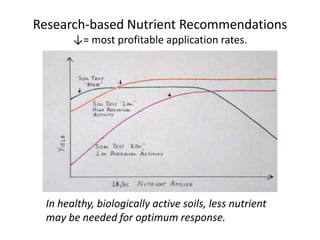
Research-based Nutrient Recommendations
↓= most profitable application rates.

In healthy, biologically active soils, less nutrient
may be needed for optimum response.
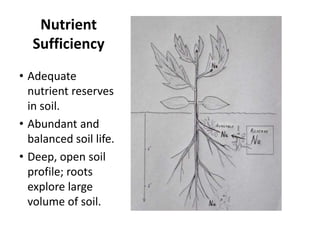
Nutrient
Sufficiency
• Adequate
nutrient reserves
in soil.
• Abundant and
balanced soil life.
• Deep, open soil
profile; roots
explore large
volume of soil.
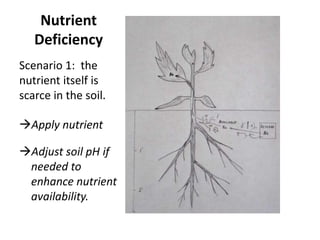
Nutrient
Deficiency
Scenario 1: the
nutrient itself is
scarce in the soil.
Apply nutrient
Adjust soil pH if
needed to
enhance nutrient
availability.
Nutrient
Deficiency
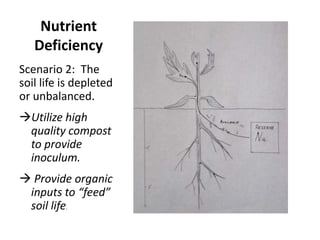
Scenario 2: The
soil life is depleted
or unbalanced.
Utilize high
quality compost
to provide
inoculum.
 Provide organic
inputs to “feed”
soil life.
Nutrient
Deficiency
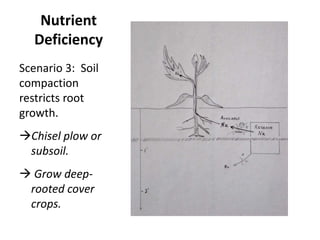
Scenario 3: Soil
compaction
restricts root
growth.

Chisel plow or
subsoil.
 Grow deeprooted cover
crops.
Tips on Using a Soil Test in
Organic Nutrient Management
• Correct sampling procedure is important.
• Note deficiencies, excesses, and imbalances.
• Observe the soil and crops.
• Verify with plant tissue analysis.

• Re-test with same lab to monitor trends.
Soil pH and Lime
•
•
•
•
•
•

Most vegetables prefer pH 6.0-7.0.
Blueberries prefer pH 4.8-5.2.
Use high-calcium limestone if Mg is high.
Use dolomitic limestone if Mg is low.
Use elemental sulfur to lower pH.
Hydrated lime and quicklime are hard on soil
life; not allowed under NOP certification.
Nitrogen (N)
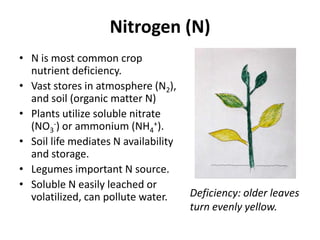
• N is most common crop
nutrient deficiency.
• Vast stores in atmosphere (N2),
and soil (organic matter N)
• Plants utilize soluble nitrate
(NO3-) or ammonium (NH4+).
• Soil life mediates N availability
and storage.
• Legumes important N source.
• Soluble N easily leached or
volatilized, can pollute water.

Deficiency: older leaves
turn evenly yellow.
Carbon-to-Nitrogen (C:N) Ratio
and Soil N Dynamics
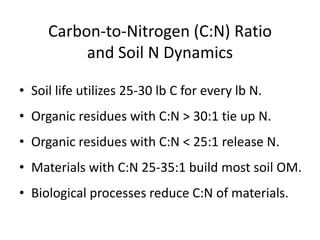
• Soil life utilizes 25-30 lb C for every lb N.
• Organic residues with C:N > 30:1 tie up N.

• Organic residues with C:N < 25:1 release N.
• Materials with C:N 25-35:1 build most soil OM.

• Biological processes reduce C:N of materials.
Organic and natural mineral N sources
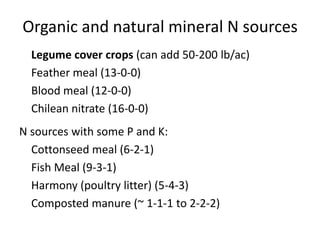
Legume cover crops (can add 50-200 lb/ac)
Feather meal (13-0-0)
Blood meal (12-0-0)
Chilean nitrate (16-0-0)
N sources with some P and K:
Cottonseed meal (6-2-1)
Fish Meal (9-3-1)
Harmony (poultry litter) (5-4-3)
Composted manure (~ 1-1-1 to 2-2-2)
Nitrogen Budgeting in
Organic Farming
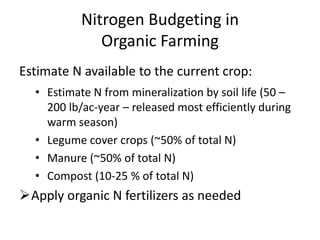
Estimate N available to the current crop:
• Estimate N from mineralization by soil life (50 –
200 lb/ac-year – released most efficiently during
warm season)
• Legume cover crops (~50% of total N)
• Manure (~50% of total N)
• Compost (10-25 % of total N)

Apply organic N fertilizers as needed
Phosphorus (P)
• Plants use soluble phosphates.
• Most soil P = insoluble mineral
and organic forms.
• Soil life mediates P availability;
mycorrhizae play vital role.
• P excesses initially “fixed,”
then accumulate in soil.
• P is lost in runoff and erosion,
can pollute surface waters.
• P is most limiting worldwide.

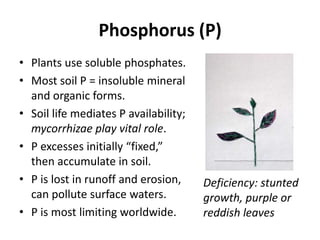
Deficiency: stunted
growth, purple or
reddish leaves
Organic and natural mineral sources of P
Rock or colloidal phosphates (0-3-0)
total (0-20-0) available over ~10 yrs
Bone meal (2-14-0) – faster release
Manure, fresh or composted, 1-2% P2O5
Composted plant matter, 0.2-0.8% P2O5
Poultry litter based fertilizers (Harmony, 5-4-3)
1 lb P2O5 = 0.44 lb P
Nitrogen-Phosphorus Balance
• Plants utilize N and P in a ratio of 6:1 – 10:1.
• Manure and compost provide N and P at
about 3:1.
• Some manure N is lost, P is stable.
• Using manure or compost for N can build up P.
• Excessive soil P can inhibit mycorrhizae, upset
plant nutrition.
• Legume cover crops add N but not P.
Managing N and P in organic systems
If soil P is low:
• Compost can be used
generously, 10-20 t/ac
annually, to provide N
and build organic matter
If soil P is high:
• Limit compost to match P
inputs with P removal –
about 2-4 tons/ac-year
• Use legumes, blood meal,
feather meal, etc. for N

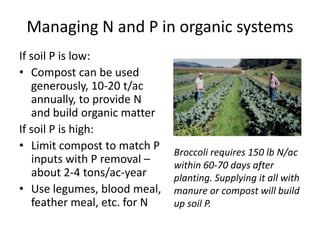
Broccoli requires 150 lb N/ac
within 60-70 days after
planting. Supplying it all with
manure or compost will build
up soil P.
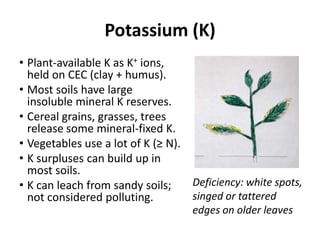
Potassium (K)
• Plant-available K as K+ ions,
held on CEC (clay + humus).
• Most soils have large
insoluble mineral K reserves.
• Cereal grains, grasses, trees
release some mineral-fixed K.
• Vegetables use a lot of K (≥ N).
• K surpluses can build up in
most soils.
Deficiency: white spots,
• K can leach from sandy soils;
singed or tattered
not considered polluting.
edges on older leaves
Organic and natural mineral sources of K
Potassium sulfate (0-0-51-18S, rapid release)
Sul-po-mag (0-0-18-11Mg-22S, rapid release)
Greensand (7% K, very slow release)
Grass hay mulch (~2% available K)
(spoiled hay sometimes available free)
Liquid K foliar fertilizers available (6% K)

1 lb K2O = 0.83 lb K
Potassium and Nutrient Balance
• Hay or grass mulches are very rich in K.
• Excess K can interfere with Mg or Ca nutrition:
 Blossom end rot, tip burn in vegetables.
 Grass tetany in livestock (life-threatening).

• K excesses are fairly easy to draw down.
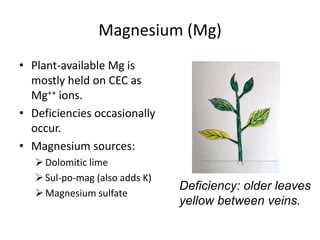
Magnesium (Mg)
• Plant-available Mg is
mostly held on CEC as
Mg++ ions.
• Deficiencies occasionally
occur.
• Magnesium sources:
 Dolomitic lime
 Sul-po-mag (also adds K)
 Magnesium sulfate

Deficiency: older leaves
yellow between veins.
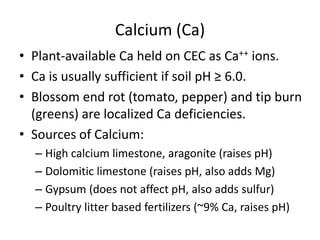
Calcium (Ca)
• Plant-available Ca held on CEC as Ca++ ions.
• Ca is usually sufficient if soil pH ≥ 6.0.
• Blossom end rot (tomato, pepper) and tip burn
(greens) are localized Ca deficiencies.
• Sources of Calcium:
– High calcium limestone, aragonite (raises pH)
– Dolomitic limestone (raises pH, also adds Mg)
– Gypsum (does not affect pH, also adds sulfur)
– Poultry litter based fertilizers (~9% Ca, raises pH)
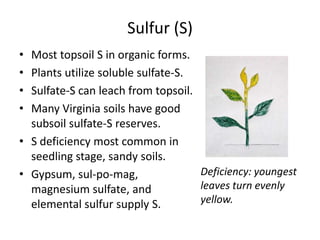
Sulfur (S)
•
•
•
•

Most topsoil S in organic forms.
Plants utilize soluble sulfate-S.
Sulfate-S can leach from topsoil.
Many Virginia soils have good
subsoil sulfate-S reserves.
• S deficiency most common in
seedling stage, sandy soils.
Deficiency: youngest
• Gypsum, sul-po-mag,
leaves turn evenly
magnesium sulfate, and
yellow.
elemental sulfur supply S.
Micronutrients essential
for plant growth
•
•
•
•
•
•
•
•
•

Zinc (Zn)
Copper (Cu)
Manganese (Mn)
Iron (Fe)
Boron (B)
Molybdenum (Mb)
Nickel (Ni)
Chorine (Cl)
Sodium (Na)

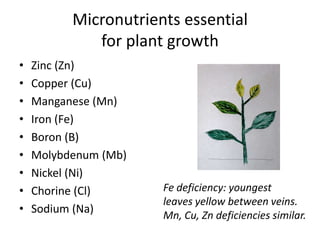
Fe deficiency: youngest
leaves yellow between veins.
Mn, Cu, Zn deficiencies similar.
Amending micronutrients
• Boron (B) deficiency is
common in Virginia.
• Zn, Cu, Mn are occasionally
deficient.
• Poultry litter is Zn and Cu
source.
• Molybdenum occasionally
deficient in legumes.
• NOP allowed micronutrient
supplements are available.

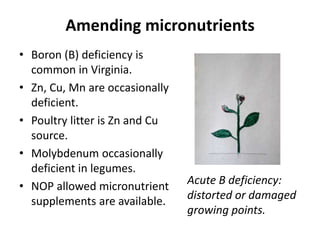
Acute B deficiency:
distorted or damaged
growing points.
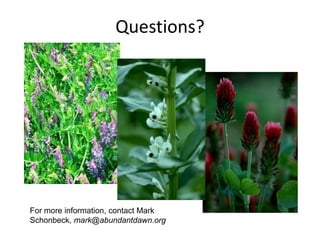
Questions?

For more information, contact Mark
Schonbeck, mark@abundantdawn.org

Southern SAWG - Basic Organic Soil Management

  • 1.
    Basic Organic SoilManagement: Caring for the Soil as a Living System Southern Sustainable Agriculture Working Group Annual Conference Mobile, AL – January 18, 2014
  • 2.
    “Feed the soil,and the soil will feed the crop” David O’Neill of Radical Roots Farm in central Virginia maintain a healthy, living soil, the foundation of successful farming.
  • 3.
    Part One Feeding andProtecting the Soil • Conservation – prevent erosion losses • Soil life – the “livestock” on every farm • Habitat – organic matter and tilth
  • 4.
    First, keep thesoil on the farm! Once the topsoil is gone, it’s gone (left). Nature builds an inch of topsoil every 300 – 500 years. Yet, good soil conservation and organic soil management can restore fertility in three to ten years (above).
  • 5.
    Four Principles ofSoil Health • • • • Keep soil covered as much of year as possible. Maximize living roots in the soil profile. Minimize soil disturbance. Energize the soil system with biodiversity. – Multi-species cover crops - 5 or more species from 3 or more plant families Based on the work of the NRCS Soil Health Team in Greensboro, NC – David Lamm, Ray Archuleta, Steve Woodruff, and Terry Briscoe
  • 6.
    Key Elements ofthe Soil Food Web Multiple trophic levels convert residues to soil organic matter
  • 7.
    Plant Roots Play aVital Role in the Soil Food Web • Root exudates and fine roots • Rhizosphere community • Mycorrhizal fungi
  • 8.
    The Organic Matter Cycle Thesoil food web is the engine of soil fertility and plant nutrition. The breakdown of organic residues is the sole source of plant nutrients, except for nitrogen fixed by microbes. N-P-S
  • 9.
    The Organic MatterCycle in Nature The organic matter cycle provides all the nutrients for plant growth in natural ecosystems such as this forest.
  • 10.
    The Organic Matter Cyclein Agriculture • Harvest removes organic matter (OM) and nutrients. • Bare soil periods reduce OM input. • Tillage burns up OM and promotes nutrient leaching.
  • 11.
    Replenishing the OrganicMatter Cycle To make up for these losses and maintain soil health, feed the soil life a “balanced diet” of: • • • • • • Cover crops and green manures Compost Organic mulches Crop residues Manure Organic fertilizers and amendments
  • 12.
    Cover Crops: theCornerstone of Sustainable Crop Production Cover crops maintain soil quality by: • Preventing erosion, compaction, crusting • Adding organic matter • Feeding the soil life  while alive (root exudates)  after termination Triticale + Field Pea
  • 13.
    Cover Crops: theCornerstone of Sustainable Organic Crop Production Cover crops provide and manage nutrients by: • Fixing N (legumes) • Scavenging surplus N • Making scarce P (legumes, buckwheat) and K (grasses) more available • Not aggravating P or K excesses when these exist Crimson Clover
  • 14.
    Cover Crops: theCornerstone of Sustainable Organic Crop Production Cover crops reduce pest problems by: • Suppressing weeds • Breaking pest and disease life cycles • Providing habitat for beneficial organisms Buckwheat
  • 15.
    Living Plant Coveris Vital to Soil Health Bare soil is hungry, stressed, and at risk (not “resting”) … and is an invitation to weeds.  Minimize bare fallow periods in crop rotations.
  • 16.
    Living Plant Coveris Vital to Soil Health This vigorous cover crop supports a thriving soil food web through abundant root exudates and sloughing of fine roots. This is the right way to “rest” the soil. Winter Rye + Hairy Vetch
  • 17.
    Managing High BiomassCover Crops Pearl millet + sunnhemp: 7 feet, 4 tons/ac in 65 days. Mow, scythe, or weed-whack top growth. Using clippings as mulch or to make compost. Till stubble as needed to prepare ground for next crop.
  • 18.
    Compost: a ConcentratedSoil Food Web Composting facilitates the conversion of raw organic residues of plant and animal origin into active organic matter and humus by mixing materials in a pile or windrow,, and managing temperature, aeration, and moisture.
  • 19.
    Composting Tips • Startwith diverse mix of organic materials. • Balance carbon & nitrogen – C:N ratio 25-35:1 Use 2 – 3 parts plant matter and 1 part manure. • Maintain optimum moisture – 50 – 60%. • Turn windrow to aerate and compost all parts. • Heating to 135 – 150°F for 15 days kills pests, pathogens, weed seeds. Avoid temps > 150°F • Cool curing period (2-6 months) builds beneficial microbiota.
  • 20.
    Good, finished compostprovides: • Inoculum of beneficial soil organisms • Active organic matter • Stable humus • Nutrient and moisture holding capacity • Slow-release nutrients Finished compost produced • Extra P, also K, S, at Poplar Manor Enterprises micronutrients in Riner, VA
  • 21.
    Manure: the OriginalOrganic Fertilizer Manure benefits: Manure cautions: • Provides N, P, K, and micronutrients. • Supports beneficial soil life. • Promotes heating and provides nutrients in compost pile (20-30% of total mix). • Unstable N • Pathogens • Antibiotic and herbicide residues • Weed seeds • Salts • Unbalanced N:P ratio • Cu and Zn buildup (poultry litter)
  • 22.
    Manure Management • Knowthe source, avoid chemical residues. • Compost or age with carbon (e.g. bedding) to stabilize nutrients and reduce pathogens. • Compost at ≥131°F for 15 days, or apply at least 120 days before harvest to protect food safety. • Spread on heavy feeding cover crop. • Adjust rates to optimize soil P and other nutrients. • Avoid nutrient runoff – do not spread on bare or frozen soil on sloping fields near streams or ponds.
  • 23.
    Organic Mulch: SimulatingNature’s Way of Feeding the Soil Organic mulches: • Protect the soil surface. • Conserve soil moisture. • Suppress annual weeds. • Feed the soil life. • Provide slow-release nutrients. • Provide habitat for spiders and other generalist pest predators. Eggplant thriving and nearly weed-free in straw mulch at Dayspring Farm in the Tidewater of Virginia
  • 24.
    Mulching cautions: • Weedseeds • Herbicide residues in hay (especially picloram, clopyralid, aminopyralid, aminocyclopyrachlor) • Cooler soil • Potential pest habitat (slugs, squash bugs) • Excess K with heavy use (esp. grass hay) • Costs of purchase, hauling, and spreading
  • 25.
    Plastic Mulch • Betterweed control • Warms soil • Practical at farm scale However: • Does not feed soil life, may stress earthworms and other organisms • Planting holes and alleys need other weed control. • Must be removed at end of season Black plastic film warms soil and suppresses weeds near crops. Alley weeds must be controlled by other means.
  • 26.
    Building and ProtectingSoil While Using Plastic Covering alleys with organic mulch (above) or a rye + clover cover crop (right) protects soil in alleys and adds organic matter.
  • 27.
    Soil Health Challengesfor Vegetable Production in the South • Many vegetable crops return little residue to feed the soil life. • Farmers working small acreages must crop intensively to make a living, have less flexibility to include soil building cover crops. • Warm, rainy climates accelerate organic matter oxidation in Southern region soils, especially in tilled annual cropping systems.
  • 28.
    The Organic Grower’sDilemma • Organic producers aim to build soil life and organic matter for long term fertility. • Without herbicides, organic systems depend on tillage and cultivation to manage weeds and cover crops. • Tillage burns up organic matter, and each pass stimulates more weed seeds to germinate. Plowing down vetch cover releases N, but leaves the soil exposed, and may cause a flush of weed emergence.
  • 29.
    Tips for MaintainingSoil Quality while Growing Organic Vegetables • Keep soil covered with living plants – as soon as one crop is harvested, plant the next! • Include one high-biomass, multi-species cover crop per year in the rotation. • Reduce tillage whenever practical.
  • 30.
    Crop rotation andintercropping in a short growing season In central Vermont, Eliot Coleman maximized year-round ground coverage by interplanting cover crops into vegetables at midgrowth.
  • 31.
    Reducing tillage tosave organic matter Reduce tillage when practical: • No-till into rolleddown cover crops • Mulch tillage (≥30% residue coverage) • Ridge tillage (skim top of ridge to plant crop) • Strip-till (disturb soil only in crop row) Demonstration of no-till vegetable transplanter in roll-crimped cereal grain cover crop at North Carolina Agriculture & Technology State U.
  • 32.
    Perennial sod torestore soil and reduce weed populations Include perennial sod crops in the rotation to restore soil quality and reduce weed seed populations. • Cereal grain + red clover for 1 year • Perennial grass + legume for 2 – 4 years After several years’ vegetables, oats + red clover were planted. Clover was grown for one year after oats were harvested.
  • 33.
    On slopes greaterthan 5 – 7%, grow perennial crops At Virginia Gold Orchards, 28 acres of Asian pears on hilly ground in Lexington, VA, Paul and YoungSuk Estabrook combines a high-value crop(left) with soil conserving perennial sod between rows of trees (right).
  • 34.
    Part Two Feeding theCrop • • • • Meeting crop nutritional needs Optimizing efficiency, avoiding pollution Understanding soil tests Developing organic recommendations
  • 35.
    Can “Feed theSoil” adequately feed the crop? • Healthy, well-fed soil food web can meet most of the crop’s nutrient needs. • Usually need some nutrient inputs. • NPK input needs are often less than conventional recommendations. • Replenish organic matter to maintain soil life.
  • 36.
    How the SoilLife Modulates Crop Nutrition Nitrogen is initially tied up as microbes digest fresh residues, then gradually released as higher trophic levels consume microbes.
  • 37.
    Organic Nutrient Management Useorganic and natural mineral amendments to: • Restore depleted soils • Remedy nutrient deficiencies & imbalances • Adjust soil pH • Meet nutrient demand of heavy feeders • Replenish nutrients removed in harvest
  • 38.
    Determining Fertilizer Needs:Soil Test A soil test is a “snapshot” of the chemical condition of the soil, including: • pH (acidity) • Plant-available P, K, Ca, Mg, micronutrients • Organic matter content • Cation exchange capacity (CEC) • Recommendations for lime, nitrogen (N), phosphate (P2O5), potash (K2O)
  • 39.
    Interpreting the SoilTest • VL = very low critically deficient • L = low likely yield limiting • M = medium possibly yield limiting • H = high optimum for most crops • VH = very high possibly excessive
  • 40.
    Understanding conventional nutrient recommendations •Lime recommendations based on soil pH, CEC, and buffer index. • NPK recommendations based on research into crop responses to nutrients on conventionally managed soils.  Usually more than harvest removal, because some of applied soluble NPK is lost or tied up.  Biologically active soils often need less inputs. • Can use organic fertilizers to provide recommended nutrients.
  • 41.
    Research-based Nutrient Recommendations ↓=most profitable application rates. In healthy, biologically active soils, less nutrient may be needed for optimum response.
  • 42.
    Nutrient Sufficiency • Adequate nutrient reserves insoil. • Abundant and balanced soil life. • Deep, open soil profile; roots explore large volume of soil.
  • 43.
    Nutrient Deficiency Scenario 1: the nutrientitself is scarce in the soil. Apply nutrient Adjust soil pH if needed to enhance nutrient availability.
  • 44.
    Nutrient Deficiency Scenario 2: The soillife is depleted or unbalanced. Utilize high quality compost to provide inoculum.  Provide organic inputs to “feed” soil life.
  • 45.
    Nutrient Deficiency Scenario 3: Soil compaction restrictsroot growth. Chisel plow or subsoil.  Grow deeprooted cover crops.
  • 46.
    Tips on Usinga Soil Test in Organic Nutrient Management • Correct sampling procedure is important. • Note deficiencies, excesses, and imbalances. • Observe the soil and crops. • Verify with plant tissue analysis. • Re-test with same lab to monitor trends.
  • 47.
    Soil pH andLime • • • • • • Most vegetables prefer pH 6.0-7.0. Blueberries prefer pH 4.8-5.2. Use high-calcium limestone if Mg is high. Use dolomitic limestone if Mg is low. Use elemental sulfur to lower pH. Hydrated lime and quicklime are hard on soil life; not allowed under NOP certification.
  • 48.
    Nitrogen (N) • Nis most common crop nutrient deficiency. • Vast stores in atmosphere (N2), and soil (organic matter N) • Plants utilize soluble nitrate (NO3-) or ammonium (NH4+). • Soil life mediates N availability and storage. • Legumes important N source. • Soluble N easily leached or volatilized, can pollute water. Deficiency: older leaves turn evenly yellow.
  • 49.
    Carbon-to-Nitrogen (C:N) Ratio andSoil N Dynamics • Soil life utilizes 25-30 lb C for every lb N. • Organic residues with C:N > 30:1 tie up N. • Organic residues with C:N < 25:1 release N. • Materials with C:N 25-35:1 build most soil OM. • Biological processes reduce C:N of materials.
  • 50.
    Organic and naturalmineral N sources Legume cover crops (can add 50-200 lb/ac) Feather meal (13-0-0) Blood meal (12-0-0) Chilean nitrate (16-0-0) N sources with some P and K: Cottonseed meal (6-2-1) Fish Meal (9-3-1) Harmony (poultry litter) (5-4-3) Composted manure (~ 1-1-1 to 2-2-2)
  • 51.
    Nitrogen Budgeting in OrganicFarming Estimate N available to the current crop: • Estimate N from mineralization by soil life (50 – 200 lb/ac-year – released most efficiently during warm season) • Legume cover crops (~50% of total N) • Manure (~50% of total N) • Compost (10-25 % of total N) Apply organic N fertilizers as needed
  • 52.
    Phosphorus (P) • Plantsuse soluble phosphates. • Most soil P = insoluble mineral and organic forms. • Soil life mediates P availability; mycorrhizae play vital role. • P excesses initially “fixed,” then accumulate in soil. • P is lost in runoff and erosion, can pollute surface waters. • P is most limiting worldwide. Deficiency: stunted growth, purple or reddish leaves
  • 53.
    Organic and naturalmineral sources of P Rock or colloidal phosphates (0-3-0) total (0-20-0) available over ~10 yrs Bone meal (2-14-0) – faster release Manure, fresh or composted, 1-2% P2O5 Composted plant matter, 0.2-0.8% P2O5 Poultry litter based fertilizers (Harmony, 5-4-3) 1 lb P2O5 = 0.44 lb P
  • 54.
    Nitrogen-Phosphorus Balance • Plantsutilize N and P in a ratio of 6:1 – 10:1. • Manure and compost provide N and P at about 3:1. • Some manure N is lost, P is stable. • Using manure or compost for N can build up P. • Excessive soil P can inhibit mycorrhizae, upset plant nutrition. • Legume cover crops add N but not P.
  • 55.
    Managing N andP in organic systems If soil P is low: • Compost can be used generously, 10-20 t/ac annually, to provide N and build organic matter If soil P is high: • Limit compost to match P inputs with P removal – about 2-4 tons/ac-year • Use legumes, blood meal, feather meal, etc. for N Broccoli requires 150 lb N/ac within 60-70 days after planting. Supplying it all with manure or compost will build up soil P.
  • 56.
    Potassium (K) • Plant-availableK as K+ ions, held on CEC (clay + humus). • Most soils have large insoluble mineral K reserves. • Cereal grains, grasses, trees release some mineral-fixed K. • Vegetables use a lot of K (≥ N). • K surpluses can build up in most soils. Deficiency: white spots, • K can leach from sandy soils; singed or tattered not considered polluting. edges on older leaves
  • 57.
    Organic and naturalmineral sources of K Potassium sulfate (0-0-51-18S, rapid release) Sul-po-mag (0-0-18-11Mg-22S, rapid release) Greensand (7% K, very slow release) Grass hay mulch (~2% available K) (spoiled hay sometimes available free) Liquid K foliar fertilizers available (6% K) 1 lb K2O = 0.83 lb K
  • 58.
    Potassium and NutrientBalance • Hay or grass mulches are very rich in K. • Excess K can interfere with Mg or Ca nutrition:  Blossom end rot, tip burn in vegetables.  Grass tetany in livestock (life-threatening). • K excesses are fairly easy to draw down.
  • 59.
    Magnesium (Mg) • Plant-availableMg is mostly held on CEC as Mg++ ions. • Deficiencies occasionally occur. • Magnesium sources:  Dolomitic lime  Sul-po-mag (also adds K)  Magnesium sulfate Deficiency: older leaves yellow between veins.
  • 60.
    Calcium (Ca) • Plant-availableCa held on CEC as Ca++ ions. • Ca is usually sufficient if soil pH ≥ 6.0. • Blossom end rot (tomato, pepper) and tip burn (greens) are localized Ca deficiencies. • Sources of Calcium: – High calcium limestone, aragonite (raises pH) – Dolomitic limestone (raises pH, also adds Mg) – Gypsum (does not affect pH, also adds sulfur) – Poultry litter based fertilizers (~9% Ca, raises pH)
  • 61.
    Sulfur (S) • • • • Most topsoilS in organic forms. Plants utilize soluble sulfate-S. Sulfate-S can leach from topsoil. Many Virginia soils have good subsoil sulfate-S reserves. • S deficiency most common in seedling stage, sandy soils. Deficiency: youngest • Gypsum, sul-po-mag, leaves turn evenly magnesium sulfate, and yellow. elemental sulfur supply S.
  • 62.
    Micronutrients essential for plantgrowth • • • • • • • • • Zinc (Zn) Copper (Cu) Manganese (Mn) Iron (Fe) Boron (B) Molybdenum (Mb) Nickel (Ni) Chorine (Cl) Sodium (Na) Fe deficiency: youngest leaves yellow between veins. Mn, Cu, Zn deficiencies similar.
  • 63.
    Amending micronutrients • Boron(B) deficiency is common in Virginia. • Zn, Cu, Mn are occasionally deficient. • Poultry litter is Zn and Cu source. • Molybdenum occasionally deficient in legumes. • NOP allowed micronutrient supplements are available. Acute B deficiency: distorted or damaged growing points.
  • 64.
    Questions? For more information,contact Mark Schonbeck, mark@abundantdawn.org