


Sources of Pricing Power
Retail prices are significantly influenced by factors
           other than costs of production

This seminar details some of the factors that limit
   competition and raise prices for consumers


                            Presented by Marcello M. Ritondo at the Henry George School of
                            Social Science in New York City on September 28, 2012.
What determines the prices we
pay for goods and services?
classical economic theory states that basic market
structures determine price:

              Perfect Competition
            Monopolistic Competition
                   Oligopoly
                   Monopoly


                           Presented by Marcello M. Ritondo at the Henry George School of
                           Social Science in New York City on September 28, 2012.
 Why do prices fluctuate?
  Pricing during natural and man made disasters

                   Price Gauging
       The strict definition of price gauging
     The broader definition of price gauging

      Classical theory of price fluctuation
      Examples of imperfect competition

    Is it fair and reasonable to expect to pay
           a fair and reasonable price?

 Free market, legal, regulatory and consumer options


                             Presented by Marcello M. Ritondo at the Henry George School of
                             Social Science in New York City on September 28, 2012.
What is price gauging?
 Media coverage example:


http://youtu.be/R6ojYtKazgQ
What is price gauging?
Academic example:


 http://youtu.be/h9QEkw6_O6w
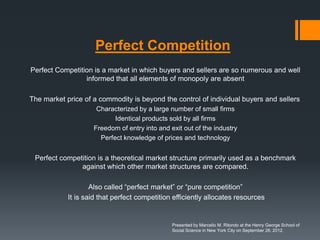
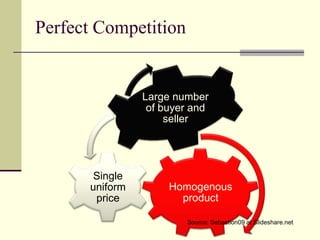
Perfect Competition
Perfect Competition is a market in which buyers and sellers are so numerous and well
                 informed that all elements of monopoly are absent

The market price of a commodity is beyond the control of individual buyers and sellers
                     Characterized by a large number of small firms
                           Identical products sold by all firms
                    Freedom of entry into and exit out of the industry
                      Perfect knowledge of prices and technology


 Perfect competition is a theoretical market structure primarily used as a benchmark
               against which other market structures are compared.

                    Also called “perfect market” or “pure competition”
            It is said that perfect competition efficiently allocates resources


                                               Presented by Marcello M. Ritondo at the Henry George School of
                                               Social Science in New York City on September 28, 2012.
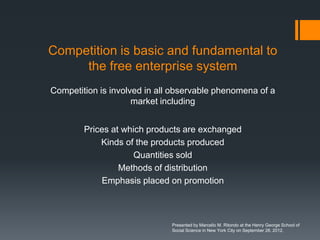
Competition is basic and fundamental to
     the free enterprise system
Competition is involved in all observable phenomena of a
                     market including


        Prices at which products are exchanged
            Kinds of the products produced
                     Quantities sold
                 Methods of distribution
            Emphasis placed on promotion


                              Presented by Marcello M. Ritondo at the Henry George School of
                              Social Science in New York City on September 28, 2012.
Competition


              Source: Sebastion09 at Slideshare.net
Value

     It is believed that having more than one
  business competing for the same consumers
  will cause the products and/or services to be
  provided at a better quality and a lower cost
          than if there were no competitors

  In other words, competition should provide
    the consumers with the best value for their
               hard-earned dollar


                             Source: Sebastion09 at Slideshare.net
ASPECTS OF COMPETITION

 Awareness
 Competitive advantage
 Technology
 Competitive differentiation


                            Source: Sebastion09 at Slideshare.net
Awareness
 To be successful in today's very competitive business world, it is
 important for businesses to be aware of what their competitors
 are doing and to find a way to compete by matching or
 improving on the competitors' product or service

 For example, if Pepsi-Cola offers a new caffeine-free soda,
 Coca-Cola may offer a new caffeine-free soda with only one
 calorie

 By offering an improvement on the competitor's product, Coca-
 Cola is trying to convince soft-drink consumers to buy the new
 coke product because it is an improvement on Pepsi's product


                                      Source: Sebastion09 at Slideshare.net
Competitive Advantage
 While being aware of the competition and making a
 countermove is important, it is also very important to pay
 attention to changing consumer wants, needs, and values and
 to make the needed changes before the competition does

 Doing research and development and being the first to provide a
 new product or service can give a company a competitive
 advantage in the marketplace

   Having a competitive advantage means that a company
        does something better than the competition


                                  Source: Sebastion09 at Slideshare.net
Technology
  One way to remain competitive is through the use of technology
                          Technology

Can help speed up production processes through the use of robots
                      or production lines
Can move information more accurately and more quickly through
                the use of computer systems
     Can stimulate and assist in research and development

          Can facilitate transparency and accountability


                                          Source: Sebastion09 at Slideshare.net
Competitive Differentiation

 Competitive differentiation occurs when a firm
 somehow differentiates its product or service
 from that of competitors

 Common ways to differentiate a product or
 service include advertising, a better-quality
 product, better service, better taste, or just
 better brand image

                            Source: Sebastion09 at Slideshare.net
Imperfect Competition

Imperfect competition implies an industry or market in which one or
             more of the following conditions exist:

                    Suppliers can influence prices
             There are significant barriers to entry and exit
                    Goods and services are unique
               Small number of suppliers and/or buyers
       Information on pricing and process is not readily available


                                      Presented by Marcello M. Ritondo at the Henry George School of
                                      Social Science in New York City on September 28, 2012.
Forms of Imperfect Competition
   Market structures generally included in the category of imperfect competition:

                     Monopoly
                     Oligopoly
                     Monopolistic Competition

 Every industry or market operates in some form of imperfect competition. For example, some
industries rely on heavy initial capital investment, such as industrial manufacturers and telecom
    providers. This makes the prospect of having many competitors practically impossible.

            Markets are evaluated by their relative closeness to perfect competition


                Are efforts made to approach Perfect Competition?


                                                   Presented by Marcello M. Ritondo at the Henry George School of
                                                   Social Science in New York City on September 28, 2012.
Perfect Competition


                Large number
                 of buyer and
                     seller


       Single
      uniform        Homogenous
       price           product

                        Source: Sebastion09 at Slideshare.net
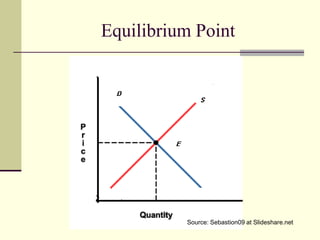
Equilibrium Point


          Source: Sebastion09 at Slideshare.net
Video: exploring a supply and demand price chart


http://youtu.be/MykJi8QVUWU?t=59s
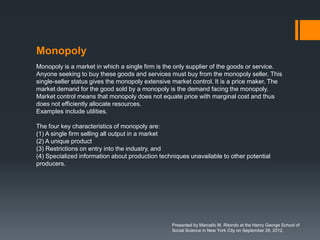
Monopoly
Monopoly is a market in which a single firm is the only supplier of the goods or service.
Anyone seeking to buy these goods and services must buy from the monopoly seller. This
single-seller status gives the monopoly extensive market control. It is a price maker. The
market demand for the good sold by a monopoly is the demand facing the monopoly.
Market control means that monopoly does not equate price with marginal cost and thus
does not efficiently allocate resources.
Examples include utilities.

The four key characteristics of monopoly are:
(1) A single firm selling all output in a market
(2) A unique product
(3) Restrictions on entry into the industry, and
(4) Specialized information about production techniques unavailable to other potential
producers.


                                                 Presented by Marcello M. Ritondo at the Henry George School of
                                                 Social Science in New York City on September 28, 2012.
Single Supplier

Monopolies achieve their single-seller status for three interrelated reasons:

(a) Economies of scale
(b) Government decree, and
(c) Resource ownership

While a monopoly can emerge and persist for any one of these reasons, most
monopolies rely on two or all three


                                              Presented by Marcello M. Ritondo at the Henry George School of
                                              Social Science in New York City on September 28, 2012.
Unique Product

A monopoly achieves single-seller status because the good supplied
is unique. There are no close substitutes available for the good
produced by a monopoly


                                      Presented by Marcello M. Ritondo at the Henry George School of
                                      Social Science in New York City on September 28, 2012.
Barriers to Entry

A monopoly often acquires and generally maintains single seller status due to restrictions
on the entry of other firms into the market. Key barriers to entry are:

(a) Government license or franchise
(b) Resource ownership
(c) Patents and copyrights
(d) High start-up cost, and
(e) Decreasing average total cost.


These restrictions might be imposed for efficiency reasons or simply for the benefit of the monopoly.
Since barriers to entry are a general deterrent to competition, If entry barriers increase, then
competition will decrease.


                                                    Presented by Marcello M. Ritondo at the Henry George School of
                                                    Social Science in New York City on September 28, 2012.
Specialized Information

A monopoly often possesses information not available to others. This specialized
information generally comes in the form of legally-established patents, copyrights,
or trademarks


                                              Presented by Marcello M. Ritondo at the Henry George School of
                                              Social Science in New York City on September 28, 2012.
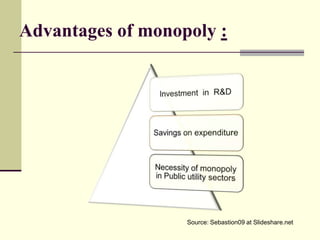
Advantages of monopoly :


                   Source: Sebastion09 at Slideshare.net
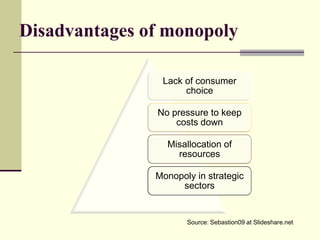
Disadvantages of monopoly

                Lack of consumer
                     choice

               No pressure to keep
                   costs down

                 Misallocation of
                   resources

               Monopoly in strategic
                    sectors


                      Source: Sebastion09 at Slideshare.net
Oligopoly

   This market structure is characterized by a small
   number of relatively large competitors, each with
  substantial market control. Oligopoly sellers exhibit
  interdependent decision making which can lead to
intense competition among the few and the motivation
      to cooperate through mergers and collusion

    Examples include automobile manufacturing


                           Presented by Marcello M. Ritondo at the Henry George School of
                           Social Science in New York City on September 28, 2012.
Monopolistic Competition

This market structure is characterized by a large number of relatively small
 competitors, each with a modest degree of market control on the supply
 side. A key feature of monopolistic competition is product differentiation.
The output of each producer is a close but not identical substitute to that of
 every other firm, which helps satisfy diverse consumer wants and needs

       Examples include toothpaste and toilet paper manufacturers


                                       Presented by Marcello M. Ritondo at the Henry George School of
                                       Social Science in New York City on September 28, 2012.
Video: market structure overview       (youtube.com, mjmfoodie's channel)


   http://youtu.be/9Hxy-TuX9fs?t=12s
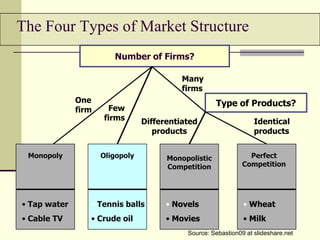
The Four Types of Market Structure
                        Number of Firms?

                                           Many
                                           firms
              One                                     Type of Products?
              firm    Few
                     firms       Differentiated                    Identical
                                    products                       products


 Monopoly            Oligopoly         Monopolistic              Perfect
                                       Competition             Competition


• Tap water      • Tennis balls        • Novels                • Wheat
• Cable TV       • Crude oil           • Movies                • Milk
                                            Source: Sebastion09 at slideshare.net
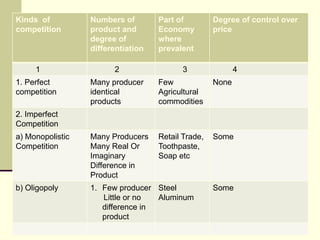
Kinds of          Numbers of        Part of         Degree of control over
competition       product and       Economy         price
                  degree of         where
                  differentiation   prevalent

     1                  2                 3                4
1. Perfect        Many producer     Few             None
competition       identical         Agricultural
                  products          commodities
2. Imperfect
Competition
a) Monopolistic   Many Producers    Retail Trade,   Some
Competition       Many Real Or      Toothpaste,
                  Imaginary         Soap etc
                  Difference in
                  Product
b) Oligopoly      1. Few producer Steel             Some
                     Little or no  Aluminum
                     difference in
                     product
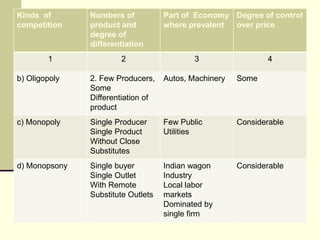
Kinds of       Numbers of           Part of Economy Degree of control
competition    product and          where prevalent over price
               degree of
               differentiation
        1              2                    3                 4

b) Oligopoly   2. Few Producers,    Autos, Machinery   Some
               Some
               Differentiation of
               product
c) Monopoly    Single Producer      Few Public         Considerable
               Single Product       Utilities
               Without Close
               Substitutes
d) Monopsony   Single buyer         Indian wagon       Considerable
               Single Outlet        Industry
               With Remote          Local labor
               Substitute Outlets   markets
                                    Dominated by
                                    single firm
Kinds of        Numbers of         Part of           Degree of control
competition     product and        Economy where     over price
                degree of          prevalent
                differentiation
       1                 2                 3                 4

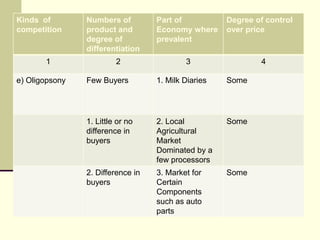
e) Oligopsony   Few Buyers         1. Milk Diaries   Some


                1. Little or no    2. Local          Some
                difference in      Agricultural
                buyers             Market
                                   Dominated by a
                                   few processors
                2. Difference in   3. Market for     Some
                buyers             Certain
                                   Components
                                   such as auto
                                   parts
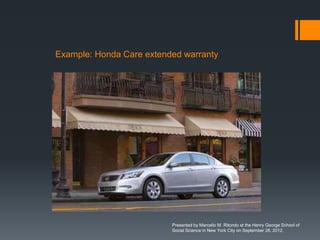
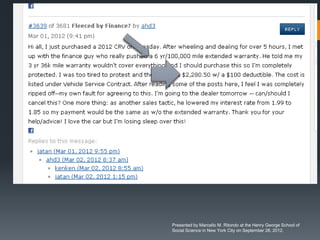
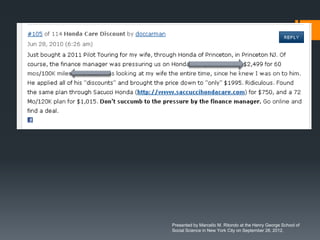
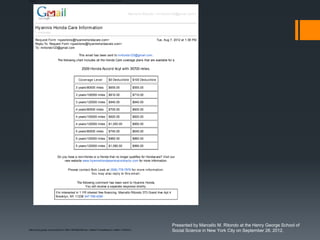
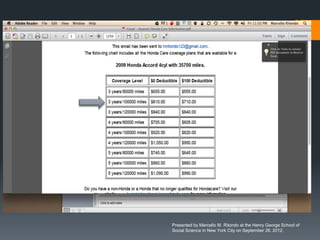
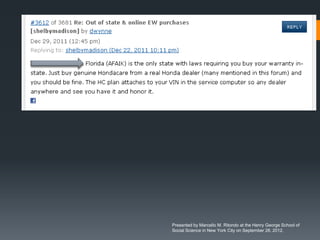
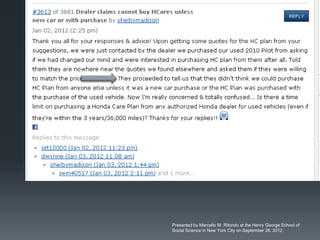
Example: Honda Care extended warranty


                          Presented by Marcello M. Ritondo at the Henry George School of
                          Social Science in New York City on September 28, 2012.
Presented by Marcello M. Ritondo at the Henry George School of
Social Science in New York City on September 28, 2012.
Presented by Marcello M. Ritondo at the Henry George School of
Social Science in New York City on September 28, 2012.
9/12/12                                          G mail - Hy annis Honda C are Information


                                                                                             Marcello Ritondo <mritondo123@gmail.com>


      Hy annis Honda Care Inform ation
      1 message

      Request Form <questions@hyannishondacare.com>                                                               Tue, Aug 7, 2012 at 1:38 PM
      Reply-To: Request Form <questions@hyannishondacare.com>
      To: mritondo123@gmail.com

                                              This email has been sent to mritondo123@gmail.com.
                          The following chart includes all the Honda Care coverage plans that are available for a

                                                 2009 Honda Accord 4cyl with 35700 miles.


                                              Coverage Level                $0 Deductible       $100 Deductible

                                           3 years/80000 miles              $655.00             $555.00

                                           3 years/100000 miles             $810.00             $710.00

                                           3 years/120000 miles             $940.00             $840.00

                                           4 years/80000 miles              $705.00             $605.00

                                           4 years/100000 miles             $920.00             $820.00

                                           4 years/120000 miles             $1,050.00           $950.00

                                           5 years/80000 miles              $745.00             $645.00

                                           5 years/100000 miles             $960.00             $860.00

                                           5 years/120000 miles             $1,090.00           $990.00


                          Do you have a non-Honda or a Honda that no longer qualifies for Hondacare? Visit our
                               new website www.hyannishondaservicecontracts.com for more information.

                                    Please contact Bob Leab at (508) 778-7878 for more information.
                                                   You may also reply to this email.

                                            The following comment has been sent to Hyannis Honda.
                                                  You will receive a seperate response shortly.
                         I'm interested in 1 YR interest free financing. Marcello Ritondo 373 Grand Ave Apt 4
                         Brooklyn, NY 11238 347-768-4290


                                                                                                                            Presented by Marcello M. Ritondo at the Henry George School of
https://mail.google.com/mail/u/0/?ui=2&ik=58f408c03f&v iew =pt&cat=H onda&search=cat&th=139022a3…
                                                                                                                            Social Science in New York City on September 28, 2012.
Presented by Marcello M. Ritondo at the Henry George School of
Social Science in New York City on September 28, 2012.
Presented by Marcello M. Ritondo at the Henry George School of
Social Science in New York City on September 28, 2012.
Presented by Marcello M. Ritondo at the Henry George School of
Social Science in New York City on September 28, 2012.
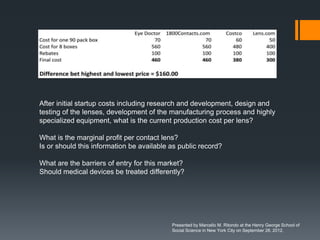
After initial startup costs including research and development, design and
testing of the lenses, development of the manufacturing process and highly
specialized equipment, what is the current production cost per lens?

What is the marginal profit per contact lens?
Is or should this information be available as public record?

What are the barriers of entry for this market?
Should medical devices be treated differently?


                                           Presented by Marcello M. Ritondo at the Henry George School of
                                           Social Science in New York City on September 28, 2012.
Additional Examples

            Prescription costs
            College textbooks
 Health care and Insurance premiums
          Emergency room visits
   Airline prices for last minute flights
$ 2.79+ per min for long distance calls!


                     Presented by Marcello M. Ritondo at the Henry George School of
                     Social Science in New York City on September 28, 2012.
video: a closer look at healthcare insurance premiums


 http://youtu.be/C4mJR3GCtDw


                               Presented by Marcello M. Ritondo at the Henry George School of
                               Social Science in New York City on September 28, 2012.
Conclusion

                 Open Questions

        Is it fair and reasonable to expect to pay
               a fair and reasonable price?

 Free Market, legal, regulatory and consumer options


                           Presented by Marcello M. Ritondo at the Henry George School of
                           Social Science in New York City on September 28, 2012.
additional references
 www.amosweb.com
 www.investopedia.com
 businessdictionary.com
 oxforddictionaries.com
 slideshare.com


              Presented by Marcello M. Ritondo at the Henry George School of
              Social Science in New York City on September 28, 2012.

Sources of Pricing Power

  • 1.
    Sources of PricingPower Retail prices are significantly influenced by factors other than costs of production This seminar details some of the factors that limit competition and raise prices for consumers Presented by Marcello M. Ritondo at the Henry George School of Social Science in New York City on September 28, 2012.
  • 2.
    What determines theprices we pay for goods and services? classical economic theory states that basic market structures determine price: Perfect Competition Monopolistic Competition Oligopoly Monopoly Presented by Marcello M. Ritondo at the Henry George School of Social Science in New York City on September 28, 2012.
  • 3.
     Why doprices fluctuate?  Pricing during natural and man made disasters  Price Gauging  The strict definition of price gauging  The broader definition of price gauging  Classical theory of price fluctuation  Examples of imperfect competition Is it fair and reasonable to expect to pay a fair and reasonable price?  Free market, legal, regulatory and consumer options Presented by Marcello M. Ritondo at the Henry George School of Social Science in New York City on September 28, 2012.
  • 4.
    What is pricegauging? Media coverage example: http://youtu.be/R6ojYtKazgQ
  • 5.
    What is pricegauging? Academic example: http://youtu.be/h9QEkw6_O6w
  • 6.
    Perfect Competition Perfect Competitionis a market in which buyers and sellers are so numerous and well informed that all elements of monopoly are absent The market price of a commodity is beyond the control of individual buyers and sellers Characterized by a large number of small firms Identical products sold by all firms Freedom of entry into and exit out of the industry Perfect knowledge of prices and technology Perfect competition is a theoretical market structure primarily used as a benchmark against which other market structures are compared. Also called “perfect market” or “pure competition” It is said that perfect competition efficiently allocates resources Presented by Marcello M. Ritondo at the Henry George School of Social Science in New York City on September 28, 2012.
  • 7.
    Competition is basicand fundamental to the free enterprise system Competition is involved in all observable phenomena of a market including Prices at which products are exchanged Kinds of the products produced Quantities sold Methods of distribution Emphasis placed on promotion Presented by Marcello M. Ritondo at the Henry George School of Social Science in New York City on September 28, 2012.
  • 8.
    Competition Source: Sebastion09 at Slideshare.net
  • 9.
    Value It is believed that having more than one business competing for the same consumers will cause the products and/or services to be provided at a better quality and a lower cost than if there were no competitors In other words, competition should provide the consumers with the best value for their hard-earned dollar Source: Sebastion09 at Slideshare.net
  • 10.
    ASPECTS OF COMPETITION Awareness  Competitive advantage  Technology  Competitive differentiation Source: Sebastion09 at Slideshare.net
  • 11.
    Awareness To besuccessful in today's very competitive business world, it is important for businesses to be aware of what their competitors are doing and to find a way to compete by matching or improving on the competitors' product or service For example, if Pepsi-Cola offers a new caffeine-free soda, Coca-Cola may offer a new caffeine-free soda with only one calorie By offering an improvement on the competitor's product, Coca- Cola is trying to convince soft-drink consumers to buy the new coke product because it is an improvement on Pepsi's product Source: Sebastion09 at Slideshare.net
  • 12.
    Competitive Advantage Whilebeing aware of the competition and making a countermove is important, it is also very important to pay attention to changing consumer wants, needs, and values and to make the needed changes before the competition does Doing research and development and being the first to provide a new product or service can give a company a competitive advantage in the marketplace Having a competitive advantage means that a company does something better than the competition Source: Sebastion09 at Slideshare.net
  • 13.
    Technology Oneway to remain competitive is through the use of technology Technology Can help speed up production processes through the use of robots or production lines Can move information more accurately and more quickly through the use of computer systems Can stimulate and assist in research and development Can facilitate transparency and accountability Source: Sebastion09 at Slideshare.net
  • 14.
    Competitive Differentiation Competitivedifferentiation occurs when a firm somehow differentiates its product or service from that of competitors Common ways to differentiate a product or service include advertising, a better-quality product, better service, better taste, or just better brand image Source: Sebastion09 at Slideshare.net
  • 15.
    Imperfect Competition Imperfect competitionimplies an industry or market in which one or more of the following conditions exist: Suppliers can influence prices There are significant barriers to entry and exit Goods and services are unique Small number of suppliers and/or buyers Information on pricing and process is not readily available Presented by Marcello M. Ritondo at the Henry George School of Social Science in New York City on September 28, 2012.
  • 16.
    Forms of ImperfectCompetition Market structures generally included in the category of imperfect competition: Monopoly Oligopoly Monopolistic Competition Every industry or market operates in some form of imperfect competition. For example, some industries rely on heavy initial capital investment, such as industrial manufacturers and telecom providers. This makes the prospect of having many competitors practically impossible. Markets are evaluated by their relative closeness to perfect competition Are efforts made to approach Perfect Competition? Presented by Marcello M. Ritondo at the Henry George School of Social Science in New York City on September 28, 2012.
  • 17.
    Perfect Competition Large number of buyer and seller Single uniform Homogenous price product Source: Sebastion09 at Slideshare.net
  • 18.
    Equilibrium Point Source: Sebastion09 at Slideshare.net
  • 19.
    Video: exploring asupply and demand price chart http://youtu.be/MykJi8QVUWU?t=59s
  • 20.
    Monopoly Monopoly is amarket in which a single firm is the only supplier of the goods or service. Anyone seeking to buy these goods and services must buy from the monopoly seller. This single-seller status gives the monopoly extensive market control. It is a price maker. The market demand for the good sold by a monopoly is the demand facing the monopoly. Market control means that monopoly does not equate price with marginal cost and thus does not efficiently allocate resources. Examples include utilities. The four key characteristics of monopoly are: (1) A single firm selling all output in a market (2) A unique product (3) Restrictions on entry into the industry, and (4) Specialized information about production techniques unavailable to other potential producers. Presented by Marcello M. Ritondo at the Henry George School of Social Science in New York City on September 28, 2012.
  • 21.
    Single Supplier Monopolies achievetheir single-seller status for three interrelated reasons: (a) Economies of scale (b) Government decree, and (c) Resource ownership While a monopoly can emerge and persist for any one of these reasons, most monopolies rely on two or all three Presented by Marcello M. Ritondo at the Henry George School of Social Science in New York City on September 28, 2012.
  • 22.
    Unique Product A monopolyachieves single-seller status because the good supplied is unique. There are no close substitutes available for the good produced by a monopoly Presented by Marcello M. Ritondo at the Henry George School of Social Science in New York City on September 28, 2012.
  • 23.
    Barriers to Entry Amonopoly often acquires and generally maintains single seller status due to restrictions on the entry of other firms into the market. Key barriers to entry are: (a) Government license or franchise (b) Resource ownership (c) Patents and copyrights (d) High start-up cost, and (e) Decreasing average total cost. These restrictions might be imposed for efficiency reasons or simply for the benefit of the monopoly. Since barriers to entry are a general deterrent to competition, If entry barriers increase, then competition will decrease. Presented by Marcello M. Ritondo at the Henry George School of Social Science in New York City on September 28, 2012.
  • 24.
    Specialized Information A monopolyoften possesses information not available to others. This specialized information generally comes in the form of legally-established patents, copyrights, or trademarks Presented by Marcello M. Ritondo at the Henry George School of Social Science in New York City on September 28, 2012.
  • 25.
    Advantages of monopoly: Source: Sebastion09 at Slideshare.net
  • 26.
    Disadvantages of monopoly Lack of consumer choice No pressure to keep costs down Misallocation of resources Monopoly in strategic sectors Source: Sebastion09 at Slideshare.net
  • 27.
    Oligopoly This market structure is characterized by a small number of relatively large competitors, each with substantial market control. Oligopoly sellers exhibit interdependent decision making which can lead to intense competition among the few and the motivation to cooperate through mergers and collusion Examples include automobile manufacturing Presented by Marcello M. Ritondo at the Henry George School of Social Science in New York City on September 28, 2012.
  • 28.
    Monopolistic Competition This marketstructure is characterized by a large number of relatively small competitors, each with a modest degree of market control on the supply side. A key feature of monopolistic competition is product differentiation. The output of each producer is a close but not identical substitute to that of every other firm, which helps satisfy diverse consumer wants and needs Examples include toothpaste and toilet paper manufacturers Presented by Marcello M. Ritondo at the Henry George School of Social Science in New York City on September 28, 2012.
  • 29.
    Video: market structureoverview (youtube.com, mjmfoodie's channel) http://youtu.be/9Hxy-TuX9fs?t=12s
  • 30.
    The Four Typesof Market Structure Number of Firms? Many firms One Type of Products? firm Few firms Differentiated Identical products products Monopoly Oligopoly Monopolistic Perfect Competition Competition • Tap water • Tennis balls • Novels • Wheat • Cable TV • Crude oil • Movies • Milk Source: Sebastion09 at slideshare.net
  • 32.
    Kinds of Numbers of Part of Degree of control over competition product and Economy price degree of where differentiation prevalent 1 2 3 4 1. Perfect Many producer Few None competition identical Agricultural products commodities 2. Imperfect Competition a) Monopolistic Many Producers Retail Trade, Some Competition Many Real Or Toothpaste, Imaginary Soap etc Difference in Product b) Oligopoly 1. Few producer Steel Some Little or no Aluminum difference in product
  • 33.
    Kinds of Numbers of Part of Economy Degree of control competition product and where prevalent over price degree of differentiation 1 2 3 4 b) Oligopoly 2. Few Producers, Autos, Machinery Some Some Differentiation of product c) Monopoly Single Producer Few Public Considerable Single Product Utilities Without Close Substitutes d) Monopsony Single buyer Indian wagon Considerable Single Outlet Industry With Remote Local labor Substitute Outlets markets Dominated by single firm
  • 34.
    Kinds of Numbers of Part of Degree of control competition product and Economy where over price degree of prevalent differentiation 1 2 3 4 e) Oligopsony Few Buyers 1. Milk Diaries Some 1. Little or no 2. Local Some difference in Agricultural buyers Market Dominated by a few processors 2. Difference in 3. Market for Some buyers Certain Components such as auto parts
  • 35.
    Example: Honda Careextended warranty Presented by Marcello M. Ritondo at the Henry George School of Social Science in New York City on September 28, 2012.
  • 36.
    Presented by MarcelloM. Ritondo at the Henry George School of Social Science in New York City on September 28, 2012.
  • 37.
    Presented by MarcelloM. Ritondo at the Henry George School of Social Science in New York City on September 28, 2012.
  • 38.
    9/12/12 G mail - Hy annis Honda C are Information Marcello Ritondo <mritondo123@gmail.com> Hy annis Honda Care Inform ation 1 message Request Form <questions@hyannishondacare.com> Tue, Aug 7, 2012 at 1:38 PM Reply-To: Request Form <questions@hyannishondacare.com> To: mritondo123@gmail.com This email has been sent to mritondo123@gmail.com. The following chart includes all the Honda Care coverage plans that are available for a 2009 Honda Accord 4cyl with 35700 miles. Coverage Level $0 Deductible $100 Deductible 3 years/80000 miles $655.00 $555.00 3 years/100000 miles $810.00 $710.00 3 years/120000 miles $940.00 $840.00 4 years/80000 miles $705.00 $605.00 4 years/100000 miles $920.00 $820.00 4 years/120000 miles $1,050.00 $950.00 5 years/80000 miles $745.00 $645.00 5 years/100000 miles $960.00 $860.00 5 years/120000 miles $1,090.00 $990.00 Do you have a non-Honda or a Honda that no longer qualifies for Hondacare? Visit our new website www.hyannishondaservicecontracts.com for more information. Please contact Bob Leab at (508) 778-7878 for more information. You may also reply to this email. The following comment has been sent to Hyannis Honda. You will receive a seperate response shortly. I'm interested in 1 YR interest free financing. Marcello Ritondo 373 Grand Ave Apt 4 Brooklyn, NY 11238 347-768-4290 Presented by Marcello M. Ritondo at the Henry George School of https://mail.google.com/mail/u/0/?ui=2&ik=58f408c03f&v iew =pt&cat=H onda&search=cat&th=139022a3… Social Science in New York City on September 28, 2012.
  • 39.
    Presented by MarcelloM. Ritondo at the Henry George School of Social Science in New York City on September 28, 2012.
  • 40.
    Presented by MarcelloM. Ritondo at the Henry George School of Social Science in New York City on September 28, 2012.
  • 41.
    Presented by MarcelloM. Ritondo at the Henry George School of Social Science in New York City on September 28, 2012.
  • 42.
    After initial startupcosts including research and development, design and testing of the lenses, development of the manufacturing process and highly specialized equipment, what is the current production cost per lens? What is the marginal profit per contact lens? Is or should this information be available as public record? What are the barriers of entry for this market? Should medical devices be treated differently? Presented by Marcello M. Ritondo at the Henry George School of Social Science in New York City on September 28, 2012.
  • 43.
    Additional Examples Prescription costs College textbooks Health care and Insurance premiums Emergency room visits Airline prices for last minute flights $ 2.79+ per min for long distance calls! Presented by Marcello M. Ritondo at the Henry George School of Social Science in New York City on September 28, 2012.
  • 44.
    video: a closerlook at healthcare insurance premiums http://youtu.be/C4mJR3GCtDw Presented by Marcello M. Ritondo at the Henry George School of Social Science in New York City on September 28, 2012.
  • 45.
    Conclusion Open Questions Is it fair and reasonable to expect to pay a fair and reasonable price?  Free Market, legal, regulatory and consumer options Presented by Marcello M. Ritondo at the Henry George School of Social Science in New York City on September 28, 2012.
  • 46.
    additional references www.amosweb.com www.investopedia.com businessdictionary.com oxforddictionaries.com slideshare.com Presented by Marcello M. Ritondo at the Henry George School of Social Science in New York City on September 28, 2012.