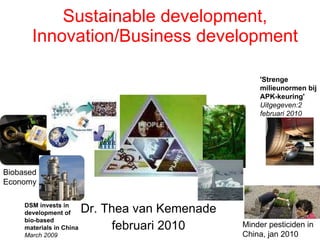
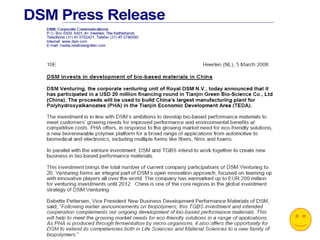
Sustainable development, Innovation/Business development Dr. Thea van Kemenade februari 2010 'Strenge milieunormen bij APK-keuring'  Uitgegeven:2 februari 2010 Minder pesticiden in China, jan 2010 Biobased Economy DSM invests in development of bio-based materials in China March 2009
Menu today General topics innovation / valorisation/ business development Format business proposition: BOP Values and identity: assignment 1 Trends in society and business Trends in Business   Market  landscape 21st  century   personal identity Group  assignment : elevator pitch: why is my business going to be a success Choosing the scope Industrial market development: success or failure Examples: materials, processes, services Example 1:  nanosensors Example 2: fibre reinforced composites Example 3: Market development India Example 4:  Biobased  block polymers by fermentation Example 5: Plato Example 6: Personal Example Fluffy Flax Example 7: Sustainable agriculture and GMO’s :role of stakeholders / consumer Assignment 2: business conditions: stakeholders description Assignment 3: competition Bulk or new business?  Assignment 4: Make your own business case
General  Topics:  Valorisation  Innovation and business development Knowledge based value generation  Societal (public benefits) Economic (companies, industry, consumer products) Knowledge paradox NL strong position in science and knowledge based economy “ weak” position knowledge transfer to society or industry or value / business development from knowledge workers OESO- innovatie-index: NL gezakt naar plaats 12  (Volkskrant 19 feb) Push or Pull?  University task or GTI’s (oa TNO)? Entrepreneurship in NL of EU? Cultural aspects: shame of bankruptcy or learning curve?
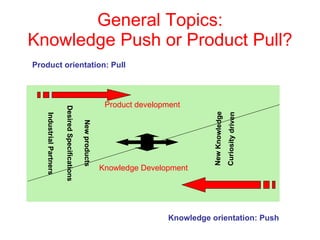
General Topics: Knowledge Push or Product Pull? Knowledge Development Product development  New Knowledge Curiosity driven New products Product orientation: Pull Knowledge orientation: Push Desired Specifications Industrial Partners
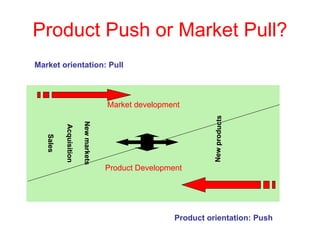
Product Push or Market Pull? Product Development Market development New products New markets Market orientation: Pull Product orientation: Push Acquisition Sales
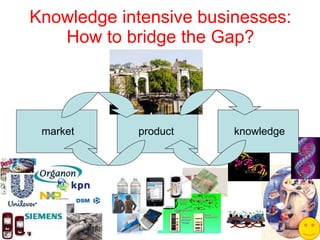
Knowledge intensive businesses: How to bridge the Gap? market product knowledge
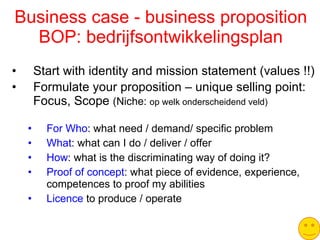
Business case - business proposition BOP: bedrijfsontwikkelingsplan Start with identity and mission statement (values !!) Formulate your proposition – unique selling point: Focus, Scope  (Niche:  op welk onderscheidend veld) For Who : what need / demand/ specific problem What : what can I do / deliver / offer How : what is the discriminating way of doing it? Proof of concept : what piece of evidence, experience, competences to proof my abilities Licence  to produce / operate
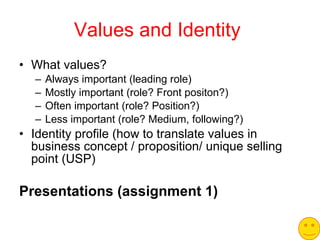
Values and Identity  What values? Always important (leading role) Mostly important (role? Front positon?) Often important (role? Position?) Less important (role? Medium, following?) Identity profile (how to translate values in business concept / proposition/ unique selling point (USP) Presentations (assignment 1)
Trends in Society and business Globalization Concentration, economy of scale: Mergers Mass individualization Consumer demand leads to Chain reversion E- commerce, B2C instead of B2B(more complicated networks) Sustainability, health safety, product/process quality Triple P: people, planet, profit….. Wish or Want?  Willingness to pay?? Less than 5 % higher price for sustainable product, however… food? Sustainable meat?
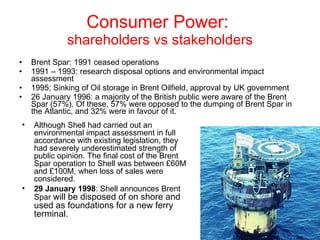
Consumer Power:  shareholders vs stakeholders Brent Spar: 1991 ceased operations 1991 – 1993: research disposal options and environmental impact assessment 1995; Sinking of Oil storage in Brent Oilfield, approval by UK government 26 January 1996: a majority of the British public were aware of the Brent Spar (57%). Of these, 57% were opposed to the dumping of Brent Spar in the Atlantic, and 32% were in favour of it. Although Shell had carried out an environmental impact assessment in full accordance with existing legislation, they had severely underestimated strength of public opinion. The final cost of the Brent Spar operation to Shell was between £60M and £100M, when loss of sales were considered.  29 January 1998 : Shell announces Brent Spar  will be disposed of on shore and used as foundations for a new ferry terminal.
Trends in business Fast availability/ turnover of new technology Upcoming Markets are seen combining traditional separated market segments Food – Pharma Materials – Medicine – Life Sciences ICT – Neurosciences Production Chains: Agribusiness & chemical Industry Multimedia, business communication and ICT Process innovation – product innovation – Transport & Logistics Mergers of companies New industrial revolution? Consumer Power: socio-economic development (stakeholders value vs shareholders value) Financial crisis: governmental role in shareholders of banks, shares in public domain, sustainability, long term optimisation vs short term interest (bonusses) Risk capital? Investment capital?
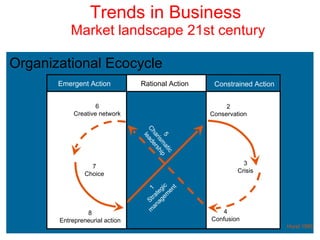
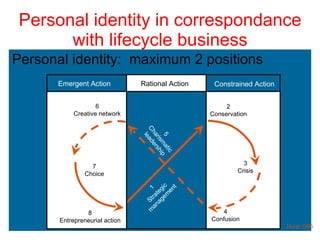
Trends in Business  Market landscape 21st century Organizational Ecocycle Emergent Action Constrained Action 5 Charismatic leadership 1 Strategic management Hurst 1995 6 Creative network 7 Choice 8 Entrepreneurial action 2 Conservation 3 Crisis 4 Confusion Rational Action
Personal identity in correspondance with lifecycle business Personal identity:  maximum 2 positions Emergent Action Constrained Action 5 Charismatic leadership 1 Strategic management Hurst 1995 6 Creative network 7 Choice 8 Entrepreneurial action 2 Conservation 3 Crisis 4 Confusion Rational Action
Group assignment Where is your personal position? Fits life cycle of market position of your own business / competion? Reflect on your business case and personal position What stage is fine, what stage will become difficult? Bring your message across: elevator pitch Why is my business going to be a success
Choosing the scope Nokia: focus on top-sport, athletes, later on, renewal as consumer sports Chemco: grafical arts photographic films  (niche, instead of consumer films: Kodak, Fuji, Agfa) You Tube: dating service…. 1.5 billion € within one year Spijker – Saab??
Industrial Market development Success or failure? Which elements are conditional? (non-)Existing technology, combinatorial renewal, innovation (non-) Existing production process, infrastructure (non-) Existing networks (non-) Existing market demand and commitment No more than 1-2 conditions non-existent Timing: not too early, not too late Depending on variety of change, it takes 3 – 20 years of development till market implementation / success Sustainable business, often > 2 non-existent: takes time!! Perceived conflict between economics and sustainability/responsible governance, within original business: need for new alliances Breakthrough innovation / transformation: “high risk investment”: Situation 2010?
Examples Sustainable business development Materials, processes, services
Areas of sustainable development: (Biobased) materials Polymers Functional polymers/ biomaterials Colloids: non toxic biodegradable paints / cosmetics / Coatings Automotives: system – integration, safety, sustainability, fibre reinforced composites (recycling), integrated information carriers (safety) (Bio-)Chemistry – Life Sciences Encapsulation: slow release of (enzymatic) catalysts, drugs, washing powder  (example OMO/Proctor & Gamble: market fight) Information carriers Chips/  PC / mobile phone / e-learning / e-business Sensors / tracing & tracking / labeling / feed back regulation Energy Solar cells, LED’s
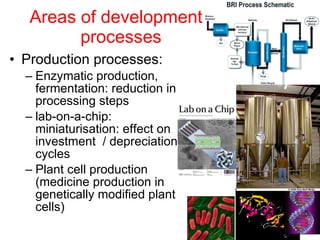
Areas of development:  processes Production processes: Enzymatic production, fermentation: reduction in processing steps lab-on-a-chip: miniaturisation: effect on investment  / depreciation cycles  Plant cell production (medicine production in genetically modified plant cells)
Areas of development: services Transport and Logistics Reducing/ optimizing transport (container, packaging / freight logistics) Reducing stock: “just in time delivery” Reducing waste (losses in handling, packaging)
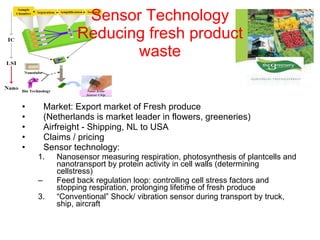
Sensor Technology Reducing fresh product waste Market: Export market of Fresh produce  (Netherlands is market leader in flowers, greeneries) Airfreight - Shipping, NL to USA Claims / pricing Sensor technology:  Nanosensor measuring respiration, photosynthesis of plantcells and nanotransport by protein activity in cell walls (determining cellstress)  Feed back regulation loop: controlling cell stress factors and stopping respiration, prolonging lifetime of fresh produce “ Conventional” Shock/ vibration sensor during transport by truck, ship, aircraft
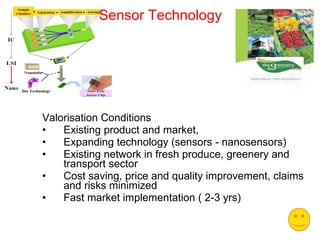
Sensor Technology Valorisation Conditions Existing product and market,  Expanding technology (sensors - nanosensors) Existing network in fresh produce, greenery and transport sector Cost saving, price and quality improvement, claims and risks minimized Fast market implementation ( 2-3 yrs)
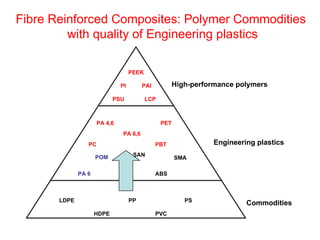
High-performance polymers Engineering plastics Commodities Fibre Reinforced Composites: Polymer Commodities  with quality of Engineering plastics PI PAI PSU LCP PEEK LDPE HDPE PP PS PVC PA 6 ABS SMA SAN POM PBT PC PA 4,6 PA 6,6 PET
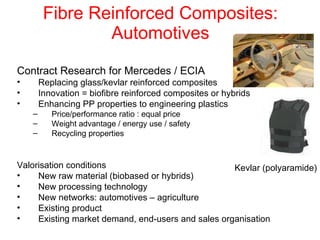
Fibre Reinforced Composites: Automotives Kevlar (polyaramide) Contract Research for Mercedes / ECIA   Replacing glass/kevlar reinforced composites Innovation = biofibre reinforced composites or hybrids Enhancing PP properties to engineering plastics Price/performance ratio : equal price  Weight advantage / energy use / safety Recycling properties Valorisation conditions New raw material (biobased or hybrids) New processing technology New networks: automotives – agriculture Existing product Existing market demand, end-users and sales organisation
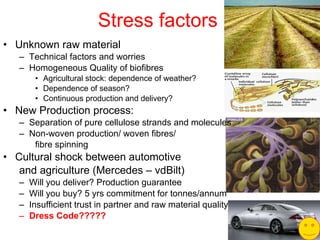
Stress factors Unknown raw material Technical factors and worries Homogeneous Quality of biofibres Agricultural stock: dependence of weather? Dependence of season? Continuous production and delivery?  New Production process:  Separation of pure cellulose strands and molecules Non-woven production/ woven fibres/  fibre spinning   Cultural shock between automotive and agriculture (Mercedes – vdBilt) Will you deliver? Production guarantee Will you buy? 5 yrs commitment for tonnes/annum Insufficient trust in partner and raw material quality Dress Code?????
Market development India Low cost production in Asia Bulk quantities of Coir fibre (burning, CO2) Fibre reinforced composites (planet, profit) Automotives Furniture Packaging: Fruit crate for export market, reducing quality loss during transport Role of unions: “people” quality of life
Biobased fermentative production of polymers Example: Caprolactam major fibre intermediate of DSM in the production of nylon-6 Production via chemical synthesis Large investment in production process Research on fermentation of Maïs waste to produce caprolactam Timing: depreciation cycle
Biobased fermentative Production of large volume block polymers Valorisation conditions New raw material (biobased) New processing technology (de-)Investment cycle New networks:  Chemical industry – agriculture Existing product Existing market demand, end-users and sales organisation DSM:  wanting her first success example of DSM - Gist
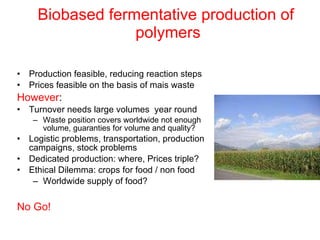
Biobased fermentative production of  polymers Production feasible, reducing reaction steps Prices feasible on the basis of mais waste However : Turnover needs large volumes  year round Waste position covers worldwide not enough volume, guaranties for volume and quality? Logistic problems, transportation, production campaigns, stock problems Dedicated production: where, Prices triple? Ethical Dilemma: crops for food / non food Worldwide supply of food? No Go!
 
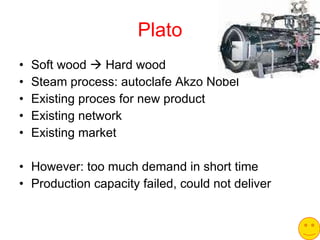
Plato Soft wood    Hard wood  Steam process: autoclafe Akzo Nobel Existing proces for new product Existing network Existing market However: too much demand in short time Production capacity failed, could not deliver
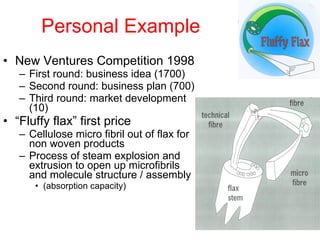
Personal Example New Ventures Competition 1998 First round: business idea (1700) Second round: business plan (700) Third round: market development (10) “ Fluffy flax” first price Cellulose micro fibril out of flax for non woven products Process of steam explosion and extrusion to open up microfibrils and molecule structure / assembly (absorption capacity)
Fluffy Flax Cellulose Fibres for nonwoven production Products: Disposable bed – “linen” (medical use) “ linen” table cloth (Duni) Industrial and medical wipes (chemical /medical waste) Heatsealable infusion paper Napkins (absorption) Replacing synthetic polymers: Polyester, viscose Two (worldwide) patents:  process patented, opening up fibre molecules application patent New raw material, same drylaid/wetlaid non woven process
Fluffy Flax Market: World wide market (substitution up to 2 %) 10 main customers (Producers of nonwovens, 200 small ones in total) DuPont, Kimberley-Clark, Hoechst,  Akzo Nobel ,  Lantor , Dexter, BBA,  Freudenberg ,  PGI ,  SCA - Duni   5 with interest and production trials:  3 contracted customers for phase 2, startup capacity  3 contracted customers for 70 % production volume for phase 3 Limited marketing costs, clear distribution channels Possible production satellites in Canada, Ukraine, China in phase 3
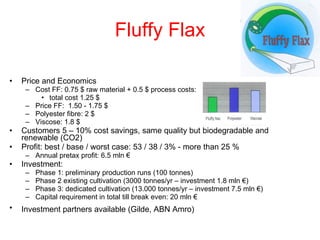
Fluffy Flax Price and Economics Cost FF: 0.75 $ raw material + 0.5 $ process costs:  total cost 1.25 $ Price FF:  1.50 - 1.75 $ Polyester fibre: 2 $ Viscose: 1.8 $  Customers 5 – 10% cost savings, same quality but biodegradable and renewable (CO2) Profit: best / base / worst case: 53 / 38 / 3% - more than 25 % Annual pretax profit: 6.5 mln €  Investment:  Phase 1: preliminary production runs (100 tonnes) Phase 2 existing cultivation (3000 tonnes/yr – investment 1.8 mln €) Phase 3: dedicated cultivation (13.000 tonnes/yr – investment 7.5 mln €) Capital requirement in total till break even: 20 mln € Investment partners available (Gilde, ABN Amro)
Fluffy Flax Partners and Business Team  Spin off: ANV AgriNewVentures (patent, expertise, technology) Belgalin (flax sourcing & blending) Agro-Industria Complex Dinteloord (production site, infrastructure) Venture Capital (Gilde)  Senior Non Wovens Industry Senior Marketing However: price PET drops to 50 % in 1999! No Go for phase 2
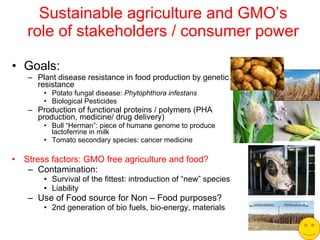
Sustainable agriculture and GMO’s role of stakeholders / consumer power Goals: Plant disease resistance in food production by genetic resistance  Potato fungal disease:  Phytophthora infestans   Biological Pesticides Production of functional proteins / polymers (PHA production, medicine/ drug delivery) Bull “Herman”: piece of humane genome to produce lactoferrine in milk Tomato secondary species: cancer medicine Stress factors: GMO free agriculture and food? Contamination:  Survival of the fittest: introduction of “new” species Liability Use of Food source for Non – Food purposes? 2nd generation of bio fuels, bio-energy, materials
Assignment stakeholders and conditions:   How is this situation for your own business? Presentation 2: stakeholder analyses Integrate 1 slide: 1, 2, 3, 4 existing/ non-existing conditions
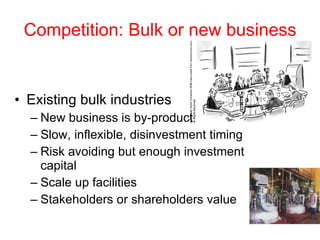
Competition: Bulk or new business Existing bulk industries New business is by-product Slow, inflexible, disinvestment timing Risk avoiding but enough investment capital Scale up facilities Stakeholders or shareholders value
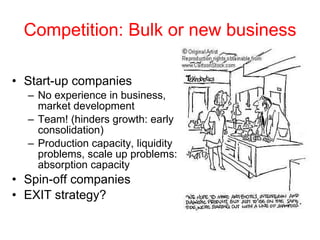
Competition: Bulk or new business Start-up companies No experience in business, market development Team! (hinders growth: early consolidation) Production capacity, liquidity problems, scale up problems: absorption capacity Spin-off companies EXIT strategy?
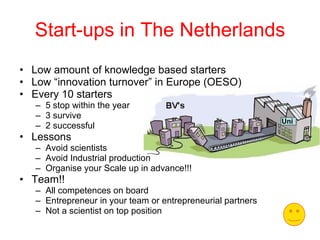
Start-ups in The Netherlands Low amount of knowledge based starters Low “innovation turnover” in Europe (OESO) Every 10 starters 5 stop within the year 3 survive 2 successful Lessons Avoid scientists Avoid Industrial production Organise your Scale up in advance!!!  Team!! All competences on board Entrepreneur in your team or entrepreneurial partners Not a scientist on top position Uni
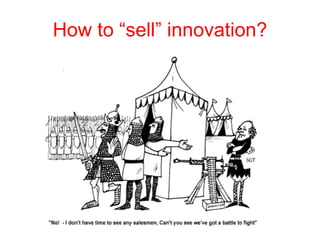
How to “sell” innovation?
Business case - business proposition Start with identity and mission statement Formulate your proposition – unique selling point For Who : what need / demand/ specific problem What : what can I do / deliver / offer How : what is the discriminating way of doing it? Proof of concept : what piece of evidence, experience, competences to proof my abilities How to organise scale up / consolidation Licence  to produce / operate
Team Assignment Pick your subject for the business case Team: present why this team.. What is needed / missing in your team Presentation: business proposal: business idea and sustainability impact  Identity, mission Fill in 1 – 5 For who, what demand, Scope! What: USP How: USP Proof of market concept: why me? Competition?  License to produce (: values, p,p,p – sustainable impact in the production/market chain, ethics, stakeholders)

Valorisation Sustainable Development 22feb10

  • 1.
    Sustainable development, Innovation/Businessdevelopment Dr. Thea van Kemenade februari 2010 'Strenge milieunormen bij APK-keuring' Uitgegeven:2 februari 2010 Minder pesticiden in China, jan 2010 Biobased Economy DSM invests in development of bio-based materials in China March 2009
  • 2.
    Menu today Generaltopics innovation / valorisation/ business development Format business proposition: BOP Values and identity: assignment 1 Trends in society and business Trends in Business Market landscape 21st century personal identity Group assignment : elevator pitch: why is my business going to be a success Choosing the scope Industrial market development: success or failure Examples: materials, processes, services Example 1: nanosensors Example 2: fibre reinforced composites Example 3: Market development India Example 4: Biobased block polymers by fermentation Example 5: Plato Example 6: Personal Example Fluffy Flax Example 7: Sustainable agriculture and GMO’s :role of stakeholders / consumer Assignment 2: business conditions: stakeholders description Assignment 3: competition Bulk or new business? Assignment 4: Make your own business case
  • 3.
    General Topics: Valorisation Innovation and business development Knowledge based value generation Societal (public benefits) Economic (companies, industry, consumer products) Knowledge paradox NL strong position in science and knowledge based economy “ weak” position knowledge transfer to society or industry or value / business development from knowledge workers OESO- innovatie-index: NL gezakt naar plaats 12 (Volkskrant 19 feb) Push or Pull? University task or GTI’s (oa TNO)? Entrepreneurship in NL of EU? Cultural aspects: shame of bankruptcy or learning curve?
  • 4.
    General Topics: KnowledgePush or Product Pull? Knowledge Development Product development New Knowledge Curiosity driven New products Product orientation: Pull Knowledge orientation: Push Desired Specifications Industrial Partners
  • 5.
    Product Push orMarket Pull? Product Development Market development New products New markets Market orientation: Pull Product orientation: Push Acquisition Sales
  • 6.
    Knowledge intensive businesses:How to bridge the Gap? market product knowledge
  • 7.
    Business case -business proposition BOP: bedrijfsontwikkelingsplan Start with identity and mission statement (values !!) Formulate your proposition – unique selling point: Focus, Scope (Niche: op welk onderscheidend veld) For Who : what need / demand/ specific problem What : what can I do / deliver / offer How : what is the discriminating way of doing it? Proof of concept : what piece of evidence, experience, competences to proof my abilities Licence to produce / operate
  • 8.
    Values and Identity What values? Always important (leading role) Mostly important (role? Front positon?) Often important (role? Position?) Less important (role? Medium, following?) Identity profile (how to translate values in business concept / proposition/ unique selling point (USP) Presentations (assignment 1)
  • 9.
    Trends in Societyand business Globalization Concentration, economy of scale: Mergers Mass individualization Consumer demand leads to Chain reversion E- commerce, B2C instead of B2B(more complicated networks) Sustainability, health safety, product/process quality Triple P: people, planet, profit….. Wish or Want? Willingness to pay?? Less than 5 % higher price for sustainable product, however… food? Sustainable meat?
  • 10.
    Consumer Power: shareholders vs stakeholders Brent Spar: 1991 ceased operations 1991 – 1993: research disposal options and environmental impact assessment 1995; Sinking of Oil storage in Brent Oilfield, approval by UK government 26 January 1996: a majority of the British public were aware of the Brent Spar (57%). Of these, 57% were opposed to the dumping of Brent Spar in the Atlantic, and 32% were in favour of it. Although Shell had carried out an environmental impact assessment in full accordance with existing legislation, they had severely underestimated strength of public opinion. The final cost of the Brent Spar operation to Shell was between £60M and £100M, when loss of sales were considered. 29 January 1998 : Shell announces Brent Spar will be disposed of on shore and used as foundations for a new ferry terminal.
  • 11.
    Trends in businessFast availability/ turnover of new technology Upcoming Markets are seen combining traditional separated market segments Food – Pharma Materials – Medicine – Life Sciences ICT – Neurosciences Production Chains: Agribusiness & chemical Industry Multimedia, business communication and ICT Process innovation – product innovation – Transport & Logistics Mergers of companies New industrial revolution? Consumer Power: socio-economic development (stakeholders value vs shareholders value) Financial crisis: governmental role in shareholders of banks, shares in public domain, sustainability, long term optimisation vs short term interest (bonusses) Risk capital? Investment capital?
  • 12.
    Trends in Business Market landscape 21st century Organizational Ecocycle Emergent Action Constrained Action 5 Charismatic leadership 1 Strategic management Hurst 1995 6 Creative network 7 Choice 8 Entrepreneurial action 2 Conservation 3 Crisis 4 Confusion Rational Action
  • 13.
    Personal identity incorrespondance with lifecycle business Personal identity: maximum 2 positions Emergent Action Constrained Action 5 Charismatic leadership 1 Strategic management Hurst 1995 6 Creative network 7 Choice 8 Entrepreneurial action 2 Conservation 3 Crisis 4 Confusion Rational Action
  • 14.
    Group assignment Whereis your personal position? Fits life cycle of market position of your own business / competion? Reflect on your business case and personal position What stage is fine, what stage will become difficult? Bring your message across: elevator pitch Why is my business going to be a success
  • 15.
    Choosing the scopeNokia: focus on top-sport, athletes, later on, renewal as consumer sports Chemco: grafical arts photographic films (niche, instead of consumer films: Kodak, Fuji, Agfa) You Tube: dating service…. 1.5 billion € within one year Spijker – Saab??
  • 16.
    Industrial Market developmentSuccess or failure? Which elements are conditional? (non-)Existing technology, combinatorial renewal, innovation (non-) Existing production process, infrastructure (non-) Existing networks (non-) Existing market demand and commitment No more than 1-2 conditions non-existent Timing: not too early, not too late Depending on variety of change, it takes 3 – 20 years of development till market implementation / success Sustainable business, often > 2 non-existent: takes time!! Perceived conflict between economics and sustainability/responsible governance, within original business: need for new alliances Breakthrough innovation / transformation: “high risk investment”: Situation 2010?
  • 17.
    Examples Sustainable businessdevelopment Materials, processes, services
  • 18.
    Areas of sustainabledevelopment: (Biobased) materials Polymers Functional polymers/ biomaterials Colloids: non toxic biodegradable paints / cosmetics / Coatings Automotives: system – integration, safety, sustainability, fibre reinforced composites (recycling), integrated information carriers (safety) (Bio-)Chemistry – Life Sciences Encapsulation: slow release of (enzymatic) catalysts, drugs, washing powder (example OMO/Proctor & Gamble: market fight) Information carriers Chips/ PC / mobile phone / e-learning / e-business Sensors / tracing & tracking / labeling / feed back regulation Energy Solar cells, LED’s
  • 19.
    Areas of development: processes Production processes: Enzymatic production, fermentation: reduction in processing steps lab-on-a-chip: miniaturisation: effect on investment / depreciation cycles Plant cell production (medicine production in genetically modified plant cells)
  • 20.
    Areas of development:services Transport and Logistics Reducing/ optimizing transport (container, packaging / freight logistics) Reducing stock: “just in time delivery” Reducing waste (losses in handling, packaging)
  • 21.
    Sensor Technology Reducingfresh product waste Market: Export market of Fresh produce (Netherlands is market leader in flowers, greeneries) Airfreight - Shipping, NL to USA Claims / pricing Sensor technology: Nanosensor measuring respiration, photosynthesis of plantcells and nanotransport by protein activity in cell walls (determining cellstress) Feed back regulation loop: controlling cell stress factors and stopping respiration, prolonging lifetime of fresh produce “ Conventional” Shock/ vibration sensor during transport by truck, ship, aircraft
  • 22.
    Sensor Technology ValorisationConditions Existing product and market, Expanding technology (sensors - nanosensors) Existing network in fresh produce, greenery and transport sector Cost saving, price and quality improvement, claims and risks minimized Fast market implementation ( 2-3 yrs)
  • 23.
    High-performance polymers Engineeringplastics Commodities Fibre Reinforced Composites: Polymer Commodities with quality of Engineering plastics PI PAI PSU LCP PEEK LDPE HDPE PP PS PVC PA 6 ABS SMA SAN POM PBT PC PA 4,6 PA 6,6 PET
  • 24.
    Fibre Reinforced Composites:Automotives Kevlar (polyaramide) Contract Research for Mercedes / ECIA Replacing glass/kevlar reinforced composites Innovation = biofibre reinforced composites or hybrids Enhancing PP properties to engineering plastics Price/performance ratio : equal price Weight advantage / energy use / safety Recycling properties Valorisation conditions New raw material (biobased or hybrids) New processing technology New networks: automotives – agriculture Existing product Existing market demand, end-users and sales organisation
  • 25.
    Stress factors Unknownraw material Technical factors and worries Homogeneous Quality of biofibres Agricultural stock: dependence of weather? Dependence of season? Continuous production and delivery? New Production process: Separation of pure cellulose strands and molecules Non-woven production/ woven fibres/ fibre spinning Cultural shock between automotive and agriculture (Mercedes – vdBilt) Will you deliver? Production guarantee Will you buy? 5 yrs commitment for tonnes/annum Insufficient trust in partner and raw material quality Dress Code?????
  • 26.
    Market development IndiaLow cost production in Asia Bulk quantities of Coir fibre (burning, CO2) Fibre reinforced composites (planet, profit) Automotives Furniture Packaging: Fruit crate for export market, reducing quality loss during transport Role of unions: “people” quality of life
  • 27.
    Biobased fermentative productionof polymers Example: Caprolactam major fibre intermediate of DSM in the production of nylon-6 Production via chemical synthesis Large investment in production process Research on fermentation of Maïs waste to produce caprolactam Timing: depreciation cycle
  • 28.
    Biobased fermentative Productionof large volume block polymers Valorisation conditions New raw material (biobased) New processing technology (de-)Investment cycle New networks: Chemical industry – agriculture Existing product Existing market demand, end-users and sales organisation DSM: wanting her first success example of DSM - Gist
  • 29.
    Biobased fermentative productionof polymers Production feasible, reducing reaction steps Prices feasible on the basis of mais waste However : Turnover needs large volumes year round Waste position covers worldwide not enough volume, guaranties for volume and quality? Logistic problems, transportation, production campaigns, stock problems Dedicated production: where, Prices triple? Ethical Dilemma: crops for food / non food Worldwide supply of food? No Go!
  • 30.
  • 31.
    Plato Soft wood  Hard wood Steam process: autoclafe Akzo Nobel Existing proces for new product Existing network Existing market However: too much demand in short time Production capacity failed, could not deliver
  • 32.
    Personal Example NewVentures Competition 1998 First round: business idea (1700) Second round: business plan (700) Third round: market development (10) “ Fluffy flax” first price Cellulose micro fibril out of flax for non woven products Process of steam explosion and extrusion to open up microfibrils and molecule structure / assembly (absorption capacity)
  • 33.
    Fluffy Flax CelluloseFibres for nonwoven production Products: Disposable bed – “linen” (medical use) “ linen” table cloth (Duni) Industrial and medical wipes (chemical /medical waste) Heatsealable infusion paper Napkins (absorption) Replacing synthetic polymers: Polyester, viscose Two (worldwide) patents: process patented, opening up fibre molecules application patent New raw material, same drylaid/wetlaid non woven process
  • 34.
    Fluffy Flax Market:World wide market (substitution up to 2 %) 10 main customers (Producers of nonwovens, 200 small ones in total) DuPont, Kimberley-Clark, Hoechst, Akzo Nobel , Lantor , Dexter, BBA, Freudenberg , PGI , SCA - Duni 5 with interest and production trials: 3 contracted customers for phase 2, startup capacity 3 contracted customers for 70 % production volume for phase 3 Limited marketing costs, clear distribution channels Possible production satellites in Canada, Ukraine, China in phase 3
  • 35.
    Fluffy Flax Priceand Economics Cost FF: 0.75 $ raw material + 0.5 $ process costs: total cost 1.25 $ Price FF: 1.50 - 1.75 $ Polyester fibre: 2 $ Viscose: 1.8 $ Customers 5 – 10% cost savings, same quality but biodegradable and renewable (CO2) Profit: best / base / worst case: 53 / 38 / 3% - more than 25 % Annual pretax profit: 6.5 mln € Investment: Phase 1: preliminary production runs (100 tonnes) Phase 2 existing cultivation (3000 tonnes/yr – investment 1.8 mln €) Phase 3: dedicated cultivation (13.000 tonnes/yr – investment 7.5 mln €) Capital requirement in total till break even: 20 mln € Investment partners available (Gilde, ABN Amro)
  • 36.
    Fluffy Flax Partnersand Business Team Spin off: ANV AgriNewVentures (patent, expertise, technology) Belgalin (flax sourcing & blending) Agro-Industria Complex Dinteloord (production site, infrastructure) Venture Capital (Gilde) Senior Non Wovens Industry Senior Marketing However: price PET drops to 50 % in 1999! No Go for phase 2
  • 37.
    Sustainable agriculture andGMO’s role of stakeholders / consumer power Goals: Plant disease resistance in food production by genetic resistance Potato fungal disease: Phytophthora infestans Biological Pesticides Production of functional proteins / polymers (PHA production, medicine/ drug delivery) Bull “Herman”: piece of humane genome to produce lactoferrine in milk Tomato secondary species: cancer medicine Stress factors: GMO free agriculture and food? Contamination: Survival of the fittest: introduction of “new” species Liability Use of Food source for Non – Food purposes? 2nd generation of bio fuels, bio-energy, materials
  • 38.
    Assignment stakeholders andconditions: How is this situation for your own business? Presentation 2: stakeholder analyses Integrate 1 slide: 1, 2, 3, 4 existing/ non-existing conditions
  • 39.
    Competition: Bulk ornew business Existing bulk industries New business is by-product Slow, inflexible, disinvestment timing Risk avoiding but enough investment capital Scale up facilities Stakeholders or shareholders value
  • 40.
    Competition: Bulk ornew business Start-up companies No experience in business, market development Team! (hinders growth: early consolidation) Production capacity, liquidity problems, scale up problems: absorption capacity Spin-off companies EXIT strategy?
  • 41.
    Start-ups in TheNetherlands Low amount of knowledge based starters Low “innovation turnover” in Europe (OESO) Every 10 starters 5 stop within the year 3 survive 2 successful Lessons Avoid scientists Avoid Industrial production Organise your Scale up in advance!!! Team!! All competences on board Entrepreneur in your team or entrepreneurial partners Not a scientist on top position Uni
  • 42.
    How to “sell”innovation?
  • 43.
    Business case -business proposition Start with identity and mission statement Formulate your proposition – unique selling point For Who : what need / demand/ specific problem What : what can I do / deliver / offer How : what is the discriminating way of doing it? Proof of concept : what piece of evidence, experience, competences to proof my abilities How to organise scale up / consolidation Licence to produce / operate
  • 44.
    Team Assignment Pickyour subject for the business case Team: present why this team.. What is needed / missing in your team Presentation: business proposal: business idea and sustainability impact Identity, mission Fill in 1 – 5 For who, what demand, Scope! What: USP How: USP Proof of market concept: why me? Competition? License to produce (: values, p,p,p – sustainable impact in the production/market chain, ethics, stakeholders)