The branch of physics which deals with
production of best sound effects in buildings
and rooms.
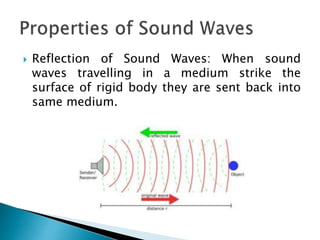
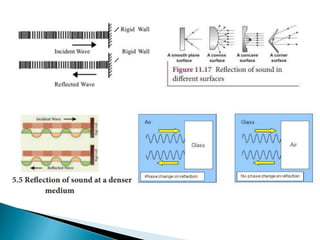
 Reflection of Sound Waves: When sound
waves travelling in a medium strike the
surface of rigid body they are sent back into
same medium.
 Reflection of Sound Wave from Rigid Surface:
When sound waves strike a rigid surface it suffers a
change in direction and phase of λ/2.
 Reflection of Sound Waves from Curved Surface:
When sound waves strike a curved surface they are
focused at principal focus of reflecting curved surface.
 Reflection of Sound Waves at a rarer medium: The
type of wave is changed i.e. a compression is reflected
as rarefaction and vice versa. There is no change in
direction and motion of particles.
 Reflection of Sound Waves at a denser medium:
When sound waves are reflected from denser medium
type of wave remains unchanged, but sign is changed
and direction of motion is opposite to incident wave.
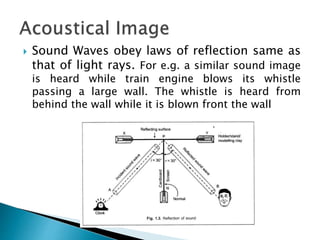
 Sound Waves obey laws of reflection same as
that of light rays. For e.g. a similar sound image
is heard while train engine blows its whistle
passing a large wall. The whistle is heard from
behind the wall while it is blown front the wall
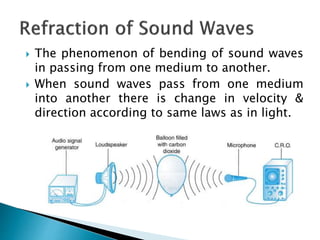
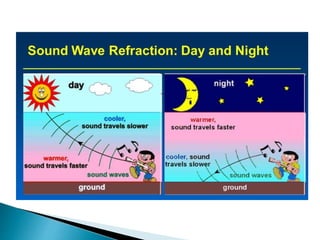
 The phenomenon of bending of sound waves
in passing from one medium to another.
 When sound waves pass from one medium
into another there is change in velocity &
direction according to same laws as in light.
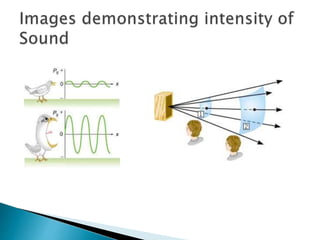
 Average sound energy transported per second
per unit area perpendicular to direction of
propagation of wave.
 Intensity, I of sound depends on
I is directly proportional to square of amplitude
of source.
I is directly proportional to square of frequency
of source.
I is directly proportional to area of vibrating
body (like sound from bigger speaker is more
than small speaker)
I is inversely proportional to distance from
source of sound
 Minimum intensity of sound which normal human
can hear is equal to an energy of 10-12 Watt/m2.
This is called Threshold of hearing denoted by Io
 Maximum intensity of sound which human ear
can hear without sensation of pain is 1Watt/m2.
 SI unit of intensity of sound is Watt / m2.
 Direction of intensity is average direction in
which sound is flowing.
 Energy emitted by body vibrating with frequency
n is E = 1/2 mω2r2
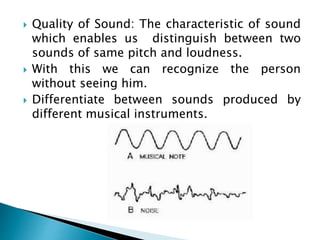
 Quality of Sound: The characteristic of sound
which enables us distinguish between two
sounds of same pitch and loudness.
 With this we can recognize the person
without seeing him.
 Differentiate between sounds produced by
different musical instruments.
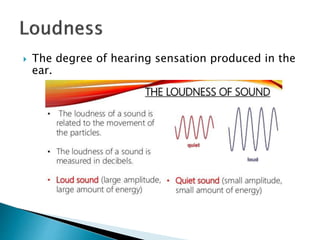
 The degree of hearing sensation produced in the
ear.
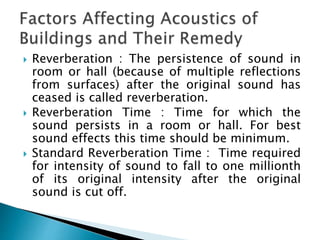
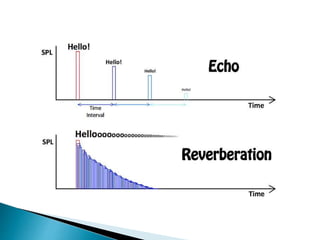
 Reverberation : The persistence of sound in
room or hall (because of multiple reflections
from surfaces) after the original sound has
ceased is called reverberation.
 Reverberation Time : Time for which the
sound persists in a room or hall. For best
sound effects this time should be minimum.
 Standard Reverberation Time : Time required
for intensity of sound to fall to one millionth
of its original intensity after the original
sound is cut off.
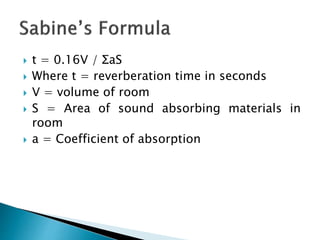
 t = 0.16V / ΣaS
 Where t = reverberation time in seconds
 V = volume of room
 S = Area of sound absorbing materials in
room
 a = Coefficient of absorption
 If reverberation time is very large hen we will
have overlapping of sound and we will not be
able to hear words clearly so we should take
steps to reduce it.
 Few open windows act as perfect absorbers.
 Sound absorbing materials such as card
boards, asbestos sheets, curtains, pictures
should be put in room.
 Good number of audience should be present
in room
 Cushioned seats act as good absorbers.
 Curved walls and corners in room should be
avoided.
 Optimum Value of reverberation time. If
reverberation time is large words will overlap
& if it is zero then words will produce dead
effect.
 For example if R.T = 0 & we said “WORD” we
will hear sound as “WOR” D sound will
become dead.
 Optimum value of RT for speech = 0.5-1 sec
and music is 1-1.5 sec (imp for MCQ)
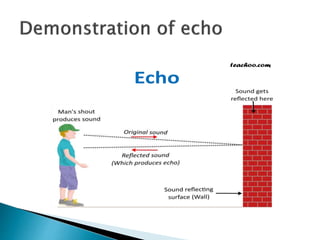
 An echo is sound heard (other than original
sound) produced by reflection from the
surface of large obstacle situated at some
distance from the listener.
 For e.g. if source and obstacle are 1km apart
(v = 340m/sec) listener will hear echo after
2X 1000 / 340 = 5.88 seconds.
 Twice distance is sound will travel to obstacle
and come back
 Minimum distance for an echo to be heard is
17m
 The intensity of hearing sensation is called as
loudness.
 To achieve good acoustical effects following
points should be kept in mind while
designing a hall
 Length of hall should be greater than breadth
(because sound being a longitudinal wave
travels back and forth)
 Wall surface behind loud speaker should be a
large parabola
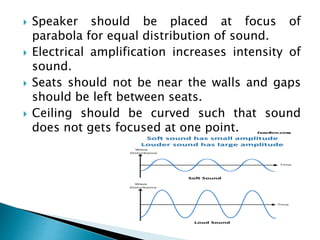
 Speaker should be placed at focus of
parabola for equal distribution of sound.
 Electrical amplification increases intensity of
sound.
 Seats should not be near the walls and gaps
should be left between seats.
 Ceiling should be curved such that sound
does not gets focused at one point.
 When sound is produced in room listener
receives sound waves in two ways:
 Waves directly from source of sound
 Waves after reflection from walls or ceiling.
 The source is continuously producing sound and
sound waves which on reflecting from walls or
ceiling overlap with each other.
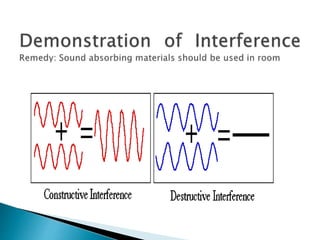
 This overlapping may cause interference
(discussed ealier). Where constructive
interference occurs sound increases and where
destructive interference occurs silence zones
form.
 If walls or ceiling are curved or cylindrical the
sound waves get focused and produce
undesirable concentration of sound energy.
 Remedy: Avoid corners and curved walls.
Plane walls with good absorbing materials
should be used.
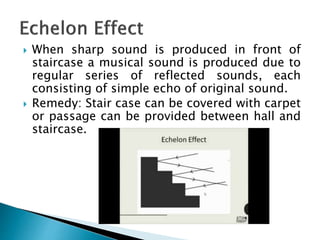
 When sharp sound is produced in front of
staircase a musical sound is produced due to
regular series of reflected sounds, each
consisting of simple echo of original sound.
 Remedy: Stair case can be covered with carpet
or passage can be provided between hall and
staircase.
 Sound which produces an unpleasant effect
on ears.
 They can be of two types: Air Borne &
Structure Borne
 Remedy: Air borne noise can be reduced by
using double doors & windows
 Structure borne noise can be reduced by
introducing discontinuities in pipes for water
and gas.
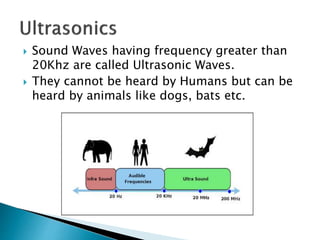
 Sound Waves having frequency greater than
20Khz are called Ultrasonic Waves.
 They cannot be heard by Humans but can be
heard by animals like dogs, bats etc.
 Ultrasonic Waves can be produced by :
 Magnetostriction Oscillator
 Piezo Electric Oscillator
 To be done from book
 (Important for long answer questions
Principle, Construction and Working of both
oscillator)
 To be done from book
 Briefly describe all application of Ultrasonic
waves.
 Important for Section B part of exam.

sound and its property

  • 1.
    The branch ofphysics which deals with production of best sound effects in buildings and rooms.
  • 2.
     Reflection ofSound Waves: When sound waves travelling in a medium strike the surface of rigid body they are sent back into same medium.
  • 3.
     Reflection ofSound Wave from Rigid Surface: When sound waves strike a rigid surface it suffers a change in direction and phase of λ/2.  Reflection of Sound Waves from Curved Surface: When sound waves strike a curved surface they are focused at principal focus of reflecting curved surface.  Reflection of Sound Waves at a rarer medium: The type of wave is changed i.e. a compression is reflected as rarefaction and vice versa. There is no change in direction and motion of particles.  Reflection of Sound Waves at a denser medium: When sound waves are reflected from denser medium type of wave remains unchanged, but sign is changed and direction of motion is opposite to incident wave.
  • 5.
     Sound Wavesobey laws of reflection same as that of light rays. For e.g. a similar sound image is heard while train engine blows its whistle passing a large wall. The whistle is heard from behind the wall while it is blown front the wall
  • 6.
     The phenomenonof bending of sound waves in passing from one medium to another.  When sound waves pass from one medium into another there is change in velocity & direction according to same laws as in light.
  • 8.
     Average soundenergy transported per second per unit area perpendicular to direction of propagation of wave.  Intensity, I of sound depends on I is directly proportional to square of amplitude of source. I is directly proportional to square of frequency of source. I is directly proportional to area of vibrating body (like sound from bigger speaker is more than small speaker) I is inversely proportional to distance from source of sound
  • 10.
     Minimum intensityof sound which normal human can hear is equal to an energy of 10-12 Watt/m2. This is called Threshold of hearing denoted by Io  Maximum intensity of sound which human ear can hear without sensation of pain is 1Watt/m2.  SI unit of intensity of sound is Watt / m2.  Direction of intensity is average direction in which sound is flowing.  Energy emitted by body vibrating with frequency n is E = 1/2 mω2r2
  • 11.
     Quality ofSound: The characteristic of sound which enables us distinguish between two sounds of same pitch and loudness.  With this we can recognize the person without seeing him.  Differentiate between sounds produced by different musical instruments.
  • 12.
     The degreeof hearing sensation produced in the ear.
  • 13.
     Reverberation :The persistence of sound in room or hall (because of multiple reflections from surfaces) after the original sound has ceased is called reverberation.  Reverberation Time : Time for which the sound persists in a room or hall. For best sound effects this time should be minimum.  Standard Reverberation Time : Time required for intensity of sound to fall to one millionth of its original intensity after the original sound is cut off.
  • 15.
     t =0.16V / ΣaS  Where t = reverberation time in seconds  V = volume of room  S = Area of sound absorbing materials in room  a = Coefficient of absorption
  • 16.
     If reverberationtime is very large hen we will have overlapping of sound and we will not be able to hear words clearly so we should take steps to reduce it.  Few open windows act as perfect absorbers.  Sound absorbing materials such as card boards, asbestos sheets, curtains, pictures should be put in room.  Good number of audience should be present in room
  • 17.
     Cushioned seatsact as good absorbers.  Curved walls and corners in room should be avoided.  Optimum Value of reverberation time. If reverberation time is large words will overlap & if it is zero then words will produce dead effect.  For example if R.T = 0 & we said “WORD” we will hear sound as “WOR” D sound will become dead.  Optimum value of RT for speech = 0.5-1 sec and music is 1-1.5 sec (imp for MCQ)
  • 18.
     An echois sound heard (other than original sound) produced by reflection from the surface of large obstacle situated at some distance from the listener.  For e.g. if source and obstacle are 1km apart (v = 340m/sec) listener will hear echo after 2X 1000 / 340 = 5.88 seconds.  Twice distance is sound will travel to obstacle and come back  Minimum distance for an echo to be heard is 17m
  • 20.
     The intensityof hearing sensation is called as loudness.  To achieve good acoustical effects following points should be kept in mind while designing a hall  Length of hall should be greater than breadth (because sound being a longitudinal wave travels back and forth)  Wall surface behind loud speaker should be a large parabola
  • 21.
     Speaker shouldbe placed at focus of parabola for equal distribution of sound.  Electrical amplification increases intensity of sound.  Seats should not be near the walls and gaps should be left between seats.  Ceiling should be curved such that sound does not gets focused at one point.
  • 22.
     When soundis produced in room listener receives sound waves in two ways:  Waves directly from source of sound  Waves after reflection from walls or ceiling.  The source is continuously producing sound and sound waves which on reflecting from walls or ceiling overlap with each other.  This overlapping may cause interference (discussed ealier). Where constructive interference occurs sound increases and where destructive interference occurs silence zones form.
  • 24.
     If wallsor ceiling are curved or cylindrical the sound waves get focused and produce undesirable concentration of sound energy.  Remedy: Avoid corners and curved walls. Plane walls with good absorbing materials should be used.
  • 25.
     When sharpsound is produced in front of staircase a musical sound is produced due to regular series of reflected sounds, each consisting of simple echo of original sound.  Remedy: Stair case can be covered with carpet or passage can be provided between hall and staircase.
  • 26.
     Sound whichproduces an unpleasant effect on ears.  They can be of two types: Air Borne & Structure Borne  Remedy: Air borne noise can be reduced by using double doors & windows  Structure borne noise can be reduced by introducing discontinuities in pipes for water and gas.
  • 27.
     Sound Waveshaving frequency greater than 20Khz are called Ultrasonic Waves.  They cannot be heard by Humans but can be heard by animals like dogs, bats etc.
  • 28.
     Ultrasonic Wavescan be produced by :  Magnetostriction Oscillator  Piezo Electric Oscillator  To be done from book  (Important for long answer questions Principle, Construction and Working of both oscillator)
  • 29.
     To bedone from book  Briefly describe all application of Ultrasonic waves.  Important for Section B part of exam.