Saul Wolf Remittances Manager Madison, WI, USA [email_address] www.woccu.org Development opportunities and private sector lessons for Africa 10/23/2009
What is WOCCU? The World Council of Credit Unions (“WOCCU”) is the global trade association and development agency for credit unions worldwide. Credit Unions are: democratic, member-owned financial cooperatives. Worldwide: 53,000+ credit unions in 96 countries. Balance business sense with a social mission. Our credit union networks in 8 countries pay out approximately $500 million USD annually in international remittances.
WOCCU Development Priorities-Remittances Micro Savings  Improve Access/Reduce Opportunity Costs Reduce Transaction Cost  Micro Credit
Why Savings “ Voluntary savings…are the most frequent source of funding for microenterprise startup and expansion…enable households to smooth consumption…to accumulate assets…to invest in education, and to better prepare for emergencies.” - Brian Branch and Janette Klaehn, Striking the Balance in Microfinance: A Practical Guide to Mobilizing Savings, ch. 1.  Available online at: http://www.woccu.org/publications/savings
Topic “ Private-sector competition can significantly decrease the cost of remittances to the African continent, but that does not have to translate into an effective tool for development.”
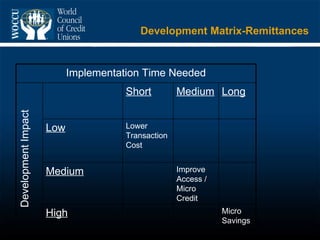
Development Matrix-Remittances Development Impact Implementation Time Needed Short Medium Long Low Lower Transaction Cost Medium Improve Access / Micro Credit High Micro Savings
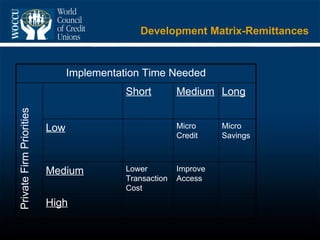
Development Matrix-Remittances Private Firm Priorities Implementation Time Needed Short Medium Long Low Micro Credit Micro Savings Medium Lower Transaction Cost Improve Access High
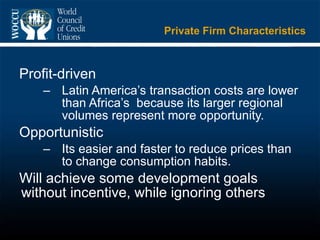
Private Firm Characteristics  Profit-driven Latin America’s transaction costs are lower than Africa’s  because its larger regional volumes represent more opportunity. Opportunistic Its easier and faster to reduce prices than to change consumption habits.  Will achieve some development goals without incentive, while ignoring others
Recommendation #1 #1. Incentivize or fund development organizations to tackle (the more difficult) consumption-related goals; allow the market to do the rest.
Why Not to Engage the Private Sector  The remittances market has a well-defined business model and market. The private sector will take care of improving access and reducing transfer costs on its own. The private sector is not interested in micro savings or micro credit (within the context of remittances)
WOCCU Development Ideal “ I  leave  my money in the credit union because I can  trust  the credit union. I picked up my remittances  in a bank for 18 years, but never opened an account . The service in the credit union is  quick and easy  and I  feel at home .” - Irma de Léon,  credit union member, Guatemala
WOCCU Development “ Remittance recipients usually withdraw all of their money when they pick up remittances…We constantly remind them to save, and eventually they do.  But, it takes time to create a culture of savings.” -Erin Gonzalez, Customer Service Representative, ECOSABA Credit Union
Recommendation #1a. #1a. Encourage organizations (private or otherwise) which have demonstrated success in changing consumption habits to offer remittances.
WOCCU Services Group Model Invest with local credit unions, to form for-profit financial services corporations. Products: international remittances, national remittances, prepaid debit cards, ATM networks, POS and PDA banking, cloud computing services, and mobile banking (2010).  Offering multiple payment transaction technologies diversifies revenue streams, thereby creating a more sustainable business model while providing increased access.  Permanent offices in Mexico, Nicaragua, Ecuador, Bolivia, Columbia, Peru, and Kenya.
Recommendation 2 #2. Improve regulatory atmosphere by: Reducing the use of exclusive contracts through better regulation, increased transparency, or outright prohibition of exclusive clauses. Clarifying and standardizing AML requirements for non-bank payers. Clarifying and standardizing cell-phone remittance payment.
Exclusivity Contract Example: Exclusive contract. 5 year initial term, automatic 1-year renewal. Signed in 2004. 180 days notification to terminate. Notification must be given 180 days or more before end of current term. Non-compete for 180 days after termination. Lost-earnings clause for early termination of first term.
Exclusivity - Potential Partnerships Draft a model contract and post it online Encourage regulators to consider banning or otherwise regulating exclusivity
Saul Wolf Remittances Manager Madison, WI, USA [email_address] www.woccu.org Development opportunities and private sector lessons for Africa 10/23/09

Development opportunities and private sector lessons for Africa

  • 1.
    Saul Wolf RemittancesManager Madison, WI, USA [email_address] www.woccu.org Development opportunities and private sector lessons for Africa 10/23/2009
  • 2.
    What is WOCCU?The World Council of Credit Unions (“WOCCU”) is the global trade association and development agency for credit unions worldwide. Credit Unions are: democratic, member-owned financial cooperatives. Worldwide: 53,000+ credit unions in 96 countries. Balance business sense with a social mission. Our credit union networks in 8 countries pay out approximately $500 million USD annually in international remittances.
  • 3.
    WOCCU Development Priorities-RemittancesMicro Savings Improve Access/Reduce Opportunity Costs Reduce Transaction Cost Micro Credit
  • 4.
    Why Savings “Voluntary savings…are the most frequent source of funding for microenterprise startup and expansion…enable households to smooth consumption…to accumulate assets…to invest in education, and to better prepare for emergencies.” - Brian Branch and Janette Klaehn, Striking the Balance in Microfinance: A Practical Guide to Mobilizing Savings, ch. 1. Available online at: http://www.woccu.org/publications/savings
  • 5.
    Topic “ Private-sectorcompetition can significantly decrease the cost of remittances to the African continent, but that does not have to translate into an effective tool for development.”
  • 6.
    Development Matrix-Remittances DevelopmentImpact Implementation Time Needed Short Medium Long Low Lower Transaction Cost Medium Improve Access / Micro Credit High Micro Savings
  • 7.
    Development Matrix-Remittances PrivateFirm Priorities Implementation Time Needed Short Medium Long Low Micro Credit Micro Savings Medium Lower Transaction Cost Improve Access High
  • 8.
    Private Firm Characteristics Profit-driven Latin America’s transaction costs are lower than Africa’s because its larger regional volumes represent more opportunity. Opportunistic Its easier and faster to reduce prices than to change consumption habits. Will achieve some development goals without incentive, while ignoring others
  • 9.
    Recommendation #1 #1.Incentivize or fund development organizations to tackle (the more difficult) consumption-related goals; allow the market to do the rest.
  • 10.
    Why Not toEngage the Private Sector The remittances market has a well-defined business model and market. The private sector will take care of improving access and reducing transfer costs on its own. The private sector is not interested in micro savings or micro credit (within the context of remittances)
  • 11.
    WOCCU Development Ideal“ I leave my money in the credit union because I can trust the credit union. I picked up my remittances in a bank for 18 years, but never opened an account . The service in the credit union is quick and easy and I feel at home .” - Irma de Léon, credit union member, Guatemala
  • 12.
    WOCCU Development “Remittance recipients usually withdraw all of their money when they pick up remittances…We constantly remind them to save, and eventually they do. But, it takes time to create a culture of savings.” -Erin Gonzalez, Customer Service Representative, ECOSABA Credit Union
  • 13.
    Recommendation #1a. #1a.Encourage organizations (private or otherwise) which have demonstrated success in changing consumption habits to offer remittances.
  • 14.
    WOCCU Services GroupModel Invest with local credit unions, to form for-profit financial services corporations. Products: international remittances, national remittances, prepaid debit cards, ATM networks, POS and PDA banking, cloud computing services, and mobile banking (2010). Offering multiple payment transaction technologies diversifies revenue streams, thereby creating a more sustainable business model while providing increased access. Permanent offices in Mexico, Nicaragua, Ecuador, Bolivia, Columbia, Peru, and Kenya.
  • 15.
    Recommendation 2 #2.Improve regulatory atmosphere by: Reducing the use of exclusive contracts through better regulation, increased transparency, or outright prohibition of exclusive clauses. Clarifying and standardizing AML requirements for non-bank payers. Clarifying and standardizing cell-phone remittance payment.
  • 16.
    Exclusivity Contract Example:Exclusive contract. 5 year initial term, automatic 1-year renewal. Signed in 2004. 180 days notification to terminate. Notification must be given 180 days or more before end of current term. Non-compete for 180 days after termination. Lost-earnings clause for early termination of first term.
  • 17.
    Exclusivity - PotentialPartnerships Draft a model contract and post it online Encourage regulators to consider banning or otherwise regulating exclusivity
  • 18.
    Saul Wolf RemittancesManager Madison, WI, USA [email_address] www.woccu.org Development opportunities and private sector lessons for Africa 10/23/09

Editor's Notes

  • #2 Hello, my name is Saul Wolf and I am the manager of the World Council of Credit Union’s remittances program. Thank you for allowing me to speak today. Before I begin to address the questions presented in today’s session, I would like to give you some background into who we are, as I think that influences our perceptions on remittances and development.
  • #3 First, I work forthe World Council of Credit Unions, or “WOCCU” as we call it. WOCCU is the global trade and development agency for credit unions worldwide. Credit unions go by many different names, Cooperativas Financieras, Cajas, or SACCO’s, for example. What ties them together is that all of them are: a) democratic b) member-owned) and c) financial entities. Worldwide, there are approximately 53000 credit unions in 96 countries. Some are so small they don’t even have buildings. Some are huge: Navy Federal Credit Union in the U.S. has more 3 million members and has $35 billion in assets. The credit union philosophy is to balance business sense with a social mission, which, while we don’t do it perfectly, is a good philosophy to have because it never leaves you feeling settled, it keeps you questioning. With respect to remittances, WOCCU’s for-profit subsidiary WOCCU Service Group actually runs the remittances program. Finally, I would just add that remittances is actually a pretty small part of WOCCU. Most of our staff is dedicated to trade association activities and development projects.
  • #4 The following are WOCCU’s development priorities—this is how we define development for remittances. Micro Savings—Converting Remittance Flows into savings. Improved Access—Finding Rural locations to make it easier for people to pick up remittances, thereby reducing opportunity costs of travel Reduce Transaction Cost—Reduce the Cost of the Sender MicroCredit—Using Remittance flows as a form of income in order to qualify for loans.
  • #5 There are other, worthy development goals but I believe savings is the foundation for many. The primary development problem with remittances today is consumption, the absence of savings.
  • #6 Circling back to the question at hand. What important here is the word “development” because development means different things to different people. At the same time, remittances is a product with a well-defined market. People know how to make money off of it. So, its important to fund projects that actually help fix problems that wouldn’t otherwise be fixed by the free market.
  • #10 I apologize in advance, my first recommendation is not at all short-term and is not directed towards the private sector. to incentivize or fund development organizations to tackle the more difficult consumption-related goals; allow the market to do the rest. I believe that, with time, Africa’s remittance pricing and access will come down, similar to what has happened in Latin America, without help from the development sector. It will happen because profit margins in Latin America have shrunk. Private sector firms are already looking at Africa.
  • #11 Its also not clear they produce better results.
  • #12 Here, I want to talk about the words in blue. “Leave” that implies a change in behavior; most remittance funds are consumed. “Trust” trust is earned over time when a customer is provided dependable service, implying financial discipline. “in a bank for 18 years, never opened an account” in 18 years, the private sector bank did not see a profit converting her to a saver, even though they could then lend that money back out. “Quick and easy” and “feel at home” again, this implies that the organization is well-run, has financial discipline, sees her as client (or member). They see her as a client or member because their business model depends on savers like her.
  • #14 Remittance expertise is not the same as development expertise-- setting up business networks requires different skill sets than changing consumption patterns. Furthermore, changing consumption patterns requires a long-term commitment. If you fund the creation of mfi-paying remitters, your long-term payback is greater even if your short-term is a wash, or slightly worse. Assuming they are sustainable, MFI networks are more likely to focus on solving long-term development goals like reducing consumption.
  • #16 The development sector can partner with the private sector to make it easier for private sector players to expand in Africa, by standardizing and clarifying AML requirements more at the regional level. Equally important: clarifying and standardizing telecommunication regulations and AML regulations to allow cell phones to receive international remittances on a regional level. Many of the largest telecoms in Africa have a regional prescense, like MTN and Zain. If you can make it easier for them to rapidly expand a business model that allows them to successfully provide an AML-compliant remittance product it multiple countries you will see lower costs and increased access.
  • #17 So, I’m locked into the contract until 2009, unless I pay lost-earnings for early termination. Then, I must give notice to terminate 180 days before the end of the current term. So if the current term expired Jan 1, 2009 I have to give notice by June 1, 2008. If I waited until June 2, I couldn’t terminate until Jan 1, 2010. After terminating I had to wait an additional 180 days to sign with someone else.
  • #18 By partnering with the private sector to improve regulations, the development community could lend credibility and provide needed attention.