Using Data to Better Understand
Worker Remittances
Manuel Orozco
Ta l k p r e s e n t e d a t t h e I n t e r n a t i o n a l Co n f e r e n c e : ‘ I m p r o vi n g Dat a
on I nt er nat i onal M i gr at i on’
To w a r d s Ag e n d a 2 0 3 0 a n d t h e G l o b a l Co m p a c t o n M i g r a t i o n
F e d e r a l F o r e ig n O ff ic e , Ber lin, 2 - 3 Dec em ber 2016
December, 2016
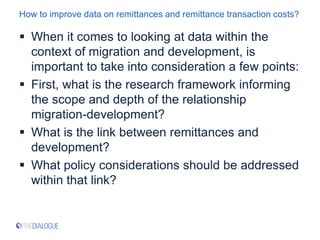
How to improve data on remittances and remittance transaction costs?
 When it comes to looking at data within the
context of migration and development, is
important to take into consideration a few points:
 First, what is the research framework informing
the scope and depth of the relationship
migration-development?
 What is the link between remittances and
development?
 What policy considerations should be addressed
within that link?
Units of analysis that guide data
collection
 Data, or the systematization of facts through
methods that make knowledge measurable depends
on a conceptual framework, measuring methods,
analytical tools and policy guidance;
 Conceptualization is not arbitrary but respond to five
units of analysis, namely:
 Actors (primary, intervening, secondary),
 Dynamics (mobility, engagement, return),
 Economic [social, political] activities (remitting,
investing, consuming, giving, sharing);
 Norms and rules and spaces of operation
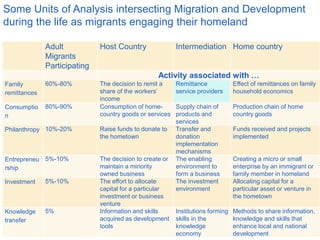
Some Units of Analysis intersecting Migration and Development
during the life as migrants engaging their homeland
The scope of engagement: complex and goes beyond costs:
Adult
Migrants
Participating
Host Country Intermediation Home country
Activity associated with …
Family
remittances
60%-80% The decision to remit a
share of the workers’
income
Remittance
service providers
Effect of remittances on family
household economics
Consumptio
n
80%-90% Consumption of home-
country goods or services
Supply chain of
products and
services
Production chain of home
country goods
Philanthropy 10%-20% Raise funds to donate to
the hometown
Transfer and
donation
implementation
mechanisms
Funds received and projects
implemented
Entrepreneu
rship
5%-10% The decision to create or
maintain a minority
owned business
The enabling
environment to
form a business
Creating a micro or small
enterprise by an immigrant or
family member in homeland
Investment 5%-10% The effort to allocate
capital for a particular
investment or business
venture
The investment
environment
Allocating capital for a
particular asset or venture in
the hometown
Knowledge
transfer
5% Information and skills
acquired as development
tools
Institutions forming
skills in the
knowledge
economy
Methods to share information,
knowledge and skills that
enhance local and national
development
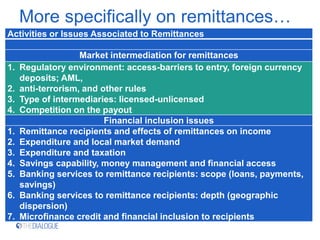
More specifically on remittances…
Activities or Issues Associated to Remittances
Market intermediation for remittances
1. Regulatory environment: access-barriers to entry, foreign currency
deposits; AML,
2. anti-terrorism, and other rules
3. Type of intermediaries: licensed-unlicensed
4. Competition on the payout
Financial inclusion issues
1. Remittance recipients and effects of remittances on income
2. Expenditure and local market demand
3. Expenditure and taxation
4. Savings capability, money management and financial access
5. Banking services to remittance recipients: scope (loans, payments,
savings)
6. Banking services to remittance recipients: depth (geographic
dispersion)
7. Microfinance credit and financial inclusion to recipients
Marketplace Intermediation:
-Players
-Dynamics
-Activities;
-Norms, rules;
Unit of Analysis: Marketplace Intermediation
 Remittance transfers are shaped by rules and the existing marketplace that
intermediates the transfers. These rules, as well as supply and demand in
this remittance marketplace, significantly shape the transfer process.
 Migrants buy foreign currency to send to relatives at a certain price; in this
context, money is treated as a commodity, or a good for which people have
a demand.
 The purchase of such currency is regulated through legislation pertaining to
foreign currency controls of different kinds (authorized entities, financial
crimes, consumer protection, sovereignty). These rules are one component
of the transfer process, as intermediaries must deal with different issues
relating to development.
 Other aspects of the money transfer include
– The legal position of the transfer (licensed or unlicensed)
– The sending methods (cash or account)
– The mechanisms utilized (front -end technology or ancillary tools)
– The extent of competition in the origin by remittance service providers
– The destination by payers (Banks, Forex, Microfinance institutions, etc).
 In addition, there are value added elements in the transfer, such as
opportunities for migrants to achieve financial access.
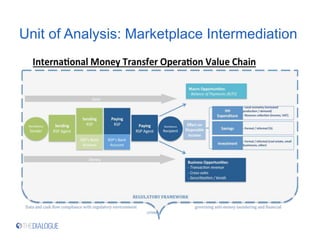
Unit of Analysis: Marketplace Intermediation
The Costs of Sending
An Issue for Debate: the Costs of Sending
 Remittance services are often considered to be expensive and inefficient.
However it is important to consider three questions:
– What drives the assumption that costs are high?
– Can costs reasonably be lowered? What impact would this
have on development?
– Finally, are we asking the right question, given the
relationship between migration and development and the
role of intermediation?
 The literature on transaction costs does not say why prices are ‘high’ or
‘low’, they simply say they are expensive. The statement appears more as a
normative rather than empirically founded explanation. Why is 6% to send
$200 considered expensive? Or why is it expensive to pay $9 to send
$300? Is it an arbitrary pricing scheme or is it based competition and
operating costs?
An Issue for Debate: the Costs of Sending
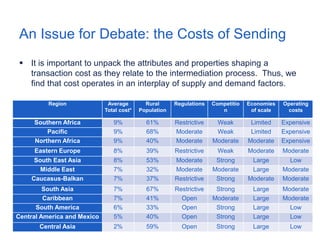
 It is important to unpack the attributes and properties shaping a
transaction cost as they relate to the intermediation process. Thus, we
find that cost operates in an interplay of supply and demand factors.
Region Average
Total cost*
Rural
Population
Regulations Competitio
n
Economies
of scale
Operating
costs
Southern Africa 9% 61% Restrictive Weak Limited Expensive
Pacific 9% 68% Moderate Weak Limited Expensive
Northern Africa 9% 40% Moderate Moderate Moderate Expensive
Eastern Europe 8% 39% Restrictive Weak Moderate Moderate
South East Asia 8% 53% Moderate Strong Large Low
Middle East 7% 32% Moderate Moderate Large Moderate
Caucasus-Balkan 7% 37% Restrictive Strong Moderate Moderate
South Asia 7% 67% Restrictive Strong Large Moderate
Caribbean 7% 41% Open Moderate Large Moderate
South America 6% 33% Open Strong Large Low
Central America and Mexico 5% 40% Open Strong Large Low
Central Asia 2% 59% Open Strong Large Low
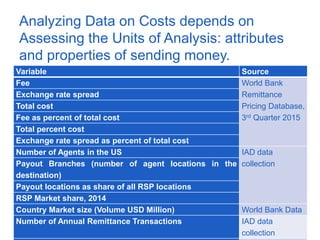
Analyzing Data on Costs depends on
Assessing the Units of Analysis: attributes
and properties of sending money.
Determinants of costs
Variable Source
Fee World Bank
Remittance
Pricing Database,
3rd Quarter 2015
Exchange rate spread
Total cost
Fee as percent of total cost
Total percent cost
Exchange rate spread as percent of total cost
Number of Agents in the US IAD data
collection
Payout Branches (number of agent locations in the
destination)
Payout locations as share of all RSP locations
RSP Market share, 2014
Country Market size (Volume USD Million) World Bank Data
Number of Annual Remittance Transactions IAD data
collection
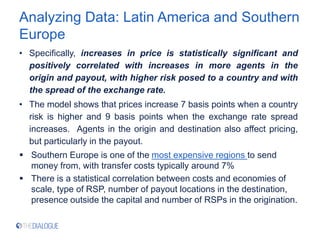
Analyzing Data: Latin America and Southern
Europe
• Specifically, increases in price is statistically significant and
positively correlated with increases in more agents in the
origin and payout, with higher risk posed to a country and with
the spread of the exchange rate.
• The model shows that prices increase 7 basis points when a country
risk is higher and 9 basis points when the exchange rate spread
increases. Agents in the origin and destination also affect pricing,
but particularly in the payout.
 Southern Europe is one of the most expensive regions to send
money from, with transfer costs typically around 7%
 There is a statistical correlation between costs and economies of
scale, type of RSP, number of payout locations in the destination,
presence outside the capital and number of RSPs in the origination.
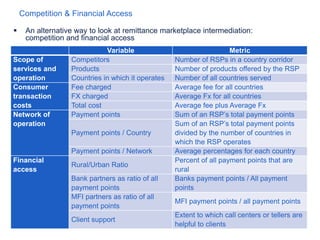
Competition & Financial Access
Variable Metric
Scope of
services and
operation
Competitors Number of RSPs in a country corridor
Products Number of products offered by the RSP
Countries in which it operates Number of all countries served
Consumer
transaction
costs
Fee charged Average fee for all countries
FX charged Average Fx for all countries
Total cost Average fee plus Average Fx
Network of
operation
Payment points Sum of an RSP’s total payment points
Payment points / Country
Sum of an RSP’s total payment points
divided by the number of countries in
which the RSP operates
Payment points / Network Average percentages for each country
Financial
access
Rural/Urban Ratio
Percent of all payment points that are
rural
Bank partners as ratio of all
payment points
Banks payment points / All payment
points
MFI partners as ratio of all
payment points
MFI payment points / all payment points
Client support
Extent to which call centers or tellers are
helpful to clients
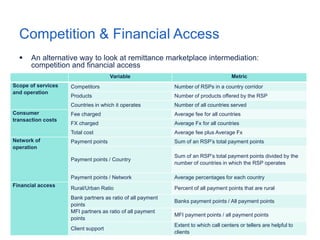
 An alternative way to look at remittance marketplace intermediation:
competition and financial access
Some conclusions…
 We are not asking the right questions…what is the relationship
between migration and development, and how should it be
addressed?
 What role do remittances play in development?
 A matter of bias:
– remittances have been assumed to be the only
practical measurable unit related to development;
– The choice of using cost for analysis reflects a crude
rational choice approach
 Consequences: incomplete and inaccurate policy guidance
– Issues are excluded, such as asset building and
financial inclusion
– Cost assumptions were not validated but posed
normatively not empirically
The Policy Problem
 Choice of data depends on framing the issues.
 Issue framing is shaped by uniformed decisions,
untested assumptions and limited consultation
and cooperation;
 The problem is not lack of data; we live in a
noisy knowledge space, rather there is
prevalence of messaging over content and rigor;
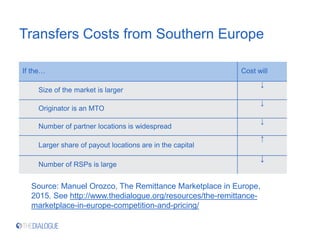
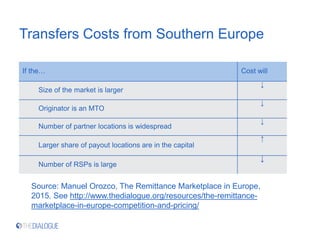
Transfers Costs from Southern Europe
If the… Cost will
Size of the market is larger
↓
Originator is an MTO
↓
Number of partner locations is widespread
↓
Larger share of payout locations are in the capital
↑
Number of RSPs is large
↓
Source: Manuel Orozco, The Remittance Marketplace in Europe,
2015. See http://www.thedialogue.org/resources/the-remittance-
marketplace-in-europe-competition-and-pricing/
Transaction Costs: Supply Side Issues
 Remittance pricing is the byproduct of the operating costs to run a particular
business. These operating costs are based on fixed and variable costs; for
example, quantities, production costs to run known quantities (commissions
to agents), and other cost center related expenses (administration,
compliance, information and communication technology support, marketing,
and call center client support, for example).
 The current and prevailing business model is predominantly demand-driven:
immigrants continue to prefer cash transfers, at least on the payout.
 To break it down, this model includes costs related to origination and
destination agents (typically 40% of the revenue), and operating costs
related to the management of the business.
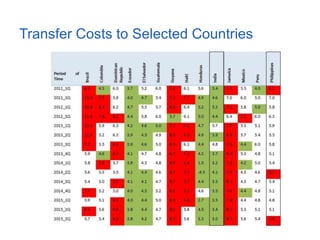
 However, as data on costs has shown, average pricing is quite variable
across countries and service providers.
 Why, if remittance transfer services are sold or serviced as a commodity (a
product delivered), do their prices vary across corridors and companies?
What determines price differences between Haiti and Honduras, for
example?
Transfer Costs to Selected Countries
Analyzing data: Latin America & Southern
Europe
 One way to analyze costs is by considering whether price differences are
influenced by some of the components that make up for the expenses
(such as fee and exchange rate commissions to agents, compliance, or
economies of scale).
 To assess pricing determinants, one can look at factors directly connected
to the business operation: agents in the origin and destination, changes in
the exchange rate (fees are typically fixed, so don’t change), compliance
costs resulting from higher risk locations, market share, and economies of
scale.
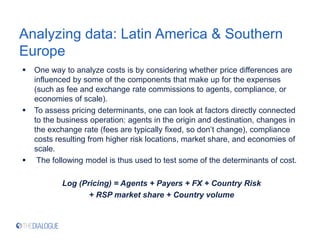
 The following model is thus used to test some of the determinants of cost.
Log (Pricing) = Agents + Payers + FX + Country Risk
+ RSP market share + Country volume
Analyzing data: Latin America & Southern
Europe
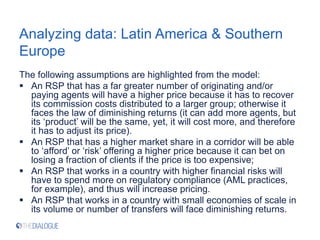
The following assumptions are highlighted from the model:
 An RSP that has a far greater number of originating and/or
paying agents will have a higher price because it has to recover
its commission costs distributed to a larger group; otherwise it
faces the law of diminishing returns (it can add more agents, but
its ‘product’ will be the same, yet, it will cost more, and therefore
it has to adjust its price).
 An RSP that has a higher market share in a corridor will be able
to ‘afford’ or ‘risk’ offering a higher price because it can bet on
losing a fraction of clients if the price is too expensive;
 An RSP that works in a country with higher financial risks will
have to spend more on regulatory compliance (AML practices,
for example), and thus will increase pricing.
 An RSP that works in a country with small economies of scale in
its volume or number of transfers will face diminishing returns.
Analyzing Data: Latin America and Southern
Europe
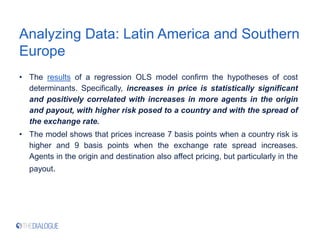
• The results of a regression OLS model confirm the hypotheses of cost
determinants. Specifically, increases in price is statistically significant
and positively correlated with increases in more agents in the origin
and payout, with higher risk posed to a country and with the spread of
the exchange rate.
• The model shows that prices increase 7 basis points when a country risk is
higher and 9 basis points when the exchange rate spread increases.
Agents in the origin and destination also affect pricing, but particularly in the
payout.
Transfers Costs from Southern Europe
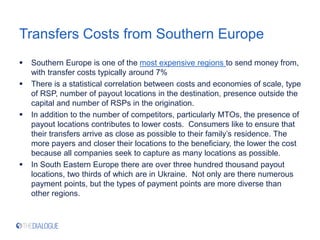
 Southern Europe is one of the most expensive regions to send money from,
with transfer costs typically around 7%
 There is a statistical correlation between costs and economies of scale, type
of RSP, number of payout locations in the destination, presence outside the
capital and number of RSPs in the origination.
 In addition to the number of competitors, particularly MTOs, the presence of
payout locations contributes to lower costs. Consumers like to ensure that
their transfers arrive as close as possible to their family’s residence. The
more payers and closer their locations to the beneficiary, the lower the cost
because all companies seek to capture as many locations as possible.
 In South Eastern Europe there are over three hundred thousand payout
locations, two thirds of which are in Ukraine. Not only are there numerous
payment points, but the types of payment points are more diverse than
other regions.
Transfers Costs from Southern Europe
If the… Cost will
Size of the market is larger
↓
Originator is an MTO
↓
Number of partner locations is widespread
↓
Larger share of payout locations are in the capital
↑
Number of RSPs is large
↓
Source: Manuel Orozco, The Remittance Marketplace in Europe,
2015. See http://www.thedialogue.org/resources/the-remittance-
marketplace-in-europe-competition-and-pricing/
Understanding Transaction Costs:
Consumer Side Issues
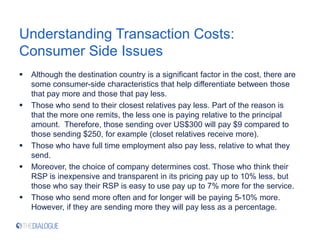
 Although the destination country is a significant factor in the cost, there are
some consumer-side characteristics that help differentiate between those
that pay more and those that pay less.
 Those who send to their closest relatives pay less. Part of the reason is
that the more one remits, the less one is paying relative to the principal
amount. Therefore, those sending over US$300 will pay $9 compared to
those sending $250, for example (closet relatives receive more).
 Those who have full time employment also pay less, relative to what they
send.
 Moreover, the choice of company determines cost. Those who think their
RSP is inexpensive and transparent in its pricing pay up to 10% less, but
those who say their RSP is easy to use pay up to 7% more for the service.
 Those who send more often and for longer will be paying 5-10% more.
However, if they are sending more they will pay less as a percentage.
Beyond Remittances: The Units of Analysis in
Migration and Development
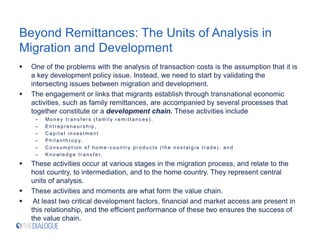
 One of the problems with the analysis of transaction costs is the assumption that it is
a key development policy issue. Instead, we need to start by validating the
intersecting issues between migration and development.
 The engagement or links that migrants establish through transnational economic
activities, such as family remittances, are accompanied by several processes that
together constitute or a development chain. These activities include
– Money t r ans f er s ( f am ily r em it t anc es ) ,
– Ent r epr eneur s hip,
– Capit al inves t m ent
– Philant hr opy,
– Cons um pt ion of hom e - c ount r y pr oduc t s ( t he nos t alg ia t r ade) , and
– Knowledg e t r ans f er.
 These activities occur at various stages in the migration process, and relate to the
host country, to intermediation, and to the home country. They represent central
units of analysis.
 These activities and moments are what form the value chain.
 At least two critical development factors, financial and market access are present in
this relationship, and the efficient performance of these two ensures the success of
the value chain.
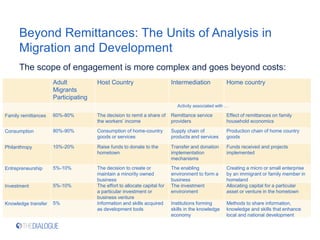
Beyond Remittances: The Units of Analysis in
Migration and Development
The scope of engagement is more complex and goes beyond costs:
Adult
Migrants
Participating
Host Country Intermediation Home country
Activity associated with …
Family remittances 60%-80% The decision to remit a share of
the workers’ income
Remittance service
providers
Effect of remittances on family
household economics
Consumption 80%-90% Consumption of home-country
goods or services
Supply chain of
products and services
Production chain of home country
goods
Philanthropy 10%-20% Raise funds to donate to the
hometown
Transfer and donation
implementation
mechanisms
Funds received and projects
implemented
Entrepreneurship 5%-10% The decision to create or
maintain a minority owned
business
The enabling
environment to form a
business
Creating a micro or small enterprise
by an immigrant or family member in
homeland
Investment 5%-10% The effort to allocate capital for
a particular investment or
business venture
The investment
environment
Allocating capital for a particular
asset or venture in the hometown
Knowledge transfer 5% Information and skills acquired
as development tools
Institutions forming
skills in the knowledge
economy
Methods to share information,
knowledge and skills that enhance
local and national development
Competition & Financial Access
Variable Metric
Scope of services
and operation
Competitors Number of RSPs in a country corridor
Products Number of products offered by the RSP
Countries in which it operates Number of all countries served
Consumer
transaction costs
Fee charged Average fee for all countries
FX charged Average Fx for all countries
Total cost Average fee plus Average Fx
Network of
operation
Payment points Sum of an RSP’s total payment points
Payment points / Country
Sum of an RSP’s total payment points divided by the
number of countries in which the RSP operates
Payment points / Network Average percentages for each country
Financial access
Rural/Urban Ratio Percent of all payment points that are rural
Bank partners as ratio of all payment
points
Banks payment points / All payment points
MFI partners as ratio of all payment
points
MFI payment points / all payment points
Client support
Extent to which call centers or tellers are helpful to
clients
 An alternative way to look at remittance marketplace intermediation:
competition and financial access
Competition in Latin America &
Caribbean
2016 2012 2009 2006
Number of RSPs 31 37 31 40
Number of Products
offed
4 3 2 2
Countries Operating 52 31 4
Fee 3.7% 4.4% 4.1% 4.7%
FX 1.2% 1.3% 1.3% 2.4%
Total cost
5.1% 5.7% 5.4% 7.1%
Payment points 15,602 5,809 4,860 4,047
Points Network 5% 7% 19%
PP per country 2,509 2,208 1,570
Rural ratio 68% 74% 58%
Bank ratio 38% 54% 78% 72%
MFI ratio 8% 21% 27% 16%
Consumer Support [1-4] 3 3 3 3
RSP
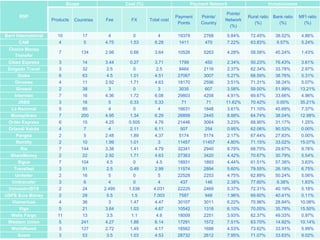
Scope Cost (%) Payment Network Inclusiveness
Products Countries Fee FX Total cost
Payment
Points
Points/
Country
Points/
Network
(%)
Rural ratio
(%)
Bank ratio
(%)
MFI ratio
(%)
Barri International 10 17 4 0 4 19379 2768 5.84% 72.45% 38.02% 4.86%
CAM 4 5 4.75 1.53 6.28 1411 470 7.22% 63.83% 9.57% 5.24%
Choice Money
Transfer
7 134 2.98 0.66 3.64 10526 5263 4.28% 58.58% 45.24% 1.43%
Cibao Express 3 14 3.44 0.27 3.71 1799 450 2.34% 50.23% 76.43% 3.61%
Delgado Travel 3 32 2.5 0 2.5 8464 2116 2.37% 62.34% 33.78% 2.97%
Dolex 6 63 4.5 1.01 4.51 27067 3007 5.27% 68.59% 38.76% 5.31%
Giromex 4 11 2.92 1.71 4.63 18170 2596 3.51% 71.31% 38.24% 5.07%
Girosol 2 38 3 0 3 3035 607 3.58% 59.00% 51.99% 13.21%
Intermex 7 16 4.36 1.72 6.08 29803 4258 4.91% 69.67% 33.66% 4.96%
JNBS 3 16 5 0.33 5.33 71 71 11.62% 70.42% 0.00% 35.21%
La Nacional 5 85 4 0 4 16631 1848 3.61% 71.10% 45.69% 7.37%
MoneyGram 7 200 4.95 1.34 6.29 26899 2445 8.88% 64.74% 38.04% 12.99%
Order Express 6 15 4.25 0.505 4.76 21446 3064 3.23% 68.90% 31.17% 1.25%
Orlandi Valuta 4 7 4 2.11 6.11 507 254 0.95% 62.06% 90.53% 0.00%
Pangea 2 5 2.48 1.89 4.37 5174 5174 2.17% 67.44% 27.83% 0.00%
Remitly 2 10 1.99 1.01 3 11457 11457 4.80% 71.15% 33.02% 15.07%
Ria 7 144 3.38 1.41 4.79 32341 2940 8.78% 68.75% 29.67% 9.76%
ShareMoney 2 22 2.92 1.71 4.63 27363 3420 4.42% 70.67% 30.79% 5.54%
Sigue 7 104 4.5 0 4.5 18931 1893 4.44% 61.51% 57.38% 3.63%
Transfast 3 51 2.5 0.49 2.99 11574 2894 5.60% 79.55% 26.18% 6.75%
Uniteller 2 16 5 0 5 22528 2253 4.75% 62.89% 50.24% 5.06%
Unitransfer 3 6 4 0 4 437 146 2.38% 77.60% 9.38% 1.83%
Univisión/BTS 2 24 2.495 1.536 4.031 22225 2469 5.37% 72.31% 40.19% 5.18%
USPS Sure Money 2 28 5.5 1.5 7.003 7587 948 1.96% 69.60% 40.41% 0.11%
Viamericas 4 36 3 1.47 4.47 30107 3011 6.22% 70.96% 28.84% 10.08%
Vigo 5 21 3.64 1.03 4.67 10542 1318 6.10% 70.05% 35.78% 15.50%
Wells Fargo 11 13 3.5 1.1 4.6 18009 2251 3.93% 62.37% 49.33% 0.97%
Western Union 5 241 4.27 1.88 6.14 17291 1572 7.51% 63.70% 14.92% 10.14%
WorldRemit 3 127 2.72 1.45 4.17 18562 1688 4.53% 73.62% 33.91% 5.99%
Xoom 3 53 3.5 1.03 4.53 28732 2612 7.95% 71.07% 33.63% 9.02%
Additional Resources
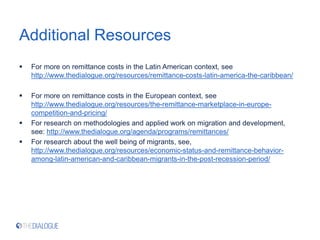
 For more on remittance costs in the Latin American context, see
http://www.thedialogue.org/resources/remittance-costs-latin-america-the-caribbean/
 For more on remittance costs in the European context, see
http://www.thedialogue.org/resources/the-remittance-marketplace-in-europe-
competition-and-pricing/
 For research on methodologies and applied work on migration and development,
see: http://www.thedialogue.org/agenda/programs/remittances/
 For research about the well being of migrants, see,
http://www.thedialogue.org/resources/economic-status-and-remittance-behavior-
among-latin-american-and-caribbean-migrants-in-the-post-recession-period/
www.thedialogue.com | 202-822-9002

Using Data to Better Understand Worker Remittances

  • 1.
    Using Data toBetter Understand Worker Remittances Manuel Orozco Ta l k p r e s e n t e d a t t h e I n t e r n a t i o n a l Co n f e r e n c e : ‘ I m p r o vi n g Dat a on I nt er nat i onal M i gr at i on’ To w a r d s Ag e n d a 2 0 3 0 a n d t h e G l o b a l Co m p a c t o n M i g r a t i o n F e d e r a l F o r e ig n O ff ic e , Ber lin, 2 - 3 Dec em ber 2016 December, 2016
  • 2.
    How to improvedata on remittances and remittance transaction costs?  When it comes to looking at data within the context of migration and development, is important to take into consideration a few points:  First, what is the research framework informing the scope and depth of the relationship migration-development?  What is the link between remittances and development?  What policy considerations should be addressed within that link?
  • 3.
    Units of analysisthat guide data collection  Data, or the systematization of facts through methods that make knowledge measurable depends on a conceptual framework, measuring methods, analytical tools and policy guidance;  Conceptualization is not arbitrary but respond to five units of analysis, namely:  Actors (primary, intervening, secondary),  Dynamics (mobility, engagement, return),  Economic [social, political] activities (remitting, investing, consuming, giving, sharing);  Norms and rules and spaces of operation
  • 4.
    Some Units ofAnalysis intersecting Migration and Development during the life as migrants engaging their homeland The scope of engagement: complex and goes beyond costs: Adult Migrants Participating Host Country Intermediation Home country Activity associated with … Family remittances 60%-80% The decision to remit a share of the workers’ income Remittance service providers Effect of remittances on family household economics Consumptio n 80%-90% Consumption of home- country goods or services Supply chain of products and services Production chain of home country goods Philanthropy 10%-20% Raise funds to donate to the hometown Transfer and donation implementation mechanisms Funds received and projects implemented Entrepreneu rship 5%-10% The decision to create or maintain a minority owned business The enabling environment to form a business Creating a micro or small enterprise by an immigrant or family member in homeland Investment 5%-10% The effort to allocate capital for a particular investment or business venture The investment environment Allocating capital for a particular asset or venture in the hometown Knowledge transfer 5% Information and skills acquired as development tools Institutions forming skills in the knowledge economy Methods to share information, knowledge and skills that enhance local and national development
  • 5.
    More specifically onremittances… Activities or Issues Associated to Remittances Market intermediation for remittances 1. Regulatory environment: access-barriers to entry, foreign currency deposits; AML, 2. anti-terrorism, and other rules 3. Type of intermediaries: licensed-unlicensed 4. Competition on the payout Financial inclusion issues 1. Remittance recipients and effects of remittances on income 2. Expenditure and local market demand 3. Expenditure and taxation 4. Savings capability, money management and financial access 5. Banking services to remittance recipients: scope (loans, payments, savings) 6. Banking services to remittance recipients: depth (geographic dispersion) 7. Microfinance credit and financial inclusion to recipients
  • 6.
  • 7.
    Unit of Analysis:Marketplace Intermediation  Remittance transfers are shaped by rules and the existing marketplace that intermediates the transfers. These rules, as well as supply and demand in this remittance marketplace, significantly shape the transfer process.  Migrants buy foreign currency to send to relatives at a certain price; in this context, money is treated as a commodity, or a good for which people have a demand.  The purchase of such currency is regulated through legislation pertaining to foreign currency controls of different kinds (authorized entities, financial crimes, consumer protection, sovereignty). These rules are one component of the transfer process, as intermediaries must deal with different issues relating to development.  Other aspects of the money transfer include – The legal position of the transfer (licensed or unlicensed) – The sending methods (cash or account) – The mechanisms utilized (front -end technology or ancillary tools) – The extent of competition in the origin by remittance service providers – The destination by payers (Banks, Forex, Microfinance institutions, etc).  In addition, there are value added elements in the transfer, such as opportunities for migrants to achieve financial access.
  • 8.
    Unit of Analysis:Marketplace Intermediation
  • 9.
    The Costs ofSending
  • 10.
    An Issue forDebate: the Costs of Sending  Remittance services are often considered to be expensive and inefficient. However it is important to consider three questions: – What drives the assumption that costs are high? – Can costs reasonably be lowered? What impact would this have on development? – Finally, are we asking the right question, given the relationship between migration and development and the role of intermediation?  The literature on transaction costs does not say why prices are ‘high’ or ‘low’, they simply say they are expensive. The statement appears more as a normative rather than empirically founded explanation. Why is 6% to send $200 considered expensive? Or why is it expensive to pay $9 to send $300? Is it an arbitrary pricing scheme or is it based competition and operating costs?
  • 11.
    An Issue forDebate: the Costs of Sending  It is important to unpack the attributes and properties shaping a transaction cost as they relate to the intermediation process. Thus, we find that cost operates in an interplay of supply and demand factors. Region Average Total cost* Rural Population Regulations Competitio n Economies of scale Operating costs Southern Africa 9% 61% Restrictive Weak Limited Expensive Pacific 9% 68% Moderate Weak Limited Expensive Northern Africa 9% 40% Moderate Moderate Moderate Expensive Eastern Europe 8% 39% Restrictive Weak Moderate Moderate South East Asia 8% 53% Moderate Strong Large Low Middle East 7% 32% Moderate Moderate Large Moderate Caucasus-Balkan 7% 37% Restrictive Strong Moderate Moderate South Asia 7% 67% Restrictive Strong Large Moderate Caribbean 7% 41% Open Moderate Large Moderate South America 6% 33% Open Strong Large Low Central America and Mexico 5% 40% Open Strong Large Low Central Asia 2% 59% Open Strong Large Low
  • 12.
    Analyzing Data onCosts depends on Assessing the Units of Analysis: attributes and properties of sending money. Determinants of costs Variable Source Fee World Bank Remittance Pricing Database, 3rd Quarter 2015 Exchange rate spread Total cost Fee as percent of total cost Total percent cost Exchange rate spread as percent of total cost Number of Agents in the US IAD data collection Payout Branches (number of agent locations in the destination) Payout locations as share of all RSP locations RSP Market share, 2014 Country Market size (Volume USD Million) World Bank Data Number of Annual Remittance Transactions IAD data collection
  • 13.
    Analyzing Data: LatinAmerica and Southern Europe • Specifically, increases in price is statistically significant and positively correlated with increases in more agents in the origin and payout, with higher risk posed to a country and with the spread of the exchange rate. • The model shows that prices increase 7 basis points when a country risk is higher and 9 basis points when the exchange rate spread increases. Agents in the origin and destination also affect pricing, but particularly in the payout.  Southern Europe is one of the most expensive regions to send money from, with transfer costs typically around 7%  There is a statistical correlation between costs and economies of scale, type of RSP, number of payout locations in the destination, presence outside the capital and number of RSPs in the origination.
  • 14.
    Competition & FinancialAccess Variable Metric Scope of services and operation Competitors Number of RSPs in a country corridor Products Number of products offered by the RSP Countries in which it operates Number of all countries served Consumer transaction costs Fee charged Average fee for all countries FX charged Average Fx for all countries Total cost Average fee plus Average Fx Network of operation Payment points Sum of an RSP’s total payment points Payment points / Country Sum of an RSP’s total payment points divided by the number of countries in which the RSP operates Payment points / Network Average percentages for each country Financial access Rural/Urban Ratio Percent of all payment points that are rural Bank partners as ratio of all payment points Banks payment points / All payment points MFI partners as ratio of all payment points MFI payment points / all payment points Client support Extent to which call centers or tellers are helpful to clients  An alternative way to look at remittance marketplace intermediation: competition and financial access
  • 15.
    Some conclusions…  Weare not asking the right questions…what is the relationship between migration and development, and how should it be addressed?  What role do remittances play in development?  A matter of bias: – remittances have been assumed to be the only practical measurable unit related to development; – The choice of using cost for analysis reflects a crude rational choice approach  Consequences: incomplete and inaccurate policy guidance – Issues are excluded, such as asset building and financial inclusion – Cost assumptions were not validated but posed normatively not empirically
  • 16.
    The Policy Problem Choice of data depends on framing the issues.  Issue framing is shaped by uniformed decisions, untested assumptions and limited consultation and cooperation;  The problem is not lack of data; we live in a noisy knowledge space, rather there is prevalence of messaging over content and rigor;
  • 18.
    Transfers Costs fromSouthern Europe If the… Cost will Size of the market is larger ↓ Originator is an MTO ↓ Number of partner locations is widespread ↓ Larger share of payout locations are in the capital ↑ Number of RSPs is large ↓ Source: Manuel Orozco, The Remittance Marketplace in Europe, 2015. See http://www.thedialogue.org/resources/the-remittance- marketplace-in-europe-competition-and-pricing/
  • 19.
    Transaction Costs: SupplySide Issues  Remittance pricing is the byproduct of the operating costs to run a particular business. These operating costs are based on fixed and variable costs; for example, quantities, production costs to run known quantities (commissions to agents), and other cost center related expenses (administration, compliance, information and communication technology support, marketing, and call center client support, for example).  The current and prevailing business model is predominantly demand-driven: immigrants continue to prefer cash transfers, at least on the payout.  To break it down, this model includes costs related to origination and destination agents (typically 40% of the revenue), and operating costs related to the management of the business.  However, as data on costs has shown, average pricing is quite variable across countries and service providers.  Why, if remittance transfer services are sold or serviced as a commodity (a product delivered), do their prices vary across corridors and companies? What determines price differences between Haiti and Honduras, for example?
  • 20.
    Transfer Costs toSelected Countries
  • 21.
    Analyzing data: LatinAmerica & Southern Europe  One way to analyze costs is by considering whether price differences are influenced by some of the components that make up for the expenses (such as fee and exchange rate commissions to agents, compliance, or economies of scale).  To assess pricing determinants, one can look at factors directly connected to the business operation: agents in the origin and destination, changes in the exchange rate (fees are typically fixed, so don’t change), compliance costs resulting from higher risk locations, market share, and economies of scale.  The following model is thus used to test some of the determinants of cost. Log (Pricing) = Agents + Payers + FX + Country Risk + RSP market share + Country volume
  • 22.
    Analyzing data: LatinAmerica & Southern Europe The following assumptions are highlighted from the model:  An RSP that has a far greater number of originating and/or paying agents will have a higher price because it has to recover its commission costs distributed to a larger group; otherwise it faces the law of diminishing returns (it can add more agents, but its ‘product’ will be the same, yet, it will cost more, and therefore it has to adjust its price).  An RSP that has a higher market share in a corridor will be able to ‘afford’ or ‘risk’ offering a higher price because it can bet on losing a fraction of clients if the price is too expensive;  An RSP that works in a country with higher financial risks will have to spend more on regulatory compliance (AML practices, for example), and thus will increase pricing.  An RSP that works in a country with small economies of scale in its volume or number of transfers will face diminishing returns.
  • 23.
    Analyzing Data: LatinAmerica and Southern Europe • The results of a regression OLS model confirm the hypotheses of cost determinants. Specifically, increases in price is statistically significant and positively correlated with increases in more agents in the origin and payout, with higher risk posed to a country and with the spread of the exchange rate. • The model shows that prices increase 7 basis points when a country risk is higher and 9 basis points when the exchange rate spread increases. Agents in the origin and destination also affect pricing, but particularly in the payout.
  • 24.
    Transfers Costs fromSouthern Europe  Southern Europe is one of the most expensive regions to send money from, with transfer costs typically around 7%  There is a statistical correlation between costs and economies of scale, type of RSP, number of payout locations in the destination, presence outside the capital and number of RSPs in the origination.  In addition to the number of competitors, particularly MTOs, the presence of payout locations contributes to lower costs. Consumers like to ensure that their transfers arrive as close as possible to their family’s residence. The more payers and closer their locations to the beneficiary, the lower the cost because all companies seek to capture as many locations as possible.  In South Eastern Europe there are over three hundred thousand payout locations, two thirds of which are in Ukraine. Not only are there numerous payment points, but the types of payment points are more diverse than other regions.
  • 25.
    Transfers Costs fromSouthern Europe If the… Cost will Size of the market is larger ↓ Originator is an MTO ↓ Number of partner locations is widespread ↓ Larger share of payout locations are in the capital ↑ Number of RSPs is large ↓ Source: Manuel Orozco, The Remittance Marketplace in Europe, 2015. See http://www.thedialogue.org/resources/the-remittance- marketplace-in-europe-competition-and-pricing/
  • 26.
    Understanding Transaction Costs: ConsumerSide Issues  Although the destination country is a significant factor in the cost, there are some consumer-side characteristics that help differentiate between those that pay more and those that pay less.  Those who send to their closest relatives pay less. Part of the reason is that the more one remits, the less one is paying relative to the principal amount. Therefore, those sending over US$300 will pay $9 compared to those sending $250, for example (closet relatives receive more).  Those who have full time employment also pay less, relative to what they send.  Moreover, the choice of company determines cost. Those who think their RSP is inexpensive and transparent in its pricing pay up to 10% less, but those who say their RSP is easy to use pay up to 7% more for the service.  Those who send more often and for longer will be paying 5-10% more. However, if they are sending more they will pay less as a percentage.
  • 27.
    Beyond Remittances: TheUnits of Analysis in Migration and Development  One of the problems with the analysis of transaction costs is the assumption that it is a key development policy issue. Instead, we need to start by validating the intersecting issues between migration and development.  The engagement or links that migrants establish through transnational economic activities, such as family remittances, are accompanied by several processes that together constitute or a development chain. These activities include – Money t r ans f er s ( f am ily r em it t anc es ) , – Ent r epr eneur s hip, – Capit al inves t m ent – Philant hr opy, – Cons um pt ion of hom e - c ount r y pr oduc t s ( t he nos t alg ia t r ade) , and – Knowledg e t r ans f er.  These activities occur at various stages in the migration process, and relate to the host country, to intermediation, and to the home country. They represent central units of analysis.  These activities and moments are what form the value chain.  At least two critical development factors, financial and market access are present in this relationship, and the efficient performance of these two ensures the success of the value chain.
  • 28.
    Beyond Remittances: TheUnits of Analysis in Migration and Development The scope of engagement is more complex and goes beyond costs: Adult Migrants Participating Host Country Intermediation Home country Activity associated with … Family remittances 60%-80% The decision to remit a share of the workers’ income Remittance service providers Effect of remittances on family household economics Consumption 80%-90% Consumption of home-country goods or services Supply chain of products and services Production chain of home country goods Philanthropy 10%-20% Raise funds to donate to the hometown Transfer and donation implementation mechanisms Funds received and projects implemented Entrepreneurship 5%-10% The decision to create or maintain a minority owned business The enabling environment to form a business Creating a micro or small enterprise by an immigrant or family member in homeland Investment 5%-10% The effort to allocate capital for a particular investment or business venture The investment environment Allocating capital for a particular asset or venture in the hometown Knowledge transfer 5% Information and skills acquired as development tools Institutions forming skills in the knowledge economy Methods to share information, knowledge and skills that enhance local and national development
  • 29.
    Competition & FinancialAccess Variable Metric Scope of services and operation Competitors Number of RSPs in a country corridor Products Number of products offered by the RSP Countries in which it operates Number of all countries served Consumer transaction costs Fee charged Average fee for all countries FX charged Average Fx for all countries Total cost Average fee plus Average Fx Network of operation Payment points Sum of an RSP’s total payment points Payment points / Country Sum of an RSP’s total payment points divided by the number of countries in which the RSP operates Payment points / Network Average percentages for each country Financial access Rural/Urban Ratio Percent of all payment points that are rural Bank partners as ratio of all payment points Banks payment points / All payment points MFI partners as ratio of all payment points MFI payment points / all payment points Client support Extent to which call centers or tellers are helpful to clients  An alternative way to look at remittance marketplace intermediation: competition and financial access
  • 30.
    Competition in LatinAmerica & Caribbean 2016 2012 2009 2006 Number of RSPs 31 37 31 40 Number of Products offed 4 3 2 2 Countries Operating 52 31 4 Fee 3.7% 4.4% 4.1% 4.7% FX 1.2% 1.3% 1.3% 2.4% Total cost 5.1% 5.7% 5.4% 7.1% Payment points 15,602 5,809 4,860 4,047 Points Network 5% 7% 19% PP per country 2,509 2,208 1,570 Rural ratio 68% 74% 58% Bank ratio 38% 54% 78% 72% MFI ratio 8% 21% 27% 16% Consumer Support [1-4] 3 3 3 3
  • 31.
    RSP Scope Cost (%)Payment Network Inclusiveness Products Countries Fee FX Total cost Payment Points Points/ Country Points/ Network (%) Rural ratio (%) Bank ratio (%) MFI ratio (%) Barri International 10 17 4 0 4 19379 2768 5.84% 72.45% 38.02% 4.86% CAM 4 5 4.75 1.53 6.28 1411 470 7.22% 63.83% 9.57% 5.24% Choice Money Transfer 7 134 2.98 0.66 3.64 10526 5263 4.28% 58.58% 45.24% 1.43% Cibao Express 3 14 3.44 0.27 3.71 1799 450 2.34% 50.23% 76.43% 3.61% Delgado Travel 3 32 2.5 0 2.5 8464 2116 2.37% 62.34% 33.78% 2.97% Dolex 6 63 4.5 1.01 4.51 27067 3007 5.27% 68.59% 38.76% 5.31% Giromex 4 11 2.92 1.71 4.63 18170 2596 3.51% 71.31% 38.24% 5.07% Girosol 2 38 3 0 3 3035 607 3.58% 59.00% 51.99% 13.21% Intermex 7 16 4.36 1.72 6.08 29803 4258 4.91% 69.67% 33.66% 4.96% JNBS 3 16 5 0.33 5.33 71 71 11.62% 70.42% 0.00% 35.21% La Nacional 5 85 4 0 4 16631 1848 3.61% 71.10% 45.69% 7.37% MoneyGram 7 200 4.95 1.34 6.29 26899 2445 8.88% 64.74% 38.04% 12.99% Order Express 6 15 4.25 0.505 4.76 21446 3064 3.23% 68.90% 31.17% 1.25% Orlandi Valuta 4 7 4 2.11 6.11 507 254 0.95% 62.06% 90.53% 0.00% Pangea 2 5 2.48 1.89 4.37 5174 5174 2.17% 67.44% 27.83% 0.00% Remitly 2 10 1.99 1.01 3 11457 11457 4.80% 71.15% 33.02% 15.07% Ria 7 144 3.38 1.41 4.79 32341 2940 8.78% 68.75% 29.67% 9.76% ShareMoney 2 22 2.92 1.71 4.63 27363 3420 4.42% 70.67% 30.79% 5.54% Sigue 7 104 4.5 0 4.5 18931 1893 4.44% 61.51% 57.38% 3.63% Transfast 3 51 2.5 0.49 2.99 11574 2894 5.60% 79.55% 26.18% 6.75% Uniteller 2 16 5 0 5 22528 2253 4.75% 62.89% 50.24% 5.06% Unitransfer 3 6 4 0 4 437 146 2.38% 77.60% 9.38% 1.83% Univisión/BTS 2 24 2.495 1.536 4.031 22225 2469 5.37% 72.31% 40.19% 5.18% USPS Sure Money 2 28 5.5 1.5 7.003 7587 948 1.96% 69.60% 40.41% 0.11% Viamericas 4 36 3 1.47 4.47 30107 3011 6.22% 70.96% 28.84% 10.08% Vigo 5 21 3.64 1.03 4.67 10542 1318 6.10% 70.05% 35.78% 15.50% Wells Fargo 11 13 3.5 1.1 4.6 18009 2251 3.93% 62.37% 49.33% 0.97% Western Union 5 241 4.27 1.88 6.14 17291 1572 7.51% 63.70% 14.92% 10.14% WorldRemit 3 127 2.72 1.45 4.17 18562 1688 4.53% 73.62% 33.91% 5.99% Xoom 3 53 3.5 1.03 4.53 28732 2612 7.95% 71.07% 33.63% 9.02%
  • 32.
    Additional Resources  Formore on remittance costs in the Latin American context, see http://www.thedialogue.org/resources/remittance-costs-latin-america-the-caribbean/  For more on remittance costs in the European context, see http://www.thedialogue.org/resources/the-remittance-marketplace-in-europe- competition-and-pricing/  For research on methodologies and applied work on migration and development, see: http://www.thedialogue.org/agenda/programs/remittances/  For research about the well being of migrants, see, http://www.thedialogue.org/resources/economic-status-and-remittance-behavior- among-latin-american-and-caribbean-migrants-in-the-post-recession-period/
  • 33.