Rashmi Athlekar PGPCMX, MICA,India Strategic Review of Obama's  Segmenting & Targetting Strategies
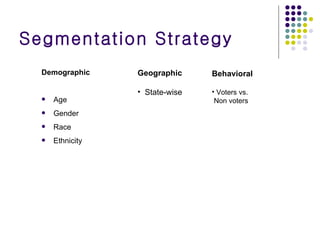
Segmentation Strategy Demographic Age Gender Race Ethnicity Geographic State-wise Behavioral Voters vs. Non voters
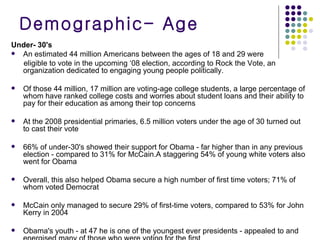
Demographic- Age Under- 30's An estimated 44 million Americans between the ages of 18 and 29 were  eligible to vote in the upcoming ‘08 election, according to Rock the Vote, an organization dedicated to engaging young people politically.  Of those 44 million, 17 million are voting-age college students, a large percentage of whom have ranked college costs and worries about student loans and their ability to pay for their education as among their top concerns At the 2008 presidential primaries, 6.5 million voters under the age of 30 turned out to cast their vote  66% of under-30's showed their support for Obama - far higher than in any previous election - compared to 31% for McCain.A staggering 54% of young white voters also went for Obama Overall, this also helped Obama secure a high number of first time voters; 71% of whom voted Democrat McCain only managed to secure 29% of first-time voters, compared to 53% for John Kerry in 2004 Obama's youth - at 47 he is one of the youngest ever presidents - appealed to and energised many of those who were voting for the first
Women 56% of the female vote went to Obama, exceeding the usual Democrat advantage. Many consider that Obama's appeal to women has been key to his electoral victory, while McCain's selection of Sarah Palin as his running mate, failed to help him secure the support of America's women. It should be noted that while Obama won the female vote overall, he lost the battle over white women by 7 points Men The male vote was essentially tied with 49% voting for Obama, thus evening the score on the male-heavy Republican advantage in 2004. 41% of white males voted for Obama, making him the first Democrat since Jimmy Carter to take more than 38% in this category Demographic- Gender
Black 95% of black voters went to the ballot for Obama and only 4% for McCain. Obama has succeeded in mobilising African-American voters who, although strongly Democratic, have in the past been apathetic in turning out to vote. Yesterday's surge in black voters, however, only boosted black turnout by two percentage points from 11% to 13%. As in previous years, more black women turned out than men. White 55% of white votes went to McCain including the notoriously hard-to-win white working class vote Obama stunned many by taking an impressive 43% of total white votes, cutting the Republican lead compared with 2004  Demographic- Race
Hispanics 66% of Hispanic voters turned out for Obama - the best ever result for a Democrat. McCain only took 31% of the Hispanic vote, despite courting them heavily in his campaign. Obama used techniques such as Spanish-language adverts to win the Hispanic voters over, many of whom had grown disgruntled with the Bush administration. Asians 63% of Asian voters went to the ballot for Obama and 34% for McCain Jews 78% of the Jewish vote went to Obama. Jewish support - which made up 2% of the overall electorate - has, in recent years, been overwhelmingly Democrat; with Al Gore receiving 79% in 2000 and John Kerry 74% in 2004  Christians Nearly 25 per cent of U.S. adults - about 30 million - are Catholic and 54 per cent of them voted for pro-abortion Obama as opposed to 46 per cent for McCain. Observers say the economy became the key issue for many Catholic Americans, which, along with issues such as the Iraq War and health care, eclipsed abortion Demographic- Ethnicity
Single voters Obama won this category by a landslide, with 66% of single voters going to the ballot for him, compared to only 32% for McCain. Married voters 51% of married voters supported McCain and 47% voted for Obama. This was a drop from 2004 for McCain compared with Bush's 15 point lead in 2004. Senior Citizens 51% of over- 65's voted for McCain - including veterans - and made up 16% of the entire electorate. They were therefore not dissimilar in influence to the under- 30's on the overall result. Demographic- Others
High earners 53% of voters who earned $200,000 or more in 2007 voted for Obama. McCain - who was expected to triumph amongst the wealthy, succeeded in polling only 45% of these voters. 73% of white evangelicals backed McCain and 25% backed Obama. This was a boost of 4 points for the Democrats from 2004, who traditionally struggle in rural areas, where many of this category live. 84% of Democrats who initially voted for Hillary Clinton in the primaries voted for Obamas. Suburban/Rural voters Were split 50-50. A key area in Bush's victory four years ago, suburban voters make up half of the total American electorate. McCain also lost ground on rural voters, with the votes split 51-47 in his favour. Demographic- Others
Professionals Reached out to professionals: Profile on  Linked In   where he would have discussed his view points on business, income tax and finance. There are separate group created on linked too where his followers could download badges and give their suggestion to him.  Demographic- Others
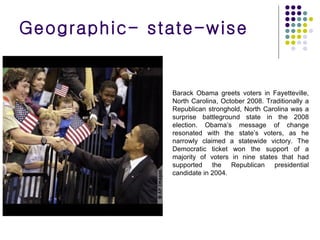
Barack Obama greets voters in Fayetteville, North Carolina, October 2008. Traditionally a Republican stronghold, North Carolina was a surprise battleground state in the 2008 election. Obama’s message of change resonated with the state’s voters, as he narrowly claimed a statewide victory. The Democratic ticket won the support of a majority of voters in nine states that had supported the Republican presidential candidate in 2004. Geographic- state-wise
Behavioral  Essentially there are voters & non-voters. Below is the detailed behavioral segmentation that the Obama campaign team had probably considered for targetting First time voters :  Youth who just became eligible to vote  Apathetic voters :  Eligible but apathetic youth, African-American voters who previously did not participate in elections  Supporters :  Campaign volunteers for Obama, certain regions of Democratic strongholds Opposition voters :  Regions of Republican strongholds, The undecided :  Fence-sitters who would swing their votes depending on candidate performance during elections
Obama’s   targetting   was most   multi-layered,   presidential out-reach campaigns in history,  reaching all sorts of voters  with  specially tailored messages   on their specially tailored outlets Successful targetting: Obama’s main segment was ‘Youth’ & he knew how to reach the 21st century American.  He used the latest technology (internet) to opening up the market to new clients as well as stimulating interest in existing ones . 
Targetting : Youth Message :  Concerns over the availability of student loans and how families will cover their college costs continue to be at the forefront of young voters' minds, in the midst of a dragging economy where credit is tight, unemployment is up, and high gas and food prices continue to eat away at families' paychecks.  Mediums : Commercial time on Comedy Central, VH1 and Spike. Until this year, MTV’s networks did  not accept political advertising, and Mr. Obama becomes the first presidential campaign  to buy time with them, an official at MTV said Mobile advertising to target the youth demographic and voters in key battleground states, according to Quattro Wireless, which helped run the campaign. Called “Vote Early,” the ad campaign was used to encourage voters to cast their ballots early, where polls opened before election day. Banners ran on the operator deck of Boost Mobile, which is known for having a young user base, and included text ads at the bottom of SMS messages sent from ChaCha, the general answer service. Users were given the option of opting-in to those message, by responding “OBAMA” to receive more information on where to vote  Facebook, the second-largest social network as ranked by Hitwise in June, has received the heftiest chunk of  Obama's  social network spending , garnering around $90,000 this year, according to FEC filings. MySpace collected about $11,500 from the campaign in 2008, reports show. He even went so far as to purchase virtual billboards in nine different videogames such as Madden NFL ’09 and Burnout: Paradise.
Targetting:  Specific Communities The Obama campaign aims to reach black voters on the Web, and one recipient of its ad dollars is social network publisher Community Connect  Many of Obama's ads have been targeted to BlackPlanet members living in specific locales Obama's campaign isn't just running ads on BlackPlanet, though. Since  launching profile pages  on all of Community Connect's social networking sites late last year, his Internet team regularly feeds new information into them. The updates are often of special relevance to the communities catered to by each network. A video posted to his BlackPlanet profile, for instance, features Obama visiting a barbershop in South Carolina.  While the content updates on his profile and state pages serve to "get people informed and interested in him and believing in him," continued Sun, "the advertising gets them to take action."
Targetting:  Locally The ability to target ads locally is important to any political candidate using any medium, but Obama's campaign took local targeting to a new level. Before several state primaries, and then again before the general election, the campaign customized online ad creative for residents of different states. During the primaries, display ads with tailored messages showed up on news sites in Texas, Ohio, Pennsylvania, and others. Later in the year, a variety of state-specific ads appeared, telling people to "Register to Vote for Barack Obama and Other Candidates For Change," and providing the last day they could register in their state in order to vote In addition to targeting geographically through ad networks, the ads showed up on local sites through firms specializing in local media. Centro, a local media buying firm, handled many of these local TV and newspaper site buys, taking in close to $630,000 by October. Cox, which offers digital local media, received $100,000 in October.
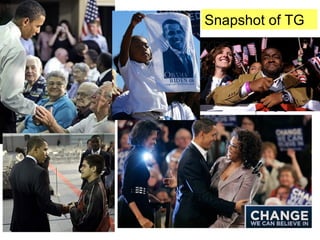
Snapshot of TG
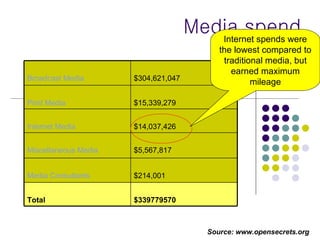
Media spend Source: www.opensecrets.org Internet spends were the lowest compared to traditional media, but earned maximum mileage $339779570 Total $214,001 Media Consultants $5,567,817 Miscellaneous Media $14,037,426 Internet Media $15,339,279 Print Media $304,621,047 Broadcast Media
Summary Multiple Touch Communicating via all channels relevant to target consumers and creating a great brand experience for them at every touch point is vital. Obama reached out to all communities and every demographic and psychographic target group, brilliantly exploiting a mix of traditional media and modern technologies. Offline, his events have been magnificent spectacles, choreographed to perfection, presidential in presentation. His retail outlets ("Obama branches") covered the whole of the US, offering accessories and memorabilia such as his "Change the World" T-Shirts. Online, his strategy had something for everyone - tools to organise locally, talk to voters, form local groups, find events, raise funds and blog. Browsers could connect via the website to Facebook, MySpace, YouTube, Flickr and many other social networking sites or click on Barack TV to see videos about the man and his life. Even his website sign-off enshrined a key emotional message ("Powered by Hope and supporters like you"). You could also contact the Obama campaign by mobile by just texting HOPE (that word again) followed by the number. Advertisements were even placed in electronic games to catch the young, newly enfranchised voters.  Barack Obama has used these established techniques to attract friendship, loyalty and trust and to create a compelling and attractive image that few can resist. By so doing he has changed perceptions in unprecedented ways, not just about himself, but about America, and not just in America, but also globally. The American Dream has been brought to life, and like a global brand, he has made everyone feel they can have a piece of it.
References http://thecaucus.blogs.nytimes.com/2008/10/08/obama-aims-tv-ads-at-younger-voters/ http://www.moconews.net/entry/419-obama-used-mobile-advertising-to-target-youth-and-voters-in-key-battleg/ http://www.marketwatch.com/news/story/capturing-youth-vote-mccain-obama/story.aspx?guid=%7B642D10CD-6E61-4CE5-8CB7-42B6E9711317%7D&dist=hppr http://www.loc.gov/fedsearch/?targets%5B%5D=recommend&targets%5B%5D=webpages&cclquery=obama+pictures http://www.dailymail.co.uk/news/worldnews/article-1083335/Breakdown-demographics-reveals-black-voters-swept-Obama-White-House.html http://www.clickz.com/3630315 http://www.opensecrets.org/pres08/expend.php?cycle=2008&cid=n00009638 http://www.sbs.ox.ac.uk/news/archives/Main/Building+brand+Obama.htm
Thank you

Segmenting & Targetting for Obama campaign

  • 1.
    Rashmi Athlekar PGPCMX,MICA,India Strategic Review of Obama's Segmenting & Targetting Strategies
  • 2.
    Segmentation Strategy DemographicAge Gender Race Ethnicity Geographic State-wise Behavioral Voters vs. Non voters
  • 3.
    Demographic- Age Under-30's An estimated 44 million Americans between the ages of 18 and 29 were eligible to vote in the upcoming ‘08 election, according to Rock the Vote, an organization dedicated to engaging young people politically. Of those 44 million, 17 million are voting-age college students, a large percentage of whom have ranked college costs and worries about student loans and their ability to pay for their education as among their top concerns At the 2008 presidential primaries, 6.5 million voters under the age of 30 turned out to cast their vote 66% of under-30's showed their support for Obama - far higher than in any previous election - compared to 31% for McCain.A staggering 54% of young white voters also went for Obama Overall, this also helped Obama secure a high number of first time voters; 71% of whom voted Democrat McCain only managed to secure 29% of first-time voters, compared to 53% for John Kerry in 2004 Obama's youth - at 47 he is one of the youngest ever presidents - appealed to and energised many of those who were voting for the first
  • 4.
    Women 56% ofthe female vote went to Obama, exceeding the usual Democrat advantage. Many consider that Obama's appeal to women has been key to his electoral victory, while McCain's selection of Sarah Palin as his running mate, failed to help him secure the support of America's women. It should be noted that while Obama won the female vote overall, he lost the battle over white women by 7 points Men The male vote was essentially tied with 49% voting for Obama, thus evening the score on the male-heavy Republican advantage in 2004. 41% of white males voted for Obama, making him the first Democrat since Jimmy Carter to take more than 38% in this category Demographic- Gender
  • 5.
    Black 95% ofblack voters went to the ballot for Obama and only 4% for McCain. Obama has succeeded in mobilising African-American voters who, although strongly Democratic, have in the past been apathetic in turning out to vote. Yesterday's surge in black voters, however, only boosted black turnout by two percentage points from 11% to 13%. As in previous years, more black women turned out than men. White 55% of white votes went to McCain including the notoriously hard-to-win white working class vote Obama stunned many by taking an impressive 43% of total white votes, cutting the Republican lead compared with 2004 Demographic- Race
  • 6.
    Hispanics 66% ofHispanic voters turned out for Obama - the best ever result for a Democrat. McCain only took 31% of the Hispanic vote, despite courting them heavily in his campaign. Obama used techniques such as Spanish-language adverts to win the Hispanic voters over, many of whom had grown disgruntled with the Bush administration. Asians 63% of Asian voters went to the ballot for Obama and 34% for McCain Jews 78% of the Jewish vote went to Obama. Jewish support - which made up 2% of the overall electorate - has, in recent years, been overwhelmingly Democrat; with Al Gore receiving 79% in 2000 and John Kerry 74% in 2004 Christians Nearly 25 per cent of U.S. adults - about 30 million - are Catholic and 54 per cent of them voted for pro-abortion Obama as opposed to 46 per cent for McCain. Observers say the economy became the key issue for many Catholic Americans, which, along with issues such as the Iraq War and health care, eclipsed abortion Demographic- Ethnicity
  • 7.
    Single voters Obamawon this category by a landslide, with 66% of single voters going to the ballot for him, compared to only 32% for McCain. Married voters 51% of married voters supported McCain and 47% voted for Obama. This was a drop from 2004 for McCain compared with Bush's 15 point lead in 2004. Senior Citizens 51% of over- 65's voted for McCain - including veterans - and made up 16% of the entire electorate. They were therefore not dissimilar in influence to the under- 30's on the overall result. Demographic- Others
  • 8.
    High earners 53%of voters who earned $200,000 or more in 2007 voted for Obama. McCain - who was expected to triumph amongst the wealthy, succeeded in polling only 45% of these voters. 73% of white evangelicals backed McCain and 25% backed Obama. This was a boost of 4 points for the Democrats from 2004, who traditionally struggle in rural areas, where many of this category live. 84% of Democrats who initially voted for Hillary Clinton in the primaries voted for Obamas. Suburban/Rural voters Were split 50-50. A key area in Bush's victory four years ago, suburban voters make up half of the total American electorate. McCain also lost ground on rural voters, with the votes split 51-47 in his favour. Demographic- Others
  • 9.
    Professionals Reached outto professionals: Profile on Linked In   where he would have discussed his view points on business, income tax and finance. There are separate group created on linked too where his followers could download badges and give their suggestion to him. Demographic- Others
  • 10.
    Barack Obama greetsvoters in Fayetteville, North Carolina, October 2008. Traditionally a Republican stronghold, North Carolina was a surprise battleground state in the 2008 election. Obama’s message of change resonated with the state’s voters, as he narrowly claimed a statewide victory. The Democratic ticket won the support of a majority of voters in nine states that had supported the Republican presidential candidate in 2004. Geographic- state-wise
  • 11.
    Behavioral Essentiallythere are voters & non-voters. Below is the detailed behavioral segmentation that the Obama campaign team had probably considered for targetting First time voters : Youth who just became eligible to vote Apathetic voters : Eligible but apathetic youth, African-American voters who previously did not participate in elections Supporters : Campaign volunteers for Obama, certain regions of Democratic strongholds Opposition voters : Regions of Republican strongholds, The undecided : Fence-sitters who would swing their votes depending on candidate performance during elections
  • 12.
    Obama’s targetting was most multi-layered, presidential out-reach campaigns in history, reaching all sorts of voters with specially tailored messages on their specially tailored outlets Successful targetting: Obama’s main segment was ‘Youth’ & he knew how to reach the 21st century American. He used the latest technology (internet) to opening up the market to new clients as well as stimulating interest in existing ones . 
  • 13.
    Targetting : YouthMessage : Concerns over the availability of student loans and how families will cover their college costs continue to be at the forefront of young voters' minds, in the midst of a dragging economy where credit is tight, unemployment is up, and high gas and food prices continue to eat away at families' paychecks. Mediums : Commercial time on Comedy Central, VH1 and Spike. Until this year, MTV’s networks did not accept political advertising, and Mr. Obama becomes the first presidential campaign to buy time with them, an official at MTV said Mobile advertising to target the youth demographic and voters in key battleground states, according to Quattro Wireless, which helped run the campaign. Called “Vote Early,” the ad campaign was used to encourage voters to cast their ballots early, where polls opened before election day. Banners ran on the operator deck of Boost Mobile, which is known for having a young user base, and included text ads at the bottom of SMS messages sent from ChaCha, the general answer service. Users were given the option of opting-in to those message, by responding “OBAMA” to receive more information on where to vote Facebook, the second-largest social network as ranked by Hitwise in June, has received the heftiest chunk of Obama's social network spending , garnering around $90,000 this year, according to FEC filings. MySpace collected about $11,500 from the campaign in 2008, reports show. He even went so far as to purchase virtual billboards in nine different videogames such as Madden NFL ’09 and Burnout: Paradise.
  • 14.
    Targetting: SpecificCommunities The Obama campaign aims to reach black voters on the Web, and one recipient of its ad dollars is social network publisher Community Connect Many of Obama's ads have been targeted to BlackPlanet members living in specific locales Obama's campaign isn't just running ads on BlackPlanet, though. Since launching profile pages on all of Community Connect's social networking sites late last year, his Internet team regularly feeds new information into them. The updates are often of special relevance to the communities catered to by each network. A video posted to his BlackPlanet profile, for instance, features Obama visiting a barbershop in South Carolina. While the content updates on his profile and state pages serve to "get people informed and interested in him and believing in him," continued Sun, "the advertising gets them to take action."
  • 15.
    Targetting: LocallyThe ability to target ads locally is important to any political candidate using any medium, but Obama's campaign took local targeting to a new level. Before several state primaries, and then again before the general election, the campaign customized online ad creative for residents of different states. During the primaries, display ads with tailored messages showed up on news sites in Texas, Ohio, Pennsylvania, and others. Later in the year, a variety of state-specific ads appeared, telling people to "Register to Vote for Barack Obama and Other Candidates For Change," and providing the last day they could register in their state in order to vote In addition to targeting geographically through ad networks, the ads showed up on local sites through firms specializing in local media. Centro, a local media buying firm, handled many of these local TV and newspaper site buys, taking in close to $630,000 by October. Cox, which offers digital local media, received $100,000 in October.
  • 16.
  • 17.
    Media spend Source:www.opensecrets.org Internet spends were the lowest compared to traditional media, but earned maximum mileage $339779570 Total $214,001 Media Consultants $5,567,817 Miscellaneous Media $14,037,426 Internet Media $15,339,279 Print Media $304,621,047 Broadcast Media
  • 18.
    Summary Multiple TouchCommunicating via all channels relevant to target consumers and creating a great brand experience for them at every touch point is vital. Obama reached out to all communities and every demographic and psychographic target group, brilliantly exploiting a mix of traditional media and modern technologies. Offline, his events have been magnificent spectacles, choreographed to perfection, presidential in presentation. His retail outlets ("Obama branches") covered the whole of the US, offering accessories and memorabilia such as his "Change the World" T-Shirts. Online, his strategy had something for everyone - tools to organise locally, talk to voters, form local groups, find events, raise funds and blog. Browsers could connect via the website to Facebook, MySpace, YouTube, Flickr and many other social networking sites or click on Barack TV to see videos about the man and his life. Even his website sign-off enshrined a key emotional message ("Powered by Hope and supporters like you"). You could also contact the Obama campaign by mobile by just texting HOPE (that word again) followed by the number. Advertisements were even placed in electronic games to catch the young, newly enfranchised voters. Barack Obama has used these established techniques to attract friendship, loyalty and trust and to create a compelling and attractive image that few can resist. By so doing he has changed perceptions in unprecedented ways, not just about himself, but about America, and not just in America, but also globally. The American Dream has been brought to life, and like a global brand, he has made everyone feel they can have a piece of it.
  • 19.
    References http://thecaucus.blogs.nytimes.com/2008/10/08/obama-aims-tv-ads-at-younger-voters/ http://www.moconews.net/entry/419-obama-used-mobile-advertising-to-target-youth-and-voters-in-key-battleg/http://www.marketwatch.com/news/story/capturing-youth-vote-mccain-obama/story.aspx?guid=%7B642D10CD-6E61-4CE5-8CB7-42B6E9711317%7D&dist=hppr http://www.loc.gov/fedsearch/?targets%5B%5D=recommend&targets%5B%5D=webpages&cclquery=obama+pictures http://www.dailymail.co.uk/news/worldnews/article-1083335/Breakdown-demographics-reveals-black-voters-swept-Obama-White-House.html http://www.clickz.com/3630315 http://www.opensecrets.org/pres08/expend.php?cycle=2008&cid=n00009638 http://www.sbs.ox.ac.uk/news/archives/Main/Building+brand+Obama.htm
  • 20.