FINANCIALEDUCATION
         AND THE FUTURE
            The Banking Industry’s Role in
            Helping Consumers Manage
            Money and Build Assets


                          FEDERAL DEPOSIT
                          INSURANCE CORPORATION


            A White Paper Prepared By
            The Federal Deposit Insurance Corporation
The troubles gripping the U.S. economy
have driven home the fact that the financial world has grown
     incredibly complicated. Most Americans would be
hard-pressed to explain the reasons for the economy’s sharp
decline or to define such contributing factors as credit default
          swaps and collateralized debt obligations.
FINANCIAL EDUCATION
          AND THE FUTURE


                          Contents
                          Executive Summary 2
                          Obstacles and Opportunities 4
                          Banking for the Unbanked 9
                          Learning to Earn 15
                          Building for the Future 21
                          Toward Greater Public Confidence 26


  FEDERAL DEPOSIT

                               A White Paper Prepared By The Federal Deposit Insurance Corporation
  INSURANCE CORPORATION
2
    FINANCIAL EDUCATION
              AND THE FUTURE
                       The Banking Industry’s Role in Helping Consumers Manage Money and Build Assets


                       Executive Summary
                       In June 2008, the Federal Deposit Insurance Corporation launched the
                       Face Your Finances Road Show, a nine-month series of panel discussions in
                       five cities that called attention to the need for improved financial
                       knowledge among Americans and spotlighted ways in which banks,
                       community organizations and regulators can help. “Every consumer
                       needs to know about deposit insurance and how to handle money. They
                       need to know how to access banking services and how to buy a home,”
                       FDIC Chairman Sheila C. Bair told the first gathering in Chicago.
                           But too few Americans have that knowledge. Many don’t know how to save money, how to
                       manage it, and how to use it to build a strong financial future. Indeed, the recession has exposed the
                       vulnerability of those with too much debt and too few assets to fall back on.
                           The need for consumer education has grown with the spread of complex financial products, yet
                       until recent years not enough has been done to help consumers, especially young people, make
                       informed decisions about their money. That is changing, as the Road Show participants pointed out.
                           A significant obstacle to improving financial skills is the large number of “unbanked” consumers—
                       the estimated 10-20 million people who have no relationship with a bank. Those without checking or
                       savings accounts often are forced to do business with check-cashing firms or payday lenders, whose
                       loans may carry an average annual percentage rate of 470 percent. Moreover, such consumers cannot
                       harness the power of regular saving to build assets for the future.
                           Many of these consumers find bank products and fees confusing and branch locations and hours
                       inconvenient. The banking industry, working with community organizations and regulators, is
                       targeting those problems by opening branches in underserved areas and offering a mix of services and
                       products geared toward the unbanked. These include remittances, fee-based check cashing, and
                       “second chance” checking accounts for those who have had accounts but lost them through misunder-
                       standing or misuse.
                           Financial institutions and community groups also are working to attract unbanked consumers
                       through Individual Development Accounts, or IDAs, which use public funds to match savings put


         FEDERAL DEPOSIT
         INSURANCE CORPORATION
FINANCIAL EDUCATION                                                      3
                                                                       AND THE FUTURE


aside by low- and moderate-income households for goals such as buying a house, building a business or
paying for college.
    Many new programs are teaching young people how to save and manage money. Though the
number is still small, more states are requiring financial education in schools. In addition, a growing
number of school districts are opening in-school bank branches staffed by students, both as a teaching
tool and as a service to the community at large.


“
       When people don’t have savings, they become
      vulnerable. Whenever there is even a small crisis,
  everything comes tumbling down. We need to emphasize
 the need to save and the need for delayed gratification. It’s
              important to save for tomorrow.”
          —ANN BADDOUR, senior policy analyst at Texas Appleseed, a public interest law
                 organization, at the FDIC’s Face Your Finances Road Show in Dallas


    Regulators such as the Federal Deposit Insurance Corporation have encouraged educational
efforts. The FDIC’s Money Smart program helps low- to moderate-income people learn more about
managing money through a 10-lesson curriculum dealing with basic borrowing and the proper use of
credit. At the same time, the nation’s 12 Federal Reserve Banks and their partners operate dozens of
financial education programs that are drawing increasing numbers of participants.
    Yet there is much more to do. Banks must find ways to build community trust, and regulators must
find ways to support change while continuing their vital oversight roles. Above all, consumers must feel
confident that the financial system works. The nation’s economic health depends on consumers
knowing how to make, save and invest money—not just for themselves and their families, but for the
good of their communities.


                                                                A White Paper Prepared By The Federal Deposit Insurance Corporation
4
                  FINANCIAL EDUCATION
                            AND THE FUTURE
                                     The Banking Industry’s Role in Helping Consumers Manage Money and Build Assets
    SECTION ONE


                                     Obstacles and Opportunities
                                     The troubles gripping the U.S. economy have driven home the fact that
                                     the financial world has grown incredibly complicated. Most Americans
                                     would be hard-pressed to explain the reasons for the economy’s sharp
                                     decline or to define such contributing factors as credit default swaps and
                                     collateralized debt obligations.
                                         No one would expect the average citizen to understand such financial complexity, but the recession
                                     has thrown light on a more fundamental lack of knowledge. Too few Americans understand even basic
                                     financial matters, a shortcoming that has exposed them to potential disaster. They save too little and
                                     spend too much, amass large credit card balances and buy houses they cannot afford. Not enough
                                     know how to create a household budget or choose the right bank account. Many don’t understand
                                     how deposit insurance works.
                                         Simply put, far too many Americans don’t understand how to use their own money, a lack of
                                     knowledge that deprives them of the opportunities for security and growth that it can provide.
                                         The need for such knowledge has exploded. The expansion of financial markets and the banking
                                     industry has created a wave of new and often complicated products that require consumers to make
                                     more choices. The right decisions can bring financial security; the wrong ones can cause enormous
                                     harm, as many of those who chose volatile adjustable-rate mortgages in recent years can attest.
                                         To celebrate the 75th anniversary of the Federal Deposit Insurance Corporation, FDIC Chairman
                                     Sheila C. Bair in June 2008 launched a nine-month-long series of panel discussions across the country
                                     to highlight both the need for financial education and the roles the banking industry, community
                                     groups and regulators play in providing it. The Face Your Finances Road Show provided an opportunity
                                     for banking and community leaders in Chicago, San Francisco, Dallas, New York City and Kansas City
                                     to offer thoughts on how consumers could become better stewards of their money, and how the
                                     country’s financial system could benefit as a result.
                                         Participants in each city told of novel approaches being taken by the banking industry and its
                                     partners in helping consumers build more secure futures—large-scale workshops on personal finance,
                                     in-school bank branches that help students learn first-hand about money management, and savings
                                     accounts that draw in unbanked consumers with matched deposits, to name just a few. But they also
                                     told of ways in which banks inadvertently hinder the participation of the very customers who would


                       FEDERAL DEPOSIT
                       INSURANCE CORPORATION
FINANCIAL EDUCATION                                                            5
                                                                         AND THE FUTURE


                                                                                                                                SECTION ONE
benefit most from their services. This white paper reflects their insights and suggestions, as well as those
from a wide range of others from the worlds of banking, nonprofits and government.
     There is broad agreement that financial illiteracy is a major problem in the United States, one that
has serious consequences both for consumers and for the economy. Record low savings rates, rising
bankruptcies and mortgage delinquencies, and high levels of credit card debt all point to a need for
better money-management skills.
     The problem cuts across social, age and economic lines, but it is most acute among consumers with
little or no previous exposure to the banking system, especially new immigrants and members of
minority communities. These groups have the most to gain from using the financial tools that banks
have to offer, yet a wide variety of factors—cultural differences, language barriers and institutional
distrust among them—have discouraged consumers from doing so.


“
   Every consumer needs to know about deposit insurance
    and how to handle money. They need to know how to
     access banking services and how to buy a home.”
   FDIC Chairman Sheila C. Bair, speaking at the FDIC’s Face Your Finances Road Show in Chicago


    Banks themselves can inadvertently contribute to the problem: confusing fees, inconvenient branch
locations and expensive (and unexpected) overdraft charges are among the many factors that can drive
customers away. “A fast food restaurant gives you prices right away. But if you walk into a traditional
deposit branch, all you get are CD rates. Even when you think you have it straight, you can incur
charges you didn’t expect,” says Jennifer Tescher, director of the Chicago-based Center for Financial
Services Innovation and a panelist at the Face Your Finances Road Show in that city.
    The lack of participation in the banking system is no small matter. Estimates of the number of
Americans who have no relationship with a bank range from 10-20 million people. A similar range of
people have also been estimated to be “underbanked,” meaning they have bank accounts but usually
conduct their financial transactions outside of mainstream financial institutions. That amounts to a
sizable number of people who may not be earning interest on their money or have no access to afford-
able loans.
    These consumers most often turn to alternative providers such as check-cashing companies and
payday lenders, whose services cost far more than those of banks. According to the Consumer Federa-
tion of America, payday lenders charge an average annual percentage rate of 470 percent on their loans.
Just as troubling, these alternative providers, unlike banks, are generally not able to help their customers


                                                                  A White Paper Prepared By The Federal Deposit Insurance Corporation
6
                  FINANCIAL EDUCATION
                            AND THE FUTURE
                                     The Banking Industry’s Role in Helping Consumers Manage Money and Build Assets
    SECTION ONE


                                     prepare for the future by encouraging asset building. Yet alternative providers are thriving.
                                         “It almost seems as if the market has become divided between two groups: those who successfully
                                     rely on banks for virtually cost-free basic financial services, and those who pay high amounts,” FDIC
                                     Chairman Sheila C. Bair said at a Consumer Federation of America conference in 2006. “Some pay 18
                                     percent for a line of credit linked to their checking account; others pay 500 to 600 percent for a payday
                                     loan. Some pay nothing or minimal fees for an unlimited checking account, while others pay significant
                                     fees just to cash their paychecks and purchase money orders to pay bills. Part of the problem is that
                                     many people lack the financial skills needed to analyze and compare products and their prices.”
                                         Since relying on check cashers and payday lenders costs far more and reduces financial options,
                                     most of these consumers would be better off as customers of mainstream financial institutions. A
                                     banking relationship would increase their chances of one day buying homes, sending their children to
                                     college and contributing to the prosperity of their communities. Yet it has proven difficult to get them
                                     into the system and keep them there.
                                         The unbanked aren’t alone in lacking the knowledge to navigate today’s complex financial system.
                                     Young people often struggle with the basics of money; in a 2008 survey by the Jump$tart Coalition for
                                     Personal Financial Literacy, high school seniors correctly answered only 48.3 percent of the survey’s
                                     basic questions about finances, down from 52.4 percent in 2006. Adults, too, often lack an


                                     Reaching Out to Young Consumers
                                         M
                                         . ountainOne Financial Partners, the North        new products—most recently the MoneyOne
                                     Adams, Massachusetts-based holding                    Teen Account.
                                     company of Hoosac Bank, Williamstown                       The new account provides account holders
                                     Savings Bank and South Coastal Bank,                  with a debit card with full parental access. It
                                     reviewed its customer base and saw a problem.         also offers financial education in the form of a
                                     Younger people were not coming to the banks           brochure that explains how debit cards work
                                     in significant numbers—bad both for the banks         and how accounts should be balanced. In its
                                     and for those potential young customers who           first 11 weeks, 122 MoneyOne Teen Accounts
                                     were missing out on what the banking industry         were opened.
                                     could offer them.                                          The students also offered insights on the
                                         To address this, MountainOne created a            banks’ websites: “Boring,” they said, and not
                                     Junior Board of Directors consisting of two           conducive to helping young people learn about
                                     students from each of the area’s five high            banking and finances. They also helped develop
                                     schools. The students helped the bank better          a new website, www.notyourmothersdebit-
                                     understand the financial needs of young people        card.com, that links from the existing sites.
                                     in the region, but they also are helping design


                       FEDERAL DEPOSIT
                       INSURANCE CORPORATION
FINANCIAL EDUCATION                                                            7
                                                                         AND THE FUTURE


                                                                                                                                SECTION ONE
understanding of how to safeguard their finances. A survey conducted for the National Foundation for
Credit Counseling and MSN Money, for instance, found that only a third of the Americans surveyed
know their credit score, an important factor in determining whether they can get a mortgage or other
loan, and at what price.


“
      We are trying to urge people to make smart choices.
         Those choices have to be available and easy.
        Jonathan Mintz, commissioner of the New York City Department of Consumer Affairs,
                            at the New York Face Your Finances Road Show


    The surest way to address such deficiencies is through education. Consumers who have learned the
basics of money management know the value of saving and household budgeting, have a better under-
standing of the proper use of credit, and have a clearer picture of the role that banks can play in helping
them build assets. Just as important, they are savvier than those without money management skills;
they know that a deal that appears to be too good to be real probably is not real.
    Consumers are not the only beneficiaries of financial education. Prosperous residents pay more
taxes to their communities, support more charities and contribute to the health of the housing market.
Indeed, the future of the nation’s economic democracy depends in no small part on its citizens having
the ability to understand how to make, invest and spend money.
     Fortunately, the issue has in recent years begun to receive the attention that it desperately needs.
Banks, community groups and regulatory agencies have launched a wave of innovative programs to
help consumers better manage their finances, and many have been notable successes.
    In Garland, Texas, United Central Bank has held more than 300 classes at schools, churches, job
centers and other locations to teach local residents the basics of money management. In Houston, a
non-profit group called Covenant Community Capital holds six-week financial education programs
for low-income families that end with a bank officer helping participants open what in many cases is
their first bank account. In Chicago, the Cara Program helps homeless and at-risk residents by teaching
them the basics of budgeting, banking and saving. There are many other examples of institutions and
non-profits thinking creatively to make the economic system more inclusive.
    Regulators, too, have addressed the issue. The Federal Deposit Insurance Corporation has been an
enthusiastic supporter of financial education efforts. In 2001, it started the Money Smart program,
which helps low- to moderate-income adults learn more about managing money with a curriculum
that consists of 10 lessons offered in seven languages on such topics as basic borrowing and the proper


                                                                  A White Paper Prepared By The Federal Deposit Insurance Corporation
8
                  FINANCIAL EDUCATION
                            AND THE FUTURE
                                     The Banking Industry’s Role in Helping Consumers Manage Money and Build Assets
    SECTION ONE


                                     use of credit. In 2008, a new version of the program, Money Smart for Young Adults, was released
                                     designed for students from ages 12 to 20.
                                          To encourage the use of the curriculum, the FDIC’s Money Smart Alliance has formed nearly
                                     1,500 partnerships with financial institutions, trade associations, non-profits and state and local
                                     agencies. So far, the Money Smart curriculum has reached more than two million consumers.
                                          The results have been heartening. A survey by The Gallup Organization of 631 Money Smart
                                     participants found that 69 percent were able to increase their savings after participating in the program,
                                     while 53 percent reduced their debt. In addition, 43 percent of those who did not have a checking
                                     account when they took the course opened one by the time they were contacted six to 12 months after
                                     the training.
                                          Many other federal agencies, including the Department of the Treasury, the Office of the Comp-
                                     troller of the Currency, the Office of Thrift Supervision, and the Federal Reserve Board have added
                                     their efforts to the push for financial competence. All together, 20 federal agencies are members of the
                                     Financial Literacy and Education Commission. More state governments are recognizing the need for
                                     personal finance courses in schools, and cities like New York and San Francisco are taking a proactive
                                     approach to helping residents get, and understand, better banking services.
                                          Establishing a banking relationship is an important step in learning more about money, but the
                                     challenges to doing so can be daunting. Potential bank customers are too often intimidated by the
                                     sheer variety of accounts they can choose from, not to mention their fees. Others believe they have too
                                     little money to open a bank account, committing themselves to a future in which high fees charged by
                                     alternative service providers keep them from amassing the savings they need. There are other barriers,
                                     too. These may include inconvenient branch locations and hours, frustrating delays in crediting
                                     deposits, and overly stringent requirements for opening accounts.
                                          Whatever the reasons, it is clear that too many people who need help see the banking industry as
                                     either irrelevant or unhelpful. Elizabeth Colvin, a member of the Internal Revenue Service’s volunteer
                                     Taxpayer Advocacy Panel and a panelist at the Dallas Face Your Finances gathering, notes that “people
                                     aren’t sure banks are really on their side. It seems more like banks are waiting for them to fail.”
                                          Overcoming that belief is a key challenge not just for the banking industry but for community
                                     groups and regulators alike. But it is just one of the challenges involved in helping consumers sharpen
                                     their financial awareness, an essential ingredient to helping all Americans make economic progress.


                       FEDERAL DEPOSIT
                       INSURANCE CORPORATION
FINANCIAL EDUCATION                                                            9
                                                                       AND THE FUTURE


                                                                                                                              SECTION TWO
Banking for the Unbanked
The reluctance of a substantial part of the American public to do
business with banks might at first seem irrational. After all, banks offer a
multitude of ways to help their customers’ money grow, from interest-
bearing checking to savings accounts to certificates of deposits, all with
the safety of FDIC insurance. They are a convenient source of
mortgages and personal loans, and they offer a variety of other useful
services, often including such options as overseas remittances, money
orders and coin counting.
     Yet millions of American households have no relationship with a bank, a disconnect that in the
words of Brookings Institution researcher Matt Fellowes denies them “an on-ramp to economic
mobility and wealth. . . . Without access to that on-ramp, people are basically living in a cash economy
where there’s no opportunity to convert that into wealth.”
     Who are the unbanked? For the most part, they are younger than the overall population, make less
money and are less educated. They have not learned financial basics at home as children. Race and
ethnicity are factors, as well. According to the Federal Reserve Board, nonwhite families are four times
more likely to do without mainstream banking than white families. Immigrants also constitute a large
proportion of the unbanked; a 2002 survey by the Pew Hispanic Center and the Kaiser Family Foun-
dation found that 35 percent of the country’s Latino population chose not to do business with banks.
     In place of traditional financial institutions, many of the unbanked—along with the underbanked,
those with only minimal ties to the banking industry—rely on alternative service providers such as
check cashers and payday lenders, which typically charge far higher fees. A 2008 study by Brookings In-
stitution researcher Fellowes found that check cashers charge an average of $40 to cash a payroll check;
he calculated that a full-time worker could save $40,000 over his or her career by switching from check
cashers to a lower-cost checking account.
     Doing business with these alternative providers can sometimes be very costly for consumers. In
Illinois, a 2005 law capped annual interest rates at 403 percent for payday loans of up to 120 days. But
these lenders, seeing a loophole, began emphasizing loans of 121 days or longer—loans that under the
new law are uncapped and which carry annual rates as high as 1,000 percent.
      Despite the high cost of check cashers and payday lenders, the decision to switch to mainstream


                                                                A White Paper Prepared By The Federal Deposit Insurance Corporation
10
                   FINANCIAL EDUCATION
                             AND THE FUTURE
                                      The Banking Industry’s Role in Helping Consumers Manage Money and Build Assets
     SECTION TWO


                                      banking is not as simple as it might seem. Most of the unbanked are making a rational choice, one that
                                      often is based on convenience of hours and location—two things the alternative services use to great
                                      advantage. “When people don’t have a convenient bank, they find themselves more likely to use
                                      high-priced providers like check cashers and pawn shops,” says Richard Neiman, superintendent of
                                      the New York State Banking Department and a panelist at the FDIC’s Face Your Finances Road Show
                                      in New York.
                                           There are other reasons as well. Some of the unbanked believe they wouldn’t use banking services
                                      often enough to justify the cost or trouble of opening a bank account. Many have no previous experi-
                                      ence with banks and find the idea of learning how they work to be daunting, especially if they don’t
                                      speak English well. Some distrust the idea of giving their money to an institution.
                                           There also is a sizable portion of the unbanked who have had bank accounts and experienced
                                      problems with them, often in the form of large overdraft fees. “For someone on public assistance, when
                                      they bounce a check it’s an entire week’s income,” notes the Rev. Emma Jordan-Simpson, executive
                                      director of the Children’s Defense Fund of New York and a participant in the New York panel discus-
                                      sion. Such troubles often lead to the loss of the account, and those who have had such problems find it
                                      difficult, if not impossible, to open another.
                                           Even without a loss of privileges, bank policies on overdraft charges and check clearing can drive
                                      customers away. When a customer deposits a check and is told that the funds will be available in five
                                      business days, the appeal of a check casher that will give them the money right away—albeit at a high
                                      cost—becomes clearer.
                                           There are broader reasons why banks are not central to the lives of many consumers, especially in
                                      low-income areas. The need for a checking account is greatly reduced, for instance, when landlords and
                                      other service providers accept only cash.
                                           In short, banks do not always provide what prospective customers want, as noted in a 2008 study of
                                      neighborhood financial services by the New York City Department of Consumer Affairs. The study
                                      found that low-income consumers avoid mainstream financial institutions largely because their
                                      products and services don’t match consumers’ needs. As an example, checking accounts that are free to
                                      customers with direct deposit may be popular with suburban consumers, but 61 percent of low-income
                                      account holders in the surveyed New York neighborhoods don’t have direct deposit.
                                           “There are consumers out there who just don’t think banks are for them,” says Jennifer Tescher of
                                      the Center for Financial Services Innovation.
                                           Unfortunately, government policies can also discourage participation. Asset limits, for instance, can
                                      be a powerful disincentive to saving because they restrict how much low-income customers can keep in


                        FEDERAL DEPOSIT
                        INSURANCE CORPORATION
FINANCIAL EDUCATION                                                            11
                                                                               AND THE FUTURE


                                                                                                                                      SECTION TWO
savings accounts; if they save too much, they can be disqualified from receiving government benefits.
Earning more in interest may put a low-income family’s health coverage at risk, and most people
value the coverage more. “One way to get unbanked people into the banking system is to get rid of
or raise asset limits,” notes Dory M. Rand, president of the Woodstock Institute, a Chicago-based
nonprofit that promotes community reinvestment and economic development in lower-income
and minority communities.


“
 There are a lot of lower-income and minority communities
not involved with banking. Unfamiliarity is part of it. The fees
are part of it. So are language barriers. And often there is a
        lack of branches and appropriate services.”
       Dory M. Rand, president of the Woodstock Institute, a nonprofit that promotes community
    reinvestment and economic development in lower-income and minority communities, speaking
                               at the Chicago Face Your Finances Road Show


    Banks themselves often face substantial barriers when it comes to serving low-income communities,
despite incentives provided by the Community Reinvestment Act. A lack of cultural understanding can
make opening new branches in such communities a complicated undertaking, especially when good
market data is lacking. In addition, a new branch might not initially do enough business to immediately
cover costs, a big issue for banks tightly focused on profitability. Profitability concerns are cited as one
of the principal challenges perceived by financial institutions in serving or targeting the underbanked in
the FDIC Survey of Banks’ Efforts to Serve the Unbanked and Underbanked.1
    But such perceived barriers can be overcome through innovative approaches. In New York City,
nearly two dozen branches have been opened in underbanked areas under the Banking Development
District (BDD) program, a joint effort of the state, the city, local communities and the banking
industry. As an incentive, the city has deposited $200 million in public funds with banks that have
opened such branches, an amount roughly matched by the state.
    One of the banks participating in the BDD program is New York’s Amalgamated Bank, which has
opened four such branches in less than two years. To make them successful, says Amalgamated
President and Chief Executive Officer Derrick Cephas, it is important to first make them convenient,
then work on putting new customers at ease. “We try to partner with the community so that customers
are familiar with us. We then must bring them into one branch, make them comfortable and give them

[1] This survey was mandated by Section 7 of the Federal Deposit Insurance Reform Conforming Amendments Act of 2005.
    The survey found that while banks offer products and services for the unbanked and underbanked, opportunities for
    improvement remain. http://www.fdic.gov/unbankedsurveys/


                                                                        A White Paper Prepared By The Federal Deposit Insurance Corporation
12
                   FINANCIAL EDUCATION
                             AND THE FUTURE
                                      The Banking Industry’s Role in Helping Consumers Manage Money and Build Assets
     SECTION TWO


                                      the products they need,” Cephas told the New York Face Your Finances discussion.
                                          Indeed, providing the right mix of products is key to attracting and keeping underbanked customers.
                                          Remittances, for example, are a powerful attraction in immigrant communities. According to the
                                      World Bank, immigrants in the United States sent $46 billion to their home countries in 2007, and
                                      banks can use remittances as an effective point of entry for new customers. Other areas that hold appeal
                                      are fee-based check cashing services, modeled after the alternative providers but at a lower cost; secured
                                      credit cards that permit customers to begin building credit histories; and “second chance” checking
                                      accounts that allow customers who have lost bank accounts in the past to repair the damage. All can be
                                      powerful tools for extending services to the unbanked.


                                      “
                                               Most of the families I deal with are skeptical of
                                         the banking industry. I deal with families every day that put
                                                        their savings in a shoebox.”
                                                Cecilia Joseph, director of operations for the Children’s Defense Fund Texas, at the
                                                                       Dallas Face Your Finances Road Show


                                           John P. Caskey, a professor of economics at Swarthmore College, offers an unorthodox approach
                                      for bringing the unbanked into the mainstream. In a paper written for the Brookings Institution, Caskey
                                      has proposed that banks create special branches called “outlets” in lower-income areas. They would
                                      have traditional banking products, but their main offering would be non-traditional services that
                                      include fee-based check-cashing, basic savings accounts with access to low-cost money orders, deposit-
                                      secured loans for those with bad credit histories, and budget-management and credit-repair seminars.
                                      Even a modest rate of success, Caskey wrote, “could mean significant improvements in the quality of
                                      life for hundreds of thousands of lower-income families.”
                                           Reaching the unbanked will require proactive efforts not just by banks, but non-profit groups and
                                      government—and a deep commitment by all to educating consumers about money management.
                                           One such effort that is making an impact is Bank On San Francisco, a public-private partnership
                                      developed by San Francisco Treasurer José Cisneros, the Federal Reserve Bank of San Francisco and
                                      the non-profit group EARN that is intended to bring banking services to 10,000 of the 50,000 city
                                      households without accounts.
                                           Focused on the goal of helping those consumers open low-cost starter accounts, the program has
                                      worked with participating financial institutions to reduce the barriers faced by the unbanked. The part-
                                      nership developed a checkless, low-cost account that avoids high minimum balances and fees, worked


                        FEDERAL DEPOSIT
                        INSURANCE CORPORATION
FINANCIAL EDUCATION                                                            13
                                                                       AND THE FUTURE


                                                                                                                              SECTION TWO
to help consumers with previous banking and credit problems open “second chance” checking
accounts, and moved toward accepting alternative forms of identification such as consular cards. Partic-
ipating financial institutions waive minimum balance requirements and forgive one overdraft charge
each year.
    Financial education is central to Bank On San Francisco’s mission. Everyone who opens a bank
account under the program can attend EARN classes held throughout the city that are designed to help
consumers manage their new accounts, create budgets and file taxes. Classes are also available online.
    Bank On San Francisco exceeded the goal it set when it began in 2006 by opening 11,000 new
accounts in its first year, 92 percent of which are still in good standing. Among those who have
benefited is a 71-year-old resident who had been paying nearly $200 a month to cash her Social
Security check and her grandson’s disability check. She now has direct deposit at a nearby credit union,


Making a Difference With IDAs
Individual Development Accounts (IDAs) have             know them, they raise the issues that help us
helped change the lives of low- and moderate-           demystify the banking system.”
income people throughout the United States.                 IDA deposits are held at Compass Bank and
The programs offered by many nonprofit and              Wells Fargo Bank and are matched by funding
governmental organizations are typified by              from the United Way of the Texas Gulf Coast, the
those of Houston’s Covenant Community                   McAuley Institute, the U.S. Department of Health
Capital Corporation.                                    and Human Services, and the City of Houston.
    Covenant was created in 1998 with a broad               Has the program worked? Absolutely, Fairfield
mission—“to enhance the beauty, safety, and             says. He cites the case of a single mother with
economic vitality of low-income communities by          cancer whose income was $600 a month. Two
increasing their capacity to develop affordable         years after taking the course and opening an IDA,
housing, grow business enterprises, and build           she bought a home with a $25,000 mortgage,
family and community assets.” In 2008, it helped        which she quickly paid off. “There is no one whose
240 low-income families to achieve those goals.         income is too low to save,” says Fairfield.
    Founder and Chief Executive Officer Stephan             “What makes it worthwhile for people to make
Fairfield says Covenant’s IDA program, called the       sacrifices? It has a lot to do with tying their saving
Smart-Savings Program, includes a six-week              to a concrete goal,” adds Julie Riddle, director of
financial literacy course. “People don’t understand     family support services at The Family Conservancy
how business works, and in that six-week class          in Kansas City and a panelist at the Kansas City
we establish rapport,” he says. “As we get to           Face Your Finances Road Show.


                                                                A White Paper Prepared By The Federal Deposit Insurance Corporation
14
                   FINANCIAL EDUCATION
                             AND THE FUTURE
                                      The Banking Industry’s Role in Helping Consumers Manage Money and Build Assets
     SECTION TWO


                                      which charges no fee for check cashing and gives her five free money orders each month.
                                          “There is a need to get the word out,” says Treasurer Cisneros, a panelist at the San Francisco Face
                                      Your Finances Road Show. “We found there was a lot of misunderstanding out there. There were people
                                      who thought it was more expensive to have a bank account than to go to a check casher. We need to let
                                      them know they might spend hundreds a year with check cashers. It comes down to letting people
                                      know what the reality is.”
                                          The successes of Bank On San Francisco have spawned “Bank On” initiatives in other cities across
                                      the nation.
                                          Across the country, financial institutions and community groups are attracting unbanked
                                      customers through the use of Individual Development Accounts, or IDAs. The sponsor of an IDA—a
                                      financial institution, government agency or non-profit—applies for public funding, which is used to
                                      match the savings that low- and moderate-income households put aside for specific goals such as
                                      buying a house, expanding a business or paying for college.
                                          According to CFED, a non-profit that tracks IDAs, more than 240 FDIC-insured banks, thrifts and
                                      credit unions participate in IDA programs. Since their inception in the 1990s, IDAs have been used to
                                      finance 8,400 home purchases, 6,000 post-secondary educations and 5,200 small business start-ups
                                      and expansions.
                                          Among the largest IDA efforts is the Saving for the American Dream program run by the United
                                      Way of Greater Los Angeles, which has invested more than $8 million in IDAs since 2001 and offers
                                      financial education to participants. The effort has paid off: participants have increased their cash savings
                                      an average of 59 percent, and those saving to buy a home recorded a 40-point increase in credit scores
                                      over two years.
                                          With such results, IDAs are “a relatively low-risk way for banks to introduce underbanked individuals
                                      to the financial mainstream,” FDIC Chairman Bair has noted, a tool that “can help people of modest
                                      means build assets and can help banks tap into new markets.”
                                          By providing the unbanked and underbanked with such useful services and products, the banking
                                      industry can tap new markets and develop a new source of profitability. In turn, the newly banked can
                                      use the power of the financial system to build better and more prosperous lives for themselves. Meeting
                                      this crucial challenge benefits everyone.


                        FEDERAL DEPOSIT
                        INSURANCE CORPORATION
FINANCIAL EDUCATION                                                              15
                                                                        AND THE FUTURE


                                                                                                                               SECTION THREE
Learning to Earn
Considering all of the things people learn in their formative years, it is
perhaps surprising that so many grow up understanding so little about
money. Whatever the reason for this lack of knowledge, the results are
plain to see: Too little savings, too much spending, and poor choices
when it comes to loans and credit cards.
     In a 2008 survey conducted for the National Foundation for Credit Counseling and MSN
Money, nearly a quarter of the respondents said they didn’t know enough about owning a home to
consider buying one. Nearly 20 percent of the respondents said they had little or no idea where their
money goes each month, and more than a third said they had no money saved other than that
intended for retirement.
     Examples abound of people who simply don’t understand how to manage their finances. At the
FDIC’s Face Your Finances Road Show in Dallas, Dallas Morning News personal finance columnist
Pamela Yip told of a friend who overdrew her checking account because she didn’t know how to
record her withdrawals.
     What can be done to put consumers on a more fiscally sound path?
     Learning about money and its proper handling early in life certainly would help, yet most states
have been slow to require financial education in schools. A survey by the Jump$tart Coalition for
Personal Financial Literacy and Citi found that only three states require such courses be taught in their
schools, and 17 states require personal financial instruction to be incorporated into other subjects,
although the number is growing.
     Americans need to become more financially literate, and quickly. With financial products burgeon-
ing and markets becoming ever more complicated, those without basic knowledge will find themselves
falling further behind on the learning curve, with predictable results.
     With that in mind, financial education has become a high priority for government agencies, non-
profits and the financial services industry alike. The past decade has brought a surge of national
programs, among them the FDIC’s Money Smart and the Money Smart Alliance, whose nearly 1,500
partners—financial institutions, educational organizations, community organizations and faith-based
groups among others—promote or implement the Money Smart curricula. In 2008, the FDIC issued
a new financial education curriculum specifically targeted to young adults.


                                                                 A White Paper Prepared By The Federal Deposit Insurance Corporation
16
                     FINANCIAL EDUCATION
                               AND THE FUTURE
                              The Banking Industry’s Role in Helping Consumers Manage Money and Build Assets
     SECTION THREE


                                 Money Smart’s partners hold classes and seminars across the country, and some have found
                              unusual ways to deliver the message. In Honolulu, the full curriculum has been offered twice a year to
                              inmates at the Federal Detention Center. The Texas Cooperative Extension, a federal, state and county
                              government partnership, has taught money management in the driveways of low-income neighbor-
                              hoods near the Mexican border.


                                “
                                         There are very basic things that you and I know
                                              how to do but a lot of people don’t.”
                                        Pamela Yip, personal finance reporter and columnist for the Dallas Morning News,
                                                       speaking at the Dallas Face Your Finances Road Show


                                  Another federal effort, the Financial Literacy and Education Commission, consisting of 20
                              United States agencies, supports the promotion of financial literacy and encourages the synchronization
                              of efforts between the public and private sectors. It also launched the National Financial Education
                              Network of State and Local Governments, a network of 60 governments and non-profits that
                              collaborate on financial education projects.
                                  Many young people have a strong appetite for financial knowledge. A 2008 survey by Capital One
                              Financial Corp. found that 50 percent of teenagers were interested in learning more about managing
                              money, while 76 percent said they wanted to learn about financing large purchases such as a home and
                              70 percent said they wanted information about investing. Another study revealed that approximately
                              88 percent of surveyed teens want to learn how to make their money grow, two-thirds believe learning
                              about money is “interesting,” and 88 percent indicate they are motivated to learn about money matters
                              to pay their bills and stay out of debt.2 The implication is that young people are willing to be educated
                              on this vital subject if someone will make the effort to teach it.
                                  Fortunately many are making such an effort, and in addition to the federal programs mentioned
                              earlier, a growing number of programs are also offered by the private and non-profit sectors specifi-
                              cally aimed at helping young people to become better stewards of their money. The non-profit
                              National Endowment for Financial Education provides lessons on money management directly to
                              students through two programs—CashCourse, designed to help college-age students learn money
                              management skills, and the High School Financial Planning Program, which is provided free to any
                              teacher or school that requests it. CashCourse is currently offered at 181 colleges and universities in
                              the United States.
                                  Another non-profit, the Los Angeles-based Operation Hope, uses volunteers to teach financial


                              [2] Charles Schwab Teens & Money 2007 Survey
FINANCIAL EDUCATION                                                              17
                                                                        AND THE FUTURE


                                                                                                                               SECTION THREE
education to students between the ages of 9 and 18, primarily in underserved urban areas. Since its
inception, the Banking On Our Future program—which features lessons in banking basics, credit and
investing, among other topics—has been offered to nearly 230,000 young people at some 700 schools
and community organizations.
    Of course, nothing beats hands-on experience when it comes to learning. From California to
Milwaukee to the Bronx, an increasing number of school districts are opening in-school bank branches
that are staffed by students and offer services both to other students and the community at large.
    The nation’s first student-run bank was Cardinal Bank, a branch of Milwaukee’s Mitchell Bank.
Opened in 2000 at South Division High School in a predominantly Latino and immigrant area of the
city, the full-service bank allows the approximately 12 students who run the bank each year to develop
financial skills and learn about banking.
    The bank’s creation was coordinated by the Sargent Shriver National Center on Poverty Law,
which notes that the partnership with Mitchell Bank “not only enriches the curriculum at South
Division High School but also expands financial services for students, faculty, and the community at
large. . . . Many South Division students are the first in their families to open a bank account. Cardinal
Bank has not only exposed the students to the importance of banking but also, in many cases, provided
banking access to their families.”


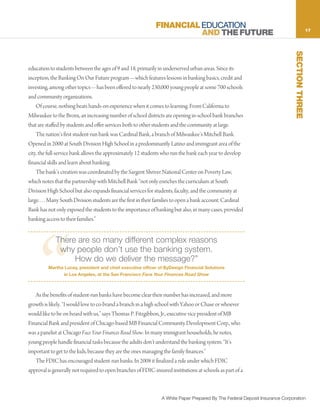
     “
             There are so many different complex reasons
              why people don’t use the banking system.
                  How do we deliver the message?”
         Martha Lucey, president and chief executive officer of ByDesign Financial Solutions
                 in Los Angeles, at the San Francisco Face Your Finances Road Show


   As the benefits of student-run banks have become clear their number has increased, and more
growth is likely. “I would love to co-brand a branch in a high school with Yahoo or Chase or whoever
would like to be on board with us,” says Thomas P. Fitzgibbon, Jr., executive vice president of MB
Financial Bank and president of Chicago-based MB Financial Community Development Corp., who
was a panelist at Chicago Face Your Finances Road Show. In many immigrant households, he notes,
young people handle financial tasks because the adults don’t understand the banking system. “It’s
important to get to the kids, because they are the ones managing the family finances.”
   The FDIC has encouraged student-run banks. In 2008 it finalized a rule under which FDIC
approval is generally not required to open branches of FDIC-insured institutions at schools as part of a


                                                                 A White Paper Prepared By The Federal Deposit Insurance Corporation
18
                     FINANCIAL EDUCATION
                               AND THE FUTURE
                                        The Banking Industry’s Role in Helping Consumers Manage Money and Build Assets
     SECTION THREE


                                        financial education program. It also is developing school-based initiatives under the Alliance for
                                        Economic Inclusion to help financial institutions and other groups set up student-run banks.
                                            State governments have joined the financial education movement. Michigan’s comprehensive
                                        Merit Curriculum, signed into law in 2006, requires students to complete a semester-long economics
                                        course, part of it focused on personal finance, in order to graduate. In Texas, the legislature has passed
                                        laws requiring schools to incorporate financial literacy into economics courses and establishing
                                        financial literacy pilot programs in as many as 25 school districts. And in Virginia, middle and high
                                        school students are now given instruction in economics and personal finances. There are many other
                                        examples of states rising to the challenge of financial literacy for the young.


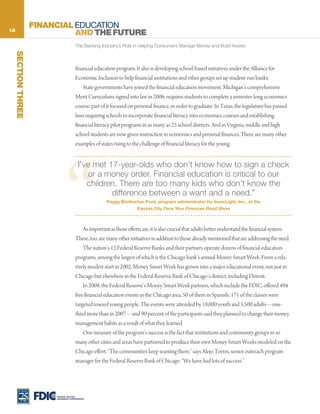
                                “
                                          I’ve met 17-year-olds who don’t know how to sign a check
                                             or a money order. Financial education is critical to our
                                             children. There are too many kids who don’t know the
                                                    difference between a want and a need.”
                                                       Peggy Brotherton-Ford, program administrator for InnerLight, Inc., at the
                                                                       Kansas City Face Your Finances Road Show


                                            As important as those efforts are, it is also crucial that adults better understand the financial system.
                                        There, too, are many other initiatives in addition to those already mentioned that are addressing the need.
                                            The nation’s 12 Federal Reserve Banks and their partners operate dozens of financial education
                                        programs, among the largest of which is the Chicago bank’s annual Money Smart Week. From a rela-
                                        tively modest start in 2002, Money Smart Week has grown into a major educational event, not just in
                                        Chicago but elsewhere in the Federal Reserve Bank of Chicago’s district, including Detroit.
                                            In 2008, the Federal Reserve’s Money Smart Week partners, which include the FDIC, offered 494
                                        free financial education events in the Chicago area, 50 of them in Spanish; 171 of the classes were
                                        targeted toward young people. The events were attended by 18,000 youth and 5,500 adults—one-
                                        third more than in 2007—and 90 percent of the participants said they planned to change their money
                                        management habits as a result of what they learned.
                                            One measure of the program’s success is the fact that institutions and community groups in so
                                        many other cities and areas have partnered to produce their own Money Smart Weeks modeled on the
                                        Chicago effort. “The communities keep wanting them,” says Alejo Torres, senior outreach program
                                        manager for the Federal Reserve Bank of Chicago. “We have had lots of success.”


                          FEDERAL DEPOSIT
                          INSURANCE CORPORATION
FINANCIAL EDUCATION                                                              19
                                                                         AND THE FUTURE


                                                                                                                                SECTION THREE
    There are many other examples of successful financial education efforts, some of which offer incen-
tives. The Bank On San Francisco Program has offered a trainer, materials and $300 to any community
group that will agree to sponsor a class. New York’s Amalgamated Bank will deposit $50 into a new
account if the customer agrees to take one of its Money Sense workshops, where they learn budgeting,
bank account basics, credit and investing fundamentals.
    To be successful, such workshops must be practical and not academic, says Amalgamated Bank
President and CEO Derrick Cephas, adding, “We have no problem filling up a room.” The workshops
also are open to the general public.
    Outreach programs are spreading nationwide. In June 2008, the FDIC and the United Way agreed
to partner to provide more access to banking services and to expand financial education among low-
income and unbanked families. United Way has 1,300 local organizations across the country.
    But financial education need not be formal. Banks need to look for opportunities to help educate
the public on an everyday basis, notes Elizabeth Colvin of the IRS’s Taxpayer Advocacy Panel. Tellers,
for instance, can ask customers if they would like to have their credit reports checked, a method to get
them thinking about the proper use of credit.
    Nor do all educational efforts require studying. The National Endowment for Financial Education
(NEFE) recently launched a website, Spendster.org, that allows consumers to calculate the true cost of


 Good Lessons in Banking
Good Lessons in Banking
           Opening a bank branch in a school can              bank operations and provide them with hands-
Opening a bank branch in a school can benefit
       benefit everyone—just ask Capital One Bank.    on instruction in financial topics.topics.also also
                                                              on instruction in financial They They
everyone—just ask CapitalNorthBank.Bank subsidiary instructhow tohow to other students
       In October 2007 its    One Fork In             instruct them them teach teach other students
October 2007 its North Fork Bank subsidiary New
       (since renamed Capital One) created the        about moneymoney matters—an importantthe the
                                                              about matters—an important step, step,
(since renamed Capital One) created the New
       York area’s first student-run branch at the bank says, because young young people are more
                                                              bank says, because people are more
York area’s first student-run branch at the Business inclined to listen to peoplepeople their age.
       Fordham Leadership Academy for                         inclined to listen to their age.
Fordham Leadership Academy for Business
       and Technology in the Bronx.                       In its firstits first year of operation, the Capital One
                                                                   In year of operation, the Capital One
and Technology in operate the branch, which is
           Seniors   the Bronx.                       branch at Fordham Academy has opened more more
                                                              branch at Fordham Academy has opened
    Seniors operate the branch, which is
       managed by Capitol One Bank Vice President     than 100 accounts. Perhaps more important, it
                                                              than 100 accounts. Perhaps more important, it
managed by Capitol One Bankmanager in the Bronx. provided a way a way student staffers to
       David Isaacs, a branch Vice President          has has provided for its for its student staffers to
David Isaacs, a branchoperation in the Bronx.
       Assisting in the manager is LaKia Williams, a  develop new skills and build self-esteem: More More
                                                              develop new skills and build self-esteem:
Assisting in the operation is LaKia Williams, for the than 60 percent of the 2007 staff attended
       community development associate        a               than 60 percent of the 2007 staff attended
community development associate for the bank. college, and this year allyearstudent bankers
       bank.                                                  college, and this 10 all 10 student bankers
    Isaacs Isaacs and Williams train the student staff in enrolled in college.
            and Williams train the student staff in   have have enrolled in college.
bank operations and provide them with hands-


                                                                  A White Paper Prepared By The Federal Deposit Insurance Corporation
20
                     FINANCIAL EDUCATION
                               AND THE FUTURE
                                        The Banking Industry’s Role in Helping Consumers Manage Money and Build Assets
     SECTION THREE


                                        unnecessary purchases financed with credit cards and illustrate how the money could grow if it were
                                        invested over 40 years for retirement. NEFE’s goal is to demonstrate the long-term consequences of
                                        buying unnecessary items and to help educate consumers about their true financial needs.
                                            Employers can play a big role in financial literacy. The need for smart decisions has become ever
                                        more apparent with the rapid shift away from employer-directed defined benefit plans and toward
                                        retirement plans directed by the employees themselves. Employers are often in the best position to
                                        make sure their employees have the skills needed to make these decisions. One company that has
                                        made a substantial commitment to financial education is United Parcel Service, which offers its
                                        employees an eight-hour “UPS Total Compensation and Financial Education” workshop along with
                                        educational materials and an online service that provides budgeting software and other tools.
                                            All of these efforts beg the question: Does financial education make a difference?
                                            Research indicates that it does. One study of employees between the ages of 30 and 48 found that
                                        those whose who were provided with financial education by their employers accumulated significantly
                                        more money for retirement than those who did not receive such education. Another, which studied the
                                        impact of NEFE’s High School Financial Planning Program during the 2003-2004 school year, found
                                        that three months after completing the program, 59 percent of the students had changed their spending
                                        patterns and 60 percent changed their savings habits. Of the latter, 80 percent said they were saving for
                                        items they really needed or wanted and 20 percent said they were saving every time they received money.


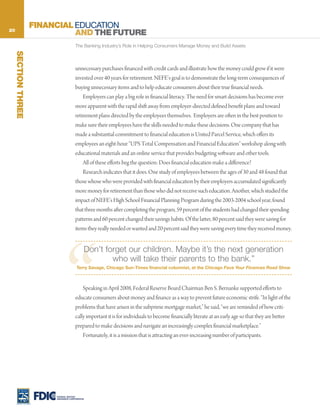
                                “
                                              Don’t forget our children. Maybe it’s the next generation
                                                      who will take their parents to the bank.”
                                         Terry Savage, Chicago Sun-Times financial columnist, at the Chicago Face Your Finances Road Show


                                            Speaking in April 2008, Federal Reserve Board Chairman Ben S. Bernanke supported efforts to
                                        educate consumers about money and finance as a way to prevent future economic strife. “In light of the
                                        problems that have arisen in the subprime mortgage market,” he said, “we are reminded of how criti-
                                        cally important it is for individuals to become financially literate at an early age so that they are better
                                        prepared to make decisions and navigate an increasingly complex financial marketplace.”
                                            Fortunately, it is a mission that is attracting an ever-increasing number of participants.


                          FEDERAL DEPOSIT
                          INSURANCE CORPORATION
FINANCIAL EDUCATION                                                            21
                                                                        AND THE FUTURE


                                                                                                                              SECTION FOUR
Building for the Future
Financial literacy is essential to making smart money decisions, but
consumers must have access to the right tools if they are to put those
decisions to use. In particular, consumers need convenient and effective
ways to save and build assets.
    The industry has already developed many such tools. According to an article published by FDIC, six
strategies successfully used by banks to help low- and moderate-income consumers build assets include:
         • Offering reasonably priced products and services
         • Offering direct deposit
         • Providing non-account services such as financial education courses
         • Partnering with organizations on such programs as Individual Development Accounts
           and financial education
         • Helping consumers get larger tax refunds through volunteer work at tax assistance sites
         • Linking credit and other products to savings through, for example, credit cards with an
           automatic savings component
    The challenge faced by banks—as well as by government agencies and community organizations
partnering with financial institutions—is to expand efforts in each of those areas through innovative and
creative new programs.
    Consider the issue of automated savings plans, which help consumers put money aside by essentially
taking the decision to save out of their hands.
    Bank of America led the way on automated savings when it introduced the Keep the Change
program in 2005. It works this way: When a customer makes a purchase using the bank’s Visa debit
card, the amount is rounded up and the difference deposited in a savings account. For example, if a
sandwich is purchased for $3.75, the account is debited $4 and the extra 25 cents is saved.
    Bank of America offers a sweetener to the deal. For the account’s first three months, the bank
matches deposits dollar for dollar, and afterward matches 5 percent of the contributions. By mid-2008,
customer round-ups and bank matches totaled $1 billion, a clear success for both the bank and for
customers who jump-started their savings by using the program.
    Notes the Woodstock Institute’s Dory M. Rand, “Bank of America’s Keep the Change program lets
inertia work for people, not against them. Research in behavioral economics show people don’t make


                                                                A White Paper Prepared By The Federal Deposit Insurance Corporation
22
                    FINANCIAL EDUCATION
                              AND THE FUTURE
                                       The Banking Industry’s Role in Helping Consumers Manage Money and Build Assets
     SECTION FOUR


                                       good decisions, and the financial industry needs to work more on their behalf.”
                                           A similar plan was introduced by Wachovia in early 2008. Its Way2Save program transfers $1 from
                                       a checking account into a savings account whenever a customer makes a debit card purchase or elec-
                                       tronic payment. The savings account earns a 5 percent annual percentage yield (APY) and a 5 percent
                                       annual bonus in the first year; in the second and third years, the APY and the annual bonus are both 2
                                       percent. By September, the program had attracted more than 300,000 new customers, and 400,000
                                       new checking accounts had been created.
                                           “If you make saving automatic, all people can save,” FDIC Chairman Bair noted at the San
                                       Francisco Face Your Finances Road Show.
                                           Direct deposit is another service that helps both consumers and banks. Some 145 million people
                                       already use it to receive payments, providing security and convenience when it comes to depositing
                                       money. But there is potential for far more people to participate. In New York City, for example, 70,000 of
                                       the city’s 300,000 employees don’t use direct deposit, says Jonathan Mintz, commissioner of New York
                                       City’s Department of Consumer Affairs and a panelist at the Face Your Finances Road Show in New York.


                                 “
                                         I would venture to say that there are millions of people who
                                                  have a closer relationship with their Tivo
                                                       than they do with their banks.”
                                                     José Cisneros, Treasurer of the City of San Francisco, at the San Francisco
                                                                            Face Your Finances Road Show


                                           Banks, community organizations and government agencies all support the expanded use of direct
                                       deposit. The Department of the Treasury’s Go Direct program, for example, encourages recipients of
                                       Social Security and other federal benefit checks to have them deposited directly in their bank accounts,
                                       eliminating the need to go to a bank and reducing the chances of loss and theft.
                                           However, direct deposit requires a bank account, and about 2.1 million Social Security recipients
                                       don’t have one; nor do about 1.8 million recipients of Supplemental Security Income (SSI). To meet
                                       their needs, the Treasury this year created a program called Direct Express in which recipients receive
                                       their payments on debit cards that can be used anywhere that accepts MasterCard; consumers can use
                                       the cards without a fee at a nationwide network of ATM machines. The program, managed by
                                       Comerica Bank, reduces the need to use the expensive services offered by check cashers.
                                           These efforts come at a time of tremendous growth in electronic payments. According to the
                                       Federal Reserve Board, more than two-thirds of all non-cash payments in the United States in 2006


                         FEDERAL DEPOSIT
                         INSURANCE CORPORATION
FINANCIAL EDUCATION                                                             23
                                                                        AND THE FUTURE


                                                                                                                               SECTION FOUR
were made electronically, amounting to 19 billion more transactions than in 2003. In the same period,
the number of debit card payments increased by 10 billion, surpassing credit cards as the most frequent
electronic payment.
    A fast-growing segment of the debit card market—and another area that can attract the unbanked—
is prepaid cards, which are sold through banks and at non-bank locations such as retailers. For the
unbanked, using and managing such cards can “help card holders begin a journey toward the use of addi-
tional financial services that can help to transition them into the economic mainstream and onto a path
toward greater financial prosperity,” according to a 2008 study by the Center for Financial Services Inno-
vation (CFSI), which noted that community organizations have recently begin offering the cards as an
entry-level financial product for people who either don’t want or cannot get a checking account.
    The cards, the CFSI study said, offer security, convenience and transparency and “may also be a
step toward the use of additional financial services that can help to transition individuals into the
economic mainstream and onto a path toward greater financial prosperity.” That is, they provide
consumers with much more cost-effective access to their money than do check cashers.
    As these developments indicate, technology plays an important role in many of the banking
industry’s innovations. The rise of mobile banking offers an example of one product with great promise
for serving new customers.


   Making Education More Effective
      Ammar Askari was director of the Center for         of supplemental products called the Foundation
  Economic Education before joining M&I Marshall          Suite that are geared to the unbanked.
  & Ilsley Bank in Milwaukee, so it is no surprise        Foundation Checking is offered to those who
  that he eventually became the bank’s first              are unable to open a bank account. Applicants
  community education administrator—a role in             are required to attend a checking education
  which he has made great efforts to bring financial      program and pay restitution on old mismanaged
  education to the community.                             accounts; Thrift Savings is a basic low-fee
       Askari designed a financial education              account with a $25 minimum balance; and
  program that is offered free to community and           Credit Builder is a loan intended to help
  government organizations. He has trained bank           customers improve their credit while at the
  employees, community, and government staff to           same time building savings.
  run workshops, and he often runs them himself.              While it is too early to judge the long-term
  In three years, 400 seminars have reached more          impact, it appears the community education
  than 7,300 participants.                                program has already made a difference. Testing in
      To help bring banking services to more              2007 indicated a 48 percent increase in financial
  people, M&I Marshall & Ilsley designed a group          knowledge among those who had participated.


                                                                 A White Paper Prepared By The Federal Deposit Insurance Corporation
24
                    FINANCIAL EDUCATION
                              AND THE FUTURE
                                       The Banking Industry’s Role in Helping Consumers Manage Money and Build Assets
     SECTION FOUR


                                           Mobile banking allows customers to use cell phones to check balances, transfer funds and pay bills.
                                       It has been used in Europe and Asia for a number of years, but it wasn’t until 2007 that major U.S.
                                       banks began offering it in some form. Bank of America and Citi are the largest, and many others are
                                       sure to follow.
                                           Such technology is a big factor in attracting younger customers, an important step in bringing them
                                       into mainstream banking. “We must provide ways for people to use the bank without coming to us,”
                                       says MB Financial Bank’s Thomas P. Fitzgibbon, Jr.
                                           Another technological advance is remote deposit, which allows customers to deposit checks
                                       without traveling to a bank. Celent, a financial-services consulting firm, estimates that 40 percent of all
                                       U.S. financial institutions will have adopted remote deposit by the end of 2008.
                                            Even older technology like ATMs can play a role in expanding the market for mainstream banking
                                       services. Celent predicts that by 2010, mainstream financial institutions could capture 22 percent of the
                                       unbanked market with automated teller machines that provide access to basic, low-cost accounts and
                                       that allow customers to execute money transfers and buy money orders and prepaid cards.
                                           Despite new services and technology, however, non-bank providers like payday lenders continue to
                                       play a big role in the financial lives of many low- and moderate-income consumers. Efforts are
                                       underway to change that. The FDIC has launched a two-year pilot program in which 31 participating
                                       banks with branches in 27 states are offering affordable small-dollar loans to compete with non-bank
                                       providers; the results of the pilot effort will be used to help other banks develop their own programs.


                                 “
                                                 How can you find ways to teach children to save more?
                                                   The traditional methods don’t work anymore. But
                                                    the payday lenders are getting to them—they’re
                                                               getting the message out.”
                                                    Peggy Brotherton-Ford, program administrator, InnerLight, Inc., at the Kansas City
                                                                             Face Your Finances Road Show


                                          Banks participating in the pilot offer unsecured loans up to $2,500, with amortization periods
                                       longer than a single pay cycle and annual percentage rates (APR) below 36 percent—a far cry from the
                                       average 470 percent APR charged by payday lenders. Furthermore, the bank loans carry no prepay-
                                       ment penalties, have origination and maintenance fees generally limited to the amount of actual costs,
                                       and often include an automatic savings component.


                         FEDERAL DEPOSIT
                         INSURANCE CORPORATION
FINANCIAL EDUCATION                                                             25
                                                                         AND THE FUTURE


                                                                                                                                SECTION FOUR
    The loans would help consumers meet financial emergencies and other short-term needs and
create a point of entry into mainstream banking. At the same time, financial institutions could use the
small-dollar loan program to expand their markets, create community goodwill and gain favorable
FDIC consideration under the Community Reinvestment Act—what the FDIC calls “a win/win for
institutions and consumers.”
    Another bank strategy in which everyone wins is tax preparation. Under the Internal Revenue Service’s
Volunteer Income Tax Assistance Program (VITA), participating banks can offer free tax-preparation for
low- and moderate-income consumers, and link tax-time to financial education or opening a new bank
account. IRS rules also allow the refund to be direct-deposited into up to three accounts per taxpayer,
thereby enabling taxpayers to easily save a portion of the tax refund in a savings account.
    The United Way of Greater Los Angeles is taking tax refunds a step further. Its Ramp-Up Acceler-
ated Savings Account Program allows low-income participants to save their refunds in subsidized, tax-
free savings accounts that carry higher than usual rates. United Way plans to offer 50 Ramp-Up
accounts in 2008 through its free tax assistance services.
    Still another strategy is the use of game-based incentives to encourage saving. So-called ‘prize-linked
savings’ programs, such as sweepstakes and rewards, can promote saving, particularly among lower-
income consumers. For example, some financial institutions have offered the opportunity to enter a
prize drawing to customers who deposit money into a savings account. Depending on how the
program is structured, the customer may receive additional sweepstakes entries for every deposit or
based on how much money is deposited. Other institutions have rewarded regular deposits into a
savings account over an extended time period with a sizable bonus deposit.
    Creative approaches are necessary if the banking industry is to help more people build financially
secure lives. But underlying those approaches is the need for more financial understanding; even the
best new bank products will miss the mark if consumers fail to see how they benefit from them.
Financial education is an essential part of providing that vision.


                                                                  A White Paper Prepared By The Federal Deposit Insurance Corporation
26
                    FINANCIAL EDUCATION
                              AND THE FUTURE
                                       The Banking Industry’s Role in Helping Consumers Manage Money and Build Assets
     SECTION FIVE


                                       Toward Greater Public Confidence
                                       As the recent economic crisis illustrates, public confidence plays a
                                       critical role in the financial health of the nation. Consumers need to
                                       have faith in the safety and security of markets and institutions; without
                                       it, fear can overtake rational thinking and eventually threaten savings,
                                       homes and futures.
                                           As is true in so many parts of life, confidence comes from knowledge. When people opt for risky
                                       and too-large mortgages, they run the risk of defaulting on their loans and losing their homes. When
                                       they pay high fees to a check casher, they hand over money that could help them weather a financial
                                       downturn. When they fail to pay attention to whether their bank deposits are fully insured, they create
                                       the possibility of a financial shock from which they might not recover.
                                           Unfortunately, too many consumers lack confidence in banks. Some distrust banks because they
                                       don’t understand how they work or because they are too confusing. Others have had bad experiences
                                       with overdraft charges and believe the deck is stacked against them. “We’re looking at a situation where
                                       people and banks are on opposite sides, looking at each other as adversaries,” says Michael Burnside,
                                       CRA Officer for Allstate Bank and a panelist at the Chicago Face Your Finances Road Show. “To
                                       overcome that, you have to come back to education.”
                                           More and more, consumers are subject to high overdraft charges and bounced-check fees. At one
                                       time, it was more common for banks to use their discretion in deciding whether to honor checks drawn
                                       on an account with insufficient funds. Things have changed with the rise of electronic banking. Today,
                                       many banks have automated, fee-based overdraft programs and may choose to automatically enroll
                                       customers in those programs without their prior written consent.
                                           For financial institutions, such charges are a two-edged sword. They are a source of profits, but they
                                       also create customer ill will and reduce public confidence in the banks’ mission. “Overdrafts are a profit
                                       incentive in the banking industry, so we need to think about how profit is made,” notes Ann Baddour, a
                                       senior policy analyst at the public interest law organization Texas Appleseed and a member of the
                                       Dallas panel. “There are too many profit incentives that are linked to failure.”
                                           Responding to concerns about such charges, the Federal Reserve Board is considering new regula-
                                       tions that would place restrictions on financial institutions’ overdraft activities regarding automated
                                       teller machine withdrawals and one-time debit card transactions. The proposal requests comment on


                         FEDERAL DEPOSIT
                         INSURANCE CORPORATION
FINANCIAL EDUCATION                                                             27
                                                                       AND THE FUTURE


                                                                                                                              SECTION FIVE
two approaches, which would either require consumers to be given an ability to opt in or opt out of
overdraft fees or charges being imposed on consumers’ accounts.
    Financial education classes for new banking customers are invaluable in helping them avoid such
charges by paying more careful attention to balances and fully understanding the terms of their
accounts. Even so, surprise charges—ATM fees, annual fees, minimum balance fees and even “account
maintenance” fees—can be perplexing even to veteran account holders and can undermine consumer
confidence in the banking industry. “A fast food restaurant gives you prices right away,” Jennifer
Tescher, director of the Center for Financial Services Innovation, told the Face Your Finances Road Show
in Chicago. “But if you walk into a traditional deposit branch, all you get are CD rates. Even when you
think you have it straight, you can incur charges you didn’t expect.”
    While complex and unexpected fees can undermine confidence, nothing is of greater importance
than the safety of bank deposits. Here, too, more needs to be done to communicate the message of
safety and security.


“
 It is time to renew our message of confidence and stability.
 We need to get more information out about what happens
 when a bank closes. A key part is to let people know there
    is very little chance of a closing, but if it does happen, it
 should be a non-event. Lines are unnecessary, and there is
  no need to come to the bank. Customers have immediate
                     access to insured deposits.”
                                     FDIC Chairman Sheila C. Bair


    When the Office of Thrift Supervision closed IndyMac Bank, FSB of Pasadena, California, in July
2008, frightened depositors lined up outside IndyMac branches—a clear sign that many Americans do
not understand how FDIC deposit insurance works.
    Indeed, most depositors take federal deposit insurance for granted. Many don’t know or fully
understand how the insurance works or know the limits of its coverage. The latter may be especially
true now, since the Emergency Economic Stabilization Act of 2008 temporarily raised coverage from
$100,000 to $250,000 for each depositor for funds in deposit accounts. That coverage will revert to
$100,000 for regular accounts on January 1, 2014, but will remain at $250,000 for bank individual
retirement accounts.


                                                                A White Paper Prepared By The Federal Deposit Insurance Corporation
28
                    FINANCIAL EDUCATION
                              AND THE FUTURE
                                       The Banking Industry’s Role in Helping Consumers Manage Money and Build Assets
     SECTION FIVE


                                           It is important in these difficult times not just to remind people how the deposit insurance system
                                       works, but to show how effectively it works. “It would be a great thing to show that no one lost a penny,”
                                       says Jennifer Tescher of the Center for Financial Services Innovation. Adds Thomas P. Fitzgibbon, Jr.
                                       of Chicago’s MB Financial Bank, “Bankers need to do a better job of informing people about how to
                                       get the best coverage. Banks have adequate training, but it probably needs to be reinforced.”
                                           Both points are seconded by FDIC Chairman Bair. “This is a critical time for the American
                                       economy. People are worried about keeping their homes. Every consumer needs to know about
                                       deposit insurance and how to handle their money.”
                                           According to banks and nonprofits, regulators can help them better reach those who need their
                                       services by providing clearer direction. Some point to confusion over the issue of opening bank
                                       accounts offsite, part of the effort by community partners to extend services to low-income people.
                                           In fact, notes the Center for Financial Services Innovation’s Jennifer Tescher, some banks have been
                                       slow to make such efforts because they believe regulators will oppose them. “An institutional culture has
                                       grown as a result of being part of a highly regulated field,” she notes. “It becomes, ‘What’s my regulator
                                       going to think?’ not ‘What will my customer think?’ Banks often will complain about regulators, but what
                                       they are really upset about is the culture that is created by being a regulated industry.”
                                           Beyond that, she says, “Partners in public programs need to know they won’t get dinged for
                                       participating.”
                                           Addressing such concerns is crucial if the banking industry is to do all it can to expand its services and
                                       increase consumers’ confidence in the system. “The question,” says FDIC Chairman Bair, “is how far we
                                       go to protect people and how much they should protect themselves. It’s a constant struggle for regulators.”
                                           Many hard questions need to be answered as the nation moves into an era of even greater financial
                                       complexity. What is the best way to educate consumers—young and old, poor and affluent—about the
                                       use of their money? How can banking institutions and their community partners expand the benefits of
                                       mainstream banking to those who most need it? And how can regulators and other government
                                       agencies encourage novel approaches while at the same time protecting the public?
                                           How those questions are answered will determine whether consumers behave as passive participants
                                       or take full control of their future. Knowledge, after all, is financial power.


                         FEDERAL DEPOSIT
                         INSURANCE CORPORATION
FINANCIAL EDUCATION                       29
          AND THE FUTURE


                           SECTION FIVE
FEDERAL DEPOSIT
                  INSURANCE CORPORATION


communityaffairs@fdic.gov
(202) 898-6724

FDIC-038-2009

FDIC: Financial Education and the Future

  • 1.
    FINANCIALEDUCATION AND THE FUTURE The Banking Industry’s Role in Helping Consumers Manage Money and Build Assets FEDERAL DEPOSIT INSURANCE CORPORATION A White Paper Prepared By The Federal Deposit Insurance Corporation
  • 2.
    The troubles grippingthe U.S. economy have driven home the fact that the financial world has grown incredibly complicated. Most Americans would be hard-pressed to explain the reasons for the economy’s sharp decline or to define such contributing factors as credit default swaps and collateralized debt obligations.
  • 3.
    FINANCIAL EDUCATION AND THE FUTURE Contents Executive Summary 2 Obstacles and Opportunities 4 Banking for the Unbanked 9 Learning to Earn 15 Building for the Future 21 Toward Greater Public Confidence 26 FEDERAL DEPOSIT A White Paper Prepared By The Federal Deposit Insurance Corporation INSURANCE CORPORATION
  • 4.
    2 FINANCIAL EDUCATION AND THE FUTURE The Banking Industry’s Role in Helping Consumers Manage Money and Build Assets Executive Summary In June 2008, the Federal Deposit Insurance Corporation launched the Face Your Finances Road Show, a nine-month series of panel discussions in five cities that called attention to the need for improved financial knowledge among Americans and spotlighted ways in which banks, community organizations and regulators can help. “Every consumer needs to know about deposit insurance and how to handle money. They need to know how to access banking services and how to buy a home,” FDIC Chairman Sheila C. Bair told the first gathering in Chicago. But too few Americans have that knowledge. Many don’t know how to save money, how to manage it, and how to use it to build a strong financial future. Indeed, the recession has exposed the vulnerability of those with too much debt and too few assets to fall back on. The need for consumer education has grown with the spread of complex financial products, yet until recent years not enough has been done to help consumers, especially young people, make informed decisions about their money. That is changing, as the Road Show participants pointed out. A significant obstacle to improving financial skills is the large number of “unbanked” consumers— the estimated 10-20 million people who have no relationship with a bank. Those without checking or savings accounts often are forced to do business with check-cashing firms or payday lenders, whose loans may carry an average annual percentage rate of 470 percent. Moreover, such consumers cannot harness the power of regular saving to build assets for the future. Many of these consumers find bank products and fees confusing and branch locations and hours inconvenient. The banking industry, working with community organizations and regulators, is targeting those problems by opening branches in underserved areas and offering a mix of services and products geared toward the unbanked. These include remittances, fee-based check cashing, and “second chance” checking accounts for those who have had accounts but lost them through misunder- standing or misuse. Financial institutions and community groups also are working to attract unbanked consumers through Individual Development Accounts, or IDAs, which use public funds to match savings put FEDERAL DEPOSIT INSURANCE CORPORATION
  • 5.
    FINANCIAL EDUCATION 3 AND THE FUTURE aside by low- and moderate-income households for goals such as buying a house, building a business or paying for college. Many new programs are teaching young people how to save and manage money. Though the number is still small, more states are requiring financial education in schools. In addition, a growing number of school districts are opening in-school bank branches staffed by students, both as a teaching tool and as a service to the community at large. “ When people don’t have savings, they become vulnerable. Whenever there is even a small crisis, everything comes tumbling down. We need to emphasize the need to save and the need for delayed gratification. It’s important to save for tomorrow.” —ANN BADDOUR, senior policy analyst at Texas Appleseed, a public interest law organization, at the FDIC’s Face Your Finances Road Show in Dallas Regulators such as the Federal Deposit Insurance Corporation have encouraged educational efforts. The FDIC’s Money Smart program helps low- to moderate-income people learn more about managing money through a 10-lesson curriculum dealing with basic borrowing and the proper use of credit. At the same time, the nation’s 12 Federal Reserve Banks and their partners operate dozens of financial education programs that are drawing increasing numbers of participants. Yet there is much more to do. Banks must find ways to build community trust, and regulators must find ways to support change while continuing their vital oversight roles. Above all, consumers must feel confident that the financial system works. The nation’s economic health depends on consumers knowing how to make, save and invest money—not just for themselves and their families, but for the good of their communities. A White Paper Prepared By The Federal Deposit Insurance Corporation
  • 6.
    4 FINANCIAL EDUCATION AND THE FUTURE The Banking Industry’s Role in Helping Consumers Manage Money and Build Assets SECTION ONE Obstacles and Opportunities The troubles gripping the U.S. economy have driven home the fact that the financial world has grown incredibly complicated. Most Americans would be hard-pressed to explain the reasons for the economy’s sharp decline or to define such contributing factors as credit default swaps and collateralized debt obligations. No one would expect the average citizen to understand such financial complexity, but the recession has thrown light on a more fundamental lack of knowledge. Too few Americans understand even basic financial matters, a shortcoming that has exposed them to potential disaster. They save too little and spend too much, amass large credit card balances and buy houses they cannot afford. Not enough know how to create a household budget or choose the right bank account. Many don’t understand how deposit insurance works. Simply put, far too many Americans don’t understand how to use their own money, a lack of knowledge that deprives them of the opportunities for security and growth that it can provide. The need for such knowledge has exploded. The expansion of financial markets and the banking industry has created a wave of new and often complicated products that require consumers to make more choices. The right decisions can bring financial security; the wrong ones can cause enormous harm, as many of those who chose volatile adjustable-rate mortgages in recent years can attest. To celebrate the 75th anniversary of the Federal Deposit Insurance Corporation, FDIC Chairman Sheila C. Bair in June 2008 launched a nine-month-long series of panel discussions across the country to highlight both the need for financial education and the roles the banking industry, community groups and regulators play in providing it. The Face Your Finances Road Show provided an opportunity for banking and community leaders in Chicago, San Francisco, Dallas, New York City and Kansas City to offer thoughts on how consumers could become better stewards of their money, and how the country’s financial system could benefit as a result. Participants in each city told of novel approaches being taken by the banking industry and its partners in helping consumers build more secure futures—large-scale workshops on personal finance, in-school bank branches that help students learn first-hand about money management, and savings accounts that draw in unbanked consumers with matched deposits, to name just a few. But they also told of ways in which banks inadvertently hinder the participation of the very customers who would FEDERAL DEPOSIT INSURANCE CORPORATION
  • 7.
    FINANCIAL EDUCATION 5 AND THE FUTURE SECTION ONE benefit most from their services. This white paper reflects their insights and suggestions, as well as those from a wide range of others from the worlds of banking, nonprofits and government. There is broad agreement that financial illiteracy is a major problem in the United States, one that has serious consequences both for consumers and for the economy. Record low savings rates, rising bankruptcies and mortgage delinquencies, and high levels of credit card debt all point to a need for better money-management skills. The problem cuts across social, age and economic lines, but it is most acute among consumers with little or no previous exposure to the banking system, especially new immigrants and members of minority communities. These groups have the most to gain from using the financial tools that banks have to offer, yet a wide variety of factors—cultural differences, language barriers and institutional distrust among them—have discouraged consumers from doing so. “ Every consumer needs to know about deposit insurance and how to handle money. They need to know how to access banking services and how to buy a home.” FDIC Chairman Sheila C. Bair, speaking at the FDIC’s Face Your Finances Road Show in Chicago Banks themselves can inadvertently contribute to the problem: confusing fees, inconvenient branch locations and expensive (and unexpected) overdraft charges are among the many factors that can drive customers away. “A fast food restaurant gives you prices right away. But if you walk into a traditional deposit branch, all you get are CD rates. Even when you think you have it straight, you can incur charges you didn’t expect,” says Jennifer Tescher, director of the Chicago-based Center for Financial Services Innovation and a panelist at the Face Your Finances Road Show in that city. The lack of participation in the banking system is no small matter. Estimates of the number of Americans who have no relationship with a bank range from 10-20 million people. A similar range of people have also been estimated to be “underbanked,” meaning they have bank accounts but usually conduct their financial transactions outside of mainstream financial institutions. That amounts to a sizable number of people who may not be earning interest on their money or have no access to afford- able loans. These consumers most often turn to alternative providers such as check-cashing companies and payday lenders, whose services cost far more than those of banks. According to the Consumer Federa- tion of America, payday lenders charge an average annual percentage rate of 470 percent on their loans. Just as troubling, these alternative providers, unlike banks, are generally not able to help their customers A White Paper Prepared By The Federal Deposit Insurance Corporation
  • 8.
    6 FINANCIAL EDUCATION AND THE FUTURE The Banking Industry’s Role in Helping Consumers Manage Money and Build Assets SECTION ONE prepare for the future by encouraging asset building. Yet alternative providers are thriving. “It almost seems as if the market has become divided between two groups: those who successfully rely on banks for virtually cost-free basic financial services, and those who pay high amounts,” FDIC Chairman Sheila C. Bair said at a Consumer Federation of America conference in 2006. “Some pay 18 percent for a line of credit linked to their checking account; others pay 500 to 600 percent for a payday loan. Some pay nothing or minimal fees for an unlimited checking account, while others pay significant fees just to cash their paychecks and purchase money orders to pay bills. Part of the problem is that many people lack the financial skills needed to analyze and compare products and their prices.” Since relying on check cashers and payday lenders costs far more and reduces financial options, most of these consumers would be better off as customers of mainstream financial institutions. A banking relationship would increase their chances of one day buying homes, sending their children to college and contributing to the prosperity of their communities. Yet it has proven difficult to get them into the system and keep them there. The unbanked aren’t alone in lacking the knowledge to navigate today’s complex financial system. Young people often struggle with the basics of money; in a 2008 survey by the Jump$tart Coalition for Personal Financial Literacy, high school seniors correctly answered only 48.3 percent of the survey’s basic questions about finances, down from 52.4 percent in 2006. Adults, too, often lack an Reaching Out to Young Consumers M . ountainOne Financial Partners, the North new products—most recently the MoneyOne Adams, Massachusetts-based holding Teen Account. company of Hoosac Bank, Williamstown The new account provides account holders Savings Bank and South Coastal Bank, with a debit card with full parental access. It reviewed its customer base and saw a problem. also offers financial education in the form of a Younger people were not coming to the banks brochure that explains how debit cards work in significant numbers—bad both for the banks and how accounts should be balanced. In its and for those potential young customers who first 11 weeks, 122 MoneyOne Teen Accounts were missing out on what the banking industry were opened. could offer them. The students also offered insights on the To address this, MountainOne created a banks’ websites: “Boring,” they said, and not Junior Board of Directors consisting of two conducive to helping young people learn about students from each of the area’s five high banking and finances. They also helped develop schools. The students helped the bank better a new website, www.notyourmothersdebit- understand the financial needs of young people card.com, that links from the existing sites. in the region, but they also are helping design FEDERAL DEPOSIT INSURANCE CORPORATION
  • 9.
    FINANCIAL EDUCATION 7 AND THE FUTURE SECTION ONE understanding of how to safeguard their finances. A survey conducted for the National Foundation for Credit Counseling and MSN Money, for instance, found that only a third of the Americans surveyed know their credit score, an important factor in determining whether they can get a mortgage or other loan, and at what price. “ We are trying to urge people to make smart choices. Those choices have to be available and easy. Jonathan Mintz, commissioner of the New York City Department of Consumer Affairs, at the New York Face Your Finances Road Show The surest way to address such deficiencies is through education. Consumers who have learned the basics of money management know the value of saving and household budgeting, have a better under- standing of the proper use of credit, and have a clearer picture of the role that banks can play in helping them build assets. Just as important, they are savvier than those without money management skills; they know that a deal that appears to be too good to be real probably is not real. Consumers are not the only beneficiaries of financial education. Prosperous residents pay more taxes to their communities, support more charities and contribute to the health of the housing market. Indeed, the future of the nation’s economic democracy depends in no small part on its citizens having the ability to understand how to make, invest and spend money. Fortunately, the issue has in recent years begun to receive the attention that it desperately needs. Banks, community groups and regulatory agencies have launched a wave of innovative programs to help consumers better manage their finances, and many have been notable successes. In Garland, Texas, United Central Bank has held more than 300 classes at schools, churches, job centers and other locations to teach local residents the basics of money management. In Houston, a non-profit group called Covenant Community Capital holds six-week financial education programs for low-income families that end with a bank officer helping participants open what in many cases is their first bank account. In Chicago, the Cara Program helps homeless and at-risk residents by teaching them the basics of budgeting, banking and saving. There are many other examples of institutions and non-profits thinking creatively to make the economic system more inclusive. Regulators, too, have addressed the issue. The Federal Deposit Insurance Corporation has been an enthusiastic supporter of financial education efforts. In 2001, it started the Money Smart program, which helps low- to moderate-income adults learn more about managing money with a curriculum that consists of 10 lessons offered in seven languages on such topics as basic borrowing and the proper A White Paper Prepared By The Federal Deposit Insurance Corporation
  • 10.
    8 FINANCIAL EDUCATION AND THE FUTURE The Banking Industry’s Role in Helping Consumers Manage Money and Build Assets SECTION ONE use of credit. In 2008, a new version of the program, Money Smart for Young Adults, was released designed for students from ages 12 to 20. To encourage the use of the curriculum, the FDIC’s Money Smart Alliance has formed nearly 1,500 partnerships with financial institutions, trade associations, non-profits and state and local agencies. So far, the Money Smart curriculum has reached more than two million consumers. The results have been heartening. A survey by The Gallup Organization of 631 Money Smart participants found that 69 percent were able to increase their savings after participating in the program, while 53 percent reduced their debt. In addition, 43 percent of those who did not have a checking account when they took the course opened one by the time they were contacted six to 12 months after the training. Many other federal agencies, including the Department of the Treasury, the Office of the Comp- troller of the Currency, the Office of Thrift Supervision, and the Federal Reserve Board have added their efforts to the push for financial competence. All together, 20 federal agencies are members of the Financial Literacy and Education Commission. More state governments are recognizing the need for personal finance courses in schools, and cities like New York and San Francisco are taking a proactive approach to helping residents get, and understand, better banking services. Establishing a banking relationship is an important step in learning more about money, but the challenges to doing so can be daunting. Potential bank customers are too often intimidated by the sheer variety of accounts they can choose from, not to mention their fees. Others believe they have too little money to open a bank account, committing themselves to a future in which high fees charged by alternative service providers keep them from amassing the savings they need. There are other barriers, too. These may include inconvenient branch locations and hours, frustrating delays in crediting deposits, and overly stringent requirements for opening accounts. Whatever the reasons, it is clear that too many people who need help see the banking industry as either irrelevant or unhelpful. Elizabeth Colvin, a member of the Internal Revenue Service’s volunteer Taxpayer Advocacy Panel and a panelist at the Dallas Face Your Finances gathering, notes that “people aren’t sure banks are really on their side. It seems more like banks are waiting for them to fail.” Overcoming that belief is a key challenge not just for the banking industry but for community groups and regulators alike. But it is just one of the challenges involved in helping consumers sharpen their financial awareness, an essential ingredient to helping all Americans make economic progress. FEDERAL DEPOSIT INSURANCE CORPORATION
  • 11.
    FINANCIAL EDUCATION 9 AND THE FUTURE SECTION TWO Banking for the Unbanked The reluctance of a substantial part of the American public to do business with banks might at first seem irrational. After all, banks offer a multitude of ways to help their customers’ money grow, from interest- bearing checking to savings accounts to certificates of deposits, all with the safety of FDIC insurance. They are a convenient source of mortgages and personal loans, and they offer a variety of other useful services, often including such options as overseas remittances, money orders and coin counting. Yet millions of American households have no relationship with a bank, a disconnect that in the words of Brookings Institution researcher Matt Fellowes denies them “an on-ramp to economic mobility and wealth. . . . Without access to that on-ramp, people are basically living in a cash economy where there’s no opportunity to convert that into wealth.” Who are the unbanked? For the most part, they are younger than the overall population, make less money and are less educated. They have not learned financial basics at home as children. Race and ethnicity are factors, as well. According to the Federal Reserve Board, nonwhite families are four times more likely to do without mainstream banking than white families. Immigrants also constitute a large proportion of the unbanked; a 2002 survey by the Pew Hispanic Center and the Kaiser Family Foun- dation found that 35 percent of the country’s Latino population chose not to do business with banks. In place of traditional financial institutions, many of the unbanked—along with the underbanked, those with only minimal ties to the banking industry—rely on alternative service providers such as check cashers and payday lenders, which typically charge far higher fees. A 2008 study by Brookings In- stitution researcher Fellowes found that check cashers charge an average of $40 to cash a payroll check; he calculated that a full-time worker could save $40,000 over his or her career by switching from check cashers to a lower-cost checking account. Doing business with these alternative providers can sometimes be very costly for consumers. In Illinois, a 2005 law capped annual interest rates at 403 percent for payday loans of up to 120 days. But these lenders, seeing a loophole, began emphasizing loans of 121 days or longer—loans that under the new law are uncapped and which carry annual rates as high as 1,000 percent. Despite the high cost of check cashers and payday lenders, the decision to switch to mainstream A White Paper Prepared By The Federal Deposit Insurance Corporation
  • 12.
    10 FINANCIAL EDUCATION AND THE FUTURE The Banking Industry’s Role in Helping Consumers Manage Money and Build Assets SECTION TWO banking is not as simple as it might seem. Most of the unbanked are making a rational choice, one that often is based on convenience of hours and location—two things the alternative services use to great advantage. “When people don’t have a convenient bank, they find themselves more likely to use high-priced providers like check cashers and pawn shops,” says Richard Neiman, superintendent of the New York State Banking Department and a panelist at the FDIC’s Face Your Finances Road Show in New York. There are other reasons as well. Some of the unbanked believe they wouldn’t use banking services often enough to justify the cost or trouble of opening a bank account. Many have no previous experi- ence with banks and find the idea of learning how they work to be daunting, especially if they don’t speak English well. Some distrust the idea of giving their money to an institution. There also is a sizable portion of the unbanked who have had bank accounts and experienced problems with them, often in the form of large overdraft fees. “For someone on public assistance, when they bounce a check it’s an entire week’s income,” notes the Rev. Emma Jordan-Simpson, executive director of the Children’s Defense Fund of New York and a participant in the New York panel discus- sion. Such troubles often lead to the loss of the account, and those who have had such problems find it difficult, if not impossible, to open another. Even without a loss of privileges, bank policies on overdraft charges and check clearing can drive customers away. When a customer deposits a check and is told that the funds will be available in five business days, the appeal of a check casher that will give them the money right away—albeit at a high cost—becomes clearer. There are broader reasons why banks are not central to the lives of many consumers, especially in low-income areas. The need for a checking account is greatly reduced, for instance, when landlords and other service providers accept only cash. In short, banks do not always provide what prospective customers want, as noted in a 2008 study of neighborhood financial services by the New York City Department of Consumer Affairs. The study found that low-income consumers avoid mainstream financial institutions largely because their products and services don’t match consumers’ needs. As an example, checking accounts that are free to customers with direct deposit may be popular with suburban consumers, but 61 percent of low-income account holders in the surveyed New York neighborhoods don’t have direct deposit. “There are consumers out there who just don’t think banks are for them,” says Jennifer Tescher of the Center for Financial Services Innovation. Unfortunately, government policies can also discourage participation. Asset limits, for instance, can be a powerful disincentive to saving because they restrict how much low-income customers can keep in FEDERAL DEPOSIT INSURANCE CORPORATION
  • 13.
    FINANCIAL EDUCATION 11 AND THE FUTURE SECTION TWO savings accounts; if they save too much, they can be disqualified from receiving government benefits. Earning more in interest may put a low-income family’s health coverage at risk, and most people value the coverage more. “One way to get unbanked people into the banking system is to get rid of or raise asset limits,” notes Dory M. Rand, president of the Woodstock Institute, a Chicago-based nonprofit that promotes community reinvestment and economic development in lower-income and minority communities. “ There are a lot of lower-income and minority communities not involved with banking. Unfamiliarity is part of it. The fees are part of it. So are language barriers. And often there is a lack of branches and appropriate services.” Dory M. Rand, president of the Woodstock Institute, a nonprofit that promotes community reinvestment and economic development in lower-income and minority communities, speaking at the Chicago Face Your Finances Road Show Banks themselves often face substantial barriers when it comes to serving low-income communities, despite incentives provided by the Community Reinvestment Act. A lack of cultural understanding can make opening new branches in such communities a complicated undertaking, especially when good market data is lacking. In addition, a new branch might not initially do enough business to immediately cover costs, a big issue for banks tightly focused on profitability. Profitability concerns are cited as one of the principal challenges perceived by financial institutions in serving or targeting the underbanked in the FDIC Survey of Banks’ Efforts to Serve the Unbanked and Underbanked.1 But such perceived barriers can be overcome through innovative approaches. In New York City, nearly two dozen branches have been opened in underbanked areas under the Banking Development District (BDD) program, a joint effort of the state, the city, local communities and the banking industry. As an incentive, the city has deposited $200 million in public funds with banks that have opened such branches, an amount roughly matched by the state. One of the banks participating in the BDD program is New York’s Amalgamated Bank, which has opened four such branches in less than two years. To make them successful, says Amalgamated President and Chief Executive Officer Derrick Cephas, it is important to first make them convenient, then work on putting new customers at ease. “We try to partner with the community so that customers are familiar with us. We then must bring them into one branch, make them comfortable and give them [1] This survey was mandated by Section 7 of the Federal Deposit Insurance Reform Conforming Amendments Act of 2005. The survey found that while banks offer products and services for the unbanked and underbanked, opportunities for improvement remain. http://www.fdic.gov/unbankedsurveys/ A White Paper Prepared By The Federal Deposit Insurance Corporation
  • 14.
    12 FINANCIAL EDUCATION AND THE FUTURE The Banking Industry’s Role in Helping Consumers Manage Money and Build Assets SECTION TWO the products they need,” Cephas told the New York Face Your Finances discussion. Indeed, providing the right mix of products is key to attracting and keeping underbanked customers. Remittances, for example, are a powerful attraction in immigrant communities. According to the World Bank, immigrants in the United States sent $46 billion to their home countries in 2007, and banks can use remittances as an effective point of entry for new customers. Other areas that hold appeal are fee-based check cashing services, modeled after the alternative providers but at a lower cost; secured credit cards that permit customers to begin building credit histories; and “second chance” checking accounts that allow customers who have lost bank accounts in the past to repair the damage. All can be powerful tools for extending services to the unbanked. “ Most of the families I deal with are skeptical of the banking industry. I deal with families every day that put their savings in a shoebox.” Cecilia Joseph, director of operations for the Children’s Defense Fund Texas, at the Dallas Face Your Finances Road Show John P. Caskey, a professor of economics at Swarthmore College, offers an unorthodox approach for bringing the unbanked into the mainstream. In a paper written for the Brookings Institution, Caskey has proposed that banks create special branches called “outlets” in lower-income areas. They would have traditional banking products, but their main offering would be non-traditional services that include fee-based check-cashing, basic savings accounts with access to low-cost money orders, deposit- secured loans for those with bad credit histories, and budget-management and credit-repair seminars. Even a modest rate of success, Caskey wrote, “could mean significant improvements in the quality of life for hundreds of thousands of lower-income families.” Reaching the unbanked will require proactive efforts not just by banks, but non-profit groups and government—and a deep commitment by all to educating consumers about money management. One such effort that is making an impact is Bank On San Francisco, a public-private partnership developed by San Francisco Treasurer José Cisneros, the Federal Reserve Bank of San Francisco and the non-profit group EARN that is intended to bring banking services to 10,000 of the 50,000 city households without accounts. Focused on the goal of helping those consumers open low-cost starter accounts, the program has worked with participating financial institutions to reduce the barriers faced by the unbanked. The part- nership developed a checkless, low-cost account that avoids high minimum balances and fees, worked FEDERAL DEPOSIT INSURANCE CORPORATION
  • 15.
    FINANCIAL EDUCATION 13 AND THE FUTURE SECTION TWO to help consumers with previous banking and credit problems open “second chance” checking accounts, and moved toward accepting alternative forms of identification such as consular cards. Partic- ipating financial institutions waive minimum balance requirements and forgive one overdraft charge each year. Financial education is central to Bank On San Francisco’s mission. Everyone who opens a bank account under the program can attend EARN classes held throughout the city that are designed to help consumers manage their new accounts, create budgets and file taxes. Classes are also available online. Bank On San Francisco exceeded the goal it set when it began in 2006 by opening 11,000 new accounts in its first year, 92 percent of which are still in good standing. Among those who have benefited is a 71-year-old resident who had been paying nearly $200 a month to cash her Social Security check and her grandson’s disability check. She now has direct deposit at a nearby credit union, Making a Difference With IDAs Individual Development Accounts (IDAs) have know them, they raise the issues that help us helped change the lives of low- and moderate- demystify the banking system.” income people throughout the United States. IDA deposits are held at Compass Bank and The programs offered by many nonprofit and Wells Fargo Bank and are matched by funding governmental organizations are typified by from the United Way of the Texas Gulf Coast, the those of Houston’s Covenant Community McAuley Institute, the U.S. Department of Health Capital Corporation. and Human Services, and the City of Houston. Covenant was created in 1998 with a broad Has the program worked? Absolutely, Fairfield mission—“to enhance the beauty, safety, and says. He cites the case of a single mother with economic vitality of low-income communities by cancer whose income was $600 a month. Two increasing their capacity to develop affordable years after taking the course and opening an IDA, housing, grow business enterprises, and build she bought a home with a $25,000 mortgage, family and community assets.” In 2008, it helped which she quickly paid off. “There is no one whose 240 low-income families to achieve those goals. income is too low to save,” says Fairfield. Founder and Chief Executive Officer Stephan “What makes it worthwhile for people to make Fairfield says Covenant’s IDA program, called the sacrifices? It has a lot to do with tying their saving Smart-Savings Program, includes a six-week to a concrete goal,” adds Julie Riddle, director of financial literacy course. “People don’t understand family support services at The Family Conservancy how business works, and in that six-week class in Kansas City and a panelist at the Kansas City we establish rapport,” he says. “As we get to Face Your Finances Road Show. A White Paper Prepared By The Federal Deposit Insurance Corporation
  • 16.
    14 FINANCIAL EDUCATION AND THE FUTURE The Banking Industry’s Role in Helping Consumers Manage Money and Build Assets SECTION TWO which charges no fee for check cashing and gives her five free money orders each month. “There is a need to get the word out,” says Treasurer Cisneros, a panelist at the San Francisco Face Your Finances Road Show. “We found there was a lot of misunderstanding out there. There were people who thought it was more expensive to have a bank account than to go to a check casher. We need to let them know they might spend hundreds a year with check cashers. It comes down to letting people know what the reality is.” The successes of Bank On San Francisco have spawned “Bank On” initiatives in other cities across the nation. Across the country, financial institutions and community groups are attracting unbanked customers through the use of Individual Development Accounts, or IDAs. The sponsor of an IDA—a financial institution, government agency or non-profit—applies for public funding, which is used to match the savings that low- and moderate-income households put aside for specific goals such as buying a house, expanding a business or paying for college. According to CFED, a non-profit that tracks IDAs, more than 240 FDIC-insured banks, thrifts and credit unions participate in IDA programs. Since their inception in the 1990s, IDAs have been used to finance 8,400 home purchases, 6,000 post-secondary educations and 5,200 small business start-ups and expansions. Among the largest IDA efforts is the Saving for the American Dream program run by the United Way of Greater Los Angeles, which has invested more than $8 million in IDAs since 2001 and offers financial education to participants. The effort has paid off: participants have increased their cash savings an average of 59 percent, and those saving to buy a home recorded a 40-point increase in credit scores over two years. With such results, IDAs are “a relatively low-risk way for banks to introduce underbanked individuals to the financial mainstream,” FDIC Chairman Bair has noted, a tool that “can help people of modest means build assets and can help banks tap into new markets.” By providing the unbanked and underbanked with such useful services and products, the banking industry can tap new markets and develop a new source of profitability. In turn, the newly banked can use the power of the financial system to build better and more prosperous lives for themselves. Meeting this crucial challenge benefits everyone. FEDERAL DEPOSIT INSURANCE CORPORATION
  • 17.
    FINANCIAL EDUCATION 15 AND THE FUTURE SECTION THREE Learning to Earn Considering all of the things people learn in their formative years, it is perhaps surprising that so many grow up understanding so little about money. Whatever the reason for this lack of knowledge, the results are plain to see: Too little savings, too much spending, and poor choices when it comes to loans and credit cards. In a 2008 survey conducted for the National Foundation for Credit Counseling and MSN Money, nearly a quarter of the respondents said they didn’t know enough about owning a home to consider buying one. Nearly 20 percent of the respondents said they had little or no idea where their money goes each month, and more than a third said they had no money saved other than that intended for retirement. Examples abound of people who simply don’t understand how to manage their finances. At the FDIC’s Face Your Finances Road Show in Dallas, Dallas Morning News personal finance columnist Pamela Yip told of a friend who overdrew her checking account because she didn’t know how to record her withdrawals. What can be done to put consumers on a more fiscally sound path? Learning about money and its proper handling early in life certainly would help, yet most states have been slow to require financial education in schools. A survey by the Jump$tart Coalition for Personal Financial Literacy and Citi found that only three states require such courses be taught in their schools, and 17 states require personal financial instruction to be incorporated into other subjects, although the number is growing. Americans need to become more financially literate, and quickly. With financial products burgeon- ing and markets becoming ever more complicated, those without basic knowledge will find themselves falling further behind on the learning curve, with predictable results. With that in mind, financial education has become a high priority for government agencies, non- profits and the financial services industry alike. The past decade has brought a surge of national programs, among them the FDIC’s Money Smart and the Money Smart Alliance, whose nearly 1,500 partners—financial institutions, educational organizations, community organizations and faith-based groups among others—promote or implement the Money Smart curricula. In 2008, the FDIC issued a new financial education curriculum specifically targeted to young adults. A White Paper Prepared By The Federal Deposit Insurance Corporation
  • 18.
    16 FINANCIAL EDUCATION AND THE FUTURE The Banking Industry’s Role in Helping Consumers Manage Money and Build Assets SECTION THREE Money Smart’s partners hold classes and seminars across the country, and some have found unusual ways to deliver the message. In Honolulu, the full curriculum has been offered twice a year to inmates at the Federal Detention Center. The Texas Cooperative Extension, a federal, state and county government partnership, has taught money management in the driveways of low-income neighbor- hoods near the Mexican border. “ There are very basic things that you and I know how to do but a lot of people don’t.” Pamela Yip, personal finance reporter and columnist for the Dallas Morning News, speaking at the Dallas Face Your Finances Road Show Another federal effort, the Financial Literacy and Education Commission, consisting of 20 United States agencies, supports the promotion of financial literacy and encourages the synchronization of efforts between the public and private sectors. It also launched the National Financial Education Network of State and Local Governments, a network of 60 governments and non-profits that collaborate on financial education projects. Many young people have a strong appetite for financial knowledge. A 2008 survey by Capital One Financial Corp. found that 50 percent of teenagers were interested in learning more about managing money, while 76 percent said they wanted to learn about financing large purchases such as a home and 70 percent said they wanted information about investing. Another study revealed that approximately 88 percent of surveyed teens want to learn how to make their money grow, two-thirds believe learning about money is “interesting,” and 88 percent indicate they are motivated to learn about money matters to pay their bills and stay out of debt.2 The implication is that young people are willing to be educated on this vital subject if someone will make the effort to teach it. Fortunately many are making such an effort, and in addition to the federal programs mentioned earlier, a growing number of programs are also offered by the private and non-profit sectors specifi- cally aimed at helping young people to become better stewards of their money. The non-profit National Endowment for Financial Education provides lessons on money management directly to students through two programs—CashCourse, designed to help college-age students learn money management skills, and the High School Financial Planning Program, which is provided free to any teacher or school that requests it. CashCourse is currently offered at 181 colleges and universities in the United States. Another non-profit, the Los Angeles-based Operation Hope, uses volunteers to teach financial [2] Charles Schwab Teens & Money 2007 Survey
  • 19.
    FINANCIAL EDUCATION 17 AND THE FUTURE SECTION THREE education to students between the ages of 9 and 18, primarily in underserved urban areas. Since its inception, the Banking On Our Future program—which features lessons in banking basics, credit and investing, among other topics—has been offered to nearly 230,000 young people at some 700 schools and community organizations. Of course, nothing beats hands-on experience when it comes to learning. From California to Milwaukee to the Bronx, an increasing number of school districts are opening in-school bank branches that are staffed by students and offer services both to other students and the community at large. The nation’s first student-run bank was Cardinal Bank, a branch of Milwaukee’s Mitchell Bank. Opened in 2000 at South Division High School in a predominantly Latino and immigrant area of the city, the full-service bank allows the approximately 12 students who run the bank each year to develop financial skills and learn about banking. The bank’s creation was coordinated by the Sargent Shriver National Center on Poverty Law, which notes that the partnership with Mitchell Bank “not only enriches the curriculum at South Division High School but also expands financial services for students, faculty, and the community at large. . . . Many South Division students are the first in their families to open a bank account. Cardinal Bank has not only exposed the students to the importance of banking but also, in many cases, provided banking access to their families.” “ There are so many different complex reasons why people don’t use the banking system. How do we deliver the message?” Martha Lucey, president and chief executive officer of ByDesign Financial Solutions in Los Angeles, at the San Francisco Face Your Finances Road Show As the benefits of student-run banks have become clear their number has increased, and more growth is likely. “I would love to co-brand a branch in a high school with Yahoo or Chase or whoever would like to be on board with us,” says Thomas P. Fitzgibbon, Jr., executive vice president of MB Financial Bank and president of Chicago-based MB Financial Community Development Corp., who was a panelist at Chicago Face Your Finances Road Show. In many immigrant households, he notes, young people handle financial tasks because the adults don’t understand the banking system. “It’s important to get to the kids, because they are the ones managing the family finances.” The FDIC has encouraged student-run banks. In 2008 it finalized a rule under which FDIC approval is generally not required to open branches of FDIC-insured institutions at schools as part of a A White Paper Prepared By The Federal Deposit Insurance Corporation
  • 20.
    18 FINANCIAL EDUCATION AND THE FUTURE The Banking Industry’s Role in Helping Consumers Manage Money and Build Assets SECTION THREE financial education program. It also is developing school-based initiatives under the Alliance for Economic Inclusion to help financial institutions and other groups set up student-run banks. State governments have joined the financial education movement. Michigan’s comprehensive Merit Curriculum, signed into law in 2006, requires students to complete a semester-long economics course, part of it focused on personal finance, in order to graduate. In Texas, the legislature has passed laws requiring schools to incorporate financial literacy into economics courses and establishing financial literacy pilot programs in as many as 25 school districts. And in Virginia, middle and high school students are now given instruction in economics and personal finances. There are many other examples of states rising to the challenge of financial literacy for the young. “ I’ve met 17-year-olds who don’t know how to sign a check or a money order. Financial education is critical to our children. There are too many kids who don’t know the difference between a want and a need.” Peggy Brotherton-Ford, program administrator for InnerLight, Inc., at the Kansas City Face Your Finances Road Show As important as those efforts are, it is also crucial that adults better understand the financial system. There, too, are many other initiatives in addition to those already mentioned that are addressing the need. The nation’s 12 Federal Reserve Banks and their partners operate dozens of financial education programs, among the largest of which is the Chicago bank’s annual Money Smart Week. From a rela- tively modest start in 2002, Money Smart Week has grown into a major educational event, not just in Chicago but elsewhere in the Federal Reserve Bank of Chicago’s district, including Detroit. In 2008, the Federal Reserve’s Money Smart Week partners, which include the FDIC, offered 494 free financial education events in the Chicago area, 50 of them in Spanish; 171 of the classes were targeted toward young people. The events were attended by 18,000 youth and 5,500 adults—one- third more than in 2007—and 90 percent of the participants said they planned to change their money management habits as a result of what they learned. One measure of the program’s success is the fact that institutions and community groups in so many other cities and areas have partnered to produce their own Money Smart Weeks modeled on the Chicago effort. “The communities keep wanting them,” says Alejo Torres, senior outreach program manager for the Federal Reserve Bank of Chicago. “We have had lots of success.” FEDERAL DEPOSIT INSURANCE CORPORATION
  • 21.
    FINANCIAL EDUCATION 19 AND THE FUTURE SECTION THREE There are many other examples of successful financial education efforts, some of which offer incen- tives. The Bank On San Francisco Program has offered a trainer, materials and $300 to any community group that will agree to sponsor a class. New York’s Amalgamated Bank will deposit $50 into a new account if the customer agrees to take one of its Money Sense workshops, where they learn budgeting, bank account basics, credit and investing fundamentals. To be successful, such workshops must be practical and not academic, says Amalgamated Bank President and CEO Derrick Cephas, adding, “We have no problem filling up a room.” The workshops also are open to the general public. Outreach programs are spreading nationwide. In June 2008, the FDIC and the United Way agreed to partner to provide more access to banking services and to expand financial education among low- income and unbanked families. United Way has 1,300 local organizations across the country. But financial education need not be formal. Banks need to look for opportunities to help educate the public on an everyday basis, notes Elizabeth Colvin of the IRS’s Taxpayer Advocacy Panel. Tellers, for instance, can ask customers if they would like to have their credit reports checked, a method to get them thinking about the proper use of credit. Nor do all educational efforts require studying. The National Endowment for Financial Education (NEFE) recently launched a website, Spendster.org, that allows consumers to calculate the true cost of Good Lessons in Banking Good Lessons in Banking Opening a bank branch in a school can bank operations and provide them with hands- Opening a bank branch in a school can benefit benefit everyone—just ask Capital One Bank. on instruction in financial topics.topics.also also on instruction in financial They They everyone—just ask CapitalNorthBank.Bank subsidiary instructhow tohow to other students In October 2007 its One Fork In instruct them them teach teach other students October 2007 its North Fork Bank subsidiary New (since renamed Capital One) created the about moneymoney matters—an importantthe the about matters—an important step, step, (since renamed Capital One) created the New York area’s first student-run branch at the bank says, because young young people are more bank says, because people are more York area’s first student-run branch at the Business inclined to listen to peoplepeople their age. Fordham Leadership Academy for inclined to listen to their age. Fordham Leadership Academy for Business and Technology in the Bronx. In its firstits first year of operation, the Capital One In year of operation, the Capital One and Technology in operate the branch, which is Seniors the Bronx. branch at Fordham Academy has opened more more branch at Fordham Academy has opened Seniors operate the branch, which is managed by Capitol One Bank Vice President than 100 accounts. Perhaps more important, it than 100 accounts. Perhaps more important, it managed by Capitol One Bankmanager in the Bronx. provided a way a way student staffers to David Isaacs, a branch Vice President has has provided for its for its student staffers to David Isaacs, a branchoperation in the Bronx. Assisting in the manager is LaKia Williams, a develop new skills and build self-esteem: More More develop new skills and build self-esteem: Assisting in the operation is LaKia Williams, for the than 60 percent of the 2007 staff attended community development associate a than 60 percent of the 2007 staff attended community development associate for the bank. college, and this year allyearstudent bankers bank. college, and this 10 all 10 student bankers Isaacs Isaacs and Williams train the student staff in enrolled in college. and Williams train the student staff in have have enrolled in college. bank operations and provide them with hands- A White Paper Prepared By The Federal Deposit Insurance Corporation
  • 22.
    20 FINANCIAL EDUCATION AND THE FUTURE The Banking Industry’s Role in Helping Consumers Manage Money and Build Assets SECTION THREE unnecessary purchases financed with credit cards and illustrate how the money could grow if it were invested over 40 years for retirement. NEFE’s goal is to demonstrate the long-term consequences of buying unnecessary items and to help educate consumers about their true financial needs. Employers can play a big role in financial literacy. The need for smart decisions has become ever more apparent with the rapid shift away from employer-directed defined benefit plans and toward retirement plans directed by the employees themselves. Employers are often in the best position to make sure their employees have the skills needed to make these decisions. One company that has made a substantial commitment to financial education is United Parcel Service, which offers its employees an eight-hour “UPS Total Compensation and Financial Education” workshop along with educational materials and an online service that provides budgeting software and other tools. All of these efforts beg the question: Does financial education make a difference? Research indicates that it does. One study of employees between the ages of 30 and 48 found that those whose who were provided with financial education by their employers accumulated significantly more money for retirement than those who did not receive such education. Another, which studied the impact of NEFE’s High School Financial Planning Program during the 2003-2004 school year, found that three months after completing the program, 59 percent of the students had changed their spending patterns and 60 percent changed their savings habits. Of the latter, 80 percent said they were saving for items they really needed or wanted and 20 percent said they were saving every time they received money. “ Don’t forget our children. Maybe it’s the next generation who will take their parents to the bank.” Terry Savage, Chicago Sun-Times financial columnist, at the Chicago Face Your Finances Road Show Speaking in April 2008, Federal Reserve Board Chairman Ben S. Bernanke supported efforts to educate consumers about money and finance as a way to prevent future economic strife. “In light of the problems that have arisen in the subprime mortgage market,” he said, “we are reminded of how criti- cally important it is for individuals to become financially literate at an early age so that they are better prepared to make decisions and navigate an increasingly complex financial marketplace.” Fortunately, it is a mission that is attracting an ever-increasing number of participants. FEDERAL DEPOSIT INSURANCE CORPORATION
  • 23.
    FINANCIAL EDUCATION 21 AND THE FUTURE SECTION FOUR Building for the Future Financial literacy is essential to making smart money decisions, but consumers must have access to the right tools if they are to put those decisions to use. In particular, consumers need convenient and effective ways to save and build assets. The industry has already developed many such tools. According to an article published by FDIC, six strategies successfully used by banks to help low- and moderate-income consumers build assets include: • Offering reasonably priced products and services • Offering direct deposit • Providing non-account services such as financial education courses • Partnering with organizations on such programs as Individual Development Accounts and financial education • Helping consumers get larger tax refunds through volunteer work at tax assistance sites • Linking credit and other products to savings through, for example, credit cards with an automatic savings component The challenge faced by banks—as well as by government agencies and community organizations partnering with financial institutions—is to expand efforts in each of those areas through innovative and creative new programs. Consider the issue of automated savings plans, which help consumers put money aside by essentially taking the decision to save out of their hands. Bank of America led the way on automated savings when it introduced the Keep the Change program in 2005. It works this way: When a customer makes a purchase using the bank’s Visa debit card, the amount is rounded up and the difference deposited in a savings account. For example, if a sandwich is purchased for $3.75, the account is debited $4 and the extra 25 cents is saved. Bank of America offers a sweetener to the deal. For the account’s first three months, the bank matches deposits dollar for dollar, and afterward matches 5 percent of the contributions. By mid-2008, customer round-ups and bank matches totaled $1 billion, a clear success for both the bank and for customers who jump-started their savings by using the program. Notes the Woodstock Institute’s Dory M. Rand, “Bank of America’s Keep the Change program lets inertia work for people, not against them. Research in behavioral economics show people don’t make A White Paper Prepared By The Federal Deposit Insurance Corporation
  • 24.
    22 FINANCIAL EDUCATION AND THE FUTURE The Banking Industry’s Role in Helping Consumers Manage Money and Build Assets SECTION FOUR good decisions, and the financial industry needs to work more on their behalf.” A similar plan was introduced by Wachovia in early 2008. Its Way2Save program transfers $1 from a checking account into a savings account whenever a customer makes a debit card purchase or elec- tronic payment. The savings account earns a 5 percent annual percentage yield (APY) and a 5 percent annual bonus in the first year; in the second and third years, the APY and the annual bonus are both 2 percent. By September, the program had attracted more than 300,000 new customers, and 400,000 new checking accounts had been created. “If you make saving automatic, all people can save,” FDIC Chairman Bair noted at the San Francisco Face Your Finances Road Show. Direct deposit is another service that helps both consumers and banks. Some 145 million people already use it to receive payments, providing security and convenience when it comes to depositing money. But there is potential for far more people to participate. In New York City, for example, 70,000 of the city’s 300,000 employees don’t use direct deposit, says Jonathan Mintz, commissioner of New York City’s Department of Consumer Affairs and a panelist at the Face Your Finances Road Show in New York. “ I would venture to say that there are millions of people who have a closer relationship with their Tivo than they do with their banks.” José Cisneros, Treasurer of the City of San Francisco, at the San Francisco Face Your Finances Road Show Banks, community organizations and government agencies all support the expanded use of direct deposit. The Department of the Treasury’s Go Direct program, for example, encourages recipients of Social Security and other federal benefit checks to have them deposited directly in their bank accounts, eliminating the need to go to a bank and reducing the chances of loss and theft. However, direct deposit requires a bank account, and about 2.1 million Social Security recipients don’t have one; nor do about 1.8 million recipients of Supplemental Security Income (SSI). To meet their needs, the Treasury this year created a program called Direct Express in which recipients receive their payments on debit cards that can be used anywhere that accepts MasterCard; consumers can use the cards without a fee at a nationwide network of ATM machines. The program, managed by Comerica Bank, reduces the need to use the expensive services offered by check cashers. These efforts come at a time of tremendous growth in electronic payments. According to the Federal Reserve Board, more than two-thirds of all non-cash payments in the United States in 2006 FEDERAL DEPOSIT INSURANCE CORPORATION
  • 25.
    FINANCIAL EDUCATION 23 AND THE FUTURE SECTION FOUR were made electronically, amounting to 19 billion more transactions than in 2003. In the same period, the number of debit card payments increased by 10 billion, surpassing credit cards as the most frequent electronic payment. A fast-growing segment of the debit card market—and another area that can attract the unbanked— is prepaid cards, which are sold through banks and at non-bank locations such as retailers. For the unbanked, using and managing such cards can “help card holders begin a journey toward the use of addi- tional financial services that can help to transition them into the economic mainstream and onto a path toward greater financial prosperity,” according to a 2008 study by the Center for Financial Services Inno- vation (CFSI), which noted that community organizations have recently begin offering the cards as an entry-level financial product for people who either don’t want or cannot get a checking account. The cards, the CFSI study said, offer security, convenience and transparency and “may also be a step toward the use of additional financial services that can help to transition individuals into the economic mainstream and onto a path toward greater financial prosperity.” That is, they provide consumers with much more cost-effective access to their money than do check cashers. As these developments indicate, technology plays an important role in many of the banking industry’s innovations. The rise of mobile banking offers an example of one product with great promise for serving new customers. Making Education More Effective Ammar Askari was director of the Center for of supplemental products called the Foundation Economic Education before joining M&I Marshall Suite that are geared to the unbanked. & Ilsley Bank in Milwaukee, so it is no surprise Foundation Checking is offered to those who that he eventually became the bank’s first are unable to open a bank account. Applicants community education administrator—a role in are required to attend a checking education which he has made great efforts to bring financial program and pay restitution on old mismanaged education to the community. accounts; Thrift Savings is a basic low-fee Askari designed a financial education account with a $25 minimum balance; and program that is offered free to community and Credit Builder is a loan intended to help government organizations. He has trained bank customers improve their credit while at the employees, community, and government staff to same time building savings. run workshops, and he often runs them himself. While it is too early to judge the long-term In three years, 400 seminars have reached more impact, it appears the community education than 7,300 participants. program has already made a difference. Testing in To help bring banking services to more 2007 indicated a 48 percent increase in financial people, M&I Marshall & Ilsley designed a group knowledge among those who had participated. A White Paper Prepared By The Federal Deposit Insurance Corporation
  • 26.
    24 FINANCIAL EDUCATION AND THE FUTURE The Banking Industry’s Role in Helping Consumers Manage Money and Build Assets SECTION FOUR Mobile banking allows customers to use cell phones to check balances, transfer funds and pay bills. It has been used in Europe and Asia for a number of years, but it wasn’t until 2007 that major U.S. banks began offering it in some form. Bank of America and Citi are the largest, and many others are sure to follow. Such technology is a big factor in attracting younger customers, an important step in bringing them into mainstream banking. “We must provide ways for people to use the bank without coming to us,” says MB Financial Bank’s Thomas P. Fitzgibbon, Jr. Another technological advance is remote deposit, which allows customers to deposit checks without traveling to a bank. Celent, a financial-services consulting firm, estimates that 40 percent of all U.S. financial institutions will have adopted remote deposit by the end of 2008. Even older technology like ATMs can play a role in expanding the market for mainstream banking services. Celent predicts that by 2010, mainstream financial institutions could capture 22 percent of the unbanked market with automated teller machines that provide access to basic, low-cost accounts and that allow customers to execute money transfers and buy money orders and prepaid cards. Despite new services and technology, however, non-bank providers like payday lenders continue to play a big role in the financial lives of many low- and moderate-income consumers. Efforts are underway to change that. The FDIC has launched a two-year pilot program in which 31 participating banks with branches in 27 states are offering affordable small-dollar loans to compete with non-bank providers; the results of the pilot effort will be used to help other banks develop their own programs. “ How can you find ways to teach children to save more? The traditional methods don’t work anymore. But the payday lenders are getting to them—they’re getting the message out.” Peggy Brotherton-Ford, program administrator, InnerLight, Inc., at the Kansas City Face Your Finances Road Show Banks participating in the pilot offer unsecured loans up to $2,500, with amortization periods longer than a single pay cycle and annual percentage rates (APR) below 36 percent—a far cry from the average 470 percent APR charged by payday lenders. Furthermore, the bank loans carry no prepay- ment penalties, have origination and maintenance fees generally limited to the amount of actual costs, and often include an automatic savings component. FEDERAL DEPOSIT INSURANCE CORPORATION
  • 27.
    FINANCIAL EDUCATION 25 AND THE FUTURE SECTION FOUR The loans would help consumers meet financial emergencies and other short-term needs and create a point of entry into mainstream banking. At the same time, financial institutions could use the small-dollar loan program to expand their markets, create community goodwill and gain favorable FDIC consideration under the Community Reinvestment Act—what the FDIC calls “a win/win for institutions and consumers.” Another bank strategy in which everyone wins is tax preparation. Under the Internal Revenue Service’s Volunteer Income Tax Assistance Program (VITA), participating banks can offer free tax-preparation for low- and moderate-income consumers, and link tax-time to financial education or opening a new bank account. IRS rules also allow the refund to be direct-deposited into up to three accounts per taxpayer, thereby enabling taxpayers to easily save a portion of the tax refund in a savings account. The United Way of Greater Los Angeles is taking tax refunds a step further. Its Ramp-Up Acceler- ated Savings Account Program allows low-income participants to save their refunds in subsidized, tax- free savings accounts that carry higher than usual rates. United Way plans to offer 50 Ramp-Up accounts in 2008 through its free tax assistance services. Still another strategy is the use of game-based incentives to encourage saving. So-called ‘prize-linked savings’ programs, such as sweepstakes and rewards, can promote saving, particularly among lower- income consumers. For example, some financial institutions have offered the opportunity to enter a prize drawing to customers who deposit money into a savings account. Depending on how the program is structured, the customer may receive additional sweepstakes entries for every deposit or based on how much money is deposited. Other institutions have rewarded regular deposits into a savings account over an extended time period with a sizable bonus deposit. Creative approaches are necessary if the banking industry is to help more people build financially secure lives. But underlying those approaches is the need for more financial understanding; even the best new bank products will miss the mark if consumers fail to see how they benefit from them. Financial education is an essential part of providing that vision. A White Paper Prepared By The Federal Deposit Insurance Corporation
  • 28.
    26 FINANCIAL EDUCATION AND THE FUTURE The Banking Industry’s Role in Helping Consumers Manage Money and Build Assets SECTION FIVE Toward Greater Public Confidence As the recent economic crisis illustrates, public confidence plays a critical role in the financial health of the nation. Consumers need to have faith in the safety and security of markets and institutions; without it, fear can overtake rational thinking and eventually threaten savings, homes and futures. As is true in so many parts of life, confidence comes from knowledge. When people opt for risky and too-large mortgages, they run the risk of defaulting on their loans and losing their homes. When they pay high fees to a check casher, they hand over money that could help them weather a financial downturn. When they fail to pay attention to whether their bank deposits are fully insured, they create the possibility of a financial shock from which they might not recover. Unfortunately, too many consumers lack confidence in banks. Some distrust banks because they don’t understand how they work or because they are too confusing. Others have had bad experiences with overdraft charges and believe the deck is stacked against them. “We’re looking at a situation where people and banks are on opposite sides, looking at each other as adversaries,” says Michael Burnside, CRA Officer for Allstate Bank and a panelist at the Chicago Face Your Finances Road Show. “To overcome that, you have to come back to education.” More and more, consumers are subject to high overdraft charges and bounced-check fees. At one time, it was more common for banks to use their discretion in deciding whether to honor checks drawn on an account with insufficient funds. Things have changed with the rise of electronic banking. Today, many banks have automated, fee-based overdraft programs and may choose to automatically enroll customers in those programs without their prior written consent. For financial institutions, such charges are a two-edged sword. They are a source of profits, but they also create customer ill will and reduce public confidence in the banks’ mission. “Overdrafts are a profit incentive in the banking industry, so we need to think about how profit is made,” notes Ann Baddour, a senior policy analyst at the public interest law organization Texas Appleseed and a member of the Dallas panel. “There are too many profit incentives that are linked to failure.” Responding to concerns about such charges, the Federal Reserve Board is considering new regula- tions that would place restrictions on financial institutions’ overdraft activities regarding automated teller machine withdrawals and one-time debit card transactions. The proposal requests comment on FEDERAL DEPOSIT INSURANCE CORPORATION
  • 29.
    FINANCIAL EDUCATION 27 AND THE FUTURE SECTION FIVE two approaches, which would either require consumers to be given an ability to opt in or opt out of overdraft fees or charges being imposed on consumers’ accounts. Financial education classes for new banking customers are invaluable in helping them avoid such charges by paying more careful attention to balances and fully understanding the terms of their accounts. Even so, surprise charges—ATM fees, annual fees, minimum balance fees and even “account maintenance” fees—can be perplexing even to veteran account holders and can undermine consumer confidence in the banking industry. “A fast food restaurant gives you prices right away,” Jennifer Tescher, director of the Center for Financial Services Innovation, told the Face Your Finances Road Show in Chicago. “But if you walk into a traditional deposit branch, all you get are CD rates. Even when you think you have it straight, you can incur charges you didn’t expect.” While complex and unexpected fees can undermine confidence, nothing is of greater importance than the safety of bank deposits. Here, too, more needs to be done to communicate the message of safety and security. “ It is time to renew our message of confidence and stability. We need to get more information out about what happens when a bank closes. A key part is to let people know there is very little chance of a closing, but if it does happen, it should be a non-event. Lines are unnecessary, and there is no need to come to the bank. Customers have immediate access to insured deposits.” FDIC Chairman Sheila C. Bair When the Office of Thrift Supervision closed IndyMac Bank, FSB of Pasadena, California, in July 2008, frightened depositors lined up outside IndyMac branches—a clear sign that many Americans do not understand how FDIC deposit insurance works. Indeed, most depositors take federal deposit insurance for granted. Many don’t know or fully understand how the insurance works or know the limits of its coverage. The latter may be especially true now, since the Emergency Economic Stabilization Act of 2008 temporarily raised coverage from $100,000 to $250,000 for each depositor for funds in deposit accounts. That coverage will revert to $100,000 for regular accounts on January 1, 2014, but will remain at $250,000 for bank individual retirement accounts. A White Paper Prepared By The Federal Deposit Insurance Corporation
  • 30.
    28 FINANCIAL EDUCATION AND THE FUTURE The Banking Industry’s Role in Helping Consumers Manage Money and Build Assets SECTION FIVE It is important in these difficult times not just to remind people how the deposit insurance system works, but to show how effectively it works. “It would be a great thing to show that no one lost a penny,” says Jennifer Tescher of the Center for Financial Services Innovation. Adds Thomas P. Fitzgibbon, Jr. of Chicago’s MB Financial Bank, “Bankers need to do a better job of informing people about how to get the best coverage. Banks have adequate training, but it probably needs to be reinforced.” Both points are seconded by FDIC Chairman Bair. “This is a critical time for the American economy. People are worried about keeping their homes. Every consumer needs to know about deposit insurance and how to handle their money.” According to banks and nonprofits, regulators can help them better reach those who need their services by providing clearer direction. Some point to confusion over the issue of opening bank accounts offsite, part of the effort by community partners to extend services to low-income people. In fact, notes the Center for Financial Services Innovation’s Jennifer Tescher, some banks have been slow to make such efforts because they believe regulators will oppose them. “An institutional culture has grown as a result of being part of a highly regulated field,” she notes. “It becomes, ‘What’s my regulator going to think?’ not ‘What will my customer think?’ Banks often will complain about regulators, but what they are really upset about is the culture that is created by being a regulated industry.” Beyond that, she says, “Partners in public programs need to know they won’t get dinged for participating.” Addressing such concerns is crucial if the banking industry is to do all it can to expand its services and increase consumers’ confidence in the system. “The question,” says FDIC Chairman Bair, “is how far we go to protect people and how much they should protect themselves. It’s a constant struggle for regulators.” Many hard questions need to be answered as the nation moves into an era of even greater financial complexity. What is the best way to educate consumers—young and old, poor and affluent—about the use of their money? How can banking institutions and their community partners expand the benefits of mainstream banking to those who most need it? And how can regulators and other government agencies encourage novel approaches while at the same time protecting the public? How those questions are answered will determine whether consumers behave as passive participants or take full control of their future. Knowledge, after all, is financial power. FEDERAL DEPOSIT INSURANCE CORPORATION
  • 31.
    FINANCIAL EDUCATION 29 AND THE FUTURE SECTION FIVE
  • 32.
    FEDERAL DEPOSIT INSURANCE CORPORATION communityaffairs@fdic.gov (202) 898-6724 FDIC-038-2009