SORTING NETWORKS Presented by: Vikram S. Choudhary, JECRC, Jodhpur.
Overview Sorting Network Components Comparison Networks Comparator Zero-one Principle Bitonic Sorting Network Half-Cleaner Bitonic Sorter Merging Network Sorting Network
Comparison Networks Sorting networks are Comparison Networks that always sort their inputs Comparison Network composed of: wires comparators Wires: transmits values from place to place Comparators: two inputs    two outputs
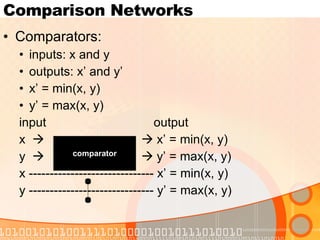
Comparison Networks Comparators: inputs: x and y outputs: x’ and y’ x’ = min(x, y) y’ = max(x, y) input  output x       x’ = min(x, y) y       y’ = max(x, y) x ------------------------------ x’ = min(x, y) y ------------------------------ y’ = max(x, y) comparator
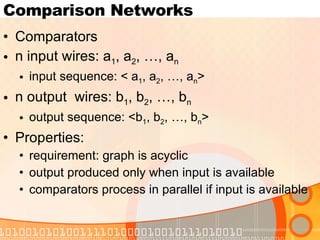
Comparison Networks Comparators n input wires: a 1 , a 2 , …, a n input sequence: < a 1 , a 2 , …, a n > n output  wires: b 1 , b 2 , …, b n output sequence: <b 1 , b 2 , …, b n > Properties: requirement: graph is acyclic output produced only when input is available comparators process in parallel if input is available
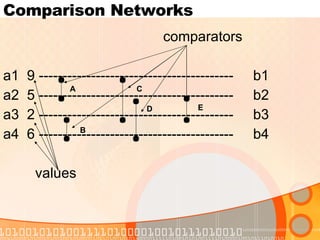
Comparison Networks comparators a1  9 -----------------------------------------  b1 a2  5 -----------------------------------------  b2 a3  2 -----------------------------------------  b3 a4  6 -----------------------------------------  b4 values A B C D E
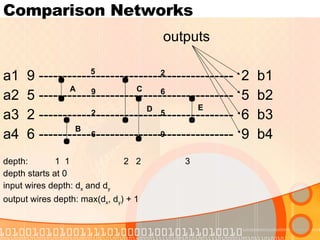
Comparison Networks outputs a1  9 -----------------------------------------  2  b1 a2  5 -----------------------------------------  5  b2 a3  2 -----------------------------------------  6  b3 a4  6 -----------------------------------------  9  b4 depth:  1  1  2  2  3 depth starts at 0 input wires depth: d x  and d y output wires depth: max(d x , d y ) + 1 A B C D E 5 9 2 6 2 6 5 9
Comparison Networks Sorting Network is a Comparison Network where the output is sorted output sequence is monotonically increasing (b 1  <= b 2  …<= b n ) for every input sequence Not  all Comparison Networks are Sorting Networks Comparison Network is like a procedure in that it specifies how comparisons are to occur
Zero-One Principle If a Sorting Network works correctly when each input is drawn from the set {0, 1}, then it works correctly on arbitrary input numbers (integers, reals, or values from any linearly sorted set)
Zero-One Principle Lemma 27.1 If a Comparison Network transforms the input sequence a = <a 1 , a 2 , …, a n > into the output sequence b = <b 1 , b 2 , …, b n >, then for any monotonically increasing function f, the network transforms the input sequence: f(a) = <f(a 1 ), f(a 2 ), …, f(a n )>  into the output sequence: f(b) = <f(b 1 ), f(b 2 ), …, f(b n )>
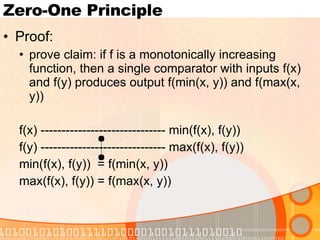
Zero-One Principle Proof: prove claim: if f is a monotonically increasing function, then a single comparator with inputs f(x) and f(y) produces output f(min(x, y)) and f(max(x, y)) f(x) ------------------------------ min(f(x), f(y)) f(y) ------------------------------ max(f(x), f(y)) min(f(x), f(y))  = f(min(x, y)) max(f(x), f(y)) = f(max(x, y))
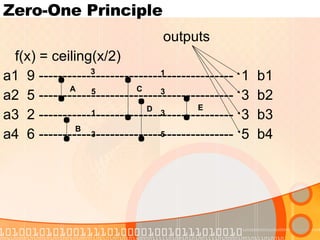
Zero-One Principle outputs f(x) = ceiling(x/2) a1  9 -----------------------------------------  1  b1 a2  5 -----------------------------------------  3  b2 a3  2 -----------------------------------------  3  b3 a4  6 -----------------------------------------  5  b4 A B C D E 3 5 1 3 1 3 3 5
Zero-One Principle Theorem 27.2 (Zero-One Principle) If a Comparison Network with n inputs sorts all 2 n  possible sequences of 0’s and 1’s correctly, then it sorts all sequences of arbitrary numbers correctly.
Zero-One Principle Proof: By contradiction: Suppose that the network sorts all zero-one sequences, but there exists a sequence of arbitrary numbers that the network does not sort: <a 1 , a 2 , …, a n >  contains elements a i  and a j where a i  < a j but the network places a j  before a i  in the output sequence
Zero-One Principle Define monotonically increasing function f: f(x) = { 0 if x <= a i , 1 if x > a i . a j  is placed before a i  in the output sequence f(a j ) placed before f(a i ) when input is <a 1 , a 2 , …, a n >  since f(a j ) = 1 and f(a i ) = 0, from above we have a contradiction
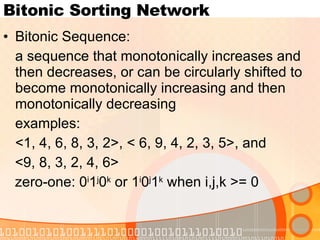
Bitonic Sorting Network Bitonic Sequence: a sequence that monotonically increases and then decreases, or can be circularly shifted to become monotonically increasing and then monotonically decreasing examples: <1, 4, 6, 8, 3, 2>, < 6, 9, 4, 2, 3, 5>, and  <9, 8, 3, 2, 4, 6> zero-one: 0 i 1 j 0 k  or 1 i 0 j 1 k  when i,j,k >= 0
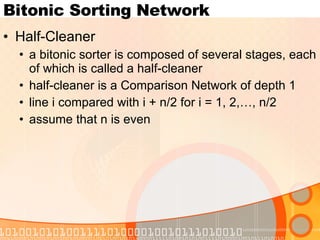
Bitonic Sorting Network Half-Cleaner a bitonic sorter is composed of several stages, each of which is called a half-cleaner half-cleaner is a Comparison Network of depth 1 line i compared with i + n/2 for i = 1, 2,…, n/2 assume that n is even
Bitonic Sorting Network Example:  Half-Cleaner[8]  all 1’s or 0’s 0 ---------------------------------- 0 0 ---------------------------------- 0  bitonic 1 ---------------------------------- 0  clean bitonic  1 ---------------------------------- 0 ________ 1 ---------------------------------- 1 0 ---------------------------------- 0  bitonic 0 ---------------------------------- 1  0 ---------------------------------- 1
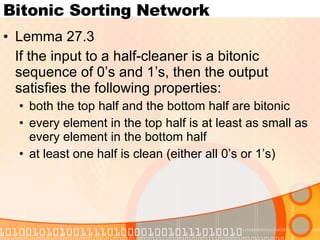
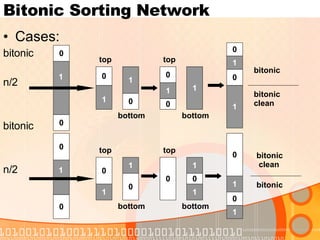
Bitonic Sorting Network Lemma 27.3 If the input to a half-cleaner is a bitonic sequence of 0’s and 1’s, then the output satisfies the following properties: both the top half and the bottom half are bitonic every element in the top half is at least as small as every element in the bottom half at least one half is clean (either all 0’s or 1’s)
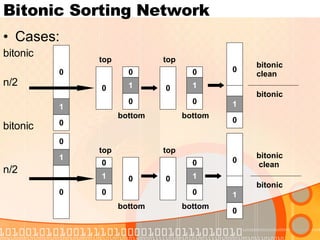
Bitonic Sorting Network Proof: the Comparison Network Half-Cleaner[n] compares inputs i and i + n/2 for i = 1, 2, … n/2 suppose input is of the form: 00…011…100…0 there are 3 possible cases for the n/2 midpoint to fall and the situation where the midpoint falls in a block of 1’s is separated into 2 cases So 4 cases in total
Bitonic Sorting Network Cases: bitonic n/2 bitonic n/2 0 1 0 0 1 0 0 0 0 1 0 0 1 0 0 1 0 0 1 0 0 1 0 0 0 0 1 0 top top top top bottom bottom bottom bottom bitonic  clean bitonic  clean bitonic bitonic
Bitonic Sorting Network Cases: bitonic n/2 bitonic n/2 0 0 0 1 0 0 1 0 1 0 0 0 0 1 0 1 1 0 0 0 1 0 top top top top bottom bottom bottom bottom bitonic  clean bitonic  clean bitonic bitonic 0 1 1 1 1 1 1 1
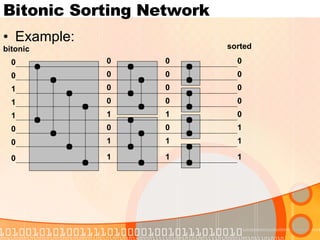
Bitonic Sorting Network Bitonic Sorter by recursively combining half-cleaners, we can build a bitonic sorter, a network that sorts bitonic sequences first stage: Half-Cleaner[n] subsequent sorts with Bitonic-Sorter[n/2] Depth D(n) of Bitonic-Sorter[n]: D(n) = {  0  if n =1, D(n/2) + 1  if n = 2 k  and k>= 1
Bitonic Sorting Network Example: Half-Cleaner[n] Bitonic- Sorter[n/2] Bitonic- Sorter[n/2]
Bitonic Sorting Network Example: 0 0 1 1 1 0 0 0 0 0 0 0 1 0 1 1 0 0 0 0 1 0 1 1 0 0 0 0 0 1 1 1 bitonic sorted
Bitonic Sorting Network Bitonic-Sorter can be used to sort a zero-one sequence By the Zero-One principle it follows that any bitonic sequence of arbitrary numbers can be sorted using this network
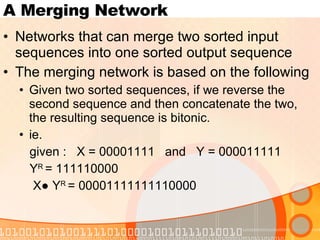
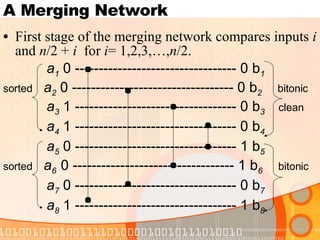
A Merging Network Networks that can merge two sorted input sequences into one sorted output sequence The merging network is based on the following Given two sorted sequences, if we reverse the second sequence and then concatenate the two, the resulting sequence is bitonic. ie. given :  X = 00001111  and  Y = 000011111 Y R  = 111110000 X● Y R  = 00001111111110000
A Merging Network We can construct  M ERGER [n]  by modifying the first half cleaner of  B ITONIC -S ORTER [n]. The key is to perform the reversal of the second half of the inputs implicitly. Given two sorted sequences <a 1 , a 2 , …, a n/2 > and <a n/2+1 , a n/2+2 , …, a n >  Want the effect of bitonically sorting the sequence  < a 1 , a 2 , …, a n/2,  a n,  a n-1,  a n-2,  ..., a n/2+1 >
A Merging Network B ITONIC -S ORTER [n] compares inputs  i  and  n /2+ i  for  i = 1,2,3,…, n /2. a 1  0 ---------------------------------- 0 b 1 a 2  0 ---------------------------------- 0 b 2   bitonic a 3  1 ---------------------------------- 0 b 3  clean bitonic  a  4  1 ---------------------------------- 0 b 4   a 8  1 ---------------------------------- 1 b 8 a 7  0 ---------------------------------- 0 b 7   bitonic a 6  0 ---------------------------------- 1 b 6 a 5  0 ---------------------------------- 1 b 5
A Merging Network First stage of the merging network compares inputs  i  and  n /2 +  i   for  i = 1,2,3,…, n /2. a 1  0 ---------------------------------- 0 b 1 sorted  a 2  0 ---------------------------------- 0 b 2   bitonic a 3  1 ---------------------------------- 0 b 3  clean a 4  1 ---------------------------------- 0 b 4   a 5  0 ---------------------------------- 1 b 5 sorted  a 6  0 ---------------------------------- 1 b 6   bitonic a 7  0 ---------------------------------- 0 b 7 a 8  1 ---------------------------------- 1 b 8
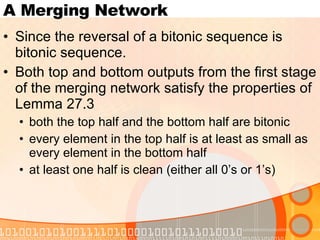
A Merging Network Since the reversal of a bitonic sequence is  bitonic sequence. Both top and bottom outputs from the first stage of the merging network satisfy the properties of Lemma 27.3 both the top half and the bottom half are bitonic every element in the top half is at least as small as every element in the bottom half at least one half is clean (either all 0’s or 1’s)
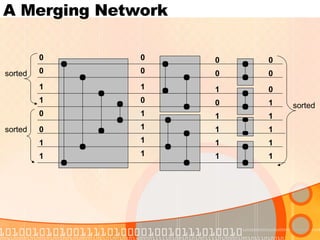
A Merging Network The top and bottom outputs can be bitonically sorted in parallel to produce the sorted output of the merging network.
A Merging Network Bitonic- Sorter[n/2] Bitonic- Sorter[n/2]
A Merging Network 1 0 0 1 0 0 1 1 0 1 1 0 1 0 1 1 0 1 1 0 1 0 1 1 0 1 0 1 1 0 1 1 sorted sorted sorted
A Merging Network First stage is different Consequently the depth is the same as  B ITONIC -S ORTER [n]  Depth D(n) of  M ERGER [n]: D(n) = {  0  if n =1, D(n/2) + 1  if n = 2 k  and k>= 1 D(n) = lg  n
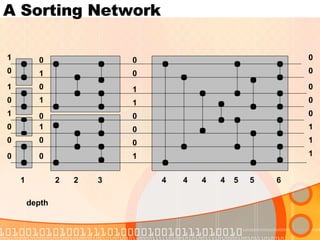
A Sorting Network Now we have all the necessary tools to construct a network that can sort any input sequence We are going to use the a fore mentioned merging network to implement a parallel version of merge sort, called  S ORTER [n]
A Sorting Network Sorter[n/2] Sorter[n/2] Merger[n]
A Sorting Network Merger[4] Merger[4] Merger[8] Merger[2] Merger[2] Merger[2] Merger[2]
A Sorting Network 1 0 1 0 1 0 0 0 0 0 1 1 0 0 0 1 0 1 0 0 0 0 1 1 0 1 0 1 0 1 0 0 1 depth 2 2 3 4 4 4 4 5 5 6
A Sorting Network
Conclusion Sorting Network Components Comparison Networks Zero-one Principle Bitonic Sorting Network Half-Cleaner Bitonic Sorter Merging Network Sorting Networks

Sortingnetworks

  • 1.
    SORTING NETWORKS Presentedby: Vikram S. Choudhary, JECRC, Jodhpur.
  • 2.
    Overview Sorting NetworkComponents Comparison Networks Comparator Zero-one Principle Bitonic Sorting Network Half-Cleaner Bitonic Sorter Merging Network Sorting Network
  • 3.
    Comparison Networks Sortingnetworks are Comparison Networks that always sort their inputs Comparison Network composed of: wires comparators Wires: transmits values from place to place Comparators: two inputs  two outputs
  • 4.
    Comparison Networks Comparators:inputs: x and y outputs: x’ and y’ x’ = min(x, y) y’ = max(x, y) input output x   x’ = min(x, y) y   y’ = max(x, y) x ------------------------------ x’ = min(x, y) y ------------------------------ y’ = max(x, y) comparator
  • 5.
    Comparison Networks Comparatorsn input wires: a 1 , a 2 , …, a n input sequence: < a 1 , a 2 , …, a n > n output wires: b 1 , b 2 , …, b n output sequence: <b 1 , b 2 , …, b n > Properties: requirement: graph is acyclic output produced only when input is available comparators process in parallel if input is available
  • 6.
    Comparison Networks comparatorsa1 9 ----------------------------------------- b1 a2 5 ----------------------------------------- b2 a3 2 ----------------------------------------- b3 a4 6 ----------------------------------------- b4 values A B C D E
  • 7.
    Comparison Networks outputsa1 9 ----------------------------------------- 2 b1 a2 5 ----------------------------------------- 5 b2 a3 2 ----------------------------------------- 6 b3 a4 6 ----------------------------------------- 9 b4 depth: 1 1 2 2 3 depth starts at 0 input wires depth: d x and d y output wires depth: max(d x , d y ) + 1 A B C D E 5 9 2 6 2 6 5 9
  • 8.
    Comparison Networks SortingNetwork is a Comparison Network where the output is sorted output sequence is monotonically increasing (b 1 <= b 2 …<= b n ) for every input sequence Not all Comparison Networks are Sorting Networks Comparison Network is like a procedure in that it specifies how comparisons are to occur
  • 9.
    Zero-One Principle Ifa Sorting Network works correctly when each input is drawn from the set {0, 1}, then it works correctly on arbitrary input numbers (integers, reals, or values from any linearly sorted set)
  • 10.
    Zero-One Principle Lemma27.1 If a Comparison Network transforms the input sequence a = <a 1 , a 2 , …, a n > into the output sequence b = <b 1 , b 2 , …, b n >, then for any monotonically increasing function f, the network transforms the input sequence: f(a) = <f(a 1 ), f(a 2 ), …, f(a n )> into the output sequence: f(b) = <f(b 1 ), f(b 2 ), …, f(b n )>
  • 11.
    Zero-One Principle Proof:prove claim: if f is a monotonically increasing function, then a single comparator with inputs f(x) and f(y) produces output f(min(x, y)) and f(max(x, y)) f(x) ------------------------------ min(f(x), f(y)) f(y) ------------------------------ max(f(x), f(y)) min(f(x), f(y)) = f(min(x, y)) max(f(x), f(y)) = f(max(x, y))
  • 12.
    Zero-One Principle outputsf(x) = ceiling(x/2) a1 9 ----------------------------------------- 1 b1 a2 5 ----------------------------------------- 3 b2 a3 2 ----------------------------------------- 3 b3 a4 6 ----------------------------------------- 5 b4 A B C D E 3 5 1 3 1 3 3 5
  • 13.
    Zero-One Principle Theorem27.2 (Zero-One Principle) If a Comparison Network with n inputs sorts all 2 n possible sequences of 0’s and 1’s correctly, then it sorts all sequences of arbitrary numbers correctly.
  • 14.
    Zero-One Principle Proof:By contradiction: Suppose that the network sorts all zero-one sequences, but there exists a sequence of arbitrary numbers that the network does not sort: <a 1 , a 2 , …, a n > contains elements a i and a j where a i < a j but the network places a j before a i in the output sequence
  • 15.
    Zero-One Principle Definemonotonically increasing function f: f(x) = { 0 if x <= a i , 1 if x > a i . a j is placed before a i in the output sequence f(a j ) placed before f(a i ) when input is <a 1 , a 2 , …, a n > since f(a j ) = 1 and f(a i ) = 0, from above we have a contradiction
  • 16.
    Bitonic Sorting NetworkBitonic Sequence: a sequence that monotonically increases and then decreases, or can be circularly shifted to become monotonically increasing and then monotonically decreasing examples: <1, 4, 6, 8, 3, 2>, < 6, 9, 4, 2, 3, 5>, and <9, 8, 3, 2, 4, 6> zero-one: 0 i 1 j 0 k or 1 i 0 j 1 k when i,j,k >= 0
  • 17.
    Bitonic Sorting NetworkHalf-Cleaner a bitonic sorter is composed of several stages, each of which is called a half-cleaner half-cleaner is a Comparison Network of depth 1 line i compared with i + n/2 for i = 1, 2,…, n/2 assume that n is even
  • 18.
    Bitonic Sorting NetworkExample: Half-Cleaner[8] all 1’s or 0’s 0 ---------------------------------- 0 0 ---------------------------------- 0 bitonic 1 ---------------------------------- 0 clean bitonic 1 ---------------------------------- 0 ________ 1 ---------------------------------- 1 0 ---------------------------------- 0 bitonic 0 ---------------------------------- 1 0 ---------------------------------- 1
  • 19.
    Bitonic Sorting NetworkLemma 27.3 If the input to a half-cleaner is a bitonic sequence of 0’s and 1’s, then the output satisfies the following properties: both the top half and the bottom half are bitonic every element in the top half is at least as small as every element in the bottom half at least one half is clean (either all 0’s or 1’s)
  • 20.
    Bitonic Sorting NetworkProof: the Comparison Network Half-Cleaner[n] compares inputs i and i + n/2 for i = 1, 2, … n/2 suppose input is of the form: 00…011…100…0 there are 3 possible cases for the n/2 midpoint to fall and the situation where the midpoint falls in a block of 1’s is separated into 2 cases So 4 cases in total
  • 21.
    Bitonic Sorting NetworkCases: bitonic n/2 bitonic n/2 0 1 0 0 1 0 0 0 0 1 0 0 1 0 0 1 0 0 1 0 0 1 0 0 0 0 1 0 top top top top bottom bottom bottom bottom bitonic clean bitonic clean bitonic bitonic
  • 22.
    Bitonic Sorting NetworkCases: bitonic n/2 bitonic n/2 0 0 0 1 0 0 1 0 1 0 0 0 0 1 0 1 1 0 0 0 1 0 top top top top bottom bottom bottom bottom bitonic clean bitonic clean bitonic bitonic 0 1 1 1 1 1 1 1
  • 23.
    Bitonic Sorting NetworkBitonic Sorter by recursively combining half-cleaners, we can build a bitonic sorter, a network that sorts bitonic sequences first stage: Half-Cleaner[n] subsequent sorts with Bitonic-Sorter[n/2] Depth D(n) of Bitonic-Sorter[n]: D(n) = { 0 if n =1, D(n/2) + 1 if n = 2 k and k>= 1
  • 24.
    Bitonic Sorting NetworkExample: Half-Cleaner[n] Bitonic- Sorter[n/2] Bitonic- Sorter[n/2]
  • 25.
    Bitonic Sorting NetworkExample: 0 0 1 1 1 0 0 0 0 0 0 0 1 0 1 1 0 0 0 0 1 0 1 1 0 0 0 0 0 1 1 1 bitonic sorted
  • 26.
    Bitonic Sorting NetworkBitonic-Sorter can be used to sort a zero-one sequence By the Zero-One principle it follows that any bitonic sequence of arbitrary numbers can be sorted using this network
  • 27.
    A Merging NetworkNetworks that can merge two sorted input sequences into one sorted output sequence The merging network is based on the following Given two sorted sequences, if we reverse the second sequence and then concatenate the two, the resulting sequence is bitonic. ie. given : X = 00001111 and Y = 000011111 Y R = 111110000 X● Y R = 00001111111110000
  • 28.
    A Merging NetworkWe can construct M ERGER [n] by modifying the first half cleaner of B ITONIC -S ORTER [n]. The key is to perform the reversal of the second half of the inputs implicitly. Given two sorted sequences <a 1 , a 2 , …, a n/2 > and <a n/2+1 , a n/2+2 , …, a n > Want the effect of bitonically sorting the sequence < a 1 , a 2 , …, a n/2, a n, a n-1, a n-2, ..., a n/2+1 >
  • 29.
    A Merging NetworkB ITONIC -S ORTER [n] compares inputs i and n /2+ i for i = 1,2,3,…, n /2. a 1 0 ---------------------------------- 0 b 1 a 2 0 ---------------------------------- 0 b 2 bitonic a 3 1 ---------------------------------- 0 b 3 clean bitonic a 4 1 ---------------------------------- 0 b 4 a 8 1 ---------------------------------- 1 b 8 a 7 0 ---------------------------------- 0 b 7 bitonic a 6 0 ---------------------------------- 1 b 6 a 5 0 ---------------------------------- 1 b 5
  • 30.
    A Merging NetworkFirst stage of the merging network compares inputs i and n /2 + i for i = 1,2,3,…, n /2. a 1 0 ---------------------------------- 0 b 1 sorted a 2 0 ---------------------------------- 0 b 2 bitonic a 3 1 ---------------------------------- 0 b 3 clean a 4 1 ---------------------------------- 0 b 4 a 5 0 ---------------------------------- 1 b 5 sorted a 6 0 ---------------------------------- 1 b 6 bitonic a 7 0 ---------------------------------- 0 b 7 a 8 1 ---------------------------------- 1 b 8
  • 31.
    A Merging NetworkSince the reversal of a bitonic sequence is bitonic sequence. Both top and bottom outputs from the first stage of the merging network satisfy the properties of Lemma 27.3 both the top half and the bottom half are bitonic every element in the top half is at least as small as every element in the bottom half at least one half is clean (either all 0’s or 1’s)
  • 32.
    A Merging NetworkThe top and bottom outputs can be bitonically sorted in parallel to produce the sorted output of the merging network.
  • 33.
    A Merging NetworkBitonic- Sorter[n/2] Bitonic- Sorter[n/2]
  • 34.
    A Merging Network1 0 0 1 0 0 1 1 0 1 1 0 1 0 1 1 0 1 1 0 1 0 1 1 0 1 0 1 1 0 1 1 sorted sorted sorted
  • 35.
    A Merging NetworkFirst stage is different Consequently the depth is the same as B ITONIC -S ORTER [n] Depth D(n) of M ERGER [n]: D(n) = { 0 if n =1, D(n/2) + 1 if n = 2 k and k>= 1 D(n) = lg n
  • 36.
    A Sorting NetworkNow we have all the necessary tools to construct a network that can sort any input sequence We are going to use the a fore mentioned merging network to implement a parallel version of merge sort, called S ORTER [n]
  • 37.
    A Sorting NetworkSorter[n/2] Sorter[n/2] Merger[n]
  • 38.
    A Sorting NetworkMerger[4] Merger[4] Merger[8] Merger[2] Merger[2] Merger[2] Merger[2]
  • 39.
    A Sorting Network1 0 1 0 1 0 0 0 0 0 1 1 0 0 0 1 0 1 0 0 0 0 1 1 0 1 0 1 0 1 0 0 1 depth 2 2 3 4 4 4 4 5 5 6
  • 40.
  • 41.
    Conclusion Sorting NetworkComponents Comparison Networks Zero-one Principle Bitonic Sorting Network Half-Cleaner Bitonic Sorter Merging Network Sorting Networks