GURU GOBIND SINGH REFINERY LIMITED,
BATHINDA
WATER BLOCK UNIT
STANDARD OPERATING PROCEDURE FOR
WATER ANALYSIS
Issue
No.
01
Issue Date
11.01.2018
Revision Revision Date Clause
Page 1 of 57
Signature: Signature by: Signature:
Prepared by: Pushpendra Reviewed by: Approved by :
Designation: Lab Designation: Designation:
PURPOSE : To determine Total Hardness of water
SCOPE : All types of water
RESPONSIBILITY : Chemist
DESCRIPTION : As follows
SUMMARY OF METHOD: -
 In alkaline medium, EDTA reacts with Ca and Mg to form a chelated
complex, Ca and Mg develop(Pink Red) Colour with Eriochrome black
“T” under alkaline condition. When EDTA is added as a titrate, Ca and
Mg divalent ions get complexes resulting in a sharp colour change from
(Pink Red) to blue, which indicates end point of titration. The pH for this
titration has to be maintained at 10.0 ± 0.1.
APPARTUS: -
 Conical flask, measuring cylinder
REAGENTS: -
 Eriochrome black T indicator: - Mix 0.5gm Eriochrome black T in 100ml
methanol OR triethanolamine.
GURU GOBIND SINGH REFINERY LIMITED,
BATHINDA
WATER BLOCK UNIT
STANDARD OPERATING PROCEDURE FOR
WATER ANALYSIS
Issue
No.
01
Issue Date
11.01.2018
Revision Revision Date Clause
Page 2 of 57
Signature: Signature by: Signature:
Prepared by: Pushpendra Reviewed by: Approved by :
Designation: Lab Designation: Designation:
 Ammonia Buffer Solution: - 67.5 gm ammonium Chloride in 570ml. NH4OH or
Ammonia solution and dilute to 1 liter with distilled water.
 0. 2N (EDTA) Ethylenediamine Tetra Acetic Acid: - Dissolve 37.22gm of EDTA
(Dried at 600
C.) in 250ml. distilled water and make up to 1 liter with distilled water .
 0.02N EDTA: - Dissolve 100ml. 0.2N EDTA solution in 900ml. Distilled water.
STANDARDISATION OF EDTA: -
 Take 25ml. of EDTA solution in 250ml. conical flask and dilute it with 50ml.
DM water and 2ml.Ammonia buffer. Add 2-3 drops of Eriochrome Black T
indicator. Titrate with 0. 2 N standard Zinc solution for the colour change
from blue to violet.
Normality = Vol. Of std. Zinc solution x N / Volume of EDTA solution.
Where
 N = Normality of Zinc solution
:
0.2N STD. ZINC SOLUTION -
 Take about 10.0gm granulated Zinc, wash it with dilute HCl, then weigh
accurately 6.5370 gm of dilute hydrochloric acid and make up the volume to
1.0 liter volumetric flask with DM water.
PROCEDURE: -
GURU GOBIND SINGH REFINERY LIMITED,
BATHINDA
WATER BLOCK UNIT
STANDARD OPERATING PROCEDURE FOR
WATER ANALYSIS
Issue
No.
01
Issue Date
11.01.2018
Revision Revision Date Clause
Page 3 of 57
Signature: Signature by: Signature:
Prepared by: Pushpendra Reviewed by: Approved by :
Designation: Lab Designation: Designation:
 Take 100ml of sample in a conical flask.
 Add 4ml Ammonia Buffer solution.
 Add 3-4 drops of Eriochrome Black T and titrate with std. EDTA (0.02N) till
red Colour change to blue. Note down the vol. of EDTA consumed.
CACULATION: - (as CaCO3 ppm)
 Total Hardness = V x equiv. Wt of CaCO3 x N x1000 / Vol. Of sample

OR
 TH = V x 10 ppm
Where
V = Vol. of EDTA consumed and N = Normality of EDTA
GURU GOBIND SINGH REFINERY LIMITED,
BATHINDA
WATER BLOCK UNIT
STANDARD OPERATING PROCEDURE FOR
WATER ANALYSIS
Issue
No.
01
Issue Date
11.01.2018
Revision Revision Date Clause
Page 4 of 57
Signature: Signature by: Signature:
Prepared by: Pushpendra Reviewed by: Approved by :
Designation: Lab Designation: Designation:
PURPOSE : To determine the pH of water
SCOPE : All types of water
RESPONSIBILITY : Chemist
DESCRIPTION : As follows
pH measurement plays a very important role in the water chemistry. pH is Defined as the
negative logarithm of the hydrogen ion concentration (to the Base 10)
pH = log10[H +
]
pH range is 0-14. An acidic solution is the one in which pH is < 7 where an
alkaline solution is the one in which pH is > 7. A neutral solution has a pH of 7.
In a neutral solution the hydrogen ion & hydroxide ion concentrations are equal
& each corresponds to 107
moles/litre.
pH MEASUREMENT
USE OF pH METER: -
An accurate pH measurement is possible with the help of pH meter.
A general Procedure for pH measurement using any standard pH meter
GURU GOBIND SINGH REFINERY LIMITED,
BATHINDA
WATER BLOCK UNIT
STANDARD OPERATING PROCEDURE FOR
WATER ANALYSIS
Issue
No.
01
Issue Date
11.01.2018
Revision Revision Date Clause
Page 5 of 57
Signature: Signature by: Signature:
Prepared by: Pushpendra Reviewed by: Approved by :
Designation: Lab Designation: Designation:
is as follows:
 Switch on & allow the instrument to warm up.
 If the instrument is equipped with a manual temperature control, take the
temperature of the solution &set the temp. Control to this value. If
automatic temp. Compensation probe is available, and then dip the temp.
Probe & the pH electrode assembly in a water sample contained in a
small beaker.
 Ensure that the pH meter is calibrated using buffer solution prior to the
pH measurement.
 Read the pH of the solution & note down the pH reading along with its
temp. .
 Remove the electrode etc., rinse in distilled water, & leave standing in
distilled water.
GURU GOBIND SINGH REFINERY LIMITED,
BATHINDA
WATER BLOCK UNIT
STANDARD OPERATING PROCEDURE FOR
WATER ANALYSIS
Issue
No.
01
Issue Date
11.01.2018
Revision Revision Date Clause
Page 6 of 57
Signature: Signature by: Signature:
Prepared by: Pushpendra Reviewed by: Approved by :
Designation: Lab Designation: Designation:
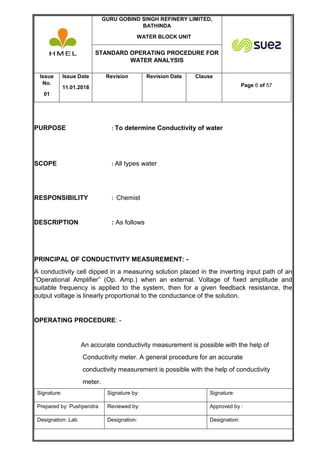
PURPOSE : To determine Conductivity of water
SCOPE : All types water
RESPONSIBILITY : Chemist
DESCRIPTION : As follows
PRINCIPAL OF CONDUCTIVITY MEASUREMENT: -
A conductivity cell dipped in a measuring solution placed in the inverting input path of an
“Operational Amplifier” (Op. Amp.) when an external. Voltage of fixed amplitude and
suitable frequency is applied to the system, then for a given feedback resistance, the
output voltage is linearly proportional to the conductance of the solution.
OPERATING PROCEDURE: -
An accurate conductivity measurement is possible with the help of
Conductivity meter. A general procedure for an accurate
conductivity measurement is possible with the help of conductivity
meter.
GURU GOBIND SINGH REFINERY LIMITED,
BATHINDA
WATER BLOCK UNIT
STANDARD OPERATING PROCEDURE FOR
WATER ANALYSIS
Issue
No.
01
Issue Date
11.01.2018
Revision Revision Date Clause
Page 7 of 57
Signature: Signature by: Signature:
Prepared by: Pushpendra Reviewed by: Approved by :
Designation: Lab Designation: Designation:
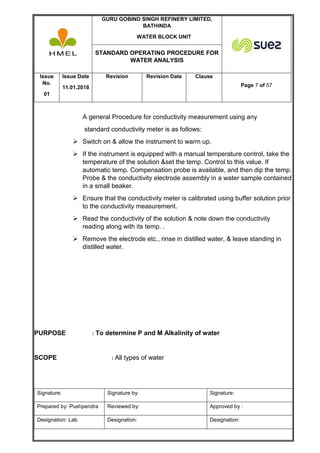
A general Procedure for conductivity measurement using any
standard conductivity meter is as follows:
 Switch on & allow the instrument to warm up.
 If the instrument is equipped with a manual temperature control, take the
temperature of the solution &set the temp. Control to this value. If
automatic temp. Compensation probe is available, and then dip the temp.
Probe & the conductivity electrode assembly in a water sample contained
in a small beaker.
 Ensure that the conductivity meter is calibrated using buffer solution prior
to the conductivity measurement.
 Read the conductivity of the solution & note down the conductivity
reading along with its temp. .
 Remove the electrode etc., rinse in distilled water, & leave standing in
distilled water.
PURPOSE : To determine P and M Alkalinity of water
SCOPE : All types of water
GURU GOBIND SINGH REFINERY LIMITED,
BATHINDA
WATER BLOCK UNIT
STANDARD OPERATING PROCEDURE FOR
WATER ANALYSIS
Issue
No.
01
Issue Date
11.01.2018
Revision Revision Date Clause
Page 8 of 57
Signature: Signature by: Signature:
Prepared by: Pushpendra Reviewed by: Approved by :
Designation: Lab Designation: Designation:
RESPONSIBILITY : Chemist
DESCRIPTION : As follows
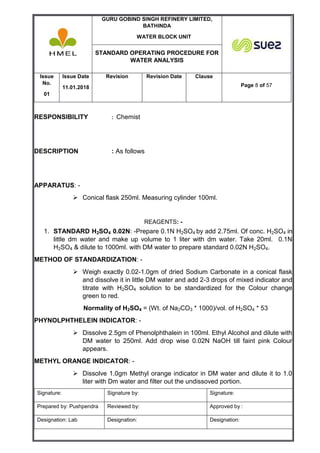
APPARATUS: -
 Conical flask 250ml. Measuring cylinder 100ml.
REAGENTS: -
1. STANDARD H2SO4 0.02N: -Prepare 0.1N H2SO4 by add 2.75ml. Of conc. H2SO4 in
little dm water and make up volume to 1 liter with dm water. Take 20ml. 0.1N
H2SO4 & dilute to 1000ml. with DM water to prepare standard 0.02N H2SO4.
METHOD OF STANDARDIZATION: -
 Weigh exactly 0.02-1.0gm of dried Sodium Carbonate in a conical flask
and dissolve it in little DM water and add 2-3 drops of mixed indicator and
titrate with H2SO4 solution to be standardized for the Colour change
green to red.
Normality of H2SO4 = (Wt. of Na2CO3 * 1000)/vol. of H2SO4 * 53
PHYNOLPHTHELEIN INDICATOR: -
 Dissolve 2.5gm of Phenolphthalein in 100ml. Ethyl Alcohol and dilute with
DM water to 250ml. Add drop wise 0.02N NaOH till faint pink Colour
appears.
METHYL ORANGE INDICATOR: -
 Dissolve 1.0gm Methyl orange indicator in DM water and dilute it to 1.0
liter with Dm water and filter out the undissoved portion.
GURU GOBIND SINGH REFINERY LIMITED,
BATHINDA
WATER BLOCK UNIT
STANDARD OPERATING PROCEDURE FOR
WATER ANALYSIS
Issue
No.
01
Issue Date
11.01.2018
Revision Revision Date Clause
Page 9 of 57
Signature: Signature by: Signature:
Prepared by: Pushpendra Reviewed by: Approved by :
Designation: Lab Designation: Designation:
MIXED INDICATOR: -
 Dissolved 0.3gm Bromocresol Green and 0.2gm Methyl Red indicator in
400ml. Methanol.
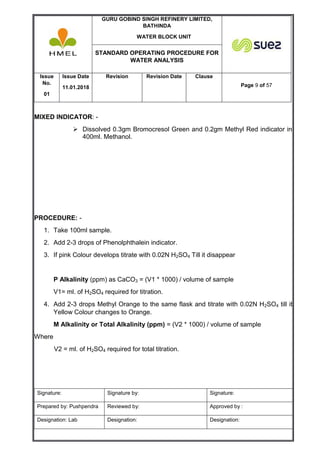
PROCEDURE: -
1. Take 100ml sample.
2. Add 2-3 drops of Phenolphthalein indicator.
3. If pink Colour develops titrate with 0.02N H2SO4 Till it disappear
P Alkalinity (ppm) as CaCO3 = (V1 * 1000) / volume of sample
V1= ml. of H2SO4 required for titration.
4. Add 2-3 drops Methyl Orange to the same flask and titrate with 0.02N H2SO4 till it
Yellow Colour changes to Orange.
M Alkalinity or Total Alkalinity (ppm) = (V2 * 1000) / volume of sample
Where
V2 = ml. of H2SO4 required for total titration.
GURU GOBIND SINGH REFINERY LIMITED,
BATHINDA
WATER BLOCK UNIT
STANDARD OPERATING PROCEDURE FOR
WATER ANALYSIS
Issue
No.
01
Issue Date
11.01.2018
Revision Revision Date Clause
Page 10 of 57
Signature: Signature by: Signature:
Prepared by: Pushpendra Reviewed by: Approved by :
Designation: Lab Designation: Designation:
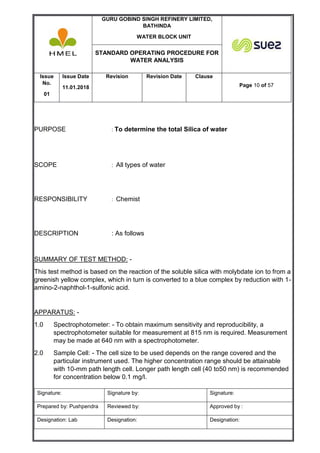
PURPOSE : To determine the total Silica of water
SCOPE : All types of water
RESPONSIBILITY : Chemist
DESCRIPTION : As follows
SUMMARY OF TEST METHOD: -
This test method is based on the reaction of the soluble silica with molybdate ion to from a
greenish yellow complex, which in turn is converted to a blue complex by reduction with 1-
amino-2-naphthol-1-sulfonic acid.
APPARATUS: -
1.0 Spectrophotometer: - To obtain maximum sensitivity and reproducibility, a
spectrophotometer suitable for measurement at 815 nm is required. Measurement
may be made at 640 nm with a spectrophotometer.
2.0 Sample Cell: - The cell size to be used depends on the range covered and the
particular instrument used. The higher concentration range should be attainable
with 10-mm path length cell. Longer path length cell (40 to50 nm) is recommended
for concentration below 0.1 mg/l.
GURU GOBIND SINGH REFINERY LIMITED,
BATHINDA
WATER BLOCK UNIT
STANDARD OPERATING PROCEDURE FOR
WATER ANALYSIS
Issue
No.
01
Issue Date
11.01.2018
Revision Revision Date Clause
Page 11 of 57
Signature: Signature by: Signature:
Prepared by: Pushpendra Reviewed by: Approved by :
Designation: Lab Designation: Designation:
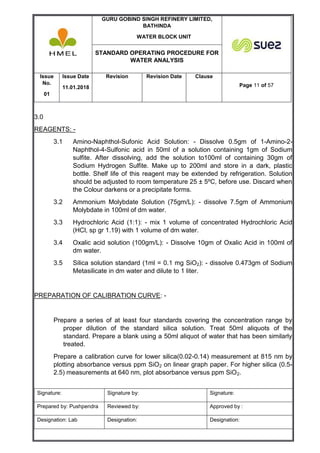
3.0
REAGENTS: -
3.1 Amino-Naphthol-Sufonic Acid Solution: - Dissolve 0.5gm of 1-Amino-2-
Naphthol-4-Sulfonic acid in 50ml of a solution containing 1gm of Sodium
sulfite. After dissolving, add the solution to100ml of containing 30gm of
Sodium Hydrogen Sulfite. Make up to 200ml and store in a dark, plastic
bottle. Shelf life of this reagent may be extended by refrigeration. Solution
should be adjusted to room temperature 25 ± 5ºC, before use. Discard when
the Colour darkens or a precipitate forms.
3.2 Ammonium Molybdate Solution (75gm/L): - dissolve 7.5gm of Ammonium
Molybdate in 100ml of dm water.
3.3 Hydrochloric Acid (1:1): - mix 1 volume of concentrated Hydrochloric Acid
(HCl, sp gr 1.19) with 1 volume of dm water.
3.4 Oxalic acid solution (100gm/L): - Dissolve 10gm of Oxalic Acid in 100ml of
dm water.
3.5 Silica solution standard (1ml = 0.1 mg SiO2): - dissolve 0.473gm of Sodium
Metasilicate in dm water and dilute to 1 liter.
PREPARATION OF CALIBRATION CURVE: -
Prepare a series of at least four standards covering the concentration range by
proper dilution of the standard silica solution. Treat 50ml aliquots of the
standard. Prepare a blank using a 50ml aliquot of water that has been similarly
treated.
Prepare a calibration curve for lower silica(0.02-0.14) measurement at 815 nm by
plotting absorbance versus ppm SiO2 on linear graph paper. For higher silica (0.5-
2.5) measurements at 640 nm, plot absorbance versus ppm SiO2.
GURU GOBIND SINGH REFINERY LIMITED,
BATHINDA
WATER BLOCK UNIT
STANDARD OPERATING PROCEDURE FOR
WATER ANALYSIS
Issue
No.
01
Issue Date
11.01.2018
Revision Revision Date Clause
Page 12 of 57
Signature: Signature by: Signature:
Prepared by: Pushpendra Reviewed by: Approved by :
Designation: Lab Designation: Designation:
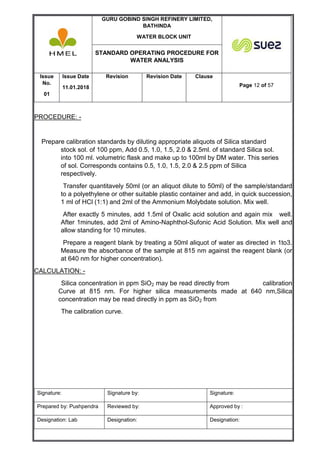
PROCEDURE: -
Prepare calibration standards by diluting appropriate aliquots of Silica standard
stock sol. of 100 ppm, Add 0.5, 1.0, 1.5, 2.0 & 2.5ml. of standard Silica sol.
into 100 ml. volumetric flask and make up to 100ml by DM water. This series
of sol. Corresponds contains 0.5, 1.0, 1.5, 2.0 & 2.5 ppm of Silica
respectively.
Transfer quantitavely 50ml (or an aliquot dilute to 50ml) of the sample/standard
to a polyethylene or other suitable plastic container and add, in quick succession,
1 ml of HCl (1:1) and 2ml of the Ammonium Molybdate solution. Mix well.
After exactly 5 minutes, add 1.5ml of Oxalic acid solution and again mix well.
After 1minutes, add 2ml of Amino-Naphthol-Sufonic Acid Solution. Mix well and
allow standing for 10 minutes.
Prepare a reagent blank by treating a 50ml aliquot of water as directed in 1to3.
Measure the absorbance of the sample at 815 nm against the reagent blank (or
at 640 nm for higher concentration).
CALCULATION: -
Silica concentration in ppm SiO2 may be read directly from calibration
Curve at 815 nm. For higher silica measurements made at 640 nm,Silica
concentration may be read directly in ppm as SiO2 from
The calibration curve.
GURU GOBIND SINGH REFINERY LIMITED,
BATHINDA
WATER BLOCK UNIT
STANDARD OPERATING PROCEDURE FOR
WATER ANALYSIS
Issue
No.
01
Issue Date
11.01.2018
Revision Revision Date Clause
Page 13 of 57
Signature: Signature by: Signature:
Prepared by: Pushpendra Reviewed by: Approved by :
Designation: Lab Designation: Designation:
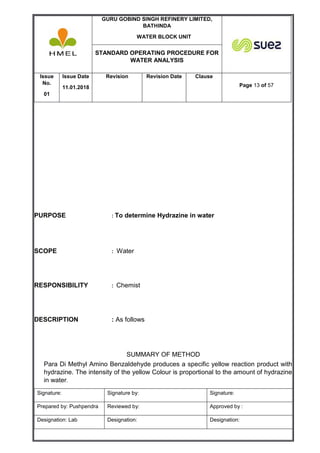
PURPOSE : To determine Hydrazine in water
SCOPE : Water
RESPONSIBILITY : Chemist
DESCRIPTION : As follows
SUMMARY OF METHOD
Para Di Methyl Amino Benzaldehyde produces a specific yellow reaction product with
hydrazine. The intensity of the yellow Colour is proportional to the amount of hydrazine
in water.
GURU GOBIND SINGH REFINERY LIMITED,
BATHINDA
WATER BLOCK UNIT
STANDARD OPERATING PROCEDURE FOR
WATER ANALYSIS
Issue
No.
01
Issue Date
11.01.2018
Revision Revision Date Clause
Page 14 of 57
Signature: Signature by: Signature:
Prepared by: Pushpendra Reviewed by: Approved by :
Designation: Lab Designation: Designation:
APPARATUS: -
1. Spectrophotometer: - To obtain maximum sensitivity and reproducibility, a
spectrophotometer suitable for measurement at 458 nm.
2. Sample Cell: - The cell size to be used depends on the range covered and the
particular instrument used. The higher concentration range should be attainable
with 10-mm path length cell. Longer path length cell (40 to50 nm) is recommended
for concentration below 0.1 mg/l.
REAGENTS: -
1. Hydrazine Standard Solution (1ml=0.1mg): - Dissolve 0.328gm of Hydrazine Di
Hydrochloride in 100ml of water and 10ml of HCl. Dilute with water to 1 liter in a
volumetric flask and mix. Take 10ml. of above sol. And make up to 1000ml by DM
water (10ppm).
2. Hydrochloric Acid: - Concentrated Hydrochloric Acid
3. Hydrochloric Acid (1:9): - Mix 1 volume of HCl with 9 volume of water.
4. Hydrochloric Acid (1:99): - Mix 1 volume of HCl with 99 volume of water.
5. Para Di Methyl Amino Benzaldehyde Solution: - Dissolve 4gm of Para Di
Methyl Amino Benzaldehyde in 200ml of Methyl Alcohol and 20 ml of HCl. Store in
a bottle out of direct sunlight.
GURU GOBIND SINGH REFINERY LIMITED,
BATHINDA
WATER BLOCK UNIT
STANDARD OPERATING PROCEDURE FOR
WATER ANALYSIS
Issue
No.
01
Issue Date
11.01.2018
Revision Revision Date Clause
Page 15 of 57
Signature: Signature by: Signature:
Prepared by: Pushpendra Reviewed by: Approved by :
Designation: Lab Designation: Designation:
SAMPLING: -
Analyze the sample as soon after collection as practicable, since hydrazine
undergoes auto-oxidation as well as oxidation by oxidizing agent. Such agent may Be in
the sample or may enter the sample from the atmosphere. If it suspected that oxidation
of the hydrazine in the sample is
occurring in the interval between Collection and analysis, or if the sample is not
be analyzed immediately collect under acid.
CALIBRATION: -
Prepare calibration standards by diluting appropriate aliquots of
hydrazine standard stock sol. of 10 ppm, Add 0.2,0.4,0.6,0.8 &
1.0ml. of standard hydrazine sol. Into 100 ml. volumetric flask and make up
to 100ml by DM water. This series of sol. Corresponds contains 0.02,0.04,0.06,0.08 &
1.0 ppm of hydrazine respectively.
PROCEDURE: -
1. To a 100ml beaker, flask or cylinder, add from a burette exactly 5.0ml of HCl (1:9),
2. Add water from a graduated burette or pipette to make a final volume of exactly 50ml
and mix. Add 10ml of Para Di Methyl Amino Benzaldehyde solution with a pipette,
and mix. Let the mixture stand at least 10 minutes and not more than 100 minutes.
3. Prepare blank & standard by treating a 50ml aliquot of water as directed in 1 & 2.
4. Measure the absorbance of the sample at 458 nm against the reagent blank.
5. Hydrazine concentration in ppm may be read directly from calibration curve at 458 nm.
GURU GOBIND SINGH REFINERY LIMITED,
BATHINDA
WATER BLOCK UNIT
STANDARD OPERATING PROCEDURE FOR
WATER ANALYSIS
Issue
No.
01
Issue Date
11.01.2018
Revision Revision Date Clause
Page 16 of 57
Signature: Signature by: Signature:
Prepared by: Pushpendra Reviewed by: Approved by :
Designation: Lab Designation: Designation:
GURU GOBIND SINGH REFINERY LIMITED,
BATHINDA
WATER BLOCK UNIT
STANDARD OPERATING PROCEDURE FOR
WATER ANALYSIS
Issue
No.
01
Issue Date
11.01.2018
Revision Revision Date Clause
Page 17 of 57
Signature: Signature by: Signature:
Prepared by: Pushpendra Reviewed by: Approved by :
Designation: Lab Designation: Designation:
PURPOSE : To determine Ortho Phosphate in water
SCOPE : All types of water
RESPONSIBILITY : Chemist
DESCRIPTION : As follows
PRINCIPAL: -
Ammonium molybdate react with phosphate to from molybdophosphoric acid,
which is reduced to blue coloured complex ‘molybdenum blue’ by the addition of
stannous chloride
.
REAGENTS: -
1. Ammonium Molybdate Solution: - (a) Dissolve 25gm Ammonium Molybdate in
about 200ml distilled water. (b) Add carefully 280ml conc. Sulphuric acid to
400ml distilled water and cool. Add (a) & (b) and dilute to 1000ml.
2. Stannous Chloride Solution: - Dissolve 2.5gm – fresh Stannous Chloride in
100ml glycerol and heat in a water bath. Mix by stirring with a glass rod. This
reagent is stable and requires no special storage.
GURU GOBIND SINGH REFINERY LIMITED,
BATHINDA
WATER BLOCK UNIT
STANDARD OPERATING PROCEDURE FOR
WATER ANALYSIS
Issue
No.
01
Issue Date
11.01.2018
Revision Revision Date Clause
Page 18 of 57
Signature: Signature by: Signature:
Prepared by: Pushpendra Reviewed by: Approved by :
Designation: Lab Designation: Designation:
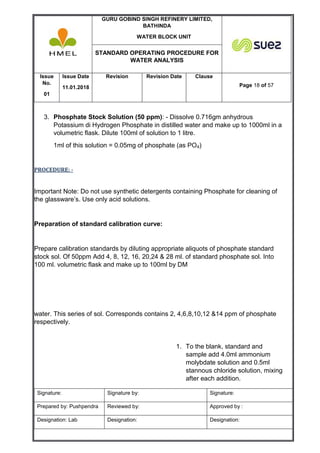
3. Phosphate Stock Solution (50 ppm): - Dissolve 0.716gm anhydrous
Potassium di Hydrogen Phosphate in distilled water and make up to 1000ml in a
volumetric flask. Dilute 100ml of solution to 1 litre.
1ml of this solution = 0.05mg of phosphate (as PO4)
PROCEDURE: -
Important Note: Do not use synthetic detergents containing Phosphate for cleaning of
the glassware’s. Use only acid solutions.
Preparation of standard calibration curve:
Prepare calibration standards by diluting appropriate aliquots of phosphate standard
stock sol. Of 50ppm Add 4, 8, 12, 16, 20,24 & 28 ml. of standard phosphate sol. Into
100 ml. volumetric flask and make up to 100ml by DM
water. This series of sol. Corresponds contains 2, 4,6,8,10,12 &14 ppm of phosphate
respectively.
1. To the blank, standard and
sample add 4.0ml ammonium
molybdate solution and 0.5ml
stannous chloride solution, mixing
after each addition.
GURU GOBIND SINGH REFINERY LIMITED,
BATHINDA
WATER BLOCK UNIT
STANDARD OPERATING PROCEDURE FOR
WATER ANALYSIS
Issue
No.
01
Issue Date
11.01.2018
Revision Revision Date Clause
Page 19 of 57
Signature: Signature by: Signature:
Prepared by: Pushpendra Reviewed by: Approved by :
Designation: Lab Designation: Designation:
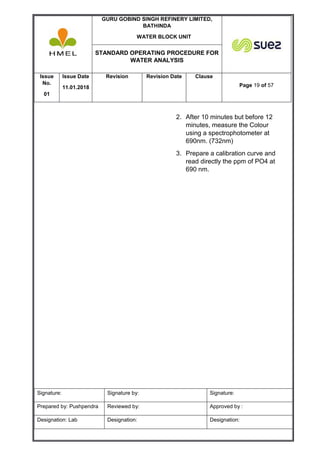
2. After 10 minutes but before 12
minutes, measure the Colour
using a spectrophotometer at
690nm. (732nm)
3. Prepare a calibration curve and
read directly the ppm of PO4 at
690 nm.
GURU GOBIND SINGH REFINERY LIMITED,
BATHINDA
WATER BLOCK UNIT
STANDARD OPERATING PROCEDURE FOR
WATER ANALYSIS
Issue
No.
01
Issue Date
11.01.2018
Revision Revision Date Clause
Page 20 of 57
Signature: Signature by: Signature:
Prepared by: Pushpendra Reviewed by: Approved by :
Designation: Lab Designation: Designation:
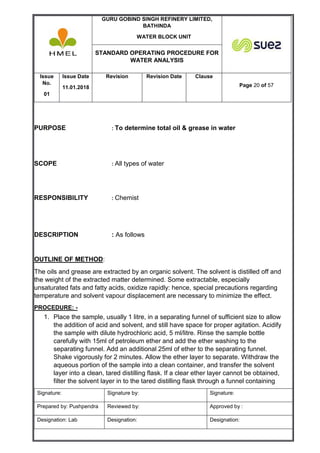
PURPOSE : To determine total oil & grease in water
SCOPE : All types of water
RESPONSIBILITY : Chemist
DESCRIPTION : As follows
OUTLINE OF METHOD:
The oils and grease are extracted by an organic solvent. The solvent is distilled off and
the weight of the extracted matter determined. Some extractable, especially
unsaturated fats and fatty acids, oxidize rapidly: hence, special precautions regarding
temperature and solvent vapour displacement are necessary to minimize the effect.
PROCEDURE: -
1. Place the sample, usually 1 litre, in a separating funnel of sufficient size to allow
the addition of acid and solvent, and still have space for proper agitation. Acidify
the sample with dilute hydrochloric acid, 5 ml/litre. Rinse the sample bottle
carefully with 15ml of petroleum ether and add the ether washing to the
separating funnel. Add an additional 25ml of ether to the separating funnel.
Shake vigorously for 2 minutes. Allow the ether layer to separate. Withdraw the
aqueous portion of the sample into a clean container, and transfer the solvent
layer into a clean, tared distilling flask. If a clear ether layer cannot be obtained,
filter the solvent layer in to the tared distilling flask through a funnel containing
GURU GOBIND SINGH REFINERY LIMITED,
BATHINDA
WATER BLOCK UNIT
STANDARD OPERATING PROCEDURE FOR
WATER ANALYSIS
Issue
No.
01
Issue Date
11.01.2018
Revision Revision Date Clause
Page 21 of 57
Signature: Signature by: Signature:
Prepared by: Pushpendra Reviewed by: Approved by :
Designation: Lab Designation: Designation:
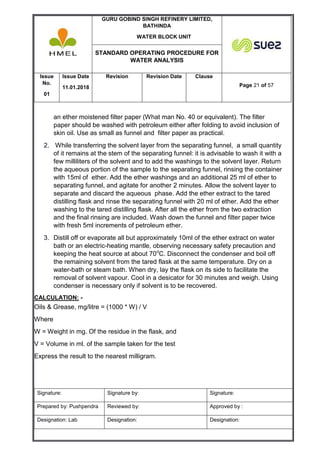
an ether moistened filter paper (What man No. 40 or equivalent). The filter
paper should be washed with petroleum either after folding to avoid inclusion of
skin oil. Use as small as funnel and filter paper as practical.
2. While transferring the solvent layer from the separating funnel, a small quantity
of it remains at the stem of the separating funnel: it is advisable to wash it with a
few milliliters of the solvent and to add the washings to the solvent layer. Return
the aqueous portion of the sample to the separating funnel, rinsing the container
with 15ml of ether. Add the ether washings and an additional 25 ml of ether to
separating funnel, and agitate for another 2 minutes. Allow the solvent layer to
separate and discard the aqueous phase. Add the ether extract to the tared
distilling flask and rinse the separating funnel with 20 ml of ether. Add the ether
washing to the tared distilling flask. After all the ether from the two extraction
and the final rinsing are included. Wash down the funnel and filter paper twice
with fresh 5ml increments of petroleum ether.
3. Distill off or evaporate all but approximately 10ml of the ether extract on water
bath or an electric-heating mantle, observing necessary safety precaution and
keeping the heat source at about 70o
C. Disconnect the condenser and boil off
the remaining solvent from the tared flask at the same temperature. Dry on a
water-bath or steam bath. When dry, lay the flask on its side to facilitate the
removal of solvent vapour. Cool in a desicator for 30 minutes and weigh. Using
condenser is necessary only if solvent is to be recovered.
CALCULATION: -
Oils & Grease, mg/litre = (1000 * W) / V
Where
W = Weight in mg. Of the residue in the flask, and
V = Volume in ml. of the sample taken for the test
Express the result to the nearest milligram.
GURU GOBIND SINGH REFINERY LIMITED,
BATHINDA
WATER BLOCK UNIT
STANDARD OPERATING PROCEDURE FOR
WATER ANALYSIS
Issue
No.
01
Issue Date
11.01.2018
Revision Revision Date Clause
Page 22 of 57
Signature: Signature by: Signature:
Prepared by: Pushpendra Reviewed by: Approved by :
Designation: Lab Designation: Designation:
GURU GOBIND SINGH REFINERY LIMITED,
BATHINDA
WATER BLOCK UNIT
STANDARD OPERATING PROCEDURE FOR
WATER ANALYSIS
Issue
No.
01
Issue Date
11.01.2018
Revision Revision Date Clause
Page 23 of 57
Signature: Signature by: Signature:
Prepared by: Pushpendra Reviewed by: Approved by :
Designation: Lab Designation: Designation:
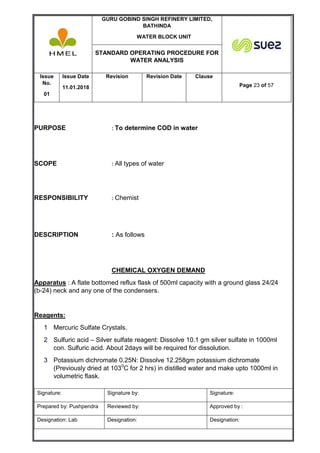
PURPOSE : To determine COD in water
SCOPE : All types of water
RESPONSIBILITY : Chemist
DESCRIPTION : As follows
CHEMICAL OXYGEN DEMAND
Apparatus : A flate bottomed reflux flask of 500ml capacity with a ground glass 24/24
(b-24) neck and any one of the condensers.
Reagents:
1 Mercuric Sulfate Crystals.
2 Sulfuric acid – Silver sulfate reagent: Dissolve 10.1 gm silver sulfate in 1000ml
con. Sulfuric acid. About 2days will be required for dissolution.
3 Potassium dichromate 0.25N: Dissolve 12.258gm potassium dichromate
(Previously dried at 1030
C for 2 hrs) in distilled water and make upto 1000ml in
volumetric flask.
GURU GOBIND SINGH REFINERY LIMITED,
BATHINDA
WATER BLOCK UNIT
STANDARD OPERATING PROCEDURE FOR
WATER ANALYSIS
Issue
No.
01
Issue Date
11.01.2018
Revision Revision Date Clause
Page 24 of 57
Signature: Signature by: Signature:
Prepared by: Pushpendra Reviewed by: Approved by :
Designation: Lab Designation: Designation:
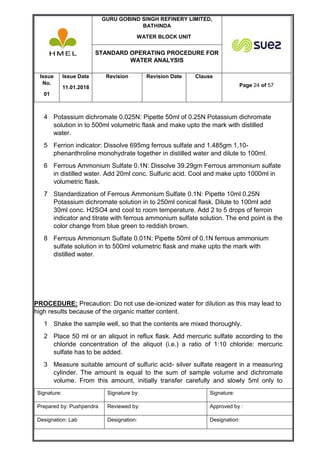
4 Potassium dichromate 0.025N: Pipette 50ml of 0.25N Potassium dichromate
solution in to 500ml volumetric flask and make upto the mark with distilled
water.
5 Ferrion indicator: Dissolve 695mg ferrous sulfate and 1.485gm 1,10-
phenanthroline monohydrate together in distilled water and dilute to 100ml.
6 Ferrous Ammonium Sulfate 0.1N: Dissolve 39.29gm Ferrous ammonium sulfate
in distilled water. Add 20ml conc. Sulfuric acid. Cool and make upto 1000ml in
volumetric flask.
7 Standardization of Ferrous Ammonium Sulfate 0.1N: Pipette 10ml 0.25N
Potassium dichromate solution in to 250ml conical flask. Dilute to 100ml add
30ml conc. H2SO4 and cool to room temperature. Add 2 to 5 drops of ferroin
indicator and titrate with ferrous ammonium sulfate solution. The end point is the
color change from blue green to reddish brown.
8 Ferrous Ammonium Sulfate 0.01N: Pipette 50ml of 0.1N ferrous ammonium
sulfate solution in to 500ml volumetric flask and make upto the mark with
distilled water.
PROCEDURE: Precaution: Do not use de-ionized water for dilution as this may lead to
high results because of the organic matter content.
1 Shake the sample well, so that the contents are mixed thoroughly.
2 Place 50 ml or an aliquot in reflux flask. Add mercuric sulfate according to the
chloride concentration of the aliquot (i.e.) a ratio of 1:10 chloride: mercuric
sulfate has to be added.
3 Measure suitable amount of sulfuric acid- silver sulfate reagent in a measuring
cylinder. The amount is equal to the sum of sample volume and dichromate
volume. From this amount, initially transfer carefully and slowly 5ml only to
GURU GOBIND SINGH REFINERY LIMITED,
BATHINDA
WATER BLOCK UNIT
STANDARD OPERATING PROCEDURE FOR
WATER ANALYSIS
Issue
No.
01
Issue Date
11.01.2018
Revision Revision Date Clause
Page 25 of 57
Signature: Signature by: Signature:
Prepared by: Pushpendra Reviewed by: Approved by :
Designation: Lab Designation: Designation:
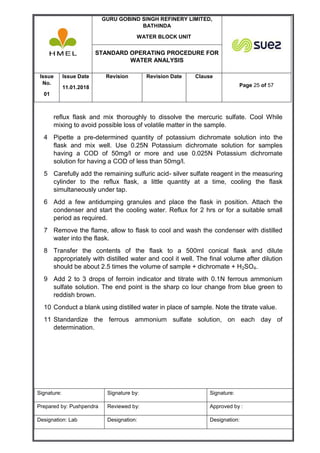
reflux flask and mix thoroughly to dissolve the mercuric sulfate. Cool While
mixing to avoid possible loss of volatile matter in the sample.
4 Pipette a pre-determined quantity of potassium dichromate solution into the
flask and mix well. Use 0.25N Potassium dichromate solution for samples
having a COD of 50mg/l or more and use 0.025N Potassium dichromate
solution for having a COD of less than 50mg/l.
5 Carefully add the remaining sulfuric acid- silver sulfate reagent in the measuring
cylinder to the reflux flask, a little quantity at a time, cooling the flask
simultaneously under tap.
6 Add a few antidumping granules and place the flask in position. Attach the
condenser and start the cooling water. Reflux for 2 hrs or for a suitable small
period as required.
7 Remove the flame, allow to flask to cool and wash the condenser with distilled
water into the flask.
8 Transfer the contents of the flask to a 500ml conical flask and dilute
appropriately with distilled water and cool it well. The final volume after dilution
should be about 2.5 times the volume of sample + dichromate + H2SO4.
9 Add 2 to 3 drops of ferroin indicator and titrate with 0.1N ferrous ammonium
sulfate solution. The end point is the sharp co lour change from blue green to
reddish brown.
10 Conduct a blank using distilled water in place of sample. Note the titrate value.
11 Standardize the ferrous ammonium sulfate solution, on each day of
determination.
GURU GOBIND SINGH REFINERY LIMITED,
BATHINDA
WATER BLOCK UNIT
STANDARD OPERATING PROCEDURE FOR
WATER ANALYSIS
Issue
No.
01
Issue Date
11.01.2018
Revision Revision Date Clause
Page 26 of 57
Signature: Signature by: Signature:
Prepared by: Pushpendra Reviewed by: Approved by :
Designation: Lab Designation: Designation:
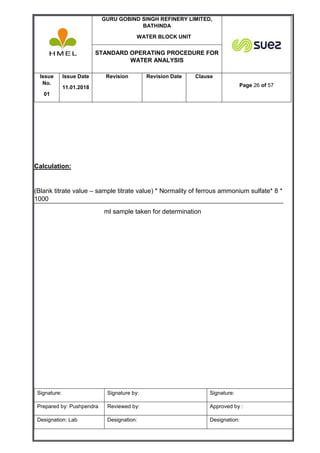
Calculation:
(Blank titrate value – sample titrate value) * Normality of ferrous ammonium sulfate* 8 *
1000
ml sample taken for determination
GURU GOBIND SINGH REFINERY LIMITED,
BATHINDA
WATER BLOCK UNIT
STANDARD OPERATING PROCEDURE FOR
WATER ANALYSIS
Issue
No.
01
Issue Date
11.01.2018
Revision Revision Date Clause
Page 27 of 57
Signature: Signature by: Signature:
Prepared by: Pushpendra Reviewed by: Approved by :
Designation: Lab Designation: Designation:
PURPOSE : To determine total BOD in water
SCOPE : All types of water
RESPONSIBILITY : Chemist
DESCRIPTION : As follows
PRINCIPLE:
Biochemical Oxygen Demand is the quantity of oxygen required by a definite
volume of the liquid effluent for oxidizing the organic matter contained in it by micro-
organisms under specified conditions. For its determination, the dissolved oxygen
content of the sample, with or without dilution, is measured before and after
incubation at 200
C for 5 days.
Apparatus:
Glass stopped bottled, narrow neck bottles of about 300ml capacity, with suitable
water sealing.
Reagents:
1 Sodium Hydroxide Solution – approximately 1N.
GURU GOBIND SINGH REFINERY LIMITED,
BATHINDA
WATER BLOCK UNIT
STANDARD OPERATING PROCEDURE FOR
WATER ANALYSIS
Issue
No.
01
Issue Date
11.01.2018
Revision Revision Date Clause
Page 28 of 57
Signature: Signature by: Signature:
Prepared by: Pushpendra Reviewed by: Approved by :
Designation: Lab Designation: Designation:
2 Hydrochloric acid -1N.
3 Sodium Sulfite Solution – Dissolve 1.5gm of anhydrous sodium sulfite in 1
litre of water. Prepare fresh solution daily for use.
4 Dilution water – Distilled water of good quality, free from metals particularly
copper and aerated.
5 Phosphate buffer solution – Dissolve 8.5gm of Potassium di hydrogen
phosphate (kh2po4), 21.75gm of Di Potassium hydrogen phosphate
(k2hpo4), 33.4gm of di sodium hydrogen phosphate hepta hydrate
(na2hpo4.7h2o) and 1.7gm of ammonium chloride in about 500ml of water
and dilute to 1 liter. The pH of this solution should be 7.2.
6 Magnesium Sulfate Solution – Dissolve 22.5gm of magnesium sulfate hepta
hydrate (mgso4.7h2o) in water and dilute to 1 litre.
7 Calcium Chloride Solution – Dissolve 27.5gm of anhydrous calcium chloride
in water and dilute to 1 litre.
8 Ferric Chloride Solution – Dissolve 0.25gm of ferric chloride (FeCl3.6H2O) in
water and dilute to 1 litre.
9 Seeding Material – Supernatant liquor of domestic sewage stored for 24
to36 hours at 200
C. In the case of industrial effluent containing organic
compounds which are not easily oxidised by sewage seed, the receiving
water collected about 3.5 km below the discharge point may be used.
Procedure:
GURU GOBIND SINGH REFINERY LIMITED,
BATHINDA
WATER BLOCK UNIT
STANDARD OPERATING PROCEDURE FOR
WATER ANALYSIS
Issue
No.
01
Issue Date
11.01.2018
Revision Revision Date Clause
Page 29 of 57
Signature: Signature by: Signature:
Prepared by: Pushpendra Reviewed by: Approved by :
Designation: Lab Designation: Designation:
1 Sample containing acidity or caustic alkalinity should be neutralized to pH about
7.00 with sodium hydroxide solution or hydrochloric acid respectively by adding a
predetermined quantity.
2 Samples containing residual chlorine or chloramines should be dechlorinated if
chlorine is not dissipated on standing for 2 hours. To dechlorinates, first
determine the quantity of sodium sulfite solution required for known aliquot of the
sample by titration to starch-iodide end point after acidifying the sample with
acetic acid (1:1) or sulfuric acid (1:50) followed by 10ml of 10 percent potassium
iodide solution. The add to the requisite volume of the sample the predetermined
quantity of sodium sulfite, avoiding any excess, and check for the absence of
chlorine after 20 minutes.
3 Samples containing toxic substances in large amounts would require special
treatment. However, the effect of small amount may be overcome by using the
proper dilution so that toxicity is removed and the maximum BOD value is
obtained. If increasing dilution show increasing BOD, the dilution should be
increased to level where BOD level off at a maximum.
4 Store the dilution water at 20 Deg. C and use when near that temperature. Take
the desired volume of dilution water required for the test sample and add , for
ever 1 litre of water, 1 ml each of phosphate buffer solution, magnesium
sulphate solution , calcium chloride solution and ferric chloride solution. Seed
the dilution with seeding material . The quantity of seeding material (0.1 to 1
percent of settled sewage or 1 to 5 percent receiving water) added should be
such that oxygen depletion in the dilution water control is between 0.2 and 0.8
mg/L after incubation at 20 Deg. C for 5 days.
5 Prepare as follows several dilution’s of the sample (usually 0.1 to 1.0 percent for
strong industrial effluents and 5 to 25 percent for treated effluent) so as to obtain
a depletion of a least 2 mg/L of dissolved oxygen after incubation for 5 days. In
the case of dilution greater than 1 : 100 prepare a 10 percent primary dilution in a
volumetric flask and from this make the final dilutions.
6 Siphon carefully the prepared seeded dilution water into a graduated 1000 ml
measuring cylinder and fill to the 500 ml mark. Add the requisite quantity of the
GURU GOBIND SINGH REFINERY LIMITED,
BATHINDA
WATER BLOCK UNIT
STANDARD OPERATING PROCEDURE FOR
WATER ANALYSIS
Issue
No.
01
Issue Date
11.01.2018
Revision Revision Date Clause
Page 30 of 57
Signature: Signature by: Signature:
Prepared by: Pushpendra Reviewed by: Approved by :
Designation: Lab Designation: Designation:
carefully well mixed sample to make the particular dilution and fill with dilution
water to 1 litre. Mix thoroughly without entraining air. Siphon the dilution into two
glass stopper bottles, fill completely and stopper. Prepare succeeding dilution of
lower concentrations in the same manner. Determine the initial dissolved oxygen
concentration in one of the two bottles of each dilution. Waterfall the other bottles
and incubate at 20 Deg. C for 5 days. At the same time, siphon the dilution water
along into two glass stopper bottles and determine the blank in one and incubate
the other at 20 Deg C for 5 days. After incubation for 5 days, determine the
dissolved oxygen in the dilutions and the blank in the same manner as the initial
dissolved oxygen content.
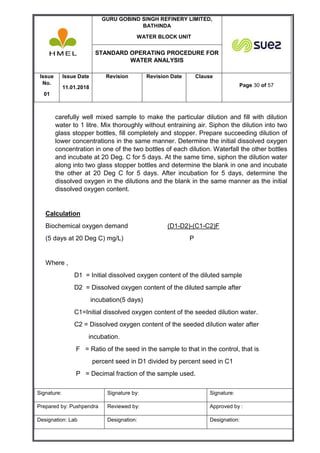
Calculation
Biochemical oxygen demand (D1-D2)-(C1-C2)F
(5 days at 20 Deg C) mg/L) P
Where ,
D1 = Initial dissolved oxygen content of the diluted sample
D2 = Dissolved oxygen content of the diluted sample after
incubation(5 days)
C1=Initial dissolved oxygen content of the seeded dilution water.
C2 = Dissolved oxygen content of the seeded dilution water after
incubation.
F = Ratio of the seed in the sample to that in the control, that is
percent seed in D1 divided by percent seed in C1
P = Decimal fraction of the sample used.
GURU GOBIND SINGH REFINERY LIMITED,
BATHINDA
WATER BLOCK UNIT
STANDARD OPERATING PROCEDURE FOR
WATER ANALYSIS
Issue
No.
01
Issue Date
11.01.2018
Revision Revision Date Clause
Page 31 of 57
Signature: Signature by: Signature:
Prepared by: Pushpendra Reviewed by: Approved by :
Designation: Lab Designation: Designation:
GURU GOBIND SINGH REFINERY LIMITED,
BATHINDA
WATER BLOCK UNIT
STANDARD OPERATING PROCEDURE FOR
WATER ANALYSIS
Issue
No.
01
Issue Date
11.01.2018
Revision Revision Date Clause
Page 32 of 57
Signature: Signature by: Signature:
Prepared by: Pushpendra Reviewed by: Approved by :
Designation: Lab Designation: Designation:
PURPOSE : To determine Dissolved Oxygen
SCOPE : All types of water
RESPONSIBILITY : Chemist
DESCRIPTION : As follows
METHOD:
The dissolved oxygen in the sample oxidizes manganous hydroxide to manganic
hydroxide, which, in turn, oxidizes iodide to free iodine in an acid medium. The
iodine liberated is determined by titration.
REAGENT REQUIRED:]
1. Manganous sulfate solution: - Dissolve 480gm of manganous sulfate
(MnSO4.4H2O) in distilled water, filter and dilute to 1 litre. The Solution
should liberate not more than a trace of iodine when added to an acidified
solution of potassium iodide.
GURU GOBIND SINGH REFINERY LIMITED,
BATHINDA
WATER BLOCK UNIT
STANDARD OPERATING PROCEDURE FOR
WATER ANALYSIS
Issue
No.
01
Issue Date
11.01.2018
Revision Revision Date Clause
Page 33 of 57
Signature: Signature by: Signature:
Prepared by: Pushpendra Reviewed by: Approved by :
Designation: Lab Designation: Designation:
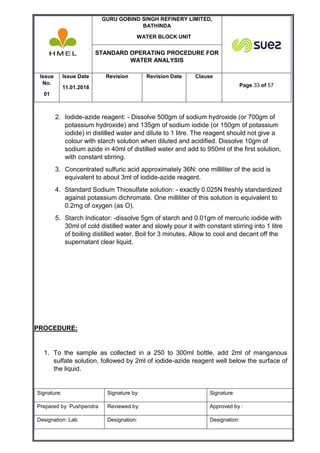
2. Iodide-azide reagent: - Dissolve 500gm of sodium hydroxide (or 700gm of
potassium hydroxide) and 135gm of sodium iodide (or 150gm of potassium
iodide) in distilled water and dilute to 1 litre. The reagent should not give a
colour with starch solution when diluted and acidified. Dissolve 10gm of
sodium azide in 40ml of distilled water and add to 950ml of the first solution,
with constant stirring.
3. Concentrated sulfuric acid approximately 36N: one milliliter of the acid is
equivalent to about 3ml of iodide-azide reagent.
4. Standard Sodium Thiosulfate solution: - exactly 0.025N freshly standardized
against potassium dichromate. One milliliter of this solution is equivalent to
0.2mg of oxygen (as O).
5. Starch Indicator: -dissolve 5gm of starch and 0.01gm of mercuric iodide with
30ml of cold distilled water and slowly pour it with constant stirring into 1 litre
of boiling distilled water. Boil for 3 minutes. Allow to cool and decant off the
supernatant clear liquid.
PROCEDURE:
1. To the sample as collected in a 250 to 300ml bottle, add 2ml of manganous
sulfate solution, followed by 2ml of iodide-azide reagent well below the surface of
the liquid.
GURU GOBIND SINGH REFINERY LIMITED,
BATHINDA
WATER BLOCK UNIT
STANDARD OPERATING PROCEDURE FOR
WATER ANALYSIS
Issue
No.
01
Issue Date
11.01.2018
Revision Revision Date Clause
Page 34 of 57
Signature: Signature by: Signature:
Prepared by: Pushpendra Reviewed by: Approved by :
Designation: Lab Designation: Designation:
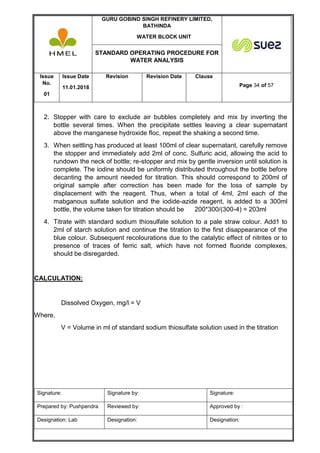
2. Stopper with care to exclude air bubbles completely and mix by inverting the
bottle several times. When the precipitate settles leaving a clear supernatant
above the manganese hydroxide floc, repeat the shaking a second time.
3. When settling has produced at least 100ml of clear supernatant, carefully remove
the stopper and immediately add 2ml of conc. Sulfuric acid, allowing the acid to
rundown the neck of bottle; re-stopper and mix by gentle inversion until solution is
complete. The iodine should be uniformly distributed throughout the bottle before
decanting the amount needed for titration. This should correspond to 200ml of
original sample after correction has been made for the loss of sample by
displacement with the reagent. Thus, when a total of 4ml, 2ml each of the
mabganous sulfate solution and the iodide-azide reagent, is added to a 300ml
bottle, the volume taken for titration should be 200*300/(300-4) = 203ml
4. Titrate with standard sodium thiosulfate solution to a pale straw colour. Add1 to
2ml of starch solution and continue the titration to the first disappearance of the
blue colour. Subsequent recolourations due to the catalytic effect of nitrites or to
presence of traces of ferric salt, which have not formed fluoride complexes,
should be disregarded.
CALCULATION:
Dissolved Oxygen, mg/l = V
Where,
V = Volume in ml of standard sodium thiosulfate solution used in the titration
GURU GOBIND SINGH REFINERY LIMITED,
BATHINDA
WATER BLOCK UNIT
STANDARD OPERATING PROCEDURE FOR
WATER ANALYSIS
Issue
No.
01
Issue Date
11.01.2018
Revision Revision Date Clause
Page 35 of 57
Signature: Signature by: Signature:
Prepared by: Pushpendra Reviewed by: Approved by :
Designation: Lab Designation: Designation:
GURU GOBIND SINGH REFINERY LIMITED,
BATHINDA
WATER BLOCK UNIT
STANDARD OPERATING PROCEDURE FOR
WATER ANALYSIS
Issue
No.
01
Issue Date
11.01.2018
Revision Revision Date Clause
Page 36 of 57
Signature: Signature by: Signature:
Prepared by: Pushpendra Reviewed by: Approved by :
Designation: Lab Designation: Designation:
PURPOSE : To determine Total Solids in water
SCOPE : All types of water
RESPONSIBILITY : Chemist
DESCRIPTION : As follows
The solids in industrial water can be of three types
1. Total solids ,
2. Suspended solids &
3. Dissolved solids.
These solids are also termed as Total residue ,filterable residue & non filterable
residue resp. Total solids is the sum of suspended solids & dissolved solids. Solids
affect the water quality in number of ways . Drinking water should have max. of 500
mg/litre dissolved solids . The temp. at which solids are dried plays an important role
on the results . It is always desirable to mention the temperature & the duration of
heating while estimating total solids . Water of crystallization, mechanically occluded
GURU GOBIND SINGH REFINERY LIMITED,
BATHINDA
WATER BLOCK UNIT
STANDARD OPERATING PROCEDURE FOR
WATER ANALYSIS
Issue
No.
01
Issue Date
11.01.2018
Revision Revision Date Clause
Page 37 of 57
Signature: Signature by: Signature:
Prepared by: Pushpendra Reviewed by: Approved by :
Designation: Lab Designation: Designation:
water , presence of organic matter affect the solids contents drastically thus giving
misleading results.
SUMMARY OF METHOD:
A well mixed sample is evaporated to dryness in in an oven at 1030
C—1050
C to a
constant weight . The increase in weight represents the solid content.
PROCEDURE
(A) TOTAL SOLIDS (AT 1050
C)
1) Take out a known volume of well mixed water sample (unfiltered , as is water
sample) in a clean ,preweighed dish.
2) Choose a sample volume that will yield minimum residue of 50 mg to 250 mg. If
necessary & successive portions of sample to the same dish.
3) Evaporate to dryness on a steam bath or in drying furnace oven. Avoid splashing
while evaporating.
4) Dry the evaporated sample for at least 1 hour at 1030
C—1050
C.
5) Cool the dish in a desiccators to room temperature & weigh .
6) Repeat the cycle of drying , cooling & weighing until a constant weigh is obtained ,
Note the weight of residue .]
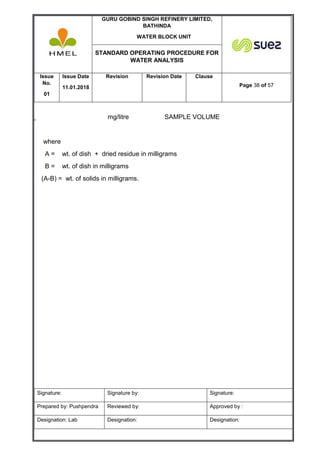
Total Solids = (A-B) X 1000
GURU GOBIND SINGH REFINERY LIMITED,
BATHINDA
WATER BLOCK UNIT
STANDARD OPERATING PROCEDURE FOR
WATER ANALYSIS
Issue
No.
01
Issue Date
11.01.2018
Revision Revision Date Clause
Page 38 of 57
Signature: Signature by: Signature:
Prepared by: Pushpendra Reviewed by: Approved by :
Designation: Lab Designation: Designation:
mg/litre SAMPLE VOLUME
where
A = wt. of dish + dried residue in milligrams
B = wt. of dish in milligrams
(A-B) = wt. of solids in milligrams.
GURU GOBIND SINGH REFINERY LIMITED,
BATHINDA
WATER BLOCK UNIT
STANDARD OPERATING PROCEDURE FOR
WATER ANALYSIS
Issue
No.
01
Issue Date
11.01.2018
Revision Revision Date Clause
Page 39 of 57
Signature: Signature by: Signature:
Prepared by: Pushpendra Reviewed by: Approved by :
Designation: Lab Designation: Designation:
PURPOSE : To determine Total Suspended Solids in water
SCOPE : All types of water
RESPONSIBILITY : Chemist
DESCRIPTION : As follows
A well mixed sample is filtered through pre weighed Whatman filter paper or through a
preweighed standard glass fibre filter. The material retained on the filter paper is the
suspended solids & is dried to a constant weight at 1500
C . The increase in weight
represents the total suspended solids.
PROCEDURE
1 Prepare a filter assembly & begin wet filter with a small volume of water.
2 Take out a known volume of well mixed water sample & filter through the
preweighed glass fibre or through preweighed Whatman filter paper.
3 Wash with distilled water.
GURU GOBIND SINGH REFINERY LIMITED,
BATHINDA
WATER BLOCK UNIT
STANDARD OPERATING PROCEDURE FOR
WATER ANALYSIS
Issue
No.
01
Issue Date
11.01.2018
Revision Revision Date Clause
Page 40 of 57
Signature: Signature by: Signature:
Prepared by: Pushpendra Reviewed by: Approved by :
Designation: Lab Designation: Designation:
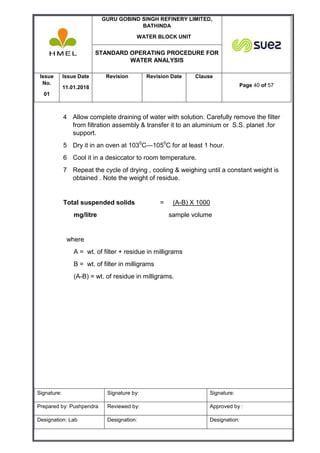
4 Allow complete draining of water with solution. Carefully remove the filter
from filtration assembly & transfer it to an aluminium or S.S. planet .for
support.
5 Dry it in an oven at 1030
C—1050
C for at least 1 hour.
6 Cool it in a desiccator to room temperature.
7 Repeat the cycle of drying , cooling & weighing until a constant weight is
obtained . Note the weight of residue.
Total suspended solids = (A-B) X 1000
mg/litre sample volume
where
A = wt. of filter + residue in milligrams
B = wt. of filter in milligrams
(A-B) = wt. of residue in milligrams.
GURU GOBIND SINGH REFINERY LIMITED,
BATHINDA
WATER BLOCK UNIT
STANDARD OPERATING PROCEDURE FOR
WATER ANALYSIS
Issue
No.
01
Issue Date
11.01.2018
Revision Revision Date Clause
Page 41 of 57
Signature: Signature by: Signature:
Prepared by: Pushpendra Reviewed by: Approved by :
Designation: Lab Designation: Designation:
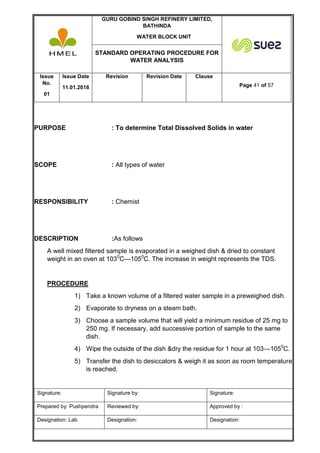
PURPOSE : To determine Total Dissolved Solids in water
SCOPE : All types of water
RESPONSIBILITY : Chemist
DESCRIPTION :As follows
A well mixed filtered sample is evaporated in a weighed dish & dried to constant
weight in an oven at 1030
C—1050
C. The increase in weight represents the TDS.
PROCEDURE
1) Take a known volume of a filtered water sample in a preweighed dish.
2) Evaporate to dryness on a steam bath.
3) Choose a sample volume that will yield a minimum residue of 25 mg to
250 mg. If necessary, add successive portion of sample to the same
dish.
4) Wipe the outside of the dish &dry the residue for 1 hour at 103—1050
C.
5) Transfer the dish to desiccators & weigh it as soon as room temperature
is reached.
GURU GOBIND SINGH REFINERY LIMITED,
BATHINDA
WATER BLOCK UNIT
STANDARD OPERATING PROCEDURE FOR
WATER ANALYSIS
Issue
No.
01
Issue Date
11.01.2018
Revision Revision Date Clause
Page 42 of 57
Signature: Signature by: Signature:
Prepared by: Pushpendra Reviewed by: Approved by :
Designation: Lab Designation: Designation:
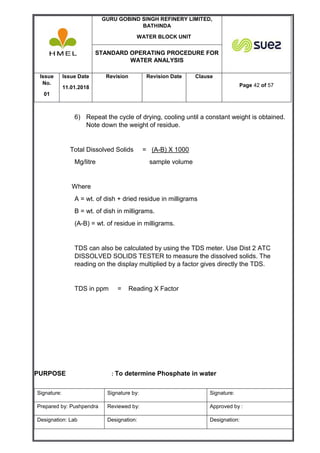
6) Repeat the cycle of drying, cooling until a constant weight is obtained.
Note down the weight of residue.
Total Dissolved Solids = (A-B) X 1000
Mg/litre sample volume
Where
A = wt. of dish + dried residue in milligrams
B = wt. of dish in milligrams.
(A-B) = wt. of residue in milligrams.
TDS can also be calculated by using the TDS meter. Use Dist 2 ATC
DISSOLVED SOLIDS TESTER to measure the dissolved solids. The
reading on the display multiplied by a factor gives directly the TDS.
TDS in ppm = Reading X Factor
PURPOSE : To determine Phosphate in water
GURU GOBIND SINGH REFINERY LIMITED,
BATHINDA
WATER BLOCK UNIT
STANDARD OPERATING PROCEDURE FOR
WATER ANALYSIS
Issue
No.
01
Issue Date
11.01.2018
Revision Revision Date Clause
Page 43 of 57
Signature: Signature by: Signature:
Prepared by: Pushpendra Reviewed by: Approved by :
Designation: Lab Designation: Designation:
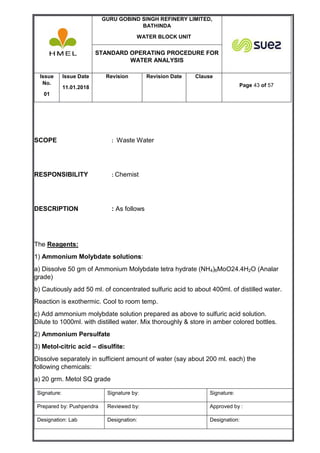
SCOPE : Waste Water
RESPONSIBILITY : Chemist
DESCRIPTION : As follows
The Reagents:
1) Ammonium Molybdate solutions:
a) Dissolve 50 gm of Ammonium Molybdate tetra hydrate (NH4)6MoO24.4H2O (Analar
grade)
b) Cautiously add 50 ml. of concentrated sulfuric acid to about 400ml. of distilled water.
Reaction is exothermic. Cool to room temp.
c) Add ammonium molybdate solution prepared as above to sulfuric acid solution.
Dilute to 1000ml. with distilled water. Mix thoroughly & store in amber colored bottles.
2) Ammonium Persulfate
3) Metol-citric acid – disulfite:
Dissolve separately in sufficient amount of water (say about 200 ml. each) the
following chemicals:
a) 20 grm. Metol SQ grade
GURU GOBIND SINGH REFINERY LIMITED,
BATHINDA
WATER BLOCK UNIT
STANDARD OPERATING PROCEDURE FOR
WATER ANALYSIS
Issue
No.
01
Issue Date
11.01.2018
Revision Revision Date Clause
Page 44 of 57
Signature: Signature by: Signature:
Prepared by: Pushpendra Reviewed by: Approved by :
Designation: Lab Designation: Designation:
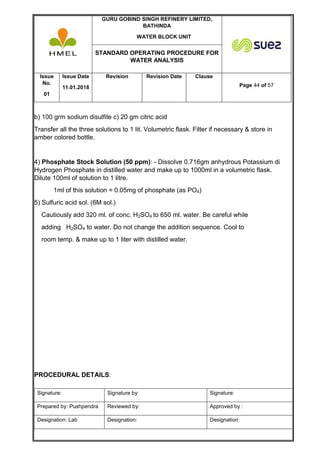
b) 100 grm sodium disulfite c) 20 gm citric acid
Transfer all the three solutions to 1 lit. Volumetric flask. Filter if necessary & store in
amber colored bottle.
4) Phosphate Stock Solution (50 ppm): - Dissolve 0.716gm anhydrous Potassium di
Hydrogen Phosphate in distilled water and make up to 1000ml in a volumetric flask.
Dilute 100ml of solution to 1 litre.
1ml of this solution = 0.05mg of phosphate (as PO4)
5) Sulfuric acid sol. (6M sol.)
Cautiously add 320 ml. of conc. H2SO4 to 650 ml. water. Be careful while
adding H2SO4 to water. Do not change the addition sequence. Cool to
room temp. & make up to 1 liter with distilled water.
PROCEDURAL DETAILS:
GURU GOBIND SINGH REFINERY LIMITED,
BATHINDA
WATER BLOCK UNIT
STANDARD OPERATING PROCEDURE FOR
WATER ANALYSIS
Issue
No.
01
Issue Date
11.01.2018
Revision Revision Date Clause
Page 45 of 57
Signature: Signature by: Signature:
Prepared by: Pushpendra Reviewed by: Approved by :
Designation: Lab Designation: Designation:
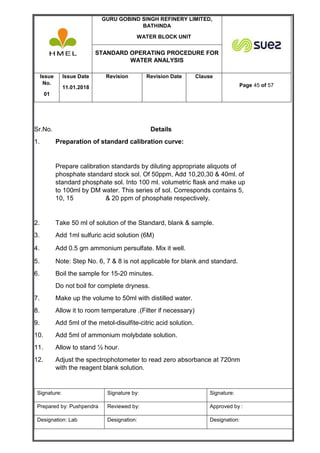
Sr.No. Details
1. Preparation of standard calibration curve:
Prepare calibration standards by diluting appropriate aliquots of
phosphate standard stock sol. Of 50ppm, Add 10,20,30 & 40ml. of
standard phosphate sol. Into 100 ml. volumetric flask and make up
to 100ml by DM water. This series of sol. Corresponds contains 5,
10, 15 & 20 ppm of phosphate respectively.
2. Take 50 ml of solution of the Standard, blank & sample.
3. Add 1ml sulfuric acid solution (6M)
4. Add 0.5 gm ammonium persulfate. Mix it well.
5. Note: Step No. 6, 7 & 8 is not applicable for blank and standard.
6. Boil the sample for 15-20 minutes.
Do not boil for complete dryness.
7. Make up the volume to 50ml with distilled water.
8. Allow it to room temperature .(Filter if necessary)
9. Add 5ml of the metol-disulfite-citric acid solution.
10. Add 5ml of ammonium molybdate solution.
11. Allow to stand ½ hour.
12. Adjust the spectrophotometer to read zero absorbance at 720nm
with the reagent blank solution.
GURU GOBIND SINGH REFINERY LIMITED,
BATHINDA
WATER BLOCK UNIT
STANDARD OPERATING PROCEDURE FOR
WATER ANALYSIS
Issue
No.
01
Issue Date
11.01.2018
Revision Revision Date Clause
Page 46 of 57
Signature: Signature by: Signature:
Prepared by: Pushpendra Reviewed by: Approved by :
Designation: Lab Designation: Designation:
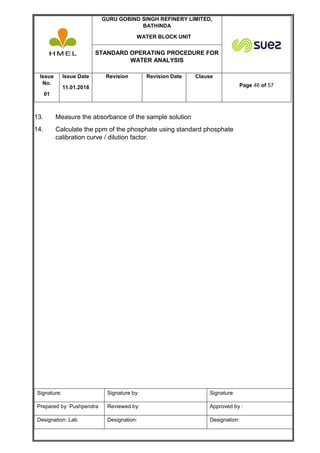
13. Measure the absorbance of the sample solution
14. Calculate the ppm of the phosphate using standard phosphate
calibration curve / dilution factor.
GURU GOBIND SINGH REFINERY LIMITED,
BATHINDA
WATER BLOCK UNIT
STANDARD OPERATING PROCEDURE FOR
WATER ANALYSIS
Issue
No.
01
Issue Date
11.01.2018
Revision Revision Date Clause
Page 47 of 57
Signature: Signature by: Signature:
Prepared by: Pushpendra Reviewed by: Approved by :
Designation: Lab Designation: Designation:
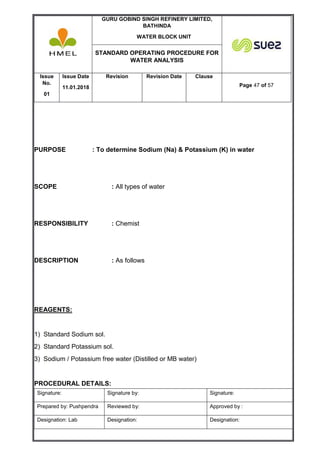
PURPOSE : To determine Sodium (Na) & Potassium (K) in water
SCOPE : All types of water
RESPONSIBILITY : Chemist
DESCRIPTION : As follows
REAGENTS:
1) Standard Sodium sol.
2) Standard Potassium sol.
3) Sodium / Potassium free water (Distilled or MB water)
PROCEDURAL DETAILS:
GURU GOBIND SINGH REFINERY LIMITED,
BATHINDA
WATER BLOCK UNIT
STANDARD OPERATING PROCEDURE FOR
WATER ANALYSIS
Issue
No.
01
Issue Date
11.01.2018
Revision Revision Date Clause
Page 48 of 57
Signature: Signature by: Signature:
Prepared by: Pushpendra Reviewed by: Approved by :
Designation: Lab Designation: Designation:
Sr No Details
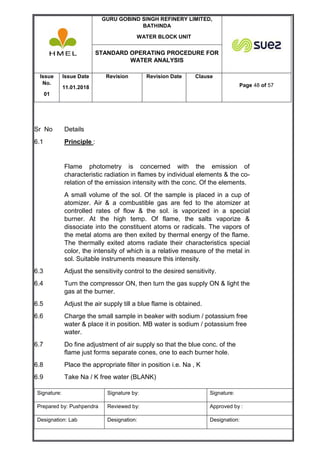
6.1 Principle :
Flame photometry is concerned with the emission of
characteristic radiation in flames by individual elements & the co-
relation of the emission intensity with the conc. Of the elements.
A small volume of the sol. Of the sample is placed in a cup of
atomizer. Air & a combustible gas are fed to the atomizer at
controlled rates of flow & the sol. is vaporized in a special
burner. At the high temp. Of flame, the salts vaporize &
dissociate into the constituent atoms or radicals. The vapors of
the metal atoms are then exited by thermal energy of the flame.
The thermally exited atoms radiate their characteristics special
color, the intensity of which is a relative measure of the metal in
sol. Suitable instruments measure this intensity.
6.3 Adjust the sensitivity control to the desired sensitivity.
6.4 Turn the compressor ON, then turn the gas supply ON & light the
gas at the burner.
6.5 Adjust the air supply till a blue flame is obtained.
6.6 Charge the small sample in beaker with sodium / potassium free
water & place it in position. MB water is sodium / potassium free
water.
6.7 Do fine adjustment of air supply so that the blue conc. of the
flame just forms separate cones, one to each burner hole.
6.8 Place the appropriate filter in position i.e. Na , K
6.9 Take Na / K free water (BLANK)
GURU GOBIND SINGH REFINERY LIMITED,
BATHINDA
WATER BLOCK UNIT
STANDARD OPERATING PROCEDURE FOR
WATER ANALYSIS
Issue
No.
01
Issue Date
11.01.2018
Revision Revision Date Clause
Page 49 of 57
Signature: Signature by: Signature:
Prepared by: Pushpendra Reviewed by: Approved by :
Designation: Lab Designation: Designation:
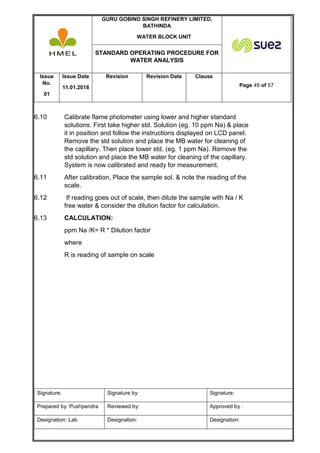
6.10 Calibrate flame photometer using lower and higher standard
solutions. First take higher std. Solution (eg. 10 ppm Na) & place
it in position and follow the instructions displayed on LCD panel.
Remove the std solution and place the MB water for cleaning of
the capillary. Then place lower std. (eg. 1 ppm Na). Remove the
std solution and place the MB water for cleaning of the capillary.
System is now calibrated and ready for measurement.
6.11 After calibration, Place the sample sol. & note the reading of the
scale.
6.12 If reading goes out of scale, then dilute the sample with Na / K
free water & consider the dilution factor for calculation.
6.13 CALCULATION:
ppm Na /K= R * Dilution factor
where
R is reading of sample on scale
GURU GOBIND SINGH REFINERY LIMITED,
BATHINDA
WATER BLOCK UNIT
STANDARD OPERATING PROCEDURE FOR
WATER ANALYSIS
Issue
No.
01
Issue Date
11.01.2018
Revision Revision Date Clause
Page 50 of 57
Signature: Signature by: Signature:
Prepared by: Pushpendra Reviewed by: Approved by :
Designation: Lab Designation: Designation:
GURU GOBIND SINGH REFINERY LIMITED,
BATHINDA
WATER BLOCK UNIT
STANDARD OPERATING PROCEDURE FOR
WATER ANALYSIS
Issue
No.
01
Issue Date
11.01.2018
Revision Revision Date Clause
Page 51 of 57
Signature: Signature by: Signature:
Prepared by: Pushpendra Reviewed by: Approved by :
Designation: Lab Designation: Designation:
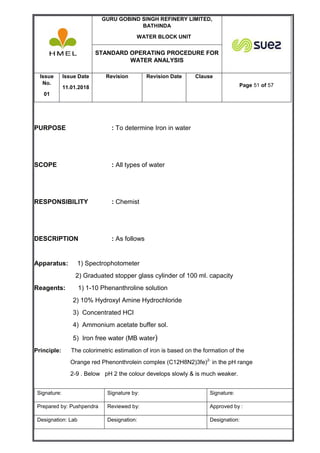
PURPOSE : To determine Iron in water
SCOPE : All types of water
RESPONSIBILITY : Chemist
DESCRIPTION : As follows
Apparatus: 1) Spectrophotometer
2) Graduated stopper glass cylinder of 100 ml. capacity
Reagents: 1) 1-10 Phenanthroline solution
2) 10% Hydroxyl Amine Hydrochloride
3) Concentrated HCl
4) Ammonium acetate buffer sol.
5) Iron free water (MB water)
Principle: The colorimetric estimation of iron is based on the formation of the
Orange red Phenonthrolein complex (C12H8N2)3fe)2-
in the pH range
2-9 . Below pH 2 the colour develops slowly & is much weaker.
GURU GOBIND SINGH REFINERY LIMITED,
BATHINDA
WATER BLOCK UNIT
STANDARD OPERATING PROCEDURE FOR
WATER ANALYSIS
Issue
No.
01
Issue Date
11.01.2018
Revision Revision Date Clause
Page 52 of 57
Signature: Signature by: Signature:
Prepared by: Pushpendra Reviewed by: Approved by :
Designation: Lab Designation: Designation:
Since this complex is formed with ferrous iron, Hydroxylamine
hydrochloride is the most satisfactory reducing agent (for the reduction
of ferric ion). Certain divalent metals such as Cd, Hg & Zn form slightly
soluble complexes with the reagent & reduce the intensity of the iron
colour, but, this interference is minimized by adding a large excess of
hydroxylammine hydrochloride reagent. Phosphorus may be present
up to 20 ppm & Fluoride up to 500 ppm does not interfere if the pH is
kept above 4.0
PROCEDURAL DETAILS:
1 Plotting calibration curve:
1.1 Take standard iron solution containing 0.01,0.02…..upto 0.1mg Fe in
different cylinders. Dilute the contents to 50ml by iron free water.
1.2 Take 50ml iron free water in one cylinder as blank.
1.3 Add 2ml of con. HCL to each cylinder. Shake well & wait for 2minutes.
1.4 Add 4 ml of Hydroxyl amine hydrochloride solution to each. Shake well &
wait for 2 minutes.
1.5 Add 20 ml of acetate buffer to each. Shake well & wait for 2 minutes.
1.6 Add 5 ml of 1-10 Phenanthroline solution to each. Shake well
1.7 Make the volume to 100 ml by iron free water of each and allow it to stand
for 10 minutes.
1.8 Adjust the spectrophotometer to zero absorbance by blank and measure
GURU GOBIND SINGH REFINERY LIMITED,
BATHINDA
WATER BLOCK UNIT
STANDARD OPERATING PROCEDURE FOR
WATER ANALYSIS
Issue
No.
01
Issue Date
11.01.2018
Revision Revision Date Clause
Page 53 of 57
Signature: Signature by: Signature:
Prepared by: Pushpendra Reviewed by: Approved by :
Designation: Lab Designation: Designation:
the absorbance at 510 nm in 1-cm cell.
1.9 Plot the absorbance against the iron contents in total 100 ml volume. Draw
best possible straight line.
2 Determination
2.1 Take 50 ml of iron free water as blank.
2.2 In another cylinder take a sample in such a way that iron content of it will
not exceed 0.1 mg. Dilute the sample to 50 ml by iron free water.
2.3 Follow the steps 1.3 to 1.8
2.4 Read the value of iron content for the absorbance from graph.
2.5 Calculation
Soluble iron content mg/lit as Fe
= Iron content from the graph x 1000 / Volume of sample taken in ml
2.6 It is not necessary to plot the calibration curve every time. For practical
purposes plotting curve once in a year is sufficient. But in case if instrument
or cell is changed than it is necessary to plot curve again.
GURU GOBIND SINGH REFINERY LIMITED,
BATHINDA
WATER BLOCK UNIT
STANDARD OPERATING PROCEDURE FOR
WATER ANALYSIS
Issue
No.
01
Issue Date
11.01.2018
Revision Revision Date Clause
Page 54 of 57
Signature: Signature by: Signature:
Prepared by: Pushpendra Reviewed by: Approved by :
Designation: Lab Designation: Designation:
GURU GOBIND SINGH REFINERY LIMITED,
BATHINDA
WATER BLOCK UNIT
STANDARD OPERATING PROCEDURE FOR
WATER ANALYSIS
Issue
No.
01
Issue Date
11.01.2018
Revision Revision Date Clause
Page 55 of 57
Signature: Signature by: Signature:
Prepared by: Pushpendra Reviewed by: Approved by :
Designation: Lab Designation: Designation:
PURPOSE : To determine Sulfate in water
SCOPE : All types of water
RESPONSIBILITY : Chemist
DESCRIPTION : As follows
EDTA METHOD
A measured excess of standard barium chloride solution is added to the sample & the
excess barium chloride estimated by titration against standard EDTA solution.
REAGENTS
GURU GOBIND SINGH REFINERY LIMITED,
BATHINDA
WATER BLOCK UNIT
STANDARD OPERATING PROCEDURE FOR
WATER ANALYSIS
Issue
No.
01
Issue Date
11.01.2018
Revision Revision Date Clause
Page 56 of 57
Signature: Signature by: Signature:
Prepared by: Pushpendra Reviewed by: Approved by :
Designation: Lab Designation: Designation:
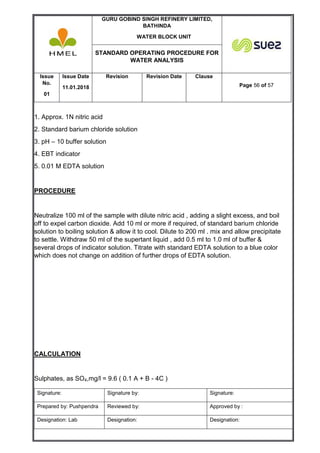
1. Approx. 1N nitric acid
2. Standard barium chloride solution
3. pH – 10 buffer solution
4. EBT indicator
5. 0.01 M EDTA solution
PROCEDURE
Neutralize 100 ml of the sample with dilute nitric acid , adding a slight excess, and boil
off to expel carbon dioxide. Add 10 ml or more if required, of standard barium chloride
solution to boiling solution & allow it to cool. Dilute to 200 ml . mix and allow precipitate
to settle. Withdraw 50 ml of the supertant liquid , add 0.5 ml to 1.0 ml of buffer &
several drops of indicator solution. Titrate with standard EDTA solution to a blue color
which does not change on addition of further drops of EDTA solution.
CALCULATION
Sulphates, as SO4,mg/l = 9.6 ( 0.1 A + B - 4C )
GURU GOBIND SINGH REFINERY LIMITED,
BATHINDA
WATER BLOCK UNIT
STANDARD OPERATING PROCEDURE FOR
WATER ANALYSIS
Issue
No.
01
Issue Date
11.01.2018
Revision Revision Date Clause
Page 57 of 57
Signature: Signature by: Signature:
Prepared by: Pushpendra Reviewed by: Approved by :
Designation: Lab Designation: Designation:
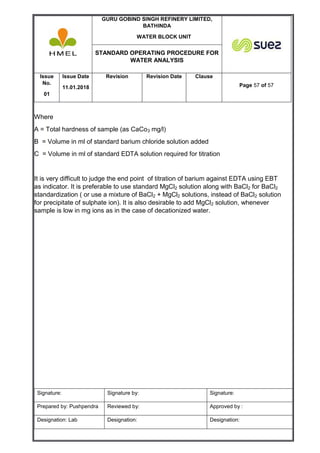
Where
A = Total hardness of sample (as CaCo3 mg/l)
B = Volume in ml of standard barium chloride solution added
C = Volume in ml of standard EDTA solution required for titration
It is very difficult to judge the end point of titration of barium against EDTA using EBT
as indicator. It is preferable to use standard MgCl2 solution along with BaCl2 for BaCl2
standardization ( or use a mixture of BaCl2 + MgCl2 solutions, instead of BaCl2 solution
for precipitate of sulphate ion). It is also desirable to add MgCl2 solution, whenever
sample is low in mg ions as in the case of decationized water.

Sop water analysis-2

  • 1.
    GURU GOBIND SINGHREFINERY LIMITED, BATHINDA WATER BLOCK UNIT STANDARD OPERATING PROCEDURE FOR WATER ANALYSIS Issue No. 01 Issue Date 11.01.2018 Revision Revision Date Clause Page 1 of 57 Signature: Signature by: Signature: Prepared by: Pushpendra Reviewed by: Approved by : Designation: Lab Designation: Designation: PURPOSE : To determine Total Hardness of water SCOPE : All types of water RESPONSIBILITY : Chemist DESCRIPTION : As follows SUMMARY OF METHOD: -  In alkaline medium, EDTA reacts with Ca and Mg to form a chelated complex, Ca and Mg develop(Pink Red) Colour with Eriochrome black “T” under alkaline condition. When EDTA is added as a titrate, Ca and Mg divalent ions get complexes resulting in a sharp colour change from (Pink Red) to blue, which indicates end point of titration. The pH for this titration has to be maintained at 10.0 ± 0.1. APPARTUS: -  Conical flask, measuring cylinder REAGENTS: -  Eriochrome black T indicator: - Mix 0.5gm Eriochrome black T in 100ml methanol OR triethanolamine.
  • 2.
    GURU GOBIND SINGHREFINERY LIMITED, BATHINDA WATER BLOCK UNIT STANDARD OPERATING PROCEDURE FOR WATER ANALYSIS Issue No. 01 Issue Date 11.01.2018 Revision Revision Date Clause Page 2 of 57 Signature: Signature by: Signature: Prepared by: Pushpendra Reviewed by: Approved by : Designation: Lab Designation: Designation:  Ammonia Buffer Solution: - 67.5 gm ammonium Chloride in 570ml. NH4OH or Ammonia solution and dilute to 1 liter with distilled water.  0. 2N (EDTA) Ethylenediamine Tetra Acetic Acid: - Dissolve 37.22gm of EDTA (Dried at 600 C.) in 250ml. distilled water and make up to 1 liter with distilled water .  0.02N EDTA: - Dissolve 100ml. 0.2N EDTA solution in 900ml. Distilled water. STANDARDISATION OF EDTA: -  Take 25ml. of EDTA solution in 250ml. conical flask and dilute it with 50ml. DM water and 2ml.Ammonia buffer. Add 2-3 drops of Eriochrome Black T indicator. Titrate with 0. 2 N standard Zinc solution for the colour change from blue to violet. Normality = Vol. Of std. Zinc solution x N / Volume of EDTA solution. Where  N = Normality of Zinc solution : 0.2N STD. ZINC SOLUTION -  Take about 10.0gm granulated Zinc, wash it with dilute HCl, then weigh accurately 6.5370 gm of dilute hydrochloric acid and make up the volume to 1.0 liter volumetric flask with DM water. PROCEDURE: -
  • 3.
    GURU GOBIND SINGHREFINERY LIMITED, BATHINDA WATER BLOCK UNIT STANDARD OPERATING PROCEDURE FOR WATER ANALYSIS Issue No. 01 Issue Date 11.01.2018 Revision Revision Date Clause Page 3 of 57 Signature: Signature by: Signature: Prepared by: Pushpendra Reviewed by: Approved by : Designation: Lab Designation: Designation:  Take 100ml of sample in a conical flask.  Add 4ml Ammonia Buffer solution.  Add 3-4 drops of Eriochrome Black T and titrate with std. EDTA (0.02N) till red Colour change to blue. Note down the vol. of EDTA consumed. CACULATION: - (as CaCO3 ppm)  Total Hardness = V x equiv. Wt of CaCO3 x N x1000 / Vol. Of sample  OR  TH = V x 10 ppm Where V = Vol. of EDTA consumed and N = Normality of EDTA
  • 4.
    GURU GOBIND SINGHREFINERY LIMITED, BATHINDA WATER BLOCK UNIT STANDARD OPERATING PROCEDURE FOR WATER ANALYSIS Issue No. 01 Issue Date 11.01.2018 Revision Revision Date Clause Page 4 of 57 Signature: Signature by: Signature: Prepared by: Pushpendra Reviewed by: Approved by : Designation: Lab Designation: Designation: PURPOSE : To determine the pH of water SCOPE : All types of water RESPONSIBILITY : Chemist DESCRIPTION : As follows pH measurement plays a very important role in the water chemistry. pH is Defined as the negative logarithm of the hydrogen ion concentration (to the Base 10) pH = log10[H + ] pH range is 0-14. An acidic solution is the one in which pH is < 7 where an alkaline solution is the one in which pH is > 7. A neutral solution has a pH of 7. In a neutral solution the hydrogen ion & hydroxide ion concentrations are equal & each corresponds to 107 moles/litre. pH MEASUREMENT USE OF pH METER: - An accurate pH measurement is possible with the help of pH meter. A general Procedure for pH measurement using any standard pH meter
  • 5.
    GURU GOBIND SINGHREFINERY LIMITED, BATHINDA WATER BLOCK UNIT STANDARD OPERATING PROCEDURE FOR WATER ANALYSIS Issue No. 01 Issue Date 11.01.2018 Revision Revision Date Clause Page 5 of 57 Signature: Signature by: Signature: Prepared by: Pushpendra Reviewed by: Approved by : Designation: Lab Designation: Designation: is as follows:  Switch on & allow the instrument to warm up.  If the instrument is equipped with a manual temperature control, take the temperature of the solution &set the temp. Control to this value. If automatic temp. Compensation probe is available, and then dip the temp. Probe & the pH electrode assembly in a water sample contained in a small beaker.  Ensure that the pH meter is calibrated using buffer solution prior to the pH measurement.  Read the pH of the solution & note down the pH reading along with its temp. .  Remove the electrode etc., rinse in distilled water, & leave standing in distilled water.
  • 6.
    GURU GOBIND SINGHREFINERY LIMITED, BATHINDA WATER BLOCK UNIT STANDARD OPERATING PROCEDURE FOR WATER ANALYSIS Issue No. 01 Issue Date 11.01.2018 Revision Revision Date Clause Page 6 of 57 Signature: Signature by: Signature: Prepared by: Pushpendra Reviewed by: Approved by : Designation: Lab Designation: Designation: PURPOSE : To determine Conductivity of water SCOPE : All types water RESPONSIBILITY : Chemist DESCRIPTION : As follows PRINCIPAL OF CONDUCTIVITY MEASUREMENT: - A conductivity cell dipped in a measuring solution placed in the inverting input path of an “Operational Amplifier” (Op. Amp.) when an external. Voltage of fixed amplitude and suitable frequency is applied to the system, then for a given feedback resistance, the output voltage is linearly proportional to the conductance of the solution. OPERATING PROCEDURE: - An accurate conductivity measurement is possible with the help of Conductivity meter. A general procedure for an accurate conductivity measurement is possible with the help of conductivity meter.
  • 7.
    GURU GOBIND SINGHREFINERY LIMITED, BATHINDA WATER BLOCK UNIT STANDARD OPERATING PROCEDURE FOR WATER ANALYSIS Issue No. 01 Issue Date 11.01.2018 Revision Revision Date Clause Page 7 of 57 Signature: Signature by: Signature: Prepared by: Pushpendra Reviewed by: Approved by : Designation: Lab Designation: Designation: A general Procedure for conductivity measurement using any standard conductivity meter is as follows:  Switch on & allow the instrument to warm up.  If the instrument is equipped with a manual temperature control, take the temperature of the solution &set the temp. Control to this value. If automatic temp. Compensation probe is available, and then dip the temp. Probe & the conductivity electrode assembly in a water sample contained in a small beaker.  Ensure that the conductivity meter is calibrated using buffer solution prior to the conductivity measurement.  Read the conductivity of the solution & note down the conductivity reading along with its temp. .  Remove the electrode etc., rinse in distilled water, & leave standing in distilled water. PURPOSE : To determine P and M Alkalinity of water SCOPE : All types of water
  • 8.
    GURU GOBIND SINGHREFINERY LIMITED, BATHINDA WATER BLOCK UNIT STANDARD OPERATING PROCEDURE FOR WATER ANALYSIS Issue No. 01 Issue Date 11.01.2018 Revision Revision Date Clause Page 8 of 57 Signature: Signature by: Signature: Prepared by: Pushpendra Reviewed by: Approved by : Designation: Lab Designation: Designation: RESPONSIBILITY : Chemist DESCRIPTION : As follows APPARATUS: -  Conical flask 250ml. Measuring cylinder 100ml. REAGENTS: - 1. STANDARD H2SO4 0.02N: -Prepare 0.1N H2SO4 by add 2.75ml. Of conc. H2SO4 in little dm water and make up volume to 1 liter with dm water. Take 20ml. 0.1N H2SO4 & dilute to 1000ml. with DM water to prepare standard 0.02N H2SO4. METHOD OF STANDARDIZATION: -  Weigh exactly 0.02-1.0gm of dried Sodium Carbonate in a conical flask and dissolve it in little DM water and add 2-3 drops of mixed indicator and titrate with H2SO4 solution to be standardized for the Colour change green to red. Normality of H2SO4 = (Wt. of Na2CO3 * 1000)/vol. of H2SO4 * 53 PHYNOLPHTHELEIN INDICATOR: -  Dissolve 2.5gm of Phenolphthalein in 100ml. Ethyl Alcohol and dilute with DM water to 250ml. Add drop wise 0.02N NaOH till faint pink Colour appears. METHYL ORANGE INDICATOR: -  Dissolve 1.0gm Methyl orange indicator in DM water and dilute it to 1.0 liter with Dm water and filter out the undissoved portion.
  • 9.
    GURU GOBIND SINGHREFINERY LIMITED, BATHINDA WATER BLOCK UNIT STANDARD OPERATING PROCEDURE FOR WATER ANALYSIS Issue No. 01 Issue Date 11.01.2018 Revision Revision Date Clause Page 9 of 57 Signature: Signature by: Signature: Prepared by: Pushpendra Reviewed by: Approved by : Designation: Lab Designation: Designation: MIXED INDICATOR: -  Dissolved 0.3gm Bromocresol Green and 0.2gm Methyl Red indicator in 400ml. Methanol. PROCEDURE: - 1. Take 100ml sample. 2. Add 2-3 drops of Phenolphthalein indicator. 3. If pink Colour develops titrate with 0.02N H2SO4 Till it disappear P Alkalinity (ppm) as CaCO3 = (V1 * 1000) / volume of sample V1= ml. of H2SO4 required for titration. 4. Add 2-3 drops Methyl Orange to the same flask and titrate with 0.02N H2SO4 till it Yellow Colour changes to Orange. M Alkalinity or Total Alkalinity (ppm) = (V2 * 1000) / volume of sample Where V2 = ml. of H2SO4 required for total titration.
  • 10.
    GURU GOBIND SINGHREFINERY LIMITED, BATHINDA WATER BLOCK UNIT STANDARD OPERATING PROCEDURE FOR WATER ANALYSIS Issue No. 01 Issue Date 11.01.2018 Revision Revision Date Clause Page 10 of 57 Signature: Signature by: Signature: Prepared by: Pushpendra Reviewed by: Approved by : Designation: Lab Designation: Designation: PURPOSE : To determine the total Silica of water SCOPE : All types of water RESPONSIBILITY : Chemist DESCRIPTION : As follows SUMMARY OF TEST METHOD: - This test method is based on the reaction of the soluble silica with molybdate ion to from a greenish yellow complex, which in turn is converted to a blue complex by reduction with 1- amino-2-naphthol-1-sulfonic acid. APPARATUS: - 1.0 Spectrophotometer: - To obtain maximum sensitivity and reproducibility, a spectrophotometer suitable for measurement at 815 nm is required. Measurement may be made at 640 nm with a spectrophotometer. 2.0 Sample Cell: - The cell size to be used depends on the range covered and the particular instrument used. The higher concentration range should be attainable with 10-mm path length cell. Longer path length cell (40 to50 nm) is recommended for concentration below 0.1 mg/l.
  • 11.
    GURU GOBIND SINGHREFINERY LIMITED, BATHINDA WATER BLOCK UNIT STANDARD OPERATING PROCEDURE FOR WATER ANALYSIS Issue No. 01 Issue Date 11.01.2018 Revision Revision Date Clause Page 11 of 57 Signature: Signature by: Signature: Prepared by: Pushpendra Reviewed by: Approved by : Designation: Lab Designation: Designation: 3.0 REAGENTS: - 3.1 Amino-Naphthol-Sufonic Acid Solution: - Dissolve 0.5gm of 1-Amino-2- Naphthol-4-Sulfonic acid in 50ml of a solution containing 1gm of Sodium sulfite. After dissolving, add the solution to100ml of containing 30gm of Sodium Hydrogen Sulfite. Make up to 200ml and store in a dark, plastic bottle. Shelf life of this reagent may be extended by refrigeration. Solution should be adjusted to room temperature 25 ± 5ºC, before use. Discard when the Colour darkens or a precipitate forms. 3.2 Ammonium Molybdate Solution (75gm/L): - dissolve 7.5gm of Ammonium Molybdate in 100ml of dm water. 3.3 Hydrochloric Acid (1:1): - mix 1 volume of concentrated Hydrochloric Acid (HCl, sp gr 1.19) with 1 volume of dm water. 3.4 Oxalic acid solution (100gm/L): - Dissolve 10gm of Oxalic Acid in 100ml of dm water. 3.5 Silica solution standard (1ml = 0.1 mg SiO2): - dissolve 0.473gm of Sodium Metasilicate in dm water and dilute to 1 liter. PREPARATION OF CALIBRATION CURVE: - Prepare a series of at least four standards covering the concentration range by proper dilution of the standard silica solution. Treat 50ml aliquots of the standard. Prepare a blank using a 50ml aliquot of water that has been similarly treated. Prepare a calibration curve for lower silica(0.02-0.14) measurement at 815 nm by plotting absorbance versus ppm SiO2 on linear graph paper. For higher silica (0.5- 2.5) measurements at 640 nm, plot absorbance versus ppm SiO2.
  • 12.
    GURU GOBIND SINGHREFINERY LIMITED, BATHINDA WATER BLOCK UNIT STANDARD OPERATING PROCEDURE FOR WATER ANALYSIS Issue No. 01 Issue Date 11.01.2018 Revision Revision Date Clause Page 12 of 57 Signature: Signature by: Signature: Prepared by: Pushpendra Reviewed by: Approved by : Designation: Lab Designation: Designation: PROCEDURE: - Prepare calibration standards by diluting appropriate aliquots of Silica standard stock sol. of 100 ppm, Add 0.5, 1.0, 1.5, 2.0 & 2.5ml. of standard Silica sol. into 100 ml. volumetric flask and make up to 100ml by DM water. This series of sol. Corresponds contains 0.5, 1.0, 1.5, 2.0 & 2.5 ppm of Silica respectively. Transfer quantitavely 50ml (or an aliquot dilute to 50ml) of the sample/standard to a polyethylene or other suitable plastic container and add, in quick succession, 1 ml of HCl (1:1) and 2ml of the Ammonium Molybdate solution. Mix well. After exactly 5 minutes, add 1.5ml of Oxalic acid solution and again mix well. After 1minutes, add 2ml of Amino-Naphthol-Sufonic Acid Solution. Mix well and allow standing for 10 minutes. Prepare a reagent blank by treating a 50ml aliquot of water as directed in 1to3. Measure the absorbance of the sample at 815 nm against the reagent blank (or at 640 nm for higher concentration). CALCULATION: - Silica concentration in ppm SiO2 may be read directly from calibration Curve at 815 nm. For higher silica measurements made at 640 nm,Silica concentration may be read directly in ppm as SiO2 from The calibration curve.
  • 13.
    GURU GOBIND SINGHREFINERY LIMITED, BATHINDA WATER BLOCK UNIT STANDARD OPERATING PROCEDURE FOR WATER ANALYSIS Issue No. 01 Issue Date 11.01.2018 Revision Revision Date Clause Page 13 of 57 Signature: Signature by: Signature: Prepared by: Pushpendra Reviewed by: Approved by : Designation: Lab Designation: Designation: PURPOSE : To determine Hydrazine in water SCOPE : Water RESPONSIBILITY : Chemist DESCRIPTION : As follows SUMMARY OF METHOD Para Di Methyl Amino Benzaldehyde produces a specific yellow reaction product with hydrazine. The intensity of the yellow Colour is proportional to the amount of hydrazine in water.
  • 14.
    GURU GOBIND SINGHREFINERY LIMITED, BATHINDA WATER BLOCK UNIT STANDARD OPERATING PROCEDURE FOR WATER ANALYSIS Issue No. 01 Issue Date 11.01.2018 Revision Revision Date Clause Page 14 of 57 Signature: Signature by: Signature: Prepared by: Pushpendra Reviewed by: Approved by : Designation: Lab Designation: Designation: APPARATUS: - 1. Spectrophotometer: - To obtain maximum sensitivity and reproducibility, a spectrophotometer suitable for measurement at 458 nm. 2. Sample Cell: - The cell size to be used depends on the range covered and the particular instrument used. The higher concentration range should be attainable with 10-mm path length cell. Longer path length cell (40 to50 nm) is recommended for concentration below 0.1 mg/l. REAGENTS: - 1. Hydrazine Standard Solution (1ml=0.1mg): - Dissolve 0.328gm of Hydrazine Di Hydrochloride in 100ml of water and 10ml of HCl. Dilute with water to 1 liter in a volumetric flask and mix. Take 10ml. of above sol. And make up to 1000ml by DM water (10ppm). 2. Hydrochloric Acid: - Concentrated Hydrochloric Acid 3. Hydrochloric Acid (1:9): - Mix 1 volume of HCl with 9 volume of water. 4. Hydrochloric Acid (1:99): - Mix 1 volume of HCl with 99 volume of water. 5. Para Di Methyl Amino Benzaldehyde Solution: - Dissolve 4gm of Para Di Methyl Amino Benzaldehyde in 200ml of Methyl Alcohol and 20 ml of HCl. Store in a bottle out of direct sunlight.
  • 15.
    GURU GOBIND SINGHREFINERY LIMITED, BATHINDA WATER BLOCK UNIT STANDARD OPERATING PROCEDURE FOR WATER ANALYSIS Issue No. 01 Issue Date 11.01.2018 Revision Revision Date Clause Page 15 of 57 Signature: Signature by: Signature: Prepared by: Pushpendra Reviewed by: Approved by : Designation: Lab Designation: Designation: SAMPLING: - Analyze the sample as soon after collection as practicable, since hydrazine undergoes auto-oxidation as well as oxidation by oxidizing agent. Such agent may Be in the sample or may enter the sample from the atmosphere. If it suspected that oxidation of the hydrazine in the sample is occurring in the interval between Collection and analysis, or if the sample is not be analyzed immediately collect under acid. CALIBRATION: - Prepare calibration standards by diluting appropriate aliquots of hydrazine standard stock sol. of 10 ppm, Add 0.2,0.4,0.6,0.8 & 1.0ml. of standard hydrazine sol. Into 100 ml. volumetric flask and make up to 100ml by DM water. This series of sol. Corresponds contains 0.02,0.04,0.06,0.08 & 1.0 ppm of hydrazine respectively. PROCEDURE: - 1. To a 100ml beaker, flask or cylinder, add from a burette exactly 5.0ml of HCl (1:9), 2. Add water from a graduated burette or pipette to make a final volume of exactly 50ml and mix. Add 10ml of Para Di Methyl Amino Benzaldehyde solution with a pipette, and mix. Let the mixture stand at least 10 minutes and not more than 100 minutes. 3. Prepare blank & standard by treating a 50ml aliquot of water as directed in 1 & 2. 4. Measure the absorbance of the sample at 458 nm against the reagent blank. 5. Hydrazine concentration in ppm may be read directly from calibration curve at 458 nm.
  • 16.
    GURU GOBIND SINGHREFINERY LIMITED, BATHINDA WATER BLOCK UNIT STANDARD OPERATING PROCEDURE FOR WATER ANALYSIS Issue No. 01 Issue Date 11.01.2018 Revision Revision Date Clause Page 16 of 57 Signature: Signature by: Signature: Prepared by: Pushpendra Reviewed by: Approved by : Designation: Lab Designation: Designation:
  • 17.
    GURU GOBIND SINGHREFINERY LIMITED, BATHINDA WATER BLOCK UNIT STANDARD OPERATING PROCEDURE FOR WATER ANALYSIS Issue No. 01 Issue Date 11.01.2018 Revision Revision Date Clause Page 17 of 57 Signature: Signature by: Signature: Prepared by: Pushpendra Reviewed by: Approved by : Designation: Lab Designation: Designation: PURPOSE : To determine Ortho Phosphate in water SCOPE : All types of water RESPONSIBILITY : Chemist DESCRIPTION : As follows PRINCIPAL: - Ammonium molybdate react with phosphate to from molybdophosphoric acid, which is reduced to blue coloured complex ‘molybdenum blue’ by the addition of stannous chloride . REAGENTS: - 1. Ammonium Molybdate Solution: - (a) Dissolve 25gm Ammonium Molybdate in about 200ml distilled water. (b) Add carefully 280ml conc. Sulphuric acid to 400ml distilled water and cool. Add (a) & (b) and dilute to 1000ml. 2. Stannous Chloride Solution: - Dissolve 2.5gm – fresh Stannous Chloride in 100ml glycerol and heat in a water bath. Mix by stirring with a glass rod. This reagent is stable and requires no special storage.
  • 18.
    GURU GOBIND SINGHREFINERY LIMITED, BATHINDA WATER BLOCK UNIT STANDARD OPERATING PROCEDURE FOR WATER ANALYSIS Issue No. 01 Issue Date 11.01.2018 Revision Revision Date Clause Page 18 of 57 Signature: Signature by: Signature: Prepared by: Pushpendra Reviewed by: Approved by : Designation: Lab Designation: Designation: 3. Phosphate Stock Solution (50 ppm): - Dissolve 0.716gm anhydrous Potassium di Hydrogen Phosphate in distilled water and make up to 1000ml in a volumetric flask. Dilute 100ml of solution to 1 litre. 1ml of this solution = 0.05mg of phosphate (as PO4) PROCEDURE: - Important Note: Do not use synthetic detergents containing Phosphate for cleaning of the glassware’s. Use only acid solutions. Preparation of standard calibration curve: Prepare calibration standards by diluting appropriate aliquots of phosphate standard stock sol. Of 50ppm Add 4, 8, 12, 16, 20,24 & 28 ml. of standard phosphate sol. Into 100 ml. volumetric flask and make up to 100ml by DM water. This series of sol. Corresponds contains 2, 4,6,8,10,12 &14 ppm of phosphate respectively. 1. To the blank, standard and sample add 4.0ml ammonium molybdate solution and 0.5ml stannous chloride solution, mixing after each addition.
  • 19.
    GURU GOBIND SINGHREFINERY LIMITED, BATHINDA WATER BLOCK UNIT STANDARD OPERATING PROCEDURE FOR WATER ANALYSIS Issue No. 01 Issue Date 11.01.2018 Revision Revision Date Clause Page 19 of 57 Signature: Signature by: Signature: Prepared by: Pushpendra Reviewed by: Approved by : Designation: Lab Designation: Designation: 2. After 10 minutes but before 12 minutes, measure the Colour using a spectrophotometer at 690nm. (732nm) 3. Prepare a calibration curve and read directly the ppm of PO4 at 690 nm.
  • 20.
    GURU GOBIND SINGHREFINERY LIMITED, BATHINDA WATER BLOCK UNIT STANDARD OPERATING PROCEDURE FOR WATER ANALYSIS Issue No. 01 Issue Date 11.01.2018 Revision Revision Date Clause Page 20 of 57 Signature: Signature by: Signature: Prepared by: Pushpendra Reviewed by: Approved by : Designation: Lab Designation: Designation: PURPOSE : To determine total oil & grease in water SCOPE : All types of water RESPONSIBILITY : Chemist DESCRIPTION : As follows OUTLINE OF METHOD: The oils and grease are extracted by an organic solvent. The solvent is distilled off and the weight of the extracted matter determined. Some extractable, especially unsaturated fats and fatty acids, oxidize rapidly: hence, special precautions regarding temperature and solvent vapour displacement are necessary to minimize the effect. PROCEDURE: - 1. Place the sample, usually 1 litre, in a separating funnel of sufficient size to allow the addition of acid and solvent, and still have space for proper agitation. Acidify the sample with dilute hydrochloric acid, 5 ml/litre. Rinse the sample bottle carefully with 15ml of petroleum ether and add the ether washing to the separating funnel. Add an additional 25ml of ether to the separating funnel. Shake vigorously for 2 minutes. Allow the ether layer to separate. Withdraw the aqueous portion of the sample into a clean container, and transfer the solvent layer into a clean, tared distilling flask. If a clear ether layer cannot be obtained, filter the solvent layer in to the tared distilling flask through a funnel containing
  • 21.
    GURU GOBIND SINGHREFINERY LIMITED, BATHINDA WATER BLOCK UNIT STANDARD OPERATING PROCEDURE FOR WATER ANALYSIS Issue No. 01 Issue Date 11.01.2018 Revision Revision Date Clause Page 21 of 57 Signature: Signature by: Signature: Prepared by: Pushpendra Reviewed by: Approved by : Designation: Lab Designation: Designation: an ether moistened filter paper (What man No. 40 or equivalent). The filter paper should be washed with petroleum either after folding to avoid inclusion of skin oil. Use as small as funnel and filter paper as practical. 2. While transferring the solvent layer from the separating funnel, a small quantity of it remains at the stem of the separating funnel: it is advisable to wash it with a few milliliters of the solvent and to add the washings to the solvent layer. Return the aqueous portion of the sample to the separating funnel, rinsing the container with 15ml of ether. Add the ether washings and an additional 25 ml of ether to separating funnel, and agitate for another 2 minutes. Allow the solvent layer to separate and discard the aqueous phase. Add the ether extract to the tared distilling flask and rinse the separating funnel with 20 ml of ether. Add the ether washing to the tared distilling flask. After all the ether from the two extraction and the final rinsing are included. Wash down the funnel and filter paper twice with fresh 5ml increments of petroleum ether. 3. Distill off or evaporate all but approximately 10ml of the ether extract on water bath or an electric-heating mantle, observing necessary safety precaution and keeping the heat source at about 70o C. Disconnect the condenser and boil off the remaining solvent from the tared flask at the same temperature. Dry on a water-bath or steam bath. When dry, lay the flask on its side to facilitate the removal of solvent vapour. Cool in a desicator for 30 minutes and weigh. Using condenser is necessary only if solvent is to be recovered. CALCULATION: - Oils & Grease, mg/litre = (1000 * W) / V Where W = Weight in mg. Of the residue in the flask, and V = Volume in ml. of the sample taken for the test Express the result to the nearest milligram.
  • 22.
    GURU GOBIND SINGHREFINERY LIMITED, BATHINDA WATER BLOCK UNIT STANDARD OPERATING PROCEDURE FOR WATER ANALYSIS Issue No. 01 Issue Date 11.01.2018 Revision Revision Date Clause Page 22 of 57 Signature: Signature by: Signature: Prepared by: Pushpendra Reviewed by: Approved by : Designation: Lab Designation: Designation:
  • 23.
    GURU GOBIND SINGHREFINERY LIMITED, BATHINDA WATER BLOCK UNIT STANDARD OPERATING PROCEDURE FOR WATER ANALYSIS Issue No. 01 Issue Date 11.01.2018 Revision Revision Date Clause Page 23 of 57 Signature: Signature by: Signature: Prepared by: Pushpendra Reviewed by: Approved by : Designation: Lab Designation: Designation: PURPOSE : To determine COD in water SCOPE : All types of water RESPONSIBILITY : Chemist DESCRIPTION : As follows CHEMICAL OXYGEN DEMAND Apparatus : A flate bottomed reflux flask of 500ml capacity with a ground glass 24/24 (b-24) neck and any one of the condensers. Reagents: 1 Mercuric Sulfate Crystals. 2 Sulfuric acid – Silver sulfate reagent: Dissolve 10.1 gm silver sulfate in 1000ml con. Sulfuric acid. About 2days will be required for dissolution. 3 Potassium dichromate 0.25N: Dissolve 12.258gm potassium dichromate (Previously dried at 1030 C for 2 hrs) in distilled water and make upto 1000ml in volumetric flask.
  • 24.
    GURU GOBIND SINGHREFINERY LIMITED, BATHINDA WATER BLOCK UNIT STANDARD OPERATING PROCEDURE FOR WATER ANALYSIS Issue No. 01 Issue Date 11.01.2018 Revision Revision Date Clause Page 24 of 57 Signature: Signature by: Signature: Prepared by: Pushpendra Reviewed by: Approved by : Designation: Lab Designation: Designation: 4 Potassium dichromate 0.025N: Pipette 50ml of 0.25N Potassium dichromate solution in to 500ml volumetric flask and make upto the mark with distilled water. 5 Ferrion indicator: Dissolve 695mg ferrous sulfate and 1.485gm 1,10- phenanthroline monohydrate together in distilled water and dilute to 100ml. 6 Ferrous Ammonium Sulfate 0.1N: Dissolve 39.29gm Ferrous ammonium sulfate in distilled water. Add 20ml conc. Sulfuric acid. Cool and make upto 1000ml in volumetric flask. 7 Standardization of Ferrous Ammonium Sulfate 0.1N: Pipette 10ml 0.25N Potassium dichromate solution in to 250ml conical flask. Dilute to 100ml add 30ml conc. H2SO4 and cool to room temperature. Add 2 to 5 drops of ferroin indicator and titrate with ferrous ammonium sulfate solution. The end point is the color change from blue green to reddish brown. 8 Ferrous Ammonium Sulfate 0.01N: Pipette 50ml of 0.1N ferrous ammonium sulfate solution in to 500ml volumetric flask and make upto the mark with distilled water. PROCEDURE: Precaution: Do not use de-ionized water for dilution as this may lead to high results because of the organic matter content. 1 Shake the sample well, so that the contents are mixed thoroughly. 2 Place 50 ml or an aliquot in reflux flask. Add mercuric sulfate according to the chloride concentration of the aliquot (i.e.) a ratio of 1:10 chloride: mercuric sulfate has to be added. 3 Measure suitable amount of sulfuric acid- silver sulfate reagent in a measuring cylinder. The amount is equal to the sum of sample volume and dichromate volume. From this amount, initially transfer carefully and slowly 5ml only to
  • 25.
    GURU GOBIND SINGHREFINERY LIMITED, BATHINDA WATER BLOCK UNIT STANDARD OPERATING PROCEDURE FOR WATER ANALYSIS Issue No. 01 Issue Date 11.01.2018 Revision Revision Date Clause Page 25 of 57 Signature: Signature by: Signature: Prepared by: Pushpendra Reviewed by: Approved by : Designation: Lab Designation: Designation: reflux flask and mix thoroughly to dissolve the mercuric sulfate. Cool While mixing to avoid possible loss of volatile matter in the sample. 4 Pipette a pre-determined quantity of potassium dichromate solution into the flask and mix well. Use 0.25N Potassium dichromate solution for samples having a COD of 50mg/l or more and use 0.025N Potassium dichromate solution for having a COD of less than 50mg/l. 5 Carefully add the remaining sulfuric acid- silver sulfate reagent in the measuring cylinder to the reflux flask, a little quantity at a time, cooling the flask simultaneously under tap. 6 Add a few antidumping granules and place the flask in position. Attach the condenser and start the cooling water. Reflux for 2 hrs or for a suitable small period as required. 7 Remove the flame, allow to flask to cool and wash the condenser with distilled water into the flask. 8 Transfer the contents of the flask to a 500ml conical flask and dilute appropriately with distilled water and cool it well. The final volume after dilution should be about 2.5 times the volume of sample + dichromate + H2SO4. 9 Add 2 to 3 drops of ferroin indicator and titrate with 0.1N ferrous ammonium sulfate solution. The end point is the sharp co lour change from blue green to reddish brown. 10 Conduct a blank using distilled water in place of sample. Note the titrate value. 11 Standardize the ferrous ammonium sulfate solution, on each day of determination.
  • 26.
    GURU GOBIND SINGHREFINERY LIMITED, BATHINDA WATER BLOCK UNIT STANDARD OPERATING PROCEDURE FOR WATER ANALYSIS Issue No. 01 Issue Date 11.01.2018 Revision Revision Date Clause Page 26 of 57 Signature: Signature by: Signature: Prepared by: Pushpendra Reviewed by: Approved by : Designation: Lab Designation: Designation: Calculation: (Blank titrate value – sample titrate value) * Normality of ferrous ammonium sulfate* 8 * 1000 ml sample taken for determination
  • 27.
    GURU GOBIND SINGHREFINERY LIMITED, BATHINDA WATER BLOCK UNIT STANDARD OPERATING PROCEDURE FOR WATER ANALYSIS Issue No. 01 Issue Date 11.01.2018 Revision Revision Date Clause Page 27 of 57 Signature: Signature by: Signature: Prepared by: Pushpendra Reviewed by: Approved by : Designation: Lab Designation: Designation: PURPOSE : To determine total BOD in water SCOPE : All types of water RESPONSIBILITY : Chemist DESCRIPTION : As follows PRINCIPLE: Biochemical Oxygen Demand is the quantity of oxygen required by a definite volume of the liquid effluent for oxidizing the organic matter contained in it by micro- organisms under specified conditions. For its determination, the dissolved oxygen content of the sample, with or without dilution, is measured before and after incubation at 200 C for 5 days. Apparatus: Glass stopped bottled, narrow neck bottles of about 300ml capacity, with suitable water sealing. Reagents: 1 Sodium Hydroxide Solution – approximately 1N.
  • 28.
    GURU GOBIND SINGHREFINERY LIMITED, BATHINDA WATER BLOCK UNIT STANDARD OPERATING PROCEDURE FOR WATER ANALYSIS Issue No. 01 Issue Date 11.01.2018 Revision Revision Date Clause Page 28 of 57 Signature: Signature by: Signature: Prepared by: Pushpendra Reviewed by: Approved by : Designation: Lab Designation: Designation: 2 Hydrochloric acid -1N. 3 Sodium Sulfite Solution – Dissolve 1.5gm of anhydrous sodium sulfite in 1 litre of water. Prepare fresh solution daily for use. 4 Dilution water – Distilled water of good quality, free from metals particularly copper and aerated. 5 Phosphate buffer solution – Dissolve 8.5gm of Potassium di hydrogen phosphate (kh2po4), 21.75gm of Di Potassium hydrogen phosphate (k2hpo4), 33.4gm of di sodium hydrogen phosphate hepta hydrate (na2hpo4.7h2o) and 1.7gm of ammonium chloride in about 500ml of water and dilute to 1 liter. The pH of this solution should be 7.2. 6 Magnesium Sulfate Solution – Dissolve 22.5gm of magnesium sulfate hepta hydrate (mgso4.7h2o) in water and dilute to 1 litre. 7 Calcium Chloride Solution – Dissolve 27.5gm of anhydrous calcium chloride in water and dilute to 1 litre. 8 Ferric Chloride Solution – Dissolve 0.25gm of ferric chloride (FeCl3.6H2O) in water and dilute to 1 litre. 9 Seeding Material – Supernatant liquor of domestic sewage stored for 24 to36 hours at 200 C. In the case of industrial effluent containing organic compounds which are not easily oxidised by sewage seed, the receiving water collected about 3.5 km below the discharge point may be used. Procedure:
  • 29.
    GURU GOBIND SINGHREFINERY LIMITED, BATHINDA WATER BLOCK UNIT STANDARD OPERATING PROCEDURE FOR WATER ANALYSIS Issue No. 01 Issue Date 11.01.2018 Revision Revision Date Clause Page 29 of 57 Signature: Signature by: Signature: Prepared by: Pushpendra Reviewed by: Approved by : Designation: Lab Designation: Designation: 1 Sample containing acidity or caustic alkalinity should be neutralized to pH about 7.00 with sodium hydroxide solution or hydrochloric acid respectively by adding a predetermined quantity. 2 Samples containing residual chlorine or chloramines should be dechlorinated if chlorine is not dissipated on standing for 2 hours. To dechlorinates, first determine the quantity of sodium sulfite solution required for known aliquot of the sample by titration to starch-iodide end point after acidifying the sample with acetic acid (1:1) or sulfuric acid (1:50) followed by 10ml of 10 percent potassium iodide solution. The add to the requisite volume of the sample the predetermined quantity of sodium sulfite, avoiding any excess, and check for the absence of chlorine after 20 minutes. 3 Samples containing toxic substances in large amounts would require special treatment. However, the effect of small amount may be overcome by using the proper dilution so that toxicity is removed and the maximum BOD value is obtained. If increasing dilution show increasing BOD, the dilution should be increased to level where BOD level off at a maximum. 4 Store the dilution water at 20 Deg. C and use when near that temperature. Take the desired volume of dilution water required for the test sample and add , for ever 1 litre of water, 1 ml each of phosphate buffer solution, magnesium sulphate solution , calcium chloride solution and ferric chloride solution. Seed the dilution with seeding material . The quantity of seeding material (0.1 to 1 percent of settled sewage or 1 to 5 percent receiving water) added should be such that oxygen depletion in the dilution water control is between 0.2 and 0.8 mg/L after incubation at 20 Deg. C for 5 days. 5 Prepare as follows several dilution’s of the sample (usually 0.1 to 1.0 percent for strong industrial effluents and 5 to 25 percent for treated effluent) so as to obtain a depletion of a least 2 mg/L of dissolved oxygen after incubation for 5 days. In the case of dilution greater than 1 : 100 prepare a 10 percent primary dilution in a volumetric flask and from this make the final dilutions. 6 Siphon carefully the prepared seeded dilution water into a graduated 1000 ml measuring cylinder and fill to the 500 ml mark. Add the requisite quantity of the
  • 30.
    GURU GOBIND SINGHREFINERY LIMITED, BATHINDA WATER BLOCK UNIT STANDARD OPERATING PROCEDURE FOR WATER ANALYSIS Issue No. 01 Issue Date 11.01.2018 Revision Revision Date Clause Page 30 of 57 Signature: Signature by: Signature: Prepared by: Pushpendra Reviewed by: Approved by : Designation: Lab Designation: Designation: carefully well mixed sample to make the particular dilution and fill with dilution water to 1 litre. Mix thoroughly without entraining air. Siphon the dilution into two glass stopper bottles, fill completely and stopper. Prepare succeeding dilution of lower concentrations in the same manner. Determine the initial dissolved oxygen concentration in one of the two bottles of each dilution. Waterfall the other bottles and incubate at 20 Deg. C for 5 days. At the same time, siphon the dilution water along into two glass stopper bottles and determine the blank in one and incubate the other at 20 Deg C for 5 days. After incubation for 5 days, determine the dissolved oxygen in the dilutions and the blank in the same manner as the initial dissolved oxygen content. Calculation Biochemical oxygen demand (D1-D2)-(C1-C2)F (5 days at 20 Deg C) mg/L) P Where , D1 = Initial dissolved oxygen content of the diluted sample D2 = Dissolved oxygen content of the diluted sample after incubation(5 days) C1=Initial dissolved oxygen content of the seeded dilution water. C2 = Dissolved oxygen content of the seeded dilution water after incubation. F = Ratio of the seed in the sample to that in the control, that is percent seed in D1 divided by percent seed in C1 P = Decimal fraction of the sample used.
  • 31.
    GURU GOBIND SINGHREFINERY LIMITED, BATHINDA WATER BLOCK UNIT STANDARD OPERATING PROCEDURE FOR WATER ANALYSIS Issue No. 01 Issue Date 11.01.2018 Revision Revision Date Clause Page 31 of 57 Signature: Signature by: Signature: Prepared by: Pushpendra Reviewed by: Approved by : Designation: Lab Designation: Designation:
  • 32.
    GURU GOBIND SINGHREFINERY LIMITED, BATHINDA WATER BLOCK UNIT STANDARD OPERATING PROCEDURE FOR WATER ANALYSIS Issue No. 01 Issue Date 11.01.2018 Revision Revision Date Clause Page 32 of 57 Signature: Signature by: Signature: Prepared by: Pushpendra Reviewed by: Approved by : Designation: Lab Designation: Designation: PURPOSE : To determine Dissolved Oxygen SCOPE : All types of water RESPONSIBILITY : Chemist DESCRIPTION : As follows METHOD: The dissolved oxygen in the sample oxidizes manganous hydroxide to manganic hydroxide, which, in turn, oxidizes iodide to free iodine in an acid medium. The iodine liberated is determined by titration. REAGENT REQUIRED:] 1. Manganous sulfate solution: - Dissolve 480gm of manganous sulfate (MnSO4.4H2O) in distilled water, filter and dilute to 1 litre. The Solution should liberate not more than a trace of iodine when added to an acidified solution of potassium iodide.
  • 33.
    GURU GOBIND SINGHREFINERY LIMITED, BATHINDA WATER BLOCK UNIT STANDARD OPERATING PROCEDURE FOR WATER ANALYSIS Issue No. 01 Issue Date 11.01.2018 Revision Revision Date Clause Page 33 of 57 Signature: Signature by: Signature: Prepared by: Pushpendra Reviewed by: Approved by : Designation: Lab Designation: Designation: 2. Iodide-azide reagent: - Dissolve 500gm of sodium hydroxide (or 700gm of potassium hydroxide) and 135gm of sodium iodide (or 150gm of potassium iodide) in distilled water and dilute to 1 litre. The reagent should not give a colour with starch solution when diluted and acidified. Dissolve 10gm of sodium azide in 40ml of distilled water and add to 950ml of the first solution, with constant stirring. 3. Concentrated sulfuric acid approximately 36N: one milliliter of the acid is equivalent to about 3ml of iodide-azide reagent. 4. Standard Sodium Thiosulfate solution: - exactly 0.025N freshly standardized against potassium dichromate. One milliliter of this solution is equivalent to 0.2mg of oxygen (as O). 5. Starch Indicator: -dissolve 5gm of starch and 0.01gm of mercuric iodide with 30ml of cold distilled water and slowly pour it with constant stirring into 1 litre of boiling distilled water. Boil for 3 minutes. Allow to cool and decant off the supernatant clear liquid. PROCEDURE: 1. To the sample as collected in a 250 to 300ml bottle, add 2ml of manganous sulfate solution, followed by 2ml of iodide-azide reagent well below the surface of the liquid.
  • 34.
    GURU GOBIND SINGHREFINERY LIMITED, BATHINDA WATER BLOCK UNIT STANDARD OPERATING PROCEDURE FOR WATER ANALYSIS Issue No. 01 Issue Date 11.01.2018 Revision Revision Date Clause Page 34 of 57 Signature: Signature by: Signature: Prepared by: Pushpendra Reviewed by: Approved by : Designation: Lab Designation: Designation: 2. Stopper with care to exclude air bubbles completely and mix by inverting the bottle several times. When the precipitate settles leaving a clear supernatant above the manganese hydroxide floc, repeat the shaking a second time. 3. When settling has produced at least 100ml of clear supernatant, carefully remove the stopper and immediately add 2ml of conc. Sulfuric acid, allowing the acid to rundown the neck of bottle; re-stopper and mix by gentle inversion until solution is complete. The iodine should be uniformly distributed throughout the bottle before decanting the amount needed for titration. This should correspond to 200ml of original sample after correction has been made for the loss of sample by displacement with the reagent. Thus, when a total of 4ml, 2ml each of the mabganous sulfate solution and the iodide-azide reagent, is added to a 300ml bottle, the volume taken for titration should be 200*300/(300-4) = 203ml 4. Titrate with standard sodium thiosulfate solution to a pale straw colour. Add1 to 2ml of starch solution and continue the titration to the first disappearance of the blue colour. Subsequent recolourations due to the catalytic effect of nitrites or to presence of traces of ferric salt, which have not formed fluoride complexes, should be disregarded. CALCULATION: Dissolved Oxygen, mg/l = V Where, V = Volume in ml of standard sodium thiosulfate solution used in the titration
  • 35.
    GURU GOBIND SINGHREFINERY LIMITED, BATHINDA WATER BLOCK UNIT STANDARD OPERATING PROCEDURE FOR WATER ANALYSIS Issue No. 01 Issue Date 11.01.2018 Revision Revision Date Clause Page 35 of 57 Signature: Signature by: Signature: Prepared by: Pushpendra Reviewed by: Approved by : Designation: Lab Designation: Designation:
  • 36.
    GURU GOBIND SINGHREFINERY LIMITED, BATHINDA WATER BLOCK UNIT STANDARD OPERATING PROCEDURE FOR WATER ANALYSIS Issue No. 01 Issue Date 11.01.2018 Revision Revision Date Clause Page 36 of 57 Signature: Signature by: Signature: Prepared by: Pushpendra Reviewed by: Approved by : Designation: Lab Designation: Designation: PURPOSE : To determine Total Solids in water SCOPE : All types of water RESPONSIBILITY : Chemist DESCRIPTION : As follows The solids in industrial water can be of three types 1. Total solids , 2. Suspended solids & 3. Dissolved solids. These solids are also termed as Total residue ,filterable residue & non filterable residue resp. Total solids is the sum of suspended solids & dissolved solids. Solids affect the water quality in number of ways . Drinking water should have max. of 500 mg/litre dissolved solids . The temp. at which solids are dried plays an important role on the results . It is always desirable to mention the temperature & the duration of heating while estimating total solids . Water of crystallization, mechanically occluded
  • 37.
    GURU GOBIND SINGHREFINERY LIMITED, BATHINDA WATER BLOCK UNIT STANDARD OPERATING PROCEDURE FOR WATER ANALYSIS Issue No. 01 Issue Date 11.01.2018 Revision Revision Date Clause Page 37 of 57 Signature: Signature by: Signature: Prepared by: Pushpendra Reviewed by: Approved by : Designation: Lab Designation: Designation: water , presence of organic matter affect the solids contents drastically thus giving misleading results. SUMMARY OF METHOD: A well mixed sample is evaporated to dryness in in an oven at 1030 C—1050 C to a constant weight . The increase in weight represents the solid content. PROCEDURE (A) TOTAL SOLIDS (AT 1050 C) 1) Take out a known volume of well mixed water sample (unfiltered , as is water sample) in a clean ,preweighed dish. 2) Choose a sample volume that will yield minimum residue of 50 mg to 250 mg. If necessary & successive portions of sample to the same dish. 3) Evaporate to dryness on a steam bath or in drying furnace oven. Avoid splashing while evaporating. 4) Dry the evaporated sample for at least 1 hour at 1030 C—1050 C. 5) Cool the dish in a desiccators to room temperature & weigh . 6) Repeat the cycle of drying , cooling & weighing until a constant weigh is obtained , Note the weight of residue .] Total Solids = (A-B) X 1000
  • 38.
    GURU GOBIND SINGHREFINERY LIMITED, BATHINDA WATER BLOCK UNIT STANDARD OPERATING PROCEDURE FOR WATER ANALYSIS Issue No. 01 Issue Date 11.01.2018 Revision Revision Date Clause Page 38 of 57 Signature: Signature by: Signature: Prepared by: Pushpendra Reviewed by: Approved by : Designation: Lab Designation: Designation: mg/litre SAMPLE VOLUME where A = wt. of dish + dried residue in milligrams B = wt. of dish in milligrams (A-B) = wt. of solids in milligrams.
  • 39.
    GURU GOBIND SINGHREFINERY LIMITED, BATHINDA WATER BLOCK UNIT STANDARD OPERATING PROCEDURE FOR WATER ANALYSIS Issue No. 01 Issue Date 11.01.2018 Revision Revision Date Clause Page 39 of 57 Signature: Signature by: Signature: Prepared by: Pushpendra Reviewed by: Approved by : Designation: Lab Designation: Designation: PURPOSE : To determine Total Suspended Solids in water SCOPE : All types of water RESPONSIBILITY : Chemist DESCRIPTION : As follows A well mixed sample is filtered through pre weighed Whatman filter paper or through a preweighed standard glass fibre filter. The material retained on the filter paper is the suspended solids & is dried to a constant weight at 1500 C . The increase in weight represents the total suspended solids. PROCEDURE 1 Prepare a filter assembly & begin wet filter with a small volume of water. 2 Take out a known volume of well mixed water sample & filter through the preweighed glass fibre or through preweighed Whatman filter paper. 3 Wash with distilled water.
  • 40.
    GURU GOBIND SINGHREFINERY LIMITED, BATHINDA WATER BLOCK UNIT STANDARD OPERATING PROCEDURE FOR WATER ANALYSIS Issue No. 01 Issue Date 11.01.2018 Revision Revision Date Clause Page 40 of 57 Signature: Signature by: Signature: Prepared by: Pushpendra Reviewed by: Approved by : Designation: Lab Designation: Designation: 4 Allow complete draining of water with solution. Carefully remove the filter from filtration assembly & transfer it to an aluminium or S.S. planet .for support. 5 Dry it in an oven at 1030 C—1050 C for at least 1 hour. 6 Cool it in a desiccator to room temperature. 7 Repeat the cycle of drying , cooling & weighing until a constant weight is obtained . Note the weight of residue. Total suspended solids = (A-B) X 1000 mg/litre sample volume where A = wt. of filter + residue in milligrams B = wt. of filter in milligrams (A-B) = wt. of residue in milligrams.
  • 41.
    GURU GOBIND SINGHREFINERY LIMITED, BATHINDA WATER BLOCK UNIT STANDARD OPERATING PROCEDURE FOR WATER ANALYSIS Issue No. 01 Issue Date 11.01.2018 Revision Revision Date Clause Page 41 of 57 Signature: Signature by: Signature: Prepared by: Pushpendra Reviewed by: Approved by : Designation: Lab Designation: Designation: PURPOSE : To determine Total Dissolved Solids in water SCOPE : All types of water RESPONSIBILITY : Chemist DESCRIPTION :As follows A well mixed filtered sample is evaporated in a weighed dish & dried to constant weight in an oven at 1030 C—1050 C. The increase in weight represents the TDS. PROCEDURE 1) Take a known volume of a filtered water sample in a preweighed dish. 2) Evaporate to dryness on a steam bath. 3) Choose a sample volume that will yield a minimum residue of 25 mg to 250 mg. If necessary, add successive portion of sample to the same dish. 4) Wipe the outside of the dish &dry the residue for 1 hour at 103—1050 C. 5) Transfer the dish to desiccators & weigh it as soon as room temperature is reached.
  • 42.
    GURU GOBIND SINGHREFINERY LIMITED, BATHINDA WATER BLOCK UNIT STANDARD OPERATING PROCEDURE FOR WATER ANALYSIS Issue No. 01 Issue Date 11.01.2018 Revision Revision Date Clause Page 42 of 57 Signature: Signature by: Signature: Prepared by: Pushpendra Reviewed by: Approved by : Designation: Lab Designation: Designation: 6) Repeat the cycle of drying, cooling until a constant weight is obtained. Note down the weight of residue. Total Dissolved Solids = (A-B) X 1000 Mg/litre sample volume Where A = wt. of dish + dried residue in milligrams B = wt. of dish in milligrams. (A-B) = wt. of residue in milligrams. TDS can also be calculated by using the TDS meter. Use Dist 2 ATC DISSOLVED SOLIDS TESTER to measure the dissolved solids. The reading on the display multiplied by a factor gives directly the TDS. TDS in ppm = Reading X Factor PURPOSE : To determine Phosphate in water
  • 43.
    GURU GOBIND SINGHREFINERY LIMITED, BATHINDA WATER BLOCK UNIT STANDARD OPERATING PROCEDURE FOR WATER ANALYSIS Issue No. 01 Issue Date 11.01.2018 Revision Revision Date Clause Page 43 of 57 Signature: Signature by: Signature: Prepared by: Pushpendra Reviewed by: Approved by : Designation: Lab Designation: Designation: SCOPE : Waste Water RESPONSIBILITY : Chemist DESCRIPTION : As follows The Reagents: 1) Ammonium Molybdate solutions: a) Dissolve 50 gm of Ammonium Molybdate tetra hydrate (NH4)6MoO24.4H2O (Analar grade) b) Cautiously add 50 ml. of concentrated sulfuric acid to about 400ml. of distilled water. Reaction is exothermic. Cool to room temp. c) Add ammonium molybdate solution prepared as above to sulfuric acid solution. Dilute to 1000ml. with distilled water. Mix thoroughly & store in amber colored bottles. 2) Ammonium Persulfate 3) Metol-citric acid – disulfite: Dissolve separately in sufficient amount of water (say about 200 ml. each) the following chemicals: a) 20 grm. Metol SQ grade
  • 44.
    GURU GOBIND SINGHREFINERY LIMITED, BATHINDA WATER BLOCK UNIT STANDARD OPERATING PROCEDURE FOR WATER ANALYSIS Issue No. 01 Issue Date 11.01.2018 Revision Revision Date Clause Page 44 of 57 Signature: Signature by: Signature: Prepared by: Pushpendra Reviewed by: Approved by : Designation: Lab Designation: Designation: b) 100 grm sodium disulfite c) 20 gm citric acid Transfer all the three solutions to 1 lit. Volumetric flask. Filter if necessary & store in amber colored bottle. 4) Phosphate Stock Solution (50 ppm): - Dissolve 0.716gm anhydrous Potassium di Hydrogen Phosphate in distilled water and make up to 1000ml in a volumetric flask. Dilute 100ml of solution to 1 litre. 1ml of this solution = 0.05mg of phosphate (as PO4) 5) Sulfuric acid sol. (6M sol.) Cautiously add 320 ml. of conc. H2SO4 to 650 ml. water. Be careful while adding H2SO4 to water. Do not change the addition sequence. Cool to room temp. & make up to 1 liter with distilled water. PROCEDURAL DETAILS:
  • 45.
    GURU GOBIND SINGHREFINERY LIMITED, BATHINDA WATER BLOCK UNIT STANDARD OPERATING PROCEDURE FOR WATER ANALYSIS Issue No. 01 Issue Date 11.01.2018 Revision Revision Date Clause Page 45 of 57 Signature: Signature by: Signature: Prepared by: Pushpendra Reviewed by: Approved by : Designation: Lab Designation: Designation: Sr.No. Details 1. Preparation of standard calibration curve: Prepare calibration standards by diluting appropriate aliquots of phosphate standard stock sol. Of 50ppm, Add 10,20,30 & 40ml. of standard phosphate sol. Into 100 ml. volumetric flask and make up to 100ml by DM water. This series of sol. Corresponds contains 5, 10, 15 & 20 ppm of phosphate respectively. 2. Take 50 ml of solution of the Standard, blank & sample. 3. Add 1ml sulfuric acid solution (6M) 4. Add 0.5 gm ammonium persulfate. Mix it well. 5. Note: Step No. 6, 7 & 8 is not applicable for blank and standard. 6. Boil the sample for 15-20 minutes. Do not boil for complete dryness. 7. Make up the volume to 50ml with distilled water. 8. Allow it to room temperature .(Filter if necessary) 9. Add 5ml of the metol-disulfite-citric acid solution. 10. Add 5ml of ammonium molybdate solution. 11. Allow to stand ½ hour. 12. Adjust the spectrophotometer to read zero absorbance at 720nm with the reagent blank solution.
  • 46.
    GURU GOBIND SINGHREFINERY LIMITED, BATHINDA WATER BLOCK UNIT STANDARD OPERATING PROCEDURE FOR WATER ANALYSIS Issue No. 01 Issue Date 11.01.2018 Revision Revision Date Clause Page 46 of 57 Signature: Signature by: Signature: Prepared by: Pushpendra Reviewed by: Approved by : Designation: Lab Designation: Designation: 13. Measure the absorbance of the sample solution 14. Calculate the ppm of the phosphate using standard phosphate calibration curve / dilution factor.
  • 47.
    GURU GOBIND SINGHREFINERY LIMITED, BATHINDA WATER BLOCK UNIT STANDARD OPERATING PROCEDURE FOR WATER ANALYSIS Issue No. 01 Issue Date 11.01.2018 Revision Revision Date Clause Page 47 of 57 Signature: Signature by: Signature: Prepared by: Pushpendra Reviewed by: Approved by : Designation: Lab Designation: Designation: PURPOSE : To determine Sodium (Na) & Potassium (K) in water SCOPE : All types of water RESPONSIBILITY : Chemist DESCRIPTION : As follows REAGENTS: 1) Standard Sodium sol. 2) Standard Potassium sol. 3) Sodium / Potassium free water (Distilled or MB water) PROCEDURAL DETAILS:
  • 48.
    GURU GOBIND SINGHREFINERY LIMITED, BATHINDA WATER BLOCK UNIT STANDARD OPERATING PROCEDURE FOR WATER ANALYSIS Issue No. 01 Issue Date 11.01.2018 Revision Revision Date Clause Page 48 of 57 Signature: Signature by: Signature: Prepared by: Pushpendra Reviewed by: Approved by : Designation: Lab Designation: Designation: Sr No Details 6.1 Principle : Flame photometry is concerned with the emission of characteristic radiation in flames by individual elements & the co- relation of the emission intensity with the conc. Of the elements. A small volume of the sol. Of the sample is placed in a cup of atomizer. Air & a combustible gas are fed to the atomizer at controlled rates of flow & the sol. is vaporized in a special burner. At the high temp. Of flame, the salts vaporize & dissociate into the constituent atoms or radicals. The vapors of the metal atoms are then exited by thermal energy of the flame. The thermally exited atoms radiate their characteristics special color, the intensity of which is a relative measure of the metal in sol. Suitable instruments measure this intensity. 6.3 Adjust the sensitivity control to the desired sensitivity. 6.4 Turn the compressor ON, then turn the gas supply ON & light the gas at the burner. 6.5 Adjust the air supply till a blue flame is obtained. 6.6 Charge the small sample in beaker with sodium / potassium free water & place it in position. MB water is sodium / potassium free water. 6.7 Do fine adjustment of air supply so that the blue conc. of the flame just forms separate cones, one to each burner hole. 6.8 Place the appropriate filter in position i.e. Na , K 6.9 Take Na / K free water (BLANK)
  • 49.
    GURU GOBIND SINGHREFINERY LIMITED, BATHINDA WATER BLOCK UNIT STANDARD OPERATING PROCEDURE FOR WATER ANALYSIS Issue No. 01 Issue Date 11.01.2018 Revision Revision Date Clause Page 49 of 57 Signature: Signature by: Signature: Prepared by: Pushpendra Reviewed by: Approved by : Designation: Lab Designation: Designation: 6.10 Calibrate flame photometer using lower and higher standard solutions. First take higher std. Solution (eg. 10 ppm Na) & place it in position and follow the instructions displayed on LCD panel. Remove the std solution and place the MB water for cleaning of the capillary. Then place lower std. (eg. 1 ppm Na). Remove the std solution and place the MB water for cleaning of the capillary. System is now calibrated and ready for measurement. 6.11 After calibration, Place the sample sol. & note the reading of the scale. 6.12 If reading goes out of scale, then dilute the sample with Na / K free water & consider the dilution factor for calculation. 6.13 CALCULATION: ppm Na /K= R * Dilution factor where R is reading of sample on scale
  • 50.
    GURU GOBIND SINGHREFINERY LIMITED, BATHINDA WATER BLOCK UNIT STANDARD OPERATING PROCEDURE FOR WATER ANALYSIS Issue No. 01 Issue Date 11.01.2018 Revision Revision Date Clause Page 50 of 57 Signature: Signature by: Signature: Prepared by: Pushpendra Reviewed by: Approved by : Designation: Lab Designation: Designation:
  • 51.
    GURU GOBIND SINGHREFINERY LIMITED, BATHINDA WATER BLOCK UNIT STANDARD OPERATING PROCEDURE FOR WATER ANALYSIS Issue No. 01 Issue Date 11.01.2018 Revision Revision Date Clause Page 51 of 57 Signature: Signature by: Signature: Prepared by: Pushpendra Reviewed by: Approved by : Designation: Lab Designation: Designation: PURPOSE : To determine Iron in water SCOPE : All types of water RESPONSIBILITY : Chemist DESCRIPTION : As follows Apparatus: 1) Spectrophotometer 2) Graduated stopper glass cylinder of 100 ml. capacity Reagents: 1) 1-10 Phenanthroline solution 2) 10% Hydroxyl Amine Hydrochloride 3) Concentrated HCl 4) Ammonium acetate buffer sol. 5) Iron free water (MB water) Principle: The colorimetric estimation of iron is based on the formation of the Orange red Phenonthrolein complex (C12H8N2)3fe)2- in the pH range 2-9 . Below pH 2 the colour develops slowly & is much weaker.
  • 52.
    GURU GOBIND SINGHREFINERY LIMITED, BATHINDA WATER BLOCK UNIT STANDARD OPERATING PROCEDURE FOR WATER ANALYSIS Issue No. 01 Issue Date 11.01.2018 Revision Revision Date Clause Page 52 of 57 Signature: Signature by: Signature: Prepared by: Pushpendra Reviewed by: Approved by : Designation: Lab Designation: Designation: Since this complex is formed with ferrous iron, Hydroxylamine hydrochloride is the most satisfactory reducing agent (for the reduction of ferric ion). Certain divalent metals such as Cd, Hg & Zn form slightly soluble complexes with the reagent & reduce the intensity of the iron colour, but, this interference is minimized by adding a large excess of hydroxylammine hydrochloride reagent. Phosphorus may be present up to 20 ppm & Fluoride up to 500 ppm does not interfere if the pH is kept above 4.0 PROCEDURAL DETAILS: 1 Plotting calibration curve: 1.1 Take standard iron solution containing 0.01,0.02…..upto 0.1mg Fe in different cylinders. Dilute the contents to 50ml by iron free water. 1.2 Take 50ml iron free water in one cylinder as blank. 1.3 Add 2ml of con. HCL to each cylinder. Shake well & wait for 2minutes. 1.4 Add 4 ml of Hydroxyl amine hydrochloride solution to each. Shake well & wait for 2 minutes. 1.5 Add 20 ml of acetate buffer to each. Shake well & wait for 2 minutes. 1.6 Add 5 ml of 1-10 Phenanthroline solution to each. Shake well 1.7 Make the volume to 100 ml by iron free water of each and allow it to stand for 10 minutes. 1.8 Adjust the spectrophotometer to zero absorbance by blank and measure
  • 53.
    GURU GOBIND SINGHREFINERY LIMITED, BATHINDA WATER BLOCK UNIT STANDARD OPERATING PROCEDURE FOR WATER ANALYSIS Issue No. 01 Issue Date 11.01.2018 Revision Revision Date Clause Page 53 of 57 Signature: Signature by: Signature: Prepared by: Pushpendra Reviewed by: Approved by : Designation: Lab Designation: Designation: the absorbance at 510 nm in 1-cm cell. 1.9 Plot the absorbance against the iron contents in total 100 ml volume. Draw best possible straight line. 2 Determination 2.1 Take 50 ml of iron free water as blank. 2.2 In another cylinder take a sample in such a way that iron content of it will not exceed 0.1 mg. Dilute the sample to 50 ml by iron free water. 2.3 Follow the steps 1.3 to 1.8 2.4 Read the value of iron content for the absorbance from graph. 2.5 Calculation Soluble iron content mg/lit as Fe = Iron content from the graph x 1000 / Volume of sample taken in ml 2.6 It is not necessary to plot the calibration curve every time. For practical purposes plotting curve once in a year is sufficient. But in case if instrument or cell is changed than it is necessary to plot curve again.
  • 54.
    GURU GOBIND SINGHREFINERY LIMITED, BATHINDA WATER BLOCK UNIT STANDARD OPERATING PROCEDURE FOR WATER ANALYSIS Issue No. 01 Issue Date 11.01.2018 Revision Revision Date Clause Page 54 of 57 Signature: Signature by: Signature: Prepared by: Pushpendra Reviewed by: Approved by : Designation: Lab Designation: Designation:
  • 55.
    GURU GOBIND SINGHREFINERY LIMITED, BATHINDA WATER BLOCK UNIT STANDARD OPERATING PROCEDURE FOR WATER ANALYSIS Issue No. 01 Issue Date 11.01.2018 Revision Revision Date Clause Page 55 of 57 Signature: Signature by: Signature: Prepared by: Pushpendra Reviewed by: Approved by : Designation: Lab Designation: Designation: PURPOSE : To determine Sulfate in water SCOPE : All types of water RESPONSIBILITY : Chemist DESCRIPTION : As follows EDTA METHOD A measured excess of standard barium chloride solution is added to the sample & the excess barium chloride estimated by titration against standard EDTA solution. REAGENTS
  • 56.
    GURU GOBIND SINGHREFINERY LIMITED, BATHINDA WATER BLOCK UNIT STANDARD OPERATING PROCEDURE FOR WATER ANALYSIS Issue No. 01 Issue Date 11.01.2018 Revision Revision Date Clause Page 56 of 57 Signature: Signature by: Signature: Prepared by: Pushpendra Reviewed by: Approved by : Designation: Lab Designation: Designation: 1. Approx. 1N nitric acid 2. Standard barium chloride solution 3. pH – 10 buffer solution 4. EBT indicator 5. 0.01 M EDTA solution PROCEDURE Neutralize 100 ml of the sample with dilute nitric acid , adding a slight excess, and boil off to expel carbon dioxide. Add 10 ml or more if required, of standard barium chloride solution to boiling solution & allow it to cool. Dilute to 200 ml . mix and allow precipitate to settle. Withdraw 50 ml of the supertant liquid , add 0.5 ml to 1.0 ml of buffer & several drops of indicator solution. Titrate with standard EDTA solution to a blue color which does not change on addition of further drops of EDTA solution. CALCULATION Sulphates, as SO4,mg/l = 9.6 ( 0.1 A + B - 4C )
  • 57.
    GURU GOBIND SINGHREFINERY LIMITED, BATHINDA WATER BLOCK UNIT STANDARD OPERATING PROCEDURE FOR WATER ANALYSIS Issue No. 01 Issue Date 11.01.2018 Revision Revision Date Clause Page 57 of 57 Signature: Signature by: Signature: Prepared by: Pushpendra Reviewed by: Approved by : Designation: Lab Designation: Designation: Where A = Total hardness of sample (as CaCo3 mg/l) B = Volume in ml of standard barium chloride solution added C = Volume in ml of standard EDTA solution required for titration It is very difficult to judge the end point of titration of barium against EDTA using EBT as indicator. It is preferable to use standard MgCl2 solution along with BaCl2 for BaCl2 standardization ( or use a mixture of BaCl2 + MgCl2 solutions, instead of BaCl2 solution for precipitate of sulphate ion). It is also desirable to add MgCl2 solution, whenever sample is low in mg ions as in the case of decationized water.