MONETARY AND FISCAL POLICY
OF INDIA
ASSIGNMENT NUMBER- 2
SUBMITTED TO:Mr.Md shadab Sami
SUBMITTED BY: Sonia verma
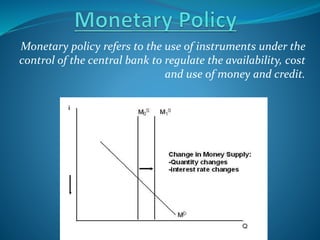
Monetary policy refers to the use of instruments under the
control of the central bank to regulate the availability, cost
and use of money and credit.
Objectives
 Maintaining price stability
 Ensuring adequate flow of credit to the productive
Sectors of the economy to support economic growth
 Rapid economic growth
 Balance of payment equilibrium
 Equal income distribution
Methods
 The RBI aims to achieve its objectives of economic
growth and control of inflation through various
methods.
These methods can be grouped as:
 General/ quantitative methods
 Selective/ qualitative methods
General/ Quantitative methods
 These methods maintain and control the total quantity or
volume of credit or money supply in the economy.
Open Market Operations
 Open market operations indicate the buying/ selling of govt.
securities in the open market to balance the money supply in the
economy
Deployment of Credit
 The RBI has taken various measures to deploy credit in different
sector of the economy. The certain %age of the bank credit has
been fixed for various sectors like agriculture, export etc.
QUANTATIVE MEASURE
 Bank rate:
 Bank Rate is the rate at which central bank of the
country (in India it is RBI) allows finance to
commercial banks.
 Bank Rate is a tool, which central bank uses for short-
term purposes.
 Any upward revision in Bank Rate by central bank is an
indication that banks should also increase deposit rates
as well as Base Rate / Benchmark Prime Lending Rate.
Quantitative methods
 CRR-Liquid cash that banks have to maintain with the
central bank as a certain percentage of their demand
and time liabilities.
 SLR-Proportion of total deposits with the commercial
banks have to keep with themselves in liquid
form(Cash and gold)
Indirect Instruments
 Liquidity Adjustment Facility (LAF):
 Consists of daily infusion or absorption of liquidity on a
repurchase basis, through repo (liquidity injection) and
reverse repo (liquidity absorption) auction operations, using
government securities as collateral.
i. Repo Rate:
 Repo rate is the rate at which the RBI lends shot-term money
to the banks against securities. When the repo rate increases
borrowing from RBI becomes more expensive.
ii. Reverse Repo Rate:
 The rate at which RBI borrows from commercial banks.
QUALITATIVE MEASURE
 Marginal Standing Facility (MSF):
 Instituted under which scheduled commercial banks
can borrow over night at their discretion up to one per
cent of their respective NDTL at 100 basis points above
the repo rate to provide a safety valve against
unanticipated liquidity shocks
 Market Stabilization Scheme (MSS):
 Liquidity of a more enduring nature arising from large
capital flows is absorbed through sale of short-dated
government securities and treasury bills.
 The mobilized cash is held in a separate government
account with the Reserve Bank
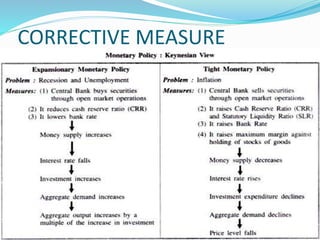
CORRECTIVE MEASURE
FISCAL POLICY
 Fiscal policy deals with taxation and government
spending and is often administered by an executive
under laws of a legislature.
OBJECTIVES OF FISCAL POLICY
 Increase in capital formation.
 Degree of Growth.
 To achieve desirable price level.
 To achieve desirable consumption level.
 To achieve desirable employment level.
 To achieve desirable income distribution.
Fiscal Policy there are three
possible positions
A Neutral position applies when the budget outcome
has neutral effect on the level of economic activity
where the govt. spending is fully funded by the
revenue collected from the tax.
An Expansionary position is when there is a higher
budget deficit where the govt. spending is higher than
the revenue collected from the tax.
An Contractionary position is when there is a lower
budget deficit where the govt. spending is lower than
the revenue collected from the tax.
The Two Main instruments of
fiscal policy
Revenue Budget - The revenue budget consists of
receipts of the government(revenue from tax and other
sources) and the expenditure met from these revenues.
Expenditure Budget- The expenditure budget may be
of two types i.e development and non-development. It
influences the economic activities of the country.
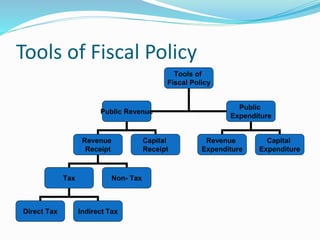
Tools of Fiscal Policy
Tools of
Fiscal Policy
Public Revenue
Public
Expenditure
Revenue
Receipt
Capital
Receipt
Revenue
Expenditure
Capital
Expenditure
Tax Non- Tax
Direct Tax Indirect Tax
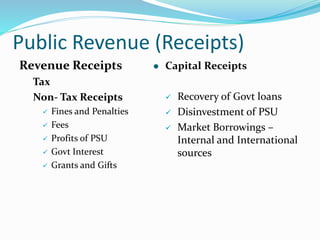
Public Revenue (Receipts)
Revenue Receipts
Tax
Non- Tax Receipts
 Fines and Penalties
 Fees
 Profits of PSU
 Govt Interest
 Grants and Gifts
 Capital Receipts
 Recovery of Govt loans
 Disinvestment of PSU
 Market Borrowings –
Internal and International
sources
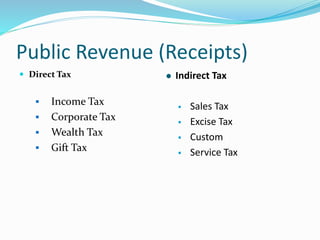
Public Revenue (Receipts)
 Direct Tax
 Income Tax
 Corporate Tax
 Wealth Tax
 Gift Tax
 Indirect Tax
 Sales Tax
 Excise Tax
 Custom
 Service Tax
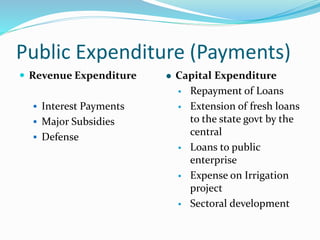
Public Expenditure (Payments)
 Revenue Expenditure
 Interest Payments
 Major Subsidies
 Defense
 Capital Expenditure
 Repayment of Loans
 Extension of fresh loans
to the state govt by the
central
 Loans to public
enterprise
 Expense on Irrigation
project
 Sectoral development
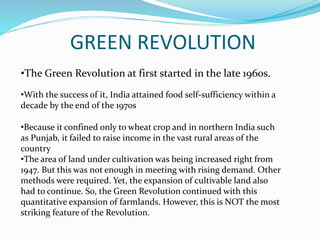
GREEN REVOLUTION
•The Green Revolution at first started in the late 1960s.
•With the success of it, India attained food self-sufficiency within a
decade by the end of the 1970s
•Because it confined only to wheat crop and in northern India such
as Punjab, it failed to raise income in the vast rural areas of the
country
•The area of land under cultivation was being increased right from
1947. But this was not enough in meeting with rising demand. Other
methods were required. Yet, the expansion of cultivable land also
had to continue. So, the Green Revolution continued with this
quantitative expansion of farmlands. However, this is NOT the most
striking feature of the Revolution.
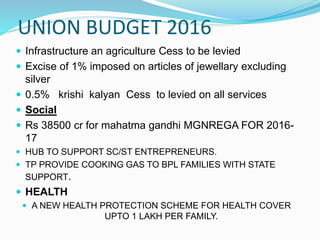
UNION BUDGET 2016
 Infrastructure an agriculture Cess to be levied
 Excise of 1% imposed on articles of jewellary excluding
silver
 0.5% krishi kalyan Cess to levied on all services
 Social
 Rs 38500 cr for mahatma gandhi MGNREGA FOR 2016-
17
 HUB TO SUPPORT SC/ST ENTREPRENEURS.
 TP PROVIDE COOKING GAS TO BPL FAMILIES WITH STATE
SUPPORT.
 HEALTH
 A NEW HEALTH PROTECTION SCHEME FOR HEALTH COVER
UPTO 1 LAKH PER FAMILY.
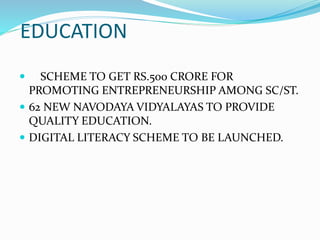
EDUCATION
 SCHEME TO GET RS.500 CRORE FOR
PROMOTING ENTREPRENEURSHIP AMONG SC/ST.
 62 NEW NAVODAYA VIDYALAYAS TO PROVIDE
QUALITY EDUCATION.
 DIGITAL LITERACY SCHEME TO BE LAUNCHED.
INVESTMENTS AND
INFRASTRUCTURE
 RS.27000 crore to be spent on roadways.
 Construction rate to be 100 km per day.
 New greenfield ports to be developed on east and west
coasts.
 100 percent FDI in marketing of food products
produced and marketed in India.
CONCLUSION
 Both monetary and fiscal policy of India plays a
crucial role in stabilising of economy.
 Effective flow of money in India
 Leads to economic growth

Sonia me

  • 1.
    MONETARY AND FISCALPOLICY OF INDIA ASSIGNMENT NUMBER- 2 SUBMITTED TO:Mr.Md shadab Sami SUBMITTED BY: Sonia verma
  • 2.
    Monetary policy refersto the use of instruments under the control of the central bank to regulate the availability, cost and use of money and credit.
  • 3.
    Objectives  Maintaining pricestability  Ensuring adequate flow of credit to the productive Sectors of the economy to support economic growth  Rapid economic growth  Balance of payment equilibrium  Equal income distribution
  • 4.
    Methods  The RBIaims to achieve its objectives of economic growth and control of inflation through various methods. These methods can be grouped as:  General/ quantitative methods  Selective/ qualitative methods
  • 5.
    General/ Quantitative methods These methods maintain and control the total quantity or volume of credit or money supply in the economy. Open Market Operations  Open market operations indicate the buying/ selling of govt. securities in the open market to balance the money supply in the economy Deployment of Credit  The RBI has taken various measures to deploy credit in different sector of the economy. The certain %age of the bank credit has been fixed for various sectors like agriculture, export etc.
  • 6.
    QUANTATIVE MEASURE  Bankrate:  Bank Rate is the rate at which central bank of the country (in India it is RBI) allows finance to commercial banks.  Bank Rate is a tool, which central bank uses for short- term purposes.  Any upward revision in Bank Rate by central bank is an indication that banks should also increase deposit rates as well as Base Rate / Benchmark Prime Lending Rate.
  • 7.
    Quantitative methods  CRR-Liquidcash that banks have to maintain with the central bank as a certain percentage of their demand and time liabilities.  SLR-Proportion of total deposits with the commercial banks have to keep with themselves in liquid form(Cash and gold)
  • 8.
    Indirect Instruments  LiquidityAdjustment Facility (LAF):  Consists of daily infusion or absorption of liquidity on a repurchase basis, through repo (liquidity injection) and reverse repo (liquidity absorption) auction operations, using government securities as collateral. i. Repo Rate:  Repo rate is the rate at which the RBI lends shot-term money to the banks against securities. When the repo rate increases borrowing from RBI becomes more expensive. ii. Reverse Repo Rate:  The rate at which RBI borrows from commercial banks.
  • 9.
    QUALITATIVE MEASURE  MarginalStanding Facility (MSF):  Instituted under which scheduled commercial banks can borrow over night at their discretion up to one per cent of their respective NDTL at 100 basis points above the repo rate to provide a safety valve against unanticipated liquidity shocks  Market Stabilization Scheme (MSS):  Liquidity of a more enduring nature arising from large capital flows is absorbed through sale of short-dated government securities and treasury bills.  The mobilized cash is held in a separate government account with the Reserve Bank
  • 10.
  • 11.
    FISCAL POLICY  Fiscalpolicy deals with taxation and government spending and is often administered by an executive under laws of a legislature.
  • 12.
    OBJECTIVES OF FISCALPOLICY  Increase in capital formation.  Degree of Growth.  To achieve desirable price level.  To achieve desirable consumption level.  To achieve desirable employment level.  To achieve desirable income distribution.
  • 13.
    Fiscal Policy thereare three possible positions A Neutral position applies when the budget outcome has neutral effect on the level of economic activity where the govt. spending is fully funded by the revenue collected from the tax. An Expansionary position is when there is a higher budget deficit where the govt. spending is higher than the revenue collected from the tax. An Contractionary position is when there is a lower budget deficit where the govt. spending is lower than the revenue collected from the tax.
  • 14.
    The Two Maininstruments of fiscal policy Revenue Budget - The revenue budget consists of receipts of the government(revenue from tax and other sources) and the expenditure met from these revenues. Expenditure Budget- The expenditure budget may be of two types i.e development and non-development. It influences the economic activities of the country.
  • 15.
    Tools of FiscalPolicy Tools of Fiscal Policy Public Revenue Public Expenditure Revenue Receipt Capital Receipt Revenue Expenditure Capital Expenditure Tax Non- Tax Direct Tax Indirect Tax
  • 16.
    Public Revenue (Receipts) RevenueReceipts Tax Non- Tax Receipts  Fines and Penalties  Fees  Profits of PSU  Govt Interest  Grants and Gifts  Capital Receipts  Recovery of Govt loans  Disinvestment of PSU  Market Borrowings – Internal and International sources
  • 17.
    Public Revenue (Receipts) Direct Tax  Income Tax  Corporate Tax  Wealth Tax  Gift Tax  Indirect Tax  Sales Tax  Excise Tax  Custom  Service Tax
  • 18.
    Public Expenditure (Payments) Revenue Expenditure  Interest Payments  Major Subsidies  Defense  Capital Expenditure  Repayment of Loans  Extension of fresh loans to the state govt by the central  Loans to public enterprise  Expense on Irrigation project  Sectoral development
  • 19.
    GREEN REVOLUTION •The GreenRevolution at first started in the late 1960s. •With the success of it, India attained food self-sufficiency within a decade by the end of the 1970s •Because it confined only to wheat crop and in northern India such as Punjab, it failed to raise income in the vast rural areas of the country •The area of land under cultivation was being increased right from 1947. But this was not enough in meeting with rising demand. Other methods were required. Yet, the expansion of cultivable land also had to continue. So, the Green Revolution continued with this quantitative expansion of farmlands. However, this is NOT the most striking feature of the Revolution.
  • 20.
    UNION BUDGET 2016 Infrastructure an agriculture Cess to be levied  Excise of 1% imposed on articles of jewellary excluding silver  0.5% krishi kalyan Cess to levied on all services  Social  Rs 38500 cr for mahatma gandhi MGNREGA FOR 2016- 17  HUB TO SUPPORT SC/ST ENTREPRENEURS.  TP PROVIDE COOKING GAS TO BPL FAMILIES WITH STATE SUPPORT.  HEALTH  A NEW HEALTH PROTECTION SCHEME FOR HEALTH COVER UPTO 1 LAKH PER FAMILY.
  • 21.
    EDUCATION  SCHEME TOGET RS.500 CRORE FOR PROMOTING ENTREPRENEURSHIP AMONG SC/ST.  62 NEW NAVODAYA VIDYALAYAS TO PROVIDE QUALITY EDUCATION.  DIGITAL LITERACY SCHEME TO BE LAUNCHED.
  • 22.
    INVESTMENTS AND INFRASTRUCTURE  RS.27000crore to be spent on roadways.  Construction rate to be 100 km per day.  New greenfield ports to be developed on east and west coasts.  100 percent FDI in marketing of food products produced and marketed in India.
  • 23.
    CONCLUSION  Both monetaryand fiscal policy of India plays a crucial role in stabilising of economy.  Effective flow of money in India  Leads to economic growth