OpenDiscovery
OpenDiscovery: Automated
Docking of Ligands to Proteins
and Molecular Simulation
Gareth Price
Computational MiniProject
Aims + Achievements
•Produce a high-throughput protocol to screen a
library of chemical compounds against a
protein
•Use this protocol to produce some putative
ligands for chemical synthesis and screening
• (Miniproject III)
•Paper submitted to ACS JCE
• “The use of freely available and Open Source tools
for in silico screening in Chemical Biology”
•Ground work for OpenDiscovery:
• Soon will be found at: www.opendiscovery.org.uk
2
Broad Outline
3
Prepare Files Screen
ParameteriseSimulate
Generating Similar Compounds
S
N Cl
N
CN(C)CCCN1c2ccccc2Sc3ccc(c1)cc13
SMILES Code
Normalise
+
Fragment
= 4 character fragments
Search against
database
Give X similar
compounds
based on Tanimoto distance
Stepping out of the current chemical “space”
4
SMILES to MOL,MOL2, PDB
•oBabel is very useful at converting between
chemical file formats
• and is the most popular tool of choice
•Also allows a conformer search, so that the
energy minimum can be found
• random, weighted or systematic (exhaustive)
search
•Installs with OBMinimize, an in vacuo
minimisation tool
N[C@@H](Cc1ccc(O)c(O)c1)C(=O)O
5
NH2
HO
HO
O
OH
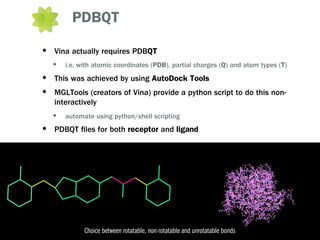
PDBQT
• Vina actually requires PDBQT
• i.e. with atomic coordinates (PDB), partial charges (Q) and atom types (T)
• This was achieved by using AutoDock Tools
• MGLTools (creators of Vina) provide a python script to do this non-
interactively
• automate using python/shell scripting
• PDBQT files for both receptor and ligand
Choice between rotatable, non-rotatable and unrotatable bonds
Binding Grid Box
Set this to 1 to
use Angstrom scaling
Broad Outline
Start
SMILESInput File
Similar Compounds
MOL MOL2
Conformer Search(OBabel)
PDB
Conformer Search(OBabel)
PDBQT
Minimization(OBMinimize)
Screen!
(VINA)
Extract
Modes
Visualize
(VMD)
Summarize
Results
Parameterize
ligands
PSF
Solvate
psf gen.pgn
Simulate!
(NAMD etc.)
8
Running Vina
box coordinates
and dimensions
receptor and ligand
files
output PDBQT with
1+ modes
exhaustiveness ∝
amount of time devoted to
finding accurate conformation and
position
vina
--receptor protein.pdbqt
--ligand ligand.pdbqt
--out all.pdbqt
--center_x 14.45
--center_y -24.772
--center_z 15.079
--size_x 10
--size_y 10
--size_z 10
! --log log.txt
--exhaustiveness 600
www.gprice.co.uk/ads
9
•Binding Affinity Energies
•One PDBQT file that has 1+ modes
• i.e. a single file with the significant conformations
+ positions
• can’t open in VMD or Chimera
• VMD refuses and Chimera opens all modes all at once
• but PyMol does work!
•Use Scripting/PyMol
• (again!)... to extract modes
Gbinding = GvdW + Gelec + Ghbond + Gdesolv + Gtors
Results
10
•A relatively new method of clustering docking
results
• based on contact analysis
results_98
results_97
results_95
results_93
results_91
results_43
results_101
results_96
results_99
results_92
results_47
results100
results_94
results_44
results_48
AuPoSOM
12
Broad Outline
Start
SMILESInput File
Similar Compounds
MOL MOL2
Conformer Search(OBabel)
PDB
Conformer Search(OBabel)
PDBQT
Minimization(OBMinimize)
Screen!
(VINA)
Extract
Modes
Visualize
(VMD)
Summarize
Results
Parameterize
ligands
PSF
Solvate
psf gen.pgn
Simulate!
(NAMD etc.)
13
A big problem
•Most forcefields only include definitions for
amino acid residues
• i.e. only bonds etc. found in proteins
•Our chemical compound ligands are not
proteins
•So we need a way to “atom-type” each
atoms to a peptide version
• …or derive new parameters from ab initio
calculations
14
Parameters
Bond Stretching
Angle Bonding
Bond rotation
(torsion)
δ+
δ+
δ-
Non-bonded interactions
(electrostatic)
Non-bonded Interactions
(Van der Waals)
out-of-plane in-plane
15
Gaussian, SwissParam and MATCH
• Gaussian is a program that can perform ab initio
quantum mechanics calculations
• 3 problems:
1. Not all the results will be correct
2. It doesn’t give all values (energies, impropers)
3. It takes ages and extracting information is very manual
16
Amber + Amber Tools
• Amber is available for a nominal fee
(400$), but their tools are free
• antechamber and LeAP are very useful
• includes solvation
• parameter files can also be used in other
programs too
• Amber is a viable option but it is a long,
convoluted process that requires a user
who knows what they are doing
• compilation, testing and set up of Amber/
Tools is non-trivial -- we need something
better (highlighted in our paper)
17
18
Sample Results
Further Work and Acknowledgements
• Combine the screening (ODScreen) and
parameterisation/simulation (ODParam) with
cheminformatics
• do we know anything about these compounds already?
• do we want to know them? (if there is no information -
probably no patent!)
• Implement other analysis tools
• other than AuPoSOM
• I would like to thank MOAC, EPSRC, Dr. Andrew
Marsh and Dr. Phil Gould for their support and
guidance throughout the project
• Also, Dr. Dan Rathbone (Aston), Dr. Alex Simperler
(Imperial), Dr. David Bray and Prof. Mark Rodger (Warwick)
19
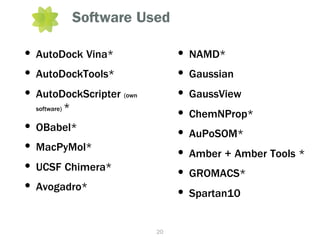
Software Used
•AutoDock Vina*
•AutoDockTools*
•AutoDockScripter (own
software) *
•OBabel*
•MacPyMol*
•UCSF Chimera*
•Avogadro*
•NAMD*
•Gaussian
•GaussView
•ChemNProp*
•AuPoSOM*
•Amber + Amber Tools *
•GROMACS*
•Spartan10
20

OpenDiscovery

  • 1.
    OpenDiscovery OpenDiscovery: Automated Docking ofLigands to Proteins and Molecular Simulation Gareth Price Computational MiniProject
  • 2.
    Aims + Achievements •Producea high-throughput protocol to screen a library of chemical compounds against a protein •Use this protocol to produce some putative ligands for chemical synthesis and screening • (Miniproject III) •Paper submitted to ACS JCE • “The use of freely available and Open Source tools for in silico screening in Chemical Biology” •Ground work for OpenDiscovery: • Soon will be found at: www.opendiscovery.org.uk 2
  • 3.
    Broad Outline 3 Prepare FilesScreen ParameteriseSimulate
  • 4.
    Generating Similar Compounds S NCl N CN(C)CCCN1c2ccccc2Sc3ccc(c1)cc13 SMILES Code Normalise + Fragment = 4 character fragments Search against database Give X similar compounds based on Tanimoto distance Stepping out of the current chemical “space” 4
  • 5.
    SMILES to MOL,MOL2,PDB •oBabel is very useful at converting between chemical file formats • and is the most popular tool of choice •Also allows a conformer search, so that the energy minimum can be found • random, weighted or systematic (exhaustive) search •Installs with OBMinimize, an in vacuo minimisation tool N[C@@H](Cc1ccc(O)c(O)c1)C(=O)O 5 NH2 HO HO O OH
  • 6.
    PDBQT • Vina actuallyrequires PDBQT • i.e. with atomic coordinates (PDB), partial charges (Q) and atom types (T) • This was achieved by using AutoDock Tools • MGLTools (creators of Vina) provide a python script to do this non- interactively • automate using python/shell scripting • PDBQT files for both receptor and ligand Choice between rotatable, non-rotatable and unrotatable bonds
  • 7.
    Binding Grid Box Setthis to 1 to use Angstrom scaling
  • 8.
    Broad Outline Start SMILESInput File SimilarCompounds MOL MOL2 Conformer Search(OBabel) PDB Conformer Search(OBabel) PDBQT Minimization(OBMinimize) Screen! (VINA) Extract Modes Visualize (VMD) Summarize Results Parameterize ligands PSF Solvate psf gen.pgn Simulate! (NAMD etc.) 8
  • 9.
    Running Vina box coordinates anddimensions receptor and ligand files output PDBQT with 1+ modes exhaustiveness ∝ amount of time devoted to finding accurate conformation and position vina --receptor protein.pdbqt --ligand ligand.pdbqt --out all.pdbqt --center_x 14.45 --center_y -24.772 --center_z 15.079 --size_x 10 --size_y 10 --size_z 10 ! --log log.txt --exhaustiveness 600 www.gprice.co.uk/ads 9
  • 10.
    •Binding Affinity Energies •OnePDBQT file that has 1+ modes • i.e. a single file with the significant conformations + positions • can’t open in VMD or Chimera • VMD refuses and Chimera opens all modes all at once • but PyMol does work! •Use Scripting/PyMol • (again!)... to extract modes Gbinding = GvdW + Gelec + Ghbond + Gdesolv + Gtors Results 10
  • 12.
    •A relatively newmethod of clustering docking results • based on contact analysis results_98 results_97 results_95 results_93 results_91 results_43 results_101 results_96 results_99 results_92 results_47 results100 results_94 results_44 results_48 AuPoSOM 12
  • 13.
    Broad Outline Start SMILESInput File SimilarCompounds MOL MOL2 Conformer Search(OBabel) PDB Conformer Search(OBabel) PDBQT Minimization(OBMinimize) Screen! (VINA) Extract Modes Visualize (VMD) Summarize Results Parameterize ligands PSF Solvate psf gen.pgn Simulate! (NAMD etc.) 13
  • 14.
    A big problem •Mostforcefields only include definitions for amino acid residues • i.e. only bonds etc. found in proteins •Our chemical compound ligands are not proteins •So we need a way to “atom-type” each atoms to a peptide version • …or derive new parameters from ab initio calculations 14
  • 15.
    Parameters Bond Stretching Angle Bonding Bondrotation (torsion) δ+ δ+ δ- Non-bonded interactions (electrostatic) Non-bonded Interactions (Van der Waals) out-of-plane in-plane 15
  • 16.
    Gaussian, SwissParam andMATCH • Gaussian is a program that can perform ab initio quantum mechanics calculations • 3 problems: 1. Not all the results will be correct 2. It doesn’t give all values (energies, impropers) 3. It takes ages and extracting information is very manual 16
  • 17.
    Amber + AmberTools • Amber is available for a nominal fee (400$), but their tools are free • antechamber and LeAP are very useful • includes solvation • parameter files can also be used in other programs too • Amber is a viable option but it is a long, convoluted process that requires a user who knows what they are doing • compilation, testing and set up of Amber/ Tools is non-trivial -- we need something better (highlighted in our paper) 17
  • 18.
  • 19.
    Further Work andAcknowledgements • Combine the screening (ODScreen) and parameterisation/simulation (ODParam) with cheminformatics • do we know anything about these compounds already? • do we want to know them? (if there is no information - probably no patent!) • Implement other analysis tools • other than AuPoSOM • I would like to thank MOAC, EPSRC, Dr. Andrew Marsh and Dr. Phil Gould for their support and guidance throughout the project • Also, Dr. Dan Rathbone (Aston), Dr. Alex Simperler (Imperial), Dr. David Bray and Prof. Mark Rodger (Warwick) 19
  • 20.
    Software Used •AutoDock Vina* •AutoDockTools* •AutoDockScripter(own software) * •OBabel* •MacPyMol* •UCSF Chimera* •Avogadro* •NAMD* •Gaussian •GaussView •ChemNProp* •AuPoSOM* •Amber + Amber Tools * •GROMACS* •Spartan10 20