Solving Equations on Words with Morphisms
and Antimorphisms
A. Blondin Mass´e, S. Gaboury, S. Hall´e and M. Larouche
Laboratoire d’informatique formelle
Universit´e du Qu´ebec `a Chicoutimi
Chicoutimi, Canada
Language and Automata Theory and Applications
(LATA 2014)
March 13th, 2014
Madrid, Spain
Blondin Mass´e et al. (LIF, UQAC) March 13th, 2014 1 / 25
Outline
1. Introduction
2. Words equations
3. From equations to graphs
4. Conclusion
Blondin Mass´e et al. (LIF, UQAC) March 13th, 2014 2 / 25
Outline
1. Introduction
2. Words equations
3. From equations to graphs
4. Conclusion
Blondin Mass´e et al. (LIF, UQAC) March 13th, 2014 3 / 25
Distinct squares conjecture
Conjecture (Fraenkel and Simpson, 1998)
A word of length n contains less than n distinct squares.
Blondin Mass´e et al. (LIF, UQAC) March 13th, 2014 4 / 25
Distinct squares conjecture
Conjecture (Fraenkel and Simpson, 1998)
A word of length n contains less than n distinct squares.
The 8 squares of the word w = 0000110110101 of length
13 are
00, 11, 0000, 0101, 1010, 011011, 101101, 110110.
Blondin Mass´e et al. (LIF, UQAC) March 13th, 2014 4 / 25
Distinct squares conjecture
Conjecture (Fraenkel and Simpson, 1998)
A word of length n contains less than n distinct squares.
The 8 squares of the word w = 0000110110101 of length
13 are
00, 11, 0000, 0101, 1010, 011011, 101101, 110110.
We look at the solutions of the equations
x1u2
1y1 = x2u2
2y2 = . . . = xku2
kyk,
with various lenghts of the xi’s and the ui’s.
Blondin Mass´e et al. (LIF, UQAC) March 13th, 2014 4 / 25
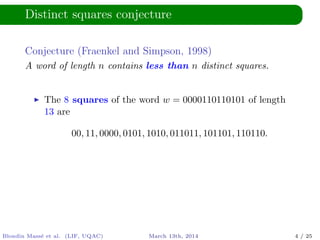
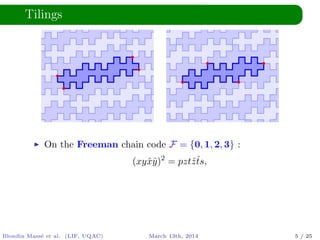
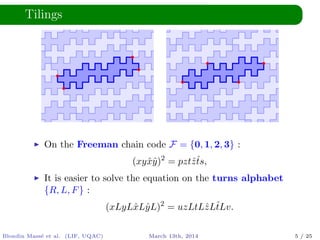
Tilings
Blondin Mass´e et al. (LIF, UQAC) March 13th, 2014 5 / 25
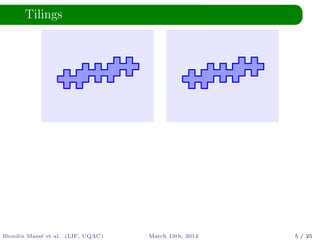
Tilings
Blondin Mass´e et al. (LIF, UQAC) March 13th, 2014 5 / 25
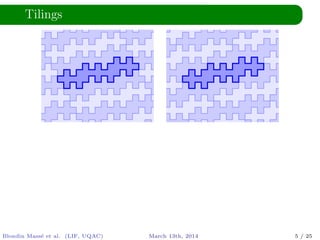
Tilings
Blondin Mass´e et al. (LIF, UQAC) March 13th, 2014 5 / 25
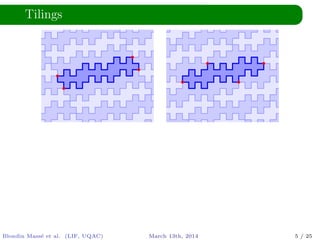
Tilings
On the Freeman chain code F = {0, 1, 2, 3} :
(xyˆxˆy)2
= pztˆzˆts,
Blondin Mass´e et al. (LIF, UQAC) March 13th, 2014 5 / 25
Tilings
On the Freeman chain code F = {0, 1, 2, 3} :
(xyˆxˆy)2
= pztˆzˆts,
It is easier to solve the equation on the turns alphabet
{R, L, F} :
(xLyLˆxLˆyL)2
= uzLtLˆzLˆtLv.
Blondin Mass´e et al. (LIF, UQAC) March 13th, 2014 5 / 25
Solving equations on words
Makanin showed that the problem of solving equations on
words with constants and variables is decidable
(1977) ;
Blondin Mass´e et al. (LIF, UQAC) March 13th, 2014 6 / 25
Solving equations on words
Makanin showed that the problem of solving equations on
words with constants and variables is decidable
(1977) ;
Plandowski showed that the problem is in fact in
PSPACE (1999) ;
Blondin Mass´e et al. (LIF, UQAC) March 13th, 2014 6 / 25
Solving equations on words
Makanin showed that the problem of solving equations on
words with constants and variables is decidable
(1977) ;
Plandowski showed that the problem is in fact in
PSPACE (1999) ;
Abdulrab propose a Lisp implementation of a solver in
1990 (not available anymore) ;
Blondin Mass´e et al. (LIF, UQAC) March 13th, 2014 6 / 25
Solving equations on words
Makanin showed that the problem of solving equations on
words with constants and variables is decidable
(1977) ;
Plandowski showed that the problem is in fact in
PSPACE (1999) ;
Abdulrab propose a Lisp implementation of a solver in
1990 (not available anymore) ;
More recenly, tools such as Hampi, Omega and Stranger
deal with string constraints and regular expressions ;
Blondin Mass´e et al. (LIF, UQAC) March 13th, 2014 6 / 25
Solving equations on words
Makanin showed that the problem of solving equations on
words with constants and variables is decidable
(1977) ;
Plandowski showed that the problem is in fact in
PSPACE (1999) ;
Abdulrab propose a Lisp implementation of a solver in
1990 (not available anymore) ;
More recenly, tools such as Hampi, Omega and Stranger
deal with string constraints and regular expressions ;
None handles morphisms and antimorphisms.
Blondin Mass´e et al. (LIF, UQAC) March 13th, 2014 6 / 25
Outline
1. Introduction
2. Words equations
3. From equations to graphs
4. Conclusion
Blondin Mass´e et al. (LIF, UQAC) March 13th, 2014 7 / 25
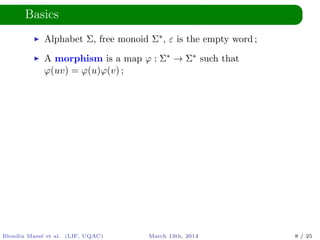
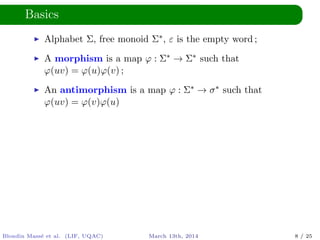
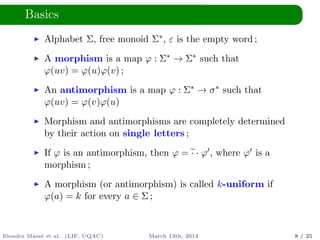
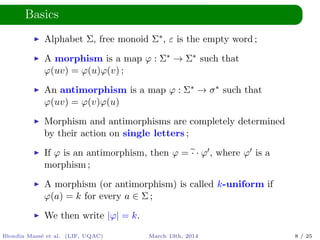
Basics
Alphabet Σ, free monoid Σ∗, ε is the empty word ;
Blondin Mass´e et al. (LIF, UQAC) March 13th, 2014 8 / 25
Basics
Alphabet Σ, free monoid Σ∗, ε is the empty word ;
A morphism is a map ϕ : Σ∗ → Σ∗ such that
ϕ(uv) = ϕ(u)ϕ(v) ;
Blondin Mass´e et al. (LIF, UQAC) March 13th, 2014 8 / 25
Basics
Alphabet Σ, free monoid Σ∗, ε is the empty word ;
A morphism is a map ϕ : Σ∗ → Σ∗ such that
ϕ(uv) = ϕ(u)ϕ(v) ;
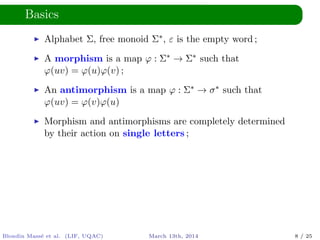
An antimorphism is a map ϕ : Σ∗ → σ∗ such that
ϕ(uv) = ϕ(v)ϕ(u)
Blondin Mass´e et al. (LIF, UQAC) March 13th, 2014 8 / 25
Basics
Alphabet Σ, free monoid Σ∗, ε is the empty word ;
A morphism is a map ϕ : Σ∗ → Σ∗ such that
ϕ(uv) = ϕ(u)ϕ(v) ;
An antimorphism is a map ϕ : Σ∗ → σ∗ such that
ϕ(uv) = ϕ(v)ϕ(u)
Morphism and antimorphisms are completely determined
by their action on single letters ;
Blondin Mass´e et al. (LIF, UQAC) March 13th, 2014 8 / 25
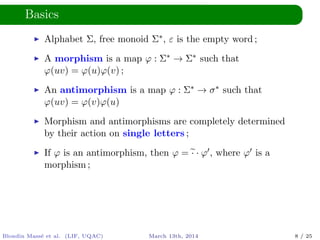
Basics
Alphabet Σ, free monoid Σ∗, ε is the empty word ;
A morphism is a map ϕ : Σ∗ → Σ∗ such that
ϕ(uv) = ϕ(u)ϕ(v) ;
An antimorphism is a map ϕ : Σ∗ → σ∗ such that
ϕ(uv) = ϕ(v)ϕ(u)
Morphism and antimorphisms are completely determined
by their action on single letters ;
If ϕ is an antimorphism, then ϕ = · · ϕ , where ϕ is a
morphism ;
Blondin Mass´e et al. (LIF, UQAC) March 13th, 2014 8 / 25
Basics
Alphabet Σ, free monoid Σ∗, ε is the empty word ;
A morphism is a map ϕ : Σ∗ → Σ∗ such that
ϕ(uv) = ϕ(u)ϕ(v) ;
An antimorphism is a map ϕ : Σ∗ → σ∗ such that
ϕ(uv) = ϕ(v)ϕ(u)
Morphism and antimorphisms are completely determined
by their action on single letters ;
If ϕ is an antimorphism, then ϕ = · · ϕ , where ϕ is a
morphism ;
A morphism (or antimorphism) is called k-uniform if
ϕ(a) = k for every a ∈ Σ ;
Blondin Mass´e et al. (LIF, UQAC) March 13th, 2014 8 / 25
Basics
Alphabet Σ, free monoid Σ∗, ε is the empty word ;
A morphism is a map ϕ : Σ∗ → Σ∗ such that
ϕ(uv) = ϕ(u)ϕ(v) ;
An antimorphism is a map ϕ : Σ∗ → σ∗ such that
ϕ(uv) = ϕ(v)ϕ(u)
Morphism and antimorphisms are completely determined
by their action on single letters ;
If ϕ is an antimorphism, then ϕ = · · ϕ , where ϕ is a
morphism ;
A morphism (or antimorphism) is called k-uniform if
ϕ(a) = k for every a ∈ Σ ;
We then write |ϕ| = k.
Blondin Mass´e et al. (LIF, UQAC) March 13th, 2014 8 / 25
Words equations systems
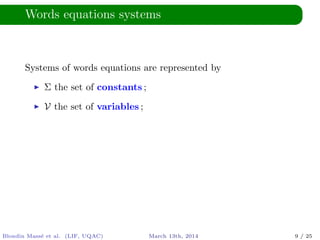
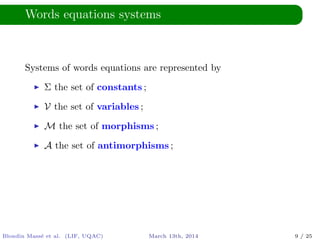
Systems of words equations are represented by
Σ the set of constants ;
Blondin Mass´e et al. (LIF, UQAC) March 13th, 2014 9 / 25
Words equations systems
Systems of words equations are represented by
Σ the set of constants ;
V the set of variables ;
Blondin Mass´e et al. (LIF, UQAC) March 13th, 2014 9 / 25
Words equations systems
Systems of words equations are represented by
Σ the set of constants ;
V the set of variables ;
M the set of morphisms ;
Blondin Mass´e et al. (LIF, UQAC) March 13th, 2014 9 / 25
Words equations systems
Systems of words equations are represented by
Σ the set of constants ;
V the set of variables ;
M the set of morphisms ;
A the set of antimorphisms ;
Blondin Mass´e et al. (LIF, UQAC) March 13th, 2014 9 / 25
Words equations systems
Systems of words equations are represented by
Σ the set of constants ;
V the set of variables ;
M the set of morphisms ;
A the set of antimorphisms ;
a list of words equations Li = Ri (i = 1, 2, . . . , m).
Blondin Mass´e et al. (LIF, UQAC) March 13th, 2014 9 / 25
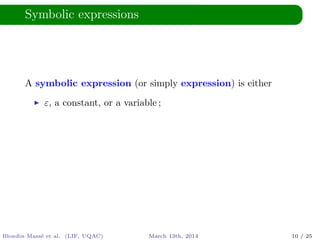
Symbolic expressions
A symbolic expression (or simply expression) is either
ε, a constant, or a variable ;
Blondin Mass´e et al. (LIF, UQAC) March 13th, 2014 10 / 25
Symbolic expressions
A symbolic expression (or simply expression) is either
ε, a constant, or a variable ;
v1v2 · · · vk, where vi is itself an expression ;
Blondin Mass´e et al. (LIF, UQAC) March 13th, 2014 10 / 25
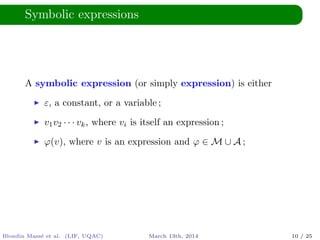
Symbolic expressions
A symbolic expression (or simply expression) is either
ε, a constant, or a variable ;
v1v2 · · · vk, where vi is itself an expression ;
ϕ(v), where v is an expression and ϕ ∈ M ∪ A ;
Blondin Mass´e et al. (LIF, UQAC) March 13th, 2014 10 / 25
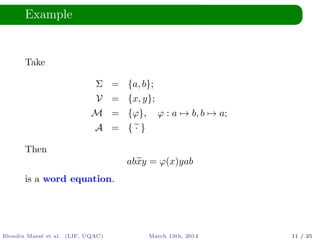
Example
Take
Σ = {a, b};
V = {x, y};
M = {ϕ}, ϕ : a → b, b → a;
A = { · }
Then
abxy = ϕ(x)yab
is a word equation.
Blondin Mass´e et al. (LIF, UQAC) March 13th, 2014 11 / 25
Assignments and solutions
An assignment is a map I : V → Σ∗ ;
Blondin Mass´e et al. (LIF, UQAC) March 13th, 2014 12 / 25
Assignments and solutions
An assignment is a map I : V → Σ∗ ;
Is is naturally extended as follows
Blondin Mass´e et al. (LIF, UQAC) March 13th, 2014 12 / 25
Assignments and solutions
An assignment is a map I : V → Σ∗ ;
Is is naturally extended as follows
1. I(ε) = ε ;
Blondin Mass´e et al. (LIF, UQAC) March 13th, 2014 12 / 25
Assignments and solutions
An assignment is a map I : V → Σ∗ ;
Is is naturally extended as follows
1. I(ε) = ε ;
2. I(u) = u, for u ∈ Σ ;
Blondin Mass´e et al. (LIF, UQAC) March 13th, 2014 12 / 25
Assignments and solutions
An assignment is a map I : V → Σ∗ ;
Is is naturally extended as follows
1. I(ε) = ε ;
2. I(u) = u, for u ∈ Σ ;
3. I(u1 · u2 · · · uk) = I(u1) · I(u2) · · · I(uk), if ui is an
expression (i = 1, 2, . . . , k) ;
Blondin Mass´e et al. (LIF, UQAC) March 13th, 2014 12 / 25
Assignments and solutions
An assignment is a map I : V → Σ∗ ;
Is is naturally extended as follows
1. I(ε) = ε ;
2. I(u) = u, for u ∈ Σ ;
3. I(u1 · u2 · · · uk) = I(u1) · I(u2) · · · I(uk), if ui is an
expression (i = 1, 2, . . . , k) ;
4. I(ϕ(u)) = ϕ(I(u)), if ϕ ∈ M ∪ A and u is an
expression.
Blondin Mass´e et al. (LIF, UQAC) March 13th, 2014 12 / 25
Assignments and solutions
An assignment is a map I : V → Σ∗ ;
Is is naturally extended as follows
1. I(ε) = ε ;
2. I(u) = u, for u ∈ Σ ;
3. I(u1 · u2 · · · uk) = I(u1) · I(u2) · · · I(uk), if ui is an
expression (i = 1, 2, . . . , k) ;
4. I(ϕ(u)) = ϕ(I(u)), if ϕ ∈ M ∪ A and u is an
expression.
Let L = R be an equation ;
Blondin Mass´e et al. (LIF, UQAC) March 13th, 2014 12 / 25
Assignments and solutions
An assignment is a map I : V → Σ∗ ;
Is is naturally extended as follows
1. I(ε) = ε ;
2. I(u) = u, for u ∈ Σ ;
3. I(u1 · u2 · · · uk) = I(u1) · I(u2) · · · I(uk), if ui is an
expression (i = 1, 2, . . . , k) ;
4. I(ϕ(u)) = ϕ(I(u)), if ϕ ∈ M ∪ A and u is an
expression.
Let L = R be an equation ;
A solution of L = R is an assigment S : V → Σ∗such that
S(L) = S(R).
Blondin Mass´e et al. (LIF, UQAC) March 13th, 2014 12 / 25
Bounded lengths
Since solving general equations on words is very hard, we
need to restrict the context ;
Blondin Mass´e et al. (LIF, UQAC) March 13th, 2014 13 / 25
Bounded lengths
Since solving general equations on words is very hard, we
need to restrict the context ;
To simplify, we assume that all lenghts of variables are
known ;
Blondin Mass´e et al. (LIF, UQAC) March 13th, 2014 13 / 25
Bounded lengths
Since solving general equations on words is very hard, we
need to restrict the context ;
To simplify, we assume that all lenghts of variables are
known ;
Let λ : V → N, where λ(v) is the length of the variable v ;
Blondin Mass´e et al. (LIF, UQAC) March 13th, 2014 13 / 25
Bounded lengths
Since solving general equations on words is very hard, we
need to restrict the context ;
To simplify, we assume that all lenghts of variables are
known ;
Let λ : V → N, where λ(v) is the length of the variable v ;
Naturally,
Blondin Mass´e et al. (LIF, UQAC) March 13th, 2014 13 / 25
Bounded lengths
Since solving general equations on words is very hard, we
need to restrict the context ;
To simplify, we assume that all lenghts of variables are
known ;
Let λ : V → N, where λ(v) is the length of the variable v ;
Naturally,
1. λ(ε) = 0 ;
Blondin Mass´e et al. (LIF, UQAC) March 13th, 2014 13 / 25
Bounded lengths
Since solving general equations on words is very hard, we
need to restrict the context ;
To simplify, we assume that all lenghts of variables are
known ;
Let λ : V → N, where λ(v) is the length of the variable v ;
Naturally,
1. λ(ε) = 0 ;
2. λ(u) = 1 for u ∈ Σ ;
Blondin Mass´e et al. (LIF, UQAC) March 13th, 2014 13 / 25
Bounded lengths
Since solving general equations on words is very hard, we
need to restrict the context ;
To simplify, we assume that all lenghts of variables are
known ;
Let λ : V → N, where λ(v) is the length of the variable v ;
Naturally,
1. λ(ε) = 0 ;
2. λ(u) = 1 for u ∈ Σ ;
3. λ(u1 · u2 · · · uk) = k
i=1 λ(ui), if ui is an expression for
i = 1, 2, . . . , k ;
Blondin Mass´e et al. (LIF, UQAC) March 13th, 2014 13 / 25
Bounded lengths
Since solving general equations on words is very hard, we
need to restrict the context ;
To simplify, we assume that all lenghts of variables are
known ;
Let λ : V → N, where λ(v) is the length of the variable v ;
Naturally,
1. λ(ε) = 0 ;
2. λ(u) = 1 for u ∈ Σ ;
3. λ(u1 · u2 · · · uk) = k
i=1 λ(ui), if ui is an expression for
i = 1, 2, . . . , k ;
4. λ(ϕ(u)) = |ϕ| · λ(u), if ϕ is uniform and u is an
expression.
Blondin Mass´e et al. (LIF, UQAC) March 13th, 2014 13 / 25
Is the problem difficult ?
Theorem
Let Σ, V, M and A be some sets of constants, variables,
morphisms and antimorphisms ;
Blondin Mass´e et al. (LIF, UQAC) March 13th, 2014 14 / 25
Is the problem difficult ?
Theorem
Let Σ, V, M and A be some sets of constants, variables,
morphisms and antimorphisms ;
Let L = R be an equation on these four sets ;
Blondin Mass´e et al. (LIF, UQAC) March 13th, 2014 14 / 25
Is the problem difficult ?
Theorem
Let Σ, V, M and A be some sets of constants, variables,
morphisms and antimorphisms ;
Let L = R be an equation on these four sets ;
Assume that all variables are of known length and that
|L| = |R| = n ;
Blondin Mass´e et al. (LIF, UQAC) March 13th, 2014 14 / 25
Is the problem difficult ?
Theorem
Let Σ, V, M and A be some sets of constants, variables,
morphisms and antimorphisms ;
Let L = R be an equation on these four sets ;
Assume that all variables are of known length and that
|L| = |R| = n ;
Then the problem of determining if some solution
S : V → Σ∗ exists for L = R is NP-complete.
Blondin Mass´e et al. (LIF, UQAC) March 13th, 2014 14 / 25
Proof of NP-completeness
Clearly in NP ;
Blondin Mass´e et al. (LIF, UQAC) March 13th, 2014 15 / 25
Proof of NP-completeness
Clearly in NP ;
We reduce 3-IN-1-SAT to the problem ;
Blondin Mass´e et al. (LIF, UQAC) March 13th, 2014 15 / 25
Proof of NP-completeness
Clearly in NP ;
We reduce 3-IN-1-SAT to the problem ;
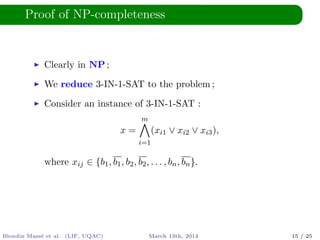
Consider an instance of 3-IN-1-SAT :
x =
m
i=1
(xi1 ∨ xi2 ∨ xi3),
where xij ∈ {b1, b1, b2, b2, . . . , bn, bn}.
Blondin Mass´e et al. (LIF, UQAC) March 13th, 2014 15 / 25
Proof of NP-completeness
Clearly in NP ;
We reduce 3-IN-1-SAT to the problem ;
Consider an instance of 3-IN-1-SAT :
x =
m
i=1
(xi1 ∨ xi2 ∨ xi3),
where xij ∈ {b1, b1, b2, b2, . . . , bn, bn}.
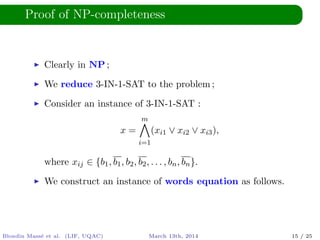
We construct an instance of words equation as follows.
Blondin Mass´e et al. (LIF, UQAC) March 13th, 2014 15 / 25
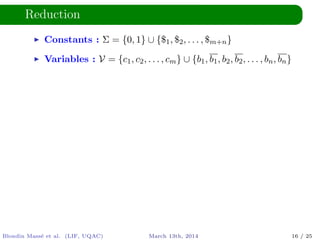
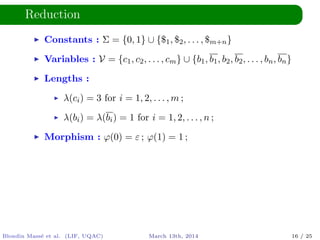
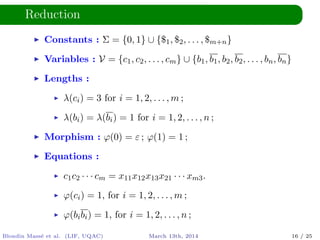
Reduction
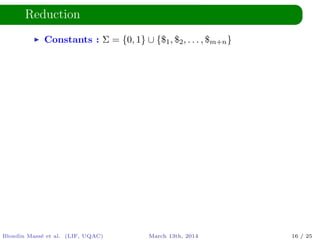
Constants : Σ = {0, 1} ∪ {$1, $2, . . . , $m+n}
Blondin Mass´e et al. (LIF, UQAC) March 13th, 2014 16 / 25
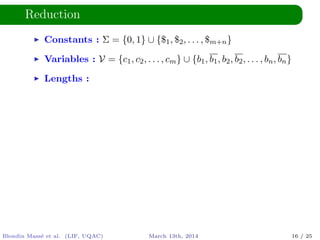
Reduction
Constants : Σ = {0, 1} ∪ {$1, $2, . . . , $m+n}
Variables : V = {c1, c2, . . . , cm} ∪ {b1, b1, b2, b2, . . . , bn, bn}
Blondin Mass´e et al. (LIF, UQAC) March 13th, 2014 16 / 25
Reduction
Constants : Σ = {0, 1} ∪ {$1, $2, . . . , $m+n}
Variables : V = {c1, c2, . . . , cm} ∪ {b1, b1, b2, b2, . . . , bn, bn}
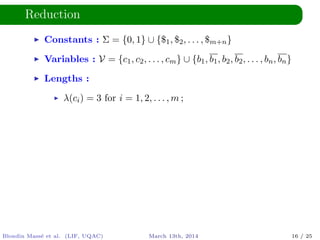
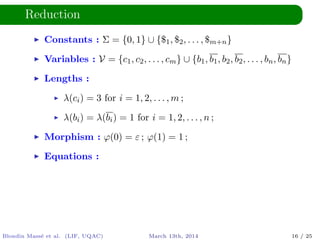
Lengths :
Blondin Mass´e et al. (LIF, UQAC) March 13th, 2014 16 / 25
Reduction
Constants : Σ = {0, 1} ∪ {$1, $2, . . . , $m+n}
Variables : V = {c1, c2, . . . , cm} ∪ {b1, b1, b2, b2, . . . , bn, bn}
Lengths :
λ(ci) = 3 for i = 1, 2, . . . , m ;
Blondin Mass´e et al. (LIF, UQAC) March 13th, 2014 16 / 25
Reduction
Constants : Σ = {0, 1} ∪ {$1, $2, . . . , $m+n}
Variables : V = {c1, c2, . . . , cm} ∪ {b1, b1, b2, b2, . . . , bn, bn}
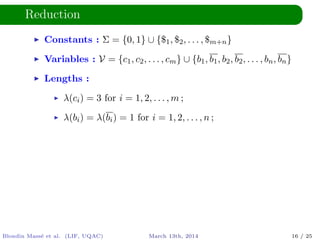
Lengths :
λ(ci) = 3 for i = 1, 2, . . . , m ;
λ(bi) = λ(bi) = 1 for i = 1, 2, . . . , n ;
Blondin Mass´e et al. (LIF, UQAC) March 13th, 2014 16 / 25
Reduction
Constants : Σ = {0, 1} ∪ {$1, $2, . . . , $m+n}
Variables : V = {c1, c2, . . . , cm} ∪ {b1, b1, b2, b2, . . . , bn, bn}
Lengths :
λ(ci) = 3 for i = 1, 2, . . . , m ;
λ(bi) = λ(bi) = 1 for i = 1, 2, . . . , n ;
Morphism : ϕ(0) = ε ; ϕ(1) = 1 ;
Blondin Mass´e et al. (LIF, UQAC) March 13th, 2014 16 / 25
Reduction
Constants : Σ = {0, 1} ∪ {$1, $2, . . . , $m+n}
Variables : V = {c1, c2, . . . , cm} ∪ {b1, b1, b2, b2, . . . , bn, bn}
Lengths :
λ(ci) = 3 for i = 1, 2, . . . , m ;
λ(bi) = λ(bi) = 1 for i = 1, 2, . . . , n ;
Morphism : ϕ(0) = ε ; ϕ(1) = 1 ;
Equations :
Blondin Mass´e et al. (LIF, UQAC) March 13th, 2014 16 / 25
Reduction
Constants : Σ = {0, 1} ∪ {$1, $2, . . . , $m+n}
Variables : V = {c1, c2, . . . , cm} ∪ {b1, b1, b2, b2, . . . , bn, bn}
Lengths :
λ(ci) = 3 for i = 1, 2, . . . , m ;
λ(bi) = λ(bi) = 1 for i = 1, 2, . . . , n ;
Morphism : ϕ(0) = ε ; ϕ(1) = 1 ;
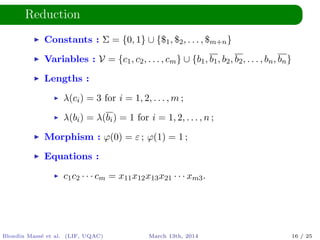
Equations :
c1c2 · · · cm = x11x12x13x21 · · · xm3.
Blondin Mass´e et al. (LIF, UQAC) March 13th, 2014 16 / 25
Reduction
Constants : Σ = {0, 1} ∪ {$1, $2, . . . , $m+n}
Variables : V = {c1, c2, . . . , cm} ∪ {b1, b1, b2, b2, . . . , bn, bn}
Lengths :
λ(ci) = 3 for i = 1, 2, . . . , m ;
λ(bi) = λ(bi) = 1 for i = 1, 2, . . . , n ;
Morphism : ϕ(0) = ε ; ϕ(1) = 1 ;
Equations :
c1c2 · · · cm = x11x12x13x21 · · · xm3.
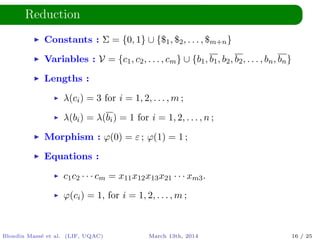
ϕ(ci) = 1, for i = 1, 2, . . . , m ;
Blondin Mass´e et al. (LIF, UQAC) March 13th, 2014 16 / 25
Reduction
Constants : Σ = {0, 1} ∪ {$1, $2, . . . , $m+n}
Variables : V = {c1, c2, . . . , cm} ∪ {b1, b1, b2, b2, . . . , bn, bn}
Lengths :
λ(ci) = 3 for i = 1, 2, . . . , m ;
λ(bi) = λ(bi) = 1 for i = 1, 2, . . . , n ;
Morphism : ϕ(0) = ε ; ϕ(1) = 1 ;
Equations :
c1c2 · · · cm = x11x12x13x21 · · · xm3.
ϕ(ci) = 1, for i = 1, 2, . . . , m ;
ϕ(bibi) = 1, for i = 1, 2, . . . , n ;
Blondin Mass´e et al. (LIF, UQAC) March 13th, 2014 16 / 25
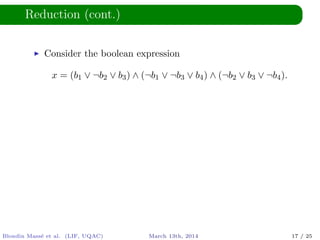
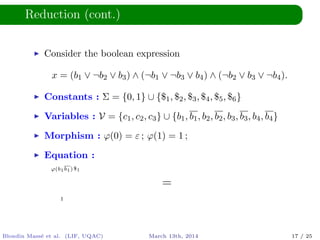
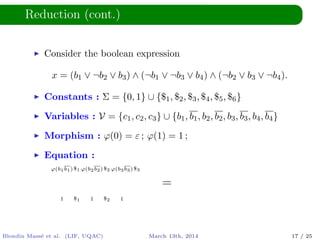
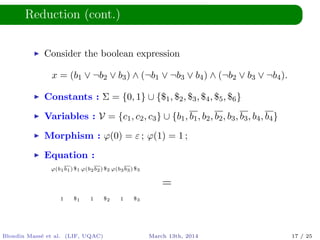
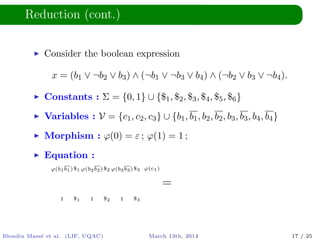
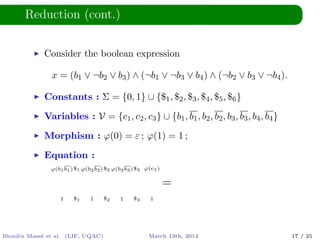
Reduction (cont.)
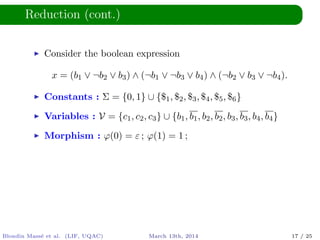
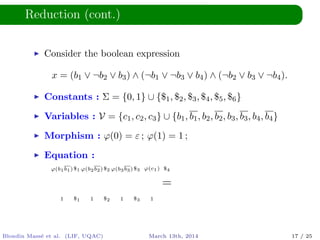
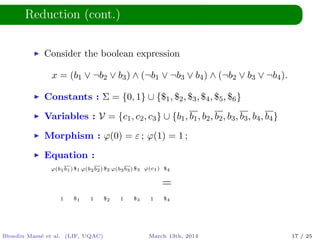
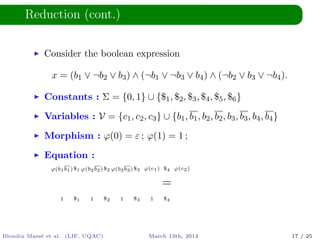
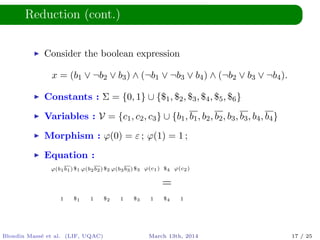
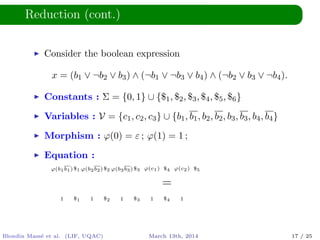
Consider the boolean expression
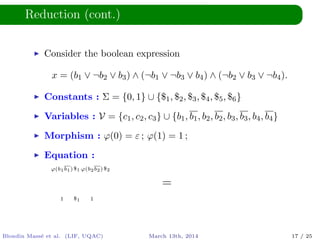
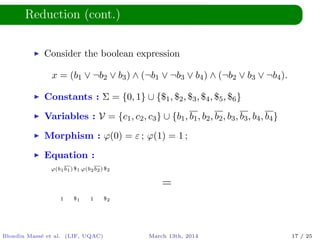
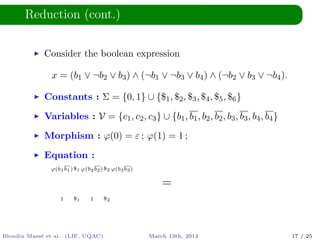
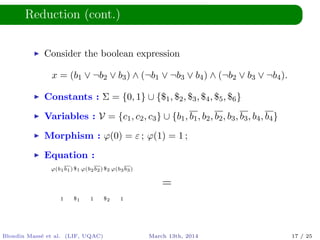
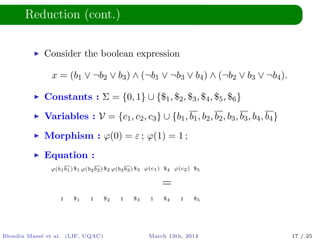
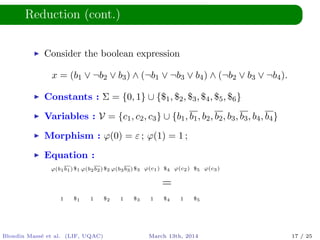
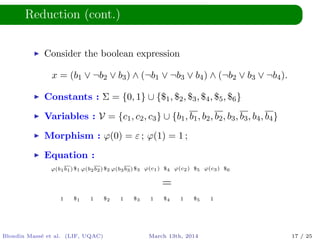
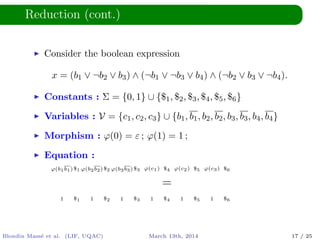
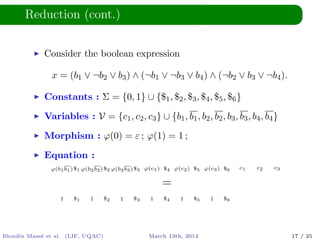
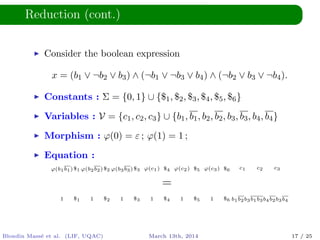
x = (b1 ∨ ¬b2 ∨ b3) ∧ (¬b1 ∨ ¬b3 ∨ b4) ∧ (¬b2 ∨ b3 ∨ ¬b4).
Blondin Mass´e et al. (LIF, UQAC) March 13th, 2014 17 / 25
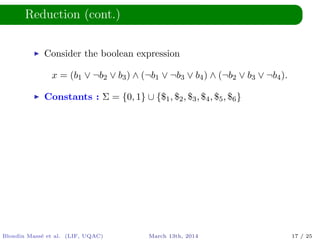
Reduction (cont.)
Consider the boolean expression
x = (b1 ∨ ¬b2 ∨ b3) ∧ (¬b1 ∨ ¬b3 ∨ b4) ∧ (¬b2 ∨ b3 ∨ ¬b4).
Constants : Σ = {0, 1} ∪ {$1, $2, $3, $4, $5, $6}
Blondin Mass´e et al. (LIF, UQAC) March 13th, 2014 17 / 25
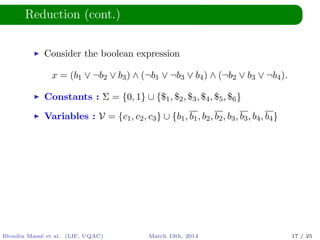
Reduction (cont.)
Consider the boolean expression
x = (b1 ∨ ¬b2 ∨ b3) ∧ (¬b1 ∨ ¬b3 ∨ b4) ∧ (¬b2 ∨ b3 ∨ ¬b4).
Constants : Σ = {0, 1} ∪ {$1, $2, $3, $4, $5, $6}
Variables : V = {c1, c2, c3} ∪ {b1, b1, b2, b2, b3, b3, b4, b4}
Blondin Mass´e et al. (LIF, UQAC) March 13th, 2014 17 / 25
Reduction (cont.)
Consider the boolean expression
x = (b1 ∨ ¬b2 ∨ b3) ∧ (¬b1 ∨ ¬b3 ∨ b4) ∧ (¬b2 ∨ b3 ∨ ¬b4).
Constants : Σ = {0, 1} ∪ {$1, $2, $3, $4, $5, $6}
Variables : V = {c1, c2, c3} ∪ {b1, b1, b2, b2, b3, b3, b4, b4}
Morphism : ϕ(0) = ε ; ϕ(1) = 1 ;
Blondin Mass´e et al. (LIF, UQAC) March 13th, 2014 17 / 25
Reduction (cont.)
Consider the boolean expression
x = (b1 ∨ ¬b2 ∨ b3) ∧ (¬b1 ∨ ¬b3 ∨ b4) ∧ (¬b2 ∨ b3 ∨ ¬b4).
Constants : Σ = {0, 1} ∪ {$1, $2, $3, $4, $5, $6}
Variables : V = {c1, c2, c3} ∪ {b1, b1, b2, b2, b3, b3, b4, b4}
Morphism : ϕ(0) = ε ; ϕ(1) = 1 ;
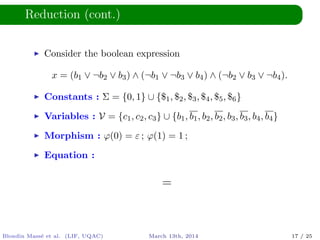
Equation :
=
Blondin Mass´e et al. (LIF, UQAC) March 13th, 2014 17 / 25
Reduction (cont.)
Consider the boolean expression
x = (b1 ∨ ¬b2 ∨ b3) ∧ (¬b1 ∨ ¬b3 ∨ b4) ∧ (¬b2 ∨ b3 ∨ ¬b4).
Constants : Σ = {0, 1} ∪ {$1, $2, $3, $4, $5, $6}
Variables : V = {c1, c2, c3} ∪ {b1, b1, b2, b2, b3, b3, b4, b4}
Morphism : ϕ(0) = ε ; ϕ(1) = 1 ;
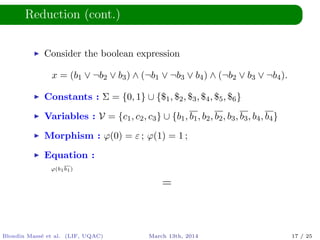
Equation :
ϕ(b1b1)
=
Blondin Mass´e et al. (LIF, UQAC) March 13th, 2014 17 / 25
Reduction (cont.)
Consider the boolean expression
x = (b1 ∨ ¬b2 ∨ b3) ∧ (¬b1 ∨ ¬b3 ∨ b4) ∧ (¬b2 ∨ b3 ∨ ¬b4).
Constants : Σ = {0, 1} ∪ {$1, $2, $3, $4, $5, $6}
Variables : V = {c1, c2, c3} ∪ {b1, b1, b2, b2, b3, b3, b4, b4}
Morphism : ϕ(0) = ε ; ϕ(1) = 1 ;
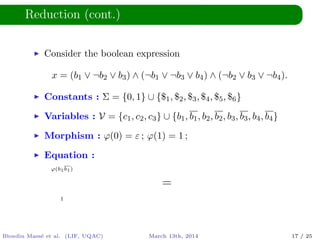
Equation :
ϕ(b1b1)
=
1
Blondin Mass´e et al. (LIF, UQAC) March 13th, 2014 17 / 25
Reduction (cont.)
Consider the boolean expression
x = (b1 ∨ ¬b2 ∨ b3) ∧ (¬b1 ∨ ¬b3 ∨ b4) ∧ (¬b2 ∨ b3 ∨ ¬b4).
Constants : Σ = {0, 1} ∪ {$1, $2, $3, $4, $5, $6}
Variables : V = {c1, c2, c3} ∪ {b1, b1, b2, b2, b3, b3, b4, b4}
Morphism : ϕ(0) = ε ; ϕ(1) = 1 ;
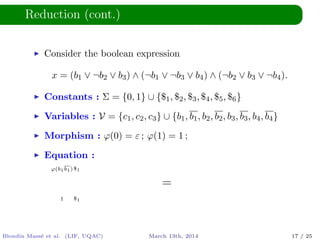
Equation :
ϕ(b1b1)$1
=
1
Blondin Mass´e et al. (LIF, UQAC) March 13th, 2014 17 / 25
Reduction (cont.)
Consider the boolean expression
x = (b1 ∨ ¬b2 ∨ b3) ∧ (¬b1 ∨ ¬b3 ∨ b4) ∧ (¬b2 ∨ b3 ∨ ¬b4).
Constants : Σ = {0, 1} ∪ {$1, $2, $3, $4, $5, $6}
Variables : V = {c1, c2, c3} ∪ {b1, b1, b2, b2, b3, b3, b4, b4}
Morphism : ϕ(0) = ε ; ϕ(1) = 1 ;
Equation :
ϕ(b1b1)$1
=
1 $1
Blondin Mass´e et al. (LIF, UQAC) March 13th, 2014 17 / 25
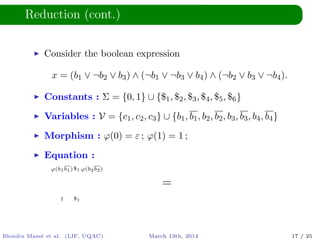
Reduction (cont.)
Consider the boolean expression
x = (b1 ∨ ¬b2 ∨ b3) ∧ (¬b1 ∨ ¬b3 ∨ b4) ∧ (¬b2 ∨ b3 ∨ ¬b4).
Constants : Σ = {0, 1} ∪ {$1, $2, $3, $4, $5, $6}
Variables : V = {c1, c2, c3} ∪ {b1, b1, b2, b2, b3, b3, b4, b4}
Morphism : ϕ(0) = ε ; ϕ(1) = 1 ;
Equation :
ϕ(b1b1)$1 ϕ(b2b2)
=
1 $1
Blondin Mass´e et al. (LIF, UQAC) March 13th, 2014 17 / 25
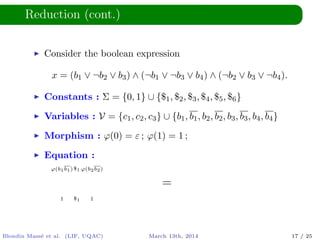
Reduction (cont.)
Consider the boolean expression
x = (b1 ∨ ¬b2 ∨ b3) ∧ (¬b1 ∨ ¬b3 ∨ b4) ∧ (¬b2 ∨ b3 ∨ ¬b4).
Constants : Σ = {0, 1} ∪ {$1, $2, $3, $4, $5, $6}
Variables : V = {c1, c2, c3} ∪ {b1, b1, b2, b2, b3, b3, b4, b4}
Morphism : ϕ(0) = ε ; ϕ(1) = 1 ;
Equation :
ϕ(b1b1)$1 ϕ(b2b2)
=
1 $1 1
Blondin Mass´e et al. (LIF, UQAC) March 13th, 2014 17 / 25
Reduction (cont.)
Consider the boolean expression
x = (b1 ∨ ¬b2 ∨ b3) ∧ (¬b1 ∨ ¬b3 ∨ b4) ∧ (¬b2 ∨ b3 ∨ ¬b4).
Constants : Σ = {0, 1} ∪ {$1, $2, $3, $4, $5, $6}
Variables : V = {c1, c2, c3} ∪ {b1, b1, b2, b2, b3, b3, b4, b4}
Morphism : ϕ(0) = ε ; ϕ(1) = 1 ;
Equation :
ϕ(b1b1)$1 ϕ(b2b2)$2
=
1 $1 1
Blondin Mass´e et al. (LIF, UQAC) March 13th, 2014 17 / 25
Reduction (cont.)
Consider the boolean expression
x = (b1 ∨ ¬b2 ∨ b3) ∧ (¬b1 ∨ ¬b3 ∨ b4) ∧ (¬b2 ∨ b3 ∨ ¬b4).
Constants : Σ = {0, 1} ∪ {$1, $2, $3, $4, $5, $6}
Variables : V = {c1, c2, c3} ∪ {b1, b1, b2, b2, b3, b3, b4, b4}
Morphism : ϕ(0) = ε ; ϕ(1) = 1 ;
Equation :
ϕ(b1b1)$1 ϕ(b2b2)$2
=
1 $1 1 $2
Blondin Mass´e et al. (LIF, UQAC) March 13th, 2014 17 / 25
Reduction (cont.)
Consider the boolean expression
x = (b1 ∨ ¬b2 ∨ b3) ∧ (¬b1 ∨ ¬b3 ∨ b4) ∧ (¬b2 ∨ b3 ∨ ¬b4).
Constants : Σ = {0, 1} ∪ {$1, $2, $3, $4, $5, $6}
Variables : V = {c1, c2, c3} ∪ {b1, b1, b2, b2, b3, b3, b4, b4}
Morphism : ϕ(0) = ε ; ϕ(1) = 1 ;
Equation :
ϕ(b1b1)$1 ϕ(b2b2)$2 ϕ(b3b3)
=
1 $1 1 $2
Blondin Mass´e et al. (LIF, UQAC) March 13th, 2014 17 / 25
Reduction (cont.)
Consider the boolean expression
x = (b1 ∨ ¬b2 ∨ b3) ∧ (¬b1 ∨ ¬b3 ∨ b4) ∧ (¬b2 ∨ b3 ∨ ¬b4).
Constants : Σ = {0, 1} ∪ {$1, $2, $3, $4, $5, $6}
Variables : V = {c1, c2, c3} ∪ {b1, b1, b2, b2, b3, b3, b4, b4}
Morphism : ϕ(0) = ε ; ϕ(1) = 1 ;
Equation :
ϕ(b1b1)$1 ϕ(b2b2)$2 ϕ(b3b3)
=
1 $1 1 $2 1
Blondin Mass´e et al. (LIF, UQAC) March 13th, 2014 17 / 25
Reduction (cont.)
Consider the boolean expression
x = (b1 ∨ ¬b2 ∨ b3) ∧ (¬b1 ∨ ¬b3 ∨ b4) ∧ (¬b2 ∨ b3 ∨ ¬b4).
Constants : Σ = {0, 1} ∪ {$1, $2, $3, $4, $5, $6}
Variables : V = {c1, c2, c3} ∪ {b1, b1, b2, b2, b3, b3, b4, b4}
Morphism : ϕ(0) = ε ; ϕ(1) = 1 ;
Equation :
ϕ(b1b1)$1 ϕ(b2b2)$2 ϕ(b3b3)$3
=
1 $1 1 $2 1
Blondin Mass´e et al. (LIF, UQAC) March 13th, 2014 17 / 25
Reduction (cont.)
Consider the boolean expression
x = (b1 ∨ ¬b2 ∨ b3) ∧ (¬b1 ∨ ¬b3 ∨ b4) ∧ (¬b2 ∨ b3 ∨ ¬b4).
Constants : Σ = {0, 1} ∪ {$1, $2, $3, $4, $5, $6}
Variables : V = {c1, c2, c3} ∪ {b1, b1, b2, b2, b3, b3, b4, b4}
Morphism : ϕ(0) = ε ; ϕ(1) = 1 ;
Equation :
ϕ(b1b1)$1 ϕ(b2b2)$2 ϕ(b3b3)$3
=
1 $1 1 $2 1 $3
Blondin Mass´e et al. (LIF, UQAC) March 13th, 2014 17 / 25
Reduction (cont.)
Consider the boolean expression
x = (b1 ∨ ¬b2 ∨ b3) ∧ (¬b1 ∨ ¬b3 ∨ b4) ∧ (¬b2 ∨ b3 ∨ ¬b4).
Constants : Σ = {0, 1} ∪ {$1, $2, $3, $4, $5, $6}
Variables : V = {c1, c2, c3} ∪ {b1, b1, b2, b2, b3, b3, b4, b4}
Morphism : ϕ(0) = ε ; ϕ(1) = 1 ;
Equation :
ϕ(b1b1)$1 ϕ(b2b2)$2 ϕ(b3b3)$3 ϕ(c1)
=
1 $1 1 $2 1 $3
Blondin Mass´e et al. (LIF, UQAC) March 13th, 2014 17 / 25
Reduction (cont.)
Consider the boolean expression
x = (b1 ∨ ¬b2 ∨ b3) ∧ (¬b1 ∨ ¬b3 ∨ b4) ∧ (¬b2 ∨ b3 ∨ ¬b4).
Constants : Σ = {0, 1} ∪ {$1, $2, $3, $4, $5, $6}
Variables : V = {c1, c2, c3} ∪ {b1, b1, b2, b2, b3, b3, b4, b4}
Morphism : ϕ(0) = ε ; ϕ(1) = 1 ;
Equation :
ϕ(b1b1)$1 ϕ(b2b2)$2 ϕ(b3b3)$3 ϕ(c1)
=
1 $1 1 $2 1 $3 1
Blondin Mass´e et al. (LIF, UQAC) March 13th, 2014 17 / 25
Reduction (cont.)
Consider the boolean expression
x = (b1 ∨ ¬b2 ∨ b3) ∧ (¬b1 ∨ ¬b3 ∨ b4) ∧ (¬b2 ∨ b3 ∨ ¬b4).
Constants : Σ = {0, 1} ∪ {$1, $2, $3, $4, $5, $6}
Variables : V = {c1, c2, c3} ∪ {b1, b1, b2, b2, b3, b3, b4, b4}
Morphism : ϕ(0) = ε ; ϕ(1) = 1 ;
Equation :
ϕ(b1b1)$1 ϕ(b2b2)$2 ϕ(b3b3)$3 ϕ(c1) $4
=
1 $1 1 $2 1 $3 1
Blondin Mass´e et al. (LIF, UQAC) March 13th, 2014 17 / 25
Reduction (cont.)
Consider the boolean expression
x = (b1 ∨ ¬b2 ∨ b3) ∧ (¬b1 ∨ ¬b3 ∨ b4) ∧ (¬b2 ∨ b3 ∨ ¬b4).
Constants : Σ = {0, 1} ∪ {$1, $2, $3, $4, $5, $6}
Variables : V = {c1, c2, c3} ∪ {b1, b1, b2, b2, b3, b3, b4, b4}
Morphism : ϕ(0) = ε ; ϕ(1) = 1 ;
Equation :
ϕ(b1b1)$1 ϕ(b2b2)$2 ϕ(b3b3)$3 ϕ(c1) $4
=
1 $1 1 $2 1 $3 1 $4
Blondin Mass´e et al. (LIF, UQAC) March 13th, 2014 17 / 25
Reduction (cont.)
Consider the boolean expression
x = (b1 ∨ ¬b2 ∨ b3) ∧ (¬b1 ∨ ¬b3 ∨ b4) ∧ (¬b2 ∨ b3 ∨ ¬b4).
Constants : Σ = {0, 1} ∪ {$1, $2, $3, $4, $5, $6}
Variables : V = {c1, c2, c3} ∪ {b1, b1, b2, b2, b3, b3, b4, b4}
Morphism : ϕ(0) = ε ; ϕ(1) = 1 ;
Equation :
ϕ(b1b1)$1 ϕ(b2b2)$2 ϕ(b3b3)$3 ϕ(c1) $4 ϕ(c2)
=
1 $1 1 $2 1 $3 1 $4
Blondin Mass´e et al. (LIF, UQAC) March 13th, 2014 17 / 25
Reduction (cont.)
Consider the boolean expression
x = (b1 ∨ ¬b2 ∨ b3) ∧ (¬b1 ∨ ¬b3 ∨ b4) ∧ (¬b2 ∨ b3 ∨ ¬b4).
Constants : Σ = {0, 1} ∪ {$1, $2, $3, $4, $5, $6}
Variables : V = {c1, c2, c3} ∪ {b1, b1, b2, b2, b3, b3, b4, b4}
Morphism : ϕ(0) = ε ; ϕ(1) = 1 ;
Equation :
ϕ(b1b1)$1 ϕ(b2b2)$2 ϕ(b3b3)$3 ϕ(c1) $4 ϕ(c2)
=
1 $1 1 $2 1 $3 1 $4 1
Blondin Mass´e et al. (LIF, UQAC) March 13th, 2014 17 / 25
Reduction (cont.)
Consider the boolean expression
x = (b1 ∨ ¬b2 ∨ b3) ∧ (¬b1 ∨ ¬b3 ∨ b4) ∧ (¬b2 ∨ b3 ∨ ¬b4).
Constants : Σ = {0, 1} ∪ {$1, $2, $3, $4, $5, $6}
Variables : V = {c1, c2, c3} ∪ {b1, b1, b2, b2, b3, b3, b4, b4}
Morphism : ϕ(0) = ε ; ϕ(1) = 1 ;
Equation :
ϕ(b1b1)$1 ϕ(b2b2)$2 ϕ(b3b3)$3 ϕ(c1) $4 ϕ(c2) $5
=
1 $1 1 $2 1 $3 1 $4 1
Blondin Mass´e et al. (LIF, UQAC) March 13th, 2014 17 / 25
Reduction (cont.)
Consider the boolean expression
x = (b1 ∨ ¬b2 ∨ b3) ∧ (¬b1 ∨ ¬b3 ∨ b4) ∧ (¬b2 ∨ b3 ∨ ¬b4).
Constants : Σ = {0, 1} ∪ {$1, $2, $3, $4, $5, $6}
Variables : V = {c1, c2, c3} ∪ {b1, b1, b2, b2, b3, b3, b4, b4}
Morphism : ϕ(0) = ε ; ϕ(1) = 1 ;
Equation :
ϕ(b1b1)$1 ϕ(b2b2)$2 ϕ(b3b3)$3 ϕ(c1) $4 ϕ(c2) $5
=
1 $1 1 $2 1 $3 1 $4 1 $5
Blondin Mass´e et al. (LIF, UQAC) March 13th, 2014 17 / 25
Reduction (cont.)
Consider the boolean expression
x = (b1 ∨ ¬b2 ∨ b3) ∧ (¬b1 ∨ ¬b3 ∨ b4) ∧ (¬b2 ∨ b3 ∨ ¬b4).
Constants : Σ = {0, 1} ∪ {$1, $2, $3, $4, $5, $6}
Variables : V = {c1, c2, c3} ∪ {b1, b1, b2, b2, b3, b3, b4, b4}
Morphism : ϕ(0) = ε ; ϕ(1) = 1 ;
Equation :
ϕ(b1b1)$1 ϕ(b2b2)$2 ϕ(b3b3)$3 ϕ(c1) $4 ϕ(c2) $5 ϕ(c3)
=
1 $1 1 $2 1 $3 1 $4 1 $5
Blondin Mass´e et al. (LIF, UQAC) March 13th, 2014 17 / 25
Reduction (cont.)
Consider the boolean expression
x = (b1 ∨ ¬b2 ∨ b3) ∧ (¬b1 ∨ ¬b3 ∨ b4) ∧ (¬b2 ∨ b3 ∨ ¬b4).
Constants : Σ = {0, 1} ∪ {$1, $2, $3, $4, $5, $6}
Variables : V = {c1, c2, c3} ∪ {b1, b1, b2, b2, b3, b3, b4, b4}
Morphism : ϕ(0) = ε ; ϕ(1) = 1 ;
Equation :
ϕ(b1b1)$1 ϕ(b2b2)$2 ϕ(b3b3)$3 ϕ(c1) $4 ϕ(c2) $5 ϕ(c3)
=
1 $1 1 $2 1 $3 1 $4 1 $5 1
Blondin Mass´e et al. (LIF, UQAC) March 13th, 2014 17 / 25
Reduction (cont.)
Consider the boolean expression
x = (b1 ∨ ¬b2 ∨ b3) ∧ (¬b1 ∨ ¬b3 ∨ b4) ∧ (¬b2 ∨ b3 ∨ ¬b4).
Constants : Σ = {0, 1} ∪ {$1, $2, $3, $4, $5, $6}
Variables : V = {c1, c2, c3} ∪ {b1, b1, b2, b2, b3, b3, b4, b4}
Morphism : ϕ(0) = ε ; ϕ(1) = 1 ;
Equation :
ϕ(b1b1)$1 ϕ(b2b2)$2 ϕ(b3b3)$3 ϕ(c1) $4 ϕ(c2) $5 ϕ(c3) $6
=
1 $1 1 $2 1 $3 1 $4 1 $5 1
Blondin Mass´e et al. (LIF, UQAC) March 13th, 2014 17 / 25
Reduction (cont.)
Consider the boolean expression
x = (b1 ∨ ¬b2 ∨ b3) ∧ (¬b1 ∨ ¬b3 ∨ b4) ∧ (¬b2 ∨ b3 ∨ ¬b4).
Constants : Σ = {0, 1} ∪ {$1, $2, $3, $4, $5, $6}
Variables : V = {c1, c2, c3} ∪ {b1, b1, b2, b2, b3, b3, b4, b4}
Morphism : ϕ(0) = ε ; ϕ(1) = 1 ;
Equation :
ϕ(b1b1)$1 ϕ(b2b2)$2 ϕ(b3b3)$3 ϕ(c1) $4 ϕ(c2) $5 ϕ(c3) $6
=
1 $1 1 $2 1 $3 1 $4 1 $5 1 $6
Blondin Mass´e et al. (LIF, UQAC) March 13th, 2014 17 / 25
Reduction (cont.)
Consider the boolean expression
x = (b1 ∨ ¬b2 ∨ b3) ∧ (¬b1 ∨ ¬b3 ∨ b4) ∧ (¬b2 ∨ b3 ∨ ¬b4).
Constants : Σ = {0, 1} ∪ {$1, $2, $3, $4, $5, $6}
Variables : V = {c1, c2, c3} ∪ {b1, b1, b2, b2, b3, b3, b4, b4}
Morphism : ϕ(0) = ε ; ϕ(1) = 1 ;
Equation :
ϕ(b1b1)$1 ϕ(b2b2)$2 ϕ(b3b3)$3 ϕ(c1) $4 ϕ(c2) $5 ϕ(c3) $6 c1 c2 c3
=
1 $1 1 $2 1 $3 1 $4 1 $5 1 $6
Blondin Mass´e et al. (LIF, UQAC) March 13th, 2014 17 / 25
Reduction (cont.)
Consider the boolean expression
x = (b1 ∨ ¬b2 ∨ b3) ∧ (¬b1 ∨ ¬b3 ∨ b4) ∧ (¬b2 ∨ b3 ∨ ¬b4).
Constants : Σ = {0, 1} ∪ {$1, $2, $3, $4, $5, $6}
Variables : V = {c1, c2, c3} ∪ {b1, b1, b2, b2, b3, b3, b4, b4}
Morphism : ϕ(0) = ε ; ϕ(1) = 1 ;
Equation :
ϕ(b1b1)$1 ϕ(b2b2)$2 ϕ(b3b3)$3 ϕ(c1) $4 ϕ(c2) $5 ϕ(c3) $6 c1 c2 c3
=
1 $1 1 $2 1 $3 1 $4 1 $5 1 $6 b1b2b3b1b3b4b2b3b4
Blondin Mass´e et al. (LIF, UQAC) March 13th, 2014 17 / 25
Outline
1. Introduction
2. Words equations
3. From equations to graphs
4. Conclusion
Blondin Mass´e et al. (LIF, UQAC) March 13th, 2014 18 / 25
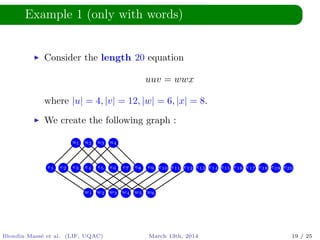
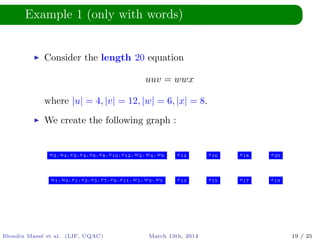
Example 1 (only with words)
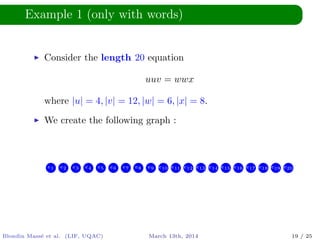
Consider the length 20 equation
uuv = wwx
where |u| = 4, |v| = 12, |w| = 6, |x| = 8.
Blondin Mass´e et al. (LIF, UQAC) March 13th, 2014 19 / 25
Example 1 (only with words)
Consider the length 20 equation
uuv = wwx
where |u| = 4, |v| = 12, |w| = 6, |x| = 8.
We create the following graph :
Blondin Mass´e et al. (LIF, UQAC) March 13th, 2014 19 / 25
Example 1 (only with words)
Consider the length 20 equation
uuv = wwx
where |u| = 4, |v| = 12, |w| = 6, |x| = 8.
We create the following graph :
e1 e2 e3 e4 e5 e6 e7 e8 e9 e10 e11 e12 e13 e14 e15 e16 e17 e18 e19 e20
Blondin Mass´e et al. (LIF, UQAC) March 13th, 2014 19 / 25
Example 1 (only with words)
Consider the length 20 equation
uuv = wwx
where |u| = 4, |v| = 12, |w| = 6, |x| = 8.
We create the following graph :
e1 e2 e3 e4 e5 e6 e7 e8 e9 e10 e11 e12 e13 e14 e15 e16 e17 e18 e19 e20
u1 u2 u3 u4
Blondin Mass´e et al. (LIF, UQAC) March 13th, 2014 19 / 25
Example 1 (only with words)
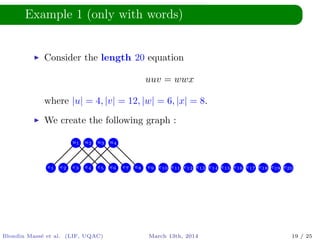
Consider the length 20 equation
uuv = wwx
where |u| = 4, |v| = 12, |w| = 6, |x| = 8.
We create the following graph :
e1 e2 e3 e4 e5 e6 e7 e8 e9 e10 e11 e12 e13 e14 e15 e16 e17 e18 e19 e20
u1 u2 u3 u4
w1 w2 w3 w4 w5 w6
Blondin Mass´e et al. (LIF, UQAC) March 13th, 2014 19 / 25
Example 1 (only with words)
Consider the length 20 equation
uuv = wwx
where |u| = 4, |v| = 12, |w| = 6, |x| = 8.
We create the following graph :
u1, u3, e1, e3, e5, e7, e9, e11, w1, w3, w5
u2, u4, e2, e4, e6, e8, e10, e12, w2, w4, w6
e13
e14
e15
e16
e17
e18
e19
e20
Blondin Mass´e et al. (LIF, UQAC) March 13th, 2014 19 / 25
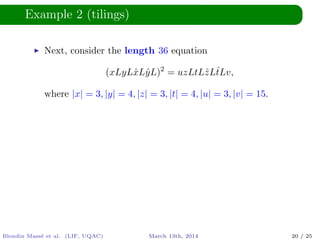
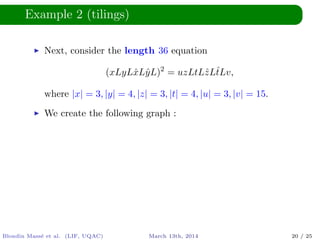
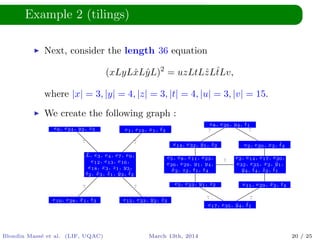
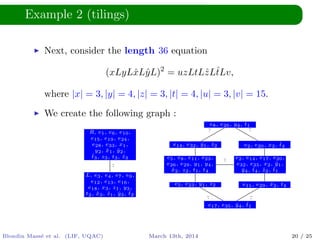
Example 2 (tilings)
Next, consider the length 36 equation
(xLyLˆxLˆyL)2
= uzLtLˆzLˆtLv,
where |x| = 3, |y| = 4, |z| = 3, |t| = 4, |u| = 3, |v| = 15.
Blondin Mass´e et al. (LIF, UQAC) March 13th, 2014 20 / 25
Example 2 (tilings)
Next, consider the length 36 equation
(xLyLˆxLˆyL)2
= uzLtLˆzLˆtLv,
where |x| = 3, |y| = 4, |z| = 3, |t| = 4, |u| = 3, |v| = 15.
We create the following graph :
Blondin Mass´e et al. (LIF, UQAC) March 13th, 2014 20 / 25
Example 2 (tilings)
Next, consider the length 36 equation
(xLyLˆxLˆyL)2
= uzLtLˆzLˆtLv,
where |x| = 3, |y| = 4, |z| = 3, |t| = 4, |u| = 3, |v| = 15.
We create the following graph :
e1, e19, x1, ˆt3
e6, e24, y2, z3
e10, e28, ˆx1, t3 e15, e33, ˆy2, ˆz3
L, e3, e4, e7, e9,
e12, e13, e16,
e18, x3, z1, y3,
t2, ˆx3, ˆz1, ˆy3, ˆt2
¯·¯·
¯· ¯·
e2, e20, x2, ˆt4
e8, e26, y4, t1
e14, e32, ˆy1, ˆz2
e5, e23, y1, z2
e17, e35, ˆy4, ˆt1
e11, e29, ˆx2, t4
¯·¯·
¯·
¯· ¯·
¯·
e2, e14, e17, e20,
e32, e35, x2, ˆy1,
ˆy4, ˆt4, ˆz2, ˆt1
e5, e8, e11, e23,
e26, e29, y1, y4,
ˆx2, z2, t1, t4
¯·
Blondin Mass´e et al. (LIF, UQAC) March 13th, 2014 20 / 25
Example 2 (tilings)
Next, consider the length 36 equation
(xLyLˆxLˆyL)2
= uzLtLˆzLˆtLv,
where |x| = 3, |y| = 4, |z| = 3, |t| = 4, |u| = 3, |v| = 15.
We create the following graph :
e2, e20, x2, ˆt4
e8, e26, y4, t1
e14, e32, ˆy1, ˆz2
e5, e23, y1, z2
e17, e35, ˆy4, ˆt1
e11, e29, ˆx2, t4
¯·¯·
¯·
¯· ¯·
¯·
R, e1, e6, e10,
e15, e19, e24,
e28, e33, x1,
y2, ˆx1, ˆy2,
ˆt3, z3, t3, ˆz3
L, e3, e4, e7, e9,
e12, e13, e16,
e18, x3, z1, y3,
t2, ˆx3, ˆz1, ˆy3, ˆt2
¯·
e2, e14, e17, e20,
e32, e35, x2, ˆy1,
ˆy4, ˆt4, ˆz2, ˆt1
e5, e8, e11, e23,
e26, e29, y1, y4,
ˆx2, z2, t1, t4
¯·
Blondin Mass´e et al. (LIF, UQAC) March 13th, 2014 20 / 25
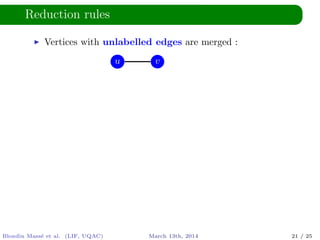
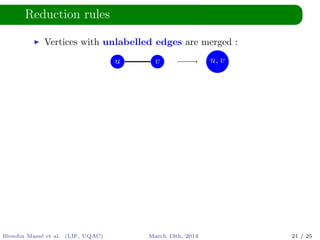
Reduction rules
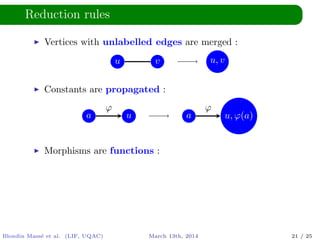
Vertices with unlabelled edges are merged :
Blondin Mass´e et al. (LIF, UQAC) March 13th, 2014 21 / 25
Reduction rules
Vertices with unlabelled edges are merged :
u v
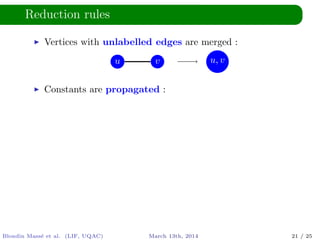
Blondin Mass´e et al. (LIF, UQAC) March 13th, 2014 21 / 25
Reduction rules
Vertices with unlabelled edges are merged :
u v u, v
Blondin Mass´e et al. (LIF, UQAC) March 13th, 2014 21 / 25
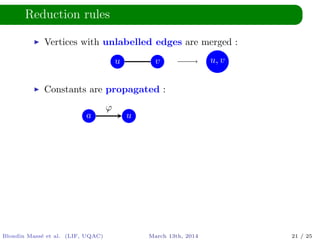
Reduction rules
Vertices with unlabelled edges are merged :
u v u, v
Constants are propagated :
Blondin Mass´e et al. (LIF, UQAC) March 13th, 2014 21 / 25
Reduction rules
Vertices with unlabelled edges are merged :
u v u, v
Constants are propagated :
a u
ϕ
Blondin Mass´e et al. (LIF, UQAC) March 13th, 2014 21 / 25
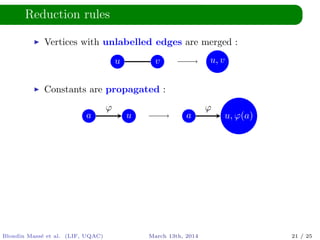
Reduction rules
Vertices with unlabelled edges are merged :
u v u, v
Constants are propagated :
a u
ϕ
a u, ϕ(a)
ϕ
Blondin Mass´e et al. (LIF, UQAC) March 13th, 2014 21 / 25
Reduction rules
Vertices with unlabelled edges are merged :
u v u, v
Constants are propagated :
a u
ϕ
a u, ϕ(a)
ϕ
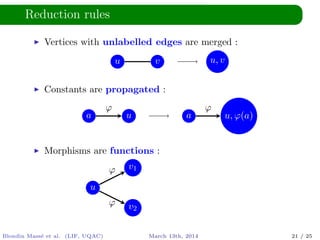
Morphisms are functions :
Blondin Mass´e et al. (LIF, UQAC) March 13th, 2014 21 / 25
Reduction rules
Vertices with unlabelled edges are merged :
u v u, v
Constants are propagated :
a u
ϕ
a u, ϕ(a)
ϕ
Morphisms are functions :
u
v1
v2
ϕ
ϕ
Blondin Mass´e et al. (LIF, UQAC) March 13th, 2014 21 / 25
Reduction rules
Vertices with unlabelled edges are merged :
u v u, v
Constants are propagated :
a u
ϕ
a u, ϕ(a)
ϕ
Morphisms are functions :
u
v1
v2
ϕ
ϕ
u v1, v2
ϕ
Blondin Mass´e et al. (LIF, UQAC) March 13th, 2014 21 / 25
Reduction rules (cont.)
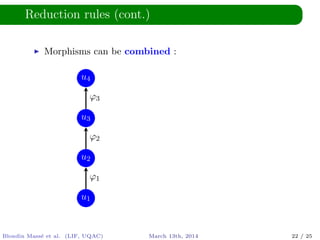
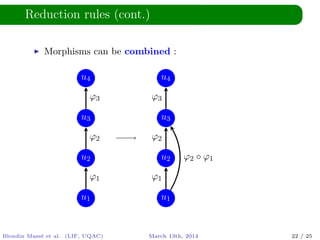
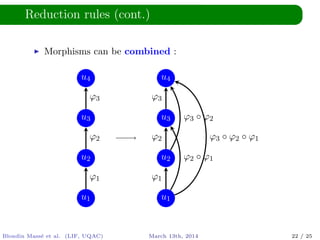
Morphisms can be combined :
Blondin Mass´e et al. (LIF, UQAC) March 13th, 2014 22 / 25
Reduction rules (cont.)
Morphisms can be combined :
u1
u2
u3
u4
ϕ1
ϕ2
ϕ3
Blondin Mass´e et al. (LIF, UQAC) March 13th, 2014 22 / 25
Reduction rules (cont.)
Morphisms can be combined :
u1
u2
u3
u4
ϕ1
ϕ2
ϕ3
u1
u2
u3
u4
ϕ1
ϕ2
ϕ3
ϕ2 ◦ ϕ1
Blondin Mass´e et al. (LIF, UQAC) March 13th, 2014 22 / 25
Reduction rules (cont.)
Morphisms can be combined :
u1
u2
u3
u4
ϕ1
ϕ2
ϕ3
u1
u2
u3
u4
ϕ1
ϕ2
ϕ3
ϕ2 ◦ ϕ1
ϕ3 ◦ ϕ2
Blondin Mass´e et al. (LIF, UQAC) March 13th, 2014 22 / 25
Reduction rules (cont.)
Morphisms can be combined :
u1
u2
u3
u4
ϕ1
ϕ2
ϕ3
u1
u2
u3
u4
ϕ1
ϕ2
ϕ3
ϕ2 ◦ ϕ1
ϕ3 ◦ ϕ2
ϕ3 ◦ ϕ2 ◦ ϕ1
Blondin Mass´e et al. (LIF, UQAC) March 13th, 2014 22 / 25
Outline
1. Introduction
2. Words equations
3. From equations to graphs
4. Conclusion
Blondin Mass´e et al. (LIF, UQAC) March 13th, 2014 23 / 25
Concluding remarks
The approach based on graphs was compared with one
using directly boolean constraint programming ;
Blondin Mass´e et al. (LIF, UQAC) March 13th, 2014 24 / 25
Concluding remarks
The approach based on graphs was compared with one
using directly boolean constraint programming ;
In almost all cases, it performed better, especially when
there are morphisms and antimorphisms ;
Blondin Mass´e et al. (LIF, UQAC) March 13th, 2014 24 / 25
Concluding remarks
The approach based on graphs was compared with one
using directly boolean constraint programming ;
In almost all cases, it performed better, especially when
there are morphisms and antimorphisms ;
Equations considered in this talk :
Blondin Mass´e et al. (LIF, UQAC) March 13th, 2014 24 / 25
Concluding remarks
The approach based on graphs was compared with one
using directly boolean constraint programming ;
In almost all cases, it performed better, especially when
there are morphisms and antimorphisms ;
Equations considered in this talk :
have fixed lengths ;
Blondin Mass´e et al. (LIF, UQAC) March 13th, 2014 24 / 25
Concluding remarks
The approach based on graphs was compared with one
using directly boolean constraint programming ;
In almost all cases, it performed better, especially when
there are morphisms and antimorphisms ;
Equations considered in this talk :
have fixed lengths ;
deal only with uniform morphisms and
antimorphisms ;
Blondin Mass´e et al. (LIF, UQAC) March 13th, 2014 24 / 25
Concluding remarks
The approach based on graphs was compared with one
using directly boolean constraint programming ;
In almost all cases, it performed better, especially when
there are morphisms and antimorphisms ;
Equations considered in this talk :
have fixed lengths ;
deal only with uniform morphisms and
antimorphisms ;
How could it be extended to the non-uniform case ?
Blondin Mass´e et al. (LIF, UQAC) March 13th, 2014 24 / 25
Questions ?
Merci de m’avoir ´ecout´e
Thank you for your attention
Les agradezco su atenci´on
Blondin Mass´e et al. (LIF, UQAC) March 13th, 2014 25 / 25

Solving Equations on Words with Morphisms and Antimorphisms

  • 1.
    Solving Equations onWords with Morphisms and Antimorphisms A. Blondin Mass´e, S. Gaboury, S. Hall´e and M. Larouche Laboratoire d’informatique formelle Universit´e du Qu´ebec `a Chicoutimi Chicoutimi, Canada Language and Automata Theory and Applications (LATA 2014) March 13th, 2014 Madrid, Spain Blondin Mass´e et al. (LIF, UQAC) March 13th, 2014 1 / 25
  • 2.
    Outline 1. Introduction 2. Wordsequations 3. From equations to graphs 4. Conclusion Blondin Mass´e et al. (LIF, UQAC) March 13th, 2014 2 / 25
  • 3.
    Outline 1. Introduction 2. Wordsequations 3. From equations to graphs 4. Conclusion Blondin Mass´e et al. (LIF, UQAC) March 13th, 2014 3 / 25
  • 4.
    Distinct squares conjecture Conjecture(Fraenkel and Simpson, 1998) A word of length n contains less than n distinct squares. Blondin Mass´e et al. (LIF, UQAC) March 13th, 2014 4 / 25
  • 5.
    Distinct squares conjecture Conjecture(Fraenkel and Simpson, 1998) A word of length n contains less than n distinct squares. The 8 squares of the word w = 0000110110101 of length 13 are 00, 11, 0000, 0101, 1010, 011011, 101101, 110110. Blondin Mass´e et al. (LIF, UQAC) March 13th, 2014 4 / 25
  • 6.
    Distinct squares conjecture Conjecture(Fraenkel and Simpson, 1998) A word of length n contains less than n distinct squares. The 8 squares of the word w = 0000110110101 of length 13 are 00, 11, 0000, 0101, 1010, 011011, 101101, 110110. We look at the solutions of the equations x1u2 1y1 = x2u2 2y2 = . . . = xku2 kyk, with various lenghts of the xi’s and the ui’s. Blondin Mass´e et al. (LIF, UQAC) March 13th, 2014 4 / 25
  • 7.
    Tilings Blondin Mass´e etal. (LIF, UQAC) March 13th, 2014 5 / 25
  • 8.
    Tilings Blondin Mass´e etal. (LIF, UQAC) March 13th, 2014 5 / 25
  • 9.
    Tilings Blondin Mass´e etal. (LIF, UQAC) March 13th, 2014 5 / 25
  • 10.
    Tilings On the Freemanchain code F = {0, 1, 2, 3} : (xyˆxˆy)2 = pztˆzˆts, Blondin Mass´e et al. (LIF, UQAC) March 13th, 2014 5 / 25
  • 11.
    Tilings On the Freemanchain code F = {0, 1, 2, 3} : (xyˆxˆy)2 = pztˆzˆts, It is easier to solve the equation on the turns alphabet {R, L, F} : (xLyLˆxLˆyL)2 = uzLtLˆzLˆtLv. Blondin Mass´e et al. (LIF, UQAC) March 13th, 2014 5 / 25
  • 12.
    Solving equations onwords Makanin showed that the problem of solving equations on words with constants and variables is decidable (1977) ; Blondin Mass´e et al. (LIF, UQAC) March 13th, 2014 6 / 25
  • 13.
    Solving equations onwords Makanin showed that the problem of solving equations on words with constants and variables is decidable (1977) ; Plandowski showed that the problem is in fact in PSPACE (1999) ; Blondin Mass´e et al. (LIF, UQAC) March 13th, 2014 6 / 25
  • 14.
    Solving equations onwords Makanin showed that the problem of solving equations on words with constants and variables is decidable (1977) ; Plandowski showed that the problem is in fact in PSPACE (1999) ; Abdulrab propose a Lisp implementation of a solver in 1990 (not available anymore) ; Blondin Mass´e et al. (LIF, UQAC) March 13th, 2014 6 / 25
  • 15.
    Solving equations onwords Makanin showed that the problem of solving equations on words with constants and variables is decidable (1977) ; Plandowski showed that the problem is in fact in PSPACE (1999) ; Abdulrab propose a Lisp implementation of a solver in 1990 (not available anymore) ; More recenly, tools such as Hampi, Omega and Stranger deal with string constraints and regular expressions ; Blondin Mass´e et al. (LIF, UQAC) March 13th, 2014 6 / 25
  • 16.
    Solving equations onwords Makanin showed that the problem of solving equations on words with constants and variables is decidable (1977) ; Plandowski showed that the problem is in fact in PSPACE (1999) ; Abdulrab propose a Lisp implementation of a solver in 1990 (not available anymore) ; More recenly, tools such as Hampi, Omega and Stranger deal with string constraints and regular expressions ; None handles morphisms and antimorphisms. Blondin Mass´e et al. (LIF, UQAC) March 13th, 2014 6 / 25
  • 17.
    Outline 1. Introduction 2. Wordsequations 3. From equations to graphs 4. Conclusion Blondin Mass´e et al. (LIF, UQAC) March 13th, 2014 7 / 25
  • 18.
    Basics Alphabet Σ, freemonoid Σ∗, ε is the empty word ; Blondin Mass´e et al. (LIF, UQAC) March 13th, 2014 8 / 25
  • 19.
    Basics Alphabet Σ, freemonoid Σ∗, ε is the empty word ; A morphism is a map ϕ : Σ∗ → Σ∗ such that ϕ(uv) = ϕ(u)ϕ(v) ; Blondin Mass´e et al. (LIF, UQAC) March 13th, 2014 8 / 25
  • 20.
    Basics Alphabet Σ, freemonoid Σ∗, ε is the empty word ; A morphism is a map ϕ : Σ∗ → Σ∗ such that ϕ(uv) = ϕ(u)ϕ(v) ; An antimorphism is a map ϕ : Σ∗ → σ∗ such that ϕ(uv) = ϕ(v)ϕ(u) Blondin Mass´e et al. (LIF, UQAC) March 13th, 2014 8 / 25
  • 21.
    Basics Alphabet Σ, freemonoid Σ∗, ε is the empty word ; A morphism is a map ϕ : Σ∗ → Σ∗ such that ϕ(uv) = ϕ(u)ϕ(v) ; An antimorphism is a map ϕ : Σ∗ → σ∗ such that ϕ(uv) = ϕ(v)ϕ(u) Morphism and antimorphisms are completely determined by their action on single letters ; Blondin Mass´e et al. (LIF, UQAC) March 13th, 2014 8 / 25
  • 22.
    Basics Alphabet Σ, freemonoid Σ∗, ε is the empty word ; A morphism is a map ϕ : Σ∗ → Σ∗ such that ϕ(uv) = ϕ(u)ϕ(v) ; An antimorphism is a map ϕ : Σ∗ → σ∗ such that ϕ(uv) = ϕ(v)ϕ(u) Morphism and antimorphisms are completely determined by their action on single letters ; If ϕ is an antimorphism, then ϕ = · · ϕ , where ϕ is a morphism ; Blondin Mass´e et al. (LIF, UQAC) March 13th, 2014 8 / 25
  • 23.
    Basics Alphabet Σ, freemonoid Σ∗, ε is the empty word ; A morphism is a map ϕ : Σ∗ → Σ∗ such that ϕ(uv) = ϕ(u)ϕ(v) ; An antimorphism is a map ϕ : Σ∗ → σ∗ such that ϕ(uv) = ϕ(v)ϕ(u) Morphism and antimorphisms are completely determined by their action on single letters ; If ϕ is an antimorphism, then ϕ = · · ϕ , where ϕ is a morphism ; A morphism (or antimorphism) is called k-uniform if ϕ(a) = k for every a ∈ Σ ; Blondin Mass´e et al. (LIF, UQAC) March 13th, 2014 8 / 25
  • 24.
    Basics Alphabet Σ, freemonoid Σ∗, ε is the empty word ; A morphism is a map ϕ : Σ∗ → Σ∗ such that ϕ(uv) = ϕ(u)ϕ(v) ; An antimorphism is a map ϕ : Σ∗ → σ∗ such that ϕ(uv) = ϕ(v)ϕ(u) Morphism and antimorphisms are completely determined by their action on single letters ; If ϕ is an antimorphism, then ϕ = · · ϕ , where ϕ is a morphism ; A morphism (or antimorphism) is called k-uniform if ϕ(a) = k for every a ∈ Σ ; We then write |ϕ| = k. Blondin Mass´e et al. (LIF, UQAC) March 13th, 2014 8 / 25
  • 25.
    Words equations systems Systemsof words equations are represented by Σ the set of constants ; Blondin Mass´e et al. (LIF, UQAC) March 13th, 2014 9 / 25
  • 26.
    Words equations systems Systemsof words equations are represented by Σ the set of constants ; V the set of variables ; Blondin Mass´e et al. (LIF, UQAC) March 13th, 2014 9 / 25
  • 27.
    Words equations systems Systemsof words equations are represented by Σ the set of constants ; V the set of variables ; M the set of morphisms ; Blondin Mass´e et al. (LIF, UQAC) March 13th, 2014 9 / 25
  • 28.
    Words equations systems Systemsof words equations are represented by Σ the set of constants ; V the set of variables ; M the set of morphisms ; A the set of antimorphisms ; Blondin Mass´e et al. (LIF, UQAC) March 13th, 2014 9 / 25
  • 29.
    Words equations systems Systemsof words equations are represented by Σ the set of constants ; V the set of variables ; M the set of morphisms ; A the set of antimorphisms ; a list of words equations Li = Ri (i = 1, 2, . . . , m). Blondin Mass´e et al. (LIF, UQAC) March 13th, 2014 9 / 25
  • 30.
    Symbolic expressions A symbolicexpression (or simply expression) is either ε, a constant, or a variable ; Blondin Mass´e et al. (LIF, UQAC) March 13th, 2014 10 / 25
  • 31.
    Symbolic expressions A symbolicexpression (or simply expression) is either ε, a constant, or a variable ; v1v2 · · · vk, where vi is itself an expression ; Blondin Mass´e et al. (LIF, UQAC) March 13th, 2014 10 / 25
  • 32.
    Symbolic expressions A symbolicexpression (or simply expression) is either ε, a constant, or a variable ; v1v2 · · · vk, where vi is itself an expression ; ϕ(v), where v is an expression and ϕ ∈ M ∪ A ; Blondin Mass´e et al. (LIF, UQAC) March 13th, 2014 10 / 25
  • 33.
    Example Take Σ = {a,b}; V = {x, y}; M = {ϕ}, ϕ : a → b, b → a; A = { · } Then abxy = ϕ(x)yab is a word equation. Blondin Mass´e et al. (LIF, UQAC) March 13th, 2014 11 / 25
  • 34.
    Assignments and solutions Anassignment is a map I : V → Σ∗ ; Blondin Mass´e et al. (LIF, UQAC) March 13th, 2014 12 / 25
  • 35.
    Assignments and solutions Anassignment is a map I : V → Σ∗ ; Is is naturally extended as follows Blondin Mass´e et al. (LIF, UQAC) March 13th, 2014 12 / 25
  • 36.
    Assignments and solutions Anassignment is a map I : V → Σ∗ ; Is is naturally extended as follows 1. I(ε) = ε ; Blondin Mass´e et al. (LIF, UQAC) March 13th, 2014 12 / 25
  • 37.
    Assignments and solutions Anassignment is a map I : V → Σ∗ ; Is is naturally extended as follows 1. I(ε) = ε ; 2. I(u) = u, for u ∈ Σ ; Blondin Mass´e et al. (LIF, UQAC) March 13th, 2014 12 / 25
  • 38.
    Assignments and solutions Anassignment is a map I : V → Σ∗ ; Is is naturally extended as follows 1. I(ε) = ε ; 2. I(u) = u, for u ∈ Σ ; 3. I(u1 · u2 · · · uk) = I(u1) · I(u2) · · · I(uk), if ui is an expression (i = 1, 2, . . . , k) ; Blondin Mass´e et al. (LIF, UQAC) March 13th, 2014 12 / 25
  • 39.
    Assignments and solutions Anassignment is a map I : V → Σ∗ ; Is is naturally extended as follows 1. I(ε) = ε ; 2. I(u) = u, for u ∈ Σ ; 3. I(u1 · u2 · · · uk) = I(u1) · I(u2) · · · I(uk), if ui is an expression (i = 1, 2, . . . , k) ; 4. I(ϕ(u)) = ϕ(I(u)), if ϕ ∈ M ∪ A and u is an expression. Blondin Mass´e et al. (LIF, UQAC) March 13th, 2014 12 / 25
  • 40.
    Assignments and solutions Anassignment is a map I : V → Σ∗ ; Is is naturally extended as follows 1. I(ε) = ε ; 2. I(u) = u, for u ∈ Σ ; 3. I(u1 · u2 · · · uk) = I(u1) · I(u2) · · · I(uk), if ui is an expression (i = 1, 2, . . . , k) ; 4. I(ϕ(u)) = ϕ(I(u)), if ϕ ∈ M ∪ A and u is an expression. Let L = R be an equation ; Blondin Mass´e et al. (LIF, UQAC) March 13th, 2014 12 / 25
  • 41.
    Assignments and solutions Anassignment is a map I : V → Σ∗ ; Is is naturally extended as follows 1. I(ε) = ε ; 2. I(u) = u, for u ∈ Σ ; 3. I(u1 · u2 · · · uk) = I(u1) · I(u2) · · · I(uk), if ui is an expression (i = 1, 2, . . . , k) ; 4. I(ϕ(u)) = ϕ(I(u)), if ϕ ∈ M ∪ A and u is an expression. Let L = R be an equation ; A solution of L = R is an assigment S : V → Σ∗such that S(L) = S(R). Blondin Mass´e et al. (LIF, UQAC) March 13th, 2014 12 / 25
  • 42.
    Bounded lengths Since solvinggeneral equations on words is very hard, we need to restrict the context ; Blondin Mass´e et al. (LIF, UQAC) March 13th, 2014 13 / 25
  • 43.
    Bounded lengths Since solvinggeneral equations on words is very hard, we need to restrict the context ; To simplify, we assume that all lenghts of variables are known ; Blondin Mass´e et al. (LIF, UQAC) March 13th, 2014 13 / 25
  • 44.
    Bounded lengths Since solvinggeneral equations on words is very hard, we need to restrict the context ; To simplify, we assume that all lenghts of variables are known ; Let λ : V → N, where λ(v) is the length of the variable v ; Blondin Mass´e et al. (LIF, UQAC) March 13th, 2014 13 / 25
  • 45.
    Bounded lengths Since solvinggeneral equations on words is very hard, we need to restrict the context ; To simplify, we assume that all lenghts of variables are known ; Let λ : V → N, where λ(v) is the length of the variable v ; Naturally, Blondin Mass´e et al. (LIF, UQAC) March 13th, 2014 13 / 25
  • 46.
    Bounded lengths Since solvinggeneral equations on words is very hard, we need to restrict the context ; To simplify, we assume that all lenghts of variables are known ; Let λ : V → N, where λ(v) is the length of the variable v ; Naturally, 1. λ(ε) = 0 ; Blondin Mass´e et al. (LIF, UQAC) March 13th, 2014 13 / 25
  • 47.
    Bounded lengths Since solvinggeneral equations on words is very hard, we need to restrict the context ; To simplify, we assume that all lenghts of variables are known ; Let λ : V → N, where λ(v) is the length of the variable v ; Naturally, 1. λ(ε) = 0 ; 2. λ(u) = 1 for u ∈ Σ ; Blondin Mass´e et al. (LIF, UQAC) March 13th, 2014 13 / 25
  • 48.
    Bounded lengths Since solvinggeneral equations on words is very hard, we need to restrict the context ; To simplify, we assume that all lenghts of variables are known ; Let λ : V → N, where λ(v) is the length of the variable v ; Naturally, 1. λ(ε) = 0 ; 2. λ(u) = 1 for u ∈ Σ ; 3. λ(u1 · u2 · · · uk) = k i=1 λ(ui), if ui is an expression for i = 1, 2, . . . , k ; Blondin Mass´e et al. (LIF, UQAC) March 13th, 2014 13 / 25
  • 49.
    Bounded lengths Since solvinggeneral equations on words is very hard, we need to restrict the context ; To simplify, we assume that all lenghts of variables are known ; Let λ : V → N, where λ(v) is the length of the variable v ; Naturally, 1. λ(ε) = 0 ; 2. λ(u) = 1 for u ∈ Σ ; 3. λ(u1 · u2 · · · uk) = k i=1 λ(ui), if ui is an expression for i = 1, 2, . . . , k ; 4. λ(ϕ(u)) = |ϕ| · λ(u), if ϕ is uniform and u is an expression. Blondin Mass´e et al. (LIF, UQAC) March 13th, 2014 13 / 25
  • 50.
    Is the problemdifficult ? Theorem Let Σ, V, M and A be some sets of constants, variables, morphisms and antimorphisms ; Blondin Mass´e et al. (LIF, UQAC) March 13th, 2014 14 / 25
  • 51.
    Is the problemdifficult ? Theorem Let Σ, V, M and A be some sets of constants, variables, morphisms and antimorphisms ; Let L = R be an equation on these four sets ; Blondin Mass´e et al. (LIF, UQAC) March 13th, 2014 14 / 25
  • 52.
    Is the problemdifficult ? Theorem Let Σ, V, M and A be some sets of constants, variables, morphisms and antimorphisms ; Let L = R be an equation on these four sets ; Assume that all variables are of known length and that |L| = |R| = n ; Blondin Mass´e et al. (LIF, UQAC) March 13th, 2014 14 / 25
  • 53.
    Is the problemdifficult ? Theorem Let Σ, V, M and A be some sets of constants, variables, morphisms and antimorphisms ; Let L = R be an equation on these four sets ; Assume that all variables are of known length and that |L| = |R| = n ; Then the problem of determining if some solution S : V → Σ∗ exists for L = R is NP-complete. Blondin Mass´e et al. (LIF, UQAC) March 13th, 2014 14 / 25
  • 54.
    Proof of NP-completeness Clearlyin NP ; Blondin Mass´e et al. (LIF, UQAC) March 13th, 2014 15 / 25
  • 55.
    Proof of NP-completeness Clearlyin NP ; We reduce 3-IN-1-SAT to the problem ; Blondin Mass´e et al. (LIF, UQAC) March 13th, 2014 15 / 25
  • 56.
    Proof of NP-completeness Clearlyin NP ; We reduce 3-IN-1-SAT to the problem ; Consider an instance of 3-IN-1-SAT : x = m i=1 (xi1 ∨ xi2 ∨ xi3), where xij ∈ {b1, b1, b2, b2, . . . , bn, bn}. Blondin Mass´e et al. (LIF, UQAC) March 13th, 2014 15 / 25
  • 57.
    Proof of NP-completeness Clearlyin NP ; We reduce 3-IN-1-SAT to the problem ; Consider an instance of 3-IN-1-SAT : x = m i=1 (xi1 ∨ xi2 ∨ xi3), where xij ∈ {b1, b1, b2, b2, . . . , bn, bn}. We construct an instance of words equation as follows. Blondin Mass´e et al. (LIF, UQAC) March 13th, 2014 15 / 25
  • 58.
    Reduction Constants : Σ= {0, 1} ∪ {$1, $2, . . . , $m+n} Blondin Mass´e et al. (LIF, UQAC) March 13th, 2014 16 / 25
  • 59.
    Reduction Constants : Σ= {0, 1} ∪ {$1, $2, . . . , $m+n} Variables : V = {c1, c2, . . . , cm} ∪ {b1, b1, b2, b2, . . . , bn, bn} Blondin Mass´e et al. (LIF, UQAC) March 13th, 2014 16 / 25
  • 60.
    Reduction Constants : Σ= {0, 1} ∪ {$1, $2, . . . , $m+n} Variables : V = {c1, c2, . . . , cm} ∪ {b1, b1, b2, b2, . . . , bn, bn} Lengths : Blondin Mass´e et al. (LIF, UQAC) March 13th, 2014 16 / 25
  • 61.
    Reduction Constants : Σ= {0, 1} ∪ {$1, $2, . . . , $m+n} Variables : V = {c1, c2, . . . , cm} ∪ {b1, b1, b2, b2, . . . , bn, bn} Lengths : λ(ci) = 3 for i = 1, 2, . . . , m ; Blondin Mass´e et al. (LIF, UQAC) March 13th, 2014 16 / 25
  • 62.
    Reduction Constants : Σ= {0, 1} ∪ {$1, $2, . . . , $m+n} Variables : V = {c1, c2, . . . , cm} ∪ {b1, b1, b2, b2, . . . , bn, bn} Lengths : λ(ci) = 3 for i = 1, 2, . . . , m ; λ(bi) = λ(bi) = 1 for i = 1, 2, . . . , n ; Blondin Mass´e et al. (LIF, UQAC) March 13th, 2014 16 / 25
  • 63.
    Reduction Constants : Σ= {0, 1} ∪ {$1, $2, . . . , $m+n} Variables : V = {c1, c2, . . . , cm} ∪ {b1, b1, b2, b2, . . . , bn, bn} Lengths : λ(ci) = 3 for i = 1, 2, . . . , m ; λ(bi) = λ(bi) = 1 for i = 1, 2, . . . , n ; Morphism : ϕ(0) = ε ; ϕ(1) = 1 ; Blondin Mass´e et al. (LIF, UQAC) March 13th, 2014 16 / 25
  • 64.
    Reduction Constants : Σ= {0, 1} ∪ {$1, $2, . . . , $m+n} Variables : V = {c1, c2, . . . , cm} ∪ {b1, b1, b2, b2, . . . , bn, bn} Lengths : λ(ci) = 3 for i = 1, 2, . . . , m ; λ(bi) = λ(bi) = 1 for i = 1, 2, . . . , n ; Morphism : ϕ(0) = ε ; ϕ(1) = 1 ; Equations : Blondin Mass´e et al. (LIF, UQAC) March 13th, 2014 16 / 25
  • 65.
    Reduction Constants : Σ= {0, 1} ∪ {$1, $2, . . . , $m+n} Variables : V = {c1, c2, . . . , cm} ∪ {b1, b1, b2, b2, . . . , bn, bn} Lengths : λ(ci) = 3 for i = 1, 2, . . . , m ; λ(bi) = λ(bi) = 1 for i = 1, 2, . . . , n ; Morphism : ϕ(0) = ε ; ϕ(1) = 1 ; Equations : c1c2 · · · cm = x11x12x13x21 · · · xm3. Blondin Mass´e et al. (LIF, UQAC) March 13th, 2014 16 / 25
  • 66.
    Reduction Constants : Σ= {0, 1} ∪ {$1, $2, . . . , $m+n} Variables : V = {c1, c2, . . . , cm} ∪ {b1, b1, b2, b2, . . . , bn, bn} Lengths : λ(ci) = 3 for i = 1, 2, . . . , m ; λ(bi) = λ(bi) = 1 for i = 1, 2, . . . , n ; Morphism : ϕ(0) = ε ; ϕ(1) = 1 ; Equations : c1c2 · · · cm = x11x12x13x21 · · · xm3. ϕ(ci) = 1, for i = 1, 2, . . . , m ; Blondin Mass´e et al. (LIF, UQAC) March 13th, 2014 16 / 25
  • 67.
    Reduction Constants : Σ= {0, 1} ∪ {$1, $2, . . . , $m+n} Variables : V = {c1, c2, . . . , cm} ∪ {b1, b1, b2, b2, . . . , bn, bn} Lengths : λ(ci) = 3 for i = 1, 2, . . . , m ; λ(bi) = λ(bi) = 1 for i = 1, 2, . . . , n ; Morphism : ϕ(0) = ε ; ϕ(1) = 1 ; Equations : c1c2 · · · cm = x11x12x13x21 · · · xm3. ϕ(ci) = 1, for i = 1, 2, . . . , m ; ϕ(bibi) = 1, for i = 1, 2, . . . , n ; Blondin Mass´e et al. (LIF, UQAC) March 13th, 2014 16 / 25
  • 68.
    Reduction (cont.) Consider theboolean expression x = (b1 ∨ ¬b2 ∨ b3) ∧ (¬b1 ∨ ¬b3 ∨ b4) ∧ (¬b2 ∨ b3 ∨ ¬b4). Blondin Mass´e et al. (LIF, UQAC) March 13th, 2014 17 / 25
  • 69.
    Reduction (cont.) Consider theboolean expression x = (b1 ∨ ¬b2 ∨ b3) ∧ (¬b1 ∨ ¬b3 ∨ b4) ∧ (¬b2 ∨ b3 ∨ ¬b4). Constants : Σ = {0, 1} ∪ {$1, $2, $3, $4, $5, $6} Blondin Mass´e et al. (LIF, UQAC) March 13th, 2014 17 / 25
  • 70.
    Reduction (cont.) Consider theboolean expression x = (b1 ∨ ¬b2 ∨ b3) ∧ (¬b1 ∨ ¬b3 ∨ b4) ∧ (¬b2 ∨ b3 ∨ ¬b4). Constants : Σ = {0, 1} ∪ {$1, $2, $3, $4, $5, $6} Variables : V = {c1, c2, c3} ∪ {b1, b1, b2, b2, b3, b3, b4, b4} Blondin Mass´e et al. (LIF, UQAC) March 13th, 2014 17 / 25
  • 71.
    Reduction (cont.) Consider theboolean expression x = (b1 ∨ ¬b2 ∨ b3) ∧ (¬b1 ∨ ¬b3 ∨ b4) ∧ (¬b2 ∨ b3 ∨ ¬b4). Constants : Σ = {0, 1} ∪ {$1, $2, $3, $4, $5, $6} Variables : V = {c1, c2, c3} ∪ {b1, b1, b2, b2, b3, b3, b4, b4} Morphism : ϕ(0) = ε ; ϕ(1) = 1 ; Blondin Mass´e et al. (LIF, UQAC) March 13th, 2014 17 / 25
  • 72.
    Reduction (cont.) Consider theboolean expression x = (b1 ∨ ¬b2 ∨ b3) ∧ (¬b1 ∨ ¬b3 ∨ b4) ∧ (¬b2 ∨ b3 ∨ ¬b4). Constants : Σ = {0, 1} ∪ {$1, $2, $3, $4, $5, $6} Variables : V = {c1, c2, c3} ∪ {b1, b1, b2, b2, b3, b3, b4, b4} Morphism : ϕ(0) = ε ; ϕ(1) = 1 ; Equation : = Blondin Mass´e et al. (LIF, UQAC) March 13th, 2014 17 / 25
  • 73.
    Reduction (cont.) Consider theboolean expression x = (b1 ∨ ¬b2 ∨ b3) ∧ (¬b1 ∨ ¬b3 ∨ b4) ∧ (¬b2 ∨ b3 ∨ ¬b4). Constants : Σ = {0, 1} ∪ {$1, $2, $3, $4, $5, $6} Variables : V = {c1, c2, c3} ∪ {b1, b1, b2, b2, b3, b3, b4, b4} Morphism : ϕ(0) = ε ; ϕ(1) = 1 ; Equation : ϕ(b1b1) = Blondin Mass´e et al. (LIF, UQAC) March 13th, 2014 17 / 25
  • 74.
    Reduction (cont.) Consider theboolean expression x = (b1 ∨ ¬b2 ∨ b3) ∧ (¬b1 ∨ ¬b3 ∨ b4) ∧ (¬b2 ∨ b3 ∨ ¬b4). Constants : Σ = {0, 1} ∪ {$1, $2, $3, $4, $5, $6} Variables : V = {c1, c2, c3} ∪ {b1, b1, b2, b2, b3, b3, b4, b4} Morphism : ϕ(0) = ε ; ϕ(1) = 1 ; Equation : ϕ(b1b1) = 1 Blondin Mass´e et al. (LIF, UQAC) March 13th, 2014 17 / 25
  • 75.
    Reduction (cont.) Consider theboolean expression x = (b1 ∨ ¬b2 ∨ b3) ∧ (¬b1 ∨ ¬b3 ∨ b4) ∧ (¬b2 ∨ b3 ∨ ¬b4). Constants : Σ = {0, 1} ∪ {$1, $2, $3, $4, $5, $6} Variables : V = {c1, c2, c3} ∪ {b1, b1, b2, b2, b3, b3, b4, b4} Morphism : ϕ(0) = ε ; ϕ(1) = 1 ; Equation : ϕ(b1b1)$1 = 1 Blondin Mass´e et al. (LIF, UQAC) March 13th, 2014 17 / 25
  • 76.
    Reduction (cont.) Consider theboolean expression x = (b1 ∨ ¬b2 ∨ b3) ∧ (¬b1 ∨ ¬b3 ∨ b4) ∧ (¬b2 ∨ b3 ∨ ¬b4). Constants : Σ = {0, 1} ∪ {$1, $2, $3, $4, $5, $6} Variables : V = {c1, c2, c3} ∪ {b1, b1, b2, b2, b3, b3, b4, b4} Morphism : ϕ(0) = ε ; ϕ(1) = 1 ; Equation : ϕ(b1b1)$1 = 1 $1 Blondin Mass´e et al. (LIF, UQAC) March 13th, 2014 17 / 25
  • 77.
    Reduction (cont.) Consider theboolean expression x = (b1 ∨ ¬b2 ∨ b3) ∧ (¬b1 ∨ ¬b3 ∨ b4) ∧ (¬b2 ∨ b3 ∨ ¬b4). Constants : Σ = {0, 1} ∪ {$1, $2, $3, $4, $5, $6} Variables : V = {c1, c2, c3} ∪ {b1, b1, b2, b2, b3, b3, b4, b4} Morphism : ϕ(0) = ε ; ϕ(1) = 1 ; Equation : ϕ(b1b1)$1 ϕ(b2b2) = 1 $1 Blondin Mass´e et al. (LIF, UQAC) March 13th, 2014 17 / 25
  • 78.
    Reduction (cont.) Consider theboolean expression x = (b1 ∨ ¬b2 ∨ b3) ∧ (¬b1 ∨ ¬b3 ∨ b4) ∧ (¬b2 ∨ b3 ∨ ¬b4). Constants : Σ = {0, 1} ∪ {$1, $2, $3, $4, $5, $6} Variables : V = {c1, c2, c3} ∪ {b1, b1, b2, b2, b3, b3, b4, b4} Morphism : ϕ(0) = ε ; ϕ(1) = 1 ; Equation : ϕ(b1b1)$1 ϕ(b2b2) = 1 $1 1 Blondin Mass´e et al. (LIF, UQAC) March 13th, 2014 17 / 25
  • 79.
    Reduction (cont.) Consider theboolean expression x = (b1 ∨ ¬b2 ∨ b3) ∧ (¬b1 ∨ ¬b3 ∨ b4) ∧ (¬b2 ∨ b3 ∨ ¬b4). Constants : Σ = {0, 1} ∪ {$1, $2, $3, $4, $5, $6} Variables : V = {c1, c2, c3} ∪ {b1, b1, b2, b2, b3, b3, b4, b4} Morphism : ϕ(0) = ε ; ϕ(1) = 1 ; Equation : ϕ(b1b1)$1 ϕ(b2b2)$2 = 1 $1 1 Blondin Mass´e et al. (LIF, UQAC) March 13th, 2014 17 / 25
  • 80.
    Reduction (cont.) Consider theboolean expression x = (b1 ∨ ¬b2 ∨ b3) ∧ (¬b1 ∨ ¬b3 ∨ b4) ∧ (¬b2 ∨ b3 ∨ ¬b4). Constants : Σ = {0, 1} ∪ {$1, $2, $3, $4, $5, $6} Variables : V = {c1, c2, c3} ∪ {b1, b1, b2, b2, b3, b3, b4, b4} Morphism : ϕ(0) = ε ; ϕ(1) = 1 ; Equation : ϕ(b1b1)$1 ϕ(b2b2)$2 = 1 $1 1 $2 Blondin Mass´e et al. (LIF, UQAC) March 13th, 2014 17 / 25
  • 81.
    Reduction (cont.) Consider theboolean expression x = (b1 ∨ ¬b2 ∨ b3) ∧ (¬b1 ∨ ¬b3 ∨ b4) ∧ (¬b2 ∨ b3 ∨ ¬b4). Constants : Σ = {0, 1} ∪ {$1, $2, $3, $4, $5, $6} Variables : V = {c1, c2, c3} ∪ {b1, b1, b2, b2, b3, b3, b4, b4} Morphism : ϕ(0) = ε ; ϕ(1) = 1 ; Equation : ϕ(b1b1)$1 ϕ(b2b2)$2 ϕ(b3b3) = 1 $1 1 $2 Blondin Mass´e et al. (LIF, UQAC) March 13th, 2014 17 / 25
  • 82.
    Reduction (cont.) Consider theboolean expression x = (b1 ∨ ¬b2 ∨ b3) ∧ (¬b1 ∨ ¬b3 ∨ b4) ∧ (¬b2 ∨ b3 ∨ ¬b4). Constants : Σ = {0, 1} ∪ {$1, $2, $3, $4, $5, $6} Variables : V = {c1, c2, c3} ∪ {b1, b1, b2, b2, b3, b3, b4, b4} Morphism : ϕ(0) = ε ; ϕ(1) = 1 ; Equation : ϕ(b1b1)$1 ϕ(b2b2)$2 ϕ(b3b3) = 1 $1 1 $2 1 Blondin Mass´e et al. (LIF, UQAC) March 13th, 2014 17 / 25
  • 83.
    Reduction (cont.) Consider theboolean expression x = (b1 ∨ ¬b2 ∨ b3) ∧ (¬b1 ∨ ¬b3 ∨ b4) ∧ (¬b2 ∨ b3 ∨ ¬b4). Constants : Σ = {0, 1} ∪ {$1, $2, $3, $4, $5, $6} Variables : V = {c1, c2, c3} ∪ {b1, b1, b2, b2, b3, b3, b4, b4} Morphism : ϕ(0) = ε ; ϕ(1) = 1 ; Equation : ϕ(b1b1)$1 ϕ(b2b2)$2 ϕ(b3b3)$3 = 1 $1 1 $2 1 Blondin Mass´e et al. (LIF, UQAC) March 13th, 2014 17 / 25
  • 84.
    Reduction (cont.) Consider theboolean expression x = (b1 ∨ ¬b2 ∨ b3) ∧ (¬b1 ∨ ¬b3 ∨ b4) ∧ (¬b2 ∨ b3 ∨ ¬b4). Constants : Σ = {0, 1} ∪ {$1, $2, $3, $4, $5, $6} Variables : V = {c1, c2, c3} ∪ {b1, b1, b2, b2, b3, b3, b4, b4} Morphism : ϕ(0) = ε ; ϕ(1) = 1 ; Equation : ϕ(b1b1)$1 ϕ(b2b2)$2 ϕ(b3b3)$3 = 1 $1 1 $2 1 $3 Blondin Mass´e et al. (LIF, UQAC) March 13th, 2014 17 / 25
  • 85.
    Reduction (cont.) Consider theboolean expression x = (b1 ∨ ¬b2 ∨ b3) ∧ (¬b1 ∨ ¬b3 ∨ b4) ∧ (¬b2 ∨ b3 ∨ ¬b4). Constants : Σ = {0, 1} ∪ {$1, $2, $3, $4, $5, $6} Variables : V = {c1, c2, c3} ∪ {b1, b1, b2, b2, b3, b3, b4, b4} Morphism : ϕ(0) = ε ; ϕ(1) = 1 ; Equation : ϕ(b1b1)$1 ϕ(b2b2)$2 ϕ(b3b3)$3 ϕ(c1) = 1 $1 1 $2 1 $3 Blondin Mass´e et al. (LIF, UQAC) March 13th, 2014 17 / 25
  • 86.
    Reduction (cont.) Consider theboolean expression x = (b1 ∨ ¬b2 ∨ b3) ∧ (¬b1 ∨ ¬b3 ∨ b4) ∧ (¬b2 ∨ b3 ∨ ¬b4). Constants : Σ = {0, 1} ∪ {$1, $2, $3, $4, $5, $6} Variables : V = {c1, c2, c3} ∪ {b1, b1, b2, b2, b3, b3, b4, b4} Morphism : ϕ(0) = ε ; ϕ(1) = 1 ; Equation : ϕ(b1b1)$1 ϕ(b2b2)$2 ϕ(b3b3)$3 ϕ(c1) = 1 $1 1 $2 1 $3 1 Blondin Mass´e et al. (LIF, UQAC) March 13th, 2014 17 / 25
  • 87.
    Reduction (cont.) Consider theboolean expression x = (b1 ∨ ¬b2 ∨ b3) ∧ (¬b1 ∨ ¬b3 ∨ b4) ∧ (¬b2 ∨ b3 ∨ ¬b4). Constants : Σ = {0, 1} ∪ {$1, $2, $3, $4, $5, $6} Variables : V = {c1, c2, c3} ∪ {b1, b1, b2, b2, b3, b3, b4, b4} Morphism : ϕ(0) = ε ; ϕ(1) = 1 ; Equation : ϕ(b1b1)$1 ϕ(b2b2)$2 ϕ(b3b3)$3 ϕ(c1) $4 = 1 $1 1 $2 1 $3 1 Blondin Mass´e et al. (LIF, UQAC) March 13th, 2014 17 / 25
  • 88.
    Reduction (cont.) Consider theboolean expression x = (b1 ∨ ¬b2 ∨ b3) ∧ (¬b1 ∨ ¬b3 ∨ b4) ∧ (¬b2 ∨ b3 ∨ ¬b4). Constants : Σ = {0, 1} ∪ {$1, $2, $3, $4, $5, $6} Variables : V = {c1, c2, c3} ∪ {b1, b1, b2, b2, b3, b3, b4, b4} Morphism : ϕ(0) = ε ; ϕ(1) = 1 ; Equation : ϕ(b1b1)$1 ϕ(b2b2)$2 ϕ(b3b3)$3 ϕ(c1) $4 = 1 $1 1 $2 1 $3 1 $4 Blondin Mass´e et al. (LIF, UQAC) March 13th, 2014 17 / 25
  • 89.
    Reduction (cont.) Consider theboolean expression x = (b1 ∨ ¬b2 ∨ b3) ∧ (¬b1 ∨ ¬b3 ∨ b4) ∧ (¬b2 ∨ b3 ∨ ¬b4). Constants : Σ = {0, 1} ∪ {$1, $2, $3, $4, $5, $6} Variables : V = {c1, c2, c3} ∪ {b1, b1, b2, b2, b3, b3, b4, b4} Morphism : ϕ(0) = ε ; ϕ(1) = 1 ; Equation : ϕ(b1b1)$1 ϕ(b2b2)$2 ϕ(b3b3)$3 ϕ(c1) $4 ϕ(c2) = 1 $1 1 $2 1 $3 1 $4 Blondin Mass´e et al. (LIF, UQAC) March 13th, 2014 17 / 25
  • 90.
    Reduction (cont.) Consider theboolean expression x = (b1 ∨ ¬b2 ∨ b3) ∧ (¬b1 ∨ ¬b3 ∨ b4) ∧ (¬b2 ∨ b3 ∨ ¬b4). Constants : Σ = {0, 1} ∪ {$1, $2, $3, $4, $5, $6} Variables : V = {c1, c2, c3} ∪ {b1, b1, b2, b2, b3, b3, b4, b4} Morphism : ϕ(0) = ε ; ϕ(1) = 1 ; Equation : ϕ(b1b1)$1 ϕ(b2b2)$2 ϕ(b3b3)$3 ϕ(c1) $4 ϕ(c2) = 1 $1 1 $2 1 $3 1 $4 1 Blondin Mass´e et al. (LIF, UQAC) March 13th, 2014 17 / 25
  • 91.
    Reduction (cont.) Consider theboolean expression x = (b1 ∨ ¬b2 ∨ b3) ∧ (¬b1 ∨ ¬b3 ∨ b4) ∧ (¬b2 ∨ b3 ∨ ¬b4). Constants : Σ = {0, 1} ∪ {$1, $2, $3, $4, $5, $6} Variables : V = {c1, c2, c3} ∪ {b1, b1, b2, b2, b3, b3, b4, b4} Morphism : ϕ(0) = ε ; ϕ(1) = 1 ; Equation : ϕ(b1b1)$1 ϕ(b2b2)$2 ϕ(b3b3)$3 ϕ(c1) $4 ϕ(c2) $5 = 1 $1 1 $2 1 $3 1 $4 1 Blondin Mass´e et al. (LIF, UQAC) March 13th, 2014 17 / 25
  • 92.
    Reduction (cont.) Consider theboolean expression x = (b1 ∨ ¬b2 ∨ b3) ∧ (¬b1 ∨ ¬b3 ∨ b4) ∧ (¬b2 ∨ b3 ∨ ¬b4). Constants : Σ = {0, 1} ∪ {$1, $2, $3, $4, $5, $6} Variables : V = {c1, c2, c3} ∪ {b1, b1, b2, b2, b3, b3, b4, b4} Morphism : ϕ(0) = ε ; ϕ(1) = 1 ; Equation : ϕ(b1b1)$1 ϕ(b2b2)$2 ϕ(b3b3)$3 ϕ(c1) $4 ϕ(c2) $5 = 1 $1 1 $2 1 $3 1 $4 1 $5 Blondin Mass´e et al. (LIF, UQAC) March 13th, 2014 17 / 25
  • 93.
    Reduction (cont.) Consider theboolean expression x = (b1 ∨ ¬b2 ∨ b3) ∧ (¬b1 ∨ ¬b3 ∨ b4) ∧ (¬b2 ∨ b3 ∨ ¬b4). Constants : Σ = {0, 1} ∪ {$1, $2, $3, $4, $5, $6} Variables : V = {c1, c2, c3} ∪ {b1, b1, b2, b2, b3, b3, b4, b4} Morphism : ϕ(0) = ε ; ϕ(1) = 1 ; Equation : ϕ(b1b1)$1 ϕ(b2b2)$2 ϕ(b3b3)$3 ϕ(c1) $4 ϕ(c2) $5 ϕ(c3) = 1 $1 1 $2 1 $3 1 $4 1 $5 Blondin Mass´e et al. (LIF, UQAC) March 13th, 2014 17 / 25
  • 94.
    Reduction (cont.) Consider theboolean expression x = (b1 ∨ ¬b2 ∨ b3) ∧ (¬b1 ∨ ¬b3 ∨ b4) ∧ (¬b2 ∨ b3 ∨ ¬b4). Constants : Σ = {0, 1} ∪ {$1, $2, $3, $4, $5, $6} Variables : V = {c1, c2, c3} ∪ {b1, b1, b2, b2, b3, b3, b4, b4} Morphism : ϕ(0) = ε ; ϕ(1) = 1 ; Equation : ϕ(b1b1)$1 ϕ(b2b2)$2 ϕ(b3b3)$3 ϕ(c1) $4 ϕ(c2) $5 ϕ(c3) = 1 $1 1 $2 1 $3 1 $4 1 $5 1 Blondin Mass´e et al. (LIF, UQAC) March 13th, 2014 17 / 25
  • 95.
    Reduction (cont.) Consider theboolean expression x = (b1 ∨ ¬b2 ∨ b3) ∧ (¬b1 ∨ ¬b3 ∨ b4) ∧ (¬b2 ∨ b3 ∨ ¬b4). Constants : Σ = {0, 1} ∪ {$1, $2, $3, $4, $5, $6} Variables : V = {c1, c2, c3} ∪ {b1, b1, b2, b2, b3, b3, b4, b4} Morphism : ϕ(0) = ε ; ϕ(1) = 1 ; Equation : ϕ(b1b1)$1 ϕ(b2b2)$2 ϕ(b3b3)$3 ϕ(c1) $4 ϕ(c2) $5 ϕ(c3) $6 = 1 $1 1 $2 1 $3 1 $4 1 $5 1 Blondin Mass´e et al. (LIF, UQAC) March 13th, 2014 17 / 25
  • 96.
    Reduction (cont.) Consider theboolean expression x = (b1 ∨ ¬b2 ∨ b3) ∧ (¬b1 ∨ ¬b3 ∨ b4) ∧ (¬b2 ∨ b3 ∨ ¬b4). Constants : Σ = {0, 1} ∪ {$1, $2, $3, $4, $5, $6} Variables : V = {c1, c2, c3} ∪ {b1, b1, b2, b2, b3, b3, b4, b4} Morphism : ϕ(0) = ε ; ϕ(1) = 1 ; Equation : ϕ(b1b1)$1 ϕ(b2b2)$2 ϕ(b3b3)$3 ϕ(c1) $4 ϕ(c2) $5 ϕ(c3) $6 = 1 $1 1 $2 1 $3 1 $4 1 $5 1 $6 Blondin Mass´e et al. (LIF, UQAC) March 13th, 2014 17 / 25
  • 97.
    Reduction (cont.) Consider theboolean expression x = (b1 ∨ ¬b2 ∨ b3) ∧ (¬b1 ∨ ¬b3 ∨ b4) ∧ (¬b2 ∨ b3 ∨ ¬b4). Constants : Σ = {0, 1} ∪ {$1, $2, $3, $4, $5, $6} Variables : V = {c1, c2, c3} ∪ {b1, b1, b2, b2, b3, b3, b4, b4} Morphism : ϕ(0) = ε ; ϕ(1) = 1 ; Equation : ϕ(b1b1)$1 ϕ(b2b2)$2 ϕ(b3b3)$3 ϕ(c1) $4 ϕ(c2) $5 ϕ(c3) $6 c1 c2 c3 = 1 $1 1 $2 1 $3 1 $4 1 $5 1 $6 Blondin Mass´e et al. (LIF, UQAC) March 13th, 2014 17 / 25
  • 98.
    Reduction (cont.) Consider theboolean expression x = (b1 ∨ ¬b2 ∨ b3) ∧ (¬b1 ∨ ¬b3 ∨ b4) ∧ (¬b2 ∨ b3 ∨ ¬b4). Constants : Σ = {0, 1} ∪ {$1, $2, $3, $4, $5, $6} Variables : V = {c1, c2, c3} ∪ {b1, b1, b2, b2, b3, b3, b4, b4} Morphism : ϕ(0) = ε ; ϕ(1) = 1 ; Equation : ϕ(b1b1)$1 ϕ(b2b2)$2 ϕ(b3b3)$3 ϕ(c1) $4 ϕ(c2) $5 ϕ(c3) $6 c1 c2 c3 = 1 $1 1 $2 1 $3 1 $4 1 $5 1 $6 b1b2b3b1b3b4b2b3b4 Blondin Mass´e et al. (LIF, UQAC) March 13th, 2014 17 / 25
  • 99.
    Outline 1. Introduction 2. Wordsequations 3. From equations to graphs 4. Conclusion Blondin Mass´e et al. (LIF, UQAC) March 13th, 2014 18 / 25
  • 100.
    Example 1 (onlywith words) Consider the length 20 equation uuv = wwx where |u| = 4, |v| = 12, |w| = 6, |x| = 8. Blondin Mass´e et al. (LIF, UQAC) March 13th, 2014 19 / 25
  • 101.
    Example 1 (onlywith words) Consider the length 20 equation uuv = wwx where |u| = 4, |v| = 12, |w| = 6, |x| = 8. We create the following graph : Blondin Mass´e et al. (LIF, UQAC) March 13th, 2014 19 / 25
  • 102.
    Example 1 (onlywith words) Consider the length 20 equation uuv = wwx where |u| = 4, |v| = 12, |w| = 6, |x| = 8. We create the following graph : e1 e2 e3 e4 e5 e6 e7 e8 e9 e10 e11 e12 e13 e14 e15 e16 e17 e18 e19 e20 Blondin Mass´e et al. (LIF, UQAC) March 13th, 2014 19 / 25
  • 103.
    Example 1 (onlywith words) Consider the length 20 equation uuv = wwx where |u| = 4, |v| = 12, |w| = 6, |x| = 8. We create the following graph : e1 e2 e3 e4 e5 e6 e7 e8 e9 e10 e11 e12 e13 e14 e15 e16 e17 e18 e19 e20 u1 u2 u3 u4 Blondin Mass´e et al. (LIF, UQAC) March 13th, 2014 19 / 25
  • 104.
    Example 1 (onlywith words) Consider the length 20 equation uuv = wwx where |u| = 4, |v| = 12, |w| = 6, |x| = 8. We create the following graph : e1 e2 e3 e4 e5 e6 e7 e8 e9 e10 e11 e12 e13 e14 e15 e16 e17 e18 e19 e20 u1 u2 u3 u4 w1 w2 w3 w4 w5 w6 Blondin Mass´e et al. (LIF, UQAC) March 13th, 2014 19 / 25
  • 105.
    Example 1 (onlywith words) Consider the length 20 equation uuv = wwx where |u| = 4, |v| = 12, |w| = 6, |x| = 8. We create the following graph : u1, u3, e1, e3, e5, e7, e9, e11, w1, w3, w5 u2, u4, e2, e4, e6, e8, e10, e12, w2, w4, w6 e13 e14 e15 e16 e17 e18 e19 e20 Blondin Mass´e et al. (LIF, UQAC) March 13th, 2014 19 / 25
  • 106.
    Example 2 (tilings) Next,consider the length 36 equation (xLyLˆxLˆyL)2 = uzLtLˆzLˆtLv, where |x| = 3, |y| = 4, |z| = 3, |t| = 4, |u| = 3, |v| = 15. Blondin Mass´e et al. (LIF, UQAC) March 13th, 2014 20 / 25
  • 107.
    Example 2 (tilings) Next,consider the length 36 equation (xLyLˆxLˆyL)2 = uzLtLˆzLˆtLv, where |x| = 3, |y| = 4, |z| = 3, |t| = 4, |u| = 3, |v| = 15. We create the following graph : Blondin Mass´e et al. (LIF, UQAC) March 13th, 2014 20 / 25
  • 108.
    Example 2 (tilings) Next,consider the length 36 equation (xLyLˆxLˆyL)2 = uzLtLˆzLˆtLv, where |x| = 3, |y| = 4, |z| = 3, |t| = 4, |u| = 3, |v| = 15. We create the following graph : e1, e19, x1, ˆt3 e6, e24, y2, z3 e10, e28, ˆx1, t3 e15, e33, ˆy2, ˆz3 L, e3, e4, e7, e9, e12, e13, e16, e18, x3, z1, y3, t2, ˆx3, ˆz1, ˆy3, ˆt2 ¯·¯· ¯· ¯· e2, e20, x2, ˆt4 e8, e26, y4, t1 e14, e32, ˆy1, ˆz2 e5, e23, y1, z2 e17, e35, ˆy4, ˆt1 e11, e29, ˆx2, t4 ¯·¯· ¯· ¯· ¯· ¯· e2, e14, e17, e20, e32, e35, x2, ˆy1, ˆy4, ˆt4, ˆz2, ˆt1 e5, e8, e11, e23, e26, e29, y1, y4, ˆx2, z2, t1, t4 ¯· Blondin Mass´e et al. (LIF, UQAC) March 13th, 2014 20 / 25
  • 109.
    Example 2 (tilings) Next,consider the length 36 equation (xLyLˆxLˆyL)2 = uzLtLˆzLˆtLv, where |x| = 3, |y| = 4, |z| = 3, |t| = 4, |u| = 3, |v| = 15. We create the following graph : e2, e20, x2, ˆt4 e8, e26, y4, t1 e14, e32, ˆy1, ˆz2 e5, e23, y1, z2 e17, e35, ˆy4, ˆt1 e11, e29, ˆx2, t4 ¯·¯· ¯· ¯· ¯· ¯· R, e1, e6, e10, e15, e19, e24, e28, e33, x1, y2, ˆx1, ˆy2, ˆt3, z3, t3, ˆz3 L, e3, e4, e7, e9, e12, e13, e16, e18, x3, z1, y3, t2, ˆx3, ˆz1, ˆy3, ˆt2 ¯· e2, e14, e17, e20, e32, e35, x2, ˆy1, ˆy4, ˆt4, ˆz2, ˆt1 e5, e8, e11, e23, e26, e29, y1, y4, ˆx2, z2, t1, t4 ¯· Blondin Mass´e et al. (LIF, UQAC) March 13th, 2014 20 / 25
  • 110.
    Reduction rules Vertices withunlabelled edges are merged : Blondin Mass´e et al. (LIF, UQAC) March 13th, 2014 21 / 25
  • 111.
    Reduction rules Vertices withunlabelled edges are merged : u v Blondin Mass´e et al. (LIF, UQAC) March 13th, 2014 21 / 25
  • 112.
    Reduction rules Vertices withunlabelled edges are merged : u v u, v Blondin Mass´e et al. (LIF, UQAC) March 13th, 2014 21 / 25
  • 113.
    Reduction rules Vertices withunlabelled edges are merged : u v u, v Constants are propagated : Blondin Mass´e et al. (LIF, UQAC) March 13th, 2014 21 / 25
  • 114.
    Reduction rules Vertices withunlabelled edges are merged : u v u, v Constants are propagated : a u ϕ Blondin Mass´e et al. (LIF, UQAC) March 13th, 2014 21 / 25
  • 115.
    Reduction rules Vertices withunlabelled edges are merged : u v u, v Constants are propagated : a u ϕ a u, ϕ(a) ϕ Blondin Mass´e et al. (LIF, UQAC) March 13th, 2014 21 / 25
  • 116.
    Reduction rules Vertices withunlabelled edges are merged : u v u, v Constants are propagated : a u ϕ a u, ϕ(a) ϕ Morphisms are functions : Blondin Mass´e et al. (LIF, UQAC) March 13th, 2014 21 / 25
  • 117.
    Reduction rules Vertices withunlabelled edges are merged : u v u, v Constants are propagated : a u ϕ a u, ϕ(a) ϕ Morphisms are functions : u v1 v2 ϕ ϕ Blondin Mass´e et al. (LIF, UQAC) March 13th, 2014 21 / 25
  • 118.
    Reduction rules Vertices withunlabelled edges are merged : u v u, v Constants are propagated : a u ϕ a u, ϕ(a) ϕ Morphisms are functions : u v1 v2 ϕ ϕ u v1, v2 ϕ Blondin Mass´e et al. (LIF, UQAC) March 13th, 2014 21 / 25
  • 119.
    Reduction rules (cont.) Morphismscan be combined : Blondin Mass´e et al. (LIF, UQAC) March 13th, 2014 22 / 25
  • 120.
    Reduction rules (cont.) Morphismscan be combined : u1 u2 u3 u4 ϕ1 ϕ2 ϕ3 Blondin Mass´e et al. (LIF, UQAC) March 13th, 2014 22 / 25
  • 121.
    Reduction rules (cont.) Morphismscan be combined : u1 u2 u3 u4 ϕ1 ϕ2 ϕ3 u1 u2 u3 u4 ϕ1 ϕ2 ϕ3 ϕ2 ◦ ϕ1 Blondin Mass´e et al. (LIF, UQAC) March 13th, 2014 22 / 25
  • 122.
    Reduction rules (cont.) Morphismscan be combined : u1 u2 u3 u4 ϕ1 ϕ2 ϕ3 u1 u2 u3 u4 ϕ1 ϕ2 ϕ3 ϕ2 ◦ ϕ1 ϕ3 ◦ ϕ2 Blondin Mass´e et al. (LIF, UQAC) March 13th, 2014 22 / 25
  • 123.
    Reduction rules (cont.) Morphismscan be combined : u1 u2 u3 u4 ϕ1 ϕ2 ϕ3 u1 u2 u3 u4 ϕ1 ϕ2 ϕ3 ϕ2 ◦ ϕ1 ϕ3 ◦ ϕ2 ϕ3 ◦ ϕ2 ◦ ϕ1 Blondin Mass´e et al. (LIF, UQAC) March 13th, 2014 22 / 25
  • 124.
    Outline 1. Introduction 2. Wordsequations 3. From equations to graphs 4. Conclusion Blondin Mass´e et al. (LIF, UQAC) March 13th, 2014 23 / 25
  • 125.
    Concluding remarks The approachbased on graphs was compared with one using directly boolean constraint programming ; Blondin Mass´e et al. (LIF, UQAC) March 13th, 2014 24 / 25
  • 126.
    Concluding remarks The approachbased on graphs was compared with one using directly boolean constraint programming ; In almost all cases, it performed better, especially when there are morphisms and antimorphisms ; Blondin Mass´e et al. (LIF, UQAC) March 13th, 2014 24 / 25
  • 127.
    Concluding remarks The approachbased on graphs was compared with one using directly boolean constraint programming ; In almost all cases, it performed better, especially when there are morphisms and antimorphisms ; Equations considered in this talk : Blondin Mass´e et al. (LIF, UQAC) March 13th, 2014 24 / 25
  • 128.
    Concluding remarks The approachbased on graphs was compared with one using directly boolean constraint programming ; In almost all cases, it performed better, especially when there are morphisms and antimorphisms ; Equations considered in this talk : have fixed lengths ; Blondin Mass´e et al. (LIF, UQAC) March 13th, 2014 24 / 25
  • 129.
    Concluding remarks The approachbased on graphs was compared with one using directly boolean constraint programming ; In almost all cases, it performed better, especially when there are morphisms and antimorphisms ; Equations considered in this talk : have fixed lengths ; deal only with uniform morphisms and antimorphisms ; Blondin Mass´e et al. (LIF, UQAC) March 13th, 2014 24 / 25
  • 130.
    Concluding remarks The approachbased on graphs was compared with one using directly boolean constraint programming ; In almost all cases, it performed better, especially when there are morphisms and antimorphisms ; Equations considered in this talk : have fixed lengths ; deal only with uniform morphisms and antimorphisms ; How could it be extended to the non-uniform case ? Blondin Mass´e et al. (LIF, UQAC) March 13th, 2014 24 / 25
  • 131.
    Questions ? Merci dem’avoir ´ecout´e Thank you for your attention Les agradezco su atenci´on Blondin Mass´e et al. (LIF, UQAC) March 13th, 2014 25 / 25