Sylvain Hallé & Hugo Tremblay
Sylvain Hallé
Hugo Tremblay
Université du Québec à Chicoutimi
CANADA
A Generic Explainability Framework
for Function Circuits
CRSNG
NSERC
Sylvain Hallé & Hugo Tremblay
+
Functions
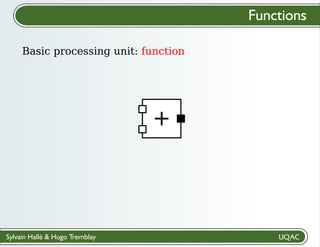
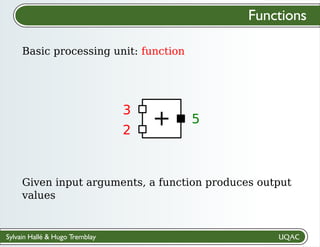
Basic processing unit: function
Sylvain Hallé & Hugo Tremblay
+
Functions
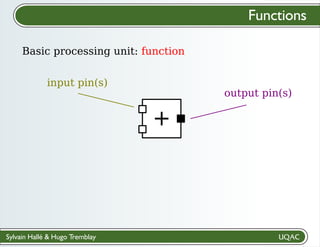
Basic processing unit: function
input pin(s)
output pin(s)
Sylvain Hallé & Hugo Tremblay
+
Functions
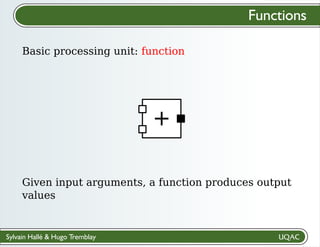
Basic processing unit: function
Given input arguments, a function produces output
values
Sylvain Hallé & Hugo Tremblay
+
Functions
Basic processing unit: function
Given input arguments, a function produces output
values
3
2
5
Sylvain Hallé & Hugo Tremblay
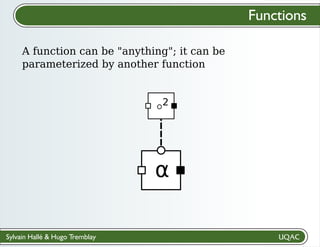
A function can be "anything"; it can be
parameterized by another function
Functions
α
2
Sylvain Hallé & Hugo Tremblay
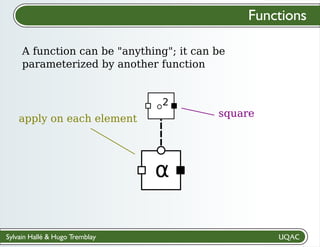
A function can be "anything"; it can be
parameterized by another function
Functions
α
2
apply on each element square
Sylvain Hallé & Hugo Tremblay
A function can be "anything"; it can be
parameterized by another function
Functions
α
2
[4,2,5] [16,4,25]
Sylvain Hallé & Hugo Tremblay
>
+
×
>
>
3
Function circuits
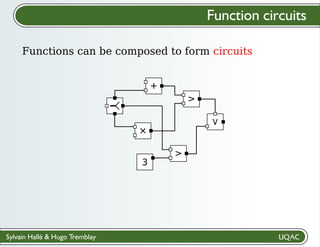
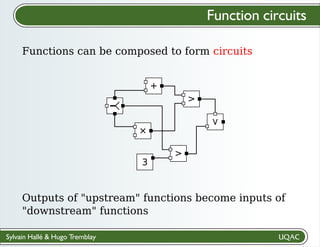
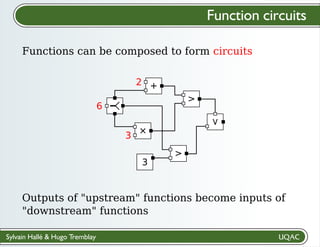
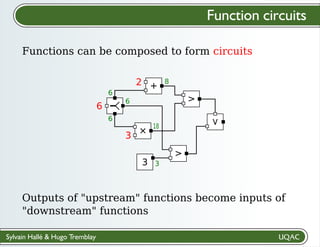
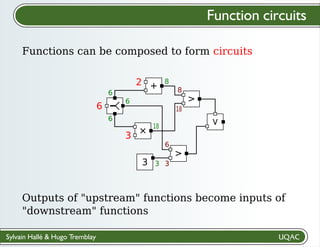
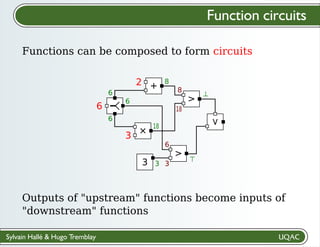
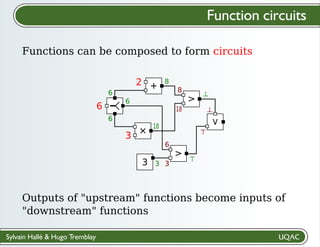
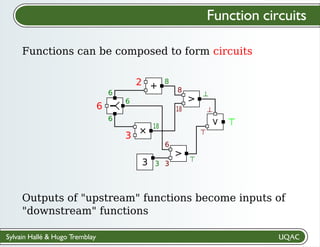
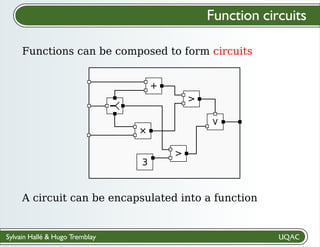
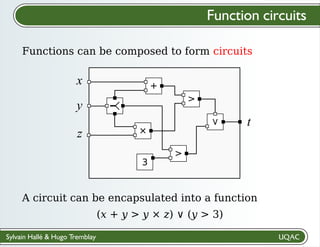
Functions can be composed to form circuits
Sylvain Hallé & Hugo Tremblay
Outputs of "upstream" functions become inputs of
"downstream" functions
>
+
×
>
>
3
Function circuits
Functions can be composed to form circuits
Sylvain Hallé & Hugo Tremblay
Outputs of "upstream" functions become inputs of
"downstream" functions
2
6
3
>
+
×
>
>
3
Function circuits
Functions can be composed to form circuits
Sylvain Hallé & Hugo Tremblay
Outputs of "upstream" functions become inputs of
"downstream" functions
2
6
3
6
8
3
18
6
6
>
+
×
>
>
3
Function circuits
Functions can be composed to form circuits
Sylvain Hallé & Hugo Tremblay
Outputs of "upstream" functions become inputs of
"downstream" functions
2
6
3
6
8
3
18
6
6
6
33
8
18
>
+
×
>
>
3
Function circuits
Functions can be composed to form circuits
Sylvain Hallé & Hugo Tremblay
Outputs of "upstream" functions become inputs of
"downstream" functions
2
6
3
6
8
3
18
6
6
6
33
8
18
⊥
⊤
>
+
×
>
>
3
Function circuits
Functions can be composed to form circuits
Sylvain Hallé & Hugo Tremblay
Outputs of "upstream" functions become inputs of
"downstream" functions
2
6
3
6
8
3
18
6
6
6
33
8
18
⊥
⊤
⊤
⊥
>
+
×
>
>
3
Function circuits
Functions can be composed to form circuits
Sylvain Hallé & Hugo Tremblay
Outputs of "upstream" functions become inputs of
"downstream" functions
2
6
3
6
8
3
18
6
6
6
33
8
18
⊥
⊤
⊤
⊥
⊤
>
+
×
>
>
3
Function circuits
Functions can be composed to form circuits
Sylvain Hallé & Hugo Tremblay
A circuit can be encapsulated into a function
>
+
×
>
>
3
Function circuits
Functions can be composed to form circuits
Sylvain Hallé & Hugo Tremblay
A circuit can be encapsulated into a function
x
y
z
t
(x + y > y × z) ∨ (y > 3)
>
+
×
>
>
3
Function circuits
Functions can be composed to form circuits
Sylvain Hallé & Hugo Tremblay
α
>
3
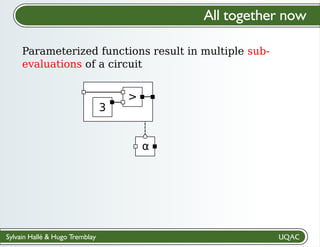
Parameterized functions result in multiple sub-
evaluations of a circuit
All together now
Sylvain Hallé & Hugo Tremblay
α
>
3
Parameterized functions result in multiple sub-
evaluations of a circuit
All together now
[4,2,5]
Sylvain Hallé & Hugo Tremblay
α
>
3
Parameterized functions result in multiple sub-
evaluations of a circuit
All together now
[4,2,5]
>
3
4
44
3
T
T3
T[ ]
Sylvain Hallé & Hugo Tremblay
α
>
3
Parameterized functions result in multiple sub-
evaluations of a circuit
All together now
[4,2,5]
>
3
4
44
3
T
T3
T[ ]
>
3
2
2
3
T
T
3
T
Sylvain Hallé & Hugo Tremblay
α
>
3
Parameterized functions result in multiple sub-
evaluations of a circuit
All together now
[4,2,5]
>
3
4
44
3
T
T3
T[ ]
>
3
2
2
3
T
T
3
T
>
3
5
5
3
T
T3
T
Sylvain Hallé & Hugo Tremblay
Part of
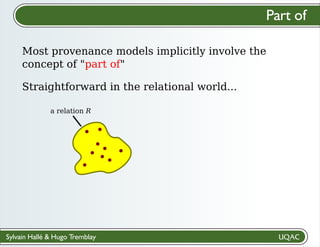
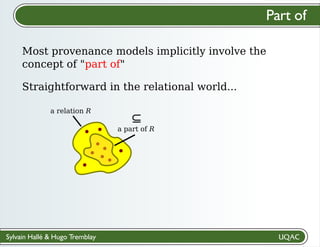
Most provenance models implicitly involve the
concept of "part of"
Straightforward in the relational world...
Sylvain Hallé & Hugo Tremblay
Part of
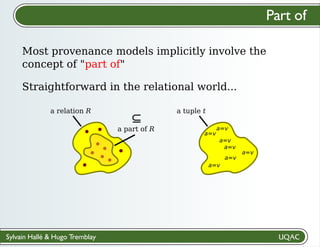
Most provenance models implicitly involve the
concept of "part of"
Straightforward in the relational world...
a relation R
Sylvain Hallé & Hugo Tremblay
Part of
Most provenance models implicitly involve the
concept of "part of"
Straightforward in the relational world...
a relation R
a part of R
⊆
Sylvain Hallé & Hugo Tremblay
Part of
Most provenance models implicitly involve the
concept of "part of"
Straightforward in the relational world...
a relation R
a part of R
⊆
a tuple t
a=v
a=v
a=v
a=v
a=v
a=v
a=v
Sylvain Hallé & Hugo Tremblay
Part of
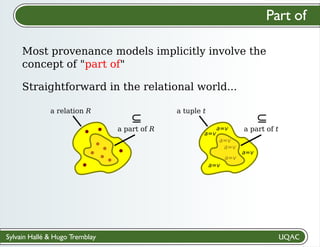
Most provenance models implicitly involve the
concept of "part of"
Straightforward in the relational world...
a relation R
a part of R
⊆
a tuple t
a=v
a=v
a=v
a=v
a=v
a=v
a=v
a part of t
⊆
Sylvain Hallé & Hugo Tremblay
Part of
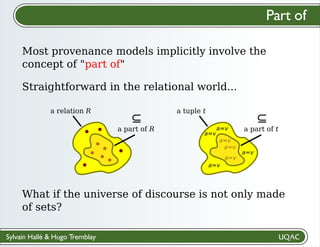
Most provenance models implicitly involve the
concept of "part of"
Straightforward in the relational world...
a relation R
a part of R
⊆
a tuple t
a=v
a=v
a=v
a=v
a=v
a=v
a=v
a part of t
⊆
What if the universe of discourse is not only made
of sets?
Sylvain Hallé & Hugo Tremblay
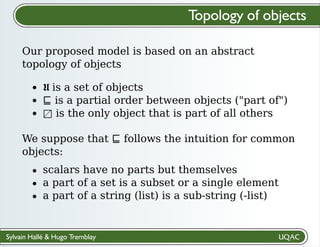
Our proposed model is based on an abstract
topology of objects
Topology of objects
𝖀 is a set of objects
⊑ is a partial order between objects ("part of")
□ is the only object that is part of all others
We suppose that ⊑ follows the intuition for common
objects:
scalars have no parts but themselves
a part of a set is a subset or a single element
a part of a string (list) is a sub-string (-list)
Sylvain Hallé & Hugo Tremblay
A designator is any function that takes an object
and returns a part of this object. Examples:
Designator
[i] the i-th item of a list
[i : j] the substring between characters i and j
the contents of some file
the i-th input pin of a function
the i-th output pin of a function
↑i
↓i
Sylvain Hallé & Hugo Tremblay
Designators can be composed:
↑2 [3] [1:5]◦ ◦
A designator is any function that takes an object
and returns a part of this object. Examples:
Designator
[i] the i-th item of a list
[i : j] the substring between characters i and j
the contents of some file
the i-th input pin of a function
the i-th output pin of a function
↑i
↓i
Sylvain Hallé & Hugo Tremblay
Designators can be composed:
↑2 [3] [1:5]◦ ◦
"The first five characters of the third
item of the second argument of the
function"
A designator is any function that takes an object
and returns a part of this object. Examples:
Designator
[i] the i-th item of a list
[i : j] the substring between characters i and j
the contents of some file
the i-th input pin of a function
the i-th output pin of a function
↑i
↓i
Sylvain Hallé & Hugo Tremblay
Designation graph
∧
↓ , f1
< <
↑ , f1< <
∧
[1],↑ , f2< < [1],↑ , f3< <
A designation graph is an and-or directed acyclic
graph (DAG) where:
the endpoints are made of a designator d and a
function f
the head of d points to an input or an output of f
It expresses an "and-or"
relationship between
function inputs and
function outputs in a
circuit.
Sylvain Hallé & Hugo Tremblay
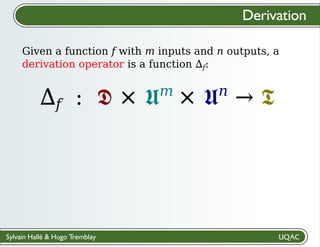
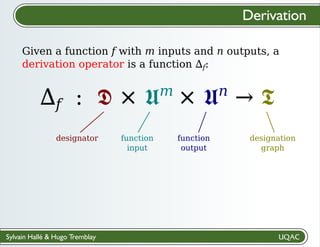
Given a function f with m inputs and n outputs, a
derivation operator is a function ∆f:
Derivation
∆f : 𝕯 × 𝖀m
× 𝖀n
→ 𝕿
Sylvain Hallé & Hugo Tremblay
Given a function f with m inputs and n outputs, a
derivation operator is a function ∆f:
Derivation
∆f : 𝕯 × 𝖀m
× 𝖀n
→ 𝕿
designator function
input
function
output
designation
graph
Sylvain Hallé & Hugo Tremblay
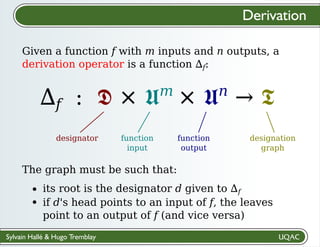
Given a function f with m inputs and n outputs, a
derivation operator is a function ∆f:
Derivation
∆f : 𝕯 × 𝖀m
× 𝖀n
→ 𝕿
The graph must be such that:
its root is the designator d given to ∆f
if d's head points to an input of f, the leaves
point to an output of f (and vice versa)
designator function
input
function
output
designation
graph
Sylvain Hallé & Hugo Tremblay
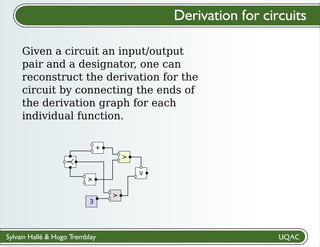
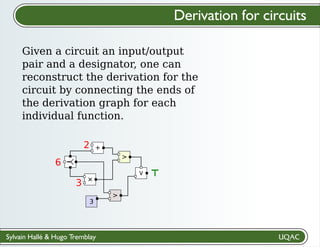
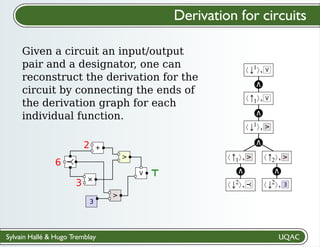
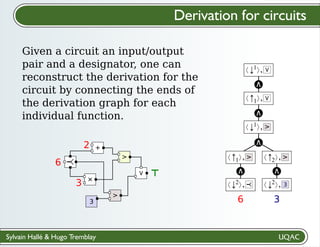
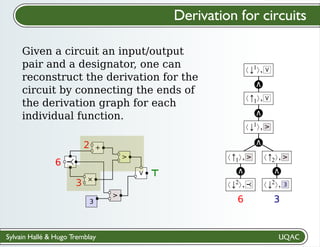
Given a circuit an input/output
pair and a designator, one can
reconstruct the derivation for the
circuit by connecting the ends of
the derivation graph for each
individual function.
Derivation for circuits
>
+
×
>
>
3
Sylvain Hallé & Hugo Tremblay
Given a circuit an input/output
pair and a designator, one can
reconstruct the derivation for the
circuit by connecting the ends of
the derivation graph for each
individual function.
Derivation for circuits
>
+
×
>
>
3
⊤
2
6
3
Sylvain Hallé & Hugo Tremblay
Given a circuit an input/output
pair and a designator, one can
reconstruct the derivation for the
circuit by connecting the ends of
the derivation graph for each
individual function.
Derivation for circuits
>
+
×
>
>
3
⊤
2
6
3
∧
↓ ,1
< <
>
↑ ,1< <
>
∧
↓ ,1
< < >
∧
↑ ,1< < > ↑ ,2< < >
∧
↓ ,2
< <
∧
↓ ,2
< < 3
Sylvain Hallé & Hugo Tremblay
Given a circuit an input/output
pair and a designator, one can
reconstruct the derivation for the
circuit by connecting the ends of
the derivation graph for each
individual function.
Derivation for circuits
>
+
×
>
>
3
⊤
2
6
3
∧
↓ ,1
< <
>
↑ ,1< <
>
∧
↓ ,1
< < >
∧
↑ ,1< < > ↑ ,2< < >
∧
↓ ,2
< <
∧
↓ ,2
< < 3
6 3
Sylvain Hallé & Hugo Tremblay
Given a circuit an input/output
pair and a designator, one can
reconstruct the derivation for the
circuit by connecting the ends of
the derivation graph for each
individual function.
Derivation for circuits
>
+
×
>
>
3
⊤
2
6
3
∧
↓ ,1
< <
>
↑ ,1< <
>
∧
↓ ,1
< < >
∧
↑ ,1< < > ↑ ,2< < >
∧
↓ ,2
< <
∧
↓ ,2
< < 3
6 3
Sylvain Hallé & Hugo Tremblay
/, [2] #
α W
3
x
Gα
>
3
1 2
A
C
3 4
B
5
a b c
a
b
A bigger example
Sylvain Hallé & Hugo Tremblay
/, [2] #
α W
3
x
Gα
>
3
1 2
A
C
3 4
B
5
a b c
a
b
A bigger example
split file
into lines
Sylvain Hallé & Hugo Tremblay
/, [2] #
α W
3
x
Gα
>
3
1 2
A
C
3 4
B
5
a b c
a
b
A bigger example
on each
line...
Sylvain Hallé & Hugo Tremblay
/, [2] #
α W
3
x
Gα
>
3
1 2
A
C
3 4
B
5
a b c
a
b
A bigger example
split on
commas
Sylvain Hallé & Hugo Tremblay
/, [2] #
α W
3
x
Gα
>
3
1 2
A
C
3 4
B
5
a b c
a
b
A bigger example
take
second
element
Sylvain Hallé & Hugo Tremblay
/, [2] #
α W
3
x
Gα
>
3
1 2
A
C
3 4
B
5
a b c
a
b
A bigger example
convert to
number
Sylvain Hallé & Hugo Tremblay
/, [2] #
α W
3
x
Gα
>
3
1 2
A
C
3 4
B
5
a b c
a
b
A bigger example
on each
window of
3 values...
Sylvain Hallé & Hugo Tremblay
/, [2] #
α W
3
x
Gα
>
3
1 2
A
C
3 4
B
5
a b c
a
b
A bigger example
take the
average
Sylvain Hallé & Hugo Tremblay
/, [2] #
α W
3
x
Gα
>
3
1 2
A
C
3 4
B
5
a b c
a
b
A bigger example
on each
average...
Sylvain Hallé & Hugo Tremblay
/, [2] #
α W
3
x
Gα
>
3
1 2
A
C
3 4
B
5
a b c
a
b
A bigger example
check that is
is greater than 3
Sylvain Hallé & Hugo Tremblay
/, [2] #
α W
3
x
Gα
>
3
1 2
A
C
3 4
B
5
a b c
a
b
A bigger example
assert they
are all so
Sylvain Hallé & Hugo Tremblay
⊤the,2,penny
fool,7,lane
on,18,come
the,2,together
hill,-80,i
strawberry,7,am
fields,1,the
forever,10,walrus
/, [2] #
α W
3
x
Gα
>
3
1 2
A
C
3 4
B
5
a b c
a
b
A bigger example
Sylvain Hallé & Hugo Tremblay
⊤the,2,penny
fool,7,lane
on,18,come
the,2,together
hill,-80,i
strawberry,7,am
fields,1,the
forever,10,walrus
∧
↓ , G1< <
∧ ∧∧
[4:5], [3] ,< < [5:5], [4] ,< < [6:8], [5] ,< < [8:8], [7] ,< <[ : ], [6] ,< <12 12
/, [2] #
α W
3
x
Gα
>
3
1 2
A
C
3 4
B
5
a b c
a
b
A bigger example
Sylvain Hallé & Hugo Tremblay
⊤the,2,penny
fool,7,lane
on,18,come
the,2,together
hill,-80,i
strawberry,7,am
fields,1,the
forever,10,walrus
∧
↓ , G1< <
∧ ∧∧
[4:5], [3] ,< < [5:5], [4] ,< < [6:8], [5] ,< < [8:8], [7] ,< <[ : ], [6] ,< <12 12
/, [2] #
α W
3
x
Gα
>
3
1 2
A
C
3 4
B
5
a b c
a
b
A bigger example
Sylvain Hallé & Hugo Tremblay
⊤the,2,penny
fool,7,lane
on,18,come
the,2,together
hill,-80,i
strawberry,7,am
fields,1,the
forever,10,walrus
∧
↓ , G1< <
∧ ∧∧
[4:5], [3] ,< < [5:5], [4] ,< < [6:8], [5] ,< < [8:8], [7] ,< <[ : ], [6] ,< <12 12
∧
/, [2] #
α W
3
x
Gα
>
3
1 2
A
C
3 4
B
5
a b c
a
b
A bigger example
Sylvain Hallé & Hugo Tremblay
⊤the,2,penny
fool,7,lane
on,18,come
the,2,together
hill,-80,i
strawberry,7,am
fields,1,the
forever,10,walrus
∧
↓ , G1< <
∧ ∧∧
[4:5], [3] ,< < [5:5], [4] ,< < [6:8], [5] ,< < [8:8], [7] ,< <[ : ], [6] ,< <12 12
∧
/, [2] #
α W
3
x
Gα
>
3
1 2
A
C
3 4
B
5
a b c
a
b
A bigger example
Sylvain Hallé & Hugo Tremblay
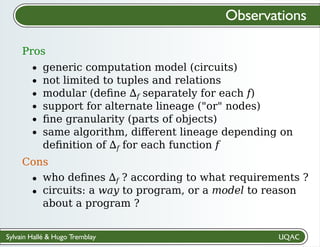
Observations
Pros
generic computation model (circuits)
not limited to tuples and relations
modular (define ∆f separately for each f)
support for alternate lineage ("or" nodes)
fine granularity (parts of objects)
same algorithm, different lineage depending on
definition of ∆f for each function f
Cons
who defines ∆f ? according to what requirements ?
circuits: a way to program, or a model to reason
about a program ?
Sylvain Hallé & Hugo Tremblay
Future work
Provide formal definitions of ∆ that correspond
to various (existing) provenance relationships
Implement and test a proof of concept
(under way: https://github.com/liflab/petitpoucet)
Retrofit this framework into existing software
(BeepBeep, Cornipickle)
Study circuits according to the designation
graphs they induce
Thank you!

A Generic Explainability Framework for Function Circuits

  • 1.
    Sylvain Hallé &Hugo Tremblay Sylvain Hallé Hugo Tremblay Université du Québec à Chicoutimi CANADA A Generic Explainability Framework for Function Circuits CRSNG NSERC
  • 2.
    Sylvain Hallé &Hugo Tremblay + Functions Basic processing unit: function
  • 3.
    Sylvain Hallé &Hugo Tremblay + Functions Basic processing unit: function input pin(s) output pin(s)
  • 4.
    Sylvain Hallé &Hugo Tremblay + Functions Basic processing unit: function Given input arguments, a function produces output values
  • 5.
    Sylvain Hallé &Hugo Tremblay + Functions Basic processing unit: function Given input arguments, a function produces output values 3 2 5
  • 6.
    Sylvain Hallé &Hugo Tremblay A function can be "anything"; it can be parameterized by another function Functions α 2
  • 7.
    Sylvain Hallé &Hugo Tremblay A function can be "anything"; it can be parameterized by another function Functions α 2 apply on each element square
  • 8.
    Sylvain Hallé &Hugo Tremblay A function can be "anything"; it can be parameterized by another function Functions α 2 [4,2,5] [16,4,25]
  • 9.
    Sylvain Hallé &Hugo Tremblay > + × > > 3 Function circuits Functions can be composed to form circuits
  • 10.
    Sylvain Hallé &Hugo Tremblay Outputs of "upstream" functions become inputs of "downstream" functions > + × > > 3 Function circuits Functions can be composed to form circuits
  • 11.
    Sylvain Hallé &Hugo Tremblay Outputs of "upstream" functions become inputs of "downstream" functions 2 6 3 > + × > > 3 Function circuits Functions can be composed to form circuits
  • 12.
    Sylvain Hallé &Hugo Tremblay Outputs of "upstream" functions become inputs of "downstream" functions 2 6 3 6 8 3 18 6 6 > + × > > 3 Function circuits Functions can be composed to form circuits
  • 13.
    Sylvain Hallé &Hugo Tremblay Outputs of "upstream" functions become inputs of "downstream" functions 2 6 3 6 8 3 18 6 6 6 33 8 18 > + × > > 3 Function circuits Functions can be composed to form circuits
  • 14.
    Sylvain Hallé &Hugo Tremblay Outputs of "upstream" functions become inputs of "downstream" functions 2 6 3 6 8 3 18 6 6 6 33 8 18 ⊥ ⊤ > + × > > 3 Function circuits Functions can be composed to form circuits
  • 15.
    Sylvain Hallé &Hugo Tremblay Outputs of "upstream" functions become inputs of "downstream" functions 2 6 3 6 8 3 18 6 6 6 33 8 18 ⊥ ⊤ ⊤ ⊥ > + × > > 3 Function circuits Functions can be composed to form circuits
  • 16.
    Sylvain Hallé &Hugo Tremblay Outputs of "upstream" functions become inputs of "downstream" functions 2 6 3 6 8 3 18 6 6 6 33 8 18 ⊥ ⊤ ⊤ ⊥ ⊤ > + × > > 3 Function circuits Functions can be composed to form circuits
  • 17.
    Sylvain Hallé &Hugo Tremblay A circuit can be encapsulated into a function > + × > > 3 Function circuits Functions can be composed to form circuits
  • 18.
    Sylvain Hallé &Hugo Tremblay A circuit can be encapsulated into a function x y z t (x + y > y × z) ∨ (y > 3) > + × > > 3 Function circuits Functions can be composed to form circuits
  • 19.
    Sylvain Hallé &Hugo Tremblay α > 3 Parameterized functions result in multiple sub- evaluations of a circuit All together now
  • 20.
    Sylvain Hallé &Hugo Tremblay α > 3 Parameterized functions result in multiple sub- evaluations of a circuit All together now [4,2,5]
  • 21.
    Sylvain Hallé &Hugo Tremblay α > 3 Parameterized functions result in multiple sub- evaluations of a circuit All together now [4,2,5] > 3 4 44 3 T T3 T[ ]
  • 22.
    Sylvain Hallé &Hugo Tremblay α > 3 Parameterized functions result in multiple sub- evaluations of a circuit All together now [4,2,5] > 3 4 44 3 T T3 T[ ] > 3 2 2 3 T T 3 T
  • 23.
    Sylvain Hallé &Hugo Tremblay α > 3 Parameterized functions result in multiple sub- evaluations of a circuit All together now [4,2,5] > 3 4 44 3 T T3 T[ ] > 3 2 2 3 T T 3 T > 3 5 5 3 T T3 T
  • 24.
    Sylvain Hallé &Hugo Tremblay Part of Most provenance models implicitly involve the concept of "part of" Straightforward in the relational world...
  • 25.
    Sylvain Hallé &Hugo Tremblay Part of Most provenance models implicitly involve the concept of "part of" Straightforward in the relational world... a relation R
  • 26.
    Sylvain Hallé &Hugo Tremblay Part of Most provenance models implicitly involve the concept of "part of" Straightforward in the relational world... a relation R a part of R ⊆
  • 27.
    Sylvain Hallé &Hugo Tremblay Part of Most provenance models implicitly involve the concept of "part of" Straightforward in the relational world... a relation R a part of R ⊆ a tuple t a=v a=v a=v a=v a=v a=v a=v
  • 28.
    Sylvain Hallé &Hugo Tremblay Part of Most provenance models implicitly involve the concept of "part of" Straightforward in the relational world... a relation R a part of R ⊆ a tuple t a=v a=v a=v a=v a=v a=v a=v a part of t ⊆
  • 29.
    Sylvain Hallé &Hugo Tremblay Part of Most provenance models implicitly involve the concept of "part of" Straightforward in the relational world... a relation R a part of R ⊆ a tuple t a=v a=v a=v a=v a=v a=v a=v a part of t ⊆ What if the universe of discourse is not only made of sets?
  • 30.
    Sylvain Hallé &Hugo Tremblay Our proposed model is based on an abstract topology of objects Topology of objects 𝖀 is a set of objects ⊑ is a partial order between objects ("part of") □ is the only object that is part of all others We suppose that ⊑ follows the intuition for common objects: scalars have no parts but themselves a part of a set is a subset or a single element a part of a string (list) is a sub-string (-list)
  • 31.
    Sylvain Hallé &Hugo Tremblay A designator is any function that takes an object and returns a part of this object. Examples: Designator [i] the i-th item of a list [i : j] the substring between characters i and j the contents of some file the i-th input pin of a function the i-th output pin of a function ↑i ↓i
  • 32.
    Sylvain Hallé &Hugo Tremblay Designators can be composed: ↑2 [3] [1:5]◦ ◦ A designator is any function that takes an object and returns a part of this object. Examples: Designator [i] the i-th item of a list [i : j] the substring between characters i and j the contents of some file the i-th input pin of a function the i-th output pin of a function ↑i ↓i
  • 33.
    Sylvain Hallé &Hugo Tremblay Designators can be composed: ↑2 [3] [1:5]◦ ◦ "The first five characters of the third item of the second argument of the function" A designator is any function that takes an object and returns a part of this object. Examples: Designator [i] the i-th item of a list [i : j] the substring between characters i and j the contents of some file the i-th input pin of a function the i-th output pin of a function ↑i ↓i
  • 34.
    Sylvain Hallé &Hugo Tremblay Designation graph ∧ ↓ , f1 < < ↑ , f1< < ∧ [1],↑ , f2< < [1],↑ , f3< < A designation graph is an and-or directed acyclic graph (DAG) where: the endpoints are made of a designator d and a function f the head of d points to an input or an output of f It expresses an "and-or" relationship between function inputs and function outputs in a circuit.
  • 35.
    Sylvain Hallé &Hugo Tremblay Given a function f with m inputs and n outputs, a derivation operator is a function ∆f: Derivation ∆f : 𝕯 × 𝖀m × 𝖀n → 𝕿
  • 36.
    Sylvain Hallé &Hugo Tremblay Given a function f with m inputs and n outputs, a derivation operator is a function ∆f: Derivation ∆f : 𝕯 × 𝖀m × 𝖀n → 𝕿 designator function input function output designation graph
  • 37.
    Sylvain Hallé &Hugo Tremblay Given a function f with m inputs and n outputs, a derivation operator is a function ∆f: Derivation ∆f : 𝕯 × 𝖀m × 𝖀n → 𝕿 The graph must be such that: its root is the designator d given to ∆f if d's head points to an input of f, the leaves point to an output of f (and vice versa) designator function input function output designation graph
  • 38.
    Sylvain Hallé &Hugo Tremblay Given a circuit an input/output pair and a designator, one can reconstruct the derivation for the circuit by connecting the ends of the derivation graph for each individual function. Derivation for circuits > + × > > 3
  • 39.
    Sylvain Hallé &Hugo Tremblay Given a circuit an input/output pair and a designator, one can reconstruct the derivation for the circuit by connecting the ends of the derivation graph for each individual function. Derivation for circuits > + × > > 3 ⊤ 2 6 3
  • 40.
    Sylvain Hallé &Hugo Tremblay Given a circuit an input/output pair and a designator, one can reconstruct the derivation for the circuit by connecting the ends of the derivation graph for each individual function. Derivation for circuits > + × > > 3 ⊤ 2 6 3 ∧ ↓ ,1 < < > ↑ ,1< < > ∧ ↓ ,1 < < > ∧ ↑ ,1< < > ↑ ,2< < > ∧ ↓ ,2 < < ∧ ↓ ,2 < < 3
  • 41.
    Sylvain Hallé &Hugo Tremblay Given a circuit an input/output pair and a designator, one can reconstruct the derivation for the circuit by connecting the ends of the derivation graph for each individual function. Derivation for circuits > + × > > 3 ⊤ 2 6 3 ∧ ↓ ,1 < < > ↑ ,1< < > ∧ ↓ ,1 < < > ∧ ↑ ,1< < > ↑ ,2< < > ∧ ↓ ,2 < < ∧ ↓ ,2 < < 3 6 3
  • 42.
    Sylvain Hallé &Hugo Tremblay Given a circuit an input/output pair and a designator, one can reconstruct the derivation for the circuit by connecting the ends of the derivation graph for each individual function. Derivation for circuits > + × > > 3 ⊤ 2 6 3 ∧ ↓ ,1 < < > ↑ ,1< < > ∧ ↓ ,1 < < > ∧ ↑ ,1< < > ↑ ,2< < > ∧ ↓ ,2 < < ∧ ↓ ,2 < < 3 6 3
  • 43.
    Sylvain Hallé &Hugo Tremblay /, [2] # α W 3 x Gα > 3 1 2 A C 3 4 B 5 a b c a b A bigger example
  • 44.
    Sylvain Hallé &Hugo Tremblay /, [2] # α W 3 x Gα > 3 1 2 A C 3 4 B 5 a b c a b A bigger example split file into lines
  • 45.
    Sylvain Hallé &Hugo Tremblay /, [2] # α W 3 x Gα > 3 1 2 A C 3 4 B 5 a b c a b A bigger example on each line...
  • 46.
    Sylvain Hallé &Hugo Tremblay /, [2] # α W 3 x Gα > 3 1 2 A C 3 4 B 5 a b c a b A bigger example split on commas
  • 47.
    Sylvain Hallé &Hugo Tremblay /, [2] # α W 3 x Gα > 3 1 2 A C 3 4 B 5 a b c a b A bigger example take second element
  • 48.
    Sylvain Hallé &Hugo Tremblay /, [2] # α W 3 x Gα > 3 1 2 A C 3 4 B 5 a b c a b A bigger example convert to number
  • 49.
    Sylvain Hallé &Hugo Tremblay /, [2] # α W 3 x Gα > 3 1 2 A C 3 4 B 5 a b c a b A bigger example on each window of 3 values...
  • 50.
    Sylvain Hallé &Hugo Tremblay /, [2] # α W 3 x Gα > 3 1 2 A C 3 4 B 5 a b c a b A bigger example take the average
  • 51.
    Sylvain Hallé &Hugo Tremblay /, [2] # α W 3 x Gα > 3 1 2 A C 3 4 B 5 a b c a b A bigger example on each average...
  • 52.
    Sylvain Hallé &Hugo Tremblay /, [2] # α W 3 x Gα > 3 1 2 A C 3 4 B 5 a b c a b A bigger example check that is is greater than 3
  • 53.
    Sylvain Hallé &Hugo Tremblay /, [2] # α W 3 x Gα > 3 1 2 A C 3 4 B 5 a b c a b A bigger example assert they are all so
  • 54.
    Sylvain Hallé &Hugo Tremblay ⊤the,2,penny fool,7,lane on,18,come the,2,together hill,-80,i strawberry,7,am fields,1,the forever,10,walrus /, [2] # α W 3 x Gα > 3 1 2 A C 3 4 B 5 a b c a b A bigger example
  • 55.
    Sylvain Hallé &Hugo Tremblay ⊤the,2,penny fool,7,lane on,18,come the,2,together hill,-80,i strawberry,7,am fields,1,the forever,10,walrus ∧ ↓ , G1< < ∧ ∧∧ [4:5], [3] ,< < [5:5], [4] ,< < [6:8], [5] ,< < [8:8], [7] ,< <[ : ], [6] ,< <12 12 /, [2] # α W 3 x Gα > 3 1 2 A C 3 4 B 5 a b c a b A bigger example
  • 56.
    Sylvain Hallé &Hugo Tremblay ⊤the,2,penny fool,7,lane on,18,come the,2,together hill,-80,i strawberry,7,am fields,1,the forever,10,walrus ∧ ↓ , G1< < ∧ ∧∧ [4:5], [3] ,< < [5:5], [4] ,< < [6:8], [5] ,< < [8:8], [7] ,< <[ : ], [6] ,< <12 12 /, [2] # α W 3 x Gα > 3 1 2 A C 3 4 B 5 a b c a b A bigger example
  • 57.
    Sylvain Hallé &Hugo Tremblay ⊤the,2,penny fool,7,lane on,18,come the,2,together hill,-80,i strawberry,7,am fields,1,the forever,10,walrus ∧ ↓ , G1< < ∧ ∧∧ [4:5], [3] ,< < [5:5], [4] ,< < [6:8], [5] ,< < [8:8], [7] ,< <[ : ], [6] ,< <12 12 ∧ /, [2] # α W 3 x Gα > 3 1 2 A C 3 4 B 5 a b c a b A bigger example
  • 58.
    Sylvain Hallé &Hugo Tremblay ⊤the,2,penny fool,7,lane on,18,come the,2,together hill,-80,i strawberry,7,am fields,1,the forever,10,walrus ∧ ↓ , G1< < ∧ ∧∧ [4:5], [3] ,< < [5:5], [4] ,< < [6:8], [5] ,< < [8:8], [7] ,< <[ : ], [6] ,< <12 12 ∧ /, [2] # α W 3 x Gα > 3 1 2 A C 3 4 B 5 a b c a b A bigger example
  • 59.
    Sylvain Hallé &Hugo Tremblay Observations Pros generic computation model (circuits) not limited to tuples and relations modular (define ∆f separately for each f) support for alternate lineage ("or" nodes) fine granularity (parts of objects) same algorithm, different lineage depending on definition of ∆f for each function f Cons who defines ∆f ? according to what requirements ? circuits: a way to program, or a model to reason about a program ?
  • 60.
    Sylvain Hallé &Hugo Tremblay Future work Provide formal definitions of ∆ that correspond to various (existing) provenance relationships Implement and test a proof of concept (under way: https://github.com/liflab/petitpoucet) Retrofit this framework into existing software (BeepBeep, Cornipickle) Study circuits according to the designation graphs they induce Thank you!