Download the full version and explore a variety of test banks
or solution manuals at https://testbankbell.com
Solution Manual for Visual C# How to Program (6th
Edition) (Deitel Series) 6th Edition
_____ Follow the link below to get your download now _____
http://testbankbell.com/product/solution-manual-for-visual-
c-how-to-program-6th-edition-deitel-series-6th-edition/
Access testbankbell.com now to download high-quality
test banks or solution manuals
We have selected some products that you may be interested in
Click the link to download now or visit testbankbell.com
for more options!.
Solution Manual for Visual Basic 2012 How to Program, 6/E
6th Edition : 0133406954
http://testbankbell.com/product/solution-manual-for-visual-
basic-2012-how-to-program-6-e-6th-edition-0133406954/
Test Bank for Visual C# 2012 How to Program, 5/E 5th
Edition : 0133379337
http://testbankbell.com/product/test-bank-for-visual-c-2012-how-to-
program-5-e-5th-edition-0133379337/
Solution Manual for C++ How to Program 10th by Deitel
http://testbankbell.com/product/solution-manual-for-c-how-to-
program-10th-by-deitel/
Test Bank for Measurement and Assessment in Education, 2/E
2nd Edition : 0205579345
http://testbankbell.com/product/test-bank-for-measurement-and-
assessment-in-education-2-e-2nd-edition-0205579345/
Fundamentals of General Organic and Biological Chemistry
8th Edition McMurry Test Bank
http://testbankbell.com/product/fundamentals-of-general-organic-and-
biological-chemistry-8th-edition-mcmurry-test-bank/
Physics of Continuous Matter Exotic and Everyday Phenomena
in the Macroscopic World 2nd Lautrup Solution Manual
http://testbankbell.com/product/physics-of-continuous-matter-exotic-
and-everyday-phenomena-in-the-macroscopic-world-2nd-lautrup-solution-
manual/
Test Bank for Guide to Networking Essentials 6th Edition
by Tomsho
http://testbankbell.com/product/test-bank-for-guide-to-networking-
essentials-6th-edition-by-tomsho/
Test Bank for Special Events: Creating and Sustaining a
New World for Celebration, 7th Edition by Goldblatt
http://testbankbell.com/product/test-bank-for-special-events-creating-
and-sustaining-a-new-world-for-celebration-7th-edition-by-goldblatt/
Test Bank for Discovering Leadership Designing Your
Success, Anthony Middlebrooks, Scott J. Allen, Mindy S.
McNutt, James L. Morrison,
http://testbankbell.com/product/test-bank-for-discovering-leadership-
designing-your-success-anthony-middlebrooks-scott-j-allen-mindy-s-
mcnutt-james-l-morrison/
Test Bank for Government and Not-For-Profit Accounting:
Concepts and Practices, 7th Edition
http://testbankbell.com/product/test-bank-for-government-and-not-for-
profit-accounting-concepts-and-practices-7th-edition/
1
Solution Manual for Visual C# How to
Program (6th Edition) (Deitel Series) 6th
Edition

Full download at: https://testbankbell.com/product/solution-manual-for-visual-c-how-to-
program-6th-edition-deitel-series-6th-edition/
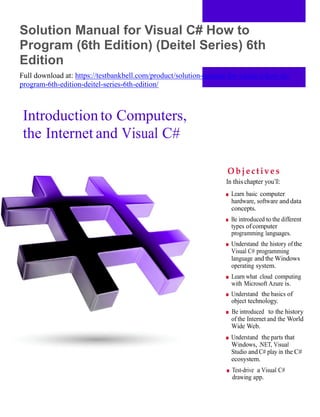
Introduction to Computers,
the Internet and Visual C#
O b je c tiv e s
In this chapter you’ll:
■ Learn basic computer
hardware, software and data
concepts.
■ Be introduced to the different
types of computer
programming languages.
■ Understand the history ofthe
Visual C# programming
language and the Windows
operating system.
■ Learn what cloud computing
with Microsoft Azure is.
■ Understand the basics of
object technology.
■ Be introduced to the history
of the Internet and the World
Wide Web.
■ Understand the parts that
Windows, .NET, Visual
Studio and C# play in the C#
ecosystem.
■ Test-drive a Visual C#
drawing app.
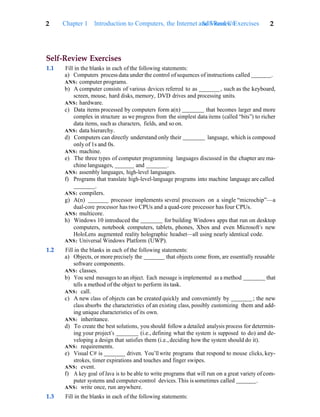
2 Chapter 1 Introduction to Computers, the Internet and Visual C#
Self-Review Exercises 2
Self-Review Exercises
1.1 Fill in the blanks in each of the following statements:
a) Computers process data under the control ofsequences of instructions called .
ANS: computer programs.
b) A computer consists of various devices referred to as , such as the keyboard,
screen, mouse, hard disks, memory, DVD drives and processing units.
ANS: hardware.
c) Data items processed by computers form a(n) that becomes larger and more
complex in structure as we progress from the simplest data items (called “bits”) to richer
data items, such as characters, fields, and so on.
ANS: data hierarchy.
d) Computers can directly understand only their language, which is composed
only of 1s and 0s.
ANS: machine.
e) The three types of computer programming languages discussed in the chapter are ma-
chine languages, and .
ANS: assembly languages, high-level languages.
f) Programs that translate high-level-language programs into machine language are called
.
ANS: compilers.
g) A(n) processor implements several processors on a single “microchip”—a
dual-core processor has two CPUs and a quad-core processor has four CPUs.
ANS: multicore.
h) Windows 10 introduced the for building Windows apps that run on desktop
computers, notebook computers, tablets, phones, Xbox and even Microsoft’s new
HoloLens augmented reality holographic headset—all using nearly identical code.
ANS: Universal Windows Platform (UWP).
1.2 Fill in the blanks in each of the following statements:
a) Objects, or more precisely the that objects come from, are essentially reusable
software components.
ANS: classes.
b) You send messages to an object. Each message is implemented as a method that
tells a method of the object to perform its task.
ANS: call.
c) A new class of objects can be created quickly and conveniently by ; the new
class absorbs the characteristics of an existing class, possibly customizing them and add-
ing unique characteristics of its own.
ANS: inheritance.
d) To create the best solutions, you should follow a detailed analysis process for determin-
ing your project’s (i.e., defining what the system is supposed to do) and de-
veloping a design that satisfies them (i.e., deciding how the system should do it).
ANS: requirements.
e) Visual C# is driven. You’ll write programs that respond to mouse clicks, key-
strokes, timer expirations and touches and finger swipes.
ANS: event.
f) A key goal of Java is to be able to write programs that will run on a great variety of com-
puter systems and computer-control devices. This is sometimes called .
ANS: write once, run anywhere.
1.3 Fill in the blanks in each of the following statements:
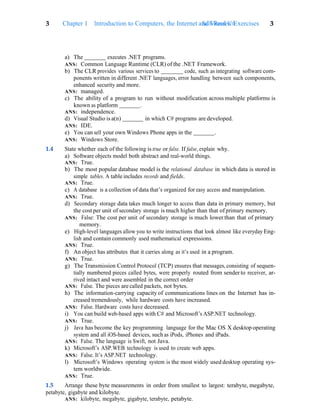
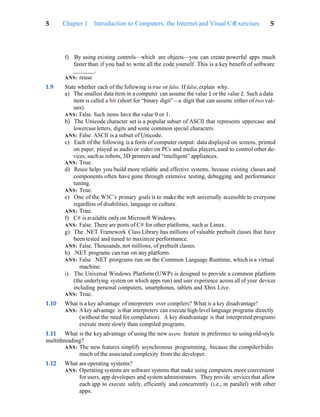
3 Chapter 1 Introduction to Computers, the Internet and Visual C#
Self-Review Exercises 3
a) The executes .NET programs.
ANS: Common Language Runtime (CLR) of the .NET Framework.
b) The CLR provides various services to code, such as integrating software com-
ponents written in different .NET languages, error handling between such components,
enhanced security and more.
ANS: managed.
c) The ability of a program to run without modification across multiple platforms is
known as platform .
ANS: independence.
d) Visual Studio is a(n) in which C# programs are developed.
ANS: IDE.
e) You can sell your own Windows Phone apps in the .
ANS: Windows Store.
1.4 State whether each of the following is true or false. If false, explain why.
a) Software objects model both abstract and real-world things.
ANS: True.
b) The most popular database model is the relational database in which data is stored in
simple tables. A table includes records and fields.
ANS: True.
c) A database is a collection of data that’s organized for easy access and manipulation.
ANS: True.
d) Secondary storage data takes much longer to access than data in primary memory, but
the cost per unit of secondary storage is much higher than that of primary memory.
ANS: False: The cost per unit of secondary storage is much lower than that of primary
memory.
e) High-level languages allow you to write instructions that look almost like everyday Eng-
lish and contain commonly used mathematical expressions.
ANS: True.
f) An object has attributes that it carries along as it’s used in a program.
ANS: True.
g) The Transmission Control Protocol (TCP) ensures that messages, consisting of sequen-
tially numbered pieces called bytes, were properly routed from sender to receiver, ar-
rived intact and were assembled in the correct order
ANS: False. The pieces are called packets, not bytes.
h) The information-carrying capacity of communications lines on the Internet has in-
creased tremendously, while hardware costs have increased.
ANS: False. Hardware costs have decreased.
i) You can build web-based apps with C# and Microsoft’s ASP.NET technology.
ANS: True.
j) Java has become the key programming language for the Mac OS X desktop operating
system and all iOS-based devices, such as iPods, iPhones and iPads.
ANS: False. The language is Swift, not Java.
k) Microsoft’s ASP.WEB technology is used to create web apps.
ANS: False. It’s ASP.NET technology.
l) Microsoft’s Windows operating system is the most widely used desktop operating sys-
tem worldwide.
ANS: True.
1.5 Arrange these byte measurements in order from smallest to largest: terabyte, megabyte,
petabyte, gigabyte and kilobyte.
ANS: kilobyte, megabyte, gigabyte, terabyte, petabyte.
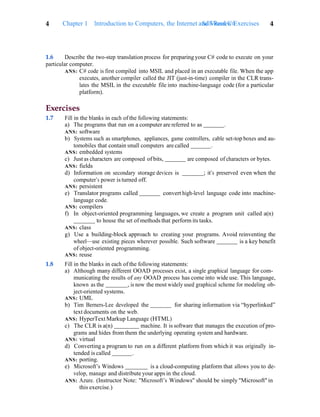
4 Chapter 1 Introduction to Computers, the Internet and Visual C#
Self-Review Exercises 4
1.6 Describe the two-step translation process for preparing your C# code to execute on your
particular computer.
ANS: C# code is first compiled into MSIL and placed in an executable file. When the app
executes, another compiler called the JIT (just-in-time) compiler in the CLR trans-
lates the MSIL in the executable file into machine-language code (for a particular
platform).
Exercises
1.7 Fill in the blanks in each of the following statements:
a) The programs that run on a computer are referred to as .
ANS: software
b) Systems such as smartphones, appliances, game controllers, cable set-top boxes and au-
tomobiles that contain small computers are called .
ANS: embedded systems
c) Just as characters are composed of bits, are composed of characters or bytes.
ANS: fields
d) Information on secondary storage devices is ; it’s preserved even when the
computer’s power is turned off.
ANS: persistent
e) Translator programs called convert high-level language code into machine-
language code.
ANS: compilers
f) In object-oriented programming languages, we create a program unit called a(n)
to house the set of methods that perform its tasks.
ANS: class
g) Use a building-block approach to creating your programs. Avoid reinventing the
wheel—use existing pieces wherever possible. Such software is a key benefit
of object-oriented programming.
ANS: reuse
1.8 Fill in the blanks in each of the following statements:
a) Although many different OOAD processes exist, a single graphical language for com-
municating the results of any OOAD process has come into wide use. This language,
known as the , is now the most widely used graphical scheme for modeling ob-
ject-oriented systems.
ANS: UML
b) Tim Berners-Lee developed the for sharing information via “hyperlinked”
text documents on the web.
ANS: HyperText Markup Language (HTML)
c) The CLR is a(n) machine. It is software that manages the execution of pro-
grams and hides from them the underlying operating system and hardware.
ANS: virtual
d) Converting a program to run on a different platform from which it was originally in-
tended is called .
ANS: porting.
e) Microsoft’s Windows is a cloud-computing platform that allows you to de-
velop, manage and distribute your apps in the cloud.
ANS: Azure. (Instructor Note: "Microsoft’s Windows" should be simply "Microsoft" in
this exercise.)
Exercises 5
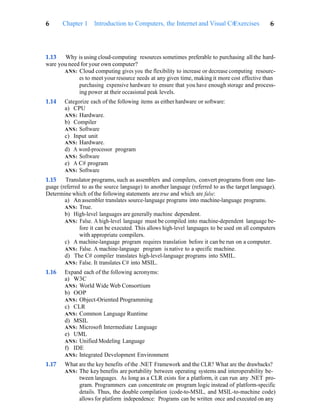
5 Chapter 1 Introduction to Computers, the Internet and Visual C#
f) By using existing controls—which are objects—you can create powerful apps much
fasterthan if you had to write all the code yourself. This is a key benefit of software
.
ANS: reuse
1.9 State whether each of the following is true or false. If false, explain why.
a) The smallest data item in a computer can assume the value 1 or the value 2. Such a data
item is called a bit (short for “binary digit”—a digit that can assume either of two val-
ues).
ANS: False. Such items have the value 0 or 1.
b) The Unicode character set is a popular subset of ASCII that represents uppercase and
lowercase letters, digits and some common special characters.
ANS: False. ASCII is a subset of Unicode.
c) Each of the following is a form of computer output: data displayed on screens, printed
on paper, played as audio or video on PCs and media players, used to control other de-
vices, such as robots, 3D printersand “intelligent” appliances.
ANS: True.
d) Reuse helps you build more reliable and effective systems, because existing classes and
components often have gone through extensive testing, debugging and performance
tuning.
ANS: True.
e) One of the W3C’s primary goals is to make the web universally accessible to everyone
regardless of disabilities, language or culture.
ANS: True.
f) C# is available only on Microsoft Windows.
ANS: False. There are ports of C# for other platforms, such as Linux.
g) The .NET Framework Class Library has millions of valuable prebuilt classes that have
been tested and tuned to maximize performance.
ANS: False. Thousands, not millions, of prebuilt classes.
h) .NET programs can run on any platform.
ANS: False. .NET prorgrams run on the Common Language Runtime, which is a virtual
machine.
i) The Universal Windows Platform (UWP) is designed to provide a common platform
(the underlying system on which apps run) and user experience across all of your devices
including personal computers, smartphones, tablets and Xbox Live.
ANS: True.
1.10 What is a key advantage of interpreters over compilers? What is a key disadvantage?
ANS: A key advantage is that interpreters can execute high-level language programs directly
(without the need for compilation). A key disadvantage is that interpreted programs
exexute more slowly than compiled programs.
1.11 What is the key advantage of using the new async feature in preference to using old-style
multithreading?
ANS: The new features simplify asynchronous programming, because the compilerhides
much of the associated complexity from the developer.
1.12 What are operating systems?
ANS: Operating systems are software systems that make using computers more convenient
for users, app developers and system administrators. They provide services that allow
each app to execute safely, efficiently and concurrently (i.e., in parallel) with other
apps.
Exercises 6
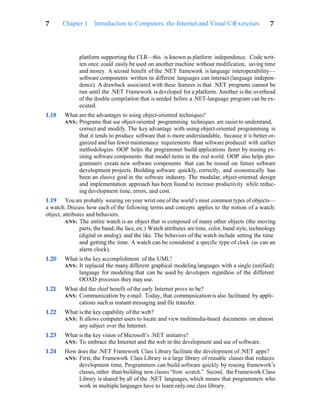
6 Chapter 1 Introduction to Computers, the Internet and Visual C#
1.13 Why is using cloud-computing resources sometimes preferable to purchasing all the hard-
ware you need for your own computer?
ANS: Cloud computing gives you the flexibility to increase or decrease computing resourc-
es to meet your resource needs at any given time, making it more cost effective than
purchasing expensive hardware to ensure that you have enough storage and process-
ing power at their occasional peak levels.
1.14 Categorize each of the following items as either hardware or software:
a) CPU
ANS: Hardware.
b) Compiler
ANS: Software
c) Input unit
ANS: Hardware.
d) A word-processor program
ANS: Software
e) A C# program
ANS: Software
1.15 Translator programs, such as assemblers and compilers, convert programs from one lan-
guage (referred to as the source language) to another language (referred to as the target language).
Determine which of the following statements are true and which are false:
a) An assembler translates source-language programs into machine-language programs.
ANS: True.
b) High-level languages are generally machine dependent.
ANS: False. A high-level language must be compiled into machine-dependent language be-
fore it can be executed. This allows high-level languages to be used on all computers
with appropriate compilers.
c) A machine-language program requires translation before it can be run on a computer.
ANS: False. A machine-language program is native to a specific machine.
d) The C# compiler translates high-level-language programs into SMIL.
ANS: False. It translates C# into MSIL.
1.16 Expand each of the following acronyms:
a) W3C
ANS: World Wide Web Consortium
b) OOP
ANS: Object-Oriented Programming
c) CLR
ANS: Common Language Runtime
d) MSIL
ANS: Microsoft Intermediate Language
e) UML
ANS: Unified Modeling Language
f) IDE
ANS: Integrated Development Environment
1.17 What are the key benefits of the .NET Framework and the CLR? What are the drawbacks?
ANS: The key benefits are portability between operating systems and interoperability be-
tween languages. As long as a CLR exists for a platform, it can run any .NET pro-
gram. Programmers can concentrate on program logic instead of platform-specific
details. Thus, the double compilation (code-to-MSIL, and MSIL-to-machine code)
allows for platform independence: Programs can be written once and executed on any
Exercises 7
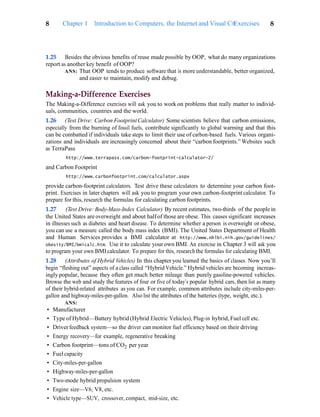
7 Chapter 1 Introduction to Computers, the Internet and Visual C#
platform supporting the CLR—this is known as platform independence. Code writ-
ten once could easily be used on another machine without modification, saving time
and money. A second benefit of the .NET framework is language interoperability—
software components written in different languages can interact (language indepen-
dence). A drawback associated with these features is that .NET programs cannot be
run until the .NET Framework is developed for a platform. Another is the overhead
of the double compilation that is needed before a .NET-language program can be ex-
ecuted.
1.18 What are the advantages to using object-oriented techniques?
ANS: Programs that use object-oriented programming techniques are easier to understand,
correct and modify. The key advantage with using object-oriented programming is
that it tends to produce software that is more understandable, because it is better or-
ganized and has fewer maintenance requirements than software produced with earlier
methodologies. OOP helps the programmer build applications faster by reusing ex-
isting software components that model items in the real world. OOP also helps pro-
grammers create new software components that can be reused on future software
development projects. Building software quickly, correctly, and economically has
been an elusive goal in the software industry. The modular, object-oriented design
and implementation approach has been found to increase productivity while reduc-
ing development time, errors, and cost.
1.19 You are probably wearing on your wrist one of the world’s most common types of objects—
a watch. Discuss how each of the following terms and concepts applies to the notion of a watch:
object, attributes and behaviors.
ANS: The entire watch is an object that is composed of many other objects (the moving
parts, the band, the face, etc.) Watch attributes are time, color, band style, technology
(digital or analog), and the like. The behaviors of the watch include setting the time
and getting the time. A watch can be considered a specific type of clock (as can an
alarm clock).
1.20 What is the key accomplishment of the UML?
ANS: It replaced the many different graphical modeling languages with a single (unified)
language for modeling that can be used by developers regardless of the different
OOAD processes they may use.
1.21 What did the chief benefit of the early Internet prove to be?
ANS: Communication by e-mail. Today, that communication is also facilitated by appli-
cations such as instant messaging and file transfer.
1.22 What is the key capability of the web?
ANS: It allows computer users to locate and view multimedia-based documents on almost
any subject over the Internet.
1.23 What is the key vision of Microsoft’s .NET initiative?
ANS: To embrace the Internet and the web in the development and use of software.
1.24 How does the .NET Framework Class Library facilitate the development of .NET apps?
ANS: First, the Framework Class Library is a large library of reusable classes that reduces
development time. Programmers can build software quickly by reusing framework’s
classes, rather than building new classes “from scratch.” Second, the Framework Class
Library is shared by all of the .NET languages, which means that programmers who
work in multiple languages have to learn only one class library.
Exercises 8
8 Chapter 1 Introduction to Computers, the Internet and Visual C#
1.25 Besides the obvious benefits of reuse made possible by OOP, what do many organizations
report as another key benefit of OOP?
ANS: That OOP tends to produce software that is more understandable, better organized,
and easier to maintain, modify and debug.
Making-a-Difference Exercises
The Making-a-Difference exercises will ask you to work on problems that really matter to individ-
uals, communities, countries and the world.
1.26 (Test Drive: Carbon Footprint Calculator) Some scientists believe that carbon emissions,
especially from the burning of fossil fuels, contribute significantly to global warming and that this
can be combatted if individuals take steps to limit their use of carbon-based fuels. Various organi-
zations and individuals are increasingly concerned about their “carbon footprints.” Websites such
as TerraPass
http://www.terrapass.com/carbon-footprint-calculator-2/
and Carbon Footprint
http://www.carbonfootprint.com/calculator.aspx
provide carbon-footprint calculators. Test drive these calculators to determine your carbon foot-
print. Exercises in later chapters will ask you to program your own carbon-footprint calculator. To
prepare for this, research the formulas for calculating carbon footprints.
1.27 (Test Drive: Body-Mass-Index Calculator) By recent estimates, two-thirds of the people in
the United States are overweight and about halfof those are obese. This causes significant increases
in illnesses such as diabetes and heart disease. To determine whether a person is overweight or obese,
you can use a measure called the body mass index (BMI). The United States Department of Health
and Human Services provides a BMI calculator at http://www.nhlbi.nih.gov/guidelines/
obesity/BMI/bmicalc.htm. Use it to calculate yourown BMI. An exercise in Chapter 3 will ask you
to program your own BMIcalculator. To prepare for this, research the formulas for calculating BMI.
1.28 (Attributes of Hybrid Vehicles) In this chapter you learned the basics of classes. Now you’ll
begin “fleshing out” aspects of a class called “Hybrid Vehicle.” Hybrid vehicles are becoming increas-
ingly popular, because they often get much better mileage than purely gasoline-powered vehicles.
Browse the web and study the features of four or five of today’s popular hybrid cars, then list as many
of their hybrid-related attributes as you can. For example, common attributes include city-miles-per-
gallon and highway-miles-per-gallon. Also list the attributes of the batteries (type, weight, etc.).
ANS:
• Manufacturer
• Type of Hybrid—Battery hybrid (Hybrid Electric Vehicles), Plug-in hybrid, Fuel cell etc.
• Driverfeedback system—so the driver can monitor fuel efficiency based on their driving
• Energy recovery—for example, regenerative breaking
• Carbon footprint—tons of CO2 per year
• Fuel capacity
• City-miles-per-gallon
• Highway-miles-per-gallon
• Two-mode hybrid propulsion system
• Engine size—V6, V8, etc.
• Vehicle type—SUV, crossover, compact, mid-size, etc.
Making-a-Difference Exercises 9
• Seating capacity
• Horse power
• Drive train (front wheel drive, all wheel drive)
• Top speed
• Torque
• Price
1.29 (Gender Neutrality) Some people want to eliminate sexism in all forms of communication.
You’ve been asked to create a program that can process a paragraph of text and replace gender-spe-
cific words with gender-neutral ones. Assuming that you’ve been given a list of gender-specific
words and their gender-neutral replacements (e.g., replace “wife” with “spouse,” “man” with “per-
son,” “daughter” with “child” and so on), explain the procedure you’d use to read through a para-
graph of text and manually perform these replacements. How might your procedure generate a
strange term like “woperchild,” which is actually listed in the Urban Dictionary (www.urbandic-
tionary.com)? In Chapter 5, you’ll learn that a more formal term for “procedure” is “algorithm,”
and that an algorithm specifies the steps to be performed and the order in which to perform them.
ANS: Search through the entire paragraph for a word such as “wife” and replace every oc-
currence with “spouse.” Repeat this searching process for every gender specific word
in the list. You could accidentally get a word like “woperchild” if you are not careful
about how you perform replacements. For example, the word “man” can be part of
a larger word, like “woman.” So, replacing every occurrence of “man” can yield
strange results. Consider the process of replacing “man” with “person” then replacing
“son” with “child.” If you encounter the word “woman,” which contains the word
“man,” you’d replace “man” with “person” resulting in the word “woperson.” In a
subsequent pass you’d encounter “woperson” and replace “son” with “child” result-
ing in the “woperchild.”
Exploring the Variety of Random
Documents with Different Content
[29] Illán and Benito Suárez de Caravajal were brothers.
[30] Chachapoyas.
[31] On his way to Spain to solicit the governorship of
Popayán, and other parts he had explored.
[32] There is no mention of this expedition led by Pineda, in
the account given by Garcilaso de la Vega.
[33] Garcilaso gives the number at 340—cavalry 150, the rest
infantry.
[34] Garcilaso gives 4,000 Indians laden with supplies, and
materials for buildings, bridges, or vessels, 4,000 head of swine,
and a flock of llamas.
[35] True, but it does not follow that no others could.
[36] Garcilaso calls it Sumaco, but Herrera has Zumaque.
[37] Garcilaso describes this tree as very tall with leaves like a
laurel, the fruit growing in clusters, and resembling an acorn.
Herrera describes it as like an olive with large pods, the tree
attaining a height of thirty feet.
[38] The Sweet Sea (Mar Dulce) was another name for the
Marañón. The "arm" was the river Napo.
[39] The Coca, principal tributary of the Napo.
[40] Mar dulce, the Marañón.
[41] Thus was the mighty river Amazon discovered by this
inhuman traitor.
[42] Jatropha manihot, an edible root.
[43] Shoes or sandals used by the Basques, made of grass.
[44] Garcilaso omits all mention of this detached expedition of
Pineda but Herrera gives a brief account of it.
[45] Almagro's son.
[46] Others say a cap with a gold medal having a silver fig
embossed upon it, and a motto—"For the men of Chile."
[47] This should be Alonso de Peña, brother-in-law of Pascual
de Andagoya. When Andagoya left Panamá to take possession of
his government, he sent Peña to Santo Domingo, to collect more
troops, horses, and stores. See my translation of Andagoya's
narrative, Introduction, p. xxvi (Hakluyt Society's vol. 34, for
1865).
[48] Buenaventura, the port of Cali, was founded by Juan
Ladrillo, under orders from the Adelantado Pascual de Andagoya,
who had received the government of the coast thence to Panamá.
The municipality of Cali ordered that six or seven settlers should
reside there to arrange for the landing of merchandize and its
transmission across the mountains to Cali. The pilots with Vaca de
Castro certainly showed great want of intelligence in not being
able to find it (see Cieza de León , p. 105, Hakluyt Society's vol.
33, for 1864)
[49] The Marquis Pizarro's secretary.
[50] Son of the Adelantado Don Diego de Almagro, usually
known as "El mozo" (the lad). He was a half-caste, by an Indian
woman of Panamá.
[51] Juan de Herrada was an able soldier, a servant of the old
Almagro, and devoted to the interests of his son.
[52] At the expiration of the term of all Spanish governors and
judges a "Juez de Residencia" was appointed to examine into
their conduct, and receive complaints and representations from
those whom they had governed or judged. This was called a
residencia. Solórzano points out many evils in the working of the
system (Política Indiana, Lib. v, cap. 10, pp. 836-849). Vaca de
Castro, however, was not sent out with powers to terminate the
rule of the Marquis. He was to receive evidence, and report to the
Home Government. If the Marquis was dead when Vaca de Castro
arrived, then the latter was to succeed as Governor.
[53] So that the statement that they were starving appears
false.
[54] This very interesting interview between the Marquis
Pizarro and his murderer is also given by Zarate and Gómara.
Garcilaso de la Vega copied from them. Prescott does not mention
it; but Sir Arthur Helps (iv, 136-137) gives a full account of this
extraordinary conversation. It is certainly worth preserving.
Pizarro must have repeated it to his friend the Bishop elect of
Quito, immediately after it took place, and the Bishop was one of
Cieza de León's most valued authorities.
[55] Prescott concurs in thus fixing the blame for the death of
Almagro. Sir Arthur Helps does not. The evidence of the Bishop of
Quito, who was with the Governor, is conclusive that Pizarro had
no knowledge of the intention of his brother to put Almagro to
death, until he reached Abancay, when it was too late.
My own conviction is that Hernando Pizarro had no such
intention, but that he was going to deliver Almagro to his old
friend Don Francisco Pizarro, to deal with him as he thought best.
But when he discovered the dangerous plot to assassinate himself
and liberate Almagro, he was convinced of the necessity of
passing the death sentence on the old Adelantado. He had no
doubt whatever of its justice. It was quite in keeping with
Hernando's stern and self-reliant character that he should take
the responsibility solely on himself. He knew that his brother
would not consent, yet he believed that it was a political
necessity. Don Francisco Pizarro must thus be entirely exonerated
from any responsibility for the execution of Almagro, whatever
Cieza de León may assert on evidence derived from unauthentic
gossip. The Bishop of Quito completely refutes him.
[56] Or, according to another account—"That is not business
for a boy."
[57] Of these murderers Juan de Herrada died a natural
death. Martín de Bilbao and Jerónimo de Almagro were killed at
the battle of Chupas. Arbolancha (the murderer of Chaves),
Barragán, Cabezas, Gómez, Guzmán, Hoces, Losa, were hanged;
Narváez was killed by Pizarro. Méndez escaped to the Inca and
murdered him, finally getting his deserts. The fate of the others is
unknown.
Both Prescott and Helps repeat a story told by Montesinos that
one of the conspirators, when they were rushing across the plaza,
ran round a pool of water instead of going through it, to avoid
getting wet. Herrada told him, as he was so particular, he must
go back. Montesinos is a late and not at all a reliable authority,
and the story need not be believed. It never rains, and there
never are pools of water in the plaza of Lima. The name of
Gómez Pérez is given, one of the villains who murdered the Inca
Manco and got their deserts.
It is to be observed that none of Almagro's old captains had
anything to do with the murder, except perhaps Chaves, although
they were violently antagonistic to the Marquis and were in Lima.
They were not murderers. Only one threw in his lot with young
Almagro.
[58] Hanged.
[59] No relation to the other Alvarados.
[60] Deserted at Chupas.
[61] Come to pay their respects after mass. It was Sunday.
[62] Five good men and true.
[63] Fifteen cowards.
[64] These gallant boys deserve more than a passing notice.
Young Vargas, son of Gómez de Tordoza, and cousin of Garcilaso
de la Vega, was of the noblest blood of Castille. One ancestor
rode by the side of St. Ferdinand at the taking of Seville, another
sacrificed his life to save his king at Aljubarrota, another defeated
the gigantic Moor in the famous duel on the Vega of Granada.
The heroic page of Pizarro was worthy of such ancestry.
Cardona sprung from equally heroic stems. He was connected
with the Córdovas, Dukes of Sesa, the family of the Gran Capitán.
[65] Herrera and others tell a story that Juan Rodríguez
Barragán hit the Marquis a blow with a silver jug full of water
when he was on the ground, which killed him. Prescott repeats
this in a footnote, calling Barragán "a soldier named Borregan."
Helps writes: "Some base fellow dashed a jug upon his prostrate
face."
Juan Rodriguez Barragán was not a soldier, but one of the
lawyers in Almagro's pay. He was Almagro's procurator at the
Judge Arbitrator's court when he pronounced the sentence at
Mala, and Barragán raised a protest. His son was certainly one of
the murderers, but the story of the jug is probably an invention.
The son was hanged after the battle of Chupas. The word
barragán means a youth, same as mancebo. Originally from
Navarre, a branch of the family settled at Baeza in Andalusia,
whose arms were or, a tree vert, at its stem a dead knight and
two ravens sable, wings raised.
[66] The Marquis Pizarro had by the Princess Inez Huayllas,
daughter of the great Inca Huayna Capac, two children, who are
mentioned in his will as legitimate, Gonzalo, who died in the
flower of his youth, and Francisca, who went to Spain, years after
her father's death, in charge of her step-father Don Francisco de
Ampuero. She was married to her uncle, Hernando, when he was
still a prisoner at Medina del Campo. By him she had three sons
and a daughter. Hernando Pizarro was released after twenty-three
years of captivity, and lived for nineteen years afterwards in his
native town of Truxillo. His great grandson[68] was created
Marquis of the Conquest. The Marquis Pizarro also had a son
named Francisco, by the Princess Anas (Angelina), sister of
Atahualpa, who was a school-fellow of the Inca Garcilaso de la
Vega at Cuzco. He died young and unmarried.
[67] Cieza de León omits Juan Ortíz de Zárate who defended
the door at first, and was badly wounded, as he had just related.
Torre and Vergara were much alarmed, but had remained in the
sala. Hurtado was the servant wounded in the court-yard.
[68]
[69] A very faithful attendant of the Marquis. He was with
Pizarro at Cajamarca, and was one of the twelve who rode with
him to Mala. He avenged his master's murder at the battle of
Chupas.
[70] One of Cieza de León's authorities. They were natives of
the same town.
[71] After the murderers had departed from Lima, the body
was placed in a coffin, and deposited in the sacristy of the old
church (called "Los Naranjos") until the cathedral was completed.
In 1607 the bodies of the Marquis Pizarro and of the Viceroy Don
Antonio de Mendoza were, by order of the king, placed under a
vault behind the high altar of the cathedral. The coffin of the
Marquis was covered with purple velvet embroidered in gold.
On June 28th, 1891, the Municipality of Lima erected a new
tomb. The body is in a coffin with glass sides, and surmounted by
a cross. On the pedestal there is the following inscription:
Captain General
Don Francisco Pizarro
Founder of Lima
on the 18th of January 1535
died 28th of June 1541
His remains were deposited in this urn
on the 29th of June 1891
by order of the Provincial Council of Lima
and through the initiative of
the Alcalde Dr. Juan de Roverech
[72] That is, he was with Pizarro at Cajamarca, where he
received 181 marcs of silver, and 3884 pesos of gold from
Atahualpa's ransom. He settled at Cuzco.
[73] One of Almagro's old captains.
[74] The bad one.
[75] Cieza de León always calls the half-caste son of the
Adelantado Don Diego de Almagro by the name 'Don Diego.'
Others call him Almagro the lad (el mozo). He was born at
Panamá, the son of Almagro by an Indian woman of Panamá who
was his servant, and called Ana Martínez. He was probably born
in 1518. Francisco Martín de Alcántara, the half brother of the
Marquis, brought the half-caste boy to Peru in 1535, when his
age was seventeen, and treated him as one of his family, in his
house at Lima. Later he was sent to Cuzco to meet his father
returning from Chile. He was with his father until the battle of Las
Salinas. It was then decided to send him to Lima under the care
of Gómez de Alvarado and Juan de Herrada. At Jauja they met
the Marquis Pizarro, who treated the lad as his own son, and
ordered him to be well cared for, and lodged in his house. This
continued for a long time. But such crowds of discontented
Almagrists were always coming there, that at last the Marquis
sent the lad to another lodging in Lima.
[76] Juan Diente was in the conspiracy, though not one of the
actual murderers. For this he was hanged at Guamanga, after the
battle of Chupas. He ought to have been let off in consideration
of his fine pedestrianism!
[77] Yana-cuna would mean "servants." Cuna is the plural
particle. There is no such word as anacona. It should be yana
(without the cuna).
[78] In the Chachapoyas province.
[79] We are not told whether Gómez de Tordoya then heard of
the heroic death of his young son, who was Pizarro's page.
[80] La Paz.
[81] See Hakluyt Society's vol., Series II, vol. xxviii, p. 159, for
the expedition of the Bishop of Plasencia. It consisted of three
small vessels commanded by Don Alonso de Camargo, and left
Spain in August 1539. Camargo lost his own ship at the entrance
of the first Narrows, in the Strait of Magellan. The second ship
returned. Camargo went on in the third ship. He reached
Valparaiso, put in at Quilca, the port of Arequipa, and finally
reached Callao, the first ship that ever gained the west coast of
South America by the Strait. Camargo settled at La Plata
(Chuquisaca) and was put to death by Carbajal.
[82] Sebastián de Belalcázar, after exploring Popayán and Cali,
and founding the cities, had gone to Spain to obtain a grant as
Governor. Pascual de Andagoya, an original citizen of Panamá,
was in Spain in 1538, and received a grant on the Pacific coast
from the Gulf of San Miguel to the river San Juan, with the title of
Adelantado. He landed at Buenaventura and marched to Cali and
Popayán. These cities were not in his jurisdiction, but he was
justified in going there, in the absence of Belalcázar, owing to the
disturbed state of the country. Meanwhile Belalcázar had obtained
the governorship he sought, with the title of Adelantado. On
finding Andagoya at Popayán, he had thrown him into prison.
[83] Belalcázar at last allowed Andagoya to proceed to
Buenaventura, with his brother-in-law Alonso de Peña, where
they embarked for Panamá. Andagoya proceeded to Spain,
having lost his government and 70,000 castellanos de Oro (over
£140,000 of our money). In 1546 he again went out with Pedro
de la Gasca, was at the battle of Sacsahuana, and died at Cuzco
in 1548. See the Narrative of Pascual de Andagoya (Hakluyt
Society's vol. 34 for 1865).
[84] They seem to have been landed at Payta, near which
port they had an interview with Vaca de Castro.
[85] Sic—a mistake for Garcilaso.
[86] Brother of Pedro Anzures.
[87] The captain of the ship that arrived from Spain. See p.
137.
[88] The Quichua tribe which inhabited the Jauja province.
[89] Of Magellan.
[90] I.e., the tropics.
[91] Actual murderers of the Marquis.
[92] Accomplices who waited outside.
[93] "Muy lucidos." It is to be feared that the prejudices of
Cieza de León were very strong.
[94] Two old captains who served under the elder Almagro.
[95] They had already murdered his son, the gallant boy who
defended the Marquis.
[96] Other authorities called him Rada, and they were
followed by Prescott and Helps. Cieza de León is right. The name
was Herrada. I am unable to concur in Mr. Prescott's estimate of
the character of this man. I cannot find any authority for that
historian's statement that Herrada was of good family, and he
certainly had no experience in high military commands.
Herrada came to Peru with Pedro de Alvarado as a common
soldier of mature years. Deserting Alvarado he entered the
service of the elder Almagro, remained with him until his death,
and then attended his young half-caste son to Lima, obtaining
unbounded influence over him. He originated the plot for the
murder of Pizarro, and was the ringleader in that atrocious crime.
None of Almagro's old captains, except Chaves, and no man of
honour, would have anything to do with it. Herrada had force of
character, but neither prudence nor ability. By inducing young
Almagro to make him his General above the heads of better men,
he affronted and estranged the old captains and friends of the
young half-caste's late father. His murders of Pizarro's secretary,
of Francisco de Chaves and others, were acts of folly which no
able conspirator would have perpetrated. The murder of Pizarro
may have been partly to avenge the death of his old master, but
he and his accomplices were far more influenced by anger at not
being provided for. Herrada's last advice to appoint two Generals
showed his incapacity. For young Almagro the death of this
ruffian was nought but a good riddance.
[97] This was the treason—the murder of the King's Governor.
The object of the battle of Chupas was to capture and punish the
traitors.
[98]
[99] Clerical errors or misprints. Probably Mato and Carhuaz.
[100] This was not Gómez the brother of Don Pedro de
Alvarado, and one of the old captains of the Adelantado Diego de
Alvarado. He appears to have been no relation, and was called
Gómez de Alvarado el mozo (the lad) to distinguish him from his
namesake. We first hear of him in Cuzco in 1538, as having been
arrested by Almagro as a partisan of Pizarro, just before the
battle of Las Salinas. He then went with Alonso de Alvarado for
the exploration and settlement of Chachapoyas. He afterwards
joined Gonzalo Pizarro and was at the battle of Anaquito, when
he saved the wounded Belalcázar from the ruffian Bachicao and
others who wanted to kill him. Gonzalo Pizarro gave him the
government of the Chachapoyas. But he deserted his Chief and
joined La Gasca, who made him a captain of cavalry. After
Sacsahuana, Gómez de Alvarado "the lad" went to Upper Peru,
and when Giron commenced a civil war, he joined Alonso de
Alvarado, but was killed in the battle of Chuquinga. Garcilaso
confuses him with the other Gómez de Alvarado.
[101] The reader will have observed some repetition and
confusion in this chapter. It is as Cieza de León wrote it.
[102] The Counts of Lemos derived from Rodríguez Alvarez
Osorio, and his wife Aldonça daughter of Alonso Henríquez,
Admiral of Castille. Their son Pedro Alvarez Osorio, who died in
1483, was Count of Lemos by right of his wife, Beatriz de Castro,
the heiress of Lemos. His great granddaughter was Beatriz de
Castro Osorio, Countess of Lemos. She married a son of the
Portuguese Duke of Braganza, and had a son who was the 4th
Count of Lemos. Vaca de Castro was a cousin. The 4th Count of
Lemos had a daughter Teresa married to the 4th Marquis of
Cañete, Viceroy of Peru, and a son Beltrán de Castro, governor of
Callao under his brother-in-law, to whom Sir Richard Hawkins
surrendered, and of whom he said that he was a very noble
knight and a perfect gentleman. A later Count of Lemos was
Viceroy of Peru.
[103] In the absence of Sotelo at Cuzco. Carrillo was one of
the murderers of the Marquis. He was hanged at Guamanga after
the battle of Chupas.
[104] Misprint for 350.
[105] Fray García de Loaysa, President of the Council of the
Indies, Archbishop of Seville, and confessor to Charles V. He was
a brother of Dr. Gerónimo de Loaysa, the first Archbishop of Lima
and friend of Vaca de Castro. The appointment of Vaca de Castro
by the Emperor, would have been settled on the recommendation
of the Council of the Indies, submitted through its President.
[106] This gives a wrong impression. The captains of the old
Adelantado Almagro had not all come to an end. Most of them
had declined to take part with the murderers of Pizarro. Francisco
de Chaves, it is true, had been murdered by Juan de Herrada. Of
the others Diego de Alvarado had returned to Spain. Gómez de
Alvarado and Juan de Sayavedra had left the young Almagro at
Jauja, and returned to Lima. Montemayor and Guevara were
actually with the army of Vaca de Castro. Sotelo alone had
remained with young Almagro, from devotion to his father's
memory, although he had protested against the murder of the
Marquis.
García de Alvarado was not an old captain of Almagro. He is
first heard of in history as one of the accomplices of the
murderers—a truculent young ruffian.
[107] One of the murderers. He was with Pizarro at
Caxamarca, and got his share of the Atahualpa ransom.
[108] Murderers of the Marquis.
[109] Accomplice.
[110] One of the murderers of the Marquis.
[111] He means Charles V, not the Inca Manco.
[112] Tilting at the ring.
[113] This was the elder Gómez de Alvarado (no relation to
the other), one of the old captains of the Adelantado Almagro. He
disapproved of the murder of the Marquis, and of the subsequent
proceedings of the young Almagro, and had therefore remained
at Lima.
[114] Now called Ayacucho.
[115] i.e., with Pizarro at Caxamarca, and received his share
of the Atahualpa ransom.
[116] None of them were actual murderers of the Marquis,
though Picón was an accomplice who waited outside. They saw
reason to expect pardon from Vaca de Castro.
[117] Murderers of the Marquis Pizarro.
[118] Accomplices.
[119] i.e. of Vaca de Castro and Diego de Almagro.
[120] Should be Çamarilla.
[121] Spain in geographical outline.
[122] As his name implies, the wily Pedro was a Cretan.
[123] Francisco de Carbajal, afterwards the lieutenant of
Gonzalo Pizarro and a ruthless executioner of traitors to his
cause.
[124] From which he hung his victims.
[125] 16th of September 1542.
[126] Inca ladies.
[127] Ravine of Lambra Luopica, not Chupas.
[128] Only a mile and a quarter.
[129] Y vuestro buen seso [sic] in the manuscript.
[130] Quica is grey in Quichua, pata an ascent.
[131] Lambras is the local name for a tree like an elder.
Huayccu means a ravine.
[132] Lame (cojo) Arias. I did not know his Christian name.
[133] The real truth was that there was not a single one of
the old and trusted captains of the elder Almagro with his son;
Diego de Alvarado had gone to Spain, Orgónez and Lerma were
slain at or after Las Salinas, Francisco de Chaves had been
murdered by Juan de Herrada, and Sotelo by García de Alvarado.
The rest were disgusted with the murder of the Marquis and at
Juan de Herrada being placed over them. Four, indeed, were
actually fighting in the army of Vaca Castro, namely Gómez de
Alvarado, Saavedra, Guevara, and Montemayor.
The murder of the ever faithful and very able Captain Sotelo
was a fatal blow to young Almagro. There was no one at Chupas
that he could trust. Six of his captains were actual assassins of
the Marquis Pizarro, three others were accomplices outside the
chamber. Little reliance could be placed on the rest. The assassins
and their accomplices would be fighting with ropes round their
necks and would fight hard. But the ill-fated young half-caste,
with his ability and bravery, was doomed.
[134] Both were assassins of the Marquis. They did this to
escape the halter.
[135] Some authorities say that the Inca Paula and his
Indians, on the side of Almagro, made an attack early in the day,
which was repulsed.
[136] Juan Rodriquez Barragán, the ensign Enrique, and eight
others also fled with Don Diego, as well as Diego Méndez.
Juan Balsa, Almagro's Captain-General, fled to Vilcas where he
was killed by the natives. He had a house at Cuzco and had
married an Inca Princess.
Some authorities say that Pedro Suárez, when he marshalled
Almagro's army, told Don Diego to remain on the spur. His plan
was to defend the ascent from the Lambras-huayccu ravine and
not to attack. It is said that when Don Diego charged down at the
head of his cavalry, Suárez told him that he would be defeated,
but that if he had taken his advice he would have been victorious.
It is added that he abandoned Don Diego, and went over to the
side of Vaca de Castro. This story is not mentioned by Cieza de
León.
[137] Holguin, Tordoya, and Gómez de Alvarado are said to
have been buried in the little church of San Cristóbal at
Guamanga, near the head of the avenue leading to the Chupas
road. But Cojo Arias told me of the tradition that Gómez de
Tordoya was not buried with the others, but in the church of La
Merced, nearer the centre of the town. In 1887 a statue of a
warrior was found in a niche in La Merced, recumbent on a
mortuary bed, embracing his sword. It is of sandstone and 6-1/2
feet long. It no doubt represents Gómez de Tordoya, probably
due to the piety of his cousin Garcilaso de la Vega. The Indians of
Guamanga (Ayacucho) are renowned as sculptors.
[138] All three were actual assassins of the Marquis Pizarro.
[139] Viz., Juan Tello de Guzmán, and Almagro's Camp-master
Pedro de Oñate.
[140] Assassins of the Marquis.
[141] Also Pedro de San Millán and Francisco Coronado.
[142] Cieza de León had already told us that the elder
Almagro was strangled in his prison. But his body was publicly
beheaded.
[143] Not so old, if he was born at Panamá. That city was only
founded in 1520, and Almagro came there some years later. He
was not more than nineteen.
[144] The story of Diego de Almagro is very interesting, and
exceedingly pathetic. It is interesting because this lad was the
first mestizo or half caste distinguished for ability, nobility of
conduct, and bearing. There have been many since.
Young Diego was born at Panamá. He was the son of an
Indian servant girl who went by the name of Ana Martínez.
Panamá was founded late in 1519. The elder Almagro did not
settle there until after Espinosa's expedition, two or three years
later than the founding of the city. Being the lad's father, his birth
probably took place in 1522 or 1523.
The lad is said to have been well "endoctrinated," so he no
doubt learnt to read and write, and to repeat the usual
invocations and prayers of the period. When Martín de Alcántara
came to Panamá on his way to join his half brother Francisco
Pizarro in Peru, he met the young lad Diego, and very kindly took
charge of him, to join his father. This was in 1535 when the lad
was twelve or thirteen. At Lima Alcántara took young Diego to his
house and treated him as one of his own children, until a way of
sending him to his father (then engaged on his Chilean
expedition) could be found. At last a servant named Juan de
Herrada was engaged, who had come to Peru with Pedro de
Alvarado. He also took the royal patent appointing the Adelantado
Almagro to be Governor of a province to the south, to be called
New Toledo. Pizarro's province, to be called New Castille, was the
northern half of the Inca Empire, and the boundary was to be
fixed by an arbitrator appointed by the King. Almagro did not wait
for an arbitrator, but immediately marched north to settle the
boundary himself, declaring Cuzco, and even Lima, to belong to
him. This was the beginning of civil dissension in the Realm.
Young Diego must have had a very good time, with all the
marching and adventure and none of the responsibility. Doted
upon by his father, liked and made much of by the Adelantado's
old captains, some of them men of good family and position, he
acquired habits of breeding and self-respect. When his father was
on the coast, young Diego was proposed as a hostage by the
Judge-Arbitrator Bobadilla. Again when Almagro released
Hernando Pizarro, his son was sent with the escort to the
Governor's camp and received presents. These are the first
occasions when he appears in history.
Diego was too young to take part in the battle of Las Salinas,
and he does not appear to have been with his father. But he was
at Cuzco, and Hernando Pizarro decided that he should be sent to
his brother the Governor and Marquis Don Francisco Pizarro. He
went with Alonso de Alvarado, Gómez de Alvarado, and his
father's servant Juan de Herrada. They found Francisco Pizarro at
Jauja. In interviews with the Marquis the lad entreated him not to
put his father to death, and Pizarro assured him that he had no
such intention. Young Diego was treated with hospitality, and
even distinction, and when he went to Lima with Juan de
Herrada, the Marquis sent orders that the lad was to be lodged in
his own house, and treated as his son. Then the news came of
the execution of the Adelantado Almagro. The son was persuaded
by Juan de Herrada that it was done by order of the Marquis,
which was quite untrue. The next news was that the royal patent
authorized the Adelantado to nominate a successor to the
government of New Toledo; and that he had named his son in his
will. Herrada, who was the lad's evil genius, filled his mind with
ideas of vengeance and ambition. When Pizarro returned to Lima
he found young Almagro full of these ideas, and constantly
intriguing with Herrada and others. He could no longer have the
boy as an inmate of his house.
Herrada had acquired complete influence over young Diego's
mind. This man had come to Peru with Pedro de Alvarado; and
transferred his services to the elder Almagro, to attend on his
son. He was a man of great energy, quick decision, and some
power in acquiring influence over others. But here his good
qualities ended. He had little ability, no judgment, and no mercy.
His one virtue was devotion to Almagro and his son, but he only
knew how to show it by an act of brutal vengeance.
The murder of the Marquis was entirely planned by this
ruffian. All the old captains of the elder Almagro but one[145]
were against it. The question arises how far young Diego was an
accomplice. He was told by Herrada that Pizarro was going to kill
him and all his friends, and it was proposed to him that the
Marquis should be seized until Vaca de Castro arrived, who would
judge between them. But I think that the boy was not cognizant
of the intended murder until after its perpetration.
In a letter which young Diego wrote to the Judges of the
Royal Audience of Panamá, putting forth his claim to succeed as
Governor, he states that his object was to seize the Marquis, not
to murder him: and that he regretted his death. The letter is
dated 14 July 1541.[146] I think that this may be believed.
Juan de Herrada showed great energy after the murder;
disarming and arresting, and forcing the municipal officers to
acknowledge young Diego as Governor. But when nearly all the
Spaniards outside Lima rose against him, he showed nothing but
incapacity and arrogance. He tortured and killed Pizarro's
secretary, and murdered Francisco de Chaves owing to a private
feud, the only old captain of the elder Almagro who was an
accomplice, though not an actual murderer. Both were acts of
unwisdom and stupid violence. The accomplice of whom he had
the highest opinion was a young ruffian named García de
Alvarado, violent, incapable, and brutally selfish—an unscrupulous
robber. Yet the ill-fated boy remained completely under the
malign influence of Juan de Herrada, and consented to make him
General of the forces he was collecting. He was thus placed over
all the veteran captains of the elder Almagro, men of position, of
tried valour, with great military experience. They were not
prepared to serve under the upstart Herrada, and they were all
disgusted at the murder of the Marquis, an atrocious crime which
could not be forgiven, as well as a piece of folly, which no one
with any judgment would have committed. Sooner or later all his
father's old captains except one left the service of the unhappy
boy, and joined the royal Governor—Gómez de Alvarado,
Saavedra, Montemayor, Guevara, all fell away from the
murderers. One only stood firm for the boy, for the sake of his
father. This was Cristóval de Sotelo, an old soldier of the school of
Orgóñez, but able, experienced in war, and possessing no
common skill in all matters relating to his profession. He was true
as steel to the cause he had once espoused.
Herrada found it necessary to leave Lima and make for Cuzco,
there to await events. He was taken ill on the way and died at
Jauja showing his incapacity with his dying breath, by advising
that Sotelo and García de Alvarado should command jointly.
Sotelo of course declined such a position, and García de Alvarado
went with a following to Arequipa, nominally to collect men and
arms, but really for plunder.
Young Diego, now free from the evil tutelage of Juan de
Herrada, began to act for himself, and showed that he possessed
ability and force of character. He was not altogether without help,
though surrounded by murderers and self-seekers. In Sotelo he
found a true friend and wise counsellor, and during the march to
Cuzco, under such guidance, he brought his levies of 550 men
into a state of tolerable military efficiency.
At Cuzco young Diego worked hard with Sotelo, in preparing
arms, superintending the casting of cannon by Pedro de Candía,
and consulting about the best course to pursue. Then the young
ruffian García de Alvarado arrived from his freebooting expedition
to Arequipa, with a large amount of treasure. He used it to form a
party of his own in the camp. He was jealous of Sotelo, who at
the time was ill in bed with a fever, and he went to his house to
pick a quarrel, ending by murdering him. Young Diego did not
dare to arrest the assassin owing to the party his stolen treasure
had got around him. He bided his time. He even consented to
make him second in command with special powers. The ambition
of the young ruffian (he was twenty-nine) was to have chief
command. He intended to murder young Almagro. But the half-
caste was more than a match for him at that game. There was to
be a grand supper, and García de Alvarado was to go to Diego's
house and invite him, having arranged for his murder after the
supper. Diego made a different arrangement, which was to kill
García de Alvarado when he came to say that the supper was
ready. This was done.
But the lad was still surrounded with difficulties and dangers.
There was a well paid Alvarado party which was discontented.
The loss of Sotelo was fatal. The gallant boy had not a single
friend whom he could trust—his associates were a gang of
murderers and self-seekers. He thought he had a friend, in a man
named Lope de Idiáquez, and consulted him. But he proved a
traitor. There was also an old soldier who had served in the
Italian wars and could marshal an army to the best advantage,
but he too was false and a traitor.
Thus, without a single friend upon whom he could rely, this
boy of nineteen prepared to encounter the Governor's army led
by all the experienced cavaliers and soldiers in Peru. To have
undertaken this showed great courage, and that he should have
done it so well denotes rare ability. It is true that he must have
known that all the leaders would fight to the last, for they fought
with halters round their necks. But the equipment of the force,
the provision of arms and accoutrements, the organization, the
route, the marching order, were all due to the energy and ability
of this half-caste boy.
Young Almagro would have been pardoned before the battle,
if he had consented to abandon the cause of the murderers who
were in his army. He was too honourable to entertain such a
proposal. He fought with great valour and determination at
Chupas, to the bitter end.
This fortune followed him in his flight from the lost battle. He
had with him Diego Méndez, who was a fool as well as an
unmitigated scoundrel. Young Almagro should have made his way
direct from the Apurimac to the mountain fastness of the Inca.
But Diego Méndez persuaded him to come to Cuzco for horse
shoes, merely because the rascal wanted to visit his own
mistress, the news of the battle of Chupas not having yet reached
the city. The delay was fatal to young Diego. The bad news
arrived when he had only got as far as the valley of Yucay. A
party was sent in pursuit and he was captured.
Young Diego made a final effort to escape his fate. A faithful
young page bought two horses, and he intended to take refuge
with the Inca. But the scheme was betrayed, and he was more
strictly guarded. This misfortune is much to be regretted. Inca
Manco would have received the able young soldier with hospitality
and kindness. He would have thrown in his lot with the Incas and,
as their very efficient General, would probably have repulsed the
force sent against Tupac Amaru, and thus prevented the
disgraceful scene, for which the Viceroy Toledo was responsible,
in the plaza of Cuzco.
Young Don Diego de Almagro met his death with the calmness
and dignity of a Christian knight, and the courage of an Indian
Chief. He should have been spared. The political reason for the
execution of his father—that he was a source of danger owing to
the still unbroken strength of his party—did not exist in the case
of the son. The Almagro party had been annihilated. The lad
should have been sent to Panamá or to Spain.
It is a very sad story, and most interesting as a proof of the
ability and courage of the first distinguished half-caste.
[145] Chaves, and he was not among the assassins.
[146] Muñoz Coll. It is printed in Spanish by Prescott, in an
appendix at the end of vol. ii of his work.
[147] Diego Méndez and seven others took refuge with the
Inca, who showed them great kindness. In return they murdered
their host and tried to escape, but were promptly seized and put
to death by the Inca's servants. The murder took place in 1545.
The design of these villains was to obtain a pardon for having
borne arms with Don Diego, by disposing of the Inca.
[148] César was at the Rio de la Plata before he went to
Cartagena.
[149] He, at the request of all the principal Spaniards in Peru,
took up their cause against the New Laws, and, when it suited
their interests, they basely deserted him.
[150] Now Chicuana. But the modern place is far from the old
site.
[151] Western?
[152] Tucumán. It was then a common practice to substitute
the â for the terminal an. The name of the Chilean commander
Villagran is often spelt without the n—Villagrâ.
[153] Avestruces in the MS.—but really the Rhea.
[154] Bixa orellana—anatto.
[155] The MS. is defective here.
[156] Orejones was the name given by Spaniards to some
wild tribes of the Gran Chaco, because they perforated and
stretched the ear lobes.
[157] Macagax in the Argentine province of Santiago del
Estero.
[158] Algarrobo (Prosopis alba, or perhaps ruscifolia, Gr.).
[159] The river Salado, which watered the province of
Socotonio, first evangelized by St. Francis Solano late in the
sixteenth century. They were by this time on the south-western
fringe of the Gran Chaco.
[160] East? Its general direction thereabouts is S.S.E.
[161] The village Soconcho is shown on the Abbé Jolís' map,
in his Historia del Chaco (1789), on the east bank of the Rio
Dulce, or Saladillo, in lat. 28° 40' S. Its true latitude is 28° 55'.
[162] Blank in the original MS.
[163] That is, his mother Juana's grandson, his Majesty's own
son.
[164] Attorney General.
[165] Santo Domingo, Mexico, Guatemala with Nicaragua and
Peru.
[166] Naboria—domestic service: tapia—task work.
[167] Juan Infante. No notice seems to be preserved of this
encomendero.
Diego de Ordás. Was a native of Campos de Valverde or
Castro Verde. He was chief Mayor-domo to Diego de Velásquez,
governor of Cuba, and was sent by him to arrest Cortés at
Trinidad, in the Island of Cuba, when he had already started on
the expedition to Mexico. Instead of arresting Cortés, D. de Ordás
joined his company and was made Captain of one of the ships of
the expedition, and became one of the principal leaders. He was
the first Spaniard to ascend Popocatepetl. After the fall of Mexico
he was sent by Cortés on a mission to Spain, when he was made
a Comendador of the order of Santiago, had the grant of Indians
which had been made to him in Mexico confirmed by the
Emperor, and was given a smoking mountain (Popocatepetl) as
his coat of arms. He then went back to Mexico, and two or three
years later returned to Castile, and petitioned for leave to
conquer the Marañón region, where he lost his life. He was about
forty years old when he left Cuba for Mexico.
Maestro Roa. When describing the festivities in Mexico to
celebrate the peace made by Francis I and the Emperor at Aguas
Muertas, Bernal Díaz says (ch. cci): "After this, on the following
morning, half this same Plaza had been turned into the City of
Rhodes with its towers ... and of the hundred knights
commanders ... the Marquis Cortés was their commander and the
Grand Master of Rhodes....
"I want to add an amusing story concerning a settler in
Mexico called the Master of Rhodes (Maestro de Roda), already
an old man, who had a great wen on his neck. He had the name
of Master of Rhodes because they called him purposely Master of
Rhodes, and it was he for whom the Marquis had sent to Castile
to heal his right arm, which he had broken in a fall from a horse
after his return from Honduras, and he paid him very well for
coming to cure his arm, and gave him some pueblos of Indians.
"When the festivals which I have mentioned were over, as this
Master of Rhodes was one of the chroniclers [of the festivities],
and was a good talker, he went to Castile at that time, and
became so well acquainted with the Señora Doña Maria de
Mendoza, the wife of the Comendador Mayor, one Francisco de
los Cobos, that he bewitched her, and promised to give her drugs
so that she should bear a child, and he said this in such a way
that she believed him, and the Señora Doña Maria promised him
that if she bore a child she would give him two thousand ducats,
and would support him before the Royal Council of the Indies in
obtaining further pueblos of Indians. This same Master of Rhodes
also promised Cardinal de Cigüenza, who was President of the
Council of the Indies, that he would cure him of the gout, and the
President believed him, and they allotted him, on the order of the
Cardinal and through the support of the Señora Doña Maria de
Mendoza, very good Indians, better than those he owned. What
he did in the matter of cures was to heal neither the Marquis's
arm (if anything he left him more crippled, although he paid him
very well and gave him the Indians I have mentioned), nor did
the Señora Doña Maria de Mendoza ever bear a child, for all the
hot sweetmeats of sarsaparilla which he ordered her to take, nor
did he cure the Cardinal of the gout; but he kept the bars of gold
which Cortés gave him, and the Indians which the Royal Council
of the Indies bestowed upon him in New Spain.
"He left behind him in Castile among the traders who had
gone to law [about Indians] a joke, to the effect that a little
sarsaparilla which the Master of Rhodes had brought with him
was worth more than all the services the true conquistadores had
rendered to his Majesty, for owing to this name, which had been
given him of Master of Rhodes, and through being a good talker,
he had deceived both the President and the Señora Doña Maria
de Mendoza, while other conquistadores, however much they had
served his Majesty, got no benefits at all." [Hakluyt Society, Series
II, vol. 40, pp. 191, 197-8.]
Francisco Vásquez Coronado. I do not think he was an original
conquistador; he probably arrived later in Mexico. He was an
intimate friend of Antonio de Mendoza, the first Viceroy of
Mexico. He married the daughter of Alonso de Estrada, the
Treasurer of Mexico. He was appointed Governor of the State of
Jalisco, and left his government to undertake the conquest of
Cibola—"the seven cities."
Bernal Díaz says of him: "Francisco Vázquez had been lately
married to a lady who was a daughter of the Treasurer Alonzo de
Estrada, and, in addition to being talented, was very beautiful;
and as he went to those cities of Cibola he had a great desire to
return to New Spain to his wife. Some of the soldiers who were in
his company said that he wished to copy the Greek Captain
Ulysses, who when he was before Troy was crazy to go and enjoy
his wife Penelope, so did Francisco Vázquez Coronado, who left
the Conquest he had undertaken. He was attacked by incipient
madness and returned to Mexico to his wife, and as they
reproached him for having returned in that way, he died within a
few days."
Later on Bernal Díaz says: "Nor will I call to mind the
expedition which Francisco Vázquez Coronado made from Mexico
to the cities which they call Cibola, for as I did not go with him I
have no right to speak of it."
Francisco Maldonado. Must have been one of the original
conquistadores as he signed the first letter of the Army of Cortés
to the Emperor. However, there were five men of the name of
Maldonado mentioned by Bernal Díaz. Two of them may be ruled
out as their names, Alonzo and Alvaro, are given—a third, a
native of Medellin, returned to Cuba, invalided. Francisco
Maldonado was therefore probably either "Maldonado 'el ancho,' a
native of Salamanca and a distinguished person who had been in
command of expeditions, who died a natural death," or
"Maldonado of Vera Cruz, who was the husband of Doña Maria de
Rincon."
Bernaldino Vázquez de Tapia. An original conquistador, as he
signed the first letter to the Emperor. He is mentioned as chosen
to accompany Pedro de Alvarado on an embassy to Montezuma,
when Cortés was at Tlaxcala—but he fell ill on the road and the
embassy was recalled. When the first Royal Audiencia of Mexico
was dismissed and many disputes arose, Bernaldino Vázquez was
chosen by the conquistadores as Proctor to go to Spain and
represent the interests of Cortés. Bernal Díaz says of him, "a very
distinguished and rich man, who died a natural death."
Juan Jaramillo. Was captain of a launch during the siege of
Mexico. He accompanied Cortés on the expedition to Honduras,
and on the way, at Orizaba, he was married to Doña Marina the
mistress of Cortés. He died a natural death.
Martín Vázquez. An original conquistador described by Bernal
Díaz as "a native of Olmedo, a rich and distinguished man" who
became a settler in Mexico—died a natural death.
Gil González de Benavides. Was not an original conquistador,
but he accompanied Cortés on his expedition to Honduras. He
was the brother of the distinguished conquistador and Captain
Alonzo de Avila, who had received the encomienda of the pueblo
of Cuautitlan, near Mexico. When Alonzo de Avila left Mexico he
gave his brother power of attorney, so that he might benefit from
the encomienda, and on the death of Alonzo de Avila the Crown
claimed the encomienda, and I think there was a lawsuit about it.
The two sons of Gil González were beheaded for conspiracy.
[168] Poniente.
[169] This must be an error, probably for Tucumán.
[170] Prosopis (Sp. var.), yielding a bean.
[171] Sent to press, Jan. 1st., 1918.
PRINTED AT THE BEDFORD PRESS, 20 AND 21, BEDFORDBURY, STRAND, LONDON, W.C.
Transcriber's Notes:
1. Obvious punctuation, hyphenation and spelling errors have been corrected.
2. In the Index, under "Tovar", reference is made to García de Tovar. This entry was non-
existent, and has been created by the transcriber.
3. Page xliv: "ryotwarry" - spelling has been corrected to "ryotwari".
4. In the Index, under "Encomendero", reference is made to a note on page 350. There
is, however, no note or mention of this term on this page, but there is a mention in
Footnote 167.
5. In the Index, under Gómez, Pero, reference is made to page iii and a note on page iii.
There is no text on page iii, but the reference pertains to page 35 and the note on this
page.
6. Some archaic words have been retained, e.g. aweary.
7. There are many inconsistencies in spelling and accentuation in the original work. These
have been kept as found.
8. Corrections described in the corrigenda have been applied to the text.
*** END OF THE PROJECT GUTENBERG EBOOK THE WAR OF
CHUPAS ***
Updated editions will replace the previous one—the old editions
will be renamed.
Creating the works from print editions not protected by U.S.
copyright law means that no one owns a United States
copyright in these works, so the Foundation (and you!) can copy
and distribute it in the United States without permission and
without paying copyright royalties. Special rules, set forth in the
General Terms of Use part of this license, apply to copying and
distributing Project Gutenberg™ electronic works to protect the
PROJECT GUTENBERG™ concept and trademark. Project
Gutenberg is a registered trademark, and may not be used if
you charge for an eBook, except by following the terms of the
trademark license, including paying royalties for use of the
Project Gutenberg trademark. If you do not charge anything for
copies of this eBook, complying with the trademark license is
very easy. You may use this eBook for nearly any purpose such
as creation of derivative works, reports, performances and
research. Project Gutenberg eBooks may be modified and
printed and given away—you may do practically ANYTHING in
the United States with eBooks not protected by U.S. copyright
law. Redistribution is subject to the trademark license, especially
commercial redistribution.
START: FULL LICENSE
THE FULL PROJECT GUTENBERG LICENSE
PLEASE READ THIS BEFORE YOU DISTRIBUTE OR USE THIS WORK
To protect the Project Gutenberg™ mission of promoting the
free distribution of electronic works, by using or distributing this
work (or any other work associated in any way with the phrase
“Project Gutenberg”), you agree to comply with all the terms of
the Full Project Gutenberg™ License available with this file or
online at www.gutenberg.org/license.
Section 1. General Terms of Use and
Redistributing Project Gutenberg™
electronic works
1.A. By reading or using any part of this Project Gutenberg™
electronic work, you indicate that you have read, understand,
agree to and accept all the terms of this license and intellectual
property (trademark/copyright) agreement. If you do not agree
to abide by all the terms of this agreement, you must cease
using and return or destroy all copies of Project Gutenberg™
electronic works in your possession. If you paid a fee for
obtaining a copy of or access to a Project Gutenberg™
electronic work and you do not agree to be bound by the terms
of this agreement, you may obtain a refund from the person or
entity to whom you paid the fee as set forth in paragraph 1.E.8.
1.B. “Project Gutenberg” is a registered trademark. It may only
be used on or associated in any way with an electronic work by
people who agree to be bound by the terms of this agreement.
There are a few things that you can do with most Project
Gutenberg™ electronic works even without complying with the
full terms of this agreement. See paragraph 1.C below. There
are a lot of things you can do with Project Gutenberg™
electronic works if you follow the terms of this agreement and
help preserve free future access to Project Gutenberg™
electronic works. See paragraph 1.E below.
1.C. The Project Gutenberg Literary Archive Foundation (“the
Foundation” or PGLAF), owns a compilation copyright in the
collection of Project Gutenberg™ electronic works. Nearly all the
individual works in the collection are in the public domain in the
United States. If an individual work is unprotected by copyright
law in the United States and you are located in the United
States, we do not claim a right to prevent you from copying,
distributing, performing, displaying or creating derivative works
based on the work as long as all references to Project
Gutenberg are removed. Of course, we hope that you will
support the Project Gutenberg™ mission of promoting free
access to electronic works by freely sharing Project Gutenberg™
works in compliance with the terms of this agreement for
keeping the Project Gutenberg™ name associated with the
work. You can easily comply with the terms of this agreement
by keeping this work in the same format with its attached full
Project Gutenberg™ License when you share it without charge
with others.
1.D. The copyright laws of the place where you are located also
govern what you can do with this work. Copyright laws in most
countries are in a constant state of change. If you are outside
the United States, check the laws of your country in addition to
the terms of this agreement before downloading, copying,
displaying, performing, distributing or creating derivative works
based on this work or any other Project Gutenberg™ work. The
Foundation makes no representations concerning the copyright
status of any work in any country other than the United States.
1.E. Unless you have removed all references to Project
Gutenberg:
1.E.1. The following sentence, with active links to, or other
immediate access to, the full Project Gutenberg™ License must
appear prominently whenever any copy of a Project
Gutenberg™ work (any work on which the phrase “Project
Gutenberg” appears, or with which the phrase “Project
Gutenberg” is associated) is accessed, displayed, performed,
viewed, copied or distributed:
This eBook is for the use of anyone anywhere in the United
States and most other parts of the world at no cost and
with almost no restrictions whatsoever. You may copy it,
give it away or re-use it under the terms of the Project
Gutenberg License included with this eBook or online at
www.gutenberg.org. If you are not located in the United
States, you will have to check the laws of the country
where you are located before using this eBook.
1.E.2. If an individual Project Gutenberg™ electronic work is
derived from texts not protected by U.S. copyright law (does not
contain a notice indicating that it is posted with permission of
the copyright holder), the work can be copied and distributed to
anyone in the United States without paying any fees or charges.
If you are redistributing or providing access to a work with the
phrase “Project Gutenberg” associated with or appearing on the
work, you must comply either with the requirements of
paragraphs 1.E.1 through 1.E.7 or obtain permission for the use
of the work and the Project Gutenberg™ trademark as set forth
in paragraphs 1.E.8 or 1.E.9.
1.E.3. If an individual Project Gutenberg™ electronic work is
posted with the permission of the copyright holder, your use and
distribution must comply with both paragraphs 1.E.1 through
1.E.7 and any additional terms imposed by the copyright holder.
Additional terms will be linked to the Project Gutenberg™
License for all works posted with the permission of the copyright
holder found at the beginning of this work.
1.E.4. Do not unlink or detach or remove the full Project
Gutenberg™ License terms from this work, or any files
Welcome to our website – the perfect destination for book lovers and
knowledge seekers. We believe that every book holds a new world,
offering opportunities for learning, discovery, and personal growth.
That’s why we are dedicated to bringing you a diverse collection of
books, ranging from classic literature and specialized publications to
self-development guides and children's books.
More than just a book-buying platform, we strive to be a bridge
connecting you with timeless cultural and intellectual values. With an
elegant, user-friendly interface and a smart search system, you can
quickly find the books that best suit your interests. Additionally,
our special promotions and home delivery services help you save time
and fully enjoy the joy of reading.
Join us on a journey of knowledge exploration, passion nurturing, and
personal growth every day!
testbankbell.com

Solution Manual for Visual C# How to Program (6th Edition) (Deitel Series) 6th Edition

  • 1.
    Download the fullversion and explore a variety of test banks or solution manuals at https://testbankbell.com Solution Manual for Visual C# How to Program (6th Edition) (Deitel Series) 6th Edition _____ Follow the link below to get your download now _____ http://testbankbell.com/product/solution-manual-for-visual- c-how-to-program-6th-edition-deitel-series-6th-edition/ Access testbankbell.com now to download high-quality test banks or solution manuals

  • 2.
    We have selectedsome products that you may be interested in Click the link to download now or visit testbankbell.com for more options!. Solution Manual for Visual Basic 2012 How to Program, 6/E 6th Edition : 0133406954 http://testbankbell.com/product/solution-manual-for-visual- basic-2012-how-to-program-6-e-6th-edition-0133406954/ Test Bank for Visual C# 2012 How to Program, 5/E 5th Edition : 0133379337 http://testbankbell.com/product/test-bank-for-visual-c-2012-how-to- program-5-e-5th-edition-0133379337/ Solution Manual for C++ How to Program 10th by Deitel http://testbankbell.com/product/solution-manual-for-c-how-to- program-10th-by-deitel/ Test Bank for Measurement and Assessment in Education, 2/E 2nd Edition : 0205579345 http://testbankbell.com/product/test-bank-for-measurement-and- assessment-in-education-2-e-2nd-edition-0205579345/
  • 3.
    Fundamentals of GeneralOrganic and Biological Chemistry 8th Edition McMurry Test Bank http://testbankbell.com/product/fundamentals-of-general-organic-and- biological-chemistry-8th-edition-mcmurry-test-bank/ Physics of Continuous Matter Exotic and Everyday Phenomena in the Macroscopic World 2nd Lautrup Solution Manual http://testbankbell.com/product/physics-of-continuous-matter-exotic- and-everyday-phenomena-in-the-macroscopic-world-2nd-lautrup-solution- manual/ Test Bank for Guide to Networking Essentials 6th Edition by Tomsho http://testbankbell.com/product/test-bank-for-guide-to-networking- essentials-6th-edition-by-tomsho/ Test Bank for Special Events: Creating and Sustaining a New World for Celebration, 7th Edition by Goldblatt http://testbankbell.com/product/test-bank-for-special-events-creating- and-sustaining-a-new-world-for-celebration-7th-edition-by-goldblatt/ Test Bank for Discovering Leadership Designing Your Success, Anthony Middlebrooks, Scott J. Allen, Mindy S. McNutt, James L. Morrison, http://testbankbell.com/product/test-bank-for-discovering-leadership- designing-your-success-anthony-middlebrooks-scott-j-allen-mindy-s- mcnutt-james-l-morrison/
  • 4.
    Test Bank forGovernment and Not-For-Profit Accounting: Concepts and Practices, 7th Edition http://testbankbell.com/product/test-bank-for-government-and-not-for- profit-accounting-concepts-and-practices-7th-edition/
  • 5.
    1 Solution Manual forVisual C# How to Program (6th Edition) (Deitel Series) 6th Edition Full download at: https://testbankbell.com/product/solution-manual-for-visual-c-how-to- program-6th-edition-deitel-series-6th-edition/ Introduction to Computers, the Internet and Visual C# O b je c tiv e s In this chapter you’ll: ■ Learn basic computer hardware, software and data concepts. ■ Be introduced to the different types of computer programming languages. ■ Understand the history ofthe Visual C# programming language and the Windows operating system. ■ Learn what cloud computing with Microsoft Azure is. ■ Understand the basics of object technology. ■ Be introduced to the history of the Internet and the World Wide Web. ■ Understand the parts that Windows, .NET, Visual Studio and C# play in the C# ecosystem. ■ Test-drive a Visual C# drawing app.

  • 6.
    2 Chapter 1Introduction to Computers, the Internet and Visual C# Self-Review Exercises 2 Self-Review Exercises 1.1 Fill in the blanks in each of the following statements: a) Computers process data under the control ofsequences of instructions called . ANS: computer programs. b) A computer consists of various devices referred to as , such as the keyboard, screen, mouse, hard disks, memory, DVD drives and processing units. ANS: hardware. c) Data items processed by computers form a(n) that becomes larger and more complex in structure as we progress from the simplest data items (called “bits”) to richer data items, such as characters, fields, and so on. ANS: data hierarchy. d) Computers can directly understand only their language, which is composed only of 1s and 0s. ANS: machine. e) The three types of computer programming languages discussed in the chapter are ma- chine languages, and . ANS: assembly languages, high-level languages. f) Programs that translate high-level-language programs into machine language are called . ANS: compilers. g) A(n) processor implements several processors on a single “microchip”—a dual-core processor has two CPUs and a quad-core processor has four CPUs. ANS: multicore. h) Windows 10 introduced the for building Windows apps that run on desktop computers, notebook computers, tablets, phones, Xbox and even Microsoft’s new HoloLens augmented reality holographic headset—all using nearly identical code. ANS: Universal Windows Platform (UWP). 1.2 Fill in the blanks in each of the following statements: a) Objects, or more precisely the that objects come from, are essentially reusable software components. ANS: classes. b) You send messages to an object. Each message is implemented as a method that tells a method of the object to perform its task. ANS: call. c) A new class of objects can be created quickly and conveniently by ; the new class absorbs the characteristics of an existing class, possibly customizing them and add- ing unique characteristics of its own. ANS: inheritance. d) To create the best solutions, you should follow a detailed analysis process for determin- ing your project’s (i.e., defining what the system is supposed to do) and de- veloping a design that satisfies them (i.e., deciding how the system should do it). ANS: requirements. e) Visual C# is driven. You’ll write programs that respond to mouse clicks, key- strokes, timer expirations and touches and finger swipes. ANS: event. f) A key goal of Java is to be able to write programs that will run on a great variety of com- puter systems and computer-control devices. This is sometimes called . ANS: write once, run anywhere. 1.3 Fill in the blanks in each of the following statements:
  • 7.
    3 Chapter 1Introduction to Computers, the Internet and Visual C# Self-Review Exercises 3 a) The executes .NET programs. ANS: Common Language Runtime (CLR) of the .NET Framework. b) The CLR provides various services to code, such as integrating software com- ponents written in different .NET languages, error handling between such components, enhanced security and more. ANS: managed. c) The ability of a program to run without modification across multiple platforms is known as platform . ANS: independence. d) Visual Studio is a(n) in which C# programs are developed. ANS: IDE. e) You can sell your own Windows Phone apps in the . ANS: Windows Store. 1.4 State whether each of the following is true or false. If false, explain why. a) Software objects model both abstract and real-world things. ANS: True. b) The most popular database model is the relational database in which data is stored in simple tables. A table includes records and fields. ANS: True. c) A database is a collection of data that’s organized for easy access and manipulation. ANS: True. d) Secondary storage data takes much longer to access than data in primary memory, but the cost per unit of secondary storage is much higher than that of primary memory. ANS: False: The cost per unit of secondary storage is much lower than that of primary memory. e) High-level languages allow you to write instructions that look almost like everyday Eng- lish and contain commonly used mathematical expressions. ANS: True. f) An object has attributes that it carries along as it’s used in a program. ANS: True. g) The Transmission Control Protocol (TCP) ensures that messages, consisting of sequen- tially numbered pieces called bytes, were properly routed from sender to receiver, ar- rived intact and were assembled in the correct order ANS: False. The pieces are called packets, not bytes. h) The information-carrying capacity of communications lines on the Internet has in- creased tremendously, while hardware costs have increased. ANS: False. Hardware costs have decreased. i) You can build web-based apps with C# and Microsoft’s ASP.NET technology. ANS: True. j) Java has become the key programming language for the Mac OS X desktop operating system and all iOS-based devices, such as iPods, iPhones and iPads. ANS: False. The language is Swift, not Java. k) Microsoft’s ASP.WEB technology is used to create web apps. ANS: False. It’s ASP.NET technology. l) Microsoft’s Windows operating system is the most widely used desktop operating sys- tem worldwide. ANS: True. 1.5 Arrange these byte measurements in order from smallest to largest: terabyte, megabyte, petabyte, gigabyte and kilobyte. ANS: kilobyte, megabyte, gigabyte, terabyte, petabyte.
  • 8.
    4 Chapter 1Introduction to Computers, the Internet and Visual C# Self-Review Exercises 4 1.6 Describe the two-step translation process for preparing your C# code to execute on your particular computer. ANS: C# code is first compiled into MSIL and placed in an executable file. When the app executes, another compiler called the JIT (just-in-time) compiler in the CLR trans- lates the MSIL in the executable file into machine-language code (for a particular platform). Exercises 1.7 Fill in the blanks in each of the following statements: a) The programs that run on a computer are referred to as . ANS: software b) Systems such as smartphones, appliances, game controllers, cable set-top boxes and au- tomobiles that contain small computers are called . ANS: embedded systems c) Just as characters are composed of bits, are composed of characters or bytes. ANS: fields d) Information on secondary storage devices is ; it’s preserved even when the computer’s power is turned off. ANS: persistent e) Translator programs called convert high-level language code into machine- language code. ANS: compilers f) In object-oriented programming languages, we create a program unit called a(n) to house the set of methods that perform its tasks. ANS: class g) Use a building-block approach to creating your programs. Avoid reinventing the wheel—use existing pieces wherever possible. Such software is a key benefit of object-oriented programming. ANS: reuse 1.8 Fill in the blanks in each of the following statements: a) Although many different OOAD processes exist, a single graphical language for com- municating the results of any OOAD process has come into wide use. This language, known as the , is now the most widely used graphical scheme for modeling ob- ject-oriented systems. ANS: UML b) Tim Berners-Lee developed the for sharing information via “hyperlinked” text documents on the web. ANS: HyperText Markup Language (HTML) c) The CLR is a(n) machine. It is software that manages the execution of pro- grams and hides from them the underlying operating system and hardware. ANS: virtual d) Converting a program to run on a different platform from which it was originally in- tended is called . ANS: porting. e) Microsoft’s Windows is a cloud-computing platform that allows you to de- velop, manage and distribute your apps in the cloud. ANS: Azure. (Instructor Note: "Microsoft’s Windows" should be simply "Microsoft" in this exercise.)
  • 9.
    Exercises 5 5 Chapter1 Introduction to Computers, the Internet and Visual C# f) By using existing controls—which are objects—you can create powerful apps much fasterthan if you had to write all the code yourself. This is a key benefit of software . ANS: reuse 1.9 State whether each of the following is true or false. If false, explain why. a) The smallest data item in a computer can assume the value 1 or the value 2. Such a data item is called a bit (short for “binary digit”—a digit that can assume either of two val- ues). ANS: False. Such items have the value 0 or 1. b) The Unicode character set is a popular subset of ASCII that represents uppercase and lowercase letters, digits and some common special characters. ANS: False. ASCII is a subset of Unicode. c) Each of the following is a form of computer output: data displayed on screens, printed on paper, played as audio or video on PCs and media players, used to control other de- vices, such as robots, 3D printersand “intelligent” appliances. ANS: True. d) Reuse helps you build more reliable and effective systems, because existing classes and components often have gone through extensive testing, debugging and performance tuning. ANS: True. e) One of the W3C’s primary goals is to make the web universally accessible to everyone regardless of disabilities, language or culture. ANS: True. f) C# is available only on Microsoft Windows. ANS: False. There are ports of C# for other platforms, such as Linux. g) The .NET Framework Class Library has millions of valuable prebuilt classes that have been tested and tuned to maximize performance. ANS: False. Thousands, not millions, of prebuilt classes. h) .NET programs can run on any platform. ANS: False. .NET prorgrams run on the Common Language Runtime, which is a virtual machine. i) The Universal Windows Platform (UWP) is designed to provide a common platform (the underlying system on which apps run) and user experience across all of your devices including personal computers, smartphones, tablets and Xbox Live. ANS: True. 1.10 What is a key advantage of interpreters over compilers? What is a key disadvantage? ANS: A key advantage is that interpreters can execute high-level language programs directly (without the need for compilation). A key disadvantage is that interpreted programs exexute more slowly than compiled programs. 1.11 What is the key advantage of using the new async feature in preference to using old-style multithreading? ANS: The new features simplify asynchronous programming, because the compilerhides much of the associated complexity from the developer. 1.12 What are operating systems? ANS: Operating systems are software systems that make using computers more convenient for users, app developers and system administrators. They provide services that allow each app to execute safely, efficiently and concurrently (i.e., in parallel) with other apps.
  • 10.
    Exercises 6 6 Chapter1 Introduction to Computers, the Internet and Visual C# 1.13 Why is using cloud-computing resources sometimes preferable to purchasing all the hard- ware you need for your own computer? ANS: Cloud computing gives you the flexibility to increase or decrease computing resourc- es to meet your resource needs at any given time, making it more cost effective than purchasing expensive hardware to ensure that you have enough storage and process- ing power at their occasional peak levels. 1.14 Categorize each of the following items as either hardware or software: a) CPU ANS: Hardware. b) Compiler ANS: Software c) Input unit ANS: Hardware. d) A word-processor program ANS: Software e) A C# program ANS: Software 1.15 Translator programs, such as assemblers and compilers, convert programs from one lan- guage (referred to as the source language) to another language (referred to as the target language). Determine which of the following statements are true and which are false: a) An assembler translates source-language programs into machine-language programs. ANS: True. b) High-level languages are generally machine dependent. ANS: False. A high-level language must be compiled into machine-dependent language be- fore it can be executed. This allows high-level languages to be used on all computers with appropriate compilers. c) A machine-language program requires translation before it can be run on a computer. ANS: False. A machine-language program is native to a specific machine. d) The C# compiler translates high-level-language programs into SMIL. ANS: False. It translates C# into MSIL. 1.16 Expand each of the following acronyms: a) W3C ANS: World Wide Web Consortium b) OOP ANS: Object-Oriented Programming c) CLR ANS: Common Language Runtime d) MSIL ANS: Microsoft Intermediate Language e) UML ANS: Unified Modeling Language f) IDE ANS: Integrated Development Environment 1.17 What are the key benefits of the .NET Framework and the CLR? What are the drawbacks? ANS: The key benefits are portability between operating systems and interoperability be- tween languages. As long as a CLR exists for a platform, it can run any .NET pro- gram. Programmers can concentrate on program logic instead of platform-specific details. Thus, the double compilation (code-to-MSIL, and MSIL-to-machine code) allows for platform independence: Programs can be written once and executed on any
  • 11.
    Exercises 7 7 Chapter1 Introduction to Computers, the Internet and Visual C# platform supporting the CLR—this is known as platform independence. Code writ- ten once could easily be used on another machine without modification, saving time and money. A second benefit of the .NET framework is language interoperability— software components written in different languages can interact (language indepen- dence). A drawback associated with these features is that .NET programs cannot be run until the .NET Framework is developed for a platform. Another is the overhead of the double compilation that is needed before a .NET-language program can be ex- ecuted. 1.18 What are the advantages to using object-oriented techniques? ANS: Programs that use object-oriented programming techniques are easier to understand, correct and modify. The key advantage with using object-oriented programming is that it tends to produce software that is more understandable, because it is better or- ganized and has fewer maintenance requirements than software produced with earlier methodologies. OOP helps the programmer build applications faster by reusing ex- isting software components that model items in the real world. OOP also helps pro- grammers create new software components that can be reused on future software development projects. Building software quickly, correctly, and economically has been an elusive goal in the software industry. The modular, object-oriented design and implementation approach has been found to increase productivity while reduc- ing development time, errors, and cost. 1.19 You are probably wearing on your wrist one of the world’s most common types of objects— a watch. Discuss how each of the following terms and concepts applies to the notion of a watch: object, attributes and behaviors. ANS: The entire watch is an object that is composed of many other objects (the moving parts, the band, the face, etc.) Watch attributes are time, color, band style, technology (digital or analog), and the like. The behaviors of the watch include setting the time and getting the time. A watch can be considered a specific type of clock (as can an alarm clock). 1.20 What is the key accomplishment of the UML? ANS: It replaced the many different graphical modeling languages with a single (unified) language for modeling that can be used by developers regardless of the different OOAD processes they may use. 1.21 What did the chief benefit of the early Internet prove to be? ANS: Communication by e-mail. Today, that communication is also facilitated by appli- cations such as instant messaging and file transfer. 1.22 What is the key capability of the web? ANS: It allows computer users to locate and view multimedia-based documents on almost any subject over the Internet. 1.23 What is the key vision of Microsoft’s .NET initiative? ANS: To embrace the Internet and the web in the development and use of software. 1.24 How does the .NET Framework Class Library facilitate the development of .NET apps? ANS: First, the Framework Class Library is a large library of reusable classes that reduces development time. Programmers can build software quickly by reusing framework’s classes, rather than building new classes “from scratch.” Second, the Framework Class Library is shared by all of the .NET languages, which means that programmers who work in multiple languages have to learn only one class library.
  • 12.
    Exercises 8 8 Chapter1 Introduction to Computers, the Internet and Visual C# 1.25 Besides the obvious benefits of reuse made possible by OOP, what do many organizations report as another key benefit of OOP? ANS: That OOP tends to produce software that is more understandable, better organized, and easier to maintain, modify and debug. Making-a-Difference Exercises The Making-a-Difference exercises will ask you to work on problems that really matter to individ- uals, communities, countries and the world. 1.26 (Test Drive: Carbon Footprint Calculator) Some scientists believe that carbon emissions, especially from the burning of fossil fuels, contribute significantly to global warming and that this can be combatted if individuals take steps to limit their use of carbon-based fuels. Various organi- zations and individuals are increasingly concerned about their “carbon footprints.” Websites such as TerraPass http://www.terrapass.com/carbon-footprint-calculator-2/ and Carbon Footprint http://www.carbonfootprint.com/calculator.aspx provide carbon-footprint calculators. Test drive these calculators to determine your carbon foot- print. Exercises in later chapters will ask you to program your own carbon-footprint calculator. To prepare for this, research the formulas for calculating carbon footprints. 1.27 (Test Drive: Body-Mass-Index Calculator) By recent estimates, two-thirds of the people in the United States are overweight and about halfof those are obese. This causes significant increases in illnesses such as diabetes and heart disease. To determine whether a person is overweight or obese, you can use a measure called the body mass index (BMI). The United States Department of Health and Human Services provides a BMI calculator at http://www.nhlbi.nih.gov/guidelines/ obesity/BMI/bmicalc.htm. Use it to calculate yourown BMI. An exercise in Chapter 3 will ask you to program your own BMIcalculator. To prepare for this, research the formulas for calculating BMI. 1.28 (Attributes of Hybrid Vehicles) In this chapter you learned the basics of classes. Now you’ll begin “fleshing out” aspects of a class called “Hybrid Vehicle.” Hybrid vehicles are becoming increas- ingly popular, because they often get much better mileage than purely gasoline-powered vehicles. Browse the web and study the features of four or five of today’s popular hybrid cars, then list as many of their hybrid-related attributes as you can. For example, common attributes include city-miles-per- gallon and highway-miles-per-gallon. Also list the attributes of the batteries (type, weight, etc.). ANS: • Manufacturer • Type of Hybrid—Battery hybrid (Hybrid Electric Vehicles), Plug-in hybrid, Fuel cell etc. • Driverfeedback system—so the driver can monitor fuel efficiency based on their driving • Energy recovery—for example, regenerative breaking • Carbon footprint—tons of CO2 per year • Fuel capacity • City-miles-per-gallon • Highway-miles-per-gallon • Two-mode hybrid propulsion system • Engine size—V6, V8, etc. • Vehicle type—SUV, crossover, compact, mid-size, etc.
  • 13.
    Making-a-Difference Exercises 9 •Seating capacity • Horse power • Drive train (front wheel drive, all wheel drive) • Top speed • Torque • Price 1.29 (Gender Neutrality) Some people want to eliminate sexism in all forms of communication. You’ve been asked to create a program that can process a paragraph of text and replace gender-spe- cific words with gender-neutral ones. Assuming that you’ve been given a list of gender-specific words and their gender-neutral replacements (e.g., replace “wife” with “spouse,” “man” with “per- son,” “daughter” with “child” and so on), explain the procedure you’d use to read through a para- graph of text and manually perform these replacements. How might your procedure generate a strange term like “woperchild,” which is actually listed in the Urban Dictionary (www.urbandic- tionary.com)? In Chapter 5, you’ll learn that a more formal term for “procedure” is “algorithm,” and that an algorithm specifies the steps to be performed and the order in which to perform them. ANS: Search through the entire paragraph for a word such as “wife” and replace every oc- currence with “spouse.” Repeat this searching process for every gender specific word in the list. You could accidentally get a word like “woperchild” if you are not careful about how you perform replacements. For example, the word “man” can be part of a larger word, like “woman.” So, replacing every occurrence of “man” can yield strange results. Consider the process of replacing “man” with “person” then replacing “son” with “child.” If you encounter the word “woman,” which contains the word “man,” you’d replace “man” with “person” resulting in the word “woperson.” In a subsequent pass you’d encounter “woperson” and replace “son” with “child” result- ing in the “woperchild.”
  • 14.
    Exploring the Varietyof Random Documents with Different Content
  • 15.
    [29] Illán andBenito Suárez de Caravajal were brothers. [30] Chachapoyas. [31] On his way to Spain to solicit the governorship of Popayán, and other parts he had explored. [32] There is no mention of this expedition led by Pineda, in the account given by Garcilaso de la Vega. [33] Garcilaso gives the number at 340—cavalry 150, the rest infantry. [34] Garcilaso gives 4,000 Indians laden with supplies, and materials for buildings, bridges, or vessels, 4,000 head of swine, and a flock of llamas. [35] True, but it does not follow that no others could. [36] Garcilaso calls it Sumaco, but Herrera has Zumaque. [37] Garcilaso describes this tree as very tall with leaves like a laurel, the fruit growing in clusters, and resembling an acorn. Herrera describes it as like an olive with large pods, the tree attaining a height of thirty feet. [38] The Sweet Sea (Mar Dulce) was another name for the Marañón. The "arm" was the river Napo. [39] The Coca, principal tributary of the Napo. [40] Mar dulce, the Marañón. [41] Thus was the mighty river Amazon discovered by this inhuman traitor. [42] Jatropha manihot, an edible root. [43] Shoes or sandals used by the Basques, made of grass. [44] Garcilaso omits all mention of this detached expedition of Pineda but Herrera gives a brief account of it. [45] Almagro's son. [46] Others say a cap with a gold medal having a silver fig embossed upon it, and a motto—"For the men of Chile." [47] This should be Alonso de Peña, brother-in-law of Pascual de Andagoya. When Andagoya left Panamá to take possession of his government, he sent Peña to Santo Domingo, to collect more troops, horses, and stores. See my translation of Andagoya's
  • 16.
    narrative, Introduction, p.xxvi (Hakluyt Society's vol. 34, for 1865). [48] Buenaventura, the port of Cali, was founded by Juan Ladrillo, under orders from the Adelantado Pascual de Andagoya, who had received the government of the coast thence to Panamá. The municipality of Cali ordered that six or seven settlers should reside there to arrange for the landing of merchandize and its transmission across the mountains to Cali. The pilots with Vaca de Castro certainly showed great want of intelligence in not being able to find it (see Cieza de León , p. 105, Hakluyt Society's vol. 33, for 1864) [49] The Marquis Pizarro's secretary. [50] Son of the Adelantado Don Diego de Almagro, usually known as "El mozo" (the lad). He was a half-caste, by an Indian woman of Panamá. [51] Juan de Herrada was an able soldier, a servant of the old Almagro, and devoted to the interests of his son. [52] At the expiration of the term of all Spanish governors and judges a "Juez de Residencia" was appointed to examine into their conduct, and receive complaints and representations from those whom they had governed or judged. This was called a residencia. Solórzano points out many evils in the working of the system (Política Indiana, Lib. v, cap. 10, pp. 836-849). Vaca de Castro, however, was not sent out with powers to terminate the rule of the Marquis. He was to receive evidence, and report to the Home Government. If the Marquis was dead when Vaca de Castro arrived, then the latter was to succeed as Governor. [53] So that the statement that they were starving appears false. [54] This very interesting interview between the Marquis Pizarro and his murderer is also given by Zarate and Gómara. Garcilaso de la Vega copied from them. Prescott does not mention it; but Sir Arthur Helps (iv, 136-137) gives a full account of this extraordinary conversation. It is certainly worth preserving. Pizarro must have repeated it to his friend the Bishop elect of Quito, immediately after it took place, and the Bishop was one of Cieza de León's most valued authorities. [55] Prescott concurs in thus fixing the blame for the death of Almagro. Sir Arthur Helps does not. The evidence of the Bishop of
  • 17.
    Quito, who waswith the Governor, is conclusive that Pizarro had no knowledge of the intention of his brother to put Almagro to death, until he reached Abancay, when it was too late. My own conviction is that Hernando Pizarro had no such intention, but that he was going to deliver Almagro to his old friend Don Francisco Pizarro, to deal with him as he thought best. But when he discovered the dangerous plot to assassinate himself and liberate Almagro, he was convinced of the necessity of passing the death sentence on the old Adelantado. He had no doubt whatever of its justice. It was quite in keeping with Hernando's stern and self-reliant character that he should take the responsibility solely on himself. He knew that his brother would not consent, yet he believed that it was a political necessity. Don Francisco Pizarro must thus be entirely exonerated from any responsibility for the execution of Almagro, whatever Cieza de León may assert on evidence derived from unauthentic gossip. The Bishop of Quito completely refutes him. [56] Or, according to another account—"That is not business for a boy." [57] Of these murderers Juan de Herrada died a natural death. Martín de Bilbao and Jerónimo de Almagro were killed at the battle of Chupas. Arbolancha (the murderer of Chaves), Barragán, Cabezas, Gómez, Guzmán, Hoces, Losa, were hanged; Narváez was killed by Pizarro. Méndez escaped to the Inca and murdered him, finally getting his deserts. The fate of the others is unknown. Both Prescott and Helps repeat a story told by Montesinos that one of the conspirators, when they were rushing across the plaza, ran round a pool of water instead of going through it, to avoid getting wet. Herrada told him, as he was so particular, he must go back. Montesinos is a late and not at all a reliable authority, and the story need not be believed. It never rains, and there never are pools of water in the plaza of Lima. The name of Gómez Pérez is given, one of the villains who murdered the Inca Manco and got their deserts. It is to be observed that none of Almagro's old captains had anything to do with the murder, except perhaps Chaves, although they were violently antagonistic to the Marquis and were in Lima. They were not murderers. Only one threw in his lot with young Almagro.
  • 18.
    [58] Hanged. [59] Norelation to the other Alvarados. [60] Deserted at Chupas. [61] Come to pay their respects after mass. It was Sunday. [62] Five good men and true. [63] Fifteen cowards. [64] These gallant boys deserve more than a passing notice. Young Vargas, son of Gómez de Tordoza, and cousin of Garcilaso de la Vega, was of the noblest blood of Castille. One ancestor rode by the side of St. Ferdinand at the taking of Seville, another sacrificed his life to save his king at Aljubarrota, another defeated the gigantic Moor in the famous duel on the Vega of Granada. The heroic page of Pizarro was worthy of such ancestry. Cardona sprung from equally heroic stems. He was connected with the Córdovas, Dukes of Sesa, the family of the Gran Capitán. [65] Herrera and others tell a story that Juan Rodríguez Barragán hit the Marquis a blow with a silver jug full of water when he was on the ground, which killed him. Prescott repeats this in a footnote, calling Barragán "a soldier named Borregan." Helps writes: "Some base fellow dashed a jug upon his prostrate face." Juan Rodriguez Barragán was not a soldier, but one of the lawyers in Almagro's pay. He was Almagro's procurator at the Judge Arbitrator's court when he pronounced the sentence at Mala, and Barragán raised a protest. His son was certainly one of the murderers, but the story of the jug is probably an invention. The son was hanged after the battle of Chupas. The word barragán means a youth, same as mancebo. Originally from Navarre, a branch of the family settled at Baeza in Andalusia, whose arms were or, a tree vert, at its stem a dead knight and two ravens sable, wings raised. [66] The Marquis Pizarro had by the Princess Inez Huayllas, daughter of the great Inca Huayna Capac, two children, who are mentioned in his will as legitimate, Gonzalo, who died in the flower of his youth, and Francisca, who went to Spain, years after her father's death, in charge of her step-father Don Francisco de Ampuero. She was married to her uncle, Hernando, when he was still a prisoner at Medina del Campo. By him she had three sons
  • 19.
    and a daughter.Hernando Pizarro was released after twenty-three years of captivity, and lived for nineteen years afterwards in his native town of Truxillo. His great grandson[68] was created Marquis of the Conquest. The Marquis Pizarro also had a son named Francisco, by the Princess Anas (Angelina), sister of Atahualpa, who was a school-fellow of the Inca Garcilaso de la Vega at Cuzco. He died young and unmarried. [67] Cieza de León omits Juan Ortíz de Zárate who defended the door at first, and was badly wounded, as he had just related. Torre and Vergara were much alarmed, but had remained in the sala. Hurtado was the servant wounded in the court-yard. [68] [69] A very faithful attendant of the Marquis. He was with Pizarro at Cajamarca, and was one of the twelve who rode with him to Mala. He avenged his master's murder at the battle of Chupas. [70] One of Cieza de León's authorities. They were natives of the same town. [71] After the murderers had departed from Lima, the body was placed in a coffin, and deposited in the sacristy of the old church (called "Los Naranjos") until the cathedral was completed. In 1607 the bodies of the Marquis Pizarro and of the Viceroy Don Antonio de Mendoza were, by order of the king, placed under a vault behind the high altar of the cathedral. The coffin of the Marquis was covered with purple velvet embroidered in gold. On June 28th, 1891, the Municipality of Lima erected a new tomb. The body is in a coffin with glass sides, and surmounted by
  • 20.
    a cross. Onthe pedestal there is the following inscription: Captain General Don Francisco Pizarro Founder of Lima on the 18th of January 1535 died 28th of June 1541 His remains were deposited in this urn on the 29th of June 1891 by order of the Provincial Council of Lima and through the initiative of the Alcalde Dr. Juan de Roverech [72] That is, he was with Pizarro at Cajamarca, where he received 181 marcs of silver, and 3884 pesos of gold from Atahualpa's ransom. He settled at Cuzco. [73] One of Almagro's old captains. [74] The bad one. [75] Cieza de León always calls the half-caste son of the Adelantado Don Diego de Almagro by the name 'Don Diego.' Others call him Almagro the lad (el mozo). He was born at Panamá, the son of Almagro by an Indian woman of Panamá who was his servant, and called Ana Martínez. He was probably born in 1518. Francisco Martín de Alcántara, the half brother of the Marquis, brought the half-caste boy to Peru in 1535, when his age was seventeen, and treated him as one of his family, in his house at Lima. Later he was sent to Cuzco to meet his father returning from Chile. He was with his father until the battle of Las Salinas. It was then decided to send him to Lima under the care of Gómez de Alvarado and Juan de Herrada. At Jauja they met the Marquis Pizarro, who treated the lad as his own son, and ordered him to be well cared for, and lodged in his house. This continued for a long time. But such crowds of discontented Almagrists were always coming there, that at last the Marquis sent the lad to another lodging in Lima. [76] Juan Diente was in the conspiracy, though not one of the actual murderers. For this he was hanged at Guamanga, after the battle of Chupas. He ought to have been let off in consideration of his fine pedestrianism!
  • 21.
    [77] Yana-cuna wouldmean "servants." Cuna is the plural particle. There is no such word as anacona. It should be yana (without the cuna). [78] In the Chachapoyas province. [79] We are not told whether Gómez de Tordoya then heard of the heroic death of his young son, who was Pizarro's page. [80] La Paz. [81] See Hakluyt Society's vol., Series II, vol. xxviii, p. 159, for the expedition of the Bishop of Plasencia. It consisted of three small vessels commanded by Don Alonso de Camargo, and left Spain in August 1539. Camargo lost his own ship at the entrance of the first Narrows, in the Strait of Magellan. The second ship returned. Camargo went on in the third ship. He reached Valparaiso, put in at Quilca, the port of Arequipa, and finally reached Callao, the first ship that ever gained the west coast of South America by the Strait. Camargo settled at La Plata (Chuquisaca) and was put to death by Carbajal. [82] Sebastián de Belalcázar, after exploring Popayán and Cali, and founding the cities, had gone to Spain to obtain a grant as Governor. Pascual de Andagoya, an original citizen of Panamá, was in Spain in 1538, and received a grant on the Pacific coast from the Gulf of San Miguel to the river San Juan, with the title of Adelantado. He landed at Buenaventura and marched to Cali and Popayán. These cities were not in his jurisdiction, but he was justified in going there, in the absence of Belalcázar, owing to the disturbed state of the country. Meanwhile Belalcázar had obtained the governorship he sought, with the title of Adelantado. On finding Andagoya at Popayán, he had thrown him into prison. [83] Belalcázar at last allowed Andagoya to proceed to Buenaventura, with his brother-in-law Alonso de Peña, where they embarked for Panamá. Andagoya proceeded to Spain, having lost his government and 70,000 castellanos de Oro (over £140,000 of our money). In 1546 he again went out with Pedro de la Gasca, was at the battle of Sacsahuana, and died at Cuzco in 1548. See the Narrative of Pascual de Andagoya (Hakluyt Society's vol. 34 for 1865). [84] They seem to have been landed at Payta, near which port they had an interview with Vaca de Castro. [85] Sic—a mistake for Garcilaso.
  • 22.
    [86] Brother ofPedro Anzures. [87] The captain of the ship that arrived from Spain. See p. 137. [88] The Quichua tribe which inhabited the Jauja province. [89] Of Magellan. [90] I.e., the tropics. [91] Actual murderers of the Marquis. [92] Accomplices who waited outside. [93] "Muy lucidos." It is to be feared that the prejudices of Cieza de León were very strong. [94] Two old captains who served under the elder Almagro. [95] They had already murdered his son, the gallant boy who defended the Marquis. [96] Other authorities called him Rada, and they were followed by Prescott and Helps. Cieza de León is right. The name was Herrada. I am unable to concur in Mr. Prescott's estimate of the character of this man. I cannot find any authority for that historian's statement that Herrada was of good family, and he certainly had no experience in high military commands. Herrada came to Peru with Pedro de Alvarado as a common soldier of mature years. Deserting Alvarado he entered the service of the elder Almagro, remained with him until his death, and then attended his young half-caste son to Lima, obtaining unbounded influence over him. He originated the plot for the murder of Pizarro, and was the ringleader in that atrocious crime. None of Almagro's old captains, except Chaves, and no man of honour, would have anything to do with it. Herrada had force of character, but neither prudence nor ability. By inducing young Almagro to make him his General above the heads of better men, he affronted and estranged the old captains and friends of the young half-caste's late father. His murders of Pizarro's secretary, of Francisco de Chaves and others, were acts of folly which no able conspirator would have perpetrated. The murder of Pizarro may have been partly to avenge the death of his old master, but he and his accomplices were far more influenced by anger at not being provided for. Herrada's last advice to appoint two Generals showed his incapacity. For young Almagro the death of this ruffian was nought but a good riddance.
  • 23.
    [97] This wasthe treason—the murder of the King's Governor. The object of the battle of Chupas was to capture and punish the traitors. [98] [99] Clerical errors or misprints. Probably Mato and Carhuaz. [100] This was not Gómez the brother of Don Pedro de Alvarado, and one of the old captains of the Adelantado Diego de Alvarado. He appears to have been no relation, and was called Gómez de Alvarado el mozo (the lad) to distinguish him from his namesake. We first hear of him in Cuzco in 1538, as having been arrested by Almagro as a partisan of Pizarro, just before the battle of Las Salinas. He then went with Alonso de Alvarado for the exploration and settlement of Chachapoyas. He afterwards joined Gonzalo Pizarro and was at the battle of Anaquito, when he saved the wounded Belalcázar from the ruffian Bachicao and others who wanted to kill him. Gonzalo Pizarro gave him the government of the Chachapoyas. But he deserted his Chief and joined La Gasca, who made him a captain of cavalry. After Sacsahuana, Gómez de Alvarado "the lad" went to Upper Peru, and when Giron commenced a civil war, he joined Alonso de Alvarado, but was killed in the battle of Chuquinga. Garcilaso confuses him with the other Gómez de Alvarado. [101] The reader will have observed some repetition and confusion in this chapter. It is as Cieza de León wrote it. [102] The Counts of Lemos derived from Rodríguez Alvarez Osorio, and his wife Aldonça daughter of Alonso Henríquez,
  • 24.
    Admiral of Castille.Their son Pedro Alvarez Osorio, who died in 1483, was Count of Lemos by right of his wife, Beatriz de Castro, the heiress of Lemos. His great granddaughter was Beatriz de Castro Osorio, Countess of Lemos. She married a son of the Portuguese Duke of Braganza, and had a son who was the 4th Count of Lemos. Vaca de Castro was a cousin. The 4th Count of Lemos had a daughter Teresa married to the 4th Marquis of Cañete, Viceroy of Peru, and a son Beltrán de Castro, governor of Callao under his brother-in-law, to whom Sir Richard Hawkins surrendered, and of whom he said that he was a very noble knight and a perfect gentleman. A later Count of Lemos was Viceroy of Peru. [103] In the absence of Sotelo at Cuzco. Carrillo was one of the murderers of the Marquis. He was hanged at Guamanga after the battle of Chupas. [104] Misprint for 350. [105] Fray García de Loaysa, President of the Council of the Indies, Archbishop of Seville, and confessor to Charles V. He was a brother of Dr. Gerónimo de Loaysa, the first Archbishop of Lima and friend of Vaca de Castro. The appointment of Vaca de Castro by the Emperor, would have been settled on the recommendation of the Council of the Indies, submitted through its President. [106] This gives a wrong impression. The captains of the old Adelantado Almagro had not all come to an end. Most of them had declined to take part with the murderers of Pizarro. Francisco de Chaves, it is true, had been murdered by Juan de Herrada. Of the others Diego de Alvarado had returned to Spain. Gómez de Alvarado and Juan de Sayavedra had left the young Almagro at Jauja, and returned to Lima. Montemayor and Guevara were actually with the army of Vaca de Castro. Sotelo alone had remained with young Almagro, from devotion to his father's memory, although he had protested against the murder of the Marquis. García de Alvarado was not an old captain of Almagro. He is first heard of in history as one of the accomplices of the murderers—a truculent young ruffian. [107] One of the murderers. He was with Pizarro at Caxamarca, and got his share of the Atahualpa ransom. [108] Murderers of the Marquis.
  • 25.
    [109] Accomplice. [110] Oneof the murderers of the Marquis. [111] He means Charles V, not the Inca Manco. [112] Tilting at the ring. [113] This was the elder Gómez de Alvarado (no relation to the other), one of the old captains of the Adelantado Almagro. He disapproved of the murder of the Marquis, and of the subsequent proceedings of the young Almagro, and had therefore remained at Lima. [114] Now called Ayacucho. [115] i.e., with Pizarro at Caxamarca, and received his share of the Atahualpa ransom. [116] None of them were actual murderers of the Marquis, though Picón was an accomplice who waited outside. They saw reason to expect pardon from Vaca de Castro. [117] Murderers of the Marquis Pizarro. [118] Accomplices. [119] i.e. of Vaca de Castro and Diego de Almagro. [120] Should be Çamarilla. [121] Spain in geographical outline. [122] As his name implies, the wily Pedro was a Cretan. [123] Francisco de Carbajal, afterwards the lieutenant of Gonzalo Pizarro and a ruthless executioner of traitors to his cause. [124] From which he hung his victims. [125] 16th of September 1542. [126] Inca ladies. [127] Ravine of Lambra Luopica, not Chupas. [128] Only a mile and a quarter. [129] Y vuestro buen seso [sic] in the manuscript. [130] Quica is grey in Quichua, pata an ascent. [131] Lambras is the local name for a tree like an elder. Huayccu means a ravine.
  • 26.
    [132] Lame (cojo)Arias. I did not know his Christian name. [133] The real truth was that there was not a single one of the old and trusted captains of the elder Almagro with his son; Diego de Alvarado had gone to Spain, Orgónez and Lerma were slain at or after Las Salinas, Francisco de Chaves had been murdered by Juan de Herrada, and Sotelo by García de Alvarado. The rest were disgusted with the murder of the Marquis and at Juan de Herrada being placed over them. Four, indeed, were actually fighting in the army of Vaca Castro, namely Gómez de Alvarado, Saavedra, Guevara, and Montemayor. The murder of the ever faithful and very able Captain Sotelo was a fatal blow to young Almagro. There was no one at Chupas that he could trust. Six of his captains were actual assassins of the Marquis Pizarro, three others were accomplices outside the chamber. Little reliance could be placed on the rest. The assassins and their accomplices would be fighting with ropes round their necks and would fight hard. But the ill-fated young half-caste, with his ability and bravery, was doomed. [134] Both were assassins of the Marquis. They did this to escape the halter. [135] Some authorities say that the Inca Paula and his Indians, on the side of Almagro, made an attack early in the day, which was repulsed. [136] Juan Rodriquez Barragán, the ensign Enrique, and eight others also fled with Don Diego, as well as Diego Méndez. Juan Balsa, Almagro's Captain-General, fled to Vilcas where he was killed by the natives. He had a house at Cuzco and had married an Inca Princess. Some authorities say that Pedro Suárez, when he marshalled Almagro's army, told Don Diego to remain on the spur. His plan was to defend the ascent from the Lambras-huayccu ravine and not to attack. It is said that when Don Diego charged down at the head of his cavalry, Suárez told him that he would be defeated, but that if he had taken his advice he would have been victorious. It is added that he abandoned Don Diego, and went over to the side of Vaca de Castro. This story is not mentioned by Cieza de León. [137] Holguin, Tordoya, and Gómez de Alvarado are said to have been buried in the little church of San Cristóbal at
  • 27.
    Guamanga, near thehead of the avenue leading to the Chupas road. But Cojo Arias told me of the tradition that Gómez de Tordoya was not buried with the others, but in the church of La Merced, nearer the centre of the town. In 1887 a statue of a warrior was found in a niche in La Merced, recumbent on a mortuary bed, embracing his sword. It is of sandstone and 6-1/2 feet long. It no doubt represents Gómez de Tordoya, probably due to the piety of his cousin Garcilaso de la Vega. The Indians of Guamanga (Ayacucho) are renowned as sculptors. [138] All three were actual assassins of the Marquis Pizarro. [139] Viz., Juan Tello de Guzmán, and Almagro's Camp-master Pedro de Oñate. [140] Assassins of the Marquis. [141] Also Pedro de San Millán and Francisco Coronado. [142] Cieza de León had already told us that the elder Almagro was strangled in his prison. But his body was publicly beheaded. [143] Not so old, if he was born at Panamá. That city was only founded in 1520, and Almagro came there some years later. He was not more than nineteen. [144] The story of Diego de Almagro is very interesting, and exceedingly pathetic. It is interesting because this lad was the first mestizo or half caste distinguished for ability, nobility of conduct, and bearing. There have been many since. Young Diego was born at Panamá. He was the son of an Indian servant girl who went by the name of Ana Martínez. Panamá was founded late in 1519. The elder Almagro did not settle there until after Espinosa's expedition, two or three years later than the founding of the city. Being the lad's father, his birth probably took place in 1522 or 1523. The lad is said to have been well "endoctrinated," so he no doubt learnt to read and write, and to repeat the usual invocations and prayers of the period. When Martín de Alcántara came to Panamá on his way to join his half brother Francisco Pizarro in Peru, he met the young lad Diego, and very kindly took charge of him, to join his father. This was in 1535 when the lad was twelve or thirteen. At Lima Alcántara took young Diego to his house and treated him as one of his own children, until a way of sending him to his father (then engaged on his Chilean
  • 28.
    expedition) could befound. At last a servant named Juan de Herrada was engaged, who had come to Peru with Pedro de Alvarado. He also took the royal patent appointing the Adelantado Almagro to be Governor of a province to the south, to be called New Toledo. Pizarro's province, to be called New Castille, was the northern half of the Inca Empire, and the boundary was to be fixed by an arbitrator appointed by the King. Almagro did not wait for an arbitrator, but immediately marched north to settle the boundary himself, declaring Cuzco, and even Lima, to belong to him. This was the beginning of civil dissension in the Realm. Young Diego must have had a very good time, with all the marching and adventure and none of the responsibility. Doted upon by his father, liked and made much of by the Adelantado's old captains, some of them men of good family and position, he acquired habits of breeding and self-respect. When his father was on the coast, young Diego was proposed as a hostage by the Judge-Arbitrator Bobadilla. Again when Almagro released Hernando Pizarro, his son was sent with the escort to the Governor's camp and received presents. These are the first occasions when he appears in history. Diego was too young to take part in the battle of Las Salinas, and he does not appear to have been with his father. But he was at Cuzco, and Hernando Pizarro decided that he should be sent to his brother the Governor and Marquis Don Francisco Pizarro. He went with Alonso de Alvarado, Gómez de Alvarado, and his father's servant Juan de Herrada. They found Francisco Pizarro at Jauja. In interviews with the Marquis the lad entreated him not to put his father to death, and Pizarro assured him that he had no such intention. Young Diego was treated with hospitality, and even distinction, and when he went to Lima with Juan de Herrada, the Marquis sent orders that the lad was to be lodged in his own house, and treated as his son. Then the news came of the execution of the Adelantado Almagro. The son was persuaded by Juan de Herrada that it was done by order of the Marquis, which was quite untrue. The next news was that the royal patent authorized the Adelantado to nominate a successor to the government of New Toledo; and that he had named his son in his will. Herrada, who was the lad's evil genius, filled his mind with ideas of vengeance and ambition. When Pizarro returned to Lima he found young Almagro full of these ideas, and constantly intriguing with Herrada and others. He could no longer have the boy as an inmate of his house.
  • 29.
    Herrada had acquiredcomplete influence over young Diego's mind. This man had come to Peru with Pedro de Alvarado; and transferred his services to the elder Almagro, to attend on his son. He was a man of great energy, quick decision, and some power in acquiring influence over others. But here his good qualities ended. He had little ability, no judgment, and no mercy. His one virtue was devotion to Almagro and his son, but he only knew how to show it by an act of brutal vengeance. The murder of the Marquis was entirely planned by this ruffian. All the old captains of the elder Almagro but one[145] were against it. The question arises how far young Diego was an accomplice. He was told by Herrada that Pizarro was going to kill him and all his friends, and it was proposed to him that the Marquis should be seized until Vaca de Castro arrived, who would judge between them. But I think that the boy was not cognizant of the intended murder until after its perpetration. In a letter which young Diego wrote to the Judges of the Royal Audience of Panamá, putting forth his claim to succeed as Governor, he states that his object was to seize the Marquis, not to murder him: and that he regretted his death. The letter is dated 14 July 1541.[146] I think that this may be believed. Juan de Herrada showed great energy after the murder; disarming and arresting, and forcing the municipal officers to acknowledge young Diego as Governor. But when nearly all the Spaniards outside Lima rose against him, he showed nothing but incapacity and arrogance. He tortured and killed Pizarro's secretary, and murdered Francisco de Chaves owing to a private feud, the only old captain of the elder Almagro who was an accomplice, though not an actual murderer. Both were acts of unwisdom and stupid violence. The accomplice of whom he had the highest opinion was a young ruffian named García de Alvarado, violent, incapable, and brutally selfish—an unscrupulous robber. Yet the ill-fated boy remained completely under the malign influence of Juan de Herrada, and consented to make him General of the forces he was collecting. He was thus placed over all the veteran captains of the elder Almagro, men of position, of tried valour, with great military experience. They were not prepared to serve under the upstart Herrada, and they were all disgusted at the murder of the Marquis, an atrocious crime which could not be forgiven, as well as a piece of folly, which no one with any judgment would have committed. Sooner or later all his
  • 30.
    father's old captainsexcept one left the service of the unhappy boy, and joined the royal Governor—Gómez de Alvarado, Saavedra, Montemayor, Guevara, all fell away from the murderers. One only stood firm for the boy, for the sake of his father. This was Cristóval de Sotelo, an old soldier of the school of Orgóñez, but able, experienced in war, and possessing no common skill in all matters relating to his profession. He was true as steel to the cause he had once espoused. Herrada found it necessary to leave Lima and make for Cuzco, there to await events. He was taken ill on the way and died at Jauja showing his incapacity with his dying breath, by advising that Sotelo and García de Alvarado should command jointly. Sotelo of course declined such a position, and García de Alvarado went with a following to Arequipa, nominally to collect men and arms, but really for plunder. Young Diego, now free from the evil tutelage of Juan de Herrada, began to act for himself, and showed that he possessed ability and force of character. He was not altogether without help, though surrounded by murderers and self-seekers. In Sotelo he found a true friend and wise counsellor, and during the march to Cuzco, under such guidance, he brought his levies of 550 men into a state of tolerable military efficiency. At Cuzco young Diego worked hard with Sotelo, in preparing arms, superintending the casting of cannon by Pedro de Candía, and consulting about the best course to pursue. Then the young ruffian García de Alvarado arrived from his freebooting expedition to Arequipa, with a large amount of treasure. He used it to form a party of his own in the camp. He was jealous of Sotelo, who at the time was ill in bed with a fever, and he went to his house to pick a quarrel, ending by murdering him. Young Diego did not dare to arrest the assassin owing to the party his stolen treasure had got around him. He bided his time. He even consented to make him second in command with special powers. The ambition of the young ruffian (he was twenty-nine) was to have chief command. He intended to murder young Almagro. But the half- caste was more than a match for him at that game. There was to be a grand supper, and García de Alvarado was to go to Diego's house and invite him, having arranged for his murder after the supper. Diego made a different arrangement, which was to kill García de Alvarado when he came to say that the supper was ready. This was done.
  • 31.
    But the ladwas still surrounded with difficulties and dangers. There was a well paid Alvarado party which was discontented. The loss of Sotelo was fatal. The gallant boy had not a single friend whom he could trust—his associates were a gang of murderers and self-seekers. He thought he had a friend, in a man named Lope de Idiáquez, and consulted him. But he proved a traitor. There was also an old soldier who had served in the Italian wars and could marshal an army to the best advantage, but he too was false and a traitor. Thus, without a single friend upon whom he could rely, this boy of nineteen prepared to encounter the Governor's army led by all the experienced cavaliers and soldiers in Peru. To have undertaken this showed great courage, and that he should have done it so well denotes rare ability. It is true that he must have known that all the leaders would fight to the last, for they fought with halters round their necks. But the equipment of the force, the provision of arms and accoutrements, the organization, the route, the marching order, were all due to the energy and ability of this half-caste boy. Young Almagro would have been pardoned before the battle, if he had consented to abandon the cause of the murderers who were in his army. He was too honourable to entertain such a proposal. He fought with great valour and determination at Chupas, to the bitter end. This fortune followed him in his flight from the lost battle. He had with him Diego Méndez, who was a fool as well as an unmitigated scoundrel. Young Almagro should have made his way direct from the Apurimac to the mountain fastness of the Inca. But Diego Méndez persuaded him to come to Cuzco for horse shoes, merely because the rascal wanted to visit his own mistress, the news of the battle of Chupas not having yet reached the city. The delay was fatal to young Diego. The bad news arrived when he had only got as far as the valley of Yucay. A party was sent in pursuit and he was captured. Young Diego made a final effort to escape his fate. A faithful young page bought two horses, and he intended to take refuge with the Inca. But the scheme was betrayed, and he was more strictly guarded. This misfortune is much to be regretted. Inca Manco would have received the able young soldier with hospitality and kindness. He would have thrown in his lot with the Incas and, as their very efficient General, would probably have repulsed the
  • 32.
    force sent againstTupac Amaru, and thus prevented the disgraceful scene, for which the Viceroy Toledo was responsible, in the plaza of Cuzco. Young Don Diego de Almagro met his death with the calmness and dignity of a Christian knight, and the courage of an Indian Chief. He should have been spared. The political reason for the execution of his father—that he was a source of danger owing to the still unbroken strength of his party—did not exist in the case of the son. The Almagro party had been annihilated. The lad should have been sent to Panamá or to Spain. It is a very sad story, and most interesting as a proof of the ability and courage of the first distinguished half-caste. [145] Chaves, and he was not among the assassins. [146] Muñoz Coll. It is printed in Spanish by Prescott, in an appendix at the end of vol. ii of his work. [147] Diego Méndez and seven others took refuge with the Inca, who showed them great kindness. In return they murdered their host and tried to escape, but were promptly seized and put to death by the Inca's servants. The murder took place in 1545. The design of these villains was to obtain a pardon for having borne arms with Don Diego, by disposing of the Inca. [148] César was at the Rio de la Plata before he went to Cartagena. [149] He, at the request of all the principal Spaniards in Peru, took up their cause against the New Laws, and, when it suited their interests, they basely deserted him. [150] Now Chicuana. But the modern place is far from the old site. [151] Western? [152] Tucumán. It was then a common practice to substitute the â for the terminal an. The name of the Chilean commander Villagran is often spelt without the n—Villagrâ. [153] Avestruces in the MS.—but really the Rhea. [154] Bixa orellana—anatto. [155] The MS. is defective here. [156] Orejones was the name given by Spaniards to some wild tribes of the Gran Chaco, because they perforated and
  • 33.
    stretched the earlobes. [157] Macagax in the Argentine province of Santiago del Estero. [158] Algarrobo (Prosopis alba, or perhaps ruscifolia, Gr.). [159] The river Salado, which watered the province of Socotonio, first evangelized by St. Francis Solano late in the sixteenth century. They were by this time on the south-western fringe of the Gran Chaco. [160] East? Its general direction thereabouts is S.S.E. [161] The village Soconcho is shown on the Abbé Jolís' map, in his Historia del Chaco (1789), on the east bank of the Rio Dulce, or Saladillo, in lat. 28° 40' S. Its true latitude is 28° 55'. [162] Blank in the original MS. [163] That is, his mother Juana's grandson, his Majesty's own son. [164] Attorney General. [165] Santo Domingo, Mexico, Guatemala with Nicaragua and Peru. [166] Naboria—domestic service: tapia—task work. [167] Juan Infante. No notice seems to be preserved of this encomendero. Diego de Ordás. Was a native of Campos de Valverde or Castro Verde. He was chief Mayor-domo to Diego de Velásquez, governor of Cuba, and was sent by him to arrest Cortés at Trinidad, in the Island of Cuba, when he had already started on the expedition to Mexico. Instead of arresting Cortés, D. de Ordás joined his company and was made Captain of one of the ships of the expedition, and became one of the principal leaders. He was the first Spaniard to ascend Popocatepetl. After the fall of Mexico he was sent by Cortés on a mission to Spain, when he was made a Comendador of the order of Santiago, had the grant of Indians which had been made to him in Mexico confirmed by the Emperor, and was given a smoking mountain (Popocatepetl) as his coat of arms. He then went back to Mexico, and two or three years later returned to Castile, and petitioned for leave to conquer the Marañón region, where he lost his life. He was about forty years old when he left Cuba for Mexico.
  • 34.
    Maestro Roa. Whendescribing the festivities in Mexico to celebrate the peace made by Francis I and the Emperor at Aguas Muertas, Bernal Díaz says (ch. cci): "After this, on the following morning, half this same Plaza had been turned into the City of Rhodes with its towers ... and of the hundred knights commanders ... the Marquis Cortés was their commander and the Grand Master of Rhodes.... "I want to add an amusing story concerning a settler in Mexico called the Master of Rhodes (Maestro de Roda), already an old man, who had a great wen on his neck. He had the name of Master of Rhodes because they called him purposely Master of Rhodes, and it was he for whom the Marquis had sent to Castile to heal his right arm, which he had broken in a fall from a horse after his return from Honduras, and he paid him very well for coming to cure his arm, and gave him some pueblos of Indians. "When the festivals which I have mentioned were over, as this Master of Rhodes was one of the chroniclers [of the festivities], and was a good talker, he went to Castile at that time, and became so well acquainted with the Señora Doña Maria de Mendoza, the wife of the Comendador Mayor, one Francisco de los Cobos, that he bewitched her, and promised to give her drugs so that she should bear a child, and he said this in such a way that she believed him, and the Señora Doña Maria promised him that if she bore a child she would give him two thousand ducats, and would support him before the Royal Council of the Indies in obtaining further pueblos of Indians. This same Master of Rhodes also promised Cardinal de Cigüenza, who was President of the Council of the Indies, that he would cure him of the gout, and the President believed him, and they allotted him, on the order of the Cardinal and through the support of the Señora Doña Maria de Mendoza, very good Indians, better than those he owned. What he did in the matter of cures was to heal neither the Marquis's arm (if anything he left him more crippled, although he paid him very well and gave him the Indians I have mentioned), nor did the Señora Doña Maria de Mendoza ever bear a child, for all the hot sweetmeats of sarsaparilla which he ordered her to take, nor did he cure the Cardinal of the gout; but he kept the bars of gold which Cortés gave him, and the Indians which the Royal Council of the Indies bestowed upon him in New Spain. "He left behind him in Castile among the traders who had gone to law [about Indians] a joke, to the effect that a little
  • 35.
    sarsaparilla which theMaster of Rhodes had brought with him was worth more than all the services the true conquistadores had rendered to his Majesty, for owing to this name, which had been given him of Master of Rhodes, and through being a good talker, he had deceived both the President and the Señora Doña Maria de Mendoza, while other conquistadores, however much they had served his Majesty, got no benefits at all." [Hakluyt Society, Series II, vol. 40, pp. 191, 197-8.] Francisco Vásquez Coronado. I do not think he was an original conquistador; he probably arrived later in Mexico. He was an intimate friend of Antonio de Mendoza, the first Viceroy of Mexico. He married the daughter of Alonso de Estrada, the Treasurer of Mexico. He was appointed Governor of the State of Jalisco, and left his government to undertake the conquest of Cibola—"the seven cities." Bernal Díaz says of him: "Francisco Vázquez had been lately married to a lady who was a daughter of the Treasurer Alonzo de Estrada, and, in addition to being talented, was very beautiful; and as he went to those cities of Cibola he had a great desire to return to New Spain to his wife. Some of the soldiers who were in his company said that he wished to copy the Greek Captain Ulysses, who when he was before Troy was crazy to go and enjoy his wife Penelope, so did Francisco Vázquez Coronado, who left the Conquest he had undertaken. He was attacked by incipient madness and returned to Mexico to his wife, and as they reproached him for having returned in that way, he died within a few days." Later on Bernal Díaz says: "Nor will I call to mind the expedition which Francisco Vázquez Coronado made from Mexico to the cities which they call Cibola, for as I did not go with him I have no right to speak of it." Francisco Maldonado. Must have been one of the original conquistadores as he signed the first letter of the Army of Cortés to the Emperor. However, there were five men of the name of Maldonado mentioned by Bernal Díaz. Two of them may be ruled out as their names, Alonzo and Alvaro, are given—a third, a native of Medellin, returned to Cuba, invalided. Francisco Maldonado was therefore probably either "Maldonado 'el ancho,' a native of Salamanca and a distinguished person who had been in command of expeditions, who died a natural death," or
  • 36.
    "Maldonado of VeraCruz, who was the husband of Doña Maria de Rincon." Bernaldino Vázquez de Tapia. An original conquistador, as he signed the first letter to the Emperor. He is mentioned as chosen to accompany Pedro de Alvarado on an embassy to Montezuma, when Cortés was at Tlaxcala—but he fell ill on the road and the embassy was recalled. When the first Royal Audiencia of Mexico was dismissed and many disputes arose, Bernaldino Vázquez was chosen by the conquistadores as Proctor to go to Spain and represent the interests of Cortés. Bernal Díaz says of him, "a very distinguished and rich man, who died a natural death." Juan Jaramillo. Was captain of a launch during the siege of Mexico. He accompanied Cortés on the expedition to Honduras, and on the way, at Orizaba, he was married to Doña Marina the mistress of Cortés. He died a natural death. Martín Vázquez. An original conquistador described by Bernal Díaz as "a native of Olmedo, a rich and distinguished man" who became a settler in Mexico—died a natural death. Gil González de Benavides. Was not an original conquistador, but he accompanied Cortés on his expedition to Honduras. He was the brother of the distinguished conquistador and Captain Alonzo de Avila, who had received the encomienda of the pueblo of Cuautitlan, near Mexico. When Alonzo de Avila left Mexico he gave his brother power of attorney, so that he might benefit from the encomienda, and on the death of Alonzo de Avila the Crown claimed the encomienda, and I think there was a lawsuit about it. The two sons of Gil González were beheaded for conspiracy. [168] Poniente. [169] This must be an error, probably for Tucumán. [170] Prosopis (Sp. var.), yielding a bean. [171] Sent to press, Jan. 1st., 1918. PRINTED AT THE BEDFORD PRESS, 20 AND 21, BEDFORDBURY, STRAND, LONDON, W.C.
  • 37.
    Transcriber's Notes: 1. Obviouspunctuation, hyphenation and spelling errors have been corrected. 2. In the Index, under "Tovar", reference is made to García de Tovar. This entry was non- existent, and has been created by the transcriber. 3. Page xliv: "ryotwarry" - spelling has been corrected to "ryotwari". 4. In the Index, under "Encomendero", reference is made to a note on page 350. There is, however, no note or mention of this term on this page, but there is a mention in Footnote 167. 5. In the Index, under Gómez, Pero, reference is made to page iii and a note on page iii. There is no text on page iii, but the reference pertains to page 35 and the note on this page. 6. Some archaic words have been retained, e.g. aweary. 7. There are many inconsistencies in spelling and accentuation in the original work. These have been kept as found. 8. Corrections described in the corrigenda have been applied to the text.
  • 38.
    *** END OFTHE PROJECT GUTENBERG EBOOK THE WAR OF CHUPAS *** Updated editions will replace the previous one—the old editions will be renamed. Creating the works from print editions not protected by U.S. copyright law means that no one owns a United States copyright in these works, so the Foundation (and you!) can copy and distribute it in the United States without permission and without paying copyright royalties. Special rules, set forth in the General Terms of Use part of this license, apply to copying and distributing Project Gutenberg™ electronic works to protect the PROJECT GUTENBERG™ concept and trademark. Project Gutenberg is a registered trademark, and may not be used if you charge for an eBook, except by following the terms of the trademark license, including paying royalties for use of the Project Gutenberg trademark. If you do not charge anything for copies of this eBook, complying with the trademark license is very easy. You may use this eBook for nearly any purpose such as creation of derivative works, reports, performances and research. Project Gutenberg eBooks may be modified and printed and given away—you may do practically ANYTHING in the United States with eBooks not protected by U.S. copyright law. Redistribution is subject to the trademark license, especially commercial redistribution. START: FULL LICENSE
  • 39.
    THE FULL PROJECTGUTENBERG LICENSE
  • 40.
    PLEASE READ THISBEFORE YOU DISTRIBUTE OR USE THIS WORK To protect the Project Gutenberg™ mission of promoting the free distribution of electronic works, by using or distributing this work (or any other work associated in any way with the phrase “Project Gutenberg”), you agree to comply with all the terms of the Full Project Gutenberg™ License available with this file or online at www.gutenberg.org/license. Section 1. General Terms of Use and Redistributing Project Gutenberg™ electronic works 1.A. By reading or using any part of this Project Gutenberg™ electronic work, you indicate that you have read, understand, agree to and accept all the terms of this license and intellectual property (trademark/copyright) agreement. If you do not agree to abide by all the terms of this agreement, you must cease using and return or destroy all copies of Project Gutenberg™ electronic works in your possession. If you paid a fee for obtaining a copy of or access to a Project Gutenberg™ electronic work and you do not agree to be bound by the terms of this agreement, you may obtain a refund from the person or entity to whom you paid the fee as set forth in paragraph 1.E.8. 1.B. “Project Gutenberg” is a registered trademark. It may only be used on or associated in any way with an electronic work by people who agree to be bound by the terms of this agreement. There are a few things that you can do with most Project Gutenberg™ electronic works even without complying with the full terms of this agreement. See paragraph 1.C below. There are a lot of things you can do with Project Gutenberg™ electronic works if you follow the terms of this agreement and help preserve free future access to Project Gutenberg™ electronic works. See paragraph 1.E below.
  • 41.
    1.C. The ProjectGutenberg Literary Archive Foundation (“the Foundation” or PGLAF), owns a compilation copyright in the collection of Project Gutenberg™ electronic works. Nearly all the individual works in the collection are in the public domain in the United States. If an individual work is unprotected by copyright law in the United States and you are located in the United States, we do not claim a right to prevent you from copying, distributing, performing, displaying or creating derivative works based on the work as long as all references to Project Gutenberg are removed. Of course, we hope that you will support the Project Gutenberg™ mission of promoting free access to electronic works by freely sharing Project Gutenberg™ works in compliance with the terms of this agreement for keeping the Project Gutenberg™ name associated with the work. You can easily comply with the terms of this agreement by keeping this work in the same format with its attached full Project Gutenberg™ License when you share it without charge with others. 1.D. The copyright laws of the place where you are located also govern what you can do with this work. Copyright laws in most countries are in a constant state of change. If you are outside the United States, check the laws of your country in addition to the terms of this agreement before downloading, copying, displaying, performing, distributing or creating derivative works based on this work or any other Project Gutenberg™ work. The Foundation makes no representations concerning the copyright status of any work in any country other than the United States. 1.E. Unless you have removed all references to Project Gutenberg: 1.E.1. The following sentence, with active links to, or other immediate access to, the full Project Gutenberg™ License must appear prominently whenever any copy of a Project Gutenberg™ work (any work on which the phrase “Project
  • 42.
    Gutenberg” appears, orwith which the phrase “Project Gutenberg” is associated) is accessed, displayed, performed, viewed, copied or distributed: This eBook is for the use of anyone anywhere in the United States and most other parts of the world at no cost and with almost no restrictions whatsoever. You may copy it, give it away or re-use it under the terms of the Project Gutenberg License included with this eBook or online at www.gutenberg.org. If you are not located in the United States, you will have to check the laws of the country where you are located before using this eBook. 1.E.2. If an individual Project Gutenberg™ electronic work is derived from texts not protected by U.S. copyright law (does not contain a notice indicating that it is posted with permission of the copyright holder), the work can be copied and distributed to anyone in the United States without paying any fees or charges. If you are redistributing or providing access to a work with the phrase “Project Gutenberg” associated with or appearing on the work, you must comply either with the requirements of paragraphs 1.E.1 through 1.E.7 or obtain permission for the use of the work and the Project Gutenberg™ trademark as set forth in paragraphs 1.E.8 or 1.E.9. 1.E.3. If an individual Project Gutenberg™ electronic work is posted with the permission of the copyright holder, your use and distribution must comply with both paragraphs 1.E.1 through 1.E.7 and any additional terms imposed by the copyright holder. Additional terms will be linked to the Project Gutenberg™ License for all works posted with the permission of the copyright holder found at the beginning of this work. 1.E.4. Do not unlink or detach or remove the full Project Gutenberg™ License terms from this work, or any files
  • 43.
    Welcome to ourwebsite – the perfect destination for book lovers and knowledge seekers. We believe that every book holds a new world, offering opportunities for learning, discovery, and personal growth. That’s why we are dedicated to bringing you a diverse collection of books, ranging from classic literature and specialized publications to self-development guides and children's books. More than just a book-buying platform, we strive to be a bridge connecting you with timeless cultural and intellectual values. With an elegant, user-friendly interface and a smart search system, you can quickly find the books that best suit your interests. Additionally, our special promotions and home delivery services help you save time and fully enjoy the joy of reading. Join us on a journey of knowledge exploration, passion nurturing, and personal growth every day! testbankbell.com