Solution Manual for C++ How to Program 10th by Deitel
Solution Manual for C++ How to Program 10th by Deitel
Solution Manual for C++ How to Program 10th by Deitel
Solution Manual for C++ How to Program 10th by Deitel
Solution Manual for C++ How to Program 10th by Deitel
1.
Solution Manual forC++ How to Program 10th by
Deitel download
http://testbankbell.com/product/solution-manual-for-c-how-to-
program-10th-by-deitel/
Visit testbankbell.com today to download the complete set of
test bank or solution manual
2.
Here are somerecommended products for you. Click the link to
download, or explore more at testbankbell.com
C++ How to Program 10th Edition Deitel Solutions Manual
http://testbankbell.com/product/c-how-to-program-10th-edition-deitel-
solutions-manual/
Solution Manual for C How to Program, 8th Edition, Paul J.
Deitel, Harvey Deitel
http://testbankbell.com/product/solution-manual-for-c-how-to-
program-8th-edition-paul-j-deitel-harvey-deitel/
Solution Manual for C How to Program, 7/E 7th Edition Paul
Deitel, Harvey Deitel
http://testbankbell.com/product/solution-manual-for-c-how-to-
program-7-e-7th-edition-paul-deitel-harvey-deitel/
Test Bank for Accounting, 25th Edition
http://testbankbell.com/product/test-bank-for-accounting-25th-edition/
3.
Taxation of Individualsand Business Entities 2017 8th
Edition Spilker Test Bank
http://testbankbell.com/product/taxation-of-individuals-and-business-
entities-2017-8th-edition-spilker-test-bank/
Solution Manual for Cost Accounting 14th Edition by
Horngren
http://testbankbell.com/product/solution-manual-for-cost-
accounting-14th-edition-by-horngren/
Test Bank for Business Analytics, 4th Edition, Jeffrey D.
Camm, James J. Cochran, Michael J. Fry, Jeffrey W. Ohlmann
http://testbankbell.com/product/test-bank-for-business-analytics-4th-
edition-jeffrey-d-camm-james-j-cochran-michael-j-fry-jeffrey-w-
ohlmann-2/
Test Bank for Texas Politics: Ideal and Reality, Enhanced,
13th Edition, Charldean Newell, David F. Prindle, James
Riddlesperger
http://testbankbell.com/product/test-bank-for-texas-politics-ideal-
and-reality-enhanced-13th-edition-charldean-newell-david-f-prindle-
james-riddlesperger/
Test Bank for BUSN 11th Edition Marcella Kelly Chuck
Williams
http://testbankbell.com/product/test-bank-for-busn-11th-edition-
marcella-kelly-chuck-williams/
4.
Solutions Manual toaccompany Physics 4th by James S.
Walker 032190303X / 9780321903037
http://testbankbell.com/product/solutions-manual-to-accompany-
physics-4th-by-james-s-walker-032190303x-9780321903037/
5.
1
C++ How toProgram 10th by Deitel
Full chapter at: https://testbankbell.com/product/solution-manual-for-c-how-to-program-10th-
by-deitel/
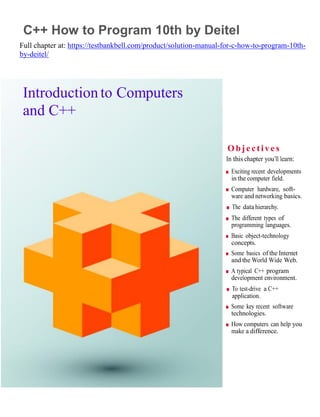
Introduction to Computers
and C++
O bje ctive s
In this chapter you’ll learn:
■ Exciting recent developments
in the computer field.
■ Computer hardware, soft-
ware and networking basics.
■ The data hierarchy.
■ The different types of
programming languages.
■ Basic object-technology
concepts.
■ Some basics of the Internet
and the World Wide Web.
■ A typical C++ program
development environment.
■ To test-drive a C++
application.
■ Some key recent software
technologies.
■ How computers can help you
make a difference.
6.
2 Chapter 1Introduction to Computers and C++ Exercises 3
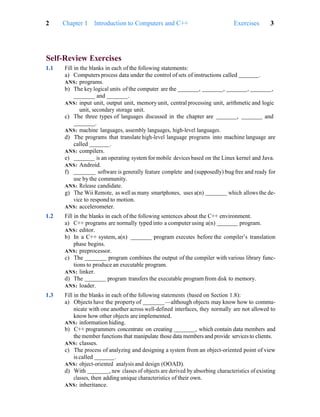
Self-Review Exercises
1.1 Fill in the blanks in each of the following statements:
a) Computers process data under the control of sets of instructions called .
ANS: programs.
b) The key logical units of the computer are the , , , ,
and .
ANS: input unit, output unit, memoryunit, central processing unit, arithmetic and logic
unit, secondary storage unit.
c) The three types of languages discussed in the chapter are , and
.
ANS: machine languages, assembly languages, high-level languages.
d) The programs that translate high-level language programs into machine language are
called .
ANS: compilers.
e) is an operating system for mobile devices based on the Linux kernel and Java.
ANS: Android.
f) software is generally feature complete and (supposedly) bug free and ready for
use by the community.
ANS: Release candidate.
g) The Wii Remote, as well as many smartphones, uses a(n) which allows the de-
vice to respond to motion.
ANS: accelerometer.
1.2 Fill in the blanks in each of the following sentences about the C++ environment.
a) C++ programs are normally typed into a computer using a(n) program.
ANS: editor.
b) In a C++ system, a(n) program executes before the compiler’s translation
phase begins.
ANS: preprocessor.
c) The program combines the output of the compiler with various library func-
tions to produce an executable program.
ANS: linker.
d) The program transfers the executable programfrom disk to memory.
ANS: loader.
1.3 Fill in the blanks in each of the following statements (based on Section 1.8):
a) Objects have the property of —although objects may know how to commu-
nicate with one another across well-defined interfaces, they normally are not allowed to
know how other objects are implemented.
ANS: information hiding.
b) C++ programmers concentrate on creating , which contain data members and
the member functions that manipulate those data members and provide services to clients.
ANS: classes.
c) The process of analyzing and designing a system from an object-oriented point of view
is called .
ANS: object-oriented analysis and design (OOAD).
d) With , new classes of objects are derived by absorbing characteristics of existing
classes, then adding unique characteristics of their own.
ANS: inheritance.
7.
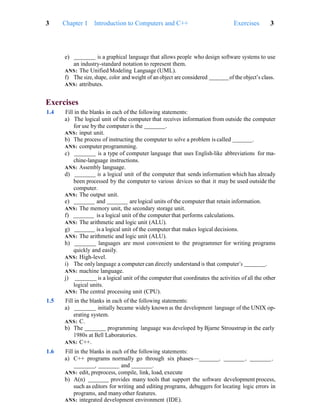
3 Chapter 1Introduction to Computers and C++ Exercises 3
e) is a graphical language that allows people who design software systems to use
an industry-standard notation to represent them.
ANS: The Unified Modeling Language (UML).
f) The size, shape, color and weight of an object are considered of the object’s class.
ANS: attributes.
Exercises
1.4 Fill in the blanks in each of the following statements:
a) The logical unit of the computer that receives information from outside the computer
for use by the computer is the .
ANS: input unit.
b) The process of instructing the computer to solve a problem is called .
ANS: computer programming.
c) is a type of computer language that uses English-like abbreviations for ma-
chine-language instructions.
ANS: Assembly language.
d) is a logical unit of the computer that sends information which has already
been processed by the computer to various devices so that it may be used outside the
computer.
ANS: The output unit.
e) and are logical units of the computer that retain information.
ANS: The memory unit, the secondary storage unit.
f) is a logical unit of the computer that performs calculations.
ANS: The arithmetic and logic unit (ALU).
g) is a logical unit of the computer that makes logical decisions.
ANS: The arithmetic and logic unit (ALU).
h) languages are most convenient to the programmer for writing programs
quickly and easily.
ANS: High-level.
i) The onlylanguage a computer can directly understand is that computer’s .
ANS: machine language.
j) is a logical unit of the computer that coordinates the activities of all the other
logical units.
ANS: The central processing unit (CPU).
1.5 Fill in the blanks in each of the following statements:
a) initially became widely known as the development language of the UNIX op-
erating system.
ANS: C.
b) The programming language was developed by Bjarne Stroustrup in the early
1980s at Bell Laboratories.
ANS: C++.
1.6 Fill in the blanks in each of the following statements:
a) C++ programs normally go through six phases— , , ,
, and .
ANS: edit, preprocess, compile, link, load, execute
b) A(n) provides many tools that support the software development process,
such as editors for writing and editing programs, debuggers for locating logic errors in
programs, and manyother features.
ANS: integrated development environment (IDE).
8.
4 Chapter 1Introduction to Computers and C++ Exercises 3
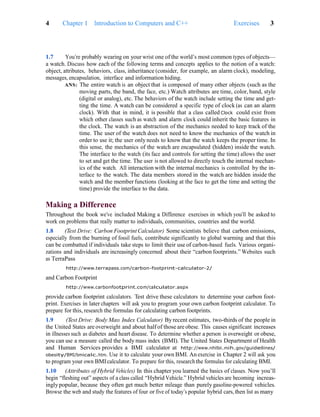
1.7 You’re probably wearing on your wrist one of the world’s most common types of objects—
a watch. Discuss how each of the following terms and concepts applies to the notion of a watch:
object, attributes, behaviors, class, inheritance (consider, for example, an alarm clock), modeling,
messages, encapsulation, interface and information hiding.
ANS: The entire watch is an object that is composed of many other objects (such as the
moving parts, the band, the face, etc.) Watch attributes are time, color, band, style
(digital or analog), etc. The behaviors of the watch include setting the time and get-
ting the time. A watch can be considered a specific type of clock (as can an alarm
clock). With that in mind, it is possible that a class called Clock could exist from
which other classes such as watch and alarm clock could inherit the basic features in
the clock. The watch is an abstraction of the mechanics needed to keep track of the
time. The user of the watch does not need to know the mechanics of the watch in
order to use it; the user only needs to know that the watch keeps the proper time. In
this sense, the mechanics of the watch are encapsulated (hidden) inside the watch.
The interface to the watch (its face and controls for setting the time) allows the user
to set and get the time. The user is not allowed to directly touch the internal mechan-
ics of the watch. All interaction with the internal mechanics is controlled by the in-
terface to the watch. The data members stored in the watch are hidden inside the
watch and the member functions (looking at the face to get the time and setting the
time) provide the interface to the data.
Making a Difference
Throughout the book we’ve included Making a Difference exercises in which you’ll be asked to
work on problems that really matter to individuals, communities, countries and the world.
1.8 (Test Drive: Carbon Footprint Calculator) Some scientists believe that carbon emissions,
especially from the burning of fossil fuels, contribute significantly to global warming and that this
can be combatted if individuals take steps to limit their use of carbon-based fuels. Various organi-
zations and individuals are increasingly concerned about their “carbon footprints.” Websites such
as TerraPass
http://www.terrapass.com/carbon-footprint-calculator-2/
and Carbon Footprint
http://www.carbonfootprint.com/calculator.aspx
provide carbon footprint calculators. Test drive these calculators to determine your carbon foot-
print. Exercises in later chapters will ask you to program your own carbon footprint calculator. To
prepare for this, research the formulas for calculating carbon footprints.
1.9 (Test Drive: Body Mass Index Calculator) By recent estimates, two-thirds of the people in
the United States are overweight and about halfof those are obese. This causes significant increases
in illnesses such as diabetes and heart disease. To determine whether a person is overweight or obese,
you can use a measure called the body mass index (BMI). The United States Department of Health
and Human Services provides a BMI calculator at http://www.nhlbi.nih.gov/guidelines/
obesity/BMI/bmicalc.htm. Use it to calculate your own BMI. An exercise in Chapter 2 will ask you
to program your own BMIcalculator. To prepare for this, research the formulas for calculating BMI.
1.10 (Attributes of Hybrid Vehicles) In this chapter you learned the basics of classes. Now you’ll
begin “fleshing out” aspects of a class called “Hybrid Vehicle.” Hybrid vehicles are becoming increas-
inglypopular, because they often get much better mileage than purely gasoline-powered vehicles.
Browse the web and study the features of four or five of today’s popular hybrid cars, then list as many
9.
Making a Difference5
5 Chapter 1 Introduction to Computers and C++
of their hybrid-related attributes as you can. For example, common attributes include city-miles-per-
gallon and highway-miles-per-gallon. Also list the attributes of the batteries (type, weight, etc.).
• Manufacturer
• Type of Hybrid—Battery hybrid (Hybrid Electric Vehicles), Plug-in hybrid, Fuel cell etc.
• Driver feedback system—so the driver can monitor fuel efficiency based on their driving
• Energy recovery—for example, regenerative breaking
• Carbon footprint—tons of CO2 per year
• Fuel capacity
• City-miles-per-gallon
• Highway-miles-per-gallon
• Two-mode hybrid propulsion system
• Engine size—V6, V8, etc.
• Vehicle type—SUV, crossover, compact, mid-size, etc.
• Seating capacity
• Horse power
• Drive train (front wheel drive, all wheel drive)
• Top speed
• Torque
• Price
1.11 (Gender Neutrality) Some people want to eliminate sexism in all forms of communication.
You’ve been asked to create a program that can process a paragraph of text and replace gender-spe-
cific words with gender-neutral ones. Assuming that you’ve been given a list of gender-specific
words and their gender-neutral replacements (e.g., replace “wife” with “spouse,” “man” with “per-
son,” “daughter” with “child” and so on), explain the procedure you’d use to read through a para-
graph of text and manually perform these replacements. How might your procedure generate a
strange term like “woperchild,” which is actually listed in the Urban Dictionary (www.urbandic-
tionary.com)? In Chapter 4, you’ll learn that a more formal term for “procedure” is “algorithm,”
and that an algorithm specifies the steps to be performed and the order in which to perform them.
ANS: Search through the entire paragraph for a word such as “wife” and replace every oc-
currence with “spouse.” Repeat this searching process for every gender specific word
in the list. You could accidentally get a word like “woperchild” if you are not careful
about how you perform replacements. For example, the word “man” can be part of
a larger word, like “woman.” So, replacing every occurrence of “man” can yield
strange results. Consider the process of replacing “man” with “person” then replacing
“son” with “child.” If you encounter the word “woman,” which contains the word
“man,” you’d replace “man” with “person” resulting in the word “woperson.” In a
subsequent pass you’d encounter “woperson” and replace “son” with “child” result-
ing in the “woperchild.”
1.12 (Privacy) Some online e-mail services save all e-mail correspondence for some period of
time. Suppose a disgruntled employee of one of these online e-mail services were to post all of the
e-mail correspondences for millions of people, including yours, on the Internet. Discuss the issues.
1.13 (Programmer Responsibility and Liability) As a programmer in industry, you may develop
software that could affect people’s health or even their lives. Suppose a software bug in one of your
programs were to cause a cancer patient to receive an excessive dose during radiation therapy and
that the person either was severely injured or died. Discuss the issues.
10.
Making a Difference5
6 Chapter 1 Introduction to Computers and C++
1.14 (2010 “Flash Crash”) An example of the consequences of our dependency on computers
was the so-called “flash crash” which occurred on May 6, 2010, when the U.S. stock market fell pre-
cipitously in a matter of minutes, wiping out trillions of dollars of investments, and then recovered
within minutes. Use the Internet to investigate the causes of this crash and discuss the issues it raises.
The method ofproducing filigree cane consists of first taking a
number of short lengths of opal or coloured cane previously drawn
and cut to about 6 in. lengths. These are then placed in vertical
positions around the inner circumference of an iron cup mould,
which may be about 5 in. in diameter. The opal strips of cane are
supported vertically in small recesses provided in the rim of the
mould at equidistant intervals. A ball of hot crystal glass is gathered
on a pontil and is lowered into the inside of the mould, the hot metal
coming in contact with the opal strips of glass adheres to them, and
upon withdrawing the glass it brings the opal strips away with it
arranged in sections round the circumference of the ball of glass.
This is now re-heated and marvered until the canes or strips of opal
are well embedded in the hot glass. Then the workman gathers
another coating of hot glass over the whole, marvers it again into a
cylindrical form, and then proceeds to draw it out as described in
cane making.
If a spiral form of lines is desired, the workmen, whilst drawing
out the cane, turn or twist the pontil and post in contrary directions.
These rotations cause the opal veins or threads to assume a spiral or
twisted form within the glass. Various coloured cane may be used in
the above process, and by placing them in alternate positions to the
opal strips within the cup mould some very pretty and curious
filigree work is obtained. These twisted filigree canes are used and
manipulated over again in the process of making the various
Venetian goblets and wine stems. Some fine effects in the
application of filigree decoration can be seen in the specimens of
Venetian glassware exhibited in the British Museum.
Millefiore work is produced by the workman, first spreading a layer
of an assortment of small coloured glass chips of varying sizes
(between 1/8 and 1/4 in. cube) over the face of the marver, and
then taking a gathering of crystal metal on his blow-iron and rolling
the ball of hot glass into the coloured mixture on the marver. The
hot glass collects up a coating of the coloured chippings, and is then
re-heated and again marvered, another gathering of crystal metal is
made, which incases the whole. This is then blown out and worked
13.
into some formof ornament, such as a paper weight, inkpot, or
bowl, producing a curious result that shows blotches of colours
embedded within the glass, the effect of which is increased if a
backing of opal glass has been used in the first gathering: this
shows the coloured effect against a white background.
Spun Glass. Another curious form of glass is the spun glass which
is much employed in making fancy ornaments. Glass can be spun
into a thread so fine and flexible that it can be worked into a fabric
like any textile material. In this way, glass ties can be made by
plaiting the spun glass threads into the required form. Spun glass
fibre is used in making the brushes used for cleaning metals with
acids. On account of its greater resistance to acids than is shown by
ordinary cloth, an endeavour is being made to use spun glass cloth
in certain industries as a commercial application. Spun glass is used
for making a form of filter cloth which is being used successfully in
filtering acid residues in certain chemical processes, and, no doubt,
when the elasticity and strength of the glass threads can be more
developed, the scope for its use in other industrial processes will be
increased.
The method of making spun glass thread consists in melting the
end of a plain or coloured glass rod (which may be square, round, or
triangular in section) in a blow-pipe flame and grasping the end
which is melting with a pair of pincers, drawing it out and affixing it
to a wooden drum, which is turned rapidly away from the glass
being heated. The drum may be 2 or 3 ft. in diameter, and as the
glass is continually fed into the heat it is drawn out into a very thin
thread by the rapidly revolving drum, and coiled up until a sufficient
quantity has been obtained. The thread is then cut across the drum,
collected, and used for plaiting or braiding into the fabric or cloth.
The iridescence and variety of colours yielded by the refraction of
light between the glass threads gives spun glass its peculiar effect,
very evident in the forms in which it is used in decorating small
ornaments such as forming the tails of glass birds.
14.
Glass wool ismade in a somewhat similar way, and is successfully
used as a non-conductive packing material for insulation from heat.
Glass frost or snow is made by blowing small gatherings of glass
out to a bursting point. These very thin shells are then crushed and
the flakes collected, and used for such purposes as surfacing sand
paper or decorating Christmas cards, being sieved to the requisite
size and affixed with a siccative to the paper.
Dolls’ eyes and artificial human eyes are made by well-trained
operators working before a blow-pipe flame and manipulating tube
and cane of delicately coloured tints to form the pupil and shell of
the eye, the veins being pencilled on with thin threads of red-
coloured glass. A considerable amount of skill and adaptation is
necessary to do this class of work, and much depends upon the
matching of the coloured cane glass used to give the natural effects.
When properly made, so clever and natural are these glass
imitations of the human eye that it is with difficulty that the ordinary
observer can tell that they are not real. A skilled worker will make
the artificial eye to fit the muscles of the socket and so move. In this
way much ingenuity has been shown in fitting the eye sockets
damaged during the war.
Aventurine is a golden coloured glass containing minute yellowish
spangles or crystals reflecting upon each other and giving its
peculiar effect. This glass is obtained by the use of an excess of
copper with strong reducing agents in the glass, whereby the copper
is partially reduced within the glass, giving the pretty spangled
effect. This glass is often used in the form of jewel stones, being cut
and polished and fitted in ornaments. The process of making this
glass was originated by the Italians, and for some time it remained a
secret with them, and even now is styled “Italian aventurine.”
Chrome aventurine is another form, giving a green, spangled
effect. This is got by using an excess of chromium in the presence of
reducing agents.
15.
The successful productionof aventurine depends upon slowly
cooling the molten glass so as to assist crystallisation.
Mica schist, or flake mica, is used to give another curious effect in
glass. A gathering of some dark-coloured glass is rolled or marvered
upon a thin layer of flaked mica, and then a further gathering or
coating of clear crystal metal is made. The whole is then blown and
formed into some fancy ornament or vase. When finished, the
glistening mica flakes show through against the coloured
background, giving a curious silvery reflection.
17.
CHAPTER XIV
OPTICAL GLASS
Themanufacture of optical glass forms a very important section of
the glass industry, and presents some of the most difficult problems
the glass maker has to deal with. It is in this section of the glass
trade that applied physical and chemical science becomes of the
utmost importance to the manufacturer. The production of optical
glass is impeded by any defects which become evident in the
structure of glass when examined under a polariscope. The presence
of any striae, seeds, or stresses within the structure of the glass
disqualifies it for any important optical work. It is a difficult matter to
get pieces of optical glass only a few inches in diameter of the right
optical constant and refractive index that are homogeneous enough
to allow of the light rays passing without some dispersion when set
up for use. It becomes necessary, therefore, to achromatise one
glass with another in the form of doublets to correct aberration. A
high degree of transparency and durability is necessary in all optical
glasses.
The persistent evidence of stresses developed in the solidification
of the glass upon cooling, even when the glass is slowly and
carefully annealed, is a most difficult factor to deal with. In
annealing optical glass, the various temperatures and time periods
have to be delicately adjusted and controlled, or big losses result.
Even then many efforts may be made before a suitable piece of
glass is obtained, and the costs keep accumulating with each
attempt, and some idea of the amount of labour involved in the
18.
undertaking to produceoptical glass at once becomes evident. The
use of decolorizers and impure materials is not permissible, on
account of the absorption and consequent resistance to the passage
of light rays. The annealing, instead of occupying one or two days, is
sometimes extended over a course of ten or fifteen days, in order
gradually to relieve any stress present. The pots in which the glass is
melted may only once be used, as the glass is usually allowed to
cool down gradually and undergo the process of annealing within the
pot.
The temperature of the furnace is controlled by regulating the
draught by means of dampers in the main flues, arranged to act so
as to carry out the annealing of the glass within the furnace. The
regulation of the temperature within the furnace is of the greatest
importance; if too hot the glass dissolves the clay of the pot, and if
retarded too much it gives difficulty in freeing the metal from seeds,
and plaining or fining the glass properly. Small furnaces containing
one or two pots give the best results. These furnaces are worked on
an intermittent process of first melting the glass and then gradually
cooling to anneal the glass within the pots in mass, the furnace
being allowed to die out gradually. When cool, the pots are broken
away from the glass, which is then cleaved into lumps. Each lump is
carefully examined for any defects and the best pieces selected for
re-annealing. These are afterwards ground to the desired shape in
the form either of a lens or prism. The chances are that not many
pieces of perfect glass can be obtained from each pot of metal, and
probably out of a whole pot only a fifth would be suitable for use
after the process of selection and cleaving has taken place.
In the manufacture of optical glass, batch materials are chosen
that do not differ greatly in specific gravity. Every effort is devoted to
obtain the purest materials possible; the batches are finely ground
and well mixed before melting. The glass-melting pots should be
made of the purest and most refractory obtainable in order to
prevent the solution of any impurities into the glass whilst it is
melting. In heating the pots for melting optical glasses every
endeavour is made to heat them equally all round the top, bottom,
19.
and sides, soas to dissolve all portions of the glass evenly and
completely together. At times the melted glass is stirred with a bent
iron rod encased in a porcelain tube, and the glass agitated in order
thoroughly to mix the components whilst fusing, and keep the
composition of the glass as uniform as possible. After the metal has
melted and plained clear from all seed and cords, the pot of metal is
annealed, and when cooled the glass is extracted in lumps and
examined for any defective pieces, which are rejected. The selected
pieces are afterwards ground to the desired shape and, if necessary,
re-annealed. In this process the pots being used only once, are
expensive items, and they considerably increase the cost of
production.
Before the war the optical glass trade was confined to a few firms
in this country, who supplied only a fraction of our needs. We have
been dependent mostly upon continental supplies of optical glass,
and it is only quite recently that Government state assistance has
been forthcoming in giving scientific aid to manufacturers by
investigating and reorganising this section of the glass industry. It is
to be hoped that this state assistance will continue, and that the
optical branch of the glass trade will be perfected to such an extent
that we may in future be independent, and produce for ourselves all
the optical glass requirements of our navy and army. It is to be
regretted that this industry did not receive state assistance before
the war. If it had, we should certainly have been better prepared and
equipped than was the case at the start of the Great War.
21.
CHAPTER XV
DECORATED GLASSWARE
Certainmethods of decorating glass are carried out whilst the glass
is being made by the workmen. Other methods consist in decorating
the glass after it has been made, such as cutting, fluting, etching,
engraving, and enamelling. In another form of decoration the
method consists of a combination of two or more of the above
processes. The crystal glass may be cased over with a thin covering
of coloured glass by the glass worker, and this outer coloured casing
cut through by the glass cutters, exposing and showing through the
colourless crystal underneath with very effective results.
A small portion of coloured glass, such as citron green, topaz,
blue, or ruby metal is gathered from the pot by an assistant, and the
workman, gathering a ball of crystal glass on his blow-iron, allows a
portion of the coloured metal held by the assistant to fall or drop
upon the ball of crystal. Upon blowing the whole out, the coloured
metal is spread as a thin casing upon the outside of the bulb of
crystal. This bulb is then worked into a wine-glass or other article,
which, after annealing, is sent to the glass cutter, who decorates the
outer surface by cutting the glass on his wheel. The colourless glass
then shows through against the coloured surface where it has been
cut to the pattern, the colour standing out in relief.
In another form of decoration, the workman allows small pear-
shaped tears or drops of coloured glass to fall upon the outer
surface of a bowl or vase, in equidistant positions round the
circumference of the article, By placing and working the coloured
22.
glass into positionin this way, some pretty artistic results are
obtained, dependent upon the skill and artistic taste of the
workmen.
In another method of decoration, certain coloured glasses are
used, the composition of which causes them to turn opalescent upon
re-heating the glass to a dull red heat. The re-heating of the tops of
crimpled flower vases made from such glass gives pretty results,
showing a gradual fading opalescence, extending from the top edges
to a few inches down the vase, into a clear coloured glass at the foot
of the stand. A similar effect, without the opalescence, is obtained
by the workman gathering a small piece of coloured glass on the tip
of his blow-iron, and then taking a further gathering of clear crystal
metal. The whole is then blown out and worked into a vase or wine-
glass, thus obtaining a coloration denser at the top edges, where the
vase or wine-glass has been sheared off, and gradually fading away
to a colourless glass a few inches towards the foot, which is clear
crystal.
There are also certain compositions which, when worked into a
vase, and re-heated on the edges, strike or turn to a colour such as
pale blue or ruby. These are self-coloured glasses, in which the
colouring remains latent until the glass is re-heated, like the
opalescent glasses. In these glasses the composition is the more
essential factor.
Glass cutting is an effective way of decorating glassware. In
using this method, the crystal glassware is made fairly heavy and
strong, so as to permit of the deep cuttings which refract the light
and show up the prismatic patterns so brilliantly.
23.
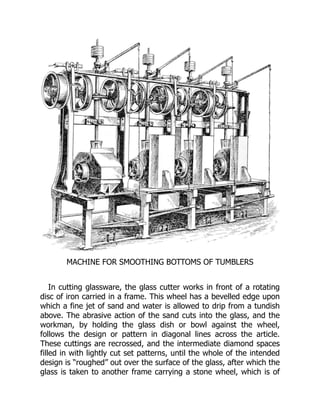
MACHINE FOR SMOOTHINGBOTTOMS OF TUMBLERS
In cutting glassware, the glass cutter works in front of a rotating
disc of iron carried in a frame. This wheel has a bevelled edge upon
which a fine jet of sand and water is allowed to drip from a tundish
above. The abrasive action of the sand cuts into the glass, and the
workman, by holding the glass dish or bowl against the wheel,
follows the design or pattern in diagonal lines across the article.
These cuttings are recrossed, and the intermediate diamond spaces
filled in with lightly cut set patterns, until the whole of the intended
design is “roughed” out over the surface of the glass, after which the
glass is taken to another frame carrying a stone wheel, which is of
24.
much finer abrasiveaction. This stone wheel smooths the rough cuts
done by the previous wheel. After this the cuts are polished
successively on a wood wheel and brush with polishing powders,
until a smooth and polished cut is obtained.
As the value of the glass is greatly increased by cutting, only the
best and clearest articles of table glass are so treated. The work of
cutting becomes technical and expensive, according to the richness
of the cutting demanded. The crystal table glass made from lead
gives the most brilliancy in cutting. Soda-lime glasses are found to
be hard to cut and do not give such brilliant and prismatic effects as
the glass made from lead compositions.
An automatic machine for grinding, smoothing, and polishing the
bottoms of tumblers, etc., “bottoms” or grinds, smooths, and
polishes tumblers at the rate of 2,000 a day. Four vertical revolving
wheels are fixed within a frame, one iron, two stone, and one wood.
Over each of these is a rotating spindle carrying the tumbler so that
the bottom of it is automatically pressed against each vertical wheel
in turn. The first wheel does the roughing, the two next the
smoothing, and the fourth the polishing. These machines are simple
and require only unskilled labour to operate, and go far towards
cheapening production.
Glass engraving and intaglio work is a much lighter and more
artistic method of decorating glass than the deep cutting before
described. In these processes the glass is cut or ground to a less
extent, and a more free treatment of design is possible. Floral
ornamentation and natural forms of applied designs can be carried
out, and portions may be left rough or polished, according to the
effect of light and shade required. The workman, whilst engraving,
works before a small copper or metal wheel rotating in a lathe, and
uses fine grades of emery or carborundum powders made into a
paste with oil, as the abrasive medium. The frame turning these
wheels is like a lathe, and may be worked by a foot treadle. The
wheels are interchangeable, and an assortment of various sizes,
having different bevelled edges, is kept at hand in a case, from
25.
which the engraverselects the one most suitable for the particular
work to be done.
Glassware for engraving and intaglio may be made much lighter
than that required for cutting.
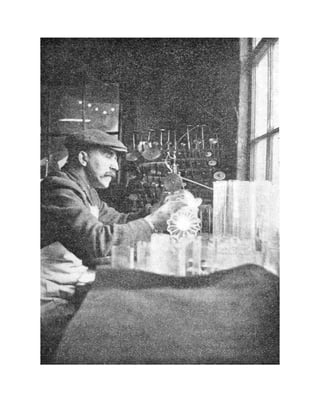
Etching is a method of decorating glass by the chemical action of
hydrofluoric acid. This acid in its various combinations attacks glass,
decomposing its surface and giving a dull or semi-matt effect. Only
those portions of glass which constitute the design are exposed to
the acid paste or fumes. The other portions are protected by a
covering of beeswax, which is unaffected by the acid and protects
any portions covered by it.
27.
GLASS ENGRAVING
The processcarried out is varied in many ways. In some cases
pantograph and etching machines are introduced to give the
designs. A warm copper plate, with the design or ornament
engraved thereon, is covered with a wax paste, and the surplus
cleaned off with a palette knife or pad of felt, leaving the paste in
the recesses of the engraving; a piece of thin tissue paper is laid
over the engraved plate and takes an impression of the design in
wax. This tissue is then transferred to the glass to be decorated, the
wax design adheres to the glass, and the paper is drawn away. A
further resist or coating of wax is painted round the design to
protect the rest of the glass, and a paste composition giving the
action of hydrofluoric acid is applied, which after a short time eats
into the exposed portions of glass. After another short interval, it is
washed off, and the wax coating removed by washing the glass in
hot, soapy water. The design then appears in a matt state against
the clear, unattacked glass.
The mechanical method of etching the design is carried out by
first dipping the whole glass into a bath of hot liquid wax, allowing a
thin coating to set and cool upon the surface of the glass. The article
is then introduced into a machine which has a number of needles,
worked by sliding gears in an eccentric fashion. These needles are
adjusted just to scratch away the thin coating of the wax into a
design, and expose the glass in the form of a decorated scroll or
band round the glass. The glass is then dipped into a vat or bath of
dilute hydrofluoric acid for a few minutes, after which it is removed
and washed, and the wax recovered by heating the glass upon a
perforated tray, when it melts and runs off the glass, and is collected
for further use. The article is then washed and cleaned and shows
the scroll or etched portions where the needle has traced the design.
Another effective result is obtained by etching a design on the back
of a plate glass panel. After cleaning and silvering or gilding the
28.
back, the designappears in a matt silver or gilt lustre upon viewing
it from the front of the mirror.
Glass which has been sand-blasted has a similar appearance to
etched glass, but a rather coarser surface. The portions of the glass
plate to be decorated are exposed to the action of a blast of air, into
which fine, sharp-grained quartz sand is automatically fed. An
abrasive action, due to the force with which the particles of sand are
blown against the glass, takes place, rendering the surface opaque
or matt. This method is generally adopted in printing trade names or
badges upon bottles, etc. A stencil of parchment or lead foil is cut
out to form, and used to protect the glass and resist the abrasion
where required. Rubber gloves are worn by the operator. The work
of sand-blasting is executed within a small enclosed dust-proof
chamber fitted with glass panels. The operator manipulates the glass
through openings in the sides of the chamber. The air blast is
supplied by a motor-driven air compressor and is regulated by a foot
pedal. The action is very sharp and quick, and is a cheap and
effective way of badging hotel glassware and proprietary bottles.
Glassware may be decorated by being enamelled with coloured
enamels. In this method of decorating, soft, easily-fused, coloured
enamels are used, containing active fluxes such as borates of lime
and lead, which melt at low temperatures. These enamel colours are
prepared by being fused and then ground to fine powders, which are
mixed with a siccative or oil medium, and painted upon the glass.
The painted ware is then heated within a gas or wood-fired
enamelling furnace or muffle, until the painted designs are melted
and fused well upon the glass. The glass is re-annealed in cooling
down the muffle. For this form of decoration, a hard refractory glass
is required that will not soften easily under the heat of the muffle;
otherwise the glassware becomes misshapen too easily under the
heat necessary to flux or fuse the enamels properly.
A form of staining glass is also practised which consists of
applying compositions containing silver salts to portions of the glass
and firing at a low heat. The silver stains the glass a deep yellow.
29.
The colour maybe varied by the use of copper salts, when a fine
ruby stain is obtained wherever applied.
Iridescent glassware is produced by several methods. Sometimes
a small proportion of silver and bismuth is added to a coloured glass
batch, and by manipulating the resulting glass in a carbonaceous
flame the silver is partially reduced within the glass, forming a pretty
iridescent reflection on the glassware. By a suitable adjustment of
the oxygen content in the composition of such glasses, the
iridescence can be regulated to such an extent that the slightest
flash or reducing influence gives a beautifully finished lustre over the
ware.
Iridescence can also be formed by re-heating crystal glassware
within a chamber in which salts of tin, barium, aluminium, and
strontium are volatilised. This method produces a superficial
iridescence which is not quite so permanent as the previous process.
Glass Silvering. The silvering of mirrors is carried out by taking a
thoroughly cleaned plate of polished glass and floating one surface
in a solution of silver nitrate, to which a reducing agent is added.
The silver is thereby precipitated or deposited in a thin lustrous film
upon the glass, which causes reflection by the rays of light striking
against the silvered background.
After silvering, the back of the plate is coated with a protecting
paint or varnish, which dries and preserves the silver deposit and
gives it permanency.
In the manufacture of fancy ornaments, such as birds, hat pins,
and small animals, various coloured glass cane and tube are worked
together by the operator melting and welding the respective colours
together before a blow-pipe flame, the tails of the birds being
formed by sealing in a fan of spun glass into the body of the bird,
which has been blown out and formed from a piece of tube. Some
very curious ornaments are formed in this way. Glass buttons, pearl,
and bead ornaments are formed by working cane and tube of
30.
various coloured compositionsbefore the blow-pipe, sticking and
shaping the various forms on to wire.
Mosaic glass decoration is used in jewellery in a mural or
tessellated form. In this method small cubical or other shaped
cuttings of various coloured opaque glass are inlaid in mastic
cements or pastes to form the design, the face being afterwards
ground and polished smooth, and mounted or set within the
ornament.
Larger cuttings may be inlaid in cement for pavement or mural
decoration.
32.
CHAPTER XVI
ENGLISH ANDFOREIGN METHODS OF GLASS MANUFACTURE COMPARED
The continental methods of glassmaking differ so much from the
English methods that a few remarks giving comparisons will be of
interest. It is noticeable that chemical and engineering science is
more thoroughly applied in the manufacture of glassware abroad.
Their method of specialising wherever possible, and the introduction
of mechanical and automatic machines have done much toward
increasing their production and efficiency.
The flourishing and extensive state of glassmaking abroad is
shown by the size and extent of the glass works, some of which
work as many as forty or fifty furnaces and employ 3,000 to 5,000
hands. Gas-fired regenerative or recuperative furnaces are more
generally used, which permit higher temperatures, cheaper metal,
and greater economy in fuel and labour.
The present type of English furnace is very wasteful, and even
with good fuel it is difficult to maintain high temperatures and
regularity in working. Our method of firing, raking, and teasing is
very exhausting to the workmen in attendance.
In many English glass works, especially those in the Stourbridge
district, it is the practice to fill the pots on a Saturday morning and
take until the following Monday night to melt and plain the glass, no
glassware being made for three days of each week. Starting on
Monday night or Tuesday morning, the glass makers work in six hour
shifts day and night until Friday night or Saturday morning, when
33.
the pots areagain filled and the weekly course starts over again.
Abroad the pots are filled nightly and hold just sufficient metal to
last out the work during the day, and are built of a capacity to suit
the articles being made. The disadvantages of our method are
obvious when a comparison is made with the continental method of
melting the glass nightly and working it out daily, especially when
the efficiency or output of the furnaces as compared with their fuel
consumption is taken into consideration.
Abroad the furnaces are small and compact; they take up less
floor space, yet they are far greater in efficiency. As they are gas-
fired, the combustion is more complete, and by the use of
regenerators or recuperators greater heat is available for melting the
glass quickly. Larger proportions of sand are used in the glass
mixtures, which, being the cheaper component, cheapen the
production of their glass wares.
Owing to the more perfect combustion which takes place within
the chambers of gas-fired furnaces abroad, lead glasses are
successfully melted within open crucible pots. When the heat comes
into direct contact with the batch materials being melted, it does its
work quicker and with less fuel consumption than is the case if it has
first to be conducted through the hood of covered pots which have
necessarily to be used in the old English type of furnace.
It is particularly noticeable that the glass workers abroad do not
spend so much time upon producing an article as is usual under the
English method of working. By the extensive use of moulds fitted to
mechanical contrivances operated by the foot, their work is
expedited and made simple and easy.
Technological education in the glass industry abroad is more
thorough and general. The glass workers, not having to work at
night, have the evenings free for recreation and education. It would
do much towards developing the English glass trade if night work for
boys could be abolished. The adoption of the continental system of
melting the metal during the night and working only during the day
(by using gas-fired furnaces) would do much in this direction. One
34.
cannot expect theyouths of the glass trade, who have to work
during nights, to attend the evening classes for educating
themselves, without a severe strain upon their constitutions. This
fact partially accounts for the repeated failure to establish technical
classes and trade schools in the glassmaking centres of this country.
The conservatism and lack of support from the glass manufacturers
themselves account for much of the slow progress and development
of the trade. As a rule, it will be found that the manufacturers have
everything to gain by the better technical education of their
employees. It is with pleasure we notice that a few at least are now
taking this broader view and giving such schools their hearty support
and financial aid. In the glassmaking centres abroad there are
established state-aided technical and trade schools, where, for a
small nominal fee, the youths of the glass works are trained and
taught the principles of their industry. Apprenticeship in the factories
then becomes unnecessary.
The working hours abroad are usually sixty hours a week (ten
hours a day), compared with the English forty-four to fifty hours’
week (six hour shifts).
The trade unions of the glass workers abroad are more
progressive, and their officials do not interfere with the
manufacturers’ endeavours to increase efficiency and cheapen
production by introducing machinery. The promotion of the
workpeople goes by merit, and not by the dictation of the trade
union officials, as is too often the case in this country. Here, very
little sentiment or good-fellowship exists between the glass workers’
union and the employers, and in its place the rank officialdom of
unionism has become so evident as to be a bar to the progress of
the industry. Instead of assisting the progress of the trade, and
mediating in cases of dispute, the union appears to exist as a buffer
of antagonism between the glass workers and their employers. Many
a capable youth in the glass trade here has been kept back from
promotion to a better position solely by the dictation of the union to
which the men belong. Cases are known where the union have
restricted the workman’s output when he may be working under
35.
piece rate. Thebest inducements may have been offered him by the
employer to increase his output, and, although the workman may be
willing to accept the master’s terms, we find a union official stepping
between them, and fixing the maximum number of the articles that
shall be made in his six hour shift. Usually, this fixed quantity is got
through in four hours, yet the workman is not allowed to make more
than the stipulated number fixed by the union, or he is fined.
Another incredible fact is that the employer here, when in need of a
workman, is not allowed to choose his own men. He must apply to
the union, and the man remaining longest on the society’s
unemployed book is then sent to him. Whatever his inefficiency may
be, the employer is bound to take him; if he employs anyone else, a
strike results. Such action is despotic and shows up the worst
features of trade unionism that can possibly be conceived. The
English glass industry has been repeatedly disorganised by this
obstinate attitude of the glass makers’ union, and a consequence is
that the foreigner has seized the opportunity to step in and increase
his market, to the detriment of our own trade; with this extended
market, increased output, and cheaper production, the foreigner
undersells us in our own country.
It is to be hoped these adverse conditions will soon be remedied
and the English glass industry restored to a more flourishing state by
the prompt and united action of the men and masters, realising the
gravity of the position and acting accordingly.
Welcome to ourwebsite – the perfect destination for book lovers and
knowledge seekers. We believe that every book holds a new world,
offering opportunities for learning, discovery, and personal growth.
That’s why we are dedicated to bringing you a diverse collection of
books, ranging from classic literature and specialized publications to
self-development guides and children's books.
More than just a book-buying platform, we strive to be a bridge
connecting you with timeless cultural and intellectual values. With an
elegant, user-friendly interface and a smart search system, you can
quickly find the books that best suit your interests. Additionally,
our special promotions and home delivery services help you save time
and fully enjoy the joy of reading.
Join us on a journey of knowledge exploration, passion nurturing, and
personal growth every day!
testbankbell.com