Solution Manual for Visual C# How to Program
(6th Edition) (Deitel Series) 6th Edition
download
https://testbankmall.com/product/solution-manual-for-visual-c-
how-to-program-6th-edition-deitel-series-6th-edition/
Find test banks or solution manuals at testbankmall.com today!
We have selected some products that you may be interested in
Click the link to download now or visit testbankmall.com
for more options!.
Solution Manual for Visual Basic 2012 How to Program, 6/E
6th Edition : 0133406954
https://testbankmall.com/product/solution-manual-for-visual-
basic-2012-how-to-program-6-e-6th-edition-0133406954/
Test Bank for Visual C# 2012 How to Program, 5/E 5th
Edition : 0133379337
https://testbankmall.com/product/test-bank-for-visual-c-2012-how-to-
program-5-e-5th-edition-0133379337/
Solution Manual for C++ How to Program 10th by Deitel
https://testbankmall.com/product/solution-manual-for-c-how-to-
program-10th-by-deitel/
Test Bank for Marketing, 6th Edition, Dhruv Grewal,
Michael Levy, ISBN: 9781259709074
https://testbankmall.com/product/test-bank-for-marketing-6th-edition-
dhruv-grewal-michael-levy-isbn-9781259709074/
Survey of Economics Principles Applications and Tools 7th
Edition OSullivan Test Bank
https://testbankmall.com/product/survey-of-economics-principles-
applications-and-tools-7th-edition-osullivan-test-bank/
Business Essentials 11th Edition Ebert Test Bank
https://testbankmall.com/product/business-essentials-11th-edition-
ebert-test-bank/
Solution Manual for Calculus, 4th Edition, Jon Rogawski,
Colin Adams, Robert Franzosa
https://testbankmall.com/product/solution-manual-for-calculus-4th-
edition-jon-rogawski-colin-adams-robert-franzosa/
Solution Manual for International Business: The Challenges
of Globalization John Wild, Kenneth L. Wild, Halia
Valladares
https://testbankmall.com/product/solution-manual-for-international-
business-the-challenges-of-globalization-john-wild-kenneth-l-wild-
halia-valladares/
Strategic Compensation in Canada Canadian 6th Edition Long
Solutions Manual
https://testbankmall.com/product/strategic-compensation-in-canada-
canadian-6th-edition-long-solutions-manual/
Operations Management Stevenson 11th Edition Solutions
Manual
https://testbankmall.com/product/operations-management-stevenson-11th-
edition-solutions-manual/
2 Chapter 1 Introduction to Computers, the Internet and Visual C#
Self-Review Exercises 2
Self-Review Exercises
1.1 Fill in the blanks in each of the following statements:
a) Computers process data under the control ofsequences of instructions called .
ANS: computer programs.
b) A computer consists of various devices referred to as , such as the keyboard,
screen, mouse, hard disks, memory, DVD drives and processing units.
ANS: hardware.
c) Data items processed by computers form a(n) that becomes larger and more
complex in structure as we progress from the simplest data items (called “bits”) to richer
data items, such as characters, fields, and so on.
ANS: data hierarchy.
d) Computers can directly understand only their language, which is composed
only of 1s and 0s.
ANS: machine.
e) The three types of computer programming languages discussed in the chapter are ma-
chine languages, and .
ANS: assembly languages, high-level languages.
f) Programs that translate high-level-language programs into machine language are called
.
ANS: compilers.
g) A(n) processor implements several processors on a single “microchip”—a
dual-core processor has two CPUs and a quad-core processor has four CPUs.
ANS: multicore.
h) Windows 10 introduced the for building Windows apps that run on desktop
computers, notebook computers, tablets, phones, Xbox and even Microsoft’s new
HoloLens augmented reality holographic headset—all using nearly identical code.
ANS: Universal Windows Platform (UWP).
1.2 Fill in the blanks in each of the following statements:
a) Objects, or more precisely the that objects come from, are essentially reusable
software components.
ANS: classes.
b) You send messages to an object. Each message is implemented as a method that
tells a method of the object to perform its task.
ANS: call.
c) A new class of objects can be created quickly and conveniently by ; the new
class absorbs the characteristics of an existing class, possibly customizing them and add-
ing unique characteristics of its own.
ANS: inheritance.
d) To create the best solutions, you should follow a detailed analysis process for determin-
ing your project’s (i.e., defining what the system is supposed to do) and de-
veloping a design that satisfies them (i.e., deciding how the system should do it).
ANS: requirements.
e) Visual C# is driven. You’ll write programs that respond to mouse clicks, key-
strokes, timer expirations and touches and finger swipes.
ANS: event.
f) A key goal of Java is to be able to write programs that will run on a great variety of com-
puter systems and computer-control devices. This is sometimes called .
ANS: write once, run anywhere.
1.3 Fill in the blanks in each of the following statements:
3 Chapter 1 Introduction to Computers, the Internet and Visual C#
Self-Review Exercises 3
a) The executes .NET programs.
ANS: Common Language Runtime (CLR) of the .NET Framework.
b) The CLR provides various services to code, such as integrating software com-
ponents written in different .NET languages, error handling between such components,
enhanced security and more.
ANS: managed.
c) The ability of a program to run without modification across multiple platforms is
known as platform .
ANS: independence.
d) Visual Studio is a(n) in which C# programs are developed.
ANS: IDE.
e) You can sell your own Windows Phone apps in the .
ANS: Windows Store.
1.4 State whether each of the following is true or false. If false, explain why.
a) Software objects model both abstract and real-world things.
ANS: True.
b) The most popular database model is the relational database in which data is stored in
simple tables. A table includes records and fields.
ANS: True.
c) A database is a collection of data that’s organized for easy access and manipulation.
ANS: True.
d) Secondary storage data takes much longer to access than data in primary memory, but
the cost per unit of secondary storage is much higher than that of primary memory.
ANS: False: The cost per unit of secondary storage is much lower than that of primary
memory.
e) High-level languages allow you to write instructions that look almost like everyday Eng-
lish and contain commonly used mathematical expressions.
ANS: True.
f) An object has attributes that it carries along as it’s used in a program.
ANS: True.
g) The Transmission Control Protocol (TCP) ensures that messages, consisting of sequen-
tially numbered pieces called bytes, were properly routed from sender to receiver, ar-
rived intact and were assembled in the correct order
ANS: False. The pieces are called packets, not bytes.
h) The information-carrying capacity of communications lines on the Internet has in-
creased tremendously, while hardware costs have increased.
ANS: False. Hardware costs have decreased.
i) You can build web-based apps with C# and Microsoft’s ASP.NET technology.
ANS: True.
j) Java has become the key programming language for the Mac OS X desktop operating
system and all iOS-based devices, such as iPods, iPhones and iPads.
ANS: False. The language is Swift, not Java.
k) Microsoft’s ASP.WEB technology is used to create web apps.
ANS: False. It’s ASP.NET technology.
l) Microsoft’s Windows operating system is the most widely used desktop operating sys-
tem worldwide.
ANS: True.
1.5 Arrange these byte measurements in order from smallest to largest: terabyte, megabyte,
petabyte, gigabyte and kilobyte.
ANS: kilobyte, megabyte, gigabyte, terabyte, petabyte.
4 Chapter 1 Introduction to Computers, the Internet and Visual C#
Self-Review Exercises 4
1.6 Describe the two-step translation process for preparing your C# code to execute on your
particular computer.
ANS: C# code is first compiled into MSIL and placed in an executable file. When the app
executes, another compiler called the JIT (just-in-time) compiler in the CLR trans-
lates the MSIL in the executable file into machine-language code (for a particular
platform).
Exercises
1.7 Fill in the blanks in each of the following statements:
a) The programs that run on a computer are referred to as .
ANS: software
b) Systems such as smartphones, appliances, game controllers, cable set-top boxes and au-
tomobiles that contain small computers are called .
ANS: embedded systems
c) Just as characters are composed of bits, are composed of characters or bytes.
ANS: fields
d) Information on secondary storage devices is ; it’s preserved even when the
computer’s power is turned off.
ANS: persistent
e) Translator programs called convert high-level language code into machine-
language code.
ANS: compilers
f) In object-oriented programming languages, we create a program unit called a(n)
to house the set of methods that perform its tasks.
ANS: class
g) Use a building-block approach to creating your programs. Avoid reinventing the
wheel—use existing pieces wherever possible. Such software is a key benefit
of object-oriented programming.
ANS: reuse
1.8 Fill in the blanks in each of the following statements:
a) Although many different OOAD processes exist, a single graphical language for com-
municating the results of any OOAD process has come into wide use. This language,
known as the , is now the most widely used graphical scheme for modeling ob-
ject-oriented systems.
ANS: UML
b) Tim Berners-Lee developed the for sharing information via “hyperlinked”
text documents on the web.
ANS: HyperText Markup Language (HTML)
c) The CLR is a(n) machine. It is software that manages the execution of pro-
grams and hides from them the underlying operating system and hardware.
ANS: virtual
d) Converting a program to run on a different platform from which it was originally in-
tended is called .
ANS: porting.
e) Microsoft’s Windows is a cloud-computing platform that allows you to de-
velop, manage and distribute your apps in the cloud.
ANS: Azure. (Instructor Note: "Microsoft’s Windows" should be simply "Microsoft" in
this exercise.)
Exercises 5
5 Chapter 1 Introduction to Computers, the Internet and Visual C#
f) By using existing controls—which are objects—you can create powerful apps much
fasterthan if you had to write all the code yourself. This is a key benefit of software
.
ANS: reuse
1.9 State whether each of the following is true or false. If false, explain why.
a) The smallest data item in a computer can assume the value 1 or the value 2. Such a data
item is called a bit (short for “binary digit”—a digit that can assume either of two val-
ues).
ANS: False. Such items have the value 0 or 1.
b) The Unicode character set is a popular subset of ASCII that represents uppercase and
lowercase letters, digits and some common special characters.
ANS: False. ASCII is a subset of Unicode.
c) Each of the following is a form of computer output: data displayed on screens, printed
on paper, played as audio or video on PCs and media players, used to control other de-
vices, such as robots, 3D printersand “intelligent” appliances.
ANS: True.
d) Reuse helps you build more reliable and effective systems, because existing classes and
components often have gone through extensive testing, debugging and performance
tuning.
ANS: True.
e) One of the W3C’s primary goals is to make the web universally accessible to everyone
regardless of disabilities, language or culture.
ANS: True.
f) C# is available only on Microsoft Windows.
ANS: False. There are ports of C# for other platforms, such as Linux.
g) The .NET Framework Class Library has millions of valuable prebuilt classes that have
been tested and tuned to maximize performance.
ANS: False. Thousands, not millions, of prebuilt classes.
h) .NET programs can run on any platform.
ANS: False. .NET prorgrams run on the Common Language Runtime, which is a virtual
machine.
i) The Universal Windows Platform (UWP) is designed to provide a common platform
(the underlying system on which apps run) and user experience across all of your devices
including personal computers, smartphones, tablets and Xbox Live.
ANS: True.
1.10 What is a key advantage of interpreters over compilers? What is a key disadvantage?
ANS: A key advantage is that interpreters can execute high-level language programs directly
(without the need for compilation). A key disadvantage is that interpreted programs
exexute more slowly than compiled programs.
1.11 What is the key advantage of using the new async feature in preference to using old-style
multithreading?
ANS: The new features simplify asynchronous programming, because the compilerhides
much of the associated complexity from the developer.
1.12 What are operating systems?
ANS: Operating systems are software systems that make using computers more convenient
for users, app developers and system administrators. They provide services that allow
each app to execute safely, efficiently and concurrently (i.e., in parallel) with other
apps.
Exercises 6
6 Chapter 1 Introduction to Computers, the Internet and Visual C#
1.13 Why is using cloud-computing resources sometimes preferable to purchasing all the hard-
ware you need for your own computer?
ANS: Cloud computing gives you the flexibility to increase or decrease computing resourc-
es to meet your resource needs at any given time, making it more cost effective than
purchasing expensive hardware to ensure that you have enough storage and process-
ing power at their occasional peak levels.
1.14 Categorize each of the following items as either hardware or software:
a) CPU
ANS: Hardware.
b) Compiler
ANS: Software
c) Input unit
ANS: Hardware.
d) A word-processor program
ANS: Software
e) A C# program
ANS: Software
1.15 Translator programs, such as assemblers and compilers, convert programs from one lan-
guage (referred to as the source language) to another language (referred to as the target language).
Determine which of the following statements are true and which are false:
a) An assembler translates source-language programs into machine-language programs.
ANS: True.
b) High-level languages are generally machine dependent.
ANS: False. A high-level language must be compiled into machine-dependent language be-
fore it can be executed. This allows high-level languages to be used on all computers
with appropriate compilers.
c) A machine-language program requires translation before it can be run on a computer.
ANS: False. A machine-language program is native to a specific machine.
d) The C# compiler translates high-level-language programs into SMIL.
ANS: False. It translates C# into MSIL.
1.16 Expand each of the following acronyms:
a) W3C
ANS: World Wide Web Consortium
b) OOP
ANS: Object-Oriented Programming
c) CLR
ANS: Common Language Runtime
d) MSIL
ANS: Microsoft Intermediate Language
e) UML
ANS: Unified Modeling Language
f) IDE
ANS: Integrated Development Environment
1.17 What are the key benefits of the .NET Framework and the CLR? What are the drawbacks?
ANS: The key benefits are portability between operating systems and interoperability be-
tween languages. As long as a CLR exists for a platform, it can run any .NET pro-
gram. Programmers can concentrate on program logic instead of platform-specific
details. Thus, the double compilation (code-to-MSIL, and MSIL-to-machine code)
allows for platform independence: Programs can be written once and executed on any
Exercises 7
7 Chapter 1 Introduction to Computers, the Internet and Visual C#
platform supporting the CLR—this is known as platform independence. Code writ-
ten once could easily be used on another machine without modification, saving time
and money. A second benefit of the .NET framework is language interoperability—
software components written in different languages can interact (language indepen-
dence). A drawback associated with these features is that .NET programs cannot be
run until the .NET Framework is developed for a platform. Another is the overhead
of the double compilation that is needed before a .NET-language program can be ex-
ecuted.
1.18 What are the advantages to using object-oriented techniques?
ANS: Programs that use object-oriented programming techniques are easier to understand,
correct and modify. The key advantage with using object-oriented programming is
that it tends to produce software that is more understandable, because it is better or-
ganized and has fewer maintenance requirements than software produced with earlier
methodologies. OOP helps the programmer build applications faster by reusing ex-
isting software components that model items in the real world. OOP also helps pro-
grammers create new software components that can be reused on future software
development projects. Building software quickly, correctly, and economically has
been an elusive goal in the software industry. The modular, object-oriented design
and implementation approach has been found to increase productivity while reduc-
ing development time, errors, and cost.
1.19 You are probably wearing on your wrist one of the world’s most common types of objects—
a watch. Discuss how each of the following terms and concepts applies to the notion of a watch:
object, attributes and behaviors.
ANS: The entire watch is an object that is composed of many other objects (the moving
parts, the band, the face, etc.) Watch attributes are time, color, band style, technology
(digital or analog), and the like. The behaviors of the watch include setting the time
and getting the time. A watch can be considered a specific type of clock (as can an
alarm clock).
1.20 What is the key accomplishment of the UML?
ANS: It replaced the many different graphical modeling languages with a single (unified)
language for modeling that can be used by developers regardless of the different
OOAD processes they may use.
1.21 What did the chief benefit of the early Internet prove to be?
ANS: Communication by e-mail. Today, that communication is also facilitated by appli-
cations such as instant messaging and file transfer.
1.22 What is the key capability of the web?
ANS: It allows computer users to locate and view multimedia-based documents on almost
any subject over the Internet.
1.23 What is the key vision of Microsoft’s .NET initiative?
ANS: To embrace the Internet and the web in the development and use of software.
1.24 How does the .NET Framework Class Library facilitate the development of .NET apps?
ANS: First, the Framework Class Library is a large library of reusable classes that reduces
development time. Programmers can build software quickly by reusing framework’s
classes, rather than building new classes “from scratch.” Second, the Framework Class
Library is shared by all of the .NET languages, which means that programmers who
work in multiple languages have to learn only one class library.
Exercises 8
8 Chapter 1 Introduction to Computers, the Internet and Visual C#
1.25 Besides the obvious benefits of reuse made possible by OOP, what do many organizations
report as another key benefit of OOP?
ANS: That OOP tends to produce software that is more understandable, better organized,
and easier to maintain, modify and debug.
Making-a-Difference Exercises
The Making-a-Difference exercises will ask you to work on problems that really matter to individ-
uals, communities, countries and the world.
1.26 (Test Drive: Carbon Footprint Calculator) Some scientists believe that carbon emissions,
especially from the burning of fossil fuels, contribute significantly to global warming and that this
can be combatted if individuals take steps to limit their use of carbon-based fuels. Various organi-
zations and individuals are increasingly concerned about their “carbon footprints.” Websites such
as TerraPass
http://www.terrapass.com/carbon-footprint-calculator-2/
and Carbon Footprint
http://www.carbonfootprint.com/calculator.aspx
provide carbon-footprint calculators. Test drive these calculators to determine your carbon foot-
print. Exercises in later chapters will ask you to program your own carbon-footprint calculator. To
prepare for this, research the formulas for calculating carbon footprints.
1.27 (Test Drive: Body-Mass-Index Calculator) By recent estimates, two-thirds of the people in
the United States are overweight and about halfof those are obese. This causes significant increases
in illnesses such as diabetes and heart disease. To determine whether a person is overweight or obese,
you can use a measure called the body mass index (BMI). The United States Department of Health
and Human Services provides a BMI calculator at http://www.nhlbi.nih.gov/guidelines/
obesity/BMI/bmicalc.htm. Use it to calculate yourown BMI. An exercise in Chapter 3 will ask you
to program your own BMIcalculator. To prepare for this, research the formulas for calculating BMI.
1.28 (Attributes of Hybrid Vehicles) In this chapter you learned the basics of classes. Now you’ll
begin “fleshing out” aspects of a class called “Hybrid Vehicle.” Hybrid vehicles are becoming increas-
ingly popular, because they often get much better mileage than purely gasoline-powered vehicles.
Browse the web and study the features of four or five of today’s popular hybrid cars, then list as many
of their hybrid-related attributes as you can. For example, common attributes include city-miles-per-
gallon and highway-miles-per-gallon. Also list the attributes of the batteries (type, weight, etc.).
ANS:
• Manufacturer
• Type of Hybrid—Battery hybrid (Hybrid Electric Vehicles), Plug-in hybrid, Fuel cell etc.
• Driverfeedback system—so the driver can monitor fuel efficiency based on their driving
• Energy recovery—for example, regenerative breaking
• Carbon footprint—tons of CO2 per year
• Fuel capacity
• City-miles-per-gallon
• Highway-miles-per-gallon
• Two-mode hybrid propulsion system
• Engine size—V6, V8, etc.
• Vehicle type—SUV, crossover, compact, mid-size, etc.
Making-a-Difference Exercises 9
• Seating capacity
• Horse power
• Drive train (front wheel drive, all wheel drive)
• Top speed
• Torque
• Price
1.29 (Gender Neutrality) Some people want to eliminate sexism in all forms of communication.
You’ve been asked to create a program that can process a paragraph of text and replace gender-spe-
cific words with gender-neutral ones. Assuming that you’ve been given a list of gender-specific
words and their gender-neutral replacements (e.g., replace “wife” with “spouse,” “man” with “per-
son,” “daughter” with “child” and so on), explain the procedure you’d use to read through a para-
graph of text and manually perform these replacements. How might your procedure generate a
strange term like “woperchild,” which is actually listed in the Urban Dictionary (www.urbandic-
tionary.com)? In Chapter 5, you’ll learn that a more formal term for “procedure” is “algorithm,”
and that an algorithm specifies the steps to be performed and the order in which to perform them.
ANS: Search through the entire paragraph for a word such as “wife” and replace every oc-
currence with “spouse.” Repeat this searching process for every gender specific word
in the list. You could accidentally get a word like “woperchild” if you are not careful
about how you perform replacements. For example, the word “man” can be part of
a larger word, like “woman.” So, replacing every occurrence of “man” can yield
strange results. Consider the process of replacing “man” with “person” then replacing
“son” with “child.” If you encounter the word “woman,” which contains the word
“man,” you’d replace “man” with “person” resulting in the word “woperson.” In a
subsequent pass you’d encounter “woperson” and replace “son” with “child” result-
ing in the “woperchild.”
Random documents with unrelated
content Scribd suggests to you:
in a magazine containing between 6,000 and 7,000 lbs. of display
fireworks.
An occurrence of a similar nature was observed at Brighton in
1903, when some changing coloured lights which had been removed
from a building where a fire had taken place (the fireworks not being
involved in any way) ignited some days afterwards.
It is thought that the lights may have been wetted during the fire,
and upon drying out some days later the different compositions in
contact in the case or cases set up chemical action, which resulted in
spontaneous ignition. It was found on examination that a blue
containing sulphur was in contact with a green containing chlorate.
It may be noted here that mixtures which are damped during
manufacture are more liable to spontaneous ignition than those
manipulated in a dry state.
Many accidents and explosions are left unexplained, either
because the evidence is destroyed by the resulting fire or by the
death of the witness or witnesses, or because of the difficulty often
experienced in getting the workpeople to give a full and faithful
account of what occurred, fearing to cause trouble for themselves or
others concerned.
There can be no doubt that the cause is frequently carelessness or
mistakes on the part of workers. In a large number of cases,
however, this explanation gives no help and the cause remains
obscure. One such may be mentioned:
In 1902 an explosion occurred in a store for non-explosive
ingredients, in which were kept the chemicals used in a firework
factory. In the building at the time was a workman who appears to
have been engaged in sifting chlorate of potash, and the technical
manager of the factory who seems to have been weighing out
ingredients. There is no doubt that he was a man of very
considerable experience, and from his responsible position unlikely
either to take risks or be guilty of carelessness.
An explosion occurred in the building, killing both occupants, and
of so violent a nature as to sever the foot of the manager and to
project one of the sheets of corrugated iron with which the roof was
covered a distance of thirty yards.
No explanation of this occurrence was arrived at other than that in
some way some of the chemicals must have become mixed to form
a sensitive and violent explosive; so much is obvious, but how the
chemicals became so mixed remains a mystery, as no mixing was
actually done in the building. The ignition of such a mixture is less
obscure as magazine boots were not necessary in the building owing
to the non-hazardous nature of the work carried on there, and
sufficient friction would be produced to fire even a fairly sensitive
mixture between a nailed boot sole and a wood floor.
An occurrence of considerable interest in this direction took place
in a warehouse at Manchester in 1908. In the building were stored
several tons of chemicals, among which were twelve tons of chlorate
of potash and thirty-two of chlorate of soda.
A workman stepping down from a barrel struck fire, and saw a
flame, which he tried to extinguish by rubbing with his foot. This,
however, had the opposite effect. He then tried a bucket of water,
which failed to put it out; he left the building and heard an
explosion, followed by a second and a third, all apparently of a
violent nature, all three being heard nearly ten miles away, and glass
broken throughout a considerable area round the warehouse.
The cause appears to have been as follows: During the
conveyance of the chlorate into the building leakings took place, and
a certain quantity remained on the floor, this mixing with dust and
other organic matter would prove a highly sensitive composition.
This was ignited by the man’s foot and rapidly spread, probably a
deposit which had accumulated under the floor became involved.
The woodwork of the building and the wooden barrels then became
ignited. The rapid decomposition of the chlorate caused by the heat
liberated large quantities of free oxygen, which united with carbon in
the smoke to form gas, which exploded upon reaching the correct
proportion for so doing.
The writer has chiefly confined himself to accidents in firework
factories; those occurring during the illegal manufacture of fireworks
in premises unlicensed for the purpose present no further interest,
and are generally caused by ignorance on the part of the participant
of the often extremely dangerous nature of the material he is
handling. To take an example:
Two boys were engaged in grinding in a mortar a “small quantity”
of chlorate of potash and sugar. An explosion resulted which blew
out the entire window frames of the room, destroyed the partition
between the room and the passage, considerably damaged the other
wall, and projected the pestle into the ceiling, where it remained
embedded.
Accidents at displays are now happily rare; the most fruitful cause
of such happenings was the detonation of shell in the mortar, that is,
the detonation of the contents or “garniture” by the explosion of the
propellant charge.
The elimination of chlorate-sulphur composition has reduced the
chances of this to a minimum, and the compulsory burying of
mortars up to the muzzle has practically eliminated the danger to
either firers or spectators.
Apart from slight injuries caused by falling rocket sticks and
mishaps of a similar nature, accidents to the public at firework
displays are things of the past.
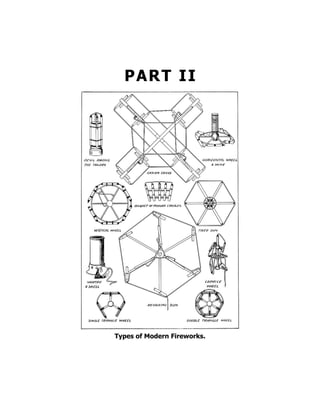
PART II
Types of Modern Fireworks.
CHAPTER I
SIMPLE FIREWORKS—ROCKET CLASS
IN the preceding chapters we have been dealing with displays of
fireworks, that is to say; fireworks in the mass. We will now turn our
attention to the firework units composing those displays, and
endeavour to trace their gradual evolution from the crude originals.
Fireworks may be divided into two classes, simple and compound.
The first of these include fireworks which are a complete item in
themselves, as the rocket, shell, or Roman candle; also the units
which, fitted on a framework, go to compose the set pieces and
devices of a display, and the small shop goods not used in displays.
We will consider this class first.
The two oldest forms of fireworks known are undoubtedly the
cracker and the rocket. As we have already noted, both of these—or
at least primitive forms—are mentioned by Marcus Graecus,
Albertus, and Roger Bacon. The description by the former is
sufficiently clear to leave no doubt in our minds that he is describing
a rocket; although the description of a cracker is not so explicit as to
enable us to say that he is actually describing a jumping cracker, yet
his mention of folding and tying would certainly give colour to that
belief. In fact, some writers have endeavoured to find a connection
between the words “Graecus” and “Cracker.”
Greene, in “Orlando Furioso” (1599), uses the words, “Yes, yes,
with squibs and crackers brauly.” John Bate, in his book previously
mentioned, under the somewhat misleading heading, “How to make
Crackers,” says: “It is well knowne that every boy can make these,
therefore I think it will be but labor lost, to bestow time to describe
their making.”
He also describes a kind of kite which he designates a “Fire
Drake,” to the tail of which he fastens “divers crackers” which are
shown in the illustration to be exactly like the jumping crackers of
the present day. Babington illustrates a cracker fixed to the top of a
rocket.
Pepys makes the following entry in his diary for November 5th,
1661: “Seeing the boys in the streets flying their crackers.”
The only practical difference between the cracker of 1635 and that
of to-day is in the difference of methods of manufacture, the early
practice being to fold the gunpowder in the paper, the modern, to
roll a paper case and fill the powder in through a funnel, afterwards
flattening it through a roller mill.
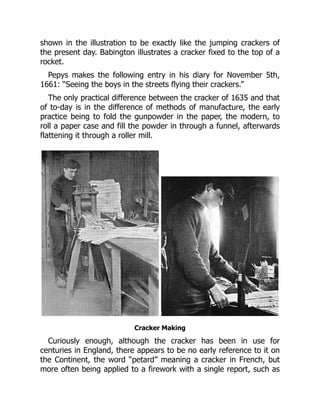
Cracker Making
Curiously enough, although the cracker has been in use for
centuries in England, there appears to be no early reference to it on
the Continent, the word “petard” meaning a cracker in French, but
more often being applied to a firework with a single report, such as
a maroon or cannon. The Dictionnaire National of 1852, however,
describes the true cracker as one of the meanings of “petard.”
The rocket is equal to the cracker in its claim to antiquity, and it is
extraordinary that these two fireworks should have changed so little
in form and composition.
John Babington gives illustrations of rocket-charging tools and
describes the manufacture of rockets, which are approximately those
of the present day. It is only in the proportion of the ingredients that
there is any considerable alteration.
The word “rocket” appears to be Italian in origin, and to be based
on the similarity in appearance of a rocket on its stick to the round
piece of wood used in the Middle Ages to cover the point of a lance
in mimic combat, and known as a “rockette,” from “rocca,” the
Italian word for a bobbin, a diminutive of distaff.
As a rocket is the most important unit in the art of pyrotechny, a
description of its manufacture will assist in the consideration of a
large number of other fireworks which are either modifications of or
based upon the underlying principles of the rocket, as well as the
several principles governing all fireworks.
The ingredients of rocket composition are those of gunpowder in
approximately similar proportions, but the resultant composition is
not gunpowder, the reason being that the ingredients are less
intimately mixed, with the result that the combustion is spread over
a longer interval of time. Instead of the whole mass deflagrating
instantly, only the exposed surface is consumed. It is the recoil
produced by the rush of gases, and partially consumed matter, from
the violently burning composition which projects the rocket forward.
The obvious form for the case containing the composition is
cylindrical, both on account of ease of construction and of charging.
In order to get the greatest possible reaction from the burning
composition, the case of the rocket is constricted or choked, so that
the fire may issue as it were in the form of a jet. This choke has one
obvious disadvantage, it reduces the surface of composition to the
area of the opening, thus restricting the initial burning surface at the
time when the maximum of effort is required to force the rocket into
motion. This defect is overcome by having a tapering hole up almost
the entire length of the composition, thus giving a large burning
surface with a consequent discharge of gas through a small orifice
and a resultant powerful jet of fire and gas.
The rocket case is of stout paper rolled on a former consolidated
by rolling under a board. The choke is formed by inserting into the
bore of the rocket two wooden tools with rounded ends, the shorter
tool having a peg projecting which is equal in diameter to the bore
of the choke. The tools are of such length that when they are
inserted the peg takes up the position where the choke is to be
formed. The case is then constricted at this point by a strong
pressure with a stout cord wound round the case and soaped to
allow it to slip round easily.
The case is then dried and charged by placing on a “spindle,”
which is a strong gun-metal base with a nipple fitting into the vent
of the rocket and having a tapering spindle which fits tightly in the
choke and projects up into the bore of the rocket. The composition
is poured in in small quantities measured in a scoop, each scoopful
being consolidated by blows with a wooden mallet or a wooden
“drift” hollowed to take the spindle. Before the first scoop of
composition is introduced, the rocket is “set down,” that is, several
blows are given on the drift to consolidate the paper at the choke
and give it accurate shape. Next, a scoop of ground dry clay is
poured in and charged firm as a protection to the paper of the
choke. The charging is then proceeded with as detailed above.
Varying drifts are used in order that the hole may approximately
correspond with the diameter of the tapering spindle as the
composition rises in the case.
A short portion of the case above the spindle is charged solid; this
is referred to as the “heading,” and is usually about one and a half
times the bore in depth.
Large rockets are charged in a mould which fits tightly round the
outside of the case and prevents the case being split under the
pressure of the blows whilst being charged.
Rocket Manufacture, from Frézier’s “Feu
d’Artifice,” 1747.
In early times these moulds were used for all sizes and were of
cast metal, and it is from them that the classification of the sizes is
derived. Rockets are designated by the weight of a ball of lead which
fits the bore of the corresponding mould. Thus we have rockets
varying in size from ½ oz. to 6 lbs. and over, war rockets being
made up to 9 and 24 lbs., but their use is now almost extinct.
This classification, although it serves its purpose well enough, is
somewhat misleading, as the thickness of the case varies in practice,
at any rate under modern conditions. In the seventeenth and
eighteenth centuries pyrotechnists seem to have had a standard
proportion between the case and bore, i.e., the thickness of the case
was one-quarter the internal diameter of the rocket.
In modern commercial practice a rocket—say for example of 1 lb.
—is a rocket rolled on a former whose diameter is that of the bore of
a 1 lb. rocket of standard thickness, but whose outside diameter is
governed by the strength of the paper employed in the case.
Several writers on pyrotechny, one Frézier writing in 1747 in
particular, have endeavoured to supersede this classification of
rockets by replacing it with a series of internal diameter
measurements, so far without success. It is hard to supersede the
traditions of centuries on a plea of mere rationalism.
Rocket compositions, although containing the same ingredients,
namely, saltpetre, sulphur, and charcoal, have them in differing
proportions. Broadly speaking, the larger the rocket the greater the
proportion of charcoal and sulphur, the variations in proportion being
considerable, from the half-ounce rocket mixing of 13 saltpetre, 2
sulphur, and 5 charcoal to the 9 lb. and 24 lb. war rocket, with 13
saltpetre, 3 sulphur, and 4 charcoal approximately, and even higher
proportions of the second and third ingredients for special purposes.
A larger proportion of charcoal gives a larger tail—a desirable feature
in display and signal rockets. Some compositions have a proportion
of mealed gunpowder to produce fiercer burning.
Early makers appear to have used mealed gunpowder and added
charcoal and other ingredients to, as it were, dilute the powder and
render the deflagration less fierce. Babington (1635) adds charcoal
in the following proportion:
1 oz.— 4 oz. rockets, 1 lb. of mealed powder to2 oz. charcoal
4 oz.— 10 oz. „ 1 lb. „ „ 2½ oz. „
10 oz.— 1 lb. „ 1 lb. „ „ 3 oz. „
John Bate’s compositions are rather erratically arranged; in some
cases he adds the saltpetre, charcoal, and sulphur, and a further
addition is “yron scales,” presumably to increase the effect of the
tail, for which purpose later pyrotechnists used iron filings.
The rocket having been charged to the top of the heading, clay is
charged in, forming a diaphragm above it. Earlier practice was to
turn down the top edge of the case on the heading composition to
form a diaphragm.
The best-known form of rocket is the sky rocket, which is fitted
with a stick held in position by having a dowelled end introduced
into a rolled paper or metal tube secured to the side of the rocket.
The object of the stick is to direct the flight of the rocket, and
further serves to hold it in position for firing, being passed through
two rings at a suitable distance one above the other on a stake,
through which it slides easily.
Sky rockets are fitted with a “cap” containing the “garniture” of
the rocket, which may take the form of “stars” or other pyrotechnic
effects, or a gun-cotton wad, or similar explosive to make a sound
signal, or small cases charged with picrate of potash, producing the
well-known “whistling rocket” effect.
The “cap” is either cylindrical or in the form of a truncated cone,
with a conical or other top. The cap is burst open and the contents
ignited by an opening charge of powder lighted through a hole
bored in the clay diaphragm above the heading, so that when the
heading is burnt through the fire may be communicated to the
opening charge.
From earliest times the rocket has been the chief item in
recreative fireworks; either the sky rocket as we know it to-day or its
many modifications and derivatives was the chief constituent of the
early displays.
During the sixteenth and seventeenth centuries a display would
contain the following items—dragons or similar figures issuing from
the scenic castle provided for the display; these would be moved by
line rockets. A line rocket has no cap or garniture, the socket usually
provided to hold the stick being lengthened, and of sufficient
diameter to allow it to slide along a tightly stretched cord passed
through it. Pieces of a similar nature to the modern fountain and
gerb would be represented by “ground rockets.” This is a rocket less
fiercely burning, charged solid, fixed to a support so that it remains
stationary whilst burning, the fire being thrown out in a jet. Rockets
would also be used to turn such primitive wheels as were exhibited,
and to actuate mechanical scenic devices, which are in effect the
“turning cases” of the present day. Serpents of fiz-gigs were much
used, both as a garniture for rockets, and to give animation to
wheels and similar pieces. These were made on the rocket principle,
similar to the squib, but slightly more elaborate. A choke was formed
between the composition and the “bounce” or powder giving the
report.
To-day the ground rocket has developed into the gerb or Chinese
tree, fountains of various kinds, the flower pot—of the larger kinds;
and among the smaller varieties, the squib with its variations, such
as Black Jack and Blue Devil, and the golden rain with its variations.
The modern, or rather more recent, method of heading the rocket
with a clay diaphragm evidently suggested that the choking of the
case might be dispensed with where the composition was less fierce,
the necessary reduction of the orifice being produced by a clay
diaphragm with a central hole of sufficient size. This method is
followed with the gerb, fountains, and flower pot, and in the
firework known to pyrotechnists as “fixt”; this unit is largely used in
display work to form the fringe frame or lattice effect of a set piece.
“Fixt” are made in 1 oz. and 2 oz. sizes, and contain a composition
of approximately one part of steel filings to four of mealed
gunpowder and finish with a bounce. The origin of the name is
uncertain: it may refer to their use on fixed pieces in
contradistinction to one revolving, or—as is most probable—was first
used to distinguish between a fixed and a moving rocket.
The time of the introduction of the clay choke is uncertain. Jones,
writing in 1765, although using clay in the heading of rockets, still
choked all cases, but Mortimer (1824) uses it, although Ruggieri
(1821), whilst doing the same, appears to think choking preferable.
The former gives instructions for charging the clay solid and
boring the central hole; Ruggieri, however, uses a nipple like a much
shortened rocket spindle, in which he agrees with the modern
practice. This method is also utilised at the present time for small-
sized rockets.
Of the fireworks of the fountain class, probably the first to develop
from the crude rocket form were the gerb and flower pot. The gerb,
or Chinese tree, contains a composition of saltpetre, sulphur,
charcoal and iron borings, with the addition—if more force is
required, as for instance to turn a device—of mealed gunpowder.
Early makers used mealed powder alone and “iron sand,” or cast-iron
reduced to powder by hammering. This composition is known as
Chinese fire, and, as its name implies, was introduced into Europe
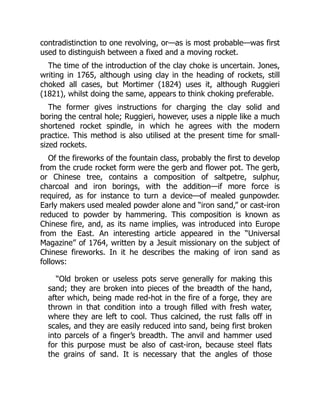
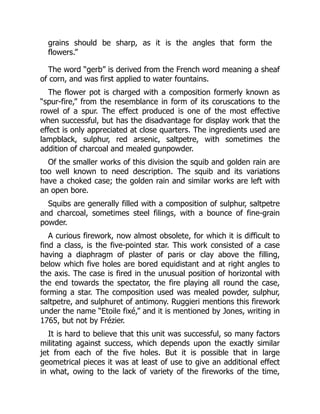
from the East. An interesting article appeared in the “Universal
Magazine” of 1764, written by a Jesuit missionary on the subject of
Chinese fireworks. In it he describes the making of iron sand as
follows:
“Old broken or useless pots serve generally for making this
sand; they are broken into pieces of the breadth of the hand,
after which, being made red-hot in the fire of a forge, they are
thrown in that condition into a trough filled with fresh water,
where they are left to cool. Thus calcined, the rust falls off in
scales, and they are easily reduced into sand, being first broken
into parcels of a finger’s breadth. The anvil and hammer used
for this purpose must be also of cast-iron, because steel flats
the grains of sand. It is necessary that the angles of those
grains should be sharp, as it is the angles that form the
flowers.”
The word “gerb” is derived from the French word meaning a sheaf
of corn, and was first applied to water fountains.
The flower pot is charged with a composition formerly known as
“spur-fire,” from the resemblance in form of its coruscations to the
rowel of a spur. The effect produced is one of the most effective
when successful, but has the disadvantage for display work that the
effect is only appreciated at close quarters. The ingredients used are
lampblack, sulphur, red arsenic, saltpetre, with sometimes the
addition of charcoal and mealed gunpowder.
Of the smaller works of this division the squib and golden rain are
too well known to need description. The squib and its variations
have a choked case; the golden rain and similar works are left with
an open bore.
Squibs are generally filled with a composition of sulphur, saltpetre
and charcoal, sometimes steel filings, with a bounce of fine-grain
powder.
A curious firework, now almost obsolete, for which it is difficult to
find a class, is the five-pointed star. This work consisted of a case
having a diaphragm of plaster of paris or clay above the filling,
below which five holes are bored equidistant and at right angles to
the axis. The case is fired in the unusual position of horizontal with
the end towards the spectator, the fire playing all round the case,
forming a star. The composition used was mealed powder, sulphur,
saltpetre, and sulphuret of antimony. Ruggieri mentions this firework
under the name “Etoile fixé,” and it is mentioned by Jones, writing in
1765, but not by Frézier.
It is hard to believe that this unit was successful, so many factors
militating against success, which depends upon the exactly similar
jet from each of the five holes. But it is possible that in large
geometrical pieces it was at least of use to give an additional effect
in what, owing to the lack of variety of the fireworks of the time,
must have been rather a monotonous repetition of a few effects. It
also would enable small blank spaces to be filled in on set pieces. In
a sun or star of the ordinary type, that is of radiating cases, the
commencement of the jets must be as far apart as the length of two
of the cases, which length is governed by the required time of
burning. This leaves a blank centre; the five-pointed star, however, if
working correctly, has the jets radiating from a point.
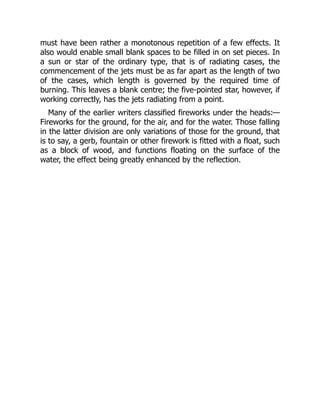
Many of the earlier writers classified fireworks under the heads:—
Fireworks for the ground, for the air, and for the water. Those falling
in the latter division are only variations of those for the ground, that
is to say, a gerb, fountain or other firework is fitted with a float, such
as a block of wood, and functions floating on the surface of the
water, the effect being greatly enhanced by the reflection.
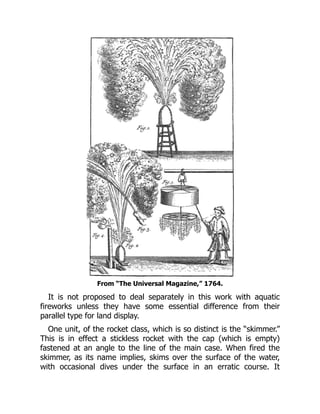
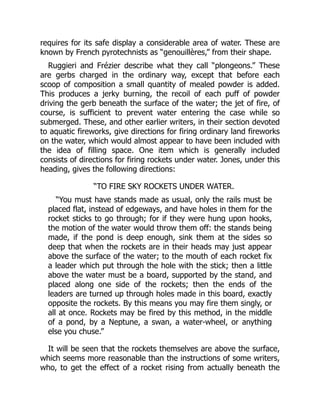
From “The Universal Magazine,” 1764.
It is not proposed to deal separately in this work with aquatic
fireworks unless they have some essential difference from their
parallel type for land display.
One unit, of the rocket class, which is so distinct is the “skimmer.”
This is in effect a stickless rocket with the cap (which is empty)
fastened at an angle to the line of the main case. When fired the
skimmer, as its name implies, skims over the surface of the water,
with occasional dives under the surface in an erratic course. It
requires for its safe display a considerable area of water. These are
known by French pyrotechnists as “genouillères,” from their shape.
Ruggieri and Frézier describe what they call “plongeons.” These
are gerbs charged in the ordinary way, except that before each
scoop of composition a small quantity of mealed powder is added.
This produces a jerky burning, the recoil of each puff of powder
driving the gerb beneath the surface of the water; the jet of fire, of
course, is sufficient to prevent water entering the case while so
submerged. These, and other earlier writers, in their section devoted
to aquatic fireworks, give directions for firing ordinary land fireworks
on the water, which would almost appear to have been included with
the idea of filling space. One item which is generally included
consists of directions for firing rockets under water. Jones, under this
heading, gives the following directions:
“TO FIRE SKY ROCKETS UNDER WATER.
“You must have stands made as usual, only the rails must be
placed flat, instead of edgeways, and have holes in them for the
rocket sticks to go through; for if they were hung upon hooks,
the motion of the water would throw them off: the stands being
made, if the pond is deep enough, sink them at the sides so
deep that when the rockets are in their heads may just appear
above the surface of the water; to the mouth of each rocket fix
a leader which put through the hole with the stick; then a little
above the water must be a board, supported by the stand, and
placed along one side of the rockets; then the ends of the
leaders are turned up through holes made in this board, exactly
opposite the rockets. By this means you may fire them singly, or
all at once. Rockets may be fired by this method, in the middle
of a pond, by a Neptune, a swan, a water-wheel, or anything
else you chuse.”
It will be seen that the rockets themselves are above the surface,
which seems more reasonable than the instructions of some writers,
who, to get the effect of a rocket rising from actually beneath the
surface, give themselves an infinite amount of trouble to render the
case and connections waterproof. The effect seen from a short
distance is identical.
CHAPTER II
SIMPLE FIREWORKS—SHELL CLASS
WE now come to a distinct class of fireworks, those whose
functioning depends on the propulsion of gunpowder. The first and
parent of this class is the shell or bomb.
The original name of the shell was “air balloon,” which is now
obsolete. Some writers have been misled by its appearance in old
amusement announcements into thinking a balloon ascent was
referred to, or that a balloon carrying fireworks was to be exhibited,
at dates considerably before the invention of gas or hot-air balloons.
In this connection it is interesting to note that Ruggieri claims that
his father was the first to release a balloon carrying fireworks in
1786.
As we have seen, the military use of shell dates from at least as
early as the middle of the sixteenth century.
Both Babington and Bate, writing in 1635, give instructions for
making shell, and although the book of the former is more advanced
in this particular matter, he is, generally speaking, considerably more
primitive.
Babington describes a hollow sphere of canvas, a part of which is
filled with a slow-burning composition, the remainder being filled
with stars and grain powder, the canvas is pierced to expose the
slow composition. The shell is fired from a mortar having a touch-
hole. The following are Babington’s instructions in the matter:
“Load your morter piece with one ounce of corne powder,
putting after a wadd and tampion, and put on your ball with the
vent towards the mouth of your piece: so elevating your piece
to the zenith, you may proceed to the firing of it, which must be
Welcome to our website – the perfect destination for book lovers and
knowledge seekers. We believe that every book holds a new world,
offering opportunities for learning, discovery, and personal growth.
That’s why we are dedicated to bringing you a diverse collection of
books, ranging from classic literature and specialized publications to
self-development guides and children's books.
More than just a book-buying platform, we strive to be a bridge
connecting you with timeless cultural and intellectual values. With an
elegant, user-friendly interface and a smart search system, you can
quickly find the books that best suit your interests. Additionally,
our special promotions and home delivery services help you save time
and fully enjoy the joy of reading.
Join us on a journey of knowledge exploration, passion nurturing, and
personal growth every day!
testbankmall.com

Solution Manual for Visual C# How to Program (6th Edition) (Deitel Series) 6th Edition
  • 1.
    Solution Manual forVisual C# How to Program (6th Edition) (Deitel Series) 6th Edition download https://testbankmall.com/product/solution-manual-for-visual-c- how-to-program-6th-edition-deitel-series-6th-edition/ Find test banks or solution manuals at testbankmall.com today!

  • 2.
    We have selectedsome products that you may be interested in Click the link to download now or visit testbankmall.com for more options!. Solution Manual for Visual Basic 2012 How to Program, 6/E 6th Edition : 0133406954 https://testbankmall.com/product/solution-manual-for-visual- basic-2012-how-to-program-6-e-6th-edition-0133406954/ Test Bank for Visual C# 2012 How to Program, 5/E 5th Edition : 0133379337 https://testbankmall.com/product/test-bank-for-visual-c-2012-how-to- program-5-e-5th-edition-0133379337/ Solution Manual for C++ How to Program 10th by Deitel https://testbankmall.com/product/solution-manual-for-c-how-to- program-10th-by-deitel/ Test Bank for Marketing, 6th Edition, Dhruv Grewal, Michael Levy, ISBN: 9781259709074 https://testbankmall.com/product/test-bank-for-marketing-6th-edition- dhruv-grewal-michael-levy-isbn-9781259709074/
  • 3.
    Survey of EconomicsPrinciples Applications and Tools 7th Edition OSullivan Test Bank https://testbankmall.com/product/survey-of-economics-principles- applications-and-tools-7th-edition-osullivan-test-bank/ Business Essentials 11th Edition Ebert Test Bank https://testbankmall.com/product/business-essentials-11th-edition- ebert-test-bank/ Solution Manual for Calculus, 4th Edition, Jon Rogawski, Colin Adams, Robert Franzosa https://testbankmall.com/product/solution-manual-for-calculus-4th- edition-jon-rogawski-colin-adams-robert-franzosa/ Solution Manual for International Business: The Challenges of Globalization John Wild, Kenneth L. Wild, Halia Valladares https://testbankmall.com/product/solution-manual-for-international- business-the-challenges-of-globalization-john-wild-kenneth-l-wild- halia-valladares/ Strategic Compensation in Canada Canadian 6th Edition Long Solutions Manual https://testbankmall.com/product/strategic-compensation-in-canada- canadian-6th-edition-long-solutions-manual/
  • 4.
    Operations Management Stevenson11th Edition Solutions Manual https://testbankmall.com/product/operations-management-stevenson-11th- edition-solutions-manual/
  • 5.
    2 Chapter 1Introduction to Computers, the Internet and Visual C# Self-Review Exercises 2 Self-Review Exercises 1.1 Fill in the blanks in each of the following statements: a) Computers process data under the control ofsequences of instructions called . ANS: computer programs. b) A computer consists of various devices referred to as , such as the keyboard, screen, mouse, hard disks, memory, DVD drives and processing units. ANS: hardware. c) Data items processed by computers form a(n) that becomes larger and more complex in structure as we progress from the simplest data items (called “bits”) to richer data items, such as characters, fields, and so on. ANS: data hierarchy. d) Computers can directly understand only their language, which is composed only of 1s and 0s. ANS: machine. e) The three types of computer programming languages discussed in the chapter are ma- chine languages, and . ANS: assembly languages, high-level languages. f) Programs that translate high-level-language programs into machine language are called . ANS: compilers. g) A(n) processor implements several processors on a single “microchip”—a dual-core processor has two CPUs and a quad-core processor has four CPUs. ANS: multicore. h) Windows 10 introduced the for building Windows apps that run on desktop computers, notebook computers, tablets, phones, Xbox and even Microsoft’s new HoloLens augmented reality holographic headset—all using nearly identical code. ANS: Universal Windows Platform (UWP). 1.2 Fill in the blanks in each of the following statements: a) Objects, or more precisely the that objects come from, are essentially reusable software components. ANS: classes. b) You send messages to an object. Each message is implemented as a method that tells a method of the object to perform its task. ANS: call. c) A new class of objects can be created quickly and conveniently by ; the new class absorbs the characteristics of an existing class, possibly customizing them and add- ing unique characteristics of its own. ANS: inheritance. d) To create the best solutions, you should follow a detailed analysis process for determin- ing your project’s (i.e., defining what the system is supposed to do) and de- veloping a design that satisfies them (i.e., deciding how the system should do it). ANS: requirements. e) Visual C# is driven. You’ll write programs that respond to mouse clicks, key- strokes, timer expirations and touches and finger swipes. ANS: event. f) A key goal of Java is to be able to write programs that will run on a great variety of com- puter systems and computer-control devices. This is sometimes called . ANS: write once, run anywhere. 1.3 Fill in the blanks in each of the following statements:
  • 6.
    3 Chapter 1Introduction to Computers, the Internet and Visual C# Self-Review Exercises 3 a) The executes .NET programs. ANS: Common Language Runtime (CLR) of the .NET Framework. b) The CLR provides various services to code, such as integrating software com- ponents written in different .NET languages, error handling between such components, enhanced security and more. ANS: managed. c) The ability of a program to run without modification across multiple platforms is known as platform . ANS: independence. d) Visual Studio is a(n) in which C# programs are developed. ANS: IDE. e) You can sell your own Windows Phone apps in the . ANS: Windows Store. 1.4 State whether each of the following is true or false. If false, explain why. a) Software objects model both abstract and real-world things. ANS: True. b) The most popular database model is the relational database in which data is stored in simple tables. A table includes records and fields. ANS: True. c) A database is a collection of data that’s organized for easy access and manipulation. ANS: True. d) Secondary storage data takes much longer to access than data in primary memory, but the cost per unit of secondary storage is much higher than that of primary memory. ANS: False: The cost per unit of secondary storage is much lower than that of primary memory. e) High-level languages allow you to write instructions that look almost like everyday Eng- lish and contain commonly used mathematical expressions. ANS: True. f) An object has attributes that it carries along as it’s used in a program. ANS: True. g) The Transmission Control Protocol (TCP) ensures that messages, consisting of sequen- tially numbered pieces called bytes, were properly routed from sender to receiver, ar- rived intact and were assembled in the correct order ANS: False. The pieces are called packets, not bytes. h) The information-carrying capacity of communications lines on the Internet has in- creased tremendously, while hardware costs have increased. ANS: False. Hardware costs have decreased. i) You can build web-based apps with C# and Microsoft’s ASP.NET technology. ANS: True. j) Java has become the key programming language for the Mac OS X desktop operating system and all iOS-based devices, such as iPods, iPhones and iPads. ANS: False. The language is Swift, not Java. k) Microsoft’s ASP.WEB technology is used to create web apps. ANS: False. It’s ASP.NET technology. l) Microsoft’s Windows operating system is the most widely used desktop operating sys- tem worldwide. ANS: True. 1.5 Arrange these byte measurements in order from smallest to largest: terabyte, megabyte, petabyte, gigabyte and kilobyte. ANS: kilobyte, megabyte, gigabyte, terabyte, petabyte.
  • 7.
    4 Chapter 1Introduction to Computers, the Internet and Visual C# Self-Review Exercises 4 1.6 Describe the two-step translation process for preparing your C# code to execute on your particular computer. ANS: C# code is first compiled into MSIL and placed in an executable file. When the app executes, another compiler called the JIT (just-in-time) compiler in the CLR trans- lates the MSIL in the executable file into machine-language code (for a particular platform). Exercises 1.7 Fill in the blanks in each of the following statements: a) The programs that run on a computer are referred to as . ANS: software b) Systems such as smartphones, appliances, game controllers, cable set-top boxes and au- tomobiles that contain small computers are called . ANS: embedded systems c) Just as characters are composed of bits, are composed of characters or bytes. ANS: fields d) Information on secondary storage devices is ; it’s preserved even when the computer’s power is turned off. ANS: persistent e) Translator programs called convert high-level language code into machine- language code. ANS: compilers f) In object-oriented programming languages, we create a program unit called a(n) to house the set of methods that perform its tasks. ANS: class g) Use a building-block approach to creating your programs. Avoid reinventing the wheel—use existing pieces wherever possible. Such software is a key benefit of object-oriented programming. ANS: reuse 1.8 Fill in the blanks in each of the following statements: a) Although many different OOAD processes exist, a single graphical language for com- municating the results of any OOAD process has come into wide use. This language, known as the , is now the most widely used graphical scheme for modeling ob- ject-oriented systems. ANS: UML b) Tim Berners-Lee developed the for sharing information via “hyperlinked” text documents on the web. ANS: HyperText Markup Language (HTML) c) The CLR is a(n) machine. It is software that manages the execution of pro- grams and hides from them the underlying operating system and hardware. ANS: virtual d) Converting a program to run on a different platform from which it was originally in- tended is called . ANS: porting. e) Microsoft’s Windows is a cloud-computing platform that allows you to de- velop, manage and distribute your apps in the cloud. ANS: Azure. (Instructor Note: "Microsoft’s Windows" should be simply "Microsoft" in this exercise.)
  • 8.
    Exercises 5 5 Chapter1 Introduction to Computers, the Internet and Visual C# f) By using existing controls—which are objects—you can create powerful apps much fasterthan if you had to write all the code yourself. This is a key benefit of software . ANS: reuse 1.9 State whether each of the following is true or false. If false, explain why. a) The smallest data item in a computer can assume the value 1 or the value 2. Such a data item is called a bit (short for “binary digit”—a digit that can assume either of two val- ues). ANS: False. Such items have the value 0 or 1. b) The Unicode character set is a popular subset of ASCII that represents uppercase and lowercase letters, digits and some common special characters. ANS: False. ASCII is a subset of Unicode. c) Each of the following is a form of computer output: data displayed on screens, printed on paper, played as audio or video on PCs and media players, used to control other de- vices, such as robots, 3D printersand “intelligent” appliances. ANS: True. d) Reuse helps you build more reliable and effective systems, because existing classes and components often have gone through extensive testing, debugging and performance tuning. ANS: True. e) One of the W3C’s primary goals is to make the web universally accessible to everyone regardless of disabilities, language or culture. ANS: True. f) C# is available only on Microsoft Windows. ANS: False. There are ports of C# for other platforms, such as Linux. g) The .NET Framework Class Library has millions of valuable prebuilt classes that have been tested and tuned to maximize performance. ANS: False. Thousands, not millions, of prebuilt classes. h) .NET programs can run on any platform. ANS: False. .NET prorgrams run on the Common Language Runtime, which is a virtual machine. i) The Universal Windows Platform (UWP) is designed to provide a common platform (the underlying system on which apps run) and user experience across all of your devices including personal computers, smartphones, tablets and Xbox Live. ANS: True. 1.10 What is a key advantage of interpreters over compilers? What is a key disadvantage? ANS: A key advantage is that interpreters can execute high-level language programs directly (without the need for compilation). A key disadvantage is that interpreted programs exexute more slowly than compiled programs. 1.11 What is the key advantage of using the new async feature in preference to using old-style multithreading? ANS: The new features simplify asynchronous programming, because the compilerhides much of the associated complexity from the developer. 1.12 What are operating systems? ANS: Operating systems are software systems that make using computers more convenient for users, app developers and system administrators. They provide services that allow each app to execute safely, efficiently and concurrently (i.e., in parallel) with other apps.
  • 9.
    Exercises 6 6 Chapter1 Introduction to Computers, the Internet and Visual C# 1.13 Why is using cloud-computing resources sometimes preferable to purchasing all the hard- ware you need for your own computer? ANS: Cloud computing gives you the flexibility to increase or decrease computing resourc- es to meet your resource needs at any given time, making it more cost effective than purchasing expensive hardware to ensure that you have enough storage and process- ing power at their occasional peak levels. 1.14 Categorize each of the following items as either hardware or software: a) CPU ANS: Hardware. b) Compiler ANS: Software c) Input unit ANS: Hardware. d) A word-processor program ANS: Software e) A C# program ANS: Software 1.15 Translator programs, such as assemblers and compilers, convert programs from one lan- guage (referred to as the source language) to another language (referred to as the target language). Determine which of the following statements are true and which are false: a) An assembler translates source-language programs into machine-language programs. ANS: True. b) High-level languages are generally machine dependent. ANS: False. A high-level language must be compiled into machine-dependent language be- fore it can be executed. This allows high-level languages to be used on all computers with appropriate compilers. c) A machine-language program requires translation before it can be run on a computer. ANS: False. A machine-language program is native to a specific machine. d) The C# compiler translates high-level-language programs into SMIL. ANS: False. It translates C# into MSIL. 1.16 Expand each of the following acronyms: a) W3C ANS: World Wide Web Consortium b) OOP ANS: Object-Oriented Programming c) CLR ANS: Common Language Runtime d) MSIL ANS: Microsoft Intermediate Language e) UML ANS: Unified Modeling Language f) IDE ANS: Integrated Development Environment 1.17 What are the key benefits of the .NET Framework and the CLR? What are the drawbacks? ANS: The key benefits are portability between operating systems and interoperability be- tween languages. As long as a CLR exists for a platform, it can run any .NET pro- gram. Programmers can concentrate on program logic instead of platform-specific details. Thus, the double compilation (code-to-MSIL, and MSIL-to-machine code) allows for platform independence: Programs can be written once and executed on any
  • 10.
    Exercises 7 7 Chapter1 Introduction to Computers, the Internet and Visual C# platform supporting the CLR—this is known as platform independence. Code writ- ten once could easily be used on another machine without modification, saving time and money. A second benefit of the .NET framework is language interoperability— software components written in different languages can interact (language indepen- dence). A drawback associated with these features is that .NET programs cannot be run until the .NET Framework is developed for a platform. Another is the overhead of the double compilation that is needed before a .NET-language program can be ex- ecuted. 1.18 What are the advantages to using object-oriented techniques? ANS: Programs that use object-oriented programming techniques are easier to understand, correct and modify. The key advantage with using object-oriented programming is that it tends to produce software that is more understandable, because it is better or- ganized and has fewer maintenance requirements than software produced with earlier methodologies. OOP helps the programmer build applications faster by reusing ex- isting software components that model items in the real world. OOP also helps pro- grammers create new software components that can be reused on future software development projects. Building software quickly, correctly, and economically has been an elusive goal in the software industry. The modular, object-oriented design and implementation approach has been found to increase productivity while reduc- ing development time, errors, and cost. 1.19 You are probably wearing on your wrist one of the world’s most common types of objects— a watch. Discuss how each of the following terms and concepts applies to the notion of a watch: object, attributes and behaviors. ANS: The entire watch is an object that is composed of many other objects (the moving parts, the band, the face, etc.) Watch attributes are time, color, band style, technology (digital or analog), and the like. The behaviors of the watch include setting the time and getting the time. A watch can be considered a specific type of clock (as can an alarm clock). 1.20 What is the key accomplishment of the UML? ANS: It replaced the many different graphical modeling languages with a single (unified) language for modeling that can be used by developers regardless of the different OOAD processes they may use. 1.21 What did the chief benefit of the early Internet prove to be? ANS: Communication by e-mail. Today, that communication is also facilitated by appli- cations such as instant messaging and file transfer. 1.22 What is the key capability of the web? ANS: It allows computer users to locate and view multimedia-based documents on almost any subject over the Internet. 1.23 What is the key vision of Microsoft’s .NET initiative? ANS: To embrace the Internet and the web in the development and use of software. 1.24 How does the .NET Framework Class Library facilitate the development of .NET apps? ANS: First, the Framework Class Library is a large library of reusable classes that reduces development time. Programmers can build software quickly by reusing framework’s classes, rather than building new classes “from scratch.” Second, the Framework Class Library is shared by all of the .NET languages, which means that programmers who work in multiple languages have to learn only one class library.
  • 11.
    Exercises 8 8 Chapter1 Introduction to Computers, the Internet and Visual C# 1.25 Besides the obvious benefits of reuse made possible by OOP, what do many organizations report as another key benefit of OOP? ANS: That OOP tends to produce software that is more understandable, better organized, and easier to maintain, modify and debug. Making-a-Difference Exercises The Making-a-Difference exercises will ask you to work on problems that really matter to individ- uals, communities, countries and the world. 1.26 (Test Drive: Carbon Footprint Calculator) Some scientists believe that carbon emissions, especially from the burning of fossil fuels, contribute significantly to global warming and that this can be combatted if individuals take steps to limit their use of carbon-based fuels. Various organi- zations and individuals are increasingly concerned about their “carbon footprints.” Websites such as TerraPass http://www.terrapass.com/carbon-footprint-calculator-2/ and Carbon Footprint http://www.carbonfootprint.com/calculator.aspx provide carbon-footprint calculators. Test drive these calculators to determine your carbon foot- print. Exercises in later chapters will ask you to program your own carbon-footprint calculator. To prepare for this, research the formulas for calculating carbon footprints. 1.27 (Test Drive: Body-Mass-Index Calculator) By recent estimates, two-thirds of the people in the United States are overweight and about halfof those are obese. This causes significant increases in illnesses such as diabetes and heart disease. To determine whether a person is overweight or obese, you can use a measure called the body mass index (BMI). The United States Department of Health and Human Services provides a BMI calculator at http://www.nhlbi.nih.gov/guidelines/ obesity/BMI/bmicalc.htm. Use it to calculate yourown BMI. An exercise in Chapter 3 will ask you to program your own BMIcalculator. To prepare for this, research the formulas for calculating BMI. 1.28 (Attributes of Hybrid Vehicles) In this chapter you learned the basics of classes. Now you’ll begin “fleshing out” aspects of a class called “Hybrid Vehicle.” Hybrid vehicles are becoming increas- ingly popular, because they often get much better mileage than purely gasoline-powered vehicles. Browse the web and study the features of four or five of today’s popular hybrid cars, then list as many of their hybrid-related attributes as you can. For example, common attributes include city-miles-per- gallon and highway-miles-per-gallon. Also list the attributes of the batteries (type, weight, etc.). ANS: • Manufacturer • Type of Hybrid—Battery hybrid (Hybrid Electric Vehicles), Plug-in hybrid, Fuel cell etc. • Driverfeedback system—so the driver can monitor fuel efficiency based on their driving • Energy recovery—for example, regenerative breaking • Carbon footprint—tons of CO2 per year • Fuel capacity • City-miles-per-gallon • Highway-miles-per-gallon • Two-mode hybrid propulsion system • Engine size—V6, V8, etc. • Vehicle type—SUV, crossover, compact, mid-size, etc.
  • 12.
    Making-a-Difference Exercises 9 •Seating capacity • Horse power • Drive train (front wheel drive, all wheel drive) • Top speed • Torque • Price 1.29 (Gender Neutrality) Some people want to eliminate sexism in all forms of communication. You’ve been asked to create a program that can process a paragraph of text and replace gender-spe- cific words with gender-neutral ones. Assuming that you’ve been given a list of gender-specific words and their gender-neutral replacements (e.g., replace “wife” with “spouse,” “man” with “per- son,” “daughter” with “child” and so on), explain the procedure you’d use to read through a para- graph of text and manually perform these replacements. How might your procedure generate a strange term like “woperchild,” which is actually listed in the Urban Dictionary (www.urbandic- tionary.com)? In Chapter 5, you’ll learn that a more formal term for “procedure” is “algorithm,” and that an algorithm specifies the steps to be performed and the order in which to perform them. ANS: Search through the entire paragraph for a word such as “wife” and replace every oc- currence with “spouse.” Repeat this searching process for every gender specific word in the list. You could accidentally get a word like “woperchild” if you are not careful about how you perform replacements. For example, the word “man” can be part of a larger word, like “woman.” So, replacing every occurrence of “man” can yield strange results. Consider the process of replacing “man” with “person” then replacing “son” with “child.” If you encounter the word “woman,” which contains the word “man,” you’d replace “man” with “person” resulting in the word “woperson.” In a subsequent pass you’d encounter “woperson” and replace “son” with “child” result- ing in the “woperchild.”
  • 13.
    Random documents withunrelated content Scribd suggests to you:
  • 14.
    in a magazinecontaining between 6,000 and 7,000 lbs. of display fireworks. An occurrence of a similar nature was observed at Brighton in 1903, when some changing coloured lights which had been removed from a building where a fire had taken place (the fireworks not being involved in any way) ignited some days afterwards. It is thought that the lights may have been wetted during the fire, and upon drying out some days later the different compositions in contact in the case or cases set up chemical action, which resulted in spontaneous ignition. It was found on examination that a blue containing sulphur was in contact with a green containing chlorate. It may be noted here that mixtures which are damped during manufacture are more liable to spontaneous ignition than those manipulated in a dry state. Many accidents and explosions are left unexplained, either because the evidence is destroyed by the resulting fire or by the death of the witness or witnesses, or because of the difficulty often experienced in getting the workpeople to give a full and faithful account of what occurred, fearing to cause trouble for themselves or others concerned. There can be no doubt that the cause is frequently carelessness or mistakes on the part of workers. In a large number of cases, however, this explanation gives no help and the cause remains obscure. One such may be mentioned: In 1902 an explosion occurred in a store for non-explosive ingredients, in which were kept the chemicals used in a firework factory. In the building at the time was a workman who appears to have been engaged in sifting chlorate of potash, and the technical manager of the factory who seems to have been weighing out ingredients. There is no doubt that he was a man of very considerable experience, and from his responsible position unlikely either to take risks or be guilty of carelessness.
  • 15.
    An explosion occurredin the building, killing both occupants, and of so violent a nature as to sever the foot of the manager and to project one of the sheets of corrugated iron with which the roof was covered a distance of thirty yards. No explanation of this occurrence was arrived at other than that in some way some of the chemicals must have become mixed to form a sensitive and violent explosive; so much is obvious, but how the chemicals became so mixed remains a mystery, as no mixing was actually done in the building. The ignition of such a mixture is less obscure as magazine boots were not necessary in the building owing to the non-hazardous nature of the work carried on there, and sufficient friction would be produced to fire even a fairly sensitive mixture between a nailed boot sole and a wood floor. An occurrence of considerable interest in this direction took place in a warehouse at Manchester in 1908. In the building were stored several tons of chemicals, among which were twelve tons of chlorate of potash and thirty-two of chlorate of soda. A workman stepping down from a barrel struck fire, and saw a flame, which he tried to extinguish by rubbing with his foot. This, however, had the opposite effect. He then tried a bucket of water, which failed to put it out; he left the building and heard an explosion, followed by a second and a third, all apparently of a violent nature, all three being heard nearly ten miles away, and glass broken throughout a considerable area round the warehouse. The cause appears to have been as follows: During the conveyance of the chlorate into the building leakings took place, and a certain quantity remained on the floor, this mixing with dust and other organic matter would prove a highly sensitive composition. This was ignited by the man’s foot and rapidly spread, probably a deposit which had accumulated under the floor became involved. The woodwork of the building and the wooden barrels then became ignited. The rapid decomposition of the chlorate caused by the heat liberated large quantities of free oxygen, which united with carbon in
  • 16.
    the smoke toform gas, which exploded upon reaching the correct proportion for so doing. The writer has chiefly confined himself to accidents in firework factories; those occurring during the illegal manufacture of fireworks in premises unlicensed for the purpose present no further interest, and are generally caused by ignorance on the part of the participant of the often extremely dangerous nature of the material he is handling. To take an example: Two boys were engaged in grinding in a mortar a “small quantity” of chlorate of potash and sugar. An explosion resulted which blew out the entire window frames of the room, destroyed the partition between the room and the passage, considerably damaged the other wall, and projected the pestle into the ceiling, where it remained embedded. Accidents at displays are now happily rare; the most fruitful cause of such happenings was the detonation of shell in the mortar, that is, the detonation of the contents or “garniture” by the explosion of the propellant charge. The elimination of chlorate-sulphur composition has reduced the chances of this to a minimum, and the compulsory burying of mortars up to the muzzle has practically eliminated the danger to either firers or spectators. Apart from slight injuries caused by falling rocket sticks and mishaps of a similar nature, accidents to the public at firework displays are things of the past.
  • 18.
    PART II Types ofModern Fireworks.
  • 19.
    CHAPTER I SIMPLE FIREWORKS—ROCKETCLASS IN the preceding chapters we have been dealing with displays of fireworks, that is to say; fireworks in the mass. We will now turn our attention to the firework units composing those displays, and endeavour to trace their gradual evolution from the crude originals. Fireworks may be divided into two classes, simple and compound. The first of these include fireworks which are a complete item in themselves, as the rocket, shell, or Roman candle; also the units which, fitted on a framework, go to compose the set pieces and devices of a display, and the small shop goods not used in displays. We will consider this class first. The two oldest forms of fireworks known are undoubtedly the cracker and the rocket. As we have already noted, both of these—or at least primitive forms—are mentioned by Marcus Graecus, Albertus, and Roger Bacon. The description by the former is sufficiently clear to leave no doubt in our minds that he is describing a rocket; although the description of a cracker is not so explicit as to enable us to say that he is actually describing a jumping cracker, yet his mention of folding and tying would certainly give colour to that belief. In fact, some writers have endeavoured to find a connection between the words “Graecus” and “Cracker.” Greene, in “Orlando Furioso” (1599), uses the words, “Yes, yes, with squibs and crackers brauly.” John Bate, in his book previously mentioned, under the somewhat misleading heading, “How to make Crackers,” says: “It is well knowne that every boy can make these, therefore I think it will be but labor lost, to bestow time to describe their making.” He also describes a kind of kite which he designates a “Fire Drake,” to the tail of which he fastens “divers crackers” which are
  • 20.
    shown in theillustration to be exactly like the jumping crackers of the present day. Babington illustrates a cracker fixed to the top of a rocket. Pepys makes the following entry in his diary for November 5th, 1661: “Seeing the boys in the streets flying their crackers.” The only practical difference between the cracker of 1635 and that of to-day is in the difference of methods of manufacture, the early practice being to fold the gunpowder in the paper, the modern, to roll a paper case and fill the powder in through a funnel, afterwards flattening it through a roller mill. Cracker Making Curiously enough, although the cracker has been in use for centuries in England, there appears to be no early reference to it on the Continent, the word “petard” meaning a cracker in French, but more often being applied to a firework with a single report, such as
  • 21.
    a maroon orcannon. The Dictionnaire National of 1852, however, describes the true cracker as one of the meanings of “petard.” The rocket is equal to the cracker in its claim to antiquity, and it is extraordinary that these two fireworks should have changed so little in form and composition. John Babington gives illustrations of rocket-charging tools and describes the manufacture of rockets, which are approximately those of the present day. It is only in the proportion of the ingredients that there is any considerable alteration. The word “rocket” appears to be Italian in origin, and to be based on the similarity in appearance of a rocket on its stick to the round piece of wood used in the Middle Ages to cover the point of a lance in mimic combat, and known as a “rockette,” from “rocca,” the Italian word for a bobbin, a diminutive of distaff. As a rocket is the most important unit in the art of pyrotechny, a description of its manufacture will assist in the consideration of a large number of other fireworks which are either modifications of or based upon the underlying principles of the rocket, as well as the several principles governing all fireworks. The ingredients of rocket composition are those of gunpowder in approximately similar proportions, but the resultant composition is not gunpowder, the reason being that the ingredients are less intimately mixed, with the result that the combustion is spread over a longer interval of time. Instead of the whole mass deflagrating instantly, only the exposed surface is consumed. It is the recoil produced by the rush of gases, and partially consumed matter, from the violently burning composition which projects the rocket forward. The obvious form for the case containing the composition is cylindrical, both on account of ease of construction and of charging. In order to get the greatest possible reaction from the burning composition, the case of the rocket is constricted or choked, so that the fire may issue as it were in the form of a jet. This choke has one obvious disadvantage, it reduces the surface of composition to the
  • 22.
    area of theopening, thus restricting the initial burning surface at the time when the maximum of effort is required to force the rocket into motion. This defect is overcome by having a tapering hole up almost the entire length of the composition, thus giving a large burning surface with a consequent discharge of gas through a small orifice and a resultant powerful jet of fire and gas. The rocket case is of stout paper rolled on a former consolidated by rolling under a board. The choke is formed by inserting into the bore of the rocket two wooden tools with rounded ends, the shorter tool having a peg projecting which is equal in diameter to the bore of the choke. The tools are of such length that when they are inserted the peg takes up the position where the choke is to be formed. The case is then constricted at this point by a strong pressure with a stout cord wound round the case and soaped to allow it to slip round easily. The case is then dried and charged by placing on a “spindle,” which is a strong gun-metal base with a nipple fitting into the vent of the rocket and having a tapering spindle which fits tightly in the choke and projects up into the bore of the rocket. The composition is poured in in small quantities measured in a scoop, each scoopful being consolidated by blows with a wooden mallet or a wooden “drift” hollowed to take the spindle. Before the first scoop of composition is introduced, the rocket is “set down,” that is, several blows are given on the drift to consolidate the paper at the choke and give it accurate shape. Next, a scoop of ground dry clay is poured in and charged firm as a protection to the paper of the choke. The charging is then proceeded with as detailed above. Varying drifts are used in order that the hole may approximately correspond with the diameter of the tapering spindle as the composition rises in the case. A short portion of the case above the spindle is charged solid; this is referred to as the “heading,” and is usually about one and a half times the bore in depth.
  • 23.
    Large rockets arecharged in a mould which fits tightly round the outside of the case and prevents the case being split under the pressure of the blows whilst being charged. Rocket Manufacture, from Frézier’s “Feu d’Artifice,” 1747. In early times these moulds were used for all sizes and were of cast metal, and it is from them that the classification of the sizes is derived. Rockets are designated by the weight of a ball of lead which fits the bore of the corresponding mould. Thus we have rockets
  • 24.
    varying in sizefrom ½ oz. to 6 lbs. and over, war rockets being made up to 9 and 24 lbs., but their use is now almost extinct. This classification, although it serves its purpose well enough, is somewhat misleading, as the thickness of the case varies in practice, at any rate under modern conditions. In the seventeenth and eighteenth centuries pyrotechnists seem to have had a standard proportion between the case and bore, i.e., the thickness of the case was one-quarter the internal diameter of the rocket. In modern commercial practice a rocket—say for example of 1 lb. —is a rocket rolled on a former whose diameter is that of the bore of a 1 lb. rocket of standard thickness, but whose outside diameter is governed by the strength of the paper employed in the case. Several writers on pyrotechny, one Frézier writing in 1747 in particular, have endeavoured to supersede this classification of rockets by replacing it with a series of internal diameter measurements, so far without success. It is hard to supersede the traditions of centuries on a plea of mere rationalism. Rocket compositions, although containing the same ingredients, namely, saltpetre, sulphur, and charcoal, have them in differing proportions. Broadly speaking, the larger the rocket the greater the proportion of charcoal and sulphur, the variations in proportion being considerable, from the half-ounce rocket mixing of 13 saltpetre, 2 sulphur, and 5 charcoal to the 9 lb. and 24 lb. war rocket, with 13 saltpetre, 3 sulphur, and 4 charcoal approximately, and even higher proportions of the second and third ingredients for special purposes. A larger proportion of charcoal gives a larger tail—a desirable feature in display and signal rockets. Some compositions have a proportion of mealed gunpowder to produce fiercer burning. Early makers appear to have used mealed gunpowder and added charcoal and other ingredients to, as it were, dilute the powder and render the deflagration less fierce. Babington (1635) adds charcoal in the following proportion: 1 oz.— 4 oz. rockets, 1 lb. of mealed powder to2 oz. charcoal
  • 25.
    4 oz.— 10oz. „ 1 lb. „ „ 2½ oz. „ 10 oz.— 1 lb. „ 1 lb. „ „ 3 oz. „ John Bate’s compositions are rather erratically arranged; in some cases he adds the saltpetre, charcoal, and sulphur, and a further addition is “yron scales,” presumably to increase the effect of the tail, for which purpose later pyrotechnists used iron filings. The rocket having been charged to the top of the heading, clay is charged in, forming a diaphragm above it. Earlier practice was to turn down the top edge of the case on the heading composition to form a diaphragm. The best-known form of rocket is the sky rocket, which is fitted with a stick held in position by having a dowelled end introduced into a rolled paper or metal tube secured to the side of the rocket. The object of the stick is to direct the flight of the rocket, and further serves to hold it in position for firing, being passed through two rings at a suitable distance one above the other on a stake, through which it slides easily. Sky rockets are fitted with a “cap” containing the “garniture” of the rocket, which may take the form of “stars” or other pyrotechnic effects, or a gun-cotton wad, or similar explosive to make a sound signal, or small cases charged with picrate of potash, producing the well-known “whistling rocket” effect. The “cap” is either cylindrical or in the form of a truncated cone, with a conical or other top. The cap is burst open and the contents ignited by an opening charge of powder lighted through a hole bored in the clay diaphragm above the heading, so that when the heading is burnt through the fire may be communicated to the opening charge. From earliest times the rocket has been the chief item in recreative fireworks; either the sky rocket as we know it to-day or its many modifications and derivatives was the chief constituent of the early displays.

  • 26.
    During the sixteenthand seventeenth centuries a display would contain the following items—dragons or similar figures issuing from the scenic castle provided for the display; these would be moved by line rockets. A line rocket has no cap or garniture, the socket usually provided to hold the stick being lengthened, and of sufficient diameter to allow it to slide along a tightly stretched cord passed through it. Pieces of a similar nature to the modern fountain and gerb would be represented by “ground rockets.” This is a rocket less fiercely burning, charged solid, fixed to a support so that it remains stationary whilst burning, the fire being thrown out in a jet. Rockets would also be used to turn such primitive wheels as were exhibited, and to actuate mechanical scenic devices, which are in effect the “turning cases” of the present day. Serpents of fiz-gigs were much used, both as a garniture for rockets, and to give animation to wheels and similar pieces. These were made on the rocket principle, similar to the squib, but slightly more elaborate. A choke was formed between the composition and the “bounce” or powder giving the report. To-day the ground rocket has developed into the gerb or Chinese tree, fountains of various kinds, the flower pot—of the larger kinds; and among the smaller varieties, the squib with its variations, such as Black Jack and Blue Devil, and the golden rain with its variations. The modern, or rather more recent, method of heading the rocket with a clay diaphragm evidently suggested that the choking of the case might be dispensed with where the composition was less fierce, the necessary reduction of the orifice being produced by a clay diaphragm with a central hole of sufficient size. This method is followed with the gerb, fountains, and flower pot, and in the firework known to pyrotechnists as “fixt”; this unit is largely used in display work to form the fringe frame or lattice effect of a set piece. “Fixt” are made in 1 oz. and 2 oz. sizes, and contain a composition of approximately one part of steel filings to four of mealed gunpowder and finish with a bounce. The origin of the name is uncertain: it may refer to their use on fixed pieces in
  • 27.
    contradistinction to onerevolving, or—as is most probable—was first used to distinguish between a fixed and a moving rocket. The time of the introduction of the clay choke is uncertain. Jones, writing in 1765, although using clay in the heading of rockets, still choked all cases, but Mortimer (1824) uses it, although Ruggieri (1821), whilst doing the same, appears to think choking preferable. The former gives instructions for charging the clay solid and boring the central hole; Ruggieri, however, uses a nipple like a much shortened rocket spindle, in which he agrees with the modern practice. This method is also utilised at the present time for small- sized rockets. Of the fireworks of the fountain class, probably the first to develop from the crude rocket form were the gerb and flower pot. The gerb, or Chinese tree, contains a composition of saltpetre, sulphur, charcoal and iron borings, with the addition—if more force is required, as for instance to turn a device—of mealed gunpowder. Early makers used mealed powder alone and “iron sand,” or cast-iron reduced to powder by hammering. This composition is known as Chinese fire, and, as its name implies, was introduced into Europe from the East. An interesting article appeared in the “Universal Magazine” of 1764, written by a Jesuit missionary on the subject of Chinese fireworks. In it he describes the making of iron sand as follows: “Old broken or useless pots serve generally for making this sand; they are broken into pieces of the breadth of the hand, after which, being made red-hot in the fire of a forge, they are thrown in that condition into a trough filled with fresh water, where they are left to cool. Thus calcined, the rust falls off in scales, and they are easily reduced into sand, being first broken into parcels of a finger’s breadth. The anvil and hammer used for this purpose must be also of cast-iron, because steel flats the grains of sand. It is necessary that the angles of those
  • 28.
    grains should besharp, as it is the angles that form the flowers.” The word “gerb” is derived from the French word meaning a sheaf of corn, and was first applied to water fountains. The flower pot is charged with a composition formerly known as “spur-fire,” from the resemblance in form of its coruscations to the rowel of a spur. The effect produced is one of the most effective when successful, but has the disadvantage for display work that the effect is only appreciated at close quarters. The ingredients used are lampblack, sulphur, red arsenic, saltpetre, with sometimes the addition of charcoal and mealed gunpowder. Of the smaller works of this division the squib and golden rain are too well known to need description. The squib and its variations have a choked case; the golden rain and similar works are left with an open bore. Squibs are generally filled with a composition of sulphur, saltpetre and charcoal, sometimes steel filings, with a bounce of fine-grain powder. A curious firework, now almost obsolete, for which it is difficult to find a class, is the five-pointed star. This work consisted of a case having a diaphragm of plaster of paris or clay above the filling, below which five holes are bored equidistant and at right angles to the axis. The case is fired in the unusual position of horizontal with the end towards the spectator, the fire playing all round the case, forming a star. The composition used was mealed powder, sulphur, saltpetre, and sulphuret of antimony. Ruggieri mentions this firework under the name “Etoile fixé,” and it is mentioned by Jones, writing in 1765, but not by Frézier. It is hard to believe that this unit was successful, so many factors militating against success, which depends upon the exactly similar jet from each of the five holes. But it is possible that in large geometrical pieces it was at least of use to give an additional effect in what, owing to the lack of variety of the fireworks of the time,
  • 29.
    must have beenrather a monotonous repetition of a few effects. It also would enable small blank spaces to be filled in on set pieces. In a sun or star of the ordinary type, that is of radiating cases, the commencement of the jets must be as far apart as the length of two of the cases, which length is governed by the required time of burning. This leaves a blank centre; the five-pointed star, however, if working correctly, has the jets radiating from a point. Many of the earlier writers classified fireworks under the heads:— Fireworks for the ground, for the air, and for the water. Those falling in the latter division are only variations of those for the ground, that is to say, a gerb, fountain or other firework is fitted with a float, such as a block of wood, and functions floating on the surface of the water, the effect being greatly enhanced by the reflection.
  • 30.
    From “The UniversalMagazine,” 1764. It is not proposed to deal separately in this work with aquatic fireworks unless they have some essential difference from their parallel type for land display. One unit, of the rocket class, which is so distinct is the “skimmer.” This is in effect a stickless rocket with the cap (which is empty) fastened at an angle to the line of the main case. When fired the skimmer, as its name implies, skims over the surface of the water, with occasional dives under the surface in an erratic course. It
  • 31.
    requires for itssafe display a considerable area of water. These are known by French pyrotechnists as “genouillères,” from their shape. Ruggieri and Frézier describe what they call “plongeons.” These are gerbs charged in the ordinary way, except that before each scoop of composition a small quantity of mealed powder is added. This produces a jerky burning, the recoil of each puff of powder driving the gerb beneath the surface of the water; the jet of fire, of course, is sufficient to prevent water entering the case while so submerged. These, and other earlier writers, in their section devoted to aquatic fireworks, give directions for firing ordinary land fireworks on the water, which would almost appear to have been included with the idea of filling space. One item which is generally included consists of directions for firing rockets under water. Jones, under this heading, gives the following directions: “TO FIRE SKY ROCKETS UNDER WATER. “You must have stands made as usual, only the rails must be placed flat, instead of edgeways, and have holes in them for the rocket sticks to go through; for if they were hung upon hooks, the motion of the water would throw them off: the stands being made, if the pond is deep enough, sink them at the sides so deep that when the rockets are in their heads may just appear above the surface of the water; to the mouth of each rocket fix a leader which put through the hole with the stick; then a little above the water must be a board, supported by the stand, and placed along one side of the rockets; then the ends of the leaders are turned up through holes made in this board, exactly opposite the rockets. By this means you may fire them singly, or all at once. Rockets may be fired by this method, in the middle of a pond, by a Neptune, a swan, a water-wheel, or anything else you chuse.” It will be seen that the rockets themselves are above the surface, which seems more reasonable than the instructions of some writers, who, to get the effect of a rocket rising from actually beneath the
  • 32.
    surface, give themselvesan infinite amount of trouble to render the case and connections waterproof. The effect seen from a short distance is identical.
  • 33.
    CHAPTER II SIMPLE FIREWORKS—SHELLCLASS WE now come to a distinct class of fireworks, those whose functioning depends on the propulsion of gunpowder. The first and parent of this class is the shell or bomb. The original name of the shell was “air balloon,” which is now obsolete. Some writers have been misled by its appearance in old amusement announcements into thinking a balloon ascent was referred to, or that a balloon carrying fireworks was to be exhibited, at dates considerably before the invention of gas or hot-air balloons. In this connection it is interesting to note that Ruggieri claims that his father was the first to release a balloon carrying fireworks in 1786. As we have seen, the military use of shell dates from at least as early as the middle of the sixteenth century. Both Babington and Bate, writing in 1635, give instructions for making shell, and although the book of the former is more advanced in this particular matter, he is, generally speaking, considerably more primitive. Babington describes a hollow sphere of canvas, a part of which is filled with a slow-burning composition, the remainder being filled with stars and grain powder, the canvas is pierced to expose the slow composition. The shell is fired from a mortar having a touch- hole. The following are Babington’s instructions in the matter: “Load your morter piece with one ounce of corne powder, putting after a wadd and tampion, and put on your ball with the vent towards the mouth of your piece: so elevating your piece to the zenith, you may proceed to the firing of it, which must be
  • 34.
    Welcome to ourwebsite – the perfect destination for book lovers and knowledge seekers. We believe that every book holds a new world, offering opportunities for learning, discovery, and personal growth. That’s why we are dedicated to bringing you a diverse collection of books, ranging from classic literature and specialized publications to self-development guides and children's books. More than just a book-buying platform, we strive to be a bridge connecting you with timeless cultural and intellectual values. With an elegant, user-friendly interface and a smart search system, you can quickly find the books that best suit your interests. Additionally, our special promotions and home delivery services help you save time and fully enjoy the joy of reading. Join us on a journey of knowledge exploration, passion nurturing, and personal growth every day! testbankmall.com