Solution Manual for C How to Program, 7/E 7th Edition Paul Deitel, Harvey Deitel
Solution Manual for C How to Program, 7/E 7th Edition Paul Deitel, Harvey Deitel
Solution Manual for C How to Program, 7/E 7th Edition Paul Deitel, Harvey Deitel
Solution Manual for C How to Program, 7/E 7th Edition Paul Deitel, Harvey Deitel
Solution Manual for C How to Program, 7/E 7th Edition Paul Deitel, Harvey Deitel
1.
Download Reliable StudyMaterials and full Test Banks at testbankmall.com
Solution Manual for C How to Program, 7/E 7th
Edition Paul Deitel, Harvey Deitel
https://testbankmall.com/product/solution-manual-for-c-how-
to-program-7-e-7th-edition-paul-deitel-harvey-deitel/
OR CLICK HERE
DOWLOAD NOW
Visit now to discover comprehensive Test Banks for All Subjects at testbankmall.com
2.
Instant digital products(PDF, ePub, MOBI) ready for you
Download now and discover formats that fit your needs...
Start reading on any device today!
Solution Manual for C++ How to Program: Late Objects
Version, 7/E 7th Edition Paul Deitel, Harvey Deitel
https://testbankmall.com/product/solution-manual-for-c-how-to-program-
late-objects-version-7-e-7th-edition-paul-deitel-harvey-deitel/
testbankmall.com
Solution Manual for C How to Program, 8th Edition, Paul J.
Deitel, Harvey Deitel
https://testbankmall.com/product/solution-manual-for-c-how-to-
program-8th-edition-paul-j-deitel-harvey-deitel/
testbankmall.com
Test Bank for C How to Program, 8th Edition, Paul J.
Deitel, Harvey Deitel
https://testbankmall.com/product/test-bank-for-c-how-to-program-8th-
edition-paul-j-deitel-harvey-deitel-2/
testbankmall.com
Solution Manual for C++ How to Program 10th by Deitel
https://testbankmall.com/product/solution-manual-for-c-how-to-
program-10th-by-deitel/
testbankmall.com
3.
C++ How toProgram 10th Edition Deitel Solutions Manual
https://testbankmall.com/product/c-how-to-program-10th-edition-deitel-
solutions-manual/
testbankmall.com
Solution Manual for Visual C# How to Program (6th Edition)
(Deitel Series) 6th Edition
https://testbankmall.com/product/solution-manual-for-visual-c-how-to-
program-6th-edition-deitel-series-6th-edition/
testbankmall.com
Test Bank for Java How To Program (early objects), 9th
Edition: Paul Deitel
https://testbankmall.com/product/test-bank-for-java-how-to-program-
early-objects-9th-edition-paul-deitel/
testbankmall.com
Solution Manual for Java How to Program, Early Objects
(11th Edition) (Deitel: How to Program) 11th Edition
https://testbankmall.com/product/solution-manual-for-java-how-to-
program-early-objects-11th-edition-deitel-how-to-program-11th-edition/
testbankmall.com
Solution Manual for Intro to Python for Computer Science
and Data Science: Learning to Program with AI, Big Data
and The Cloud By Paul J. Deitel, Harvey M. Deitel,
https://testbankmall.com/product/solution-manual-for-intro-to-python-
for-computer-science-and-data-science-learning-to-program-with-ai-big-
data-and-the-cloud-by-paul-j-deitel-harvey-m-deitel/
testbankmall.com
5.
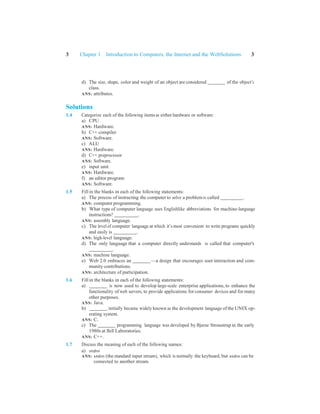
2 Chapter 1Introduction to Computers, the Internet and the WebSolutions 3
[***Instructor’s Manual***]
Self-Review Exercises
1.1 Fill in the blanks in each of the following:
a) Computers process data under the control of sequences of instructions called computer
.
ANS: programs.
b) is a type of computer language that uses Englishlike abbreviations for ma-
chine-language instructions.
ANS: Assembly language.
c) languages are most convenient to the programmer for writing programs
quickly and easily.
ANS: High-level.
d) The onlylanguage a computer can directly understand is that computer’s .
ANS: machine language.
e) The programs that translate high-level language programs into machine language are
called .
ANS: compilers.
f) With development, individuals and companies contribute their efforts in de-
veloping, maintaining and evolving software in exchange for the right to use that soft-
ware for their own purposes, typically at no charge.
ANS: open-source.
g) C is widely known as the development language of the operating system.
ANS: UNIX
1.2 Fill in the blanks in each of the following sentences about the C environment.
a) C programs are normally typed into a computer using a(n) program.
ANS: editor.
b) In a C system, a(n) program automatically executes before the translation
phase begins.
ANS: preprocessor.
c) The two most common kinds of preprocessor directives are and .
ANS: including other files in the file to be compiled, performing various text replacements.
d) The programcombines the output of the compiler with various library func-
tions to produce an executable image.
ANS: linker.
e) The program transfers the executable image from disk to memory.
ANS: loader.
1.3 Fill in the blanks in each of the following statements (based on Section 1.9):
a) Objects have the property of —although objects may know how to commu-
nicate with one another across well-defined interfaces, they normally are not allowed to
know how other objects are implemented.
ANS: information hiding.
b) In object-oriented programming languages, we create to house the set of
methods that perform tasks.
ANS: classes.
c) With , new classes of objects are derived by absorbing characteristics of existing
classes, then adding unique characteristics of their own.
ANS: inheritance.
6.
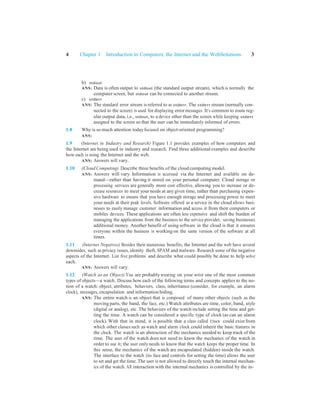
3 Chapter 1Introduction to Computers, the Internet and the WebSolutions 3
d) The size, shape, color and weight of an object are considered of the object’s
class.
ANS: attributes.
Solutions
1.4 Categorize each of the following items as either hardware or software:
a) CPU
ANS: Hardware.
b) C++ compiler
ANS: Software.
c) ALU
ANS: Hardware.
d) C++ preprocessor
ANS: Software.
e) input unit
ANS: Hardware.
f) an editor program
ANS: Software.
1.5 Fill in the blanks in each of the following statements:
a) The process of instructing the computer to solve a problemis called .
ANS: computer programming.
b) What type of computer language uses Englishlike abbreviations for machine-language
instructions? .
ANS: assembly language.
c) The level of computer language at which it’s most convenient to write programs quickly
and easily is .
ANS: high-level language.
d) The only language that a computer directly understands is called that computer's
.
ANS: machine language.
e) Web 2.0 embraces an —a design that encourages user interaction and com-
munity contributions.
ANS: architecture of participation.
1.6 Fill in the blanks in each of the following statements:
a) is now used to develop large-scale enterprise applications, to enhance the
functionality of web servers, to provide applications for consumer devices and for many
other purposes.
ANS: Java.
b) initially became widely known as the development language of the UNIX op-
erating system.
ANS: C.
c) The programming language was developed by Bjarne Stroustrup in the early
1980s at Bell Laboratories.
ANS: C++.
1.7 Discuss the meaning of each of the following names:
a) stdin
ANS: stdin (the standard input stream), which is normally the keyboard, but stdin can be
connected to another stream.
7.
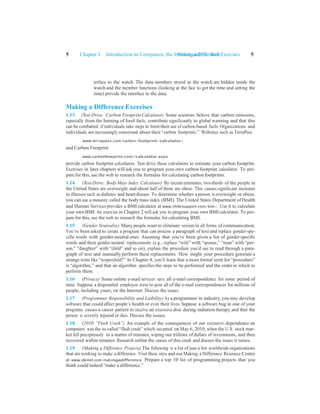
4 Chapter 1Introduction to Computers, the Internet and the WebSolutions 3
b) stdout
ANS: Data is often output to stdout (the standard output stream), which is normally the
computer screen, but stdout can be connected to another stream.
c) stderr
ANS: The standard error stream is referred to as stderr. The stderr stream (normally con-
nected to the screen) is used for displaying error messages. It’s common to route reg-
ular output data, i.e., stdout, to a device other than the screen while keeping stderr
assigned to the screen so that the user can be immediately informed of errors.
1.8 Why is so much attention todayfocused on object-oriented programming?
ANS:
1.9 (Internet in Industry and Research) Figure 1.1 provides examples of how computers and
the Internet are being used in industry and research. Find three additional examples and describe
how each is using the Internet and the web.
ANS: Answers will vary.
1.10 (Cloud Computing) Describe three benefits of the cloud computing model.
ANS: Answers will vary. Information is accessed via the Internet and available on de-
mand—rather than having it stored on your personal computer. Cloud storage or
processing services are generally more cost effective, allowing you to increase or de-
crease resources to meet your needs at anygiven time, rather than purchasing expen-
sive hardware to ensure that you have enough storage and processing power to meet
your needs at their peak levels. Software offered as a service in the cloud allows busi-
nesses to easily manage customer information and access it from their computers or
mobiles devices. These applications are often less expensive and shift the burden of
managing the applications from the business to the service provider, saving businesses
additional money. Another benefit of using software in the cloud is that it ensures
everyone within the business is working on the same version of the software at all
times.
1.11 (Internet Negatives) Besides their numerous benefits, the Internet and the web have several
downsides, such as privacy issues, identity theft, SPAM and malware. Research some of the negative
aspects of the Internet. List five problems and describe what could possibly be done to help solve
each.
ANS: Answers will vary.
1.12 (Watch as an Object) You are probablywearing on your wrist one of the most common
types of objects—a watch. Discuss how each of the following terms and concepts applies to the no-
tion of a watch: object, attributes, behaviors, class, inheritance (consider, for example, an alarm
clock), messages, encapsulation and information hiding.
ANS: The entire watch is an object that is composed of many other objects (such as the
moving parts, the band, the face, etc.) Watch attributes are time, color, band, style
(digital or analog), etc. The behaviors of the watch include setting the time and get-
ting the time. A watch can be considered a specific type of clock (as can an alarm
clock). With that in mind, it is possible that a class called Clock could exist from
which other classes such as watch and alarm clock could inherit the basic features in
the clock. The watch is an abstraction of the mechanics needed to keep track of the
time. The user of the watch does not need to know the mechanics of the watch in
order to use it; the user onlyneeds to know that the watch keeps the proper time. In
this sense, the mechanics of the watch are encapsulated (hidden) inside the watch.
The interface to the watch (its face and controls for setting the time) allows the user
to set and get the time. The user is not allowed to directly touch the internal mechan-
ics of the watch. All interaction with the internal mechanics is controlled by the in-
8.
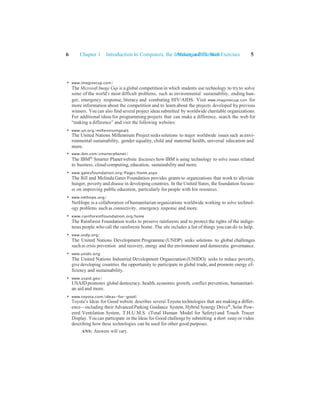
Making a DifferenceExercises 5
5 Chapter 1 Introduction to Computers, the Internet and the Web
terface to the watch. The data members stored in the watch are hidden inside the
watch and the member functions (looking at the face to get the time and setting the
time) provide the interface to the data.
Making a Difference Exercises
1.13 (Test-Drive: Carbon Footprint Calculator) Some scientists believe that carbon emissions,
especially from the burning of fossil fuels, contribute significantly to global warming and that this
can be combatted if individuals take steps to limit their use of carbon-based fuels. Organizations and
individuals are increasingly concerned about their “carbon footprints.” Websites such as TerraPass
www.terrapass.com/carbon-footprint-calculator/
and Carbon Footprint
www.carbonfootprint.com/calculator.aspx
provide carbon footprint calculators. Test-drive these calculators to estimate your carbon footprint.
Exercises in later chapters will ask you to program your own carbon footprint calculator. To pre-
pare for this, use the web to research the formulas for calculating carbon footprints.
1.14 (Test-Drive: Body Mass Index Calculator) By recent estimates, two-thirds of the people in
the United States are overweight and about half of those are obese. This causes significant increases
in illnesses such as diabetes and heart disease. To determine whether a person is overweight or obese,
you can use a measure called the bodymass index (BMI). The United States Department of Health
and Human Services provides a BMI calculator at www.nhlbisupport.com/bmi/. Use it to calculate
your own BMI. An exercise in Chapter 2 will ask you to program your own BMIcalculator. To pre-
pare for this, use the web to research the formulas for calculating BMI.
1.15 (Gender Neutrality) Manypeople want to eliminate sexism in all forms of communication.
You’ve been asked to create a program that can process a paragraph of text and replace gender-spe-
cific words with gender-neutral ones. Assuming that you’ve been given a list of gender-specific
words and their gender-neutral replacements (e.g., replace “wife” with “spouse,” “man” with “per-
son,” “daughter” with “child” and so on), explain the procedure you’d use to read through a para-
graph of text and manually perform these replacements. How might your procedure generate a
strange term like “woperchild?” In Chapter 4, you’ll learn that a more formal term for “procedure”
is “algorithm,” and that an algorithm specifies the steps to be performed and the order in which to
perform them.
1.16 (Privacy) Some online e-mail services save all e-mail correspondence for some period of
time. Suppose a disgruntled employee were to post all of the e-mail correspondences for millions of
people, including yours, on the Internet. Discuss the issues.
1.17 (Programmer Responsibility and Liability) As a programmer in industry, you may develop
software that could affect people’s health or even their lives. Suppose a software bug in one of your
programs causes a cancer patient to receive an excessive dose during radiation therapy and that the
person is severely injured or dies. Discuss the issues.
1.18 (2010 “Flash Crash”) An example of the consequences of our excessive dependence on
computers was the so-called “flash crash” which occurred on May 6, 2010, when the U.S. stock mar-
ket fell precipitously in a matter of minutes, wiping out trillions of dollars of investments, and then
recovered within minutes. Research online the causes of this crash and discuss the issues it raises.
1.19 (Making a Difference Projects) The following is a list of just a few worldwide organizations
that are working to make a difference. Visit these sites and our Making a Difference Resource Center
at www.deitel.com/makingadifference. Prepare a top 10 list of programming projects that you
think could indeed “make a difference.”
9.
Making a DifferenceExercises 5
6 Chapter 1 Introduction to Computers, the Internet and the Web
• www.imaginecup.com/
The Microsoft Image Cup is a global competition in which students use technology to tryto solve
some of the world’s most difficult problems, such as environmental sustainability, ending hun-
ger, emergency response, literacy and combating HIV/AIDS. Visit www.imaginecup.com for
more information about the competition and to learn about the projects developed by previous
winners. You can also find several project ideas submitted by worldwide charitable organizations.
For additional ideas for programming projects that can make a difference, search the web for
“making a difference” and visit the following websites:
• www.un.org/millenniumgoals
The United Nations Millennium Project seeks solutions to major worldwide issues such as envi-
ronmental sustainability, gender equality, child and maternal health, universal education and
more.
• www.ibm.com/smarterplanet/
The IBM® Smarter Planet website discusses how IBM is using technology to solve issues related
to business, cloud computing, education, sustainability and more.
• www.gatesfoundation.org/Pages/home.aspx
The Bill and Melinda Gates Foundation provides grants to organizations that work to alleviate
hunger, poverty and disease in developing countries. In the United States, the foundation focuss-
es on improving public education, particularly for people with few resources.
• www.nethope.org/
NetHope is a collaboration of humanitarian organizations worldwide working to solve technol-
ogy problems such as connectivity, emergency response and more.
• www.rainforestfoundation.org/home
The Rainforest Foundation works to preserve rainforests and to protect the rights of the indige-
nous people who call the rainforests home. The site includes a list of things you can do to help.
• www.undp.org/
The United Nations Development Programme (UNDP) seeks solutions to global challenges
such as crisis prevention and recovery, energy and the environment and democratic governance.
• www.unido.org
The United Nations Industrial Development Organization (UNIDO) seeks to reduce poverty,
give developing countries the opportunity to participate in global trade, and promote energy ef-
ficiency and sustainability.
• www.usaid.gov/
USAID promotes global democracy, health, economic growth, conflict prevention, humanitari-
an aid and more.
• www.toyota.com/ideas-for-good/
Toyota’s Ideas for Good website describes several Toyota technologies that are makinga differ-
ence—including their Advanced Parking Guidance System, Hybrid Synergy Drive®, Solar Pow-
ered Ventilation System, T.H.U.M.S. (Total Human Model for Safety) and Touch Tracer
Display. You can participate in the Ideas for Good challenge by submitting a short essay or video
describing how these technologies can be used for other good purposes.
ANS: Answers will vary.
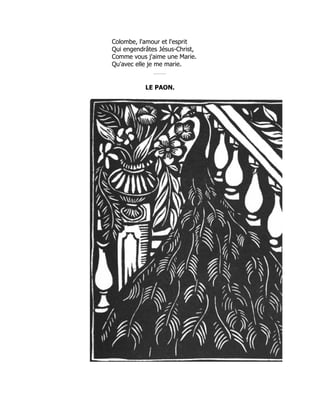
Colombe, l'amour etl'esprit
Qui engendrâtes Jésus-Christ,
Comme vous j'aime une Marie.
Qu'avec elle je me marie.
LE PAON.
12.
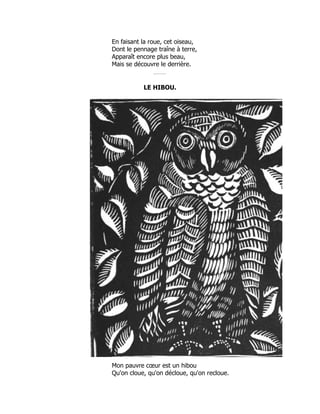
En faisant laroue, cet oiseau,
Dont le pennage traîne à terre,
Apparaît encore plus beau,
Mais se découvre le derrière.
LE HIBOU.
Mon pauvre cœur est un hibou
Qu'on cloue, qu'on décloue, qu'on recloue.
13.
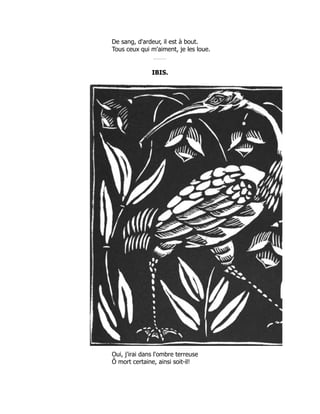
De sang, d'ardeur,il est à bout.
Tous ceux qui m'aiment, je les loue.
IBIS.
Oui, j'irai dans l'ombre terreuse
Ô mort certaine, ainsi soit-il!
14.
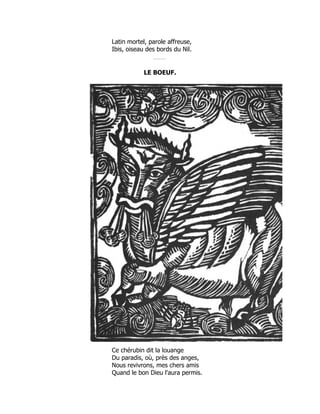
Latin mortel, paroleaffreuse,
Ibis, oiseau des bords du Nil.
LE BOEUF.
Ce chérubin dit la louange
Du paradis, où, près des anges,
Nous revivrons, mes chers amis
Quand le bon Dieu l'aura permis.
15.
NOTES.
Admirez le pouvoirinsigne
Et la noblesse de la ligne.
Il loue la ligne qui a formé les images, magnifiques ornements de ce divertissement
poétique.
Elle est la voix que la lumière fit entendre
Et dont parle Hermès Trismégiste en son Pimandre.
«Bientôt, lit-on dans le Pimandre, descendirent des ténèbres... et il en sortit un cri
inarticulé qui semblait la voix de la lumière.»
Cette voix de la lumière, n'est-ce pas le dessin» c'est-à-dire la ligne? Et quand la
lumière s'exprime pleinement tout se colore. La peinture est proprement un langage
lumineux.
Du Thrace magique.
Orphée était datif de la Thrace. Ce sublime poète jouait d'une lyre que Mercure lui
avait donnée. Elle était composée d'une carapace de tortue, de cuir collé à l'entour, de
deux branches, d'un chevalet et de cordes faites avec des boyaux de brebis. Mercure
donna également de ces lyres à Apollon et à Amphion. Quand Orphée jouait en
chantant, les animaux sauvages eux-mêmes venaient écouter son cantique. Orphée
inventa toutes les sciences, tous les arts. Fondé dans la magie, il connut l'avenir et
prédit chrétiennement l'avènement du SAUVEUR.
Mes durs rêves formels sauront te chevaucher,
Mon destin au char d'or sera ton beau cocher.
16.
Le premier quimonta Pégase fut Bellérophon quand il alla attaquer la Chimère. Il
existe aujourd'hui bien des chimères, et avant de combattre l'une d'elles, la plus
ennemie de la poésie, il convient de brider Pégase et même de l'atteler. On sait bien ce
que je veux dire.
La hase pleine qui conçoit.
Chez la femelle du lièvre la superfétation est possible.
Avec ses quatre dromadaires,
Don Pedro d'Alfaroubeira
Courut le monde et l'admira.
La célèbre relation de voyage intitulée: Historia del Infante D. Pedro de Portugal, en la
que se refiere lo que le sucedio en le viaje que hizo cuando anduvo las siete partes del
mundo, compuesto por Gomez de Santistevan, uno de los doce que llevo en su
compania el infante, rapporte que l'Infant du Portugal, don Pedro d'Alfaroubeira, se mit
en route avec douze compagnons pour visiter les sept parties du monde. Ces
voyageurs étaient montés sur quatre dromadaires, et après avoir passé en Espagne, ils
allèrent en Norvège et, de là, à Babylone et en Terre-Sainte. Le prince portugais visita
encore les états du prêtre Jean et revint dans son pays au bout de trois ans et quatre
mois.
Et le palais de Rosemonde.
Voici, touchant ce palais, témoignage de l'amour que le roi d'Angleterre éprouvait pour
sa maîtresse, ce couplet d'une complainte dont je ne connais point l'Auteur:
Pour mettre Rosemonde à l'abri de la haine
Que lui portait la reine,
Le roi fit construire un palais
Tel qu'on n'en vit jamais.
Les mouches ganiques qui sont
Les divinités de la neige.
Toutes n'apparaissent pas sous la forme de flocons, mais beaucoup ont été
apprivoisées par les sorciers finnois ou lapons et elles leur obéissent. Les magiciens se
les transmettent de père en fils et les gardent enfermées dans une boîte où elles se
tiennent invisibles, prêtes à s'envoler en essaim pour tourmenter les voleurs, tout en
chantant les paroles magiques, ainsi quelles-mêmes immortelles.
Voici la fine sauterelle,
La nourriture de saint Jean.
«Et erat Joannes vestitus pilis cameli, et zona pellicea, circa lumbos ejus, et locustas,
et mel silvestre edebat.» S. Marc. I, 6.
La femelle de l'alcyon,
L'Amour, les volantes Sirènes
Savent de mortelles chansons
Dangereuses et inhumaines.
17.
Les navigateurs, entendantchanter la femelle de l'alcyon, s'apprêtaient à mourir, sauf
toutefois vers la mi-décembre, où ces oiseaux font leurs nids, et l'on pensait qu'alors la
mer était calme. Quant à l'Amour et quant aux Sirènes, ces oiseaux merveilleux
chantent si harmonieusement que la vie même de celui qui les écoute n'est pas un prix
trop élevé pour payer une telle musique.
Ce chérubin.
On distingue parmi les hiérarchies célestes, vouées au service et à la gloire de la
divinité, des êtres aux formes inconnues et de la plus surprenante beauté. Les
chérubins sont des bœufs ailés, mais aucunement monstrueux.
Quand le bon Dieu l'aura permis.
Ceux qui s'exercent à la poésie ne recherchent et n'aiment rien autre que la perfection
qui est Dieu lui-même. Et cette divine bonté, cette suprême perfection
abandonneraient ceux dont la vie n'a eu pour but que de les découvrir et de les
glorifier? Cela paraît impossible, et, à mon sens, les poètes ont le droit d'espérer après
leur mort le bonheur perdurable que procure l'entière connaissance de Dieu, c'est-à-
dire de la sublime beauté.
18.
*** END OFTHE PROJECT GUTENBERG EBOOK LE BESTIAIRE: OU,
CORTÈGE D'ORPHÉE ***
Updated editions will replace the previous one—the old editions will
be renamed.
Creating the works from print editions not protected by U.S.
copyright law means that no one owns a United States copyright in
these works, so the Foundation (and you!) can copy and distribute it
in the United States without permission and without paying
copyright royalties. Special rules, set forth in the General Terms of
Use part of this license, apply to copying and distributing Project
Gutenberg™ electronic works to protect the PROJECT GUTENBERG™
concept and trademark. Project Gutenberg is a registered trademark,
and may not be used if you charge for an eBook, except by following
the terms of the trademark license, including paying royalties for use
of the Project Gutenberg trademark. If you do not charge anything
for copies of this eBook, complying with the trademark license is
very easy. You may use this eBook for nearly any purpose such as
creation of derivative works, reports, performances and research.
Project Gutenberg eBooks may be modified and printed and given
away—you may do practically ANYTHING in the United States with
eBooks not protected by U.S. copyright law. Redistribution is subject
to the trademark license, especially commercial redistribution.
START: FULL LICENSE
PLEASE READ THISBEFORE YOU DISTRIBUTE OR USE THIS WORK
To protect the Project Gutenberg™ mission of promoting the free
distribution of electronic works, by using or distributing this work (or
any other work associated in any way with the phrase “Project
Gutenberg”), you agree to comply with all the terms of the Full
Project Gutenberg™ License available with this file or online at
www.gutenberg.org/license.
Section 1. General Terms of Use and
Redistributing Project Gutenberg™
electronic works
1.A. By reading or using any part of this Project Gutenberg™
electronic work, you indicate that you have read, understand, agree
to and accept all the terms of this license and intellectual property
(trademark/copyright) agreement. If you do not agree to abide by all
the terms of this agreement, you must cease using and return or
destroy all copies of Project Gutenberg™ electronic works in your
possession. If you paid a fee for obtaining a copy of or access to a
Project Gutenberg™ electronic work and you do not agree to be
bound by the terms of this agreement, you may obtain a refund
from the person or entity to whom you paid the fee as set forth in
paragraph 1.E.8.
1.B. “Project Gutenberg” is a registered trademark. It may only be
used on or associated in any way with an electronic work by people
who agree to be bound by the terms of this agreement. There are a
few things that you can do with most Project Gutenberg™ electronic
works even without complying with the full terms of this agreement.
See paragraph 1.C below. There are a lot of things you can do with
Project Gutenberg™ electronic works if you follow the terms of this
agreement and help preserve free future access to Project
Gutenberg™ electronic works. See paragraph 1.E below.
21.
1.C. The ProjectGutenberg Literary Archive Foundation (“the
Foundation” or PGLAF), owns a compilation copyright in the
collection of Project Gutenberg™ electronic works. Nearly all the
individual works in the collection are in the public domain in the
United States. If an individual work is unprotected by copyright law
in the United States and you are located in the United States, we do
not claim a right to prevent you from copying, distributing,
performing, displaying or creating derivative works based on the
work as long as all references to Project Gutenberg are removed. Of
course, we hope that you will support the Project Gutenberg™
mission of promoting free access to electronic works by freely
sharing Project Gutenberg™ works in compliance with the terms of
this agreement for keeping the Project Gutenberg™ name associated
with the work. You can easily comply with the terms of this
agreement by keeping this work in the same format with its attached
full Project Gutenberg™ License when you share it without charge
with others.
1.D. The copyright laws of the place where you are located also
govern what you can do with this work. Copyright laws in most
countries are in a constant state of change. If you are outside the
United States, check the laws of your country in addition to the
terms of this agreement before downloading, copying, displaying,
performing, distributing or creating derivative works based on this
work or any other Project Gutenberg™ work. The Foundation makes
no representations concerning the copyright status of any work in
any country other than the United States.
1.E. Unless you have removed all references to Project Gutenberg:
1.E.1. The following sentence, with active links to, or other
immediate access to, the full Project Gutenberg™ License must
appear prominently whenever any copy of a Project Gutenberg™
work (any work on which the phrase “Project Gutenberg” appears,
or with which the phrase “Project Gutenberg” is associated) is
accessed, displayed, performed, viewed, copied or distributed:
22.
This eBook isfor the use of anyone anywhere in the United
States and most other parts of the world at no cost and with
almost no restrictions whatsoever. You may copy it, give it away
or re-use it under the terms of the Project Gutenberg License
included with this eBook or online at www.gutenberg.org. If you
are not located in the United States, you will have to check the
laws of the country where you are located before using this
eBook.
1.E.2. If an individual Project Gutenberg™ electronic work is derived
from texts not protected by U.S. copyright law (does not contain a
notice indicating that it is posted with permission of the copyright
holder), the work can be copied and distributed to anyone in the
United States without paying any fees or charges. If you are
redistributing or providing access to a work with the phrase “Project
Gutenberg” associated with or appearing on the work, you must
comply either with the requirements of paragraphs 1.E.1 through
1.E.7 or obtain permission for the use of the work and the Project
Gutenberg™ trademark as set forth in paragraphs 1.E.8 or 1.E.9.
1.E.3. If an individual Project Gutenberg™ electronic work is posted
with the permission of the copyright holder, your use and distribution
must comply with both paragraphs 1.E.1 through 1.E.7 and any
additional terms imposed by the copyright holder. Additional terms
will be linked to the Project Gutenberg™ License for all works posted
with the permission of the copyright holder found at the beginning
of this work.
1.E.4. Do not unlink or detach or remove the full Project
Gutenberg™ License terms from this work, or any files containing a
part of this work or any other work associated with Project
Gutenberg™.
1.E.5. Do not copy, display, perform, distribute or redistribute this
electronic work, or any part of this electronic work, without
prominently displaying the sentence set forth in paragraph 1.E.1
23.
with active linksor immediate access to the full terms of the Project
Gutenberg™ License.
1.E.6. You may convert to and distribute this work in any binary,
compressed, marked up, nonproprietary or proprietary form,
including any word processing or hypertext form. However, if you
provide access to or distribute copies of a Project Gutenberg™ work
in a format other than “Plain Vanilla ASCII” or other format used in
the official version posted on the official Project Gutenberg™ website
(www.gutenberg.org), you must, at no additional cost, fee or
expense to the user, provide a copy, a means of exporting a copy, or
a means of obtaining a copy upon request, of the work in its original
“Plain Vanilla ASCII” or other form. Any alternate format must
include the full Project Gutenberg™ License as specified in
paragraph 1.E.1.
1.E.7. Do not charge a fee for access to, viewing, displaying,
performing, copying or distributing any Project Gutenberg™ works
unless you comply with paragraph 1.E.8 or 1.E.9.
1.E.8. You may charge a reasonable fee for copies of or providing
access to or distributing Project Gutenberg™ electronic works
provided that:
• You pay a royalty fee of 20% of the gross profits you derive
from the use of Project Gutenberg™ works calculated using the
method you already use to calculate your applicable taxes. The
fee is owed to the owner of the Project Gutenberg™ trademark,
but he has agreed to donate royalties under this paragraph to
the Project Gutenberg Literary Archive Foundation. Royalty
payments must be paid within 60 days following each date on
which you prepare (or are legally required to prepare) your
periodic tax returns. Royalty payments should be clearly marked
as such and sent to the Project Gutenberg Literary Archive
Foundation at the address specified in Section 4, “Information
24.
about donations tothe Project Gutenberg Literary Archive
Foundation.”
• You provide a full refund of any money paid by a user who
notifies you in writing (or by e-mail) within 30 days of receipt
that s/he does not agree to the terms of the full Project
Gutenberg™ License. You must require such a user to return or
destroy all copies of the works possessed in a physical medium
and discontinue all use of and all access to other copies of
Project Gutenberg™ works.
• You provide, in accordance with paragraph 1.F.3, a full refund of
any money paid for a work or a replacement copy, if a defect in
the electronic work is discovered and reported to you within 90
days of receipt of the work.
• You comply with all other terms of this agreement for free
distribution of Project Gutenberg™ works.
1.E.9. If you wish to charge a fee or distribute a Project Gutenberg™
electronic work or group of works on different terms than are set
forth in this agreement, you must obtain permission in writing from
the Project Gutenberg Literary Archive Foundation, the manager of
the Project Gutenberg™ trademark. Contact the Foundation as set
forth in Section 3 below.
1.F.
1.F.1. Project Gutenberg volunteers and employees expend
considerable effort to identify, do copyright research on, transcribe
and proofread works not protected by U.S. copyright law in creating
the Project Gutenberg™ collection. Despite these efforts, Project
Gutenberg™ electronic works, and the medium on which they may
be stored, may contain “Defects,” such as, but not limited to,
incomplete, inaccurate or corrupt data, transcription errors, a
copyright or other intellectual property infringement, a defective or
25.
damaged disk orother medium, a computer virus, or computer
codes that damage or cannot be read by your equipment.
1.F.2. LIMITED WARRANTY, DISCLAIMER OF DAMAGES - Except for
the “Right of Replacement or Refund” described in paragraph 1.F.3,
the Project Gutenberg Literary Archive Foundation, the owner of the
Project Gutenberg™ trademark, and any other party distributing a
Project Gutenberg™ electronic work under this agreement, disclaim
all liability to you for damages, costs and expenses, including legal
fees. YOU AGREE THAT YOU HAVE NO REMEDIES FOR
NEGLIGENCE, STRICT LIABILITY, BREACH OF WARRANTY OR
BREACH OF CONTRACT EXCEPT THOSE PROVIDED IN PARAGRAPH
1.F.3. YOU AGREE THAT THE FOUNDATION, THE TRADEMARK
OWNER, AND ANY DISTRIBUTOR UNDER THIS AGREEMENT WILL
NOT BE LIABLE TO YOU FOR ACTUAL, DIRECT, INDIRECT,
CONSEQUENTIAL, PUNITIVE OR INCIDENTAL DAMAGES EVEN IF
YOU GIVE NOTICE OF THE POSSIBILITY OF SUCH DAMAGE.
1.F.3. LIMITED RIGHT OF REPLACEMENT OR REFUND - If you
discover a defect in this electronic work within 90 days of receiving
it, you can receive a refund of the money (if any) you paid for it by
sending a written explanation to the person you received the work
from. If you received the work on a physical medium, you must
return the medium with your written explanation. The person or
entity that provided you with the defective work may elect to provide
a replacement copy in lieu of a refund. If you received the work
electronically, the person or entity providing it to you may choose to
give you a second opportunity to receive the work electronically in
lieu of a refund. If the second copy is also defective, you may
demand a refund in writing without further opportunities to fix the
problem.
1.F.4. Except for the limited right of replacement or refund set forth
in paragraph 1.F.3, this work is provided to you ‘AS-IS’, WITH NO
OTHER WARRANTIES OF ANY KIND, EXPRESS OR IMPLIED,
26.
INCLUDING BUT NOTLIMITED TO WARRANTIES OF
MERCHANTABILITY OR FITNESS FOR ANY PURPOSE.
1.F.5. Some states do not allow disclaimers of certain implied
warranties or the exclusion or limitation of certain types of damages.
If any disclaimer or limitation set forth in this agreement violates the
law of the state applicable to this agreement, the agreement shall be
interpreted to make the maximum disclaimer or limitation permitted
by the applicable state law. The invalidity or unenforceability of any
provision of this agreement shall not void the remaining provisions.
1.F.6. INDEMNITY - You agree to indemnify and hold the Foundation,
the trademark owner, any agent or employee of the Foundation,
anyone providing copies of Project Gutenberg™ electronic works in
accordance with this agreement, and any volunteers associated with
the production, promotion and distribution of Project Gutenberg™
electronic works, harmless from all liability, costs and expenses,
including legal fees, that arise directly or indirectly from any of the
following which you do or cause to occur: (a) distribution of this or
any Project Gutenberg™ work, (b) alteration, modification, or
additions or deletions to any Project Gutenberg™ work, and (c) any
Defect you cause.
Section 2. Information about the Mission
of Project Gutenberg™
Project Gutenberg™ is synonymous with the free distribution of
electronic works in formats readable by the widest variety of
computers including obsolete, old, middle-aged and new computers.
It exists because of the efforts of hundreds of volunteers and
donations from people in all walks of life.
Volunteers and financial support to provide volunteers with the
assistance they need are critical to reaching Project Gutenberg™’s
goals and ensuring that the Project Gutenberg™ collection will
27.
remain freely availablefor generations to come. In 2001, the Project
Gutenberg Literary Archive Foundation was created to provide a
secure and permanent future for Project Gutenberg™ and future
generations. To learn more about the Project Gutenberg Literary
Archive Foundation and how your efforts and donations can help,
see Sections 3 and 4 and the Foundation information page at
www.gutenberg.org.
Section 3. Information about the Project
Gutenberg Literary Archive Foundation
The Project Gutenberg Literary Archive Foundation is a non-profit
501(c)(3) educational corporation organized under the laws of the
state of Mississippi and granted tax exempt status by the Internal
Revenue Service. The Foundation’s EIN or federal tax identification
number is 64-6221541. Contributions to the Project Gutenberg
Literary Archive Foundation are tax deductible to the full extent
permitted by U.S. federal laws and your state’s laws.
The Foundation’s business office is located at 809 North 1500 West,
Salt Lake City, UT 84116, (801) 596-1887. Email contact links and up
to date contact information can be found at the Foundation’s website
and official page at www.gutenberg.org/contact
Section 4. Information about Donations to
the Project Gutenberg Literary Archive
Foundation
Project Gutenberg™ depends upon and cannot survive without
widespread public support and donations to carry out its mission of
increasing the number of public domain and licensed works that can
be freely distributed in machine-readable form accessible by the
widest array of equipment including outdated equipment. Many
28.
small donations ($1to $5,000) are particularly important to
maintaining tax exempt status with the IRS.
The Foundation is committed to complying with the laws regulating
charities and charitable donations in all 50 states of the United
States. Compliance requirements are not uniform and it takes a
considerable effort, much paperwork and many fees to meet and
keep up with these requirements. We do not solicit donations in
locations where we have not received written confirmation of
compliance. To SEND DONATIONS or determine the status of
compliance for any particular state visit www.gutenberg.org/donate.
While we cannot and do not solicit contributions from states where
we have not met the solicitation requirements, we know of no
prohibition against accepting unsolicited donations from donors in
such states who approach us with offers to donate.
International donations are gratefully accepted, but we cannot make
any statements concerning tax treatment of donations received from
outside the United States. U.S. laws alone swamp our small staff.
Please check the Project Gutenberg web pages for current donation
methods and addresses. Donations are accepted in a number of
other ways including checks, online payments and credit card
donations. To donate, please visit: www.gutenberg.org/donate.
Section 5. General Information About
Project Gutenberg™ electronic works
Professor Michael S. Hart was the originator of the Project
Gutenberg™ concept of a library of electronic works that could be
freely shared with anyone. For forty years, he produced and
distributed Project Gutenberg™ eBooks with only a loose network of
volunteer support.
29.
Project Gutenberg™ eBooksare often created from several printed
editions, all of which are confirmed as not protected by copyright in
the U.S. unless a copyright notice is included. Thus, we do not
necessarily keep eBooks in compliance with any particular paper
edition.
Most people start at our website which has the main PG search
facility: www.gutenberg.org.
This website includes information about Project Gutenberg™,
including how to make donations to the Project Gutenberg Literary
Archive Foundation, how to help produce our new eBooks, and how
to subscribe to our email newsletter to hear about new eBooks.


![2 Chapter 1 Introduction to Computers, the Internet and the WebSolutions 3
[***Instructor’s Manual***]
Self-Review Exercises
1.1 Fill in the blanks in each of the following:
a) Computers process data under the control of sequences of instructions called computer
.
ANS: programs.
b) is a type of computer language that uses Englishlike abbreviations for ma-
chine-language instructions.
ANS: Assembly language.
c) languages are most convenient to the programmer for writing programs
quickly and easily.
ANS: High-level.
d) The onlylanguage a computer can directly understand is that computer’s .
ANS: machine language.
e) The programs that translate high-level language programs into machine language are
called .
ANS: compilers.
f) With development, individuals and companies contribute their efforts in de-
veloping, maintaining and evolving software in exchange for the right to use that soft-
ware for their own purposes, typically at no charge.
ANS: open-source.
g) C is widely known as the development language of the operating system.
ANS: UNIX
1.2 Fill in the blanks in each of the following sentences about the C environment.
a) C programs are normally typed into a computer using a(n) program.
ANS: editor.
b) In a C system, a(n) program automatically executes before the translation
phase begins.
ANS: preprocessor.
c) The two most common kinds of preprocessor directives are and .
ANS: including other files in the file to be compiled, performing various text replacements.
d) The programcombines the output of the compiler with various library func-
tions to produce an executable image.
ANS: linker.
e) The program transfers the executable image from disk to memory.
ANS: loader.
1.3 Fill in the blanks in each of the following statements (based on Section 1.9):
a) Objects have the property of —although objects may know how to commu-
nicate with one another across well-defined interfaces, they normally are not allowed to
know how other objects are implemented.
ANS: information hiding.
b) In object-oriented programming languages, we create to house the set of
methods that perform tasks.
ANS: classes.
c) With , new classes of objects are derived by absorbing characteristics of existing
classes, then adding unique characteristics of their own.
ANS: inheritance.](https://image.slidesharecdn.com/83-250228160914-5c401ff9/85/Solution-Manual-for-C-How-to-Program-7-E-7th-Edition-Paul-Deitel-Harvey-Deitel-5-320.jpg)