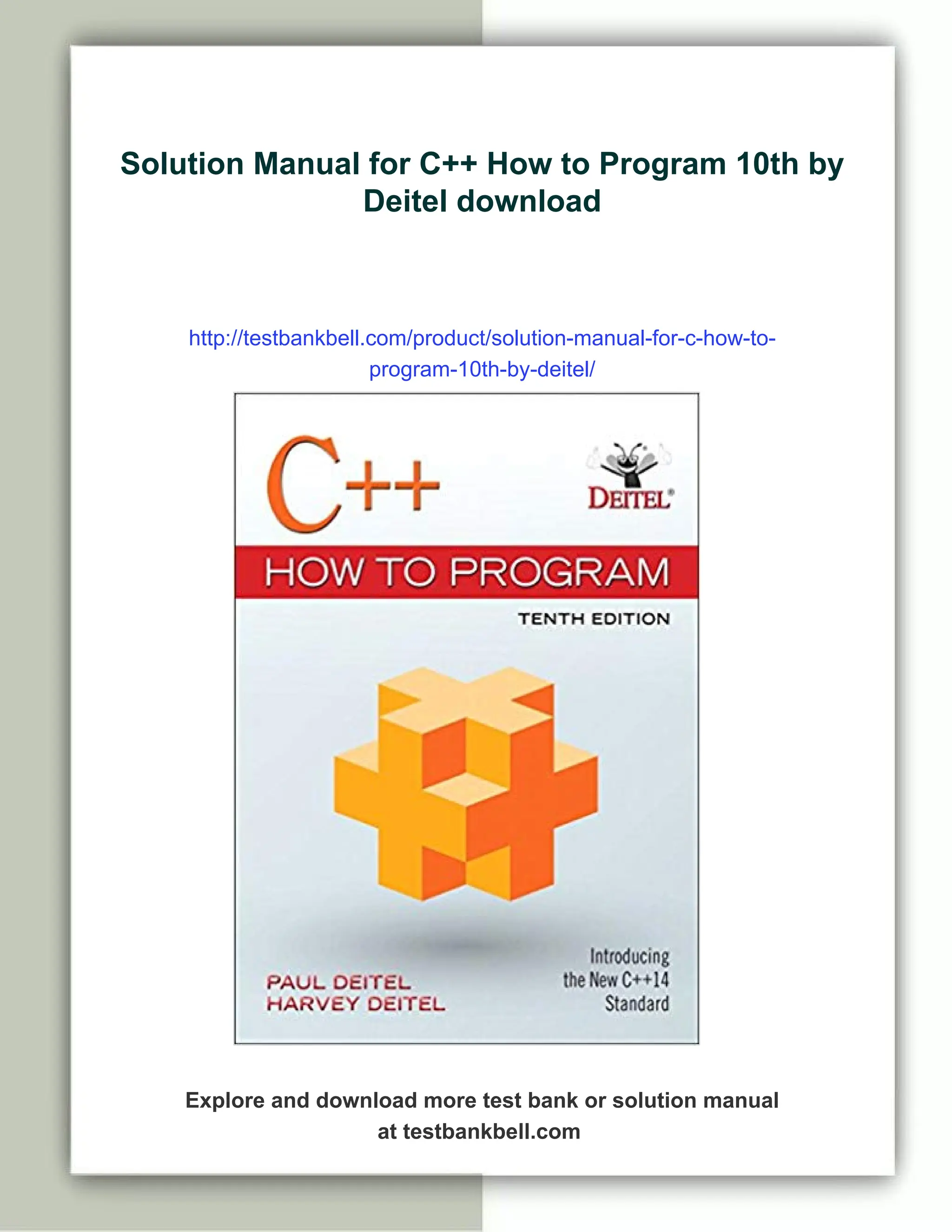
Solution Manual for C++ How to Program 10th by Deitel
Solution Manual for C++ How to Program 10th by Deitel
Solution Manual for C++ How to Program 10th by Deitel
Solution Manual for C++ How to Program 10th by Deitel
Solution Manual for C++ How to Program 10th by Deitel
1.
Solution Manual forC++ How to Program 10th by
Deitel download
http://testbankbell.com/product/solution-manual-for-c-how-to-
program-10th-by-deitel/
Explore and download more test bank or solution manual
at testbankbell.com
2.
Here are somerecommended products for you. Click the link to
download, or explore more at testbankbell.com
C++ How to Program 10th Edition Deitel Solutions Manual
http://testbankbell.com/product/c-how-to-program-10th-edition-deitel-
solutions-manual/
Solution Manual for C How to Program, 8th Edition, Paul J.
Deitel, Harvey Deitel
http://testbankbell.com/product/solution-manual-for-c-how-to-
program-8th-edition-paul-j-deitel-harvey-deitel/
Solution Manual for C How to Program, 7/E 7th Edition Paul
Deitel, Harvey Deitel
http://testbankbell.com/product/solution-manual-for-c-how-to-
program-7-e-7th-edition-paul-deitel-harvey-deitel/
Test Bank for Accounting, 25th Edition
http://testbankbell.com/product/test-bank-for-accounting-25th-edition/
3.
Taxation of Individualsand Business Entities 2017 8th
Edition Spilker Test Bank
http://testbankbell.com/product/taxation-of-individuals-and-business-
entities-2017-8th-edition-spilker-test-bank/
Solution Manual for Cost Accounting 14th Edition by
Horngren
http://testbankbell.com/product/solution-manual-for-cost-
accounting-14th-edition-by-horngren/
Test Bank for Business Analytics, 4th Edition, Jeffrey D.
Camm, James J. Cochran, Michael J. Fry, Jeffrey W. Ohlmann
http://testbankbell.com/product/test-bank-for-business-analytics-4th-
edition-jeffrey-d-camm-james-j-cochran-michael-j-fry-jeffrey-w-
ohlmann-2/
Test Bank for Texas Politics: Ideal and Reality, Enhanced,
13th Edition, Charldean Newell, David F. Prindle, James
Riddlesperger
http://testbankbell.com/product/test-bank-for-texas-politics-ideal-
and-reality-enhanced-13th-edition-charldean-newell-david-f-prindle-
james-riddlesperger/
Test Bank for BUSN 11th Edition Marcella Kelly Chuck
Williams
http://testbankbell.com/product/test-bank-for-busn-11th-edition-
marcella-kelly-chuck-williams/
4.
Solutions Manual toaccompany Physics 4th by James S.
Walker 032190303X / 9780321903037
http://testbankbell.com/product/solutions-manual-to-accompany-
physics-4th-by-james-s-walker-032190303x-9780321903037/
5.
1
C++ How toProgram 10th by Deitel
Full chapter at: https://testbankbell.com/product/solution-manual-for-c-how-to-program-10th-
by-deitel/
Introduction to Computers
and C++
O bje ctive s
In this chapter you’ll learn:
■ Exciting recent developments
in the computer field.
■ Computer hardware, soft-
ware and networking basics.
■ The data hierarchy.
■ The different types of
programming languages.
■ Basic object-technology
concepts.
■ Some basics of the Internet
and the World Wide Web.
■ A typical C++ program
development environment.
■ To test-drive a C++
application.
■ Some key recent software
technologies.
■ How computers can help you
make a difference.
6.
2 Chapter 1Introduction to Computers and C++ Exercises 3
Self-Review Exercises
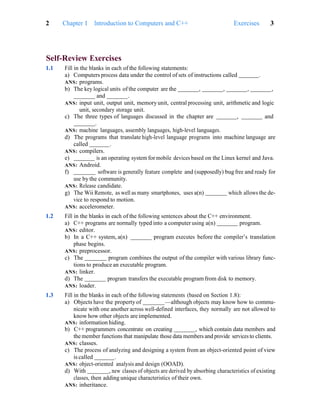
1.1 Fill in the blanks in each of the following statements:
a) Computers process data under the control of sets of instructions called .
ANS: programs.
b) The key logical units of the computer are the , , , ,
and .
ANS: input unit, output unit, memoryunit, central processing unit, arithmetic and logic
unit, secondary storage unit.
c) The three types of languages discussed in the chapter are , and
.
ANS: machine languages, assembly languages, high-level languages.
d) The programs that translate high-level language programs into machine language are
called .
ANS: compilers.
e) is an operating system for mobile devices based on the Linux kernel and Java.
ANS: Android.
f) software is generally feature complete and (supposedly) bug free and ready for
use by the community.
ANS: Release candidate.
g) The Wii Remote, as well as many smartphones, uses a(n) which allows the de-
vice to respond to motion.
ANS: accelerometer.
1.2 Fill in the blanks in each of the following sentences about the C++ environment.
a) C++ programs are normally typed into a computer using a(n) program.
ANS: editor.
b) In a C++ system, a(n) program executes before the compiler’s translation
phase begins.
ANS: preprocessor.
c) The program combines the output of the compiler with various library func-
tions to produce an executable program.
ANS: linker.
d) The program transfers the executable programfrom disk to memory.
ANS: loader.
1.3 Fill in the blanks in each of the following statements (based on Section 1.8):
a) Objects have the property of —although objects may know how to commu-
nicate with one another across well-defined interfaces, they normally are not allowed to
know how other objects are implemented.
ANS: information hiding.
b) C++ programmers concentrate on creating , which contain data members and
the member functions that manipulate those data members and provide services to clients.
ANS: classes.
c) The process of analyzing and designing a system from an object-oriented point of view
is called .
ANS: object-oriented analysis and design (OOAD).
d) With , new classes of objects are derived by absorbing characteristics of existing
classes, then adding unique characteristics of their own.
ANS: inheritance.
7.
3 Chapter 1Introduction to Computers and C++ Exercises 3
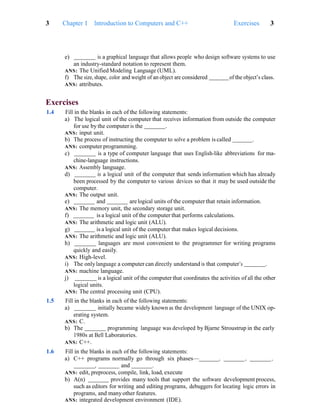
e) is a graphical language that allows people who design software systems to use
an industry-standard notation to represent them.
ANS: The Unified Modeling Language (UML).
f) The size, shape, color and weight of an object are considered of the object’s class.
ANS: attributes.
Exercises
1.4 Fill in the blanks in each of the following statements:
a) The logical unit of the computer that receives information from outside the computer
for use by the computer is the .
ANS: input unit.
b) The process of instructing the computer to solve a problem is called .
ANS: computer programming.
c) is a type of computer language that uses English-like abbreviations for ma-
chine-language instructions.
ANS: Assembly language.
d) is a logical unit of the computer that sends information which has already
been processed by the computer to various devices so that it may be used outside the
computer.
ANS: The output unit.
e) and are logical units of the computer that retain information.
ANS: The memory unit, the secondary storage unit.
f) is a logical unit of the computer that performs calculations.
ANS: The arithmetic and logic unit (ALU).
g) is a logical unit of the computer that makes logical decisions.
ANS: The arithmetic and logic unit (ALU).
h) languages are most convenient to the programmer for writing programs
quickly and easily.
ANS: High-level.
i) The onlylanguage a computer can directly understand is that computer’s .
ANS: machine language.
j) is a logical unit of the computer that coordinates the activities of all the other
logical units.
ANS: The central processing unit (CPU).
1.5 Fill in the blanks in each of the following statements:
a) initially became widely known as the development language of the UNIX op-
erating system.
ANS: C.
b) The programming language was developed by Bjarne Stroustrup in the early
1980s at Bell Laboratories.
ANS: C++.
1.6 Fill in the blanks in each of the following statements:
a) C++ programs normally go through six phases— , , ,
, and .
ANS: edit, preprocess, compile, link, load, execute
b) A(n) provides many tools that support the software development process,
such as editors for writing and editing programs, debuggers for locating logic errors in
programs, and manyother features.
ANS: integrated development environment (IDE).
8.
4 Chapter 1Introduction to Computers and C++ Exercises 3
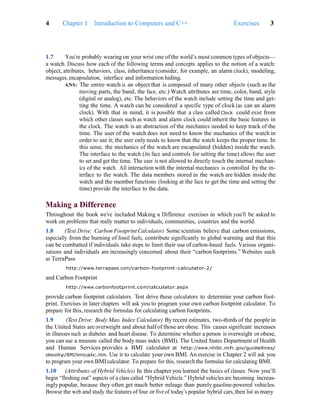
1.7 You’re probably wearing on your wrist one of the world’s most common types of objects—
a watch. Discuss how each of the following terms and concepts applies to the notion of a watch:
object, attributes, behaviors, class, inheritance (consider, for example, an alarm clock), modeling,
messages, encapsulation, interface and information hiding.
ANS: The entire watch is an object that is composed of many other objects (such as the
moving parts, the band, the face, etc.) Watch attributes are time, color, band, style
(digital or analog), etc. The behaviors of the watch include setting the time and get-
ting the time. A watch can be considered a specific type of clock (as can an alarm
clock). With that in mind, it is possible that a class called Clock could exist from
which other classes such as watch and alarm clock could inherit the basic features in
the clock. The watch is an abstraction of the mechanics needed to keep track of the
time. The user of the watch does not need to know the mechanics of the watch in
order to use it; the user only needs to know that the watch keeps the proper time. In
this sense, the mechanics of the watch are encapsulated (hidden) inside the watch.
The interface to the watch (its face and controls for setting the time) allows the user
to set and get the time. The user is not allowed to directly touch the internal mechan-
ics of the watch. All interaction with the internal mechanics is controlled by the in-
terface to the watch. The data members stored in the watch are hidden inside the
watch and the member functions (looking at the face to get the time and setting the
time) provide the interface to the data.
Making a Difference
Throughout the book we’ve included Making a Difference exercises in which you’ll be asked to
work on problems that really matter to individuals, communities, countries and the world.
1.8 (Test Drive: Carbon Footprint Calculator) Some scientists believe that carbon emissions,
especially from the burning of fossil fuels, contribute significantly to global warming and that this
can be combatted if individuals take steps to limit their use of carbon-based fuels. Various organi-
zations and individuals are increasingly concerned about their “carbon footprints.” Websites such
as TerraPass
http://www.terrapass.com/carbon-footprint-calculator-2/
and Carbon Footprint
http://www.carbonfootprint.com/calculator.aspx
provide carbon footprint calculators. Test drive these calculators to determine your carbon foot-
print. Exercises in later chapters will ask you to program your own carbon footprint calculator. To
prepare for this, research the formulas for calculating carbon footprints.
1.9 (Test Drive: Body Mass Index Calculator) By recent estimates, two-thirds of the people in
the United States are overweight and about halfof those are obese. This causes significant increases
in illnesses such as diabetes and heart disease. To determine whether a person is overweight or obese,
you can use a measure called the body mass index (BMI). The United States Department of Health
and Human Services provides a BMI calculator at http://www.nhlbi.nih.gov/guidelines/
obesity/BMI/bmicalc.htm. Use it to calculate your own BMI. An exercise in Chapter 2 will ask you
to program your own BMIcalculator. To prepare for this, research the formulas for calculating BMI.
1.10 (Attributes of Hybrid Vehicles) In this chapter you learned the basics of classes. Now you’ll
begin “fleshing out” aspects of a class called “Hybrid Vehicle.” Hybrid vehicles are becoming increas-
inglypopular, because they often get much better mileage than purely gasoline-powered vehicles.
Browse the web and study the features of four or five of today’s popular hybrid cars, then list as many
9.
Making a Difference5
5 Chapter 1 Introduction to Computers and C++
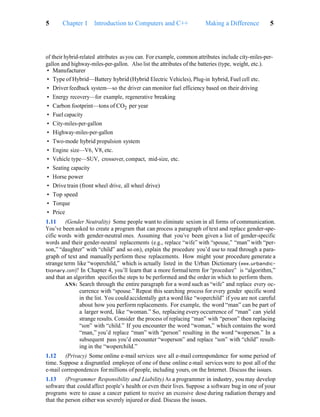
of their hybrid-related attributes as you can. For example, common attributes include city-miles-per-
gallon and highway-miles-per-gallon. Also list the attributes of the batteries (type, weight, etc.).
• Manufacturer
• Type of Hybrid—Battery hybrid (Hybrid Electric Vehicles), Plug-in hybrid, Fuel cell etc.
• Driver feedback system—so the driver can monitor fuel efficiency based on their driving
• Energy recovery—for example, regenerative breaking
• Carbon footprint—tons of CO2 per year
• Fuel capacity
• City-miles-per-gallon
• Highway-miles-per-gallon
• Two-mode hybrid propulsion system
• Engine size—V6, V8, etc.
• Vehicle type—SUV, crossover, compact, mid-size, etc.
• Seating capacity
• Horse power
• Drive train (front wheel drive, all wheel drive)
• Top speed
• Torque
• Price
1.11 (Gender Neutrality) Some people want to eliminate sexism in all forms of communication.
You’ve been asked to create a program that can process a paragraph of text and replace gender-spe-
cific words with gender-neutral ones. Assuming that you’ve been given a list of gender-specific
words and their gender-neutral replacements (e.g., replace “wife” with “spouse,” “man” with “per-
son,” “daughter” with “child” and so on), explain the procedure you’d use to read through a para-
graph of text and manually perform these replacements. How might your procedure generate a
strange term like “woperchild,” which is actually listed in the Urban Dictionary (www.urbandic-
tionary.com)? In Chapter 4, you’ll learn that a more formal term for “procedure” is “algorithm,”
and that an algorithm specifies the steps to be performed and the order in which to perform them.
ANS: Search through the entire paragraph for a word such as “wife” and replace every oc-
currence with “spouse.” Repeat this searching process for every gender specific word
in the list. You could accidentally get a word like “woperchild” if you are not careful
about how you perform replacements. For example, the word “man” can be part of
a larger word, like “woman.” So, replacing every occurrence of “man” can yield
strange results. Consider the process of replacing “man” with “person” then replacing
“son” with “child.” If you encounter the word “woman,” which contains the word
“man,” you’d replace “man” with “person” resulting in the word “woperson.” In a
subsequent pass you’d encounter “woperson” and replace “son” with “child” result-
ing in the “woperchild.”
1.12 (Privacy) Some online e-mail services save all e-mail correspondence for some period of
time. Suppose a disgruntled employee of one of these online e-mail services were to post all of the
e-mail correspondences for millions of people, including yours, on the Internet. Discuss the issues.
1.13 (Programmer Responsibility and Liability) As a programmer in industry, you may develop
software that could affect people’s health or even their lives. Suppose a software bug in one of your
programs were to cause a cancer patient to receive an excessive dose during radiation therapy and
that the person either was severely injured or died. Discuss the issues.
10.
Making a Difference5
6 Chapter 1 Introduction to Computers and C++
1.14 (2010 “Flash Crash”) An example of the consequences of our dependency on computers
was the so-called “flash crash” which occurred on May 6, 2010, when the U.S. stock market fell pre-
cipitously in a matter of minutes, wiping out trillions of dollars of investments, and then recovered
within minutes. Use the Internet to investigate the causes of this crash and discuss the issues it raises.
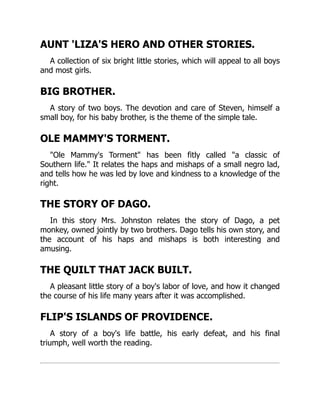
AUNT 'LIZA'S HEROAND OTHER STORIES.
A collection of six bright little stories, which will appeal to all boys
and most girls.
BIG BROTHER.
A story of two boys. The devotion and care of Steven, himself a
small boy, for his baby brother, is the theme of the simple tale.
OLE MAMMY'S TORMENT.
"Ole Mammy's Torment" has been fitly called "a classic of
Southern life." It relates the haps and mishaps of a small negro lad,
and tells how he was led by love and kindness to a knowledge of the
right.
THE STORY OF DAGO.
In this story Mrs. Johnston relates the story of Dago, a pet
monkey, owned jointly by two brothers. Dago tells his own story, and
the account of his haps and mishaps is both interesting and
amusing.
THE QUILT THAT JACK BUILT.
A pleasant little story of a boy's labor of love, and how it changed
the course of his life many years after it was accomplished.
FLIP'S ISLANDS OF PROVIDENCE.
A story of a boy's life battle, his early defeat, and his final
triumph, well worth the reading.
*** END OFTHE PROJECT GUTENBERG EBOOK OUR LITTLE
POLISH COUSIN ***
Updated editions will replace the previous one—the old editions will
be renamed.
Creating the works from print editions not protected by U.S.
copyright law means that no one owns a United States copyright in
these works, so the Foundation (and you!) can copy and distribute it
in the United States without permission and without paying
copyright royalties. Special rules, set forth in the General Terms of
Use part of this license, apply to copying and distributing Project
Gutenberg™ electronic works to protect the PROJECT GUTENBERG™
concept and trademark. Project Gutenberg is a registered trademark,
and may not be used if you charge for an eBook, except by following
the terms of the trademark license, including paying royalties for use
of the Project Gutenberg trademark. If you do not charge anything
for copies of this eBook, complying with the trademark license is
very easy. You may use this eBook for nearly any purpose such as
creation of derivative works, reports, performances and research.
Project Gutenberg eBooks may be modified and printed and given
away—you may do practically ANYTHING in the United States with
eBooks not protected by U.S. copyright law. Redistribution is subject
to the trademark license, especially commercial redistribution.
START: FULL LICENSE
PLEASE READ THISBEFORE YOU DISTRIBUTE OR USE THIS WORK
To protect the Project Gutenberg™ mission of promoting the free
distribution of electronic works, by using or distributing this work (or
any other work associated in any way with the phrase “Project
Gutenberg”), you agree to comply with all the terms of the Full
Project Gutenberg™ License available with this file or online at
www.gutenberg.org/license.
Section 1. General Terms of Use and
Redistributing Project Gutenberg™
electronic works
1.A. By reading or using any part of this Project Gutenberg™
electronic work, you indicate that you have read, understand, agree
to and accept all the terms of this license and intellectual property
(trademark/copyright) agreement. If you do not agree to abide by all
the terms of this agreement, you must cease using and return or
destroy all copies of Project Gutenberg™ electronic works in your
possession. If you paid a fee for obtaining a copy of or access to a
Project Gutenberg™ electronic work and you do not agree to be
bound by the terms of this agreement, you may obtain a refund
from the person or entity to whom you paid the fee as set forth in
paragraph 1.E.8.
1.B. “Project Gutenberg” is a registered trademark. It may only be
used on or associated in any way with an electronic work by people
who agree to be bound by the terms of this agreement. There are a
few things that you can do with most Project Gutenberg™ electronic
works even without complying with the full terms of this agreement.
See paragraph 1.C below. There are a lot of things you can do with
Project Gutenberg™ electronic works if you follow the terms of this
agreement and help preserve free future access to Project
Gutenberg™ electronic works. See paragraph 1.E below.
17.
1.C. The ProjectGutenberg Literary Archive Foundation (“the
Foundation” or PGLAF), owns a compilation copyright in the
collection of Project Gutenberg™ electronic works. Nearly all the
individual works in the collection are in the public domain in the
United States. If an individual work is unprotected by copyright law
in the United States and you are located in the United States, we do
not claim a right to prevent you from copying, distributing,
performing, displaying or creating derivative works based on the
work as long as all references to Project Gutenberg are removed. Of
course, we hope that you will support the Project Gutenberg™
mission of promoting free access to electronic works by freely
sharing Project Gutenberg™ works in compliance with the terms of
this agreement for keeping the Project Gutenberg™ name associated
with the work. You can easily comply with the terms of this
agreement by keeping this work in the same format with its attached
full Project Gutenberg™ License when you share it without charge
with others.
1.D. The copyright laws of the place where you are located also
govern what you can do with this work. Copyright laws in most
countries are in a constant state of change. If you are outside the
United States, check the laws of your country in addition to the
terms of this agreement before downloading, copying, displaying,
performing, distributing or creating derivative works based on this
work or any other Project Gutenberg™ work. The Foundation makes
no representations concerning the copyright status of any work in
any country other than the United States.
1.E. Unless you have removed all references to Project Gutenberg:
1.E.1. The following sentence, with active links to, or other
immediate access to, the full Project Gutenberg™ License must
appear prominently whenever any copy of a Project Gutenberg™
work (any work on which the phrase “Project Gutenberg” appears,
or with which the phrase “Project Gutenberg” is associated) is
accessed, displayed, performed, viewed, copied or distributed:
18.
This eBook isfor the use of anyone anywhere in the United
States and most other parts of the world at no cost and with
almost no restrictions whatsoever. You may copy it, give it away
or re-use it under the terms of the Project Gutenberg License
included with this eBook or online at www.gutenberg.org. If you
are not located in the United States, you will have to check the
laws of the country where you are located before using this
eBook.
1.E.2. If an individual Project Gutenberg™ electronic work is derived
from texts not protected by U.S. copyright law (does not contain a
notice indicating that it is posted with permission of the copyright
holder), the work can be copied and distributed to anyone in the
United States without paying any fees or charges. If you are
redistributing or providing access to a work with the phrase “Project
Gutenberg” associated with or appearing on the work, you must
comply either with the requirements of paragraphs 1.E.1 through
1.E.7 or obtain permission for the use of the work and the Project
Gutenberg™ trademark as set forth in paragraphs 1.E.8 or 1.E.9.
1.E.3. If an individual Project Gutenberg™ electronic work is posted
with the permission of the copyright holder, your use and distribution
must comply with both paragraphs 1.E.1 through 1.E.7 and any
additional terms imposed by the copyright holder. Additional terms
will be linked to the Project Gutenberg™ License for all works posted
with the permission of the copyright holder found at the beginning
of this work.
1.E.4. Do not unlink or detach or remove the full Project
Gutenberg™ License terms from this work, or any files containing a
part of this work or any other work associated with Project
Gutenberg™.
1.E.5. Do not copy, display, perform, distribute or redistribute this
electronic work, or any part of this electronic work, without
prominently displaying the sentence set forth in paragraph 1.E.1
19.
with active linksor immediate access to the full terms of the Project
Gutenberg™ License.
1.E.6. You may convert to and distribute this work in any binary,
compressed, marked up, nonproprietary or proprietary form,
including any word processing or hypertext form. However, if you
provide access to or distribute copies of a Project Gutenberg™ work
in a format other than “Plain Vanilla ASCII” or other format used in
the official version posted on the official Project Gutenberg™ website
(www.gutenberg.org), you must, at no additional cost, fee or
expense to the user, provide a copy, a means of exporting a copy, or
a means of obtaining a copy upon request, of the work in its original
“Plain Vanilla ASCII” or other form. Any alternate format must
include the full Project Gutenberg™ License as specified in
paragraph 1.E.1.
1.E.7. Do not charge a fee for access to, viewing, displaying,
performing, copying or distributing any Project Gutenberg™ works
unless you comply with paragraph 1.E.8 or 1.E.9.
1.E.8. You may charge a reasonable fee for copies of or providing
access to or distributing Project Gutenberg™ electronic works
provided that:
• You pay a royalty fee of 20% of the gross profits you derive
from the use of Project Gutenberg™ works calculated using the
method you already use to calculate your applicable taxes. The
fee is owed to the owner of the Project Gutenberg™ trademark,
but he has agreed to donate royalties under this paragraph to
the Project Gutenberg Literary Archive Foundation. Royalty
payments must be paid within 60 days following each date on
which you prepare (or are legally required to prepare) your
periodic tax returns. Royalty payments should be clearly marked
as such and sent to the Project Gutenberg Literary Archive
Foundation at the address specified in Section 4, “Information
20.
about donations tothe Project Gutenberg Literary Archive
Foundation.”
• You provide a full refund of any money paid by a user who
notifies you in writing (or by e-mail) within 30 days of receipt
that s/he does not agree to the terms of the full Project
Gutenberg™ License. You must require such a user to return or
destroy all copies of the works possessed in a physical medium
and discontinue all use of and all access to other copies of
Project Gutenberg™ works.
• You provide, in accordance with paragraph 1.F.3, a full refund of
any money paid for a work or a replacement copy, if a defect in
the electronic work is discovered and reported to you within 90
days of receipt of the work.
• You comply with all other terms of this agreement for free
distribution of Project Gutenberg™ works.
1.E.9. If you wish to charge a fee or distribute a Project Gutenberg™
electronic work or group of works on different terms than are set
forth in this agreement, you must obtain permission in writing from
the Project Gutenberg Literary Archive Foundation, the manager of
the Project Gutenberg™ trademark. Contact the Foundation as set
forth in Section 3 below.
1.F.
1.F.1. Project Gutenberg volunteers and employees expend
considerable effort to identify, do copyright research on, transcribe
and proofread works not protected by U.S. copyright law in creating
the Project Gutenberg™ collection. Despite these efforts, Project
Gutenberg™ electronic works, and the medium on which they may
be stored, may contain “Defects,” such as, but not limited to,
incomplete, inaccurate or corrupt data, transcription errors, a
copyright or other intellectual property infringement, a defective or
21.
damaged disk orother medium, a computer virus, or computer
codes that damage or cannot be read by your equipment.
1.F.2. LIMITED WARRANTY, DISCLAIMER OF DAMAGES - Except for
the “Right of Replacement or Refund” described in paragraph 1.F.3,
the Project Gutenberg Literary Archive Foundation, the owner of the
Project Gutenberg™ trademark, and any other party distributing a
Project Gutenberg™ electronic work under this agreement, disclaim
all liability to you for damages, costs and expenses, including legal
fees. YOU AGREE THAT YOU HAVE NO REMEDIES FOR
NEGLIGENCE, STRICT LIABILITY, BREACH OF WARRANTY OR
BREACH OF CONTRACT EXCEPT THOSE PROVIDED IN PARAGRAPH
1.F.3. YOU AGREE THAT THE FOUNDATION, THE TRADEMARK
OWNER, AND ANY DISTRIBUTOR UNDER THIS AGREEMENT WILL
NOT BE LIABLE TO YOU FOR ACTUAL, DIRECT, INDIRECT,
CONSEQUENTIAL, PUNITIVE OR INCIDENTAL DAMAGES EVEN IF
YOU GIVE NOTICE OF THE POSSIBILITY OF SUCH DAMAGE.
1.F.3. LIMITED RIGHT OF REPLACEMENT OR REFUND - If you
discover a defect in this electronic work within 90 days of receiving
it, you can receive a refund of the money (if any) you paid for it by
sending a written explanation to the person you received the work
from. If you received the work on a physical medium, you must
return the medium with your written explanation. The person or
entity that provided you with the defective work may elect to provide
a replacement copy in lieu of a refund. If you received the work
electronically, the person or entity providing it to you may choose to
give you a second opportunity to receive the work electronically in
lieu of a refund. If the second copy is also defective, you may
demand a refund in writing without further opportunities to fix the
problem.
1.F.4. Except for the limited right of replacement or refund set forth
in paragraph 1.F.3, this work is provided to you ‘AS-IS’, WITH NO
OTHER WARRANTIES OF ANY KIND, EXPRESS OR IMPLIED,
22.
INCLUDING BUT NOTLIMITED TO WARRANTIES OF
MERCHANTABILITY OR FITNESS FOR ANY PURPOSE.
1.F.5. Some states do not allow disclaimers of certain implied
warranties or the exclusion or limitation of certain types of damages.
If any disclaimer or limitation set forth in this agreement violates the
law of the state applicable to this agreement, the agreement shall be
interpreted to make the maximum disclaimer or limitation permitted
by the applicable state law. The invalidity or unenforceability of any
provision of this agreement shall not void the remaining provisions.
1.F.6. INDEMNITY - You agree to indemnify and hold the Foundation,
the trademark owner, any agent or employee of the Foundation,
anyone providing copies of Project Gutenberg™ electronic works in
accordance with this agreement, and any volunteers associated with
the production, promotion and distribution of Project Gutenberg™
electronic works, harmless from all liability, costs and expenses,
including legal fees, that arise directly or indirectly from any of the
following which you do or cause to occur: (a) distribution of this or
any Project Gutenberg™ work, (b) alteration, modification, or
additions or deletions to any Project Gutenberg™ work, and (c) any
Defect you cause.
Section 2. Information about the Mission
of Project Gutenberg™
Project Gutenberg™ is synonymous with the free distribution of
electronic works in formats readable by the widest variety of
computers including obsolete, old, middle-aged and new computers.
It exists because of the efforts of hundreds of volunteers and
donations from people in all walks of life.
Volunteers and financial support to provide volunteers with the
assistance they need are critical to reaching Project Gutenberg™’s
goals and ensuring that the Project Gutenberg™ collection will
23.
remain freely availablefor generations to come. In 2001, the Project
Gutenberg Literary Archive Foundation was created to provide a
secure and permanent future for Project Gutenberg™ and future
generations. To learn more about the Project Gutenberg Literary
Archive Foundation and how your efforts and donations can help,
see Sections 3 and 4 and the Foundation information page at
www.gutenberg.org.
Section 3. Information about the Project
Gutenberg Literary Archive Foundation
The Project Gutenberg Literary Archive Foundation is a non-profit
501(c)(3) educational corporation organized under the laws of the
state of Mississippi and granted tax exempt status by the Internal
Revenue Service. The Foundation’s EIN or federal tax identification
number is 64-6221541. Contributions to the Project Gutenberg
Literary Archive Foundation are tax deductible to the full extent
permitted by U.S. federal laws and your state’s laws.
The Foundation’s business office is located at 809 North 1500 West,
Salt Lake City, UT 84116, (801) 596-1887. Email contact links and up
to date contact information can be found at the Foundation’s website
and official page at www.gutenberg.org/contact
Section 4. Information about Donations to
the Project Gutenberg Literary Archive
Foundation
Project Gutenberg™ depends upon and cannot survive without
widespread public support and donations to carry out its mission of
increasing the number of public domain and licensed works that can
be freely distributed in machine-readable form accessible by the
widest array of equipment including outdated equipment. Many
24.
small donations ($1to $5,000) are particularly important to
maintaining tax exempt status with the IRS.
The Foundation is committed to complying with the laws regulating
charities and charitable donations in all 50 states of the United
States. Compliance requirements are not uniform and it takes a
considerable effort, much paperwork and many fees to meet and
keep up with these requirements. We do not solicit donations in
locations where we have not received written confirmation of
compliance. To SEND DONATIONS or determine the status of
compliance for any particular state visit www.gutenberg.org/donate.
While we cannot and do not solicit contributions from states where
we have not met the solicitation requirements, we know of no
prohibition against accepting unsolicited donations from donors in
such states who approach us with offers to donate.
International donations are gratefully accepted, but we cannot make
any statements concerning tax treatment of donations received from
outside the United States. U.S. laws alone swamp our small staff.
Please check the Project Gutenberg web pages for current donation
methods and addresses. Donations are accepted in a number of
other ways including checks, online payments and credit card
donations. To donate, please visit: www.gutenberg.org/donate.
Section 5. General Information About
Project Gutenberg™ electronic works
Professor Michael S. Hart was the originator of the Project
Gutenberg™ concept of a library of electronic works that could be
freely shared with anyone. For forty years, he produced and
distributed Project Gutenberg™ eBooks with only a loose network of
volunteer support.
25.
Project Gutenberg™ eBooksare often created from several printed
editions, all of which are confirmed as not protected by copyright in
the U.S. unless a copyright notice is included. Thus, we do not
necessarily keep eBooks in compliance with any particular paper
edition.
Most people start at our website which has the main PG search
facility: www.gutenberg.org.
This website includes information about Project Gutenberg™,
including how to make donations to the Project Gutenberg Literary
Archive Foundation, how to help produce our new eBooks, and how
to subscribe to our email newsletter to hear about new eBooks.
26.
Welcome to ourwebsite – the perfect destination for book lovers and
knowledge seekers. We believe that every book holds a new world,
offering opportunities for learning, discovery, and personal growth.
That’s why we are dedicated to bringing you a diverse collection of
books, ranging from classic literature and specialized publications to
self-development guides and children's books.
More than just a book-buying platform, we strive to be a bridge
connecting you with timeless cultural and intellectual values. With an
elegant, user-friendly interface and a smart search system, you can
quickly find the books that best suit your interests. Additionally,
our special promotions and home delivery services help you save time
and fully enjoy the joy of reading.
Join us on a journey of knowledge exploration, passion nurturing, and
personal growth every day!
testbankbell.com