Solution Manual for C How to Program, 7/E 7th Edition Paul Deitel, Harvey Deitel
Solution Manual for C How to Program, 7/E 7th Edition Paul Deitel, Harvey Deitel
Solution Manual for C How to Program, 7/E 7th Edition Paul Deitel, Harvey Deitel
Solution Manual for C How to Program, 7/E 7th Edition Paul Deitel, Harvey Deitel
Solution Manual for C How to Program, 7/E 7th Edition Paul Deitel, Harvey Deitel
1.
Solution Manual forC How to Program, 7/E 7th
Edition Paul Deitel, Harvey Deitel download
http://testbankbell.com/product/solution-manual-for-c-how-to-
program-7-e-7th-edition-paul-deitel-harvey-deitel/
Explore and download more test bank or solution manual
at testbankbell.com
2.
We have selectedsome products that you may be interested in
Click the link to download now or visit testbankbell.com
for more options!.
Solution Manual for C++ How to Program: Late Objects
Version, 7/E 7th Edition Paul Deitel, Harvey Deitel
http://testbankbell.com/product/solution-manual-for-c-how-to-program-
late-objects-version-7-e-7th-edition-paul-deitel-harvey-deitel/
Solution Manual for C How to Program, 8th Edition, Paul J.
Deitel, Harvey Deitel
http://testbankbell.com/product/solution-manual-for-c-how-to-
program-8th-edition-paul-j-deitel-harvey-deitel/
Test Bank for C How to Program, 8th Edition, Paul J.
Deitel, Harvey Deitel
http://testbankbell.com/product/test-bank-for-c-how-to-program-8th-
edition-paul-j-deitel-harvey-deitel-2/
Test Bank for Managerial Economics, 12th Edition: Hirschey
http://testbankbell.com/product/test-bank-for-managerial-
economics-12th-edition-hirschey/
3.
Test Bank forMcGraw Hills Essentials of Federal Taxation
2014 2nd Edition Spilker
http://testbankbell.com/product/test-bank-for-mcgraw-hills-essentials-
of-federal-taxation-2014-2nd-edition-spilker/
Test Bank for Foundations and Adult Health Nursing, 5th
Edition: Barbara Christensen
http://testbankbell.com/product/test-bank-for-foundations-and-adult-
health-nursing-5th-edition-barbara-christensen/
Solution Manual for Managerial Accounting: Creating Value
in a Dynamic Business Environment, 12th Edition, Ronald
Hilton, David Platt
http://testbankbell.com/product/solution-manual-for-managerial-
accounting-creating-value-in-a-dynamic-business-environment-12th-
edition-ronald-hilton-david-platt-is/
Test Bank for Developmental Psychology Childhood and
Adolescence 9th Edition by Shaffer
http://testbankbell.com/product/test-bank-for-developmental-
psychology-childhood-and-adolescence-9th-edition-by-shaffer/
Test Bank for Discovering Psychology 8th Edition
Hockenbury
http://testbankbell.com/product/test-bank-for-discovering-
psychology-8th-edition-hockenbury/
4.
Solution Manual forA Microscale Approach to Organic
Laboratory Techniques, 6th Edition, Donald L. Pavia,
George S. Kriz, Gary M. Lampman, Randall G. Engel
http://testbankbell.com/product/solution-manual-for-a-microscale-
approach-to-organic-laboratory-techniques-6th-edition-donald-l-pavia-
george-s-kriz-gary-m-lampman-randall-g-engel/
5.
1
C How toProgram, 7/E 7th Edition Paul Deitel
Full chapter download at: https://testbankbell.com/product/solution-manual-for-c-how-to-
program-7-e-7th-edition-paul-deitel-harvey-deitel/
Introduction to Computers,
the Internet and the Web
The chief merit of language is
clearness.
—Galen
Our life is frittered away by
detail. … Simplify, simplify.
—Henry David Thoreau
He had a wonderful talent for
packing thought close, and
rendering it portable.
—Thomas B. Macaulay
Man is still the most
extraordinary computer of all.
—John F. Kennedy
Ob j e cti v e s
In this chapter, you’ll learn:
■ Basic computer concepts.
■ The different types of
programming languages.
■ The history of the C
programming language.
■ The purpose of the C
Standard Library.
■ The elements of a typical C
program development
environment.
■ To test-drive a C application
in Windows, Linux and Mac
OS X.
■ Some basics of the Internet
and the World Wide Web.
6.
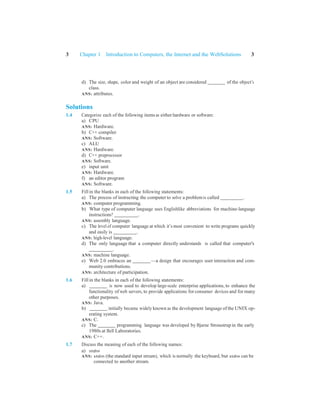
2 Chapter 1Introduction to Computers, the Internet and the WebSolutions 3
[***Instructor’s Manual***]
Self-Review Exercises
1.1 Fill in the blanks in each of the following:
a) Computers process data under the control of sequences of instructions called computer
.
ANS: programs.
b) is a type of computer language that uses Englishlike abbreviations for ma-
chine-language instructions.
ANS: Assembly language.
c) languages are most convenient to the programmer for writing programs
quickly and easily.
ANS: High-level.
d) The onlylanguage a computer can directly understand is that computer’s .
ANS: machine language.
e) The programs that translate high-level language programs into machine language are
called .
ANS: compilers.
f) With development, individuals and companies contribute their efforts in de-
veloping, maintaining and evolving software in exchange for the right to use that soft-
ware for their own purposes, typically at no charge.
ANS: open-source.
g) C is widely known as the development language of the operating system.
ANS: UNIX
1.2 Fill in the blanks in each of the following sentences about the C environment.
a) C programs are normally typed into a computer using a(n) program.
ANS: editor.
b) In a C system, a(n) program automatically executes before the translation
phase begins.
ANS: preprocessor.
c) The two most common kinds of preprocessor directives are and .
ANS: including other files in the file to be compiled, performing various text replacements.
d) The programcombines the output of the compiler with various library func-
tions to produce an executable image.
ANS: linker.
e) The program transfers the executable image from disk to memory.
ANS: loader.
1.3 Fill in the blanks in each of the following statements (based on Section 1.9):
a) Objects have the property of —although objects may know how to commu-
nicate with one another across well-defined interfaces, they normally are not allowed to
know how other objects are implemented.
ANS: information hiding.
b) In object-oriented programming languages, we create to house the set of
methods that perform tasks.
ANS: classes.
c) With , new classes of objects are derived by absorbing characteristics of existing
classes, then adding unique characteristics of their own.
ANS: inheritance.
7.
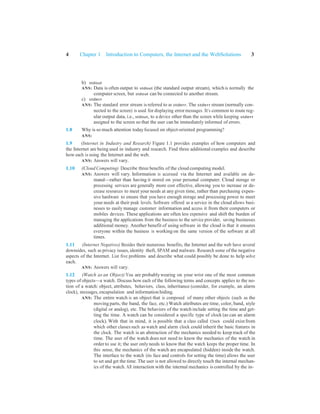
3 Chapter 1Introduction to Computers, the Internet and the WebSolutions 3
d) The size, shape, color and weight of an object are considered of the object’s
class.
ANS: attributes.
Solutions
1.4 Categorize each of the following items as either hardware or software:
a) CPU
ANS: Hardware.
b) C++ compiler
ANS: Software.
c) ALU
ANS: Hardware.
d) C++ preprocessor
ANS: Software.
e) input unit
ANS: Hardware.
f) an editor program
ANS: Software.
1.5 Fill in the blanks in each of the following statements:
a) The process of instructing the computer to solve a problemis called .
ANS: computer programming.
b) What type of computer language uses Englishlike abbreviations for machine-language
instructions? .
ANS: assembly language.
c) The level of computer language at which it’s most convenient to write programs quickly
and easily is .
ANS: high-level language.
d) The only language that a computer directly understands is called that computer's
.
ANS: machine language.
e) Web 2.0 embraces an —a design that encourages user interaction and com-
munity contributions.
ANS: architecture of participation.
1.6 Fill in the blanks in each of the following statements:
a) is now used to develop large-scale enterprise applications, to enhance the
functionality of web servers, to provide applications for consumer devices and for many
other purposes.
ANS: Java.
b) initially became widely known as the development language of the UNIX op-
erating system.
ANS: C.
c) The programming language was developed by Bjarne Stroustrup in the early
1980s at Bell Laboratories.
ANS: C++.
1.7 Discuss the meaning of each of the following names:
a) stdin
ANS: stdin (the standard input stream), which is normally the keyboard, but stdin can be
connected to another stream.
8.
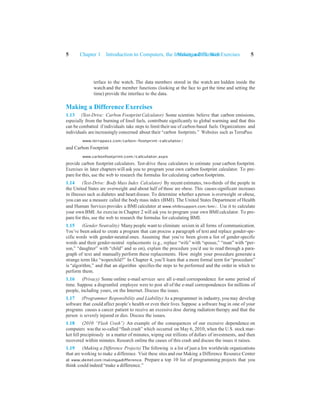
4 Chapter 1Introduction to Computers, the Internet and the WebSolutions 3
b) stdout
ANS: Data is often output to stdout (the standard output stream), which is normally the
computer screen, but stdout can be connected to another stream.
c) stderr
ANS: The standard error stream is referred to as stderr. The stderr stream (normally con-
nected to the screen) is used for displaying error messages. It’s common to route reg-
ular output data, i.e., stdout, to a device other than the screen while keeping stderr
assigned to the screen so that the user can be immediately informed of errors.
1.8 Why is so much attention todayfocused on object-oriented programming?
ANS:
1.9 (Internet in Industry and Research) Figure 1.1 provides examples of how computers and
the Internet are being used in industry and research. Find three additional examples and describe
how each is using the Internet and the web.
ANS: Answers will vary.
1.10 (Cloud Computing) Describe three benefits of the cloud computing model.
ANS: Answers will vary. Information is accessed via the Internet and available on de-
mand—rather than having it stored on your personal computer. Cloud storage or
processing services are generally more cost effective, allowing you to increase or de-
crease resources to meet your needs at anygiven time, rather than purchasing expen-
sive hardware to ensure that you have enough storage and processing power to meet
your needs at their peak levels. Software offered as a service in the cloud allows busi-
nesses to easily manage customer information and access it from their computers or
mobiles devices. These applications are often less expensive and shift the burden of
managing the applications from the business to the service provider, saving businesses
additional money. Another benefit of using software in the cloud is that it ensures
everyone within the business is working on the same version of the software at all
times.
1.11 (Internet Negatives) Besides their numerous benefits, the Internet and the web have several
downsides, such as privacy issues, identity theft, SPAM and malware. Research some of the negative
aspects of the Internet. List five problems and describe what could possibly be done to help solve
each.
ANS: Answers will vary.
1.12 (Watch as an Object) You are probablywearing on your wrist one of the most common
types of objects—a watch. Discuss how each of the following terms and concepts applies to the no-
tion of a watch: object, attributes, behaviors, class, inheritance (consider, for example, an alarm
clock), messages, encapsulation and information hiding.
ANS: The entire watch is an object that is composed of many other objects (such as the
moving parts, the band, the face, etc.) Watch attributes are time, color, band, style
(digital or analog), etc. The behaviors of the watch include setting the time and get-
ting the time. A watch can be considered a specific type of clock (as can an alarm
clock). With that in mind, it is possible that a class called Clock could exist from
which other classes such as watch and alarm clock could inherit the basic features in
the clock. The watch is an abstraction of the mechanics needed to keep track of the
time. The user of the watch does not need to know the mechanics of the watch in
order to use it; the user onlyneeds to know that the watch keeps the proper time. In
this sense, the mechanics of the watch are encapsulated (hidden) inside the watch.
The interface to the watch (its face and controls for setting the time) allows the user
to set and get the time. The user is not allowed to directly touch the internal mechan-
ics of the watch. All interaction with the internal mechanics is controlled by the in-
9.
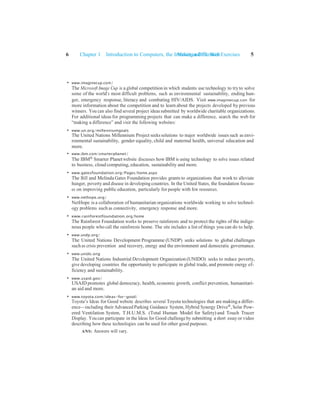
Making a DifferenceExercises 5
5 Chapter 1 Introduction to Computers, the Internet and the Web
terface to the watch. The data members stored in the watch are hidden inside the
watch and the member functions (looking at the face to get the time and setting the
time) provide the interface to the data.
Making a Difference Exercises
1.13 (Test-Drive: Carbon Footprint Calculator) Some scientists believe that carbon emissions,
especially from the burning of fossil fuels, contribute significantly to global warming and that this
can be combatted if individuals take steps to limit their use of carbon-based fuels. Organizations and
individuals are increasingly concerned about their “carbon footprints.” Websites such as TerraPass
www.terrapass.com/carbon-footprint-calculator/
and Carbon Footprint
www.carbonfootprint.com/calculator.aspx
provide carbon footprint calculators. Test-drive these calculators to estimate your carbon footprint.
Exercises in later chapters will ask you to program your own carbon footprint calculator. To pre-
pare for this, use the web to research the formulas for calculating carbon footprints.
1.14 (Test-Drive: Body Mass Index Calculator) By recent estimates, two-thirds of the people in
the United States are overweight and about half of those are obese. This causes significant increases
in illnesses such as diabetes and heart disease. To determine whether a person is overweight or obese,
you can use a measure called the bodymass index (BMI). The United States Department of Health
and Human Services provides a BMI calculator at www.nhlbisupport.com/bmi/. Use it to calculate
your own BMI. An exercise in Chapter 2 will ask you to program your own BMIcalculator. To pre-
pare for this, use the web to research the formulas for calculating BMI.
1.15 (Gender Neutrality) Manypeople want to eliminate sexism in all forms of communication.
You’ve been asked to create a program that can process a paragraph of text and replace gender-spe-
cific words with gender-neutral ones. Assuming that you’ve been given a list of gender-specific
words and their gender-neutral replacements (e.g., replace “wife” with “spouse,” “man” with “per-
son,” “daughter” with “child” and so on), explain the procedure you’d use to read through a para-
graph of text and manually perform these replacements. How might your procedure generate a
strange term like “woperchild?” In Chapter 4, you’ll learn that a more formal term for “procedure”
is “algorithm,” and that an algorithm specifies the steps to be performed and the order in which to
perform them.
1.16 (Privacy) Some online e-mail services save all e-mail correspondence for some period of
time. Suppose a disgruntled employee were to post all of the e-mail correspondences for millions of
people, including yours, on the Internet. Discuss the issues.
1.17 (Programmer Responsibility and Liability) As a programmer in industry, you may develop
software that could affect people’s health or even their lives. Suppose a software bug in one of your
programs causes a cancer patient to receive an excessive dose during radiation therapy and that the
person is severely injured or dies. Discuss the issues.
1.18 (2010 “Flash Crash”) An example of the consequences of our excessive dependence on
computers was the so-called “flash crash” which occurred on May 6, 2010, when the U.S. stock mar-
ket fell precipitously in a matter of minutes, wiping out trillions of dollars of investments, and then
recovered within minutes. Research online the causes of this crash and discuss the issues it raises.
1.19 (Making a Difference Projects) The following is a list of just a few worldwide organizations
that are working to make a difference. Visit these sites and our Making a Difference Resource Center
at www.deitel.com/makingadifference. Prepare a top 10 list of programming projects that you
think could indeed “make a difference.”
10.
Making a DifferenceExercises 5
6 Chapter 1 Introduction to Computers, the Internet and the Web
• www.imaginecup.com/
The Microsoft Image Cup is a global competition in which students use technology to tryto solve
some of the world’s most difficult problems, such as environmental sustainability, ending hun-
ger, emergency response, literacy and combating HIV/AIDS. Visit www.imaginecup.com for
more information about the competition and to learn about the projects developed by previous
winners. You can also find several project ideas submitted by worldwide charitable organizations.
For additional ideas for programming projects that can make a difference, search the web for
“making a difference” and visit the following websites:
• www.un.org/millenniumgoals
The United Nations Millennium Project seeks solutions to major worldwide issues such as envi-
ronmental sustainability, gender equality, child and maternal health, universal education and
more.
• www.ibm.com/smarterplanet/
The IBM® Smarter Planet website discusses how IBM is using technology to solve issues related
to business, cloud computing, education, sustainability and more.
• www.gatesfoundation.org/Pages/home.aspx
The Bill and Melinda Gates Foundation provides grants to organizations that work to alleviate
hunger, poverty and disease in developing countries. In the United States, the foundation focuss-
es on improving public education, particularly for people with few resources.
• www.nethope.org/
NetHope is a collaboration of humanitarian organizations worldwide working to solve technol-
ogy problems such as connectivity, emergency response and more.
• www.rainforestfoundation.org/home
The Rainforest Foundation works to preserve rainforests and to protect the rights of the indige-
nous people who call the rainforests home. The site includes a list of things you can do to help.
• www.undp.org/
The United Nations Development Programme (UNDP) seeks solutions to global challenges
such as crisis prevention and recovery, energy and the environment and democratic governance.
• www.unido.org
The United Nations Industrial Development Organization (UNIDO) seeks to reduce poverty,
give developing countries the opportunity to participate in global trade, and promote energy ef-
ficiency and sustainability.
• www.usaid.gov/
USAID promotes global democracy, health, economic growth, conflict prevention, humanitari-
an aid and more.
• www.toyota.com/ideas-for-good/
Toyota’s Ideas for Good website describes several Toyota technologies that are makinga differ-
ence—including their Advanced Parking Guidance System, Hybrid Synergy Drive®, Solar Pow-
ered Ventilation System, T.H.U.M.S. (Total Human Model for Safety) and Touch Tracer
Display. You can participate in the Ideas for Good challenge by submitting a short essay or video
describing how these technologies can be used for other good purposes.
ANS: Answers will vary.
S
CHAPTER XII
HE waswayward, she was passionate, she was sometimes
wild. She was not what, in the Pigeons' Seminary, could be
called a good child, for all her sins were frankly manifest, and
she knew no fear nor naughty stratagem; her mind, to all but
Kate, was open as the day, and there it was the fault of honest
Kate's stupidity. But often Miss Bell must be moaning at
transgressions almost harmless in themselves, yet so terribly unlike a
Christian bairn, as when Bud spent an afternoon in a tent with some
gypsy children, changed clothes with them the better to act a part,
and stormed because she could not have them in to tea with her. Or
when she asked Lady Anne, bazaar-collecting in the house of Dyce,
if she ever had had a proposal. It was a mercy that Lady Anne that
very week had had one, and was only too pleased to tell of it and
say she had accepted.
“Then you're safe out of the woods,” said Bud, gravely. “There's
our Kate, she hasn't had a proposal yet, and I guess she's on the
slopey side of thirty. It must be dreff'le to be as old—as old as a
house and have no beau to love you. It must be 'scrudating.”
Lady Anne let her eyes turn for a moment on the sisters Dyce, and
the child observed and reddened.
“Oh, Auntie Bell!” she said, quickly. “Auntie Bell had heaps and
heaps of beaux all dying to marry her, but she gave them the calm,
cold eye and said she had to cling to Uncle Dan. It was very noble of
her, wasn't it?”
“Indeed it was!” admitted Lady Anne, very much ashamed of
herself.
“And Auntie Ailie is not on the slopey side of thirty,” continued
Bud, determined to make all amends. “She's young enough to love
dolls.”
13.
It was Bellwho censured her for this dreadful behavior. “You are a
perfect torment, Lennox,” she said, at the first opportunity. “A bairn
like you must not be talking about beaux, and love, and proposals,
and nonsense of that kind—it's fair ridiculous.”
“Why, I thought love was the Great Thing!” exclaimed Bud, much
astonished. “It's in all the books, there's hardly anything else, 'cept
when somebody is murdered and you know that the man who did it
is the only one you don't suspect. Indeed, auntie, I thought it was
the Great Thing!”
“And so it is, my dear,” said Ailie. “There's very little else in all the
world, except—except the children,” and she folded her niece in her
arms. “It is the Great Thing; it has made Lady Anne prettier than
ever she was in her life before, it has made her brighter, humbler,
gentler, kinder. God bless her, I hope she will be happy.”
“But it was very wrong; it was a kind of fib for you to talk about
me having lots of lads in my time,” said Auntie Bell. “You do not
know whether I had or not.”
Bud looked at her and saw a flush on her face. “I think,” said she,
“the beaux must have been very stupid, then. But I guess there
must have been one, Auntie Bell, and you have forgotten all about
him.” And at that Miss Bell went hurriedly from the room with a
pretence that she heard a pot boil over, and Ailie in a low voice told
her niece all about Bell's beau, deep drowned in the Indian Ocean.
For days after that the child was tender with her elder aunt, and
made a splendid poem in blank verse upon the late Captain James
Murray, which Bell was never to see, but Ailie treasured. For days
was she angelic good. Her rages never came to fever heat. Her
rebellions burned themselves out in her bosom. Nobly she struggled
with long division and the grammar that she abominated; very
meekly she took censure for copy-books blotted and words
shamefully misspelled in Uncle Daniel's study. Some way this love
that she had thought a mere amusement, like shopping in Chicago,
took a new complexion in her mind—became a dear and solemn
thing, like her uncle's Bible readings, when, on Sunday nights at
14.
worship in theparlor, he took his audience through the desert to the
Promised Land, and the abandoned street was vocal with domestic
psalm from the provost's open window. She could not guess—how
could she, the child?—that love has its variety. She thought there
was but the one love in all the world—the same she felt herself for
most things—a gladness and agreement with things as they were.
And yet at times in her reading she got glimpses of love's terror and
empire, as in the stories of Othello and of Amy Robsart, and herself
began to wish she had a lover. She thought at first of Uncle Dan; but
he could not be serious, and she had never heard him sigh—in him
was wanting some remove, some mystery. What she wanted was a
lover on a milk-white steed, a prince who was “the flower o' them
a',” as in Aunt Ailie's song “Glenlogie”; and she could not imagine
Uncle Dan with his spectacles on riding any kind of steed, though
she felt it would be nice to have him with her when the real prince
was there.
Do you think it unlikely that this child should have such dreams?
Ah, then, you are not of her number, or you have forgotten. She
never forgot. Many a time she told me in after years of how in the
attic bower, with Footles snug at her feet, she conjured up the lad on
the milk-white steed, not so much for himself alone, but that she
might act the lady-love. And in those dreams she was tall and
slender, sometimes proud, disdainful, wounding the poor wretch with
sharp words and cold glances; or she was meek and languishing,
sighing out her heart even in presence of his true-love gifts of candy
and P. & A. MacGlashan's penny tarts. She walked with him in
gardens enchanted; they sailed at nights over calm, moonlit seas,
and she would be playing the lute. She did not know what the lute
was like; but it was the instrument of love, and had a dulcet sound,
like the alto flutes in the burgh band.
But, of course, no fairy prince came wooing Daniel Dyce's little
niece, though men there were in the place—elderly and bald, with
married daughters—who tried to buy her kisses for sixpences and
sweets, and at last she felt vicariously the joys of love by conducting
the affairs of Kate.
15.
Kate had manywooers—that is the solace of her class. They liked
her that she was genial and plump, with a flattering smile and a soft
touch of the Gaelic accent that in the proper key and hour is the
thing to break hearts. She twirled them all round her little finger, and
Bud was soon to see this and to learn that the maid was still very far
from the slopey side of thirty. But Kate, too, had her dreams—of
some misty lad of the mind, with short, curled hair, clothes brass-
buttoned, and a delicious smell of tar—something or other on a
yacht. The name she had endowed him with was Charles. She made
him up from passing visions of seamen on the quays, and of notions
gleaned from her reading of penny novelettes.
One week-night Bud came on her in the kitchen dressed in her
Sunday clothes and struggling with a spluttering pen.
“Are you at your lessons, too?” said the child. “You naughty Kate!
there's a horrid blot. No lady makes blots.”
“It wasn't me, it was this devilish pen; besides, I'm not a lady,”
said Kate, licking the latest blot with her tongue and grimacing.
“What way do you spell weather?”
“W-e-t-h-e-r,” said Bud. “At least, I think that's the way; but I'd
best run and ask Aunt Ailie—she's a speller from Spellerville.”
“Indeed and you'll do nothing of the kind,” cried the maid, alarmed
and reddening. “You'll do nothing of the kind, Lennox, because—I'm
writing to Charles.”
“A love-letter! Oh, I've got you with the goods on you!” exclaimed
Bud, enchanted. “And what are you doing with your hurrah clothes
on?”
“I like to put on my Sunday clothes when I'm writing Charles,” said
the maid, a little put-about. “Do you think it's kind of daft?”
“It's not daft at all, it's real cute of you; it's what I do myself when
I'm writing love-letters, for it makes me feel kind of grander. It's just
the same with poetry; I simply can't make really poetry unless I
have on a nice frock and my hands washed.”
“You write love-letters!” said the maid, astounded.
16.
“Yes, you poor,perishing soul!” retorted Bud. “And you needn't
yelp. I've written scores of love-letters without stopping to take
breath. Stop! stop!” she interrupted herself, and breathed an inward
little prayer. “I mean that I write them—well, kind of write them—in
my mind.” But this was a qualification beyond Kate's comprehension.
“Then I wish you would give me a hand with this one,” said she,
despairingly. “All the nice words are so hard to spell, and this is such
a bad pen.”
“They're all bad pens; they're all devilish,” said Bud, from long
experience. “But I'd love to help you write that letter. Let me see—
pooh! it's dreff'le bad, Kate. I can't read a bit of it, almost.”
“I'm sure and neither can I,” said Kate, distressed.
“Then how in the world do you expect Charles to read it?” asked
Bud.
“Oh, he's—he's a better scholar than me,” said Kate, complacently.
“But you might write this one for me.”
Bud washed her hands, took a chair to the kitchen table, threw
back her hair from her eyes, and eagerly entered into the office of
love-letter-writer, “What will I say to him?” she asked.
“My dear, dear Charles,” said the maid, who at least knew so
much.
“My adorable Charles,” said Bud, as an improvement, and down it
went with the consent of the dictator.
“I'm keeping fine, and I'm very busy,” suggested Kate, upon
deliberation. “The weather is capital here at present, and it is a good
thing, for the farmers are busy with their hay.”
Bud sat back and stared at her in amazement. “Are you sure this
is for a Charles?” she asked. “You might as well call him Sissy and
talk frocks. Why, you must tell him how you love him.”
“Oh, I don't like,” said Kate, confused. “It sounds so—so bold and
impudent when you put it in the English and write it down. But
please yourself; put down what you like and I'll be dipping the pen
for you.”
17.
Bud was notslow to take the opportunity. For half an hour she sat
at the kitchen table and searched her soul for fitting words that
would convey Kate's adoration. Once or twice the maid asked what
she was writing, but all she said was: “Don't worry, Kate. I'm right in
the throes.” There were blots and there were erasions, but
something like this did the epistle look when it was done:
“My adorable Charles,—I am writing this letter to let you know
how much I truly love you. Oh Charles, dear, you are the Joy of my
heart. I am thinking of you so often, often, till my Heart just aches.
It is lovely wether here at present. Now I will tell you all about the
Games. They took place in a park near here Friday and there was
seventeen beautiful dances. They danced to give you spassums. One
of them was a Noble youth. He was a Prince in his own write, under
Spells for sevn years. When he danced, lo and behold he was the
admiration of all Beholders. Alas? poor youth. When I say alas I
mean that it was so sad being like that full of Spells in the flower of
his youth. He looked at me so sad when he was dancing, and I was
so glad. It was just like money from home. Dear Charles, I will tell
you all about myself. I am full of goodness most the time for God
loves good people. But sometimes I am not and I have a temper like
two crost sticks when I must pray to be changed. The dancing
gentleman truly loves me to destruction. He kissed my hand and
hastily mountain his noble steed, galoped furiously away. Ah, the
coarse of true love never did run smooth. Perhaps he will fall upon
the forein plain. Dearest Charles—adorable—I must now tell you that
I am being educated for my proper station in life. There is Geograpy,
and penmanship with the right commas, and Long Division and
conjunctives which I abominate. But my teacher, a sweet lady
named Miss Alison Dyce, says they are all truly refining. Oh I am
weary, weary, he cometh not. That is for you, darling Charles, my
own.—Your true heart love, Kate MacNeill.”
“Is that all right?” asked Bud, anxiously.
“Yes; at least it 'll do fine,” said the maid, with that Highland
politeness that is often so bad for business. “There's not much about
18.
himself in it,but och! it 'll do fine. It's as nice a letter as ever I saw:
the lines are all that straight.”
“But there's blots,” said Bud, regretfully. “There oughtn't to be
blots in a real love-letter.”
“Toots! just put a cross beside each of them, and write 'this is a
kiss,”' said Kate, who must have had some previous experience. “You
forgot to ask him how's his health, as it leaves us at present.”
So Bud completed the letter as instructed. “Now for the envelope,”
said she.
“I'll put the address on it myself,” said Kate, confused. “He would
be sure somebody else had been reading it if the address was not in
my hand of write”—an odd excuse, whose absurdity escaped the
child. So the maid put the letter in the bosom of her Sunday gown
against her heart, where meanwhile dwelt the only Charles. It is, I
sometimes think, where we should all deposit and retain our love-
letters; for the lad and lass, as we must think of them, have no
existence any more than poor Kate's Charles.
119
Two days passed. Often in those two days would Bud come,
asking anxiously if there was any answer yet from Charles. As often
the maid of Colonsay reddened, and said with resignation there was
not so much as the scrape of a pen. “He'll be on the sea,” she
explained at last, “and not near a post-office. Stop you till he gets
near a post-office, and you'll see the fine letter I'll get.”
“I didn't know he was a sailor,” said Bud. “Why, I calculated he
was a Highland chieftain or a knight, or something like that. If I had
known he was a sailor I'd have made that letter different. I'd have
loaded it up to the nozzle with sloppy weather, and said, Oh, how
sad I was—that's you, Kate—to lie awake nights thinking about him
out on the heaving billow. Is he a captain?”
“Yes,” said Kate, promptly. “A full captain in the summer-time. In
the winter he just stays at home and helps on his mother's farm. Not
19.
a cheep toyour aunties about Charles, darling Lennox,” she added,
anxiously. “They're—they're that particular!”
“I don't think you're a true love at all,” said Bud, reflecting on
many interviews at the kitchen window and the back door. “Just
think of the way you make goo-goo eyes at the letter-carrier and the
butcher's man and the ash-pit gentleman. What would Charles say?”
“Toots! I'm only putting by the time with them,” explained the
maid. “It's only a diversion. When I marry I will marry for my own
conveniency, and the man for me is Charles.”
“What's the name of his ship?” asked the child. “The Good Intent,”
said Kate, who had known a skiff of the name in Colonsay. “A
beautiful ship, with two yellow chimneys, and flags to the
masthead.”
“That's fine and fancy!” said Bud. “There was a gentleman who
loved me to destruction, coming over on the ship from New York,
and loaded me with candy. He was not the captain, but he had gold
braid everywhere, and his name was George Sibley Purser. He
promised he would marry me when I made a name for myself, but I
'spect Mister J. S. Purser 'll go away and forget.”
“That's just the way with them all,” said Kate.
“I don't care, then,” said Bud. “I'm all right; I'm not kicking.”
Next day the breakfast in the house of Dyce was badly served, for
Kate was wild to read a letter that the post had brought, and when
she opened it, you may be sure Bud was at her shoulder. It said:
“Dearest Kate,—I love you truly and I am thinking of you most the
time. Thank God we was all safed. Now I will tell you all about the
Wreck. The sea was mountains high, and we had a cargo of spise
and perils from Java on the left-hand side the map as you go to
Australia. When the Pirite ship chased us we went down with all
hands. But we constrickted a raft and sailed on and on till we had to
draw lots who would drink the blood. Just right there a sailor cried 'A
sail, A sail, and sure enough it was a sail. And now I will tell you all
about Naples. There is a monsterious mountain there, or cone which
belches horrid flames and lavar. Once upon' a time it belched all over
20.
a town bythe name of Pompy and it is there till this very day. The
bay of naples is the grandest in the world it is called the golden
horn. Dearest Katherine, I am often on the mast at night. It is cold
and shakey in that place and oh how the wind doth blow, but I ring
a bell and say alls well which makes the saloon people truly glad. We
had five stow-ways. One of them was a sweet fairhaired child from
Liverpool, he was drove from home. But a good and beautious lady,
one of the first new england families is going to adopt him and make
him her only air. How beautiful and bright he stood as born to rule
the storm. I weary for your letters darling Katherine.—Write soon to
your true love till death, Charles.”
Kate struggled through this extraordinary epistle with
astonishment. “Who in the world is it from?” she asked Bud.
“Charles, stupid,” said Bud, astonished that there should be any
doubt about that point. “Didn't I—didn't we write him the other
night? It was up to him to write back, wasn't it?”
“Of course,” said Kate, very conscious of that letter still unposted,
“but—but he doesn't say Charles anything, just Charles. It's a daft
like thing not to give his name; it might be anybody. There's my
Charles, and there's Charles Maclean from Oronsay—what way am I
to know which of them it is?”
“It'll be either or eyether,” said Bud. “Do you know Charles
Maclean?”
“Of course I do,” said the maid. “He's following the sea, and we
were well acquaint.”
“Did he propose to you?” asked Bud.
“Well, he did not exactly propose,” admitted Kate, “but we
sometimes went a walk together to the churchyard on a Sunday, and
you know yourself what that means out in Colonsay. I'll just keep the
letter and think of it. It's the nicest letter I ever got, and full of
information. It's Charles Maclean, I'll warrant you, but he did not use
to call me Katherine—he just said Kate and his face would be as red
as anything. Fancy him going down with all hands! My heart is sore
21.
for him,” andthe maid there and then transferred her devotion from
the misty lad of her own imagination to Charles Maclean of Oronsay.
“You'll help me to write him a letter back to-night,” she said.
“Yes, indeed, I'll love to,” said the child, wearily. But by the time
the night came on, and Wanton Wully rang his curfew bell, and the
rooks came clanging home to the tall trees of the forest, she was
beyond all interest in life or love.
22.
A
CHAPTER XIII
NTON WULLYonly briefly rang the morning bell, and gingerly,
with tight-shut lips and deep nose breathings, as if its loud
alarm could so be mitigated. Once before he had done it just
as delicately—when the Earl was dying, and the bell-ringer,
uncertain of his skill to toll, when the time came, with the right half-
minute pauses, grieved the town and horrified the castle by a
rehearsal in the middle of a winter night. But no soul of mercy is in
brazen bells that hang aloof from man in lofty steeples, and this one,
swung ever so gently, sullenly boomed—boomed—boomed.
“Oh, to the devil wi' ye!” said Wanton Wully, sweating with
vexation. “Of all the senseless bells! A big, boss bluiter! I canna
compel nor coax ye!” and he gave the rope one vicious tug that
brought it, broken, round his ears, then went from the church into
the sunny, silent, morning street, where life and the day suspended.
In faith, a senseless bell, a merciless bell, waking folk to toil and
grief. Dr. Brash and Ailie, heavy-eyed, beside the bed in the attic
bower, shivered at the sound of it, and looked with fear and yearning
at the sleeping child.
Bud moved her head from side to side a little on the pillow, with a
murmur from her parched lips, and there was a flicker of the eyelids
—that was all. Between her and the everlasting swound, where
giddily swings the world and all its living things, there seemed no
more than a sheet of tissue-paper: it was as if a breath of the tender
morning air would quench the wavering flame that once was joy and
Lennox Dyce. The heart of Auntie Ailie rose clamoring in her bosom;
her eyes stung with the brine of tears restrained, but she clinched
her teeth that she might still be worthy of the doctor's confidence.
He saw it, and put out his hand and pressed her shoulder, a fat,
old-fashioned man, well up in years, with whiskers under his chin
23.
like a cravat,yet beautiful as a prince to Ailie, for on him all her
hopes were cast. “They call me agnostic—atheist even, whiles, I
hear,” he said, in the midst of their vigil; “and, indeed, I'm
sometimes beat to get my mind beyond the mechanism, but—h'm!—
a fine child, a noble child; she was made for something—h'm! That
mind and talent—h'm!—that spirit—h'm!—the base of it was surely
never yon gray stuff in the convolutions.” And another time the
minister had come in (the folk in the street were furious to see him
do it!), and timidly suggested prayer. “Prayer!” said Dr. Brash,
“before this child, and her quite conscious! Man, what in God's own
name are we doing here, this—h'm!—dear, good lady and I, but
fever ourselves with sleepless, silent prayer? Do you think a proper
prayer must be official? There's not a drop of stuff in a druggist's
bottle but what's a solution of hope and faith and—h'm!—prayer.
Confound it, sir!”
He put out his hand and pressed her on the shoulder, and never
said a word. Oh, the doctors! the doctors! Hale men and hearty, we
can see their shortcomings and can smile at them, but when the
night-light burns among the phials!
It was the eighth day after Kate, with a face of clay and her
sleeves rolled up, and the dough still on her elbows as she had come
from the baking-board, burst upon the doctor in his surgery with the
cry, “Dr. Brash, Dr. Brash! ye're to haste ye and come at once to the
wee one!” He had gone as nearly on the wings of the wind as a fat
man may in carpet slippers, and found a distracted family round the
fevered child.
“Tut, tut, lassie,” said he, chucking her lightly under the chin.
“What new prank is this, to be pretending illness? Or if it's not a let-
on, I'll be bound it's MacGlashan's almond tablet.”
“It's these cursed crab-apples in the garden; I'm sure it's the crab-
apples, doctor,” said Miss Bell, looking ten years older than her usual.
“H'm! I think not,” said Dr. Brash, more gravely, with his finger on
the pulse.
24.
“It's bound tobe,” said Bell, piteous at having to give up her only
hope. “Didn't you eat some yesterday, pet, after I told you that you
were not for your life to touch them?”
“No,” said Bud, with hot and heavy breathing. “Then why didn't
ye, why didn't ye; and then it might have been the apples?” said
poor Miss Bell. “You shouldn't have minded me; I'm aye so
domineering.”
“No, you're not,” said Bud, wanly smiling.
“Indeed I am; the thing's acknowledged and you needn't deny it,”
said her auntie. “I'm desperate domineering to you.”
“Well, I'm—I'm not kicking,” said Bud. It was the last cheerful
expression she gave utterance to for many days.
Wanton Wully was not long the only one that morning in the
sunny street. Women came out unusually early, as it seemed, to
beat their basses; but the first thing that they did was to look at the
front of Daniel Dyce's house with a kind of terror lest none of the
blinds should be up and Mr. Dyce's old kid glove should be off the
knocker. “Have you heard what way she is keeping to-day?” they
asked the bellman.
“Not a cheep!” said he. “I saw Kate sweepin' out her door-step,
but I couldna ask her. That's the curse of my occupation; I wish to
goodness they had another man for the grave-diggin'.”
“You and your graves!” said the women. “Who was mentioning
them?”
He stood on the siver-side and looked at the blank front of Daniel
Dyce's house with a gloomy eye. “A perfect caution!” he said, “that's
what she was—a perfect caution! She called me Mr. Wanton and
always asked me how was my legs.”
“Is there anything wrong with your legs?” said one of the women.
“Whiles a weakness,” said Wanton Wully, for he was no hypocrite.
“Her uncle tell't me once it was a kind o' weakness that they keep on
gantrys doon in Maggie White's. But she does not understand—the
25.
wee one; quitethe leddy! she thought it was a kind o' gout. Me! I
never had the gout—I never had the money for it, more's the pity.”
He went disconsolate down the street to get his brush and barrow,
for he was, between the morning bell and breakfast-time, the
burgh's cleansing department. Later—till the middle of the day—he
was the harbor-master, wore a red-collared coat and chased the
gulls from the roofs of the shipping-boxes and the boys from the
slip-side where they might fall in and drown themselves; his
afternoons had half a dozen distinct official cares, of which, in that
wholesome air, grave-digging came seldomest. This morning he
swept assiduously and long before the house of Daniel Dyce.
Workmen passing yawning to their tasks in wood and garden, field
and shed, looked at the muffled knocker and put the question; their
wives, making, a little later, a message to the well, stopped, too, put
down their water-stoups, and speculated on the state of things
within. Smoke rose from more than one chimney in the Dyces'
house. “It's the parlor fire,” said Wanton Wully. “It means breakfast.
Cheery Dan, they say, aye makes a hearty breakfast; I like to see the
gift in a man mysel' though I never had it; it's a good sign o' him the
night before.”
Peter the post came clamping by-and-by along the street with his
letters, calling loudly up the closes, less willing than usual to climb
the long stairs, for he was in a hurry to reach the Dyces'. Not the
window for him this morning, nor had it been so for a week, since
Kate no longer hung on the sashes, having lost all interest in the
outer world. He went tiptoe through the flagged close to the back
door and lightly tapped.
“What way is she this morning?” said he, in the husky whisper
that was the best he could control his voice to, and in his eagerness
almost mastered his roving eye.
“She's got the turn!—she's got the turn!” said the maid,
transported. “Miss Dyce was down the now and told me that her
temper was reduced.”
“Lord help us! I never knew she had one,” said the post.
26.
“It's no' temperthat I mean,” said Kate, “but yon thing that you
measure wi' the weather-glass the doctor's aye so cross wi' that he
shakes and shakes and shakes at it. But, anyway, she's better. I
hope Miss Ailie will come down for a bite; if not she'll starve hersel'.”
“That's rare! By George, that's tip-top!” said the postman, so
uplifted that he went off with the M.C. step he used at Masons' balls,
and would have clean forgotten to give Kate the letters if she had
not cried him back.
Wanton Wully sat on a barrow-tram waiting the postman's exit.
“What way is she?” said he, and Peter's errant eye cocked to all
parts of the compass. What he wanted was to keep this titbit to
himself, to have the satisfaction of passing it along with his letters.
To give it to Wanton Wully at this stage would be to throw away
good-fortune. It was said by Daniel Dyce that the only way to keep a
dead secret in the burgh was to send Wully and his handbell round
the town with it as public crier. When Wanton Wully cried, it beat
you to understand a word he said after “Notice!” but unofficially he
was marvellously gleg at circulating news. “What way is she?” he
asked again, seeing the postman's hesitation.
“If ye'll promise to stick to the head o' the toun and let me alone
in the ither end, I'll tell ye,” said Peter, and it was so agreed.
But they had not long all the glory of the good tidings to
themselves. Dr. Brash came out of Dyce's house for the first time in
two days, very sunken in the eyes and sorely needing shaving, and it
could be noticed by the dullest that he had his jaunty walk and a
flower in the lapel of his badly crushed coat. Ailie put it there with
trembling fingers; she could have kissed the man besides, if there
had not been the chance that he might think her only another silly
woman. Later Footles hurled himself in fury from the doorway, his
master close behind him. At the sight of Mr. Dyce the street was
happy; it was the first time they had seen him for a week. In burgh
towns that are small enough we have this compensation, that if we
have to grieve in common over many things, a good man's personal
joy exalts us all.
27.
“She's better, Mr.Dyce, I'm hearing,” said P. & A. MacGlashan,
wiping his hands on his apron to prepare for a fervent clasp from
one who he ought to have known was not of the fervent-clasping
kind.
“Thank God! Thank God!” said Mr. Dyce. “You would know she
was pretty far through?”
“Well—we kind of jaloused. But we kent there was no danger—the
thing would be ridiculous!” said P. & A. MacGlashan, and went into
his shop in a hurry, much uplifted, too, and picked out a big bunch
of black grapes and sent his boy with them, with his compliments, to
Miss Lennox Dyce, care of Daniel Dyce, Esquire, Writer.
Miss Minto so adored the man she could not show herself to him
in an hour like that; for she knew that she must weep, and a face
begrutten ill became her, so in she came from the door of her
Emporium and watched him pass the window. She saw in him what
she had never seen before—for in his clothing he was always trim
and tidy, quite perjink, as hereabouts we say—she saw, with the
sharp eyes of a woman who looks at the man she would like to
manage, that his hat was dusty and his boots not very brightly
polished. More than all the news that leaked that week from the
Dyces' dwelling it realized for her the state of things there.
“Tcht! tcht! tcht!” she said to herself; “three of them yonder, and
he's quite neglected!” She went into a back room, where gathered
the stuff for her Great Annual Jumble Sales with ninepenny things at
sevenpence ha'penny, and searched a drawer that sometimes had
revealed tremendous joy to Lennox and other bairns who were
privileged to see what they called “Miss Minto's back.” In the drawer
there was a doll called Grace, a large, robust, and indestructible
wooden child that had shared Miss Minto's youth and found the
years more kindly than she, since it got no wrinkles thinking on the
cares of competition in the millinery and mantua-making trade, but
dozed its days away upon feathers and silk and velvet swatches.
Grace was dressed like a queen—if queens are attired in gorgeous,
hand-stitched remnants; she had so long been part of Miss Minto's
life that the mantua-maker swithered in her first intention. But she
28.
thought how happyMr. Dyce must be that day, and hurriedly packed
the doll in a box and went round herself with it for Lennox Dyce.
As she knocked lightly at the front door, the old kid glove came
loose in her hand—an omen! One glance up and down the street to
see that no one noticed her, and then she slipped it in her pocket,
with a guilty countenance. She was not young, at least she was not
in her 'teens, but young enough to do a thing like that for luck and
her liking of Daniel Dyce. Yet her courage failed her, and when Kate
came to the door the first thing she handed to her was the glove.
“It fell off,” she said. “I hope it means that it's no longer needed.
And this is a little thing for Miss Lennox, Kate; you will give her it
with my compliments. I hear there's an improvement?”
“You wouldna believe it!” said Kate. “Thank God she'll soon be
carrying on as bad as ever!”
Mr. Dyce would not have cared a rap that morning if he had come
upon his clerks at Catch-the-Ten, or even playing leap-frog on their
desks. He was humming a psalm you may guess at as he looked at
the documents heaped on his table—his calf-bound books and the
dark, japanned deed-boxes round his room.
“Everything just the same, and business still going on!” he said to
his clerk. “Dear me! dear me! what a desperate world! Do you know,
I had the notion that everything was stopped. No, when I think of it,
I oftener fancied all this was a dream.”
“Not Menzies vs. Kilblane, at any rate,” said the clerk, with his
hand on a bulky Process, for he was a cheery soul and knew the
mind of Daniel Dyce.
“I dare say not,” said the lawyer. “That plea will last a while, I'm
thinking. And all about a five-pound fence! Let you and me,
Alexander, thank our stars there are no sick bairns in the house of
either Menzies or Kilblane, for then they would understand how
much their silly fence mattered, and pity be on our Table-of-Fees!”
He tossed over the papers with an impatient hand. “Trash!” said he.
“What frightful trash! I can't be bothered with them—not to-day.
29.
They're no moreto me than a docken leaf. And last week they were
almost everything. You'll have heard the child has got the turn?”
“I should think I did!” said Alexander. “And no one better pleased
to hear it!”
“Thank you, Alick. How's the family?”
“Fine,” said the clerk.
“Let me think, now—seven, isn't it? A big responsibility.”
“Not so bad as long's we have the health,” said Alexander.
“Yes, yes,” said Mr. Dyce. “All one wants in this world is the health
—and a little more money. I was just thinking—” He stopped himself,
hummed a bar of melody, and twinkled through his spectacles.
“You'll have read Dickens?” said he.
“I was familiar with his works when I was young,” said Alexander,
like a man confessing that in youth he played at bools. “They were
not bad.”
“Just so! Well, do you know there was an idea came to my mind
just now that's too clearly the consequence of reading Dickens for a
week back, so I'll hold my hand and keep my project for another
early occasion when it won't be Dickens that's dictating.”
He went early back that day, to relieve Ailie at her nursing, as he
pretended to himself, but really for his own delight in looking at the
life in eyes where yesterday was a cloud. A new, fresh, wholesome
air seemed to fill the house. Bud lay on high pillows, with Miss
Minto's Grace propped against her knees, and the garret was full of
the odor of flowers that had come in a glorious bunch from the
banker's garden. Bell had grown miraculously young again, and from
between Ailie's eyebrows had disappeared the two black lines that
had come there when Dr. Brash had dropped in her ear the dreadful
word pneumonia. But Dr. Brash had beaten it! Oh, if she only knew
the way to knit a winter waistcoat for him!
The child put out her hand to her uncle, and he kissed her on the
palm, frightful even yet of putting a lip to her cheek, lest he should
30.
experience again theterror of the hot breath from that consuming
inward fire.
“Well,” said he, briskly, “how's our health, your ladyship? Losh
bless me! What a fine, big, sonsy baby you have gotten here; poor
Alibel's nose will be out of joint, I'm thinking.”
“Hasn't got any,” said Bud, still weakly, in her new, thin, and
unpractised voice, as she turned with a look that showed no
lessening affection for the old doll, badly battered in the visage and
wanting in the limbs, which lay beside her on the pillow.
“Blythmeat and breadberry,” said Daniel Dyce. “In the house of
Daniel Dyce! Bell and Ailie, here's an example for you!”
31.
F
CHAPTER XIV
OLLOWING onstormy weeks had come an Indian summer,
when the world was blessed with Ailie's idea of Arden weather,
that keeps one wood forever green and glad with company,
knows only the rumor of distant ice and rain, and makes men,
reading thereof by winter fires, smell fir and feel the breeze on their
naked necks and hunger for the old, abandoned bed among the
brackens. “It is better to hear the lark sing than the mouse squeak,”
was the motto of Daniel Dyce, and though the larks were absent, he
would have the little one' in the garden long hours of the day. She
basked there like a kitten in the sunlight till her wan cheek bloomed.
The robin sang among the apples—pensive a bit for the ear of age
that knows the difference between the voice of spring and autumn—
sweet enough for youth that happily does not have an ear for its
gallant melancholy; the starlings blew like a dust about the sky; over
the garden wall—the only one in the town that wanted broken
bottles—far-off hills raised up their heads to keek at the little lassie,
who saw from this that the world was big and glorious as ever.
“My! ain't this fine and clean?” said Bud. “Feels as if Aunt Bell had
been up this morning bright and early with a duster.” She was
enraptured with the blaze of the nasturtiums, that Bell would aye
declare should be the flower of Scotland, for “Indian cress here, or
Indian cress there,” as she would say “they're more like Scots than
any flower I ken. The poorer the soil the better they thrive, and they
come to gold where all your fancy flowers would rot for the want of
nutriment. Nutriment! Give them that in plenty and you'll see a
bonny display of green and no' much blossom. The thing's a parable
—the worst you can do with a Scotsman, if you want the best from
him, 's to feed him ower rich. Look at Captain Consequence, never
the same since he was abroad—mulligatawny even-on in India; a
32.
score of servant-men,and never a hand's turn for himself—all the
blossom from that kind of Indian cress is on his nose.”
“Land's sake! I am glad I'm not dead,” said Bud, with all her body
tingling as she heard the bees buzz in the nasturtium bells and
watched the droll dog Footles snap at the butterflies.
“It's not a bad world, one way and the other,” said Miss Bell,
knitting at her side; “it would have been a hantle worse if we had
the making o't. But here we have no continuing city, and yonder—if
the Lord had willed—you would have gone sweeping through the
gates of the new Jerusalem.”
“Sweeping!” said the child. “I can't sweep for keeps; Kate won't
give me a chance to learn. But, anyhow, I guess this is a good
enough world for a miserable sinner like me.”
Mr. Dyce, who had carried her, chair and all, into the garden,
though she could have walked there, chuckled at this confession.
“Dan,” said Bell, “think shame of yourself! you make the child
light-minded.”
“The last thing I would look for in women is consistency,” said he,
“and I dare say that's the way I like them. What is it Ailie quotes
from Emerson?
'A foolish consistency is the hobgoblin of little minds,'
—that kind of goblin never scared a woman in the dark yet. But
surely you'll let me laugh when I think of you chiding her gladness in
life to-day, when I mind of you last week so desperate throng among
the poultices.”
“I'm for none of your lawyer arguments,” said Bell, trying in vain
to gag herself with a knitting-pin from one of the Shetland shawls
she had been turning out for years with the hope that some day she
could keep one for herself. “It might have been that 'she pleased
God and was beloved of Him, so that, living among sinners'—among
sinners, Dan—'she was translated. Yea, speedily was she taken
away, lest that wickedness should alter her understanding, or deceit
beguile her soul.'”
33.
“I declare ifI haven't forgot my peppermints!” said her brother,
quizzing her, and clapping his outside pockets. “A consoling text! I
have no doubt at all you could enlarge upon it most acceptably, but
confess that you are just as glad as me that there's the like of Dr.
Brash.”
“I like the doc,” the child broke in, with most of this dispute
beyond her; “he's a real cuddley man. Every time he rapped at my
chest I wanted to cry 'Come in.' Say, isn't he slick with a poultice!”
“He was slick enough to save your life, my dear,” said Uncle Dan,
soberly. “I'm almost jealous of him now, for Bud's more his than
mine.”
“Did he make me better?” asked the child.
“Under God. I'm thinking we would have been in a bonny habble
wanting him.”
“I don't know what a bonny habble is from Adam,” said Bud, “but I
bet the doc wasn't everything—there was that prayer, you know.”
“Eh?” exclaimed her uncle, sharply.
“Oh, I heard you, Uncle Dan,” said Bud, with a sly look up at him.
“I wasn't sleeping really that night, and I was awful liable to have
tickled you on the bald bit of your head. I never saw it before. I
could have done it easily if it wasn't that I was so tired; and my
breath was so sticky that I had to keep on yanking it, just; and you
were so solemn and used such dre'ffle big words. I didn't tickle you,
but I thought I'd help you pray, and so I kept my eyes shut and said
a bit myself. Say, I want to tell you something”—she stammered,
with a shaking lip—“I felt real mean when you talked about a sinless
child; of course you didn't know, but it was—it wasn't true. I know
why I was taken ill: it was a punishment for telling fibs to Kate. I
was mighty frightened that I'd die before I had a chance to tell you.”
“Fibs!” said Mr. Dyce, seriously. “That's bad. And I'm loath to think
it of you, for it's the only sin that does not run in the family, and the
one I most abominate.”
Bell stopped her knitting, quite distressed, and the child lost her
new-come bloom. “I didn't mean it for fibs,” she said, “and it wasn't
34.
anything I said,but a thing I did when I was being Winifred Wallace.
Kate wanted me to write a letter—”
“Who to?” demanded Auntie Bell.
“It was to—it was to—oh, I daren't tell you,” said Bud, distressed.
“It wouldn't be fair, and maybe she'll tell you herself, if you ask her.
Anyhow, I wrote the letter for her, and seeing she wasn't getting any
answer to it, and was just looney for one, and I was mighty keen
myself, I turned Winny on, and wrote one. I went out and posted it
that dre'ffle wet night you had the party, and I never let on to Kate,
so she took it for a really really letter from the person we sent the
other one to. I got soaked going to the post-office, and that's where
I guess God began to play His hand. Jim said the Almighty held a
royal flush every blessed time; but that's card talk; I don't know
what it means, 'cept that Jim said it when the 'Span of Life' manager
skipped with the boodle—lit out with the cash, I mean—and the
company had to walk home from Kalamazoo on the railroad ties.”
“Mercy on us! I never heard a word of it,” cried Miss Bell. “This 'll
be a warning! People that have bairns to manage shouldn't be giving
parties; it was the only night since ever you came here that we
never put you to your bed. Did Kate not change your clothes when
you came in wet?”
“She didn't know I was out, for that would have spoiled
everything, 'cause she'd have asked me what I was doing out, and
I'd have had to tell her, for I can't fib that kind of fib. When I came
in all soaking, I took a teeny-weeny loan of uncle's tartan rug, and
played to Kate I was Helen Macgregor, and Kate went into spasms,
and didn't notice anything till my clothes were dry. Was it very very
naughty of me?”
“It was, indeed! It was worse than naughty, it was silly,” said her
uncle Dan, remembering all the prank had cost them.
“Oh, Lennox, my poor, sinful bairn!” said her aunt, most
melancholy.
“I didn't mean the least harm,” protested the child, trembling on
the verge of tears. “I did it all to make Kate feel kind of gay, for I
35.
hate to seea body mope—and I wanted a little fun myself,” she
added, hastily, determined to confess all.
“I'll Kate her, the wretch!” cried Auntie Bell, quite furious,
gathering up her knitting.
“Why, Auntie Bell, it wasn't her fault, it was—”
But before she could say more Miss Bell was flying to the house
for an explanation, Footles barking at her heels astonished, for it
was the first time he had seen her trot with a ball of wool trailing
behind her. The maid had the kitchen window open to the last inch,
and looked out on a street deserted but for a ring of bairns that
played before the baker's door. Their voices, clear and sweet, and
laden with no sense of care or apprehension, filled the afternoon
with melody—
“'Water, water wall-flowers,
Growing up so high,
We are all maidens
And we must all die.'”
To the maid of Colonsay in an autumn mood the rhyme conveyed
some pensive sentiment that was pleasant though it almost made
her cry: the air slipped to her heart, the words in some way found
the Gaelic chord that shakes in sympathy with minor keys, for
beautiful is all the world, our day of it so brief! Even Miss Bell was
calmed by the children's song as it came from the sunny street into
the low-ceiled, shady kitchen. She had played that game herself,
sting these words long ago, never thinking of their meaning—how
pitiful it was that words and a tune should so endure, unchanging,
and all else alter!
“Kate, Kate, you foolish lass!” she cried, and the maid drew in with
the old astonishment and remorse, as if it was her first delinquency.
“I—I was looking for the post,” said she.
“Not for the first time, it seems,” said her mistress. “I'm sorry to
hear it was some business of yours that sent Miss Lennox to the
post-office on a wet night that was the whole cause of our
36.
Welcome to ourwebsite – the perfect destination for book lovers and
knowledge seekers. We believe that every book holds a new world,
offering opportunities for learning, discovery, and personal growth.
That’s why we are dedicated to bringing you a diverse collection of
books, ranging from classic literature and specialized publications to
self-development guides and children's books.
More than just a book-buying platform, we strive to be a bridge
connecting you with timeless cultural and intellectual values. With an
elegant, user-friendly interface and a smart search system, you can
quickly find the books that best suit your interests. Additionally,
our special promotions and home delivery services help you save time
and fully enjoy the joy of reading.
Join us on a journey of knowledge exploration, passion nurturing, and
personal growth every day!
testbankbell.com




![2 Chapter 1 Introduction to Computers, the Internet and the WebSolutions 3
[***Instructor’s Manual***]
Self-Review Exercises
1.1 Fill in the blanks in each of the following:
a) Computers process data under the control of sequences of instructions called computer
.
ANS: programs.
b) is a type of computer language that uses Englishlike abbreviations for ma-
chine-language instructions.
ANS: Assembly language.
c) languages are most convenient to the programmer for writing programs
quickly and easily.
ANS: High-level.
d) The onlylanguage a computer can directly understand is that computer’s .
ANS: machine language.
e) The programs that translate high-level language programs into machine language are
called .
ANS: compilers.
f) With development, individuals and companies contribute their efforts in de-
veloping, maintaining and evolving software in exchange for the right to use that soft-
ware for their own purposes, typically at no charge.
ANS: open-source.
g) C is widely known as the development language of the operating system.
ANS: UNIX
1.2 Fill in the blanks in each of the following sentences about the C environment.
a) C programs are normally typed into a computer using a(n) program.
ANS: editor.
b) In a C system, a(n) program automatically executes before the translation
phase begins.
ANS: preprocessor.
c) The two most common kinds of preprocessor directives are and .
ANS: including other files in the file to be compiled, performing various text replacements.
d) The programcombines the output of the compiler with various library func-
tions to produce an executable image.
ANS: linker.
e) The program transfers the executable image from disk to memory.
ANS: loader.
1.3 Fill in the blanks in each of the following statements (based on Section 1.9):
a) Objects have the property of —although objects may know how to commu-
nicate with one another across well-defined interfaces, they normally are not allowed to
know how other objects are implemented.
ANS: information hiding.
b) In object-oriented programming languages, we create to house the set of
methods that perform tasks.
ANS: classes.
c) With , new classes of objects are derived by absorbing characteristics of existing
classes, then adding unique characteristics of their own.
ANS: inheritance.](https://image.slidesharecdn.com/83-250410022740-71733c8c/85/Solution-Manual-for-C-How-to-Program-7-E-7th-Edition-Paul-Deitel-Harvey-Deitel-6-320.jpg)