Solution Manual for C++ How to Program: Late Objects
Version, 7/E 7th Edition Paul Deitel, Harvey Deitel
download pdf
http://testbankbell.com/product/solution-manual-for-c-how-to-program-
late-objects-version-7-e-7th-edition-paul-deitel-harvey-deitel/
Visit testbankbell.com today to download the complete set of
test banks or solution manuals!
Here are some recommended products for you. Click the link to
download, or explore more at testbankbell.com
Solution Manual for C How to Program, 7/E 7th Edition Paul
Deitel, Harvey Deitel
http://testbankbell.com/product/solution-manual-for-c-how-to-
program-7-e-7th-edition-paul-deitel-harvey-deitel/
Solution Manual for C How to Program, 8th Edition, Paul J.
Deitel, Harvey Deitel
http://testbankbell.com/product/solution-manual-for-c-how-to-
program-8th-edition-paul-j-deitel-harvey-deitel/
Test Bank for C How to Program, 8th Edition, Paul J.
Deitel, Harvey Deitel
http://testbankbell.com/product/test-bank-for-c-how-to-program-8th-
edition-paul-j-deitel-harvey-deitel-2/
Test bank for Drugs Across the Spectrum 7e by Goldberg
1133594166
http://testbankbell.com/product/test-bank-for-drugs-across-the-
spectrum-7e-by-goldberg-1133594166/
Test Bank for Women’s Gynecologic Health, 3rd Edition,
Kerri Durnell Schuiling, Frances E. Likis, ISBN-10:
1284076024, ISBN-13: 9781284076028
http://testbankbell.com/product/test-bank-for-womens-gynecologic-
health-3rd-edition-kerri-durnell-schuiling-frances-e-likis-
isbn-10-1284076024-isbn-13-9781284076028/
Test Bank for Psychology Core Concepts, 7th Edition :
Zimbardo
http://testbankbell.com/product/test-bank-for-psychology-core-
concepts-7th-edition-zimbardo/
Industrial Organizational Psychology Understanding the
Workplace 5th Edition Levy Test Bank
http://testbankbell.com/product/industrial-organizational-psychology-
understanding-the-workplace-5th-edition-levy-test-bank/
Test Bank for Biology: The Essentials 3rd Edition
http://testbankbell.com/product/test-bank-for-biology-the-
essentials-3rd-edition/
Test Bank for Adolescence, 12th Edition Laurence Steinberg
http://testbankbell.com/product/test-bank-for-adolescence-12th-
edition-laurence-steinberg/
Elementary Statistics Picturing the World Larson 6th
Edition Test Bank
http://testbankbell.com/product/elementary-statistics-picturing-the-
world-larson-6th-edition-test-bank/
C++ How to Program:
Late Objects Version, 7/E
7th
Full chapter download at: https://testbankbell.com/product/solution-manual-for-c-how-
to-program-late-objects-version-7-e-7th-edition-paul-deitel-harvey-deitel/
Ob j e cti v e s
In this chapter you’ll learn:
■ Basic hardware and software
concepts.
■ The different types of
programming languages.
■ A typical C++ program
development environment.
■ The history of the Internet
and the World Wide Web,
and the Web 2.0
phenomenon.
■ To test-drive C++
applications in GNU C++ on
Linux and Microsoft’s Visual
C++® on Windows®.
■ Some basic object
technology concepts.
© 2011 Pearson Education, Inc., Upper Saddle River, NJ. All Rights Reserved.
2 Chapter 1 Introduction to Computers, the Internet and the World Wide Web:
Exercises 2
© 2011 Pearson Education, Inc., Upper Saddle River, NJ. All Rights Reserved.
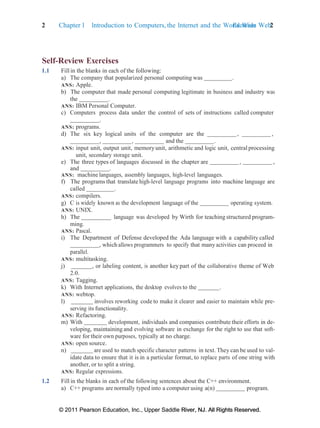
Self-Review Exercises
1.1 Fill in the blanks in each of the following:
a) The company that popularized personal computing was .
ANS: Apple.
b) The computer that made personal computing legitimate in business and industry was
the .
ANS: IBM Personal Computer.
c) Computers process data under the control of sets of instructions called computer
.
ANS: programs.
d) The six key logical units of the computer are the , ,
, , and the .
ANS: input unit, output unit, memoryunit, arithmetic and logic unit, central processing
unit, secondary storage unit.
e) The three types of languages discussed in the chapter are , ,
and .
ANS: machine languages, assembly languages, high-level languages.
f) The programs that translate high-level language programs into machine language are
called .
ANS: compilers.
g) C is widely known as the development language of the operating system.
ANS: UNIX.
h) The language was developed by Wirth for teaching structured program-
ming.
ANS: Pascal.
i) The Department of Defense developed the Ada language with a capability called
, which allows programmers to specify that many activities can proceed in
parallel.
ANS: multitasking.
j) , or labeling content, is another key part of the collaborative theme of Web
2.0.
ANS: Tagging.
k) With Internet applications, the desktop evolves to the .
ANS: webtop.
l) involves reworking code to make it clearer and easier to maintain while pre-
serving its functionality.
ANS: Refactoring.
m) With development, individuals and companies contribute their efforts in de-
veloping, maintaining and evolving software in exchange for the right to use that soft-
ware for their own purposes, typically at no charge.
ANS: open source.
n) are used to match specific character patterns in text. They can be used to val-
idate data to ensure that it is in a particular format, to replace parts of one string with
another, or to split a string.
ANS: Regular expressions.
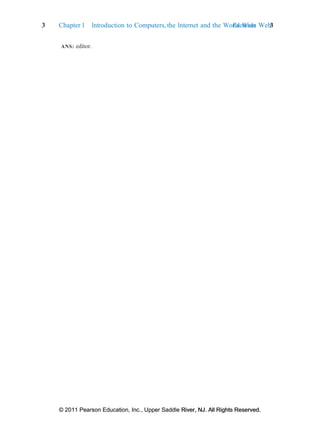
1.2 Fill in the blanks in each of the following sentences about the C++ environment.
a) C++ programs are normally typed into a computer using a(n) program.
3 Chapter 1 Introduction to Computers, the Internet and the World Wide Web:
Exercises 3
© 2011 Pearson Education, Inc., Upper Saddle River, NJ. All Rights Reserved.
ANS: editor.
4 Chapter 1 Introduction to Computers, the Internet and the World Wide Web:
Exercises 4
© 2011 Pearson Education, Inc., Upper Saddle River, NJ. All Rights Reserved.
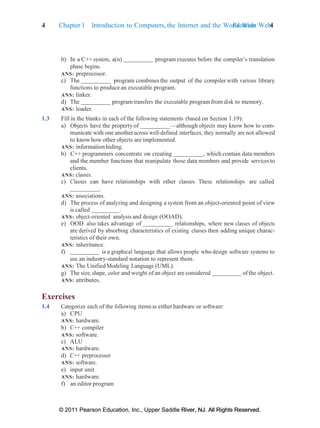
b) In a C++ system, a(n) programexecutes before the compiler’s translation
phase begins.
ANS: preprocessor.
c) The program combines the output of the compiler with various library
functions to produce an executable program.
ANS: linker.
d) The programtransfers the executable programfrom disk to memory.
ANS: loader.
1.3 Fill in the blanks in each of the following statements (based on Section 1.19):
a) Objects have the property of —although objects may know how to com-
municate with one anotheracross well-defined interfaces, they normally are not allowed
to know how other objects are implemented.
ANS: information hiding.
b) C++ programmers concentrate on creating , which contain data members
and the member functions that manipulate those data members and provide services to
clients.
ANS: classes.
c) Classes can have relationships with other classes. These relationships are called
.
ANS: associations.
d) The process of analyzing and designing a system from an object-oriented point of view
is called .
ANS: object-oriented analysis and design (OOAD).
e) OOD also takes advantage of relationships, where new classes of objects
are derived by absorbing characteristics of existing classes then adding unique charac-
teristics of their own.
ANS: inheritance.
f) is a graphical language that allows people who design software systems to
use an industry-standard notation to represent them.
ANS: The Unified Modeling Language (UML).
g) The size, shape, color and weight of an object are considered of the object.
ANS: attributes.
Exercises
1.4 Categorize each of the following items as either hardware or software:
a) CPU
ANS: hardware.
b) C++ compiler
ANS: software.
c) ALU
ANS: hardware.
d) C++ preprocessor
ANS: software.
e) input unit
ANS: hardware.
f) an editor program
5 Chapter 1 Introduction to Computers, the Internet and the World Wide Web:
Exercises 5
© 2011 Pearson Education, Inc., Upper Saddle River, NJ. All Rights Reserved.
ANS: software.
6 Chapter 1 Introduction to Computers, the Internet and the World Wide Web:
Exercises 6
© 2011 Pearson Education, Inc., Upper Saddle River, NJ. All Rights Reserved.
1.5 Why might you want to write a program in a machine-independent language instead of a
machine-dependent language? Why might a machine-dependent language be more appropriate for
writing certain types of programs?
ANS: Machine independent languages are useful for writing programs to be executed on
multiple computer platforms. Machine dependent languages are appropriate for
writing programs to be executed on a single platform.
1.6 Fill in the blanks in each of the following statements:
a) Which logical unit of the computer receives information from outside the computerfor
use by the computer? .
ANS: input unit.
b) The process of instructing the computer to solve specific problems is called
.
ANS: computer programming.
c) What type of computer language uses English-like abbreviations for machine language
instructions? .
ANS: assembly language.
d) Which logical unit of the computer sends information that has already been processed
by the computer to various devices so that the information may be used outside the
computer? .
ANS: output unit.
e) Which logical units of the computer retain information? .
ANS: memory unit and secondary storage unit.
f) Which logical unit of the computer performs calculations? .
ANS: arithmetic and logical unit.
g) Which logical unit of the computer makes logical decisions? .
ANS: arithmetic and logical unit.
h) The level of computer language most convenient to the programmer for writing pro-
grams quickly and easily is .
ANS: high-level language.
i) The only language that a computer directly understands is called that computer's
.
ANS: machine language.
j) Which logical unit of the computer coordinates the activities of all the other logical
units? .
ANS: central processing unit.
1.7 Why is so much attention todayfocused on object-oriented programming?
ANS: Object-oriented programming enables the programmer to build reusable software
components that model items in the real world. Building software quickly, correctly,
and economically has been an elusive goal in the software industry. The modular, ob-
ject-oriented design and implementation approach has been found to increase pro-
ductivity while reducing development time, errors, and cost.
1.8 Distinguish between the terms fatal error and nonfatal error. Why might you prefer to ex-
perience a fatal error rather than a nonfatal error?
ANS: A fatal error causes a program to terminate prematurely. A nonfatal error occurs when
the logic of the program is incorrect, and the program does not work properly. A fatal
error is preferred for debugging purposes. A fatal error immediately lets you know
6 Chapter 1 Introduction to Computers, the Internet and the World Wide Web:
Exercises 6
© 2011 Pearson Education, Inc., Upper Saddle River, NJ. All Rights Reserved.
there is a problem with the program, whereas a nonfatal error can be subtle and pos-
sibly go undetected.
1.9 Give a brief answer to each of the following questions:
© 2011 Pearson Education, Inc., Upper Saddle River, NJ. All Rights Reserved.
Making a Difference 5
5 Chapter 1 Introduction to Computers, the Internet and the World Wide Web:
a) Why does this text discuss structured programming in addition to object-oriented pro-
gramming?
ANS: Objects are composed in part of structured program pieces.
b) What kinds of messages do people send to one another?
ANS: People send messages through body language, speech, writings, e-mail, telephones,
etc.
c) Objects send messages to one another across well-defined interfaces. What interfaces
does a car radio (object) present to its user (a person object)?
ANS: Dials and buttons that allow the user to select a station, adjust the volume, adjust bass
and treble, play a CD or tape, etc.
1.10 (The Watch as an Object) You are probably wearing on your wrist one of the world’s most
common types of objects—a watch. Discuss how each of the following terms and concepts applies
to the notion of a watch: object, attributes, behaviors, class, inheritance (consider, for example, an
alarm clock), encapsulation, interface, information hiding, data members and member functions.
ANS: The entire watch is an object that is composed of many other objects (such as the
moving parts, the band, the face, etc.) Watch attributes are time, color, band, style
(digital or analog), etc. The behaviors of the watch include setting the time and get-
ting the time. A watch can be considered a specific type of clock (as can an alarm
clock). With that in mind, it is possible that a class called Clock could exist from
which other classes such as watch and alarm clock could inherit the basic features of
the clock. The watch is an abstraction of the mechanics needed to keep track of the
time. The user of the watch does not need to know the mechanics of the watch in
order to use it; the user only needs to know how to read the face of the watch and
that the watch keeps the proper time. In this sense, the mechanics of the watch are
encapsulated (hidden) inside the watch. The interface to the watch (its face and con-
trols for setting the time) allows the user to set and get the time. The user is not al-
lowed to directly touch the internal mechanics of the watch. All interaction with the
internal mechanics is controlled by the interface to the watch. The data members
stored in the watch are hidden inside the watch and the member functions (looking
at the face to get the time and setting the time) provide the interface to the data.
1.11 Fill in the blanks in each of the following statements (based on Section 1.17):
a) The open source database management system used in LAMP development is
.
ANS: MySQL
b) A key advantage of Software as a Service (SaaS) is .
ANS: When the servers are updated, all clients worldwide see the new capabilities; no local
installation is needed.
c) are proven architectures forconstructing flexible and maintainable object-ori-
ented software.
ANS: Design patterns
d) is the most popular open source server-side “scripting” language for develop-
ing Internet-based applications.
ANS: PHP
Making a Difference
© 2011 Pearson Education, Inc., Upper Saddle River, NJ. All Rights Reserved.
Making a Difference 6
6 Chapter 1 Introduction to Computers, the Internet and the World Wide Web:
1.12 (Test Drive: Carbon Footprint Calculator) Some scientists believe that carbon emissions,
especially from the burning of fossil fuels, contribute significantly to global warming and that this
can be combatted if individuals take steps to limit their use of carbon-based fuels. Organizations and
individuals are increasingly concerned about their “carbon footprints.” Websites such as TerraPass
© 2011 Pearson Education, Inc., Upper Saddle River, NJ. All Rights Reserved.
Making a Difference 7
7 Chapter 1 Introduction to Computers, the Internet and the World Wide Web:
www.terrapass.com/carbon-footprint-calculator/
and Carbon Footprint
www.carbonfootprint.com/calculator.aspx
provide carbon footprint calculators. Test drive these calculators to determine your carbon foot-
print. Exercises in later chapters will ask you to program your own carbon footprint calculator. To
prepare for this, research the formulas for calculating carbon footprints.
1.13 (Test Drive: Body Mass Index Calculator) By recent estimates, two-thirds of the people in
the United States are overweight and about half of those are obese. This causes significant increases
in illnesses such as diabetes and heart disease. To determine whether a person is overweight or obese,
you can use a measure called the bodymass index (BMI). The United States Department of Health
and Human Services provides a BMI calculator at www.nhlbisupport.com/bmi/. Use it to calculate
your own BMI. An exercise in Chapter 2 will ask you to program your own BMI calculator. To pre-
pare for this, research the formulas for calculating BMI.
1.14 (Attributes of Hybrid Vehicles) In this chapter you learned the basics of classes. Now you’ll
begin “fleshing out” aspects of a class called “Hybrid Vehicle.” Hybrid vehicles are becoming in-
creasingly popular, because they often get much better mileage than purely gasoline-powered vehi-
cles. Browse the web and study the features of four or five of today’s popular hybrid cars, then list
as many of their hybrid-related attributes as you can. For example, common attributes include city-
miles-per-gallon and highway-miles-per-gallon. Also list the attributes of the batteries (type, weight,
etc.).
ANS:
• Manufacturer
• Type of Hybrid—Battery hybrid (Hybrid Electric Vehicles), Plug-in hybrid, Fuel cell etc.
• Driverfeedback system—so the driver can monitor fuel efficiency based on their driving
• Energy recovery—for example, regenerative breaking
• Carbon footprint—tons of CO2 per year
• Fuel capacity
• City-miles-per-gallon
• Highway-miles-per-gallon
• Two-mode hybrid propulsion system
• Engine size—V6, V8, etc.
• Vehicle type—SUV, crossover, compact, mid-size, etc.
• Seating capacity
• Horse power
• Drive train (front wheel drive, all wheel drive)
• Top speed
• Torque
• Price
1.15 (Gender Neutrality) Manypeople want to eliminate sexism in all forms of communication.
You’ve been asked to create a program that can process a paragraph of text and replace gender-spe-
cific words with gender-neutral ones. Assuming that you’ve been given a list of gender-specific
© 2011 Pearson Education, Inc., Upper Saddle River, NJ. All Rights Reserved.
Making a Difference 8
8 Chapter 1 Introduction to Computers, the Internet and the World Wide Web:
words and their gender-neutral replacements (e.g., replace “wife” by “spouse,” “man” by “person,”
“daughter” by “child” and so on), explain the procedure you’d use to read through a paragraph of
text and manually perform these replacements. How might your procedure generate a strange term
© 2011 Pearson Education, Inc., Upper Saddle River, NJ. All Rights Reserved.
Making a Difference 9
9 Chapter 1 Introduction to Computers, the Internet and the World Wide Web:
like “woperchild?” In Chapter 3, you’ll learn that a more formal term for “procedure” is “algo-
rithm,” and that an algorithm specifies the steps to be performed and the order in which to perform
them.
ANS: Search through the entire paragraph for a word such as “wife” and replace every oc-
currence with “spouse.” Repeat this searching process for every gender specific word
in the list. You could accidentally get a word like “woperchild” if you are not careful
about how you perform replacements. For example, the word “man” can be part of
a larger word, like “woman.” So, replacing everyoccurrence of “man” can yield
strange results. Consider the process of replacing “man” with “person” then replacing
“son” with “child.” If you encounter the word “woman,” which contains the word
“man,” you’d replace “man” with “person” resulting in the word “woperson.” In a
subsequent pass you’d encounter “woperson” and replace “son” with “child” result-
ing in the “woperchild.”
Random documents with unrelated
content Scribd suggests to you:
────────────────
CHAPTER V ◆ UP FROM MELODRAMA
────────────────
About 1911 I saw the fate of the popular-priced game, and got
out of it before the final crash, as did Sam Harris, Al Woods and a
few of the others. I started to look about for a new way of earning
my living. I had made money at the game and was in no danger
from that source, but I was then, in 1910, only thirty-seven years old
and had trained myself to the habit of almost constant work, a habit
I have never as yet been able to break.
My name, as the author of literally hundreds of bloodthirsty
melodramas, was a thing of scorn to the highbrows of the theater,
used as a horrible example to young authors and to frighten bad
children. The very thought of my being allowed to produce a play in
a Broadway theater was quite absurd, as my friends all assured me.
I kept on writing, however, for the same reason that keeps me at it
now, because I love to write plays, no matter whom it hurts. For a
year or two I had a tough time, but I managed to find a market
among the road stars and the one night stand companies, and I
wrote a few comedies and dramatized several novels. They were
successful enough in the towns where they were played but were
never heard of in New York. At this time, also, I developed a trick of
writing plays directly for stock companies and by good salesmanship
built up quite an income from this by-product. I was absolutely
bound to break into the New York game and in spite of many rebuffs
I kept knocking at the doors of the New York managers.
The doors of New York managers, however, were closely guarded,
even in the comparatively far-off days of which I am writing, and in
the season of 1910 the best I could manage to do, aside from my
usual flock of road shows and my growing list of plays popular with
the stock companies at that time successfully scattered all over the
country, was to secure a couple of matinée performances. As a
matter of fact, a matinée performance of the play of a new author is
simply a public announcement by the manager of his lack of faith
and neither of these efforts of mine came to much. The first of
these, THE WISHING RING, was produced by Lee Shubert at Daly’s with
Marguerite Clark and a supporting company thrown together from
the cast of a musical play at that time current in the theater.
Marguerite Clark was charming in the part and later made use of the
play on the road and produced it for a short run in Chicago. THE
WISHING RING was directed by Cecil De Mille and was, I think, the last
thing he did before he left New York and threw in his lot with the
picture people.
The second of these half-hearted matinée productions was made
for me by Daniel Frohman at the Lyceum and gave Laurette Taylor
one of her first chances to show her very extraordinary talent. This
play, LOLA, was a queer sort of fish, part crude melodrama and part a
very real and very fine example of good play writing, but it was one
of those plays of which one must say it is either great or absurd. My
shady reputation and the hasty and careless production made only
one answer probable. In fact, it was many years before the name of
Owen Davis was much of a help to a play, and it would probably
have taken me at least a thousand to establish a trade-mark as a
serious dramatist had the public known that aside from the crimes
committed under the name of Owen Davis I must also answer to
many others. I had fallen into the playful habit of inventing other
names to hide my evil deeds. At one time I used so many assumed
names that the mere invention of them became a task and Al Woods
used to help me out by calmly borrowing the name of one of his
clerks or stenographers and writing it down as author of my latest
thriller.
When CONVICT 999 was first produced in Pittsburgh, the dramatic
critic of the largest of the morning papers said in his review of the
play: “Here at last is a fine melodrama and heaven be praised. Here,
in the person of John Oliver, a new writer, we have at last found a
man who knows more about how to write a play of this kind than
the irrepressible Owen Davis ever knew.”
William A. Brady was the first to give me a regular Broadway
production with a first class company and in doing so, although he
little knew it at the time, he started an association that lasted for
many years. Mr. Brady is a strong man and had he been able to
foresee what was in store for him the day on which we signed our
first contract, it is highly probable these confessions would never
have been written. With great confidence, however, Mr. Brady
commanded me to write him a big melodrama and as a result Doris
Keane and William Courtney appeared in a direful thing called MAKING
GOOD. The title of this play turned out to be a god-send to the New
York critics and if I had put as much wit into my play as they put
into their slaughter of it, Mr. Brady and I would have been happier
even if they had been deprived of a great pleasure. As a matter of
fact, I should be a very popular man with the critics. Several of them
owe their standing as humorists almost entirely to me and at least
one of the finest of them, Frank O’Malley, won his place in the ranks
of humorists over my dead body.
In later years Mr. O’Malley confided to me that he often journeyed
miles to get to a play of mine, a compliment that at the time I quite
failed to value at its true worth.
Twenty-four hours after the first New York production of MAKING
GOOD I was safely hidden in the country with my still loyal wife and
two small sons, luckily at the time too young to know their shame.
At once I started out, quite undismayed, to write another. One old
habit that still clings to me: if I have a failure, to sit down at my
desk before I have so much as slept on it, and write at least part of
the next one; as a matter of fact, most of the good plays I have
written have been started at such a time. Here then, in the wilds of
Westchester, I stuck to it until I finished THE FAMILY CUPBOARD, much
the best thing I had done up to then, and a play that might very well
be a success if produced to-day. The manuscript of this play I sent
at once to a play-broker with instructions to offer it for production
with no author’s name on the manuscript. A few days later the
broker called me up with the startling information that he had sold
my play to William A. Brady—rather dread news as, following what
the New York critics had said about MAKING GOOD, Mr. Brady had
thrown me out of his office and practically forbidden me its sacred
ground.
It seemed, so my broker said, that Mr. Brady had paid good
money for an option on the play and was very curious as to the
identity of the modest author. When he learned it, he had something
very like a stroke, but in time he forgave me.
All the years I worked with Mr. Brady were punctuated by terrible
fights between us that always ended in a renewal of friendship and
affection. He is by far the most colorful figure in the American
theater and even when one disagrees with him, which is apt to be
rather often, his strength and his complete belief in his own opinion
cause his opponents awful moments of doubt. If Mr. Brady really set
out to convince me that a red apple was a yellow one, I should at
once go and order a new pair of glasses.
Mr. Brady, David Belasco and Daniel Frohman are the last of the
old guard and, each in his different way, has written his name boldly
on the pages of our drama. Different as these three men are they
have one thing in common: a great and abiding love of the theater
and its people.
Mr. Brady and I together did THE FAMILY CUPBOARD, SINNERS, FOREVER
AFTER, AT 9.45 and many others. FOREVER AFTER was Alice Brady’s first
big part; partly owing to its simple, straightforward love story and
partly to her fine performance, it turned out to be one of the best
money-makers I have ever had. These plays were at the moment my
idea of one step up from the NELLIE, THE BEAUTIFUL CLOAK MODEL of the Al
Woods days.
At about this time the Actors’ Equity Association was formed and
pulled a real battle for their rights against the absurd and vicious
standards of the business. That they won that battle is well-known
and that they deserved to win it is fully admitted by fair-minded and
honest managers of the Sam Harris type—although, of course, if all
managers had been of his type no fight would have been necessary.
The actors’ strike at this time closed all the theaters and, as usual,
the author, who wasn’t in the fight at all and had nothing to win
whatever the outcome, lost much more money than any actor and
rather resented the row being pulled in his front yard. Most authors
were in sympathy with the actors but I know that for one I wished
they had chosen to fight with some other weapons than my three
plays, the runs of which were interrupted and from which I had been
drawing a very considerable royalty.
Hit in the dramatist’s tenderest spot, we met and organized and
from that day to this many of my hours have been given up to
service to the authors’ societies. I was at that time the last president
of the old Society of American Dramatists and Composers and a
member of the Authors’ League. With the help of a handful of ardent
spirits, I brought all the active dramatists of the day into the old
society and merged it with the Authors’ League as the Dramatists’
Guild of the Authors’ League of America. A group of strong men and
women came to the front and served faithfully on hundreds of
committees and through long hours of conferences. Among the most
active of these were Augustus Thomas, James Forbes, Gene Buck,
Rupert Hughes, Channing Pollock, Edward Childs Carpenter, Percival
Wilde, Rachel Crothers, Ann Crawford Flexner, Jules Goodman and
Montague Glass; then later Arthur Richman, George Middleton and
William Cary Duncan and a number of others.
I remained as president of this group until I resigned to take up
the presidency of the Authors’ League and gave, as all these others
gave, a very considerable part of my life for many years. At present,
thanks to our efforts, the dramatists are as well organized as the
actors and like the actor eager at all times for a battle, but we are
unfortunately quite without an adversary, one of the peculiar things
about the manager being that he is unable to agree to anything
whatever that any other manager thinks would be a good thing.
At meetings of the managerial society one man will frequently say:
“I don’t know what Mr. Blank wants to do about this problem, but
anything he thinks I think different.” It is a truly tragic thing that the
men who should be the leaders of the great institution that the
American theater should be have been incapable of enough business
foresight to bind themselves firmly together to protect their
interests. Always we have been out-generaled by the motion picture
men, bled white by the ticket speculator and discriminated against
by the railroads, the labor unions, and even the newspapers, who
are by rights our natural allies and our traditional friends. If the
theater is the cultural and the educational force I have always
claimed it was, surely it has a right to public loyalty and support and
I must always think that, if we have in large part lost that support, it
is because the dignity and the importance of the drama has been
hidden by the lack of dignity and the lack of importance of many of
our leaders.
I thought these things in the time of which I am now writing,
1912-1913, but naturally I had neither the independence of age nor
circumstance at that time to dare to fully express myself. Just before
the war I had begun to be impatient of the machine-made plays I
had been writing for so long and began to listen to my wife’s
pleadings to cut down the quantity and try to improve the quality of
my work. She had been begging me to do this for ten years or more,
and like other good husbands I rather like to do any little thing my
wife asks of me—after she has been asking it for ten years. I really
think I wanted to please her, but I also think that I had by this time
outgrown the sentimental comedy-drama as once before I had
outgrown the cheap melodramas. Naturally enough as soon as I lost
my own belief in my form of expression I was no longer successful in
it.
Let no man go unchallenged who in your presence talks of
purposely “writing down” to an audience, or of “giving them what
they want” or any other fish-bait of that description. I am here to tell
you that no man ever successfully wrote or produced any play, or
any novel below his own mental level at the moment. When I wrote
NELLIE, THE BEAUTIFUL CLOAK MODEL, I was honestly deeply moved by the
lady’s many misfortunes or I couldn’t have put it over, and when I
wrote the comedy-dramas that followed it I truly believed in them or
no audience in the world would have sat through them. This is
always true, I think, of writers or of managers. We are entirely
emotional people and our work reflects us. I know of several
supremely successful producers who made great fortunes selling the
piffle they loved and who, as soon as their money brought them
contacts that resulted in an increase in their taste and knowledge
promptly appointed themselves judges of the drama and even more
promptly went broke.
You may well afford to laugh at the faker who boasts of skill great
enough to assume a mood and color different from his own. The
next time he tells you of how he “wrote down to the boobs” simply
tell him he is either a liar or a fool—probably both. For surely, if he is
not a liar, he must be the greatest fool on earth to use for a cheap
success a genius great enough to have brought him a real one.
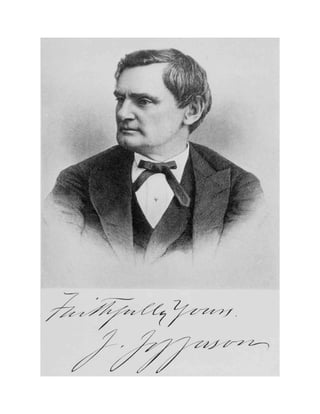
Faithfully yours,
J. Jefferson
(From the Messmore Kendall Collection)
“I have always admired Augustus Thomas”
(From the Messmore Kendall Collection)
If then, about fifteen years ago, I wanted to write a higher form of
drama it was for no nobler reason than because I had begun to be
bored by the sort of work I was doing and because it bored me it
had begun to bore my audiences. Several times in my life I have
been driven to an advance of this sort and always because of the
fact that I found my old occupation gone. As time goes on, I have
come to believe that if I could live two or three hundred years I
might develop into quite a playwright. In any case I once more
threw my box of tricks away and sat down quietly and tried to study
out a new method. In this I was helped by the change that had
begun to come over the drama. I was influenced as all our writers
were at the time by the Russian and Hungarian dramatists who had
discarded the artificial form of the “well-made play” and were writing
a new form of photographic realism that tempted us all to follow in
their footsteps.
As a result I wrote THE DETOUR, which remains in my mind the
example of the best work I have done for the theater. Of all my
plays the DETOUR, THE GAMBLER OF THE WEST (one of the old melodramas
of the Al Woods days) and THE NERVOUS WRECK are my pets. THE DETOUR
was produced by Lee Shubert at the Astor Theatre in the early fall of
1921 and, although it was never a money-maker, it gave me what I
wanted and made my wife very happy. As she had stuck around by
this time for some fifteen years waiting for something like this to
happen, it was, to say the least, no more than she deserved.
In the production of THE DETOUR I was fortunate enough to be able
to secure Augustin Duncan to play the principal part and to stage
the play. He more than justified the confidence I had in him. To me
Mr. Duncan is a great artist and by far the most sincere example of
the man who puts his art above his pocketbook I have ever met. I
suppose more rot has been spilled out by men and women who pose
as “devoted to their art” than by any other set of posing hypocrites
since the world began. We all of us play the tune we know and to
rebuke us for that tune is as silly as it is to praise us for it. To use
what talents we may have to earn a decent living for ourselves and
those dependent upon us is, to a man of any philosophy, a far finer
thing than to sit in a Greenwich Village attic and mouth jealous
platitudes about the baseness of commercial art.
This statement of my opinion is neither a defense nor an alibi. I
myself, as these confessions of mine are describing to you, have
always written for the love of the theater rather than from any art
impulse and I am the first to admit that my love of the theater has
always been more compelling than my love of the drama, if you
follow me in the distinction.
As a practical man, born of a practical line of hard-headed Yanks, I
have studied my own small talents and developed them and tried to
make up for a lack of the real fires of genius by an honest admission
of that lack and a true enthusiasm for the work that at the moment
came nearest to expressing my attitude. The true genius, the true
artist, is very rare, but Augustin Duncan is distinctly of that number.
He is quite as incapable of doing any work that doesn’t seem fine to
him as I am of writing anything at all unless I am going to be paid
for it, and he is as firm in his refusals as I am. And in my life, during
which I have written several million words, I doubt if I have written
five thousand without practical reward.
Max Gordon, one of the managers with whom I have been
associated, looked at me in troubled amazement one day lately
when I had made some mildly humorous comment and said: “That’s
the first time I ever heard you say anything funny for less than ten
percent.” Max Gordon, like many others of my acquaintance,
assumes this attitude of mine to be founded on a desire for money,
but as a matter of fact I care very little about money or the things
that money stands for. Any man who can make good can always
make money, but the fun is in the making good, in the thrill and the
sense of power that comes from activities sanely thought out and
successfully accomplished. Under Mr. Duncan’s fine direction THE
DETOUR was molded into shape and ready for its first performance.
Not one word of my original manuscript was changed from the day I
wrote it, which fact is most amazingly to his credit rather than to
mine. He is so fine a director that he molded his company to my
play, rather than my play to his company—the true duty of a director,
although few of them have the sense to know it. To the picture
director an author’s play is a sort of clover field in which he loves to
kick up his heels and romp about at his own sweet will, making any
changes at all that his fancy may dictate, most of them being made
for the very simple reason that he doesn’t quite grasp the meaning
of what is on the written page in front of him. Even in the theater
there are few managers who realize the value of one man’s
unbroken line of thought. “Plays are not written, they are re-written”
is a motto often repeated to writers and in the old days these wise
words were proudly framed and hung over the desk of one of our
greatest producers. This musty old truism has been used to
slaughter plays during all the years since Dion Boucicault first
uttered it, and like most other truisms its principal fault lies in the
fact that it isn’t true. When I was in Harvard I met Mr. Boucicault in
a barroom on Bowdoin Square in Boston and, as I looked at him in
awe and homage, I had little thought of ever being bold enough to
challenge any of his theories. Dion Boucicault was a great playwright
of the eighties, a man of sound knowledge of his craft, but like the
best of us there were occasions when he talked nonsense.
Plays are written by their authors. They are good plays or bad
plays depending almost wholly upon the degree of talent of the
author plus his accident of choice of a subject. This goes for pictures
as well as for stage plays. The germ of success is put in only by the
original author in spite of Mr. Boucicault and the combined opinion of
the Managers’ Association and the motion picture industry. I am
stating here an important fact upon which I have a great deal of
special information. I doubt if any man alive has ever been called in
as a play doctor more frequently than I, and for the good of my soul
I am willing to admit that I have very rarely saved a patient. I have
often seen plays helped by careful and skillful revision but I have
never once seen a play built into a real success unless the germ of
that success was firmly planted by the author in his first manuscript.
Frequently I have seen, so frequently as to have learned to be in
dread and horror of the practice, sensitive and beautiful plays and
picture stories so coarsened and debased by the rough hands of
managers, directors, supervisors and other quacks, that all hope of
success has been dosed and purged out of them. I am stoutly of the
opinion that if no changes at all in original manuscripts were ever
made the percentage of success both in plays and pictures would be
infinitely higher. This does not in the least mean that I think the
author is always right. Of course he isn’t. Play writing is the most
difficult form of all the forms of literary expression, and no man ever
wrote a perfect play. But I think the trained writer knows more about
his business than any one else can hope to know, and I think it is as
silly for an outsider to meddle with his work as it would be for a kind
neighbor to write a few helpful words in the middle of the
prescription you have paid a physician to prescribe for your sick
child.
Every one in the world is, I suppose, a potential story-teller. I am
constantly being asked to read plays written by elevator boys, maid-
servants, policemen and taxi drivers, and it is not surprising that
when a man finds himself in power over a writer he should at once
demand a share of the joy of the creator. But to me play writing is
and scenario writing ought to be a definitely understood and
carefully studied profession; and the outsider without special
knowledge or special talent who undertakes to turn out a
masterpiece is in exactly the same position to do good work as the
Irishman who had never tried to play the violin but had always
thought he could do it.
Even in editorial rooms, where a higher class of intelligence is
usually found in authority over the story departments, one notices
this instinctive urge to get a finger into the pie and the theater is
cursed with it; as the picture business is superlative in all things this
very human failing may be found here in its fullest flowering. Just as
Tom Sawyer’s young friends all wanted a turn at whitewashing the
fence so do the picture executives—supervisors, directors, script-
girls, cutters, film-editors, messenger boys, stage-hands and scrub-
women—all yearn to make just the least little bit of a change in a
story to satisfy some instinctive lech to be an author. I have seen so
many plays and screen stories ruined by this enforced collaboration
that I honestly look upon it as the major evil that threatens a young
writer’s success.
In the first place it’s a silly custom because once the author
surrenders the integrity of his story he is helpless to even be a fair
judge of the hybrid product that takes its place, and as plays and
stories do not succeed on account of their structural perfection but
by virtue of their spiritual and inspirational qualities, it is obvious
that no man without a creative talent has any right to mess about
with them.
Duncan knew the folly of all this and his skill and instinct resulted
in a fine and sensitive performance.
Again a play of mine was to have its first performance at a holiday
matinée and again, as had happened to me during the first matinée
of THROUGH THE BREAKERS, I was to be given the benefit of an honest
lay opinion of my talents. We opened in Asbury Park, New Jersey,
famous among people of the theater for drawing the prize boob
audiences of America. An audience at any seashore resort is a
terrible thing, but in Asbury Park for some reason its reactions are
amazing. Good plays die and terrible plays are heralded as great, so
that the wise author simply sits in suffering silence with cotton in his
ears. Personally as I sat with my wife through this first performance
of THE DETOUR I had been very happy, so happy in fact that I
neglected the cotton, and on my way out of the crowded theater I
heard the first critical opinion of this, the first attempt on my part to
write of life simply and honestly. “Do you know,” remarked a very
pretty young woman as we passed, “I think I could write a better
play than this one myself.” In spite, however, of this completely
honest expression of opinion THE DETOUR gave me a new standing as
a writer of serious plays. Another rusty old saw of the trade is the
one about all the great plays resting in closets, trunks and unread in
managers’ offices, plays so fine that, were they to be produced, a
new drama would spring full grown into being. I have been looking
for one of those for twenty years, but so far it has escaped me. In all
the hundreds of these neglected manuscripts that it has been my
sad fate to have read I found just one real play. When I demanded a
hearing for it and got one, it turned out to be just fair. There is a real
utility about a great play that sooner or later will bring it to the
stage; some one will see it and rave about it and it will get its
chance. It isn’t so difficult to tell a really great play when one reads
it, or a really bad play, it’s the in-between it is difficult to judge, the
degree of badness or of value that means failure or success. Careful
reading of these supposed masterpieces will usually prove rather a
shock. I’ve read a thousand, and I am not the man I was.
The Great War was over by this time and the changes it had
brought about in our moods and our standards was being sharply
reflected in the theater. The motion pictures, successful as they had
grown to be, had not as yet challenged our right to existence and
we had begun to produce something in the nature of an American
Drama. Eugene O’Neill had written several fine plays. Arthur
Richman’s AMBUSH, Gilbert Emery’s THE HERO and my THE DETOUR and
ICEBOUND were at least a step toward a true folk play and the rise of
the Theatre Guild and of Arthur Hopkins, who to me has always
seemed the great man of the theater in my time, gave fine promise
of fine things.
The Great War had disturbed and sobered me. I was about forty-
two years old at the time America entered it, fat, near-sighted and
cursed with a gouty constitution. Quite obviously I couldn’t fight,
and yet, like all men who stood just across the border line from
heroic action, I had my moments of longing and resentment; here
was a big thing and I couldn’t be part of it. I had been a sort of
adventurer all my life and yet when the greatest adventure of all
time was going on I must stand on the side lines.
Fate had decided that I was to have no real connection with the
war. I was too old, and my two boys were too young. The nearest I
came to the feeling of personal participation was when my youngest
brother, Colonel, then Major, Robert P. Davis, sailed with his regiment
for France. My peace of mind received one slight shock, however,
when my oldest son, Donald, then not quite fourteen, slipped away
from Yonkers, where we were living at the time, and enlisted in the
Navy. Exactly what might have come of that I never will know, for
when the young man was marched with a squad of volunteers to the
Battery and lined up before the keen eye of an officer, he was rudely
yanked out of line and sent home to me with a stern warning which
frightened me very much but made no dent at all in the culprit’s
armor. He felt no repentance at all but furiously cursed the United
States Navy for not knowing a good man when they saw one.
After the war a writer faced a new world. The changes in the form
of play writing speak volumes of the change in our mode of thought
and our standards. When I had written my first plays in the early
nineties, asides were freely spoken. I had frequently written scenes
in the old days in which the lovely heroine sat calmly in a chair,
violently struggling to pretend not to hear the villain and his fellow
conspirators who plotted her undoing in loud voices at a distance of
six feet. The soliloquy was also in good usage, that marvelous aid to
the clumsy craftsman by which all necessity for a carefully reticent
exposition could be laughed aside. I used to start a play, for
example, with a lady alone on the stage as the first curtain rose. She
would perhaps turn sadly away from the window and looking the
audience firmly in its composite eye would exclaim: “Poor John; I
wonder if he knows that I have been untrue to him.” This naturally
saved a lot of time and had a distinct advantage from the audience’s
point of view. They had very little excuse for not knowing what the
play was all about.
Deeper, however, than any change in the shifting methods of play
writing was the change in the point of view of our audiences. The
“Prodigal Son” story, the “Cinderella” story, and the “Magdalen” story
seemed to have lost their power; the old one about, “My son shall
never marry a daughter of the Hoosis’s” no longer bit very deep, and
the poor dramatist had to learn all over again.
I can best explain the change that twenty years had brought by
telling of an experience I had with a play called DRIFTWOOD. I wrote
this play in 1905 and read it to a famous star of that time; the lady
liked the part and urged her manager to produce the play, but after
long reflection he decided against it on the grounds that the heroine
of my play had made in her youth what the French writers so politely
describe as “a slip,” and in his experience it was out of the question
that any audience could ever be willing for her, no matter how deep
her repentance, to marry a decent man. Twenty years after I dug
this old faded manuscript out of a trunk and was struck by some
scenes of what seemed to me to be of real power and truth, and
again I took it to a great woman star, whose verdict was “It didn’t
seem to her to be about anything worth making such a fuss about.”
And she was as right in her opinion as the manager of the old days
had been in his.
After the production of THE DETOUR I attacked my work from a
slightly different point of view, and my next job was the very
pleasant one of making for my old friend, William A. Brady, the
American adaptation of THE INSECT COMEDY, which was produced as THE
WORLD WE LIVE IN. I followed this with ICEBOUND, which won for me the
Pulitzer Prize in 1923 and caused me to be selected as a member of
the National Institute of Arts and Letters.
I had some adventures with ICEBOUND before I got it on the stage
and got myself into a terrible mess that grew deeper as its success
grew more assured. David Belasco had seen THE DETOUR and had
written me that if I could write another play as good he would gladly
produce it at once. I sent him the manuscript of ICE BOUND as soon as
I completed it, and in a few days had a telegram from him saying
that he liked it very much and asked me to see Mr. Roder, his
manager, and arrange the details of a contract. The next day I called
on Ben Roder, whom I had known for many years, and he offered
me a contract containing a clause giving Mr. Belasco the right to
produce the play at any time during the next two years. Mr. Belasco
was away with David Warfield’s production of THE MERCHANT OF VENICE
and Mr. Roder was a bit impatient of my objection to the clause I
have mentioned. I have always been in a hurry all my life, and I had
caught from Al Woods during my long association with him his
ardent desire to see a play on the stage the very moment he falls in
love with it. Neither yesterday nor to-morrow ever meant very much
to me; to-day has always been the right time to produce any play
that I had faith in. This fact is so well known to the men with whom
I do business that it is no longer necessary for me to tell them that if
they want to do a play of mine at all they must start casting it the
very hour after they have first read it. Mr. Roder, however, was not
quite used to my rather stormy manner, and the result of our talk
was an angry outburst on my part.
“Mr. Belasco,” I said, “will give me a contract before noon on
Monday for an immediate production or he can’t have the play.” Such
language is all out of line in the Belasco office, and Mr. Roder smiled
a kindly and tolerant smile as I walked out of his office, merely
remarking that he didn’t think I was quite crazy enough to turn
down a Belasco production. I have always been a free lance in the
theater and perhaps a bit militant in my stand for an author’s rights
and his prerogatives, and I made up my mind to go through with my
bluff unless Mr. Belasco came to my terms. On Monday I would sell
my play to some one else. With this in view I took all four of my
remaining manuscripts under my arm, and by noon I had placed
three of them with managers of good standing, in each case saying
that the play must be purchased by Monday noon or not at all, in
each case walking out of the office followed by an exact duplicate of
Mr. Roder’s tolerant but unbelieving smile.
It was noon and I was hungry, so, with my remaining manuscript
tucked into my overcoat pocket, I dropped into the grill room of the
old Knickerbocker Hotel for lunch. During lunch young Max Gordon,
whom I had known since his boyhood, sat down for a moment at my
table for a friendly chat. Max Gordon and Al Lewis had been
successful vaudeville agents and had recently owned interests in
several plays, but as yet had made no productions under their own
names. Max was always of an inquiring turn of mind and very little
escapes him. One glance at the yellow envelope sticking out of my
overcoat pocket was enough.
“How’s your new play?” was his first start. His second was to
calmly stretch out his hand and take my last manuscript out of my
pocket and transfer it to his own. “I’d like to read it,” he blandly
observed, and in spite of some protest on my part he walked out of
the room with it in his pocket. I had already covered the three
managers who, aside from Mr. Belasco, had seemed to me to be
best fitted to produce this play and I went home. The next day being
Saturday, I went up to St. Andrews for my usual week-end game of
golf with my golfing partner, Bob Davis, Bob being no blood kin of
mine but a very dear friend of many years’ standing. Sunday
morning the bell of my apartment rang and Mr. Max Gordon walked
calmly in and dropped a thousand dollars on my table and blandly
announced that “we are going to produce ICEBOUND.” Questioned as
to the “we” part of it he replied that Sam Harris and Al Lewis had
read the play and that Mr. Harris had offered to put it out under his
trade mark with Lewis and Gordon as silent but active partners. Sam
Harris could then, as he could now, have anything of mine he
wanted, so I promptly shook hands and called it a trade.
Then the storm broke. By ‘phone, by letter and by telegram every
one of the managers whom I had given until Monday noon to buy
my play sent messages that they would produce it, and it took me
about five years to square myself.
As a matter of fact I have never been able to see the justice in the
trade custom of never submitting a play to more than one manager
at a time. If I own a house and want to sell it, I give that house to
more than one agent, and the grocer who displays a particularly fine
melon on his stand doesn’t consider it the property of the first
customer who admires it. Before it’s anybody’s but his some one
must pay good money for it. Experience has taught me that any
manager who wants a play never lets an author out of his office until
he has signed a contract, and he is crazy if he does. I have been
roused from my bed at four o’clock in the morning and forced to
promise a play to an excited manager before he allowed me to crawl
back under the bedclothes, and any less ardent expression of
willingness has grown to be very suspicious in my eyes.
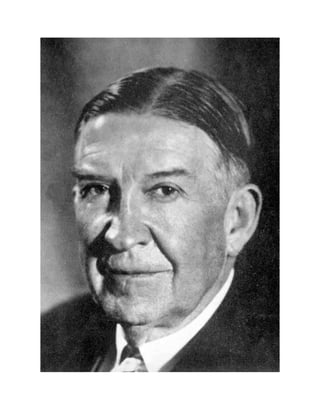
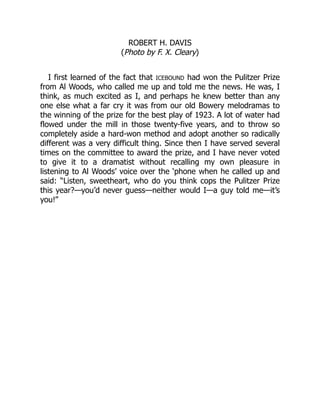
ROBERT H. DAVIS
(Photo by F. X. Cleary)
I first learned of the fact that ICEBOUND had won the Pulitzer Prize
from Al Woods, who called me up and told me the news. He was, I
think, as much excited as I, and perhaps he knew better than any
one else what a far cry it was from our old Bowery melodramas to
the winning of the prize for the best play of 1923. A lot of water had
flowed under the mill in those twenty-five years, and to throw so
completely aside a hard-won method and adopt another so radically
different was a very difficult thing. Since then I have served several
times on the committee to award the prize, and I have never voted
to give it to a dramatist without recalling my own pleasure in
listening to Al Woods’ voice over the ‘phone when he called up and
said: “Listen, sweetheart, who do you think cops the Pulitzer Prize
this year?—you’d never guess—neither would I—a guy told me—it’s
you!”
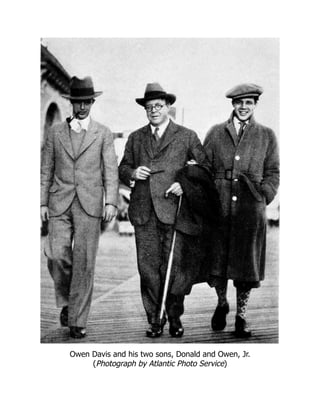
Owen Davis and his two sons, Donald and Owen, Jr.
(Photograph by Atlantic Photo Service)
During the run of ICEBOUND Bob Davis ruined a golf game by telling
me about a new story he was about to publish. It was, so he told
me, written by E. J. Rath, but, as a matter of fact, it had in all
probability sprung from his own amazing mind, as have literally
hundreds of other stories that have appeared under the names of
our most famous writers. Bob has been for many years the dry nurse
of American fiction and responsible for the present fame of more
successful novelists and short story writers than any one man who
has ever lived. This story that he called The Wreck bored me very
much and quite ruined my game, as Bob usually saves his loudest
and most startling statements until I am at the top of my back
swing; so to keep him quiet I told him to shut up and I’d read the
fool thing if he would send it to me. When I read the proof sheets,
all I could find there was a very amusing character, but urged on by
Bob I finally agreed to try my best to make a play out of it. The play
was THE NERVOUS WRECK, probably one of the most successful farces of
the last twenty years.
As soon as I finished this play I took it to Sam Harris, who read it
promptly and told me it was terrible. As I fully agreed with him, we
decided to have it tried out on the west coast, figuring that the
further we got it from the sight of our friends the better. Mr. Harris
had at that time some business relations with Thomas Wilks of Los
Angeles, and the play was announced for production by him. After
the first rehearsal Mr. Wilks’ stock company went on strike and
refused to play the thing, saying that it was without a doubt the
worst play ever written by mortal man. It was only after a battle that
they were forced to continue.
Mr. Edward Horton who first played the part has since told me that
he was never in his life so startled as he was by the screams of
laughter that followed his first scene, and he and the leading lady
got together after the first performance and hastily learned their
lines, a thing that up to that time they had not thought it worth
while to do. The farce played in Los Angeles for twelve weeks to
enormous business, but Mr. Harris and I were still a bit doubtful and
rather reluctantly started to put together a cast for an eastern
tryout. We put it on in Atlantic City with Mr. Horton and Miss Frances
Howard, now Mrs. Samuel Goldwyn, in the leading parts. After the
first performance Mr. Harris confided in me that he had always
thought it the worst play he had ever seen and that now he was
sure of it. I had very little if any more faith than he had, and we
returned to New York together in disgust. But to our amazement the
fool thing did a big week’s business and we decided to see it once
more during the following week in Long Branch. At Long Branch we
saw it before a half empty house and decided we would close it up,
and that I would work on it at my leisure.
I re-wrote it completely seven different times, and each time Mr.
Harris liked it just a little bit less. It kicked around the office for a
year before Al Lewis picked it up in an idle moment and insisted on
our once again tempting fate with it.
The third cast we selected for this outcast of ours was headed by
Otto Kruger and June Walker. Otto said it was terrible and almost
walked out on us, but at last we got it on in Washington, where Mr.
Harris said he would come to see it with an unprejudiced eye. This
time he only remarked that he’d be damned if he knew why he had
ever bothered with the thing, but if it was any fun for me to mess
about with such truck he had no objection to my seeing what I could
do. Messing about with a farce isn’t exactly fun, and I almost killed
myself working over it.
During the next week in Baltimore, Mr. Harris wired me that a
failure at his New York theater was leaving his house dark, and that
he had booked THE NERVOUS WRECK to open there the following
Monday. By that time I had the play in pretty good shape. Al Lewis,
Sam Forrest and I had been at it night and day, but I had no last act
at all. A farce without a last act is a pretty sad affair, and one night
in desperation I remembered a hot comedy scene I had in an
unproduced farce called THE HAUNTED HOUSE. I promptly pulled the
scene bodily out of one play and stuck it into another.
This scene, the examination of some cowboys on a ranch by a
young eastern highbrow who used the methods of laboratory
psychology, made the play’s success, but left me in an awful mess
when the time came to produce THE HAUNTED HOUSE, which was now
without any last act at all. One act, however, has always been a little
thing in my life, and I stuck something in the hole left by the missing
scene, and with the late Wallace Eddinger in the leading part, THE
HAUNTED HOUSE did well enough for a season.
────────────────
CHAPTER VI ◆ HOW TO WRITE THREE HUNDRED
PLAYS
────────────────
I love farce, but of all the forms of dramatic writing it is by all
odds the most difficult and demands more hard work and more
technical dexterity of the writer than any other.
A good farce, in the first place, must have a plot that could as
easily be told as a tragedy, and a character not only essentially true
but completely familiar to any audience; and it must have at least
three times as much situation in it as any other type of play.
We hear a lot of late of the technique of play writing, and I have
grown a bit impatient of some of the dogmatic drivel laid before the
eyes of would-be dramatists. In reality the dramatist sails on
uncharted seas. There is no master to whose word he can bow, and
no oracle to whom he can submit his questions. The only way to
write a good play is to make it good. If I were asked to put into one
sentence the result of my experience as a writer, I should say:
“Dream out a story about the sort of persons you know the most
about, and tell it as simply as you can.”
Of course, rules for play writing don’t mean anything, not even
that the writer who lays down the rules ever uses them himself. He
may be like the cook who prefers to go out to lunch, and yet I have
picked up one or two tricks, short cuts, easy ways to do hard things,
and I am going to write a few of them down in the faint hope of
their being of some slight help to a beginner.
Of course, the usual way to learn to write is by repeated failure,
by doing almost everything so badly that the awful consequences
are so deeply burned into one’s memory that each disaster has
resulted in being so terrified of one particular blunder that it can
never be repeated.
Technique is, as I understand it, simply a facing of certain facts, a
realization of some mistakes, a summing up of some experiences of
one’s self or of others, into an expressed formula. I think I believe in
that. It is a good thing to know thoroughly all the rules of play
writing (only there really aren’t any). These rules, the result of one’s
own experience or the theories of others should be carefully learned,
and then twice as carefully forgotten. Conscious technique in any art
is very painful. The sculptor knows that under his clay are the
trusses to hold up his figure, but he doesn’t let them show. It might
be well to note, however, that if he forgot to put them in, his
beautiful figure would be a shapeless mass on the floor.
Of course, the man who knows the most about play writing
doesn’t write the best plays, but quite as surely knowing a little
about his trade isn’t going to hurt him. I quarrel sometimes with my
friend, M. L. Malevinsky, over the real value of this special
knowledge. To me play writing is almost entirely an emotional thing,
and in the foreword I wrote for his quite remarkable book on THE
TECHNIQUE OF THE DRAMA I tried to express my feeling of the limitations
of technical knowledge by writing: “It is probable that the hedge
sparrow has quite as much technique as the meadow lark, but only
the song bird can sing.”
If you care to read the few observations I am about to write
down, read them with the thought that they aren’t meant to be too
slavishly followed; they are not words of wisdom at all, they are
simply scars from the battlefield, and they are only meant as a sort
of protective mechanism to save your fingers from being burned as
deeply as my own have been.
1. Don’t write at all until you have something you are sure is
worth writing about.
2. Don’t make notes. Anything one may possibly forget isn’t worth
remembering.
3. After your story has shaped itself in your mind, tell it to yourself
over and over and over again—then try it on some one else. Wives
are good; they have to stand for it. Let the first thing you put down
on paper be an outline narrative of your play, written in two hundred
words. If your story won’t go into two hundred words, throw it away.
The next step is to write several more outlines, at first in narrative
form. Later put in a little dialogue, not probably to be used in your
final copy, but to give you a growing acquaintance with your
characters.
4. Modern plays are about how characters react to situations, not
about situations in themselves.
5. Be absolutely sure of your last scene before you write a word of
your first act. Paul Potter, a master of the form of play writing, was
the first to tell me that the French dramatists always wrote their last
act first. I have never quite done that, but I do try to know exactly
what I am going to do with my characters at the end of the play
before I start out. One of the oldest mechanical rules of play writing
is, Act 1 plus Act 2 equal Act 3. I have altered that a little in my own
work, and I think I could express it as: the characters of Act 1
multiplied by the emotions of Act 2 equal Act 3. A play really is a
character driven by an emotion along a definite line to a definite
end. Mr. Malevinsky states somewhat the same thing. I fully agree
with him that every play expresses a definite emotion, but I do not
think the author is or should be conscious of the fact. In the end any
carefully written play results in a story line marked out by one
character, driven by one dominant emotion to the definite climax of
that emotion—success, failure, love, death, whatever it may be. But
if one wants a successful play, it must have an ending absolutely
made imperative by what has happened in the first part of your
story, plus what has happened in the second part. If two-thirds of
the way through you have a possible choice as to the outcome, you
will have a failure every time. Authors write first acts and second
acts, but the audience writes all good last acts. A modern audience
cares very little whether your play ends happily or not, but they
insist upon its ending along the line you yourself have started it on,
and audiences know a lot more about play writing than any
dramatist ever knew.
6. Don’t try to tell of the sort of life you don’t know anything
about. If you know the little girl next door, tell a story about her—
forget the King of France.
7. If, after you have written a speech, and read it over and find it
sounds very beautiful to you, cross it out; beauty in the modern play
is in the thought, not in the words. This is a tough lesson for us old-
timers to learn, and to this day the last thing I do before I send my
manuscript on its first journey is to comb it over for stray “effective
speeches” or bits of bombast, once my specialty and now my
bitterest enemy.
8. Don’t give a thought as to how big or how little your cast is, or
how much or how little your production is going to cost. If it’s a
good play it can’t cost too much, and if it’s a bad one it can’t help it.
9. Get yourself in the habit of reading over all you have written
previously before you start each day’s work, and as the manuscript
grows force yourself to be more and more critical of what you have
done. A play should consist of at least a hundred thousand words,
twenty thousand on paper and eighty thousand in the waste basket.
10. Don’t worry about how long it is going to take you to finish
your task; it doesn’t matter. Some days you won’t be able to write at
all, and other days you can’t stop writing. I have written through
hundreds of lunch and dinner hours and thousands of business and
social appointments. Don’t let any one bother you when you are
writing or anything. If the ‘phone rings, don’t answer it, and if your
wife rebels, divorce her. Nothing and nobody is important when the
thoughts are boiling. Nobody expects a dramatist to be a respectable
Welcome to our website – the perfect destination for book lovers and
knowledge seekers. We believe that every book holds a new world,
offering opportunities for learning, discovery, and personal growth.
That’s why we are dedicated to bringing you a diverse collection of
books, ranging from classic literature and specialized publications to
self-development guides and children's books.
More than just a book-buying platform, we strive to be a bridge
connecting you with timeless cultural and intellectual values. With an
elegant, user-friendly interface and a smart search system, you can
quickly find the books that best suit your interests. Additionally,
our special promotions and home delivery services help you save time
and fully enjoy the joy of reading.
Join us on a journey of knowledge exploration, passion nurturing, and
personal growth every day!
testbankbell.com

Solution Manual for C++ How to Program: Late Objects Version, 7/E 7th Edition Paul Deitel, Harvey Deitel


  • 1.
    Solution Manual forC++ How to Program: Late Objects Version, 7/E 7th Edition Paul Deitel, Harvey Deitel download pdf http://testbankbell.com/product/solution-manual-for-c-how-to-program- late-objects-version-7-e-7th-edition-paul-deitel-harvey-deitel/ Visit testbankbell.com today to download the complete set of test banks or solution manuals!

  • 2.
    Here are somerecommended products for you. Click the link to download, or explore more at testbankbell.com Solution Manual for C How to Program, 7/E 7th Edition Paul Deitel, Harvey Deitel http://testbankbell.com/product/solution-manual-for-c-how-to- program-7-e-7th-edition-paul-deitel-harvey-deitel/ Solution Manual for C How to Program, 8th Edition, Paul J. Deitel, Harvey Deitel http://testbankbell.com/product/solution-manual-for-c-how-to- program-8th-edition-paul-j-deitel-harvey-deitel/ Test Bank for C How to Program, 8th Edition, Paul J. Deitel, Harvey Deitel http://testbankbell.com/product/test-bank-for-c-how-to-program-8th- edition-paul-j-deitel-harvey-deitel-2/ Test bank for Drugs Across the Spectrum 7e by Goldberg 1133594166 http://testbankbell.com/product/test-bank-for-drugs-across-the- spectrum-7e-by-goldberg-1133594166/


  • 3.
    Test Bank forWomen’s Gynecologic Health, 3rd Edition, Kerri Durnell Schuiling, Frances E. Likis, ISBN-10: 1284076024, ISBN-13: 9781284076028 http://testbankbell.com/product/test-bank-for-womens-gynecologic- health-3rd-edition-kerri-durnell-schuiling-frances-e-likis- isbn-10-1284076024-isbn-13-9781284076028/ Test Bank for Psychology Core Concepts, 7th Edition : Zimbardo http://testbankbell.com/product/test-bank-for-psychology-core- concepts-7th-edition-zimbardo/ Industrial Organizational Psychology Understanding the Workplace 5th Edition Levy Test Bank http://testbankbell.com/product/industrial-organizational-psychology- understanding-the-workplace-5th-edition-levy-test-bank/ Test Bank for Biology: The Essentials 3rd Edition http://testbankbell.com/product/test-bank-for-biology-the- essentials-3rd-edition/ Test Bank for Adolescence, 12th Edition Laurence Steinberg http://testbankbell.com/product/test-bank-for-adolescence-12th- edition-laurence-steinberg/
  • 4.
    Elementary Statistics Picturingthe World Larson 6th Edition Test Bank http://testbankbell.com/product/elementary-statistics-picturing-the- world-larson-6th-edition-test-bank/
  • 5.
    C++ How toProgram: Late Objects Version, 7/E 7th Full chapter download at: https://testbankbell.com/product/solution-manual-for-c-how- to-program-late-objects-version-7-e-7th-edition-paul-deitel-harvey-deitel/ Ob j e cti v e s In this chapter you’ll learn: ■ Basic hardware and software concepts. ■ The different types of programming languages. ■ A typical C++ program development environment. ■ The history of the Internet and the World Wide Web, and the Web 2.0 phenomenon. ■ To test-drive C++ applications in GNU C++ on Linux and Microsoft’s Visual C++® on Windows®. ■ Some basic object technology concepts. © 2011 Pearson Education, Inc., Upper Saddle River, NJ. All Rights Reserved.
  • 6.
    2 Chapter 1Introduction to Computers, the Internet and the World Wide Web: Exercises 2 © 2011 Pearson Education, Inc., Upper Saddle River, NJ. All Rights Reserved. © 2011 Pearson Education, Inc., Upper Saddle River, NJ. All Rights Reserved. Self-Review Exercises 1.1 Fill in the blanks in each of the following: a) The company that popularized personal computing was . ANS: Apple. b) The computer that made personal computing legitimate in business and industry was the . ANS: IBM Personal Computer. c) Computers process data under the control of sets of instructions called computer . ANS: programs. d) The six key logical units of the computer are the , , , , and the . ANS: input unit, output unit, memoryunit, arithmetic and logic unit, central processing unit, secondary storage unit. e) The three types of languages discussed in the chapter are , , and . ANS: machine languages, assembly languages, high-level languages. f) The programs that translate high-level language programs into machine language are called . ANS: compilers. g) C is widely known as the development language of the operating system. ANS: UNIX. h) The language was developed by Wirth for teaching structured program- ming. ANS: Pascal. i) The Department of Defense developed the Ada language with a capability called , which allows programmers to specify that many activities can proceed in parallel. ANS: multitasking. j) , or labeling content, is another key part of the collaborative theme of Web 2.0. ANS: Tagging. k) With Internet applications, the desktop evolves to the . ANS: webtop. l) involves reworking code to make it clearer and easier to maintain while pre- serving its functionality. ANS: Refactoring. m) With development, individuals and companies contribute their efforts in de- veloping, maintaining and evolving software in exchange for the right to use that soft- ware for their own purposes, typically at no charge. ANS: open source. n) are used to match specific character patterns in text. They can be used to val- idate data to ensure that it is in a particular format, to replace parts of one string with another, or to split a string. ANS: Regular expressions. 1.2 Fill in the blanks in each of the following sentences about the C++ environment. a) C++ programs are normally typed into a computer using a(n) program.
  • 7.
    3 Chapter 1Introduction to Computers, the Internet and the World Wide Web: Exercises 3 © 2011 Pearson Education, Inc., Upper Saddle River, NJ. All Rights Reserved. © 2011 Pearson Education, Inc., Upper Saddle River, NJ. All Rights Reserved. ANS: editor.
  • 8.
    4 Chapter 1Introduction to Computers, the Internet and the World Wide Web: Exercises 4 © 2011 Pearson Education, Inc., Upper Saddle River, NJ. All Rights Reserved. © 2011 Pearson Education, Inc., Upper Saddle River, NJ. All Rights Reserved. b) In a C++ system, a(n) programexecutes before the compiler’s translation phase begins. ANS: preprocessor. c) The program combines the output of the compiler with various library functions to produce an executable program. ANS: linker. d) The programtransfers the executable programfrom disk to memory. ANS: loader. 1.3 Fill in the blanks in each of the following statements (based on Section 1.19): a) Objects have the property of —although objects may know how to com- municate with one anotheracross well-defined interfaces, they normally are not allowed to know how other objects are implemented. ANS: information hiding. b) C++ programmers concentrate on creating , which contain data members and the member functions that manipulate those data members and provide services to clients. ANS: classes. c) Classes can have relationships with other classes. These relationships are called . ANS: associations. d) The process of analyzing and designing a system from an object-oriented point of view is called . ANS: object-oriented analysis and design (OOAD). e) OOD also takes advantage of relationships, where new classes of objects are derived by absorbing characteristics of existing classes then adding unique charac- teristics of their own. ANS: inheritance. f) is a graphical language that allows people who design software systems to use an industry-standard notation to represent them. ANS: The Unified Modeling Language (UML). g) The size, shape, color and weight of an object are considered of the object. ANS: attributes. Exercises 1.4 Categorize each of the following items as either hardware or software: a) CPU ANS: hardware. b) C++ compiler ANS: software. c) ALU ANS: hardware. d) C++ preprocessor ANS: software. e) input unit ANS: hardware. f) an editor program
  • 9.
    5 Chapter 1Introduction to Computers, the Internet and the World Wide Web: Exercises 5 © 2011 Pearson Education, Inc., Upper Saddle River, NJ. All Rights Reserved. © 2011 Pearson Education, Inc., Upper Saddle River, NJ. All Rights Reserved. ANS: software.
  • 10.
    6 Chapter 1Introduction to Computers, the Internet and the World Wide Web: Exercises 6 © 2011 Pearson Education, Inc., Upper Saddle River, NJ. All Rights Reserved. © 2011 Pearson Education, Inc., Upper Saddle River, NJ. All Rights Reserved. 1.5 Why might you want to write a program in a machine-independent language instead of a machine-dependent language? Why might a machine-dependent language be more appropriate for writing certain types of programs? ANS: Machine independent languages are useful for writing programs to be executed on multiple computer platforms. Machine dependent languages are appropriate for writing programs to be executed on a single platform. 1.6 Fill in the blanks in each of the following statements: a) Which logical unit of the computer receives information from outside the computerfor use by the computer? . ANS: input unit. b) The process of instructing the computer to solve specific problems is called . ANS: computer programming. c) What type of computer language uses English-like abbreviations for machine language instructions? . ANS: assembly language. d) Which logical unit of the computer sends information that has already been processed by the computer to various devices so that the information may be used outside the computer? . ANS: output unit. e) Which logical units of the computer retain information? . ANS: memory unit and secondary storage unit. f) Which logical unit of the computer performs calculations? . ANS: arithmetic and logical unit. g) Which logical unit of the computer makes logical decisions? . ANS: arithmetic and logical unit. h) The level of computer language most convenient to the programmer for writing pro- grams quickly and easily is . ANS: high-level language. i) The only language that a computer directly understands is called that computer's . ANS: machine language. j) Which logical unit of the computer coordinates the activities of all the other logical units? . ANS: central processing unit. 1.7 Why is so much attention todayfocused on object-oriented programming? ANS: Object-oriented programming enables the programmer to build reusable software components that model items in the real world. Building software quickly, correctly, and economically has been an elusive goal in the software industry. The modular, ob- ject-oriented design and implementation approach has been found to increase pro- ductivity while reducing development time, errors, and cost. 1.8 Distinguish between the terms fatal error and nonfatal error. Why might you prefer to ex- perience a fatal error rather than a nonfatal error? ANS: A fatal error causes a program to terminate prematurely. A nonfatal error occurs when the logic of the program is incorrect, and the program does not work properly. A fatal error is preferred for debugging purposes. A fatal error immediately lets you know
  • 11.
    6 Chapter 1Introduction to Computers, the Internet and the World Wide Web: Exercises 6 © 2011 Pearson Education, Inc., Upper Saddle River, NJ. All Rights Reserved. © 2011 Pearson Education, Inc., Upper Saddle River, NJ. All Rights Reserved. there is a problem with the program, whereas a nonfatal error can be subtle and pos- sibly go undetected. 1.9 Give a brief answer to each of the following questions:
  • 12.
    © 2011 PearsonEducation, Inc., Upper Saddle River, NJ. All Rights Reserved. © 2011 Pearson Education, Inc., Upper Saddle River, NJ. All Rights Reserved. Making a Difference 5 5 Chapter 1 Introduction to Computers, the Internet and the World Wide Web: a) Why does this text discuss structured programming in addition to object-oriented pro- gramming? ANS: Objects are composed in part of structured program pieces. b) What kinds of messages do people send to one another? ANS: People send messages through body language, speech, writings, e-mail, telephones, etc. c) Objects send messages to one another across well-defined interfaces. What interfaces does a car radio (object) present to its user (a person object)? ANS: Dials and buttons that allow the user to select a station, adjust the volume, adjust bass and treble, play a CD or tape, etc. 1.10 (The Watch as an Object) You are probably wearing on your wrist one of the world’s most common types of objects—a watch. Discuss how each of the following terms and concepts applies to the notion of a watch: object, attributes, behaviors, class, inheritance (consider, for example, an alarm clock), encapsulation, interface, information hiding, data members and member functions. ANS: The entire watch is an object that is composed of many other objects (such as the moving parts, the band, the face, etc.) Watch attributes are time, color, band, style (digital or analog), etc. The behaviors of the watch include setting the time and get- ting the time. A watch can be considered a specific type of clock (as can an alarm clock). With that in mind, it is possible that a class called Clock could exist from which other classes such as watch and alarm clock could inherit the basic features of the clock. The watch is an abstraction of the mechanics needed to keep track of the time. The user of the watch does not need to know the mechanics of the watch in order to use it; the user only needs to know how to read the face of the watch and that the watch keeps the proper time. In this sense, the mechanics of the watch are encapsulated (hidden) inside the watch. The interface to the watch (its face and con- trols for setting the time) allows the user to set and get the time. The user is not al- lowed to directly touch the internal mechanics of the watch. All interaction with the internal mechanics is controlled by the interface to the watch. The data members stored in the watch are hidden inside the watch and the member functions (looking at the face to get the time and setting the time) provide the interface to the data. 1.11 Fill in the blanks in each of the following statements (based on Section 1.17): a) The open source database management system used in LAMP development is . ANS: MySQL b) A key advantage of Software as a Service (SaaS) is . ANS: When the servers are updated, all clients worldwide see the new capabilities; no local installation is needed. c) are proven architectures forconstructing flexible and maintainable object-ori- ented software. ANS: Design patterns d) is the most popular open source server-side “scripting” language for develop- ing Internet-based applications. ANS: PHP Making a Difference
  • 13.
    © 2011 PearsonEducation, Inc., Upper Saddle River, NJ. All Rights Reserved. © 2011 Pearson Education, Inc., Upper Saddle River, NJ. All Rights Reserved. Making a Difference 6 6 Chapter 1 Introduction to Computers, the Internet and the World Wide Web: 1.12 (Test Drive: Carbon Footprint Calculator) Some scientists believe that carbon emissions, especially from the burning of fossil fuels, contribute significantly to global warming and that this can be combatted if individuals take steps to limit their use of carbon-based fuels. Organizations and individuals are increasingly concerned about their “carbon footprints.” Websites such as TerraPass
  • 14.
    © 2011 PearsonEducation, Inc., Upper Saddle River, NJ. All Rights Reserved. © 2011 Pearson Education, Inc., Upper Saddle River, NJ. All Rights Reserved. Making a Difference 7 7 Chapter 1 Introduction to Computers, the Internet and the World Wide Web: www.terrapass.com/carbon-footprint-calculator/ and Carbon Footprint www.carbonfootprint.com/calculator.aspx provide carbon footprint calculators. Test drive these calculators to determine your carbon foot- print. Exercises in later chapters will ask you to program your own carbon footprint calculator. To prepare for this, research the formulas for calculating carbon footprints. 1.13 (Test Drive: Body Mass Index Calculator) By recent estimates, two-thirds of the people in the United States are overweight and about half of those are obese. This causes significant increases in illnesses such as diabetes and heart disease. To determine whether a person is overweight or obese, you can use a measure called the bodymass index (BMI). The United States Department of Health and Human Services provides a BMI calculator at www.nhlbisupport.com/bmi/. Use it to calculate your own BMI. An exercise in Chapter 2 will ask you to program your own BMI calculator. To pre- pare for this, research the formulas for calculating BMI. 1.14 (Attributes of Hybrid Vehicles) In this chapter you learned the basics of classes. Now you’ll begin “fleshing out” aspects of a class called “Hybrid Vehicle.” Hybrid vehicles are becoming in- creasingly popular, because they often get much better mileage than purely gasoline-powered vehi- cles. Browse the web and study the features of four or five of today’s popular hybrid cars, then list as many of their hybrid-related attributes as you can. For example, common attributes include city- miles-per-gallon and highway-miles-per-gallon. Also list the attributes of the batteries (type, weight, etc.). ANS: • Manufacturer • Type of Hybrid—Battery hybrid (Hybrid Electric Vehicles), Plug-in hybrid, Fuel cell etc. • Driverfeedback system—so the driver can monitor fuel efficiency based on their driving • Energy recovery—for example, regenerative breaking • Carbon footprint—tons of CO2 per year • Fuel capacity • City-miles-per-gallon • Highway-miles-per-gallon • Two-mode hybrid propulsion system • Engine size—V6, V8, etc. • Vehicle type—SUV, crossover, compact, mid-size, etc. • Seating capacity • Horse power • Drive train (front wheel drive, all wheel drive) • Top speed • Torque • Price 1.15 (Gender Neutrality) Manypeople want to eliminate sexism in all forms of communication. You’ve been asked to create a program that can process a paragraph of text and replace gender-spe- cific words with gender-neutral ones. Assuming that you’ve been given a list of gender-specific
  • 15.
    © 2011 PearsonEducation, Inc., Upper Saddle River, NJ. All Rights Reserved. © 2011 Pearson Education, Inc., Upper Saddle River, NJ. All Rights Reserved. Making a Difference 8 8 Chapter 1 Introduction to Computers, the Internet and the World Wide Web: words and their gender-neutral replacements (e.g., replace “wife” by “spouse,” “man” by “person,” “daughter” by “child” and so on), explain the procedure you’d use to read through a paragraph of text and manually perform these replacements. How might your procedure generate a strange term
  • 16.
    © 2011 PearsonEducation, Inc., Upper Saddle River, NJ. All Rights Reserved. © 2011 Pearson Education, Inc., Upper Saddle River, NJ. All Rights Reserved. Making a Difference 9 9 Chapter 1 Introduction to Computers, the Internet and the World Wide Web: like “woperchild?” In Chapter 3, you’ll learn that a more formal term for “procedure” is “algo- rithm,” and that an algorithm specifies the steps to be performed and the order in which to perform them. ANS: Search through the entire paragraph for a word such as “wife” and replace every oc- currence with “spouse.” Repeat this searching process for every gender specific word in the list. You could accidentally get a word like “woperchild” if you are not careful about how you perform replacements. For example, the word “man” can be part of a larger word, like “woman.” So, replacing everyoccurrence of “man” can yield strange results. Consider the process of replacing “man” with “person” then replacing “son” with “child.” If you encounter the word “woman,” which contains the word “man,” you’d replace “man” with “person” resulting in the word “woperson.” In a subsequent pass you’d encounter “woperson” and replace “son” with “child” result- ing in the “woperchild.”
  • 17.
    Random documents withunrelated content Scribd suggests to you:
  • 18.
    ──────────────── CHAPTER V ◆UP FROM MELODRAMA ──────────────── About 1911 I saw the fate of the popular-priced game, and got out of it before the final crash, as did Sam Harris, Al Woods and a few of the others. I started to look about for a new way of earning my living. I had made money at the game and was in no danger from that source, but I was then, in 1910, only thirty-seven years old and had trained myself to the habit of almost constant work, a habit I have never as yet been able to break. My name, as the author of literally hundreds of bloodthirsty melodramas, was a thing of scorn to the highbrows of the theater, used as a horrible example to young authors and to frighten bad children. The very thought of my being allowed to produce a play in a Broadway theater was quite absurd, as my friends all assured me. I kept on writing, however, for the same reason that keeps me at it now, because I love to write plays, no matter whom it hurts. For a year or two I had a tough time, but I managed to find a market among the road stars and the one night stand companies, and I wrote a few comedies and dramatized several novels. They were successful enough in the towns where they were played but were never heard of in New York. At this time, also, I developed a trick of writing plays directly for stock companies and by good salesmanship built up quite an income from this by-product. I was absolutely bound to break into the New York game and in spite of many rebuffs I kept knocking at the doors of the New York managers.
  • 19.
    The doors ofNew York managers, however, were closely guarded, even in the comparatively far-off days of which I am writing, and in the season of 1910 the best I could manage to do, aside from my usual flock of road shows and my growing list of plays popular with the stock companies at that time successfully scattered all over the country, was to secure a couple of matinée performances. As a matter of fact, a matinée performance of the play of a new author is simply a public announcement by the manager of his lack of faith and neither of these efforts of mine came to much. The first of these, THE WISHING RING, was produced by Lee Shubert at Daly’s with Marguerite Clark and a supporting company thrown together from the cast of a musical play at that time current in the theater. Marguerite Clark was charming in the part and later made use of the play on the road and produced it for a short run in Chicago. THE WISHING RING was directed by Cecil De Mille and was, I think, the last thing he did before he left New York and threw in his lot with the picture people. The second of these half-hearted matinée productions was made for me by Daniel Frohman at the Lyceum and gave Laurette Taylor one of her first chances to show her very extraordinary talent. This play, LOLA, was a queer sort of fish, part crude melodrama and part a very real and very fine example of good play writing, but it was one of those plays of which one must say it is either great or absurd. My shady reputation and the hasty and careless production made only one answer probable. In fact, it was many years before the name of Owen Davis was much of a help to a play, and it would probably have taken me at least a thousand to establish a trade-mark as a serious dramatist had the public known that aside from the crimes committed under the name of Owen Davis I must also answer to many others. I had fallen into the playful habit of inventing other names to hide my evil deeds. At one time I used so many assumed names that the mere invention of them became a task and Al Woods used to help me out by calmly borrowing the name of one of his clerks or stenographers and writing it down as author of my latest thriller.
  • 20.
    When CONVICT 999was first produced in Pittsburgh, the dramatic critic of the largest of the morning papers said in his review of the play: “Here at last is a fine melodrama and heaven be praised. Here, in the person of John Oliver, a new writer, we have at last found a man who knows more about how to write a play of this kind than the irrepressible Owen Davis ever knew.” William A. Brady was the first to give me a regular Broadway production with a first class company and in doing so, although he little knew it at the time, he started an association that lasted for many years. Mr. Brady is a strong man and had he been able to foresee what was in store for him the day on which we signed our first contract, it is highly probable these confessions would never have been written. With great confidence, however, Mr. Brady commanded me to write him a big melodrama and as a result Doris Keane and William Courtney appeared in a direful thing called MAKING GOOD. The title of this play turned out to be a god-send to the New York critics and if I had put as much wit into my play as they put into their slaughter of it, Mr. Brady and I would have been happier even if they had been deprived of a great pleasure. As a matter of fact, I should be a very popular man with the critics. Several of them owe their standing as humorists almost entirely to me and at least one of the finest of them, Frank O’Malley, won his place in the ranks of humorists over my dead body. In later years Mr. O’Malley confided to me that he often journeyed miles to get to a play of mine, a compliment that at the time I quite failed to value at its true worth. Twenty-four hours after the first New York production of MAKING GOOD I was safely hidden in the country with my still loyal wife and two small sons, luckily at the time too young to know their shame. At once I started out, quite undismayed, to write another. One old habit that still clings to me: if I have a failure, to sit down at my desk before I have so much as slept on it, and write at least part of the next one; as a matter of fact, most of the good plays I have written have been started at such a time. Here then, in the wilds of
  • 21.
    Westchester, I stuckto it until I finished THE FAMILY CUPBOARD, much the best thing I had done up to then, and a play that might very well be a success if produced to-day. The manuscript of this play I sent at once to a play-broker with instructions to offer it for production with no author’s name on the manuscript. A few days later the broker called me up with the startling information that he had sold my play to William A. Brady—rather dread news as, following what the New York critics had said about MAKING GOOD, Mr. Brady had thrown me out of his office and practically forbidden me its sacred ground. It seemed, so my broker said, that Mr. Brady had paid good money for an option on the play and was very curious as to the identity of the modest author. When he learned it, he had something very like a stroke, but in time he forgave me. All the years I worked with Mr. Brady were punctuated by terrible fights between us that always ended in a renewal of friendship and affection. He is by far the most colorful figure in the American theater and even when one disagrees with him, which is apt to be rather often, his strength and his complete belief in his own opinion cause his opponents awful moments of doubt. If Mr. Brady really set out to convince me that a red apple was a yellow one, I should at once go and order a new pair of glasses. Mr. Brady, David Belasco and Daniel Frohman are the last of the old guard and, each in his different way, has written his name boldly on the pages of our drama. Different as these three men are they have one thing in common: a great and abiding love of the theater and its people. Mr. Brady and I together did THE FAMILY CUPBOARD, SINNERS, FOREVER AFTER, AT 9.45 and many others. FOREVER AFTER was Alice Brady’s first big part; partly owing to its simple, straightforward love story and partly to her fine performance, it turned out to be one of the best money-makers I have ever had. These plays were at the moment my idea of one step up from the NELLIE, THE BEAUTIFUL CLOAK MODEL of the Al Woods days.
  • 22.
    At about thistime the Actors’ Equity Association was formed and pulled a real battle for their rights against the absurd and vicious standards of the business. That they won that battle is well-known and that they deserved to win it is fully admitted by fair-minded and honest managers of the Sam Harris type—although, of course, if all managers had been of his type no fight would have been necessary. The actors’ strike at this time closed all the theaters and, as usual, the author, who wasn’t in the fight at all and had nothing to win whatever the outcome, lost much more money than any actor and rather resented the row being pulled in his front yard. Most authors were in sympathy with the actors but I know that for one I wished they had chosen to fight with some other weapons than my three plays, the runs of which were interrupted and from which I had been drawing a very considerable royalty. Hit in the dramatist’s tenderest spot, we met and organized and from that day to this many of my hours have been given up to service to the authors’ societies. I was at that time the last president of the old Society of American Dramatists and Composers and a member of the Authors’ League. With the help of a handful of ardent spirits, I brought all the active dramatists of the day into the old society and merged it with the Authors’ League as the Dramatists’ Guild of the Authors’ League of America. A group of strong men and women came to the front and served faithfully on hundreds of committees and through long hours of conferences. Among the most active of these were Augustus Thomas, James Forbes, Gene Buck, Rupert Hughes, Channing Pollock, Edward Childs Carpenter, Percival Wilde, Rachel Crothers, Ann Crawford Flexner, Jules Goodman and Montague Glass; then later Arthur Richman, George Middleton and William Cary Duncan and a number of others. I remained as president of this group until I resigned to take up the presidency of the Authors’ League and gave, as all these others gave, a very considerable part of my life for many years. At present, thanks to our efforts, the dramatists are as well organized as the actors and like the actor eager at all times for a battle, but we are
  • 23.
    unfortunately quite withoutan adversary, one of the peculiar things about the manager being that he is unable to agree to anything whatever that any other manager thinks would be a good thing. At meetings of the managerial society one man will frequently say: “I don’t know what Mr. Blank wants to do about this problem, but anything he thinks I think different.” It is a truly tragic thing that the men who should be the leaders of the great institution that the American theater should be have been incapable of enough business foresight to bind themselves firmly together to protect their interests. Always we have been out-generaled by the motion picture men, bled white by the ticket speculator and discriminated against by the railroads, the labor unions, and even the newspapers, who are by rights our natural allies and our traditional friends. If the theater is the cultural and the educational force I have always claimed it was, surely it has a right to public loyalty and support and I must always think that, if we have in large part lost that support, it is because the dignity and the importance of the drama has been hidden by the lack of dignity and the lack of importance of many of our leaders. I thought these things in the time of which I am now writing, 1912-1913, but naturally I had neither the independence of age nor circumstance at that time to dare to fully express myself. Just before the war I had begun to be impatient of the machine-made plays I had been writing for so long and began to listen to my wife’s pleadings to cut down the quantity and try to improve the quality of my work. She had been begging me to do this for ten years or more, and like other good husbands I rather like to do any little thing my wife asks of me—after she has been asking it for ten years. I really think I wanted to please her, but I also think that I had by this time outgrown the sentimental comedy-drama as once before I had outgrown the cheap melodramas. Naturally enough as soon as I lost my own belief in my form of expression I was no longer successful in it.
  • 24.
    Let no mango unchallenged who in your presence talks of purposely “writing down” to an audience, or of “giving them what they want” or any other fish-bait of that description. I am here to tell you that no man ever successfully wrote or produced any play, or any novel below his own mental level at the moment. When I wrote NELLIE, THE BEAUTIFUL CLOAK MODEL, I was honestly deeply moved by the lady’s many misfortunes or I couldn’t have put it over, and when I wrote the comedy-dramas that followed it I truly believed in them or no audience in the world would have sat through them. This is always true, I think, of writers or of managers. We are entirely emotional people and our work reflects us. I know of several supremely successful producers who made great fortunes selling the piffle they loved and who, as soon as their money brought them contacts that resulted in an increase in their taste and knowledge promptly appointed themselves judges of the drama and even more promptly went broke. You may well afford to laugh at the faker who boasts of skill great enough to assume a mood and color different from his own. The next time he tells you of how he “wrote down to the boobs” simply tell him he is either a liar or a fool—probably both. For surely, if he is not a liar, he must be the greatest fool on earth to use for a cheap success a genius great enough to have brought him a real one.
  • 26.
    Faithfully yours, J. Jefferson (Fromthe Messmore Kendall Collection)
  • 28.
    “I have alwaysadmired Augustus Thomas” (From the Messmore Kendall Collection) If then, about fifteen years ago, I wanted to write a higher form of drama it was for no nobler reason than because I had begun to be bored by the sort of work I was doing and because it bored me it had begun to bore my audiences. Several times in my life I have been driven to an advance of this sort and always because of the fact that I found my old occupation gone. As time goes on, I have come to believe that if I could live two or three hundred years I might develop into quite a playwright. In any case I once more threw my box of tricks away and sat down quietly and tried to study out a new method. In this I was helped by the change that had begun to come over the drama. I was influenced as all our writers were at the time by the Russian and Hungarian dramatists who had discarded the artificial form of the “well-made play” and were writing a new form of photographic realism that tempted us all to follow in their footsteps. As a result I wrote THE DETOUR, which remains in my mind the example of the best work I have done for the theater. Of all my plays the DETOUR, THE GAMBLER OF THE WEST (one of the old melodramas of the Al Woods days) and THE NERVOUS WRECK are my pets. THE DETOUR was produced by Lee Shubert at the Astor Theatre in the early fall of 1921 and, although it was never a money-maker, it gave me what I wanted and made my wife very happy. As she had stuck around by this time for some fifteen years waiting for something like this to happen, it was, to say the least, no more than she deserved. In the production of THE DETOUR I was fortunate enough to be able to secure Augustin Duncan to play the principal part and to stage the play. He more than justified the confidence I had in him. To me Mr. Duncan is a great artist and by far the most sincere example of the man who puts his art above his pocketbook I have ever met. I suppose more rot has been spilled out by men and women who pose as “devoted to their art” than by any other set of posing hypocrites
  • 29.
    since the worldbegan. We all of us play the tune we know and to rebuke us for that tune is as silly as it is to praise us for it. To use what talents we may have to earn a decent living for ourselves and those dependent upon us is, to a man of any philosophy, a far finer thing than to sit in a Greenwich Village attic and mouth jealous platitudes about the baseness of commercial art. This statement of my opinion is neither a defense nor an alibi. I myself, as these confessions of mine are describing to you, have always written for the love of the theater rather than from any art impulse and I am the first to admit that my love of the theater has always been more compelling than my love of the drama, if you follow me in the distinction. As a practical man, born of a practical line of hard-headed Yanks, I have studied my own small talents and developed them and tried to make up for a lack of the real fires of genius by an honest admission of that lack and a true enthusiasm for the work that at the moment came nearest to expressing my attitude. The true genius, the true artist, is very rare, but Augustin Duncan is distinctly of that number. He is quite as incapable of doing any work that doesn’t seem fine to him as I am of writing anything at all unless I am going to be paid for it, and he is as firm in his refusals as I am. And in my life, during which I have written several million words, I doubt if I have written five thousand without practical reward. Max Gordon, one of the managers with whom I have been associated, looked at me in troubled amazement one day lately when I had made some mildly humorous comment and said: “That’s the first time I ever heard you say anything funny for less than ten percent.” Max Gordon, like many others of my acquaintance, assumes this attitude of mine to be founded on a desire for money, but as a matter of fact I care very little about money or the things that money stands for. Any man who can make good can always make money, but the fun is in the making good, in the thrill and the sense of power that comes from activities sanely thought out and successfully accomplished. Under Mr. Duncan’s fine direction THE
  • 30.
    DETOUR was moldedinto shape and ready for its first performance. Not one word of my original manuscript was changed from the day I wrote it, which fact is most amazingly to his credit rather than to mine. He is so fine a director that he molded his company to my play, rather than my play to his company—the true duty of a director, although few of them have the sense to know it. To the picture director an author’s play is a sort of clover field in which he loves to kick up his heels and romp about at his own sweet will, making any changes at all that his fancy may dictate, most of them being made for the very simple reason that he doesn’t quite grasp the meaning of what is on the written page in front of him. Even in the theater there are few managers who realize the value of one man’s unbroken line of thought. “Plays are not written, they are re-written” is a motto often repeated to writers and in the old days these wise words were proudly framed and hung over the desk of one of our greatest producers. This musty old truism has been used to slaughter plays during all the years since Dion Boucicault first uttered it, and like most other truisms its principal fault lies in the fact that it isn’t true. When I was in Harvard I met Mr. Boucicault in a barroom on Bowdoin Square in Boston and, as I looked at him in awe and homage, I had little thought of ever being bold enough to challenge any of his theories. Dion Boucicault was a great playwright of the eighties, a man of sound knowledge of his craft, but like the best of us there were occasions when he talked nonsense. Plays are written by their authors. They are good plays or bad plays depending almost wholly upon the degree of talent of the author plus his accident of choice of a subject. This goes for pictures as well as for stage plays. The germ of success is put in only by the original author in spite of Mr. Boucicault and the combined opinion of the Managers’ Association and the motion picture industry. I am stating here an important fact upon which I have a great deal of special information. I doubt if any man alive has ever been called in as a play doctor more frequently than I, and for the good of my soul I am willing to admit that I have very rarely saved a patient. I have often seen plays helped by careful and skillful revision but I have
  • 31.
    never once seena play built into a real success unless the germ of that success was firmly planted by the author in his first manuscript. Frequently I have seen, so frequently as to have learned to be in dread and horror of the practice, sensitive and beautiful plays and picture stories so coarsened and debased by the rough hands of managers, directors, supervisors and other quacks, that all hope of success has been dosed and purged out of them. I am stoutly of the opinion that if no changes at all in original manuscripts were ever made the percentage of success both in plays and pictures would be infinitely higher. This does not in the least mean that I think the author is always right. Of course he isn’t. Play writing is the most difficult form of all the forms of literary expression, and no man ever wrote a perfect play. But I think the trained writer knows more about his business than any one else can hope to know, and I think it is as silly for an outsider to meddle with his work as it would be for a kind neighbor to write a few helpful words in the middle of the prescription you have paid a physician to prescribe for your sick child. Every one in the world is, I suppose, a potential story-teller. I am constantly being asked to read plays written by elevator boys, maid- servants, policemen and taxi drivers, and it is not surprising that when a man finds himself in power over a writer he should at once demand a share of the joy of the creator. But to me play writing is and scenario writing ought to be a definitely understood and carefully studied profession; and the outsider without special knowledge or special talent who undertakes to turn out a masterpiece is in exactly the same position to do good work as the Irishman who had never tried to play the violin but had always thought he could do it. Even in editorial rooms, where a higher class of intelligence is usually found in authority over the story departments, one notices this instinctive urge to get a finger into the pie and the theater is cursed with it; as the picture business is superlative in all things this very human failing may be found here in its fullest flowering. Just as
  • 32.
    Tom Sawyer’s youngfriends all wanted a turn at whitewashing the fence so do the picture executives—supervisors, directors, script- girls, cutters, film-editors, messenger boys, stage-hands and scrub- women—all yearn to make just the least little bit of a change in a story to satisfy some instinctive lech to be an author. I have seen so many plays and screen stories ruined by this enforced collaboration that I honestly look upon it as the major evil that threatens a young writer’s success. In the first place it’s a silly custom because once the author surrenders the integrity of his story he is helpless to even be a fair judge of the hybrid product that takes its place, and as plays and stories do not succeed on account of their structural perfection but by virtue of their spiritual and inspirational qualities, it is obvious that no man without a creative talent has any right to mess about with them. Duncan knew the folly of all this and his skill and instinct resulted in a fine and sensitive performance. Again a play of mine was to have its first performance at a holiday matinée and again, as had happened to me during the first matinée of THROUGH THE BREAKERS, I was to be given the benefit of an honest lay opinion of my talents. We opened in Asbury Park, New Jersey, famous among people of the theater for drawing the prize boob audiences of America. An audience at any seashore resort is a terrible thing, but in Asbury Park for some reason its reactions are amazing. Good plays die and terrible plays are heralded as great, so that the wise author simply sits in suffering silence with cotton in his ears. Personally as I sat with my wife through this first performance of THE DETOUR I had been very happy, so happy in fact that I neglected the cotton, and on my way out of the crowded theater I heard the first critical opinion of this, the first attempt on my part to write of life simply and honestly. “Do you know,” remarked a very pretty young woman as we passed, “I think I could write a better play than this one myself.” In spite, however, of this completely honest expression of opinion THE DETOUR gave me a new standing as
  • 33.
    a writer ofserious plays. Another rusty old saw of the trade is the one about all the great plays resting in closets, trunks and unread in managers’ offices, plays so fine that, were they to be produced, a new drama would spring full grown into being. I have been looking for one of those for twenty years, but so far it has escaped me. In all the hundreds of these neglected manuscripts that it has been my sad fate to have read I found just one real play. When I demanded a hearing for it and got one, it turned out to be just fair. There is a real utility about a great play that sooner or later will bring it to the stage; some one will see it and rave about it and it will get its chance. It isn’t so difficult to tell a really great play when one reads it, or a really bad play, it’s the in-between it is difficult to judge, the degree of badness or of value that means failure or success. Careful reading of these supposed masterpieces will usually prove rather a shock. I’ve read a thousand, and I am not the man I was. The Great War was over by this time and the changes it had brought about in our moods and our standards was being sharply reflected in the theater. The motion pictures, successful as they had grown to be, had not as yet challenged our right to existence and we had begun to produce something in the nature of an American Drama. Eugene O’Neill had written several fine plays. Arthur Richman’s AMBUSH, Gilbert Emery’s THE HERO and my THE DETOUR and ICEBOUND were at least a step toward a true folk play and the rise of the Theatre Guild and of Arthur Hopkins, who to me has always seemed the great man of the theater in my time, gave fine promise of fine things. The Great War had disturbed and sobered me. I was about forty- two years old at the time America entered it, fat, near-sighted and cursed with a gouty constitution. Quite obviously I couldn’t fight, and yet, like all men who stood just across the border line from heroic action, I had my moments of longing and resentment; here was a big thing and I couldn’t be part of it. I had been a sort of adventurer all my life and yet when the greatest adventure of all time was going on I must stand on the side lines.
  • 34.
    Fate had decidedthat I was to have no real connection with the war. I was too old, and my two boys were too young. The nearest I came to the feeling of personal participation was when my youngest brother, Colonel, then Major, Robert P. Davis, sailed with his regiment for France. My peace of mind received one slight shock, however, when my oldest son, Donald, then not quite fourteen, slipped away from Yonkers, where we were living at the time, and enlisted in the Navy. Exactly what might have come of that I never will know, for when the young man was marched with a squad of volunteers to the Battery and lined up before the keen eye of an officer, he was rudely yanked out of line and sent home to me with a stern warning which frightened me very much but made no dent at all in the culprit’s armor. He felt no repentance at all but furiously cursed the United States Navy for not knowing a good man when they saw one. After the war a writer faced a new world. The changes in the form of play writing speak volumes of the change in our mode of thought and our standards. When I had written my first plays in the early nineties, asides were freely spoken. I had frequently written scenes in the old days in which the lovely heroine sat calmly in a chair, violently struggling to pretend not to hear the villain and his fellow conspirators who plotted her undoing in loud voices at a distance of six feet. The soliloquy was also in good usage, that marvelous aid to the clumsy craftsman by which all necessity for a carefully reticent exposition could be laughed aside. I used to start a play, for example, with a lady alone on the stage as the first curtain rose. She would perhaps turn sadly away from the window and looking the audience firmly in its composite eye would exclaim: “Poor John; I wonder if he knows that I have been untrue to him.” This naturally saved a lot of time and had a distinct advantage from the audience’s point of view. They had very little excuse for not knowing what the play was all about. Deeper, however, than any change in the shifting methods of play writing was the change in the point of view of our audiences. The “Prodigal Son” story, the “Cinderella” story, and the “Magdalen” story seemed to have lost their power; the old one about, “My son shall
  • 35.
    never marry adaughter of the Hoosis’s” no longer bit very deep, and the poor dramatist had to learn all over again. I can best explain the change that twenty years had brought by telling of an experience I had with a play called DRIFTWOOD. I wrote this play in 1905 and read it to a famous star of that time; the lady liked the part and urged her manager to produce the play, but after long reflection he decided against it on the grounds that the heroine of my play had made in her youth what the French writers so politely describe as “a slip,” and in his experience it was out of the question that any audience could ever be willing for her, no matter how deep her repentance, to marry a decent man. Twenty years after I dug this old faded manuscript out of a trunk and was struck by some scenes of what seemed to me to be of real power and truth, and again I took it to a great woman star, whose verdict was “It didn’t seem to her to be about anything worth making such a fuss about.” And she was as right in her opinion as the manager of the old days had been in his. After the production of THE DETOUR I attacked my work from a slightly different point of view, and my next job was the very pleasant one of making for my old friend, William A. Brady, the American adaptation of THE INSECT COMEDY, which was produced as THE WORLD WE LIVE IN. I followed this with ICEBOUND, which won for me the Pulitzer Prize in 1923 and caused me to be selected as a member of the National Institute of Arts and Letters. I had some adventures with ICEBOUND before I got it on the stage and got myself into a terrible mess that grew deeper as its success grew more assured. David Belasco had seen THE DETOUR and had written me that if I could write another play as good he would gladly produce it at once. I sent him the manuscript of ICE BOUND as soon as I completed it, and in a few days had a telegram from him saying that he liked it very much and asked me to see Mr. Roder, his manager, and arrange the details of a contract. The next day I called on Ben Roder, whom I had known for many years, and he offered me a contract containing a clause giving Mr. Belasco the right to
  • 36.
    produce the playat any time during the next two years. Mr. Belasco was away with David Warfield’s production of THE MERCHANT OF VENICE and Mr. Roder was a bit impatient of my objection to the clause I have mentioned. I have always been in a hurry all my life, and I had caught from Al Woods during my long association with him his ardent desire to see a play on the stage the very moment he falls in love with it. Neither yesterday nor to-morrow ever meant very much to me; to-day has always been the right time to produce any play that I had faith in. This fact is so well known to the men with whom I do business that it is no longer necessary for me to tell them that if they want to do a play of mine at all they must start casting it the very hour after they have first read it. Mr. Roder, however, was not quite used to my rather stormy manner, and the result of our talk was an angry outburst on my part. “Mr. Belasco,” I said, “will give me a contract before noon on Monday for an immediate production or he can’t have the play.” Such language is all out of line in the Belasco office, and Mr. Roder smiled a kindly and tolerant smile as I walked out of his office, merely remarking that he didn’t think I was quite crazy enough to turn down a Belasco production. I have always been a free lance in the theater and perhaps a bit militant in my stand for an author’s rights and his prerogatives, and I made up my mind to go through with my bluff unless Mr. Belasco came to my terms. On Monday I would sell my play to some one else. With this in view I took all four of my remaining manuscripts under my arm, and by noon I had placed three of them with managers of good standing, in each case saying that the play must be purchased by Monday noon or not at all, in each case walking out of the office followed by an exact duplicate of Mr. Roder’s tolerant but unbelieving smile. It was noon and I was hungry, so, with my remaining manuscript tucked into my overcoat pocket, I dropped into the grill room of the old Knickerbocker Hotel for lunch. During lunch young Max Gordon, whom I had known since his boyhood, sat down for a moment at my table for a friendly chat. Max Gordon and Al Lewis had been successful vaudeville agents and had recently owned interests in
  • 37.
    several plays, butas yet had made no productions under their own names. Max was always of an inquiring turn of mind and very little escapes him. One glance at the yellow envelope sticking out of my overcoat pocket was enough. “How’s your new play?” was his first start. His second was to calmly stretch out his hand and take my last manuscript out of my pocket and transfer it to his own. “I’d like to read it,” he blandly observed, and in spite of some protest on my part he walked out of the room with it in his pocket. I had already covered the three managers who, aside from Mr. Belasco, had seemed to me to be best fitted to produce this play and I went home. The next day being Saturday, I went up to St. Andrews for my usual week-end game of golf with my golfing partner, Bob Davis, Bob being no blood kin of mine but a very dear friend of many years’ standing. Sunday morning the bell of my apartment rang and Mr. Max Gordon walked calmly in and dropped a thousand dollars on my table and blandly announced that “we are going to produce ICEBOUND.” Questioned as to the “we” part of it he replied that Sam Harris and Al Lewis had read the play and that Mr. Harris had offered to put it out under his trade mark with Lewis and Gordon as silent but active partners. Sam Harris could then, as he could now, have anything of mine he wanted, so I promptly shook hands and called it a trade. Then the storm broke. By ‘phone, by letter and by telegram every one of the managers whom I had given until Monday noon to buy my play sent messages that they would produce it, and it took me about five years to square myself. As a matter of fact I have never been able to see the justice in the trade custom of never submitting a play to more than one manager at a time. If I own a house and want to sell it, I give that house to more than one agent, and the grocer who displays a particularly fine melon on his stand doesn’t consider it the property of the first customer who admires it. Before it’s anybody’s but his some one must pay good money for it. Experience has taught me that any manager who wants a play never lets an author out of his office until
  • 38.
    he has signeda contract, and he is crazy if he does. I have been roused from my bed at four o’clock in the morning and forced to promise a play to an excited manager before he allowed me to crawl back under the bedclothes, and any less ardent expression of willingness has grown to be very suspicious in my eyes.
  • 40.
    ROBERT H. DAVIS (Photoby F. X. Cleary) I first learned of the fact that ICEBOUND had won the Pulitzer Prize from Al Woods, who called me up and told me the news. He was, I think, as much excited as I, and perhaps he knew better than any one else what a far cry it was from our old Bowery melodramas to the winning of the prize for the best play of 1923. A lot of water had flowed under the mill in those twenty-five years, and to throw so completely aside a hard-won method and adopt another so radically different was a very difficult thing. Since then I have served several times on the committee to award the prize, and I have never voted to give it to a dramatist without recalling my own pleasure in listening to Al Woods’ voice over the ‘phone when he called up and said: “Listen, sweetheart, who do you think cops the Pulitzer Prize this year?—you’d never guess—neither would I—a guy told me—it’s you!”
  • 41.
    Owen Davis andhis two sons, Donald and Owen, Jr. (Photograph by Atlantic Photo Service)
  • 42.
    During the runof ICEBOUND Bob Davis ruined a golf game by telling me about a new story he was about to publish. It was, so he told me, written by E. J. Rath, but, as a matter of fact, it had in all probability sprung from his own amazing mind, as have literally hundreds of other stories that have appeared under the names of our most famous writers. Bob has been for many years the dry nurse of American fiction and responsible for the present fame of more successful novelists and short story writers than any one man who has ever lived. This story that he called The Wreck bored me very much and quite ruined my game, as Bob usually saves his loudest and most startling statements until I am at the top of my back swing; so to keep him quiet I told him to shut up and I’d read the fool thing if he would send it to me. When I read the proof sheets, all I could find there was a very amusing character, but urged on by Bob I finally agreed to try my best to make a play out of it. The play was THE NERVOUS WRECK, probably one of the most successful farces of the last twenty years. As soon as I finished this play I took it to Sam Harris, who read it promptly and told me it was terrible. As I fully agreed with him, we decided to have it tried out on the west coast, figuring that the further we got it from the sight of our friends the better. Mr. Harris had at that time some business relations with Thomas Wilks of Los Angeles, and the play was announced for production by him. After the first rehearsal Mr. Wilks’ stock company went on strike and refused to play the thing, saying that it was without a doubt the worst play ever written by mortal man. It was only after a battle that they were forced to continue. Mr. Edward Horton who first played the part has since told me that he was never in his life so startled as he was by the screams of laughter that followed his first scene, and he and the leading lady got together after the first performance and hastily learned their lines, a thing that up to that time they had not thought it worth while to do. The farce played in Los Angeles for twelve weeks to enormous business, but Mr. Harris and I were still a bit doubtful and rather reluctantly started to put together a cast for an eastern
  • 43.
    tryout. We putit on in Atlantic City with Mr. Horton and Miss Frances Howard, now Mrs. Samuel Goldwyn, in the leading parts. After the first performance Mr. Harris confided in me that he had always thought it the worst play he had ever seen and that now he was sure of it. I had very little if any more faith than he had, and we returned to New York together in disgust. But to our amazement the fool thing did a big week’s business and we decided to see it once more during the following week in Long Branch. At Long Branch we saw it before a half empty house and decided we would close it up, and that I would work on it at my leisure. I re-wrote it completely seven different times, and each time Mr. Harris liked it just a little bit less. It kicked around the office for a year before Al Lewis picked it up in an idle moment and insisted on our once again tempting fate with it. The third cast we selected for this outcast of ours was headed by Otto Kruger and June Walker. Otto said it was terrible and almost walked out on us, but at last we got it on in Washington, where Mr. Harris said he would come to see it with an unprejudiced eye. This time he only remarked that he’d be damned if he knew why he had ever bothered with the thing, but if it was any fun for me to mess about with such truck he had no objection to my seeing what I could do. Messing about with a farce isn’t exactly fun, and I almost killed myself working over it. During the next week in Baltimore, Mr. Harris wired me that a failure at his New York theater was leaving his house dark, and that he had booked THE NERVOUS WRECK to open there the following Monday. By that time I had the play in pretty good shape. Al Lewis, Sam Forrest and I had been at it night and day, but I had no last act at all. A farce without a last act is a pretty sad affair, and one night in desperation I remembered a hot comedy scene I had in an unproduced farce called THE HAUNTED HOUSE. I promptly pulled the scene bodily out of one play and stuck it into another. This scene, the examination of some cowboys on a ranch by a young eastern highbrow who used the methods of laboratory
  • 44.
    psychology, made theplay’s success, but left me in an awful mess when the time came to produce THE HAUNTED HOUSE, which was now without any last act at all. One act, however, has always been a little thing in my life, and I stuck something in the hole left by the missing scene, and with the late Wallace Eddinger in the leading part, THE HAUNTED HOUSE did well enough for a season.
  • 46.
    ──────────────── CHAPTER VI ◆HOW TO WRITE THREE HUNDRED PLAYS ──────────────── I love farce, but of all the forms of dramatic writing it is by all odds the most difficult and demands more hard work and more technical dexterity of the writer than any other. A good farce, in the first place, must have a plot that could as easily be told as a tragedy, and a character not only essentially true but completely familiar to any audience; and it must have at least three times as much situation in it as any other type of play. We hear a lot of late of the technique of play writing, and I have grown a bit impatient of some of the dogmatic drivel laid before the eyes of would-be dramatists. In reality the dramatist sails on uncharted seas. There is no master to whose word he can bow, and no oracle to whom he can submit his questions. The only way to write a good play is to make it good. If I were asked to put into one sentence the result of my experience as a writer, I should say: “Dream out a story about the sort of persons you know the most about, and tell it as simply as you can.” Of course, rules for play writing don’t mean anything, not even that the writer who lays down the rules ever uses them himself. He may be like the cook who prefers to go out to lunch, and yet I have picked up one or two tricks, short cuts, easy ways to do hard things, and I am going to write a few of them down in the faint hope of their being of some slight help to a beginner.
  • 47.
    Of course, theusual way to learn to write is by repeated failure, by doing almost everything so badly that the awful consequences are so deeply burned into one’s memory that each disaster has resulted in being so terrified of one particular blunder that it can never be repeated. Technique is, as I understand it, simply a facing of certain facts, a realization of some mistakes, a summing up of some experiences of one’s self or of others, into an expressed formula. I think I believe in that. It is a good thing to know thoroughly all the rules of play writing (only there really aren’t any). These rules, the result of one’s own experience or the theories of others should be carefully learned, and then twice as carefully forgotten. Conscious technique in any art is very painful. The sculptor knows that under his clay are the trusses to hold up his figure, but he doesn’t let them show. It might be well to note, however, that if he forgot to put them in, his beautiful figure would be a shapeless mass on the floor. Of course, the man who knows the most about play writing doesn’t write the best plays, but quite as surely knowing a little about his trade isn’t going to hurt him. I quarrel sometimes with my friend, M. L. Malevinsky, over the real value of this special knowledge. To me play writing is almost entirely an emotional thing, and in the foreword I wrote for his quite remarkable book on THE TECHNIQUE OF THE DRAMA I tried to express my feeling of the limitations of technical knowledge by writing: “It is probable that the hedge sparrow has quite as much technique as the meadow lark, but only the song bird can sing.” If you care to read the few observations I am about to write down, read them with the thought that they aren’t meant to be too slavishly followed; they are not words of wisdom at all, they are simply scars from the battlefield, and they are only meant as a sort of protective mechanism to save your fingers from being burned as deeply as my own have been.
  • 48.
    1. Don’t writeat all until you have something you are sure is worth writing about. 2. Don’t make notes. Anything one may possibly forget isn’t worth remembering. 3. After your story has shaped itself in your mind, tell it to yourself over and over and over again—then try it on some one else. Wives are good; they have to stand for it. Let the first thing you put down on paper be an outline narrative of your play, written in two hundred words. If your story won’t go into two hundred words, throw it away. The next step is to write several more outlines, at first in narrative form. Later put in a little dialogue, not probably to be used in your final copy, but to give you a growing acquaintance with your characters. 4. Modern plays are about how characters react to situations, not about situations in themselves. 5. Be absolutely sure of your last scene before you write a word of your first act. Paul Potter, a master of the form of play writing, was the first to tell me that the French dramatists always wrote their last act first. I have never quite done that, but I do try to know exactly what I am going to do with my characters at the end of the play before I start out. One of the oldest mechanical rules of play writing is, Act 1 plus Act 2 equal Act 3. I have altered that a little in my own work, and I think I could express it as: the characters of Act 1 multiplied by the emotions of Act 2 equal Act 3. A play really is a character driven by an emotion along a definite line to a definite end. Mr. Malevinsky states somewhat the same thing. I fully agree with him that every play expresses a definite emotion, but I do not think the author is or should be conscious of the fact. In the end any carefully written play results in a story line marked out by one character, driven by one dominant emotion to the definite climax of that emotion—success, failure, love, death, whatever it may be. But if one wants a successful play, it must have an ending absolutely made imperative by what has happened in the first part of your story, plus what has happened in the second part. If two-thirds of
  • 49.
    the way throughyou have a possible choice as to the outcome, you will have a failure every time. Authors write first acts and second acts, but the audience writes all good last acts. A modern audience cares very little whether your play ends happily or not, but they insist upon its ending along the line you yourself have started it on, and audiences know a lot more about play writing than any dramatist ever knew. 6. Don’t try to tell of the sort of life you don’t know anything about. If you know the little girl next door, tell a story about her— forget the King of France. 7. If, after you have written a speech, and read it over and find it sounds very beautiful to you, cross it out; beauty in the modern play is in the thought, not in the words. This is a tough lesson for us old- timers to learn, and to this day the last thing I do before I send my manuscript on its first journey is to comb it over for stray “effective speeches” or bits of bombast, once my specialty and now my bitterest enemy. 8. Don’t give a thought as to how big or how little your cast is, or how much or how little your production is going to cost. If it’s a good play it can’t cost too much, and if it’s a bad one it can’t help it. 9. Get yourself in the habit of reading over all you have written previously before you start each day’s work, and as the manuscript grows force yourself to be more and more critical of what you have done. A play should consist of at least a hundred thousand words, twenty thousand on paper and eighty thousand in the waste basket. 10. Don’t worry about how long it is going to take you to finish your task; it doesn’t matter. Some days you won’t be able to write at all, and other days you can’t stop writing. I have written through hundreds of lunch and dinner hours and thousands of business and social appointments. Don’t let any one bother you when you are writing or anything. If the ‘phone rings, don’t answer it, and if your wife rebels, divorce her. Nothing and nobody is important when the thoughts are boiling. Nobody expects a dramatist to be a respectable
  • 50.
    Welcome to ourwebsite – the perfect destination for book lovers and knowledge seekers. We believe that every book holds a new world, offering opportunities for learning, discovery, and personal growth. That’s why we are dedicated to bringing you a diverse collection of books, ranging from classic literature and specialized publications to self-development guides and children's books. More than just a book-buying platform, we strive to be a bridge connecting you with timeless cultural and intellectual values. With an elegant, user-friendly interface and a smart search system, you can quickly find the books that best suit your interests. Additionally, our special promotions and home delivery services help you save time and fully enjoy the joy of reading. Join us on a journey of knowledge exploration, passion nurturing, and personal growth every day! testbankbell.com