Solution Manual for Visual C# How to Program
(6th Edition) (Deitel Series) 6th Edition
install download
https://testbankmall.com/product/solution-manual-for-visual-c-
how-to-program-6th-edition-deitel-series-6th-edition/
Download more testbank from https://testbankmall.com
Instant digital products (PDF, ePub, MOBI) available
Download now and explore formats that suit you...
Solution Manual for Visual Basic 2012 How to Program, 6/E
6th Edition : 0133406954
https://testbankmall.com/product/solution-manual-for-visual-
basic-2012-how-to-program-6-e-6th-edition-0133406954/
testbankmall.com
Test Bank for Visual C# 2012 How to Program, 5/E 5th
Edition : 0133379337
https://testbankmall.com/product/test-bank-for-visual-c-2012-how-to-
program-5-e-5th-edition-0133379337/
testbankmall.com
Solution Manual for C++ How to Program 10th by Deitel
https://testbankmall.com/product/solution-manual-for-c-how-to-
program-10th-by-deitel/
testbankmall.com
Solution Manual for VHDL for Engineers Kenneth L. Short
https://testbankmall.com/product/solution-manual-for-vhdl-for-
engineers-kenneth-l-short/
testbankmall.com
Solution Manual for Economics: Principles for a Changing
World 5th Edition Eric Chiang
https://testbankmall.com/product/solution-manual-for-economics-
principles-for-a-changing-world-5th-edition-eric-chiang/
testbankmall.com
Test Bank for Ethical, Legal, and Professional Issues in
Counseling, 5th Edition, Theodore P. Remley
https://testbankmall.com/product/test-bank-for-ethical-legal-and-
professional-issues-in-counseling-5th-edition-theodore-p-remley/
testbankmall.com
Test Bank for Wardlaw’s Perspectives in Nutrition, 9th
Edition: Carol Byrd-Bredbenner
https://testbankmall.com/product/test-bank-for-wardlaws-perspectives-
in-nutrition-9th-edition-carol-byrd-bredbenner/
testbankmall.com
Test Bank for Berry and Kohns Operating Room Technique
13th Edition by Phillips
https://testbankmall.com/product/test-bank-for-berry-and-kohns-
operating-room-technique-13th-edition-by-phillips/
testbankmall.com
Test Bank for Porth Pathophysiology Concepts of Altered
Health States, 1st Canadian Edition: Hannon
https://testbankmall.com/product/test-bank-for-porth-pathophysiology-
concepts-of-altered-health-states-1st-canadian-edition-hannon/
testbankmall.com
Test Bank for Fundamentals of Nursing Care Concepts,
Connections & Skills 3rd by Burton
https://testbankmall.com/product/test-bank-for-fundamentals-of-
nursing-care-concepts-connections-skills-3rd-by-burton/
testbankmall.com
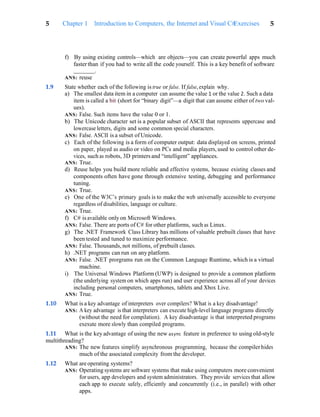
2 Chapter 1 Introduction to Computers, the Internet and Visual C#
Self-Review Exercises 2
Self-Review Exercises
1.1 Fill in the blanks in each of the following statements:
a) Computers process data under the control ofsequences of instructions called .
ANS: computer programs.
b) A computer consists of various devices referred to as , such as the keyboard,
screen, mouse, hard disks, memory, DVD drives and processing units.
ANS: hardware.
c) Data items processed by computers form a(n) that becomes larger and more
complex in structure as we progress from the simplest data items (called “bits”) to richer
data items, such as characters, fields, and so on.
ANS: data hierarchy.
d) Computers can directly understand only their language, which is composed
only of 1s and 0s.
ANS: machine.
e) The three types of computer programming languages discussed in the chapter are ma-
chine languages, and .
ANS: assembly languages, high-level languages.
f) Programs that translate high-level-language programs into machine language are called
.
ANS: compilers.
g) A(n) processor implements several processors on a single “microchip”—a
dual-core processor has two CPUs and a quad-core processor has four CPUs.
ANS: multicore.
h) Windows 10 introduced the for building Windows apps that run on desktop
computers, notebook computers, tablets, phones, Xbox and even Microsoft’s new
HoloLens augmented reality holographic headset—all using nearly identical code.
ANS: Universal Windows Platform (UWP).
1.2 Fill in the blanks in each of the following statements:
a) Objects, or more precisely the that objects come from, are essentially reusable
software components.
ANS: classes.
b) You send messages to an object. Each message is implemented as a method that
tells a method of the object to perform its task.
ANS: call.
c) A new class of objects can be created quickly and conveniently by ; the new
class absorbs the characteristics of an existing class, possibly customizing them and add-
ing unique characteristics of its own.
ANS: inheritance.
d) To create the best solutions, you should follow a detailed analysis process for determin-
ing your project’s (i.e., defining what the system is supposed to do) and de-
veloping a design that satisfies them (i.e., deciding how the system should do it).
ANS: requirements.
e) Visual C# is driven. You’ll write programs that respond to mouse clicks, key-
strokes, timer expirations and touches and finger swipes.
ANS: event.
f) A key goal of Java is to be able to write programs that will run on a great variety of com-
puter systems and computer-control devices. This is sometimes called .
ANS: write once, run anywhere.
1.3 Fill in the blanks in each of the following statements:
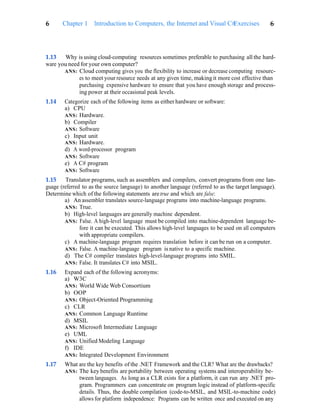
3 Chapter 1 Introduction to Computers, the Internet and Visual C#
Self-Review Exercises 3
a) The executes .NET programs.
ANS: Common Language Runtime (CLR) of the .NET Framework.
b) The CLR provides various services to code, such as integrating software com-
ponents written in different .NET languages, error handling between such components,
enhanced security and more.
ANS: managed.
c) The ability of a program to run without modification across multiple platforms is
known as platform .
ANS: independence.
d) Visual Studio is a(n) in which C# programs are developed.
ANS: IDE.
e) You can sell your own Windows Phone apps in the .
ANS: Windows Store.
1.4 State whether each of the following is true or false. If false, explain why.
a) Software objects model both abstract and real-world things.
ANS: True.
b) The most popular database model is the relational database in which data is stored in
simple tables. A table includes records and fields.
ANS: True.
c) A database is a collection of data that’s organized for easy access and manipulation.
ANS: True.
d) Secondary storage data takes much longer to access than data in primary memory, but
the cost per unit of secondary storage is much higher than that of primary memory.
ANS: False: The cost per unit of secondary storage is much lower than that of primary
memory.
e) High-level languages allow you to write instructions that look almost like everyday Eng-
lish and contain commonly used mathematical expressions.
ANS: True.
f) An object has attributes that it carries along as it’s used in a program.
ANS: True.
g) The Transmission Control Protocol (TCP) ensures that messages, consisting of sequen-
tially numbered pieces called bytes, were properly routed from sender to receiver, ar-
rived intact and were assembled in the correct order
ANS: False. The pieces are called packets, not bytes.
h) The information-carrying capacity of communications lines on the Internet has in-
creased tremendously, while hardware costs have increased.
ANS: False. Hardware costs have decreased.
i) You can build web-based apps with C# and Microsoft’s ASP.NET technology.
ANS: True.
j) Java has become the key programming language for the Mac OS X desktop operating
system and all iOS-based devices, such as iPods, iPhones and iPads.
ANS: False. The language is Swift, not Java.
k) Microsoft’s ASP.WEB technology is used to create web apps.
ANS: False. It’s ASP.NET technology.
l) Microsoft’s Windows operating system is the most widely used desktop operating sys-
tem worldwide.
ANS: True.
1.5 Arrange these byte measurements in order from smallest to largest: terabyte, megabyte,
petabyte, gigabyte and kilobyte.
ANS: kilobyte, megabyte, gigabyte, terabyte, petabyte.
4 Chapter 1 Introduction to Computers, the Internet and Visual C#
Self-Review Exercises 4
1.6 Describe the two-step translation process for preparing your C# code to execute on your
particular computer.
ANS: C# code is first compiled into MSIL and placed in an executable file. When the app
executes, another compiler called the JIT (just-in-time) compiler in the CLR trans-
lates the MSIL in the executable file into machine-language code (for a particular
platform).
Exercises
1.7 Fill in the blanks in each of the following statements:
a) The programs that run on a computer are referred to as .
ANS: software
b) Systems such as smartphones, appliances, game controllers, cable set-top boxes and au-
tomobiles that contain small computers are called .
ANS: embedded systems
c) Just as characters are composed of bits, are composed of characters or bytes.
ANS: fields
d) Information on secondary storage devices is ; it’s preserved even when the
computer’s power is turned off.
ANS: persistent
e) Translator programs called convert high-level language code into machine-
language code.
ANS: compilers
f) In object-oriented programming languages, we create a program unit called a(n)
to house the set of methods that perform its tasks.
ANS: class
g) Use a building-block approach to creating your programs. Avoid reinventing the
wheel—use existing pieces wherever possible. Such software is a key benefit
of object-oriented programming.
ANS: reuse
1.8 Fill in the blanks in each of the following statements:
a) Although many different OOAD processes exist, a single graphical language for com-
municating the results of any OOAD process has come into wide use. This language,
known as the , is now the most widely used graphical scheme for modeling ob-
ject-oriented systems.
ANS: UML
b) Tim Berners-Lee developed the for sharing information via “hyperlinked”
text documents on the web.
ANS: HyperText Markup Language (HTML)
c) The CLR is a(n) machine. It is software that manages the execution of pro-
grams and hides from them the underlying operating system and hardware.
ANS: virtual
d) Converting a program to run on a different platform from which it was originally in-
tended is called .
ANS: porting.
e) Microsoft’s Windows is a cloud-computing platform that allows you to de-
velop, manage and distribute your apps in the cloud.
ANS: Azure. (Instructor Note: "Microsoft’s Windows" should be simply "Microsoft" in
this exercise.)
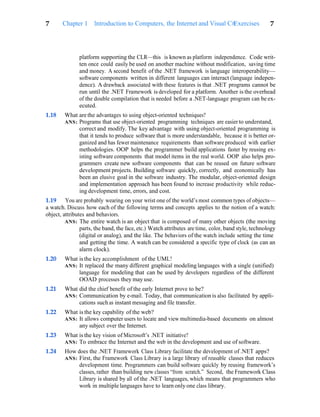
Exercises 5
5 Chapter 1 Introduction to Computers, the Internet and Visual C#
f) By using existing controls—which are objects—you can create powerful apps much
fasterthan if you had to write all the code yourself. This is a key benefit of software
.
ANS: reuse
1.9 State whether each of the following is true or false. If false, explain why.
a) The smallest data item in a computer can assume the value 1 or the value 2. Such a data
item is called a bit (short for “binary digit”—a digit that can assume either of two val-
ues).
ANS: False. Such items have the value 0 or 1.
b) The Unicode character set is a popular subset of ASCII that represents uppercase and
lowercase letters, digits and some common special characters.
ANS: False. ASCII is a subset of Unicode.
c) Each of the following is a form of computer output: data displayed on screens, printed
on paper, played as audio or video on PCs and media players, used to control other de-
vices, such as robots, 3D printersand “intelligent” appliances.
ANS: True.
d) Reuse helps you build more reliable and effective systems, because existing classes and
components often have gone through extensive testing, debugging and performance
tuning.
ANS: True.
e) One of the W3C’s primary goals is to make the web universally accessible to everyone
regardless of disabilities, language or culture.
ANS: True.
f) C# is available only on Microsoft Windows.
ANS: False. There are ports of C# for other platforms, such as Linux.
g) The .NET Framework Class Library has millions of valuable prebuilt classes that have
been tested and tuned to maximize performance.
ANS: False. Thousands, not millions, of prebuilt classes.
h) .NET programs can run on any platform.
ANS: False. .NET prorgrams run on the Common Language Runtime, which is a virtual
machine.
i) The Universal Windows Platform (UWP) is designed to provide a common platform
(the underlying system on which apps run) and user experience across all of your devices
including personal computers, smartphones, tablets and Xbox Live.
ANS: True.
1.10 What is a key advantage of interpreters over compilers? What is a key disadvantage?
ANS: A key advantage is that interpreters can execute high-level language programs directly
(without the need for compilation). A key disadvantage is that interpreted programs
exexute more slowly than compiled programs.
1.11 What is the key advantage of using the new async feature in preference to using old-style
multithreading?
ANS: The new features simplify asynchronous programming, because the compilerhides
much of the associated complexity from the developer.
1.12 What are operating systems?
ANS: Operating systems are software systems that make using computers more convenient
for users, app developers and system administrators. They provide services that allow
each app to execute safely, efficiently and concurrently (i.e., in parallel) with other
apps.
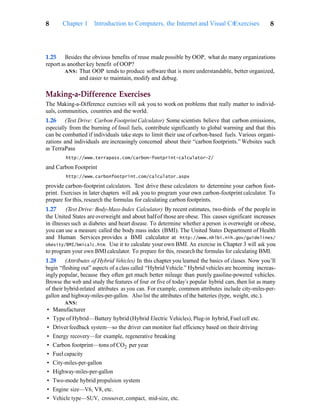
Exercises 6
6 Chapter 1 Introduction to Computers, the Internet and Visual C#
1.13 Why is using cloud-computing resources sometimes preferable to purchasing all the hard-
ware you need for your own computer?
ANS: Cloud computing gives you the flexibility to increase or decrease computing resourc-
es to meet your resource needs at any given time, making it more cost effective than
purchasing expensive hardware to ensure that you have enough storage and process-
ing power at their occasional peak levels.
1.14 Categorize each of the following items as either hardware or software:
a) CPU
ANS: Hardware.
b) Compiler
ANS: Software
c) Input unit
ANS: Hardware.
d) A word-processor program
ANS: Software
e) A C# program
ANS: Software
1.15 Translator programs, such as assemblers and compilers, convert programs from one lan-
guage (referred to as the source language) to another language (referred to as the target language).
Determine which of the following statements are true and which are false:
a) An assembler translates source-language programs into machine-language programs.
ANS: True.
b) High-level languages are generally machine dependent.
ANS: False. A high-level language must be compiled into machine-dependent language be-
fore it can be executed. This allows high-level languages to be used on all computers
with appropriate compilers.
c) A machine-language program requires translation before it can be run on a computer.
ANS: False. A machine-language program is native to a specific machine.
d) The C# compiler translates high-level-language programs into SMIL.
ANS: False. It translates C# into MSIL.
1.16 Expand each of the following acronyms:
a) W3C
ANS: World Wide Web Consortium
b) OOP
ANS: Object-Oriented Programming
c) CLR
ANS: Common Language Runtime
d) MSIL
ANS: Microsoft Intermediate Language
e) UML
ANS: Unified Modeling Language
f) IDE
ANS: Integrated Development Environment
1.17 What are the key benefits of the .NET Framework and the CLR? What are the drawbacks?
ANS: The key benefits are portability between operating systems and interoperability be-
tween languages. As long as a CLR exists for a platform, it can run any .NET pro-
gram. Programmers can concentrate on program logic instead of platform-specific
details. Thus, the double compilation (code-to-MSIL, and MSIL-to-machine code)
allows for platform independence: Programs can be written once and executed on any
Exercises 7
7 Chapter 1 Introduction to Computers, the Internet and Visual C#
platform supporting the CLR—this is known as platform independence. Code writ-
ten once could easily be used on another machine without modification, saving time
and money. A second benefit of the .NET framework is language interoperability—
software components written in different languages can interact (language indepen-
dence). A drawback associated with these features is that .NET programs cannot be
run until the .NET Framework is developed for a platform. Another is the overhead
of the double compilation that is needed before a .NET-language program can be ex-
ecuted.
1.18 What are the advantages to using object-oriented techniques?
ANS: Programs that use object-oriented programming techniques are easier to understand,
correct and modify. The key advantage with using object-oriented programming is
that it tends to produce software that is more understandable, because it is better or-
ganized and has fewer maintenance requirements than software produced with earlier
methodologies. OOP helps the programmer build applications faster by reusing ex-
isting software components that model items in the real world. OOP also helps pro-
grammers create new software components that can be reused on future software
development projects. Building software quickly, correctly, and economically has
been an elusive goal in the software industry. The modular, object-oriented design
and implementation approach has been found to increase productivity while reduc-
ing development time, errors, and cost.
1.19 You are probably wearing on your wrist one of the world’s most common types of objects—
a watch. Discuss how each of the following terms and concepts applies to the notion of a watch:
object, attributes and behaviors.
ANS: The entire watch is an object that is composed of many other objects (the moving
parts, the band, the face, etc.) Watch attributes are time, color, band style, technology
(digital or analog), and the like. The behaviors of the watch include setting the time
and getting the time. A watch can be considered a specific type of clock (as can an
alarm clock).
1.20 What is the key accomplishment of the UML?
ANS: It replaced the many different graphical modeling languages with a single (unified)
language for modeling that can be used by developers regardless of the different
OOAD processes they may use.
1.21 What did the chief benefit of the early Internet prove to be?
ANS: Communication by e-mail. Today, that communication is also facilitated by appli-
cations such as instant messaging and file transfer.
1.22 What is the key capability of the web?
ANS: It allows computer users to locate and view multimedia-based documents on almost
any subject over the Internet.
1.23 What is the key vision of Microsoft’s .NET initiative?
ANS: To embrace the Internet and the web in the development and use of software.
1.24 How does the .NET Framework Class Library facilitate the development of .NET apps?
ANS: First, the Framework Class Library is a large library of reusable classes that reduces
development time. Programmers can build software quickly by reusing framework’s
classes, rather than building new classes “from scratch.” Second, the Framework Class
Library is shared by all of the .NET languages, which means that programmers who
work in multiple languages have to learn only one class library.
Exercises 8
8 Chapter 1 Introduction to Computers, the Internet and Visual C#
1.25 Besides the obvious benefits of reuse made possible by OOP, what do many organizations
report as another key benefit of OOP?
ANS: That OOP tends to produce software that is more understandable, better organized,
and easier to maintain, modify and debug.
Making-a-Difference Exercises
The Making-a-Difference exercises will ask you to work on problems that really matter to individ-
uals, communities, countries and the world.
1.26 (Test Drive: Carbon Footprint Calculator) Some scientists believe that carbon emissions,
especially from the burning of fossil fuels, contribute significantly to global warming and that this
can be combatted if individuals take steps to limit their use of carbon-based fuels. Various organi-
zations and individuals are increasingly concerned about their “carbon footprints.” Websites such
as TerraPass
http://www.terrapass.com/carbon-footprint-calculator-2/
and Carbon Footprint
http://www.carbonfootprint.com/calculator.aspx
provide carbon-footprint calculators. Test drive these calculators to determine your carbon foot-
print. Exercises in later chapters will ask you to program your own carbon-footprint calculator. To
prepare for this, research the formulas for calculating carbon footprints.
1.27 (Test Drive: Body-Mass-Index Calculator) By recent estimates, two-thirds of the people in
the United States are overweight and about halfof those are obese. This causes significant increases
in illnesses such as diabetes and heart disease. To determine whether a person is overweight or obese,
you can use a measure called the body mass index (BMI). The United States Department of Health
and Human Services provides a BMI calculator at http://www.nhlbi.nih.gov/guidelines/
obesity/BMI/bmicalc.htm. Use it to calculate yourown BMI. An exercise in Chapter 3 will ask you
to program your own BMIcalculator. To prepare for this, research the formulas for calculating BMI.
1.28 (Attributes of Hybrid Vehicles) In this chapter you learned the basics of classes. Now you’ll
begin “fleshing out” aspects of a class called “Hybrid Vehicle.” Hybrid vehicles are becoming increas-
ingly popular, because they often get much better mileage than purely gasoline-powered vehicles.
Browse the web and study the features of four or five of today’s popular hybrid cars, then list as many
of their hybrid-related attributes as you can. For example, common attributes include city-miles-per-
gallon and highway-miles-per-gallon. Also list the attributes of the batteries (type, weight, etc.).
ANS:
• Manufacturer
• Type of Hybrid—Battery hybrid (Hybrid Electric Vehicles), Plug-in hybrid, Fuel cell etc.
• Driverfeedback system—so the driver can monitor fuel efficiency based on their driving
• Energy recovery—for example, regenerative breaking
• Carbon footprint—tons of CO2 per year
• Fuel capacity
• City-miles-per-gallon
• Highway-miles-per-gallon
• Two-mode hybrid propulsion system
• Engine size—V6, V8, etc.
• Vehicle type—SUV, crossover, compact, mid-size, etc.
Making-a-Difference Exercises 9
• Seating capacity
• Horse power
• Drive train (front wheel drive, all wheel drive)
• Top speed
• Torque
• Price
1.29 (Gender Neutrality) Some people want to eliminate sexism in all forms of communication.
You’ve been asked to create a program that can process a paragraph of text and replace gender-spe-
cific words with gender-neutral ones. Assuming that you’ve been given a list of gender-specific
words and their gender-neutral replacements (e.g., replace “wife” with “spouse,” “man” with “per-
son,” “daughter” with “child” and so on), explain the procedure you’d use to read through a para-
graph of text and manually perform these replacements. How might your procedure generate a
strange term like “woperchild,” which is actually listed in the Urban Dictionary (www.urbandic-
tionary.com)? In Chapter 5, you’ll learn that a more formal term for “procedure” is “algorithm,”
and that an algorithm specifies the steps to be performed and the order in which to perform them.
ANS: Search through the entire paragraph for a word such as “wife” and replace every oc-
currence with “spouse.” Repeat this searching process for every gender specific word
in the list. You could accidentally get a word like “woperchild” if you are not careful
about how you perform replacements. For example, the word “man” can be part of
a larger word, like “woman.” So, replacing every occurrence of “man” can yield
strange results. Consider the process of replacing “man” with “person” then replacing
“son” with “child.” If you encounter the word “woman,” which contains the word
“man,” you’d replace “man” with “person” resulting in the word “woperson.” In a
subsequent pass you’d encounter “woperson” and replace “son” with “child” result-
ing in the “woperchild.”
Other documents randomly have
different content
nâmaiùi, manekhai brâpnânai:
“nang nî khorângâ misâ,” hannâ­
nai,
âsi dâmbâ: “Âfâ, dâ âng manbâi;”
hannânai âbrâiâ khât­
lângnaise.
Ârù bebaidî thângùi thângùi fukuri
manse manhùibâ beaubù bî khînânai
bînî bidyâ khô baugâr­
naise. Phâre bî
nâmaie nâmaie manâkhùi. Ereaunù
sâse mânsùi lùgù mannânai
sùngnaise: “Nanghâ beau ma
gamâdang?” hanbâ; “Âfâ, ânghâ
beau gahâm basthu manse gamâbai,
nangbù namaibâ, âng gahâm
mangô;” bungnai-au bîbù bîzang
namaifânaise, ârù unau nâmaiùi
nâmaiùi hâbru zang musunlâ-
musunlî zânânai, theobù mane­
khai,
bî mânsùiâ brâpnânai âsi dâmnaise.
Obâ bî “o âfâ, dâsù âng bekhô
manbai!” hannânai, rong zânânai,
nå-hâ-lâgi khrep-khrep dâmnânai nå
manhúinaise. Bikhô nunânai brai
bùrùiâ minî-sù-naise. Agla bîkhô
sinai manâ­
khùiman, unau sùngnânai
mithînaise. “Ârù thâkâfurâ mâ
khâm-khù?” hanbâ, bungnaise “Âng
hingzau sâse lâbodangman, Behâ
megon thaine bù betnai. Bînîkhai
ârù mosô slainaise, Bihâ bù udui
goblong zânai, ârù burmâ mâse zang
bîkhô slainaise. Bîbù ângkhô bânù
thinnaikhai brâp­
nânai, thâlit
slainaise. Thâlit khô nunânai, sâse
mânsùiâ bînai­
khai, be mânsùinîfrai
Presently, he stopped by a tank, and
again forgot his new acquisition. So
he plunged into the mud to look for
it. And a man came up and asked
what he was searching for? To
which he replied “My friend, my
friend! I have lost something very
valuable. Do come and help me to
look.” On which, the two searched
until they were covered with mud;
and when they found nothing, the
new-comer cracked his fingers in
vexation, and the simpleton, crying
“I’ve found it! I’ve found it!” went
gaily cracking his fingers all the
way home. And when his father and
mother saw him, they smiled at his
state, and till they spoke to him did
not know who he was. And then
they asked him what he had done
with his money. “Oh!” said he, “first
of all I bought a lovely maiden, and,
because her eyes were bad, I
exchanged her for an ox; and
because there was something wrong
with the ox, I got a goat in
exchange; and because the goat
wanted me to carry him, I got angry
and changed him for plantains. And
the plantains I gave to a man who
be bidyâ khô sùlùngnânai thâlit
hùnani lâbodang. Ârù âng mâ
khâmnù nânggò?” Zapbai!
taught me to crack my fingers, and
what else would you have me do?”
And that’s all!
Sâ-snî âbrâ nî khorâng. The Story of the Seven
Simpletons.
Sùrbâ âbrâ sâsnî dangman. Bîsùr
sân se dâpseau onkhâtlâng-nai-au
nâmâ-au-nù dùi-slùng bângai
mannânai bîkhônù mâbrùi bâtgan
hannânai khorâng zâlai-naise.
Beaunù bîdâ gederâ bung­
naise
“Boibù zânzî khâphrâ-nânai bâtnù
nângbai;” hannânai, boinùkhri bî
âglâ zânânai, bînî khithîau sâse
hom-hù-naise. Bebaidî-nù bînî
zânziau bî, bînî zânziau bî
homlainânai dùislungau
sânsrilainaise. Beaunù âtheng-mani
zerbâ-mâni sânsrinai-au thoi
onkhâtlainaise. Phâre bebaidînù
zenthen ùi bâtkhângnânai bîdâ
gederâ sâse-se lângkhâtbai nung­
‐
nânai sân-naise. Sânânai sârå bùâ
mannaise. Ârù unau bînî godâiâ
sânnaise. Bî bù sâ-rå bùâ
mannaikhai, sâfrimbù khonse
khonse sânnânai sâṛå bùâ man­
nai.
Bînîkhai boibù sâse lâng­
khâtbai
There were, once upon a time, seven
simpletons. And once they were
going down the road, and meeting a
puddle, were in great distress as to
how they should cross it. And the
eldest said “I will go first, and you
all follow, holding one another’s
loin cloths.” So they held one
another’s cloths and crawled
through the puddle on their hands
and knees, getting very muddy and
dirty in doing so. But when they had
fairly got across, the elder set to
work to count; and, as he failed to
count himself, behold, there was one
missing. Then the next brother
counted; and, as he, too, found one
missing, they each in turn counted.
And so it became clear that one was
lost; and there they stood debating
this deplorable business. Just then a
wily Brahmin came up, and asked
what was the matter. And they told
hannânai zingâsî-nânai khorâng
zâzlaibai thâdangman. Ereaunù
bething Bâmun sâse thângnânai
besùrkhô nunânai sùngnaise:
“Gotho-fùr nung-sùrhâ mâ zâdang?”
Bîsùr bung­
naise “Âfâ, zangfùr bîdâ
bîfong sâsnî man. Dâ be dùisâ bât-
naiau zangfùrhâ sâse lângkhâtbai.
Bînîkhai beaunù zangfùr zingâsi-lai-
bai thâdang,” hannaikhai Bâmunâ
srî srî sânnânai sâsnî khôbù nudang.
Bînîkhai bî “Besùr âbrâ zânù
nânggô” nungnânai, besùrkho
khithânaise, “Gåthåfùr, nangsùr
ângnî nåi-au bùibâ, âng nangsùrnî
mânsùikhô dîhonnânai hùnù hâgan,”
han­
naikhai, bîsur mânthî zânaise.
Unau Bâmun goe khândisnî
khaunânai bîdâ gedernî âkhâiau
hùnânai “Be goe-â-khândi bese
dang, nang sân.” Hanbâ, bî sânnanai
khândî snî mannâise. Beaunù
Bamunâ bungnaise: “Nangsùr be
goekhô rânlainânai zâ,” hanbâ,
rânnai-au gâgai gâgai grup-gaglai-
naise. Beaunù bîsur rong zânânai
Bâmun-nî nåiau bùinò-lâgi Bâmun
zang thâng-fâ-naise.
him that they had been seven, but
that in crossing the puddle, one of
them had been lost. On which, the
Brahmin, quickly counting them,
found that they were still seven,
and, judging them to be simpletons,
said to them “My sons, if you will
come to my house and work for me,
I will find you the missing man.” To
which with one accord they agreed.
Then the Brahmin split a betelnut
into seven pieces and put them into
the hand of the eldest. “Now count
them,” said he, “and tell me how
many there be.” And he counted and
found that there were seven. “Now
take each man a piece,” said the
Brahmin, and, behold, to each piece
there was a man. So in great joy and
peace of mind they went to the
Brahmin’s house to work.
Phâre bebaidînù sânnesù thâ­
nânai
sânse bîsùrkhô bâriau megong
dângnù lâgi thin-nâise. Âru Bâmun-
hâ sâse fisâtlâ dang­
man. Bîkhôbu
bîsùrzang hùnânai khithânaise,
“ângnî fisâ­
tlâ-iâ bù nangsùr zang
And then, one day, he sent the seven
simpletons out into the garden to
weed the vegetables, and with them
he sent his only son, saying “If the
lad is lazy and falls behind, shove
him along and make him work.”
megong dâng-thang, ârù un zâ-lâng-
bâ bîkhô thutlun-thutlân lângfâ.”
Erùi bungbâ bîsùr bâriau thâng­
nânai
megong dânghùidang. Phâre unau
Bâmun-nî fisâtlâiâ un zâlâng-naise.
Beaunù bîkhô nunânai bîsùr
railainaise “Dùhùi bîfâ khithâ-
dangman “gåthå un zâlângbâ bîkhô
thutlun thutlân lâng,” hannânai, dâ-
nî-au zang­
fùr mâ khâmgan?”
Beaunù bîdâ gederâ “Bebaidînù
khâmnù nânggô,” hannânai,
sâfrimbu bî khonse, bî khonse,
megong dâng­
nai sekhâr zang
thunânai hùnânai. Bamun-nî
gåthåkhô bùthâtnânai dinnaise.
Phâre unau megong
dângkhângnânai nåiau faibâ
Bamunâ sùngnaiau khithânaise
“nang khithânaibaidi zangfùr bîkhô
sekhâr zang thunai-au bî thoinânai
thâbai.” Phâre Bamu­
nâ srî srî
thânaise.
So they all went into the garden and
began cutting the weeds with their
knives; and presently the boy fell
into the rear. On which they said
“There is that Brahmin boy fallen
behind. Did not his father say that
we were to push him along? What is
to be done now? But the elder
brother said, “Do? Why, do as we
were told.” On which each of them
hit him with his weeding knife, so
that presently he died. And when the
weeding was quite finished, they
went and told the Brahmin, saying
“You told us to shove him along,
and as we had our knives in our
hands, we hurt him so that he died.”
But the Brahmin was speechless, for
they had but done as they were told.
Ârù sânse hâli oinù thinnânai
bungnaise “Nangsùr gâbun simli sâ-
i-au hâli oinù thângnù nânggan.”
Phâre unau bîsùr fungzâni
sikhângnânai nângal mosô fâgâ
lânanai simlifâng guriau thângnânai,
simli sâ-i-au khaise gâkhùnaise, ârú
khaise hâ-i-au thânânai mosôkhô
fâgâ zang khâ­
nânai hùbâ, sâ-i-au
thânaifrâ bù-khù-lâng-naise. Beaunù
dîdung zå-i zå-i hâli snî mosô22
Another day he told them to go and
plough. “Take your ploughs up
above the great simul tree,” he said.
So they rose in the early morning,
and, taking ploughs, cattle and
ropes, went to the great simul tree.
And some stayed below and bound
the ploughs and cattle with the
ropes, and others climbed the tree
and hauled. But the ropes broke and
the cattle were killed and the
gâsenù thoi-thrå-naise. Unåu nå-i-au
fainânai bîsùr Bâmunnù khithâ­
naise
“Zangfùr simlî sâ-i-au mosô dî-
khâng-nù hâekai hâli oinù
hâiakhuise.” Bamunâ “mosôfrâ mâ
zâkhù?” Hanbâ, “thoi-thrâ-bai,”
khithânaise. Bâmunâ unau mung-bô
upai mane zânânai ârù mosô
bainânai bîsùrkhô hâli oi-hù-naise.
ploughs were smashed. And then
they went and told the Brahmin that
they had tried to plough above the
simul tree and had failed. “And what
of the cattle?” said he, “Oh! they
fell down and were killed,” they
replied. So, in despair, he bought
other cattle and sent them out to
plough afresh.
Phâre mai mannai-au mai hâ­
nânai
unau Bâmunâ dângri khaie khaie
hùnânai bîsùrkhô rùgânù thinnaise.
Beaunù bîsùr mai­
khô mau dinnù
hannânai sùng­
bâ, Bâmunâ
bungnaise “Bùrùiâ zerùi din-nù
thin-ù, beau-nù din,” hanbâ, bîsùr
thângnânai, bùrùi-khô sùng-hùi-
naise. Bùrùiâ nå-nî hâbâfùr
khâmnai-i-au monau brâpnânai
thâdangman. Beaunù bî bungnaise
“Mai din-nù thaùni manâbâ, ângnî
khoro-au-nù dinfai!” hanbâ, bîsùr
boibo mai bibân zang bùrùi-khô hù-
sin-thrå-naise. Bîbaidî-nù gâsenù
mai rùgânânai bînî sâiau dinnaise.
Phâre manâbâ Bâmun dublî nî frai
fainânai bùrùi khô nâmaibâ bîsùr
khithânaise “Ângnî khårå-au-nù mai
din han-nai-khai zang­
fur mai zang
hu-sin-nânai din­
dang.” Biaubù braiâ
mungbô upai mane zânanai, bùrùi
khô fopnù lâgi bîsurnù hoṭnaise.
Phâre bîsùr bùrùi-khô khânânai oâ
And when the harvest was ripe, they
reaped the paddy, and, tying it in
sheaves, brought it home and asked
where they were to put it. And the
Brahmin said “Put it where my old
woman tells you to put it.” So they
went and asked the Brahmin’s wife.
But she was very busy, and only
cried “Oh, bother you and your
paddy! Put it on my head!” On this,
they all took their sheaves, and
heaped them on the old woman, so
that she died. And when the
Brahmin came from his work and
asked for his old woman, they said
they had buried her in the paddy, as
she told them to. On which, being at
his wit’s end, he bade them go and
bury her. On this, they tied the
corpse on a bamboo sledge and
bumped it along through the
bamboo-clump, so that it got
knocked off by the way.
sing sing bageding-bagedâ bân-
lâng-nai-au bùrùiâ oâ thânai-au
nângnânai siri-lângnaise.
And when they came to some fallow
land, they dug a grave, and then
began looking about for the corpse.
Now there was an old woman hard
by herding cattle. “Cunning old
wretch!” said they, “she is afraid of
being buried, and is pretending to be
somebody else.” So they got hold of
her, and, in spite of her struggles,
buried her.
Phâre besùr bâkor-bâreau23
thângnânai bîbânkhô dinnânai
hâkhor zaunânai bùrùikhô fopnù
lâgi naibâ, manekhai, bùrùi-khô
nâmaibainaise. Sùrbâ bùrùi sâse
khâthi-au-nù mai nebai thâdang­
man.
Bîkhônù nunânai bîsùr railainaise
“Bâmun bùrùiâ bud­
digrang fop-
zânù gînânai, beaunù mai nebai thâ-
thî-dang,” hannânai bîkhô homnânai
lângnânai fopnâ­
nai dinnânai
fainaise. Bînî unau Bâmunâ monau
bîsùrkhô gînânai bùthâtnù lâgi mon
khâmnânai bîsùrnù khithânaise
“Gåthåfùr, dinî zangfùr simlifâng
gederkhô dân-hùi-nù nânggô,”
hannânai, ruâ lânânai simlîfâng ni
guriau thânglainaise. Thâng-nânai
ruâ zang bongfâng khô såùi såùi
bong­
fâng gaglai-sî gaglai-sî zâbâ,
Bâmunâ bîsurkhô bungnaise
“Bongfâng gaglai-sî-sù gau-gan,
nang-sùr boibù hom-thânu nânggô.”
Khithânânai Bâmunâ saunânai
And the Brahmin, in fear of what
they might do next, began to
contrive means to get rid of them.
So he said “Today, my sons, we will
go and cut down the great simul
tree.” So they took their axes and,
going to the simul tree, began
hewing with a will, and when the
tree was tottering to its fall, the
Brahmin said to them “If the tree
falls down, it will be broken. Run
under it and catch it!” And when
they did so, the Brahmin gave the
last strokes, and the tree fell on the
seven simpletons and killed them.
And that’s all!
hùnaise. Unau bong­
fâng gaglai-sin-
nânai sâsnî âbrâ thoinaise. Zapbai!
Khânâ khuzâ nî khorâng. The Story of the Blind Man
and the Hunchback.
Sânùi khânâ khuzâ zang phisi­
khî
man. Phâre bîsùr sânse railainaise
“Zang-fùr mâlâi-nî gâmiau bîbaibâ
zang-nî gâmî-nî-khrî bângsin
mangan.” Hanlainâ­
nai khuzaiâ
khânâkhô lauthiau homnânai,
bùlângnaise. Thângùi thângùi nâmâ
gezerau dîdung sorûi manse gâ-
fnâng-nânai phisikhî-nû khithânaise
“Sikhî, be lai mâ, herâ? Mâbâ galâu
zibô baidi gâfnângdang.” Khuzâiâ
bungnaise “Be hâthî khânai dîdung
sorûi.” Hanbâ, khanâiâ, “Obâ bekhô
lâ, herâ, sikhî”; hannânai bungnaise,
Khintu bî lâê-khai “Ângnù
dîkhângnânûi hu;” hannânai,
khânaia didung-khô lânaise.
There sprang up a friendship
between a blind man and a
hunchback. And one day they said
to one another “We shall get more if
we beg in some other village than
our own.” The hunchback made the
blind man hold his stick, and so
dragged him along. And as they
went, the blind man trod upon an
old elephant rope which lay upon
the road, and said to his friend “Ah!
friend, what is this thing like a long
snake which I am treading upon?”
The hunchback said “Why, it is only
an old elephant-rope.” But the blind
man said “Take it, my friend, take
it.” But, as the hunchback refused,
the blind man bid his friend hand it
to him, and so they went their ways
thence.
Phâre bînîfrai thângùi dûisâ manse
man-hûi-nî-au bâtlangbâ khûsûng
And presently they came to a river;
and as they were wading across it,
mâse khânâiâ gâfnâng-naise, ârù
bungnaise “Sikhî, ne ne! Âng mâbâ
mâse gâfnâng­
dang.” Hanbâ, khuzâiâ
“Onthai-frâ-khô-nù mâthù bungbai
thâiù, herâ, sikhî, nang-lâi?”
Khânâiâ bungnaise “Nonggâ,
nonggâ, sikhî, nang gùgrùmnai.”
Hanbâ bî gùgrùmnânai khusum-khô
mannânai, khânâ-nù khithâbâ,
bungnaise “O sikhî, obâ bekhô lâ
herâ: zangfurnù bekhô nâng­
gan.”
Khuzaiâ “Ilit ilit lâiâ, herâ” han-nai-
khai, khânâiâ bîkhô-bù gagai-nù
lânaise. Bînî­
frai bibaidî-nù thângùi
thângùi dâpse-au dol dâmnai
khnânânai khânaiâ khuzânîau
sùngnaise “Sikhî bî dolâ-lai sùr thù?
Mau thù dâmdang, herâ?” Hanbâ
khuzaiâ khithânaise; Beaunù sùrbâ
gurkhiâ gåthåfùr dâm­
dang” hanbâ,
khânâiâ bîkhô lânù lâgi thin-naise.
the blind man trod upon a tortoise
and told his friend that he had trod
upon something living; but the
hunchback said it was only a stone,
and asked what was the use of
standing there talking. But the blind
man begged him to feel and see.
And when the hunchback
announced that it was a tortoise, the
blind man begged his friend to take
that, too; and on the hunchback
declaring that it was too heavy, he
finally carried it himself.
Then they went their ways and came
to a meadow, and heard a drum
being beaten. And the blind man
asked what that was, and where the
drumming was going on. On which
the hunchback said it was only
cowherds drumming. On which the
blind man was for sending the
hunchback to fetch the drum.
Khintù bî, “âng mâbrùi lâbogan?
Bîsùr-khô âng bùlù hâiâ zâgan,
manâthù bîsur gabâng dang,” hanbâ,
khânâiâ manse buddhi khâmnânai
phisikhî-nù khithanaise “Sikhî, nang
hâgrâ sing sing thâng-khmâ-nanai,
bîsùr nî khâthî manbâ, mosâ baidî
sùgùmnânai hù! Obânù bîsùr
gînanai khâtgan,” hanbâ, bîbai­
dînù
khuzâiâ khâmnai-au, gåthå-frâ
gînanai dol khô zrâpzrup gâr-lâng-
But the hunchback said “How shall
I fetch it? They will be too strong
for me, for they are many.” Then the
blind man devised a plan, and bade
the hunchback crawl through the
jungle and roar like a tiger. Which
the hunchback did; and the cowherd
boys, on hearing his roaring, ran
away headlong and left the drum,
which the hunchback gave, as
before, to the blind man to carry.
bâ, khuzâiâ dol khô lâbona­
nai
khânânù hoṛ-hù-naise. Obasù
bînîfrai sânùi zang hâgrâ gezer
gezer thângùi thângùi nå nunanai,
khuzâiâ bungnaise “Sikhî, dâ sân
hâpbai, manâ faibai, Dâlai ârù mâu
thâng-bâu-nù? Beau-nù nå danga.
Zangfùr beau-nù thâ-dù-nî,” hanbâ,
khânâiâ bung­
naise “Hagra gezernî
nåkhô âng gabâng gahâm man-srâiâ,
herâ, sikhî,” hannânai mâ mâ nå
dang gahâmùi nainù thinbâ khuzâiâ
khithânaise “Nåiâ gâng-ne gâng-
thâm. Bândâr bù gong-se dang,”
hanbâ khânâiâ “Bî bândârau-nù
thâgan,” hannânai, phisikhî-nù
khithâbâ, bândâr-sing-hà
bùlângnaise, ârù dor-fur-khô
gahâmùi khâ-fthâ-nù thinnânai,
beaunù thânaise. Unau beau thânai
Râikhô-frâ fainânai, bungnâise—
Then the friends went through the
forest, until they came to some
houses. On which the hunchback
said “My friend, the sun has set, and
evening has come. How much
further are we to go? Here are
houses, let’s stop here.” But the
blind man said he did not think very
well of houses in the jungle, and
sent his friend to have a good look
at them.
Presently the hunchback returned
and said “There are two or three
houses and a granary.” On this, the
blind man decided that they would
stay in the granary, and so was
dragged into the granary, where they
carefully fastened the doors and
prepared to stay for the night. And
while they were there, Rakshashas
came and said—
“Zùsâ zùsâ manâmdang;
“Zânù zânù lubuidang.”24
“Fine rice, fine rice, I can smell;
“And better things to eat as well.”
hannânai, nå gong frùm-bù namâi-
giding-bai-bâ, khânâiâ rai-dau-hoṭ-
naise “Âng beaunù dâng.” Hanbâ,
raikhoâ bungnaise “Nang lai sùr?”
Khânâ bù bung­
naise “Nang lai sùr?”
Raikho khithânaise “Âng Raikhô!”
Khâ­
naiâ bungnaise “Âng Zâkhô!
Bebaîdînù be-sùr brâp-lai-naise
Unâu khânâiâ bung-naise “Brâp-nù
And while they were gliding round
the house, the blind man shouted
loudly “Here am I!” “Who are
you?” said the Rakshashas. “Who
are you?” shouted the blind man. “I
am a Rakshasha,” said one of them.
“And I am a Zakshasha!”28 said the
blind man. Whereupon they all got
very angry. Then the blind man said
bù nânggâ, munù bù nânggâ
Nangkhô bù âng nuâ­
khùi, ângkhô
bù nang nuâ­
khùi. Bînîkhai manse
buddi khâmbâ, zanghâ gahâm
zâgan,” hannânai khânâiâ raikhônî
khenai bîhot-bâ, Raikhoâ gaigainî
khù-mùn daise phunânai khithîhoṭ-
naise. Obâsù khânâiâ bungnaise
“Dâniâ ângnî khenai-khô nai.”
Hannânai, hâthî dîdung khô dî­
‐
honnânai hùnaise. Bîkhô nunâ­
nai
Raikhoâ gîkhrongbâ, khânâiâ ârù
themâ bî-hoṭ-naise Raikhoâ bù
gaigainî themâ khô khithî-hoṭ-bâ, bî
khusung khô khithîhoṭ-naise. Obâsù
Raikhoâ be Zâkhoâ-nù nunggô
nungnânai, gî-sin-bai. Khanâiâ ârù
bînî udui dâmnù thinnânai, dâmbâ,
bungnâise, “Dindù dindù hâmbai,
âng khnâbai. Dâniâ ângnî khô
khnâsong!” hannânai, dol khô dùm
dùm dâmnânai hùbâ, Rai­
khofrâ
gînanai, khât-thro-lâng-naise.
“You need not get angry and you
need not get noisy. I can’t see you
and you can’t see me. Let us make
an expedient by which you can be
satisfied.” So saying, the blind man
bade the Rakshasha show him a
lock of his hair. On this a Rakshasha
tore out a bunch of hair and showed
it to him. On which the blind man
said “Now see mine!” And so
saying, thrust out of a chink the
elephant rope. And on seeing it, the
Rakshasha became very afraid.
Then the blind man demanded to
see a flea (from his body). And
when the Rakshasha had shown him
one, the blind man put forth his
tortoise. Then the Rakshasha
thought “This must indeed be a
Zakshasha,” and was greatly afraid.
Then the blind man bade him beat
his breast. And, on his doing so,
cried “Well done, well done! I have
heard you. Now hear me!” and
straightway began to beat his drum
“rub-a-dub-dub.” On which the
Rakshashas were greatly frightened
and ran right away.
Unao, khânâiâ phisikhîkhô
bungnaise “Sikhî mâ mâ gahâm
bastù dang, bifurkhô khâ ârù nang
bâse, ângnù bù bâse hù, ârù mâmâr
thângdù-nî thù” hannâ­
nai bîsùr
bînîfrai mâmâr failainaise. Ârù
Then the blind man said to his
friend “Take any good things that
there are, and tie them up. You take
some and give me some, and let us
go;” and, so saying, they went away
together. And when they were come
dâpse gazân thâni-au thâng­
nânai
khuzâiâ be bastufarkhô rânnù
nâmainânai rânnaise, Rân-khângbâ
khânâ-khô bungnaise “Sikhî
nangthâng bobekhô lâiu lâ,” Hanbâ
bî dângnainanânai khuzâ thing-nî
bhâgù-khô bângsin man-dâng-nânai,
rânnâiâ hâmâ khùise hannânai,
golaigothai khâmnaise. Phâre
khuzâiâ “Nang-thâng-lai nuâ-labâ
mâbrùi mithînai, herâ? Khonle
khonle rânnù gnâng khâm-hùiù!”
Hannânai ârù rân-phâphinbâ, obâbù
bâng­
sin man-dâng-nânai, ârù
“Hamâ-khùise, hamâ-khùise,”
hannânai golai-gothai khâmnaise.
Bîbaidî nù khonbrùi khon-bâ
khâmbâ khuzâiâ brâpnânai, âkhâiau
bâli lânânai “Nanglai gomâ khânâ
nâ misâ khânâ lùi?” hannânai
gahâmùinù megonau bâlizang
hùnânai hùnaise. Ârù obânù bî
nunai zânaise. Ârù bî bù brâpnânai;
“nunglai” mâ sâbâ dângâ lùi, nunù
hâma hannânai godo-au zo-sin-
nânai lânânai, khuzâ bikhung-au
gomâgom sobai thâbâ bîbù gahâm
zânaise. Unau sânùi zang gahâm zâ-
lai-nâise, ârù bastù-fùr-khô gahâmùi
rân­
lainânai, nå-i-au thâng-lai-naise.
Zapbai!
to a far place, the hunchback began
dividing the spoil. And, when that
was done, he bade his friend take
which share he would. But the blind
man groped about and found that
the share nearest to the hunchback
was the biggest. So the hunchback
said “How did you, without seeing,
find that out? Now I have got to
divide it all over again!” So he made
a fresh division.
And the same thing happened again,
and the blind man turned everything
topsy-turvy. And, when this had
occurred four or five times, the
hunchback became angry, and
taking sand in his hand rubbed it
into the blind man’s eyes, saying
“Now we shall see if you are really
blind or not;” whereby the blind
man recovered his sight. But he, too,
was angry and said “What a hideous
thing you are, and hateful to look
upon.” And he jumped on the
hunchback’s back and belaboured
his hump till he made him straight
and well. And when the two were
hale and well, they divided their
spoil fairly and went home happily.
And that’s all!
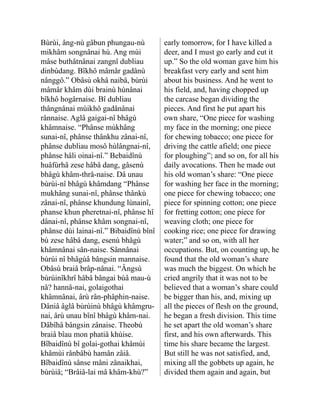
Sâse âbrâ brai nî khorâng. The Story of a silly old man.
Brai bùrùi dangman. Braiâ hâgrâ
gezerau dubli dotse lânanai hâbâ
maubai thâdangman. Phâre sânse
shikâri sâse hâgrâiau mùi gaunânai
thoi-frâm-nânai khârùi khârùi brainî
dubli gezer thing thângdangman.
Beaunù braiâ nunânai bîkhô khudâl
zang khårå-au-nù denânai mùikhô
bùthâtnaise. Buthâtnânai hâgrâ
singau hakhmânânai dinnaise.
Emphâre unau mùi gaunai giri­
maia
khîthù khîthù thoi sirîlâng­
nai naie
naie nâmai-lângùi-lângùi brainî
dubliaunù sin gamânaise. Obâsù
braikhô sùngnaise: “Helùi brai!
Nang bething mùi mâse fainai nunâi
nâ?” Braiâ bung­
naise “Ânghâ dublî-
nî shimâiâ khùlâthing boinîfrai
sâthing boinîfrai” hannânai bungbâ
bî bung­
naise “Nonggâ nonggâ! âng
mùinî khorâng-sù nang-nî-au
sùngdang,” Braiâ khithânaise
“Zânun! be dubliau mai zâiù nâ zâiâ
âng khîthânù hâiâ.” “Nang­
ga-lùi,
brai, bî khorâng-khô âng
sùngâkhui.” Brai bung­
naise “Dâ
sânzôfûbai, ânghâ mikhâm ukhui-
sù-dang. Âng thâng-nù-sùi;”
hannânai, nåiau khâtlângnaise.
Obâsù unau braiâ mikhâm dùi
zâkhângnânai bùrùi-khô bungnaise;
There was an old man and his wife.
One day, when the old man was
clearing jungle, a half-dead deer that
had been shot by a huntsman, came
limping that way and crossed the
old man’s field. On which the old
man killed it by hitting it on the
head with his hoe, and hid it away in
the jungle. Presently, the man who
shot the deer made his appearance,
having tracked its blood as far as the
old man’s field. “Here, old man!”
said he, “have you seen a wounded
deer pass this way?” The old man
replied “The boundaries of my
field? Well, the east boundary is
here and the west over there!” But
the other said “Not so, not so, I am
asking about a wounded deer.” To
which the old man replied “I know
what you mean; but whether it will
be a good crop or not, how shall I
say?” “Not so, not so,” said the
other; that isn’t what I want to
know.” But the old man said “I
cannot stop any longer. The dark is
falling, and I am hungry for my
supper. I’m off.” So saying, he went
away home, and when he had had
his supper, he said to his old woman
“You must give me my breakfast
Bùrùi, âng-nù gâbun phungau-nù
mikhâm song­
nânai hù. Ang mùi
mâse buthât­
nânai zangnî dubliau
dinbùdang. Bîkhô mâmâr gadânù
nânggô.” Obâsù okhâ naibâ, bùrùi
mâmâr khâm dùi brainù hùnânai
bîkhô hogârnaise. Bî dubliau
thângnâ­
nai mùikhô gadânânai
rânnaise. Aglâ gaigai-nî bhâgù
khâmnaise. “Phânse mùkhâng
sunai-nî, phânse thânkhu zânai-nî,
phânse dubliau mosô hùlângnai-nî,
phânse hâli oinai-nî.” Bebaidînù
huâfùrhâ zese hâbâ dang, gâsenù
bhâgù khâm-thrå-naise. Dâ unau
bùrùi-nî bhâgù khâmdang “Phânse
mukhâng sunai-nî, phânse thânkù
zânai-nî, phânse khundung lùnainî,
phanse khun pheretnai-nî, phânse hî
dânai-nî, phânse khâm songnai-nî,
phânse dùi lainai-nî.” Bibaidînù bînî
bù zese hâbâ dang, esenù bhâgù
khâmnânai sân-naise. Sânnânai
bùrùi nî bhâgùâ bângsin man­
naise.
Obâsù braiâ brâp-nânai. “Ângsù
bùrùinîkhrî hâbâ bângai bùâ mau-ù
nâ? hannâ-nai, golaigothai
khâmnânai, ârù rân-phâphin-naise.
Dâniâ âglâ bùrùi­
nù bhâgù khâmgru-
nai, ârù unau bînî bhâgù khâm-nai.
Dâbîhâ bângsin zânaise. Theobù
braiâ bîau mon phatiâ khùise.
Bîbaidî­
nù bî golai-gothai khâmùi
khâmùi rânbâbù hamân zâiâ.
Bîbaidînù sânse mâni zânaikhai,
bùrùiâ; “Brâiâ-lai mâ khâm-khù?”
early tomorrow, for I have killed a
deer, and I must go early and cut it
up.” So the old woman gave him his
breakfast very early and sent him
about his business. And he went to
his field, and, having chopped up
the carcase began dividing the
pieces. And first he put apart his
own share, “One piece for washing
my face in the morning; one piece
for chewing tobacco; one piece for
driving the cattle afield; one piece
for ploughing”; and so on, for all his
daily avocations. Then he made out
his old woman’s share: “One piece
for washing her face in the morning;
one piece for chewing tobacco; one
piece for spinning cotton; one piece
for fretting cotton; one piece for
weaving cloth; one piece for
cooking rice; one piece for drawing
water;” and so on, with all her
occupations. But, on counting up, he
found that the old woman’s share
was much the biggest. On which he
cried angrily that it was not to be
believed that a woman’s share could
be bigger than his, and, mixing up
all the pieces of flesh on the ground,
he began a fresh division. This time
he set apart the old woman’s share
first, and his own afterwards. This
time his share became the largest.
But still he was not satisfied, and,
mixing all the gobbets up again, he
divided them again and again, but
hannânai, dhinkî thorâ manse
lânanai, dublîau thângnânai, brai-
khô-nuhùi-dang, gaigainù bidot
zang nânglaibâ thâdang. Bîdot-frâ-
bù khonle khonle dâng-phlebai thâ-
naikhai, gebletheble zâlâng­
bai.
Obâsù bùrùiâ dhinkî thorâ zang srî
srî khîthû-au khubui-hoṭ-bâ, braiâ
mâbâ imfu hoṭbai hannâ­
nai, bîdot-
khô gârnânai nåhâ khâtlâng-naise.
Emphâre, bùrùiâ bîdot khô hî zang
ban-nânai bâ­
nânai nå-au lâbonânai,
songnânai, brai-zang zâ-lai-bâ, braiâ
sùngnaise “Bùrùi, belai mâ-nî
bîdot?” hanbâ, bùrùiâ khithânaise
“Âng dausâ fisâ mâse buthâtnânai,
nanghâ manâ lâng-nai-khai,
bekhônù song-dop-nânai dindang.
Nangnî bî mùi-bîdot-khô nebai
thâbâ, zangfur dâ khâm man-zâ-gla-
gauman.” Zapbai!
never got them equal. Meanwhile,
the day had slipped by and evening
was come. So the old woman,
taking the pestle of the dhenki, went
to look for her husband, and there
she found him in the midst of the
lumps of flesh, which had become
covered with dust and dirt through
much mixing. Then the old woman
let fly the dhenki stump at his back.
On which he cried that a snake had
bitten him and ran home, on which
the old woman tied up the meat in a
cloth and carried it to her house, and
cooked some hastily for supper. And
when her husband asked where the
meat came from, she said that he
had been such a long time in
coming, that she had killed a
chicken and cooked it for him. “And
if you had stopped dividing that
deer’s flesh, we should never have
got any supper at all,” said she. And
that’s all!
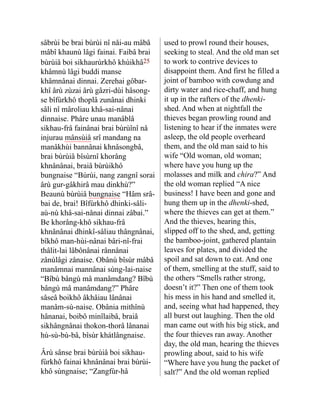
Brai bùrùini khorâng. The Story of the four
Thieves.
Sâne brai bùrùi dangman. Bîsurhâ
nå-â-bù gongne man. Phâre sikhau
There was an aged couple who lived
in a pair of houses. And four thieves
sâbrùi be brai bùrùi nî nåi-au mâbâ
mâbî khaunù lâgi fainai. Faibâ brai
bùrùiâ boi si­
khaurùrkhô khùikhâ25
khâmnù lâgi buddi manse
khâmnânai dinnai. Zerehai gôbar-
khî ârù zùzai ârù gâzri-dùi hâsong-
se bîfùrkhô thoplâ zunânai dhinki
sâli nî mâroliau khâ-sai-nânai
dinnaise. Phâre unau manâblâ
sikhau-frâ fainânai brai bùrùînî nå
injurau mânsùiâ srî mandang na
manâ­
khùi bannânai khnâsongbâ,
brai bùrùiâ bîsùrnî khorâng
khnânânai, braiâ bùrùikhô
bungnaise “Bùrùi, nang zangnî sorai
ârù gur-gâkhirâ mau dinkhù?”
Beaunù bùrùiâ bungnaise “Hâm srâ-
bai de, brai! Bîfùrkhô dhinki-sâli-
aù-nù khâ-sai-nânai dinnai zâbai.”
Be khorâng-khô sikhau-frâ
khnânânai dhinkî-sâliau thângnânai,
bîkhô man-hùi-nânai bâri-nî-frai
thâlit-lai lâbônânai rânnânai
zânùlâgi zånaise. Obânù bîsùr mâbâ
manâmnai mannânai sùng-lai-naise
“Bîbù bângù mâ manâmdang? Bîbù
bângù mâ manâmdang?” Phâre
sâseâ boikhô âkhâiau lânânai
manâm-sù-naise. Obânia mithînù
hâna­
nai, boibô minîlaibâ, braiâ
sikhângnânai thokon-thorâ lâna­
nai
hù-sù-bù-bâ, bîsùr khátlâng­
naise.
Ârù sânse brai bùrùiâ boi sikhau-
fùrkhô fainai khnânânai brai bùrùi-
khô sùngnaise; “Zangfùr-hâ
used to prowl round their houses,
seeking to steal. And the old man set
to work to contrive devices to
disappoint them. And first he filled a
joint of bamboo with cowdung and
dirty water and rice-chaff, and hung
it up in the rafters of the dhenki-
shed. And when at nightfall the
thieves began prowling round and
listening to hear if the inmates were
asleep, the old people overheard
them, and the old man said to his
wife “Old woman, old woman;
where have you hung up the
molasses and milk and chira?” And
the old woman replied “A nice
business! I have been and gone and
hung them up in the dhenki-shed,
where the thieves can get at them.”
And the thieves, hearing this,
slipped off to the shed, and, getting
the bamboo-joint, gathered plantain
leaves for plates, and divided the
spoil and sat down to eat. And one
of them, smelling at the stuff, said to
the others “Smells rather strong,
doesn’t it?” Then one of them took
his mess in his hand and smelled it,
and, seeing what had happened, they
all burst out laughing. Then the old
man came out with his big stick, and
the four thieves ran away. Another
day, the old man, hearing the thieves
prowling about, said to his wife
“Where have you hung the packet of
salt?” And the old woman replied
songkhrùi thoplâ mau dinkhù?”
Obâsu bùrùiâ bungnaise “Dâsù
gahâm zâbai, brai! Songkhrùi
thoplaiâ zang udunai nå-nî khùlâ-
fât-sî inzurau senânai dindang!
Sikhaufrâ maubâ lâng-nù hâgô.”
Bîsùr railainai-fùr-khô sikhau-frâ
khnâ­
nânai inzùr dân-sî-nânai âkhai
sùnânai songkhrùi-thoplâ-khô dâng-
grùm-baibâ braiâ khâthrùi-lângô
lânânai thângnânai âkhâi dân-hùi-
naise. Obâ bî “Âng manâ khùise”
hannânai thângbâ, ârù sâse sikhauâ
bîbaidînù dâng-grùm-bâ, bîkhô-bù
âsî-au dân-fnâng-naise. Phâre
bebaidî-nù sâse sikhau-nî khùmâ
dânnai, ârù sâse-nî gonthong dân-
fnâng-naise.
“A fine affair! I have hung it up on
south wall of our sleeping-house,
where the thieves can easily get it.”
And so one of the thieves thrust his
hand in, and began feeling about for
the bundle, on which the old man
took his knife and cut his hand. But
he only said “I can’t find it,” and
went away.
Phâre unau bîsùr gârai gahâm man-
nu lâgi dùi nâmai-bai-nai-e-aù
sethlau-nù thâlit khârùi sâmnai
megongdù-au dùi mannâ­
nai âkhai
hù-sùm-naise. Beaunù bângsin
âlunai manbâbù, lùgù-nî mânsùifùr-
nù khithâiâlâbâ “Gahâm manbai,”
hannânai bungnaise. Bebaidînù
sâbrùi-hâ-bù zâbâ, brâplainaise.
Obânù braiâ nå-nî frai onkhâtnânai
thokon lânanai bîsùrkhô hu-hoṭ-
naise.
On which the other three felt about,
and one got his finger cut, and
another his ear, and the fourth his
nose. Then they looked about in the
yard for something to ease the pain,
and the first, finding a cooking pot
in which acrid plantain ashes had
been steeped, plunged his hand in,
and, getting more pain than before,
only said “Ah! that’s good.” On
which the others followed his
example. And, while they were
hopping about in pain, the old man
came out and took his stick, and
drove them away.
Bînîfrai ârù sânse brai-bùrùi-nî
bâriau thâlit bîfong dangman, ârù
bînî khâthiau phânlù bîfong fângse
dangman. Beaunù bere-thinklî bâhâ
lâdang. Phâre hoṛau be sikhau
sâbrùiâ brai bùrùinî nåiau faibâ,
braiâ bùrùi-khô sùngnaise “Bùrùi,
nang zang-fùr-nî thâkâ-thinkhlî-khô
mau fopnânai dinkhu?” hanbâ
bùrùiâ khithânaise “Dinîbù gahâm
zâbai, de, brai! zangnî thâka-thinkliâ
thâlit-guriau fop­
nânai dinnai-au-nù
thâbai. Bînî khâthi-au-nù fânlù-
fîfâng-bù fângse dang. Dâ sikhaufrâ
manù-khî-mâ-sù!” Bekhô si­
khau frâ
khnânânai, be thâlit guri-hâ
thângnânai nâmai-lai-hùi-bâ bere-
bâhâ-khô man-naise. Phare bîkhô
besùr dikhângnânai lâbobâ, bâhâiâ
gùbrùnânai berefrâ sikhau-fùr-khô
oṭbâ, besùr “Aiâ! aiâ!” hannânai,
khâtnaise, ârù braiâ thokon lânânai
hùsùnaise.
Another day, the old people found a
wasps’ nest on a chili plant under a
plantain tree. And when the thieves
came, the old man said to his wife
“Old woman, old woman, where
have you put the lota with our
money in it?” And the old woman
answered “To-day’s luck is the
worst of all. I have left the lota
under the plantain tree in the garden,
by the chili bush, and no doubt the
thieves will get it.” Hearing this, the
thieves went and disturbed the
wasps’ nest, and the wasps flew out
and stung them. And when they
cried in pain and ran away, the old
man ran after them with his stick
and beat them soundly.
Bînîfrai ârù sânse braiâ thâthî dânnù
lâgi sekhâr lânânai hâgrâiau
thângbâ, boi sikhau sâbrùi-khô
thaigrit guruiau udulângbâ thânai
nunânai thai­
grit bong-fângau
uthînânai thâri gnâng thaigrit
thaibrùi khânânai lâbô-nânai be
sikhau sâbrùi nî kheneau thaise
thaise khâ-khmâ-naise. Phâre unau
“Sikhau! sikhau!” hannânai braiâ
Again, another day, when the old
man went out to cut reeds for his
fence, he found the four thieves
asleep under an O tree (the fruit of
which is hard and heavy), and the
old man, climbing quietly into the
tree, cut four of the fruits, with the
stalks attached, and tied them to the
thieves’ hair. Then he suddenly cried
out “Thief! thief!” And the more
gâpzrî-khâu-bâ bîsùr srî mannânai
sik­
hângnânai khâtlângnaise. Khâtbâ,
zesenu khârù, esenù thaigrit fithâiâ
bikhungau dup dup bulângnaise.
Bîsùr braia khîthù khîthù fainânai
zang-fùr khô sodang nungnânai
khâre-thâng-naise. Phâre unau
gazân thângnânai zirai-hùi-bâ,
thaigrit khô nunânai gârnaise.
they ran, the more the heavy fruit
bumped on their backs, so that they
thought the old man was running
after them and beating them. And
they ran a very long way before they
discovered their mistake, and
unloosed the fruit from their hair.
Bînîfrai ârù sânse braiâ mai duliau
thânânai bùrùikhô fùrùng­
naise
“Bùrùi, nang hoṛau sikhau faibâ
gaigainù sùngnânai, gaigainù khithâ
de, ereùi hannâ­
nai “Brai, brai hùn!
nang thurse khurui mau dindang?”
“Dhinkhî-sâliaunu maiduli-au bîfùr
khô dinnai zâbai. Dâ sikhau faibâ,
man-lâng-sî-gan dâ! Mâ khâmkhù!”
Be khorâng-khô sikhau khnâ­
nânai,
mâmâr dhinkhi saliau thângnânai
naihùibâ be dulikhô dikhângnânai
“O! beaunù thorse khurui-fùr dang
le! Ilit mâthù!” Obâsù bîsùr
khânânai bânnânai lâng-lâi-naise.
And, again, the old man climbed
into the mat receptacle in which the
paddy was stored; but, before doing
so, he instructed his wife to imitate
his voice and ask where the brass
plates and cups had been put; and to
answer in her own voice that they
had been put into the paddy
receptacle in the dhenki-shed. And
when the thieves heard all this, they
hurried to the dhenki-shed, and,
lifting up the paddy receptacle, said
with one accord: “My! isn’t it
heavy?” And so they tied it to poles
and carried it away on their
shoulders.
Phâre unau thângùi thângùi dùisâ
gathau manse man-hùi-naise.
Beaunù bâtbâ braia; “Sî­
hâng sihâng
zâbai, um, um, di­
khâng!” hanbâ
bîsùr “Mauhâ sùr raidang lùi.”
Khaise bungnaise, “Be duliau rainai
baidî khnâ-i-ù.” Ârù sâseâ “Beau
Presently, they came to a deep river,
and as they were wading across, the
old man cried “Look here! I am
getting wet, carry it higher.” On
which they said to one another
“Surely, some one spoke?” But,
thinking it was a mistake, they went
1
2
3
4
5
6
7
8
9
10
11
12
13
14
15
16
17
18
mungbô gùiâ; nangsùr erenùsù
khnâdang!” Obâsù thângùi thângùi
zâbrâ gathau mannânai, braiâ sî-
sam-bâ khithânaise “Phutu-khoâ,
golâm-bundî-fur! Mânù gahâmùi
dikhângâlùi? Nangsùr kânâ nâ?
nunù hâïâ-khùi?” Ereau bung­
bâ
sikhau-frâ bikhô dùi-au gârnâ­
nai
khât-lâng-naise. Zapbai!
on, and came to deeper water. On
this the old man called out again
“Stupid brutes! Sons of slaves!
Can’t you see your way? I am
getting wet through.” And the
thieves were frightened, and,
dropping the old man in the water,
ran clean away. That’s all!
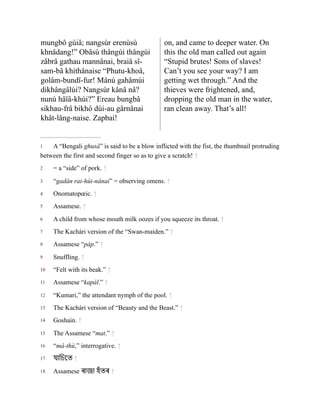
A “Bengali ghusâ” is said to be a blow inflicted with the fist, the thumbnail protruding
between the first and second finger so as to give a scratch! ↑
= a “side” of pork. ↑
“gadân rai-hùi-nânai” = observing omens. ↑
Onomatopœic. ↑
Assamese. ↑
A child from whose mouth milk oozes if you squeeze its throat. ↑
The Kachári version of the “Swan-maiden.” ↑
Assamese “páp.” ↑
Snuffling. ↑
“Felt with its beak.” ↑
Assamese “kapál.” ↑
“Kumari,” the attendant nymph of the pool. ↑
The Kachári version of “Beauty and the Beast.” ↑
Goshain. ↑
The Assamese “mat.” ↑
“mâ-thù,” interrogative. ↑
যাচিতে ↑
Assamese ৰাজা হঁতৰ ↑
19
20
21
22
23
24
25
26
27
28
About two paces. ↑
Assamese বল. ↑
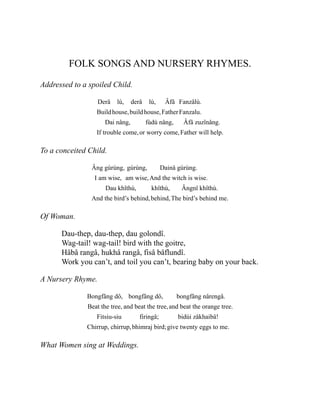
It was not true of him that “dígiti crepantis signa novit.” The coincidence of sound is
curious. ↑
Seven “plough” of cattle. ↑
Assamese বাকয়ণী। ↑
This exactly corresponds to our own “Fee faw fum; I smell the blood of an
Englishman!” and the Bengali “Aù maù khaù, mánsher gandha paù!” ↑
Query—Assamese “hingsha.” ↑
The hideous Kuvera, god of wealth. He was a white man with three legs and eight
teeth. Apparently, the same as the Hindu Pluto; and lord of the shades as well as of
wealth. ↑
I.e., the season personified. ↑
A burlesque word from “zânù” = to eat. ↑
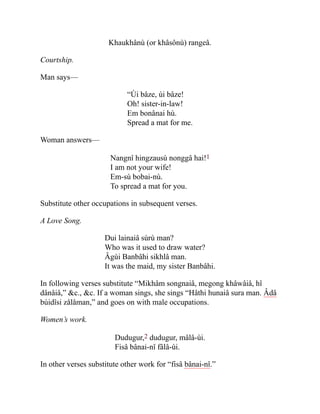
FOLK SONGS AND NURSERY RHYMES.
Addressed to a spoiled Child.
Derâ
Build
lù,
house,
derâ
build
lù,
house,
Âfâ
Father
Fanzâlù.
Fanzalu.
Dai nâng,
If trouble come,
fùdù nâng,
or worry come,
Âfâ zuzînâng.
Father will help.
To a conceited Child.
Âng gùrùng,
I am wise,
gùrùng,
am wise,
Dainâ gùrùng.
And the witch is wise.
Dau khîthù,
And the bird’s behind,
khîthù,
behind,
Ângnî khîthù.
The bird’s behind me.
Of Woman.
Dau-thep, dau-thep, dau golondî.
Wag-tail! wag-tail! bird with the goitre,
Hâbâ rangâ, hukhâ rangâ, fisâ bâflundî.
Work you can’t, and toil you can’t, bearing baby on your back.
A Nursery Rhyme.
Bongfâng dô,
Beat the tree,
bongfâng dô,
and beat the tree,
bongfâng nârengâ.
and beat the orange tree.
Fitsiu-siu
Chirrup, chirrup,
firingâ;
bhimraj bird;
bidùi zåkhaibâ!
give twenty eggs to me.
What Women sing at Weddings.
Zô sit sit,
Pour, pour the beer,
Gogorleng;
Gogorleng;
Zô sit sit.
pour the beer.
Dângnai dângnai sit,
Pour in torrents,
Gogorleng;
Gogorleng;
dângnai dângnai sit.
pour in torrents, pour.
Then you substitute other festive occupations, for instance:
Goe khau khau (cut, cut the betelnut).
Zô lù lù (pass round the beer).
Khurui sù sù (wash the plates), &c., &c.
“Gogorleng” is the traditional name for the bâru or bohua, who plays the
buffoon at weddings.
A Woman to her Lover.
Sô mâlîbai, sôbaî.
Come, my lover, come.
Gangâ zâliâ.
O! Ganges fisherman.
Thâkânî kheru manâbâ.
If I don’t get silver earrings.
Âng-bù thângliâ.
I, too, cannot go.
In the following verses the woman substitutes other ornaments or presents:
An exchange of Compliments.
A girl sings—
Silâkhonârùi gåthåfùr,
Chinakona boys,
Moisù hùnù fai!
Come and drive buffaloes.
Boy answers (derisively)—
Hunù rangâ, munù rangâ.
I cannot drive, I cannot wive.
Ângkhô dâ ling, fai.
Don’t cry to me to come.
Engkhut khârùi khùrù khùrù.
The mess of rice goes bubble-bubble.
Ângnî fâtse fùrù fùrù.
My share is but trouble trouble.
Khuru khusuli.
You’ve got the itch.
Bidot zâsuli.
Eater of meat.
What Women sing when the Bride is taken away.
Dâ gâpse, ai—dâ gapse.
Don’t weep, dear, don’t weep.
Khânu lai lângâ.
Not to bind thee do they take thee;
Sunu lai lângâ
Not to wound thee do they take thee;
Bângâl Simsânù lângâ.
Not for Bengali or Bhutia do they, &c.
Ehe! hai! hùi!—
Oh! ho! ho!
The second, third and fourth lines may of course be varied ad infinitum.
The lament of a Mother.
Thokon srong srong.
With multitudes of clubs.
Thângdangman, âfâ Sokhai, nanglai.
Thou wentest, son Sokhai, thou.
Emfu blî blâ thângdangman, &c.
Flashing thy sword, thou wentest, &c.
Khaukhâ dumâ dumî, &c.
With great turban bound, &c.
Nang dangbâ omâ bidot zang zâdangman, &c.
Whilst thou lived’st I ate pig’s flesh, &c.
and so on.
“Buffalo Girls come out to play.”
Ùi! Silakhonârùi hingzau-fùr,
Oh! Chinakona women.
Nâ gutnù fai.
Come and catch fish.
Nâ gutnù rangâbâ,
If you cannot catch fish,
Lùgùse dâlâ fai!
Don’t come with us at all!
In other verses substitute “megong khânù,” or other things man and maid
may do together.
A Love Song.
Âgùi Boisâgi,
O! sister wanderer,
Âng khô dâ bâsi!
Do not spurn me!
Sikhlâ sipnù hâiâbâ,
If you cannot sweep the yard,
Âng-bu sipfâgan.
I will help you sweep.
In the next verse, for the last two lines, substitute—”Dùi lainù hâiâbâ âng
bù lai-fâ-gan,” and so on, with other female occupations. If a woman sings,
the first line will be “Âdâ Bùidâsi,” and she will select men’s work, as, e.g.,
“Hâthi hunù hâiâbâ, ângbù thâng-fâ-gan.”
A Mother-in-law scolds her Daughter-in-law.
Wâ bîzô nî gândeolâ!
On bamboo top, Oh! dragon fly,
Bîrdau, bîrdau, bîrdang,
Flutter, flutter, fly,
Bauharî godai zô zongnaiâ,
My youngest daughter-in-law’s brewing beer.
Khùiram-dùiram zâdang.
Is bitter-sweet.
or
Bauhâri godai khâm songnaia sigram-zethram zâdang, &c., &c.
My youngest daughter-in-law’s cooking rice is only hugger-mugger.
A Woman to her Husband.
Hî dai dai hùbâbâ,
If I weave him cloth.
Zimnù rangeâ.
He can’t put it on.
Mâ huâ zang gorop-khù!
What a husband have I got!
Zangnî khâfâlâ!
Ah! my evil luck!
Sûnî khâfâlâ.
My dreadful luck.
For the first two lines substitute—
Gâmsâ dai dai hùbâ-bù.
Gânnù rangeâ.
or
Phâli dai dai hùbâ-bù.
Khaukhânù (or khâsônù) rangeâ.
Courtship.
Man says—
“Ùi bâze, ùi bâze!
Oh! sister-in-law!
Em bonânai hù.
Spread a mat for me.
Woman answers—
Nangnî hingzausù nonggâ hai!1
I am not your wife!
Em-sù bobai-nù.
To spread a mat for you.
Substitute other occupations in subsequent verses.
A Love Song.
Dui lainaiâ sùrù man?
Who was it used to draw water?
Âgùi Banbâhi sikhlâ man.
It was the maid, my sister Banbâhi.
In following verses substitute “Mikhâm songnaiâ, megong khâwâiâ, hî
dânâiâ,” &c., &c. If a woman sings, she sings “Hâthi hunaiâ sura man. Âdâ
bùidîsi zålåman,” and goes on with male occupations.
Women’s work.
Dudugur,2 dudugur, mâlâ-ùi.
Fisâ bânai-nî fâlâ-ùi.
In other verses substitute other work for “fisâ bânai-nî.”
1
2
3
Reproach of Women.3
Boisâgi, âsâgî, rå-rå,
Megong mikhâm songblâ, dùilau, dùi-sau!
Hoâ sâse nù-bù-lâ,
Gadau gâsi!
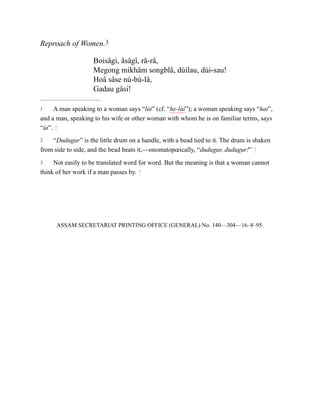
A man speaking to a woman says “lùi” (cf. “he-lùi”); a woman speaking says “hai”,
and a man, speaking to his wife or other woman with whom he is on familiar terms, says
“ùi”. ↑
“Dudugur” is the little drum on a handle, with a bead tied to it. The drum is shaken
from side to side, and the bead beats it,—onomatopœically, “dudugur, dudugur!” ↑
Not easily to be translated word for word. But the meaning is that a woman cannot
think of her work if a man passes by. ↑
ASSAM SECRETARIAT PRINTING OFFICE (GENERAL) No. 140—304—16–8–95.
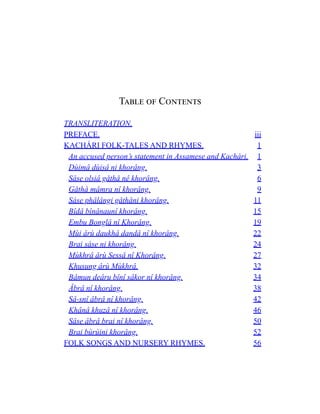
Table of Contents
TRANSLITERATION.
PREFACE. iii
KACHÁRI FOLK-TALES AND RHYMES. 1
An accused person’s statement in Assamese and Kachári. 1
Dùimâ dùisâ ni khorâng. 3
Sâse olsiâ gåthå nê khorâng. 6
Gåthå mâmra nî khorâng. 9
Sáse phâlângi gåthåni khorâng. 11
Bîdâ bînânaunî khorâng. 15
Embu Bonglâ nî Khorâng. 19
Mùi ârù daukhâ dandâ nî khorâng. 22
Brai sáse ni khorâng. 24
Mùkhrâ ârù Sessâ nî Khorâng. 27
Khusung ârù Mùkhrâ. 32
Bâmun deâru bînî sâkor nî khorâng. 34
Âbrâ nî khorâng. 38
Sâ-snî âbrâ nî khorâng. 42
Khânâ khuzâ nî khorâng. 46
Sâse âbrâ brai nî khorâng. 50
Brai bùrùini khorâng. 52
FOLK SONGS AND NURSERY RHYMES. 56
Colophon
Corrections
The following corrections have been applied to the text:
Page Source Correction
iii, 5, 5,
17, 21,
60 [Not in source] .
iv indentical identical
1, 4 , .
4 ng Âng
5, 5 Sri Srî
6 hùnânâi hùnânai
6 ol iâ olsiâ
6 oidang- ùi oidang-hùi
7, 9, 17 angnù ângnù
7 khi-” thâ-i-ù khithâ-i-ù
7 búnnânai bùnnânai
7 ” [Deleted]
9 Bir Bîr
12, 20 . [Deleted]
12 dih­
onnânai dîh­
onnânai
16 dânnu dânnù
19 dangmân dangman
19 khâmúi khâmùi
20 lânânâi lânânai
22 hûnânai hùnânai
22, 46 khorang khorâng
22 Binîkhai Bînikhai
24 khoráng khorâng
26 Obâ­
nú Obâ­
nù
26, 54 bîsúr bîsùr
26 Obâsú Obâsù
26 Obânû Obânù
26 Beaunú Beaunù
27 âgúi âgùi
27 raukhôbú raukhôbù
27 dúi dùi
27 Mùkhrá Mùkhrâ
27 Khoràng Khorâng
27 mânsùià mânsùiâ
28 lui lùi
28 lúi lùi
28 ângnú ângnù
28 hú ù
28 Múkhrâ Mùkhrâ
28 bú bù
28 ârú ârù
28 nu-zâ-húi-nai-sui-
lâiù
nu-zâ-hùi-nai-sui-
lâiù
28 ang âng
29 mú­
khrâiâ mù­
khrâiâ
31 hanânai hannânai
32 thalit thâlit
33 húnânai hùnânai
33 múkhrâiâ mùkhrâiâ
34 beaunú beaunù
35 sakhorâ sâkhorâ
35 duluse dùlùse
36 bifur­
khô bîfùrkhô
36 hanu hanù
37 ângnu ângnù
38 Abrà Âbrâ
38 ní nî
38 khoràng khorâng
38 súngnaise sùngnaise
38 múiâ mùiâ
40 mânsúiâ mânsùiâ
40 âbrânú âbrânù
40, 43 hunânai hùnânai
44 zangfur zangfùr
44 oinu oinù
44 Zangfur Zangfùr
45 gïnânai gînânai
46 Sânûi Sânùi
46 Ângnû Ângnù
46 thângûi thângùi
48 bû bù
49 Zâkhoâ-nú Zâkhoâ-nù
49 Sikhi Sikhî
49 bhâgú-khô bhâgù-khô
50 hùnanai hùnânai
50 boinifraî boinîfrai
51 bùriù-khô bùrùi-khô
53 mânsuiâ mânsùiâ
53 bangnaise bungnaise
55 sikhau-fúr-khô sikhau-fùr-khô
55 zang-fur zang-fùr
24 bán ban
30 [Not in source] ,
59 Ágùi Âgùi
60 he-lùî he-lùi
61 Adâ Âdâ
61 bânaini-nî bânai-nî
*** END OF THE PROJECT GUTENBERG EBOOK A COLLECTION OF
KACHÁRI FOLK-TALES AND RHYMES ***
Updated editions will replace the previous one—the old editions
will be renamed.
Creating the works from print editions not protected by U.S.
copyright law means that no one owns a United States
copyright in these works, so the Foundation (and you!) can copy
and distribute it in the United States without permission and
without paying copyright royalties. Special rules, set forth in the
General Terms of Use part of this license, apply to copying and
distributing Project Gutenberg™ electronic works to protect the
PROJECT GUTENBERG™ concept and trademark. Project
Gutenberg is a registered trademark, and may not be used if
you charge for an eBook, except by following the terms of the
trademark license, including paying royalties for use of the
Project Gutenberg trademark. If you do not charge anything for
copies of this eBook, complying with the trademark license is
very easy. You may use this eBook for nearly any purpose such
as creation of derivative works, reports, performances and
research. Project Gutenberg eBooks may be modified and
printed and given away—you may do practically ANYTHING in
the United States with eBooks not protected by U.S. copyright
law. Redistribution is subject to the trademark license, especially
commercial redistribution.
START: FULL LICENSE

Solution Manual for Visual C# How to Program (6th Edition) (Deitel Series) 6th Edition

  • 1.
    Solution Manual forVisual C# How to Program (6th Edition) (Deitel Series) 6th Edition install download https://testbankmall.com/product/solution-manual-for-visual-c- how-to-program-6th-edition-deitel-series-6th-edition/ Download more testbank from https://testbankmall.com

  • 2.
    Instant digital products(PDF, ePub, MOBI) available Download now and explore formats that suit you... Solution Manual for Visual Basic 2012 How to Program, 6/E 6th Edition : 0133406954 https://testbankmall.com/product/solution-manual-for-visual- basic-2012-how-to-program-6-e-6th-edition-0133406954/ testbankmall.com Test Bank for Visual C# 2012 How to Program, 5/E 5th Edition : 0133379337 https://testbankmall.com/product/test-bank-for-visual-c-2012-how-to- program-5-e-5th-edition-0133379337/ testbankmall.com Solution Manual for C++ How to Program 10th by Deitel https://testbankmall.com/product/solution-manual-for-c-how-to- program-10th-by-deitel/ testbankmall.com Solution Manual for VHDL for Engineers Kenneth L. Short https://testbankmall.com/product/solution-manual-for-vhdl-for- engineers-kenneth-l-short/ testbankmall.com
  • 3.
    Solution Manual forEconomics: Principles for a Changing World 5th Edition Eric Chiang https://testbankmall.com/product/solution-manual-for-economics- principles-for-a-changing-world-5th-edition-eric-chiang/ testbankmall.com Test Bank for Ethical, Legal, and Professional Issues in Counseling, 5th Edition, Theodore P. Remley https://testbankmall.com/product/test-bank-for-ethical-legal-and- professional-issues-in-counseling-5th-edition-theodore-p-remley/ testbankmall.com Test Bank for Wardlaw’s Perspectives in Nutrition, 9th Edition: Carol Byrd-Bredbenner https://testbankmall.com/product/test-bank-for-wardlaws-perspectives- in-nutrition-9th-edition-carol-byrd-bredbenner/ testbankmall.com Test Bank for Berry and Kohns Operating Room Technique 13th Edition by Phillips https://testbankmall.com/product/test-bank-for-berry-and-kohns- operating-room-technique-13th-edition-by-phillips/ testbankmall.com Test Bank for Porth Pathophysiology Concepts of Altered Health States, 1st Canadian Edition: Hannon https://testbankmall.com/product/test-bank-for-porth-pathophysiology- concepts-of-altered-health-states-1st-canadian-edition-hannon/ testbankmall.com
  • 4.
    Test Bank forFundamentals of Nursing Care Concepts, Connections & Skills 3rd by Burton https://testbankmall.com/product/test-bank-for-fundamentals-of- nursing-care-concepts-connections-skills-3rd-by-burton/ testbankmall.com
  • 5.
    2 Chapter 1Introduction to Computers, the Internet and Visual C# Self-Review Exercises 2 Self-Review Exercises 1.1 Fill in the blanks in each of the following statements: a) Computers process data under the control ofsequences of instructions called . ANS: computer programs. b) A computer consists of various devices referred to as , such as the keyboard, screen, mouse, hard disks, memory, DVD drives and processing units. ANS: hardware. c) Data items processed by computers form a(n) that becomes larger and more complex in structure as we progress from the simplest data items (called “bits”) to richer data items, such as characters, fields, and so on. ANS: data hierarchy. d) Computers can directly understand only their language, which is composed only of 1s and 0s. ANS: machine. e) The three types of computer programming languages discussed in the chapter are ma- chine languages, and . ANS: assembly languages, high-level languages. f) Programs that translate high-level-language programs into machine language are called . ANS: compilers. g) A(n) processor implements several processors on a single “microchip”—a dual-core processor has two CPUs and a quad-core processor has four CPUs. ANS: multicore. h) Windows 10 introduced the for building Windows apps that run on desktop computers, notebook computers, tablets, phones, Xbox and even Microsoft’s new HoloLens augmented reality holographic headset—all using nearly identical code. ANS: Universal Windows Platform (UWP). 1.2 Fill in the blanks in each of the following statements: a) Objects, or more precisely the that objects come from, are essentially reusable software components. ANS: classes. b) You send messages to an object. Each message is implemented as a method that tells a method of the object to perform its task. ANS: call. c) A new class of objects can be created quickly and conveniently by ; the new class absorbs the characteristics of an existing class, possibly customizing them and add- ing unique characteristics of its own. ANS: inheritance. d) To create the best solutions, you should follow a detailed analysis process for determin- ing your project’s (i.e., defining what the system is supposed to do) and de- veloping a design that satisfies them (i.e., deciding how the system should do it). ANS: requirements. e) Visual C# is driven. You’ll write programs that respond to mouse clicks, key- strokes, timer expirations and touches and finger swipes. ANS: event. f) A key goal of Java is to be able to write programs that will run on a great variety of com- puter systems and computer-control devices. This is sometimes called . ANS: write once, run anywhere. 1.3 Fill in the blanks in each of the following statements:
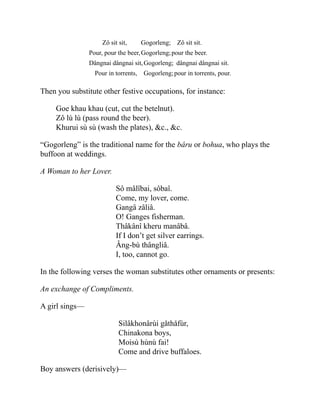
  • 6.
    3 Chapter 1Introduction to Computers, the Internet and Visual C# Self-Review Exercises 3 a) The executes .NET programs. ANS: Common Language Runtime (CLR) of the .NET Framework. b) The CLR provides various services to code, such as integrating software com- ponents written in different .NET languages, error handling between such components, enhanced security and more. ANS: managed. c) The ability of a program to run without modification across multiple platforms is known as platform . ANS: independence. d) Visual Studio is a(n) in which C# programs are developed. ANS: IDE. e) You can sell your own Windows Phone apps in the . ANS: Windows Store. 1.4 State whether each of the following is true or false. If false, explain why. a) Software objects model both abstract and real-world things. ANS: True. b) The most popular database model is the relational database in which data is stored in simple tables. A table includes records and fields. ANS: True. c) A database is a collection of data that’s organized for easy access and manipulation. ANS: True. d) Secondary storage data takes much longer to access than data in primary memory, but the cost per unit of secondary storage is much higher than that of primary memory. ANS: False: The cost per unit of secondary storage is much lower than that of primary memory. e) High-level languages allow you to write instructions that look almost like everyday Eng- lish and contain commonly used mathematical expressions. ANS: True. f) An object has attributes that it carries along as it’s used in a program. ANS: True. g) The Transmission Control Protocol (TCP) ensures that messages, consisting of sequen- tially numbered pieces called bytes, were properly routed from sender to receiver, ar- rived intact and were assembled in the correct order ANS: False. The pieces are called packets, not bytes. h) The information-carrying capacity of communications lines on the Internet has in- creased tremendously, while hardware costs have increased. ANS: False. Hardware costs have decreased. i) You can build web-based apps with C# and Microsoft’s ASP.NET technology. ANS: True. j) Java has become the key programming language for the Mac OS X desktop operating system and all iOS-based devices, such as iPods, iPhones and iPads. ANS: False. The language is Swift, not Java. k) Microsoft’s ASP.WEB technology is used to create web apps. ANS: False. It’s ASP.NET technology. l) Microsoft’s Windows operating system is the most widely used desktop operating sys- tem worldwide. ANS: True. 1.5 Arrange these byte measurements in order from smallest to largest: terabyte, megabyte, petabyte, gigabyte and kilobyte. ANS: kilobyte, megabyte, gigabyte, terabyte, petabyte.
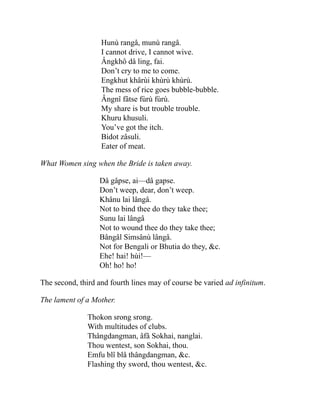
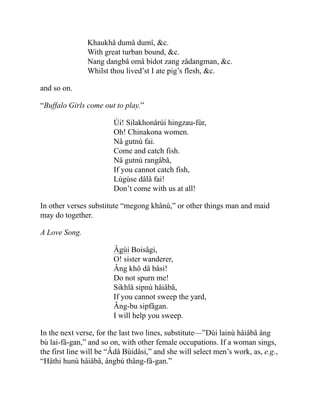
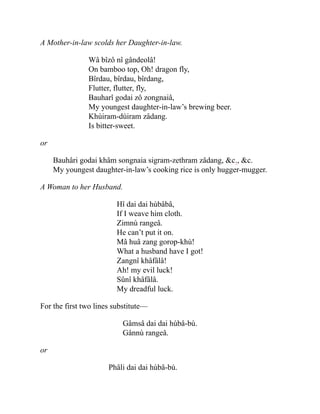
  • 7.
    4 Chapter 1Introduction to Computers, the Internet and Visual C# Self-Review Exercises 4 1.6 Describe the two-step translation process for preparing your C# code to execute on your particular computer. ANS: C# code is first compiled into MSIL and placed in an executable file. When the app executes, another compiler called the JIT (just-in-time) compiler in the CLR trans- lates the MSIL in the executable file into machine-language code (for a particular platform). Exercises 1.7 Fill in the blanks in each of the following statements: a) The programs that run on a computer are referred to as . ANS: software b) Systems such as smartphones, appliances, game controllers, cable set-top boxes and au- tomobiles that contain small computers are called . ANS: embedded systems c) Just as characters are composed of bits, are composed of characters or bytes. ANS: fields d) Information on secondary storage devices is ; it’s preserved even when the computer’s power is turned off. ANS: persistent e) Translator programs called convert high-level language code into machine- language code. ANS: compilers f) In object-oriented programming languages, we create a program unit called a(n) to house the set of methods that perform its tasks. ANS: class g) Use a building-block approach to creating your programs. Avoid reinventing the wheel—use existing pieces wherever possible. Such software is a key benefit of object-oriented programming. ANS: reuse 1.8 Fill in the blanks in each of the following statements: a) Although many different OOAD processes exist, a single graphical language for com- municating the results of any OOAD process has come into wide use. This language, known as the , is now the most widely used graphical scheme for modeling ob- ject-oriented systems. ANS: UML b) Tim Berners-Lee developed the for sharing information via “hyperlinked” text documents on the web. ANS: HyperText Markup Language (HTML) c) The CLR is a(n) machine. It is software that manages the execution of pro- grams and hides from them the underlying operating system and hardware. ANS: virtual d) Converting a program to run on a different platform from which it was originally in- tended is called . ANS: porting. e) Microsoft’s Windows is a cloud-computing platform that allows you to de- velop, manage and distribute your apps in the cloud. ANS: Azure. (Instructor Note: "Microsoft’s Windows" should be simply "Microsoft" in this exercise.)
  • 8.
    Exercises 5 5 Chapter1 Introduction to Computers, the Internet and Visual C# f) By using existing controls—which are objects—you can create powerful apps much fasterthan if you had to write all the code yourself. This is a key benefit of software . ANS: reuse 1.9 State whether each of the following is true or false. If false, explain why. a) The smallest data item in a computer can assume the value 1 or the value 2. Such a data item is called a bit (short for “binary digit”—a digit that can assume either of two val- ues). ANS: False. Such items have the value 0 or 1. b) The Unicode character set is a popular subset of ASCII that represents uppercase and lowercase letters, digits and some common special characters. ANS: False. ASCII is a subset of Unicode. c) Each of the following is a form of computer output: data displayed on screens, printed on paper, played as audio or video on PCs and media players, used to control other de- vices, such as robots, 3D printersand “intelligent” appliances. ANS: True. d) Reuse helps you build more reliable and effective systems, because existing classes and components often have gone through extensive testing, debugging and performance tuning. ANS: True. e) One of the W3C’s primary goals is to make the web universally accessible to everyone regardless of disabilities, language or culture. ANS: True. f) C# is available only on Microsoft Windows. ANS: False. There are ports of C# for other platforms, such as Linux. g) The .NET Framework Class Library has millions of valuable prebuilt classes that have been tested and tuned to maximize performance. ANS: False. Thousands, not millions, of prebuilt classes. h) .NET programs can run on any platform. ANS: False. .NET prorgrams run on the Common Language Runtime, which is a virtual machine. i) The Universal Windows Platform (UWP) is designed to provide a common platform (the underlying system on which apps run) and user experience across all of your devices including personal computers, smartphones, tablets and Xbox Live. ANS: True. 1.10 What is a key advantage of interpreters over compilers? What is a key disadvantage? ANS: A key advantage is that interpreters can execute high-level language programs directly (without the need for compilation). A key disadvantage is that interpreted programs exexute more slowly than compiled programs. 1.11 What is the key advantage of using the new async feature in preference to using old-style multithreading? ANS: The new features simplify asynchronous programming, because the compilerhides much of the associated complexity from the developer. 1.12 What are operating systems? ANS: Operating systems are software systems that make using computers more convenient for users, app developers and system administrators. They provide services that allow each app to execute safely, efficiently and concurrently (i.e., in parallel) with other apps.
  • 9.
    Exercises 6 6 Chapter1 Introduction to Computers, the Internet and Visual C# 1.13 Why is using cloud-computing resources sometimes preferable to purchasing all the hard- ware you need for your own computer? ANS: Cloud computing gives you the flexibility to increase or decrease computing resourc- es to meet your resource needs at any given time, making it more cost effective than purchasing expensive hardware to ensure that you have enough storage and process- ing power at their occasional peak levels. 1.14 Categorize each of the following items as either hardware or software: a) CPU ANS: Hardware. b) Compiler ANS: Software c) Input unit ANS: Hardware. d) A word-processor program ANS: Software e) A C# program ANS: Software 1.15 Translator programs, such as assemblers and compilers, convert programs from one lan- guage (referred to as the source language) to another language (referred to as the target language). Determine which of the following statements are true and which are false: a) An assembler translates source-language programs into machine-language programs. ANS: True. b) High-level languages are generally machine dependent. ANS: False. A high-level language must be compiled into machine-dependent language be- fore it can be executed. This allows high-level languages to be used on all computers with appropriate compilers. c) A machine-language program requires translation before it can be run on a computer. ANS: False. A machine-language program is native to a specific machine. d) The C# compiler translates high-level-language programs into SMIL. ANS: False. It translates C# into MSIL. 1.16 Expand each of the following acronyms: a) W3C ANS: World Wide Web Consortium b) OOP ANS: Object-Oriented Programming c) CLR ANS: Common Language Runtime d) MSIL ANS: Microsoft Intermediate Language e) UML ANS: Unified Modeling Language f) IDE ANS: Integrated Development Environment 1.17 What are the key benefits of the .NET Framework and the CLR? What are the drawbacks? ANS: The key benefits are portability between operating systems and interoperability be- tween languages. As long as a CLR exists for a platform, it can run any .NET pro- gram. Programmers can concentrate on program logic instead of platform-specific details. Thus, the double compilation (code-to-MSIL, and MSIL-to-machine code) allows for platform independence: Programs can be written once and executed on any
  • 10.
    Exercises 7 7 Chapter1 Introduction to Computers, the Internet and Visual C# platform supporting the CLR—this is known as platform independence. Code writ- ten once could easily be used on another machine without modification, saving time and money. A second benefit of the .NET framework is language interoperability— software components written in different languages can interact (language indepen- dence). A drawback associated with these features is that .NET programs cannot be run until the .NET Framework is developed for a platform. Another is the overhead of the double compilation that is needed before a .NET-language program can be ex- ecuted. 1.18 What are the advantages to using object-oriented techniques? ANS: Programs that use object-oriented programming techniques are easier to understand, correct and modify. The key advantage with using object-oriented programming is that it tends to produce software that is more understandable, because it is better or- ganized and has fewer maintenance requirements than software produced with earlier methodologies. OOP helps the programmer build applications faster by reusing ex- isting software components that model items in the real world. OOP also helps pro- grammers create new software components that can be reused on future software development projects. Building software quickly, correctly, and economically has been an elusive goal in the software industry. The modular, object-oriented design and implementation approach has been found to increase productivity while reduc- ing development time, errors, and cost. 1.19 You are probably wearing on your wrist one of the world’s most common types of objects— a watch. Discuss how each of the following terms and concepts applies to the notion of a watch: object, attributes and behaviors. ANS: The entire watch is an object that is composed of many other objects (the moving parts, the band, the face, etc.) Watch attributes are time, color, band style, technology (digital or analog), and the like. The behaviors of the watch include setting the time and getting the time. A watch can be considered a specific type of clock (as can an alarm clock). 1.20 What is the key accomplishment of the UML? ANS: It replaced the many different graphical modeling languages with a single (unified) language for modeling that can be used by developers regardless of the different OOAD processes they may use. 1.21 What did the chief benefit of the early Internet prove to be? ANS: Communication by e-mail. Today, that communication is also facilitated by appli- cations such as instant messaging and file transfer. 1.22 What is the key capability of the web? ANS: It allows computer users to locate and view multimedia-based documents on almost any subject over the Internet. 1.23 What is the key vision of Microsoft’s .NET initiative? ANS: To embrace the Internet and the web in the development and use of software. 1.24 How does the .NET Framework Class Library facilitate the development of .NET apps? ANS: First, the Framework Class Library is a large library of reusable classes that reduces development time. Programmers can build software quickly by reusing framework’s classes, rather than building new classes “from scratch.” Second, the Framework Class Library is shared by all of the .NET languages, which means that programmers who work in multiple languages have to learn only one class library.
  • 11.
    Exercises 8 8 Chapter1 Introduction to Computers, the Internet and Visual C# 1.25 Besides the obvious benefits of reuse made possible by OOP, what do many organizations report as another key benefit of OOP? ANS: That OOP tends to produce software that is more understandable, better organized, and easier to maintain, modify and debug. Making-a-Difference Exercises The Making-a-Difference exercises will ask you to work on problems that really matter to individ- uals, communities, countries and the world. 1.26 (Test Drive: Carbon Footprint Calculator) Some scientists believe that carbon emissions, especially from the burning of fossil fuels, contribute significantly to global warming and that this can be combatted if individuals take steps to limit their use of carbon-based fuels. Various organi- zations and individuals are increasingly concerned about their “carbon footprints.” Websites such as TerraPass http://www.terrapass.com/carbon-footprint-calculator-2/ and Carbon Footprint http://www.carbonfootprint.com/calculator.aspx provide carbon-footprint calculators. Test drive these calculators to determine your carbon foot- print. Exercises in later chapters will ask you to program your own carbon-footprint calculator. To prepare for this, research the formulas for calculating carbon footprints. 1.27 (Test Drive: Body-Mass-Index Calculator) By recent estimates, two-thirds of the people in the United States are overweight and about halfof those are obese. This causes significant increases in illnesses such as diabetes and heart disease. To determine whether a person is overweight or obese, you can use a measure called the body mass index (BMI). The United States Department of Health and Human Services provides a BMI calculator at http://www.nhlbi.nih.gov/guidelines/ obesity/BMI/bmicalc.htm. Use it to calculate yourown BMI. An exercise in Chapter 3 will ask you to program your own BMIcalculator. To prepare for this, research the formulas for calculating BMI. 1.28 (Attributes of Hybrid Vehicles) In this chapter you learned the basics of classes. Now you’ll begin “fleshing out” aspects of a class called “Hybrid Vehicle.” Hybrid vehicles are becoming increas- ingly popular, because they often get much better mileage than purely gasoline-powered vehicles. Browse the web and study the features of four or five of today’s popular hybrid cars, then list as many of their hybrid-related attributes as you can. For example, common attributes include city-miles-per- gallon and highway-miles-per-gallon. Also list the attributes of the batteries (type, weight, etc.). ANS: • Manufacturer • Type of Hybrid—Battery hybrid (Hybrid Electric Vehicles), Plug-in hybrid, Fuel cell etc. • Driverfeedback system—so the driver can monitor fuel efficiency based on their driving • Energy recovery—for example, regenerative breaking • Carbon footprint—tons of CO2 per year • Fuel capacity • City-miles-per-gallon • Highway-miles-per-gallon • Two-mode hybrid propulsion system • Engine size—V6, V8, etc. • Vehicle type—SUV, crossover, compact, mid-size, etc.
  • 12.
    Making-a-Difference Exercises 9 •Seating capacity • Horse power • Drive train (front wheel drive, all wheel drive) • Top speed • Torque • Price 1.29 (Gender Neutrality) Some people want to eliminate sexism in all forms of communication. You’ve been asked to create a program that can process a paragraph of text and replace gender-spe- cific words with gender-neutral ones. Assuming that you’ve been given a list of gender-specific words and their gender-neutral replacements (e.g., replace “wife” with “spouse,” “man” with “per- son,” “daughter” with “child” and so on), explain the procedure you’d use to read through a para- graph of text and manually perform these replacements. How might your procedure generate a strange term like “woperchild,” which is actually listed in the Urban Dictionary (www.urbandic- tionary.com)? In Chapter 5, you’ll learn that a more formal term for “procedure” is “algorithm,” and that an algorithm specifies the steps to be performed and the order in which to perform them. ANS: Search through the entire paragraph for a word such as “wife” and replace every oc- currence with “spouse.” Repeat this searching process for every gender specific word in the list. You could accidentally get a word like “woperchild” if you are not careful about how you perform replacements. For example, the word “man” can be part of a larger word, like “woman.” So, replacing every occurrence of “man” can yield strange results. Consider the process of replacing “man” with “person” then replacing “son” with “child.” If you encounter the word “woman,” which contains the word “man,” you’d replace “man” with “person” resulting in the word “woperson.” In a subsequent pass you’d encounter “woperson” and replace “son” with “child” result- ing in the “woperchild.”
  • 13.
    Other documents randomlyhave different content
  • 14.
    nâmaiùi, manekhai brâpnânai: “nangnî khorângâ misâ,” hannâ­ nai, âsi dâmbâ: “Âfâ, dâ âng manbâi;” hannânai âbrâiâ khât­ lângnaise. Ârù bebaidî thângùi thângùi fukuri manse manhùibâ beaubù bî khînânai bînî bidyâ khô baugâr­ naise. Phâre bî nâmaie nâmaie manâkhùi. Ereaunù sâse mânsùi lùgù mannânai sùngnaise: “Nanghâ beau ma gamâdang?” hanbâ; “Âfâ, ânghâ beau gahâm basthu manse gamâbai, nangbù namaibâ, âng gahâm mangô;” bungnai-au bîbù bîzang namaifânaise, ârù unau nâmaiùi nâmaiùi hâbru zang musunlâ- musunlî zânânai, theobù mane­ khai, bî mânsùiâ brâpnânai âsi dâmnaise. Obâ bî “o âfâ, dâsù âng bekhô manbai!” hannânai, rong zânânai, nå-hâ-lâgi khrep-khrep dâmnânai nå manhúinaise. Bikhô nunânai brai bùrùiâ minî-sù-naise. Agla bîkhô sinai manâ­ khùiman, unau sùngnânai mithînaise. “Ârù thâkâfurâ mâ khâm-khù?” hanbâ, bungnaise “Âng hingzau sâse lâbodangman, Behâ megon thaine bù betnai. Bînîkhai ârù mosô slainaise, Bihâ bù udui goblong zânai, ârù burmâ mâse zang bîkhô slainaise. Bîbù ângkhô bânù thinnaikhai brâp­ nânai, thâlit slainaise. Thâlit khô nunânai, sâse mânsùiâ bînai­ khai, be mânsùinîfrai Presently, he stopped by a tank, and again forgot his new acquisition. So he plunged into the mud to look for it. And a man came up and asked what he was searching for? To which he replied “My friend, my friend! I have lost something very valuable. Do come and help me to look.” On which, the two searched until they were covered with mud; and when they found nothing, the new-comer cracked his fingers in vexation, and the simpleton, crying “I’ve found it! I’ve found it!” went gaily cracking his fingers all the way home. And when his father and mother saw him, they smiled at his state, and till they spoke to him did not know who he was. And then they asked him what he had done with his money. “Oh!” said he, “first of all I bought a lovely maiden, and, because her eyes were bad, I exchanged her for an ox; and because there was something wrong with the ox, I got a goat in exchange; and because the goat wanted me to carry him, I got angry and changed him for plantains. And the plantains I gave to a man who
  • 15.
    be bidyâ khôsùlùngnânai thâlit hùnani lâbodang. Ârù âng mâ khâmnù nânggò?” Zapbai! taught me to crack my fingers, and what else would you have me do?” And that’s all! Sâ-snî âbrâ nî khorâng. The Story of the Seven Simpletons. Sùrbâ âbrâ sâsnî dangman. Bîsùr sân se dâpseau onkhâtlâng-nai-au nâmâ-au-nù dùi-slùng bângai mannânai bîkhônù mâbrùi bâtgan hannânai khorâng zâlai-naise. Beaunù bîdâ gederâ bung­ naise “Boibù zânzî khâphrâ-nânai bâtnù nângbai;” hannânai, boinùkhri bî âglâ zânânai, bînî khithîau sâse hom-hù-naise. Bebaidî-nù bînî zânziau bî, bînî zânziau bî homlainânai dùislungau sânsrilainaise. Beaunù âtheng-mani zerbâ-mâni sânsrinai-au thoi onkhâtlainaise. Phâre bebaidînù zenthen ùi bâtkhângnânai bîdâ gederâ sâse-se lângkhâtbai nung­ ‐ nânai sân-naise. Sânânai sârå bùâ mannaise. Ârù unau bînî godâiâ sânnaise. Bî bù sâ-rå bùâ mannaikhai, sâfrimbù khonse khonse sânnânai sâṛå bùâ man­ nai. Bînîkhai boibù sâse lâng­ khâtbai There were, once upon a time, seven simpletons. And once they were going down the road, and meeting a puddle, were in great distress as to how they should cross it. And the eldest said “I will go first, and you all follow, holding one another’s loin cloths.” So they held one another’s cloths and crawled through the puddle on their hands and knees, getting very muddy and dirty in doing so. But when they had fairly got across, the elder set to work to count; and, as he failed to count himself, behold, there was one missing. Then the next brother counted; and, as he, too, found one missing, they each in turn counted. And so it became clear that one was lost; and there they stood debating this deplorable business. Just then a wily Brahmin came up, and asked what was the matter. And they told
  • 16.
    hannânai zingâsî-nânai khorâng zâzlaibaithâdangman. Ereaunù bething Bâmun sâse thângnânai besùrkhô nunânai sùngnaise: “Gotho-fùr nung-sùrhâ mâ zâdang?” Bîsùr bung­ naise “Âfâ, zangfùr bîdâ bîfong sâsnî man. Dâ be dùisâ bât- naiau zangfùrhâ sâse lângkhâtbai. Bînîkhai beaunù zangfùr zingâsi-lai- bai thâdang,” hannaikhai Bâmunâ srî srî sânnânai sâsnî khôbù nudang. Bînîkhai bî “Besùr âbrâ zânù nânggô” nungnânai, besùrkho khithânaise, “Gåthåfùr, nangsùr ângnî nåi-au bùibâ, âng nangsùrnî mânsùikhô dîhonnânai hùnù hâgan,” han­ naikhai, bîsur mânthî zânaise. Unau Bâmun goe khândisnî khaunânai bîdâ gedernî âkhâiau hùnânai “Be goe-â-khândi bese dang, nang sân.” Hanbâ, bî sânnanai khândî snî mannâise. Beaunù Bamunâ bungnaise: “Nangsùr be goekhô rânlainânai zâ,” hanbâ, rânnai-au gâgai gâgai grup-gaglai- naise. Beaunù bîsur rong zânânai Bâmun-nî nåiau bùinò-lâgi Bâmun zang thâng-fâ-naise. him that they had been seven, but that in crossing the puddle, one of them had been lost. On which, the Brahmin, quickly counting them, found that they were still seven, and, judging them to be simpletons, said to them “My sons, if you will come to my house and work for me, I will find you the missing man.” To which with one accord they agreed. Then the Brahmin split a betelnut into seven pieces and put them into the hand of the eldest. “Now count them,” said he, “and tell me how many there be.” And he counted and found that there were seven. “Now take each man a piece,” said the Brahmin, and, behold, to each piece there was a man. So in great joy and peace of mind they went to the Brahmin’s house to work. Phâre bebaidînù sânnesù thâ­ nânai sânse bîsùrkhô bâriau megong dângnù lâgi thin-nâise. Âru Bâmun- hâ sâse fisâtlâ dang­ man. Bîkhôbu bîsùrzang hùnânai khithânaise, “ângnî fisâ­ tlâ-iâ bù nangsùr zang And then, one day, he sent the seven simpletons out into the garden to weed the vegetables, and with them he sent his only son, saying “If the lad is lazy and falls behind, shove him along and make him work.”
  • 17.
    megong dâng-thang, ârùun zâ-lâng- bâ bîkhô thutlun-thutlân lângfâ.” Erùi bungbâ bîsùr bâriau thâng­ nânai megong dânghùidang. Phâre unau Bâmun-nî fisâtlâiâ un zâlâng-naise. Beaunù bîkhô nunânai bîsùr railainaise “Dùhùi bîfâ khithâ- dangman “gåthå un zâlângbâ bîkhô thutlun thutlân lâng,” hannânai, dâ- nî-au zang­ fùr mâ khâmgan?” Beaunù bîdâ gederâ “Bebaidînù khâmnù nânggô,” hannânai, sâfrimbu bî khonse, bî khonse, megong dâng­ nai sekhâr zang thunânai hùnânai. Bamun-nî gåthåkhô bùthâtnânai dinnaise. Phâre unau megong dângkhângnânai nåiau faibâ Bamunâ sùngnaiau khithânaise “nang khithânaibaidi zangfùr bîkhô sekhâr zang thunai-au bî thoinânai thâbai.” Phâre Bamu­ nâ srî srî thânaise. So they all went into the garden and began cutting the weeds with their knives; and presently the boy fell into the rear. On which they said “There is that Brahmin boy fallen behind. Did not his father say that we were to push him along? What is to be done now? But the elder brother said, “Do? Why, do as we were told.” On which each of them hit him with his weeding knife, so that presently he died. And when the weeding was quite finished, they went and told the Brahmin, saying “You told us to shove him along, and as we had our knives in our hands, we hurt him so that he died.” But the Brahmin was speechless, for they had but done as they were told. Ârù sânse hâli oinù thinnânai bungnaise “Nangsùr gâbun simli sâ- i-au hâli oinù thângnù nânggan.” Phâre unau bîsùr fungzâni sikhângnânai nângal mosô fâgâ lânanai simlifâng guriau thângnânai, simli sâ-i-au khaise gâkhùnaise, ârú khaise hâ-i-au thânânai mosôkhô fâgâ zang khâ­ nânai hùbâ, sâ-i-au thânaifrâ bù-khù-lâng-naise. Beaunù dîdung zå-i zå-i hâli snî mosô22 Another day he told them to go and plough. “Take your ploughs up above the great simul tree,” he said. So they rose in the early morning, and, taking ploughs, cattle and ropes, went to the great simul tree. And some stayed below and bound the ploughs and cattle with the ropes, and others climbed the tree and hauled. But the ropes broke and the cattle were killed and the
  • 18.
    gâsenù thoi-thrå-naise. Unåunå-i-au fainânai bîsùr Bâmunnù khithâ­ naise “Zangfùr simlî sâ-i-au mosô dî- khâng-nù hâekai hâli oinù hâiakhuise.” Bamunâ “mosôfrâ mâ zâkhù?” Hanbâ, “thoi-thrâ-bai,” khithânaise. Bâmunâ unau mung-bô upai mane zânânai ârù mosô bainânai bîsùrkhô hâli oi-hù-naise. ploughs were smashed. And then they went and told the Brahmin that they had tried to plough above the simul tree and had failed. “And what of the cattle?” said he, “Oh! they fell down and were killed,” they replied. So, in despair, he bought other cattle and sent them out to plough afresh. Phâre mai mannai-au mai hâ­ nânai unau Bâmunâ dângri khaie khaie hùnânai bîsùrkhô rùgânù thinnaise. Beaunù bîsùr mai­ khô mau dinnù hannânai sùng­ bâ, Bâmunâ bungnaise “Bùrùiâ zerùi din-nù thin-ù, beau-nù din,” hanbâ, bîsùr thângnânai, bùrùi-khô sùng-hùi- naise. Bùrùiâ nå-nî hâbâfùr khâmnai-i-au monau brâpnânai thâdangman. Beaunù bî bungnaise “Mai din-nù thaùni manâbâ, ângnî khoro-au-nù dinfai!” hanbâ, bîsùr boibo mai bibân zang bùrùi-khô hù- sin-thrå-naise. Bîbaidî-nù gâsenù mai rùgânânai bînî sâiau dinnaise. Phâre manâbâ Bâmun dublî nî frai fainânai bùrùi khô nâmaibâ bîsùr khithânaise “Ângnî khårå-au-nù mai din han-nai-khai zang­ fur mai zang hu-sin-nânai din­ dang.” Biaubù braiâ mungbô upai mane zânanai, bùrùi khô fopnù lâgi bîsurnù hoṭnaise. Phâre bîsùr bùrùi-khô khânânai oâ And when the harvest was ripe, they reaped the paddy, and, tying it in sheaves, brought it home and asked where they were to put it. And the Brahmin said “Put it where my old woman tells you to put it.” So they went and asked the Brahmin’s wife. But she was very busy, and only cried “Oh, bother you and your paddy! Put it on my head!” On this, they all took their sheaves, and heaped them on the old woman, so that she died. And when the Brahmin came from his work and asked for his old woman, they said they had buried her in the paddy, as she told them to. On which, being at his wit’s end, he bade them go and bury her. On this, they tied the corpse on a bamboo sledge and bumped it along through the bamboo-clump, so that it got knocked off by the way.
  • 19.
    sing sing bageding-bagedâbân- lâng-nai-au bùrùiâ oâ thânai-au nângnânai siri-lângnaise. And when they came to some fallow land, they dug a grave, and then began looking about for the corpse. Now there was an old woman hard by herding cattle. “Cunning old wretch!” said they, “she is afraid of being buried, and is pretending to be somebody else.” So they got hold of her, and, in spite of her struggles, buried her. Phâre besùr bâkor-bâreau23 thângnânai bîbânkhô dinnânai hâkhor zaunânai bùrùikhô fopnù lâgi naibâ, manekhai, bùrùi-khô nâmaibainaise. Sùrbâ bùrùi sâse khâthi-au-nù mai nebai thâdang­ man. Bîkhônù nunânai bîsùr railainaise “Bâmun bùrùiâ bud­ digrang fop- zânù gînânai, beaunù mai nebai thâ- thî-dang,” hannânai bîkhô homnânai lângnânai fopnâ­ nai dinnânai fainaise. Bînî unau Bâmunâ monau bîsùrkhô gînânai bùthâtnù lâgi mon khâmnânai bîsùrnù khithânaise “Gåthåfùr, dinî zangfùr simlifâng gederkhô dân-hùi-nù nânggô,” hannânai, ruâ lânânai simlîfâng ni guriau thânglainaise. Thâng-nânai ruâ zang bongfâng khô såùi såùi bong­ fâng gaglai-sî gaglai-sî zâbâ, Bâmunâ bîsurkhô bungnaise “Bongfâng gaglai-sî-sù gau-gan, nang-sùr boibù hom-thânu nânggô.” Khithânânai Bâmunâ saunânai And the Brahmin, in fear of what they might do next, began to contrive means to get rid of them. So he said “Today, my sons, we will go and cut down the great simul tree.” So they took their axes and, going to the simul tree, began hewing with a will, and when the tree was tottering to its fall, the Brahmin said to them “If the tree falls down, it will be broken. Run under it and catch it!” And when they did so, the Brahmin gave the last strokes, and the tree fell on the seven simpletons and killed them. And that’s all!
  • 20.
    hùnaise. Unau bong­ fânggaglai-sin- nânai sâsnî âbrâ thoinaise. Zapbai! Khânâ khuzâ nî khorâng. The Story of the Blind Man and the Hunchback. Sânùi khânâ khuzâ zang phisi­ khî man. Phâre bîsùr sânse railainaise “Zang-fùr mâlâi-nî gâmiau bîbaibâ zang-nî gâmî-nî-khrî bângsin mangan.” Hanlainâ­ nai khuzaiâ khânâkhô lauthiau homnânai, bùlângnaise. Thângùi thângùi nâmâ gezerau dîdung sorûi manse gâ- fnâng-nânai phisikhî-nû khithânaise “Sikhî, be lai mâ, herâ? Mâbâ galâu zibô baidi gâfnângdang.” Khuzâiâ bungnaise “Be hâthî khânai dîdung sorûi.” Hanbâ, khanâiâ, “Obâ bekhô lâ, herâ, sikhî”; hannânai bungnaise, Khintu bî lâê-khai “Ângnù dîkhângnânûi hu;” hannânai, khânaia didung-khô lânaise. There sprang up a friendship between a blind man and a hunchback. And one day they said to one another “We shall get more if we beg in some other village than our own.” The hunchback made the blind man hold his stick, and so dragged him along. And as they went, the blind man trod upon an old elephant rope which lay upon the road, and said to his friend “Ah! friend, what is this thing like a long snake which I am treading upon?” The hunchback said “Why, it is only an old elephant-rope.” But the blind man said “Take it, my friend, take it.” But, as the hunchback refused, the blind man bid his friend hand it to him, and so they went their ways thence. Phâre bînîfrai thângùi dûisâ manse man-hûi-nî-au bâtlangbâ khûsûng And presently they came to a river; and as they were wading across it,
  • 21.
    mâse khânâiâ gâfnâng-naise,ârù bungnaise “Sikhî, ne ne! Âng mâbâ mâse gâfnâng­ dang.” Hanbâ, khuzâiâ “Onthai-frâ-khô-nù mâthù bungbai thâiù, herâ, sikhî, nang-lâi?” Khânâiâ bungnaise “Nonggâ, nonggâ, sikhî, nang gùgrùmnai.” Hanbâ bî gùgrùmnânai khusum-khô mannânai, khânâ-nù khithâbâ, bungnaise “O sikhî, obâ bekhô lâ herâ: zangfurnù bekhô nâng­ gan.” Khuzaiâ “Ilit ilit lâiâ, herâ” han-nai- khai, khânâiâ bîkhô-bù gagai-nù lânaise. Bînî­ frai bibaidî-nù thângùi thângùi dâpse-au dol dâmnai khnânânai khânaiâ khuzânîau sùngnaise “Sikhî bî dolâ-lai sùr thù? Mau thù dâmdang, herâ?” Hanbâ khuzaiâ khithânaise; Beaunù sùrbâ gurkhiâ gåthåfùr dâm­ dang” hanbâ, khânâiâ bîkhô lânù lâgi thin-naise. the blind man trod upon a tortoise and told his friend that he had trod upon something living; but the hunchback said it was only a stone, and asked what was the use of standing there talking. But the blind man begged him to feel and see. And when the hunchback announced that it was a tortoise, the blind man begged his friend to take that, too; and on the hunchback declaring that it was too heavy, he finally carried it himself. Then they went their ways and came to a meadow, and heard a drum being beaten. And the blind man asked what that was, and where the drumming was going on. On which the hunchback said it was only cowherds drumming. On which the blind man was for sending the hunchback to fetch the drum. Khintù bî, “âng mâbrùi lâbogan? Bîsùr-khô âng bùlù hâiâ zâgan, manâthù bîsur gabâng dang,” hanbâ, khânâiâ manse buddhi khâmnânai phisikhî-nù khithanaise “Sikhî, nang hâgrâ sing sing thâng-khmâ-nanai, bîsùr nî khâthî manbâ, mosâ baidî sùgùmnânai hù! Obânù bîsùr gînanai khâtgan,” hanbâ, bîbai­ dînù khuzâiâ khâmnai-au, gåthå-frâ gînanai dol khô zrâpzrup gâr-lâng- But the hunchback said “How shall I fetch it? They will be too strong for me, for they are many.” Then the blind man devised a plan, and bade the hunchback crawl through the jungle and roar like a tiger. Which the hunchback did; and the cowherd boys, on hearing his roaring, ran away headlong and left the drum, which the hunchback gave, as before, to the blind man to carry.
  • 22.
    bâ, khuzâiâ dolkhô lâbona­ nai khânânù hoṛ-hù-naise. Obasù bînîfrai sânùi zang hâgrâ gezer gezer thângùi thângùi nå nunanai, khuzâiâ bungnaise “Sikhî, dâ sân hâpbai, manâ faibai, Dâlai ârù mâu thâng-bâu-nù? Beau-nù nå danga. Zangfùr beau-nù thâ-dù-nî,” hanbâ, khânâiâ bung­ naise “Hagra gezernî nåkhô âng gabâng gahâm man-srâiâ, herâ, sikhî,” hannânai mâ mâ nå dang gahâmùi nainù thinbâ khuzâiâ khithânaise “Nåiâ gâng-ne gâng- thâm. Bândâr bù gong-se dang,” hanbâ khânâiâ “Bî bândârau-nù thâgan,” hannânai, phisikhî-nù khithâbâ, bândâr-sing-hà bùlângnaise, ârù dor-fur-khô gahâmùi khâ-fthâ-nù thinnânai, beaunù thânaise. Unau beau thânai Râikhô-frâ fainânai, bungnâise— Then the friends went through the forest, until they came to some houses. On which the hunchback said “My friend, the sun has set, and evening has come. How much further are we to go? Here are houses, let’s stop here.” But the blind man said he did not think very well of houses in the jungle, and sent his friend to have a good look at them. Presently the hunchback returned and said “There are two or three houses and a granary.” On this, the blind man decided that they would stay in the granary, and so was dragged into the granary, where they carefully fastened the doors and prepared to stay for the night. And while they were there, Rakshashas came and said— “Zùsâ zùsâ manâmdang; “Zânù zânù lubuidang.”24 “Fine rice, fine rice, I can smell; “And better things to eat as well.” hannânai, nå gong frùm-bù namâi- giding-bai-bâ, khânâiâ rai-dau-hoṭ- naise “Âng beaunù dâng.” Hanbâ, raikhoâ bungnaise “Nang lai sùr?” Khânâ bù bung­ naise “Nang lai sùr?” Raikho khithânaise “Âng Raikhô!” Khâ­ naiâ bungnaise “Âng Zâkhô! Bebaîdînù be-sùr brâp-lai-naise Unâu khânâiâ bung-naise “Brâp-nù And while they were gliding round the house, the blind man shouted loudly “Here am I!” “Who are you?” said the Rakshashas. “Who are you?” shouted the blind man. “I am a Rakshasha,” said one of them. “And I am a Zakshasha!”28 said the blind man. Whereupon they all got very angry. Then the blind man said
  • 23.
    bù nânggâ, munùbù nânggâ Nangkhô bù âng nuâ­ khùi, ângkhô bù nang nuâ­ khùi. Bînîkhai manse buddi khâmbâ, zanghâ gahâm zâgan,” hannânai khânâiâ raikhônî khenai bîhot-bâ, Raikhoâ gaigainî khù-mùn daise phunânai khithîhoṭ- naise. Obâsù khânâiâ bungnaise “Dâniâ ângnî khenai-khô nai.” Hannânai, hâthî dîdung khô dî­ ‐ honnânai hùnaise. Bîkhô nunâ­ nai Raikhoâ gîkhrongbâ, khânâiâ ârù themâ bî-hoṭ-naise Raikhoâ bù gaigainî themâ khô khithî-hoṭ-bâ, bî khusung khô khithîhoṭ-naise. Obâsù Raikhoâ be Zâkhoâ-nù nunggô nungnânai, gî-sin-bai. Khanâiâ ârù bînî udui dâmnù thinnânai, dâmbâ, bungnâise, “Dindù dindù hâmbai, âng khnâbai. Dâniâ ângnî khô khnâsong!” hannânai, dol khô dùm dùm dâmnânai hùbâ, Rai­ khofrâ gînanai, khât-thro-lâng-naise. “You need not get angry and you need not get noisy. I can’t see you and you can’t see me. Let us make an expedient by which you can be satisfied.” So saying, the blind man bade the Rakshasha show him a lock of his hair. On this a Rakshasha tore out a bunch of hair and showed it to him. On which the blind man said “Now see mine!” And so saying, thrust out of a chink the elephant rope. And on seeing it, the Rakshasha became very afraid. Then the blind man demanded to see a flea (from his body). And when the Rakshasha had shown him one, the blind man put forth his tortoise. Then the Rakshasha thought “This must indeed be a Zakshasha,” and was greatly afraid. Then the blind man bade him beat his breast. And, on his doing so, cried “Well done, well done! I have heard you. Now hear me!” and straightway began to beat his drum “rub-a-dub-dub.” On which the Rakshashas were greatly frightened and ran right away. Unao, khânâiâ phisikhîkhô bungnaise “Sikhî mâ mâ gahâm bastù dang, bifurkhô khâ ârù nang bâse, ângnù bù bâse hù, ârù mâmâr thângdù-nî thù” hannâ­ nai bîsùr bînîfrai mâmâr failainaise. Ârù Then the blind man said to his friend “Take any good things that there are, and tie them up. You take some and give me some, and let us go;” and, so saying, they went away together. And when they were come
  • 24.
    dâpse gazân thâni-authâng­ nânai khuzâiâ be bastufarkhô rânnù nâmainânai rânnaise, Rân-khângbâ khânâ-khô bungnaise “Sikhî nangthâng bobekhô lâiu lâ,” Hanbâ bî dângnainanânai khuzâ thing-nî bhâgù-khô bângsin man-dâng-nânai, rânnâiâ hâmâ khùise hannânai, golaigothai khâmnaise. Phâre khuzâiâ “Nang-thâng-lai nuâ-labâ mâbrùi mithînai, herâ? Khonle khonle rânnù gnâng khâm-hùiù!” Hannânai ârù rân-phâphinbâ, obâbù bâng­ sin man-dâng-nânai, ârù “Hamâ-khùise, hamâ-khùise,” hannânai golai-gothai khâmnaise. Bîbaidî nù khonbrùi khon-bâ khâmbâ khuzâiâ brâpnânai, âkhâiau bâli lânânai “Nanglai gomâ khânâ nâ misâ khânâ lùi?” hannânai gahâmùinù megonau bâlizang hùnânai hùnaise. Ârù obânù bî nunai zânaise. Ârù bî bù brâpnânai; “nunglai” mâ sâbâ dângâ lùi, nunù hâma hannânai godo-au zo-sin- nânai lânânai, khuzâ bikhung-au gomâgom sobai thâbâ bîbù gahâm zânaise. Unau sânùi zang gahâm zâ- lai-nâise, ârù bastù-fùr-khô gahâmùi rân­ lainânai, nå-i-au thâng-lai-naise. Zapbai! to a far place, the hunchback began dividing the spoil. And, when that was done, he bade his friend take which share he would. But the blind man groped about and found that the share nearest to the hunchback was the biggest. So the hunchback said “How did you, without seeing, find that out? Now I have got to divide it all over again!” So he made a fresh division. And the same thing happened again, and the blind man turned everything topsy-turvy. And, when this had occurred four or five times, the hunchback became angry, and taking sand in his hand rubbed it into the blind man’s eyes, saying “Now we shall see if you are really blind or not;” whereby the blind man recovered his sight. But he, too, was angry and said “What a hideous thing you are, and hateful to look upon.” And he jumped on the hunchback’s back and belaboured his hump till he made him straight and well. And when the two were hale and well, they divided their spoil fairly and went home happily. And that’s all!
  • 25.
    Sâse âbrâ brainî khorâng. The Story of a silly old man. Brai bùrùi dangman. Braiâ hâgrâ gezerau dubli dotse lânanai hâbâ maubai thâdangman. Phâre sânse shikâri sâse hâgrâiau mùi gaunânai thoi-frâm-nânai khârùi khârùi brainî dubli gezer thing thângdangman. Beaunù braiâ nunânai bîkhô khudâl zang khårå-au-nù denânai mùikhô bùthâtnaise. Buthâtnânai hâgrâ singau hakhmânânai dinnaise. Emphâre unau mùi gaunai giri­ maia khîthù khîthù thoi sirîlâng­ nai naie naie nâmai-lângùi-lângùi brainî dubliaunù sin gamânaise. Obâsù braikhô sùngnaise: “Helùi brai! Nang bething mùi mâse fainai nunâi nâ?” Braiâ bung­ naise “Ânghâ dublî- nî shimâiâ khùlâthing boinîfrai sâthing boinîfrai” hannânai bungbâ bî bung­ naise “Nonggâ nonggâ! âng mùinî khorâng-sù nang-nî-au sùngdang,” Braiâ khithânaise “Zânun! be dubliau mai zâiù nâ zâiâ âng khîthânù hâiâ.” “Nang­ ga-lùi, brai, bî khorâng-khô âng sùngâkhui.” Brai bung­ naise “Dâ sânzôfûbai, ânghâ mikhâm ukhui- sù-dang. Âng thâng-nù-sùi;” hannânai, nåiau khâtlângnaise. Obâsù unau braiâ mikhâm dùi zâkhângnânai bùrùi-khô bungnaise; There was an old man and his wife. One day, when the old man was clearing jungle, a half-dead deer that had been shot by a huntsman, came limping that way and crossed the old man’s field. On which the old man killed it by hitting it on the head with his hoe, and hid it away in the jungle. Presently, the man who shot the deer made his appearance, having tracked its blood as far as the old man’s field. “Here, old man!” said he, “have you seen a wounded deer pass this way?” The old man replied “The boundaries of my field? Well, the east boundary is here and the west over there!” But the other said “Not so, not so, I am asking about a wounded deer.” To which the old man replied “I know what you mean; but whether it will be a good crop or not, how shall I say?” “Not so, not so,” said the other; that isn’t what I want to know.” But the old man said “I cannot stop any longer. The dark is falling, and I am hungry for my supper. I’m off.” So saying, he went away home, and when he had had his supper, he said to his old woman “You must give me my breakfast
  • 26.
    Bùrùi, âng-nù gâbunphungau-nù mikhâm song­ nânai hù. Ang mùi mâse buthât­ nânai zangnî dubliau dinbùdang. Bîkhô mâmâr gadânù nânggô.” Obâsù okhâ naibâ, bùrùi mâmâr khâm dùi brainù hùnânai bîkhô hogârnaise. Bî dubliau thângnâ­ nai mùikhô gadânânai rânnaise. Aglâ gaigai-nî bhâgù khâmnaise. “Phânse mùkhâng sunai-nî, phânse thânkhu zânai-nî, phânse dubliau mosô hùlângnai-nî, phânse hâli oinai-nî.” Bebaidînù huâfùrhâ zese hâbâ dang, gâsenù bhâgù khâm-thrå-naise. Dâ unau bùrùi-nî bhâgù khâmdang “Phânse mukhâng sunai-nî, phânse thânkù zânai-nî, phânse khundung lùnainî, phanse khun pheretnai-nî, phânse hî dânai-nî, phânse khâm songnai-nî, phânse dùi lainai-nî.” Bibaidînù bînî bù zese hâbâ dang, esenù bhâgù khâmnânai sân-naise. Sânnânai bùrùi nî bhâgùâ bângsin man­ naise. Obâsù braiâ brâp-nânai. “Ângsù bùrùinîkhrî hâbâ bângai bùâ mau-ù nâ? hannâ-nai, golaigothai khâmnânai, ârù rân-phâphin-naise. Dâniâ âglâ bùrùi­ nù bhâgù khâmgru- nai, ârù unau bînî bhâgù khâm-nai. Dâbîhâ bângsin zânaise. Theobù braiâ bîau mon phatiâ khùise. Bîbaidî­ nù bî golai-gothai khâmùi khâmùi rânbâbù hamân zâiâ. Bîbaidînù sânse mâni zânaikhai, bùrùiâ; “Brâiâ-lai mâ khâm-khù?” early tomorrow, for I have killed a deer, and I must go early and cut it up.” So the old woman gave him his breakfast very early and sent him about his business. And he went to his field, and, having chopped up the carcase began dividing the pieces. And first he put apart his own share, “One piece for washing my face in the morning; one piece for chewing tobacco; one piece for driving the cattle afield; one piece for ploughing”; and so on, for all his daily avocations. Then he made out his old woman’s share: “One piece for washing her face in the morning; one piece for chewing tobacco; one piece for spinning cotton; one piece for fretting cotton; one piece for weaving cloth; one piece for cooking rice; one piece for drawing water;” and so on, with all her occupations. But, on counting up, he found that the old woman’s share was much the biggest. On which he cried angrily that it was not to be believed that a woman’s share could be bigger than his, and, mixing up all the pieces of flesh on the ground, he began a fresh division. This time he set apart the old woman’s share first, and his own afterwards. This time his share became the largest. But still he was not satisfied, and, mixing all the gobbets up again, he divided them again and again, but
  • 27.
    hannânai, dhinkî thorâmanse lânanai, dublîau thângnânai, brai- khô-nuhùi-dang, gaigainù bidot zang nânglaibâ thâdang. Bîdot-frâ- bù khonle khonle dâng-phlebai thâ- naikhai, gebletheble zâlâng­ bai. Obâsù bùrùiâ dhinkî thorâ zang srî srî khîthû-au khubui-hoṭ-bâ, braiâ mâbâ imfu hoṭbai hannâ­ nai, bîdot- khô gârnânai nåhâ khâtlâng-naise. Emphâre, bùrùiâ bîdot khô hî zang ban-nânai bâ­ nânai nå-au lâbonânai, songnânai, brai-zang zâ-lai-bâ, braiâ sùngnaise “Bùrùi, belai mâ-nî bîdot?” hanbâ, bùrùiâ khithânaise “Âng dausâ fisâ mâse buthâtnânai, nanghâ manâ lâng-nai-khai, bekhônù song-dop-nânai dindang. Nangnî bî mùi-bîdot-khô nebai thâbâ, zangfur dâ khâm man-zâ-gla- gauman.” Zapbai! never got them equal. Meanwhile, the day had slipped by and evening was come. So the old woman, taking the pestle of the dhenki, went to look for her husband, and there she found him in the midst of the lumps of flesh, which had become covered with dust and dirt through much mixing. Then the old woman let fly the dhenki stump at his back. On which he cried that a snake had bitten him and ran home, on which the old woman tied up the meat in a cloth and carried it to her house, and cooked some hastily for supper. And when her husband asked where the meat came from, she said that he had been such a long time in coming, that she had killed a chicken and cooked it for him. “And if you had stopped dividing that deer’s flesh, we should never have got any supper at all,” said she. And that’s all! Brai bùrùini khorâng. The Story of the four Thieves. Sâne brai bùrùi dangman. Bîsurhâ nå-â-bù gongne man. Phâre sikhau There was an aged couple who lived in a pair of houses. And four thieves
  • 28.
    sâbrùi be braibùrùi nî nåi-au mâbâ mâbî khaunù lâgi fainai. Faibâ brai bùrùiâ boi si­ khaurùrkhô khùikhâ25 khâmnù lâgi buddi manse khâmnânai dinnai. Zerehai gôbar- khî ârù zùzai ârù gâzri-dùi hâsong- se bîfùrkhô thoplâ zunânai dhinki sâli nî mâroliau khâ-sai-nânai dinnaise. Phâre unau manâblâ sikhau-frâ fainânai brai bùrùînî nå injurau mânsùiâ srî mandang na manâ­ khùi bannânai khnâsongbâ, brai bùrùiâ bîsùrnî khorâng khnânânai, braiâ bùrùikhô bungnaise “Bùrùi, nang zangnî sorai ârù gur-gâkhirâ mau dinkhù?” Beaunù bùrùiâ bungnaise “Hâm srâ- bai de, brai! Bîfùrkhô dhinki-sâli- aù-nù khâ-sai-nânai dinnai zâbai.” Be khorâng-khô sikhau-frâ khnânânai dhinkî-sâliau thângnânai, bîkhô man-hùi-nânai bâri-nî-frai thâlit-lai lâbônânai rânnânai zânùlâgi zånaise. Obânù bîsùr mâbâ manâmnai mannânai sùng-lai-naise “Bîbù bângù mâ manâmdang? Bîbù bângù mâ manâmdang?” Phâre sâseâ boikhô âkhâiau lânânai manâm-sù-naise. Obânia mithînù hâna­ nai, boibô minîlaibâ, braiâ sikhângnânai thokon-thorâ lâna­ nai hù-sù-bù-bâ, bîsùr khátlâng­ naise. Ârù sânse brai bùrùiâ boi sikhau- fùrkhô fainai khnânânai brai bùrùi- khô sùngnaise; “Zangfùr-hâ used to prowl round their houses, seeking to steal. And the old man set to work to contrive devices to disappoint them. And first he filled a joint of bamboo with cowdung and dirty water and rice-chaff, and hung it up in the rafters of the dhenki- shed. And when at nightfall the thieves began prowling round and listening to hear if the inmates were asleep, the old people overheard them, and the old man said to his wife “Old woman, old woman; where have you hung up the molasses and milk and chira?” And the old woman replied “A nice business! I have been and gone and hung them up in the dhenki-shed, where the thieves can get at them.” And the thieves, hearing this, slipped off to the shed, and, getting the bamboo-joint, gathered plantain leaves for plates, and divided the spoil and sat down to eat. And one of them, smelling at the stuff, said to the others “Smells rather strong, doesn’t it?” Then one of them took his mess in his hand and smelled it, and, seeing what had happened, they all burst out laughing. Then the old man came out with his big stick, and the four thieves ran away. Another day, the old man, hearing the thieves prowling about, said to his wife “Where have you hung the packet of salt?” And the old woman replied
  • 29.
    songkhrùi thoplâ maudinkhù?” Obâsu bùrùiâ bungnaise “Dâsù gahâm zâbai, brai! Songkhrùi thoplaiâ zang udunai nå-nî khùlâ- fât-sî inzurau senânai dindang! Sikhaufrâ maubâ lâng-nù hâgô.” Bîsùr railainai-fùr-khô sikhau-frâ khnâ­ nânai inzùr dân-sî-nânai âkhai sùnânai songkhrùi-thoplâ-khô dâng- grùm-baibâ braiâ khâthrùi-lângô lânânai thângnânai âkhâi dân-hùi- naise. Obâ bî “Âng manâ khùise” hannânai thângbâ, ârù sâse sikhauâ bîbaidînù dâng-grùm-bâ, bîkhô-bù âsî-au dân-fnâng-naise. Phâre bebaidî-nù sâse sikhau-nî khùmâ dânnai, ârù sâse-nî gonthong dân- fnâng-naise. “A fine affair! I have hung it up on south wall of our sleeping-house, where the thieves can easily get it.” And so one of the thieves thrust his hand in, and began feeling about for the bundle, on which the old man took his knife and cut his hand. But he only said “I can’t find it,” and went away. Phâre unau bîsùr gârai gahâm man- nu lâgi dùi nâmai-bai-nai-e-aù sethlau-nù thâlit khârùi sâmnai megongdù-au dùi mannâ­ nai âkhai hù-sùm-naise. Beaunù bângsin âlunai manbâbù, lùgù-nî mânsùifùr- nù khithâiâlâbâ “Gahâm manbai,” hannânai bungnaise. Bebaidînù sâbrùi-hâ-bù zâbâ, brâplainaise. Obânù braiâ nå-nî frai onkhâtnânai thokon lânanai bîsùrkhô hu-hoṭ- naise. On which the other three felt about, and one got his finger cut, and another his ear, and the fourth his nose. Then they looked about in the yard for something to ease the pain, and the first, finding a cooking pot in which acrid plantain ashes had been steeped, plunged his hand in, and, getting more pain than before, only said “Ah! that’s good.” On which the others followed his example. And, while they were hopping about in pain, the old man came out and took his stick, and drove them away.
  • 30.
    Bînîfrai ârù sânsebrai-bùrùi-nî bâriau thâlit bîfong dangman, ârù bînî khâthiau phânlù bîfong fângse dangman. Beaunù bere-thinklî bâhâ lâdang. Phâre hoṛau be sikhau sâbrùiâ brai bùrùinî nåiau faibâ, braiâ bùrùi-khô sùngnaise “Bùrùi, nang zang-fùr-nî thâkâ-thinkhlî-khô mau fopnânai dinkhu?” hanbâ bùrùiâ khithânaise “Dinîbù gahâm zâbai, de, brai! zangnî thâka-thinkliâ thâlit-guriau fop­ nânai dinnai-au-nù thâbai. Bînî khâthi-au-nù fânlù- fîfâng-bù fângse dang. Dâ sikhaufrâ manù-khî-mâ-sù!” Bekhô si­ khau frâ khnânânai, be thâlit guri-hâ thângnânai nâmai-lai-hùi-bâ bere- bâhâ-khô man-naise. Phare bîkhô besùr dikhângnânai lâbobâ, bâhâiâ gùbrùnânai berefrâ sikhau-fùr-khô oṭbâ, besùr “Aiâ! aiâ!” hannânai, khâtnaise, ârù braiâ thokon lânânai hùsùnaise. Another day, the old people found a wasps’ nest on a chili plant under a plantain tree. And when the thieves came, the old man said to his wife “Old woman, old woman, where have you put the lota with our money in it?” And the old woman answered “To-day’s luck is the worst of all. I have left the lota under the plantain tree in the garden, by the chili bush, and no doubt the thieves will get it.” Hearing this, the thieves went and disturbed the wasps’ nest, and the wasps flew out and stung them. And when they cried in pain and ran away, the old man ran after them with his stick and beat them soundly. Bînîfrai ârù sânse braiâ thâthî dânnù lâgi sekhâr lânânai hâgrâiau thângbâ, boi sikhau sâbrùi-khô thaigrit guruiau udulângbâ thânai nunânai thai­ grit bong-fângau uthînânai thâri gnâng thaigrit thaibrùi khânânai lâbô-nânai be sikhau sâbrùi nî kheneau thaise thaise khâ-khmâ-naise. Phâre unau “Sikhau! sikhau!” hannânai braiâ Again, another day, when the old man went out to cut reeds for his fence, he found the four thieves asleep under an O tree (the fruit of which is hard and heavy), and the old man, climbing quietly into the tree, cut four of the fruits, with the stalks attached, and tied them to the thieves’ hair. Then he suddenly cried out “Thief! thief!” And the more
  • 31.
    gâpzrî-khâu-bâ bîsùr srîmannânai sik­ hângnânai khâtlângnaise. Khâtbâ, zesenu khârù, esenù thaigrit fithâiâ bikhungau dup dup bulângnaise. Bîsùr braia khîthù khîthù fainânai zang-fùr khô sodang nungnânai khâre-thâng-naise. Phâre unau gazân thângnânai zirai-hùi-bâ, thaigrit khô nunânai gârnaise. they ran, the more the heavy fruit bumped on their backs, so that they thought the old man was running after them and beating them. And they ran a very long way before they discovered their mistake, and unloosed the fruit from their hair. Bînîfrai ârù sânse braiâ mai duliau thânânai bùrùikhô fùrùng­ naise “Bùrùi, nang hoṛau sikhau faibâ gaigainù sùngnânai, gaigainù khithâ de, ereùi hannâ­ nai “Brai, brai hùn! nang thurse khurui mau dindang?” “Dhinkhî-sâliaunu maiduli-au bîfùr khô dinnai zâbai. Dâ sikhau faibâ, man-lâng-sî-gan dâ! Mâ khâmkhù!” Be khorâng-khô sikhau khnâ­ nânai, mâmâr dhinkhi saliau thângnânai naihùibâ be dulikhô dikhângnânai “O! beaunù thorse khurui-fùr dang le! Ilit mâthù!” Obâsù bîsùr khânânai bânnânai lâng-lâi-naise. And, again, the old man climbed into the mat receptacle in which the paddy was stored; but, before doing so, he instructed his wife to imitate his voice and ask where the brass plates and cups had been put; and to answer in her own voice that they had been put into the paddy receptacle in the dhenki-shed. And when the thieves heard all this, they hurried to the dhenki-shed, and, lifting up the paddy receptacle, said with one accord: “My! isn’t it heavy?” And so they tied it to poles and carried it away on their shoulders. Phâre unau thângùi thângùi dùisâ gathau manse man-hùi-naise. Beaunù bâtbâ braia; “Sî­ hâng sihâng zâbai, um, um, di­ khâng!” hanbâ bîsùr “Mauhâ sùr raidang lùi.” Khaise bungnaise, “Be duliau rainai baidî khnâ-i-ù.” Ârù sâseâ “Beau Presently, they came to a deep river, and as they were wading across, the old man cried “Look here! I am getting wet, carry it higher.” On which they said to one another “Surely, some one spoke?” But, thinking it was a mistake, they went
  • 32.
    1 2 3 4 5 6 7 8 9 10 11 12 13 14 15 16 17 18 mungbô gùiâ; nangsùrerenùsù khnâdang!” Obâsù thângùi thângùi zâbrâ gathau mannânai, braiâ sî- sam-bâ khithânaise “Phutu-khoâ, golâm-bundî-fur! Mânù gahâmùi dikhângâlùi? Nangsùr kânâ nâ? nunù hâïâ-khùi?” Ereau bung­ bâ sikhau-frâ bikhô dùi-au gârnâ­ nai khât-lâng-naise. Zapbai! on, and came to deeper water. On this the old man called out again “Stupid brutes! Sons of slaves! Can’t you see your way? I am getting wet through.” And the thieves were frightened, and, dropping the old man in the water, ran clean away. That’s all! A “Bengali ghusâ” is said to be a blow inflicted with the fist, the thumbnail protruding between the first and second finger so as to give a scratch! ↑ = a “side” of pork. ↑ “gadân rai-hùi-nânai” = observing omens. ↑ Onomatopœic. ↑ Assamese. ↑ A child from whose mouth milk oozes if you squeeze its throat. ↑ The Kachári version of the “Swan-maiden.” ↑ Assamese “páp.” ↑ Snuffling. ↑ “Felt with its beak.” ↑ Assamese “kapál.” ↑ “Kumari,” the attendant nymph of the pool. ↑ The Kachári version of “Beauty and the Beast.” ↑ Goshain. ↑ The Assamese “mat.” ↑ “mâ-thù,” interrogative. ↑ যাচিতে ↑ Assamese ৰাজা হঁতৰ ↑
  • 33.
    19 20 21 22 23 24 25 26 27 28 About two paces.↑ Assamese বল. ↑ It was not true of him that “dígiti crepantis signa novit.” The coincidence of sound is curious. ↑ Seven “plough” of cattle. ↑ Assamese বাকয়ণী। ↑ This exactly corresponds to our own “Fee faw fum; I smell the blood of an Englishman!” and the Bengali “Aù maù khaù, mánsher gandha paù!” ↑ Query—Assamese “hingsha.” ↑ The hideous Kuvera, god of wealth. He was a white man with three legs and eight teeth. Apparently, the same as the Hindu Pluto; and lord of the shades as well as of wealth. ↑ I.e., the season personified. ↑ A burlesque word from “zânù” = to eat. ↑
  • 34.
    FOLK SONGS ANDNURSERY RHYMES. Addressed to a spoiled Child. Derâ Build lù, house, derâ build lù, house, Âfâ Father Fanzâlù. Fanzalu. Dai nâng, If trouble come, fùdù nâng, or worry come, Âfâ zuzînâng. Father will help. To a conceited Child. Âng gùrùng, I am wise, gùrùng, am wise, Dainâ gùrùng. And the witch is wise. Dau khîthù, And the bird’s behind, khîthù, behind, Ângnî khîthù. The bird’s behind me. Of Woman. Dau-thep, dau-thep, dau golondî. Wag-tail! wag-tail! bird with the goitre, Hâbâ rangâ, hukhâ rangâ, fisâ bâflundî. Work you can’t, and toil you can’t, bearing baby on your back. A Nursery Rhyme. Bongfâng dô, Beat the tree, bongfâng dô, and beat the tree, bongfâng nârengâ. and beat the orange tree. Fitsiu-siu Chirrup, chirrup, firingâ; bhimraj bird; bidùi zåkhaibâ! give twenty eggs to me. What Women sing at Weddings.
  • 35.
    Zô sit sit, Pour,pour the beer, Gogorleng; Gogorleng; Zô sit sit. pour the beer. Dângnai dângnai sit, Pour in torrents, Gogorleng; Gogorleng; dângnai dângnai sit. pour in torrents, pour. Then you substitute other festive occupations, for instance: Goe khau khau (cut, cut the betelnut). Zô lù lù (pass round the beer). Khurui sù sù (wash the plates), &c., &c. “Gogorleng” is the traditional name for the bâru or bohua, who plays the buffoon at weddings. A Woman to her Lover. Sô mâlîbai, sôbaî. Come, my lover, come. Gangâ zâliâ. O! Ganges fisherman. Thâkânî kheru manâbâ. If I don’t get silver earrings. Âng-bù thângliâ. I, too, cannot go. In the following verses the woman substitutes other ornaments or presents: An exchange of Compliments. A girl sings— Silâkhonârùi gåthåfùr, Chinakona boys, Moisù hùnù fai! Come and drive buffaloes. Boy answers (derisively)—
  • 36.
    Hunù rangâ, munùrangâ. I cannot drive, I cannot wive. Ângkhô dâ ling, fai. Don’t cry to me to come. Engkhut khârùi khùrù khùrù. The mess of rice goes bubble-bubble. Ângnî fâtse fùrù fùrù. My share is but trouble trouble. Khuru khusuli. You’ve got the itch. Bidot zâsuli. Eater of meat. What Women sing when the Bride is taken away. Dâ gâpse, ai—dâ gapse. Don’t weep, dear, don’t weep. Khânu lai lângâ. Not to bind thee do they take thee; Sunu lai lângâ Not to wound thee do they take thee; Bângâl Simsânù lângâ. Not for Bengali or Bhutia do they, &c. Ehe! hai! hùi!— Oh! ho! ho! The second, third and fourth lines may of course be varied ad infinitum. The lament of a Mother. Thokon srong srong. With multitudes of clubs. Thângdangman, âfâ Sokhai, nanglai. Thou wentest, son Sokhai, thou. Emfu blî blâ thângdangman, &c. Flashing thy sword, thou wentest, &c.
  • 37.
    Khaukhâ dumâ dumî,&c. With great turban bound, &c. Nang dangbâ omâ bidot zang zâdangman, &c. Whilst thou lived’st I ate pig’s flesh, &c. and so on. “Buffalo Girls come out to play.” Ùi! Silakhonârùi hingzau-fùr, Oh! Chinakona women. Nâ gutnù fai. Come and catch fish. Nâ gutnù rangâbâ, If you cannot catch fish, Lùgùse dâlâ fai! Don’t come with us at all! In other verses substitute “megong khânù,” or other things man and maid may do together. A Love Song. Âgùi Boisâgi, O! sister wanderer, Âng khô dâ bâsi! Do not spurn me! Sikhlâ sipnù hâiâbâ, If you cannot sweep the yard, Âng-bu sipfâgan. I will help you sweep. In the next verse, for the last two lines, substitute—”Dùi lainù hâiâbâ âng bù lai-fâ-gan,” and so on, with other female occupations. If a woman sings, the first line will be “Âdâ Bùidâsi,” and she will select men’s work, as, e.g., “Hâthi hunù hâiâbâ, ângbù thâng-fâ-gan.”
  • 38.
    A Mother-in-law scoldsher Daughter-in-law. Wâ bîzô nî gândeolâ! On bamboo top, Oh! dragon fly, Bîrdau, bîrdau, bîrdang, Flutter, flutter, fly, Bauharî godai zô zongnaiâ, My youngest daughter-in-law’s brewing beer. Khùiram-dùiram zâdang. Is bitter-sweet. or Bauhâri godai khâm songnaia sigram-zethram zâdang, &c., &c. My youngest daughter-in-law’s cooking rice is only hugger-mugger. A Woman to her Husband. Hî dai dai hùbâbâ, If I weave him cloth. Zimnù rangeâ. He can’t put it on. Mâ huâ zang gorop-khù! What a husband have I got! Zangnî khâfâlâ! Ah! my evil luck! Sûnî khâfâlâ. My dreadful luck. For the first two lines substitute— Gâmsâ dai dai hùbâ-bù. Gânnù rangeâ. or Phâli dai dai hùbâ-bù.
  • 39.
    Khaukhânù (or khâsônù)rangeâ. Courtship. Man says— “Ùi bâze, ùi bâze! Oh! sister-in-law! Em bonânai hù. Spread a mat for me. Woman answers— Nangnî hingzausù nonggâ hai!1 I am not your wife! Em-sù bobai-nù. To spread a mat for you. Substitute other occupations in subsequent verses. A Love Song. Dui lainaiâ sùrù man? Who was it used to draw water? Âgùi Banbâhi sikhlâ man. It was the maid, my sister Banbâhi. In following verses substitute “Mikhâm songnaiâ, megong khâwâiâ, hî dânâiâ,” &c., &c. If a woman sings, she sings “Hâthi hunaiâ sura man. Âdâ bùidîsi zålåman,” and goes on with male occupations. Women’s work. Dudugur,2 dudugur, mâlâ-ùi. Fisâ bânai-nî fâlâ-ùi. In other verses substitute other work for “fisâ bânai-nî.”
  • 40.
    1 2 3 Reproach of Women.3 Boisâgi,âsâgî, rå-rå, Megong mikhâm songblâ, dùilau, dùi-sau! Hoâ sâse nù-bù-lâ, Gadau gâsi! A man speaking to a woman says “lùi” (cf. “he-lùi”); a woman speaking says “hai”, and a man, speaking to his wife or other woman with whom he is on familiar terms, says “ùi”. ↑ “Dudugur” is the little drum on a handle, with a bead tied to it. The drum is shaken from side to side, and the bead beats it,—onomatopœically, “dudugur, dudugur!” ↑ Not easily to be translated word for word. But the meaning is that a woman cannot think of her work if a man passes by. ↑ ASSAM SECRETARIAT PRINTING OFFICE (GENERAL) No. 140—304—16–8–95.
  • 41.
    Table of Contents TRANSLITERATION. PREFACE.iii KACHÁRI FOLK-TALES AND RHYMES. 1 An accused person’s statement in Assamese and Kachári. 1 Dùimâ dùisâ ni khorâng. 3 Sâse olsiâ gåthå nê khorâng. 6 Gåthå mâmra nî khorâng. 9 Sáse phâlângi gåthåni khorâng. 11 Bîdâ bînânaunî khorâng. 15 Embu Bonglâ nî Khorâng. 19 Mùi ârù daukhâ dandâ nî khorâng. 22 Brai sáse ni khorâng. 24 Mùkhrâ ârù Sessâ nî Khorâng. 27 Khusung ârù Mùkhrâ. 32 Bâmun deâru bînî sâkor nî khorâng. 34 Âbrâ nî khorâng. 38 Sâ-snî âbrâ nî khorâng. 42 Khânâ khuzâ nî khorâng. 46 Sâse âbrâ brai nî khorâng. 50 Brai bùrùini khorâng. 52 FOLK SONGS AND NURSERY RHYMES. 56
  • 42.
    Colophon Corrections The following correctionshave been applied to the text: Page Source Correction iii, 5, 5, 17, 21, 60 [Not in source] . iv indentical identical 1, 4 , . 4 ng Âng 5, 5 Sri Srî 6 hùnânâi hùnânai 6 ol iâ olsiâ 6 oidang- ùi oidang-hùi 7, 9, 17 angnù ângnù 7 khi-” thâ-i-ù khithâ-i-ù 7 búnnânai bùnnânai 7 ” [Deleted] 9 Bir Bîr 12, 20 . [Deleted] 12 dih­ onnânai dîh­ onnânai 16 dânnu dânnù 19 dangmân dangman 19 khâmúi khâmùi 20 lânânâi lânânai
  • 43.
    22 hûnânai hùnânai 22,46 khorang khorâng 22 Binîkhai Bînikhai 24 khoráng khorâng 26 Obâ­ nú Obâ­ nù 26, 54 bîsúr bîsùr 26 Obâsú Obâsù 26 Obânû Obânù 26 Beaunú Beaunù 27 âgúi âgùi 27 raukhôbú raukhôbù 27 dúi dùi 27 Mùkhrá Mùkhrâ 27 Khoràng Khorâng 27 mânsùià mânsùiâ 28 lui lùi 28 lúi lùi 28 ângnú ângnù 28 hú ù 28 Múkhrâ Mùkhrâ 28 bú bù 28 ârú ârù 28 nu-zâ-húi-nai-sui- lâiù nu-zâ-hùi-nai-sui- lâiù 28 ang âng 29 mú­ khrâiâ mù­ khrâiâ 31 hanânai hannânai 32 thalit thâlit 33 húnânai hùnânai 33 múkhrâiâ mùkhrâiâ 34 beaunú beaunù
  • 44.
    35 sakhorâ sâkhorâ 35duluse dùlùse 36 bifur­ khô bîfùrkhô 36 hanu hanù 37 ângnu ângnù 38 Abrà Âbrâ 38 ní nî 38 khoràng khorâng 38 súngnaise sùngnaise 38 múiâ mùiâ 40 mânsúiâ mânsùiâ 40 âbrânú âbrânù 40, 43 hunânai hùnânai 44 zangfur zangfùr 44 oinu oinù 44 Zangfur Zangfùr 45 gïnânai gînânai 46 Sânûi Sânùi 46 Ângnû Ângnù 46 thângûi thângùi 48 bû bù 49 Zâkhoâ-nú Zâkhoâ-nù 49 Sikhi Sikhî 49 bhâgú-khô bhâgù-khô 50 hùnanai hùnânai 50 boinifraî boinîfrai 51 bùriù-khô bùrùi-khô 53 mânsuiâ mânsùiâ 53 bangnaise bungnaise 55 sikhau-fúr-khô sikhau-fùr-khô
  • 45.
    55 zang-fur zang-fùr 24bán ban 30 [Not in source] , 59 Ágùi Âgùi 60 he-lùî he-lùi 61 Adâ Âdâ 61 bânaini-nî bânai-nî
  • 46.
    *** END OFTHE PROJECT GUTENBERG EBOOK A COLLECTION OF KACHÁRI FOLK-TALES AND RHYMES *** Updated editions will replace the previous one—the old editions will be renamed. Creating the works from print editions not protected by U.S. copyright law means that no one owns a United States copyright in these works, so the Foundation (and you!) can copy and distribute it in the United States without permission and without paying copyright royalties. Special rules, set forth in the General Terms of Use part of this license, apply to copying and distributing Project Gutenberg™ electronic works to protect the PROJECT GUTENBERG™ concept and trademark. Project Gutenberg is a registered trademark, and may not be used if you charge for an eBook, except by following the terms of the trademark license, including paying royalties for use of the Project Gutenberg trademark. If you do not charge anything for copies of this eBook, complying with the trademark license is very easy. You may use this eBook for nearly any purpose such as creation of derivative works, reports, performances and research. Project Gutenberg eBooks may be modified and printed and given away—you may do practically ANYTHING in the United States with eBooks not protected by U.S. copyright law. Redistribution is subject to the trademark license, especially commercial redistribution. START: FULL LICENSE