Solution Manual for C How to Program, 7/E 7th Edition Paul Deitel, Harvey Deitel
Solution Manual for C How to Program, 7/E 7th Edition Paul Deitel, Harvey Deitel
Solution Manual for C How to Program, 7/E 7th Edition Paul Deitel, Harvey Deitel
Solution Manual for C How to Program, 7/E 7th Edition Paul Deitel, Harvey Deitel
Solution Manual for C How to Program, 7/E 7th Edition Paul Deitel, Harvey Deitel
1.
Solution Manual forC How to Program, 7/E 7th
Edition Paul Deitel, Harvey Deitel download
https://testbankmall.com/product/solution-manual-for-c-how-to-
program-7-e-7th-edition-paul-deitel-harvey-deitel/
Find test banks or solution manuals at testbankmall.com today!
2.
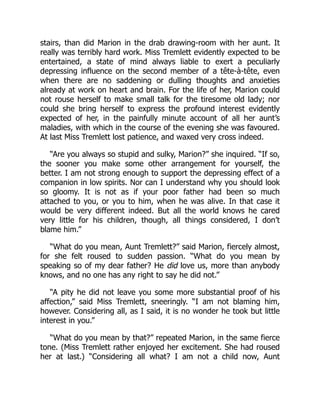
Here are somerecommended products for you. Click the link to
download, or explore more at testbankmall.com
Solution Manual for C++ How to Program: Late Objects
Version, 7/E 7th Edition Paul Deitel, Harvey Deitel
https://testbankmall.com/product/solution-manual-for-c-how-to-program-
late-objects-version-7-e-7th-edition-paul-deitel-harvey-deitel/
Solution Manual for C How to Program, 8th Edition, Paul J.
Deitel, Harvey Deitel
https://testbankmall.com/product/solution-manual-for-c-how-to-
program-8th-edition-paul-j-deitel-harvey-deitel/
Test Bank for C How to Program, 8th Edition, Paul J.
Deitel, Harvey Deitel
https://testbankmall.com/product/test-bank-for-c-how-to-program-8th-
edition-paul-j-deitel-harvey-deitel-2/
Test Bank for Scientific American Nutrition for a Changing
World 1st Edition by Pope
https://testbankmall.com/product/test-bank-for-scientific-american-
nutrition-for-a-changing-world-1st-edition-by-pope/
3.
Test Bank forUnderstanding Health Insurance 13th Edition
by Green
https://testbankmall.com/product/test-bank-for-understanding-health-
insurance-13th-edition-by-green/
Solution Manual for Financial Accounting Theory and
Analysis: Text and Cases 11th Edition
https://testbankmall.com/product/solution-manual-for-financial-
accounting-theory-and-analysis-text-and-cases-11th-edition/
Test Bank for Principles of Microeconomics 8th Edition
https://testbankmall.com/product/test-bank-for-principles-of-
microeconomics-8th-edition/
Solution Manual for McGraw-Hill Connect Resources for
Hoyle, Fundamentals of Advanced Accounting, 5e
https://testbankmall.com/product/solution-manual-for-mcgraw-hill-
connect-resources-for-hoyle-fundamentals-of-advanced-accounting-5e/
Test Bank for Sport Psychology: Concepts and Applications
7th Edition
https://testbankmall.com/product/test-bank-for-sport-psychology-
concepts-and-applications-7th-edition/
4.
Solution Manual forFinancial ACCT2 2nd Edition by Godwin
https://testbankmall.com/product/solution-manual-for-financial-
acct2-2nd-edition-by-godwin/
5.
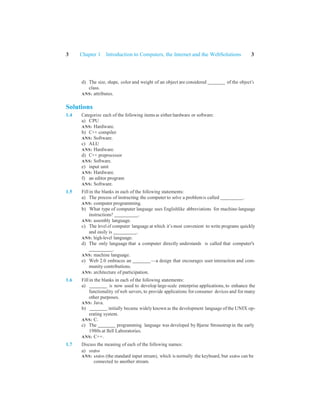
2 Chapter 1Introduction to Computers, the Internet and the WebSolutions 3
[***Instructor’s Manual***]
Self-Review Exercises
1.1 Fill in the blanks in each of the following:
a) Computers process data under the control of sequences of instructions called computer
.
ANS: programs.
b) is a type of computer language that uses Englishlike abbreviations for ma-
chine-language instructions.
ANS: Assembly language.
c) languages are most convenient to the programmer for writing programs
quickly and easily.
ANS: High-level.
d) The onlylanguage a computer can directly understand is that computer’s .
ANS: machine language.
e) The programs that translate high-level language programs into machine language are
called .
ANS: compilers.
f) With development, individuals and companies contribute their efforts in de-
veloping, maintaining and evolving software in exchange for the right to use that soft-
ware for their own purposes, typically at no charge.
ANS: open-source.
g) C is widely known as the development language of the operating system.
ANS: UNIX
1.2 Fill in the blanks in each of the following sentences about the C environment.
a) C programs are normally typed into a computer using a(n) program.
ANS: editor.
b) In a C system, a(n) program automatically executes before the translation
phase begins.
ANS: preprocessor.
c) The two most common kinds of preprocessor directives are and .
ANS: including other files in the file to be compiled, performing various text replacements.
d) The programcombines the output of the compiler with various library func-
tions to produce an executable image.
ANS: linker.
e) The program transfers the executable image from disk to memory.
ANS: loader.
1.3 Fill in the blanks in each of the following statements (based on Section 1.9):
a) Objects have the property of —although objects may know how to commu-
nicate with one another across well-defined interfaces, they normally are not allowed to
know how other objects are implemented.
ANS: information hiding.
b) In object-oriented programming languages, we create to house the set of
methods that perform tasks.
ANS: classes.
c) With , new classes of objects are derived by absorbing characteristics of existing
classes, then adding unique characteristics of their own.
ANS: inheritance.
6.
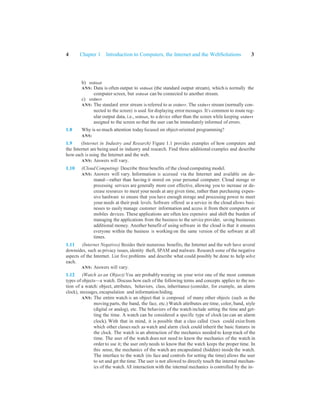
3 Chapter 1Introduction to Computers, the Internet and the WebSolutions 3
d) The size, shape, color and weight of an object are considered of the object’s
class.
ANS: attributes.
Solutions
1.4 Categorize each of the following items as either hardware or software:
a) CPU
ANS: Hardware.
b) C++ compiler
ANS: Software.
c) ALU
ANS: Hardware.
d) C++ preprocessor
ANS: Software.
e) input unit
ANS: Hardware.
f) an editor program
ANS: Software.
1.5 Fill in the blanks in each of the following statements:
a) The process of instructing the computer to solve a problemis called .
ANS: computer programming.
b) What type of computer language uses Englishlike abbreviations for machine-language
instructions? .
ANS: assembly language.
c) The level of computer language at which it’s most convenient to write programs quickly
and easily is .
ANS: high-level language.
d) The only language that a computer directly understands is called that computer's
.
ANS: machine language.
e) Web 2.0 embraces an —a design that encourages user interaction and com-
munity contributions.
ANS: architecture of participation.
1.6 Fill in the blanks in each of the following statements:
a) is now used to develop large-scale enterprise applications, to enhance the
functionality of web servers, to provide applications for consumer devices and for many
other purposes.
ANS: Java.
b) initially became widely known as the development language of the UNIX op-
erating system.
ANS: C.
c) The programming language was developed by Bjarne Stroustrup in the early
1980s at Bell Laboratories.
ANS: C++.
1.7 Discuss the meaning of each of the following names:
a) stdin
ANS: stdin (the standard input stream), which is normally the keyboard, but stdin can be
connected to another stream.
7.
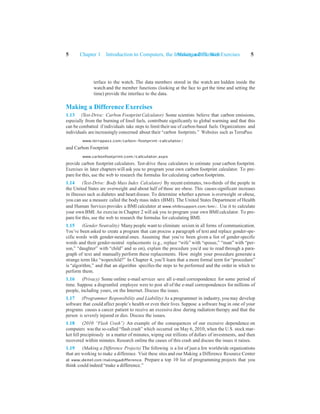
4 Chapter 1Introduction to Computers, the Internet and the WebSolutions 3
b) stdout
ANS: Data is often output to stdout (the standard output stream), which is normally the
computer screen, but stdout can be connected to another stream.
c) stderr
ANS: The standard error stream is referred to as stderr. The stderr stream (normally con-
nected to the screen) is used for displaying error messages. It’s common to route reg-
ular output data, i.e., stdout, to a device other than the screen while keeping stderr
assigned to the screen so that the user can be immediately informed of errors.
1.8 Why is so much attention todayfocused on object-oriented programming?
ANS:
1.9 (Internet in Industry and Research) Figure 1.1 provides examples of how computers and
the Internet are being used in industry and research. Find three additional examples and describe
how each is using the Internet and the web.
ANS: Answers will vary.
1.10 (Cloud Computing) Describe three benefits of the cloud computing model.
ANS: Answers will vary. Information is accessed via the Internet and available on de-
mand—rather than having it stored on your personal computer. Cloud storage or
processing services are generally more cost effective, allowing you to increase or de-
crease resources to meet your needs at anygiven time, rather than purchasing expen-
sive hardware to ensure that you have enough storage and processing power to meet
your needs at their peak levels. Software offered as a service in the cloud allows busi-
nesses to easily manage customer information and access it from their computers or
mobiles devices. These applications are often less expensive and shift the burden of
managing the applications from the business to the service provider, saving businesses
additional money. Another benefit of using software in the cloud is that it ensures
everyone within the business is working on the same version of the software at all
times.
1.11 (Internet Negatives) Besides their numerous benefits, the Internet and the web have several
downsides, such as privacy issues, identity theft, SPAM and malware. Research some of the negative
aspects of the Internet. List five problems and describe what could possibly be done to help solve
each.
ANS: Answers will vary.
1.12 (Watch as an Object) You are probablywearing on your wrist one of the most common
types of objects—a watch. Discuss how each of the following terms and concepts applies to the no-
tion of a watch: object, attributes, behaviors, class, inheritance (consider, for example, an alarm
clock), messages, encapsulation and information hiding.
ANS: The entire watch is an object that is composed of many other objects (such as the
moving parts, the band, the face, etc.) Watch attributes are time, color, band, style
(digital or analog), etc. The behaviors of the watch include setting the time and get-
ting the time. A watch can be considered a specific type of clock (as can an alarm
clock). With that in mind, it is possible that a class called Clock could exist from
which other classes such as watch and alarm clock could inherit the basic features in
the clock. The watch is an abstraction of the mechanics needed to keep track of the
time. The user of the watch does not need to know the mechanics of the watch in
order to use it; the user onlyneeds to know that the watch keeps the proper time. In
this sense, the mechanics of the watch are encapsulated (hidden) inside the watch.
The interface to the watch (its face and controls for setting the time) allows the user
to set and get the time. The user is not allowed to directly touch the internal mechan-
ics of the watch. All interaction with the internal mechanics is controlled by the in-
8.
Making a DifferenceExercises 5
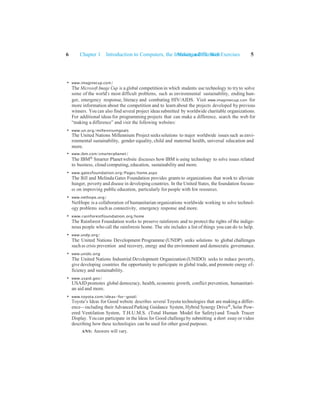
5 Chapter 1 Introduction to Computers, the Internet and the Web
terface to the watch. The data members stored in the watch are hidden inside the
watch and the member functions (looking at the face to get the time and setting the
time) provide the interface to the data.
Making a Difference Exercises
1.13 (Test-Drive: Carbon Footprint Calculator) Some scientists believe that carbon emissions,
especially from the burning of fossil fuels, contribute significantly to global warming and that this
can be combatted if individuals take steps to limit their use of carbon-based fuels. Organizations and
individuals are increasingly concerned about their “carbon footprints.” Websites such as TerraPass
www.terrapass.com/carbon-footprint-calculator/
and Carbon Footprint
www.carbonfootprint.com/calculator.aspx
provide carbon footprint calculators. Test-drive these calculators to estimate your carbon footprint.
Exercises in later chapters will ask you to program your own carbon footprint calculator. To pre-
pare for this, use the web to research the formulas for calculating carbon footprints.
1.14 (Test-Drive: Body Mass Index Calculator) By recent estimates, two-thirds of the people in
the United States are overweight and about half of those are obese. This causes significant increases
in illnesses such as diabetes and heart disease. To determine whether a person is overweight or obese,
you can use a measure called the bodymass index (BMI). The United States Department of Health
and Human Services provides a BMI calculator at www.nhlbisupport.com/bmi/. Use it to calculate
your own BMI. An exercise in Chapter 2 will ask you to program your own BMIcalculator. To pre-
pare for this, use the web to research the formulas for calculating BMI.
1.15 (Gender Neutrality) Manypeople want to eliminate sexism in all forms of communication.
You’ve been asked to create a program that can process a paragraph of text and replace gender-spe-
cific words with gender-neutral ones. Assuming that you’ve been given a list of gender-specific
words and their gender-neutral replacements (e.g., replace “wife” with “spouse,” “man” with “per-
son,” “daughter” with “child” and so on), explain the procedure you’d use to read through a para-
graph of text and manually perform these replacements. How might your procedure generate a
strange term like “woperchild?” In Chapter 4, you’ll learn that a more formal term for “procedure”
is “algorithm,” and that an algorithm specifies the steps to be performed and the order in which to
perform them.
1.16 (Privacy) Some online e-mail services save all e-mail correspondence for some period of
time. Suppose a disgruntled employee were to post all of the e-mail correspondences for millions of
people, including yours, on the Internet. Discuss the issues.
1.17 (Programmer Responsibility and Liability) As a programmer in industry, you may develop
software that could affect people’s health or even their lives. Suppose a software bug in one of your
programs causes a cancer patient to receive an excessive dose during radiation therapy and that the
person is severely injured or dies. Discuss the issues.
1.18 (2010 “Flash Crash”) An example of the consequences of our excessive dependence on
computers was the so-called “flash crash” which occurred on May 6, 2010, when the U.S. stock mar-
ket fell precipitously in a matter of minutes, wiping out trillions of dollars of investments, and then
recovered within minutes. Research online the causes of this crash and discuss the issues it raises.
1.19 (Making a Difference Projects) The following is a list of just a few worldwide organizations
that are working to make a difference. Visit these sites and our Making a Difference Resource Center
at www.deitel.com/makingadifference. Prepare a top 10 list of programming projects that you
think could indeed “make a difference.”
9.
Making a DifferenceExercises 5
6 Chapter 1 Introduction to Computers, the Internet and the Web
• www.imaginecup.com/
The Microsoft Image Cup is a global competition in which students use technology to tryto solve
some of the world’s most difficult problems, such as environmental sustainability, ending hun-
ger, emergency response, literacy and combating HIV/AIDS. Visit www.imaginecup.com for
more information about the competition and to learn about the projects developed by previous
winners. You can also find several project ideas submitted by worldwide charitable organizations.
For additional ideas for programming projects that can make a difference, search the web for
“making a difference” and visit the following websites:
• www.un.org/millenniumgoals
The United Nations Millennium Project seeks solutions to major worldwide issues such as envi-
ronmental sustainability, gender equality, child and maternal health, universal education and
more.
• www.ibm.com/smarterplanet/
The IBM® Smarter Planet website discusses how IBM is using technology to solve issues related
to business, cloud computing, education, sustainability and more.
• www.gatesfoundation.org/Pages/home.aspx
The Bill and Melinda Gates Foundation provides grants to organizations that work to alleviate
hunger, poverty and disease in developing countries. In the United States, the foundation focuss-
es on improving public education, particularly for people with few resources.
• www.nethope.org/
NetHope is a collaboration of humanitarian organizations worldwide working to solve technol-
ogy problems such as connectivity, emergency response and more.
• www.rainforestfoundation.org/home
The Rainforest Foundation works to preserve rainforests and to protect the rights of the indige-
nous people who call the rainforests home. The site includes a list of things you can do to help.
• www.undp.org/
The United Nations Development Programme (UNDP) seeks solutions to global challenges
such as crisis prevention and recovery, energy and the environment and democratic governance.
• www.unido.org
The United Nations Industrial Development Organization (UNIDO) seeks to reduce poverty,
give developing countries the opportunity to participate in global trade, and promote energy ef-
ficiency and sustainability.
• www.usaid.gov/
USAID promotes global democracy, health, economic growth, conflict prevention, humanitari-
an aid and more.
• www.toyota.com/ideas-for-good/
Toyota’s Ideas for Good website describes several Toyota technologies that are makinga differ-
ence—including their Advanced Parking Guidance System, Hybrid Synergy Drive®, Solar Pow-
ered Ventilation System, T.H.U.M.S. (Total Human Model for Safety) and Touch Tracer
Display. You can participate in the Ideas for Good challenge by submitting a short essay or video
describing how these technologies can be used for other good purposes.
ANS: Answers will vary.
stairs, than didMarion in the drab drawing-room with her aunt. It
really was terribly hard work. Miss Tremlett evidently expected to be
entertained, a state of mind always liable to exert a peculiarly
depressing influence on the second member of a tête-à-tête, even
when there are no saddening or dulling thoughts and anxieties
already at work on heart and brain. For the life of her, Marion could
not rouse herself to make small talk for the tiresome old lady; nor
could she bring herself to express the profound interest evidently
expected of her, in the painfully minute account of all her aunt’s
maladies, with which in the course of the evening she was favoured.
At last Miss Tremlett lost patience, and waxed very cross indeed.
“Are you always so stupid and sulky, Marion?” she inquired. “If so,
the sooner you make some other arrangement for yourself, the
better. I am not strong enough to support the depressing effect of a
companion in low spirits. Nor can I understand why you should look
so gloomy. It is not as if your poor father had been so much
attached to you, or you to him, when he was alive. In that case it
would be very different indeed. But all the world knows he cared
very little for his children, though, all things considered, I don’t
blame him.”
“What do you mean, Aunt Tremlett?” said Marion, fiercely almost,
for she felt roused to sudden passion. “What do you mean by
speaking so of my dear father? He did love us, more than anybody
knows, and no one has any right to say he did not.”
“A pity he did not leave you some more substantial proof of his
affection,” said Miss Tremlett, sneeringly. “I am not blaming him,
however. Considering all, as I said, it is no wonder he took but little
interest in you.”
“What do you mean by that?” repeated Marion, in the same fierce
tone. (Miss Tremlett rather enjoyed her excitement. She had roused
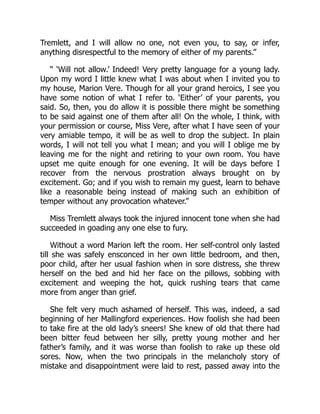
her at last.) “Considering all what? I am not a child now, Aunt
12.
Tremlett, and Iwill allow no one, not even you, to say, or infer,
anything disrespectful to the memory of either of my parents.”
“ ‘Will not allow.’ Indeed! Very pretty language for a young lady.
Upon my word I little knew what I was about when I invited you to
my house, Marion Vere. Though for all your grand heroics, I see you
have some notion of what I refer to. ‘Either’ of your parents, you
said. So, then, you do allow it is possible there might be something
to be said against one of them after all! On the whole, I think, with
your permission or course, Miss Vere, after what I have seen of your
very amiable tempo, it will be as well to drop the subject. In plain
words, I will not tell you what I mean; and you will I oblige me by
leaving me for the night and retiring to your own room. You have
upset me quite enough for one evening. It will be days before I
recover from the nervous prostration always brought on by
excitement. Go; and if you wish to remain my guest, learn to behave
like a reasonable being instead of making such an exhibition of
temper without any provocation whatever.”
Miss Tremlett always took the injured innocent tone when she had
succeeded in goading any one else to fury.
Without a word Marion left the room. Her self-control only lasted
till she was safely ensconced in her own little bedroom, and then,
poor child, after her usual fashion when in sore distress, she threw
herself on the bed and hid her face on the pillows, sobbing with
excitement and weeping the hot, quick rushing tears that came
more from anger than grief.
She felt very much ashamed of herself. This was, indeed, a sad
beginning of her Mallingford experiences. How foolish she had been
to take fire at the old lady’s sneers! She knew of old that there had
been bitter feud between her silly, pretty young mother and her
father’s family, and it was worse than foolish to rake up these old
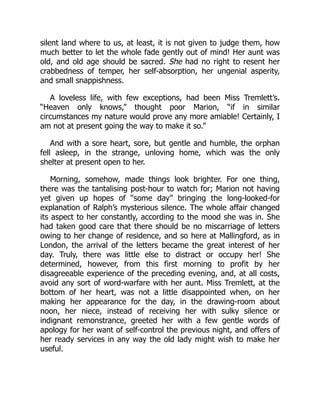
sores. Now, when the two principals in the melancholy story of
mistake and disappointment were laid to rest, passed away into the
13.
silent land whereto us, at least, it is not given to judge them, how
much better to let the whole fade gently out of mind! Her aunt was
old, and old age should be sacred. She had no right to resent her
crabbedness of temper, her self-absorption, her ungenial asperity,
and small snappishness.
A loveless life, with few exceptions, had been Miss Tremlett’s.
“Heaven only knows,” thought poor Marion, “if in similar
circumstances my nature would prove any more amiable! Certainly, I
am not at present going the way to make it so.”
And with a sore heart, sore, but gentle and humble, the orphan
fell asleep, in the strange, unloving home, which was the only
shelter at present open to her.
Morning, somehow, made things look brighter. For one thing,
there was the tantalising post-hour to watch for; Marion not having
yet given up hopes of “some day” bringing the long-looked-for
explanation of Ralph’s mysterious silence. The whole affair changed
its aspect to her constantly, according to the mood she was in. She
had taken good care that there should be no miscarriage of letters
owing to her change of residence, and so here at Mallingford, as in
London, the arrival of the letters became the great interest of her
day. Truly, there was little else to distract or occupy her! She
determined, however, from this first morning to profit by her
disagreeable experience of the preceding evening, and, at all costs,
avoid any sort of word-warfare with her aunt. Miss Tremlett, at the
bottom of her heart, was not a little disappointed when, on her
making her appearance for the day, in the drawing-room about
noon, her niece, instead of receiving her with sulky silence or
indignant remonstrance, greeted her with a few gentle words of
apology for her want of self-control the previous night, and offers of
her ready services in any way the old lady might wish to make her
useful.
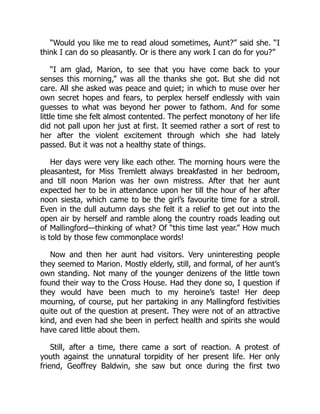
14.
“Would you likeme to read aloud sometimes, Aunt?” said she. “I
think I can do so pleasantly. Or is there any work I can do for you?”
“I am glad, Marion, to see that you have come back to your
senses this morning,” was all the thanks she got. But she did not
care. All she asked was peace and quiet; in which to muse over her
own secret hopes and fears, to perplex herself endlessly with vain
guesses to what was beyond her power to fathom. And for some
little time she felt almost contented. The perfect monotony of her life
did not pall upon her just at first. It seemed rather a sort of rest to
her after the violent excitement through which she had lately
passed. But it was not a healthy state of things.
Her days were very like each other. The morning hours were the
pleasantest, for Miss Tremlett always breakfasted in her bedroom,
and till noon Marion was her own mistress. After that her aunt
expected her to be in attendance upon her till the hour of her after
noon siesta, which came to be the girl’s favourite time for a stroll.
Even in the dull autumn days she felt it a relief to get out into the
open air by herself and ramble along the country roads leading out
of Mallingford—thinking of what? Of “this time last year.” How much
is told by those few commonplace words!
Now and then her aunt had visitors. Very uninteresting people
they seemed to Marion. Mostly elderly, still, and formal, of her aunt’s
own standing. Not many of the younger denizens of the little town
found their way to the Cross House. Had they done so, I question if
they would have been much to my heroine’s taste! Her deep
mourning, of course, put her partaking in any Mallingford festivities
quite out of the question at present. They were not of an attractive
kind, and even had she been in perfect health and spirits she would
have cared little about them.
Still, after a time, there came a sort of reaction. A protest of
youth against the unnatural torpidity of her present life. Her only
friend, Geoffrey Baldwin, she saw but once during the first two
15.
months of herMallingford life, for, much to his regret, within a week
of Miss Vere’s arrival in the neighbourhood, he was called away on
business connected with his own affairs—the disposal of a small
property of his father’s in a distant county—and it was late in
November before he found himself free to return home.
It was very provoking! Just when he had hoped to be of some
use to her, to cheer her a little in her present gloomy life. Geoffrey
had never before in his life thought so much, or so continuously, on
any subject, as during the dull autumn weeks he thought of his poor
little ward at the Cross House. He wrote to her once or twice,
though he was by no means a great hand at letter writing; and was
immensely delighted with the answers he duly received. At last, by
the beginning of December, he found himself on his way home;
much to his satisfaction, for not only was he anxious to see Marion
again, but was also in a great state of fidget about his hunters. The
season had opened most favourably, no signs of frost to speak of,
and already he had missed some capital days. It was really too
provoking, thought Geoffrey to himself, as comfortably ensconced in
the railway carriage, he lit his last pipe before entering Mallingford
station.
The next day he rode over to see Marion. Being well acquainted
with the Cross House hours, he took care to be there early, and the
great clock in the Market Place was only just striking eleven as he
stood on the door steps. Miss Tremlett was not yet visible, he was
informed by the sour-faced Martha (who, however, as we have seen,
was more amiable than she looked), Miss Vere was up-stairs, but if
Mr. Baldwin would step into the drawing-room, the young lady
should be told he was there.
So into the grim drawing-room Geoffrey stepped. Grimmer than
ever it looked at this season; when truly it takes an extra amount of
bright colours and cheerful faces inside, to balance the dismalness of
all things out-of-doors. And this winter was what they called an open
season. Damp and dank and foggy. Above all—for a flat
16.
unpicturesque county likeBrentshire, whose only beauty consisted in
the freshness and luxuriance of its vegetation, this “grim December”
was not the time to see it to advantage.
Geoffrey shivered slightly as he entered the uninviting room.
From physical causes only; he was not particularly sensitive to more
recondite influences. The fire was only just lighted and was
smouldering and sputtering with that irritating air of feeling offended
at having been lighted at all, peculiar to inartistically built fires on a
damp winter’s morning. Mr. Baldwin strolled to the window and
stood biting the end of his riding whip, staring out on the ugly,
dreary plot of ground misnamed a garden.
“It’s not a pleasant place for her to be in, certainly,” thought he,
“My little breakfast-room at the Manor Farm, notwithstanding all the
litter of guns and fishing-rods and pipes, is a much more inviting
room than this. To my mind at least—I wonder if she would think
so!” And then he fell to wondering which of his horses would carry
him best to cover on the morrow, considering the direction which
was likely to be taken, the nature of the ground &c. “By-the-bye,” he
thought suddenly, “I wonder if Miss Vere has ever been at a meet.
I’ll ask her. Bessie, I’m certain, would carry a lady, only then who
would be with her? If Harry were here it would be all right. There
are those Copley girls, they are very good-natured, and might ask
her to join them. I’ll see if I can’t manage it.”
But his further reflections were interrupted by the opening of the
door, and the entrance of Marion herself. She knew who was there,
and her pale face was slightly flushed with pleasure as she came in;
but for all that, Geoffrey was not a little startled by her appearance.
She looked painfully fragile. The cold weather and her black dress
increased the extreme delicacy of her complexion, and the almost
attenuated look of her slight, tall figure. Strangely enough, at that
moment there thrilled through Geoffrey the same foreboding, the
same acute misgiving as had tortured the heart of Ralph Severn that
last evening at Altes. And in the present instance it acted to some
17.
extent as arevelation. As his gaze rested on Marion, a tremor seized
the strong man. Horses, hunting, all he had been thinking of with so
much interest but a moment before, faded from his mind, and in
perfect silence he touched the hand so cordially extended to him,
and mechanically drew nearer the fire a chair on which Marion
seated herself. She did not observe his agitation, and began to talk
brightly and heartily.
“I am so glad, so very glad, to see you again, Mr. Baldwin,” she
said, “I really began to think you were never coming back. And I
wanted to tell you that I have, really and truly, been doing my very
best to be good and patient—but really, Mr. Baldwin, it is drearily,
inexpressibly dull here.”
Geoffrey’s only answer was a glance of sympathy, enough
however to encourage her to proceed.
“It did not seem so bad at first,” she went on, “it was more like a
rest to me; but now it is getting very bad. There are days on which I
can hardly bear the terrible monotony and loneliness. I have not told
Harry so for fear of disturbing him; but I have wished very much to
see you and tell you, Mr. Baldwin. I really would rather be a servant,”
(a governess she was going to have said, but the association was
too painful), “or anything in the world than live on here like this
always. You are not angry with me for saying this, Mr. Baldwin? I
know it seems childish and selfish, but today I was feeling so—I
don’t know what to call it—homesick expresses it best; and I
thought it would be such a relief to tell you about it; but I hope you
are not vexed with me?” she repeated, looking up at his face
beseechingly.
“Vexed with you! My dear Miss Vere,” exclaimed Geoffrey. “How
can you use such expressions? As if, even if I had a right to be
vexed with you, which I have not, anything you could by any
possibility say or do, could ever seem to me anything—I am stupid—
I can’t make pretty speeches, least of all when I most mean them.
18.
Only don’t everspeak as if I could be vexed with you. I am sorry,
terribly sorry to see you looking so pale and thin, and to hear how
this wretched life is trying you. But what is to be done? There is the
difficulty. As I said to you before, I see present no help for it, unless
——.” But here he stopped abruptly, his fair face suddenly flushing
crimson.
“Unless what Mr. Baldwin,” said Marion innocently. “Don’t be
afraid to tell me the alternative, however disagreeable. Is there any
fresh trouble about our money matters?”
“Oh dear no,” replied the young man, thankful that he had not, on
the impulse of the moment, wrecked all by a premature betrayal of
his hardly-as-yet-to-himself-acknowledged hopes, and eager to
distract her attention. “Oh dear no, don’t get anything of that sort
into your head. It is true I fear some little time must pass before
your affairs are thoroughly settled; but by the spring, at latest, I
hope we may hit on some better arrangement.”
“By the spring,” repeated Marion, dolefully; “ah, well, it does not
much matter. After all, I daresay a good deal of the dullness is in
myself. But tell me, Mr. Baldwin, what were you going to say?
‘Unless,’ you began,—unless what?”
“Nothing, Miss Vere—nothing, truly,” replied Geoffrey, rather
awkwardly; “it was only an idea that struck me, but at present
impossible to carry out. Please don’t speak about it.”
“Very well,” answered Marion, looking rather puzzled; “I won’t ask
you about it if you would rather I did not. I am afraid the truth is I
am very difficult to please. I fear in my present mood I should not
be happy anywhere, except—”
“Except where, Miss Vere?” said Geoffrey, lightly; but Marion
looked painfully embarrassed and made no reply. A curious misgiving
shot through Mr. Baldwin’s heart; but he did not persist in his inquiry,
and turned it off with a jest.
19.
“We have bothour secrets, you see,” he said, laughingly; my
‘unless,’ and your ‘except.’ Well, supposing we put both aside for the
present, and consider things as they are. Can nothing be done to
make your stay here pleasanter, so long as it lasts?”
“Nothing,” said Marion, sadly. “Don’t trouble yourself so much
about me, Mr. Baldwin; it is only a fit of low spirits. I shall be better
again in a day or two. It is an immense comfort to me to grumble a
little. I can’t tell you how much good it does me.”
“But you are not looking well,” he persisted, “and you know it is
my duty to look after you. This life is killing you. Have you made no
acquaintances here at all, Miss Vere?”
“None whatever. My aunt’s friends are all old, like herself; and
somehow I don’t fancy I should get on very well with other girls, Mr.
Baldwin. I have grown so dull and stupid; and from what I have
seen of the Mallingford girls at church, and some few who call here
with their mothers, I am sure they would not take to me, nor I to
them. No, just leave me alone. I shall do very well. There is only one
thing I wanted to ask you: can you ask leave for me to go to see
Miss Veronica Temple? She is the only one of my friends that I
remember as a child, still here, and I should so like to see her,
particularly as she can’t come to see me. I spoke of it to my aunt
one day, but to my surprise she got into such a rage I was glad to
change the subject. Why does she dislike Miss Temple so, Mr.
Baldwin?”
“Some old quarrel—what, I can’t exactly say—with Mrs. Temple,”
replied Geoffrey. “Of late years, you know, Miss Tremlett has taken it
into her head to become very Low Church, and she insulted the
widow, Mrs. Temple, very much one day, by drawing a comparison
between the state of Church matters in her husband’s day, when his
daughters played the organ and dressed up the altar—did just as
they, chose, in fact, for he was the easiest of good old easy-going
parsons—and the present condition of things under that very
20.
vigorous and vulgarIrishman, Mr. Magee, who toadies Miss Tremlett
tremendously, as you may have seen for yourself.”
“Yes, indeed,” replied Marion; “horrid man he is, I think! And I am
sure the Temples were the best and most charitable of people. How
long has Miss Veronica been crippled, Mr. Baldwin? I remember
running up and down that steep stair leading to the organ loft with
Harry in her arms when we were quite little children. Such a bright,
active creature, I always imagined her. It seems so sad to come back
to find her so changed.”
“But bright and active still, though she never leaves her sofa,”
said Geoffrey; “she is one of the sweetest women I ever knew. You
must certainly go to see her. She will be delighted, I know. I shall
call and ask her about it on my way home.”
“Thank you very much,” said Marion, earnestly. “I should like to
see her again,” she added softly. And then she sat, leaning her cheek
on her hand, gazing silently into the fire.
It was burning more cheerfully by this time, and the flickering
light danced fitfully on Marion’s pale face; for it was a very gloomy
day outside, and the dingy room was in a sort of twilight. Geoffrey
looked at her anxiously. Suddenly he spoke again:
“Do you ride, Miss Vere” he asked.
She started; for her thoughts had been far away, and he had to
repeat the words before she caught their sense. When she did so,
she answered carelessly:
“A little. That is to say, I have ridden, and I am not nervous. I
liked it very much.”
Geoffrey’s face brightened.
21.
“I have amare that I’m certain would carry you beautifully,” he
said, “I’ll have her tried. I was thinking, if you were to make
acquaintance with some of the girls about here who ride, you might
come to a meet now and then. There are the Copleys of Copley
Wood. They’re really not bad girls, and I know they would be
delighted to make friends with you.”
But Marion laid her hand on his arm.
“I should like to ride with you Mr. Baldwin, very much, if you will
be troubled with me. But I don’t want to make any new
acquaintances. I know it seems very fanciful and unreasonable, but I
don’t feel as if I had spirits for it. Let me ride alone with you,
please.”
“You shall if you like, Miss Vere,” he replied, “but you couldn’t very
well come to a meet unless you knew some of the other ladies. It
wouldn’t be comfortable for you. I’ll tell you how we’ll do. I’ll have
Bessie tried for you, and you shall have a few rides quietly me first,
and then, if you like it, I’ll arrange for the Copley girls to ask you to
join their party to the next meet at a convenient distance. You won’t
object to this? Riding will do you good, I know, and if you ride I shall
not be satisfied unless you come to see the meets. What do you say
to this?”
“That you are too good to me, Mr. Baldwin, and I should be
shamefully ungrateful if I did not do whatever you wish. I shall look
out my habit today. I expect it will be much too big for me, I have
got so thin,” she said lightly. Geoffrey looked at the hand she had
laid in his. It was indeed white and wasted.
“My darling!” he whispered under his breath, so low that she had
no suspicion of the inaudible words.
Then he dropped it gently, and looking up, said cheerfully,
22.
“All right then.You may expect to see me some day with Bessie
all ready for you. Goodbye, and do try to get some more colour in
your cheeks by the next time I see you. Guardians are allowed to
make rude remarks, you know,” he added, laughingly; “it’s it all for
their wards’ good.”
And with another shake of her hand he left her.
“How very kind he is,” thought Marion. “I wonder—I wonder, if it
could possibly do any good for me to tell him all about it. But no,”
she decided, on thinking it over. She had done as much as seemed
to her right and fitting. More would be undignified and unmaidenly.
And then she was so utterly in the dark. What might not have
occurred since she left Altes? Ralph could not be dead; of that she
was certain. He could not have died without her knowing it. But a
worse thing might have come to pass. At this very moment, for all
she knew to the contrary, he might be already the husband of
another woman.
“Though not in heart,” she said to herself. “He was not the man to
love twice. Not at least so quickly. And never while he lives will he
love another as he loved me. In this at least he is mine.”
Thus she felt in certain moods. There were others, however, in
which her faith was less undoubting, in which she almost questioned
if she had not exaggerated what he had said; whether after all it had
not been with Ralph a much less serious affair than, to her cost, it
had been with her? Then again she seemed drawn the other way.
His was no slight or shallow nature. Were his depth and earnestness
to be doubted, in what could she ever allow herself to believe? And
so the poor child was tossed and torn. Still, it came to pass, thanks
to Geoffrey Baldwin, that a little more brightness and enjoyment
were at this time infused into her daily life. The riding proved a
success, and, as her young guardian observed with self-
congratulation, “really did bring some colour to her cheeks.”
23.
The Copley girlscame up to Mr. Baldwin’s favourable account of
them, and did their best in the way of showing kindness to “that
pretty, pale Miss Vere, that Geoffrey Baldwin is so taken up about.”
They were hearty, healthy girls, and both engaged to be married to
the most satisfactory partis. Possibly this last had something to say
to their cordial reception of their old friend’s interesting ward.
The renewal of her acquaintance with the invalid Miss Temple,
was also in a different way a source of great pleasure to Marion.
Trifling incidents both—her introduction to the Copley girls, and her
meeting again with the kind Veronica—but they both influenced her
indirectly in the great decision of her life, towards which, though she
knew it not, the tide of affairs was rapidly drawing her.
24.
CHAPTER VIII.
AND RALPH?
“Learnby a mortal yearning to ascend
Seeking a higher object.”— L AODAMIA.
“For love and beauty and delight
There is no death nor change; their might
Exceeds our organs, which endure
No light, being themselves obscure.”
THE SENSITIVE PLANT.
AH, yes! What of Ralph? Through all these months, to Marion so
weary with suspense and ever-recurring disappointment, what had
he been about? How came it that he, whom we have heard vowing
to himself that her happiness should be his first consideration, had
allowed her thus to suffer, when, as we know, a word from him at
any moment would have set all right, would have made the world
rosy again, and filled with sunlight even the grim old house at
Mallingford?
25.
To explain itall, to show what a strange chain of commonplace
mistakes and cross-purposes had, coupled with one small act of
deliberate malice, effected all the mischief, tortured with doubt and
misgiving two true hearts, and altogether changed the course of
two, if not three, lives—to make all this clear, we must step back
some way: to the very time, indeed, we last heard of Ralph. Heard
of him, only, incidentally, as having been successful in obtaining the
promise of Sir Archibald, or rather, through his influence, that of the
powers that be in such matters, with respect to the expected
consular vacancy at A—.
That was the last, I think, that we know of him thus far,
excepting, by-the-by, an instant’s peep of him more recently in his
mother’s Swiss maison de campaigne, where the Severns were
domesticated for the summer. To return, however, to the day in
March, on which, hopeful and elated, as I think I said, Ralph set out
again for Altes, having succeeded in the mission which had brought
him across the water.
The journey back was a much more cheerful affair than had been
that to England.
Ralph was not naturally by any means given to over-anxiety about
money matters—in fact his actual experience of limited means had
been but small, for he had always had enough for moderate
requirements. But he was a thoroughly conscientious man. Many
would say morbidly so, and I daresay there might be nothing
exaggerated or unreasonable in such an opinion.
Very quiet and reserved people are apt to become morbid on
some point. They get hold of a notion, and turn it round and round
in their minds, till a sort of mental dizziness, very adverse to clear
judgement, results. It is a grand thing now and then to get a fresh,
outside opinion on matters about which we are deeply interested.
Nor is the soundness of that opinion of as much moment as might
be imagined. Its freshness is the great thing; for assuredly, though
26.
directly it maynot influence our eventual decision, our own powers
of judgement will, by its breezy rush through our cobwebbed brain,
become marvellously invigorated, and braced for the work, which,
after all, to be well done, must be their own, and no one else’s!
Such had been on Ralph the effect of his rare confidence in
another—that other, as will be remembered, having been the
sensible, middle-aged, but nevertheless quite sufficiently “romantic,”
Mr. Price. From the date of his long talk with his odd tutor, the young
man’s bewilderments, fors and againsts, conflicting duties and
inclinations, ranged themselves with wonderful order and celerity. It
was all nonsense, “morbid humbug,” he soon learnt to call it, about
his being different from other men, cut off by peculiar circumstances
from what, after all, in plain, honest English is every man’s birthright
—liberty to please himself in the choice of the helpmeet, without
which Providence certainly never intended him, or any other able-
bodied young man, to go through life! Provided, of course, the
prospective helpmeet saw things in the same way as he; of which,
Heaven be thanked, he had no reasonable grounds to doubt.
What he could do, without too much going out of his way, or any
approach to unmanly subservience, to conciliate his mother, he
would. But beyond a certain point he now saw clearly it was not his
duty to defer to her. Should she show herself inclined to be
reasonable, which state of things, however, he at present felt far
from sanguine about: he would be only too ready to meet her at any
point on the friendly road, he would, in any case, swallow his pride,
to the extent of accepting from her whatever amount of pecuniary
assistance she saw fit to afford him. Pride, indeed, was hardly the
word for it, for in a sense the property was his own, though at
present, unfortunately, not to be obtained but by her good-will. And
if she took it into her head to stand out and refuse him anything?
Well, then, he had the appointment at A—— to fall back upon, the
securing of which, his practical good sense and Mr. Price’s advice,
had shown him to be the one distinct duty before him; without
27.
which as acertainty, however small, he had no right to allow the
fortunes of another to be joined to his.
What he had said to Marion, before leaving Altes, had not been
on impulse. Each word, each look and gesture, that last evening
when she had shown him in her innocence, the whole depths of her
pure, loving heart, and tempted him sorely to say but one word
more, to press her if but for an instant to his breast—each word and
glance that evening he had rigidly controlled, and acted throughout
implicitly as he believed to be for the best. From the light of after
results, we now may question if he did wisely; if, after all, it had not
been better to have gone further, or not so far? From the top of the
hill it requires no great wisdom to look back and say which would
have been the best road up: but this is not how we are meant to
travel our life-journey. Slowly and toilfully, with but little light, and
what there is often dazzling and deceptive, with bleeding feet and
trembling limbs we creep along—one step beyond, often the limit of
our darkened view. This is how the Allwise sees fit to train us. Doubt
not and judge not. When at last we climb beyond the mists and
fogs, though that time may be still a far way off, we shall see that it
was for the best.
But no misgiving of this kind came to torment Ralph on his way
back, as he thought, to the woman, from whom no reasonable
barrier now divided him.
“For to put it in its very worst light,” said he to himself (a feat by-
the-bye your very conscientious people are strangely fond of
performing), “even if my health gives way and I have to throw up
the A—— appointment, my mother is not so utterly devoid of natural
affection as to let us starve while she is rolling in wealth. And even if
I were to die and leave my darling alone, why, we should have had
our little hit of happiness, which surely is better than to have had
none at all. And if my Marion had a child, or children,” he murmured
to himself softly, “it would force my mother to take an interest in her
for the old name’s sake. It would not seem quite so bad to leave her
28.
if she hadboys and girls about her! She seems so very lonely, poor
child, except for Mrs. Archer, who after all is only a friend. Though I
really don’t know why I should think myself likely to die. I am
perfectly healthy, though not very robust. John’s death, I think, put it
into my head that I should not live to be old.”
And then in thought he wandered off to picturing to himself
where and when he could best manage to see Marion alone.
“I wonder if she thought me cold,” he said to himself; “I must
have seemed so. But still I am sure she understood me. She has a
wonderfully quick and delicate sympathy. Yes, I am certain she
understood me or she would not have trusted me so. The only
unsatisfactory remembrance I have of our conversation is of her
sudden distress when she bethought herself of what she hinted at as
a barrier on her side. What could it be? Some disgrace in her family.
Something connected with her father. But that will soon be explained
and set straight. Nothing not actually affecting herself could conic
between us.”
So he whiled away the many hours of his journey, tedious only in
so far as the days seemed long till he could see her again, hear
repeated by her own lips the sweet assurance, which, had he been a
vainer or more conventional man, he would have read many a time
ere now; in her changing colour, the varying tones of her voice, the
childlike trust and appeal in her innocent eyes when she raised them
to his.
I don’t know that ever Ralph Severn was happier than during this
journey back to Altes. Truly, this falling in love of his had done great
things for him: sunnied his whole nature, and for the first time
revealed to him the marvellous beauty there is in this life of ours;
the light and joy which underlie it, our intense powers of happiness
no less than of suffering. All which things being real and true,
whatever be the dark mysteries for the present on the other side; it
was, I doubt not, well for him to have had a glimpse of them, an
29.
actual personal experienceof happiness, however short-lived. We
speak fluently of the discipline of suffering? Is nothing to be learnt
from its twin sister, joy? Or is she sent but to mock us? I cannot
think so. Her visits may be short and rare, but some good gift of
enduring kind she surely leaves behind, if only, blinded by the tears
we shed at her departure, we did not fail to see it.
Such, however, it seems to me, is not the case with the highest
and deepest natures. To them, I think, all life experience is but as
fresh and precious soil in a garden where all is turned to good
account sooner or later. There may be ugly and unsightly things
about; the flowers, when withered, may seem to pollute the air and
cumber the ground; but only to our ignorance does it appear so.
Under the great Master-hand all is arranged, nothing overlooked.
Every shower of rain, every ray of sunshine, has its peculiar mission.
All influences tend to the one great end in view, the ultimate
perfection of the work. If only the gardener be humble and willing,
patient, and, withal, earnest to learn. Then even from his mistakes
he shall gain precious and lasting fruit.
Ralph Severn’s character was no shallow one. His love for Marion
was, as I have said, the one great affection of his life. And
something his nature gained from its present happiness that it never
afterwards lost. Something indefinite and subtle. But an influence for
good.
It was late in the evening when he reached Altes. His mother and
Miss Vyse, ignorant of the precise hour at which his arrival might be
expected, were just about leaving the drawing-room for the night.
The children, of course, were in bed; but, in the fulness of his happy
heart, Ralph went and kissed little Sybil as she lay asleep.
How forcibly it reminded him of his last return to the Rue des
Lauriers!
30.
He only sawLady Severn and his cousin-by-courtesy for a very
few minutes; but even in that time his quick perception revealed to
him some slight change in the manner of both. In Florence it was
the most marked. Her tone seemed to him more natural because
more unrestrained. A sort of contemptuous indifference to him,
united to something of triumph and secret satisfaction, peeped out
in her carelessly good-natured, rather condescending greeting. She
was looking very well too, exceedingly radiant and handsome. Her
white skin appeared positively dazzling, her clear black eyebrows in
their faultless curve, relieving what might otherwise have been too
marble-like for attractive living beauty; her glorious hair, in which
nestled a cluster of crimson roses (of a peculiar and carefully-
selected shade, by contrast browning the surface they lay on) shone
a mass of burnished gold; for by candlelight the tinge of red only
intensified its lustre and richness. She stood thus for a moment,
under the full glare of the lamp—a rash thing for any but a perfectly
beautiful woman to do; but Florence knew herself to be one of the
few whose charms are immensely increased by such an ordeal—her
eyes cast down—fortunately so, if she were challenging the young
man’s admiration, for wonderfully fine as they were Ralph never
could succeed in admiring them, nor her, when he felt them fixed on
his face. She was dressed in black, something soft and sweeping,
but yet intensely black; and from out of its midst curved her round
white arms, rose her beautiful, dazzling neck and throat, on which
lay some heavy coils of dull, red gold chain, or beads. A golden rope
was the appearance they presented at a little distance, or “rather,”
thought Ralph, as in his moment’s glance he saw the coils heave
slightly as she breathed, “are they like some magical snake she has
bewitched to serve her purpose?”
It was a silly fancy, but it dispelled the momentary impression of
her great beauty; which, not to have been struck by, one must
needs have been less or more than human.
“What can she be after now?” thought Ralph, with some
misgiving. “All this very effective get-up must have been done with a
31.
purpose. And heruncommonly cool tone! Rather a change from the
oily manner she used to favour me with, though upon my word I
think it’s an improvement. Can she be intending to try to pique me?
No, she would never be so silly. Besides, they did not know I was
coming to-night. I declare I believe she has got hold of some one
else. How I pity the poor devil! All the same, from personal motives,
I can’t refrain from wishing her success.” And half puzzled, half
amused, he turned to his mother.
“How well you are looking, Ralph!” broke from her involuntarily.
And it was very true. For all that he was tired and travel-stained, for
he had come in to see his mother before changing his clothes, the
young man certainly looked his very best. There was a healthy
brown flush under his somewhat sallow skin, which improved him
vastly, and showed to advantage the dark, rather too deep set eyes,
whose colour I never could succeed in defining. His figure, always
lithe and sinewy, seemed to have gained in vigour and erectness. He
looked both taller and stronger; his whole carriage told of greater
heartiness and elasticity, a quicker and healthier flow of the life-
blood in his veins.
He looked pleased at the gratification involuntarily displayed in his
mother’s tone, for till then her manner had chilled and perplexed
him. She was more cordial than when he had left her, but she looked
uneasy and depressed, and received him with the manner of one
almost against her convictions, allowing to return to favour a but
half-penitent culprit. Her “So you are back again, Ah, well!” had
something rather piteous in its tone of reproach and resignation, but
was, at the same time, exceedingly irritating. “Let bygones be
bygones,” it seemed to say. “You have been an undutiful son, but I
am the most magnanimous and long-suffering of mothers.”
Underlying all this, however, was a different feeling, an evident
anxiety as to his well-being, evinced by the heartiness of her
exclamation as to his satisfactory looks. And besides this, he felt
convinced she was concealing something which she believed would
distress him; for, with all her worldly-mindedness and class
32.
prejudice, Lady Severnwas the most transparent and honest-
intentioned of women. He could not make it out, nor ask to have it
explained; for, joined to his constitutional reserve, his mother and he
were not, never had been, on such terms as to allow him frankly to
beg her to confide to him the cause of her evident uneasiness. So
they separated for the night. He, happy man, to forget all mysteries
and misgivings in the thought of tomorrow’s meeting with Marion.
Poor Ralph!
The morning came only too soon to dispel his dream. He did not
see the children at breakfast as usual, and on expressing his surprise
was told by his mother that they now breakfasted separately, as
otherwise it made them too late for their lessons.
“Then does Miss Freer come earlier now?” was on his tongue to
ask, but something in the air of satisfaction with which Florence was
sipping her coffee, stopped his intention.
“I shall not mention my darling’s name before her,” he said to
himself.
A few minutes later Lotty and Sybil ran in “just for one moment,
Grandmamma,” clamorous in their welcome of their truant uncle.
While they were still busy hugging Sir Ralph, the bell rang.
“Oh come, Lotty, do,” said Sybil the virtuous, “that will be Miss
Brown.”
“Miss Brown,” quoth Ralph, in haste, “who the—who on earth is
she?”
“Our governess, since Miss Freer left,” replied Lotty, (Sybil was as
yet incapable of approaching the subject of Miss Freer’s departure
without tears, and therefore was wise enough to leave the
explanation to Lotty’s less sensitive tongue). “Didn’t you know, Uncle
Ralph, that Miss Freer had left? She went away with Mrs. Archer, but
she would have left off teaching us at any rate. Grandmamma
33.
thought she wasnot ‘inexperienced’ enough for us now we are
getting so big. Not instructed enough, though she was very kind.
Miss Brown plays far grander on the piano. You can hear her quite
across the street. Just like the band on the Place. And she——.”
“Lotty,” said her grandmother sharply, “you talk much too fast. It
is not for little girls like you to discuss their elders. Go now, both of
you, at once, to Miss Brown, and be good girls.”
Lotty disappeared instantly. Sybil lingered one little short moment
to kiss her uncle softly once more, and then followed her sister.
What had the child-heart read of the sorrow, the sudden, sharp
pang of bitter disappointment that thrilled through the strong man,
in whom her innocence, she instinctively wished to comfort?
For once in his life Ralph felt thankful for Lotty’s tongue. Its
chatter gave him an instant in which to recover himself, to rally his
scattered forces and decide on his present course. Perfect silence!
He was not in the habit of betraying his feelings, and certainly his
powers of self-control must not fail him now, for the gratification of
the heartless beauty at his mother’s board.
His first impulse had been to rise in the strength of his wrath and
indignation, to have done, for once in a way, with conventional
restrictions, and to hurl bitter, biting words at her, who in his inmost
heart he believed to be the author of all this. It was well he did not
do so. Florence was prepared for it, would have enjoyed it
immensely, and would certainly have remained mistress of the field.
His heroics would have been altogether out of place, as a very few
minutes sufficed to show him, and would but have exposed himself
and another to ridicule and derision. For what would Florence have
answered? She had the words all ready.
“My dear Ralph, what do you mean? My dearest aunt, has your
son gone out of his mind? How can I, of all people, be responsible
for Mrs. Archer’s having been called to India to nurse her husband,
34.
or to themovements of the young lady visiting her? Truly, Sir Ralph,
you must excuse me, but just ask yourself—why should I be
supposed to take so extraordinary an interest in every young lady
my aunt sees it to engage to teach your nieces? And still more, what
possible reason could I have for supposing this particular young lady
to be an object of interest to you? It is not usual, to say the least,
for the gentleman of the house, to have an understanding with the
governess?”
Which memorable speech however was never destined to be
uttered.
Ralph thought better of it, and decided to nurse his wrath and
keep his own counsel.
There is a great deal of nonsense spoken and written about truth,
and truth tellers. The most exalted characters in a certain of class
fiction can never bring themselves without a tremendous fuss, either
to utter or act a falsehood, and if they ever attempt either, they are
sure to bungle it: spite of themselves “their ingenuous nature
betrays itself,” “their lips scorn to descend to the meanness,” &c. &c.
It is not so in real life. I know of no persons who, when they are put
to it, can tell a falsehood better, or act it more cleverly, than
essentially truthful, because truth-loving natures. The reason, I
fancy, lies somewhere in this direction. It takes some strength, some
resolution, to do something they thoroughly dislike, and so they,
having “gone for it,” feeling the necessity of the disagreeable action,
do it to the best of their ability, set their shoulder to the wheel and
go through with it with a will. This is how, to my experience, really
thorough people tell stories!
Ralph did his bit of falsity very neatly. All the same, alas, Florence
saw through it! He did not over-act it. He looked up with a
sufficiently concerned expression, saying to his mother:
35.
Welcome to ourwebsite – the perfect destination for book lovers and
knowledge seekers. We believe that every book holds a new world,
offering opportunities for learning, discovery, and personal growth.
That’s why we are dedicated to bringing you a diverse collection of
books, ranging from classic literature and specialized publications to
self-development guides and children's books.
More than just a book-buying platform, we strive to be a bridge
connecting you with timeless cultural and intellectual values. With an
elegant, user-friendly interface and a smart search system, you can
quickly find the books that best suit your interests. Additionally,
our special promotions and home delivery services help you save time
and fully enjoy the joy of reading.
Join us on a journey of knowledge exploration, passion nurturing, and
personal growth every day!
testbankmall.com




![2 Chapter 1 Introduction to Computers, the Internet and the WebSolutions 3
[***Instructor’s Manual***]
Self-Review Exercises
1.1 Fill in the blanks in each of the following:
a) Computers process data under the control of sequences of instructions called computer
.
ANS: programs.
b) is a type of computer language that uses Englishlike abbreviations for ma-
chine-language instructions.
ANS: Assembly language.
c) languages are most convenient to the programmer for writing programs
quickly and easily.
ANS: High-level.
d) The onlylanguage a computer can directly understand is that computer’s .
ANS: machine language.
e) The programs that translate high-level language programs into machine language are
called .
ANS: compilers.
f) With development, individuals and companies contribute their efforts in de-
veloping, maintaining and evolving software in exchange for the right to use that soft-
ware for their own purposes, typically at no charge.
ANS: open-source.
g) C is widely known as the development language of the operating system.
ANS: UNIX
1.2 Fill in the blanks in each of the following sentences about the C environment.
a) C programs are normally typed into a computer using a(n) program.
ANS: editor.
b) In a C system, a(n) program automatically executes before the translation
phase begins.
ANS: preprocessor.
c) The two most common kinds of preprocessor directives are and .
ANS: including other files in the file to be compiled, performing various text replacements.
d) The programcombines the output of the compiler with various library func-
tions to produce an executable image.
ANS: linker.
e) The program transfers the executable image from disk to memory.
ANS: loader.
1.3 Fill in the blanks in each of the following statements (based on Section 1.9):
a) Objects have the property of —although objects may know how to commu-
nicate with one another across well-defined interfaces, they normally are not allowed to
know how other objects are implemented.
ANS: information hiding.
b) In object-oriented programming languages, we create to house the set of
methods that perform tasks.
ANS: classes.
c) With , new classes of objects are derived by absorbing characteristics of existing
classes, then adding unique characteristics of their own.
ANS: inheritance.](https://image.slidesharecdn.com/83-250504194302-56eea7c6/85/Solution-Manual-for-C-How-to-Program-7-E-7th-Edition-Paul-Deitel-Harvey-Deitel-5-320.jpg)