


Virtual Machine Introspection 
to Detect and Protect 
Tamas K. Lengyel 
tklengyel@sec.in.tum.de 
tamas.lengyel@zentific.com 
https://github.com/tklengyel
Agenda 
1. Motivation & Cloud security 
2. Xen 
3. Virtual Machine Introspection 
I. Isolation 
II. Interpretation 
III. Interposition 
4. Demo 
5. Public release of new tools
Motivation 
This is my PhD topic 
● Malware collection & analysis 
DARPA Cyber Fast Track 
● Cloud IDS/IPS prototype 
Up-and-coming field
Cloud Security? 
● Virtualization is a magic box of invulnerability 
● Why bother if Cloud instances are short-lived 
and easily wiped? 
● Isn't worth the cost of overhead 
● It's not going to happen to me 
● I'll just use my existing tools and be fine 
Wrong!
Cloud Security 
● In-guest AV / HIDS 
✗ No isolation 
● Network IDS 
✗ Limited or no context 
● Scan VM disk and memory 
✗ No interposition 
Better than nothing
Cloud Security! 
● Move protection out from the VM 
✔ Hypervisor based isolation 
● Full view of the VM state 
✔ Interpret virtual hardware to see processes, 
users, connections, files.. 
● Actively monitor & control 
✔ Interposition
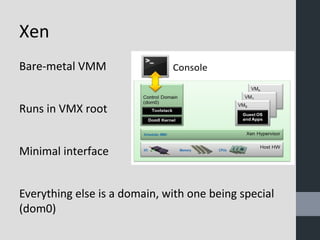
Xen 
Bare-metal VMM 
Runs in VMX root 
Minimal interface 
Everything else is a domain, with one being special 
(dom0)
Isolation 
We could move the security stack to dom0.. 
.. or move it into its own domain! 
Xen allows for advanced disaggregation and role 
delegation 
With some caveats..
Access control in Xen 
Xen Security Modules (XSM) 
– Disabled by default. 
– Only usable starting with 4.3 
In the guest kernel! 
– if (!xen_initial_domain()) 
return -EPERM; 
– We patched that in Linux 3.8 
In XenStore (ignore for now) 
– Domain meta info is only a plus
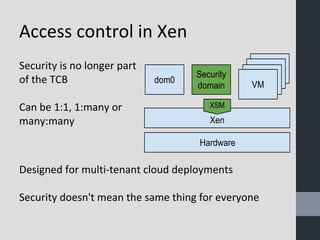
Access control in Xen 
Security is no longer part 
of the TCB 
Can be 1:1, 1:many or 
many:many 
Designed for multi-tenant cloud deployments 
Security doesn't mean the same thing for everyone
Interpretation 
Interpreting the guest virtual hardware 
– Memory 
– VCPU 
Memory interpretation: 
– Paging, paging, paging 
OS interpretation: 
– Debug symbols!
LibVMI + Rekall 
LibVMI 
– Xen and KVM support 
– Paging support for 
● x86, x86+PAE, x86_64 & ARM 
– OS support 
● Windows, Linux 
Rekall 
– Generates nice debug profiles 
– ..and lots of other fancy stuff
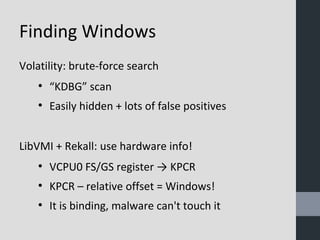
Finding Windows 
Volatility: brute-force search 
● “KDBG” scan 
● Easily hidden + lots of false positives 
LibVMI + Rekall: use hardware info! 
● VCPU0 FS/GS register → KPCR 
● KPCR – relative offset = Windows! 
● It is binding, malware can't touch it
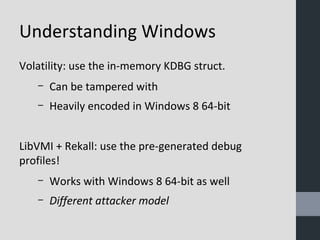
Understanding Windows 
Volatility: use the in-memory KDBG struct. 
– Can be tampered with 
– Heavily encoded in Windows 8 64-bit 
LibVMI + Rekall: use the pre-generated debug 
profiles! 
– Works with Windows 8 64-bit as well 
– Different attacker model
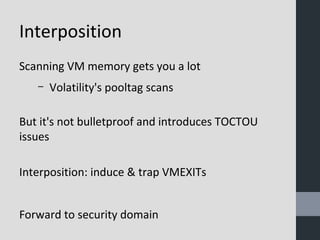
Interposition 
Scanning VM memory gets you a lot 
– Volatility's pooltag scans 
But it's not bulletproof and introduces TOCTOU 
issues 
Interposition: induce & trap VMEXITs 
Forward to security domain
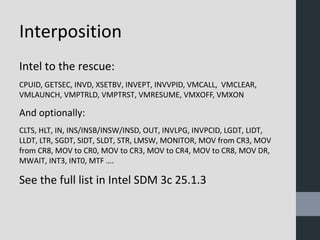
Interposition 
Intel to the rescue: 
CPUID, GETSEC, INVD, XSETBV, INVEPT, INVVPID, VMCALL, VMCLEAR, 
VMLAUNCH, VMPTRLD, VMPTRST, VMRESUME, VMXOFF, VMXON 
And optionally: 
CLTS, HLT, IN, INS/INSB/INSW/INSD, OUT, INVLPG, INVPCID, LGDT, LIDT, 
LLDT, LTR, SGDT, SIDT, SLDT, STR, LMSW, MONITOR, MOV from CR3, MOV 
from CR8, MOV to CR0, MOV to CR3, MOV to CR4, MOV to CR8, MOV DR, 
MWAIT, INT3, INT0, MTF …. 
See the full list in Intel SDM 3c 25.1.3
Interposition with LibVMI 
● MOV-TO-CR0/3/4 
– New process being scheduled, CPU feature 
enabled/disabled, TLB flush, etc. 
● EPT violation 
– Trap R/W/X of any memory page in the guest 
– Invisible to the guest 
– Needs to be reset after hit 
● Singlestepping 
– Intel Monitor Trap Flag (MTF) 
● Debug events (INT3)
Demo time! 
http://goo.gl/XMSJ7y
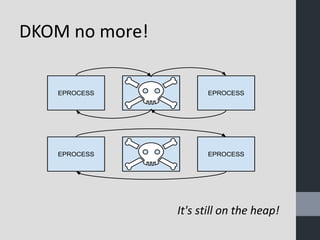
DKOM no more! 
It's still on the heap!
Demo time! 
http://goo.gl/XMSJ7y
DRAKVUF 
“Scalability, Fidelity and Stealth in the DRAKVUF 
Dynamic Malware Analysis System” - ACSAC 2014 
http://drakvuf.com 
Anyone gets the name reference?
Conclusion 
● Cloud security requires new tools and new 
approaches 
● VMI is rapidly maturing to fill the gap 
● Dealing with rootkits is easier externally 
● Tools are open-source (GPL/LGPL) 
● Patches are welcome ;)
What's ahead 
VMI gets you a lot.. but there are blind-spots 
– Virt-DMA, emulation.. 
● Who watches the watcher? 
– SMM/AMT based VMM integrity check 
● Xen on ARM 
– “Cloud” security for your phone/car!
Shout-out 
Cheers to the Zentific crew 
– Steve, Matt & Russ 
To the Volatility crew 
– MHL, Andrew, Gleeda & Moyix 
To the Rekall crew 
– Scudette 
To Mudge 
– Thanks for the CFT!
Thanks!

Hacktivity2014: Virtual Machine Introspection to Detect and Protect

  • 1.
    Virtual Machine Introspection to Detect and Protect Tamas K. Lengyel tklengyel@sec.in.tum.de tamas.lengyel@zentific.com https://github.com/tklengyel
  • 2.
    Agenda 1. Motivation& Cloud security 2. Xen 3. Virtual Machine Introspection I. Isolation II. Interpretation III. Interposition 4. Demo 5. Public release of new tools
  • 3.
    Motivation This ismy PhD topic ● Malware collection & analysis DARPA Cyber Fast Track ● Cloud IDS/IPS prototype Up-and-coming field
  • 4.
    Cloud Security? ●Virtualization is a magic box of invulnerability ● Why bother if Cloud instances are short-lived and easily wiped? ● Isn't worth the cost of overhead ● It's not going to happen to me ● I'll just use my existing tools and be fine Wrong!
  • 5.
    Cloud Security ●In-guest AV / HIDS ✗ No isolation ● Network IDS ✗ Limited or no context ● Scan VM disk and memory ✗ No interposition Better than nothing
  • 6.
    Cloud Security! ●Move protection out from the VM ✔ Hypervisor based isolation ● Full view of the VM state ✔ Interpret virtual hardware to see processes, users, connections, files.. ● Actively monitor & control ✔ Interposition
  • 7.
    Xen Bare-metal VMM Runs in VMX root Minimal interface Everything else is a domain, with one being special (dom0)
  • 8.
    Isolation We couldmove the security stack to dom0.. .. or move it into its own domain! Xen allows for advanced disaggregation and role delegation With some caveats..
  • 9.
    Access control inXen Xen Security Modules (XSM) – Disabled by default. – Only usable starting with 4.3 In the guest kernel! – if (!xen_initial_domain()) return -EPERM; – We patched that in Linux 3.8 In XenStore (ignore for now) – Domain meta info is only a plus
  • 10.
    Access control inXen Security is no longer part of the TCB Can be 1:1, 1:many or many:many Designed for multi-tenant cloud deployments Security doesn't mean the same thing for everyone
  • 11.
    Interpretation Interpreting theguest virtual hardware – Memory – VCPU Memory interpretation: – Paging, paging, paging OS interpretation: – Debug symbols!
  • 12.
    LibVMI + Rekall LibVMI – Xen and KVM support – Paging support for ● x86, x86+PAE, x86_64 & ARM – OS support ● Windows, Linux Rekall – Generates nice debug profiles – ..and lots of other fancy stuff
  • 13.
    Finding Windows Volatility:brute-force search ● “KDBG” scan ● Easily hidden + lots of false positives LibVMI + Rekall: use hardware info! ● VCPU0 FS/GS register → KPCR ● KPCR – relative offset = Windows! ● It is binding, malware can't touch it
  • 14.
    Understanding Windows Volatility:use the in-memory KDBG struct. – Can be tampered with – Heavily encoded in Windows 8 64-bit LibVMI + Rekall: use the pre-generated debug profiles! – Works with Windows 8 64-bit as well – Different attacker model
  • 15.
    Interposition Scanning VMmemory gets you a lot – Volatility's pooltag scans But it's not bulletproof and introduces TOCTOU issues Interposition: induce & trap VMEXITs Forward to security domain
  • 16.
    Interposition Intel tothe rescue: CPUID, GETSEC, INVD, XSETBV, INVEPT, INVVPID, VMCALL, VMCLEAR, VMLAUNCH, VMPTRLD, VMPTRST, VMRESUME, VMXOFF, VMXON And optionally: CLTS, HLT, IN, INS/INSB/INSW/INSD, OUT, INVLPG, INVPCID, LGDT, LIDT, LLDT, LTR, SGDT, SIDT, SLDT, STR, LMSW, MONITOR, MOV from CR3, MOV from CR8, MOV to CR0, MOV to CR3, MOV to CR4, MOV to CR8, MOV DR, MWAIT, INT3, INT0, MTF …. See the full list in Intel SDM 3c 25.1.3
  • 17.
    Interposition with LibVMI ● MOV-TO-CR0/3/4 – New process being scheduled, CPU feature enabled/disabled, TLB flush, etc. ● EPT violation – Trap R/W/X of any memory page in the guest – Invisible to the guest – Needs to be reset after hit ● Singlestepping – Intel Monitor Trap Flag (MTF) ● Debug events (INT3)
  • 18.
  • 19.
    DKOM no more! It's still on the heap!
  • 20.
  • 21.
    DRAKVUF “Scalability, Fidelityand Stealth in the DRAKVUF Dynamic Malware Analysis System” - ACSAC 2014 http://drakvuf.com Anyone gets the name reference?
  • 22.
    Conclusion ● Cloudsecurity requires new tools and new approaches ● VMI is rapidly maturing to fill the gap ● Dealing with rootkits is easier externally ● Tools are open-source (GPL/LGPL) ● Patches are welcome ;)
  • 23.
    What's ahead VMIgets you a lot.. but there are blind-spots – Virt-DMA, emulation.. ● Who watches the watcher? – SMM/AMT based VMM integrity check ● Xen on ARM – “Cloud” security for your phone/car!
  • 24.
    Shout-out Cheers tothe Zentific crew – Steve, Matt & Russ To the Volatility crew – MHL, Andrew, Gleeda & Moyix To the Rekall crew – Scudette To Mudge – Thanks for the CFT!
  • 25.