SOLlDS AND LIQUIDS
By; Anushay Abrar
WHAT IS MATTER?
❖
❖
MASS
Mass is the amount of matter or substance that makes up an
object.
It is measured in units called kilograms (kg).
Mass always stays the same.
Mass can be measured using a:
★ Lever balance
★ Electronic balance
DOES AIR HAVE MASS?
Matter is anything that has mass and takes up space.
Although air has mass, a small volume of air, such as the
air in the balloons, doesn't have too much.
Air just isn't very dense. We can show that the air in the
balloon has mass by building a balance.
DOES WATER HAVE MASS?
Water molecules all have the same mass and size.
No matter what size sample of water you measure, the
relationship between the mass and volume will always be the
same.
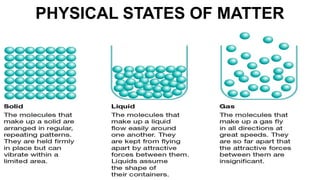
PHYSICAL STATES OF MATTER
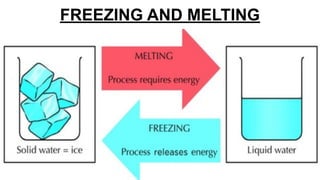
FREEZING AND MELTING
FREEZING:
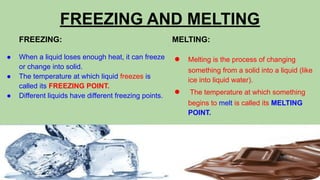
● When a liquid loses enough heat, it can freeze
or change into solid.
● The temperature at which liquid freezes is
called its FREEZING POINT.
● Different liquids have different freezing points.
MELTING:
● Melting is the process of changing
something from a solid into a liquid (like
ice into liquid water).
● The temperature at which something
begins to melt is called its MELTING
POINT.
FREEZING AND MELTING
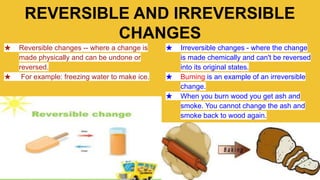
REVERSIBLE AND IRREVERSIBLE
CHANGES
★ Reversible changes -- where a change is
made physically and can be undone or
reversed.
★ For example: freezing water to make ice.
★ Irreversible changes - where the change
is made chemically and can't be reversed
into its original states.
★ Burning is an example of an irreversible
change.
★ When you burn wood you get ash and
smoke. You cannot change the ash and
smoke back to wood again.
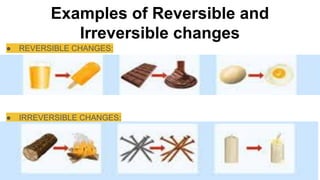
Examples of Reversible and
Irreversible changes
● REVERSIBLE CHANGES:
● IRREVERSIBLE CHANGES:
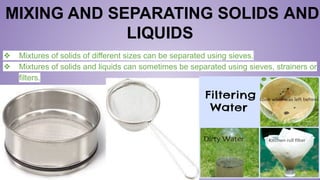
MIXING AND SEPARATING SOLIDS AND
LIQUIDS
❖ Mixtures of solids of different sizes can be separated using sieves.
❖ Mixtures of solids and liquids can sometimes be separated using sieves, strainers or
filters.
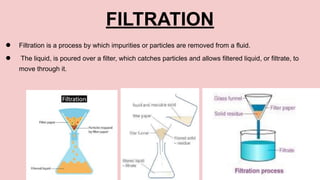
FILTRATION
● Filtration is a process by which impurities or particles are removed from a fluid.
● The liquid, is poured over a filter, which catches particles and allows filtered liquid, or filtrate, to
move through it.
DISSOLVING
● Some solids, such as salt and sugar, can dissolve in water to form solutions.
● When a solid dissolves in water, it breaks up into tiny particles that spread evenly
throughout the water.
● Solids that can dissolve in water cannot be separated from water by Filtration as the
dissolved particles are small enough to pass through the pores of the filters.
● Dissolving is a reversible.
Solids and liquids grade 4

Solids and liquids grade 4

  • 1.
  • 2.
  • 3.
    MASS Mass is theamount of matter or substance that makes up an object. It is measured in units called kilograms (kg). Mass always stays the same. Mass can be measured using a: ★ Lever balance ★ Electronic balance
  • 4.
    DOES AIR HAVEMASS? Matter is anything that has mass and takes up space. Although air has mass, a small volume of air, such as the air in the balloons, doesn't have too much. Air just isn't very dense. We can show that the air in the balloon has mass by building a balance.
  • 5.
    DOES WATER HAVEMASS? Water molecules all have the same mass and size. No matter what size sample of water you measure, the relationship between the mass and volume will always be the same.
  • 6.
  • 7.
    FREEZING AND MELTING FREEZING: ●When a liquid loses enough heat, it can freeze or change into solid. ● The temperature at which liquid freezes is called its FREEZING POINT. ● Different liquids have different freezing points. MELTING: ● Melting is the process of changing something from a solid into a liquid (like ice into liquid water). ● The temperature at which something begins to melt is called its MELTING POINT.
  • 8.
  • 9.
    REVERSIBLE AND IRREVERSIBLE CHANGES ★Reversible changes -- where a change is made physically and can be undone or reversed. ★ For example: freezing water to make ice. ★ Irreversible changes - where the change is made chemically and can't be reversed into its original states. ★ Burning is an example of an irreversible change. ★ When you burn wood you get ash and smoke. You cannot change the ash and smoke back to wood again.
  • 10.
    Examples of Reversibleand Irreversible changes ● REVERSIBLE CHANGES: ● IRREVERSIBLE CHANGES:
  • 11.
    MIXING AND SEPARATINGSOLIDS AND LIQUIDS ❖ Mixtures of solids of different sizes can be separated using sieves. ❖ Mixtures of solids and liquids can sometimes be separated using sieves, strainers or filters.
  • 12.
    FILTRATION ● Filtration isa process by which impurities or particles are removed from a fluid. ● The liquid, is poured over a filter, which catches particles and allows filtered liquid, or filtrate, to move through it.
  • 13.
    DISSOLVING ● Some solids,such as salt and sugar, can dissolve in water to form solutions. ● When a solid dissolves in water, it breaks up into tiny particles that spread evenly throughout the water. ● Solids that can dissolve in water cannot be separated from water by Filtration as the dissolved particles are small enough to pass through the pores of the filters. ● Dissolving is a reversible.