Learning Session’s

      Object Oriented Life
          VIVEK.P.S
Welcome and Introduction

   The subject of the session.
   The overall goals of the session.
Overview

   Overview of the OOP’S.
    Why this is important for you.
   Class design principles
   C# and OOP’s
Vocabulary

   SRP: Single Responsibility Principle.
   OCP: Open/Closed Principle.
   LSP: Liskov Substitution Principle.
   ISP: Interface Segregation Principle.
   DIP: Dependency Inversion Principle.
Single Responsibility Principle

   A responsibility is considered to be one
    reason to change a class.
   if we have 2 reasons to change for a
    class, we have to split the functionality
    in two classes.
   A class should have only one reason to
    change.
Single Responsibility Principle

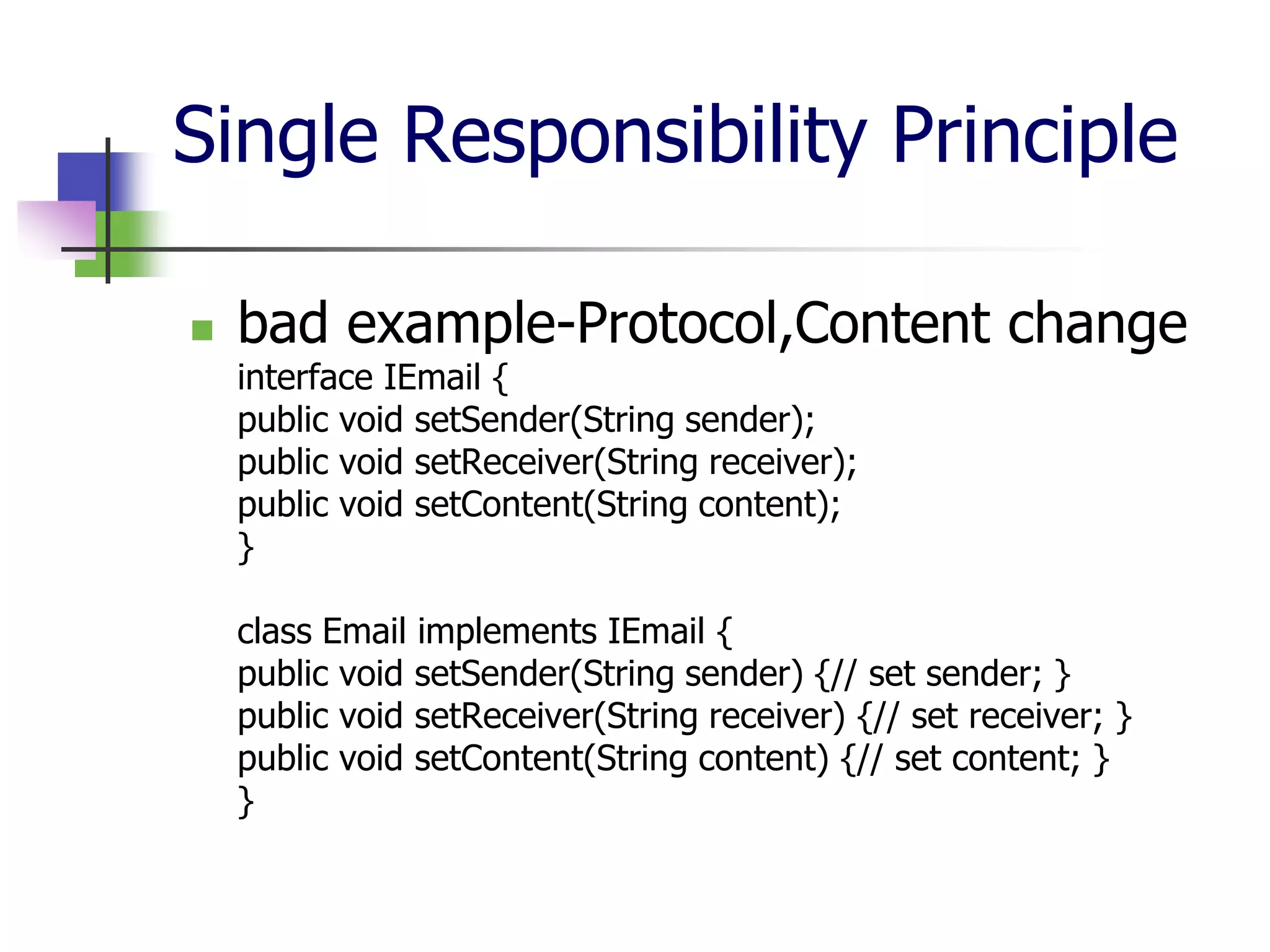
   bad example-Protocol,Content change
    interface IEmail {
    public void setSender(String sender);
    public void setReceiver(String receiver);
    public void setContent(String content);
    }

    class Email implements IEmail {
    public void setSender(String sender) {// set sender; }
    public void setReceiver(String receiver) {// set receiver; }
    public void setContent(String content) {// set content; }
    }
Single Responsibility Principle

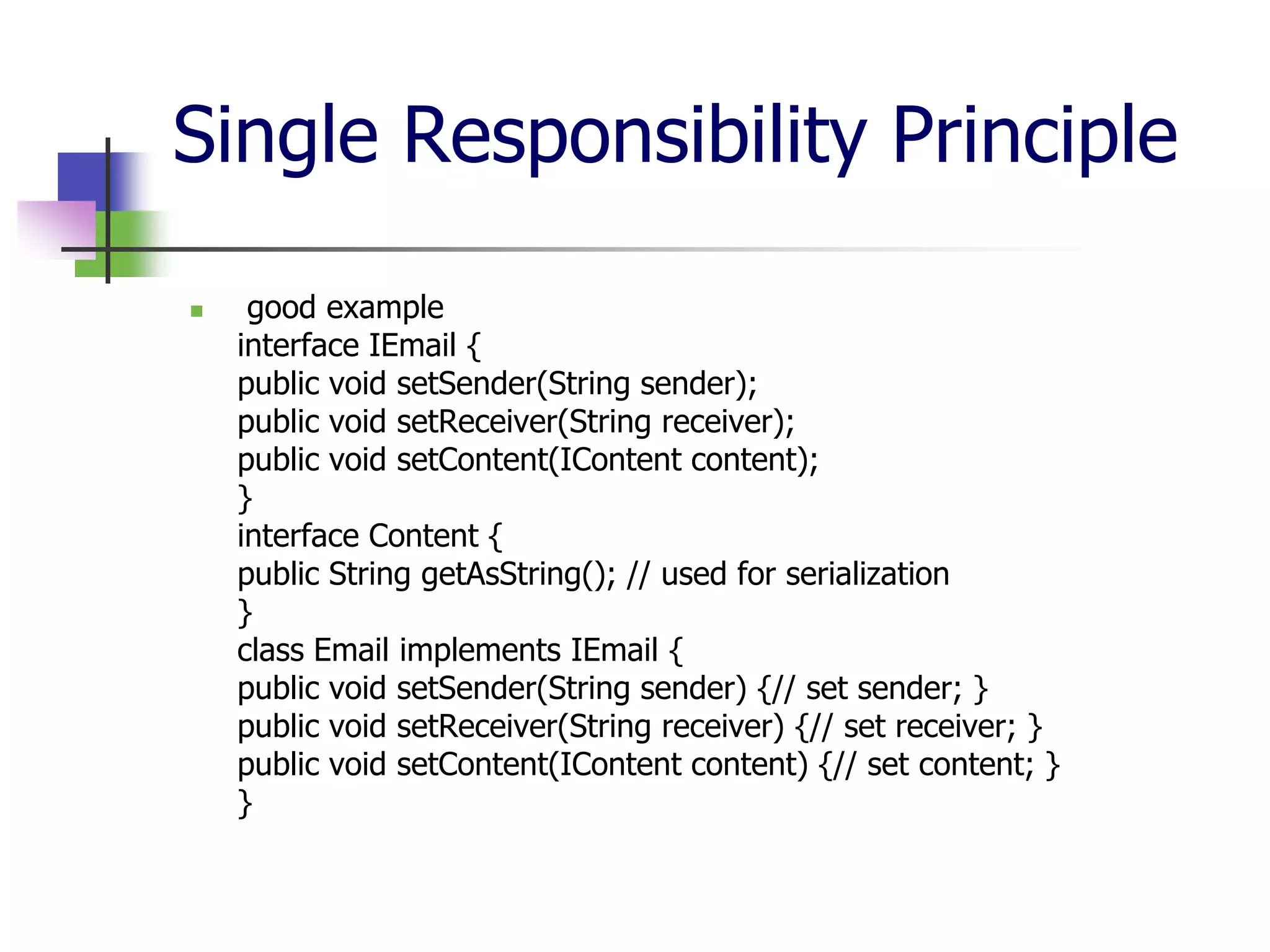
    good example
    interface IEmail {
    public void setSender(String sender);
    public void setReceiver(String receiver);
    public void setContent(IContent content);
    }
    interface Content {
    public String getAsString(); // used for serialization
    }
    class Email implements IEmail {
    public void setSender(String sender) {// set sender; }
    public void setReceiver(String receiver) {// set receiver; }
    public void setContent(IContent content) {// set content; }
    }
Single Responsibility Principle

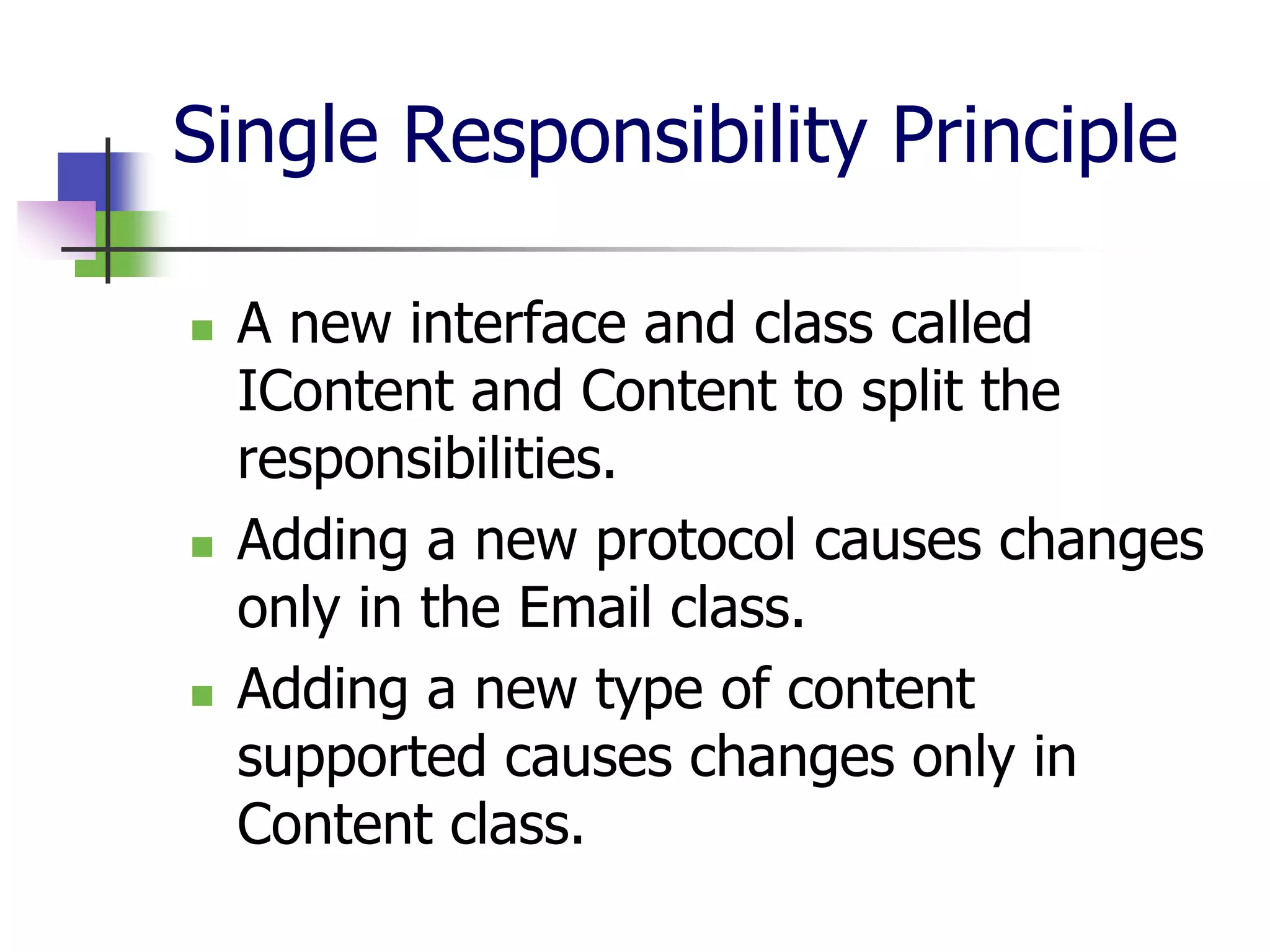
   A new interface and class called
    IContent and Content to split the
    responsibilities.
   Adding a new protocol causes changes
    only in the Email class.
   Adding a new type of content
    supported causes changes only in
    Content class.
Open Close Principle

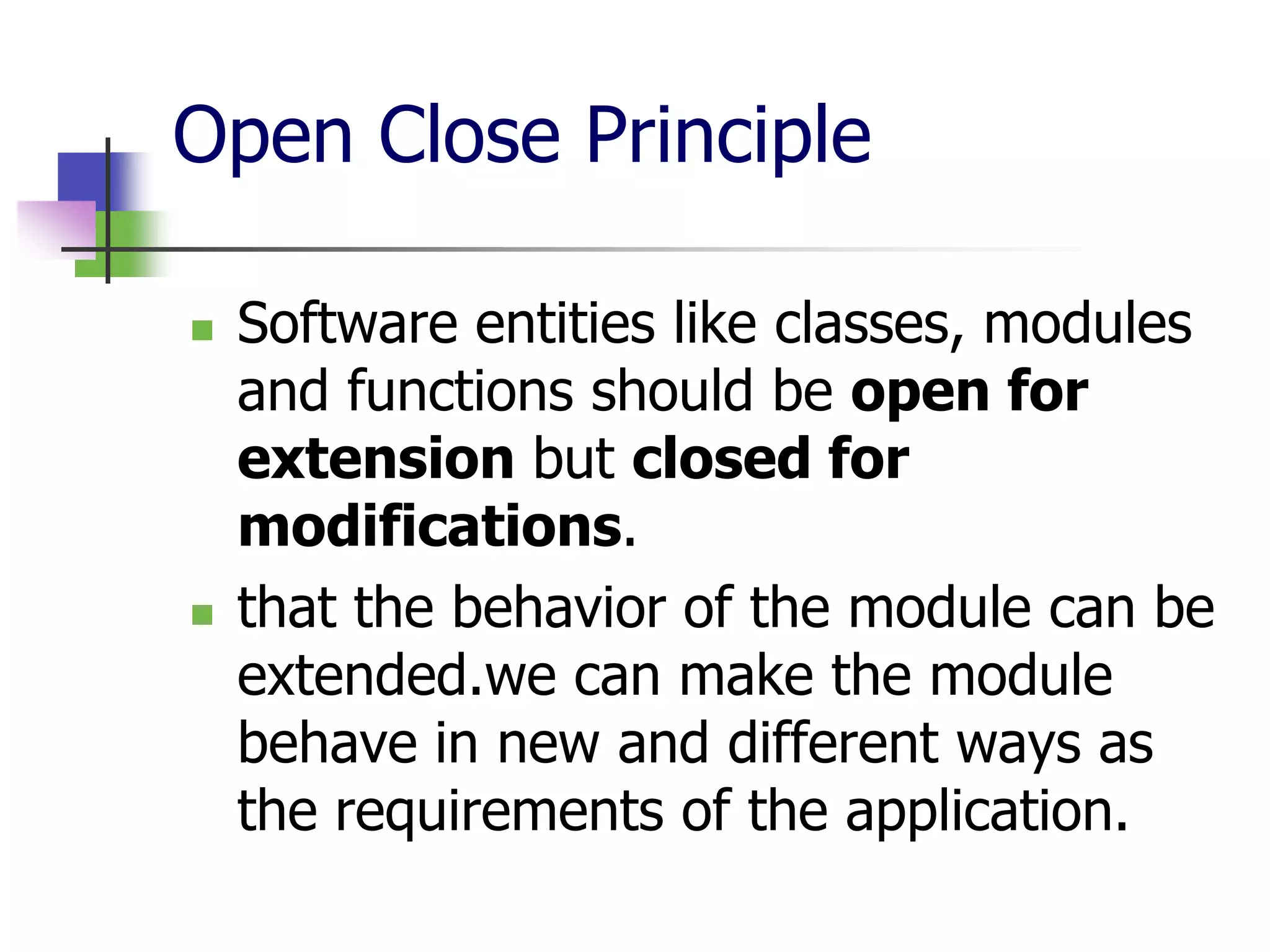
   Software entities like classes, modules
    and functions should be open for
    extension but closed for
    modifications.
   that the behavior of the module can be
    extended.we can make the module
    behave in new and different ways as
    the requirements of the application.
Open Close Principle

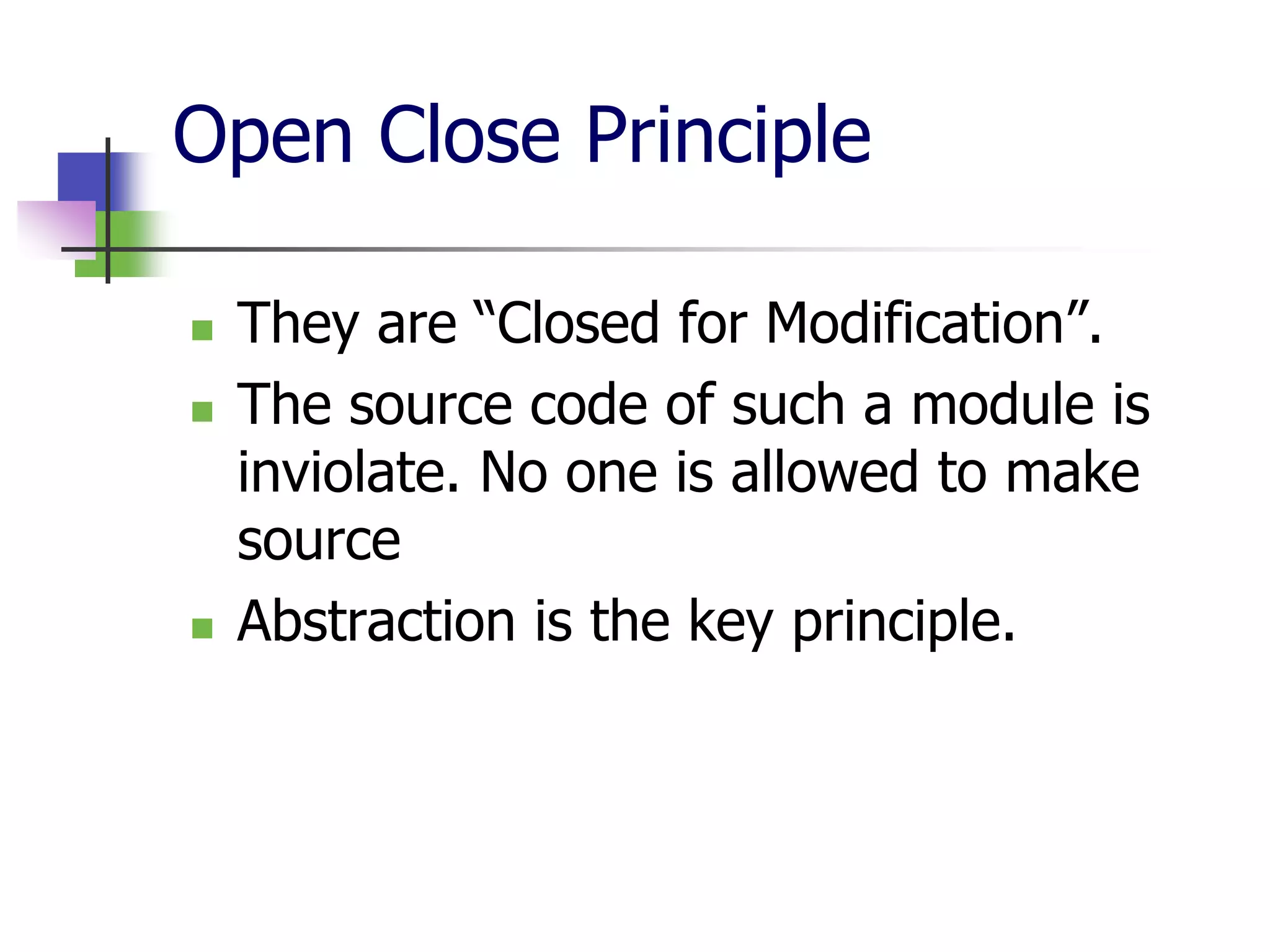
   They are “Closed for Modification”.
   The source code of such a module is
    inviolate. No one is allowed to make
    source
   Abstraction is the key principle.
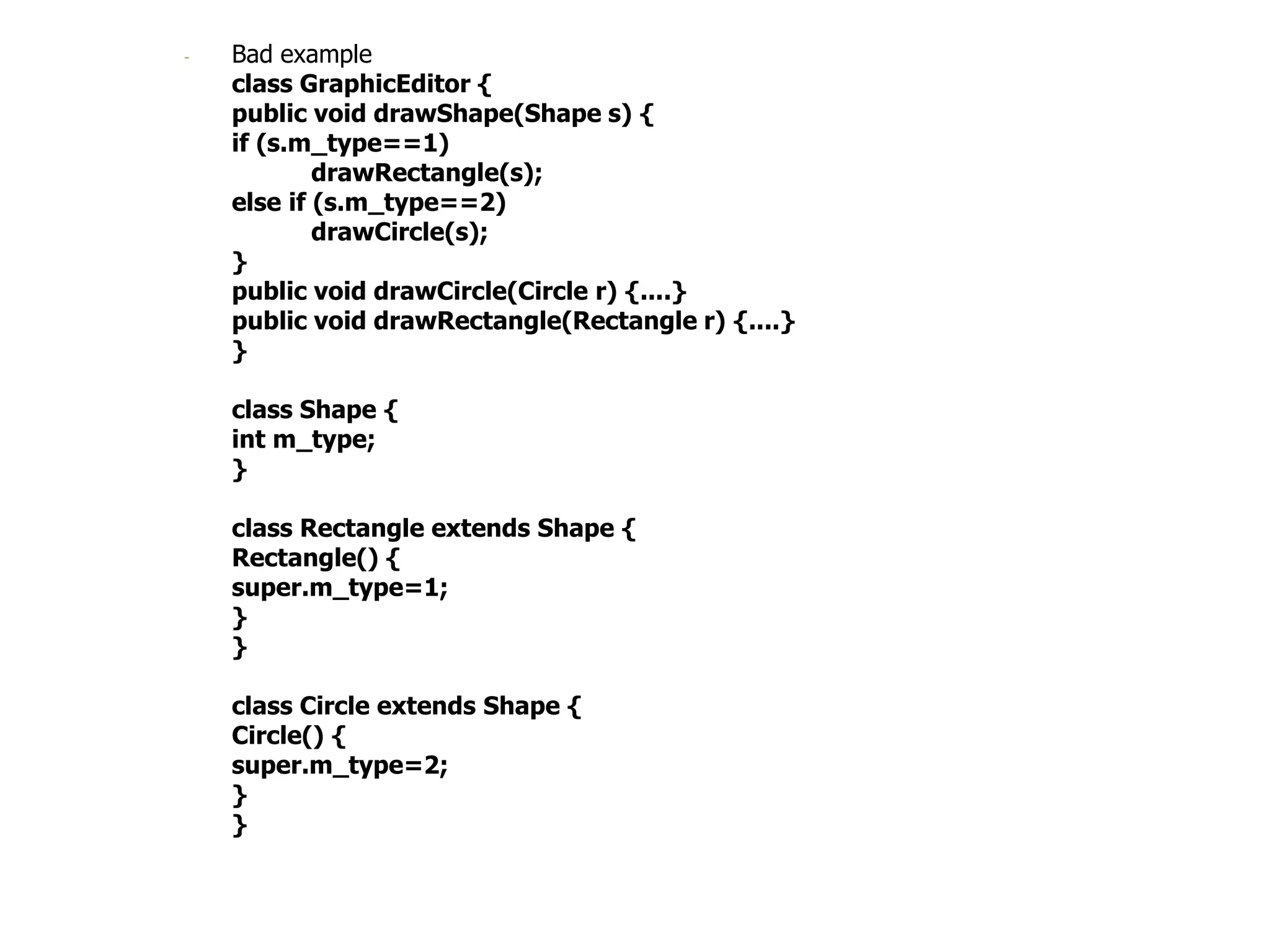
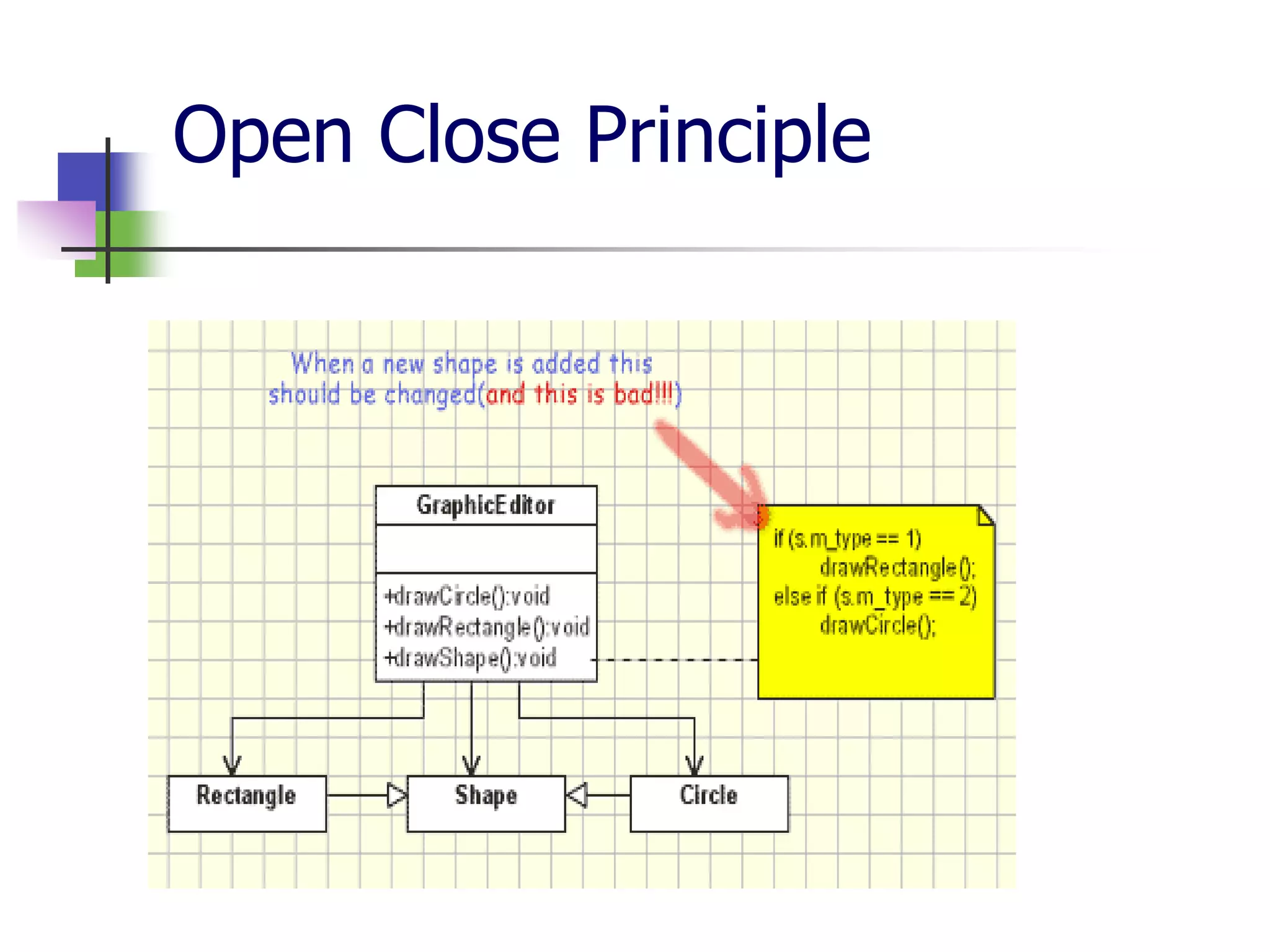
-   Bad example
    class GraphicEditor {
    public void drawShape(Shape s) {
    if (s.m_type==1)
            drawRectangle(s);
    else if (s.m_type==2)
            drawCircle(s);
    }
    public void drawCircle(Circle r) {....}
    public void drawRectangle(Rectangle r) {....}
    }

    class Shape {
    int m_type;
    }

    class Rectangle extends Shape {
    Rectangle() {
    super.m_type=1;
    }
    }

    class Circle extends Shape {
    Circle() {
    super.m_type=2;
    }
    }
Open Close Principle

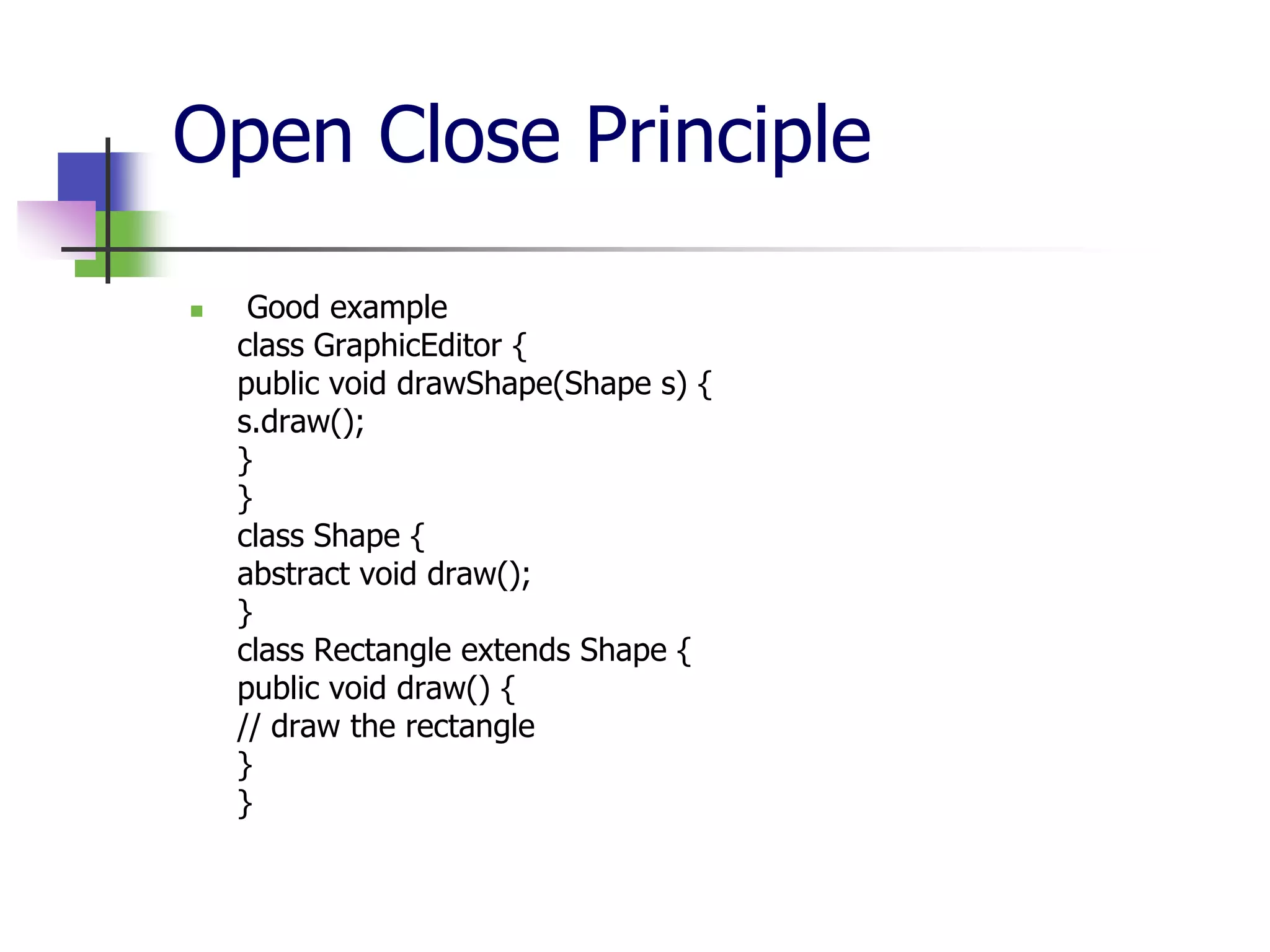
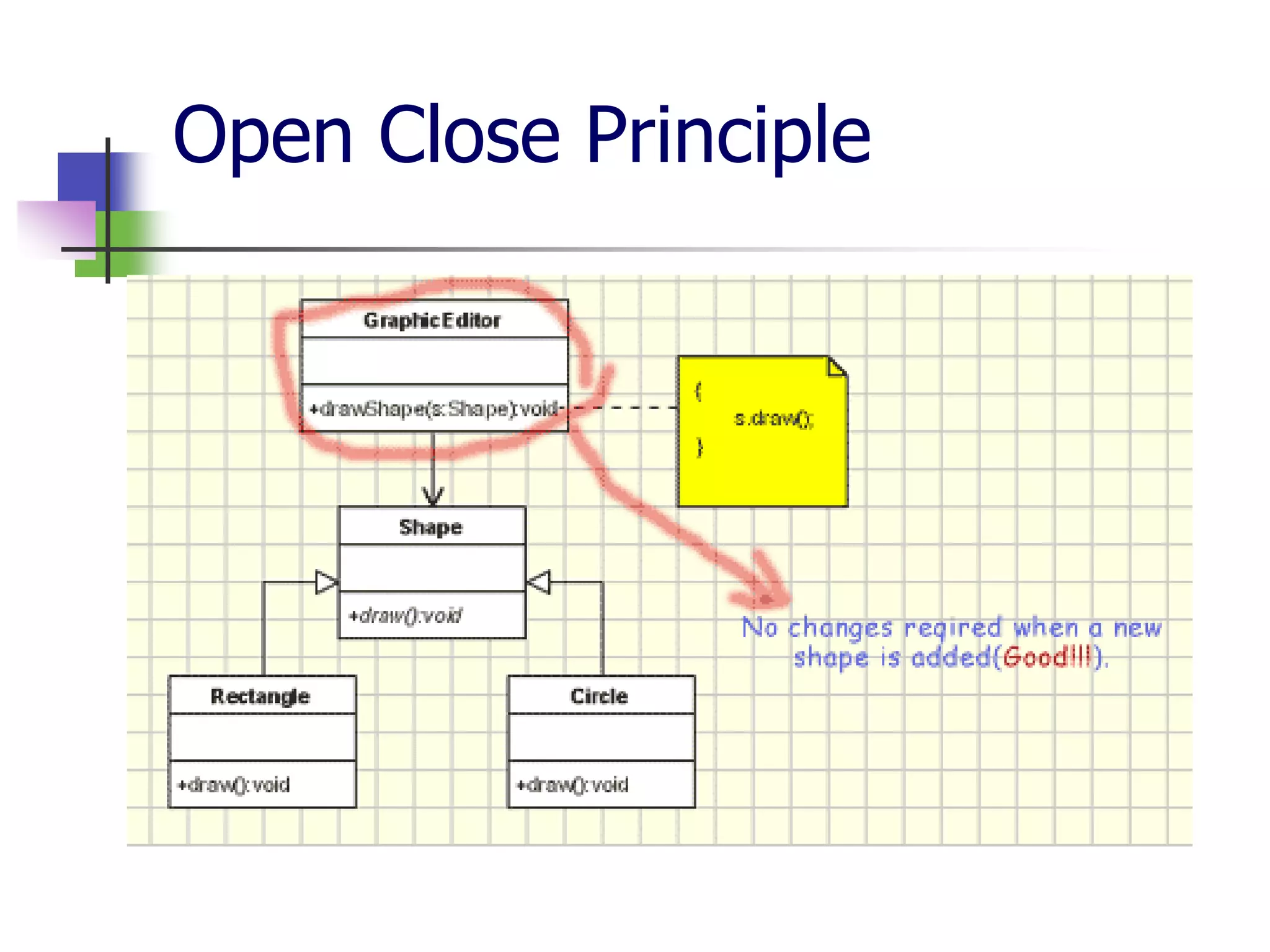
    Good example
    class GraphicEditor {
    public void drawShape(Shape s) {
    s.draw();
    }
    }
    class Shape {
    abstract void draw();
    }
    class Rectangle extends Shape {
    public void draw() {
    // draw the rectangle
    }
    }
Open Close Principle
Liskov's Substitution Principle

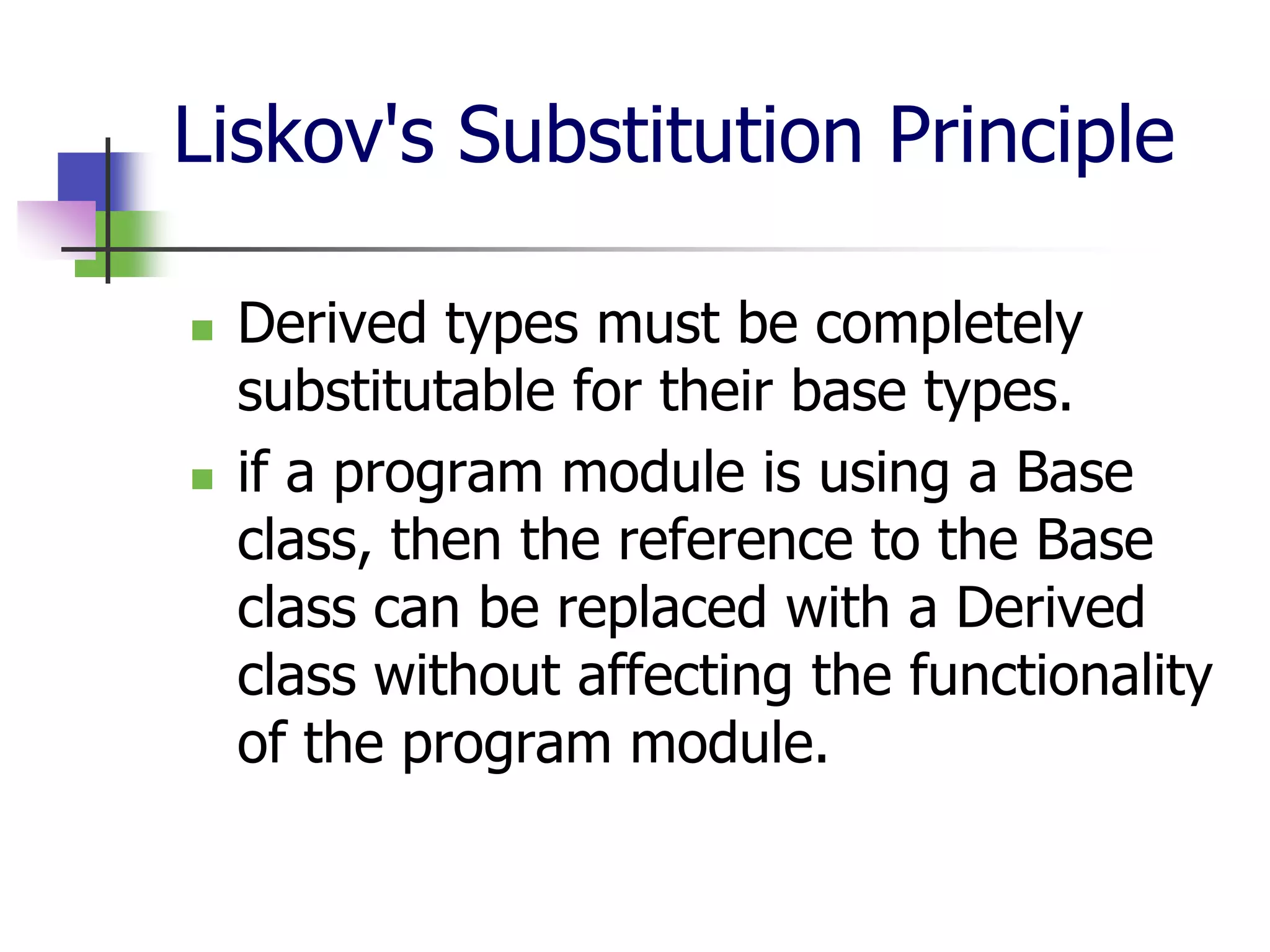
   Derived types must be completely
    substitutable for their base types.
   if a program module is using a Base
    class, then the reference to the Base
    class can be replaced with a Derived
    class without affecting the functionality
    of the program module.
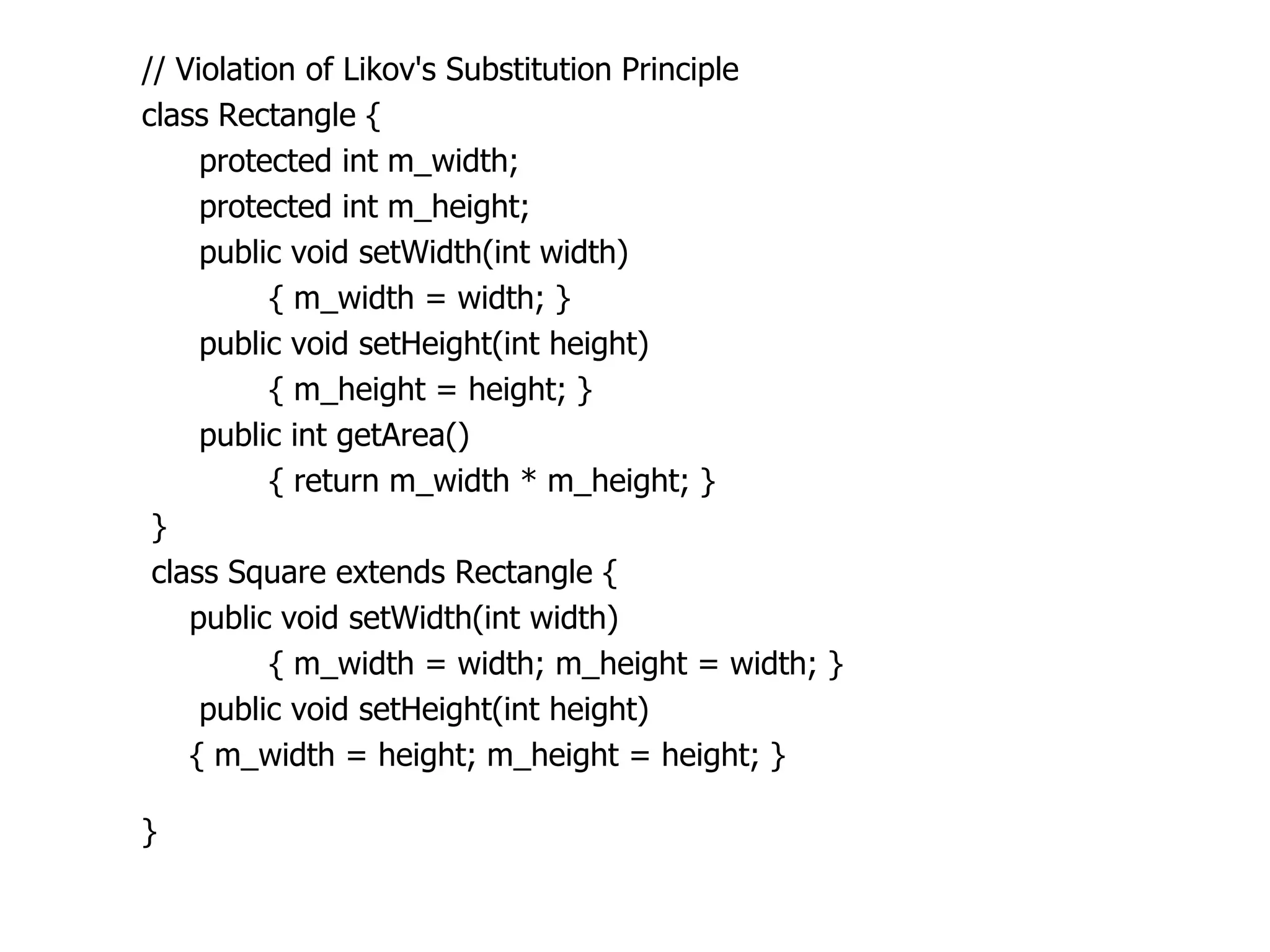
// Violation of Likov's Substitution Principle
class Rectangle {
     protected int m_width;
     protected int m_height;
     public void setWidth(int width)
          { m_width = width; }
     public void setHeight(int height)
          { m_height = height; }
     public int getArea()
          { return m_width * m_height; }
 }
 class Square extends Rectangle {
    public void setWidth(int width)
          { m_width = width; m_height = width; }
     public void setHeight(int height)
    { m_width = height; m_height = height; }

}
class LspTest {
    private static Rectangle getNewRectangle()
    {
          // it can be an object returned by some factory ...
          return new Square();
    }
    public static void main (String args[])
    {
          Rectangle r = LspTest.getNewRectangle();
          r.setWidth(5);
          r.setHeight(10);
          // user knows that r it's a rectangle.
          // It assumes that he's able to set the width and height as for the
    base class
          System.out.println(r.getArea());
          // now he's surprised to see that the area is 100 instead of 50.
    }
}
Liskov's Substitution Principle

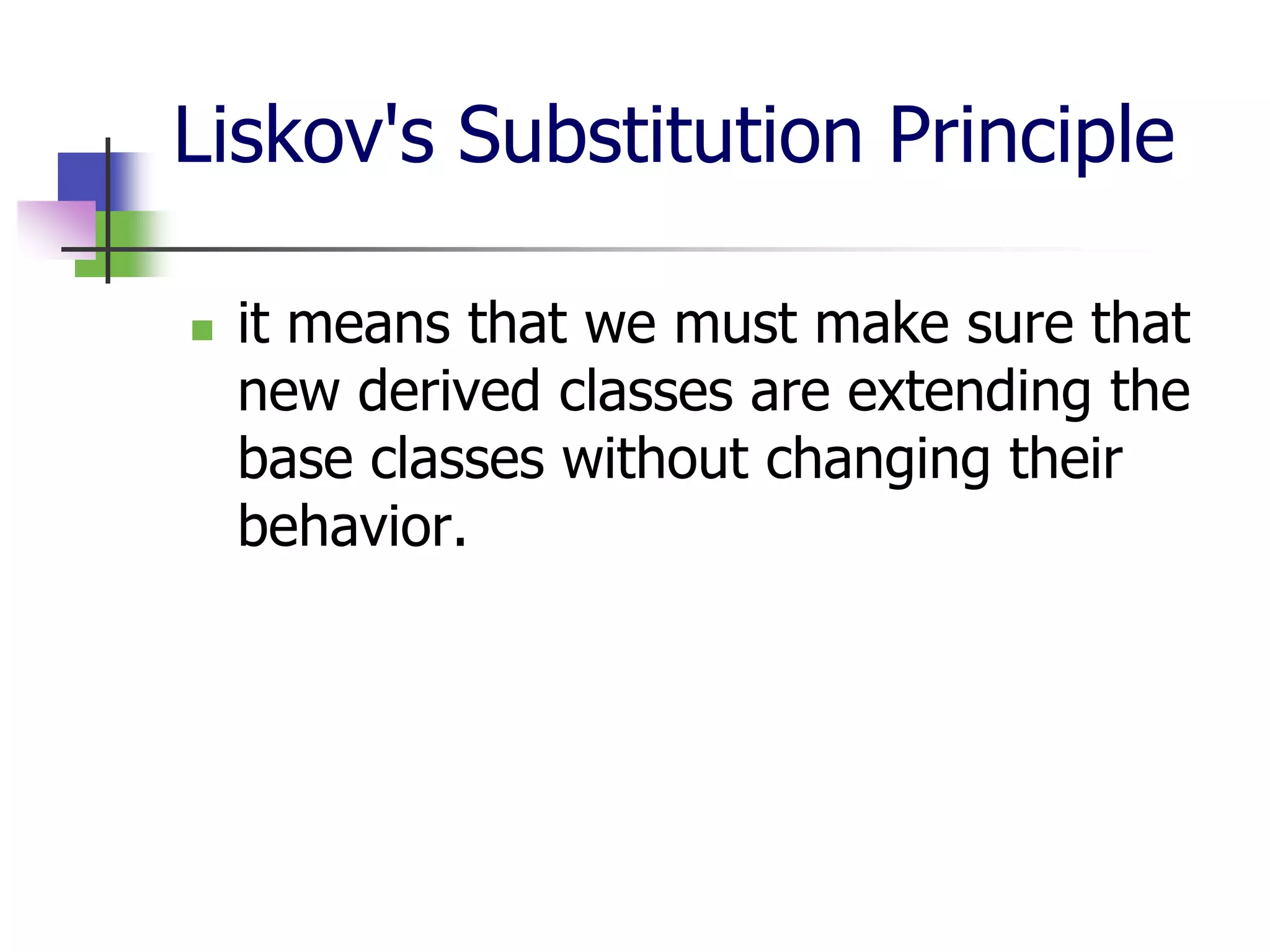
   it means that we must make sure that
    new derived classes are extending the
    base classes without changing their
    behavior.
Interface Segregation Principle

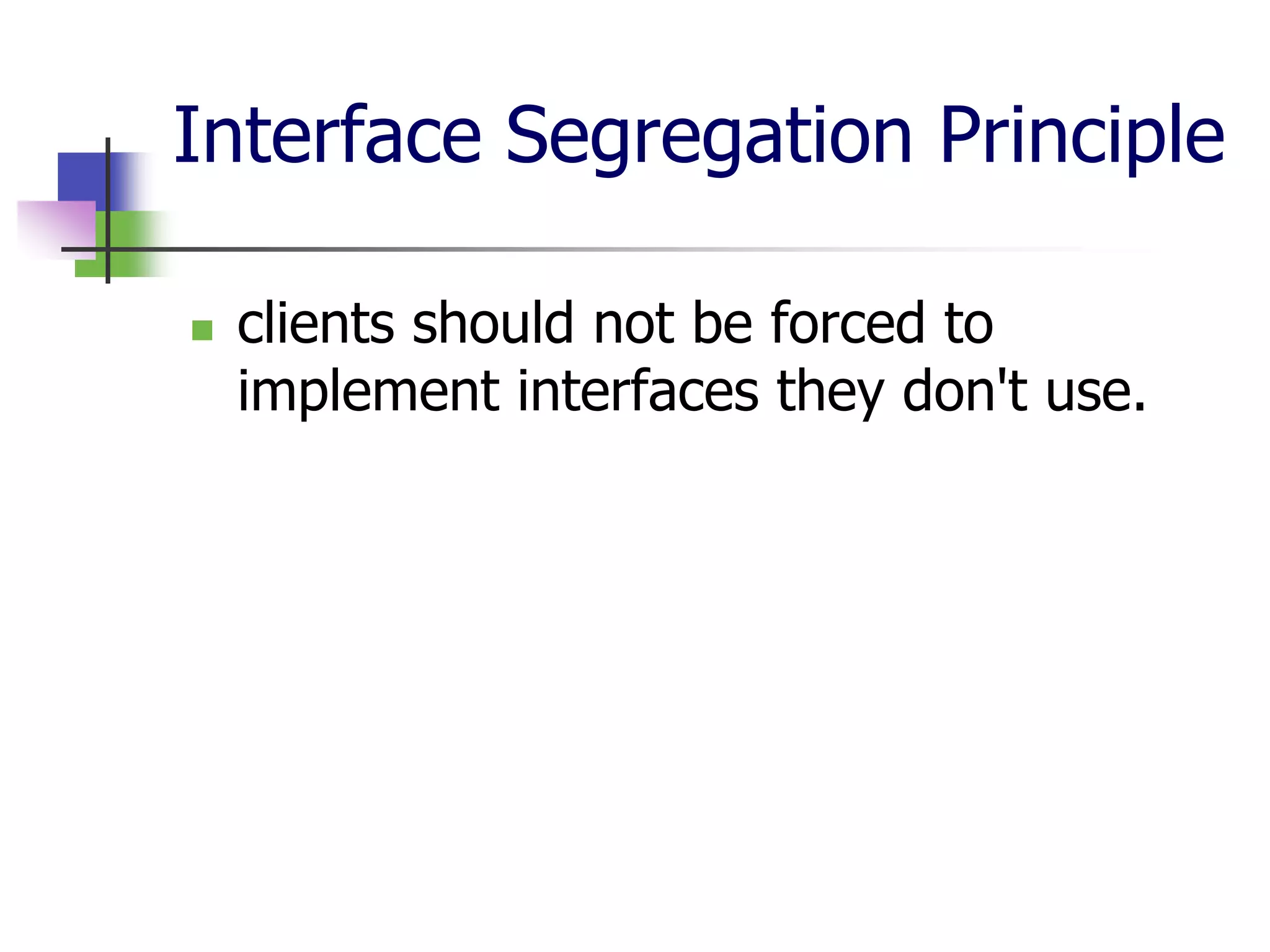
   clients should not be forced to
    implement interfaces they don't use.
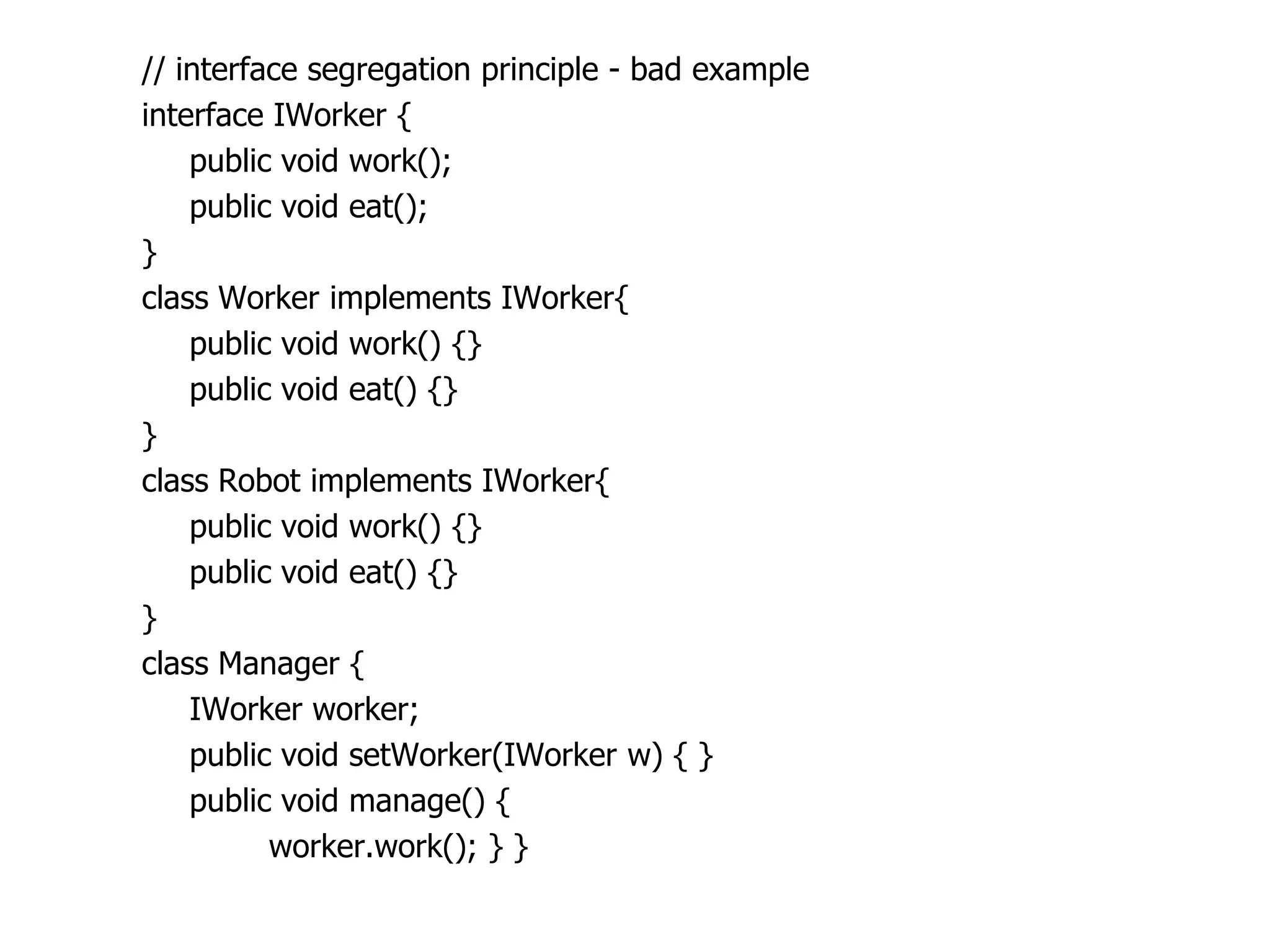
// interface segregation principle - bad example
interface IWorker {
    public void work();
    public void eat();
}
class Worker implements IWorker{
    public void work() {}
    public void eat() {}
}
class Robot implements IWorker{
    public void work() {}
    public void eat() {}
}
class Manager {
    IWorker worker;
    public void setWorker(IWorker w) { }
    public void manage() {
          worker.work(); } }
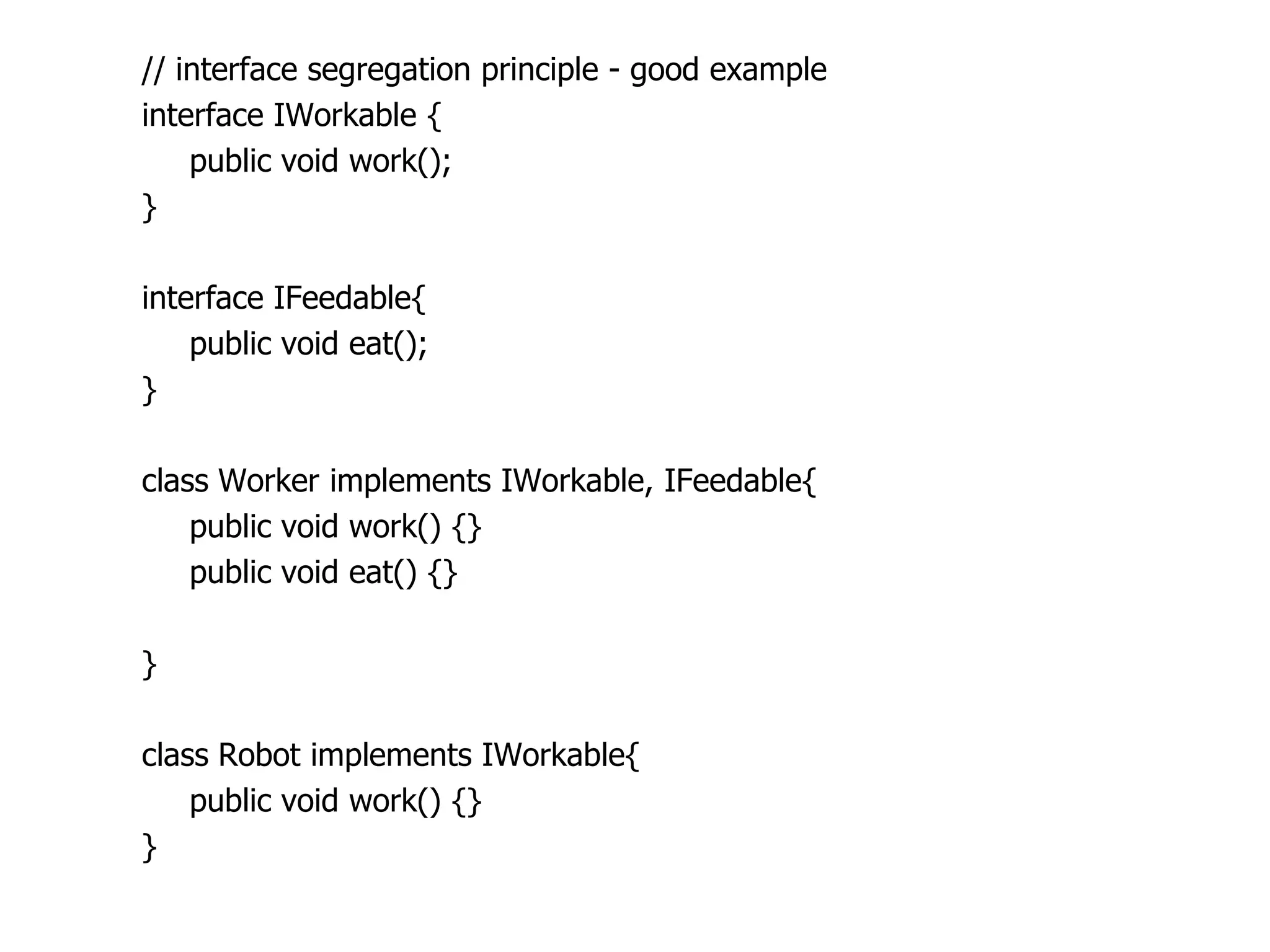
// interface segregation principle - good example
interface IWorkable {
    public void work();
}

interface IFeedable{
    public void eat();
}

class Worker implements IWorkable, IFeedable{
    public void work() {}
    public void eat() {}

}

class Robot implements IWorkable{
    public void work() {}
}
Dependency Inversion Principle

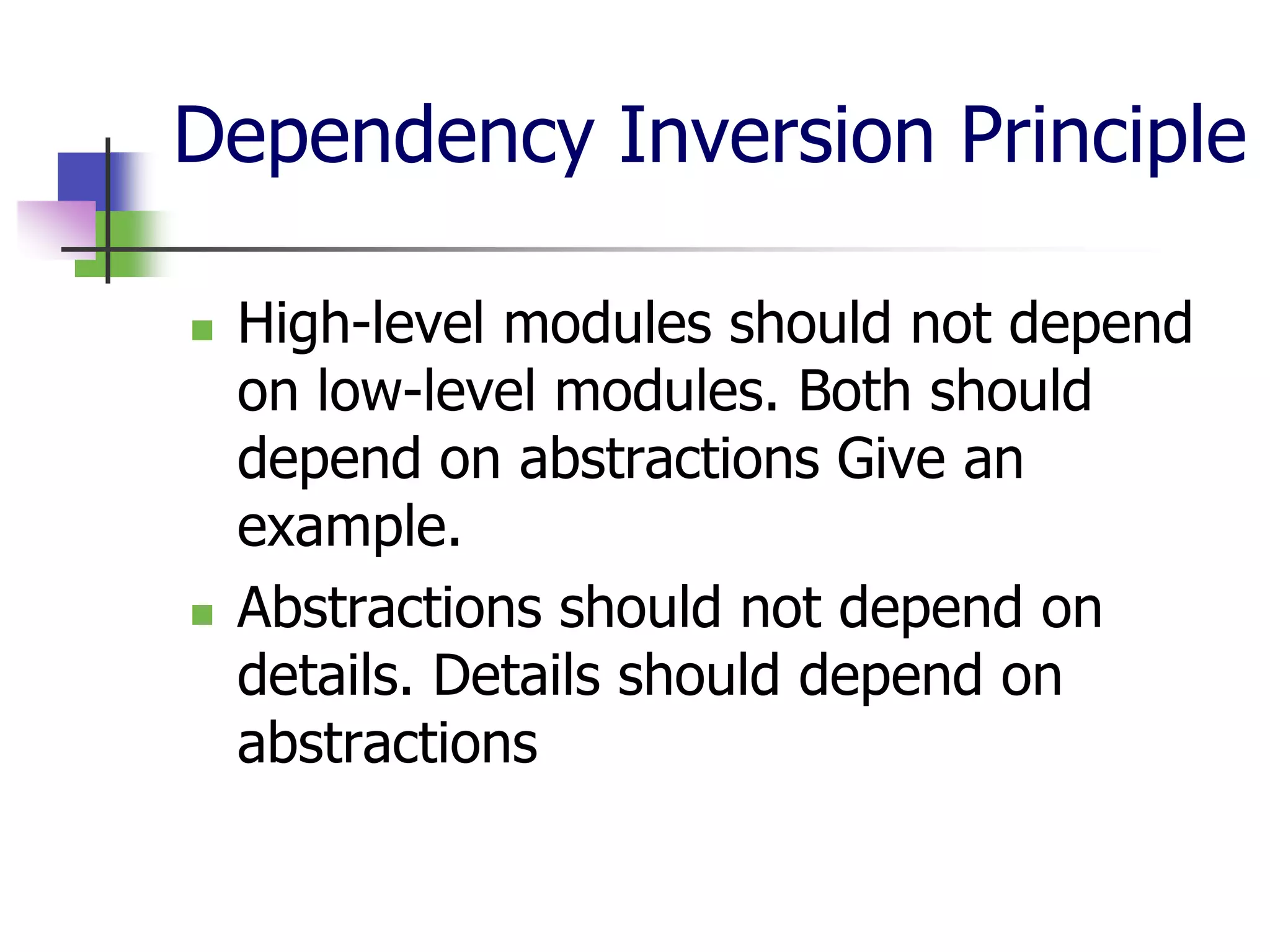
   High-level modules should not depend
    on low-level modules. Both should
    depend on abstractions Give an
    example.
   Abstractions should not depend on
    details. Details should depend on
    abstractions
Dependency Inversion Principle


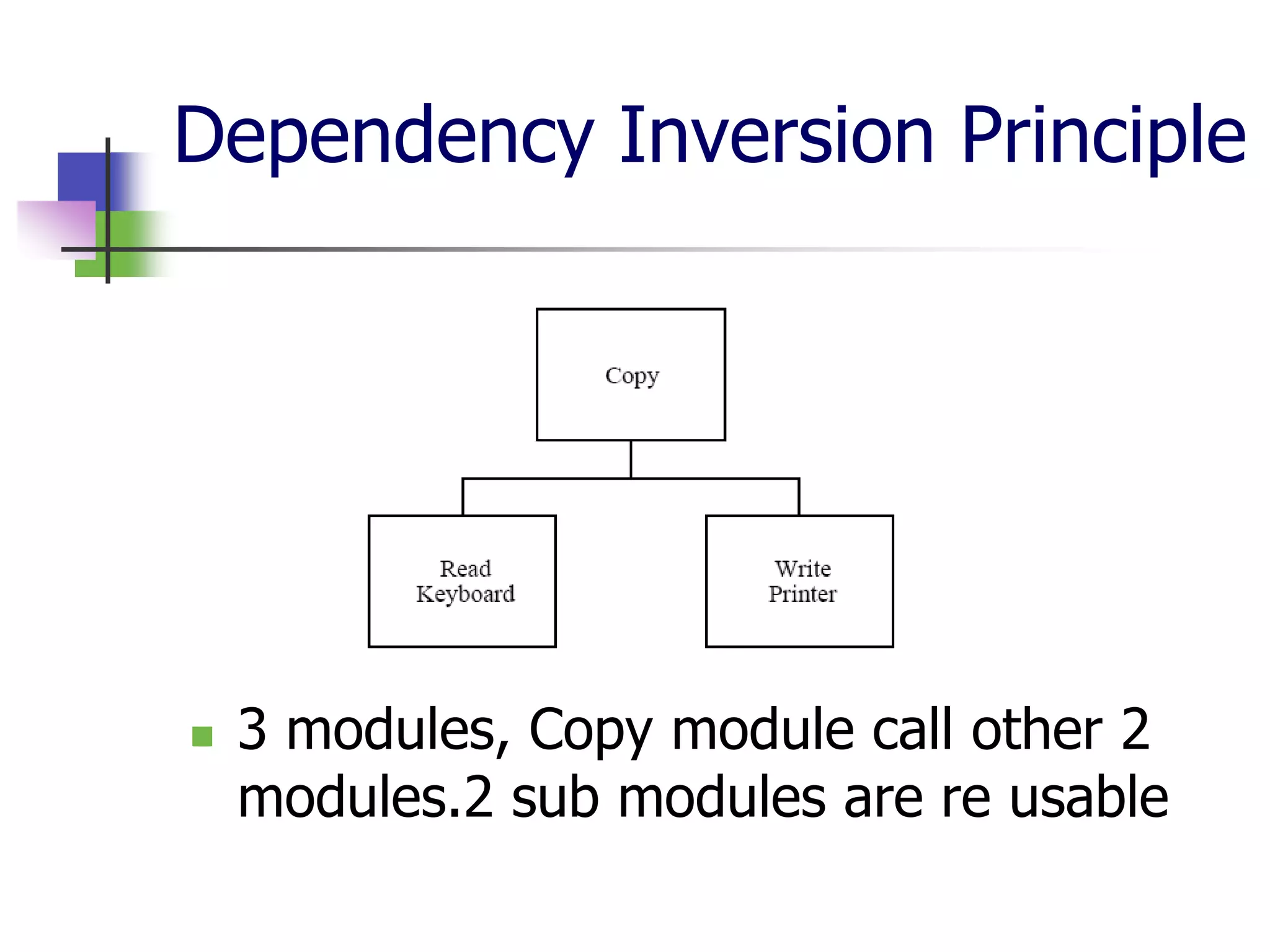
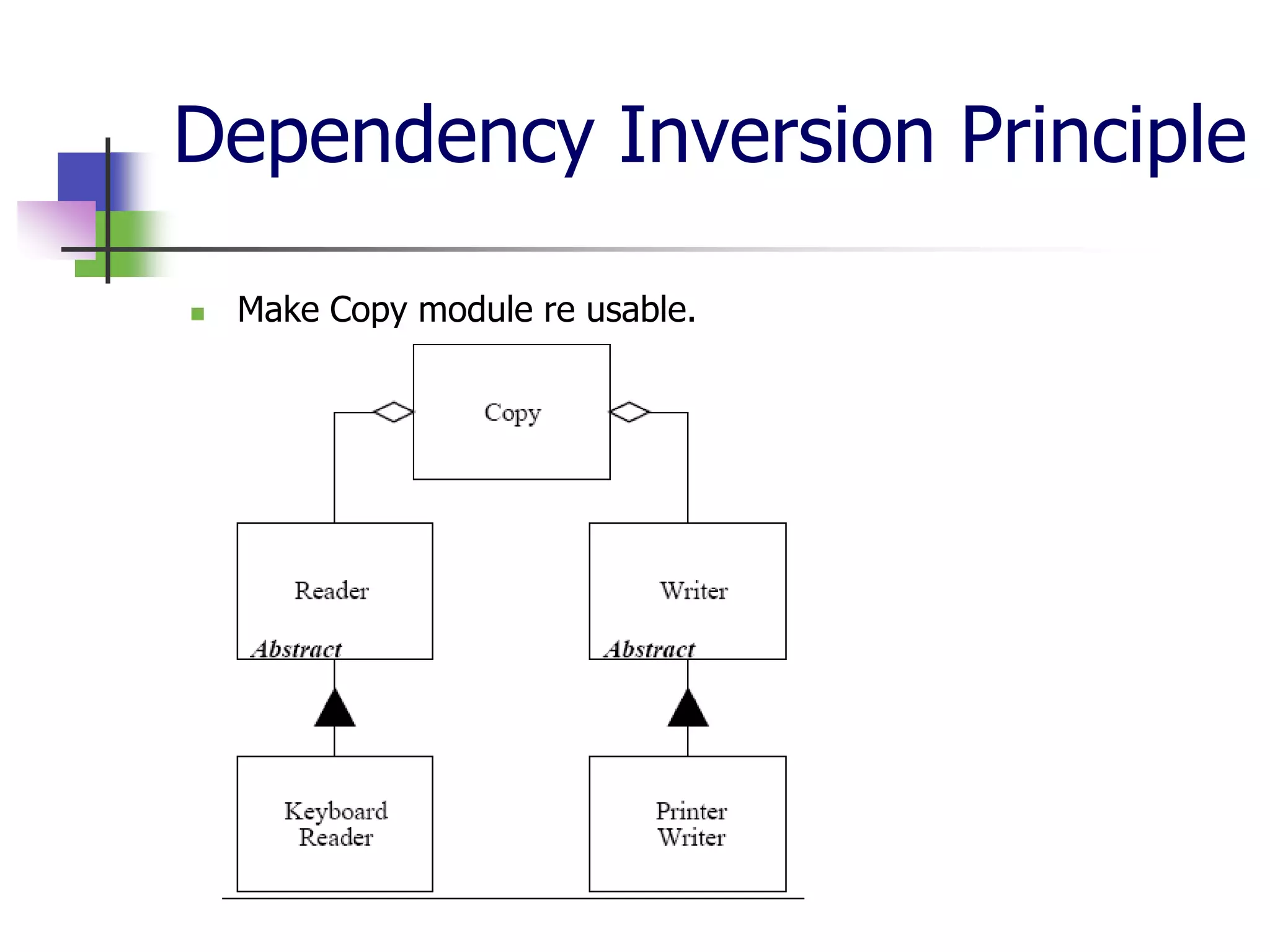
   3 modules, Copy module call other 2
    modules.2 sub modules are re usable
Dependency Inversion Principle

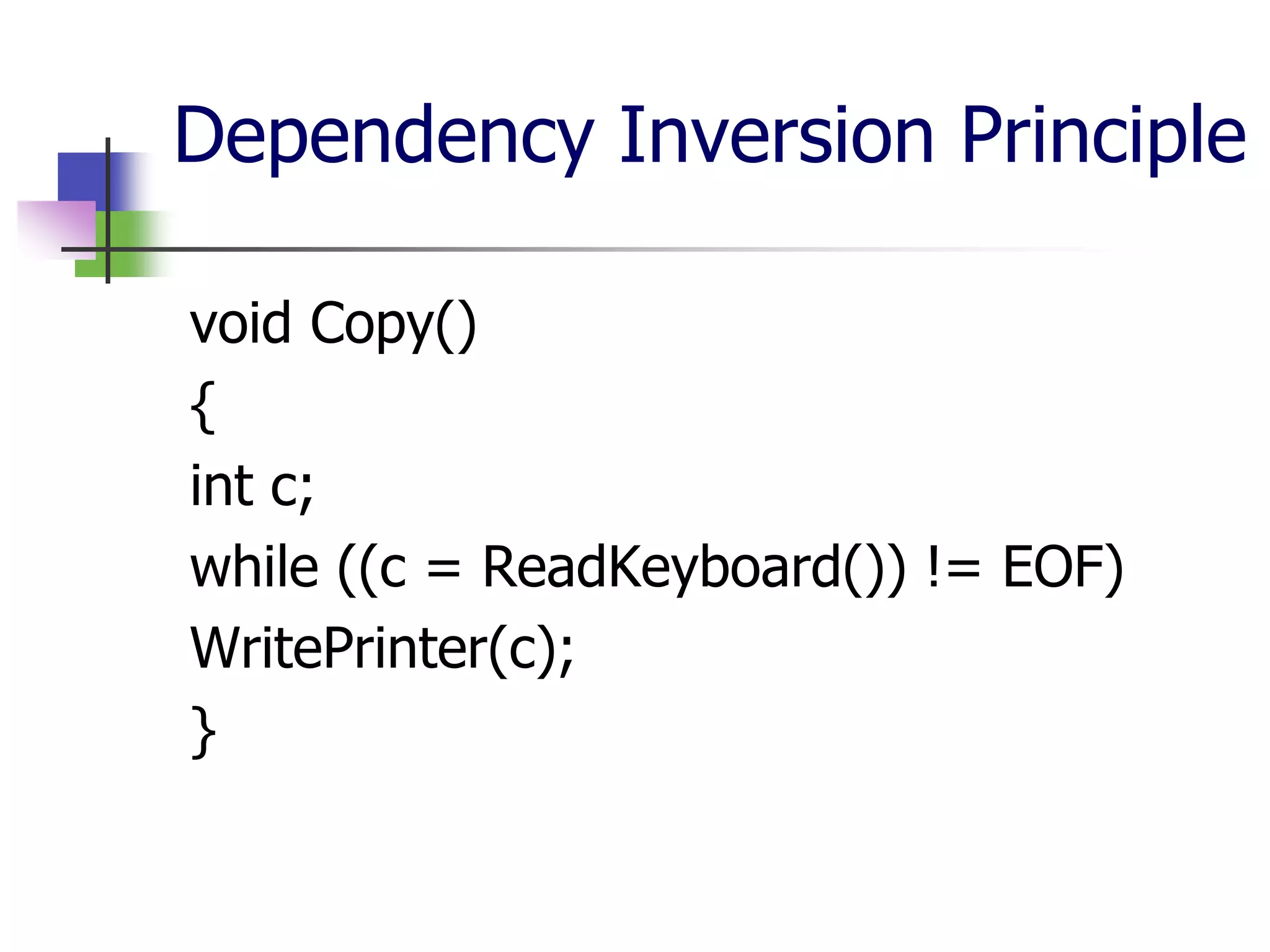
void Copy()
{
int c;
while ((c = ReadKeyboard()) != EOF)
WritePrinter(c);
}
Dependency Inversion Principle

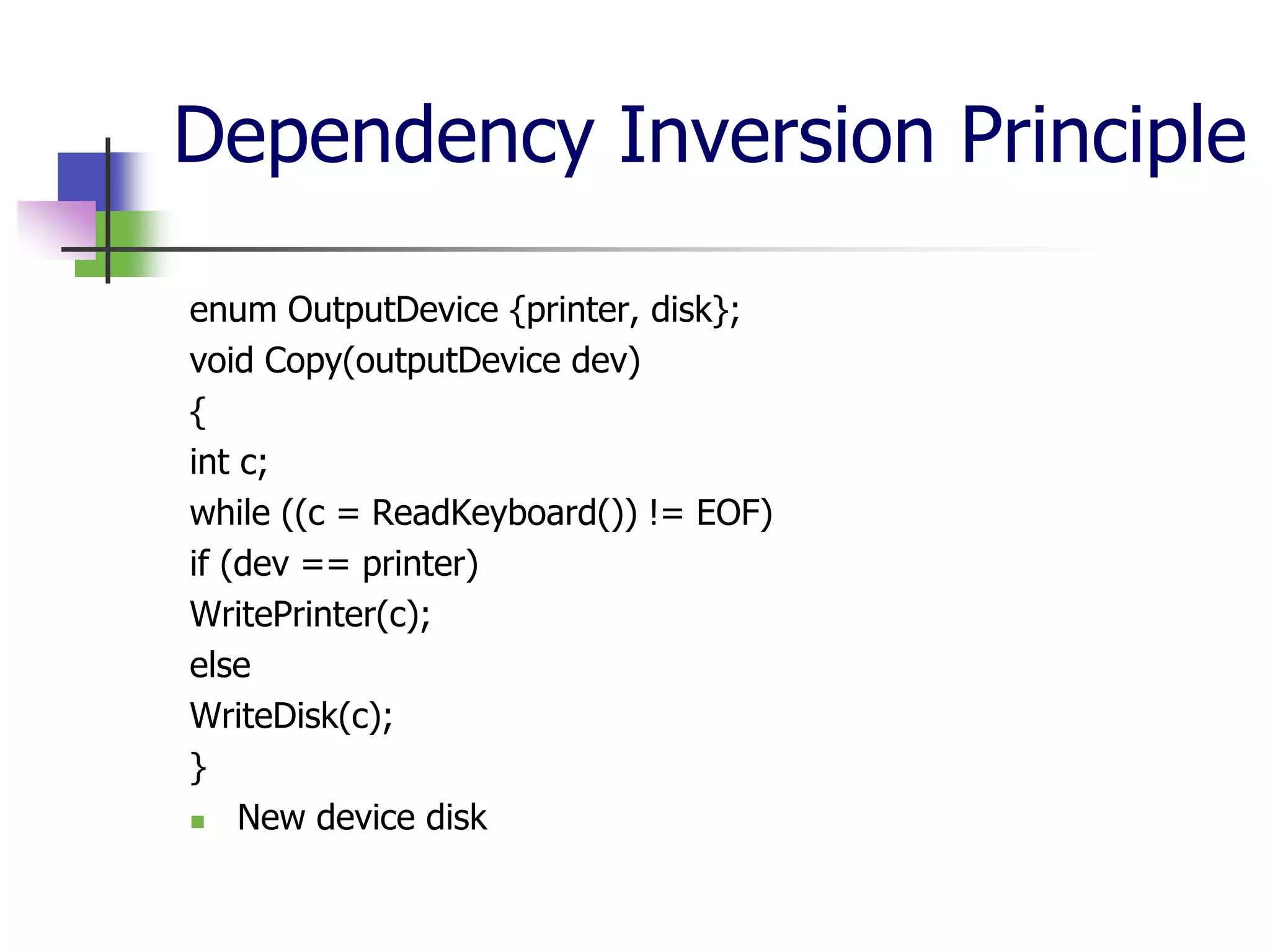
enum OutputDevice {printer, disk};
void Copy(outputDevice dev)
{
int c;
while ((c = ReadKeyboard()) != EOF)
if (dev == printer)
WritePrinter(c);
else
WriteDisk(c);
}
   New device disk
Dependency Inversion Principle

   Make Copy module re usable.
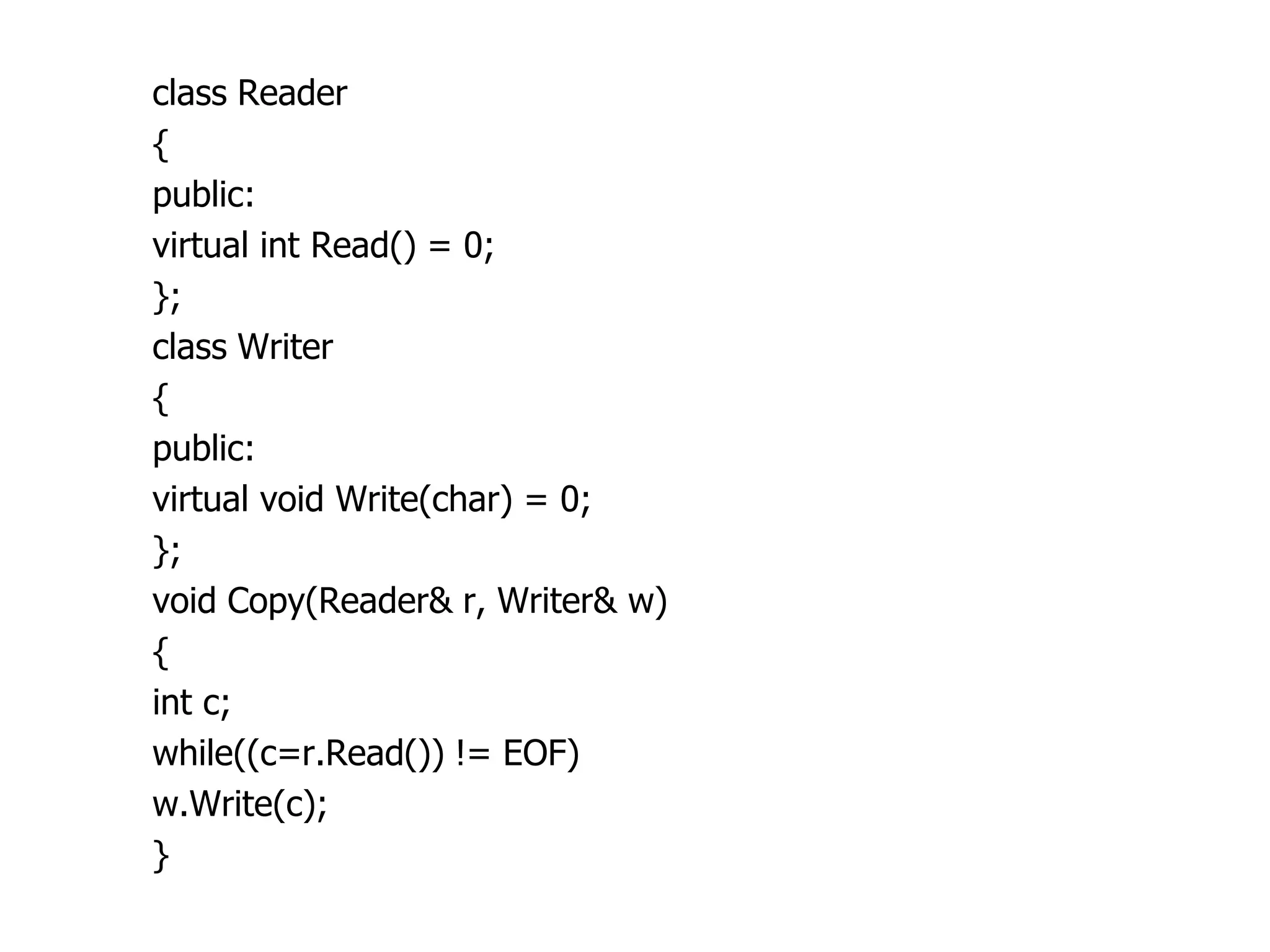
class Reader
{
public:
virtual int Read() = 0;
};
class Writer
{
public:
virtual void Write(char) = 0;
};
void Copy(Reader& r, Writer& w)
{
int c;
while((c=r.Read()) != EOF)
w.Write(c);
}
Summary
   SRP: One reason to change.
   OCP: Extend function with out editing
    code.
   LSP: Derived types can substitute
    base.
   ISP: Don’t implement Interface they
    don’t use
   DIP: Depend on abstraction instead of
    details.
C# oop’s

  Refreshing of what you know..
More information

   http://vivekcek.wordpress.com.

Object Oriented Principle’s

  • 1.
    Learning Session’s Object Oriented Life VIVEK.P.S
  • 2.
    Welcome and Introduction  The subject of the session.  The overall goals of the session.
  • 3.
    Overview  Overview of the OOP’S.  Why this is important for you.  Class design principles  C# and OOP’s
  • 4.
    Vocabulary  SRP: Single Responsibility Principle.  OCP: Open/Closed Principle.  LSP: Liskov Substitution Principle.  ISP: Interface Segregation Principle.  DIP: Dependency Inversion Principle.
  • 5.
  • 6.
    Single Responsibility Principle  A responsibility is considered to be one reason to change a class.  if we have 2 reasons to change for a class, we have to split the functionality in two classes.  A class should have only one reason to change.
  • 7.
    Single Responsibility Principle  bad example-Protocol,Content change interface IEmail { public void setSender(String sender); public void setReceiver(String receiver); public void setContent(String content); } class Email implements IEmail { public void setSender(String sender) {// set sender; } public void setReceiver(String receiver) {// set receiver; } public void setContent(String content) {// set content; } }
  • 8.
    Single Responsibility Principle  good example interface IEmail { public void setSender(String sender); public void setReceiver(String receiver); public void setContent(IContent content); } interface Content { public String getAsString(); // used for serialization } class Email implements IEmail { public void setSender(String sender) {// set sender; } public void setReceiver(String receiver) {// set receiver; } public void setContent(IContent content) {// set content; } }
  • 9.
    Single Responsibility Principle  A new interface and class called IContent and Content to split the responsibilities.  Adding a new protocol causes changes only in the Email class.  Adding a new type of content supported causes changes only in Content class.
  • 10.
  • 11.
    Open Close Principle  Software entities like classes, modules and functions should be open for extension but closed for modifications.  that the behavior of the module can be extended.we can make the module behave in new and different ways as the requirements of the application.
  • 12.
    Open Close Principle  They are “Closed for Modification”.  The source code of such a module is inviolate. No one is allowed to make source  Abstraction is the key principle.
  • 13.
    - Bad example class GraphicEditor { public void drawShape(Shape s) { if (s.m_type==1) drawRectangle(s); else if (s.m_type==2) drawCircle(s); } public void drawCircle(Circle r) {....} public void drawRectangle(Rectangle r) {....} } class Shape { int m_type; } class Rectangle extends Shape { Rectangle() { super.m_type=1; } } class Circle extends Shape { Circle() { super.m_type=2; } }
  • 14.
  • 15.
    Open Close Principle  Good example class GraphicEditor { public void drawShape(Shape s) { s.draw(); } } class Shape { abstract void draw(); } class Rectangle extends Shape { public void draw() { // draw the rectangle } }
  • 16.
  • 17.
  • 18.
    Liskov's Substitution Principle  Derived types must be completely substitutable for their base types.  if a program module is using a Base class, then the reference to the Base class can be replaced with a Derived class without affecting the functionality of the program module.
  • 19.
    // Violation ofLikov's Substitution Principle class Rectangle { protected int m_width; protected int m_height; public void setWidth(int width) { m_width = width; } public void setHeight(int height) { m_height = height; } public int getArea() { return m_width * m_height; } } class Square extends Rectangle { public void setWidth(int width) { m_width = width; m_height = width; } public void setHeight(int height) { m_width = height; m_height = height; } }
  • 20.
    class LspTest { private static Rectangle getNewRectangle() { // it can be an object returned by some factory ... return new Square(); } public static void main (String args[]) { Rectangle r = LspTest.getNewRectangle(); r.setWidth(5); r.setHeight(10); // user knows that r it's a rectangle. // It assumes that he's able to set the width and height as for the base class System.out.println(r.getArea()); // now he's surprised to see that the area is 100 instead of 50. } }
  • 21.
    Liskov's Substitution Principle  it means that we must make sure that new derived classes are extending the base classes without changing their behavior.
  • 22.
  • 23.
    Interface Segregation Principle  clients should not be forced to implement interfaces they don't use.
  • 24.
    // interface segregationprinciple - bad example interface IWorker { public void work(); public void eat(); } class Worker implements IWorker{ public void work() {} public void eat() {} } class Robot implements IWorker{ public void work() {} public void eat() {} } class Manager { IWorker worker; public void setWorker(IWorker w) { } public void manage() { worker.work(); } }
  • 25.
    // interface segregationprinciple - good example interface IWorkable { public void work(); } interface IFeedable{ public void eat(); } class Worker implements IWorkable, IFeedable{ public void work() {} public void eat() {} } class Robot implements IWorkable{ public void work() {} }
  • 26.
  • 27.
    Dependency Inversion Principle  High-level modules should not depend on low-level modules. Both should depend on abstractions Give an example.  Abstractions should not depend on details. Details should depend on abstractions
  • 28.
    Dependency Inversion Principle  3 modules, Copy module call other 2 modules.2 sub modules are re usable
  • 29.
    Dependency Inversion Principle voidCopy() { int c; while ((c = ReadKeyboard()) != EOF) WritePrinter(c); }
  • 30.
    Dependency Inversion Principle enumOutputDevice {printer, disk}; void Copy(outputDevice dev) { int c; while ((c = ReadKeyboard()) != EOF) if (dev == printer) WritePrinter(c); else WriteDisk(c); }  New device disk
  • 31.
    Dependency Inversion Principle  Make Copy module re usable.
  • 32.
    class Reader { public: virtual intRead() = 0; }; class Writer { public: virtual void Write(char) = 0; }; void Copy(Reader& r, Writer& w) { int c; while((c=r.Read()) != EOF) w.Write(c); }
  • 33.
    Summary  SRP: One reason to change.  OCP: Extend function with out editing code.  LSP: Derived types can substitute base.  ISP: Don’t implement Interface they don’t use  DIP: Depend on abstraction instead of details.
  • 34.
    C# oop’s Refreshing of what you know..
  • 35.
    More information  http://vivekcek.wordpress.com.