CODE CRAFTSMANSHIP CHECKLIST
      Ryan Polk
The List
   Intended as a checklist for   The items presented are intended to
                                  give a selection of ideas for
    further research.             consideration in any Code Quality
                                  training agenda.
   Not a comprehensive list.
                                  It is understood that one training
   If your not thinking about    would not be capable of covering
    these subjects your not       all subjects listed. The decision that
                                  needs to be made by any
    moving your development       organization is what topics are of
                                  most value to the teams.
    career forward.
   What Else / How can we
    do it better?
Code Craftsmanship Topics
3


       TDD / Automated Unit Tests         SOA (Service Oriented
       Continuous Delivery                 Architecture)
       Refactoring                        Paired Programming
       Design Patterns                    UML / Object Modeling
       Emergent Design
       SOLID Principles
       Misc. Code Craftsmanship
          Error Handling
          Code Smells and Heuristics
          Etc…
Continuous Delivery
4


       Principles and technical practices that enable rapid, incremental
        delivery of high quality, valuable new functionality to users.

       Taking the next step beyond Continuous Integration is essential in
        all development originations that produce highly integrated and
        complex systems.

       Through automation of the build, deployment, and testing process,
        and improved collaboration between developers, testers, and
        operations, delivery teams can get changes released in a matter
        of hours sometimes even minutes no matter what the size of a
        project or the complexity of its code base.
Refactoring
5

       Code refactoring is the process of changing a computer program's source code without
        modifying its external functional behavior in order to improve some of the nonfunctional
        attributes of the software.
       Advantages include improved code readability and reduced complexity to improve the
        maintainability of the source code.
       Techniques that allow for more abstraction
         -   Encapsulate Field – force code to access the field with getter and setter methods
         -   Generalize Type – create more general types to allow for more code sharing
         -   Replace type-checking code with State/Strategy
         -   Replace conditional with polymorphism
       Techniques for breaking code apart into more logical pieces
         - Extract Method, to turn part of a larger method into a new method. By breaking down code in smaller
           pieces, it is more easily understandable. This is also applicable to functions.
         - Extract Class moves part of the code from an existing class into a new class.
       Techniques for improving names and location of code
         -   Move Method or Move Field – move to a more appropriate Class or source file
         -   Rename Method or Rename Field – changing the name into a new one that better reveals its purpose
         -   Pull Up – in OOP, move to a superclass
         -   Push Down – in OOP, move to a subclass
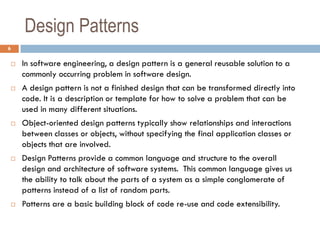
Design Patterns
6

       In software engineering, a design pattern is a general reusable solution to a
        commonly occurring problem in software design.
       A design pattern is not a finished design that can be transformed directly into
        code. It is a description or template for how to solve a problem that can be
        used in many different situations.
       Object-oriented design patterns typically show relationships and interactions
        between classes or objects, without specifying the final application classes or
        objects that are involved.
       Design Patterns provide a common language and structure to the overall
        design and architecture of software systems. This common language gives us
        the ability to talk about the parts of a system as a simple conglomerate of
        patterns instead of a list of random parts.
       Patterns are a basic building block of code re-use and code extensibility.
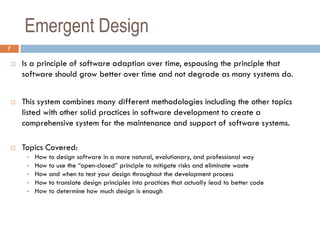
Emergent Design
7

       Is a principle of software adaption over time, espousing the principle that
        software should grow better over time and not degrade as many systems do.


       This system combines many different methodologies including the other topics
        listed with other solid practices in software development to create a
        comprehensive system for the maintenance and support of software systems.

       Topics Covered:
         -   How to design software in a more natural, evolutionary, and professional way
         -   How to use the “open-closed” principle to mitigate risks and eliminate waste
         -   How and when to test your design throughout the development process
         -   How to translate design principles into practices that actually lead to better code
         -   How to determine how much design is enough
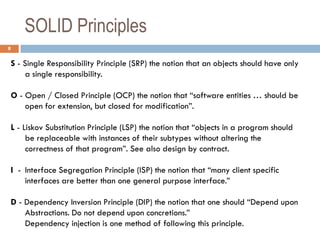
SOLID Principles
8

    S - Single Responsibility Principle (SRP) the notion that an objects should have only
         a single responsibility.

    O - Open / Closed Principle (OCP) the notion that “software entities … should be
        open for extension, but closed for modification”.

    L - Liskov Substitution Principle (LSP) the notion that “objects in a program should
         be replaceable with instances of their subtypes without altering the
         correctness of that program”. See also design by contract.

    I - Interface Segregation Principle (ISP) the notion that “many client specific
        interfaces are better than one general purpose interface.”

    D - Dependency Inversion Principle (DIP) the notion that one should “Depend upon
        Abstractions. Do not depend upon concretions.”
        Dependency injection is one method of following this principle.
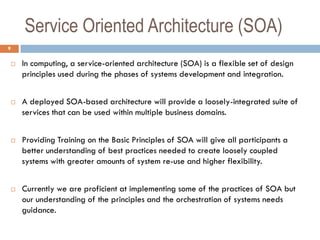
Service Oriented Architecture (SOA)
9

       In computing, a service-oriented architecture (SOA) is a flexible set of design
        principles used during the phases of systems development and integration.


       A deployed SOA-based architecture will provide a loosely-integrated suite of
        services that can be used within multiple business domains.


       Providing Training on the Basic Principles of SOA will give all participants a
        better understanding of best practices needed to create loosely coupled
        systems with greater amounts of system re-use and higher flexibility.


       Currently we are proficient at implementing some of the practices of SOA but
        our understanding of the principles and the orchestration of systems needs
        guidance.
Paired Programming
10

 Pair programming is an agile software development technique in which two
 programmers work together at one work station. One types in code while the
 other reviews each line of code as it is typed in. The person typing is called the
 driver. The person reviewing the code is called the observer (or navigator). The
 two programmers switch roles frequently.
    Some studies have found that programmers working in pairs produce shorter programs,
     with better designs and fewer bugs, than programmers working alone.
    Studies have found reduction in defect rates of 15% to 50%, varying depending on
     programmer experience and task complexity.

 Topics to Discuss & Variants:
    Paired Programming Mechanics
    Remote pair programming
    Ping pong pair programming
    The fusing of pair and solo programming
UML / Object Modeling
11

    Unified Modeling Language (UML) is a standardized general-purpose
     modeling language in the field of software engineering.


    UML includes a set of graphical notation techniques to create visual models of
     software-intensive systems.


    Like Design Patters UML provides developers with a standard form of
     communication that allows everyone to understand architectural patterns and
     how systems work.


    By providing training on this subject we provide the structure for visual
     comprehension of systems.
Miscellaneous Code Craftsmanship
12

 A general section of miscellaneous code craftsmanship tutorials with distinct examples from
 code in our environment. This session would be run as a best practices code review
 teaching each attendee all of the following and more.
    Clean Code
    Meaningful Names
    Functions
    Comments
    Formatting
    Objects and Data Structures
    Error handling
    Boundaries
    Classes
    Systems
    Concurrency
    Code Smells and Heuristics
    About 10 others…

Code Craftsmanship Checklist

  • 1.
  • 2.
    The List  Intended as a checklist for The items presented are intended to give a selection of ideas for further research. consideration in any Code Quality training agenda.  Not a comprehensive list. It is understood that one training  If your not thinking about would not be capable of covering these subjects your not all subjects listed. The decision that needs to be made by any moving your development organization is what topics are of most value to the teams. career forward.  What Else / How can we do it better?
  • 3.
    Code Craftsmanship Topics 3  TDD / Automated Unit Tests  SOA (Service Oriented  Continuous Delivery Architecture)  Refactoring  Paired Programming  Design Patterns  UML / Object Modeling  Emergent Design  SOLID Principles  Misc. Code Craftsmanship  Error Handling  Code Smells and Heuristics  Etc…
  • 4.
    Continuous Delivery 4  Principles and technical practices that enable rapid, incremental delivery of high quality, valuable new functionality to users.  Taking the next step beyond Continuous Integration is essential in all development originations that produce highly integrated and complex systems.  Through automation of the build, deployment, and testing process, and improved collaboration between developers, testers, and operations, delivery teams can get changes released in a matter of hours sometimes even minutes no matter what the size of a project or the complexity of its code base.
  • 5.
    Refactoring 5  Code refactoring is the process of changing a computer program's source code without modifying its external functional behavior in order to improve some of the nonfunctional attributes of the software.  Advantages include improved code readability and reduced complexity to improve the maintainability of the source code.  Techniques that allow for more abstraction - Encapsulate Field – force code to access the field with getter and setter methods - Generalize Type – create more general types to allow for more code sharing - Replace type-checking code with State/Strategy - Replace conditional with polymorphism  Techniques for breaking code apart into more logical pieces - Extract Method, to turn part of a larger method into a new method. By breaking down code in smaller pieces, it is more easily understandable. This is also applicable to functions. - Extract Class moves part of the code from an existing class into a new class.  Techniques for improving names and location of code - Move Method or Move Field – move to a more appropriate Class or source file - Rename Method or Rename Field – changing the name into a new one that better reveals its purpose - Pull Up – in OOP, move to a superclass - Push Down – in OOP, move to a subclass
  • 6.
    Design Patterns 6  In software engineering, a design pattern is a general reusable solution to a commonly occurring problem in software design.  A design pattern is not a finished design that can be transformed directly into code. It is a description or template for how to solve a problem that can be used in many different situations.  Object-oriented design patterns typically show relationships and interactions between classes or objects, without specifying the final application classes or objects that are involved.  Design Patterns provide a common language and structure to the overall design and architecture of software systems. This common language gives us the ability to talk about the parts of a system as a simple conglomerate of patterns instead of a list of random parts.  Patterns are a basic building block of code re-use and code extensibility.
  • 7.
    Emergent Design 7  Is a principle of software adaption over time, espousing the principle that software should grow better over time and not degrade as many systems do.  This system combines many different methodologies including the other topics listed with other solid practices in software development to create a comprehensive system for the maintenance and support of software systems.  Topics Covered: - How to design software in a more natural, evolutionary, and professional way - How to use the “open-closed” principle to mitigate risks and eliminate waste - How and when to test your design throughout the development process - How to translate design principles into practices that actually lead to better code - How to determine how much design is enough
  • 8.
    SOLID Principles 8 S - Single Responsibility Principle (SRP) the notion that an objects should have only a single responsibility. O - Open / Closed Principle (OCP) the notion that “software entities … should be open for extension, but closed for modification”. L - Liskov Substitution Principle (LSP) the notion that “objects in a program should be replaceable with instances of their subtypes without altering the correctness of that program”. See also design by contract. I - Interface Segregation Principle (ISP) the notion that “many client specific interfaces are better than one general purpose interface.” D - Dependency Inversion Principle (DIP) the notion that one should “Depend upon Abstractions. Do not depend upon concretions.” Dependency injection is one method of following this principle.
  • 9.
    Service Oriented Architecture(SOA) 9  In computing, a service-oriented architecture (SOA) is a flexible set of design principles used during the phases of systems development and integration.  A deployed SOA-based architecture will provide a loosely-integrated suite of services that can be used within multiple business domains.  Providing Training on the Basic Principles of SOA will give all participants a better understanding of best practices needed to create loosely coupled systems with greater amounts of system re-use and higher flexibility.  Currently we are proficient at implementing some of the practices of SOA but our understanding of the principles and the orchestration of systems needs guidance.
  • 10.
    Paired Programming 10 Pairprogramming is an agile software development technique in which two programmers work together at one work station. One types in code while the other reviews each line of code as it is typed in. The person typing is called the driver. The person reviewing the code is called the observer (or navigator). The two programmers switch roles frequently.  Some studies have found that programmers working in pairs produce shorter programs, with better designs and fewer bugs, than programmers working alone.  Studies have found reduction in defect rates of 15% to 50%, varying depending on programmer experience and task complexity. Topics to Discuss & Variants:  Paired Programming Mechanics  Remote pair programming  Ping pong pair programming  The fusing of pair and solo programming
  • 11.
    UML / ObjectModeling 11  Unified Modeling Language (UML) is a standardized general-purpose modeling language in the field of software engineering.  UML includes a set of graphical notation techniques to create visual models of software-intensive systems.  Like Design Patters UML provides developers with a standard form of communication that allows everyone to understand architectural patterns and how systems work.  By providing training on this subject we provide the structure for visual comprehension of systems.
  • 12.
    Miscellaneous Code Craftsmanship 12 A general section of miscellaneous code craftsmanship tutorials with distinct examples from code in our environment. This session would be run as a best practices code review teaching each attendee all of the following and more.  Clean Code  Meaningful Names  Functions  Comments  Formatting  Objects and Data Structures  Error handling  Boundaries  Classes  Systems  Concurrency  Code Smells and Heuristics  About 10 others…