Solar Tree
Submitted
By
Gopinath.J(1AU13EC004)
Under the guidance
of
Prof BHAVYA A.B
Nandi Institute Of Technology and
Management Science
Content
A. Introduction
B. What Is Solar Tree
C. Components Of Solar Tree
D. Spiralling Phyllataxy
E. Why We Call It As A Solar Tree
F. How Solar Panels Work
G. Need Of Solar Tree
H. Advantages Of Solar Panel
I. Better Than Traditional System
J. Applications
K. Solar Tree In India
L. Advantages
M. Disadvantages
N. Conclusion
Introduction
 Now a days with the growing population and energy demand
we should take a renewable option of energy source and also
we should keep in mind that energy should not cause
pollution and other natural hazards. In this case the solar
energy is the best option for us.
 India is a highly populated country , so we should take the
advantage of such an energy which requires a very less
space to produce energy efficiently . In this case solar tree
could be the best one for us . We can also use the
technique called “SPIRALLING PHYLLATAXY” to improve
the efficiency of the plant .
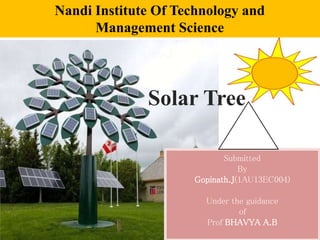
WHATIS SOLAR TREE
A solar tree is a decorative means of producing solar energy and
also electricity. It uses multiple no of solar panels which forms the
shape of a tree. The panels are arranged in a tree fashion in a tall
tower/pole.
TREE stands for
 T= TREE GENERATING
 R=RENEWABLE
 E=ENERGY and
 E=ELECTRICITY
This is like a tree in structure and the panels are like leaves of
the tree which produces energy.
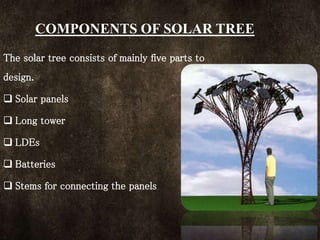
COMPONENTS OF SOLAR TREE
The solar tree consists of mainly five parts to
design.
 Solar panels
 Long tower
 LDEs
 Batteries
 Stems for connecting the panels
SPIRALLING PHYLLATAXY
 It is a technique used in designing of solar tree .
 It provides the way to help the lower panels from the
shadow of upper ones, so that it can track maximum power
from sun.
 This technology is used to improve the efficiency of the
plant .
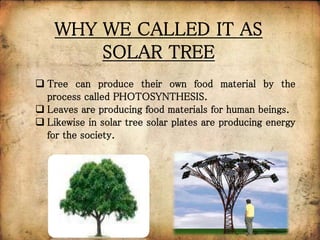
WHY WE CALLED IT AS
SOLAR TREE
 Tree can produce their own food material by the
process called PHOTOSYNTHESIS.
 Leaves are producing food materials for human beings.
 Likewise in solar tree solar plates are producing energy
for the society.
How Solar Panels Work?
Photovoltaic cell converts sunlight
into electric energy and this effect is
known as photovoltaic effect.
Solar cells essentially create electricity
by converting photons of light into
electrons.
Solar cell producing direct current, or
DC, this DC current is converted to
alternating current, or AC by using
inverter.
NEED OF SOLAR TREE
 Due to less land requirement
It require less land as compare to traditional PV system. So
we require such a plant which can generate max. energy using
minimum land.
 Efficient energy generation
It can generate energy very efficiently as compare to
traditional system.
 It can collect energy from wind
The stem are flexible so that they can rotate in any direction
and by shaking themselves they produce energy also from wind as
in the case of a natural tree.
Advantages of Solar Panel
 Ecologically Friendly
 Decreased Electrical Bill
 Low Maintenance
 Efficiency
WHY IT IS BETTER THAN A TRADITIONAL
SYSTEM
 For the traditional system we
require large size of land
Example –To generate 2 MW
power from a pv module we
requires 10 -12 acres of land
for housing of panels only.
 For the same amount of energy
we require only 0.10-0.12
acres of land in case of solar
tree.
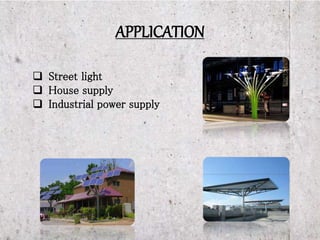
APPLICATION
 Street light
 House supply
 Industrial power supply
SOLAR TREE IN INDIA
 India being a developing country and highly populated
requires a power plant where maximum energy can be
generated by using minimum land.
 We must try to produce energy from sun by using solar
tree in our country to increase our per capita land and
fulfil the growing energy demand.
ADVANTAGES
 No air pollution
 We wouldn’t have to worry as much about future
energy sources
 People in poor country would have access to
electricity
 People can save money
 Land requirement is very less
DISADVANTAGES
 Cost is high
 May cause hazards to the birds and insects
 Hazards to eyesight from solar reflectors
Conclusion
 To fulfils the increasing energy demand the people.
 Saving of land, this project is very successful one.

 This can provide electricity without any power cut
problem.
 The extra energy can be provided to the grid.
Reference
Www.Google.Com
2
3
THANK YOUTHANK
YOU

Solar tree

  • 1.
    Solar Tree Submitted By Gopinath.J(1AU13EC004) Under theguidance of Prof BHAVYA A.B Nandi Institute Of Technology and Management Science
  • 2.
    Content A. Introduction B. WhatIs Solar Tree C. Components Of Solar Tree D. Spiralling Phyllataxy E. Why We Call It As A Solar Tree F. How Solar Panels Work G. Need Of Solar Tree H. Advantages Of Solar Panel I. Better Than Traditional System J. Applications K. Solar Tree In India L. Advantages M. Disadvantages N. Conclusion
  • 3.
    Introduction  Now adays with the growing population and energy demand we should take a renewable option of energy source and also we should keep in mind that energy should not cause pollution and other natural hazards. In this case the solar energy is the best option for us.  India is a highly populated country , so we should take the advantage of such an energy which requires a very less space to produce energy efficiently . In this case solar tree could be the best one for us . We can also use the technique called “SPIRALLING PHYLLATAXY” to improve the efficiency of the plant .
  • 4.
    WHATIS SOLAR TREE Asolar tree is a decorative means of producing solar energy and also electricity. It uses multiple no of solar panels which forms the shape of a tree. The panels are arranged in a tree fashion in a tall tower/pole. TREE stands for  T= TREE GENERATING  R=RENEWABLE  E=ENERGY and  E=ELECTRICITY This is like a tree in structure and the panels are like leaves of the tree which produces energy.
  • 5.
    COMPONENTS OF SOLARTREE The solar tree consists of mainly five parts to design.  Solar panels  Long tower  LDEs  Batteries  Stems for connecting the panels
  • 6.
    SPIRALLING PHYLLATAXY  Itis a technique used in designing of solar tree .  It provides the way to help the lower panels from the shadow of upper ones, so that it can track maximum power from sun.  This technology is used to improve the efficiency of the plant .
  • 7.
    WHY WE CALLEDIT AS SOLAR TREE  Tree can produce their own food material by the process called PHOTOSYNTHESIS.  Leaves are producing food materials for human beings.  Likewise in solar tree solar plates are producing energy for the society.
  • 8.
    How Solar PanelsWork? Photovoltaic cell converts sunlight into electric energy and this effect is known as photovoltaic effect. Solar cells essentially create electricity by converting photons of light into electrons. Solar cell producing direct current, or DC, this DC current is converted to alternating current, or AC by using inverter.
  • 9.
    NEED OF SOLARTREE  Due to less land requirement It require less land as compare to traditional PV system. So we require such a plant which can generate max. energy using minimum land.  Efficient energy generation It can generate energy very efficiently as compare to traditional system.  It can collect energy from wind The stem are flexible so that they can rotate in any direction and by shaking themselves they produce energy also from wind as in the case of a natural tree.
  • 10.
    Advantages of SolarPanel  Ecologically Friendly  Decreased Electrical Bill  Low Maintenance  Efficiency
  • 11.
    WHY IT ISBETTER THAN A TRADITIONAL SYSTEM  For the traditional system we require large size of land Example –To generate 2 MW power from a pv module we requires 10 -12 acres of land for housing of panels only.  For the same amount of energy we require only 0.10-0.12 acres of land in case of solar tree.
  • 12.
    APPLICATION  Street light House supply  Industrial power supply
  • 13.
    SOLAR TREE ININDIA  India being a developing country and highly populated requires a power plant where maximum energy can be generated by using minimum land.  We must try to produce energy from sun by using solar tree in our country to increase our per capita land and fulfil the growing energy demand.
  • 14.
    ADVANTAGES  No airpollution  We wouldn’t have to worry as much about future energy sources  People in poor country would have access to electricity  People can save money  Land requirement is very less
  • 15.
    DISADVANTAGES  Cost ishigh  May cause hazards to the birds and insects  Hazards to eyesight from solar reflectors
  • 16.
    Conclusion  To fulfilsthe increasing energy demand the people.  Saving of land, this project is very successful one.   This can provide electricity without any power cut problem.  The extra energy can be provided to the grid.
  • 17.
  • 19.