Solar System
Focus Question: How can the Solar
System be characterized?
Investigation 1; Part 1
Solar System Definition
 What

is the Solar System?

– Solar refers to Sol, another name for our
Sun.
– System is a set of objects working together
 Solar

System = our Sun and a set of
other objects working together in some
way.
How Does the Solar System
Work?
 Set

of Picture Cards

– Spread out in front of you Picture-side up
– Look at front of card only
 Put

cards into groups by similar
characteristics
– Use just what you observe in images, not
prior knowledge*

 How

did you sort your cards?


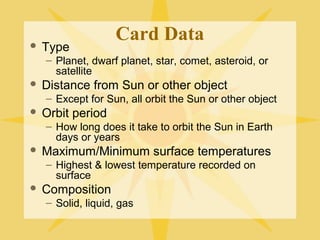
Type

Card Data

– Planet, dwarf planet, star, comet, asteroid, or
satellite


Distance from Sun or other object
– Except for Sun, all orbit the Sun or other object



Orbit period
– How long does it take to orbit the Sun in Earth
days or years



Maximum/Minimum surface temperatures
– Highest & lowest temperature recorded on
surface



Composition
– Solid, liquid, gas
Orbit
 Revolving

or moving in a path around
another object.
 Challenge:
– Find all the planet cards and Sun card.
– Use “Distance from…” information on
cards to arrange planets in order, starting
with the Sun.
Solar System
 Sun

and eight planets in order describe
the solar system
 Other objects in solar system
– Use information on cards to incorporate
other objects into solar system*
Solar System Data Sheet
 Complete

notebook sheet - start by
filling out table on left side of sheet.
 Planet cards
– Separate planets into classes based on
composition*
– How did you use composition to sort
planets?
 Rock

planets
 Gas planets
 Ice and rock dwarf planet
Composition
What do you notice about the sizes of the
planets you have put in your groups?
 What do you notice about the distance from
the Sun for the planets in your groups?
 Terrestrial Planets


– Four rocky planets closest to the Sun
– Terrestrial means “land”, rocky composition


Gas Giants
– Beyond the asteroid belt
– Why “Gas Giant” name?
Pluto
 Dwarf

Planet

– Located in Kuiper Belt
 Area

filled with “dirty ice” objects, made of
frozen dust, water, and gas
 Some objects are planet size
 Pluto

– Rock-and-ice dwarf planet or
Kuiper object
Vocabulary
 The

Sun

– An average star at the center of the solar
system around which all other solarsystem bodies revolve.
 Solar

System

– The Sun and all the bodies that orbit it,
including the planets and their moons, the
asteroids, and the comets.
 Orbit

– The path an object takes around another
object; for example, Earth has an orbit
around the Sun.
 Planet

– A large natural object that orbits around a
star, such as the Sun.
 Asteroid

– A rocky object, which can be a few
hundred meters to several hundred
kilometers wide, that orbits the Sun.
 Comet

– A small body of ice and dust that orbits the
Sun in a large oval path.
Content
 What

is the Sun?

– Average-sized star; mostly hydrogen
(72%) and helium (26%); other solar
system bodies revolve around it
 What

is the solar system?

– Sun and all the bodies that orbit it,
including planets and their moons,
asteroids, and comets
 Your

questions?
 Homework- Read A Tour of the Solar
System, pg 145-158. Use 3-Column
notes for each section. Answer
questions on page 158 in notebook.

Solar System Data Inv. 1-1

  • 1.
    Solar System Focus Question:How can the Solar System be characterized? Investigation 1; Part 1
  • 2.
    Solar System Definition What is the Solar System? – Solar refers to Sol, another name for our Sun. – System is a set of objects working together  Solar System = our Sun and a set of other objects working together in some way.
  • 3.
    How Does theSolar System Work?  Set of Picture Cards – Spread out in front of you Picture-side up – Look at front of card only  Put cards into groups by similar characteristics – Use just what you observe in images, not prior knowledge*  How did you sort your cards?
  • 4.
     Type Card Data – Planet,dwarf planet, star, comet, asteroid, or satellite  Distance from Sun or other object – Except for Sun, all orbit the Sun or other object  Orbit period – How long does it take to orbit the Sun in Earth days or years  Maximum/Minimum surface temperatures – Highest & lowest temperature recorded on surface  Composition – Solid, liquid, gas
  • 5.
    Orbit  Revolving or movingin a path around another object.  Challenge: – Find all the planet cards and Sun card. – Use “Distance from…” information on cards to arrange planets in order, starting with the Sun.
  • 6.
    Solar System  Sun andeight planets in order describe the solar system  Other objects in solar system – Use information on cards to incorporate other objects into solar system*
  • 7.
    Solar System DataSheet  Complete notebook sheet - start by filling out table on left side of sheet.  Planet cards – Separate planets into classes based on composition* – How did you use composition to sort planets?  Rock planets  Gas planets  Ice and rock dwarf planet
  • 8.
    Composition What do younotice about the sizes of the planets you have put in your groups?  What do you notice about the distance from the Sun for the planets in your groups?  Terrestrial Planets  – Four rocky planets closest to the Sun – Terrestrial means “land”, rocky composition  Gas Giants – Beyond the asteroid belt – Why “Gas Giant” name?
  • 9.
    Pluto  Dwarf Planet – Locatedin Kuiper Belt  Area filled with “dirty ice” objects, made of frozen dust, water, and gas  Some objects are planet size  Pluto – Rock-and-ice dwarf planet or Kuiper object
  • 10.
    Vocabulary  The Sun – Anaverage star at the center of the solar system around which all other solarsystem bodies revolve.  Solar System – The Sun and all the bodies that orbit it, including the planets and their moons, the asteroids, and the comets.
  • 11.
     Orbit – Thepath an object takes around another object; for example, Earth has an orbit around the Sun.  Planet – A large natural object that orbits around a star, such as the Sun.  Asteroid – A rocky object, which can be a few hundred meters to several hundred kilometers wide, that orbits the Sun.
  • 12.
     Comet – Asmall body of ice and dust that orbits the Sun in a large oval path.
  • 13.
    Content  What is theSun? – Average-sized star; mostly hydrogen (72%) and helium (26%); other solar system bodies revolve around it  What is the solar system? – Sun and all the bodies that orbit it, including planets and their moons, asteroids, and comets  Your questions?  Homework- Read A Tour of the Solar System, pg 145-158. Use 3-Column notes for each section. Answer questions on page 158 in notebook.