JOSEPH HEYES SPACE
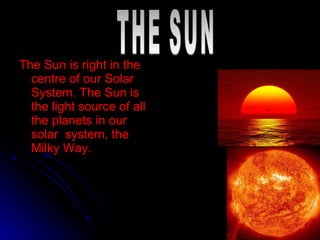
The Sun is right in the centre of our Solar System. The Sun is the light source of all the planets in our solar  system, the Milky Way. THE SUN
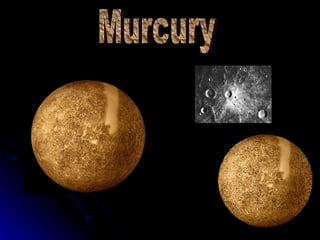
Murcury
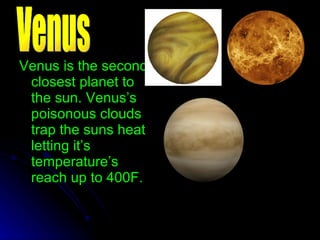
Venus is the second closest planet to the sun. Venus’s poisonous clouds trap the suns heat letting it’s temperature’s reach up to 400F. Venus
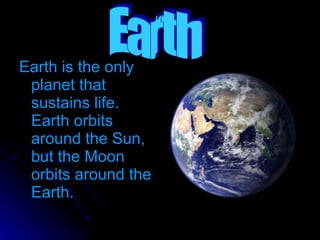
Earth is the only planet that sustains life. Earth orbits around the Sun, but the Moon orbits around the Earth.   Earth
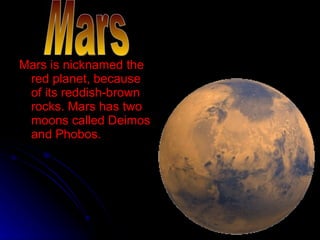
Mars is nicknamed the red planet, because of its reddish-brown rocks. Mars has two moons called Deimos and Phobos. Mars
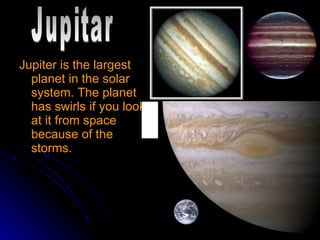
Jupiter is the largest planet in the solar system. The planet has swirls if you look at it from space because of the storms. Jupitar
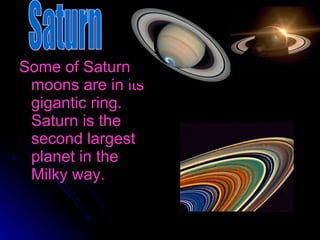
Some of Saturn’s moons are in its gigantic ring. Saturn is the second largest planet in the Milky way. Saturn
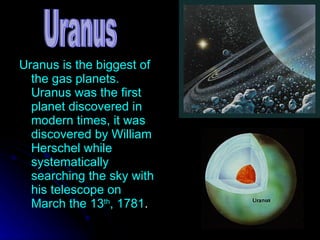
Uranus is the biggest of the gas planets. Uranus was the first planet discovered in modern times, it was discovered by William Herschel while systematically searching the sky with his telescope on March the 13 th , 1781 . Uranus
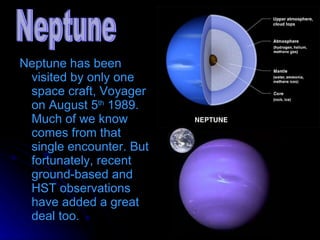
Neptune has been visited by only one space craft, Voyager  on August 5 th  1989. Much of we know comes from that single encounter. But fortunately, recent ground-based and HST observations have added a great deal too. Neptune
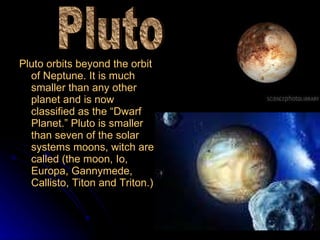
Pluto orbits beyond the orbit of Neptune. It is much smaller than any other planet and is now classified as the “Dwarf Planet.” Pluto is smaller than seven of the solar systems moons, witch are called (the moon, Io, Europa, Gannymede, Callisto, Titon and Triton.) Pluto
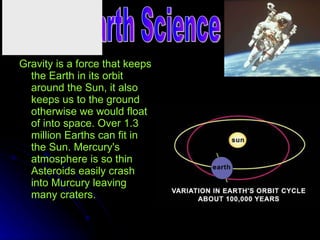
Gravity is a force that keeps the Earth in its orbit around the Sun, it also keeps us to the ground otherwise we would float of into space. Over 1.3 million Earths can fit in the Sun. Mercury's atmosphere is so thin Asteroids easily crash into Murcury leaving many craters.   Space/earth Science
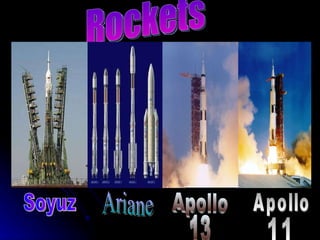
Rockets Apollo 11 Apollo 13 Ariane Soyuz

Space Joseph

  • 1.
  • 2.
    The Sun isright in the centre of our Solar System. The Sun is the light source of all the planets in our solar system, the Milky Way. THE SUN
  • 3.
  • 4.
    Venus is thesecond closest planet to the sun. Venus’s poisonous clouds trap the suns heat letting it’s temperature’s reach up to 400F. Venus
  • 5.
    Earth is theonly planet that sustains life. Earth orbits around the Sun, but the Moon orbits around the Earth. Earth
  • 6.
    Mars is nicknamedthe red planet, because of its reddish-brown rocks. Mars has two moons called Deimos and Phobos. Mars
  • 7.
    Jupiter is thelargest planet in the solar system. The planet has swirls if you look at it from space because of the storms. Jupitar
  • 8.
    Some of Saturn’smoons are in its gigantic ring. Saturn is the second largest planet in the Milky way. Saturn
  • 9.
    Uranus is thebiggest of the gas planets. Uranus was the first planet discovered in modern times, it was discovered by William Herschel while systematically searching the sky with his telescope on March the 13 th , 1781 . Uranus
  • 10.
    Neptune has beenvisited by only one space craft, Voyager on August 5 th 1989. Much of we know comes from that single encounter. But fortunately, recent ground-based and HST observations have added a great deal too. Neptune
  • 11.
    Pluto orbits beyondthe orbit of Neptune. It is much smaller than any other planet and is now classified as the “Dwarf Planet.” Pluto is smaller than seven of the solar systems moons, witch are called (the moon, Io, Europa, Gannymede, Callisto, Titon and Triton.) Pluto
  • 12.
    Gravity is aforce that keeps the Earth in its orbit around the Sun, it also keeps us to the ground otherwise we would float of into space. Over 1.3 million Earths can fit in the Sun. Mercury's atmosphere is so thin Asteroids easily crash into Murcury leaving many craters. Space/earth Science
  • 13.
    Rockets Apollo 11Apollo 13 Ariane Soyuz