THE SOLAR SYST
EM
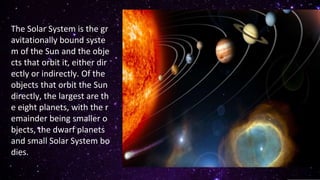
The Solar System is the gr
avitationally bound syste
m of the Sun and the obje
cts that orbit it, either dir
ectly or indirectly. Of the
objects that orbit the Sun
directly, the largest are th
e eight planets, with the r
emainder being smaller o
bjects, the dwarf planets
and small Solar System bo
dies.
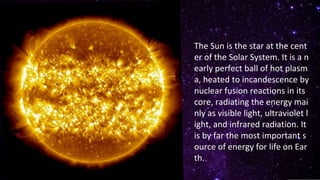
The Sun is the star at the cent
er of the Solar System. It is a n
early perfect ball of hot plasm
a, heated to incandescence by
nuclear fusion reactions in its
core, radiating the energy mai
nly as visible light, ultraviolet l
ight, and infrared radiation. It
is by far the most important s
ource of energy for life on Ear
th.
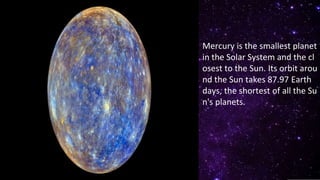
Mercury is the smallest planet
in the Solar System and the cl
osest to the Sun. Its orbit arou
nd the Sun takes 87.97 Earth
days, the shortest of all the Su
n's planets.
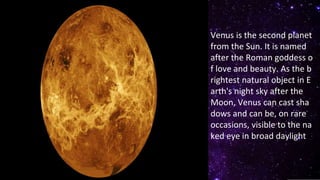
Venus is the second planet
from the Sun. It is named
after the Roman goddess o
f love and beauty. As the b
rightest natural object in E
arth's night sky after the
Moon, Venus can cast sha
dows and can be, on rare
occasions, visible to the na
ked eye in broad daylight
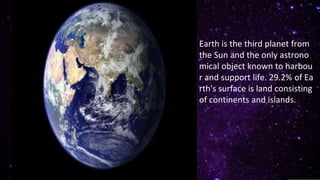
Earth is the third planet from
the Sun and the only astrono
mical object known to harbou
r and support life. 29.2% of Ea
rth's surface is land consisting
of continents and islands.
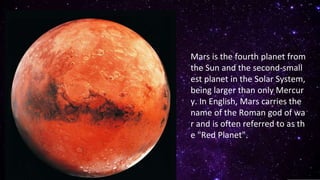
Mars is the fourth planet from
the Sun and the second-small
est planet in the Solar System,
being larger than only Mercur
y. In English, Mars carries the
name of the Roman god of wa
r and is often referred to as th
e "Red Planet".
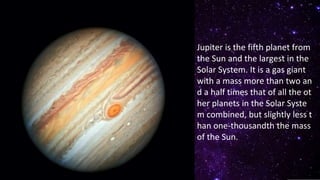
Jupiter is the fifth planet from
the Sun and the largest in the
Solar System. It is a gas giant
with a mass more than two an
d a half times that of all the ot
her planets in the Solar Syste
m combined, but slightly less t
han one-thousandth the mass
of the Sun.
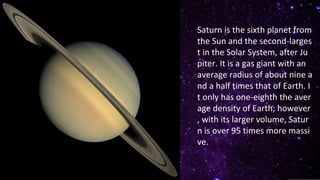
Saturn is the sixth planet from
the Sun and the second-larges
t in the Solar System, after Ju
piter. It is a gas giant with an
average radius of about nine a
nd a half times that of Earth. I
t only has one-eighth the aver
age density of Earth; however
, with its larger volume, Satur
n is over 95 times more massi
ve.
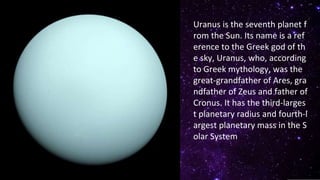
Uranus is the seventh planet f
rom the Sun. Its name is a ref
erence to the Greek god of th
e sky, Uranus, who, according
to Greek mythology, was the
great-grandfather of Ares, gra
ndfather of Zeus and father of
Cronus. It has the third-larges
t planetary radius and fourth-l
argest planetary mass in the S
olar System
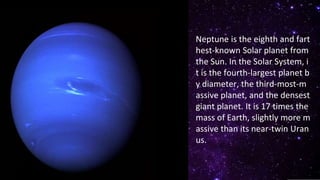
Neptune is the eighth and fart
hest-known Solar planet from
the Sun. In the Solar System, i
t is the fourth-largest planet b
y diameter, the third-most-m
assive planet, and the densest
giant planet. It is 17 times the
mass of Earth, slightly more m
assive than its near-twin Uran
us.
THANK YOU
CARLO JAMES BASA
11-ST.IRENEUS

The solar system wps office

  • 1.
  • 2.
    The Solar Systemis the gr avitationally bound syste m of the Sun and the obje cts that orbit it, either dir ectly or indirectly. Of the objects that orbit the Sun directly, the largest are th e eight planets, with the r emainder being smaller o bjects, the dwarf planets and small Solar System bo dies.
  • 3.
    The Sun isthe star at the cent er of the Solar System. It is a n early perfect ball of hot plasm a, heated to incandescence by nuclear fusion reactions in its core, radiating the energy mai nly as visible light, ultraviolet l ight, and infrared radiation. It is by far the most important s ource of energy for life on Ear th.
  • 4.
    Mercury is thesmallest planet in the Solar System and the cl osest to the Sun. Its orbit arou nd the Sun takes 87.97 Earth days, the shortest of all the Su n's planets.
  • 5.
    Venus is thesecond planet from the Sun. It is named after the Roman goddess o f love and beauty. As the b rightest natural object in E arth's night sky after the Moon, Venus can cast sha dows and can be, on rare occasions, visible to the na ked eye in broad daylight
  • 6.
    Earth is thethird planet from the Sun and the only astrono mical object known to harbou r and support life. 29.2% of Ea rth's surface is land consisting of continents and islands.
  • 7.
    Mars is thefourth planet from the Sun and the second-small est planet in the Solar System, being larger than only Mercur y. In English, Mars carries the name of the Roman god of wa r and is often referred to as th e "Red Planet".
  • 8.
    Jupiter is thefifth planet from the Sun and the largest in the Solar System. It is a gas giant with a mass more than two an d a half times that of all the ot her planets in the Solar Syste m combined, but slightly less t han one-thousandth the mass of the Sun.
  • 9.
    Saturn is thesixth planet from the Sun and the second-larges t in the Solar System, after Ju piter. It is a gas giant with an average radius of about nine a nd a half times that of Earth. I t only has one-eighth the aver age density of Earth; however , with its larger volume, Satur n is over 95 times more massi ve.
  • 10.
    Uranus is theseventh planet f rom the Sun. Its name is a ref erence to the Greek god of th e sky, Uranus, who, according to Greek mythology, was the great-grandfather of Ares, gra ndfather of Zeus and father of Cronus. It has the third-larges t planetary radius and fourth-l argest planetary mass in the S olar System
  • 11.
    Neptune is theeighth and fart hest-known Solar planet from the Sun. In the Solar System, i t is the fourth-largest planet b y diameter, the third-most-m assive planet, and the densest giant planet. It is 17 times the mass of Earth, slightly more m assive than its near-twin Uran us.
  • 12.
    THANK YOU CARLO JAMESBASA 11-ST.IRENEUS