

SOLAR POWER SATELLITE
Department Of Electrical Engineering,
Gogte Institute Of Technology, Belagavi.
TABLE OF CONTENTS
• INTRODUCTION
• PROBLEMS IN PRESENT SCENARIO
• HISTORY OF WIRELESS POWER TRANSMISSION
• WORKING
• COMPONENTS OF THE SYSTEM
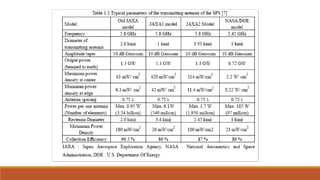
• MODELS
• MERITS
• LIMITATIONS
• CONCLUSION
INTRODUCTION
• In todays world the energy demands are ever increasing but we are not able to meet the huge
energy demands.
• Solar power satellites and wireless power transmission are one of the many proposed methods
of harnessing solar energy.
• We already have solar plants on ground but the amount of energy they produce per unit area is
less.
• Where as if we put solar power satellites in the outer space we can obtain 4 times the amount
of energy produced by ground systems.
• We use wireless power transmission to receive energy produced by solar power satellites.
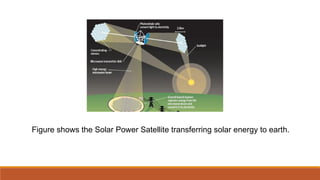
Figure shows the Solar Power Satellite transferring solar energy to earth.
PROBLEMS IN PRESENT SCENARIO
• High transmission and distribution loss.
• India has highest T&D loss at a whooping 27%.
• This process involves higher efficiency , low power cost and
protection from power theft.
HISTORY OF WIRELESS POWER TRANSMISSION
• James C. Maxwell predicted the existence of radio waves by means of mathematical model.
• Nicola Tesla suggested an idea of the wireless power transmission and carried out the first
WPT experiment in 1899.
• Rectenna was conceived by W.C. Brown of Raytheon Company in the early of 1960s.
• Ground-to-Ground MPT Experiment in 1975 at the Venus Site of JPL Goldstone Facility was
successful.
WORKING
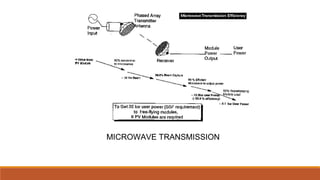
• Satellite with large solar panels convert the solar energy to DC power.
• A DC to RF converter converts this power to microwaves.
• A very powerful antenna is used to beam these microwaves down to earth.
• On ground there is a Recenna which receives the microwaves and
converts them back to DC power using RF to DC converter.
• This DC power is converted to AC power and is connected to the grid.
MICROWAVE TRANSMISSION
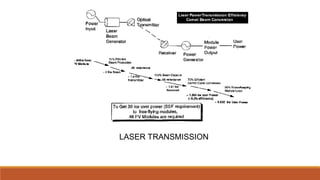
LASER TRANSMISSION
COMPONENTS OF THE SYSTEM
Solar Power Satallite
• Solar panels are designed to absorb the sun's rays as a source of energy for generating
electricity.
• They have an efficiency of around 19% on ground.
• Cost is very at present but will reduce to economical price as technology advances.
• We use Geostationary satallites at height of 36,000 km above sea level.
• Magnetron, klystron, travelling Wave Tube etc. or Semiconductor
microwave transmitters can be used to generate microwaves.
• Magnetron is widely used for experimentation of WPT and has an
efficiency above 80%.
• Microwave transmission uses 2.45GHz or 5.8GHz of ISM band.
• The highest efficiency over 90% is achieved at 2.45GHz among all
the frequencies.
Microwave Generator
• The receiver used in this case is called a ‘RECTENNA’.
• As it’s name implies it is a rectifier combined with an antenna.
• The main function of a rectenna is conversion of the microwave
power received into dc power for practical uses.
• It has efficiencies of over 85%.
• Dyengo recently developed microwave based rectenna and rectifier
circuit to achieve conversion efficiency of 90% at 2 GHz band.
Receiver
MODELS
• Tesla fed 300 kW power to tesla coil resonated at 150 kHz. Unfortunately, he failed
because the transmitted power was diffused to all directions with 150 kHz radio
waves whose wave length was 21 km.
• In 1975 NASA JPL Goldstone achieved success in WPT of 34kW power over a
distance of 1.5km with an efficiency of 82%.
• Japan recently succeeded in WPT of 1.8kW power over a distance of 55m.
MERITS
• The energy is available 24 hours a day, and the total solar energy available to the
satellite is between 4 and 5 times more than is available anywhere on Earth and 15
times more than the average location.
• During rain and after natural disaster it is often hard to manage cables and towers so it
removes this difficulty.
• Losses during transmission and distribution can be reduced.
• Microwaves (electricity) are more environments friendly. It does not involve emission of
carbon gases.
• Electricity bills using conventional supply can be cut to very low.
• Zero fuel cost.
LIMITATIONS
• Biological effects associated with the wireless transmission of electricity due to the high
frequency microwave signals is the first demerit of this technology.
• This project is a onetime expense but it involves a lot of initial expenditure. It is
expected that the price of receive electricity through this technology would decline
overtime.
• This technology is limited to the use of few technologies like solar satellites and Tesla
grid.
• The transmission of electric current through this mode is susceptible to interference with
communication system. Can cause problems for aircrafts.
CONCLUSION
• The concept of Microwave Power transmission (MPT) and Wireless Power
Transmission system is presented.
• The technological developments in Wireless Power Transmission (WPT) will improve
this system.
• This concept offers greater possibilities for transmitting power with negligible losses and
ease of transmission than any invention or discovery is made.
THANK YOUTHANK YOU

Solar Power Satellites

  • 1.
    SOLAR POWER SATELLITE DepartmentOf Electrical Engineering, Gogte Institute Of Technology, Belagavi.
  • 2.
    TABLE OF CONTENTS •INTRODUCTION • PROBLEMS IN PRESENT SCENARIO • HISTORY OF WIRELESS POWER TRANSMISSION • WORKING • COMPONENTS OF THE SYSTEM • MODELS • MERITS • LIMITATIONS • CONCLUSION
  • 3.
    INTRODUCTION • In todaysworld the energy demands are ever increasing but we are not able to meet the huge energy demands. • Solar power satellites and wireless power transmission are one of the many proposed methods of harnessing solar energy. • We already have solar plants on ground but the amount of energy they produce per unit area is less. • Where as if we put solar power satellites in the outer space we can obtain 4 times the amount of energy produced by ground systems. • We use wireless power transmission to receive energy produced by solar power satellites.
  • 4.
    Figure shows theSolar Power Satellite transferring solar energy to earth.
  • 5.
    PROBLEMS IN PRESENTSCENARIO • High transmission and distribution loss. • India has highest T&D loss at a whooping 27%. • This process involves higher efficiency , low power cost and protection from power theft.
  • 6.
    HISTORY OF WIRELESSPOWER TRANSMISSION • James C. Maxwell predicted the existence of radio waves by means of mathematical model. • Nicola Tesla suggested an idea of the wireless power transmission and carried out the first WPT experiment in 1899. • Rectenna was conceived by W.C. Brown of Raytheon Company in the early of 1960s. • Ground-to-Ground MPT Experiment in 1975 at the Venus Site of JPL Goldstone Facility was successful.
  • 7.
    WORKING • Satellite withlarge solar panels convert the solar energy to DC power. • A DC to RF converter converts this power to microwaves. • A very powerful antenna is used to beam these microwaves down to earth. • On ground there is a Recenna which receives the microwaves and converts them back to DC power using RF to DC converter. • This DC power is converted to AC power and is connected to the grid.
  • 8.
  • 9.
  • 10.
    COMPONENTS OF THESYSTEM Solar Power Satallite • Solar panels are designed to absorb the sun's rays as a source of energy for generating electricity. • They have an efficiency of around 19% on ground. • Cost is very at present but will reduce to economical price as technology advances. • We use Geostationary satallites at height of 36,000 km above sea level.
  • 11.
    • Magnetron, klystron,travelling Wave Tube etc. or Semiconductor microwave transmitters can be used to generate microwaves. • Magnetron is widely used for experimentation of WPT and has an efficiency above 80%. • Microwave transmission uses 2.45GHz or 5.8GHz of ISM band. • The highest efficiency over 90% is achieved at 2.45GHz among all the frequencies. Microwave Generator
  • 12.
    • The receiverused in this case is called a ‘RECTENNA’. • As it’s name implies it is a rectifier combined with an antenna. • The main function of a rectenna is conversion of the microwave power received into dc power for practical uses. • It has efficiencies of over 85%. • Dyengo recently developed microwave based rectenna and rectifier circuit to achieve conversion efficiency of 90% at 2 GHz band. Receiver
  • 13.
    MODELS • Tesla fed300 kW power to tesla coil resonated at 150 kHz. Unfortunately, he failed because the transmitted power was diffused to all directions with 150 kHz radio waves whose wave length was 21 km. • In 1975 NASA JPL Goldstone achieved success in WPT of 34kW power over a distance of 1.5km with an efficiency of 82%. • Japan recently succeeded in WPT of 1.8kW power over a distance of 55m.
  • 15.
    MERITS • The energyis available 24 hours a day, and the total solar energy available to the satellite is between 4 and 5 times more than is available anywhere on Earth and 15 times more than the average location. • During rain and after natural disaster it is often hard to manage cables and towers so it removes this difficulty. • Losses during transmission and distribution can be reduced. • Microwaves (electricity) are more environments friendly. It does not involve emission of carbon gases. • Electricity bills using conventional supply can be cut to very low. • Zero fuel cost.
  • 16.
    LIMITATIONS • Biological effectsassociated with the wireless transmission of electricity due to the high frequency microwave signals is the first demerit of this technology. • This project is a onetime expense but it involves a lot of initial expenditure. It is expected that the price of receive electricity through this technology would decline overtime. • This technology is limited to the use of few technologies like solar satellites and Tesla grid. • The transmission of electric current through this mode is susceptible to interference with communication system. Can cause problems for aircrafts.
  • 17.
    CONCLUSION • The conceptof Microwave Power transmission (MPT) and Wireless Power Transmission system is presented. • The technological developments in Wireless Power Transmission (WPT) will improve this system. • This concept offers greater possibilities for transmitting power with negligible losses and ease of transmission than any invention or discovery is made.
  • 18.