Solution
Week 58 (10/20/03)
Coins and Gaussians
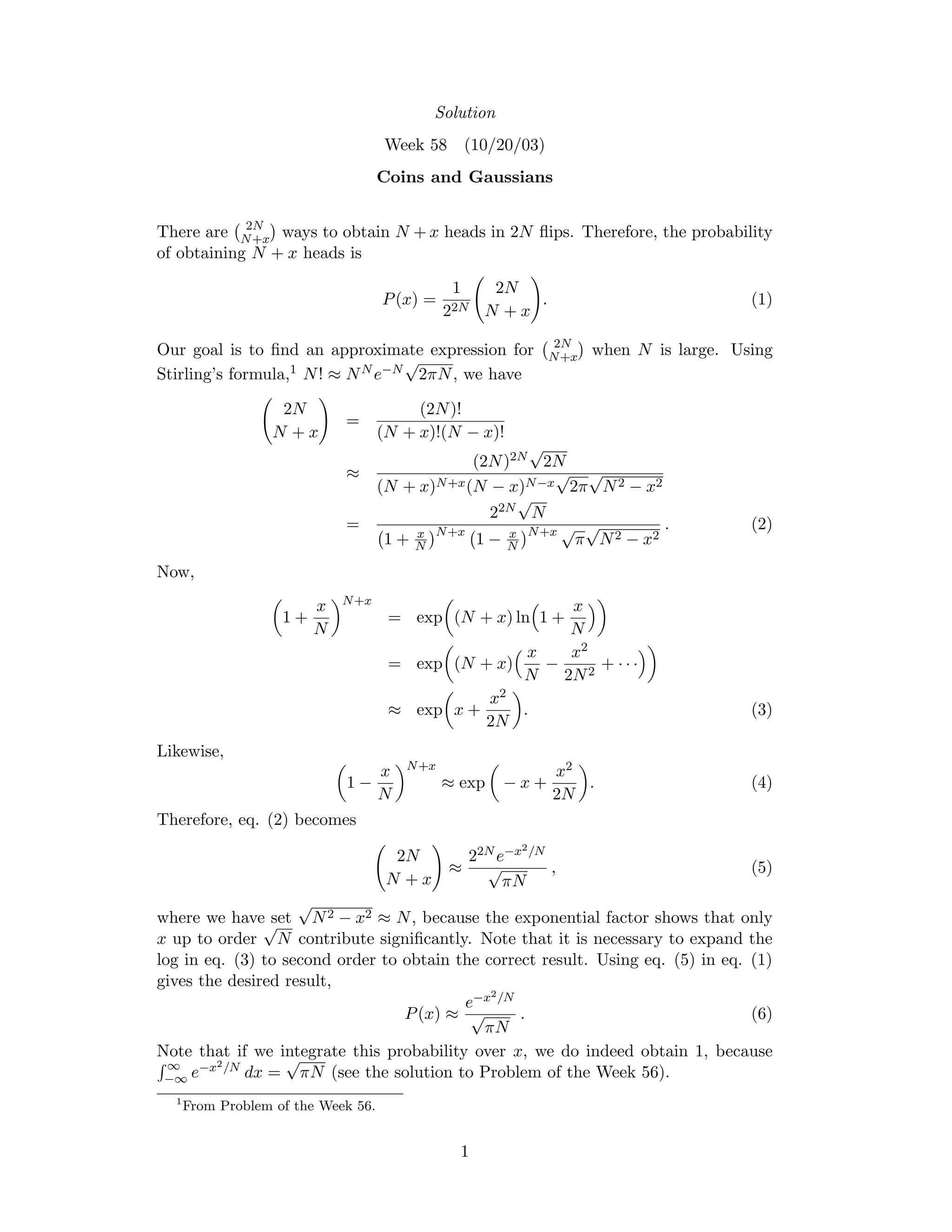
There are 2N
N+x ways to obtain N + x heads in 2N flips. Therefore, the probability
of obtaining N + x heads is
P(x) =
1
22N
2N
N + x
. (1)
Our goal is to find an approximate expression for 2N
N+x when N is large. Using
Stirling’s formula,1 N! ≈ NN e−N
√
2πN, we have
2N
N + x
=
(2N)!
(N + x)!(N − x)!
≈
(2N)2N
√
2N
(N + x)N+x(N − x)N−x
√
2π
√
N2 − x2
=
22N
√
N
1 + x
N
N+x
1 − x
N
N+x √
π
√
N2 − x2
. (2)
Now,
1 +
x
N
N+x
= exp (N + x) ln 1 +
x
N
= exp (N + x)
x
N
−
x2
2N2
+ · · ·
≈ exp x +
x2
2N
. (3)
Likewise,
1 −
x
N
N+x
≈ exp − x +
x2
2N
. (4)
Therefore, eq. (2) becomes
2N
N + x
≈
22N e−x2/N
√
πN
, (5)
where we have set
√
N2 − x2 ≈ N, because the exponential factor shows that only
x up to order
√
N contribute significantly. Note that it is necessary to expand the
log in eq. (3) to second order to obtain the correct result. Using eq. (5) in eq. (1)
gives the desired result,
P(x) ≈
e−x2/N
√
πN
. (6)
Note that if we integrate this probability over x, we do indeed obtain 1, because
∞
−∞ e−x2/N dx =
√
πN (see the solution to Problem of the Week 56).
1
From Problem of the Week 56.
1
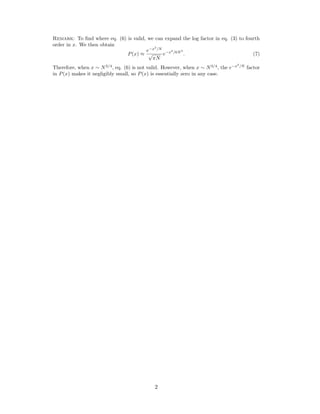
Remark: To find where eq. (6) is valid, we can expand the log factor in eq. (3) to fourth
order in x. We then obtain
P(x) ≈
e−x2
/N
√
πN
e−x4
/6N3
. (7)
Therefore, when x ∼ N3/4
, eq. (6) is not valid. However, when x ∼ N3/4
, the e−x2
/N
factor
in P(x) makes it negligibly small, so P(x) is essentially zero in any case.
2

Sol58

  • 1.
    Solution Week 58 (10/20/03) Coinsand Gaussians There are 2N N+x ways to obtain N + x heads in 2N flips. Therefore, the probability of obtaining N + x heads is P(x) = 1 22N 2N N + x . (1) Our goal is to find an approximate expression for 2N N+x when N is large. Using Stirling’s formula,1 N! ≈ NN e−N √ 2πN, we have 2N N + x = (2N)! (N + x)!(N − x)! ≈ (2N)2N √ 2N (N + x)N+x(N − x)N−x √ 2π √ N2 − x2 = 22N √ N 1 + x N N+x 1 − x N N+x √ π √ N2 − x2 . (2) Now, 1 + x N N+x = exp (N + x) ln 1 + x N = exp (N + x) x N − x2 2N2 + · · · ≈ exp x + x2 2N . (3) Likewise, 1 − x N N+x ≈ exp − x + x2 2N . (4) Therefore, eq. (2) becomes 2N N + x ≈ 22N e−x2/N √ πN , (5) where we have set √ N2 − x2 ≈ N, because the exponential factor shows that only x up to order √ N contribute significantly. Note that it is necessary to expand the log in eq. (3) to second order to obtain the correct result. Using eq. (5) in eq. (1) gives the desired result, P(x) ≈ e−x2/N √ πN . (6) Note that if we integrate this probability over x, we do indeed obtain 1, because ∞ −∞ e−x2/N dx = √ πN (see the solution to Problem of the Week 56). 1 From Problem of the Week 56. 1
  • 2.
    Remark: To findwhere eq. (6) is valid, we can expand the log factor in eq. (3) to fourth order in x. We then obtain P(x) ≈ e−x2 /N √ πN e−x4 /6N3 . (7) Therefore, when x ∼ N3/4 , eq. (6) is not valid. However, when x ∼ N3/4 , the e−x2 /N factor in P(x) makes it negligibly small, so P(x) is essentially zero in any case. 2