This is about soils and the change and distribution of biodiversity within time
1.
GEOD 301: SOILS& BIOGEOGRAPHY
Lecture 4:
Soil Classification Systems
Dr. Peter B. Obour
1
2.
Objectives
By the endof this lecture, students should be able to
1. Explain the soil classification systems of the
world
2. Understand the soils of Ghana
3. Understand the agricultural potentials of soils in
Ghana
2
3.
Soil Classification Systems(I)
Soil classification means to arrange soil in groups
and label them based on their properties and
behavior.
Classification systems generally group together
broad categories of soils that have similar features
or properties, which are considered to be of
importance.
Reason for classification: Soil classification is like a
language between engineers. The known soil
classification communicates their probable
engineering behavior, and allows engineers access
to the accumulated experience of other engineers.
3
4.
Soil Classification Systems(II)
Various soil classification systems are in use
worldwide.
Two types of scientific classification systems –
o Those based on processes of soil development
o Those based on quantifiable characteristics of the
soils.
Some classification systems have elements of both
types. These systems are sometimes referred to as
comprehensive systems.
4
5.
Soil Classification Systems(III)
Soil Classification Systems have been developed
by different organizations
1. Unified soil classification system (USCS).
2. AASHTO (American Association of state Highway
and Transportation Officials) soil
classification system.
3. FAA (Federal Aviation Administration) soil
classification system.
4. Textural soil classification system.
5. The Food and Agriculture Organisation of the
United Nations
5
6.
Soil Classification Systems(IV)
6. The USDA Soil Taxonomy first published by the United
States Department of Agriculture’s Soil Survey Staff in 1975.
The USDA system classifies soil types on the basis of
measured properties of the profile and Soil climate. At the
highest level, the system places soils of the world in one of
12 categories (orders).
7. Interim Ghana Soil Classification System Developed in the
late 1950s (Brammer, 1962). In this system, the soil-forming
factors are more central than the concept of diagnostic
horizons as contained in some advanced systems.
N.B: Students should read more about these systems
6
7.
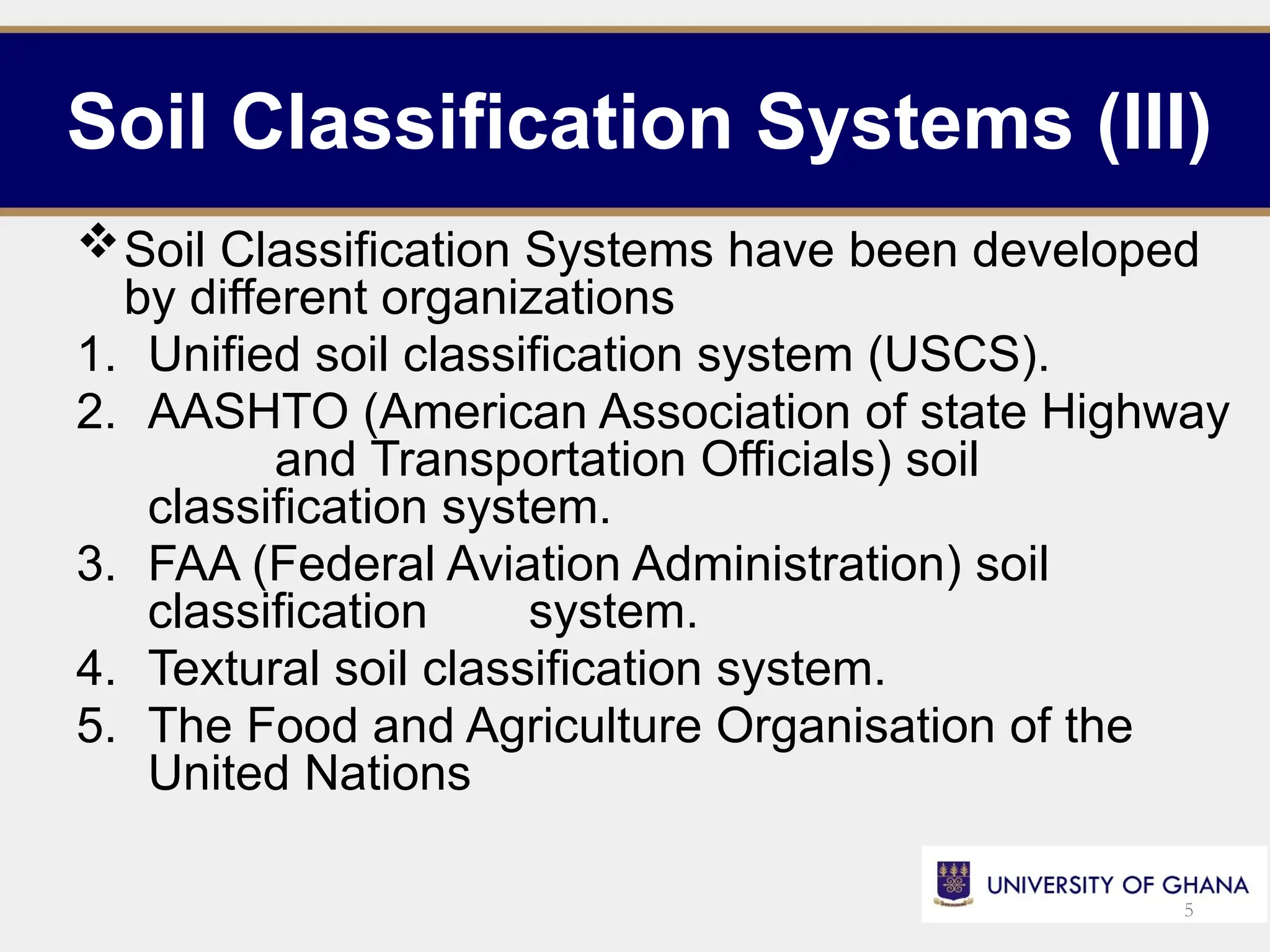
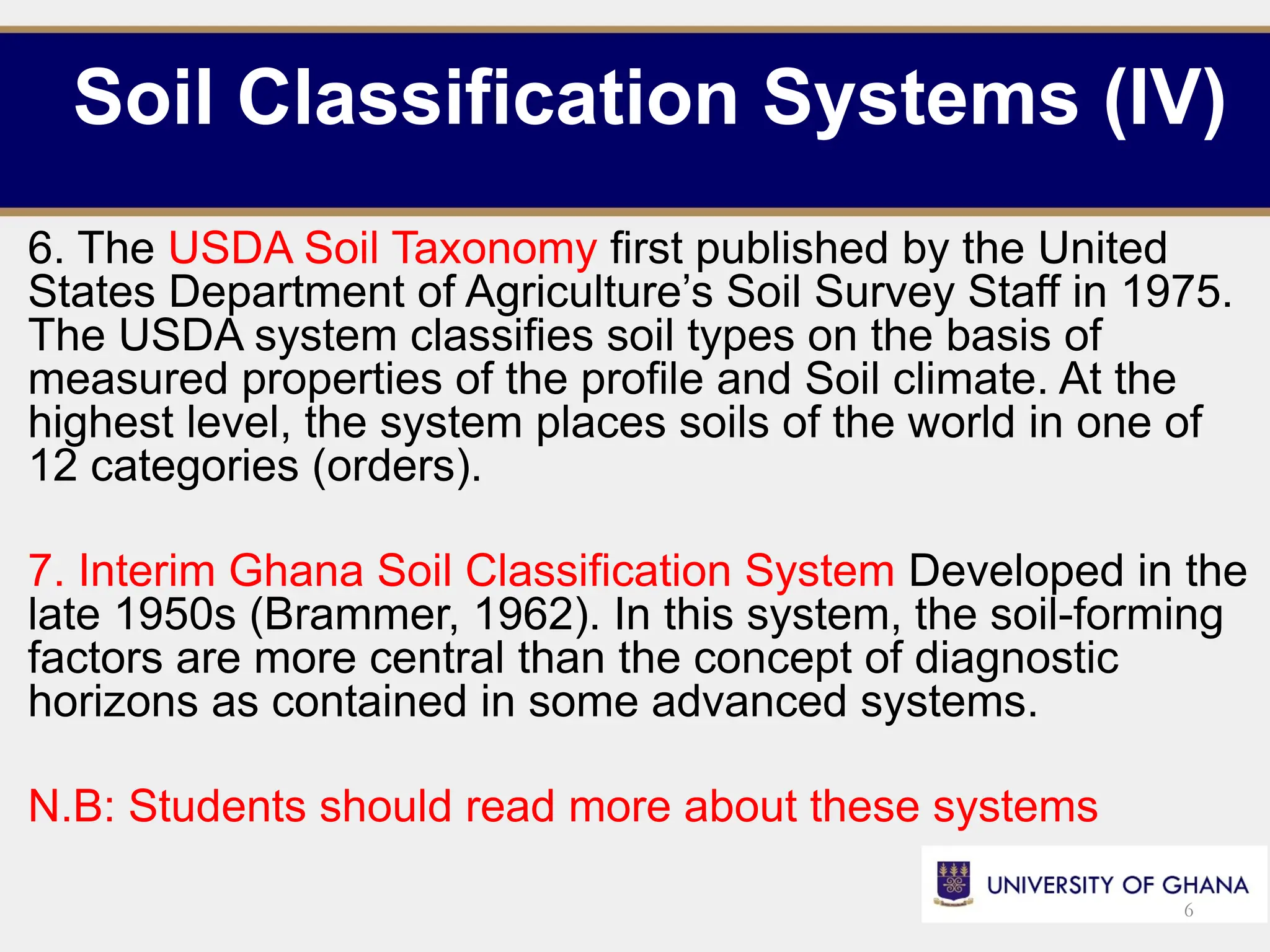
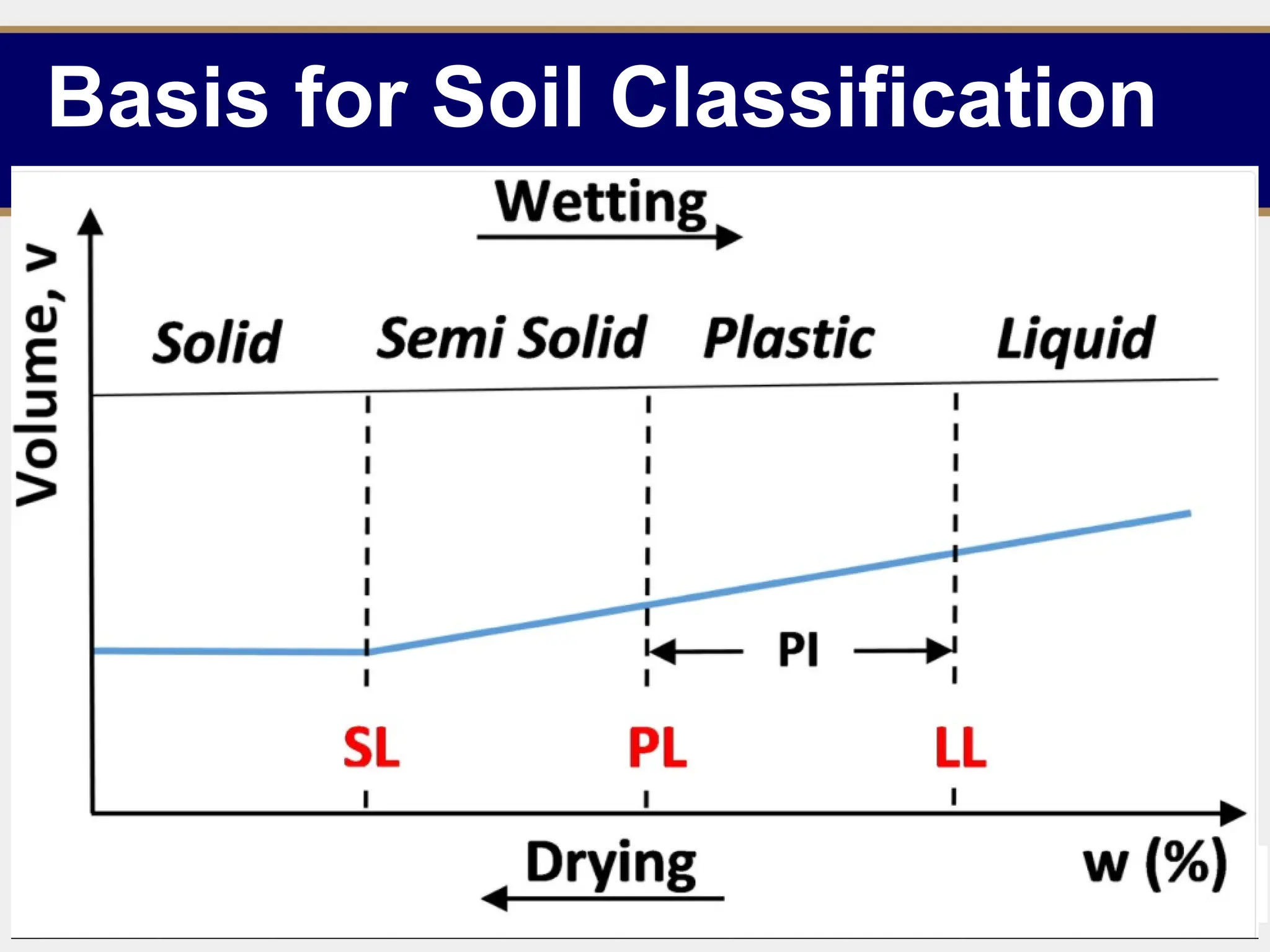
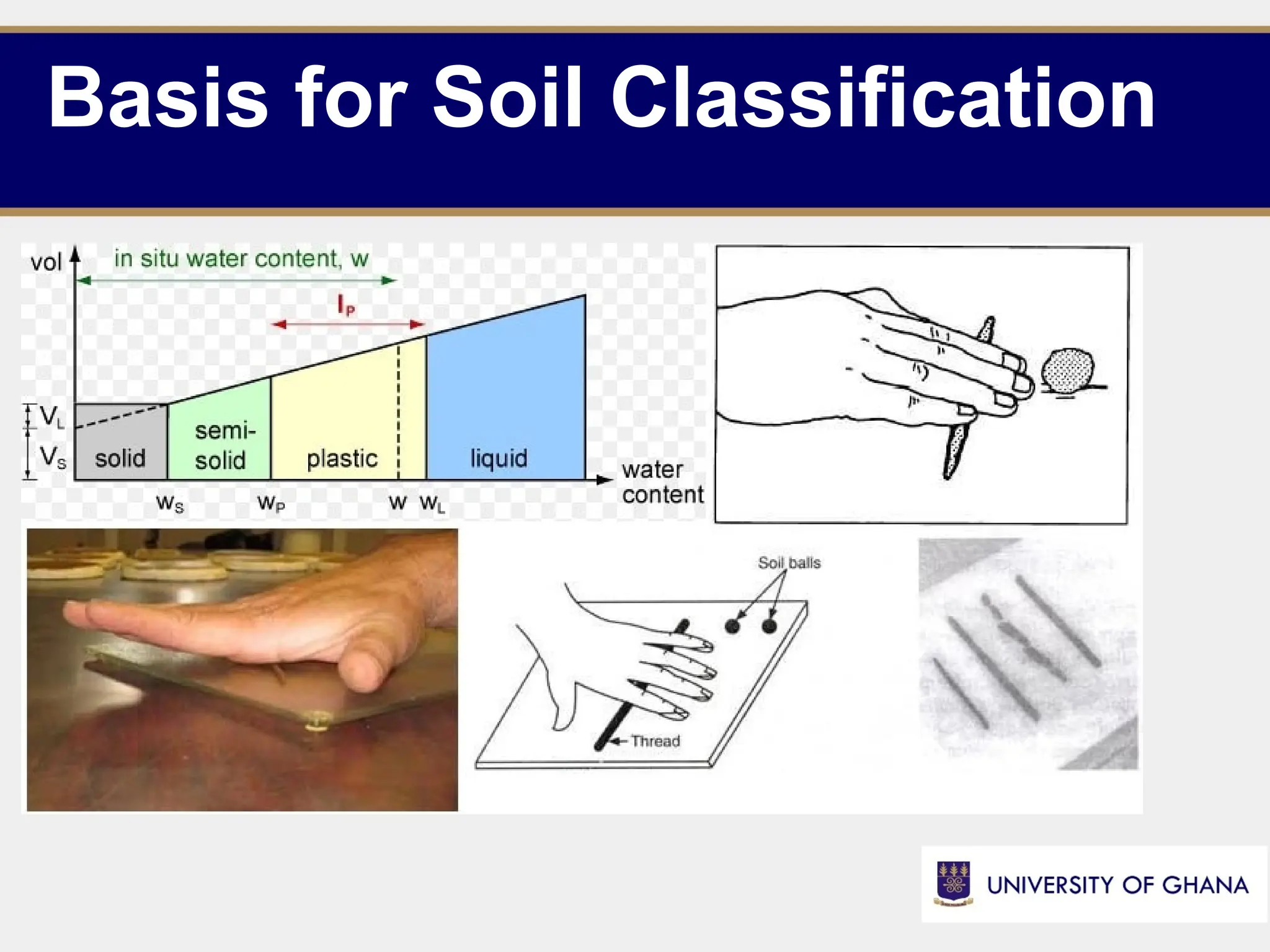
Basis for SoilClassification
7
Classification is based on the following
physical properties
Particle Size Distribution (PSD)
Liquid limit (LL)
Plasticity Index (PI)
Classification gives some idea about the
general behaviour of soil
However to predict true behaviour additional
information based on geotechnical properties
are required
Unified Soil ClassificationSystem (USCS)
Origin of USCS:
This system was first developed by Professor A. Casagrande
(1948) for the purpose of airfield construction during World War
II. Afterwards, it was modified by Professor Casagrande, the
U.S. Bureau of Reclamation, and the U.S. Army Corps of
Engineers to enable the system to be applicable to dams,
foundations, and other construction (Holtz and Kovacs, 1981).
Four major divisions:
(1)Coarse-grained
(2)Fine-grained
(3)Organic soils
(4)Peat 9
10.
10
• Tests requiredfor classification of soil are:
1. Liquid and plastic limit tests.
2. Particle size analysis test.
Broad Classification includes the following two types;
1. Coarse-grained soil
2. Fine-grained soil
• The soil is classified into 15 groups.
• Each group is designated a symbol consisting of two
capital letters
• The first letter is based on main soil type
• The second letter is based on gradation and plasticity
Unified Soil Classification System
(USCS)
11.
Major Soils ofthe World (Twelve Soil Orders based
on USDA Soil Taxonomy)
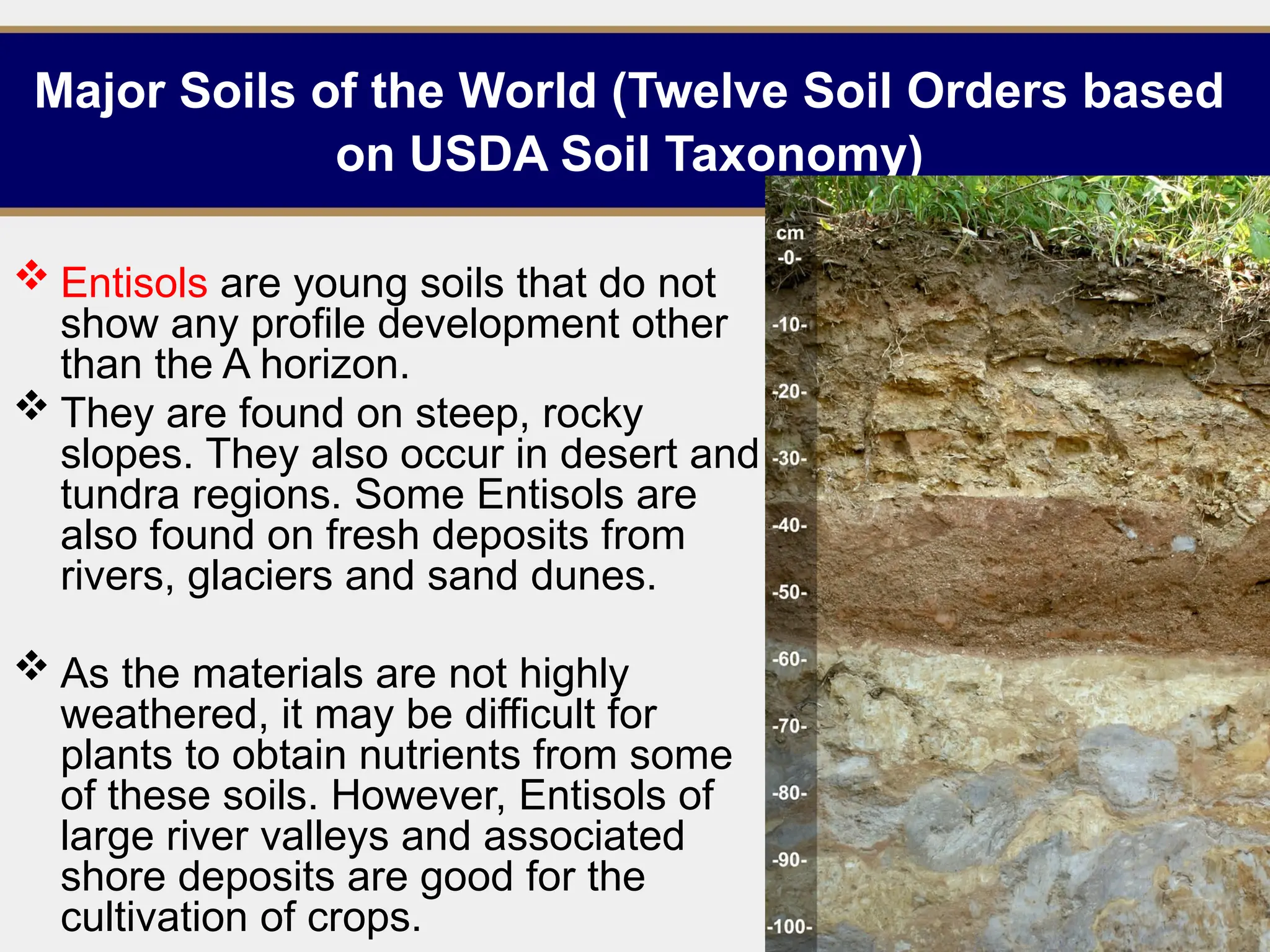
Entisols are young soils that do not
show any profile development other
than the A horizon.
They are found on steep, rocky
slopes. They also occur in desert and
tundra regions. Some Entisols are
also found on fresh deposits from
rivers, glaciers and sand dunes.
As the materials are not highly
weathered, it may be difficult for
plants to obtain nutrients from some
of these soils. However, Entisols of
large river valleys and associated
shore deposits are good for the
cultivation of crops. 11
12.
Major Soils ofthe World (Twelve Soil Orders
based on USDA Soil Taxonomy)
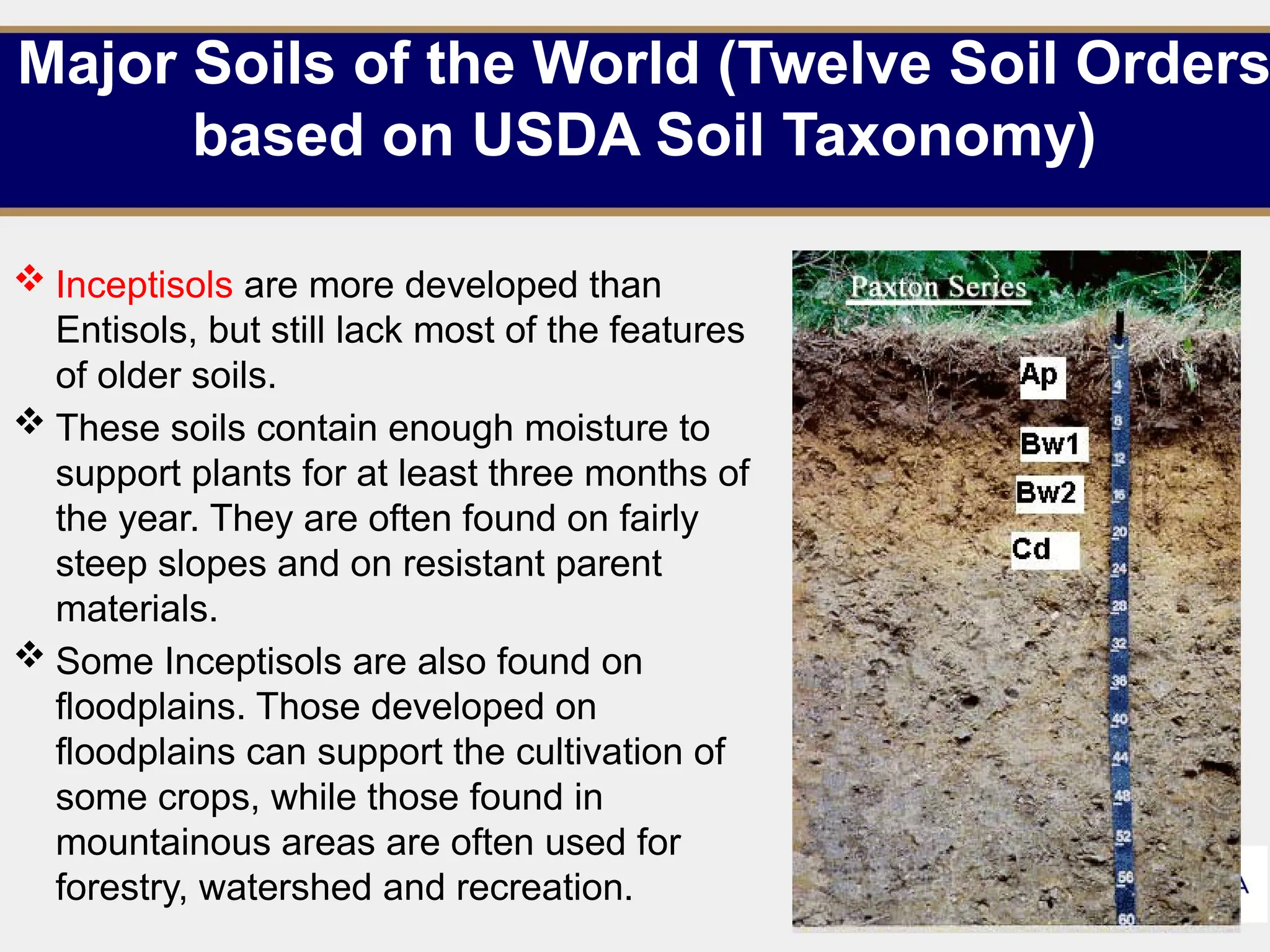
Inceptisols are more developed than
Entisols, but still lack most of the features
of older soils.
These soils contain enough moisture to
support plants for at least three months of
the year. They are often found on fairly
steep slopes and on resistant parent
materials.
Some Inceptisols are also found on
floodplains. Those developed on
floodplains can support the cultivation of
some crops, while those found in
mountainous areas are often used for
forestry, watershed and recreation. 12
13.
Major Soils ofthe World (Twelve Soil
Orders based on USDA Soil Taxonomy)
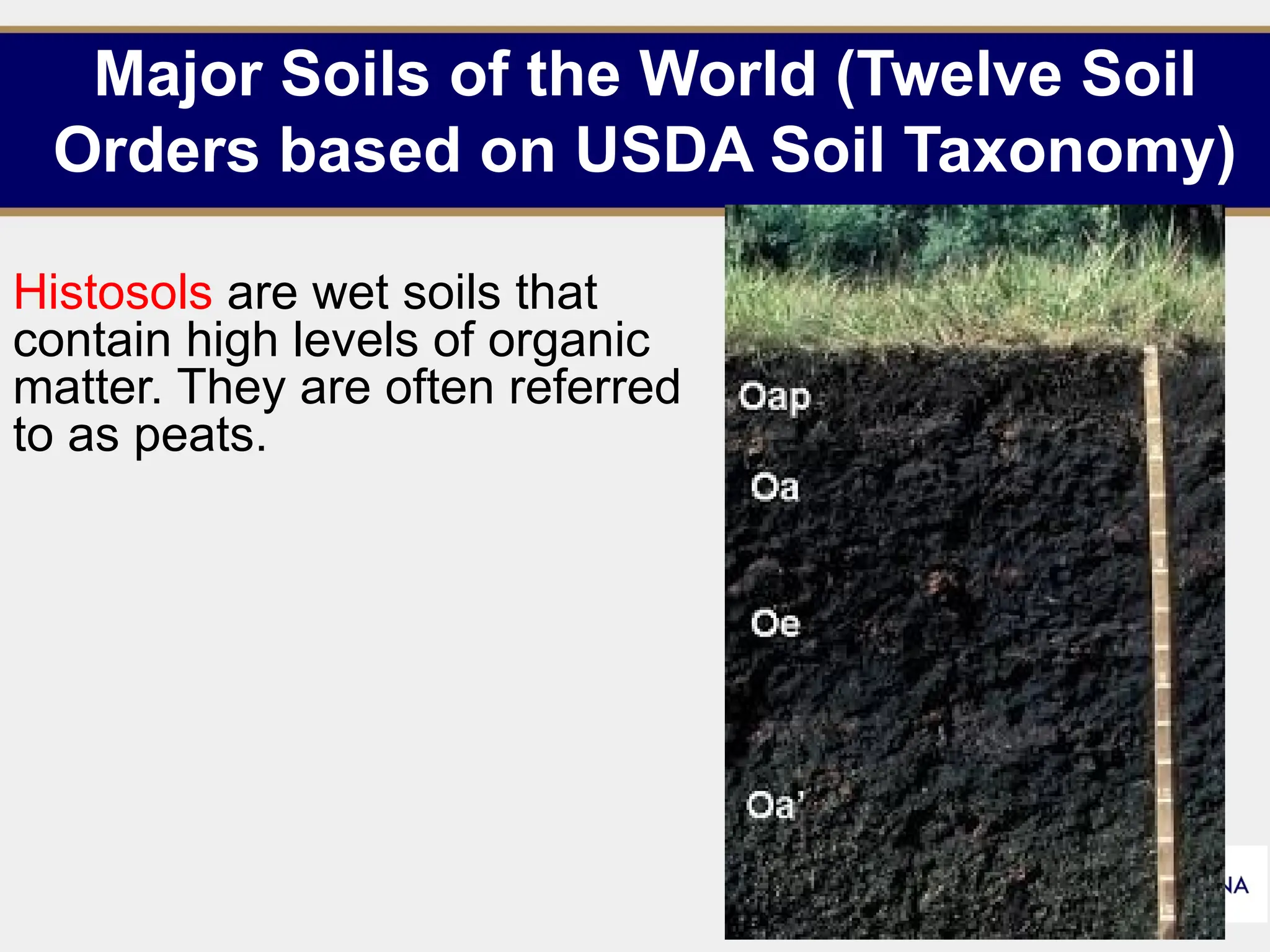
Histosols are wet soils that
contain high levels of organic
matter. They are often referred
to as peats.
13
14.
Major Soils ofthe World (Twelve Soil
Orders based on USDA Soil Taxonomy)
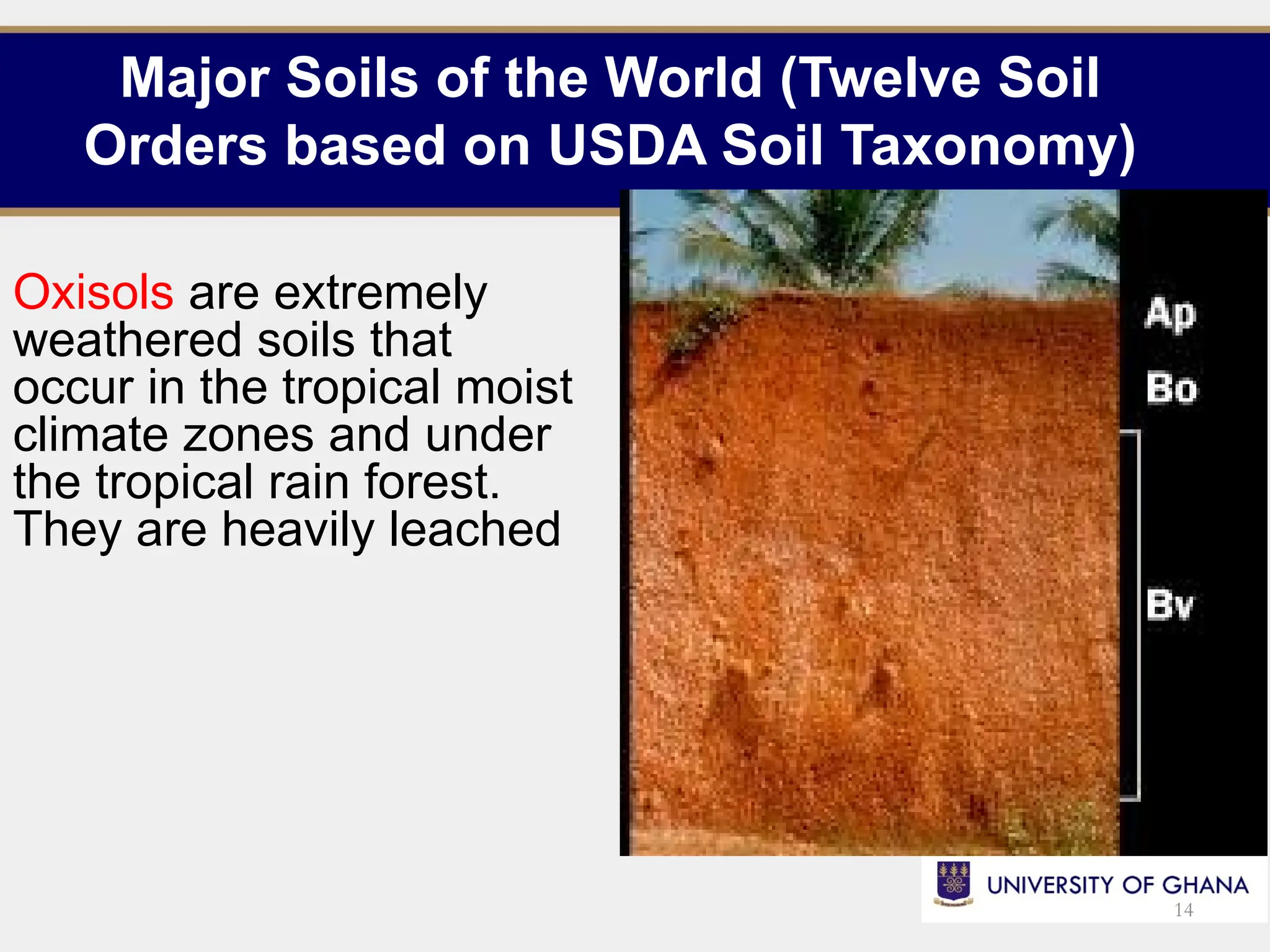
Oxisols are extremely
weathered soils that
occur in the tropical moist
climate zones and under
the tropical rain forest.
They are heavily leached
14
15.
Major Soils ofthe World (Twelve Soil Orders
based on USDA Soil Taxonomy)
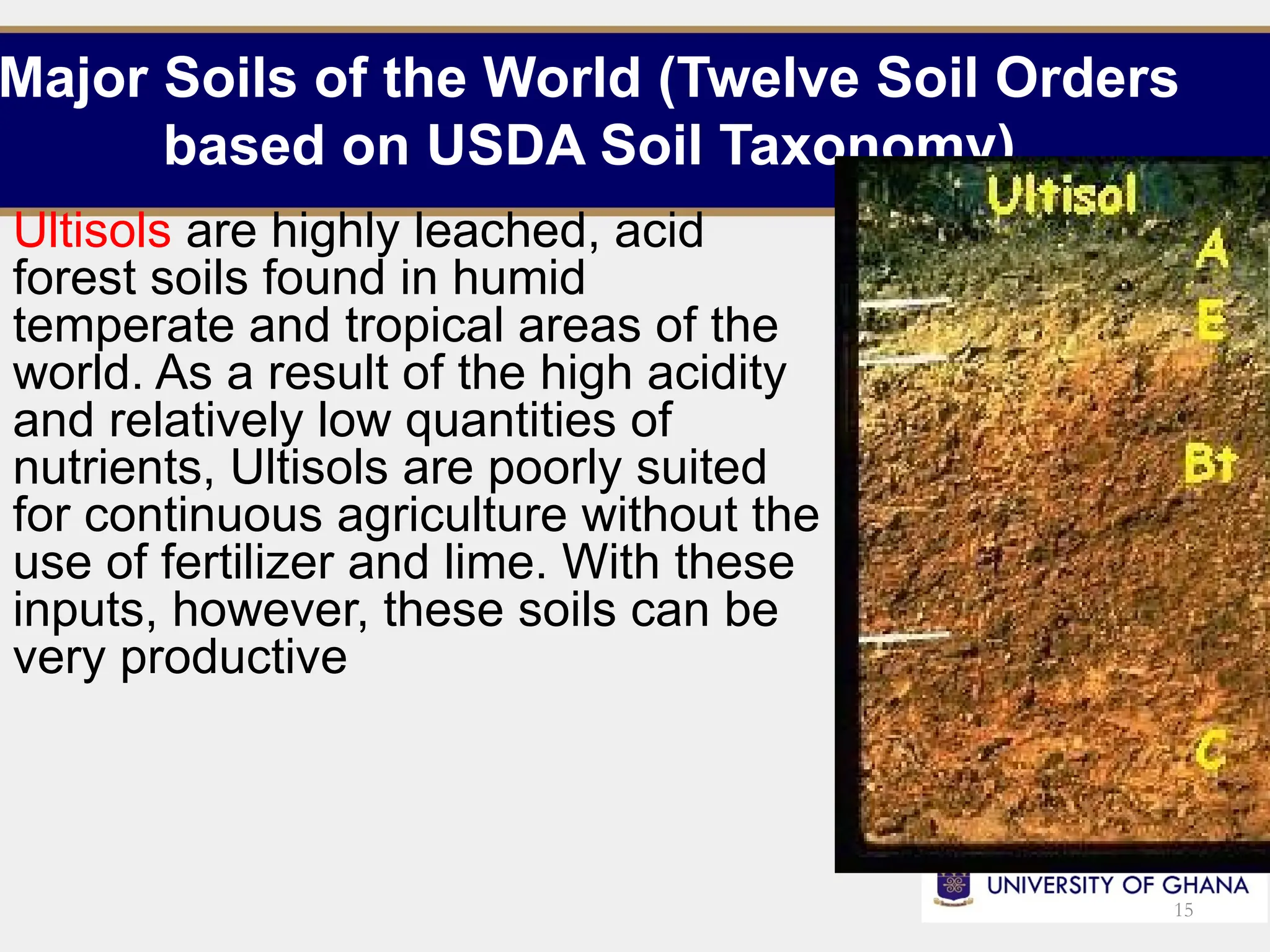
Ultisols are highly leached, acid
forest soils found in humid
temperate and tropical areas of the
world. As a result of the high acidity
and relatively low quantities of
nutrients, Ultisols are poorly suited
for continuous agriculture without the
use of fertilizer and lime. With these
inputs, however, these soils can be
very productive
15
16.
Major Soils ofthe World (Twelve Soil
Orders based on USDA Soil Taxonomy)
Vertisols are soils with high content of clay.
They often develop under savannah vegetation
in the tropical and subtropical climates.
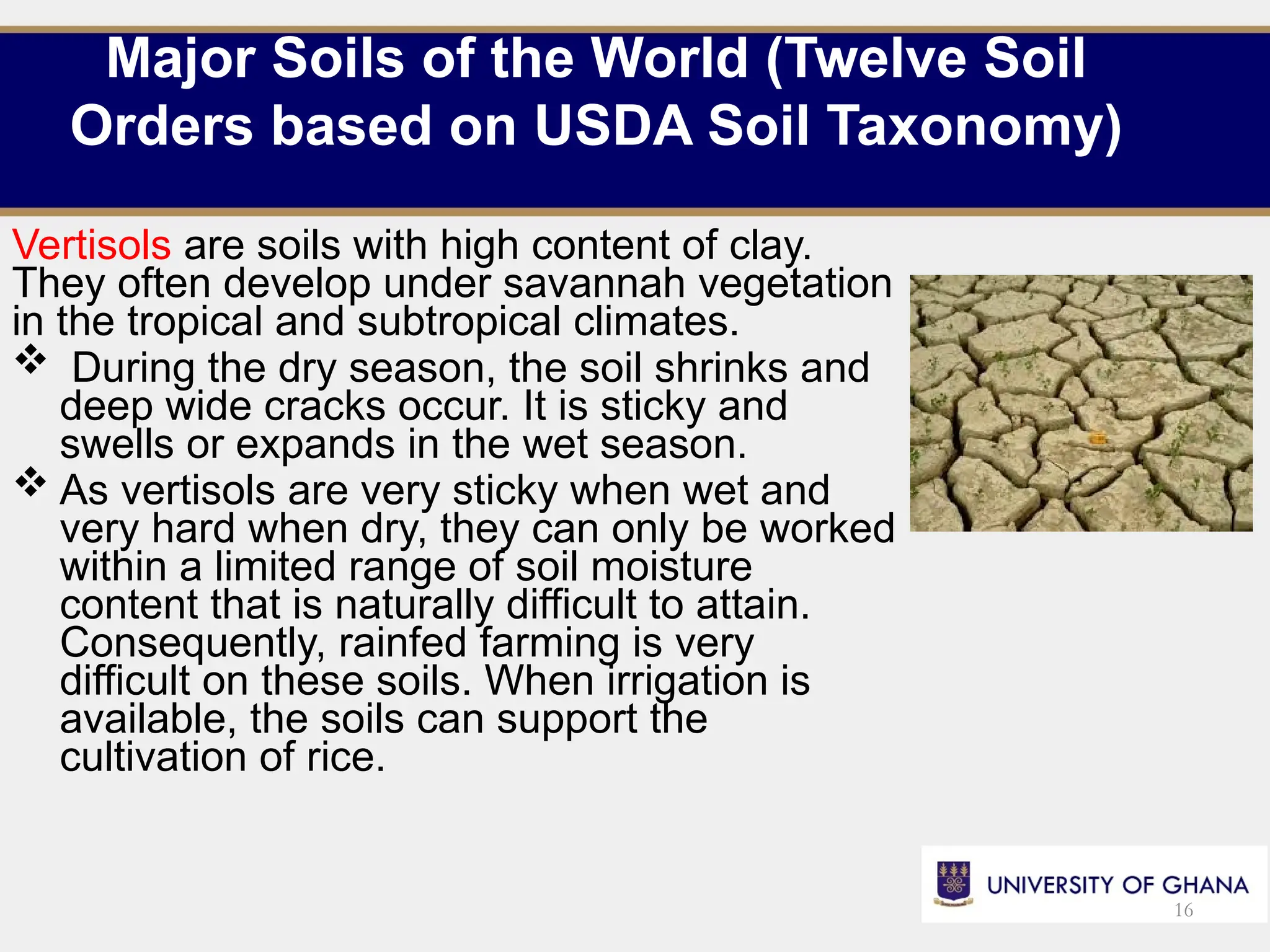
During the dry season, the soil shrinks and
deep wide cracks occur. It is sticky and
swells or expands in the wet season.
As vertisols are very sticky when wet and
very hard when dry, they can only be worked
within a limited range of soil moisture
content that is naturally difficult to attain.
Consequently, rainfed farming is very
difficult on these soils. When irrigation is
available, the soils can support the
cultivation of rice.
16
17.
Major Soils ofthe World (Twelve Soil
Orders based on USDA Soil Taxonomy)
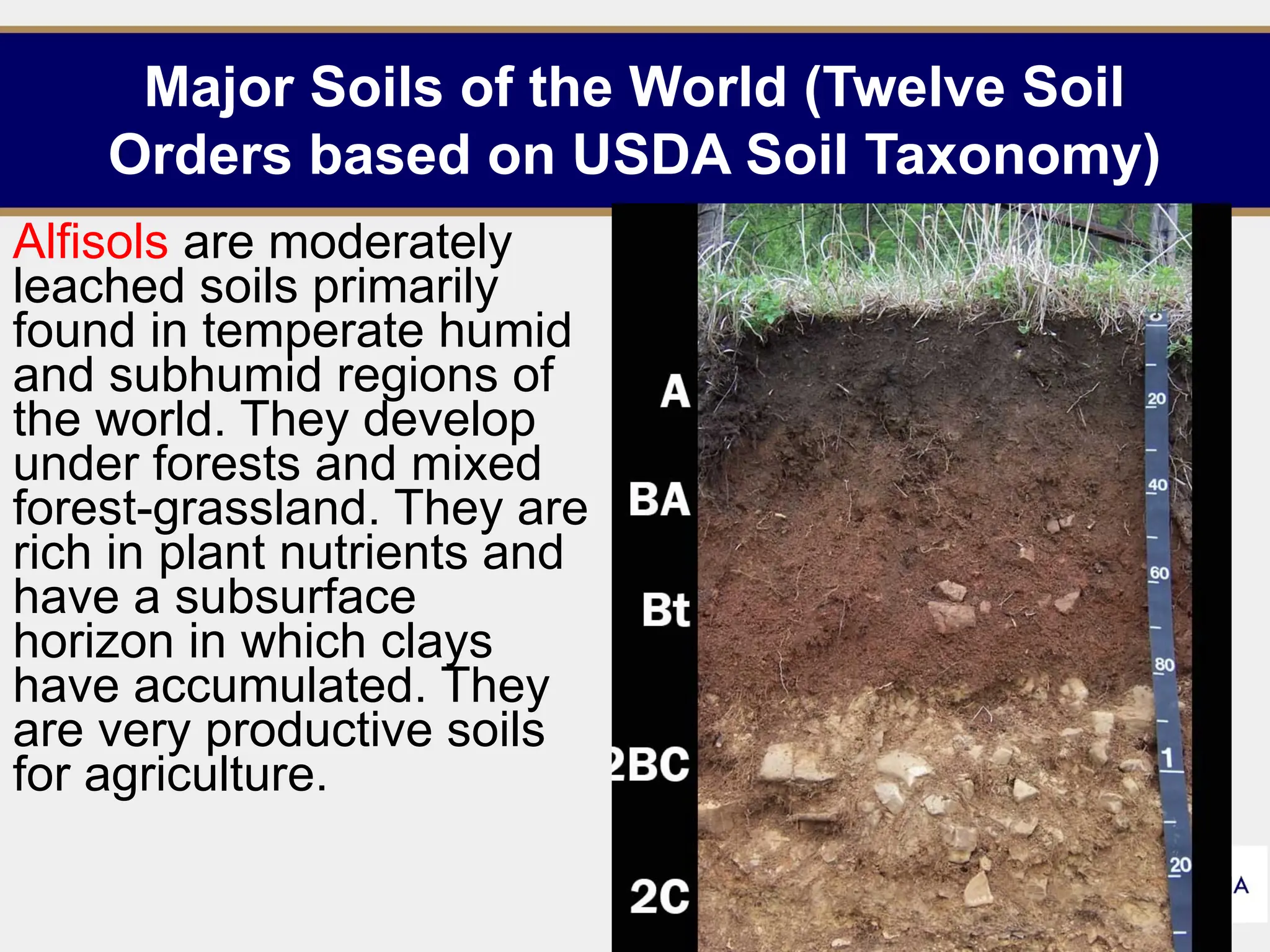
Alfisols are moderately
leached soils primarily
found in temperate humid
and subhumid regions of
the world. They develop
under forests and mixed
forest-grassland. They are
rich in plant nutrients and
have a subsurface
horizon in which clays
have accumulated. They
are very productive soils
for agriculture.
17
18.
Major Soils ofthe World (Twelve Soil
Orders based on USDA Soil Taxonomy)
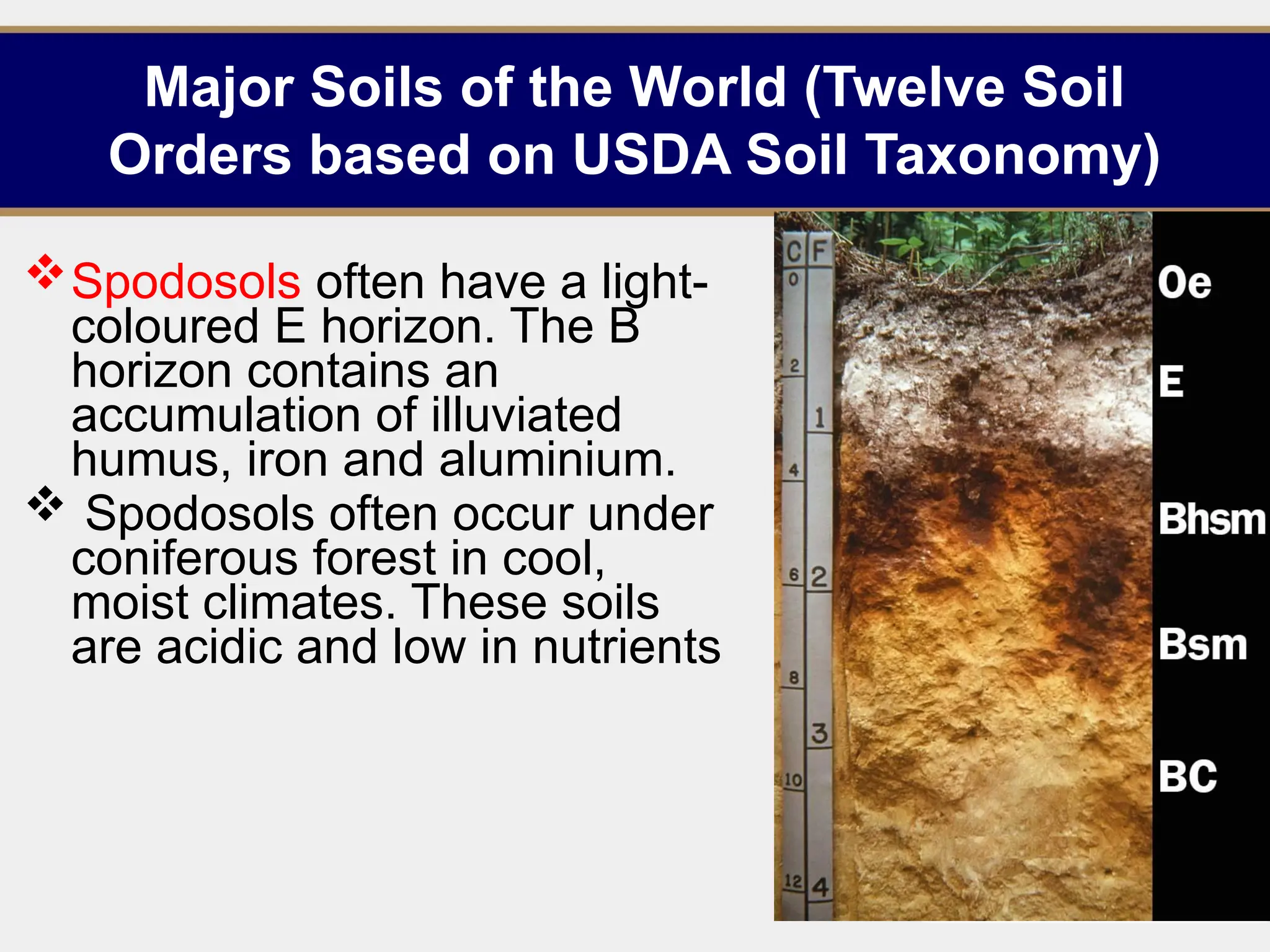
Spodosols often have a light-
coloured E horizon. The B
horizon contains an
accumulation of illuviated
humus, iron and aluminium.
Spodosols often occur under
coniferous forest in cool,
moist climates. These soils
are acidic and low in nutrients
18
19.
Major Soils ofthe World (Twelve Soil
Orders based on USDA Soil Taxonomy)
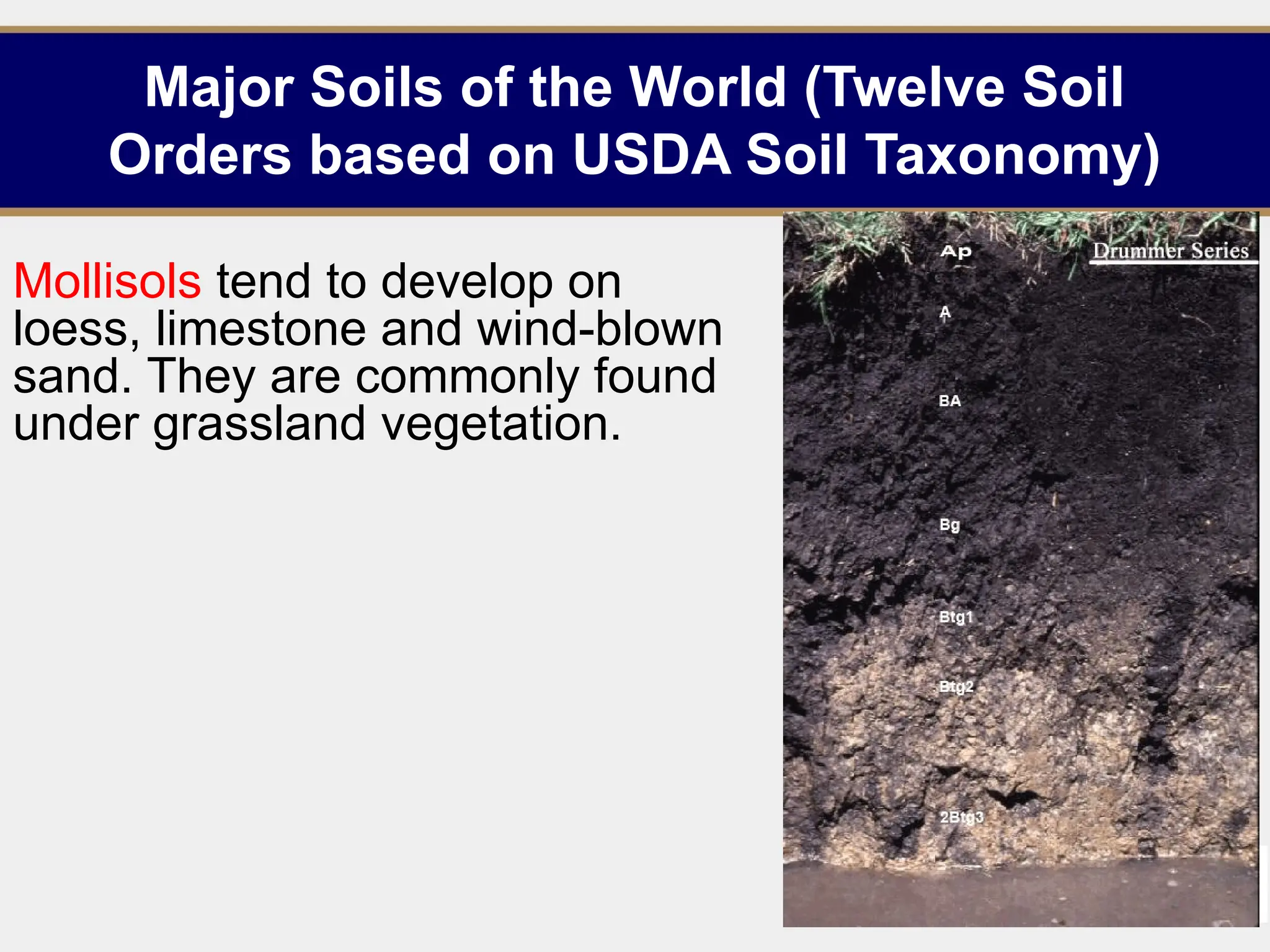
Mollisols tend to develop on
loess, limestone and wind-blown
sand. They are commonly found
under grassland vegetation.
19
20.
Major Soils ofthe World (Twelve Soil
Orders based on USDA Soil Taxonomy)
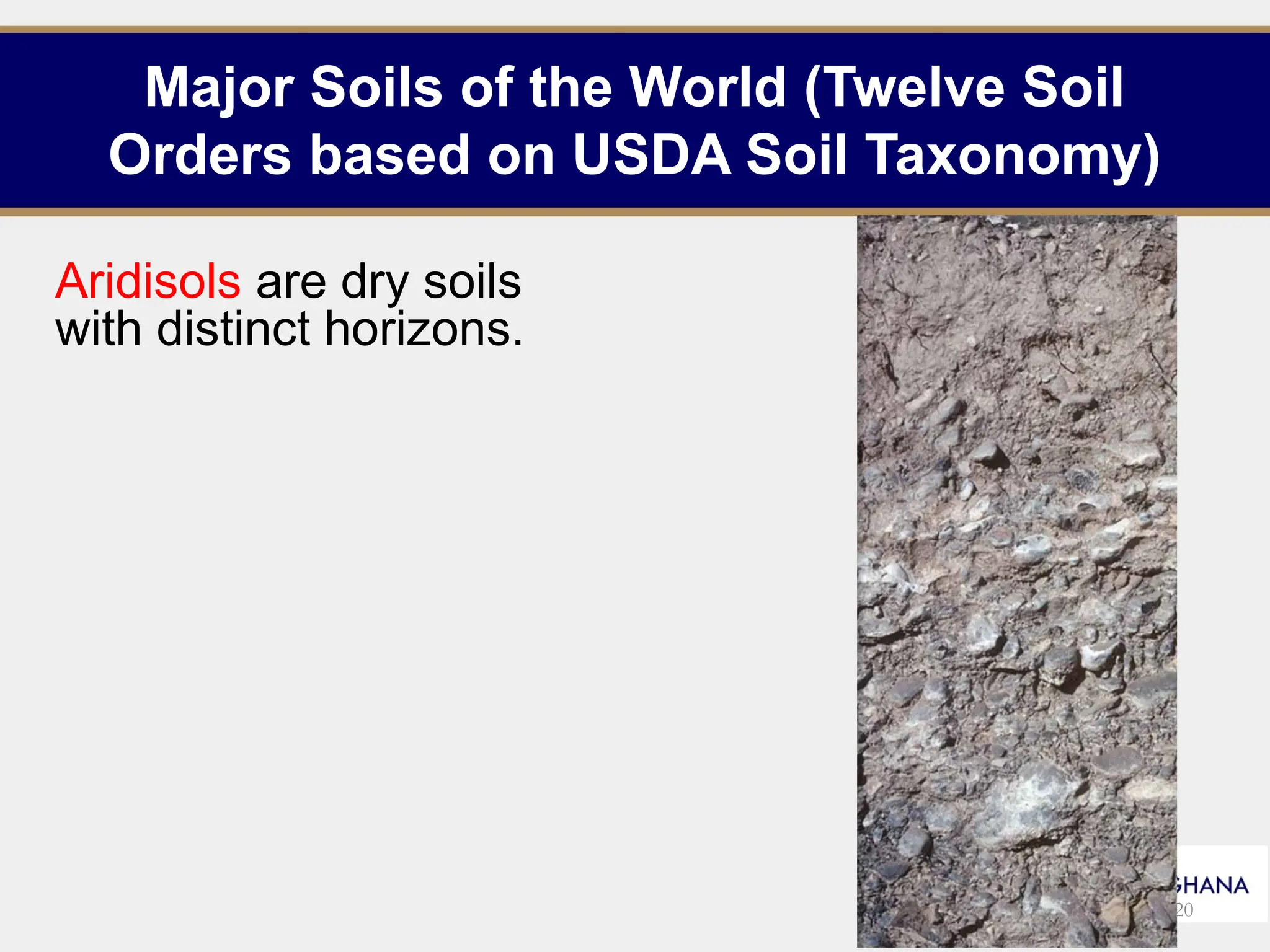
Aridisols are dry soils
with distinct horizons.
20
21.
Major Soils ofthe World (Twelve Soil
Orders based on USDA Soil Taxonomy)
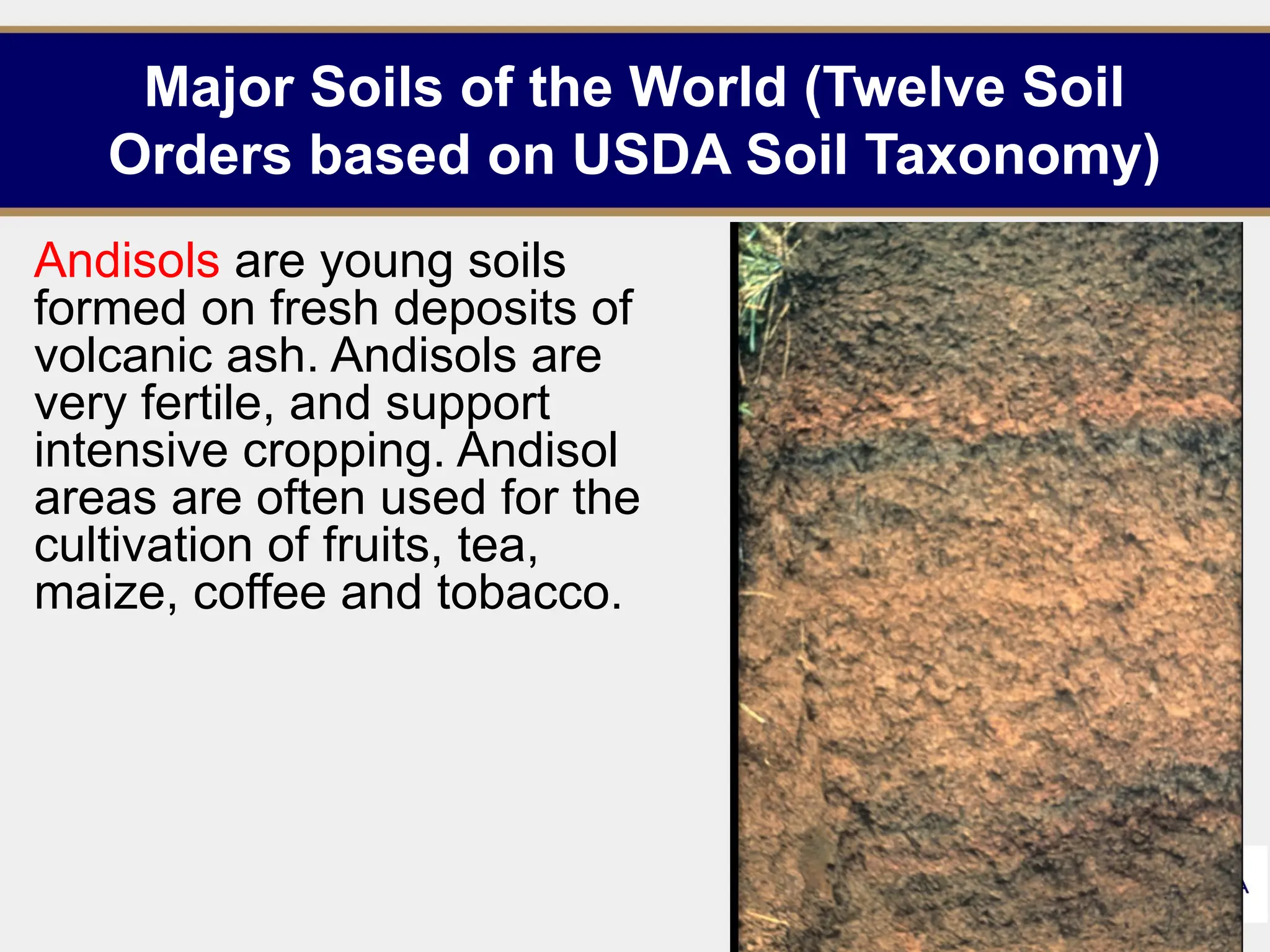
Andisols are young soils
formed on fresh deposits of
volcanic ash. Andisols are
very fertile, and support
intensive cropping. Andisol
areas are often used for the
cultivation of fruits, tea,
maize, coffee and tobacco.
21
22.
Major Soils ofthe World (Twelve Soil
Orders based on USDA Soil Taxonomy)
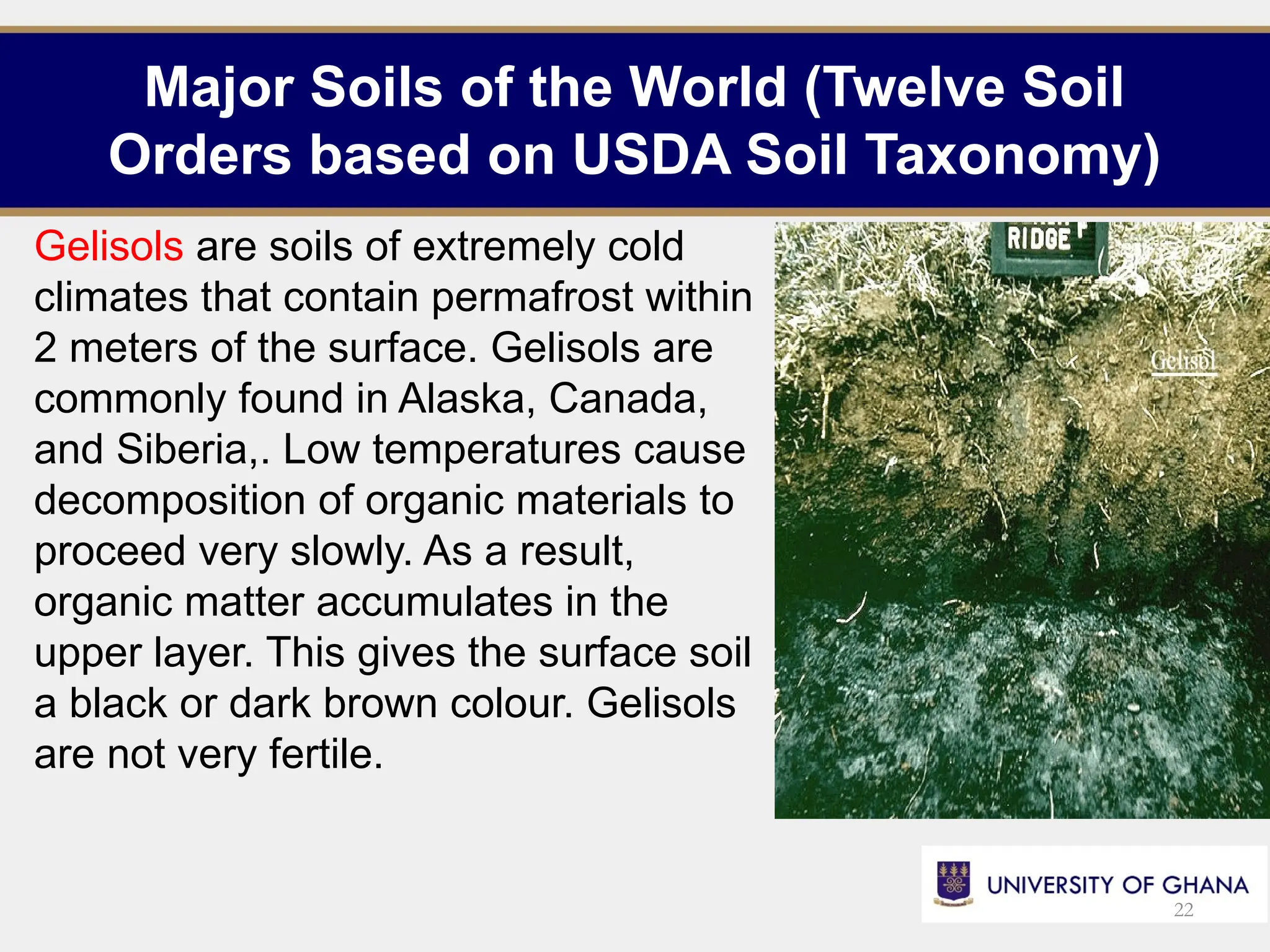
Gelisols are soils of extremely cold
climates that contain permafrost within
2 meters of the surface. Gelisols are
commonly found in Alaska, Canada,
and Siberia,. Low temperatures cause
decomposition of organic materials to
proceed very slowly. As a result,
organic matter accumulates in the
upper layer. This gives the surface soil
a black or dark brown colour. Gelisols
are not very fertile.
22
23.
Soils in theforest zone of Ghana (II)
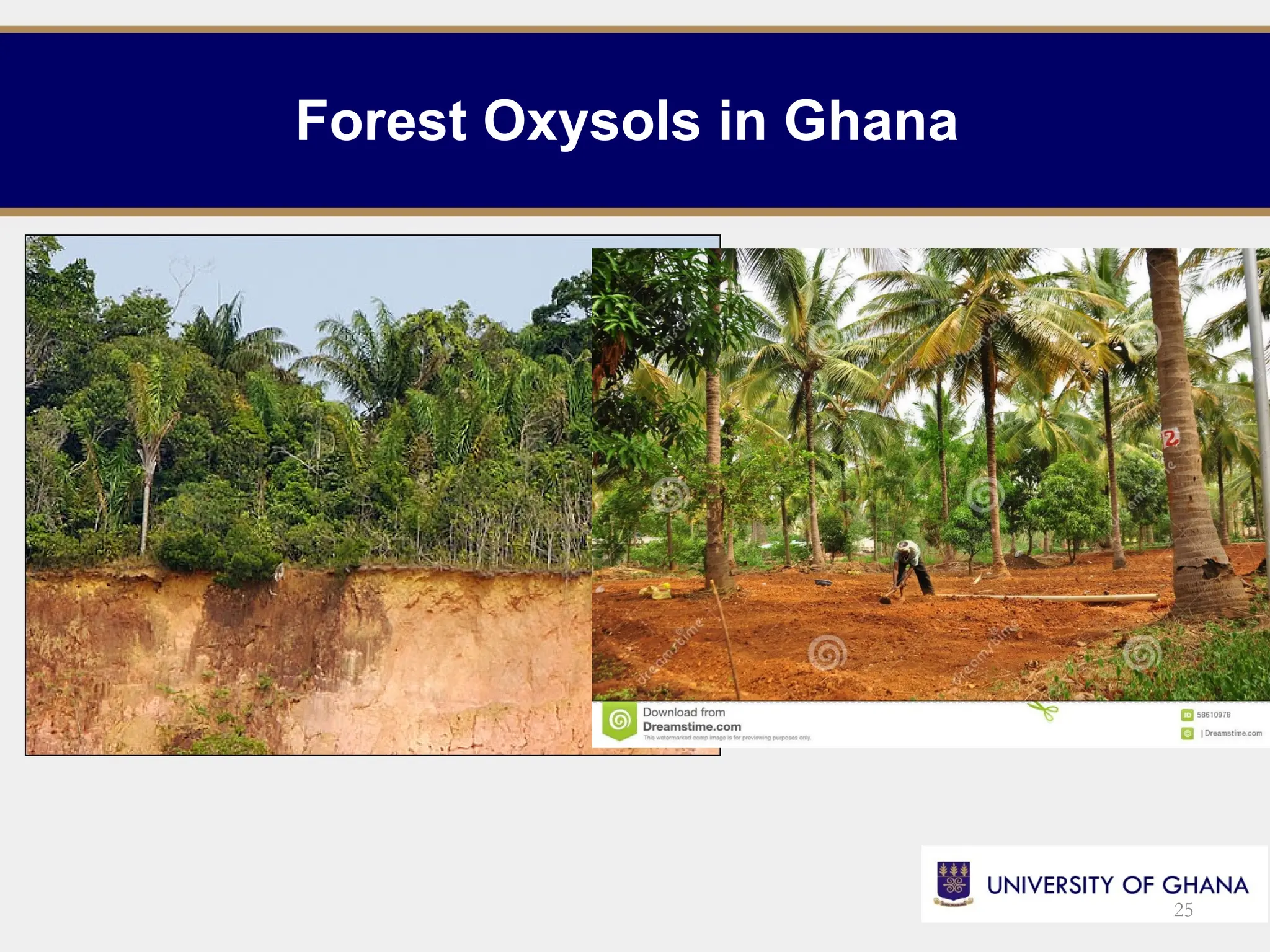
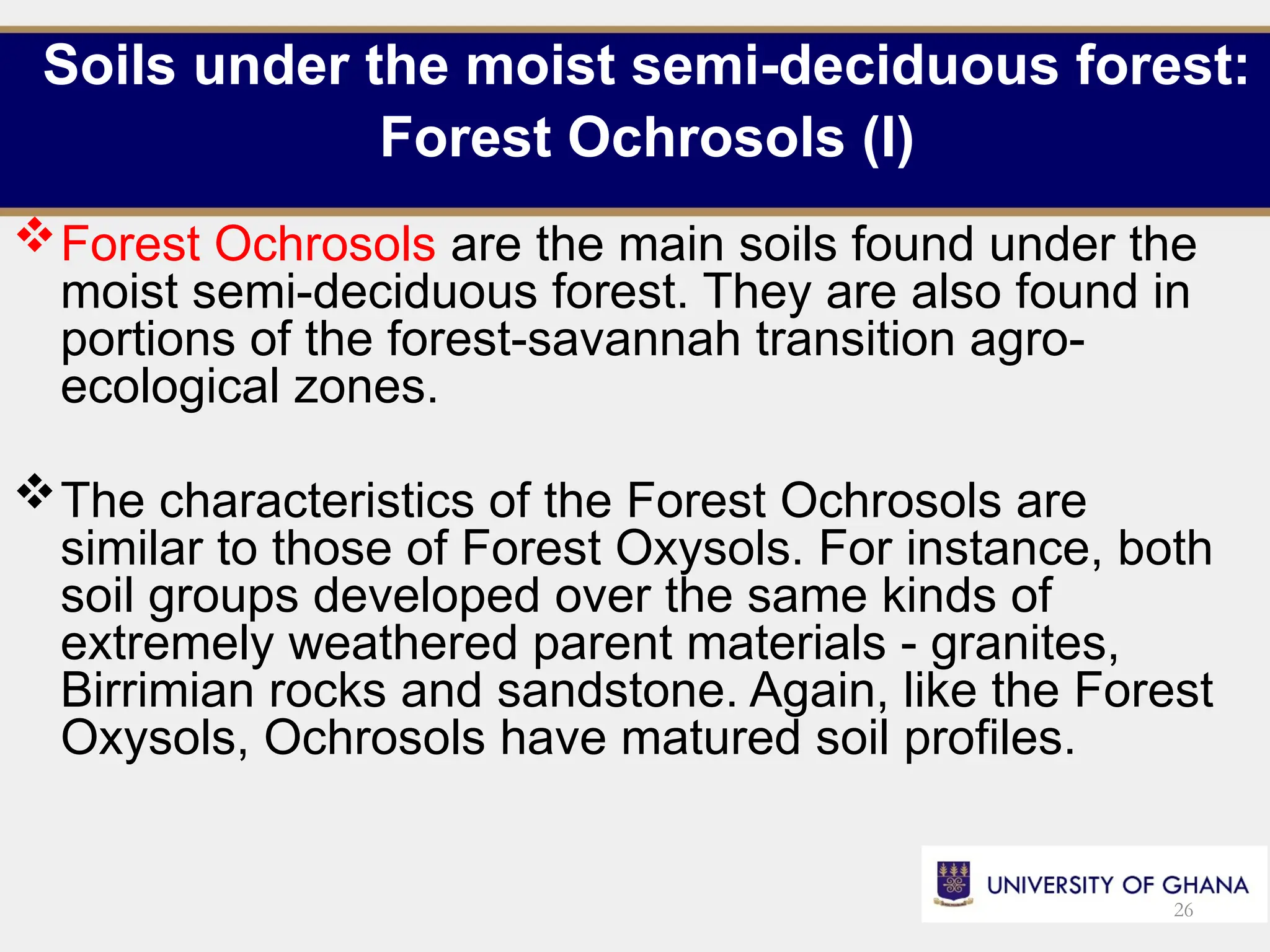
The forest oxysols: found under the rain forest in
the South-Western part of Ghana. They generally
develop in areas with annual rainfall amounts of
1800 mm and above, but some have also been
identified in some areas with annual rainfall
amounts of around 1600 mm on certain parent
materials (Brammer, 1962).
The soils are formed over a wide range of highly
weathered parent materials, notably granite,
Tarkwaian, and Birrimian rocks.
23
24.
Soils in theforest zone of
Ghana (II)
Oxysols have matured profiles, and their colour
ranges from brown to orange.
The texture of these soils also largely depends on the
parent material. However, most Oxysols are loamy
and well drained. The heavy precipitation in the forest
zone promotes rapid decomposition. Hence, organic
matter content of Oxysols is lower than those of
Forest Ochrosols.
Because they are strongly acid, Forest Oxysols are
only good for the cultivation of acid tolerant tree
crops, such as coconut, coffee, oil palm and rubber.
24
Soils under themoist semi-deciduous forest:
Forest Ochrosols (I)
Forest Ochrosols are the main soils found under the
moist semi-deciduous forest. They are also found in
portions of the forest-savannah transition agro-
ecological zones.
The characteristics of the Forest Ochrosols are
similar to those of Forest Oxysols. For instance, both
soil groups developed over the same kinds of
extremely weathered parent materials - granites,
Birrimian rocks and sandstone. Again, like the Forest
Oxysols, Ochrosols have matured soil profiles.
26
27.
Soils under themoist semi-deciduous forest:
Forest Ochrosols (II)
• However, as rainfall amounts in regions with Forest
Ochrosols are not as high as those with Forest
Oxysols, Ochrosols are not as highly leached as
Forest Oxysols. Consequently, Forest Ochrosols tend
to contain higher quantities of nutrients, and are also
relatively less acid.
27
28.
Soils under themoist semi-deciduous
forest: Forest Ochrosols (III)
Since Forest Ochrosols are relatively less acid,
they are suitable for the cultivation of a wide range
of crops.
The common tree crops that can be cultivated on
these soils include: cocoa, oil palm, rubber and
citrus. Forest Ochrosols can also support food
crops, such as cassava, plantain, yams and maize.
28
29.
Intergrades
There are somesoils whose features are intermediate
between forest Ochrosol and Oxysol. These are called
Ochrosol-Oxysol intergrades. The term intergrade means
“intermediate in grade”.
The Ochrosol-Oxysol Intergrades occupy the areas
between the Forest Ochrosols and Forest Oxysols.
Another soil group in the forest zone of Ghana is the
Rubrisol-Ochrosol intergrades, which are found in very
few areas within the Forest Ochrosol region.
These soils are not so leached and therefore contain
more nutrients than the Forest Ochrosols. In fact, as far
as crop production is concerned, the rubrisol-ochrosol
intergrades are among the best soils in Ghana.
29
30.
Soils under theInterior Wooded Savanna of
Ghana
Savanna Ochrosols
These soils are similar to the Forest Ochrosols except that they are
found in the savanna areas with semi-arid climatic conditions. The
soils developed over granites, sandstone and shale. The main
difference between these soils and the Forest Ochrosols is that the
Savanna Ochrosols have less nutrient levels and are also less acid
than their forest counterparts. The Savanna Ochrosols can be
divided into Red and Yellow Savanna Ochrosols.
Although nutrients levels of Savanna Ochrosols are not as high as
they are in the Forest Ochrosols, the Savanna Ochrosols are quite
good for crop production. This is due to the fact that these soils are
less acid. In fact, the bulk of Ghana’s food crops are grown on these
soils. The most common crops that are cultivated on these soils are:
maize, millet, cowpea, groundnuts, yams, and cassava. The major
factors that militate against crop production on these soils are low
nutrient and moisture levels.
30
31.
Groundwater Laterites (I)
TheGroundwater Laterites are the most extensive soil
group in the interior wooded savanna zone. They cover
about 75% of this zone. They developed over Voltaian
shales and granites.
Below the surface of groundwater laterites is a
“cemented layer” of ironstone, referred to as iron pan.
This hard layer, which is the main characteristics of the
Groundwater Laterites, makes it difficult for water to
pass through the soil. Consequently, the surface soil
becomes waterlogged in the rainy season, but dries
out in the dry season.
The colour of the soil ranges from pale brown to pale
grey. Groundwater Laterites are generally poor in
nutrients and in organic matter.
31
32.
Groundwater Laterites (II)
Theagricultural potential of Groundwater Laterites is
significantly limited by the abundance of iron pan (hard
layer of ironstone).
The soils also have less nutrient and moisture levels. The
extreme waterlogging that occurs in the rainy season also
affects the availability of oxygen to roots of plants.
Despite these limitations, some crops are cultivated on
these soils. These include millet, maize, groundnuts and
cowpea. In addition, wetland rice is grown on the low flat
terrains which are inundated in the rainy season.
32
33.
Soils in theSouth-East Coastal Savanna
Zone of Ghana
Tropical Black Clays (Earths)
The Tropical Black Clays (also known as the Akuse soils) are
mostly found in the coastal savanna zone. These soils are
developed over basic gneiss in the Accra-Ho-Keta plains.
Tropical Black Clays are generally heavy and sticky during the
rainy season. However, in the dry season, they become hard
and develop wide cracks.
Given that Tropical Black Clays are very heavy and sticky when
wet and very hard when dry, they can only be ploughed within a
limited range of soil moisture content that is naturally difficult to
attain. Consequently, a greater proportion of these soils are not
often cultivated. Commercial crop production on these soils
occurs on irrigated lands (e.g Asutuare, Kpong, Afife irrigation
projects). Sugar cane and Rice are the main crops on these
irrigated fields.
33
34.
Tropical Grey Earths
These soils are also commonly found in the coastal savanna zone
of Ghana. They actually occupy the rest of the gneiss areas lying
to the east of the black clays. They usually develop on lower
slopes where they are locally influenced by drainage. The soils
consist of a thin layer of grey sand overlying clay pan (very hard
clay). To some extent, the tropical grey earths are similar to the
tropical black soils. The main difference is that the grey soils are
slightly acid.
The presence of hardpan near the surface of the soil seriously
affects water infiltration and the development of roots. Again, the
topsoils are very low in nutrients and the subsoils which are
relatively richer in nutrients are not accessible to plant roots.
Consequently, these soils are mostly used as open grazing fields.
34
35.
Sodium Vleisols
These arealkaline soils commonly found in areas around
salty coastal lagoons and creeks of the lower end of the
Volta River. Specifically, they stretch eastward from the
Songaw lagoon to the Togo border along the coast of
Ghana.
These soils are black or dark grey in colour. They are
clayey soils which become sticky in the rainy season, but
lose a significant proportion of their moisture in the dry
season. The Sodium Vleisols are not very suitable for
crop production. Sugarcane is, however, cultivated on
Sodium Vleisols around the Lower Volta Basin
35
36.
Other minor soilgroups
Lithosols: These are shallow soils formed on steep
slopes. They have very little agricultural value.
Alluviosols: These soils develop along the borders of
rivers and streams. They are either recent alluvial
deposits or presently influenced by the floods of these
drainage channels. The topsoils are generally sandy,
loamy or clayey. Their suitability for agriculture is
limited by their locations in the flood plains. Sugarcane
is commonly cultivated on these soils. In addition, they
are locally used for wetland rice. Dry season vegetable
gardening is common in some parts of the country
where there are these soils.
36
#5 Classification of earth materials for engineering purposes uses the Unified Soil Classification System (USCS), which is based on a combination of physical and behavioral properties (An ingenious feature of the system is the differentiation of silts and clays by means of the plasticity chart).
American Association of State Highway and Transportation Officials, and is used as a guide for the classification of soils and soil-aggregate mixtures for highway construction purposes (American Association of State Highway and Transportation Officials (AASHTO 2012) does not classify soils by type (e.g. sands, clays) but simply divides them into seven major groups, essentially classifying soils according to their suitability as subgrades)
FAA classification of soils for airport construction
Defines twelve major soil texture classifications
The Food and Agriculture Organization of the United Nations (FAO) developed a supra-national classification, which offers useful generalizations about pedogenesis in relation to the interactions between the main soil-forming factors
#6 USDA soil taxonomy (ST) developed by the United States Department of Agriculture and the National Cooperative Soil Survey provides an elaborate classification of soil types according to several parameters (most commonly their properties) and in several levels: Order, Suborder, Great Group, Subgroup, Family, and Series.
Order: It is the highest (broadest) category. The names of orders are a combinations of formative elements (which defines the characteristics of the soils), and the ending sols. Example the soil order Aridosols are characteristically dry soils in arid regions. Inceptisols are soils with only the beginning or inception of profile development.
#23 In the Ghana's soil classification system, the factors of soil formation are more central than the concept of diagnostic horizons as contained in the Soil Taxonomy
Brief overview of the Interim Ghana Soil Classification System (Brammer, 1962)
The system recognizes the following categories (levels):
Order
Suborder
Soil group family
Great soil group
Great soil subgroup
Soil series (and phases of soil series).
#31 The laterite soil is formed under conditions of high temperature and heavy rainfall with alternate wet and dry periods, which leads to leaching of soil, leaving only oxides of iron and aluminum. It lacks fertility due to a lower base-exchanging capacity and a lower content of nitrogen, phosphorus, and potassium
Laterite hardpans (hard, impervious layers composed chiefly of iron and aluminum oxides cemented by relatively insoluble materials) by capillary movement (the movement of water containing mineral salts to the surface)
#33 An expansive tropical black clay (also known as black cotton soil because the cotton plant thrives well on it
#34 The sparsely populated Grey Earths are not cultivated but these soils provide the major grazing grounds on the plains.