U N I V E R S I T Y O F A A R H U S
Faculty of Agricultural Sciences
The role of soil science
in optimization of
soil resource management
Per Schjønning
University of Aarhus
Faculty of Agricultural Sciences
NJF Congress
June 27-29 2007, Copenhagen
Plan for presentation
• Values in science and the Soil Quality concept
• Risk Assessment (Soil Framework Directive)
• Tools for analysing and regulating the system
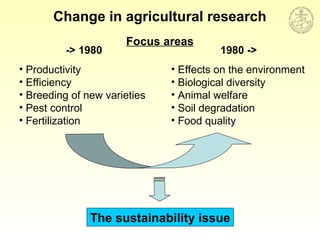
Change in agricultural research
-> 1980
• Productivity
• Efficiency
• Breeding of new varieties
• Pest control
• Fertilization
1980 ->
• Effects on the environment
• Biological diversity
• Animal welfare
• Soil degradation
• Food quality
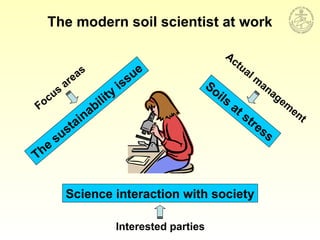
The sustainability issue
Focus areas
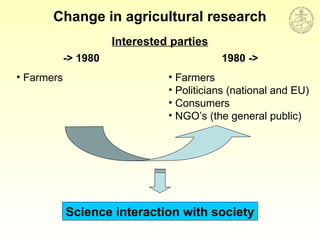
Change in agricultural research
Science interaction with society
Interested parties
-> 1980
• Farmers
1980 ->
• Farmers
• Politicians (national and EU)
• Consumers
• NGO’s (the general public)
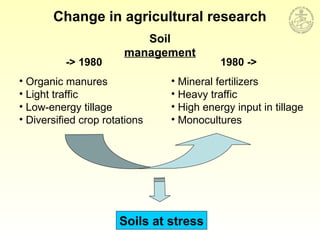
Change in agricultural research
-> 1980
• Organic manures
• Light traffic
• Low-energy tillage
• Diversified crop rotations
1980 ->
• Mineral fertilizers
• Heavy traffic
• High energy input in tillage
• Monocultures
Soils at stress
Soil
management
The
sustainability
issue
Science interaction with society
Soils
at stress
The modern soil scientist at work
Focus
areas
Interested parties
Actual m
anagem
ent
The SSSA SQ definition
Soil quality is the capacity of a specific kind of soil
to function, within natural or managed ecosystem
boundaries, to sustain plant and animal productivity,
maintain or enhance water and air quality,
and support human health and habitation
(Agronomy News, June 1995)
Soil quality
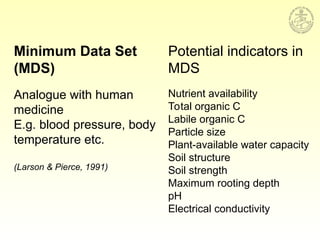
Minimum Data Set
(MDS)
Analogue with human
medicine
E.g. blood pressure, body
temperature etc.
(Larson & Pierce, 1991)
Potential indicators in
MDS
Nutrient availability
Total organic C
Labile organic C
Particle size
Plant-available water capacity
Soil structure
Soil strength
Maximum rooting depth
pH
Electrical conductivity
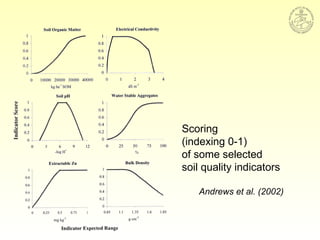
Scoring
(indexing 0-1)
of some selected
soil quality indicators
Andrews et al. (2002)
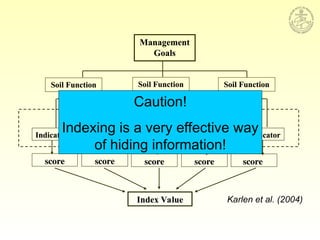
Soil Function Soil Function Soil Function
Management
Goals
Minimum Data Set
Indicator Indicator Indicator Indicator
Indicator
score score score score
score
Index Value
Soil Function Soil Function Soil Function
Management
Goals
Minimum Data Set
Indicator Indicator Indicator Indicator
Indicator
score score score score
score
Index Value
Soil Function Soil Function Soil Function
Management
Goals
Minimum Data Set
Indicator Indicator Indicator Indicator
Indicator
score score score score
score
Index Value Karlen et al. (2004)
Caution!
Indexing is a very effective way
of hiding information!
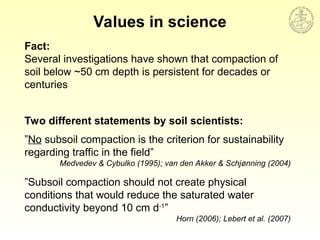
Values in science
”No subsoil compaction is the criterion for sustainability
regarding traffic in the field”
Medvedev & Cybulko (1995); van den Akker & Schjønning (2004)
”Subsoil compaction should not create physical
conditions that would reduce the saturated water
conductivity beyond 10 cm d-1
”
Horn (2006); Lebert et al. (2007)
Fact:
Several investigations have shown that compaction of
soil below ~50 cm depth is persistent for decades or
centuries
Two different statements by soil scientists:
Soil quality is how well
soil does
what we want it to do
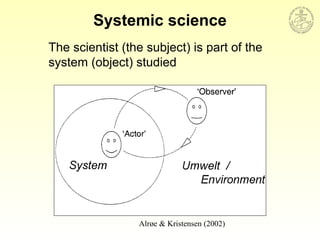
The scientist (the subject) is part of the
system (object) studied
Systemic science
Alrøe & Kristensen (2002)
Reflexive objectivity
The ability to perform science
with full awareness
of the values in play
Based on Alrøe and Kristensen (2002)
Reflexive objective
- some implications
• Beware of the overall purpose of your research
• Present the results together with your own priorities
• Identify potential precautionary actions,- but
present them separately
Plan for presentation
• Values in science and the Soil Quality concept
• Risk Assessment (Soil Framework Directive)
• Tools for analysing and regulating the system
Resistance = capacity to resist change
Resilience = capacity to return to pre-stressed situation
Stability of soil
properties and functions
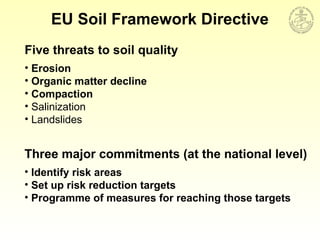
EU Soil Framework Directive
Five threats to soil quality
• Erosion
• Organic matter decline
• Compaction
• Salinization
• Landslides
Three major commitments (at the national level)
• Identify risk areas
• Set up risk reduction targets
• Programme of measures for reaching those targets
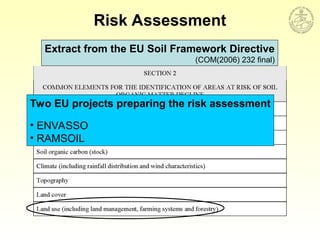
Extract from the EU Soil Framework Directive
(COM(2006) 232 final)
Risk Assessment
Two EU projects preparing the risk assessment
• ENVASSO
• RAMSOIL
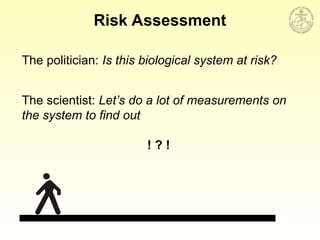
Risk Assessment
The politician: Is this biological system at risk?
The scientist: Let’s do a lot of measurements on
the system to find out
! ? !
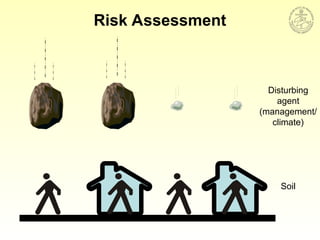
Risk Assessment
Disturbing
agent
(management/
climate)
Soil
Risk Assessment
”A process intended to calculate or
estimate the risk to a given target organism,
system or sub(population), including the
identification of attendant uncertainties, following
exposure to a particular agent, taking into
account the inherent characteristics of
the agent of concern as well as
the characteristics of the specific target system”
OECD (2003)
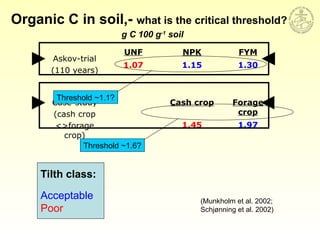
Askov-trial
(110 years)
UNF NPK FYM
1.07 1.15 1.30
Case-study
(cash crop
<>forage
crop)
Cash crop Forage
crop
1.45 1.97
Tilth class:
Acceptable
Poor
Organic C in soil,- what is the critical threshold?
g C 100 g-1
soil
(Munkholm et al. 2002;
Schjønning et al. 2002)
Threshold ~1.1?
Threshold ~1.6?
Indicator
threshold
(soil type 1)
Indicator
threshold
(soil type 2)
Indicator
threshold
(soil type 3)
Indicator
threshold
(soil type 4)
Indicator
threshold
(universal [indexed])
Soil indicator thresholds
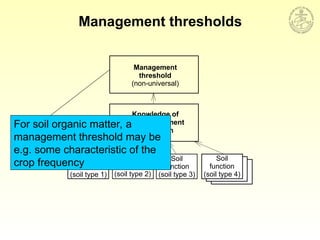
Management thresholds
Management
threshold
(non-universal)
Soil
function
(soil type 1)
Soil
function
(soil type 2)
Soil
function
(soil type 3)
Soil
function
(soil type 4)
Knowledge of
soil/management
interaction
For soil organic matter, a
management threshold may be
e.g. some characteristic of the
crop frequency
Plan for presentation
• Values in science and the Soil Quality concept
• Risk Assessment (Soil Framework Directive)
• Tools for analysing and regulating the system
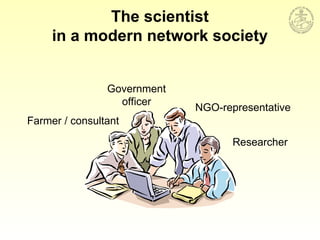
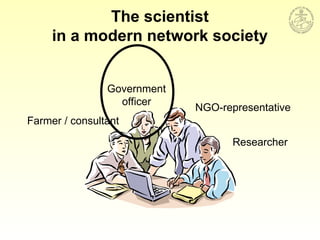
Researcher
NGO-representative
Government
officer
Farmer / consultant
The scientist
in a modern network society
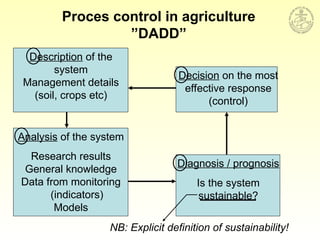
Diagnosis / prognosis
Is the system
sustainable?
Proces control in agriculture
”DADD”
NB: Explicit definition of sustainability!
Description of the
system
Management details
(soil, crops etc)
Analysis of the system
Research results
General knowledge
Data from monitoring
(indicators)
Models
Decision on the most
effective response
(control)
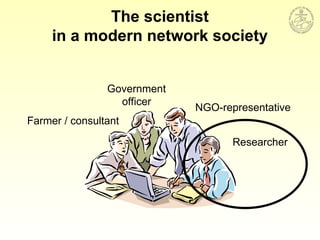
Researcher
NGO-representative
Government
officer
Farmer / consultant
The scientist
in a modern network society
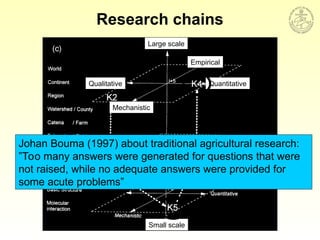
Research chains
Bouma, 2001
Large scale
Small scale
Mechanistic
Empirical
Quantitative
Qualitative
Johan Bouma (1997) about traditional agricultural research:
”Too many answers were generated for questions that were
not raised, while no adequate answers were provided for
some acute problems”
Mechanistic
Empirical
Qualitative Quantitative
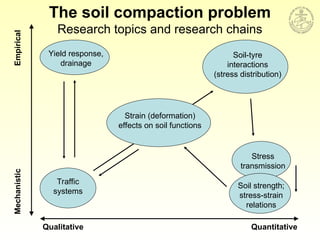
The soil compaction problem
Research topics and research chains
Yield response,
drainage
Soil-tyre
interactions
(stress distribution)
Traffic
systems
Stress
transmission
Soil strength;
stress-strain
relations
Strain (deformation)
effects on soil functions
Researcher
NGO-representative
Government
officer
Farmer / consultant
The scientist
in a modern network society
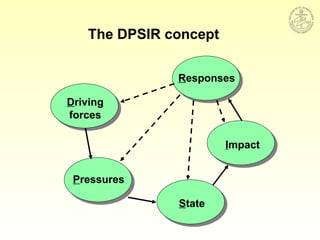
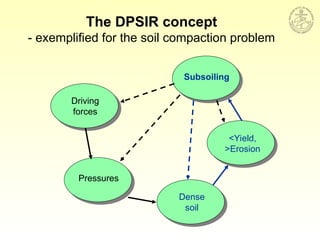
The DPSIR concept
Driving
forces
Pressures
State
Impact
Responses
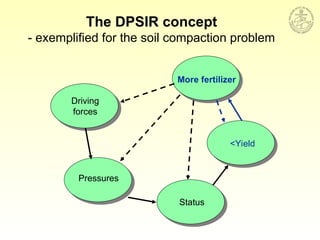
The DPSIR concept
- exemplified for the soil compaction problem
Driving
forces
Pressures
Status
<Yield
More fertilizer
Driving
forces
Pressures
Dense
soil
<Yield,
>Erosion
Subsoiling
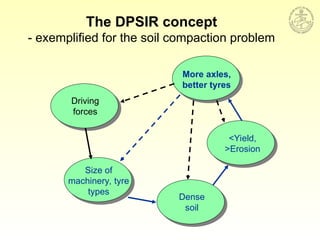
The DPSIR concept
- exemplified for the soil compaction problem
Driving
forces
Size of
machinery, tyre
types
Dense
soil
<Yield,
>Erosion
More axles,
better tyres
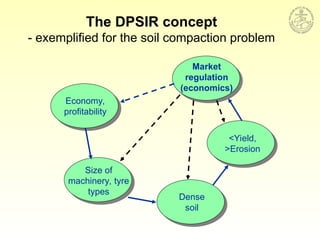
The DPSIR concept
- exemplified for the soil compaction problem
Economy,
profitability
Size of
machinery, tyre
types
Dense
soil
<Yield,
>Erosion
Market
regulation
(economics)
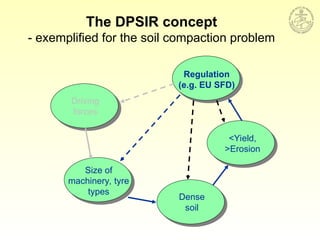
The DPSIR concept
- exemplified for the soil compaction problem
Driving
forces
Size of
machinery, tyre
types
Dense
soil
<Yield,
>Erosion
Regulation
(e.g. EU SFD)
The DPSIR concept
- exemplified for the soil compaction problem
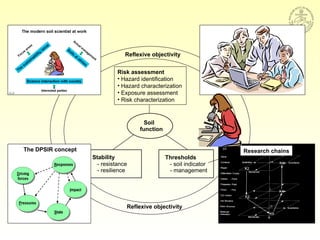
Soil
function
Stability
- resistance
- resilience
Thresholds
- soil indicator
- management
But not indexed!
Reflexive objectivity
The DPSIR concept Research chains
Risk assessment
• Hazard identification
• Hazard characterization
• Exposure assessment
• Risk characterization

NJF_Theme_7_Thursday_Per_Schjonning_net-version.ppt

  • 1.
    U N IV E R S I T Y O F A A R H U S Faculty of Agricultural Sciences The role of soil science in optimization of soil resource management Per Schjønning University of Aarhus Faculty of Agricultural Sciences NJF Congress June 27-29 2007, Copenhagen
  • 2.
    Plan for presentation •Values in science and the Soil Quality concept • Risk Assessment (Soil Framework Directive) • Tools for analysing and regulating the system
  • 3.
    Change in agriculturalresearch -> 1980 • Productivity • Efficiency • Breeding of new varieties • Pest control • Fertilization 1980 -> • Effects on the environment • Biological diversity • Animal welfare • Soil degradation • Food quality The sustainability issue Focus areas
  • 4.
    Change in agriculturalresearch Science interaction with society Interested parties -> 1980 • Farmers 1980 -> • Farmers • Politicians (national and EU) • Consumers • NGO’s (the general public)
  • 5.
    Change in agriculturalresearch -> 1980 • Organic manures • Light traffic • Low-energy tillage • Diversified crop rotations 1980 -> • Mineral fertilizers • Heavy traffic • High energy input in tillage • Monocultures Soils at stress Soil management
  • 6.
    The sustainability issue Science interaction withsociety Soils at stress The modern soil scientist at work Focus areas Interested parties Actual m anagem ent
  • 7.
    The SSSA SQdefinition Soil quality is the capacity of a specific kind of soil to function, within natural or managed ecosystem boundaries, to sustain plant and animal productivity, maintain or enhance water and air quality, and support human health and habitation (Agronomy News, June 1995) Soil quality
  • 8.
    Minimum Data Set (MDS) Analoguewith human medicine E.g. blood pressure, body temperature etc. (Larson & Pierce, 1991) Potential indicators in MDS Nutrient availability Total organic C Labile organic C Particle size Plant-available water capacity Soil structure Soil strength Maximum rooting depth pH Electrical conductivity
  • 9.
    Scoring (indexing 0-1) of someselected soil quality indicators Andrews et al. (2002)
  • 10.
    Soil Function SoilFunction Soil Function Management Goals Minimum Data Set Indicator Indicator Indicator Indicator Indicator score score score score score Index Value Soil Function Soil Function Soil Function Management Goals Minimum Data Set Indicator Indicator Indicator Indicator Indicator score score score score score Index Value Soil Function Soil Function Soil Function Management Goals Minimum Data Set Indicator Indicator Indicator Indicator Indicator score score score score score Index Value Karlen et al. (2004) Caution! Indexing is a very effective way of hiding information!
  • 11.
    Values in science ”Nosubsoil compaction is the criterion for sustainability regarding traffic in the field” Medvedev & Cybulko (1995); van den Akker & Schjønning (2004) ”Subsoil compaction should not create physical conditions that would reduce the saturated water conductivity beyond 10 cm d-1 ” Horn (2006); Lebert et al. (2007) Fact: Several investigations have shown that compaction of soil below ~50 cm depth is persistent for decades or centuries Two different statements by soil scientists:
  • 12.
    Soil quality ishow well soil does what we want it to do
  • 13.
    The scientist (thesubject) is part of the system (object) studied Systemic science Alrøe & Kristensen (2002)
  • 14.
    Reflexive objectivity The abilityto perform science with full awareness of the values in play Based on Alrøe and Kristensen (2002)
  • 15.
    Reflexive objective - someimplications • Beware of the overall purpose of your research • Present the results together with your own priorities • Identify potential precautionary actions,- but present them separately
  • 16.
    Plan for presentation •Values in science and the Soil Quality concept • Risk Assessment (Soil Framework Directive) • Tools for analysing and regulating the system
  • 17.
    Resistance = capacityto resist change Resilience = capacity to return to pre-stressed situation Stability of soil properties and functions
  • 18.
    EU Soil FrameworkDirective Five threats to soil quality • Erosion • Organic matter decline • Compaction • Salinization • Landslides Three major commitments (at the national level) • Identify risk areas • Set up risk reduction targets • Programme of measures for reaching those targets
  • 19.
    Extract from theEU Soil Framework Directive (COM(2006) 232 final) Risk Assessment Two EU projects preparing the risk assessment • ENVASSO • RAMSOIL
  • 20.
    Risk Assessment The politician:Is this biological system at risk? The scientist: Let’s do a lot of measurements on the system to find out ! ? !
  • 21.
  • 22.
    Risk Assessment ”A processintended to calculate or estimate the risk to a given target organism, system or sub(population), including the identification of attendant uncertainties, following exposure to a particular agent, taking into account the inherent characteristics of the agent of concern as well as the characteristics of the specific target system” OECD (2003)
  • 23.
    Askov-trial (110 years) UNF NPKFYM 1.07 1.15 1.30 Case-study (cash crop <>forage crop) Cash crop Forage crop 1.45 1.97 Tilth class: Acceptable Poor Organic C in soil,- what is the critical threshold? g C 100 g-1 soil (Munkholm et al. 2002; Schjønning et al. 2002) Threshold ~1.1? Threshold ~1.6?
  • 24.
    Indicator threshold (soil type 1) Indicator threshold (soiltype 2) Indicator threshold (soil type 3) Indicator threshold (soil type 4) Indicator threshold (universal [indexed]) Soil indicator thresholds
  • 25.
    Management thresholds Management threshold (non-universal) Soil function (soil type1) Soil function (soil type 2) Soil function (soil type 3) Soil function (soil type 4) Knowledge of soil/management interaction For soil organic matter, a management threshold may be e.g. some characteristic of the crop frequency
  • 26.
    Plan for presentation •Values in science and the Soil Quality concept • Risk Assessment (Soil Framework Directive) • Tools for analysing and regulating the system
  • 27.
  • 28.
    Diagnosis / prognosis Isthe system sustainable? Proces control in agriculture ”DADD” NB: Explicit definition of sustainability! Description of the system Management details (soil, crops etc) Analysis of the system Research results General knowledge Data from monitoring (indicators) Models Decision on the most effective response (control)
  • 29.
  • 30.
    Research chains Bouma, 2001 Largescale Small scale Mechanistic Empirical Quantitative Qualitative Johan Bouma (1997) about traditional agricultural research: ”Too many answers were generated for questions that were not raised, while no adequate answers were provided for some acute problems”
  • 31.
    Mechanistic Empirical Qualitative Quantitative The soilcompaction problem Research topics and research chains Yield response, drainage Soil-tyre interactions (stress distribution) Traffic systems Stress transmission Soil strength; stress-strain relations Strain (deformation) effects on soil functions
  • 32.
  • 33.
  • 34.
    The DPSIR concept -exemplified for the soil compaction problem Driving forces Pressures Status <Yield More fertilizer
  • 35.
  • 36.
    Driving forces Size of machinery, tyre types Dense soil <Yield, >Erosion Moreaxles, better tyres The DPSIR concept - exemplified for the soil compaction problem
  • 37.
  • 38.
    Driving forces Size of machinery, tyre types Dense soil <Yield, >Erosion Regulation (e.g.EU SFD) The DPSIR concept - exemplified for the soil compaction problem
  • 39.
    Soil function Stability - resistance - resilience Thresholds -soil indicator - management But not indexed! Reflexive objectivity Reflexive objectivity The DPSIR concept Research chains Risk assessment • Hazard identification • Hazard characterization • Exposure assessment • Risk characterization