Soil Information for
policy making
Towards Global Soil Information: Activities Within The Geo Task
Global Soil Data
Rome, 20/03/2012
Thomas Straßburger, EC – DG ENV B.1
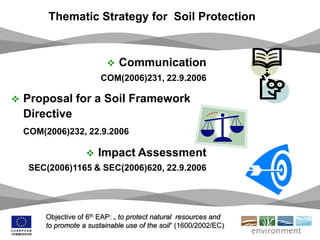
 Communication
COM(2006)231, 22.9.2006
 Proposal for a Soil Framework
Directive
COM(2006)232, 22.9.2006
 Impact Assessment
SEC(2006)1165 & SEC(2006)620, 22.9.2006
Thematic Strategy for Soil Protection
Objective of 6th EAP: „ to protect natural resources and
to promote a sustainable use of the soil“ (1600/2002/EC)
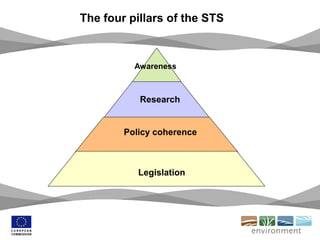
Legislation
Research
Policy coherence
Awareness
The four pillars of the STS
Subsidiarity
Summary of the proposed action
 CF to protect soil („preservation of soil functions, prevention of soil degradation,
mitigation of its effects, restoration of degraded soils and integration in other
sectoral policies“);
 Identifying and assessing impact of sectoral policies on soil degradation;
 Requirement to take precautionary measures;
 Reducing soil sealing („maintaining as many soil functions as possible“);
 Defining areas at risk of erosion, organic matter decline, salinisation,...;
 Setting up an inventory of contaminated sites (location, spatial distribution, size)
The Ten Plagues
Main threats to a sustained quality of soils in Europe as identified by the
SFD:
 Erosion
 Organic matter decline
 Compaction
 Salinisation
 Landslides
 Acidification
 Biodiversity decline
 Contamination
 Sealing
 Ignorance
European dimension ?
Milestone:
By 2020, EU policies take into account their direct and
indirect impact on land use in the EU and globally, and
the rate of land take is on track with an aim to achieve no
net land take by 2050; soil erosion is reduced and the
soil organic matter increased, with remedial work on
contaminated sites well underway.
Resource Efficiency Roadmap
COM(2011) 571, 20.9.2011
http://ec.europa.eu/environment/resource_efficiency/index_en.htm
EC:
 ... develop the scientific knowledge-base on biotic material, land-use effects and
trends, and spatial planning, including impacts at global level and effects on
trading partners, and ... ;
 publish guidelines on best practice to limit, mitigate or compensate soil sealing
(in 2012);
MS:
 ... and limit land take and soil sealing to the extent possible (continuous);
 ... actions needed for reducing erosion and increasing soil organic matter
(continuous);
 ... inventory of contaminated sites, and a schedule for remedial work ...
RE Roadmap
Zero Draft for Rio+20
An ambitious but attainable target of
‚zero net land and soil degradation‘
 Minimizing erosion;
 Maintaining and, where possible,
increasing soil organic matter;
 Preventing unsustainable and uncontrolled
urban expansion
 Follows the example of the EU Strategy for the Baltic Sea Region
 Has the objective of providing an integrated approach to sustainable
development
 Suggested specific soil-related indicative target:
 Reduce by 25% the area affected by soil erosion exceeding 10
tonnes per hectare by 2020
replaced by: By 2020, ecosystems and their services are
maintained and enhanced by ... ... restoring at least 15% of
degraded ecosystems, including degraded soils.
EU Strategy for the Danube Region
COM(2010) 715, 8.12.2010
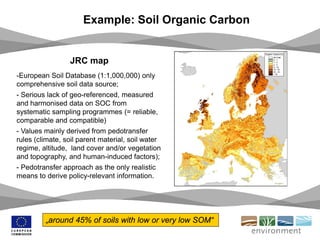
JRC map
-European Soil Database (1:1,000,000) only
comprehensive soil data source;
- Serious lack of geo-referenced, measured
and harmonised data on SOC from
systematic sampling programmes (= reliable,
comparable and compatible)
- Values mainly derived from pedotransfer
rules (climate, soil parent material, soil water
regime, altitude, land cover and/or vegetation
and topography, and human-induced factors);
- Pedotransfer approach as the only realistic
means to derive policy-relevant information.
Example: Soil Organic Carbon
„around 45% of soils with low or very low SOM“
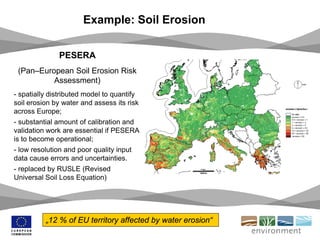
Example: Soil Erosion
PESERA
(Pan–European Soil Erosion Risk
Assessment)
- spatially distributed model to quantify
soil erosion by water and assess its risk
across Europe;
- substantial amount of calibration and
validation work are essential if PESERA
is to become operational;
- low resolution and poor quality input
data cause errors and uncertainties.
- replaced by RUSLE (Revised
Universal Soil Loss Equation)
„12 % of EU territory affected by water erosion“
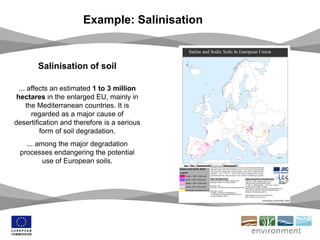
Example: Salinisation
Salinisation of soil
... affects an estimated 1 to 3 million
hectares in the enlarged EU, mainly in
the Mediterranean countries. It is
regarded as a major cause of
desertification and therefore is a serious
form of soil degradation.
... among the major degradation
processes endangering the potential
use of European soils.
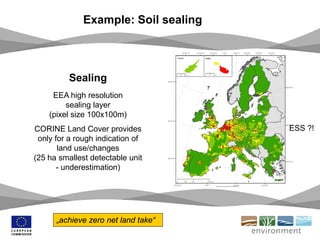
Example: Soil sealing
Sealing
EEA high resolution
sealing layer
(pixel size 100x100m)
CORINE Land Cover provides
only for a rough indication of
land use/changes
(25 ha smallest detectable unit
- underestimation)
„achieve zero net land take“
ESS ?!
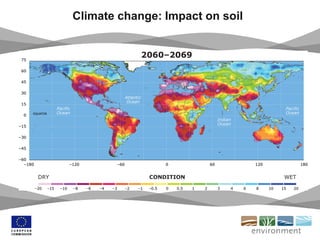
Climate change: Impact on soil
STS implementation report
COM(2012) 46, 13.02.2012
 ... globally up to 50,000 km² lost annually through land degradation, mainly
due to soil erosion (according to UNEP);
 ... model of soil erosion has estimated the area affected in EU-27 at 1.3
million km², with rates in excess of 10 t/ha/y on almost 20%;
 ... there is still no scientifically-sound assessment on desertification at
European level;
 ... salinisation affecting soil productivity, however there are no systematic
data available on trends across Europe;
 ... as there is no systematic monitoring of soil acidification across Europe;
 ... shows a preliminary assessment of where soil biodiversity is threatened;
 ... difficult to quantify the full extent of local soil contamination, as the vast
majority of Member States lack comprehensive inventories.
Research - LUCAS
Land Use/Cover Area frame Statistical Survey
Estimates of the area occupied by different land use or land cover types are
computed on the basis of observations taken at more than 250,000 sample
points throughout the EU;
Integration of a specific soil module in the 2009 and 2012 surveys;
Results to feed into European Soil Data Centre (ESDAC – JRC hosted);
Starting point for harmonised European monitoring of soil parameters for a
whole range of statistical, research and policy purposes;
Provide ground truth and calibration for many space-borne information
collection activities (such as CLC and GMES land products in general).
24 May 2011 18
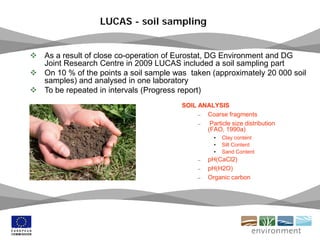
LUCAS - soil sampling
SOIL ANALYSIS
– Coarse fragments
– Particle size distribution
(FAO, 1990a)
• Clay content
• Silt Content
• Sand Content
– pH(CaCl2)
– pH(H2O)
– Organic carbon
 As a result of close co-operation of Eurostat, DG Environment and DG
Joint Research Centre in 2009 LUCAS included a soil sampling part
 On 10 % of the points a soil sample was taken (approximately 20 000 soil
samples) and analysed in one laboratory
 To be repeated in intervals (Progress report)
 Need for more precise data than available currently from Corine on land
use
 to detect smaller changes and "localised" impacts (e.g erosion
hotspots and coastal areas degradation, as well as smaller size
urban expansion beyond resolution of Corine)
 to follow up on RE milestone of no net land take by 2050
 Need for advancements on Ecosystem-services mapping
 for specific ecosystem services that are more of a regulatory /
aesthetic nature (like water retention / purification, carbon
sequestration; air purification, recreation…)
 for specific areas: riparian, coastal
 Ensuring use of JRC's work on ESS-Mapping and other work like the
detailed analysis on Forest habitat fragmentation (EIONET)
 INSPIRE - no collection of new data, but to make data available
Comments
Thanks for your kind attention
http://ec.europa.eu/environment/soil/index.htm

Soil Information for policy making - Thomas Straßburger, EC – DG ENV

  • 1.
    Soil Information for policymaking Towards Global Soil Information: Activities Within The Geo Task Global Soil Data Rome, 20/03/2012 Thomas Straßburger, EC – DG ENV B.1
  • 2.
     Communication COM(2006)231, 22.9.2006 Proposal for a Soil Framework Directive COM(2006)232, 22.9.2006  Impact Assessment SEC(2006)1165 & SEC(2006)620, 22.9.2006 Thematic Strategy for Soil Protection Objective of 6th EAP: „ to protect natural resources and to promote a sustainable use of the soil“ (1600/2002/EC)
  • 3.
  • 4.
  • 5.
    Summary of theproposed action  CF to protect soil („preservation of soil functions, prevention of soil degradation, mitigation of its effects, restoration of degraded soils and integration in other sectoral policies“);  Identifying and assessing impact of sectoral policies on soil degradation;  Requirement to take precautionary measures;  Reducing soil sealing („maintaining as many soil functions as possible“);  Defining areas at risk of erosion, organic matter decline, salinisation,...;  Setting up an inventory of contaminated sites (location, spatial distribution, size)
  • 6.
    The Ten Plagues Mainthreats to a sustained quality of soils in Europe as identified by the SFD:  Erosion  Organic matter decline  Compaction  Salinisation  Landslides  Acidification  Biodiversity decline  Contamination  Sealing  Ignorance European dimension ?
  • 7.
    Milestone: By 2020, EUpolicies take into account their direct and indirect impact on land use in the EU and globally, and the rate of land take is on track with an aim to achieve no net land take by 2050; soil erosion is reduced and the soil organic matter increased, with remedial work on contaminated sites well underway. Resource Efficiency Roadmap COM(2011) 571, 20.9.2011 http://ec.europa.eu/environment/resource_efficiency/index_en.htm
  • 8.
    EC:  ... developthe scientific knowledge-base on biotic material, land-use effects and trends, and spatial planning, including impacts at global level and effects on trading partners, and ... ;  publish guidelines on best practice to limit, mitigate or compensate soil sealing (in 2012); MS:  ... and limit land take and soil sealing to the extent possible (continuous);  ... actions needed for reducing erosion and increasing soil organic matter (continuous);  ... inventory of contaminated sites, and a schedule for remedial work ... RE Roadmap
  • 9.
    Zero Draft forRio+20 An ambitious but attainable target of ‚zero net land and soil degradation‘  Minimizing erosion;  Maintaining and, where possible, increasing soil organic matter;  Preventing unsustainable and uncontrolled urban expansion
  • 10.
     Follows theexample of the EU Strategy for the Baltic Sea Region  Has the objective of providing an integrated approach to sustainable development  Suggested specific soil-related indicative target:  Reduce by 25% the area affected by soil erosion exceeding 10 tonnes per hectare by 2020 replaced by: By 2020, ecosystems and their services are maintained and enhanced by ... ... restoring at least 15% of degraded ecosystems, including degraded soils. EU Strategy for the Danube Region COM(2010) 715, 8.12.2010
  • 11.
    JRC map -European SoilDatabase (1:1,000,000) only comprehensive soil data source; - Serious lack of geo-referenced, measured and harmonised data on SOC from systematic sampling programmes (= reliable, comparable and compatible) - Values mainly derived from pedotransfer rules (climate, soil parent material, soil water regime, altitude, land cover and/or vegetation and topography, and human-induced factors); - Pedotransfer approach as the only realistic means to derive policy-relevant information. Example: Soil Organic Carbon „around 45% of soils with low or very low SOM“
  • 12.
    Example: Soil Erosion PESERA (Pan–EuropeanSoil Erosion Risk Assessment) - spatially distributed model to quantify soil erosion by water and assess its risk across Europe; - substantial amount of calibration and validation work are essential if PESERA is to become operational; - low resolution and poor quality input data cause errors and uncertainties. - replaced by RUSLE (Revised Universal Soil Loss Equation) „12 % of EU territory affected by water erosion“
  • 13.
    Example: Salinisation Salinisation ofsoil ... affects an estimated 1 to 3 million hectares in the enlarged EU, mainly in the Mediterranean countries. It is regarded as a major cause of desertification and therefore is a serious form of soil degradation. ... among the major degradation processes endangering the potential use of European soils.
  • 14.
    Example: Soil sealing Sealing EEAhigh resolution sealing layer (pixel size 100x100m) CORINE Land Cover provides only for a rough indication of land use/changes (25 ha smallest detectable unit - underestimation) „achieve zero net land take“ ESS ?!
  • 15.
  • 16.
    STS implementation report COM(2012)46, 13.02.2012  ... globally up to 50,000 km² lost annually through land degradation, mainly due to soil erosion (according to UNEP);  ... model of soil erosion has estimated the area affected in EU-27 at 1.3 million km², with rates in excess of 10 t/ha/y on almost 20%;  ... there is still no scientifically-sound assessment on desertification at European level;  ... salinisation affecting soil productivity, however there are no systematic data available on trends across Europe;  ... as there is no systematic monitoring of soil acidification across Europe;  ... shows a preliminary assessment of where soil biodiversity is threatened;  ... difficult to quantify the full extent of local soil contamination, as the vast majority of Member States lack comprehensive inventories.
  • 17.
    Research - LUCAS LandUse/Cover Area frame Statistical Survey Estimates of the area occupied by different land use or land cover types are computed on the basis of observations taken at more than 250,000 sample points throughout the EU; Integration of a specific soil module in the 2009 and 2012 surveys; Results to feed into European Soil Data Centre (ESDAC – JRC hosted); Starting point for harmonised European monitoring of soil parameters for a whole range of statistical, research and policy purposes; Provide ground truth and calibration for many space-borne information collection activities (such as CLC and GMES land products in general).
  • 18.
    24 May 201118 LUCAS - soil sampling SOIL ANALYSIS – Coarse fragments – Particle size distribution (FAO, 1990a) • Clay content • Silt Content • Sand Content – pH(CaCl2) – pH(H2O) – Organic carbon  As a result of close co-operation of Eurostat, DG Environment and DG Joint Research Centre in 2009 LUCAS included a soil sampling part  On 10 % of the points a soil sample was taken (approximately 20 000 soil samples) and analysed in one laboratory  To be repeated in intervals (Progress report)
  • 19.
     Need formore precise data than available currently from Corine on land use  to detect smaller changes and "localised" impacts (e.g erosion hotspots and coastal areas degradation, as well as smaller size urban expansion beyond resolution of Corine)  to follow up on RE milestone of no net land take by 2050  Need for advancements on Ecosystem-services mapping  for specific ecosystem services that are more of a regulatory / aesthetic nature (like water retention / purification, carbon sequestration; air purification, recreation…)  for specific areas: riparian, coastal  Ensuring use of JRC's work on ESS-Mapping and other work like the detailed analysis on Forest habitat fragmentation (EIONET)  INSPIRE - no collection of new data, but to make data available Comments
  • 20.
    Thanks for yourkind attention http://ec.europa.eu/environment/soil/index.htm