SOFTWARE
DEVELOPMENT MODELS
BY : NADIA CHAIRUNISSA
Departement of Information System
Faculty of Science and Technology
State Islamic University of Sultan
Syarif Kasim of Riau
SOFTWARE DEVELOPMENT
MODELS
V-model
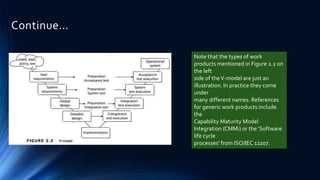
Need, Wish,
Policy, Law
User
Requirement
System
Requirement
Global Design
Detailed Design
Implementation
Testing
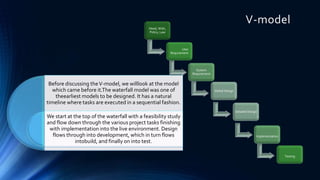
Before discussing theV-model, we willlook at the model
which came before it.The waterfall model was one of
theearliest models to be designed. It has a natural
timeline where tasks are executed in a sequential fashion.
We start at the top of the waterfall with a feasibility study
and flow down through the various project tasks finishing
with implementation into the live environment. Design
flows through into development, which in turn flows
intobuild, and finally on into test.
Continue..
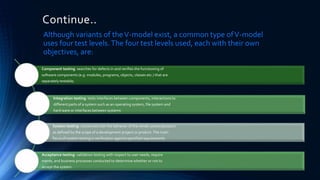
Although variants of theV-model exist, a common type ofV-model
uses four test levels.The four test levels used, each with their own
objectives, are:
Component testing: searches for defects in and verifies the functioning of
software components (e.g. modules, programs, objects, classes etc.) that are
separately testable;
Integration testing: tests interfaces between components, interactions to
different parts of a system such as an operating system, file system and
hard ware or interfaces between systems
System testing: concerned with the behavior of the whole system/product
as defined by the scope of a development project or product.The main
focus of system testing is verification against specified requirements
Acceptance testing: validation testing with respect to user needs, require
ments, and business processes conducted to determine whether or not to
accept the system.
Continue…
Note that the types of work
products mentioned in Figure 2.2 on
the left
side of theV-model are just an
illustration. In practice they come
under
many different names. References
for generic work products include
the
Capability Maturity Model
Integration (CMMi) or the 'Software
life cycle
processes' from ISO/IEC 12207.
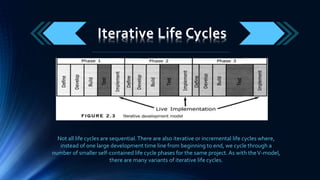
Iterative Life Cycles
Not all life cycles are sequential.There are also iterative or incremental life cycles where,
instead of one large development time line from beginning to end, we cycle through a
number of smaller self-contained life cycle phases for the same project. As with theV-model,
there are many variants of iterative life cycles.
Continue…
A common feature of iterative approaches is that the
delivery is divided into increments or builds with each
increment adding new functionality.The initial increment
will contain the infrastructure required to support the initial
build functionality.The increment produced by an iteration
may be tested at several levels as part of its development.
Subsequent increments will need testing for the new
functionality, regression testing of the existing
functionality, and integration testing of both new and
existing parts. Regression testing is increasingly important
on all iterations after the first one.This means that more
testing will be required at each subsequent delivery phase
which must be allowed for in the project plans
Continue…
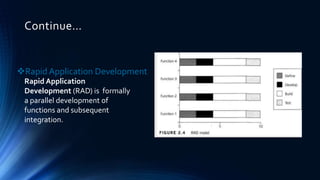
Rapid Application Development
Rapid Application
Development (RAD) is formally
a parallel development of
functions and subsequent
integration.
Continue…
The RAD development process encourages active customer feedback.
The customer gets early visibility of the product, can provide feedback on
the design and can decide, based on the existing functionality, whether to
proceed with the development, what functionality to include in the next
delivery cycle or even to halt the project if it is not delivering the
expected value. An early business-focused solution in the market place
gives an early return on investment (ROI) and can provide valuable
marketing information for the business. Validation with the RAD
development process is thus an early and major activity.
Continue…
Agile development
Extreme Programming (XP) is currently one of the most well-known agile development life cycle models.
(See [Agile] for ideas behind thisapproach.)The methodology claims to be more human friendly than
traditional development methods. Some characteristics of XP are:
It promotes the generation of business stories to define the functionality.
It demands an on-site customer for continual feedback and to define and carry out functional
acceptance testing .
It promotes pair programming and shared code ownership amongst the developers.
It states that component test scripts shall be written before the code is written and that those tests
should be automated.
It states that integration and testing of the code shall happen several times a day.
It states that we always implement the simplest solution to meet today's problems.
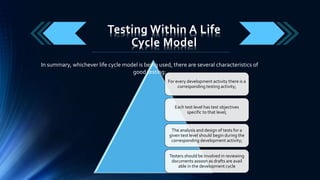
Testing Within A Life
Cycle Model
For every development activity there is a
corresponding testing activity;
Each test level has test objectives
specific to that level;
The analysis and design of tests for a
given test level should begin during the
corresponding development activity;
Testers should be involved in reviewing
documents assoon as drafts are avail
able in the development cycle
In summary, whichever life cycle model is being used, there are several characteristics of
good testing:
Bibliography
• Graham et.al. (2011). ISTQB-Fondation of Software
• Testing. London: Cengage Learning EMEA
LINK
http://sif.uin-suska.ac.id/
http://fst.uin-suska.ac.id/
http://www.uin-suska.ac.id

Software Development Models

  • 1.
    SOFTWARE DEVELOPMENT MODELS BY :NADIA CHAIRUNISSA Departement of Information System Faculty of Science and Technology State Islamic University of Sultan Syarif Kasim of Riau
  • 2.
  • 3.
    V-model Need, Wish, Policy, Law User Requirement System Requirement GlobalDesign Detailed Design Implementation Testing Before discussing theV-model, we willlook at the model which came before it.The waterfall model was one of theearliest models to be designed. It has a natural timeline where tasks are executed in a sequential fashion. We start at the top of the waterfall with a feasibility study and flow down through the various project tasks finishing with implementation into the live environment. Design flows through into development, which in turn flows intobuild, and finally on into test.
  • 4.
    Continue.. Although variants oftheV-model exist, a common type ofV-model uses four test levels.The four test levels used, each with their own objectives, are: Component testing: searches for defects in and verifies the functioning of software components (e.g. modules, programs, objects, classes etc.) that are separately testable; Integration testing: tests interfaces between components, interactions to different parts of a system such as an operating system, file system and hard ware or interfaces between systems System testing: concerned with the behavior of the whole system/product as defined by the scope of a development project or product.The main focus of system testing is verification against specified requirements Acceptance testing: validation testing with respect to user needs, require ments, and business processes conducted to determine whether or not to accept the system.
  • 5.
    Continue… Note that thetypes of work products mentioned in Figure 2.2 on the left side of theV-model are just an illustration. In practice they come under many different names. References for generic work products include the Capability Maturity Model Integration (CMMi) or the 'Software life cycle processes' from ISO/IEC 12207.
  • 6.
    Iterative Life Cycles Notall life cycles are sequential.There are also iterative or incremental life cycles where, instead of one large development time line from beginning to end, we cycle through a number of smaller self-contained life cycle phases for the same project. As with theV-model, there are many variants of iterative life cycles.
  • 7.
    Continue… A common featureof iterative approaches is that the delivery is divided into increments or builds with each increment adding new functionality.The initial increment will contain the infrastructure required to support the initial build functionality.The increment produced by an iteration may be tested at several levels as part of its development. Subsequent increments will need testing for the new functionality, regression testing of the existing functionality, and integration testing of both new and existing parts. Regression testing is increasingly important on all iterations after the first one.This means that more testing will be required at each subsequent delivery phase which must be allowed for in the project plans
  • 8.
    Continue… Rapid Application Development RapidApplication Development (RAD) is formally a parallel development of functions and subsequent integration.
  • 9.
    Continue… The RAD developmentprocess encourages active customer feedback. The customer gets early visibility of the product, can provide feedback on the design and can decide, based on the existing functionality, whether to proceed with the development, what functionality to include in the next delivery cycle or even to halt the project if it is not delivering the expected value. An early business-focused solution in the market place gives an early return on investment (ROI) and can provide valuable marketing information for the business. Validation with the RAD development process is thus an early and major activity.
  • 10.
    Continue… Agile development Extreme Programming(XP) is currently one of the most well-known agile development life cycle models. (See [Agile] for ideas behind thisapproach.)The methodology claims to be more human friendly than traditional development methods. Some characteristics of XP are: It promotes the generation of business stories to define the functionality. It demands an on-site customer for continual feedback and to define and carry out functional acceptance testing . It promotes pair programming and shared code ownership amongst the developers. It states that component test scripts shall be written before the code is written and that those tests should be automated. It states that integration and testing of the code shall happen several times a day. It states that we always implement the simplest solution to meet today's problems.
  • 11.
    Testing Within ALife Cycle Model For every development activity there is a corresponding testing activity; Each test level has test objectives specific to that level; The analysis and design of tests for a given test level should begin during the corresponding development activity; Testers should be involved in reviewing documents assoon as drafts are avail able in the development cycle In summary, whichever life cycle model is being used, there are several characteristics of good testing:
  • 12.
    Bibliography • Graham et.al.(2011). ISTQB-Fondation of Software • Testing. London: Cengage Learning EMEA
  • 13.