
Review of Project Management
       Methodologies
              for
  Software Development Life
            Circles
            (SDLC)

     Maksym Dovgopolyi, PMP
             2012
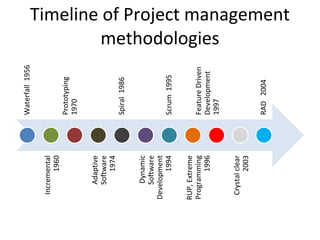
Waterfall 1956

 Incremental
       1960
                 Prototyping
                 1970

    Adaptive
    Software
        1974
                 Spiral 1986

    Dynamic
    Software
Development
        1994     Scrum 1995

RUP, Extreme
Programming      Feature Driven
        1996     Development
                                           methodologies


                 1997

 Crystal clear
         2003

                 RAD 2004
                                  Timeline of Project management
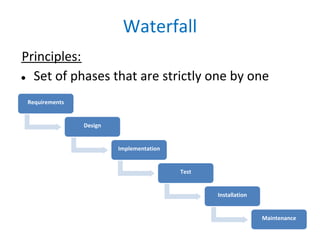
Waterfall
Principles:
● Set of phases that are strictly one by one

 Requirements


                Design


                         Implementation


                                          Test


                                                 Installation


                                                                Maintenance
Waterfall
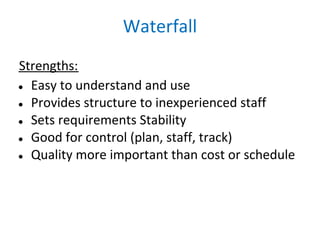
Strengths:
● Easy to understand and use

● Provides structure to inexperienced staff

● Sets requirements Stability

● Good for control (plan, staff, track)

● Quality more important than cost or schedule
Waterfall
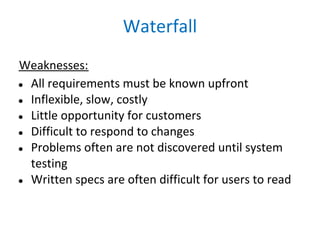
Weaknesses:
● All requirements must be known upfront
● Inflexible, slow, costly
● Little opportunity for customers
● Difficult to respond to changes
● Problems often are not discovered until system
  testing
● Written specs are often difficult for users to read
Waterfall
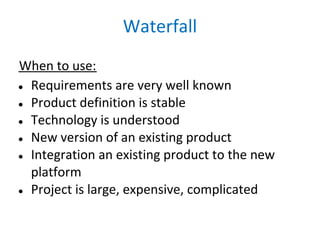
When to use:
● Requirements are very well known

● Product definition is stable

● Technology is understood

● New version of an existing product

● Integration an existing product to the new

  platform
● Project is large, expensive, complicated
Incremental
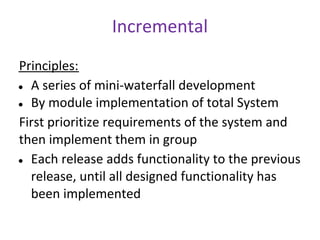
Principles:
● A series of mini-waterfall development

● By module implementation of total System

First prioritize requirements of the system and
then implement them in group
● Each release adds functionality to the previous

  release, until all designed functionality has
  been implemented
Incremental
Strengths:
● Risk of changes in requirements is reduced

● Customer gets important functionality early

● Initial product delivery is faster

● Lowers initial delivery cost

● Customer can respond to each build
Incremental
Weaknesses:
● Requires good planning and design

● Requires early definition of done and fully

  functional system to allow for the definition of
  increments
● Total cost of the complete system is still high
Incremental
When to use:
● Web Information Systems (WIS)
● Leading-edge applications
● Large projects where requirements are not well
  understood
● Project where budget and technical changes are
  expected
● A need to get basic functionality to the market
  earlier
Agile
Some of the most common methods among
others:
● Adaptive Software Development (ASD)

● Feature Driven Development (FDD)

● Crystal Clear

● Rapid Application Development (RAD)

● Scrum

● Extreme Programming (XP)

● Lean Software Development
Rapid Application Development (RAD)

Principles:
● Fast development and delivery of high quality

  system with low cost
● Breaking the project into small segments

● To produce high quality system quickly

● Users closely involved in the system design

● Uses “time boxes”

● Iterative software product delivery
Rapid Application Development (RAD)

Strengths
● The operational version of app is available

  much earlier
● Provides the ability to rapidly change system

  design as demanded
● Generally savings in time, money and human

  effort
● Time-box approach
Rapid Application Development (RAD)

Weaknesses:
● May lead to lower overall system quality

● Could be Gold-plating

● Potential for design system lack of scalability

● Risk of never achieving closure
Rapid Application Development (RAD)

Where to use:
● Small or medium projects with short duration
● Project scope is focused, business objectives are well
  defined
● Functionality of the system is clearly visible in the user UI
● End-users are involved
● Team is stable and skilled
● Input data for the project already exists
● Technical architecture is defined
● Tech requirements are reasonable and well within the
  capabilities of the technology being used
● Low technical risks
● System can be modularized
Extreme Programming (XP)
Principles:
● Coding is the key activity throughout the

  project
● Communication among teammates is done

  with code
Extreme Programming (XP)
Practices/Strengths:
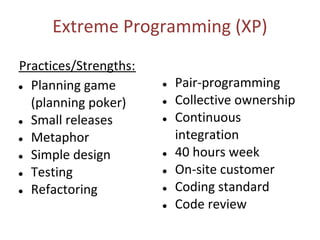
● Planning game        ●   Pair-programming
  (planning poker)     ●   Collective ownership
● Small releases       ●   Continuous
● Metaphor                 integration
● Simple design        ●   40 hours week
● Testing              ●   On-site customer
● Refactoring          ●   Coding standard
                       ●   Code review
Spiral
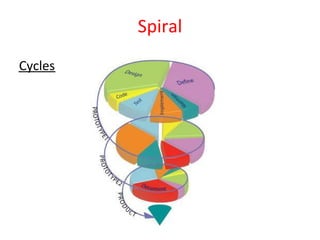
Cycles
Spiral
Principles:
● Identify and resolve risks by breaking a project

  into small segments
● Study alternatives

● Begin each cycle with an identification of

  stakeholders and End cycle with review and
  commitment
Spiral
Strengths:
● Provides early indication of risks
● User sees the system earlier because of rapid
  prototyping tools
● Critical high-risk functions are developed first
● User can be closely tied to all life-cycle steps
● Early and frequent feedback from user
● Can incorporate Waterfall, Prototyping and
  Incremental methodologies depending on which
  of these models best fits a given iteration
Spiral
Weaknesses:
● Challenging to determine the exact composition of
  dev. methodology to use for each iteration around the
  Spiral
● Highly customized to each project
● PM has to be skilled and experienced to determine
  how to apply it
● Each cycle may generate more work for the next cycle
● Cycle continues with no clear termination condition;
  there is risk of not meeting budget or schedule
● May be hard to define objectives, milestones
Spiral
When to use:
● Users/clients are unsure of their needs
● Requirements are complex
● Significant changes are expected
● Real-time or safety-critical system
● Risk avoidance is High priority
● PM is highly skilled and experienced
● Project might benefit from a mix of other
  development methodologies
Prototyping
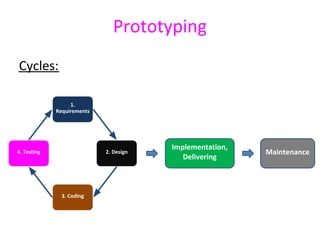
Cycles:

                  1.
             Requirements


                                        Implementation,
4. Testing                  2. Design                     Maintenance
                                           Delivering


               3. Coding
Prototyping
Principles:
● User is involved throughout of process

● The basic understanding of the business

  problem is necessary to avoid solving the
  wrong problem
● Split the project into small segments to reduce

  risks
Prototyping
Strengths:
● Provides quick implementation

● Encourages innovation and flexible design

● Helps to easily identify confusing or difficult or

  missing functionality
● Useful to resolve unclear objectives

● Improves user and developer communication

  with stakeholders
Prototyping
Weaknesses:
● Approval process and control is not strict
● Requirements may frequently change significantly
● Identification of non-functional elements is
  difficult to document
● Can lead to poorly designed system (quick and
  dirty)
● Can lead to false expectations – customer believes
  that system is “finished”. It looks good and has
  adequate user UI, but not truly functional
Prototyping
Where to use:
● Online system requiring extensive user dialoging
● Project is large with many users and functions, where project risks
  need to be reduced
● Project objectives are unclear
● Pressure of immediate implementation of something
● Functional requirements may change frequently and significantly
● User is not fully knowledgeable
● Team members are experienced
● Team composition is stable
● PM is experienced
● Not strict requirements for approval at design milestones
● Analysts assess business problems before the project start
Good Luck!

Software development life cycles (sdlc)

  • 1.
    Review of ProjectManagement Methodologies for Software Development Life Circles (SDLC) Maksym Dovgopolyi, PMP 2012
  • 2.
    Waterfall 1956 Incremental 1960 Prototyping 1970 Adaptive Software 1974 Spiral 1986 Dynamic Software Development 1994 Scrum 1995 RUP, Extreme Programming Feature Driven 1996 Development methodologies 1997 Crystal clear 2003 RAD 2004 Timeline of Project management
  • 3.
    Waterfall Principles: ● Set ofphases that are strictly one by one Requirements Design Implementation Test Installation Maintenance
  • 4.
    Waterfall Strengths: ● Easy tounderstand and use ● Provides structure to inexperienced staff ● Sets requirements Stability ● Good for control (plan, staff, track) ● Quality more important than cost or schedule
  • 5.
    Waterfall Weaknesses: ● All requirementsmust be known upfront ● Inflexible, slow, costly ● Little opportunity for customers ● Difficult to respond to changes ● Problems often are not discovered until system testing ● Written specs are often difficult for users to read
  • 6.
    Waterfall When to use: ●Requirements are very well known ● Product definition is stable ● Technology is understood ● New version of an existing product ● Integration an existing product to the new platform ● Project is large, expensive, complicated
  • 7.
    Incremental Principles: ● A seriesof mini-waterfall development ● By module implementation of total System First prioritize requirements of the system and then implement them in group ● Each release adds functionality to the previous release, until all designed functionality has been implemented
  • 8.
    Incremental Strengths: ● Risk ofchanges in requirements is reduced ● Customer gets important functionality early ● Initial product delivery is faster ● Lowers initial delivery cost ● Customer can respond to each build
  • 9.
    Incremental Weaknesses: ● Requires goodplanning and design ● Requires early definition of done and fully functional system to allow for the definition of increments ● Total cost of the complete system is still high
  • 10.
    Incremental When to use: ●Web Information Systems (WIS) ● Leading-edge applications ● Large projects where requirements are not well understood ● Project where budget and technical changes are expected ● A need to get basic functionality to the market earlier
  • 11.
    Agile Some of themost common methods among others: ● Adaptive Software Development (ASD) ● Feature Driven Development (FDD) ● Crystal Clear ● Rapid Application Development (RAD) ● Scrum ● Extreme Programming (XP) ● Lean Software Development
  • 12.
    Rapid Application Development(RAD) Principles: ● Fast development and delivery of high quality system with low cost ● Breaking the project into small segments ● To produce high quality system quickly ● Users closely involved in the system design ● Uses “time boxes” ● Iterative software product delivery
  • 13.
    Rapid Application Development(RAD) Strengths ● The operational version of app is available much earlier ● Provides the ability to rapidly change system design as demanded ● Generally savings in time, money and human effort ● Time-box approach
  • 14.
    Rapid Application Development(RAD) Weaknesses: ● May lead to lower overall system quality ● Could be Gold-plating ● Potential for design system lack of scalability ● Risk of never achieving closure
  • 15.
    Rapid Application Development(RAD) Where to use: ● Small or medium projects with short duration ● Project scope is focused, business objectives are well defined ● Functionality of the system is clearly visible in the user UI ● End-users are involved ● Team is stable and skilled ● Input data for the project already exists ● Technical architecture is defined ● Tech requirements are reasonable and well within the capabilities of the technology being used ● Low technical risks ● System can be modularized
  • 16.
    Extreme Programming (XP) Principles: ●Coding is the key activity throughout the project ● Communication among teammates is done with code
  • 17.
    Extreme Programming (XP) Practices/Strengths: ●Planning game ● Pair-programming (planning poker) ● Collective ownership ● Small releases ● Continuous ● Metaphor integration ● Simple design ● 40 hours week ● Testing ● On-site customer ● Refactoring ● Coding standard ● Code review
  • 18.
  • 19.
    Spiral Principles: ● Identify andresolve risks by breaking a project into small segments ● Study alternatives ● Begin each cycle with an identification of stakeholders and End cycle with review and commitment
  • 20.
    Spiral Strengths: ● Provides earlyindication of risks ● User sees the system earlier because of rapid prototyping tools ● Critical high-risk functions are developed first ● User can be closely tied to all life-cycle steps ● Early and frequent feedback from user ● Can incorporate Waterfall, Prototyping and Incremental methodologies depending on which of these models best fits a given iteration
  • 21.
    Spiral Weaknesses: ● Challenging todetermine the exact composition of dev. methodology to use for each iteration around the Spiral ● Highly customized to each project ● PM has to be skilled and experienced to determine how to apply it ● Each cycle may generate more work for the next cycle ● Cycle continues with no clear termination condition; there is risk of not meeting budget or schedule ● May be hard to define objectives, milestones
  • 22.
    Spiral When to use: ●Users/clients are unsure of their needs ● Requirements are complex ● Significant changes are expected ● Real-time or safety-critical system ● Risk avoidance is High priority ● PM is highly skilled and experienced ● Project might benefit from a mix of other development methodologies
  • 23.
    Prototyping Cycles: 1. Requirements Implementation, 4. Testing 2. Design Maintenance Delivering 3. Coding
  • 24.
    Prototyping Principles: ● User isinvolved throughout of process ● The basic understanding of the business problem is necessary to avoid solving the wrong problem ● Split the project into small segments to reduce risks
  • 25.
    Prototyping Strengths: ● Provides quickimplementation ● Encourages innovation and flexible design ● Helps to easily identify confusing or difficult or missing functionality ● Useful to resolve unclear objectives ● Improves user and developer communication with stakeholders
  • 26.
    Prototyping Weaknesses: ● Approval processand control is not strict ● Requirements may frequently change significantly ● Identification of non-functional elements is difficult to document ● Can lead to poorly designed system (quick and dirty) ● Can lead to false expectations – customer believes that system is “finished”. It looks good and has adequate user UI, but not truly functional
  • 27.
    Prototyping Where to use: ●Online system requiring extensive user dialoging ● Project is large with many users and functions, where project risks need to be reduced ● Project objectives are unclear ● Pressure of immediate implementation of something ● Functional requirements may change frequently and significantly ● User is not fully knowledgeable ● Team members are experienced ● Team composition is stable ● PM is experienced ● Not strict requirements for approval at design milestones ● Analysts assess business problems before the project start
  • 28.