Software Configuration
Management
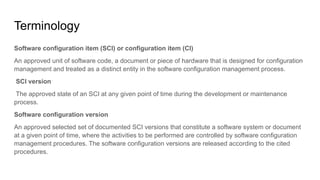
Terminology
Software configuration item (SCI) or configuration item (CI)
An approved unit of software code, a document or piece of hardware that is designed for configuration
management and treated as a distinct entity in the software configuration management process.
SCI version
The approved state of an SCI at any given point of time during the development or maintenance
process.
Software configuration version
An approved selected set of documented SCI versions that constitute a software system or document
at a given point of time, where the activities to be performed are controlled by software configuration
management procedures. The software configuration versions are released according to the cited
procedures.
Software configuration management
An SQA component responsible for applying (computerized and non-
computerized) technical tools and administrative procedures that enable
completion of the tasks required to maintain SCIs and software configuration
versions
SCM Task
The tasks of software configuration management may be classified into four
groups:
■ Control software change
■ Release of SCI and software configuration versions
■ Provision of SCM information services
■ Verification of compliance to SCM procedures.
Change Control
● Examining change requests and approving implementation of appropriate
requests.
● Assuring the quality of each new version of software configuration before it
becomes operational.
Approval to carry out proposed changes
Change Requests: These requests may involve different parts of the software, known as Software Configuration Items
(SCIs).
Decision-Making Body: To manage these changes effectively, an authorized group (often called a Change Control
Authority, or CCA) reviews each change request. This body ensures that changes align with project goals or customer
needs and decides whether to approve or reject each request.
Factors in Decision-Making: When reviewing a change request, the CCA considers several factors, such as:
● Value: Does the change add meaningful improvement or benefit?
● Urgency: Is the change needed immediately, or can it wait?
● Impact: How will the change affect timelines, service levels, and other project aspects?
● Effort: How much work is required to make the change?
● Quality Assurance: What testing and verification steps will be needed?
● Resources and Cost: What are the estimated costs and the expertise needed?
Software Change Request (SCR) Form: To evaluate each proposed change, the CCA uses a Software Change Request (SCR)
form (also called a CR or ECR in some organizations). This form includes all the necessary details about the change, helping the CCA
make informed decisions.
Types of Decisions: The CCA does not automatically approve every request, even if it seems urgent. They might:
● Approve it for immediate implementation.
● Postpone it for later.
● Reject it entirely.
Software Change Order (SCO): If a change request is approved for immediate action, a Software Change Order (SCO) is issued.
This document provides the details of the approved changes and outlines the schedule for implementation. The SCO may adjust the
initial request, including which changes will be made and the timing, based on the CCA’s judgment.
Quality assurance of software changes
Quality assurance of each of the changed SCIs
Quality assurance of the entire new software system version (that includes
changed SCIs).
Release Management
The need to release a new software configuration version usually stems from one
or more of the following conditions:
■ Defective SCIs
■ Special features demanded by new customers
■ The team’s initiatives to introduce SCI improvements.
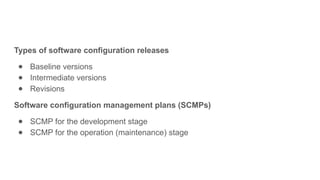
Types of software configuration releases
● Baseline versions
● Intermediate versions
● Revisions
Software configuration management plans (SCMPs)
● SCMP for the development stage
● SCMP for the operation (maintenance) stage
Software configuration evolution models
■ The linear evolution model
■ The tree evolution model
Documentation of software configuration versions.
Documentation of SCI versions and documentation of software configuration
releases (versions and revisions)
Software   Configuration Management.pptx

Software Configuration Management.pptx

  • 1.
  • 2.
    Terminology Software configuration item(SCI) or configuration item (CI) An approved unit of software code, a document or piece of hardware that is designed for configuration management and treated as a distinct entity in the software configuration management process. SCI version The approved state of an SCI at any given point of time during the development or maintenance process. Software configuration version An approved selected set of documented SCI versions that constitute a software system or document at a given point of time, where the activities to be performed are controlled by software configuration management procedures. The software configuration versions are released according to the cited procedures.
  • 3.
    Software configuration management AnSQA component responsible for applying (computerized and non- computerized) technical tools and administrative procedures that enable completion of the tasks required to maintain SCIs and software configuration versions
  • 4.
    SCM Task The tasksof software configuration management may be classified into four groups: ■ Control software change ■ Release of SCI and software configuration versions ■ Provision of SCM information services ■ Verification of compliance to SCM procedures.
  • 5.
    Change Control ● Examiningchange requests and approving implementation of appropriate requests. ● Assuring the quality of each new version of software configuration before it becomes operational.
  • 6.
    Approval to carryout proposed changes Change Requests: These requests may involve different parts of the software, known as Software Configuration Items (SCIs). Decision-Making Body: To manage these changes effectively, an authorized group (often called a Change Control Authority, or CCA) reviews each change request. This body ensures that changes align with project goals or customer needs and decides whether to approve or reject each request. Factors in Decision-Making: When reviewing a change request, the CCA considers several factors, such as: ● Value: Does the change add meaningful improvement or benefit? ● Urgency: Is the change needed immediately, or can it wait? ● Impact: How will the change affect timelines, service levels, and other project aspects? ● Effort: How much work is required to make the change? ● Quality Assurance: What testing and verification steps will be needed? ● Resources and Cost: What are the estimated costs and the expertise needed?
  • 7.
    Software Change Request(SCR) Form: To evaluate each proposed change, the CCA uses a Software Change Request (SCR) form (also called a CR or ECR in some organizations). This form includes all the necessary details about the change, helping the CCA make informed decisions. Types of Decisions: The CCA does not automatically approve every request, even if it seems urgent. They might: ● Approve it for immediate implementation. ● Postpone it for later. ● Reject it entirely. Software Change Order (SCO): If a change request is approved for immediate action, a Software Change Order (SCO) is issued. This document provides the details of the approved changes and outlines the schedule for implementation. The SCO may adjust the initial request, including which changes will be made and the timing, based on the CCA’s judgment.
  • 8.
    Quality assurance ofsoftware changes Quality assurance of each of the changed SCIs Quality assurance of the entire new software system version (that includes changed SCIs).
  • 9.
    Release Management The needto release a new software configuration version usually stems from one or more of the following conditions: ■ Defective SCIs ■ Special features demanded by new customers ■ The team’s initiatives to introduce SCI improvements.
  • 10.
    Types of softwareconfiguration releases ● Baseline versions ● Intermediate versions ● Revisions Software configuration management plans (SCMPs) ● SCMP for the development stage ● SCMP for the operation (maintenance) stage
  • 11.
    Software configuration evolutionmodels ■ The linear evolution model ■ The tree evolution model Documentation of software configuration versions. Documentation of SCI versions and documentation of software configuration releases (versions and revisions)