Software Engineering II
By: Muhammad Usman
email:mu702823@gmail.com
Requirements Engineering
 Inception: ask a set of questions that establish
 basic understanding of the problem
 the people who want a solution
 the nature of the solution that is desired, and
 the effectiveness of preliminary communication and
collaboration between the customer and the developer
 Elicitation: elicit requirements from all
stakeholders
Requirements Engineering
 Elaboration: create an analysis model that
identifies data, function and behavioral
requirements
 Negotiation: agree on a deliverable system that is
realistic for developers and customers
 Specification: can be any one (or more) of the
following:
 A written document
 A set of models
 A formal mathematical
 A collection of user scenarios (use-cases)
 A prototype
Requirements Engineering
 Validation: a review mechanism that looks for
 errors in content or interpretation
 areas where clarification may be required
 missing information
 inconsistencies (a major problem when large products or
systems are engineered)
 conflicting or unrealistic (unachievable) requirements.
 Requirements management
Requirements Engineering
 Requirements management
 Requirements for computer-based systems change, and
the desire to change requirements persists throughout
the life of the system.
 Requirements management is a set of activities that help
the project team identify, control, and track requirements
and changes to requirements at any time as the project
proceeds.
 Many of these activities are identical to the software
configuration management (SCM) techniques
Requirements Engineering
Inception
 Identify stakeholders
 “who else do you think I should talk to?”
 Recognize multiple points of view
 Work toward collaboration
 The first questions
 Who is behind the request for this work?
 Who will use the solution?
 What will be the economic benefit of a successful
solution
 Is there another source for the solution that you need?
Eliciting Requirements
 meetings are conducted and attended by both software
engineers and customers
 rules for preparation and participation are established
 an agenda is suggested
 a "facilitator" (can be a customer, a developer, or an
outsider) controls the meeting
 a "definition mechanism" (can be work sheets, flip charts, or
wall stickers or an electronic bulletin board, chat room or
virtual forum) is used
 the goal is
 to identify the problem
 propose elements of the solution
 negotiate different approaches, and
 specify a preliminary set of solution requirements
Building the Analysis Model
Elements of the analysis model
 Scenario-based elements
 Functional—processing narratives for software functions
 Use-case—descriptions of the interaction between an “actor” and
the system
 Class-based elements
 Implied by scenarios
 Behavioral elements
 State diagram
 Flow-oriented elements
 Data flow diagram
Use-Cases
 A collection of user scenarios that describe the thread of
usage of a system
 Each scenario is described from the point-of-view of an
“actor”—a person or device that interacts with the software
in some way
 Each scenario answers the following questions:
 Who is the primary actor, the secondary actor (s)?
 What are the actor’s goals?
 What preconditions should exist before the story
begins?
 What main tasks or functions are performed by the
actor?
 What extensions might be considered as the story is
described?
Use-Cases
 What variations in the actor’s interaction are possible?
 What system information will the actor acquire, produce,
or change?
 Will the actor have to inform the system about changes
in the external environment?
 What information does the actor desire from the
system?
 Does the actor wish to be informed about unexpected
changes?
Negotiating Requirements
 Identify the key stakeholders
 These are the people who will be involved in the
negotiation
 Determine each of the stakeholders “win
conditions”
 Win conditions are not always obvious
 Negotiate
 Work toward a set of requirements that lead to “win-
win”
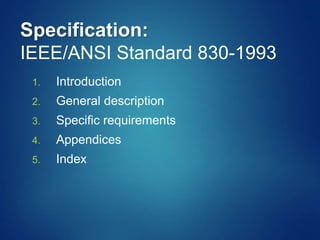
Specification:
IEEE/ANSI Standard 830-1993
1. Introduction
2. General description
3. Specific requirements
4. Appendices
5. Index
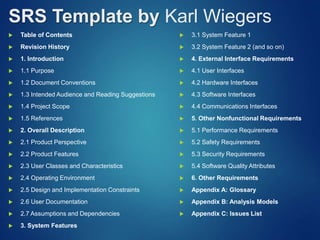
SRS Template by Karl Wiegers
 Table of Contents
 Revision History
 1. Introduction
 1.1 Purpose
 1.2 Document Conventions
 1.3 Intended Audience and Reading Suggestions
 1.4 Project Scope
 1.5 References
 2. Overall Description
 2.1 Product Perspective
 2.2 Product Features
 2.3 User Classes and Characteristics
 2.4 Operating Environment
 2.5 Design and Implementation Constraints
 2.6 User Documentation
 2.7 Assumptions and Dependencies
 3. System Features
 3.1 System Feature 1
 3.2 System Feature 2 (and so on)
 4. External Interface Requirements
 4.1 User Interfaces
 4.2 Hardware Interfaces
 4.3 Software Interfaces
 4.4 Communications Interfaces
 5. Other Nonfunctional Requirements
 5.1 Performance Requirements
 5.2 Safety Requirements
 5.3 Security Requirements
 5.4 Software Quality Attributes
 6. Other Requirements
 Appendix A: Glossary
 Appendix B: Analysis Models
 Appendix C: Issues List
Validating Requirements
 Is each requirement consistent with the overall objective for
the system/product?
 Have all requirements been specified at the proper level of
abstraction? That is, do some requirements provide a level
of technical detail that is inappropriate at this stage?
 Is the requirement really necessary or does it represent an
add-on feature that may not be essential to the objective of
the system?
 Is each requirement bounded and unambiguous?
 Does each requirement have attribution? That is, is a source
(generally, a specific individual) noted for each requirement?
 Do any requirements conflict with other requirements?
 Is each requirement achievable in the technical environment
that will house the system or product?
 Is each requirement testable, once implemented?
 Does the requirements model properly reflect the
information, function and behavior of the system to be built.
 Has the requirements model been “partitioned” in a way that
exposes progressively more detailed information about the
system.
 Have requirements patterns been used to simplify the
requirements model. Have all patterns been properly
validated? Are all patterns consistent with customer
requirements?
Validating Requirements

Requirements Engineering

  • 1.
    Software Engineering II By:Muhammad Usman email:mu702823@gmail.com
  • 2.
    Requirements Engineering  Inception:ask a set of questions that establish  basic understanding of the problem  the people who want a solution  the nature of the solution that is desired, and  the effectiveness of preliminary communication and collaboration between the customer and the developer  Elicitation: elicit requirements from all stakeholders
  • 3.
    Requirements Engineering  Elaboration:create an analysis model that identifies data, function and behavioral requirements  Negotiation: agree on a deliverable system that is realistic for developers and customers
  • 4.
     Specification: canbe any one (or more) of the following:  A written document  A set of models  A formal mathematical  A collection of user scenarios (use-cases)  A prototype Requirements Engineering
  • 5.
     Validation: areview mechanism that looks for  errors in content or interpretation  areas where clarification may be required  missing information  inconsistencies (a major problem when large products or systems are engineered)  conflicting or unrealistic (unachievable) requirements.  Requirements management Requirements Engineering
  • 6.
     Requirements management Requirements for computer-based systems change, and the desire to change requirements persists throughout the life of the system.  Requirements management is a set of activities that help the project team identify, control, and track requirements and changes to requirements at any time as the project proceeds.  Many of these activities are identical to the software configuration management (SCM) techniques Requirements Engineering
  • 7.
    Inception  Identify stakeholders “who else do you think I should talk to?”  Recognize multiple points of view  Work toward collaboration  The first questions  Who is behind the request for this work?  Who will use the solution?  What will be the economic benefit of a successful solution  Is there another source for the solution that you need?
  • 8.
    Eliciting Requirements  meetingsare conducted and attended by both software engineers and customers  rules for preparation and participation are established  an agenda is suggested  a "facilitator" (can be a customer, a developer, or an outsider) controls the meeting  a "definition mechanism" (can be work sheets, flip charts, or wall stickers or an electronic bulletin board, chat room or virtual forum) is used  the goal is  to identify the problem  propose elements of the solution  negotiate different approaches, and  specify a preliminary set of solution requirements
  • 9.
    Building the AnalysisModel Elements of the analysis model  Scenario-based elements  Functional—processing narratives for software functions  Use-case—descriptions of the interaction between an “actor” and the system  Class-based elements  Implied by scenarios  Behavioral elements  State diagram  Flow-oriented elements  Data flow diagram
  • 10.
    Use-Cases  A collectionof user scenarios that describe the thread of usage of a system  Each scenario is described from the point-of-view of an “actor”—a person or device that interacts with the software in some way  Each scenario answers the following questions:  Who is the primary actor, the secondary actor (s)?  What are the actor’s goals?  What preconditions should exist before the story begins?  What main tasks or functions are performed by the actor?  What extensions might be considered as the story is described?
  • 11.
    Use-Cases  What variationsin the actor’s interaction are possible?  What system information will the actor acquire, produce, or change?  Will the actor have to inform the system about changes in the external environment?  What information does the actor desire from the system?  Does the actor wish to be informed about unexpected changes?
  • 12.
    Negotiating Requirements  Identifythe key stakeholders  These are the people who will be involved in the negotiation  Determine each of the stakeholders “win conditions”  Win conditions are not always obvious  Negotiate  Work toward a set of requirements that lead to “win- win”
  • 13.
    Specification: IEEE/ANSI Standard 830-1993 1.Introduction 2. General description 3. Specific requirements 4. Appendices 5. Index
  • 14.
    SRS Template byKarl Wiegers  Table of Contents  Revision History  1. Introduction  1.1 Purpose  1.2 Document Conventions  1.3 Intended Audience and Reading Suggestions  1.4 Project Scope  1.5 References  2. Overall Description  2.1 Product Perspective  2.2 Product Features  2.3 User Classes and Characteristics  2.4 Operating Environment  2.5 Design and Implementation Constraints  2.6 User Documentation  2.7 Assumptions and Dependencies  3. System Features  3.1 System Feature 1  3.2 System Feature 2 (and so on)  4. External Interface Requirements  4.1 User Interfaces  4.2 Hardware Interfaces  4.3 Software Interfaces  4.4 Communications Interfaces  5. Other Nonfunctional Requirements  5.1 Performance Requirements  5.2 Safety Requirements  5.3 Security Requirements  5.4 Software Quality Attributes  6. Other Requirements  Appendix A: Glossary  Appendix B: Analysis Models  Appendix C: Issues List
  • 15.
    Validating Requirements  Iseach requirement consistent with the overall objective for the system/product?  Have all requirements been specified at the proper level of abstraction? That is, do some requirements provide a level of technical detail that is inappropriate at this stage?  Is the requirement really necessary or does it represent an add-on feature that may not be essential to the objective of the system?  Is each requirement bounded and unambiguous?  Does each requirement have attribution? That is, is a source (generally, a specific individual) noted for each requirement?  Do any requirements conflict with other requirements?
  • 16.
     Is eachrequirement achievable in the technical environment that will house the system or product?  Is each requirement testable, once implemented?  Does the requirements model properly reflect the information, function and behavior of the system to be built.  Has the requirements model been “partitioned” in a way that exposes progressively more detailed information about the system.  Have requirements patterns been used to simplify the requirements model. Have all patterns been properly validated? Are all patterns consistent with customer requirements? Validating Requirements