Introduction Knowledge Representation Semantic Web Reasoning
Adding Semantics to Ontologies
Cristiano Longo
Dipartimento di Matematica e Informatica, Universit`a di Catania, Italy
mailto://longo@dmi.unict.it
SOD2014
Introduction Knowledge Representation Semantic Web Reasoning
About
This talk is about the word Semantic in the “Semantic Web.”
It will provides some basic theoretical notions for a better understanding of Semantic
Web technologies (in particular OWL).
Introduction Knowledge Representation Semantic Web Reasoning
Topics
Some answers for the following questions will be provided:
How can we represent knowledge? (ontologies)
Which tools the Semantic Web framework offer to this end? (OWL)
How representing knowledge with these tools can be useful? (reasoning)
Introduction Knowledge Representation Semantic Web Reasoning
Topics
Some answers for the following questions will be provided:
How can we represent knowledge? (ontologies)
Which tools the Semantic Web framework offer to this end? (OWL)
How representing knowledge with these tools can be useful? (reasoning)
Introduction Knowledge Representation Semantic Web Reasoning
Topics
Some answers for the following questions will be provided:
How can we represent knowledge? (ontologies)
Which tools the Semantic Web framework offer to this end? (OWL)
How representing knowledge with these tools can be useful? (reasoning)
Introduction Knowledge Representation Semantic Web Reasoning
Notice
For the sake of readability and for historical reason, we will use notation and
terminology from Descriptio Logics, which underpin Semantic Web languages (in
particular OWL).
Introduction Knowledge Representation Semantic Web Reasoning
Representing Knowledge in Logic and Computer Science
Introduction Knowledge Representation Semantic Web Reasoning
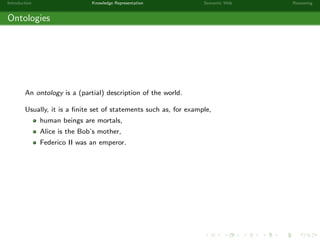
Ontologies
An ontology is a (partial) description of the world.
Usually, it is a finite set of statements such as, for example,
human beings are mortals,
Alice is the Bob’s mother,
Federico II was an emperor.
Introduction Knowledge Representation Semantic Web Reasoning
Basics
A knowledge domain is described in terms of
individuals, to indicate domain items (Alice, Bob, . . . ),
concepts (aka classes), which denote sets of domain objects (Person, Male, . . . ),
and
roles (aka properties), which are relations on domain items (parentOf,
partnerOf, . . . ).
Introduction Knowledge Representation Semantic Web Reasoning
Vocabulary and Assertions
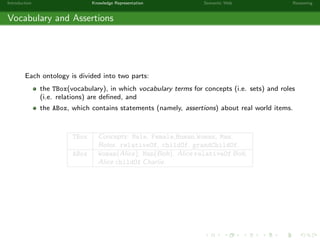
Each ontology is divided into two parts:
the TBox(vocabulary), in which vocabulary terms for concepts (i.e. sets) and roles
(i.e. relations) are defined, and
the ABox, which contains statements (namely, assertions) about real world items.
TBox Concepts: Male, Female,Human,Woman, Man.
Roles: relativeOf, childOf, grandChildOf.
ABox Woman(Alice), Man(Bob), Alice relativeOf Bob,
Alice childOf Charlie.
Introduction Knowledge Representation Semantic Web Reasoning
Vocabulary and Assertions
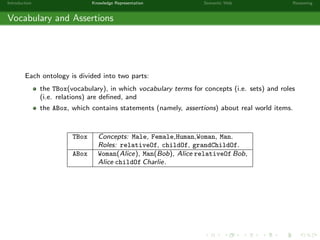
Each ontology is divided into two parts:
the TBox(vocabulary), in which vocabulary terms for concepts (i.e. sets) and roles
(i.e. relations) are defined, and
the ABox, which contains statements (namely, assertions) about real world items.
TBox Concepts: Male, Female,Human,Woman, Man.
Roles: relativeOf, childOf, grandChildOf.
ABox Woman(Alice), Man(Bob), Alice relativeOf Bob,
Alice childOf Charlie.
Introduction Knowledge Representation Semantic Web Reasoning
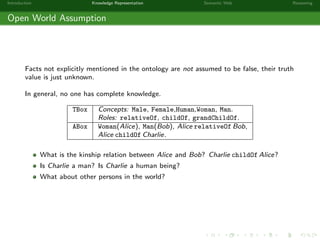
Open World Assumption
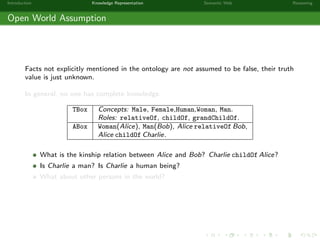
Facts not explicitly mentioned in the ontology are not assumed to be false, their truth
value is just unknown.
In general, no one has complete knowledge.
TBox Concepts: Male, Female,Human,Woman, Man.
Roles: relativeOf, childOf, grandChildOf.
ABox Woman(Alice), Man(Bob), Alice relativeOf Bob,
Alice childOf Charlie.
What is the kinship relation between Alice and Bob? Charlie childOf Alice?
Is Charlie a man? Is Charlie a human being?
What about other persons in the world?
Introduction Knowledge Representation Semantic Web Reasoning
Open World Assumption
Facts not explicitly mentioned in the ontology are not assumed to be false, their truth
value is just unknown.
In general, no one has complete knowledge.
TBox Concepts: Male, Female,Human,Woman, Man.
Roles: relativeOf, childOf, grandChildOf.
ABox Woman(Alice), Man(Bob), Alice relativeOf Bob,
Alice childOf Charlie.
What is the kinship relation between Alice and Bob? Charlie childOf Alice?
Is Charlie a man? Is Charlie a human being?
What about other persons in the world?
Introduction Knowledge Representation Semantic Web Reasoning
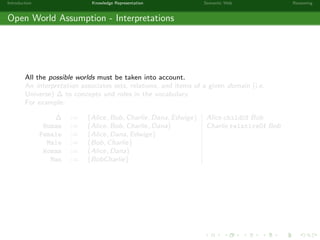
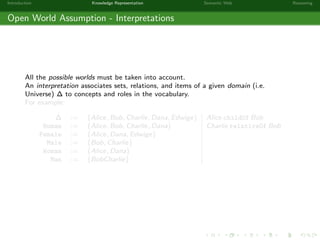
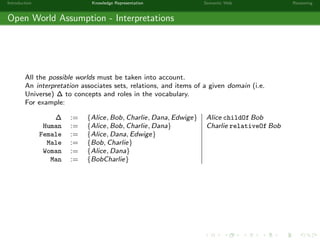
Open World Assumption - Interpretations
All the possible worlds must be taken into account.
An interpretation associates sets, relations, and items of a given domain (i.e.
Universe) ∆ to concepts and roles in the vocabulary.
For example:
∆ := {Alice, Bob, Charlie, Dana, Edwige} Alice childOf Bob
Human := {Alice, Bob, Charlie, Dana} Charlie relativeOf Bob
Female := {Alice, Dana, Edwige}
Male := {Bob, Charlie}
Woman := {Alice, Dana}
Man := {BobCharlie}
Introduction Knowledge Representation Semantic Web Reasoning
Open World Assumption - Interpretations
All the possible worlds must be taken into account.
An interpretation associates sets, relations, and items of a given domain (i.e.
Universe) ∆ to concepts and roles in the vocabulary.
For example:
∆ := {Alice, Bob, Charlie, Dana, Edwige} Alice childOf Bob
Human := {Alice, Bob, Charlie, Dana} Charlie relativeOf Bob
Female := {Alice, Dana, Edwige}
Male := {Bob, Charlie}
Woman := {Alice, Dana}
Man := {BobCharlie}
Introduction Knowledge Representation Semantic Web Reasoning
Open World Assumption - Interpretations
All the possible worlds must be taken into account.
An interpretation associates sets, relations, and items of a given domain (i.e.
Universe) ∆ to concepts and roles in the vocabulary.
For example:
∆ := {Alice, Bob, Charlie, Dana, Edwige} Alice childOf Bob
Human := {Alice, Bob, Charlie, Dana} Charlie relativeOf Bob
Female := {Alice, Dana, Edwige}
Male := {Bob, Charlie}
Woman := {Alice, Dana}
Man := {BobCharlie}
Introduction Knowledge Representation Semantic Web Reasoning
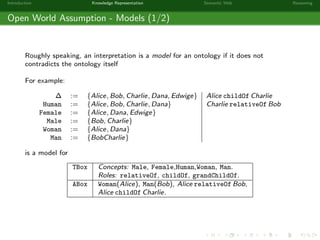
Open World Assumption - Models (1/2)
Roughly speaking, an interpretation is a model for an ontology if it does not
contradicts the ontology itself
For example:
∆ := {Alice, Bob, Charlie, Dana, Edwige} Alice childOf Charlie
Human := {Alice, Bob, Charlie, Dana} Charlie relativeOf Bob
Female := {Alice, Dana, Edwige}
Male := {Bob, Charlie}
Woman := {Alice, Dana}
Man := {BobCharlie}
is a model for
TBox Concepts: Male, Female,Human,Woman, Man.
Roles: relativeOf, childOf, grandChildOf.
ABox Woman(Alice), Man(Bob), Alice relativeOf Bob,
Alice childOf Charlie.
Introduction Knowledge Representation Semantic Web Reasoning
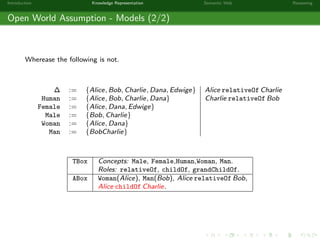
Open World Assumption - Models (2/2)
Wherease the following is not.
∆ := {Alice, Bob, Charlie, Dana, Edwige} Alice relativeOf Charlie
Human := {Alice, Bob, Charlie, Dana} Charlie relativeOf Bob
Female := {Alice, Dana, Edwige}
Male := {Bob, Charlie}
Woman := {Alice, Dana}
Man := {BobCharlie}
TBox Concepts: Male, Female,Human,Woman, Man.
Roles: relativeOf, childOf, grandChildOf.
ABox Woman(Alice), Man(Bob), Alice relativeOf Bob,
Alice childOf Charlie.
Introduction Knowledge Representation Semantic Web Reasoning
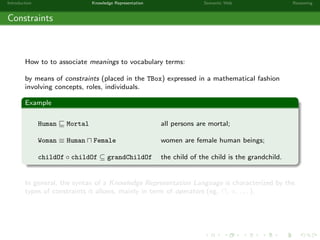
Constraints
How to to associate meanings to vocabulary terms:
by means of constraints (placed in the TBox) expressed in a mathematical fashion
involving concepts, roles, individuals.
Example
Human Mortal all persons are mortal;
Woman ≡ Human Female women are female human beings;
childOf ◦ childOf ⊆ grandChildOf the child of the child is the grandchild.
In general, the syntax of a Knowledge Representation Language is characterized by the
types of constraints it allows, mainly in term of operators (eg. , ◦, . . . ).
Introduction Knowledge Representation Semantic Web Reasoning
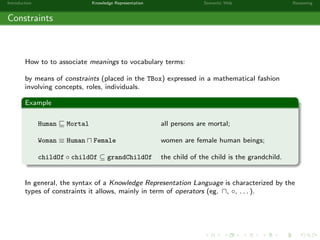
Constraints
How to to associate meanings to vocabulary terms:
by means of constraints (placed in the TBox) expressed in a mathematical fashion
involving concepts, roles, individuals.
Example
Human Mortal all persons are mortal;
Woman ≡ Human Female women are female human beings;
childOf ◦ childOf ⊆ grandChildOf the child of the child is the grandchild.
In general, the syntax of a Knowledge Representation Language is characterized by the
types of constraints it allows, mainly in term of operators (eg. , ◦, . . . ).
Introduction Knowledge Representation Semantic Web Reasoning
Representing Knowledge the Semantic Web
Introduction Knowledge Representation Semantic Web Reasoning
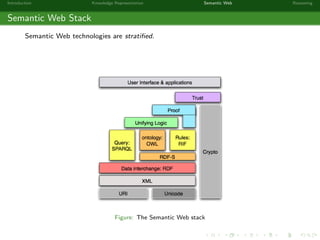
Semantic Web Stack
Semantic Web technologies are stratified.
Figure: The Semantic Web stack
Introduction Knowledge Representation Semantic Web Reasoning
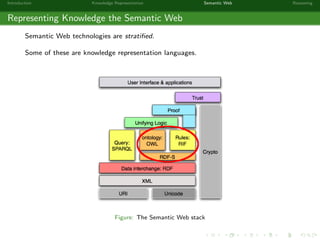
Representing Knowledge the Semantic Web
Semantic Web technologies are stratified.
Some of these are knowledge representation languages.
Figure: The Semantic Web stack
Introduction Knowledge Representation Semantic Web Reasoning
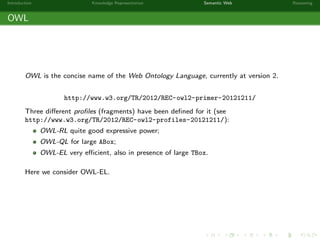
OWL
OWL is the concise name of the Web Ontology Language, currently at version 2.
http://www.w3.org/TR/2012/REC-owl2-primer-20121211/
Three different profiles (fragments) have been defined for it (see
http://www.w3.org/TR/2012/REC-owl2-profiles-20121211/):
OWL-RL quite good expressive power;
OWL-QL for large ABox;
OWL-EL very efficient, also in presence of large TBox.
Here we consider OWL-EL.
Introduction Knowledge Representation Semantic Web Reasoning
OWL
OWL is the concise name of the Web Ontology Language, currently at version 2.
http://www.w3.org/TR/2012/REC-owl2-primer-20121211/
Three different profiles (fragments) have been defined for it (see
http://www.w3.org/TR/2012/REC-owl2-profiles-20121211/):
OWL-RL quite good expressive power;
OWL-QL for large ABox;
OWL-EL very efficient, also in presence of large TBox.
Here we consider OWL-EL.
Introduction Knowledge Representation Semantic Web Reasoning
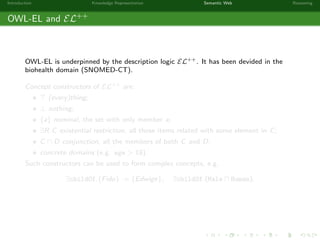
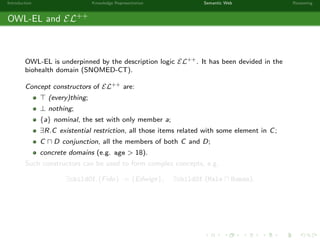
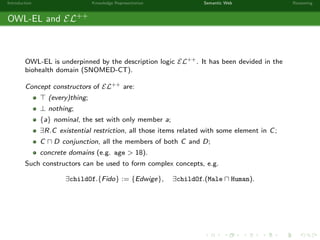
OWL-EL and EL++
OWL-EL is underpinned by the description logic EL++. It has been devided in the
biohealth domain (SNOMED-CT).
Concept constructors of EL++ are:
(every)thing;
⊥ nothing;
{a} nominal, the set with only member a;
∃R.C existential restriction, all those items related with some element in C;
C D conjunction, all the members of both C and D;
concrete domains (e.g. age > 18).
Such constructors can be used to form complex concepts, e.g.
∃childOf.{Fido} := {Edwige}, ∃childOf.(Male Human).
Introduction Knowledge Representation Semantic Web Reasoning
OWL-EL and EL++
OWL-EL is underpinned by the description logic EL++. It has been devided in the
biohealth domain (SNOMED-CT).
Concept constructors of EL++ are:
(every)thing;
⊥ nothing;
{a} nominal, the set with only member a;
∃R.C existential restriction, all those items related with some element in C;
C D conjunction, all the members of both C and D;
concrete domains (e.g. age > 18).
Such constructors can be used to form complex concepts, e.g.
∃childOf.{Fido} := {Edwige}, ∃childOf.(Male Human).
Introduction Knowledge Representation Semantic Web Reasoning
OWL-EL and EL++
OWL-EL is underpinned by the description logic EL++. It has been devided in the
biohealth domain (SNOMED-CT).
Concept constructors of EL++ are:
(every)thing;
⊥ nothing;
{a} nominal, the set with only member a;
∃R.C existential restriction, all those items related with some element in C;
C D conjunction, all the members of both C and D;
concrete domains (e.g. age > 18).
Such constructors can be used to form complex concepts, e.g.
∃childOf.{Fido} := {Edwige}, ∃childOf.(Male Human).
Introduction Knowledge Representation Semantic Web Reasoning
EL++
concepts - Thing
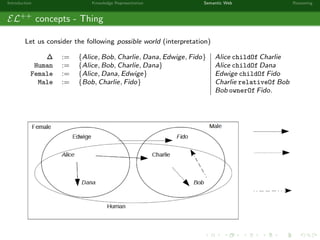
Let us consider the following possible world (interpretation)
∆ := {Alice, Bob, Charlie, Dana, Edwige, Fido} Alice childOf Charlie
Human := {Alice, Bob, Charlie, Dana} Alice childOf Dana
Female := {Alice, Dana, Edwige} Edwige childOf Fido
Male := {Bob, Charlie, Fido} Charlie relativeOf Bob
Bob ownerOf Fido.
Introduction Knowledge Representation Semantic Web Reasoning
EL++
concepts - Thing
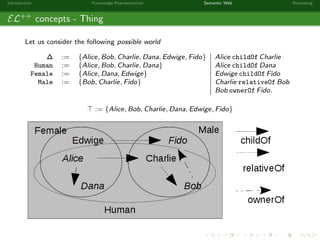
Let us consider the following possible world
∆ := {Alice, Bob, Charlie, Dana, Edwige, Fido} Alice childOf Charlie
Human := {Alice, Bob, Charlie, Dana} Alice childOf Dana
Female := {Alice, Dana, Edwige} Edwige childOf Fido
Male := {Bob, Charlie, Fido} Charlie relativeOf Bob
Bob ownerOf Fido.
:= {Alice, Bob, Charlie, Dana, Edwige, Fido}
Introduction Knowledge Representation Semantic Web Reasoning
EL++
concepts - Nothing
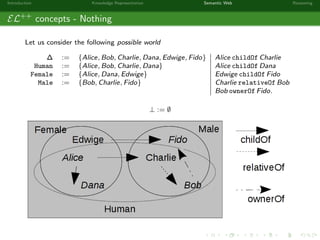
Let us consider the following possible world
∆ := {Alice, Bob, Charlie, Dana, Edwige, Fido} Alice childOf Charlie
Human := {Alice, Bob, Charlie, Dana} Alice childOf Dana
Female := {Alice, Dana, Edwige} Edwige childOf Fido
Male := {Bob, Charlie, Fido} Charlie relativeOf Bob
Bob ownerOf Fido.
⊥ := ∅
Introduction Knowledge Representation Semantic Web Reasoning
EL++
concepts - Nominal
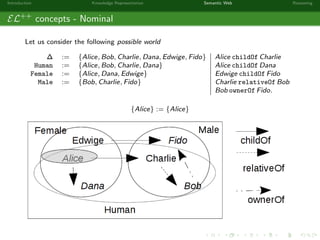
Let us consider the following possible world
∆ := {Alice, Bob, Charlie, Dana, Edwige, Fido} Alice childOf Charlie
Human := {Alice, Bob, Charlie, Dana} Alice childOf Dana
Female := {Alice, Dana, Edwige} Edwige childOf Fido
Male := {Bob, Charlie, Fido} Charlie relativeOf Bob
Bob ownerOf Fido.
{Alice} := {Alice}
Introduction Knowledge Representation Semantic Web Reasoning
EL++
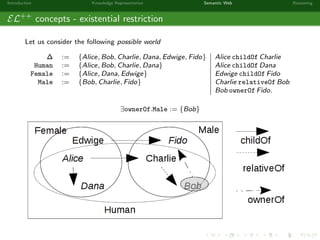
concepts - existential restriction
Let us consider the following possible world
∆ := {Alice, Bob, Charlie, Dana, Edwige, Fido} Alice childOf Charlie
Human := {Alice, Bob, Charlie, Dana} Alice childOf Dana
Female := {Alice, Dana, Edwige} Edwige childOf Fido
Male := {Bob, Charlie, Fido} Charlie relativeOf Bob
Bob ownerOf Fido.
∃ownerOf.Male := {Bob}
Introduction Knowledge Representation Semantic Web Reasoning
EL++
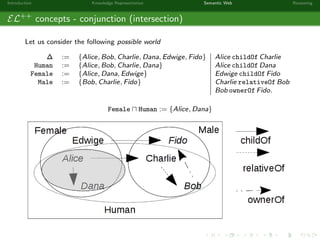
concepts - conjunction (intersection)
Let us consider the following possible world
∆ := {Alice, Bob, Charlie, Dana, Edwige, Fido} Alice childOf Charlie
Human := {Alice, Bob, Charlie, Dana} Alice childOf Dana
Female := {Alice, Dana, Edwige} Edwige childOf Fido
Male := {Bob, Charlie, Fido} Charlie relativeOf Bob
Bob ownerOf Fido.
Female Human := {Alice, Dana}
Introduction Knowledge Representation Semantic Web Reasoning
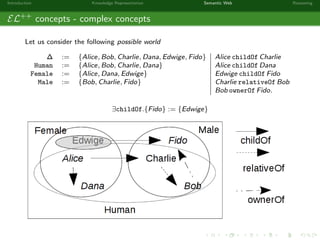
EL++
concepts - complex concepts
Let us consider the following possible world
∆ := {Alice, Bob, Charlie, Dana, Edwige, Fido} Alice childOf Charlie
Human := {Alice, Bob, Charlie, Dana} Alice childOf Dana
Female := {Alice, Dana, Edwige} Edwige childOf Fido
Male := {Bob, Charlie, Fido} Charlie relativeOf Bob
Bob ownerOf Fido.
∃childOf.{Fido} := {Edwige}
Introduction Knowledge Representation Semantic Web Reasoning
EL++
constraints
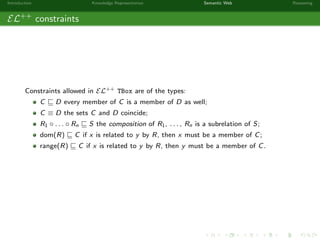
Constraints allowed in EL++ TBox are of the types:
C D every member of C is a member of D as well;
C ≡ D the sets C and D coincide;
R1 ◦ . . . ◦ Rn S the composition of R1, . . . , Rn is a subrelation of S;
dom(R) C if x is related to y by R, then x must be a member of C;
range(R) C if x is related to y by R, then y must be a member of C.
Introduction Knowledge Representation Semantic Web Reasoning
EL++
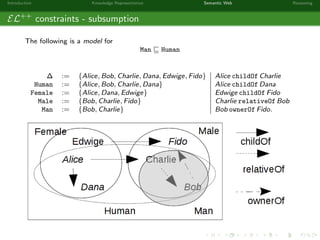
constraints - subsumption
The following is a model for
Man Human
∆ := {Alice, Bob, Charlie, Dana, Edwige, Fido} Alice childOf Charlie
Human := {Alice, Bob, Charlie, Dana} Alice childOf Dana
Female := {Alice, Dana, Edwige} Edwige childOf Fido
Male := {Bob, Charlie, Fido} Charlie relativeOf Bob
Man := {Bob, Charlie} Bob ownerOf Fido.
Introduction Knowledge Representation Semantic Web Reasoning
EL++
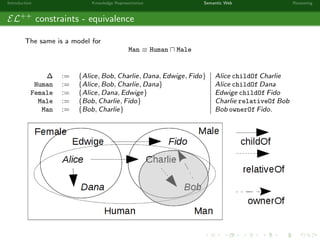
constraints - equivalence
The same is a model for
Man ≡ Human Male
∆ := {Alice, Bob, Charlie, Dana, Edwige, Fido} Alice childOf Charlie
Human := {Alice, Bob, Charlie, Dana} Alice childOf Dana
Female := {Alice, Dana, Edwige} Edwige childOf Fido
Male := {Bob, Charlie, Fido} Charlie relativeOf Bob
Man := {Bob, Charlie} Bob ownerOf Fido.
Introduction Knowledge Representation Semantic Web Reasoning
EL++
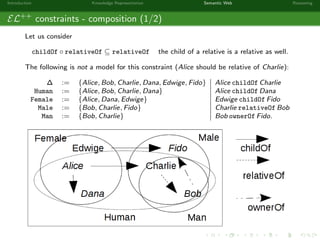
constraints - composition (1/2)
Let us consider
childOf ◦ relativeOf ⊆ relativeOf the child of a relative is a relative as well.
The following is not a model for this constraint (Alice should be relative of Charlie):
∆ := {Alice, Bob, Charlie, Dana, Edwige, Fido} Alice childOf Charlie
Human := {Alice, Bob, Charlie, Dana} Alice childOf Dana
Female := {Alice, Dana, Edwige} Edwige childOf Fido
Male := {Bob, Charlie, Fido} Charlie relativeOf Bob
Man := {Bob, Charlie} Bob ownerOf Fido.
Introduction Knowledge Representation Semantic Web Reasoning
EL++
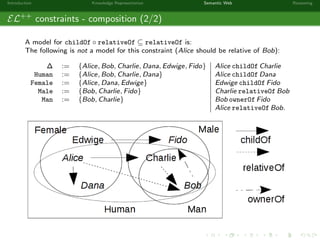
constraints - composition (2/2)
A model for childOf ◦ relativeOf ⊆ relativeOf is:
The following is not a model for this constraint (Alice should be relative of Bob):
∆ := {Alice, Bob, Charlie, Dana, Edwige, Fido} Alice childOf Charlie
Human := {Alice, Bob, Charlie, Dana} Alice childOf Dana
Female := {Alice, Dana, Edwige} Edwige childOf Fido
Male := {Bob, Charlie, Fido} Charlie relativeOf Bob
Man := {Bob, Charlie} Bob ownerOf Fido
Alice relativeOf Bob.
Introduction Knowledge Representation Semantic Web Reasoning
EL++
constraints - domain
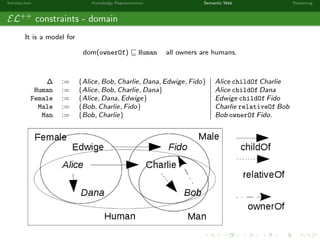
It is a model for
dom(ownerOf) Human all owners are humans.
∆ := {Alice, Bob, Charlie, Dana, Edwige, Fido} Alice childOf Charlie
Human := {Alice, Bob, Charlie, Dana} Alice childOf Dana
Female := {Alice, Dana, Edwige} Edwige childOf Fido
Male := {Bob, Charlie, Fido} Charlie relativeOf Bob
Man := {Bob, Charlie} Bob ownerOf Fido.
Introduction Knowledge Representation Semantic Web Reasoning
EL++
constraints - range
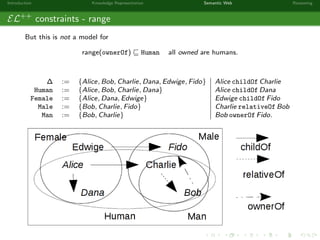
But this is not a model for
range(ownerOf) Human all owned are humans.
∆ := {Alice, Bob, Charlie, Dana, Edwige, Fido} Alice childOf Charlie
Human := {Alice, Bob, Charlie, Dana} Alice childOf Dana
Female := {Alice, Dana, Edwige} Edwige childOf Fido
Male := {Bob, Charlie, Fido} Charlie relativeOf Bob
Man := {Bob, Charlie} Bob ownerOf Fido.
Introduction Knowledge Representation Semantic Web Reasoning
Using Knowledge encoded in EL++
Introduction Knowledge Representation Semantic Web Reasoning
Reasoning
Defining a formal semantics enables some reasoning task to be performed
automatically.
Here we will see
consistency checking, to check the absence of logical errors,
inferencing, to extract hidden knowledge.
Introduction Knowledge Representation Semantic Web Reasoning
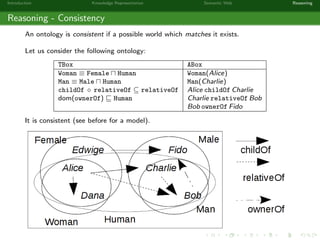
Reasoning - Consistency
An ontology is consistent if a possible world which matches it exists.
Let us consider the following ontology:
TBox ABox
Woman ≡ Female Human Woman(Alice)
Man ≡ Male Human Man(Charlie)
childOf ◦ relativeOf ⊆ relativeOf Alice childOf Charlie
dom(ownerOf) Human Charlie relativeOf Bob
Bob ownerOf Fido
It is consistent (see before for a model).
Introduction Knowledge Representation Semantic Web Reasoning
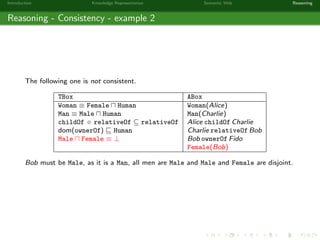
Reasoning - Consistency - example 2
The following one is not consistent.
TBox ABox
Woman ≡ Female Human Woman(Alice)
Man ≡ Male Human Man(Charlie)
childOf ◦ relativeOf ⊆ relativeOf Alice childOf Charlie
dom(ownerOf) Human Charlie relativeOf Bob
Male Female ≡ ⊥ Bob ownerOf Fido
Female(Bob)
Bob must be Male, as it is a Man, all men are Male and Male and Female are disjoint.
Introduction Knowledge Representation Semantic Web Reasoning
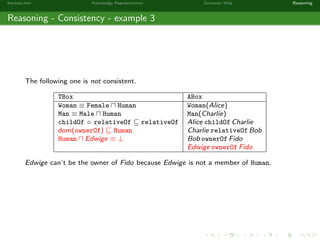
Reasoning - Consistency - example 3
The following one is not consistent.
TBox ABox
Woman ≡ Female Human Woman(Alice)
Man ≡ Male Human Man(Charlie)
childOf ◦ relativeOf ⊆ relativeOf Alice childOf Charlie
dom(ownerOf) Human Charlie relativeOf Bob
Human Edwige ≡ ⊥ Bob ownerOf Fido
Edwige ownerOf Fido
Edwige can’t be the owner of Fido because Edwige is not a member of Human.
Introduction Knowledge Representation Semantic Web Reasoning
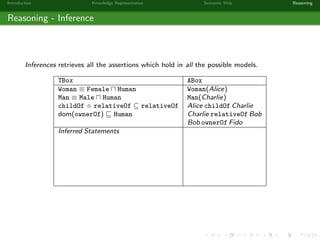
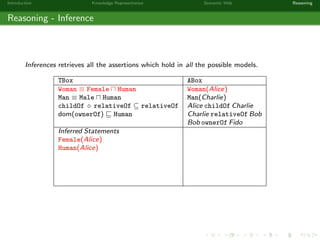
Reasoning - Inference
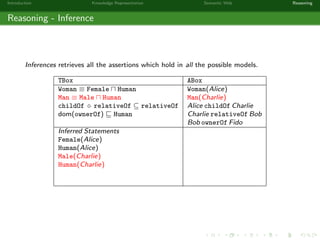
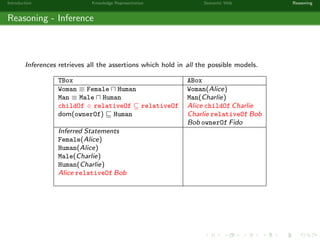
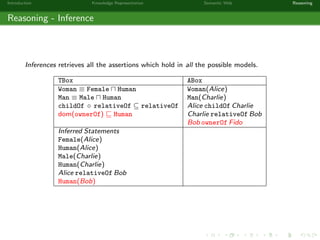
Inferences retrieves all the assertions which hold in all the possible models.
TBox ABox
Woman ≡ Female Human Woman(Alice)
Man ≡ Male Human Man(Charlie)
childOf ◦ relativeOf ⊆ relativeOf Alice childOf Charlie
dom(ownerOf) Human Charlie relativeOf Bob
Bob ownerOf Fido
Inferred Statements
Introduction Knowledge Representation Semantic Web Reasoning
Reasoning - Inference
Inferences retrieves all the assertions which hold in all the possible models.
TBox ABox
Woman ≡ Female Human Woman(Alice)
Man ≡ Male Human Man(Charlie)
childOf ◦ relativeOf ⊆ relativeOf Alice childOf Charlie
dom(ownerOf) Human Charlie relativeOf Bob
Bob ownerOf Fido
Inferred Statements
Female(Alice)
Human(Alice)
Introduction Knowledge Representation Semantic Web Reasoning
Reasoning - Inference
Inferences retrieves all the assertions which hold in all the possible models.
TBox ABox
Woman ≡ Female Human Woman(Alice)
Man ≡ Male Human Man(Charlie)
childOf ◦ relativeOf ⊆ relativeOf Alice childOf Charlie
dom(ownerOf) Human Charlie relativeOf Bob
Bob ownerOf Fido
Inferred Statements
Female(Alice)
Human(Alice)
Male(Charlie)
Human(Charlie)
Introduction Knowledge Representation Semantic Web Reasoning
Reasoning - Inference
Inferences retrieves all the assertions which hold in all the possible models.
TBox ABox
Woman ≡ Female Human Woman(Alice)
Man ≡ Male Human Man(Charlie)
childOf ◦ relativeOf ⊆ relativeOf Alice childOf Charlie
dom(ownerOf) Human Charlie relativeOf Bob
Bob ownerOf Fido
Inferred Statements
Female(Alice)
Human(Alice)
Male(Charlie)
Human(Charlie)
Alice relativeOf Bob
Introduction Knowledge Representation Semantic Web Reasoning
Reasoning - Inference
Inferences retrieves all the assertions which hold in all the possible models.
TBox ABox
Woman ≡ Female Human Woman(Alice)
Man ≡ Male Human Man(Charlie)
childOf ◦ relativeOf ⊆ relativeOf Alice childOf Charlie
dom(ownerOf) Human Charlie relativeOf Bob
Bob ownerOf Fido
Inferred Statements
Female(Alice)
Human(Alice)
Male(Charlie)
Human(Charlie)
Alice relativeOf Bob
Human(Bob)
Introduction Knowledge Representation Semantic Web Reasoning
Thank You!
(questions?)

Adding Semantics to Ontologies

  • 1.
    Introduction Knowledge RepresentationSemantic Web Reasoning Adding Semantics to Ontologies Cristiano Longo Dipartimento di Matematica e Informatica, Universit`a di Catania, Italy mailto://longo@dmi.unict.it SOD2014
  • 2.
    Introduction Knowledge RepresentationSemantic Web Reasoning About This talk is about the word Semantic in the “Semantic Web.” It will provides some basic theoretical notions for a better understanding of Semantic Web technologies (in particular OWL).
  • 3.
    Introduction Knowledge RepresentationSemantic Web Reasoning Topics Some answers for the following questions will be provided: How can we represent knowledge? (ontologies) Which tools the Semantic Web framework offer to this end? (OWL) How representing knowledge with these tools can be useful? (reasoning)
  • 4.
    Introduction Knowledge RepresentationSemantic Web Reasoning Topics Some answers for the following questions will be provided: How can we represent knowledge? (ontologies) Which tools the Semantic Web framework offer to this end? (OWL) How representing knowledge with these tools can be useful? (reasoning)
  • 5.
    Introduction Knowledge RepresentationSemantic Web Reasoning Topics Some answers for the following questions will be provided: How can we represent knowledge? (ontologies) Which tools the Semantic Web framework offer to this end? (OWL) How representing knowledge with these tools can be useful? (reasoning)
  • 6.
    Introduction Knowledge RepresentationSemantic Web Reasoning Notice For the sake of readability and for historical reason, we will use notation and terminology from Descriptio Logics, which underpin Semantic Web languages (in particular OWL).
  • 7.
    Introduction Knowledge RepresentationSemantic Web Reasoning Representing Knowledge in Logic and Computer Science
  • 8.
    Introduction Knowledge RepresentationSemantic Web Reasoning Ontologies An ontology is a (partial) description of the world. Usually, it is a finite set of statements such as, for example, human beings are mortals, Alice is the Bob’s mother, Federico II was an emperor.
  • 9.
    Introduction Knowledge RepresentationSemantic Web Reasoning Basics A knowledge domain is described in terms of individuals, to indicate domain items (Alice, Bob, . . . ), concepts (aka classes), which denote sets of domain objects (Person, Male, . . . ), and roles (aka properties), which are relations on domain items (parentOf, partnerOf, . . . ).
  • 10.
    Introduction Knowledge RepresentationSemantic Web Reasoning Vocabulary and Assertions Each ontology is divided into two parts: the TBox(vocabulary), in which vocabulary terms for concepts (i.e. sets) and roles (i.e. relations) are defined, and the ABox, which contains statements (namely, assertions) about real world items. TBox Concepts: Male, Female,Human,Woman, Man. Roles: relativeOf, childOf, grandChildOf. ABox Woman(Alice), Man(Bob), Alice relativeOf Bob, Alice childOf Charlie.
  • 11.
    Introduction Knowledge RepresentationSemantic Web Reasoning Vocabulary and Assertions Each ontology is divided into two parts: the TBox(vocabulary), in which vocabulary terms for concepts (i.e. sets) and roles (i.e. relations) are defined, and the ABox, which contains statements (namely, assertions) about real world items. TBox Concepts: Male, Female,Human,Woman, Man. Roles: relativeOf, childOf, grandChildOf. ABox Woman(Alice), Man(Bob), Alice relativeOf Bob, Alice childOf Charlie.
  • 12.
    Introduction Knowledge RepresentationSemantic Web Reasoning Open World Assumption Facts not explicitly mentioned in the ontology are not assumed to be false, their truth value is just unknown. In general, no one has complete knowledge. TBox Concepts: Male, Female,Human,Woman, Man. Roles: relativeOf, childOf, grandChildOf. ABox Woman(Alice), Man(Bob), Alice relativeOf Bob, Alice childOf Charlie. What is the kinship relation between Alice and Bob? Charlie childOf Alice? Is Charlie a man? Is Charlie a human being? What about other persons in the world?
  • 13.
    Introduction Knowledge RepresentationSemantic Web Reasoning Open World Assumption Facts not explicitly mentioned in the ontology are not assumed to be false, their truth value is just unknown. In general, no one has complete knowledge. TBox Concepts: Male, Female,Human,Woman, Man. Roles: relativeOf, childOf, grandChildOf. ABox Woman(Alice), Man(Bob), Alice relativeOf Bob, Alice childOf Charlie. What is the kinship relation between Alice and Bob? Charlie childOf Alice? Is Charlie a man? Is Charlie a human being? What about other persons in the world?
  • 14.
    Introduction Knowledge RepresentationSemantic Web Reasoning Open World Assumption - Interpretations All the possible worlds must be taken into account. An interpretation associates sets, relations, and items of a given domain (i.e. Universe) ∆ to concepts and roles in the vocabulary. For example: ∆ := {Alice, Bob, Charlie, Dana, Edwige} Alice childOf Bob Human := {Alice, Bob, Charlie, Dana} Charlie relativeOf Bob Female := {Alice, Dana, Edwige} Male := {Bob, Charlie} Woman := {Alice, Dana} Man := {BobCharlie}
  • 15.
    Introduction Knowledge RepresentationSemantic Web Reasoning Open World Assumption - Interpretations All the possible worlds must be taken into account. An interpretation associates sets, relations, and items of a given domain (i.e. Universe) ∆ to concepts and roles in the vocabulary. For example: ∆ := {Alice, Bob, Charlie, Dana, Edwige} Alice childOf Bob Human := {Alice, Bob, Charlie, Dana} Charlie relativeOf Bob Female := {Alice, Dana, Edwige} Male := {Bob, Charlie} Woman := {Alice, Dana} Man := {BobCharlie}
  • 16.
    Introduction Knowledge RepresentationSemantic Web Reasoning Open World Assumption - Interpretations All the possible worlds must be taken into account. An interpretation associates sets, relations, and items of a given domain (i.e. Universe) ∆ to concepts and roles in the vocabulary. For example: ∆ := {Alice, Bob, Charlie, Dana, Edwige} Alice childOf Bob Human := {Alice, Bob, Charlie, Dana} Charlie relativeOf Bob Female := {Alice, Dana, Edwige} Male := {Bob, Charlie} Woman := {Alice, Dana} Man := {BobCharlie}
  • 17.
    Introduction Knowledge RepresentationSemantic Web Reasoning Open World Assumption - Models (1/2) Roughly speaking, an interpretation is a model for an ontology if it does not contradicts the ontology itself For example: ∆ := {Alice, Bob, Charlie, Dana, Edwige} Alice childOf Charlie Human := {Alice, Bob, Charlie, Dana} Charlie relativeOf Bob Female := {Alice, Dana, Edwige} Male := {Bob, Charlie} Woman := {Alice, Dana} Man := {BobCharlie} is a model for TBox Concepts: Male, Female,Human,Woman, Man. Roles: relativeOf, childOf, grandChildOf. ABox Woman(Alice), Man(Bob), Alice relativeOf Bob, Alice childOf Charlie.
  • 18.
    Introduction Knowledge RepresentationSemantic Web Reasoning Open World Assumption - Models (2/2) Wherease the following is not. ∆ := {Alice, Bob, Charlie, Dana, Edwige} Alice relativeOf Charlie Human := {Alice, Bob, Charlie, Dana} Charlie relativeOf Bob Female := {Alice, Dana, Edwige} Male := {Bob, Charlie} Woman := {Alice, Dana} Man := {BobCharlie} TBox Concepts: Male, Female,Human,Woman, Man. Roles: relativeOf, childOf, grandChildOf. ABox Woman(Alice), Man(Bob), Alice relativeOf Bob, Alice childOf Charlie.
  • 19.
    Introduction Knowledge RepresentationSemantic Web Reasoning Constraints How to to associate meanings to vocabulary terms: by means of constraints (placed in the TBox) expressed in a mathematical fashion involving concepts, roles, individuals. Example Human Mortal all persons are mortal; Woman ≡ Human Female women are female human beings; childOf ◦ childOf ⊆ grandChildOf the child of the child is the grandchild. In general, the syntax of a Knowledge Representation Language is characterized by the types of constraints it allows, mainly in term of operators (eg. , ◦, . . . ).
  • 20.
    Introduction Knowledge RepresentationSemantic Web Reasoning Constraints How to to associate meanings to vocabulary terms: by means of constraints (placed in the TBox) expressed in a mathematical fashion involving concepts, roles, individuals. Example Human Mortal all persons are mortal; Woman ≡ Human Female women are female human beings; childOf ◦ childOf ⊆ grandChildOf the child of the child is the grandchild. In general, the syntax of a Knowledge Representation Language is characterized by the types of constraints it allows, mainly in term of operators (eg. , ◦, . . . ).
  • 21.
    Introduction Knowledge RepresentationSemantic Web Reasoning Representing Knowledge the Semantic Web
  • 22.
    Introduction Knowledge RepresentationSemantic Web Reasoning Semantic Web Stack Semantic Web technologies are stratified. Figure: The Semantic Web stack
  • 23.
    Introduction Knowledge RepresentationSemantic Web Reasoning Representing Knowledge the Semantic Web Semantic Web technologies are stratified. Some of these are knowledge representation languages. Figure: The Semantic Web stack
  • 24.
    Introduction Knowledge RepresentationSemantic Web Reasoning OWL OWL is the concise name of the Web Ontology Language, currently at version 2. http://www.w3.org/TR/2012/REC-owl2-primer-20121211/ Three different profiles (fragments) have been defined for it (see http://www.w3.org/TR/2012/REC-owl2-profiles-20121211/): OWL-RL quite good expressive power; OWL-QL for large ABox; OWL-EL very efficient, also in presence of large TBox. Here we consider OWL-EL.
  • 25.
    Introduction Knowledge RepresentationSemantic Web Reasoning OWL OWL is the concise name of the Web Ontology Language, currently at version 2. http://www.w3.org/TR/2012/REC-owl2-primer-20121211/ Three different profiles (fragments) have been defined for it (see http://www.w3.org/TR/2012/REC-owl2-profiles-20121211/): OWL-RL quite good expressive power; OWL-QL for large ABox; OWL-EL very efficient, also in presence of large TBox. Here we consider OWL-EL.
  • 26.
    Introduction Knowledge RepresentationSemantic Web Reasoning OWL-EL and EL++ OWL-EL is underpinned by the description logic EL++. It has been devided in the biohealth domain (SNOMED-CT). Concept constructors of EL++ are: (every)thing; ⊥ nothing; {a} nominal, the set with only member a; ∃R.C existential restriction, all those items related with some element in C; C D conjunction, all the members of both C and D; concrete domains (e.g. age > 18). Such constructors can be used to form complex concepts, e.g. ∃childOf.{Fido} := {Edwige}, ∃childOf.(Male Human).
  • 27.
    Introduction Knowledge RepresentationSemantic Web Reasoning OWL-EL and EL++ OWL-EL is underpinned by the description logic EL++. It has been devided in the biohealth domain (SNOMED-CT). Concept constructors of EL++ are: (every)thing; ⊥ nothing; {a} nominal, the set with only member a; ∃R.C existential restriction, all those items related with some element in C; C D conjunction, all the members of both C and D; concrete domains (e.g. age > 18). Such constructors can be used to form complex concepts, e.g. ∃childOf.{Fido} := {Edwige}, ∃childOf.(Male Human).
  • 28.
    Introduction Knowledge RepresentationSemantic Web Reasoning OWL-EL and EL++ OWL-EL is underpinned by the description logic EL++. It has been devided in the biohealth domain (SNOMED-CT). Concept constructors of EL++ are: (every)thing; ⊥ nothing; {a} nominal, the set with only member a; ∃R.C existential restriction, all those items related with some element in C; C D conjunction, all the members of both C and D; concrete domains (e.g. age > 18). Such constructors can be used to form complex concepts, e.g. ∃childOf.{Fido} := {Edwige}, ∃childOf.(Male Human).
  • 29.
    Introduction Knowledge RepresentationSemantic Web Reasoning EL++ concepts - Thing Let us consider the following possible world (interpretation) ∆ := {Alice, Bob, Charlie, Dana, Edwige, Fido} Alice childOf Charlie Human := {Alice, Bob, Charlie, Dana} Alice childOf Dana Female := {Alice, Dana, Edwige} Edwige childOf Fido Male := {Bob, Charlie, Fido} Charlie relativeOf Bob Bob ownerOf Fido.
  • 30.
    Introduction Knowledge RepresentationSemantic Web Reasoning EL++ concepts - Thing Let us consider the following possible world ∆ := {Alice, Bob, Charlie, Dana, Edwige, Fido} Alice childOf Charlie Human := {Alice, Bob, Charlie, Dana} Alice childOf Dana Female := {Alice, Dana, Edwige} Edwige childOf Fido Male := {Bob, Charlie, Fido} Charlie relativeOf Bob Bob ownerOf Fido. := {Alice, Bob, Charlie, Dana, Edwige, Fido}
  • 31.
    Introduction Knowledge RepresentationSemantic Web Reasoning EL++ concepts - Nothing Let us consider the following possible world ∆ := {Alice, Bob, Charlie, Dana, Edwige, Fido} Alice childOf Charlie Human := {Alice, Bob, Charlie, Dana} Alice childOf Dana Female := {Alice, Dana, Edwige} Edwige childOf Fido Male := {Bob, Charlie, Fido} Charlie relativeOf Bob Bob ownerOf Fido. ⊥ := ∅
  • 32.
    Introduction Knowledge RepresentationSemantic Web Reasoning EL++ concepts - Nominal Let us consider the following possible world ∆ := {Alice, Bob, Charlie, Dana, Edwige, Fido} Alice childOf Charlie Human := {Alice, Bob, Charlie, Dana} Alice childOf Dana Female := {Alice, Dana, Edwige} Edwige childOf Fido Male := {Bob, Charlie, Fido} Charlie relativeOf Bob Bob ownerOf Fido. {Alice} := {Alice}
  • 33.
    Introduction Knowledge RepresentationSemantic Web Reasoning EL++ concepts - existential restriction Let us consider the following possible world ∆ := {Alice, Bob, Charlie, Dana, Edwige, Fido} Alice childOf Charlie Human := {Alice, Bob, Charlie, Dana} Alice childOf Dana Female := {Alice, Dana, Edwige} Edwige childOf Fido Male := {Bob, Charlie, Fido} Charlie relativeOf Bob Bob ownerOf Fido. ∃ownerOf.Male := {Bob}
  • 34.
    Introduction Knowledge RepresentationSemantic Web Reasoning EL++ concepts - conjunction (intersection) Let us consider the following possible world ∆ := {Alice, Bob, Charlie, Dana, Edwige, Fido} Alice childOf Charlie Human := {Alice, Bob, Charlie, Dana} Alice childOf Dana Female := {Alice, Dana, Edwige} Edwige childOf Fido Male := {Bob, Charlie, Fido} Charlie relativeOf Bob Bob ownerOf Fido. Female Human := {Alice, Dana}
  • 35.
    Introduction Knowledge RepresentationSemantic Web Reasoning EL++ concepts - complex concepts Let us consider the following possible world ∆ := {Alice, Bob, Charlie, Dana, Edwige, Fido} Alice childOf Charlie Human := {Alice, Bob, Charlie, Dana} Alice childOf Dana Female := {Alice, Dana, Edwige} Edwige childOf Fido Male := {Bob, Charlie, Fido} Charlie relativeOf Bob Bob ownerOf Fido. ∃childOf.{Fido} := {Edwige}
  • 36.
    Introduction Knowledge RepresentationSemantic Web Reasoning EL++ constraints Constraints allowed in EL++ TBox are of the types: C D every member of C is a member of D as well; C ≡ D the sets C and D coincide; R1 ◦ . . . ◦ Rn S the composition of R1, . . . , Rn is a subrelation of S; dom(R) C if x is related to y by R, then x must be a member of C; range(R) C if x is related to y by R, then y must be a member of C.
  • 37.
    Introduction Knowledge RepresentationSemantic Web Reasoning EL++ constraints - subsumption The following is a model for Man Human ∆ := {Alice, Bob, Charlie, Dana, Edwige, Fido} Alice childOf Charlie Human := {Alice, Bob, Charlie, Dana} Alice childOf Dana Female := {Alice, Dana, Edwige} Edwige childOf Fido Male := {Bob, Charlie, Fido} Charlie relativeOf Bob Man := {Bob, Charlie} Bob ownerOf Fido.
  • 38.
    Introduction Knowledge RepresentationSemantic Web Reasoning EL++ constraints - equivalence The same is a model for Man ≡ Human Male ∆ := {Alice, Bob, Charlie, Dana, Edwige, Fido} Alice childOf Charlie Human := {Alice, Bob, Charlie, Dana} Alice childOf Dana Female := {Alice, Dana, Edwige} Edwige childOf Fido Male := {Bob, Charlie, Fido} Charlie relativeOf Bob Man := {Bob, Charlie} Bob ownerOf Fido.
  • 39.
    Introduction Knowledge RepresentationSemantic Web Reasoning EL++ constraints - composition (1/2) Let us consider childOf ◦ relativeOf ⊆ relativeOf the child of a relative is a relative as well. The following is not a model for this constraint (Alice should be relative of Charlie): ∆ := {Alice, Bob, Charlie, Dana, Edwige, Fido} Alice childOf Charlie Human := {Alice, Bob, Charlie, Dana} Alice childOf Dana Female := {Alice, Dana, Edwige} Edwige childOf Fido Male := {Bob, Charlie, Fido} Charlie relativeOf Bob Man := {Bob, Charlie} Bob ownerOf Fido.
  • 40.
    Introduction Knowledge RepresentationSemantic Web Reasoning EL++ constraints - composition (2/2) A model for childOf ◦ relativeOf ⊆ relativeOf is: The following is not a model for this constraint (Alice should be relative of Bob): ∆ := {Alice, Bob, Charlie, Dana, Edwige, Fido} Alice childOf Charlie Human := {Alice, Bob, Charlie, Dana} Alice childOf Dana Female := {Alice, Dana, Edwige} Edwige childOf Fido Male := {Bob, Charlie, Fido} Charlie relativeOf Bob Man := {Bob, Charlie} Bob ownerOf Fido Alice relativeOf Bob.
  • 41.
    Introduction Knowledge RepresentationSemantic Web Reasoning EL++ constraints - domain It is a model for dom(ownerOf) Human all owners are humans. ∆ := {Alice, Bob, Charlie, Dana, Edwige, Fido} Alice childOf Charlie Human := {Alice, Bob, Charlie, Dana} Alice childOf Dana Female := {Alice, Dana, Edwige} Edwige childOf Fido Male := {Bob, Charlie, Fido} Charlie relativeOf Bob Man := {Bob, Charlie} Bob ownerOf Fido.
  • 42.
    Introduction Knowledge RepresentationSemantic Web Reasoning EL++ constraints - range But this is not a model for range(ownerOf) Human all owned are humans. ∆ := {Alice, Bob, Charlie, Dana, Edwige, Fido} Alice childOf Charlie Human := {Alice, Bob, Charlie, Dana} Alice childOf Dana Female := {Alice, Dana, Edwige} Edwige childOf Fido Male := {Bob, Charlie, Fido} Charlie relativeOf Bob Man := {Bob, Charlie} Bob ownerOf Fido.
  • 43.
    Introduction Knowledge RepresentationSemantic Web Reasoning Using Knowledge encoded in EL++
  • 44.
    Introduction Knowledge RepresentationSemantic Web Reasoning Reasoning Defining a formal semantics enables some reasoning task to be performed automatically. Here we will see consistency checking, to check the absence of logical errors, inferencing, to extract hidden knowledge.
  • 45.
    Introduction Knowledge RepresentationSemantic Web Reasoning Reasoning - Consistency An ontology is consistent if a possible world which matches it exists. Let us consider the following ontology: TBox ABox Woman ≡ Female Human Woman(Alice) Man ≡ Male Human Man(Charlie) childOf ◦ relativeOf ⊆ relativeOf Alice childOf Charlie dom(ownerOf) Human Charlie relativeOf Bob Bob ownerOf Fido It is consistent (see before for a model).
  • 46.
    Introduction Knowledge RepresentationSemantic Web Reasoning Reasoning - Consistency - example 2 The following one is not consistent. TBox ABox Woman ≡ Female Human Woman(Alice) Man ≡ Male Human Man(Charlie) childOf ◦ relativeOf ⊆ relativeOf Alice childOf Charlie dom(ownerOf) Human Charlie relativeOf Bob Male Female ≡ ⊥ Bob ownerOf Fido Female(Bob) Bob must be Male, as it is a Man, all men are Male and Male and Female are disjoint.
  • 47.
    Introduction Knowledge RepresentationSemantic Web Reasoning Reasoning - Consistency - example 3 The following one is not consistent. TBox ABox Woman ≡ Female Human Woman(Alice) Man ≡ Male Human Man(Charlie) childOf ◦ relativeOf ⊆ relativeOf Alice childOf Charlie dom(ownerOf) Human Charlie relativeOf Bob Human Edwige ≡ ⊥ Bob ownerOf Fido Edwige ownerOf Fido Edwige can’t be the owner of Fido because Edwige is not a member of Human.
  • 48.
    Introduction Knowledge RepresentationSemantic Web Reasoning Reasoning - Inference Inferences retrieves all the assertions which hold in all the possible models. TBox ABox Woman ≡ Female Human Woman(Alice) Man ≡ Male Human Man(Charlie) childOf ◦ relativeOf ⊆ relativeOf Alice childOf Charlie dom(ownerOf) Human Charlie relativeOf Bob Bob ownerOf Fido Inferred Statements
  • 49.
    Introduction Knowledge RepresentationSemantic Web Reasoning Reasoning - Inference Inferences retrieves all the assertions which hold in all the possible models. TBox ABox Woman ≡ Female Human Woman(Alice) Man ≡ Male Human Man(Charlie) childOf ◦ relativeOf ⊆ relativeOf Alice childOf Charlie dom(ownerOf) Human Charlie relativeOf Bob Bob ownerOf Fido Inferred Statements Female(Alice) Human(Alice)
  • 50.
    Introduction Knowledge RepresentationSemantic Web Reasoning Reasoning - Inference Inferences retrieves all the assertions which hold in all the possible models. TBox ABox Woman ≡ Female Human Woman(Alice) Man ≡ Male Human Man(Charlie) childOf ◦ relativeOf ⊆ relativeOf Alice childOf Charlie dom(ownerOf) Human Charlie relativeOf Bob Bob ownerOf Fido Inferred Statements Female(Alice) Human(Alice) Male(Charlie) Human(Charlie)
  • 51.
    Introduction Knowledge RepresentationSemantic Web Reasoning Reasoning - Inference Inferences retrieves all the assertions which hold in all the possible models. TBox ABox Woman ≡ Female Human Woman(Alice) Man ≡ Male Human Man(Charlie) childOf ◦ relativeOf ⊆ relativeOf Alice childOf Charlie dom(ownerOf) Human Charlie relativeOf Bob Bob ownerOf Fido Inferred Statements Female(Alice) Human(Alice) Male(Charlie) Human(Charlie) Alice relativeOf Bob
  • 52.
    Introduction Knowledge RepresentationSemantic Web Reasoning Reasoning - Inference Inferences retrieves all the assertions which hold in all the possible models. TBox ABox Woman ≡ Female Human Woman(Alice) Man ≡ Male Human Man(Charlie) childOf ◦ relativeOf ⊆ relativeOf Alice childOf Charlie dom(ownerOf) Human Charlie relativeOf Bob Bob ownerOf Fido Inferred Statements Female(Alice) Human(Alice) Male(Charlie) Human(Charlie) Alice relativeOf Bob Human(Bob)
  • 53.
    Introduction Knowledge RepresentationSemantic Web Reasoning Thank You! (questions?)