Key terms and names
Terms
Names
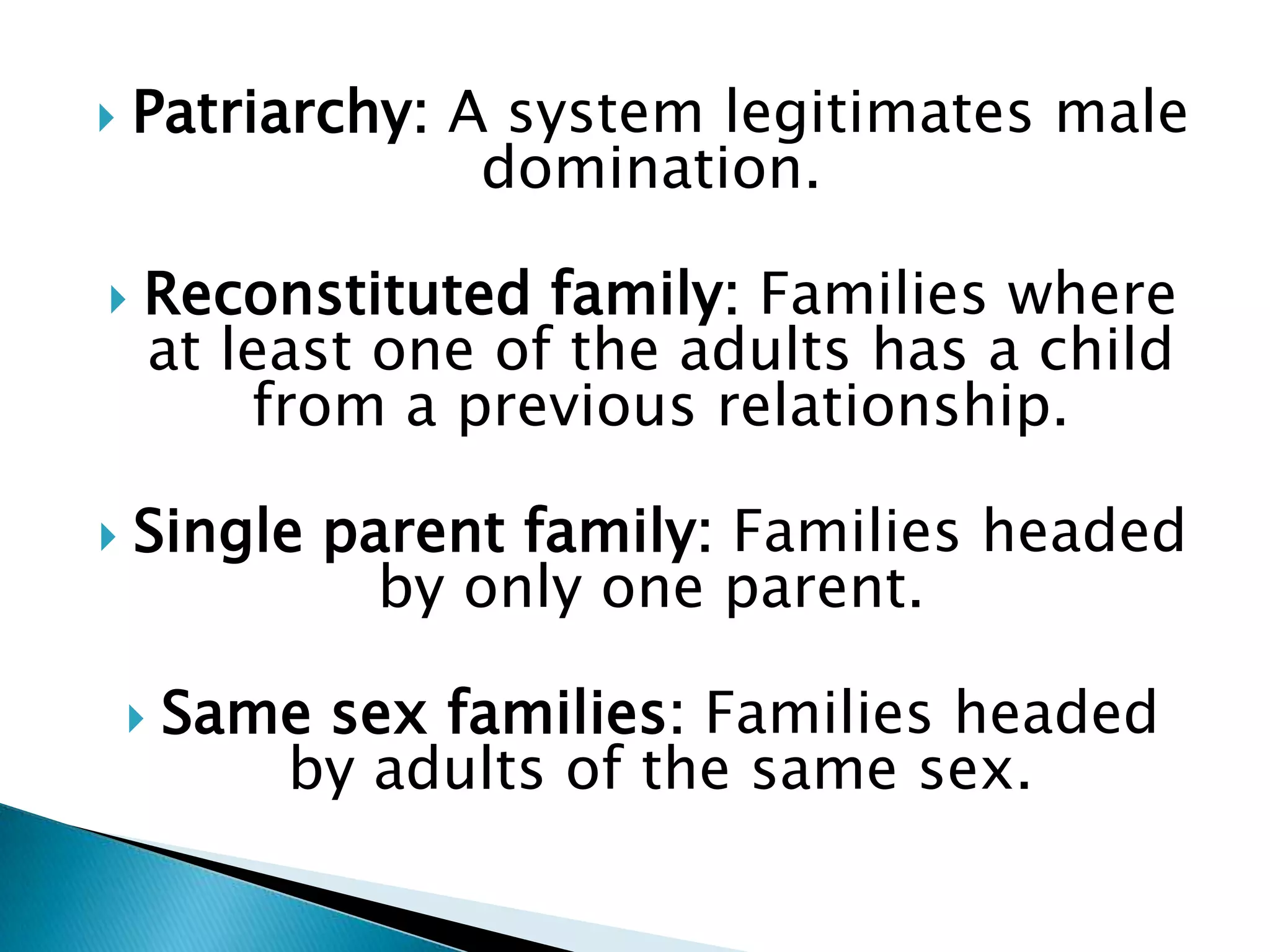
   Patriarchy: A system legitimates male
                 domination.

   Reconstituted family: Families where
    at least one of the adults has a child
        from a previous relationship.

   Single parent family: Families headed
             by only one parent.

       Same sex families: Families headed
           by adults of the same sex.
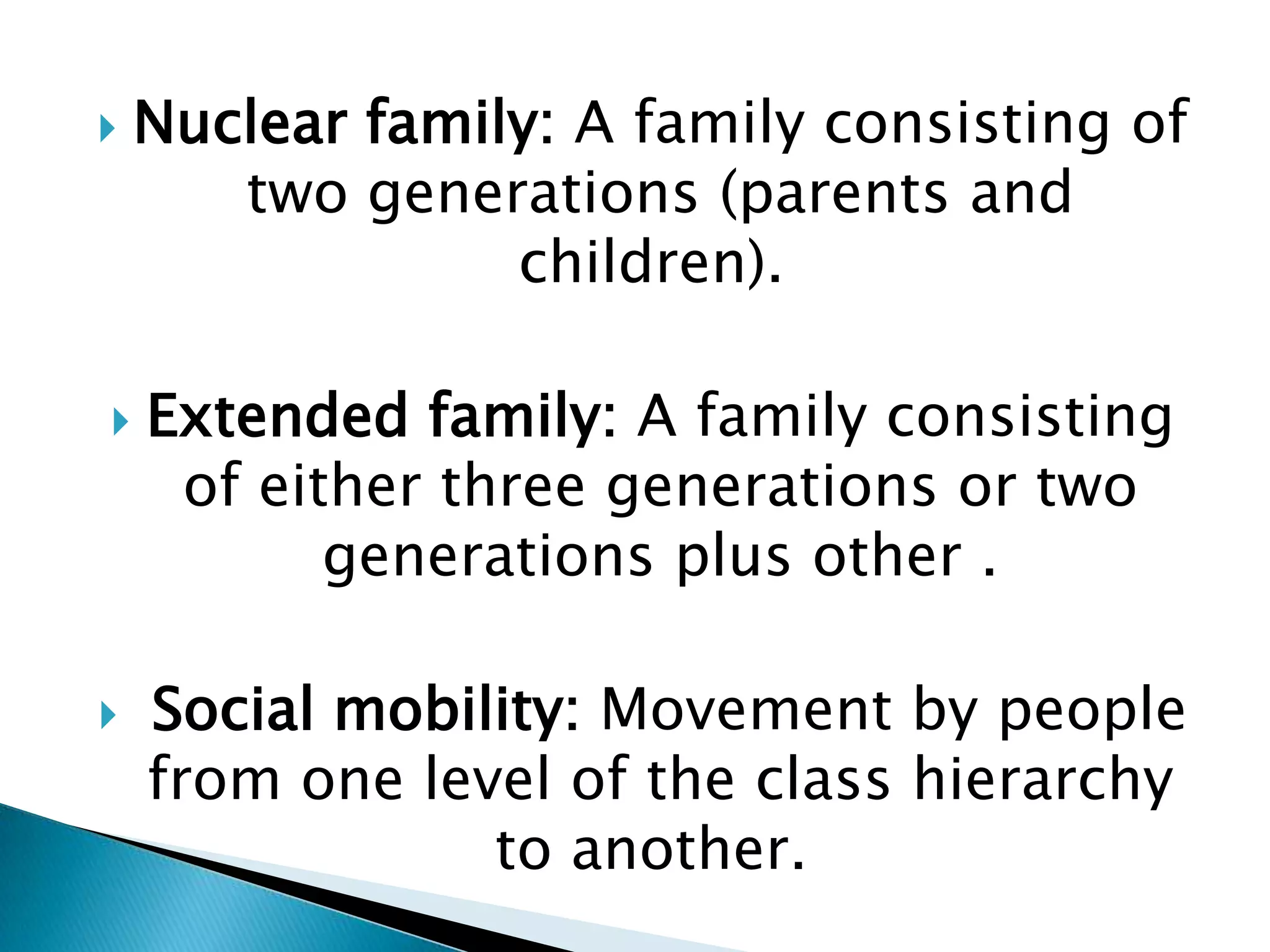
   Nuclear family: A family consisting of
       two generations (parents and
                 children).

   Extended family: A family consisting
     of either three generations or two
           generations plus other .

   Social mobility: Movement by people
    from one level of the class hierarchy
                to another.
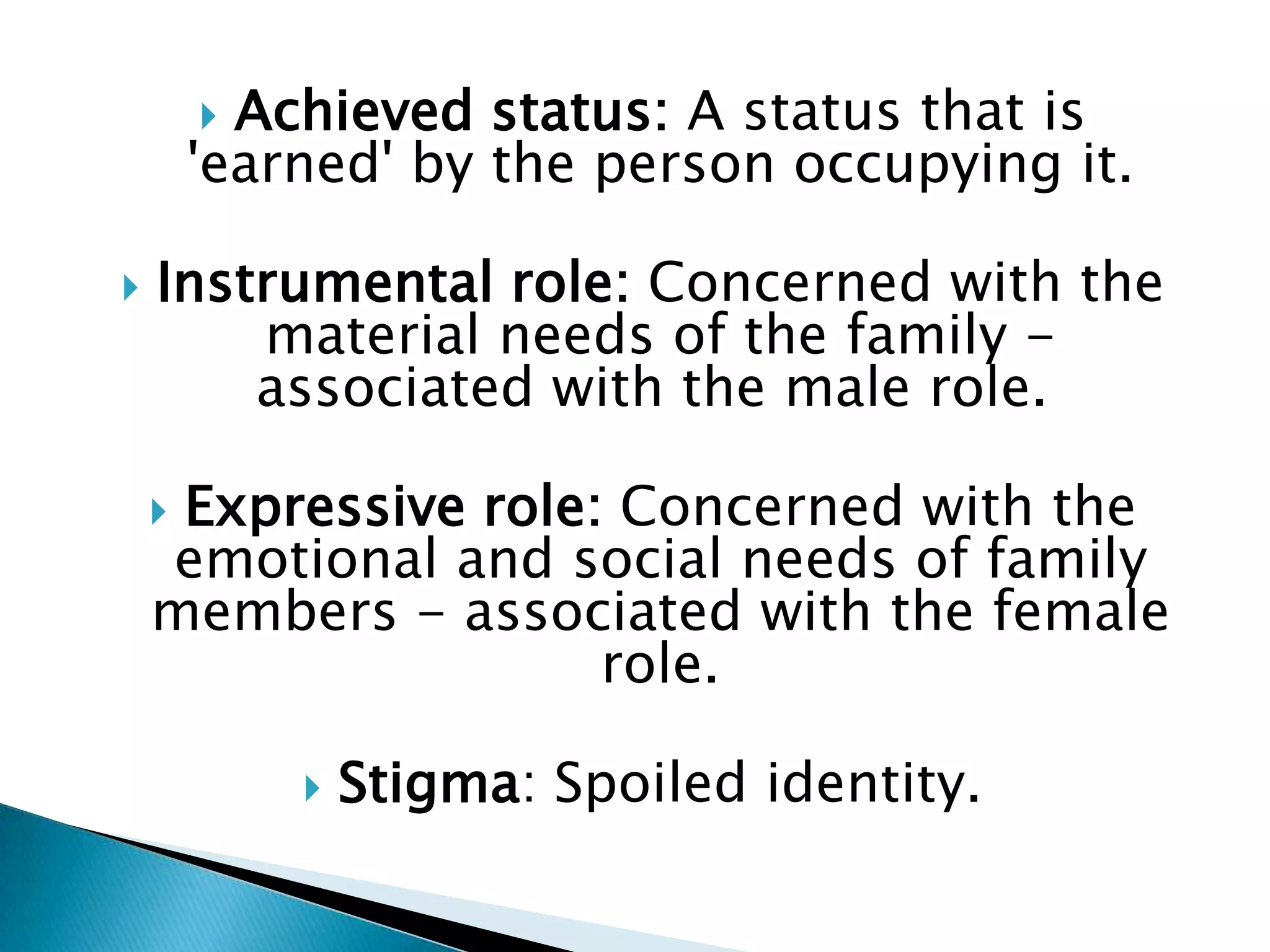
 Achieved status: A status that is
        'earned' by the person occupying it.

   Instrumental role: Concerned with the
        material needs of the family -
        associated with the male role.

    Expressive role: Concerned with the
    emotional and social needs of family
    members - associated with the female
                     role.

               Stigma: Spoiled identity.
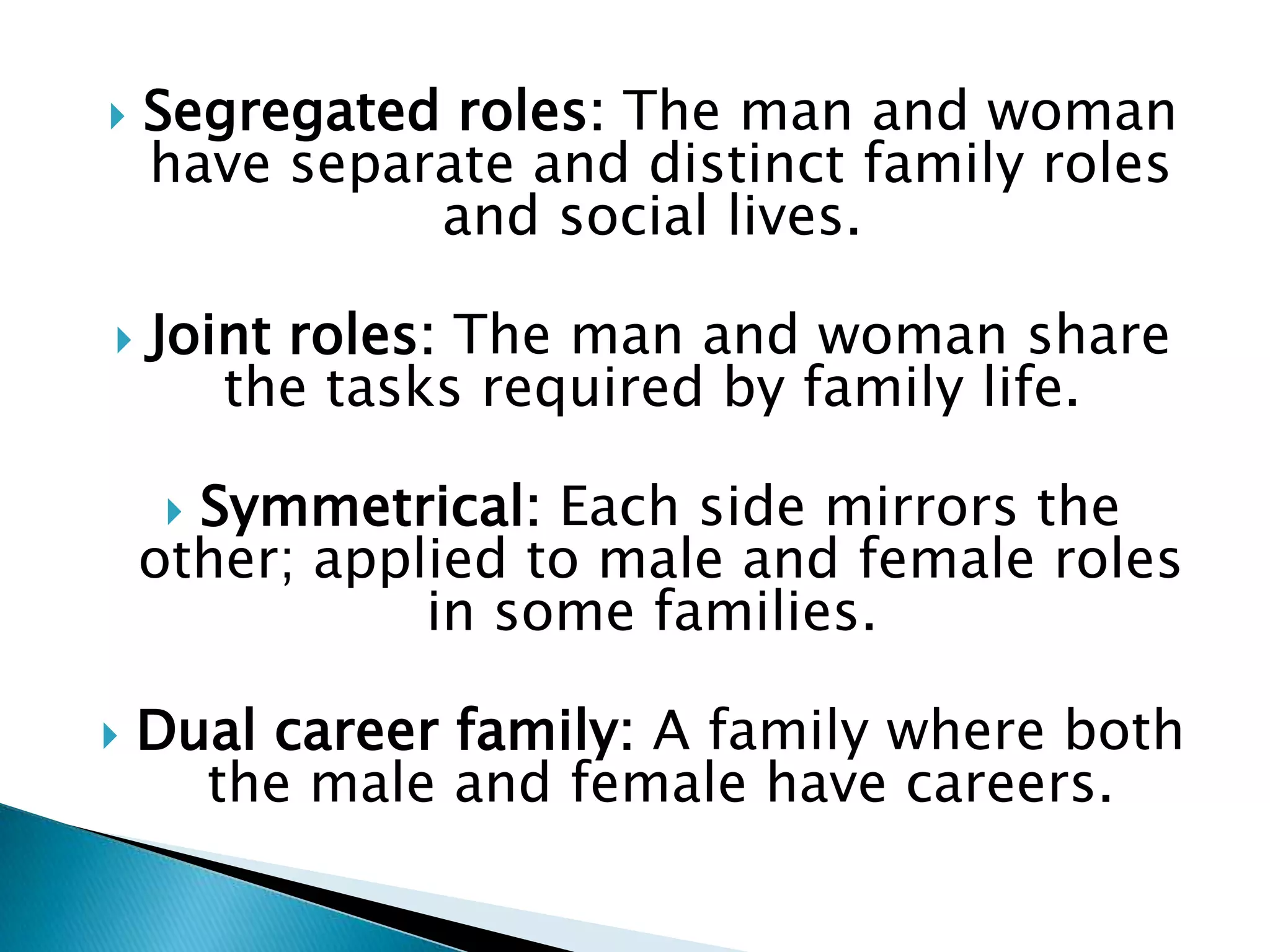
   Segregated roles: The man and woman
    have separate and distinct family roles
              and social lives.

   Joint roles: The man and woman share
       the tasks required by family life.

     Symmetrical: Each side mirrors the
    other; applied to male and female roles
               in some families.

   Dual career family: A family where both
      the male and female have careers.
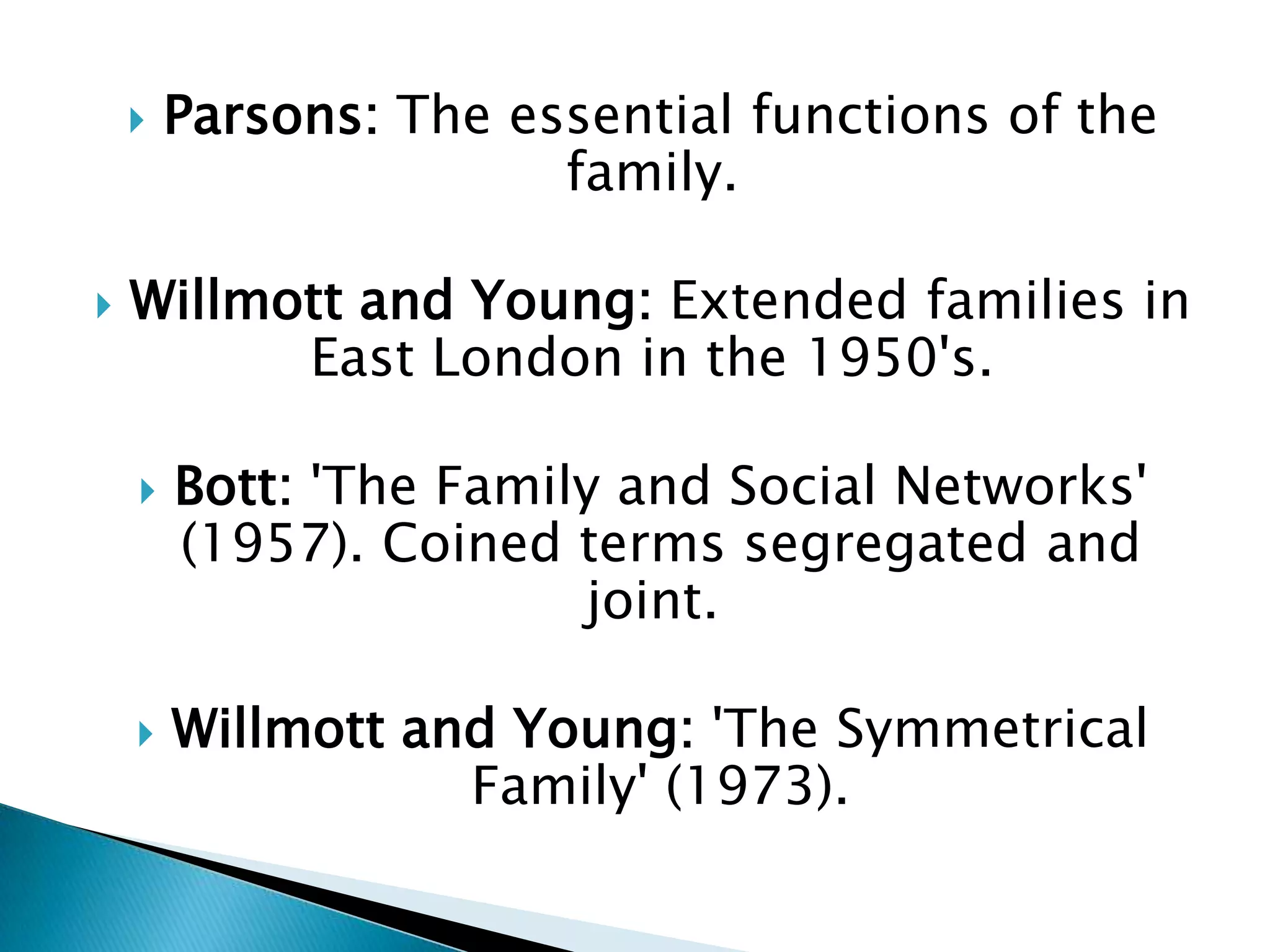
   Parsons: The essential functions of the
                       family.

   Willmott and Young: Extended families in
          East London in the 1950's.

       Bott: 'The Family and Social Networks'
        (1957). Coined terms segregated and
                        joint.

       Willmott and Young: 'The Symmetrical
                   Family' (1973).
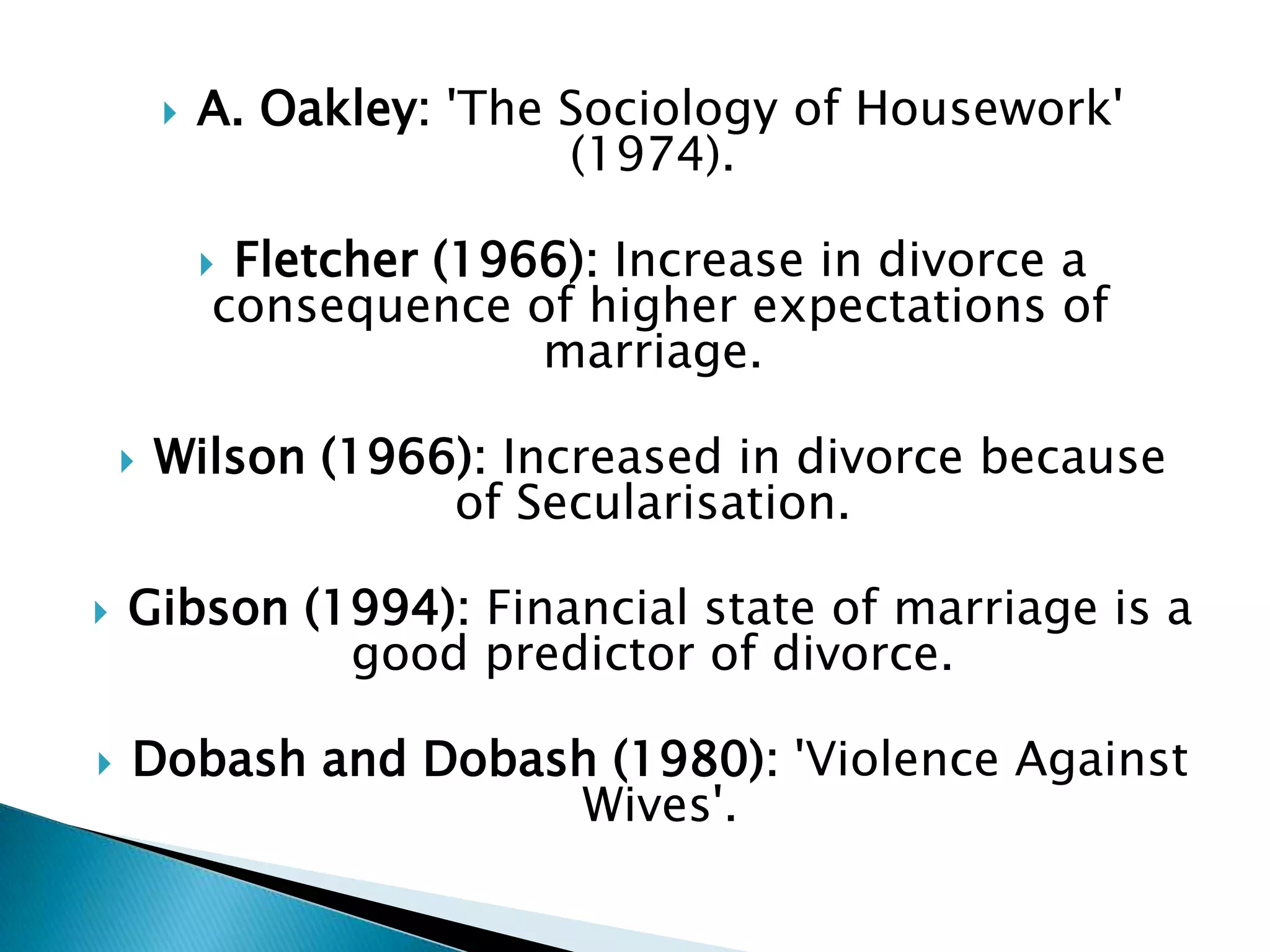
   A. Oakley: 'The Sociology of Housework'
                            (1974).

            Fletcher (1966): Increase in divorce a
            consequence of higher expectations of
                          marriage.

       Wilson (1966): Increased in divorce because
                    of Secularisation.

   Gibson (1994): Financial state of marriage is a
             good predictor of divorce.

   Dobash and Dobash (1980): 'Violence Against
                    Wives'.
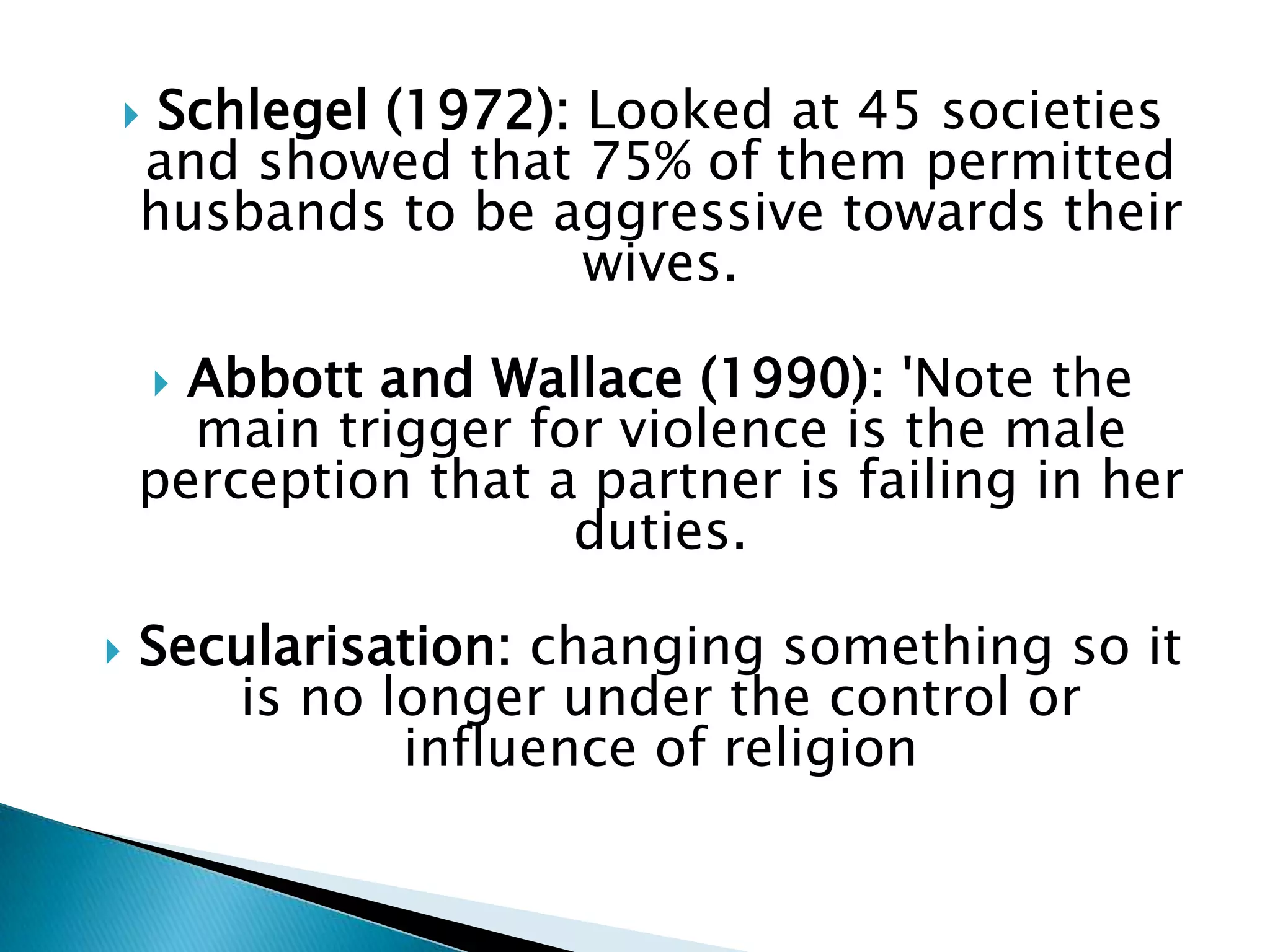
    Schlegel (1972): Looked at 45 societies
    and showed that 75% of them permitted
    husbands to be aggressive towards their
                      wives.

     Abbott and Wallace (1990): 'Note the
      main trigger for violence is the male
    perception that a partner is failing in her
                     duties.

   Secularisation: changing something so it
       is no longer under the control or
              influence of religion
Terms
Names
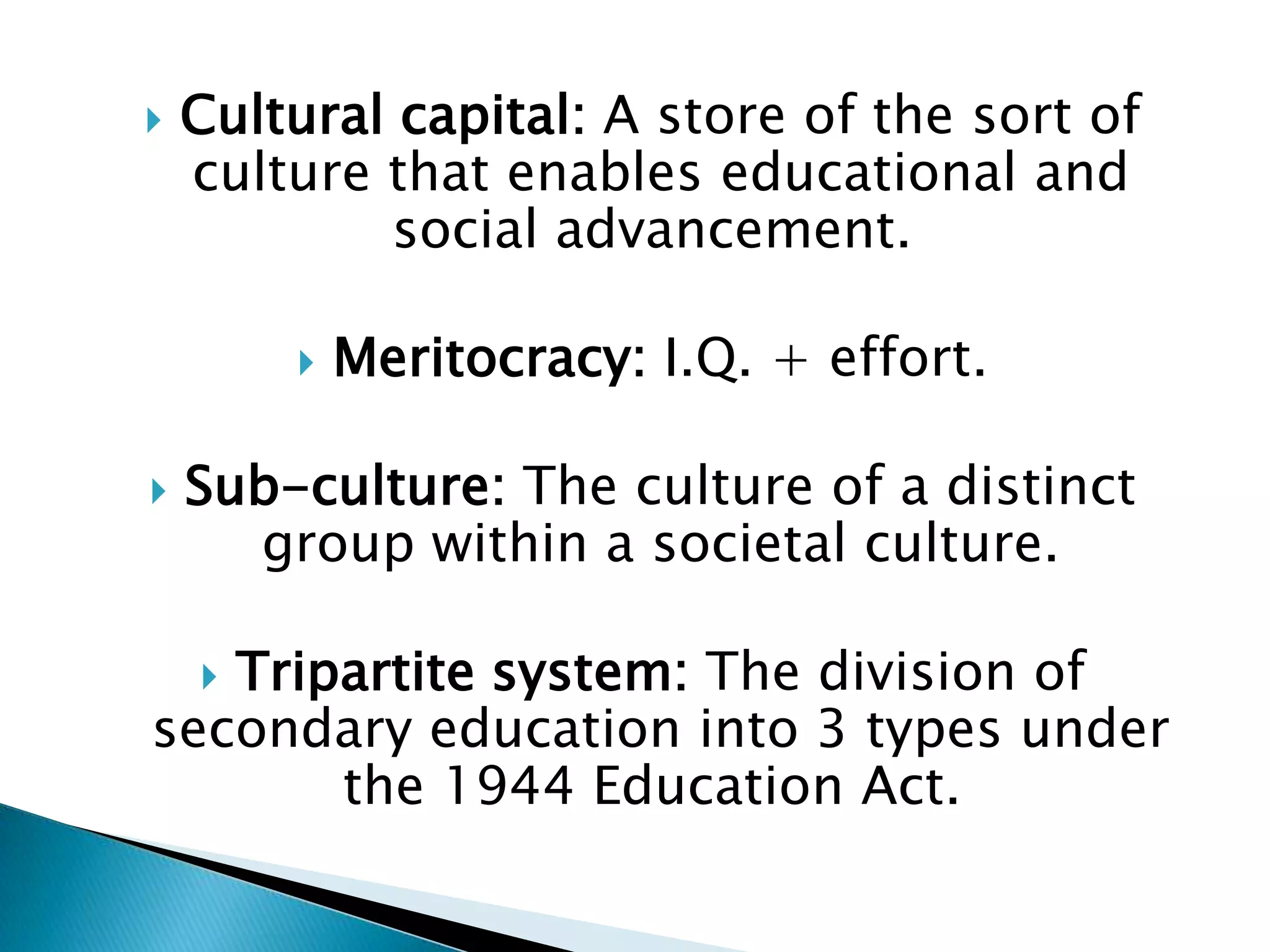
   Cultural capital: A store of the sort of
    culture that enables educational and
            social advancement.

           Meritocracy: I.Q. + effort.

   Sub-culture: The culture of a distinct
      group within a societal culture.

   Tripartite system: The division of
    
secondary education into 3 types under
       the 1944 Education Act.
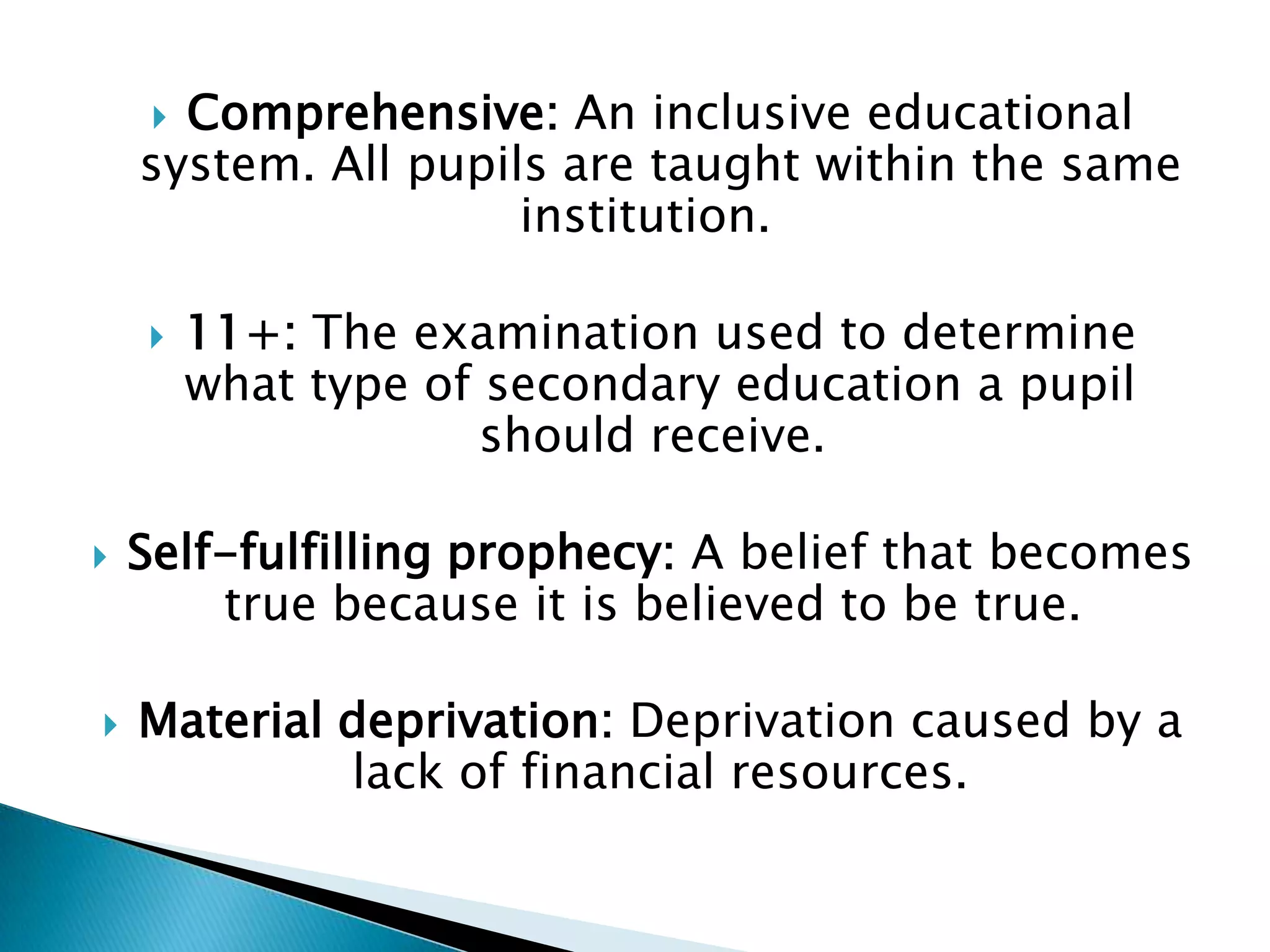
Comprehensive: An inclusive educational
    system. All pupils are taught within the same
                     institution.

        11+: The examination used to determine
         what type of secondary education a pupil
                      should receive.

   Self-fulfilling prophecy: A belief that becomes
        true because it is believed to be true.

   Material deprivation: Deprivation caused by a
             lack of financial resources.
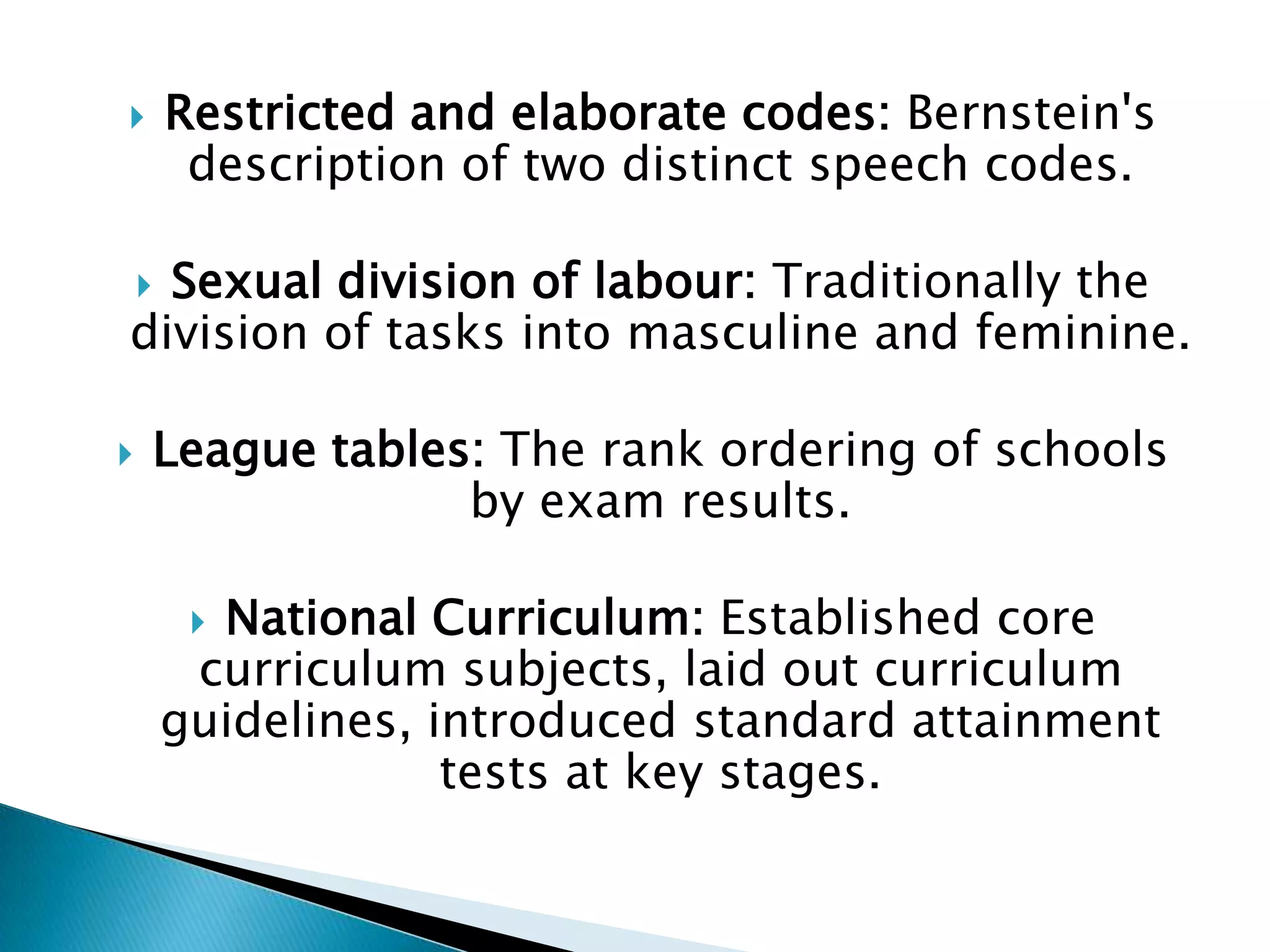
       Restricted and elaborate codes: Bernstein's
         description of two distinct speech codes.

  Sexual division of labour: Traditionally the
    
division of tasks into masculine and feminine.

   League tables: The rank ordering of schools
                 by exam results.

         National Curriculum: Established core
         curriculum subjects, laid out curriculum
        guidelines, introduced standard attainment
                     tests at key stages.
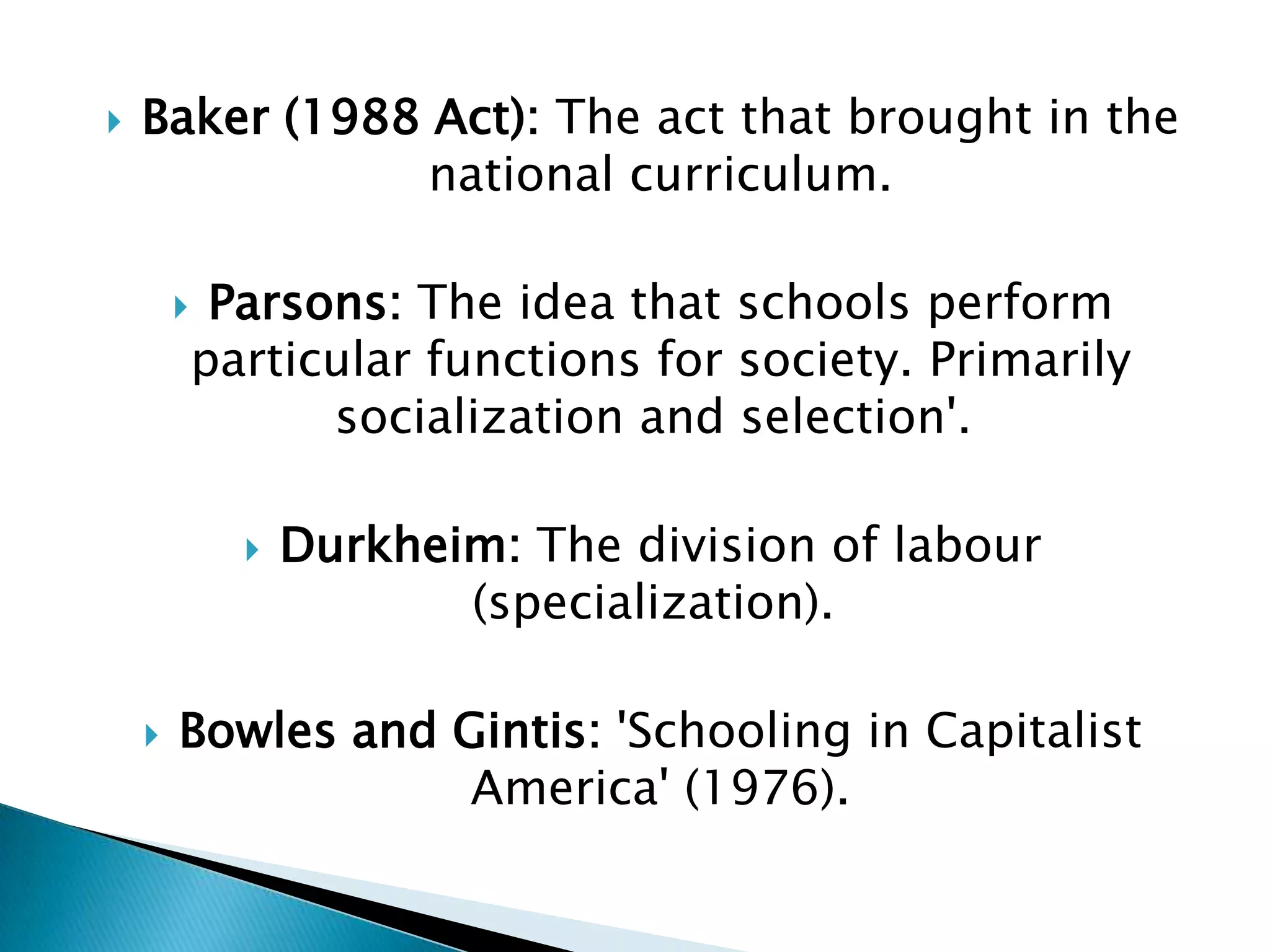
   Baker (1988 Act): The act that brought in the
                national curriculum.

            Parsons: The idea that schools perform
            particular functions for society. Primarily
                  socialization and selection'.

                 Durkheim: The division of labour
                         (specialization).

       Bowles and Gintis: 'Schooling in Capitalist
                    America' (1976).
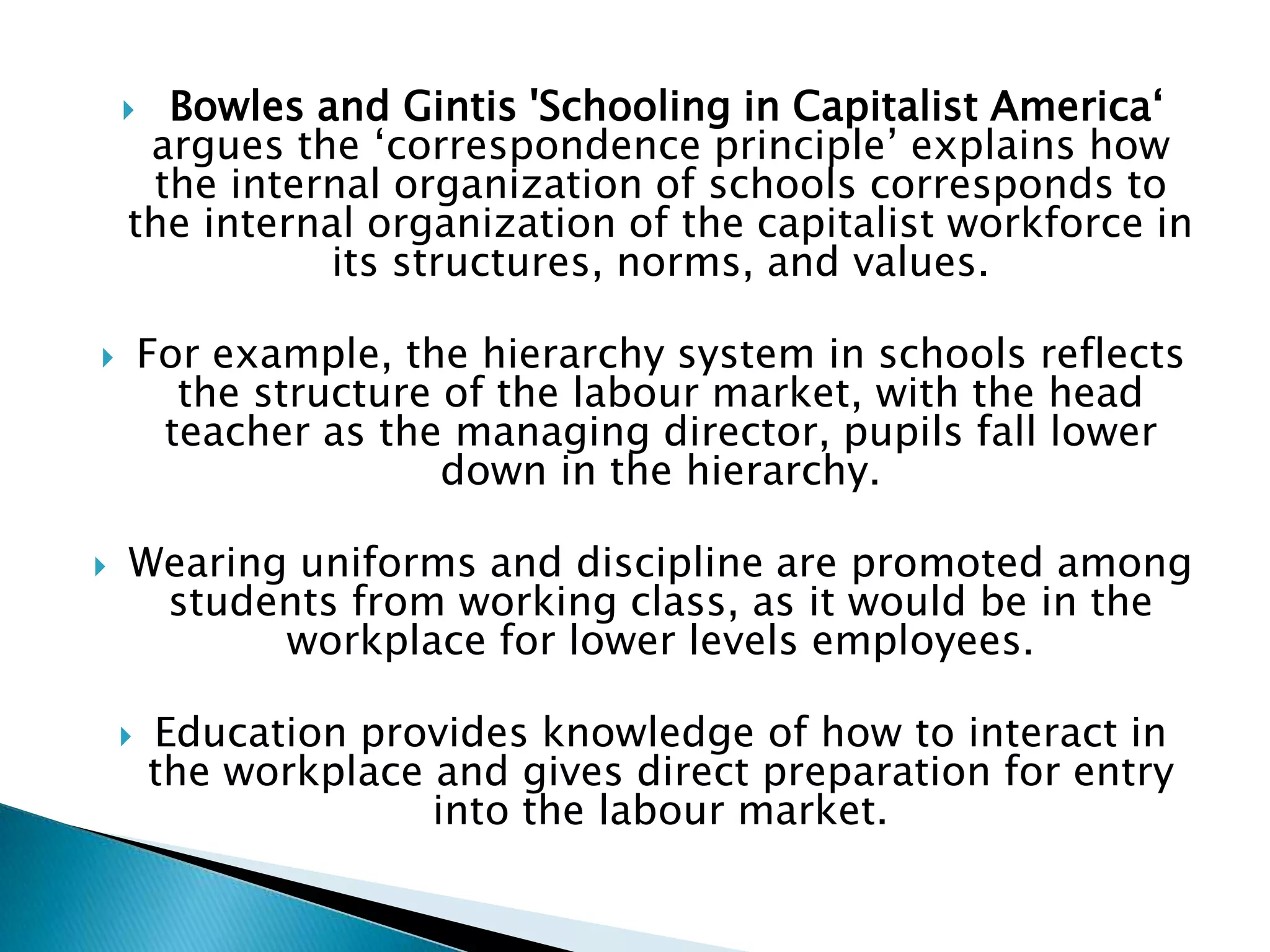
 Bowles and Gintis 'Schooling in Capitalist America‘
     argues the ‘correspondence principle’ explains how
     the internal organization of schools corresponds to
    the internal organization of the capitalist workforce in
              its structures, norms, and values.

       For example, the hierarchy system in schools reflects
          the structure of the labour market, with the head
         teacher as the managing director, pupils fall lower
                        down in the hierarchy.

   Wearing uniforms and discipline are promoted among
     students from working class, as it would be in the
           workplace for lower levels employees.

       Education provides knowledge of how to interact in
        the workplace and gives direct preparation for entry
                      into the labour market.
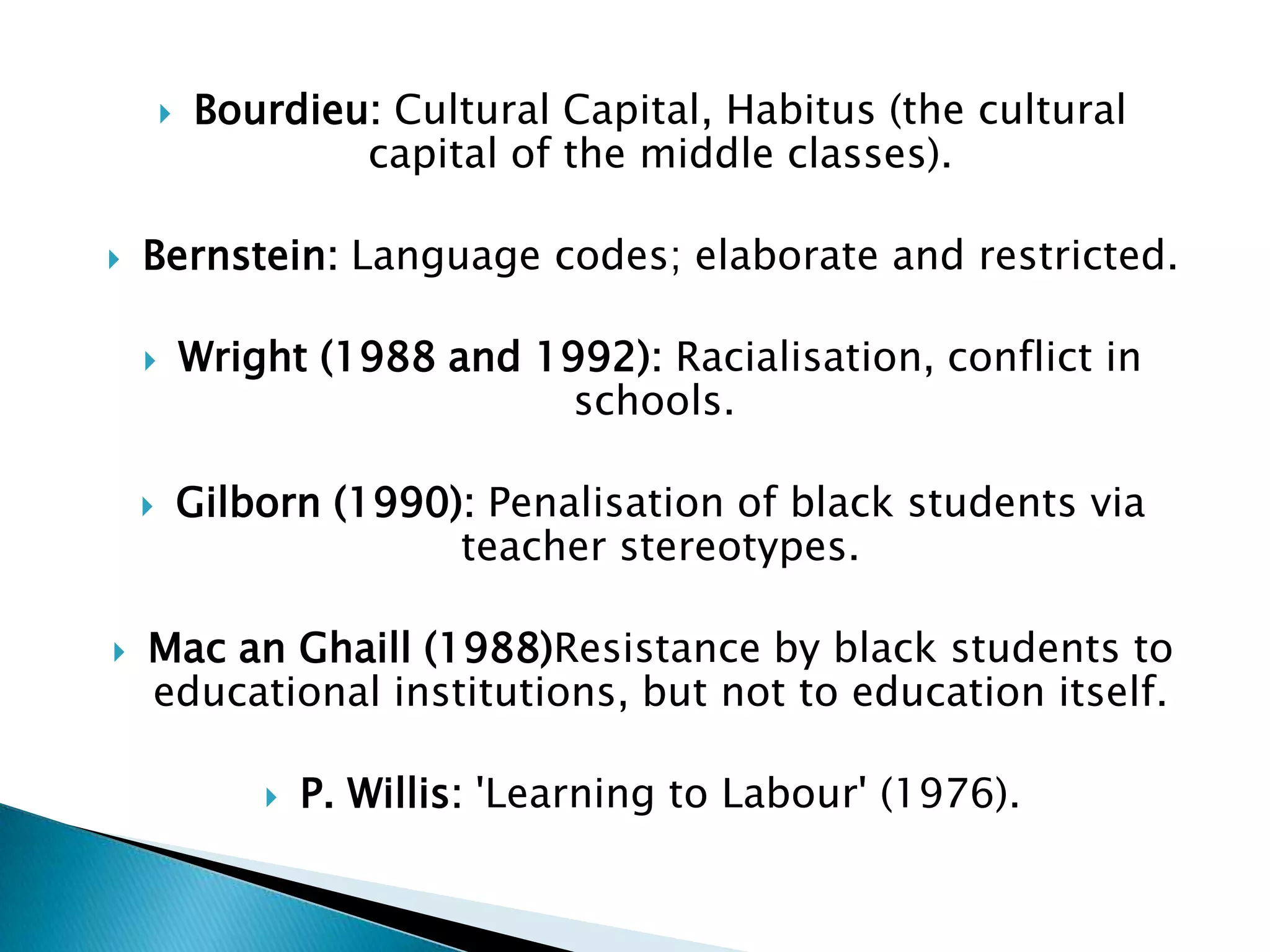
   Bourdieu: Cultural Capital, Habitus (the cultural
                    capital of the middle classes).

   Bernstein: Language codes; elaborate and restricted.

           Wright (1988 and 1992): Racialisation, conflict in
                               schools.

           Gilborn (1990): Penalisation of black students via
                          teacher stereotypes.

   Mac an Ghaill (1988)Resistance by black students to
    educational institutions, but not to education itself.

                   P. Willis: 'Learning to Labour' (1976).
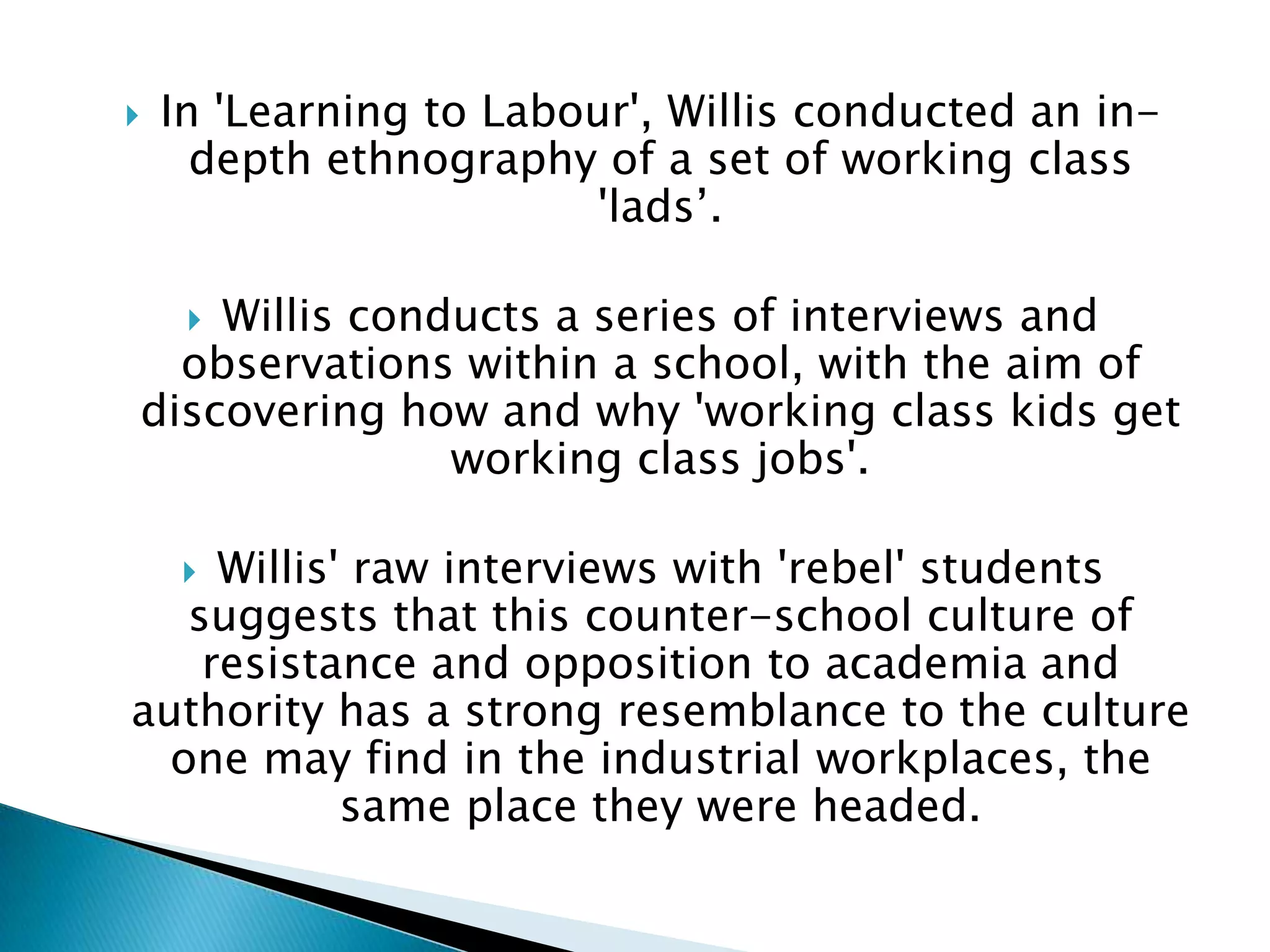
   In 'Learning to Labour', Willis conducted an in-
      depth ethnography of a set of working class
                         'lads’.

    Willis conducts a series of interviews and
     
  observations within a school, with the aim of
discovering how and why 'working class kids get
               working class jobs'.

     Willis' raw interviews with 'rebel' students
     
   suggests that this counter-school culture of
    resistance and opposition to academia and
authority has a strong resemblance to the culture
  one may find in the industrial workplaces, the
            same place they were headed.
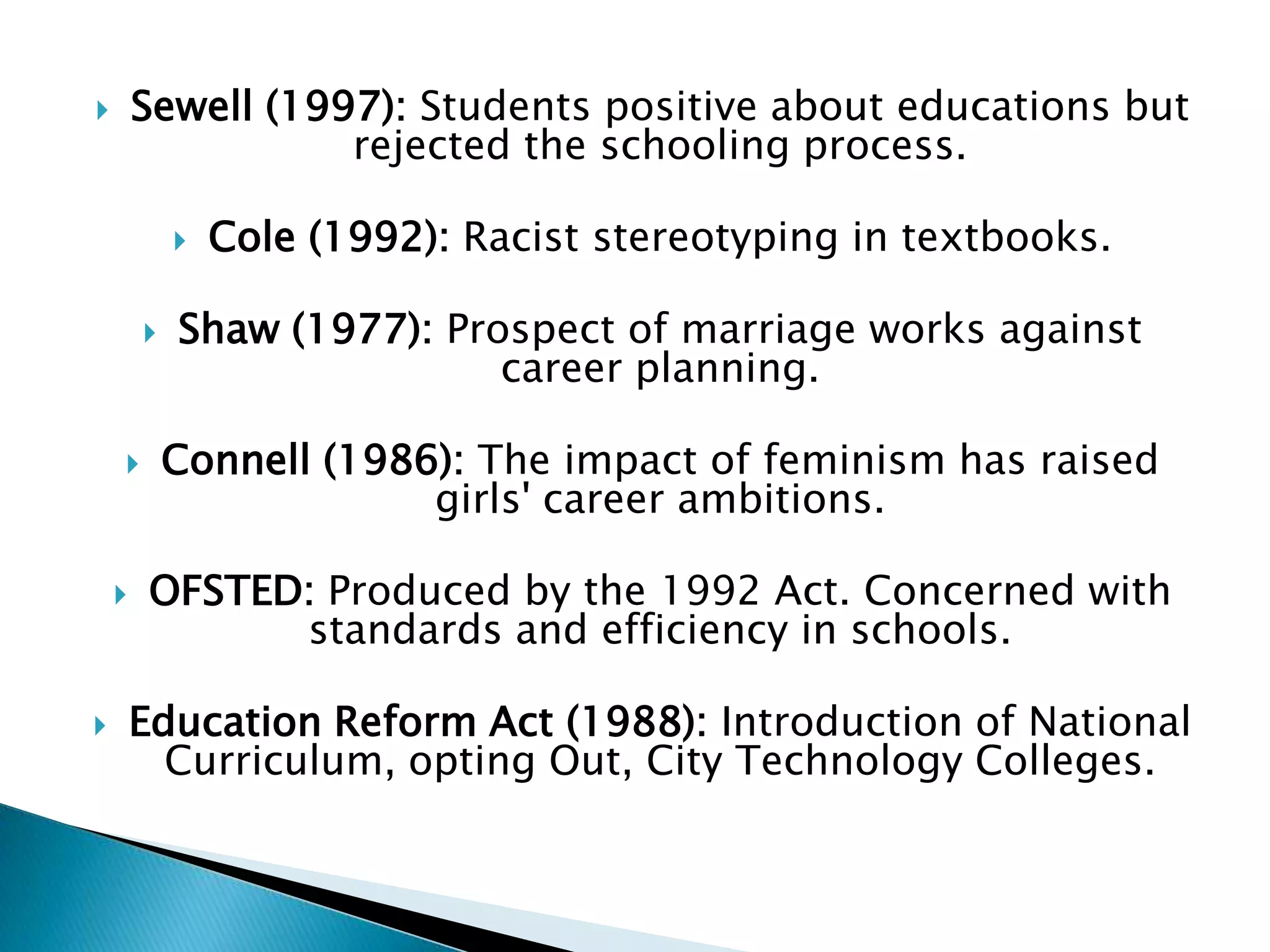
       Sewell (1997): Students positive about educations but
                   rejected the schooling process.

               Cole (1992): Racist stereotyping in textbooks.

           Shaw (1977): Prospect of marriage works against
                            career planning.

           Connell (1986): The impact of feminism has raised
                         girls' career ambitions.

        OFSTED: Produced by the 1992 Act. Concerned with
               standards and efficiency in schools.

       Education Reform Act (1988): Introduction of National
          Curriculum, opting Out, City Technology Colleges.

Sociology key terms and names

  • 1.
  • 2.
  • 3.
    Patriarchy: A system legitimates male domination.  Reconstituted family: Families where at least one of the adults has a child from a previous relationship.  Single parent family: Families headed by only one parent.  Same sex families: Families headed by adults of the same sex.
  • 4.
    Nuclear family: A family consisting of two generations (parents and children).  Extended family: A family consisting of either three generations or two generations plus other .  Social mobility: Movement by people from one level of the class hierarchy to another.
  • 5.
     Achieved status:A status that is 'earned' by the person occupying it.  Instrumental role: Concerned with the material needs of the family - associated with the male role. Expressive role: Concerned with the emotional and social needs of family members - associated with the female role.  Stigma: Spoiled identity.
  • 6.
    Segregated roles: The man and woman have separate and distinct family roles and social lives.  Joint roles: The man and woman share the tasks required by family life. Symmetrical: Each side mirrors the other; applied to male and female roles in some families.  Dual career family: A family where both the male and female have careers.
  • 7.
    Parsons: The essential functions of the family.  Willmott and Young: Extended families in East London in the 1950's.  Bott: 'The Family and Social Networks' (1957). Coined terms segregated and joint.  Willmott and Young: 'The Symmetrical Family' (1973).
  • 8.
    A. Oakley: 'The Sociology of Housework' (1974). Fletcher (1966): Increase in divorce a consequence of higher expectations of marriage.  Wilson (1966): Increased in divorce because of Secularisation.  Gibson (1994): Financial state of marriage is a good predictor of divorce.  Dobash and Dobash (1980): 'Violence Against Wives'.
  • 9.
    Schlegel (1972): Looked at 45 societies and showed that 75% of them permitted husbands to be aggressive towards their wives.  Abbott and Wallace (1990): 'Note the main trigger for violence is the male perception that a partner is failing in her duties.  Secularisation: changing something so it is no longer under the control or influence of religion
  • 10.
  • 11.
    Cultural capital: A store of the sort of culture that enables educational and social advancement.  Meritocracy: I.Q. + effort.  Sub-culture: The culture of a distinct group within a societal culture. Tripartite system: The division of  secondary education into 3 types under the 1944 Education Act.
  • 12.
    Comprehensive: An inclusiveeducational system. All pupils are taught within the same institution.  11+: The examination used to determine what type of secondary education a pupil should receive.  Self-fulfilling prophecy: A belief that becomes true because it is believed to be true.  Material deprivation: Deprivation caused by a lack of financial resources.
  • 13.
    Restricted and elaborate codes: Bernstein's description of two distinct speech codes. Sexual division of labour: Traditionally the  division of tasks into masculine and feminine.  League tables: The rank ordering of schools by exam results. National Curriculum: Established core curriculum subjects, laid out curriculum guidelines, introduced standard attainment tests at key stages.
  • 14.
    Baker (1988 Act): The act that brought in the national curriculum.  Parsons: The idea that schools perform particular functions for society. Primarily socialization and selection'.  Durkheim: The division of labour (specialization).  Bowles and Gintis: 'Schooling in Capitalist America' (1976).
  • 15.
     Bowles andGintis 'Schooling in Capitalist America‘ argues the ‘correspondence principle’ explains how the internal organization of schools corresponds to the internal organization of the capitalist workforce in its structures, norms, and values.  For example, the hierarchy system in schools reflects the structure of the labour market, with the head teacher as the managing director, pupils fall lower down in the hierarchy.  Wearing uniforms and discipline are promoted among students from working class, as it would be in the workplace for lower levels employees.  Education provides knowledge of how to interact in the workplace and gives direct preparation for entry into the labour market.
  • 16.
    Bourdieu: Cultural Capital, Habitus (the cultural capital of the middle classes).  Bernstein: Language codes; elaborate and restricted.  Wright (1988 and 1992): Racialisation, conflict in schools.  Gilborn (1990): Penalisation of black students via teacher stereotypes.  Mac an Ghaill (1988)Resistance by black students to educational institutions, but not to education itself.  P. Willis: 'Learning to Labour' (1976).
  • 17.
    In 'Learning to Labour', Willis conducted an in- depth ethnography of a set of working class 'lads’. Willis conducts a series of interviews and  observations within a school, with the aim of discovering how and why 'working class kids get working class jobs'. Willis' raw interviews with 'rebel' students  suggests that this counter-school culture of resistance and opposition to academia and authority has a strong resemblance to the culture one may find in the industrial workplaces, the same place they were headed.
  • 18.
    Sewell (1997): Students positive about educations but rejected the schooling process.  Cole (1992): Racist stereotyping in textbooks.  Shaw (1977): Prospect of marriage works against career planning.  Connell (1986): The impact of feminism has raised girls' career ambitions.  OFSTED: Produced by the 1992 Act. Concerned with standards and efficiency in schools.  Education Reform Act (1988): Introduction of National Curriculum, opting Out, City Technology Colleges.