Social Tools
to Share Your
Research
Nickoal Eichmann | Research Librarian | nle42@msstate.edu
@NickoalEichmann
@MSU_Libraries
#socialresearcher
Today’s Objectives
We will discuss:
● The research lifecycle
● Possible social tools suited for you
● How to become a trusted voice
● How to track your influence and tell your
impact story
@NickoalEichmann @MSU_Libraries #socialresearcher
How many of you have…
… a Google Scholar profile?
• When you’re googled, it’s the top result
• Automatically indexes published articles
• Used for citations counts | h-index
@NickoalEichmann @MSU_Libraries #socialresearcher
How many of you have…
… used a social networking site, e.g.
• Facebook?
• Twitter?
… read or written a blog post?
… a LinkedIn profile?
… used an academic networking site?
@NickoalEichmann @MSU_Libraries #socialresearcher
Some Fun Facts:
Social Networks
Facebook
• 1.3 billion users [1]
• 2.5 billion pieces of content shared daily [2]
Twitter
• 284 million active monthly users [3]
• 500 million tweets sent daily [3]
• 1 in 40 scholars in on Twitter [4]
[1] Van Noorden 2014 | [2] Harrington 2014 | [3] Twitter 2015 | [4] Darling 2013
@NickoalEichmann @MSU_Libraries #socialresearcher
Some Fun Facts:
Academic Networks
LinkedIn
• 300 million users [5]
Academia.edu
• 14 million registered users [6]
ResearchGate
• 4.5 million users [7]
• 10,000 new users daily [8]
[5] Connor 2014 | [6] Academia.edu 2014 | [7 & 8] Van Noorden, 2014
@NickoalEichmann @MSU_Libraries #socialresearcher
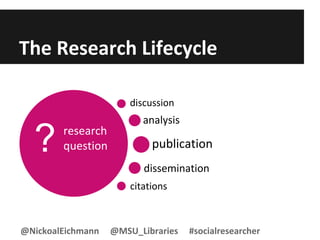
The Research Lifecycle
research
question
discussion
analysis
publication
dissemination
citations
?
@NickoalEichmann @MSU_Libraries #socialresearcher
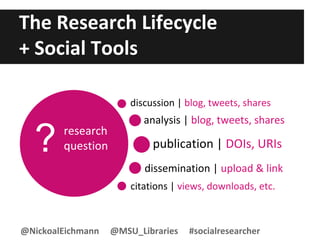
The Research Lifecycle
+ Social Tools
research
question
discussion | blog, tweets, shares
analysis | blog, tweets, shares
publication | DOIs, URIs
dissemination | upload & link
citations | views, downloads, etc.
?
@NickoalEichmann @MSU_Libraries #socialresearcher
So many people,
so many tools…
Things to consider:
▪ Who do you want to reach?
▪ What tools are they using?
▪ How do they know you’re someone they should
listen to?
Why Scholars Use Social Media:
http://bit.ly/1xsnT2C
@NickoalEichmann @MSU_Libraries #socialresearcher
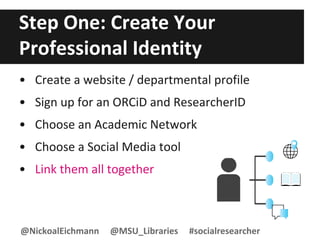
Step One: Create Your
Professional Identity
• Create a website / departmental profile
• Sign up for an ORCiD and ResearcherID
• Choose an Academic Network
• Choose a Social Media tool
• Link them all together
@NickoalEichmann @MSU_Libraries #socialresearcher
Step Two: Link Content
• Posters
• Slides
• Videos
• Images
• Datasets
• Software
• Conference Papers
• Journal articles, book chapters, books *
* Publication agreement? CCBY?
@NickoalEichmann @MSU_Libraries #socialresearcher
Use Cases:
Computer Engineer
• ORCiD | ResearcherID
• Institutional profile
• ResearchGate
• Twitter
• Dryad | GitHub
@NickoalEichmann @MSU_Libraries #socialresearcher
Use Cases:
Sociologist
• ORCiD | ResearcherID
• Personal Website
• ResearchGate
• Twitter
• Figshare
@NickoalEichmann @MSU_Libraries #socialresearcher
Use Cases:
Historian (Humanist)
• ORCiD | ResearcherID
• Blog with personal page
• Academia.edu
• Twitter and Facebook
• SlideShare
@NickoalEichmann @MSU_Libraries #socialresearcher
Step Three: Engage
Use your voice to build trust
• Discuss your research
• Share other's works
• Share your work
• Tweet at #conferences and
#workshops
@NickoalEichmann @MSU_Libraries #socialresearcher
Can you share your work?
● In most cases, you can share pre-prints and post-
prints.
● It’s rare that you can share publisher’s final
version (unless it’s Open Access)
● Use SHERPA-RoMEO to check or journal’s author
posting guidelines: www.sherpa.ac.uk/romeo/
Criticisms of Researchers Using
the Social Web
“How do you have time to do actual work?”
“Blogging is a waste of time”
“P&T committees don’t care about your tweets”
Formal publication is just one part of the research
process, and citations are just one part of your
impact story.
@NickoalEichmann @MSU_Libraries #socialresearcher
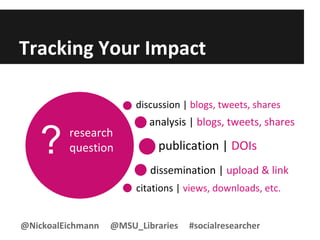
Tracking Your Impact
research
question
discussion | blogs, tweets, shares
analysis | blogs, tweets, shares
publication | DOIs
dissemination | upload & link
citations | views, downloads, etc.
?
@NickoalEichmann @MSU_Libraries #socialresearcher
Altmetrics
Potential advantages:
• Provide a window of the impact of web-native scholarly
products (datasets, software, blog posts, videos, etc.).
• Show how scholarly products are read, discussed, saved,
recommended, and cited
• Indicate impacts on diverse audiences
• Provide evidence of impact in days instead of years
Adapted from Piwowar 2014
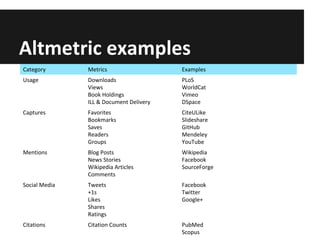
Altmetric examples
Category Metrics Examples
Usage Downloads
Views
Book Holdings
ILL & Document Delivery
PLoS
WorldCat
Vimeo
DSpace
Captures Favorites
Bookmarks
Saves
Readers
Groups
CiteULike
Slideshare
GitHub
Mendeley
YouTube
Mentions Blog Posts
News Stories
Wikipedia Articles
Comments
Wikipedia
Facebook
SourceForge
Social Media Tweets
+1s
Likes
Shares
Ratings
Facebook
Twitter
Google+
Citations Citation Counts PubMed
Scopus
Altmetrics
A Few Tools:
• Altmetric.com | Bookmarklet
• Scopus
• ImpactStory
Keep in Mind:
• All data require context
• Altmetrics are still relatively new but moving
towards normalization
@NickoalEichmann @MSU_Libraries #socialresearcher
Telling Your Impact Story
• Your blog posts developed into dissertation
chapters, which were published as articles / your
first book (Ben Schmidt, “Sapping Attention”)
• Someone’s tweet about your conference
presentation led to a guest blog post, which led
to a peer-reviewed journal article
• Your discussion on Twitter gave a name to an
idea, which developed into a start-up with grant
funding (Priem = “altmetrics”)
Quick Tips
• Building an audience and finding your voice can
take time
• Share early, and share often
• Save yourself time:
• Limit blogs to manageable lengths
• Use TweetDeck or HootSuite
• Auto-tweet, -blog, -post
@NickoalEichmann @MSU_Libraries #socialresearcher
Questions?
Feedback?
www.surveymonkey.com/r/MSUworkshop
thank you!
@NickoalEichmann @MSU_Libraries #socialresearcher

Social Tools to Share Your Research

  • 1.
    Social Tools to ShareYour Research Nickoal Eichmann | Research Librarian | nle42@msstate.edu @NickoalEichmann @MSU_Libraries #socialresearcher
  • 2.
    Today’s Objectives We willdiscuss: ● The research lifecycle ● Possible social tools suited for you ● How to become a trusted voice ● How to track your influence and tell your impact story @NickoalEichmann @MSU_Libraries #socialresearcher
  • 3.
    How many ofyou have… … a Google Scholar profile? • When you’re googled, it’s the top result • Automatically indexes published articles • Used for citations counts | h-index @NickoalEichmann @MSU_Libraries #socialresearcher
  • 4.
    How many ofyou have… … used a social networking site, e.g. • Facebook? • Twitter? … read or written a blog post? … a LinkedIn profile? … used an academic networking site? @NickoalEichmann @MSU_Libraries #socialresearcher
  • 5.
    Some Fun Facts: SocialNetworks Facebook • 1.3 billion users [1] • 2.5 billion pieces of content shared daily [2] Twitter • 284 million active monthly users [3] • 500 million tweets sent daily [3] • 1 in 40 scholars in on Twitter [4] [1] Van Noorden 2014 | [2] Harrington 2014 | [3] Twitter 2015 | [4] Darling 2013 @NickoalEichmann @MSU_Libraries #socialresearcher
  • 6.
    Some Fun Facts: AcademicNetworks LinkedIn • 300 million users [5] Academia.edu • 14 million registered users [6] ResearchGate • 4.5 million users [7] • 10,000 new users daily [8] [5] Connor 2014 | [6] Academia.edu 2014 | [7 & 8] Van Noorden, 2014 @NickoalEichmann @MSU_Libraries #socialresearcher
  • 7.
  • 8.
    The Research Lifecycle +Social Tools research question discussion | blog, tweets, shares analysis | blog, tweets, shares publication | DOIs, URIs dissemination | upload & link citations | views, downloads, etc. ? @NickoalEichmann @MSU_Libraries #socialresearcher
  • 9.
    So many people, somany tools… Things to consider: ▪ Who do you want to reach? ▪ What tools are they using? ▪ How do they know you’re someone they should listen to? Why Scholars Use Social Media: http://bit.ly/1xsnT2C @NickoalEichmann @MSU_Libraries #socialresearcher
  • 10.
    Step One: CreateYour Professional Identity • Create a website / departmental profile • Sign up for an ORCiD and ResearcherID • Choose an Academic Network • Choose a Social Media tool • Link them all together @NickoalEichmann @MSU_Libraries #socialresearcher
  • 11.
    Step Two: LinkContent • Posters • Slides • Videos • Images • Datasets • Software • Conference Papers • Journal articles, book chapters, books * * Publication agreement? CCBY? @NickoalEichmann @MSU_Libraries #socialresearcher
  • 12.
    Use Cases: Computer Engineer •ORCiD | ResearcherID • Institutional profile • ResearchGate • Twitter • Dryad | GitHub @NickoalEichmann @MSU_Libraries #socialresearcher
  • 13.
    Use Cases: Sociologist • ORCiD| ResearcherID • Personal Website • ResearchGate • Twitter • Figshare @NickoalEichmann @MSU_Libraries #socialresearcher
  • 14.
    Use Cases: Historian (Humanist) •ORCiD | ResearcherID • Blog with personal page • Academia.edu • Twitter and Facebook • SlideShare @NickoalEichmann @MSU_Libraries #socialresearcher
  • 15.
    Step Three: Engage Useyour voice to build trust • Discuss your research • Share other's works • Share your work • Tweet at #conferences and #workshops @NickoalEichmann @MSU_Libraries #socialresearcher
  • 16.
    Can you shareyour work? ● In most cases, you can share pre-prints and post- prints. ● It’s rare that you can share publisher’s final version (unless it’s Open Access) ● Use SHERPA-RoMEO to check or journal’s author posting guidelines: www.sherpa.ac.uk/romeo/
  • 17.
    Criticisms of ResearchersUsing the Social Web “How do you have time to do actual work?” “Blogging is a waste of time” “P&T committees don’t care about your tweets” Formal publication is just one part of the research process, and citations are just one part of your impact story. @NickoalEichmann @MSU_Libraries #socialresearcher
  • 18.
    Tracking Your Impact research question discussion| blogs, tweets, shares analysis | blogs, tweets, shares publication | DOIs dissemination | upload & link citations | views, downloads, etc. ? @NickoalEichmann @MSU_Libraries #socialresearcher
  • 19.
    Altmetrics Potential advantages: • Providea window of the impact of web-native scholarly products (datasets, software, blog posts, videos, etc.). • Show how scholarly products are read, discussed, saved, recommended, and cited • Indicate impacts on diverse audiences • Provide evidence of impact in days instead of years Adapted from Piwowar 2014
  • 20.
    Altmetric examples Category MetricsExamples Usage Downloads Views Book Holdings ILL & Document Delivery PLoS WorldCat Vimeo DSpace Captures Favorites Bookmarks Saves Readers Groups CiteULike Slideshare GitHub Mendeley YouTube Mentions Blog Posts News Stories Wikipedia Articles Comments Wikipedia Facebook SourceForge Social Media Tweets +1s Likes Shares Ratings Facebook Twitter Google+ Citations Citation Counts PubMed Scopus
  • 21.
    Altmetrics A Few Tools: •Altmetric.com | Bookmarklet • Scopus • ImpactStory Keep in Mind: • All data require context • Altmetrics are still relatively new but moving towards normalization @NickoalEichmann @MSU_Libraries #socialresearcher
  • 22.
    Telling Your ImpactStory • Your blog posts developed into dissertation chapters, which were published as articles / your first book (Ben Schmidt, “Sapping Attention”) • Someone’s tweet about your conference presentation led to a guest blog post, which led to a peer-reviewed journal article • Your discussion on Twitter gave a name to an idea, which developed into a start-up with grant funding (Priem = “altmetrics”)
  • 23.
    Quick Tips • Buildingan audience and finding your voice can take time • Share early, and share often • Save yourself time: • Limit blogs to manageable lengths • Use TweetDeck or HootSuite • Auto-tweet, -blog, -post @NickoalEichmann @MSU_Libraries #socialresearcher
  • 24.

Editor's Notes

  • #6 Citations accessed October 2014
  • #8 Citations accessed October 2014
  • #12 Who: Your peers, primarily (these are the people most likely to cite your end products) What: Where are your peers? Are scholars from specific disciplines more likely to use one tool over another? Geographic considerations; The academic networking site could depend on who you want to reach and where they are active How: Build your identity (personal website, choose an academic networking site, cross link with consistency). This is the foundation to your research platform
  • #13 Website: This could be a WordPress site or your departmental profile page (ex. MSU Libraries’ Faculty Profiles, Graduate Student Profiles); Purpose is to let curious peers (or whomever) learn more about you as a scholar (and maybe about your personality); Networking site meant to be a snapshot, while a dedicated site, even a blog, will give people more insight and information ORCiDs and ResearcherIDs: Helps with metrics, both traditional and alternative (will come back to this); helps with name disambiguation; get credit for your work Network: choose based on who you want to reach (consider discipline, geography, where institutional peers are) Social Media tool: what are they using? What kind of “reach” do you want to have? Mostly academic? Public/general readership? Consider who to follow (also discipline specific) Link: Link all of your presences together (Cross channel consistency with all your profiles)
  • #17 Humanist (and digital humanist)
  • #21 Formal publication is just one part of the research process, and citations are just one part of your impact story. Which brings us back to the research cycle
  • #22 Altmetrics = attention metrics, but correlate with actual citations For traditional metrics workshops at MSU Libraries : D. Lee’s “Who’s Citing You?”
  • #23 Five Categories of Impact | Flavors of Altmetrics Adapted from Buschman & Michalek 2013 [ http://asis.org/Bulletin/Apr-13/AprMay13_Buschman_Michalek.html ]