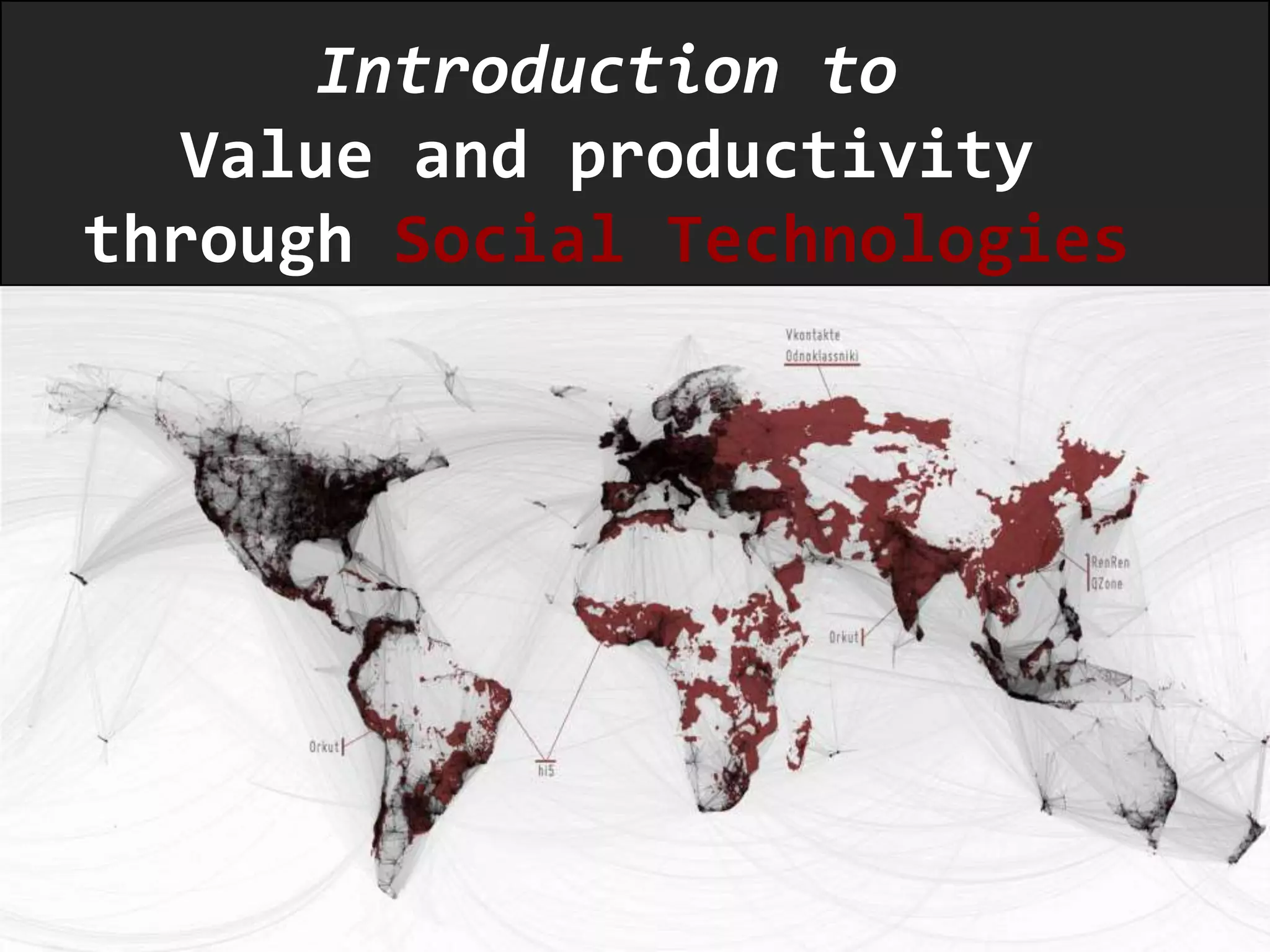
Introduction to
  Value and productivity
through Social Technologies
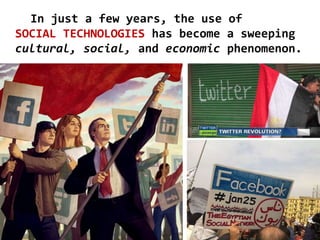
In just a few years, the use of
SOCIAL TECHNOLOGIES has become a sweeping
cultural, social, and economic phenomenon.
SOCIAL TECHNOLOGIES literally changed how
  millions of people live.
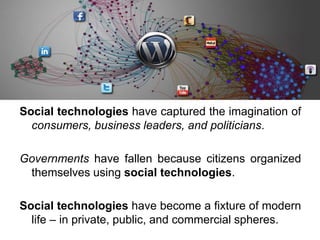
Social technologies have captured the imagination of
  consumers, business leaders, and politicians.

Governments have fallen because citizens organized
 themselves using social technologies.

Social technologies have become a fixture of modern
  life – in private, public, and commercial spheres.
Companies of all kinds have started to
 use social technologies as a way to win
 customers, improve performance, and
 advance their mission.

People have adopted new behaviours:
 transferring social interactions online,
 forming connection, and creating and
 sharing content.
If you still have a question
   Why should I care?
“Social Technologies”
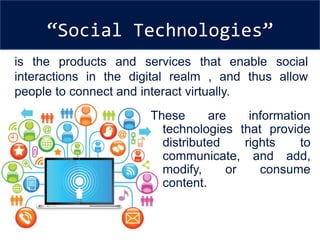
is the products and services that enable social
interactions in the digital realm , and thus allow
people to connect and interact virtually.
                       These      are    information
                         technologies that provide
                         distributed    rights     to
                         communicate, and add,
                         modify,     or    consume
                         content.
“Social Technologies”
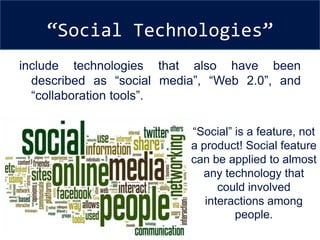
include technologies that also have been
  described as “social media”, “Web 2.0”, and
  “collaboration tools”.

                           “Social” is a feature, not
                           a product! Social feature
                           can be applied to almost
                             any technology that
                                 could involved
                              interactions among
                                    people.
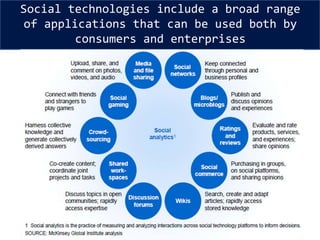
Social technologies include a broad range
of applications that can be used both by
        consumers and enterprises
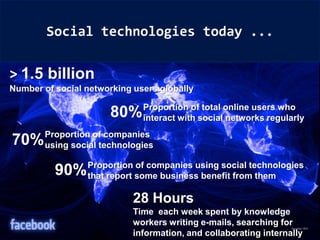
Social technologies today ...


> 1.5 billion
Number of social networking users globally

                              Proportion of total online users who
                       80%    interact with social networks regularly
        Proportion of companies
70%     using social technologies

                 Proportion of companies using social technologies
          90%    that report some business benefit from them

                            28 Hours
                            Time each week spent by knowledge
                            workers writing e-mails, searching for
                            information, and collaborating internally
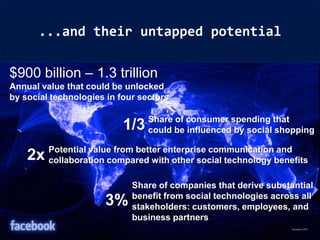
...and their untapped potential

$900 billion – 1.3 trillion
Annual value that could be unlocked
by social technologies in four sectors

                                 Share of consumer spending that
                           1/3   could be influenced by social shopping

         Potential value from better enterprise communication and
    2x   collaboration compared with other social technology benefits

                             Share of companies that derive substantial
                             benefit from social technologies across all
                      3%     stakeholders: customers, employees, and
                             business partners
Business are changing their
        behaviours as well.
While social technologies have swept through
 popular culture and are being adopted across
 industries, business have only just begun to
 understand how to create value with this new
 tools
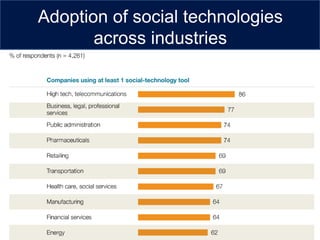
Adoption of social technologies
       across industries
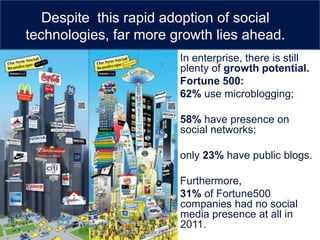
Despite this rapid adoption of social
technologies, far more growth lies ahead.
                        In enterprise, there is still
                        plenty of growth potential.
                        Fortune 500:
                        62% use microblogging;

                        58% have presence on
                        social networks;

                        only 23% have public blogs.

                        Furthermore,
                        31% of Fortune500
                        companies had no social
                        media presence at all in
                        2011.
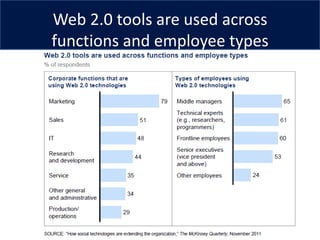
Web 2.0 tools are used across
functions and employee types
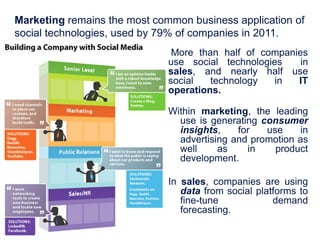
Marketing remains the most common business application of
social technologies, used by 79% of companies in 2011.
                               More than half of companies
                              use social technologies    in
                              sales, and nearly half use
                              social   technology   in  IT
                              operations.

                              Within marketing, the leading
                                use is generating consumer
                                insights,    for   use     in
                                advertising and promotion as
                                well     as    in    product
                                development.

                              In sales, companies are using
                                 data from social platforms to
                                 fine-tune            demand
                                 forecasting.
Value
Early use of social technologies, when these ways
  of interacting are applied to commercial and
  professional activities (e.g. Developing and
  selling products, working together to solve a
  business problem), the resulting value creation
  is impressive.
Potential value and ease of capture
       vary across industries
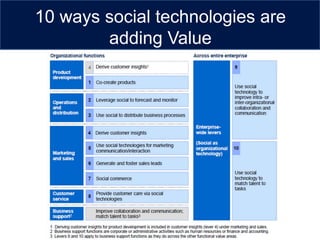
10 ways social technologies are
        adding Value
10 ways social technologies are
          adding Value
1. Co-Create Products: Companies using social
    platforms can crowd source ideas from their
    consumer community (product ideas, evaluation
    of the ideas by the crowd, consumers submitting
    designs).

2. Demand Forecasting: Through multiplying the
    potential  sources of   information  about
    demand, companies can obtain more accurate
    and granular data.

3. Distributing Business Processes: Companies
    such as TomTom and Google Maps are using
    inout from users to locate and qualify mapping
    errors and the latest updates to road networks.
10 ways social technologies are adding
                 Value
4. Market Research:
   There are now tools that can measure sentiment as
   it happens that allows companies to see if the latest
   feedback about a product is positive or negative.
   Brand health can be now checked by the “Chatter”
   tone online.

5. Marketing Communications: communication that
  is effectively close to zero cost and provides
  feedback in minutes. You can see what types of
  marketing communications are engaging and what
  aren’t.
10 ways social technologies are
            adding Value
6. Lead Generation: the power of social networks to attract
   customers and drive inbound inquiries. Displaying a
   companies expertise via blogs and online whitepapers and

   ebooks are transforming how professional services
   companies market their business.

7. Social Commerce: All of us listen to the recommendations
   of friends and family and social commerce allows companies
   to make it easy for their consumers to share what they have
   bought or “like”.

8. Customer Care: Agencies and larger brands are monitoring
   social media channels with community managers who
   monitor social networks such as Facebook to turn customer
   care problems into opportunities to impress customers with
   the speed of the response.
10 ways social technologies are
           adding Value
9. Collaboration: Social technologies are improving
  organizational      performance       by     making
  collaboration and co-creation efficient both
  internally and with external suppliers and partners.

10. Matching Talents to Roles: Social platforms
  such as LinkedIn (Facebook is also coming soon,
  but there is a popular APP “Branch out” & “Class
  door”) provide insights into people’s skills,
  passions and interests that provide a more
  complete picture of a candidate than a one
  dimensional resume will ever achieve.
Communication & Collaboration
2/3 of the value creation opportunity afforded by social
  technologies lies in improving communication and
  collaboration within and across enterprise.

It can raise the productivity of knowledge workers by
   20-25% if they become fully networked enterprise.

Social technologies are used by all interaction workers
  for all relevant activities and that the time that they
  save in communicating, finding information, and
  collaborating is then applied to highly productive use.
(For more information – Appendix 1 «Ways of social collaboration”)
Value
As a niche company we can capture additional
  consumer surplus (in the form of better product
  and lower prices) through the deeper customer
  insights generated by social technologies and the
  greater transparency that online communities
  provide.

Finally, social technologies can empower our
  company to form communities of interest around
  specific issues or causes, providing societal
  benefits. (e.g online quize, trainings, tests).
Company’s characteristics:
Social networks can add value to almost any
  business but companies that will benefit most
  from social technologies will have these
  characteristics:

• High percentage of knowledge workers
• Business success is dependent on brand
  recognition and consumer perception
• Need to build credibility and trust to sell their
  products and services
• Digital distribution of products and services
• Experiential or inspirational products and services
Supporting a variety of processes

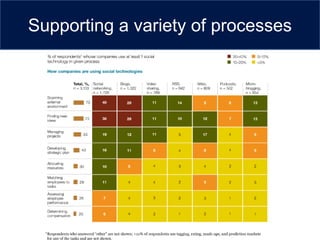
Companies use these tools to scan the external
  environment for new ideas.
Also different technologies are better suited to
  specific types of business processes, as the
  accompanying heat map shows.
Social networking and blogs, in particular, are used
  most heavily in externally focused processes
  that gather competitive intelligence and support
  marketing efforts.
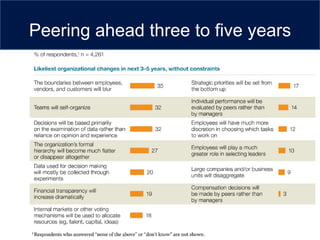
Peering ahead three to five years
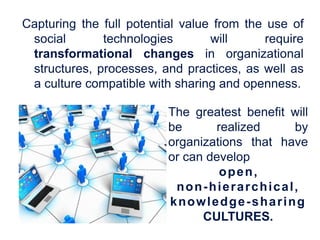
Capturing the full potential value from the use of
 social       technologies        will      require
 transformational changes in organizational
 structures, processes, and practices, as well as
 a culture compatible with sharing and openness.

                          The greatest benefit will
                          be      realized     by
                          organizations that have
                          or can develop
                                   open,
                           non-hierarchical,
                          knowledge-sharing
                                CULTURES.
Actions to get the process underway:

• Identify critical business gaps that requires
  social interactions and timeline.

• Evaluate current web presence services that
  can be leveraged to support social media
  integrations and automate the publishing
  contents.

• Consider budget needs versus budget
  capabilities for social media branding,
  subscription, & advertisement within social
  media platforms.
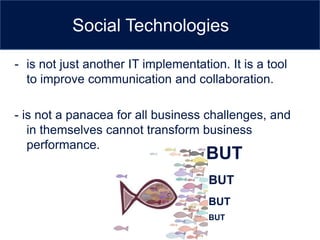
Social Technologies

- is not just another IT implementation. It is a tool
  to improve communication and collaboration.

- is not a panacea for all business challenges, and
   in themselves cannot transform business
   performance.
                                     BUT
                                     BUT
                                     BUT
                                     BUT
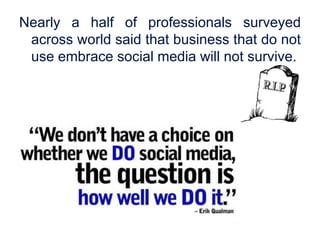
Nearly a half of professionals surveyed
 across world said that business that do not
 use embrace social media will not survive.
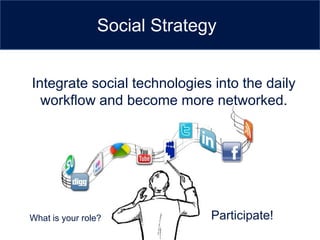
Social Strategy


Integrate social technologies into the daily
  workflow and become more networked.


What is your role?            Participate!
For me.
• In many instances, this is just another cost versus benefit exercise. Most of
  the Small/Medium business IT are internal resource limited and it is
  prudent to outsource certain support services, such as developing a web
  strategy for website development [design/hosting, Search engine
  optimization (SEO), Information architecture (IA), User experience
  engineering(UXE), content development]. On the other hand, those
  Business/IT/marketing teams with established network support groups
  and comprehensive management capabilities may elect to do the job
  themselves in Enterprise business environment. There is no one right or
  wrong answer, it depends on specific environments.
• Conversely, if outsourcing is a viable option, there are scores of vendors
  interested in obtaining small, medium and enterprise business. Social
  media integration services is a growing market within website
  development industry and the list of vendors includes
  small companies in just matter of click in Google search providing service
  offerings such as Website hosting, development, content management,
  outsourced marketing, help-desk, technical support, etc.
• To get the social media technologies integration process
  started business/IT leaders should take the following
  actions (Refer to the below social media landscape to select
  the required platform for your business):
• Identify Social media Integration support goals and
  objectives
• Determine social media presence and targeted audience,
  market, locations, age group for the next twelve months.
• Decide if outsourcing the website re-design, SEO, social
  branding, content publishing is a better solution than
  internal support services (For small and medium business
  its better to outsource as cost factor).
Cлед.слайд – Соц.медиа ЛЕНДСКЕЙП

Social technologies

  • 1.
    Introduction to Value and productivity through Social Technologies
  • 2.
    In just afew years, the use of SOCIAL TECHNOLOGIES has become a sweeping cultural, social, and economic phenomenon.
  • 3.
    SOCIAL TECHNOLOGIES literallychanged how millions of people live.
  • 4.
    Social technologies havecaptured the imagination of consumers, business leaders, and politicians. Governments have fallen because citizens organized themselves using social technologies. Social technologies have become a fixture of modern life – in private, public, and commercial spheres.
  • 5.
    Companies of allkinds have started to use social technologies as a way to win customers, improve performance, and advance their mission. People have adopted new behaviours: transferring social interactions online, forming connection, and creating and sharing content.
  • 6.
    If you stillhave a question Why should I care?
  • 8.
    “Social Technologies” is theproducts and services that enable social interactions in the digital realm , and thus allow people to connect and interact virtually. These are information technologies that provide distributed rights to communicate, and add, modify, or consume content.
  • 9.
    “Social Technologies” include technologiesthat also have been described as “social media”, “Web 2.0”, and “collaboration tools”. “Social” is a feature, not a product! Social feature can be applied to almost any technology that could involved interactions among people.
  • 10.
    Social technologies includea broad range of applications that can be used both by consumers and enterprises
  • 11.
    Social technologies today... > 1.5 billion Number of social networking users globally Proportion of total online users who 80% interact with social networks regularly Proportion of companies 70% using social technologies Proportion of companies using social technologies 90% that report some business benefit from them 28 Hours Time each week spent by knowledge workers writing e-mails, searching for information, and collaborating internally
  • 12.
    ...and their untappedpotential $900 billion – 1.3 trillion Annual value that could be unlocked by social technologies in four sectors Share of consumer spending that 1/3 could be influenced by social shopping Potential value from better enterprise communication and 2x collaboration compared with other social technology benefits Share of companies that derive substantial benefit from social technologies across all 3% stakeholders: customers, employees, and business partners
  • 13.
    Business are changingtheir behaviours as well. While social technologies have swept through popular culture and are being adopted across industries, business have only just begun to understand how to create value with this new tools
  • 14.
    Adoption of socialtechnologies across industries
  • 15.
    Despite this rapidadoption of social technologies, far more growth lies ahead. In enterprise, there is still plenty of growth potential. Fortune 500: 62% use microblogging; 58% have presence on social networks; only 23% have public blogs. Furthermore, 31% of Fortune500 companies had no social media presence at all in 2011.
  • 16.
    Web 2.0 toolsare used across functions and employee types
  • 17.
    Marketing remains themost common business application of social technologies, used by 79% of companies in 2011. More than half of companies use social technologies in sales, and nearly half use social technology in IT operations. Within marketing, the leading use is generating consumer insights, for use in advertising and promotion as well as in product development. In sales, companies are using data from social platforms to fine-tune demand forecasting.
  • 18.
    Value Early use ofsocial technologies, when these ways of interacting are applied to commercial and professional activities (e.g. Developing and selling products, working together to solve a business problem), the resulting value creation is impressive.
  • 19.
    Potential value andease of capture vary across industries
  • 20.
    10 ways socialtechnologies are adding Value
  • 21.
    10 ways socialtechnologies are adding Value 1. Co-Create Products: Companies using social platforms can crowd source ideas from their consumer community (product ideas, evaluation of the ideas by the crowd, consumers submitting designs). 2. Demand Forecasting: Through multiplying the potential sources of information about demand, companies can obtain more accurate and granular data. 3. Distributing Business Processes: Companies such as TomTom and Google Maps are using inout from users to locate and qualify mapping errors and the latest updates to road networks.
  • 22.
    10 ways socialtechnologies are adding Value 4. Market Research: There are now tools that can measure sentiment as it happens that allows companies to see if the latest feedback about a product is positive or negative. Brand health can be now checked by the “Chatter” tone online. 5. Marketing Communications: communication that is effectively close to zero cost and provides feedback in minutes. You can see what types of marketing communications are engaging and what aren’t.
  • 23.
    10 ways socialtechnologies are adding Value 6. Lead Generation: the power of social networks to attract customers and drive inbound inquiries. Displaying a companies expertise via blogs and online whitepapers and ebooks are transforming how professional services companies market their business. 7. Social Commerce: All of us listen to the recommendations of friends and family and social commerce allows companies to make it easy for their consumers to share what they have bought or “like”. 8. Customer Care: Agencies and larger brands are monitoring social media channels with community managers who monitor social networks such as Facebook to turn customer care problems into opportunities to impress customers with the speed of the response.
  • 24.
    10 ways socialtechnologies are adding Value 9. Collaboration: Social technologies are improving organizational performance by making collaboration and co-creation efficient both internally and with external suppliers and partners. 10. Matching Talents to Roles: Social platforms such as LinkedIn (Facebook is also coming soon, but there is a popular APP “Branch out” & “Class door”) provide insights into people’s skills, passions and interests that provide a more complete picture of a candidate than a one dimensional resume will ever achieve.
  • 25.
    Communication & Collaboration 2/3of the value creation opportunity afforded by social technologies lies in improving communication and collaboration within and across enterprise. It can raise the productivity of knowledge workers by 20-25% if they become fully networked enterprise. Social technologies are used by all interaction workers for all relevant activities and that the time that they save in communicating, finding information, and collaborating is then applied to highly productive use. (For more information – Appendix 1 «Ways of social collaboration”)
  • 26.
    Value As a nichecompany we can capture additional consumer surplus (in the form of better product and lower prices) through the deeper customer insights generated by social technologies and the greater transparency that online communities provide. Finally, social technologies can empower our company to form communities of interest around specific issues or causes, providing societal benefits. (e.g online quize, trainings, tests).
  • 27.
    Company’s characteristics: Social networkscan add value to almost any business but companies that will benefit most from social technologies will have these characteristics: • High percentage of knowledge workers • Business success is dependent on brand recognition and consumer perception • Need to build credibility and trust to sell their products and services • Digital distribution of products and services • Experiential or inspirational products and services
  • 28.
  • 29.
    Supporting a varietyof processes Companies use these tools to scan the external environment for new ideas. Also different technologies are better suited to specific types of business processes, as the accompanying heat map shows. Social networking and blogs, in particular, are used most heavily in externally focused processes that gather competitive intelligence and support marketing efforts.
  • 30.
    Peering ahead threeto five years
  • 31.
    Capturing the fullpotential value from the use of social technologies will require transformational changes in organizational structures, processes, and practices, as well as a culture compatible with sharing and openness. The greatest benefit will be realized by organizations that have or can develop open, non-hierarchical, knowledge-sharing CULTURES.
  • 32.
    Actions to getthe process underway: • Identify critical business gaps that requires social interactions and timeline. • Evaluate current web presence services that can be leveraged to support social media integrations and automate the publishing contents. • Consider budget needs versus budget capabilities for social media branding, subscription, & advertisement within social media platforms.
  • 33.
    Social Technologies - isnot just another IT implementation. It is a tool to improve communication and collaboration. - is not a panacea for all business challenges, and in themselves cannot transform business performance. BUT BUT BUT BUT
  • 34.
    Nearly a halfof professionals surveyed across world said that business that do not use embrace social media will not survive.
  • 35.
    Social Strategy Integrate socialtechnologies into the daily workflow and become more networked. What is your role? Participate!
  • 37.
    For me. • Inmany instances, this is just another cost versus benefit exercise. Most of the Small/Medium business IT are internal resource limited and it is prudent to outsource certain support services, such as developing a web strategy for website development [design/hosting, Search engine optimization (SEO), Information architecture (IA), User experience engineering(UXE), content development]. On the other hand, those Business/IT/marketing teams with established network support groups and comprehensive management capabilities may elect to do the job themselves in Enterprise business environment. There is no one right or wrong answer, it depends on specific environments. • Conversely, if outsourcing is a viable option, there are scores of vendors interested in obtaining small, medium and enterprise business. Social media integration services is a growing market within website development industry and the list of vendors includes small companies in just matter of click in Google search providing service offerings such as Website hosting, development, content management, outsourced marketing, help-desk, technical support, etc.
  • 38.
    • To getthe social media technologies integration process started business/IT leaders should take the following actions (Refer to the below social media landscape to select the required platform for your business): • Identify Social media Integration support goals and objectives • Determine social media presence and targeted audience, market, locations, age group for the next twelve months. • Decide if outsourcing the website re-design, SEO, social branding, content publishing is a better solution than internal support services (For small and medium business its better to outsource as cost factor). Cлед.слайд – Соц.медиа ЛЕНДСКЕЙП