

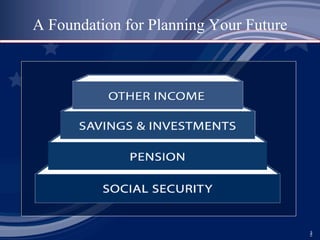







A Foundation for Planning Your Future
Social Security is the foundation  for a comfortable retirement,  but you also will need  other savings and investments.  If you want to learn more  about how and why to save,  visit  www.mymoney.gov . Save for a Secure Future
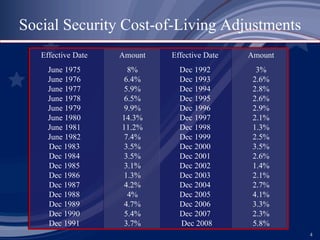
Social Security Cost-of-Living Adjustments Effective Date Amount June 1975 8% June 1976 6.4% June 1977 5.9% June 1978 6.5% June 1979 9.9% June 1980 14.3% June 1981 11.2% June 1982 7.4% Dec 1983 3.5% Dec 1984 3.5% Dec 1985 3.1% Dec 1986 1.3% Dec 1987 4.2% Dec 1988 4% Dec 1989 4.7% Dec 1990 5.4% Dec 1991 3.7% Effective Date Amount Dec 1992 3% Dec 1993 2.6% Dec 1994 2.8% Dec 1995 2.6% Dec 1996 2.9% Dec 1997 2.1% Dec 1998 1.3% Dec 1999 2.5% Dec 2000 3.5% Dec 2001 2.6% Dec 2002 1.4% Dec 2003 2.1% Dec 2004 2.7% Dec 2005 4.1% Dec 2006 3.3% Dec 2007 2.3% Dec 2008  5.8%
You Need to Work to Earn Social Security Credits Each  $ 1,090 in earnings gives you one credit You can earn a maximum of 4 credits per year Example: To earn 4 credits in 2009, you must earn  at least  $ 4,360.00. Earning 40 credits throughout your working life will qualify you for a retirement benefit.
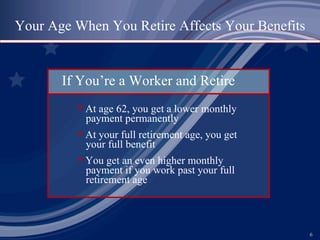
Your Age When You Retire Affects Your Benefits If You’re a Worker and Retire At age 62, you get a lower monthly   payment permanently At your full retirement age, you get   your full benefit You get an even higher monthly   payment if you work past your full   retirement age
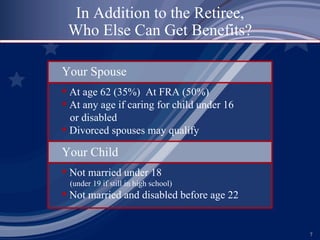
In Addition to the Retiree, Who Else Can Get Benefits? Your Spouse At age 62 (35%)  At FRA (50%) At any age if caring for child under 16  or disabled Divorced spouses may qualify Your Child  Not married under 18 (under 19 if still in high school) Not married and disabled before age 22
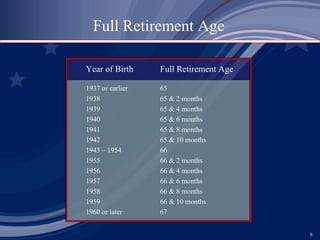
Full Retirement Age Year of Birth Full Retirement Age 1937 or earlier 65 1938 65 & 2 months 1939 65 & 4 months 1940 65 & 6 months 1941 65 & 8 months 1942 65 & 10 months 1943 – 1954 66 1955 66 & 2 months 1956 66 & 4 months 1957 66 & 6 months 1958 66 & 8 months 1959 66 & 10 months 1960 or later 67
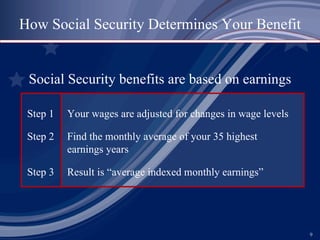
How Social Security Determines Your Benefit Social Security benefits are based on earnings Step 1 Your wages are adjusted for changes in wage levels Step 2 Find the monthly average of your 35 highest  earnings years Step 3 Result is “average indexed monthly earnings”
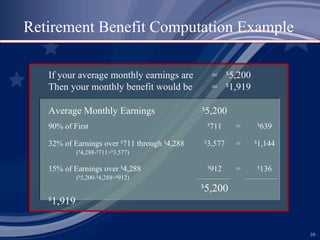
If your average monthly earnings are = $ 5,200 Then your monthly benefit would be = $ 1,919 Average Monthly Earnings $ 5,200 90% of First $ 711 = $ 639 32% of Earnings over  $ 711 through  $ 4,288   $ 3,577 = $ 1,144 ( $ 4,288- $ 711= $ 3,577) 15% of Earnings over  $ 4,288   $ 912 = $ 136 ( $ 5,200- $ 4,288= $ 912) $ 5,200 $ 1,919 Retirement Benefit Computation Example
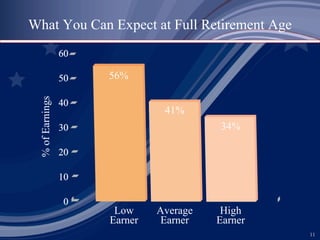
What You Can Expect at Full Retirement Age % of Earnings Low Earner Average Earner High Earner 56% 41% 34%
If any part of your government pension is based on work not covered by  Social Security, you may be affected by the Windfall Elimination Provision. Windfall Elimination Provision
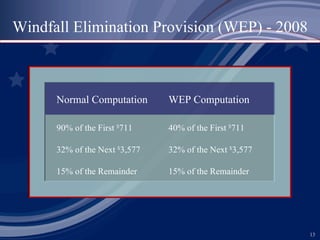
Windfall Elimination Provision (WEP) - 2008 Normal Computation WEP Computation 90% of the First  $ 711 40% of the First  $ 711 32% of the Next  $ 3,577 32% of the Next  $ 3,577 15% of the Remainder 15% of the Remainder
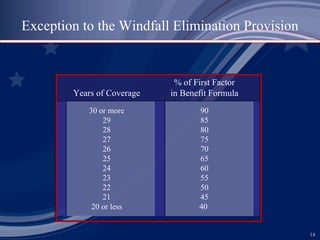
Exception to the Windfall Elimination Provision % of First Factor Years of Coverage in Benefit Formula 30 or more 90 29 85 28 80 27 75 26 70 25 65 24 60 23 55 22 50 21 45 20 or less 40
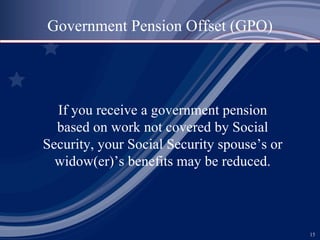
Government Pension Offset (GPO) If you receive a government pension based on work not covered by Social Security, your Social Security spouse’s or widow(er)’s benefits may be reduced.
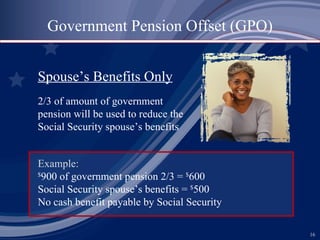
Example: $ 900 of government pension 2/3 =  $ 600 Social Security spouse’s benefits =  $ 500 No cash benefit payable by Social Security Government Pension Offset (GPO) Spouse’s Benefits Only 2/3 of amount of government  pension will be used to reduce the  Social Security spouse’s benefits
You Can Work & Still Receive Benefits You Can If You Make More, If You Are Make Up To Some Benefits Will Be Withheld Under Full Retirement Age $ 14,160/yr. ( $ 1,180/mo.) $ 1 for every  $ 2 The Year Full Retirement Age is Reached $ 37,680/yr. ($3,140/mo.) $ 1 for every  $ 3 Month of Full Retirement Age and Above No Limit No Limit
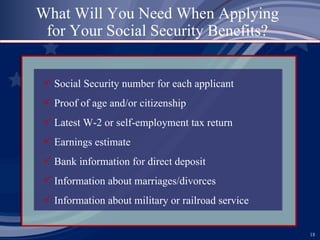
What Will You Need When Applying for Your Social Security Benefits? Social Security number for each applicant Proof of age and/or citizenship Latest W-2 or self-employment tax return Earnings estimate Bank information for direct deposit Information about marriages/divorces Information about military or railroad service
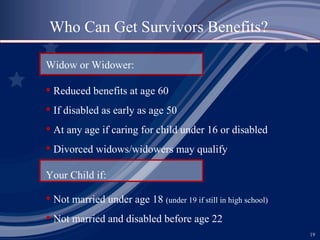
Who Can Get Survivors Benefits? Widow or Widower: Reduced benefits at age 60 If disabled as early as age 50 At any age if caring for child under 16 or disabled Divorced widows/widowers may qualify Your Child if: Not married under age 18  (under 19 if still in high school) Not married and disabled before age 22
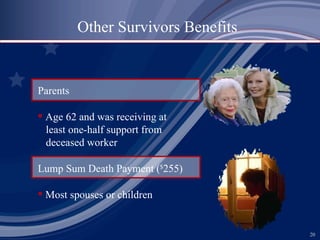
Parents Age 62 and was receiving at least one-half support from  deceased worker Lump Sum Death Payment ( $ 255) Most spouses or children Other Survivors Benefits
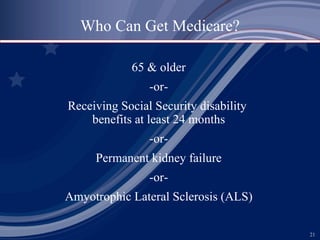
65 & older -or- Receiving Social Security disability  benefits at least 24 months -or- Permanent kidney failure -or- Amyotrophic Lateral Sclerosis (ALS) Who Can Get Medicare?
When Can I Sign Up for Medicare? Medicare Enrollment Periods: Initial - at age 65 Special - if still working General - January-March
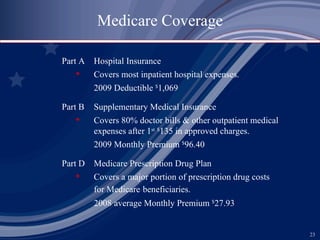
Medicare Coverage Part A Hospital Insurance Covers most inpatient hospital expenses.  2009 Deductible  $ 1,069 Part B Supplementary Medical Insurance Covers 80% doctor bills & other outpatient medical  expenses after 1 st   $ 135 in approved charges. 2009 Monthly Premium  $ 96.40 Part D Medicare Prescription Drug Plan Covers a major portion of prescription drug costs for Medicare   beneficiaries.  2008 average Monthly Premium  $ 27.93
For More Medicare Information 1-800-MEDICARE (1-800-633-4227) TTY 1-877-486-2048 www.medicare.gov
What Should You Do to Prepare for Your Retirement? Get estimates of benefits using different  retirement ages and wage estimates www.socialsecurity.gov
Social Security’s Online Services Retirement & Disability Applications Apply for Extra Help Retirement/Survivors/Disability Planner Request a  Statement Change of Address Medicare Card Replacements Request a Benefit Verification Letter Start or Change Direct Deposit
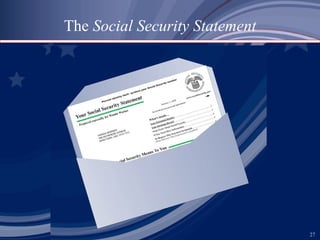
The  Social Security Statement
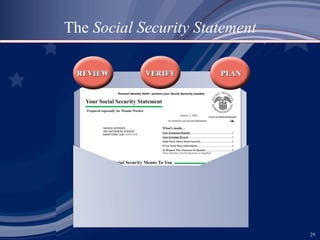
The  Social Security Statement The Statement provides you with estimates of monthly Social Security retirement, disability and survivors benefits The Statement allows you to check your earnings history for accuracy
The  Social Security Statement

Social Security Powerpoint Presentation

  • 1.
  • 2.
    A Foundation forPlanning Your Future
  • 3.
    Social Security isthe foundation for a comfortable retirement, but you also will need other savings and investments. If you want to learn more about how and why to save, visit www.mymoney.gov . Save for a Secure Future
  • 4.
    Social Security Cost-of-LivingAdjustments Effective Date Amount June 1975 8% June 1976 6.4% June 1977 5.9% June 1978 6.5% June 1979 9.9% June 1980 14.3% June 1981 11.2% June 1982 7.4% Dec 1983 3.5% Dec 1984 3.5% Dec 1985 3.1% Dec 1986 1.3% Dec 1987 4.2% Dec 1988 4% Dec 1989 4.7% Dec 1990 5.4% Dec 1991 3.7% Effective Date Amount Dec 1992 3% Dec 1993 2.6% Dec 1994 2.8% Dec 1995 2.6% Dec 1996 2.9% Dec 1997 2.1% Dec 1998 1.3% Dec 1999 2.5% Dec 2000 3.5% Dec 2001 2.6% Dec 2002 1.4% Dec 2003 2.1% Dec 2004 2.7% Dec 2005 4.1% Dec 2006 3.3% Dec 2007 2.3% Dec 2008 5.8%
  • 5.
    You Need toWork to Earn Social Security Credits Each $ 1,090 in earnings gives you one credit You can earn a maximum of 4 credits per year Example: To earn 4 credits in 2009, you must earn at least $ 4,360.00. Earning 40 credits throughout your working life will qualify you for a retirement benefit.
  • 6.
    Your Age WhenYou Retire Affects Your Benefits If You’re a Worker and Retire At age 62, you get a lower monthly payment permanently At your full retirement age, you get your full benefit You get an even higher monthly payment if you work past your full retirement age
  • 7.
    In Addition tothe Retiree, Who Else Can Get Benefits? Your Spouse At age 62 (35%) At FRA (50%) At any age if caring for child under 16 or disabled Divorced spouses may qualify Your Child Not married under 18 (under 19 if still in high school) Not married and disabled before age 22
  • 8.
    Full Retirement AgeYear of Birth Full Retirement Age 1937 or earlier 65 1938 65 & 2 months 1939 65 & 4 months 1940 65 & 6 months 1941 65 & 8 months 1942 65 & 10 months 1943 – 1954 66 1955 66 & 2 months 1956 66 & 4 months 1957 66 & 6 months 1958 66 & 8 months 1959 66 & 10 months 1960 or later 67
  • 9.
    How Social SecurityDetermines Your Benefit Social Security benefits are based on earnings Step 1 Your wages are adjusted for changes in wage levels Step 2 Find the monthly average of your 35 highest earnings years Step 3 Result is “average indexed monthly earnings”
  • 10.
    If your averagemonthly earnings are = $ 5,200 Then your monthly benefit would be = $ 1,919 Average Monthly Earnings $ 5,200 90% of First $ 711 = $ 639 32% of Earnings over $ 711 through $ 4,288 $ 3,577 = $ 1,144 ( $ 4,288- $ 711= $ 3,577) 15% of Earnings over $ 4,288 $ 912 = $ 136 ( $ 5,200- $ 4,288= $ 912) $ 5,200 $ 1,919 Retirement Benefit Computation Example
  • 11.
    What You CanExpect at Full Retirement Age % of Earnings Low Earner Average Earner High Earner 56% 41% 34%
  • 12.
    If any partof your government pension is based on work not covered by Social Security, you may be affected by the Windfall Elimination Provision. Windfall Elimination Provision
  • 13.
    Windfall Elimination Provision(WEP) - 2008 Normal Computation WEP Computation 90% of the First $ 711 40% of the First $ 711 32% of the Next $ 3,577 32% of the Next $ 3,577 15% of the Remainder 15% of the Remainder
  • 14.
    Exception to theWindfall Elimination Provision % of First Factor Years of Coverage in Benefit Formula 30 or more 90 29 85 28 80 27 75 26 70 25 65 24 60 23 55 22 50 21 45 20 or less 40
  • 15.
    Government Pension Offset(GPO) If you receive a government pension based on work not covered by Social Security, your Social Security spouse’s or widow(er)’s benefits may be reduced.
  • 16.
    Example: $ 900of government pension 2/3 = $ 600 Social Security spouse’s benefits = $ 500 No cash benefit payable by Social Security Government Pension Offset (GPO) Spouse’s Benefits Only 2/3 of amount of government pension will be used to reduce the Social Security spouse’s benefits
  • 17.
    You Can Work& Still Receive Benefits You Can If You Make More, If You Are Make Up To Some Benefits Will Be Withheld Under Full Retirement Age $ 14,160/yr. ( $ 1,180/mo.) $ 1 for every $ 2 The Year Full Retirement Age is Reached $ 37,680/yr. ($3,140/mo.) $ 1 for every $ 3 Month of Full Retirement Age and Above No Limit No Limit
  • 18.
    What Will YouNeed When Applying for Your Social Security Benefits? Social Security number for each applicant Proof of age and/or citizenship Latest W-2 or self-employment tax return Earnings estimate Bank information for direct deposit Information about marriages/divorces Information about military or railroad service
  • 19.
    Who Can GetSurvivors Benefits? Widow or Widower: Reduced benefits at age 60 If disabled as early as age 50 At any age if caring for child under 16 or disabled Divorced widows/widowers may qualify Your Child if: Not married under age 18 (under 19 if still in high school) Not married and disabled before age 22
  • 20.
    Parents Age 62and was receiving at least one-half support from deceased worker Lump Sum Death Payment ( $ 255) Most spouses or children Other Survivors Benefits
  • 21.
    65 & older-or- Receiving Social Security disability benefits at least 24 months -or- Permanent kidney failure -or- Amyotrophic Lateral Sclerosis (ALS) Who Can Get Medicare?
  • 22.
    When Can ISign Up for Medicare? Medicare Enrollment Periods: Initial - at age 65 Special - if still working General - January-March
  • 23.
    Medicare Coverage PartA Hospital Insurance Covers most inpatient hospital expenses. 2009 Deductible $ 1,069 Part B Supplementary Medical Insurance Covers 80% doctor bills & other outpatient medical expenses after 1 st $ 135 in approved charges. 2009 Monthly Premium $ 96.40 Part D Medicare Prescription Drug Plan Covers a major portion of prescription drug costs for Medicare beneficiaries. 2008 average Monthly Premium $ 27.93
  • 24.
    For More MedicareInformation 1-800-MEDICARE (1-800-633-4227) TTY 1-877-486-2048 www.medicare.gov
  • 25.
    What Should YouDo to Prepare for Your Retirement? Get estimates of benefits using different retirement ages and wage estimates www.socialsecurity.gov
  • 26.
    Social Security’s OnlineServices Retirement & Disability Applications Apply for Extra Help Retirement/Survivors/Disability Planner Request a Statement Change of Address Medicare Card Replacements Request a Benefit Verification Letter Start or Change Direct Deposit
  • 27.
    The SocialSecurity Statement
  • 28.
    The SocialSecurity Statement The Statement provides you with estimates of monthly Social Security retirement, disability and survivors benefits The Statement allows you to check your earnings history for accuracy
  • 29.
    The SocialSecurity Statement